How To Contribute to PostgreSQL Hari Babu Kommi
Your speaker +61 2 9452 9087 haribabuk@fast.au.fujitsu.com postgresql.fastware.com
Contents Need of contribution to the PostgreSQL community Advantages of contributing to community Contribution methods
Need of contribution PostgreSQL is a “world’s most advanced open source database” that powers many mission critical systems around the world. It needs support from individuals and companies to continue it’s development further to compete against major commercial databases.
Advantages of contribution Contributing to community will benefit both individuals and companies. All the individuals that contributes to PostgreSQL echo system are listed as contributors.  https://www.postgresql.org/community/contributors/ All the companies that contributes to PostgreSQL echo system are listed as sponsors.  https://www.postgresql.org/about/sponsors/
Contribution methods There are plenty of ways to contribute to PostgreSQL (echo system) and many people are already doing the same. This topic is to list out the some of the possible ways to contribute to PostgreSQL database by individuals and companies.
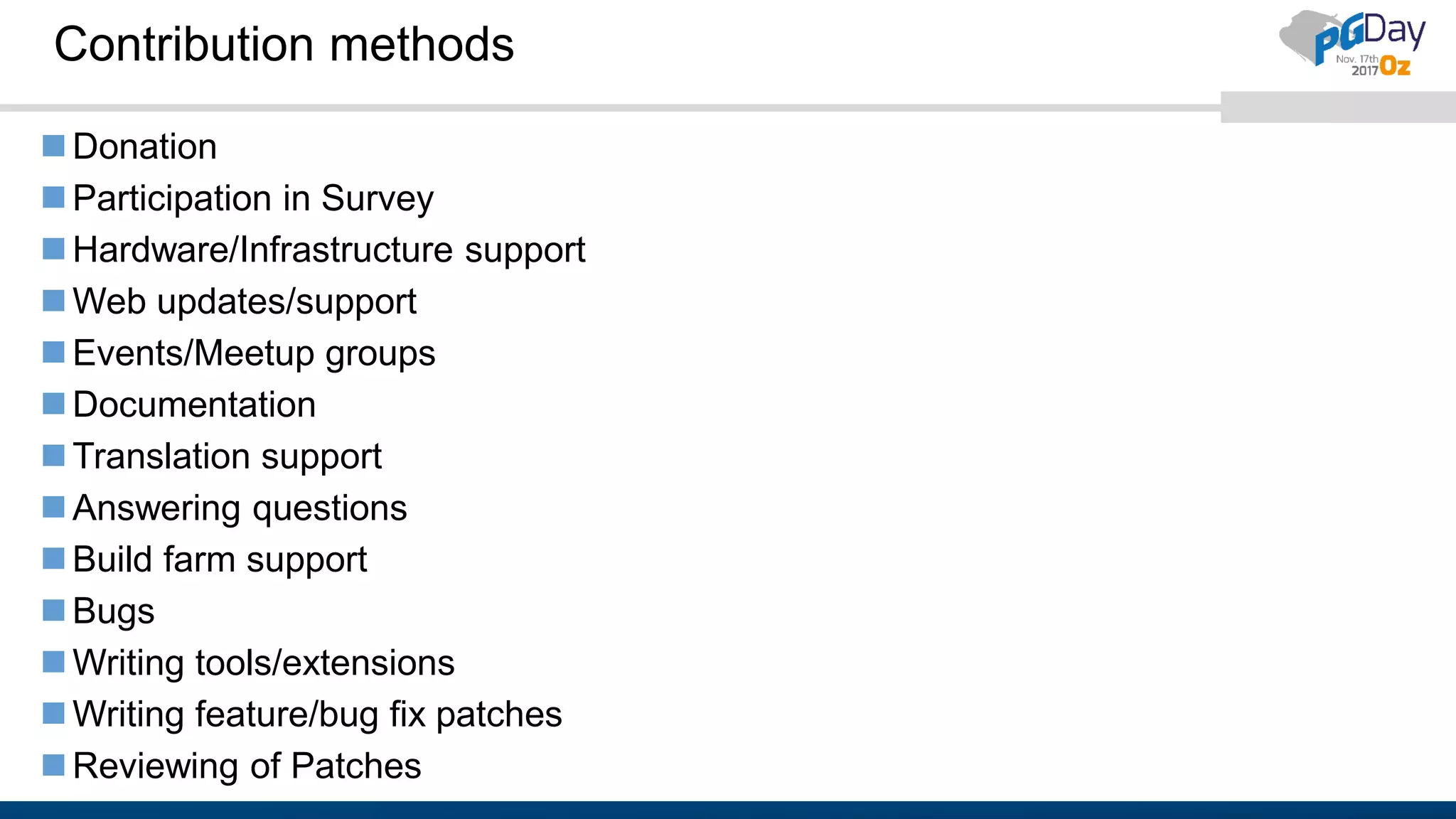
Contribution methods Donation Participation in Survey Hardware/Infrastructure support Web updates/support Events/Meetup groups Documentation Translation support Answering questions Build farm support Bugs Writing tools/extensions Writing feature/bug fix patches Reviewing of Patches
Donation The Simple way to support PostgreSQL NFO is by contributing some donation. The funds that are collected by the PostgreSQL groups are used for various activities such as education, user groups and advocacy. https://www.postgresql.org/about/donate/
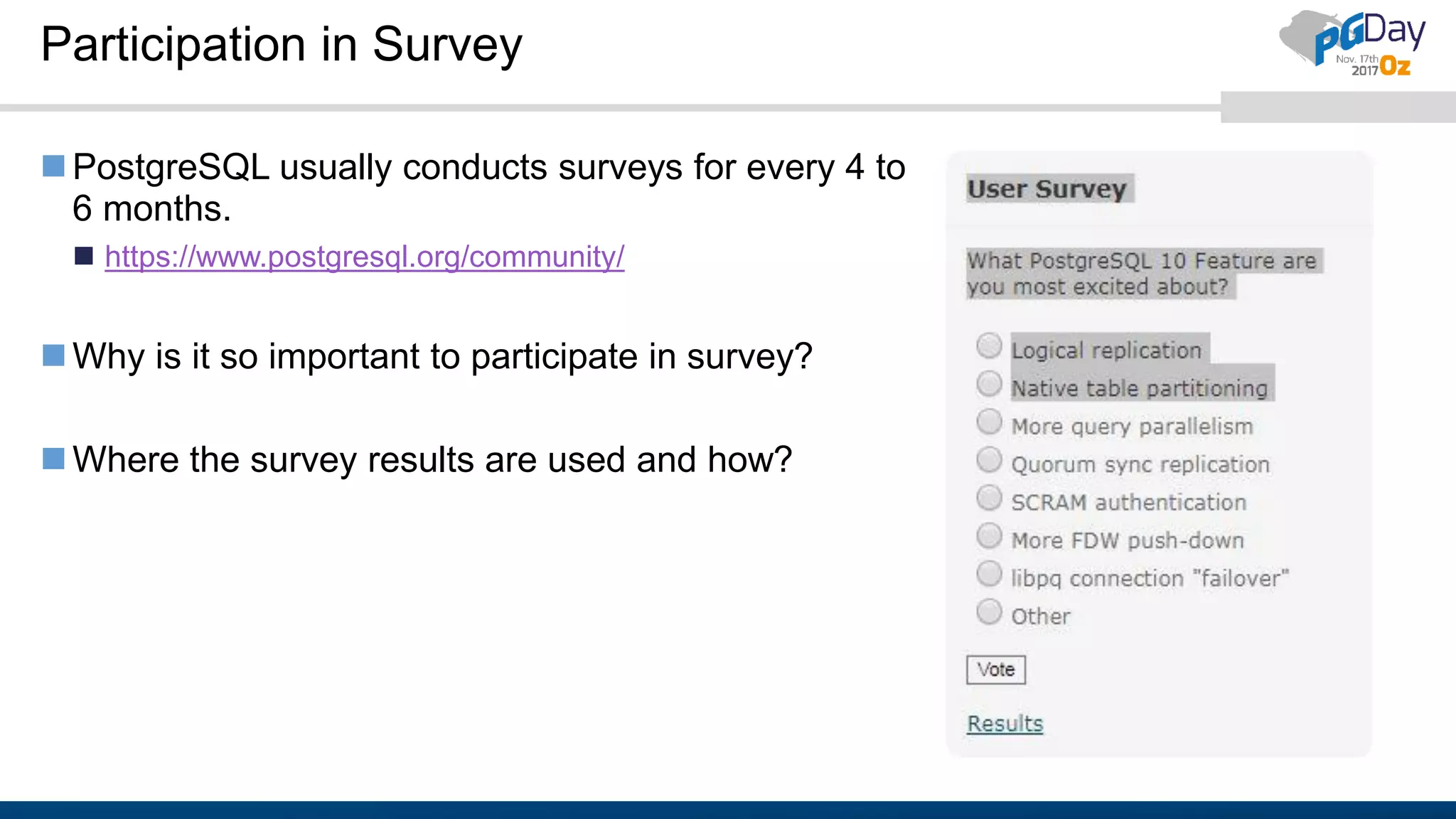
Participation in Survey PostgreSQL usually conducts surveys for every 4 to 6 months.  https://www.postgresql.org/community/ Why is it so important to participate in survey? Where the survey results are used and how?
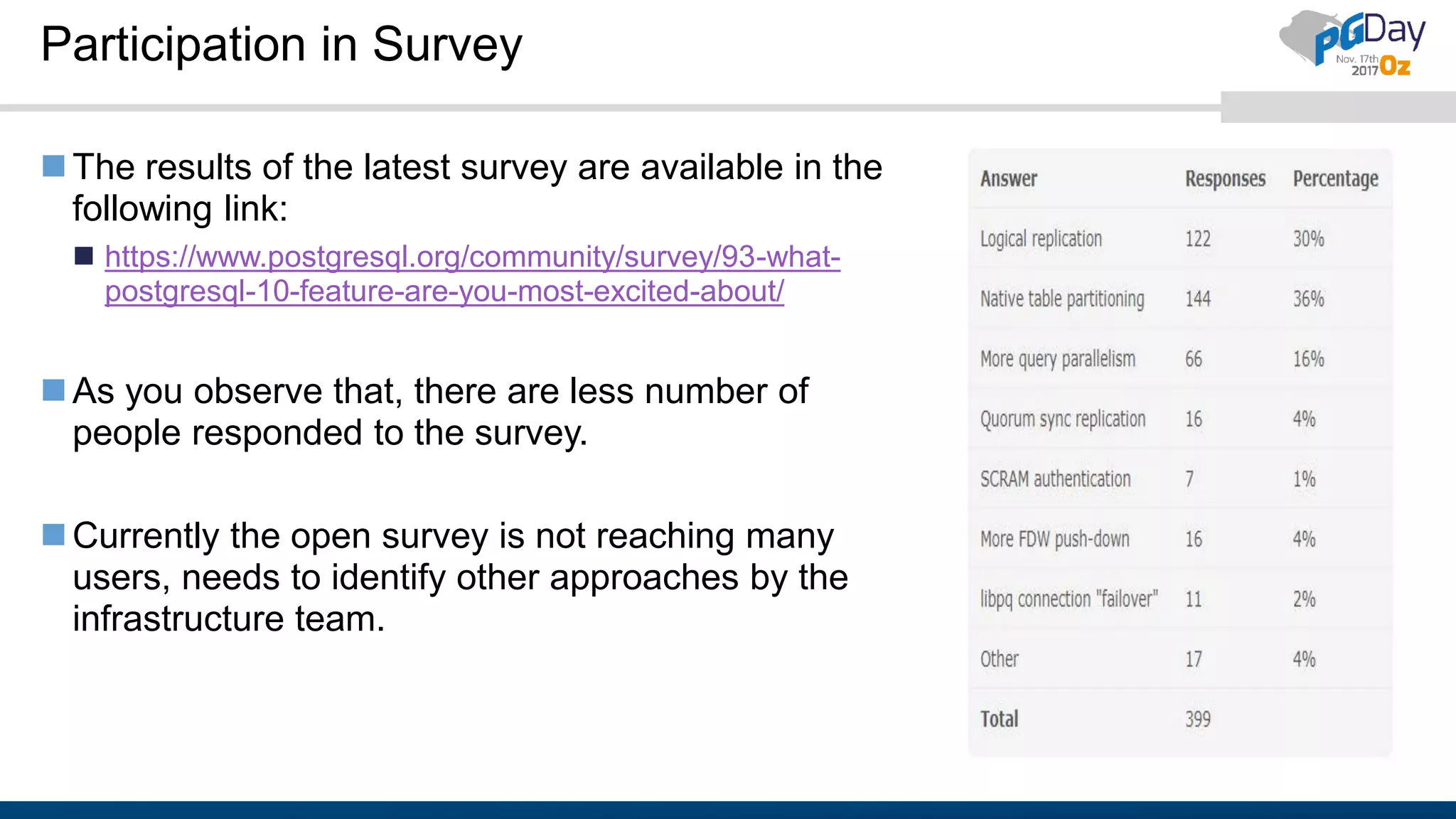
Participation in Survey The results of the latest survey are available in the following link:  https://www.postgresql.org/community/survey/93-what- postgresql-10-feature-are-you-most-excited-about/ As you observe that, there are less number of people responded to the survey. Currently the open survey is not reaching many users, needs to identify other approaches by the infrastructure team.
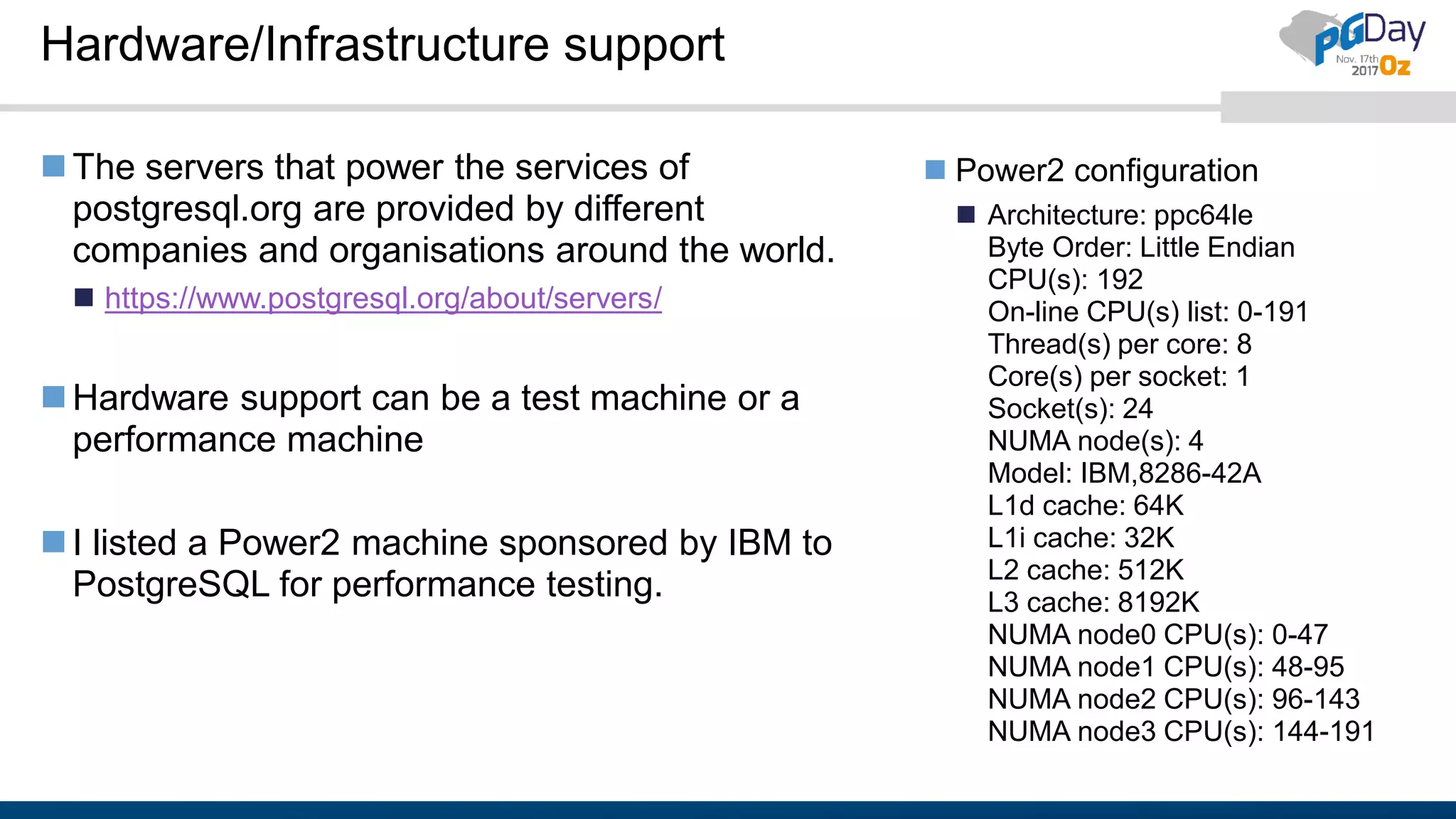
Hardware/Infrastructure support The servers that power the services of postgresql.org are provided by different companies and organisations around the world.  https://www.postgresql.org/about/servers/ Hardware support can be a test machine or a performance machine I listed a Power2 machine sponsored by IBM to PostgreSQL for performance testing.  Power2 configuration  Architecture: ppc64le Byte Order: Little Endian CPU(s): 192 On-line CPU(s) list: 0-191 Thread(s) per core: 8 Core(s) per socket: 1 Socket(s): 24 NUMA node(s): 4 Model: IBM,8286-42A L1d cache: 64K L1i cache: 32K L2 cache: 512K L3 cache: 8192K NUMA node0 CPU(s): 0-47 NUMA node1 CPU(s): 48-95 NUMA node2 CPU(s): 96-143 NUMA node3 CPU(s): 144-191
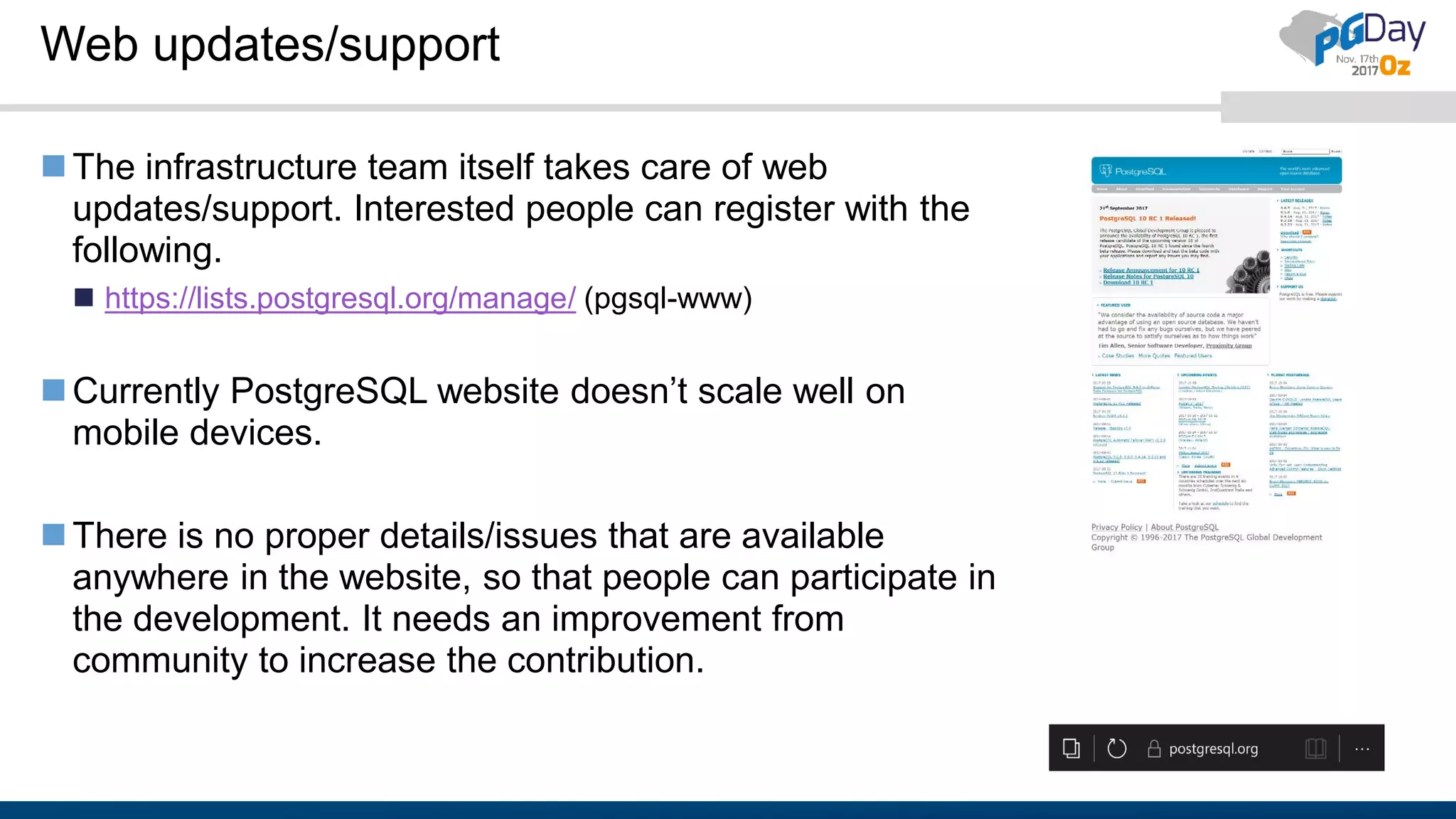
Web updates/support The infrastructure team itself takes care of web updates/support. Interested people can register with the following.  https://lists.postgresql.org/manage/ (pgsql-www) Currently PostgreSQL website doesn’t scale well on mobile devices. There is no proper details/issues that are available anywhere in the website, so that people can participate in the development. It needs an improvement from community to increase the contribution.
Events/Meetup groups Thanks for the Organizers and Sponsors of the PG Day Australia event. Conducting events/local meetups will help in growing the PostgreSQL community. Try to conduct monthly/quarterly meetups. Following are some of the local meetup groups in Australia.  https://www.meetup.com/Sydney-PostgreSQL-User-Group/  https://www.meetup.com/melpug/  https://www.meetup.com/Brisbane-PostgreSQL-User-Group/
Documentation PostgreSQL community provides a very high quality documentation, but there are cases that it may not handle everything and some information may misleading and etc. Register to the following mailing list and provide your updates including the review of the changes suggested by others.  https://lists.postgresql.org/manage/ (pgsql-docs) If you’re a document developer or knows the tools that are used for the documentation, you valuable information is welcomed.
Translations support PostgreSQL programs (server and client) can issue their messages in your favourite language. Creating and maintaining translated message sets needs the help of people who speak their own language well and want to contribute to the PostgreSQL effort. All the translation issues are tracked in redmine.  https://redmine.postgresql.org/projects/pgtranslation There is a dedicated mailing list to discuss the translations updates/issues.  https://www.postgresql.org/list/pgsql-translators/
Answering questions Try to answer the simple to complex questions that are raised by the users not only related to the following,  Performance  General discussions  Administration  Etc. PostgreSQL community mailing list is very supportive, you will receive all the information that you needed.
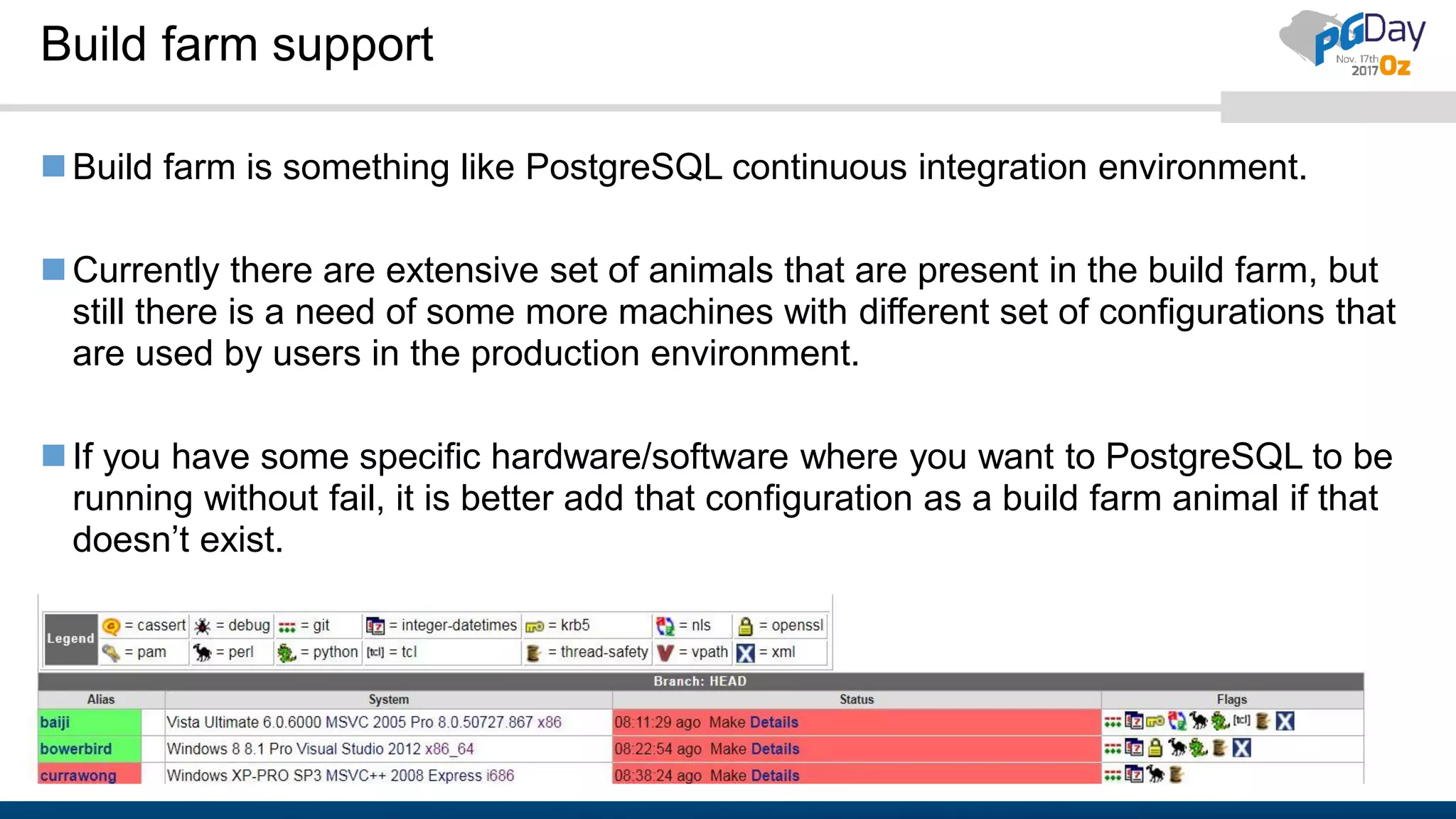
Build farm support Build farm is something like PostgreSQL continuous integration environment. Currently there are extensive set of animals that are present in the build farm, but still there is a need of some more machines with different set of configurations that are used by users in the production environment. If you have some specific hardware/software where you want to PostgreSQL to be running without fail, it is better add that configuration as a build farm animal if that doesn’t exist.
Bugs PostgreSQL community review and it’s extensive build farm support catches most of the problems, but still there may be problems that can occur only with production data. Need your support in validating new features or performance enhancements with respect to quality and functionality. Many people will face problems in sharing the bug details to the community. Steps to follow for quicker bug fix,  A reproducible test steps  If not, try to provide a call stack with debug symbols.  Or provide a core dump in a shared location.
Bugs Once all details are captured, raise the bug with the following bug reporting form.  https://www.postgresql.org/account/submitbug/ Try to register to the following mailing list to check the progress of the bug and also the bug patterns, that can help in further testing.  https://lists.postgresql.org/manage/ (pgsql-bugs)
Writing tools/extensions PostgreSQL have many variety of tools and extensions that are useful for many applications. Before writing any tool/extension by your own for your needs, please make sure that the existing are supported the same.  https://www.postgresql.org/download/product-categories/ Writing an extension is easier than writing a core feature.
Writing feature/bug fix patches If you found a bug or interested in fixing bugs raised by others, generate a patch and post it to the mailing list. Community acts very quickly in fixing any bugs that arise. Try to clarify the users when they raised a bug, but actually that is an expected behavior with details.
Writing feature/bug fix patches  If you found some interesting feature and thought of to be present in PostgreSQL.  Find out the use case scenario  Check for any older discussion on the mailing list  Post your idea to community.  Once everyone agrees and come to a common approach, generate a POC patch.  Every feature that is submitted to PostgreSQL, has to follow the review process.  https://commitfest.postgresql.org/  Definitely there may be complete rewrite of the patch based on the feedback.
Reviewing Patches  PostgreSQL is a community database, it needs support from you not just only features, but also from reviewing the submitted patches.  Please make sure that if you submit a patch, make sure that you reviewed another patch.  Review can be anything from source code, documentation, test and etc.  PostgreSQL community started recognizing the contribution from the reviewers also by listing their names in the release notes from version 10.  In the past, many patches are not received the much feedback from reviewers especially from actual users of those features.
How to contribute PostgreSQL

How to contribute PostgreSQL

  • 1.
    How To Contributeto PostgreSQL Hari Babu Kommi
  • 2.
    Your speaker +61 29452 9087 haribabuk@fast.au.fujitsu.com postgresql.fastware.com
  • 3.
    Contents Need of contributionto the PostgreSQL community Advantages of contributing to community Contribution methods
  • 4.
    Need of contribution PostgreSQLis a “world’s most advanced open source database” that powers many mission critical systems around the world. It needs support from individuals and companies to continue it’s development further to compete against major commercial databases.
  • 5.
    Advantages of contribution Contributingto community will benefit both individuals and companies. All the individuals that contributes to PostgreSQL echo system are listed as contributors.  https://www.postgresql.org/community/contributors/ All the companies that contributes to PostgreSQL echo system are listed as sponsors.  https://www.postgresql.org/about/sponsors/
  • 6.
    Contribution methods There areplenty of ways to contribute to PostgreSQL (echo system) and many people are already doing the same. This topic is to list out the some of the possible ways to contribute to PostgreSQL database by individuals and companies.
  • 7.
    Contribution methods Donation Participation inSurvey Hardware/Infrastructure support Web updates/support Events/Meetup groups Documentation Translation support Answering questions Build farm support Bugs Writing tools/extensions Writing feature/bug fix patches Reviewing of Patches
  • 8.
    Donation The Simple wayto support PostgreSQL NFO is by contributing some donation. The funds that are collected by the PostgreSQL groups are used for various activities such as education, user groups and advocacy. https://www.postgresql.org/about/donate/
  • 9.
    Participation in Survey PostgreSQLusually conducts surveys for every 4 to 6 months.  https://www.postgresql.org/community/ Why is it so important to participate in survey? Where the survey results are used and how?
  • 10.
    Participation in Survey Theresults of the latest survey are available in the following link:  https://www.postgresql.org/community/survey/93-what- postgresql-10-feature-are-you-most-excited-about/ As you observe that, there are less number of people responded to the survey. Currently the open survey is not reaching many users, needs to identify other approaches by the infrastructure team.
  • 11.
    Hardware/Infrastructure support The serversthat power the services of postgresql.org are provided by different companies and organisations around the world.  https://www.postgresql.org/about/servers/ Hardware support can be a test machine or a performance machine I listed a Power2 machine sponsored by IBM to PostgreSQL for performance testing.  Power2 configuration  Architecture: ppc64le Byte Order: Little Endian CPU(s): 192 On-line CPU(s) list: 0-191 Thread(s) per core: 8 Core(s) per socket: 1 Socket(s): 24 NUMA node(s): 4 Model: IBM,8286-42A L1d cache: 64K L1i cache: 32K L2 cache: 512K L3 cache: 8192K NUMA node0 CPU(s): 0-47 NUMA node1 CPU(s): 48-95 NUMA node2 CPU(s): 96-143 NUMA node3 CPU(s): 144-191
  • 12.
    Web updates/support The infrastructureteam itself takes care of web updates/support. Interested people can register with the following.  https://lists.postgresql.org/manage/ (pgsql-www) Currently PostgreSQL website doesn’t scale well on mobile devices. There is no proper details/issues that are available anywhere in the website, so that people can participate in the development. It needs an improvement from community to increase the contribution.
  • 13.
    Events/Meetup groups Thanks forthe Organizers and Sponsors of the PG Day Australia event. Conducting events/local meetups will help in growing the PostgreSQL community. Try to conduct monthly/quarterly meetups. Following are some of the local meetup groups in Australia.  https://www.meetup.com/Sydney-PostgreSQL-User-Group/  https://www.meetup.com/melpug/  https://www.meetup.com/Brisbane-PostgreSQL-User-Group/
  • 14.
    Documentation PostgreSQL community providesa very high quality documentation, but there are cases that it may not handle everything and some information may misleading and etc. Register to the following mailing list and provide your updates including the review of the changes suggested by others.  https://lists.postgresql.org/manage/ (pgsql-docs) If you’re a document developer or knows the tools that are used for the documentation, you valuable information is welcomed.
  • 15.
    Translations support PostgreSQL programs(server and client) can issue their messages in your favourite language. Creating and maintaining translated message sets needs the help of people who speak their own language well and want to contribute to the PostgreSQL effort. All the translation issues are tracked in redmine.  https://redmine.postgresql.org/projects/pgtranslation There is a dedicated mailing list to discuss the translations updates/issues.  https://www.postgresql.org/list/pgsql-translators/
  • 16.
    Answering questions Try toanswer the simple to complex questions that are raised by the users not only related to the following,  Performance  General discussions  Administration  Etc. PostgreSQL community mailing list is very supportive, you will receive all the information that you needed.
  • 17.
    Build farm support Buildfarm is something like PostgreSQL continuous integration environment. Currently there are extensive set of animals that are present in the build farm, but still there is a need of some more machines with different set of configurations that are used by users in the production environment. If you have some specific hardware/software where you want to PostgreSQL to be running without fail, it is better add that configuration as a build farm animal if that doesn’t exist.
  • 18.
    Bugs PostgreSQL community reviewand it’s extensive build farm support catches most of the problems, but still there may be problems that can occur only with production data. Need your support in validating new features or performance enhancements with respect to quality and functionality. Many people will face problems in sharing the bug details to the community. Steps to follow for quicker bug fix,  A reproducible test steps  If not, try to provide a call stack with debug symbols.  Or provide a core dump in a shared location.
  • 19.
    Bugs Once all detailsare captured, raise the bug with the following bug reporting form.  https://www.postgresql.org/account/submitbug/ Try to register to the following mailing list to check the progress of the bug and also the bug patterns, that can help in further testing.  https://lists.postgresql.org/manage/ (pgsql-bugs)
  • 20.
    Writing tools/extensions PostgreSQL havemany variety of tools and extensions that are useful for many applications. Before writing any tool/extension by your own for your needs, please make sure that the existing are supported the same.  https://www.postgresql.org/download/product-categories/ Writing an extension is easier than writing a core feature.
  • 21.
    Writing feature/bug fixpatches If you found a bug or interested in fixing bugs raised by others, generate a patch and post it to the mailing list. Community acts very quickly in fixing any bugs that arise. Try to clarify the users when they raised a bug, but actually that is an expected behavior with details.
  • 22.
    Writing feature/bug fixpatches  If you found some interesting feature and thought of to be present in PostgreSQL.  Find out the use case scenario  Check for any older discussion on the mailing list  Post your idea to community.  Once everyone agrees and come to a common approach, generate a POC patch.  Every feature that is submitted to PostgreSQL, has to follow the review process.  https://commitfest.postgresql.org/  Definitely there may be complete rewrite of the patch based on the feedback.
  • 23.
    Reviewing Patches  PostgreSQLis a community database, it needs support from you not just only features, but also from reviewing the submitted patches.  Please make sure that if you submit a patch, make sure that you reviewed another patch.  Review can be anything from source code, documentation, test and etc.  PostgreSQL community started recognizing the contribution from the reviewers also by listing their names in the release notes from version 10.  In the past, many patches are not received the much feedback from reviewers especially from actual users of those features.