(mostly) How we moved from ^ Java to Scala Graham Tackley guardian.co.uk
History • Java shop since 2006 • guardian.co.uk: java + spring + velocity + hibernate + oracle • ~100k lines production java code (and ~35k xml...)
Content API • Provide API to access all of our website content • Limited beta released early 2009 • Started implementation of final version late 2009 • Live May 2010: http://content.guardianapis.com
Content API (demo of http://content.guardianapis.com)
November 2009 • Started new Content API implementation • java + guice + guice servlets + apache solr
November 2009 • A few people had played with scala • No production scala code
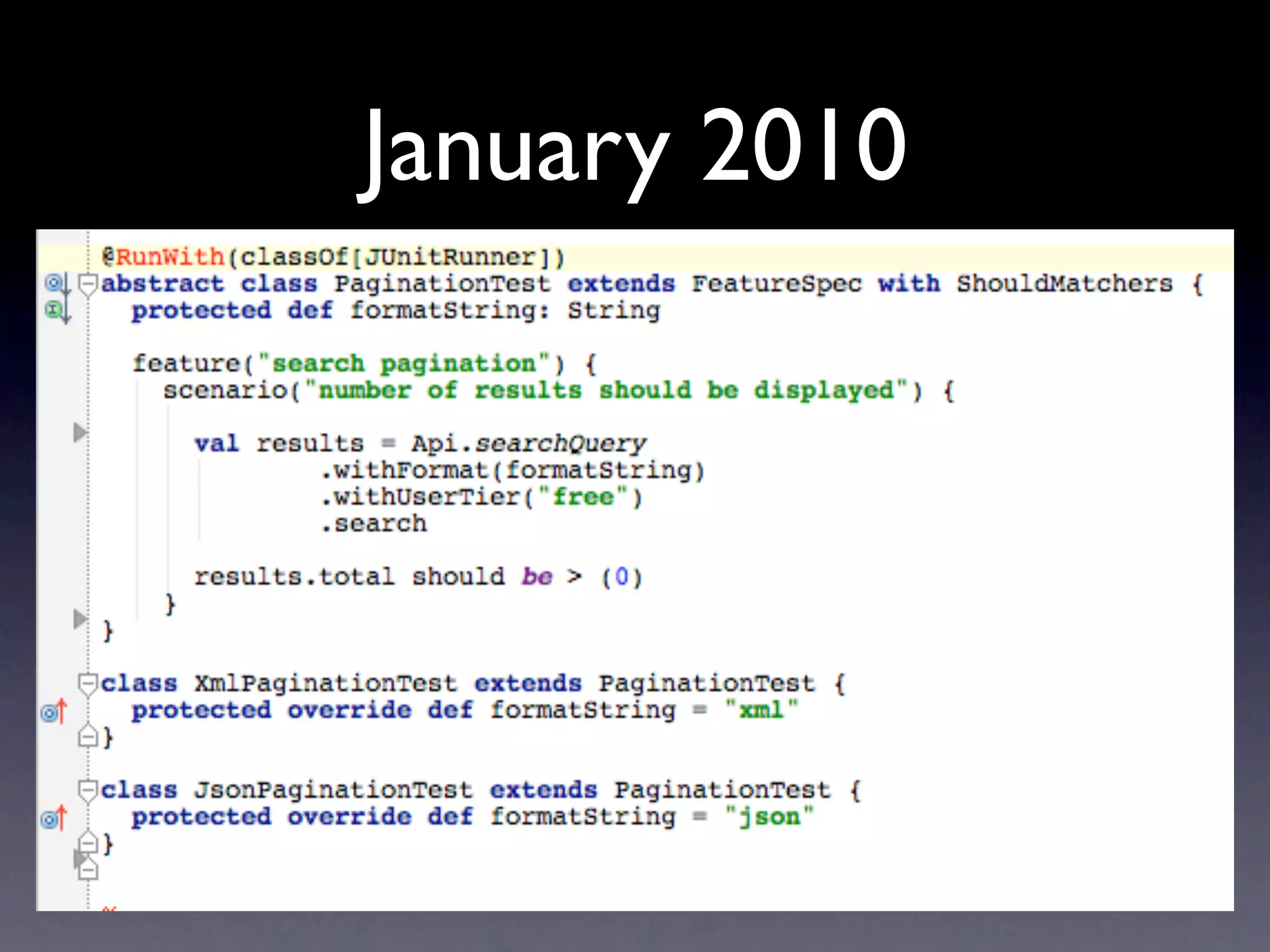
January 2010 • Comprehensive integration tests were very important to us • Started writing our integration tests in Scala with the awesome ScalaTest • Already a maven project, so mixed scala- java support easy with maven-scala-plugin demo: mavan-scala-plugin, ScalaTest
January 2010
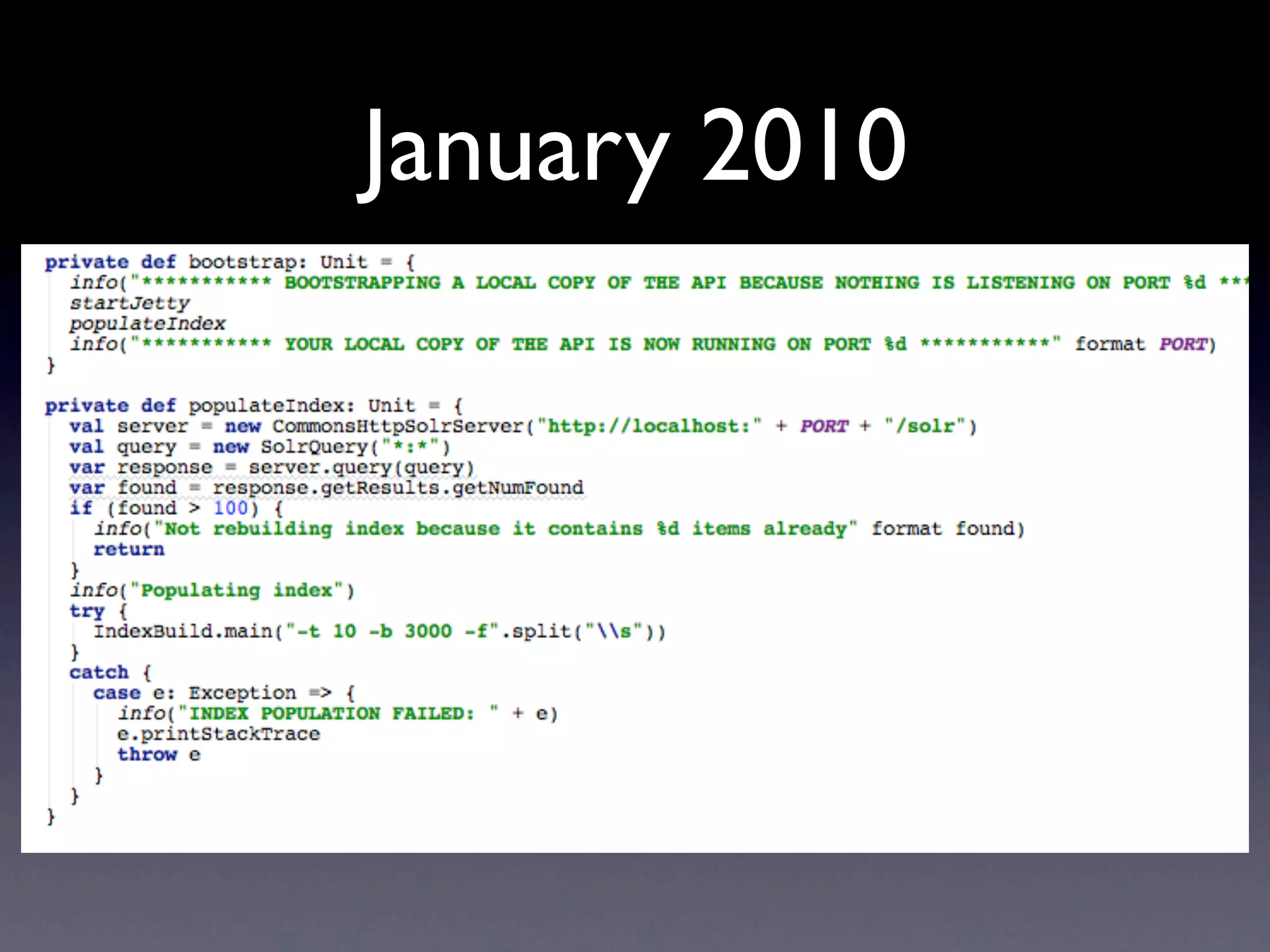
January 2010 • A fair bit of our test code was java- without-semicolons as we learnt about Scala...
January 2010
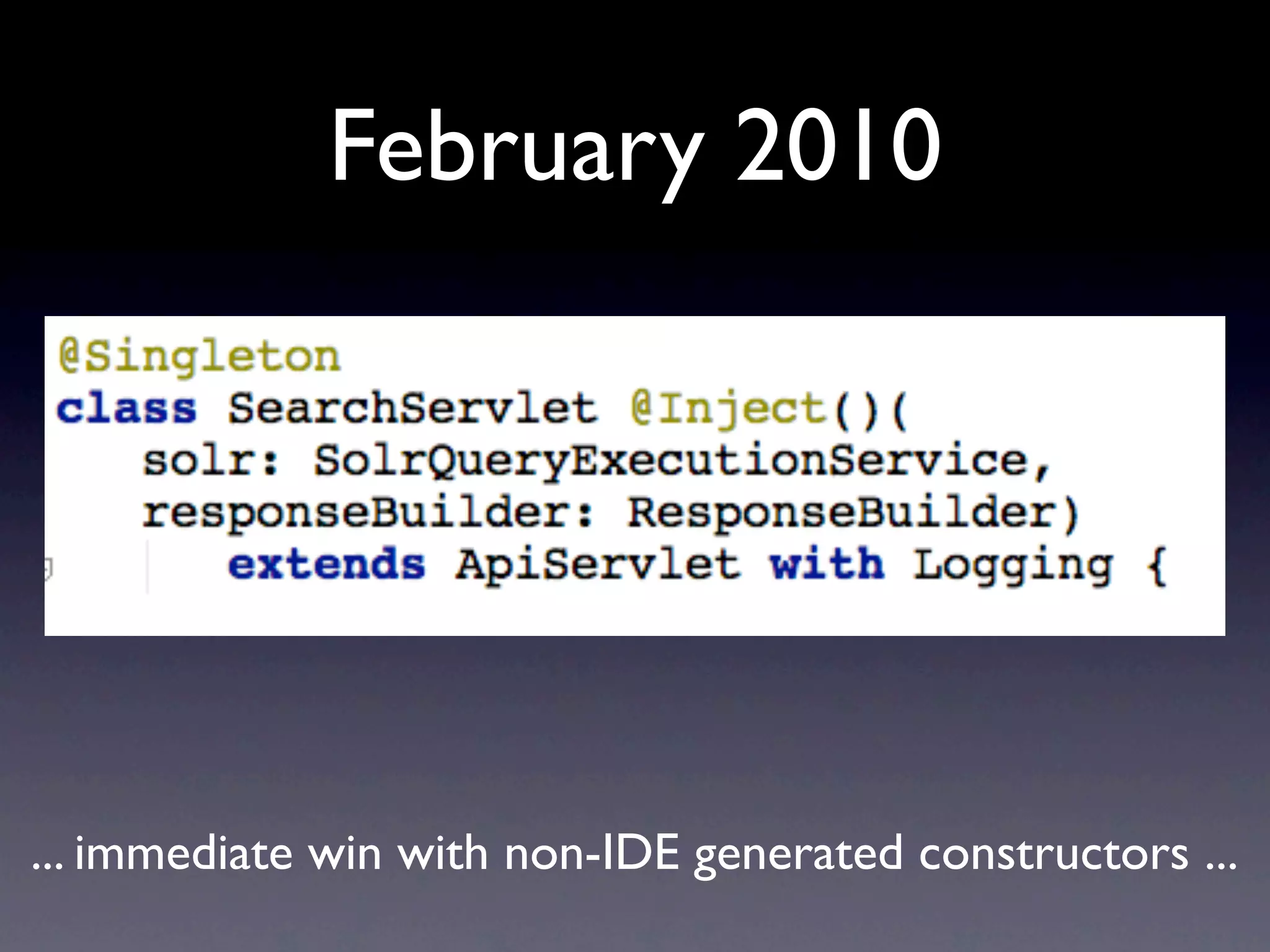
February 2010 • ... despite that we loved it so much that after a month we decided to convert the whole app to Scala • scala + guice + guice servlets + apache solr
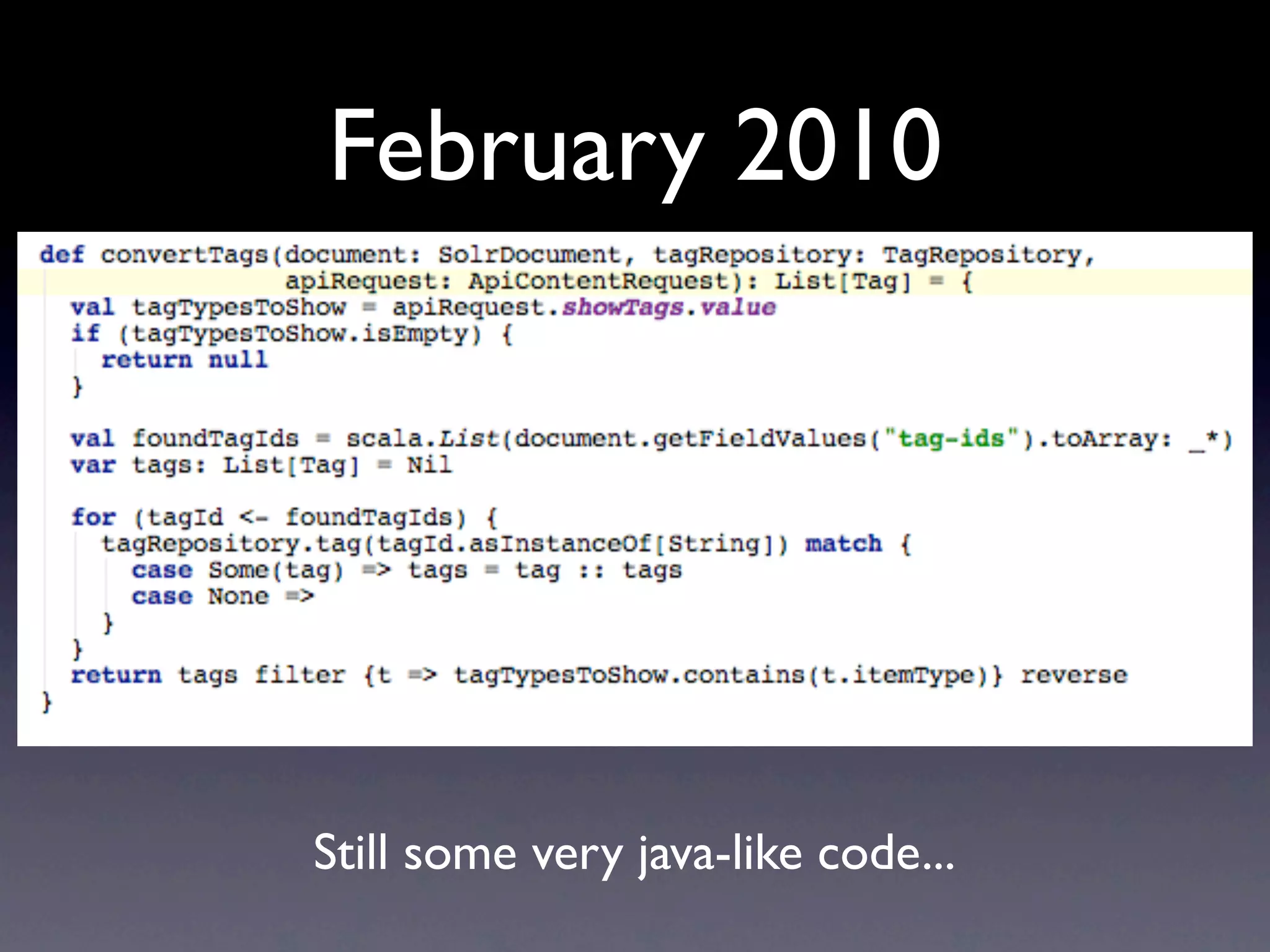
February 2010 Still some very java-like code...
February 2010 ... immediate win with non-IDE generated constructors ...
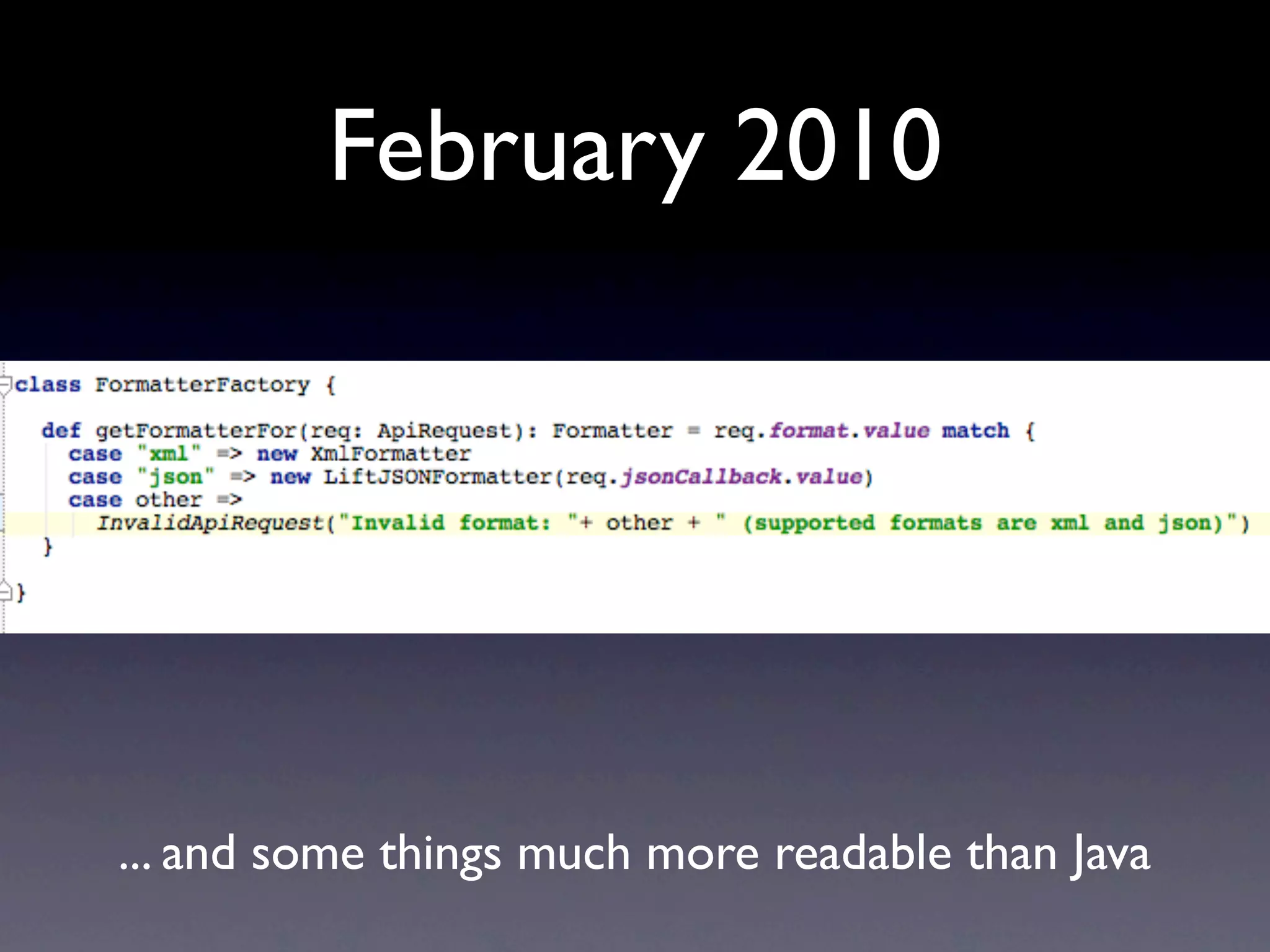
February 2010 ... and some things much more readable than Java
Our top 5 things we loved about scala on day one
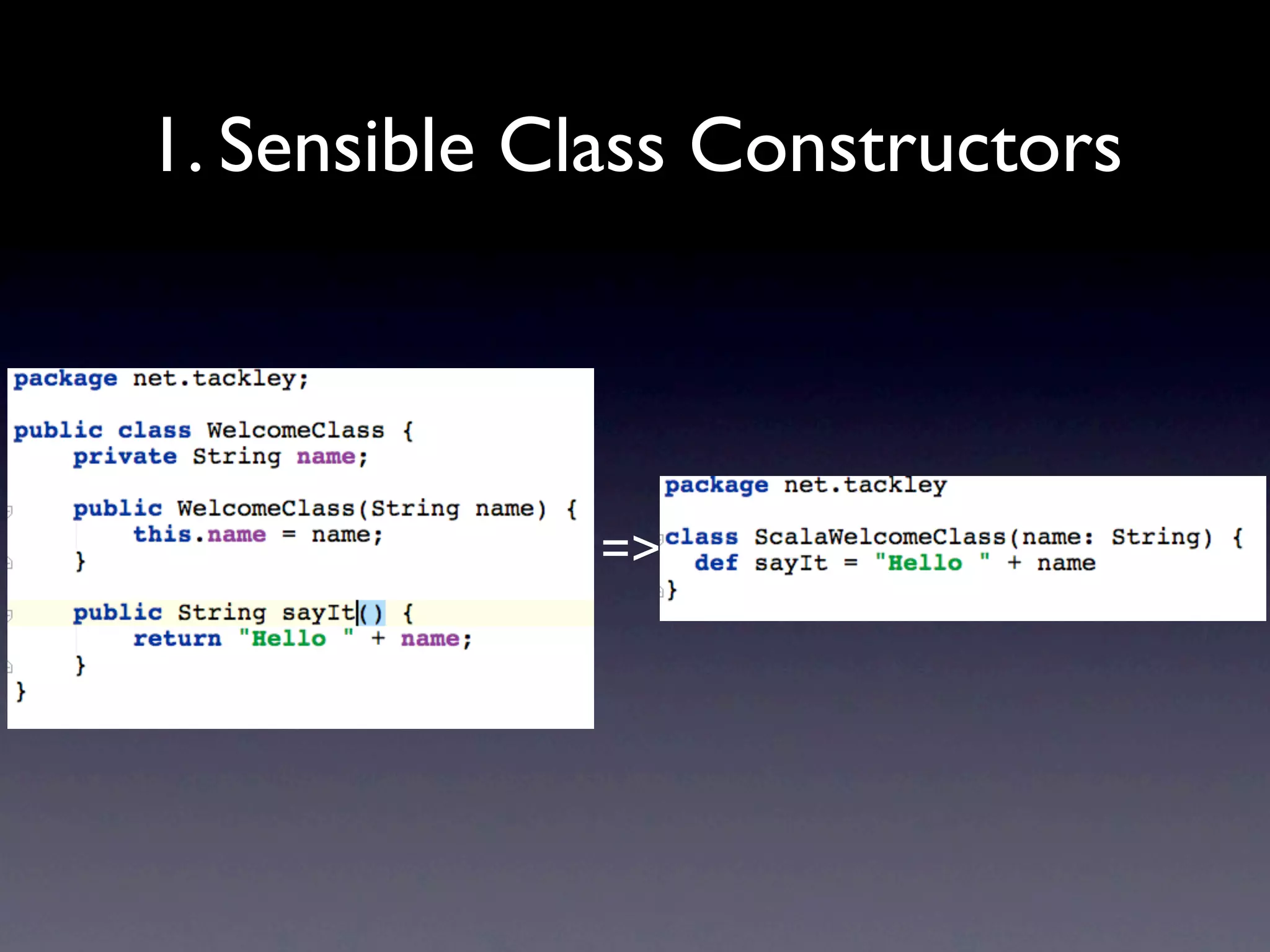
1. Sensible Class Constructors =>
2. Type inference / val & var List<String> myList = new ArrayList<String>(); => import java.util.ArrayList val myList = new ArrayList[String]
3. No source file naming constraints • Don’t need to be named after package & class name like java • So multiple classes are allowed in a single file e.g. ResponseRenderer.scala
4. REPL (console) • run “scala” for a scala shell • awesome for experimentation
5. Same tools, libs, deployment & runtime characteristics as Java • We still use IntelliJ (with the scala plugin) • A scala war file is just a war file • All the experience of running jvm in production still applies • Can still use java libraries e.g. GuiceServletConfig.scala, XmlFormatter.scala
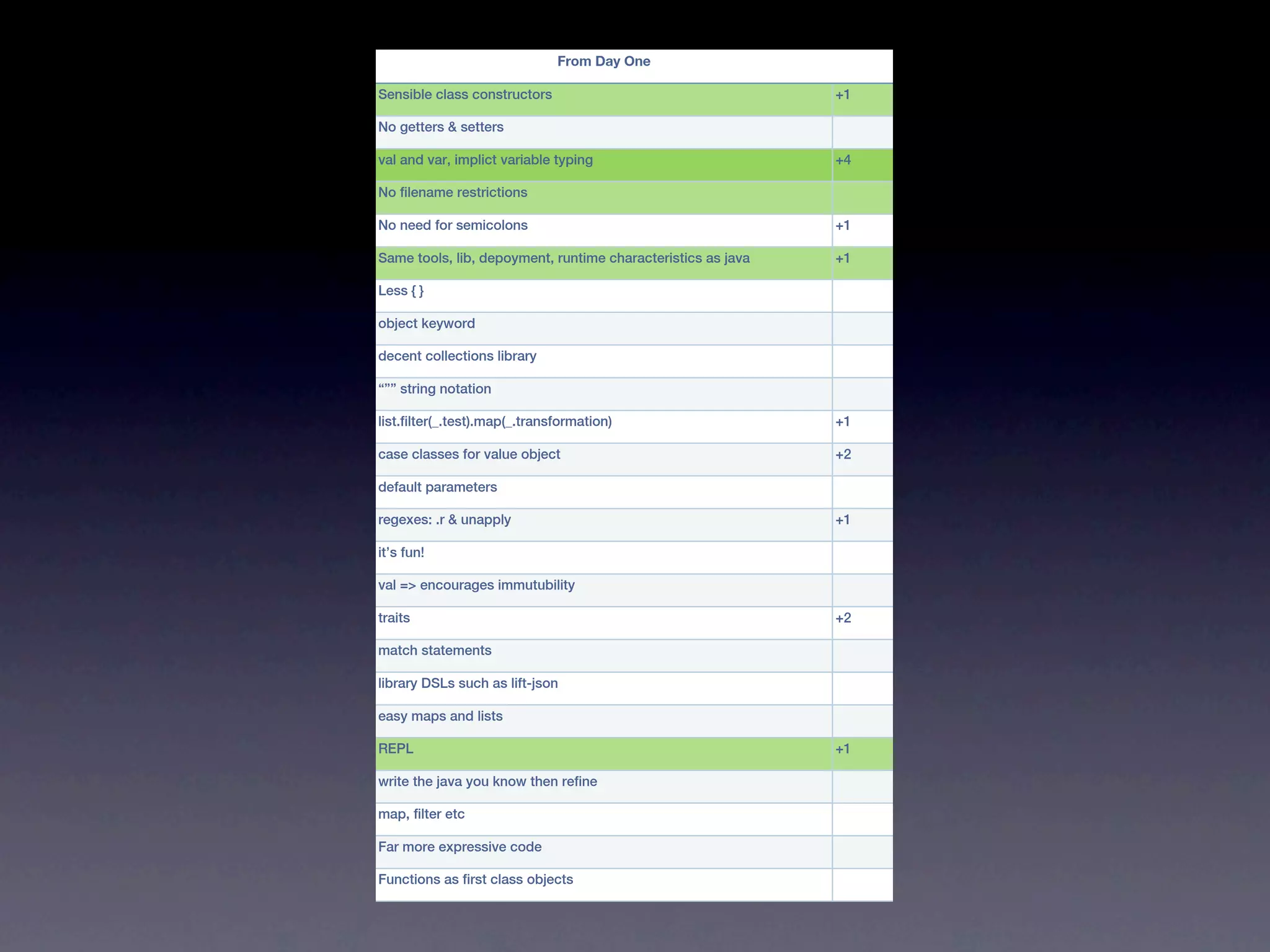
From Day One Sensible class constructors +1 No getters & setters val and var, implict variable typing +4 No filename restrictions No need for semicolons +1 Same tools, lib, depoyment, runtime characteristics as java +1 Less { } object keyword decent collections library “”” string notation list.filter(_.test).map(_.transformation) +1 case classes for value object +2 default parameters regexes: .r & unapply +1 it’s fun! val => encourages immutubility traits +2 match statements library DSLs such as lift-json easy maps and lists REPL +1 write the java you know then refine map, filter etc Far more expressive code Functions as first class objects
Our top 5 things we loved about scala on day one SUMMARY: Scala is great even if you only use it as a more concise java (java-without-semicolons™); for us this was a great way to start.
July 2010 • Switched from maven to simple-build-tool • Mainly for incremental compilation • ~ test-quick and ~ prepare-webapp also invaluable
Our top 5 things we love about scala one year on
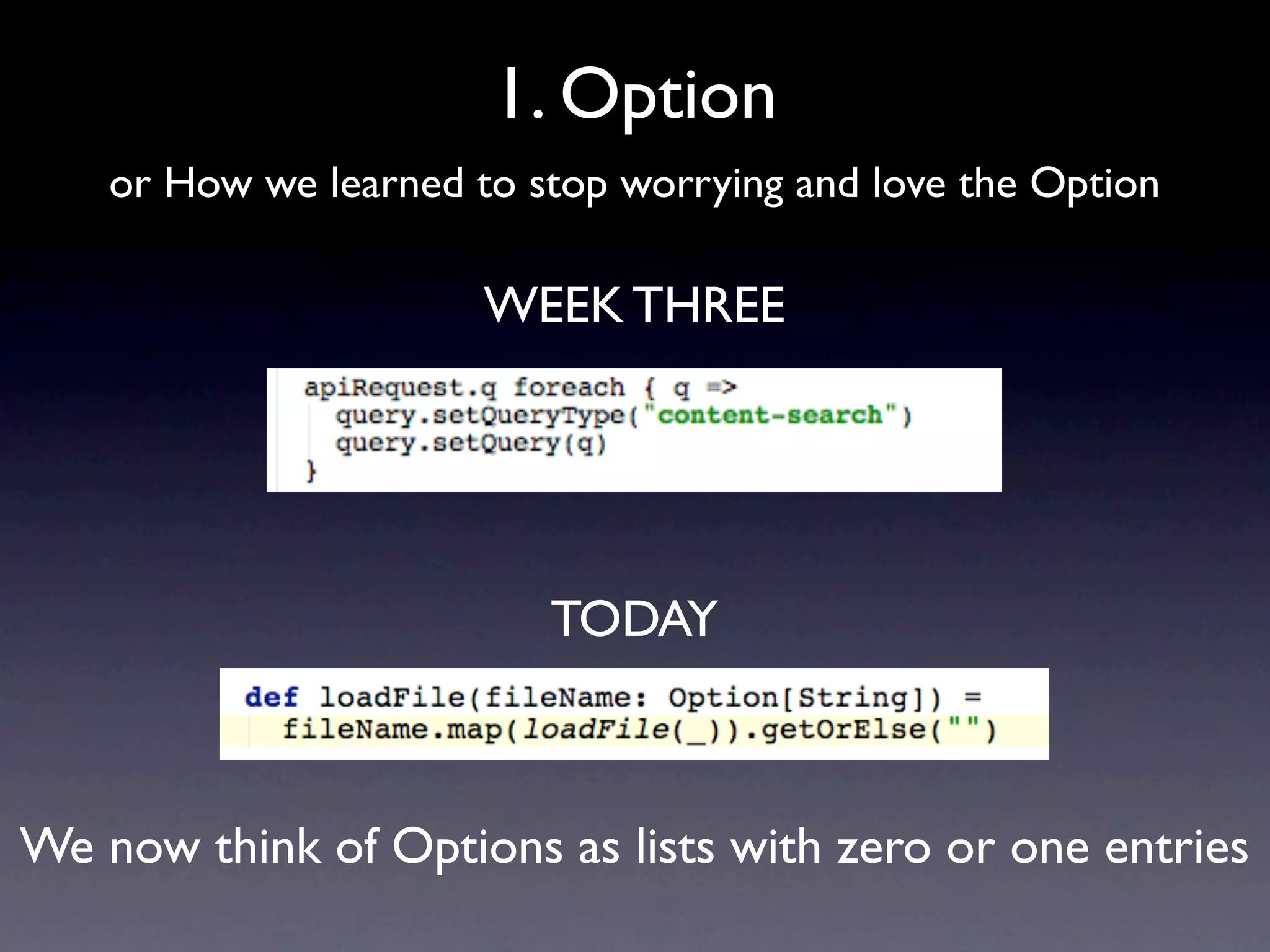
1. Option or How we learned to stop worrying and love the Option We’d read “don’t use nulls, use Option instead” DAY ONE x != null became x.isDefined DAY THREE x match { case None => ... case Some(value) => ... }
1. Option or How we learned to stop worrying and love the Option WEEK THREE TODAY We now think of Options as lists with zero or one entries
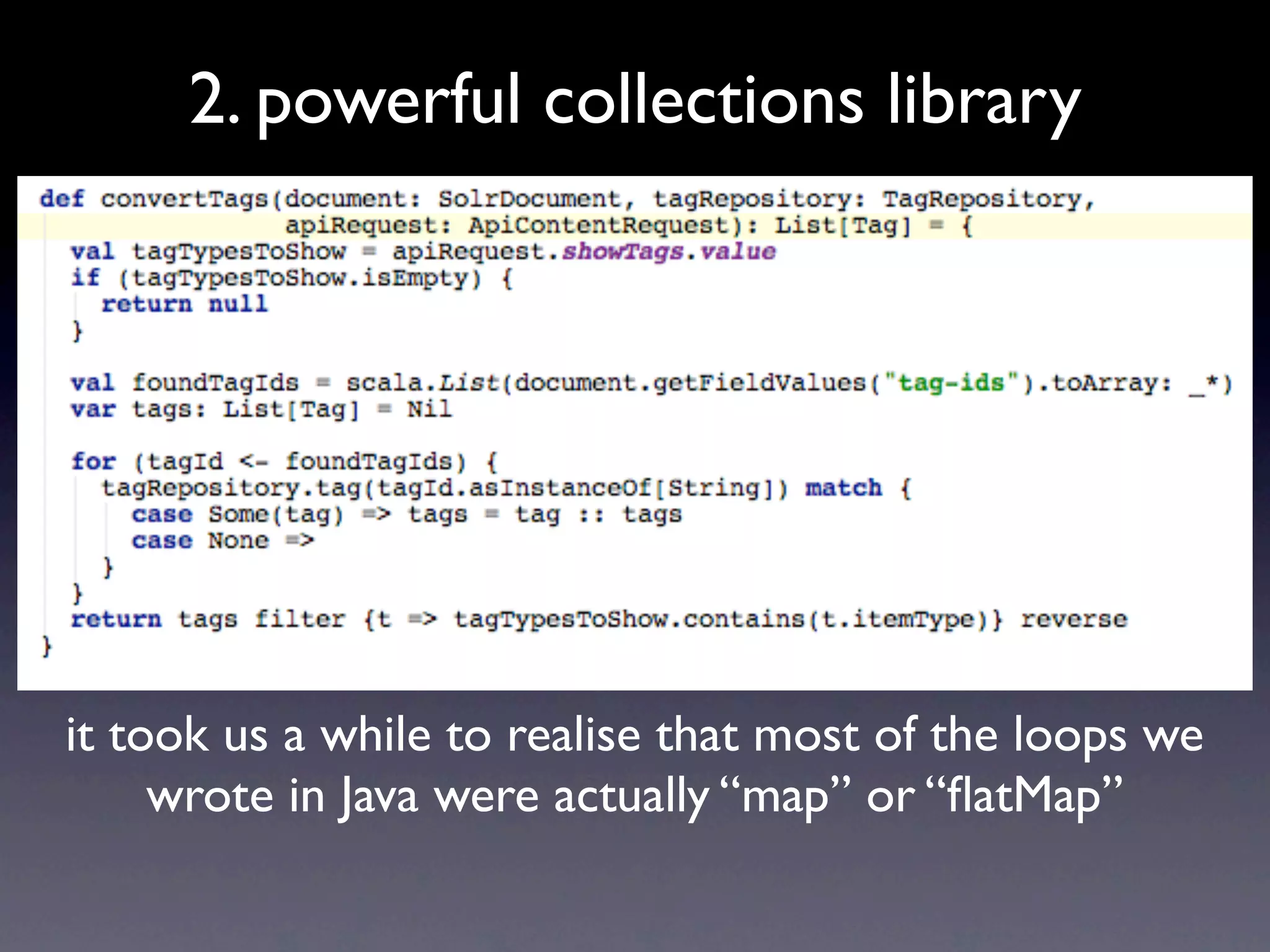
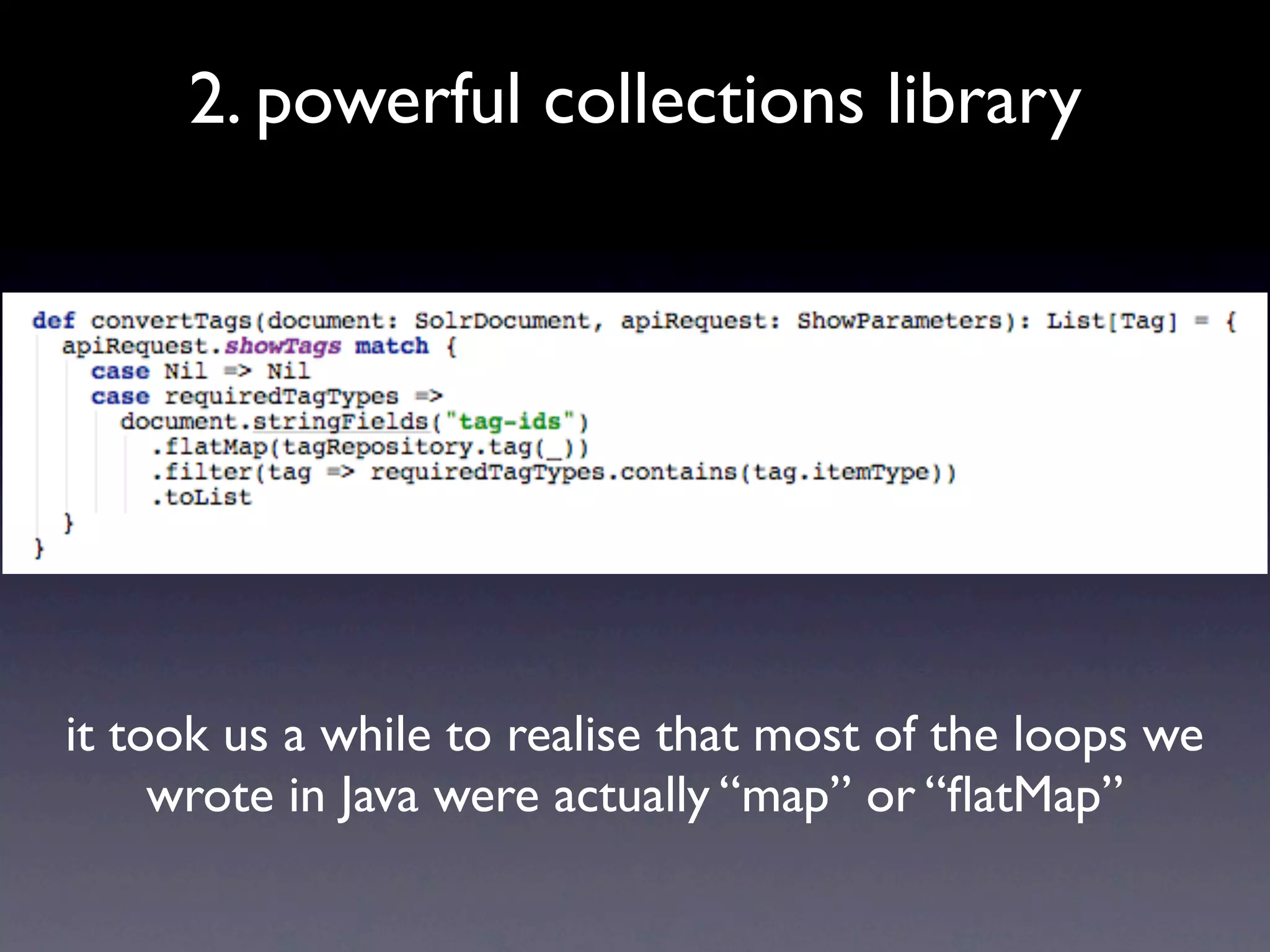
2. powerful collections library it took us a while to realise that most of the loops we wrote in Java were actually “map” or “flatMap”
3. traits as mixins demo: SearchRequest
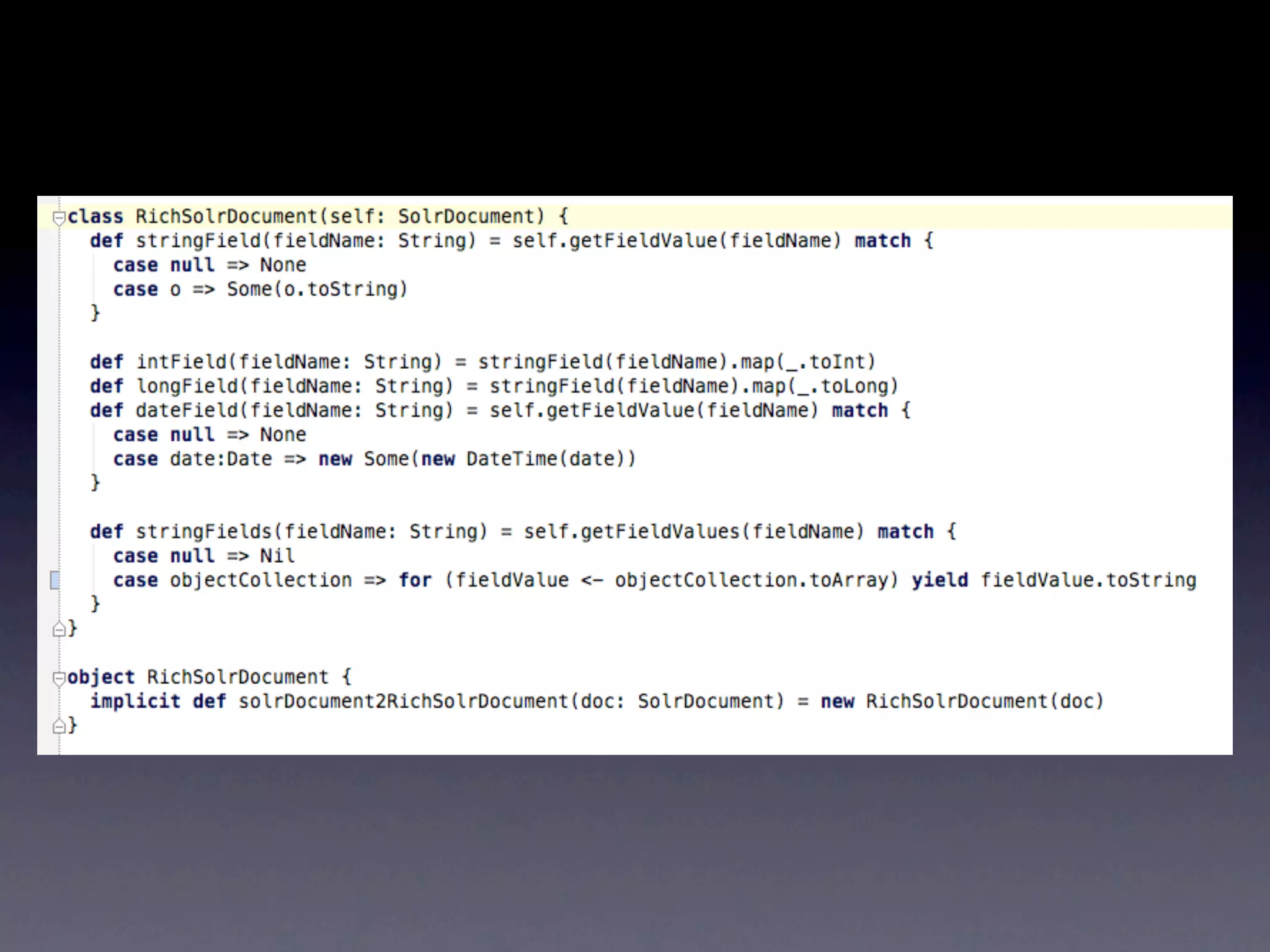
4. implicit conversions to enhance existing classes Content API extensively uses Solr/J, which is good but returns loads of nulls We used implicit conversions to hide the Java yuk demo: RichSolrDocument
5. pattern matching demo: UserTier
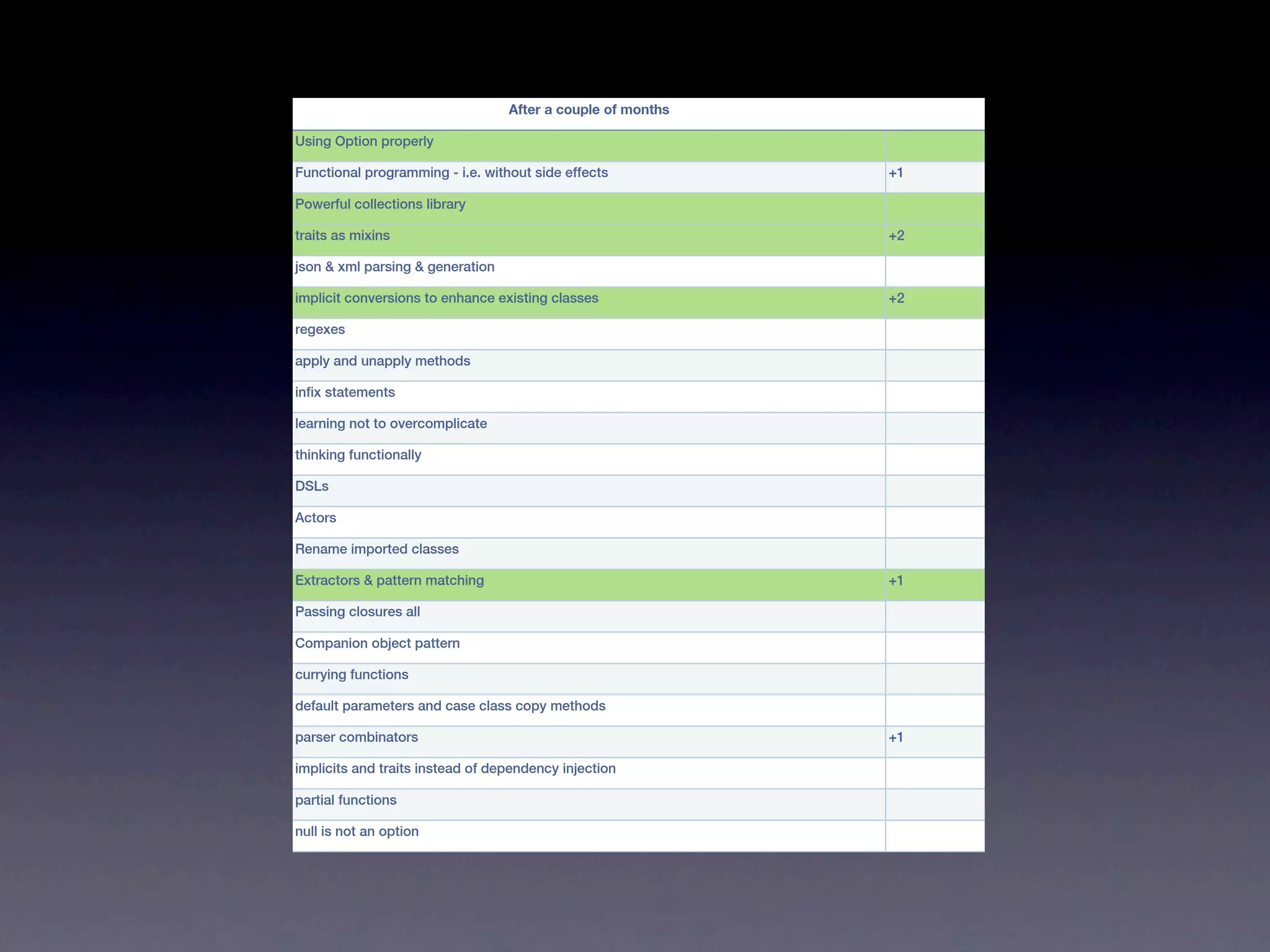
After a couple of months Using Option properly Functional programming - i.e. without side effects +1 Powerful collections library traits as mixins +2 json & xml parsing & generation implicit conversions to enhance existing classes +2 regexes apply and unapply methods infix statements learning not to overcomplicate thinking functionally DSLs Actors Rename imported classes Extractors & pattern matching +1 Passing closures all Companion object pattern currying functions default parameters and case class copy methods parser combinators +1 implicits and traits instead of dependency injection partial functions null is not an option
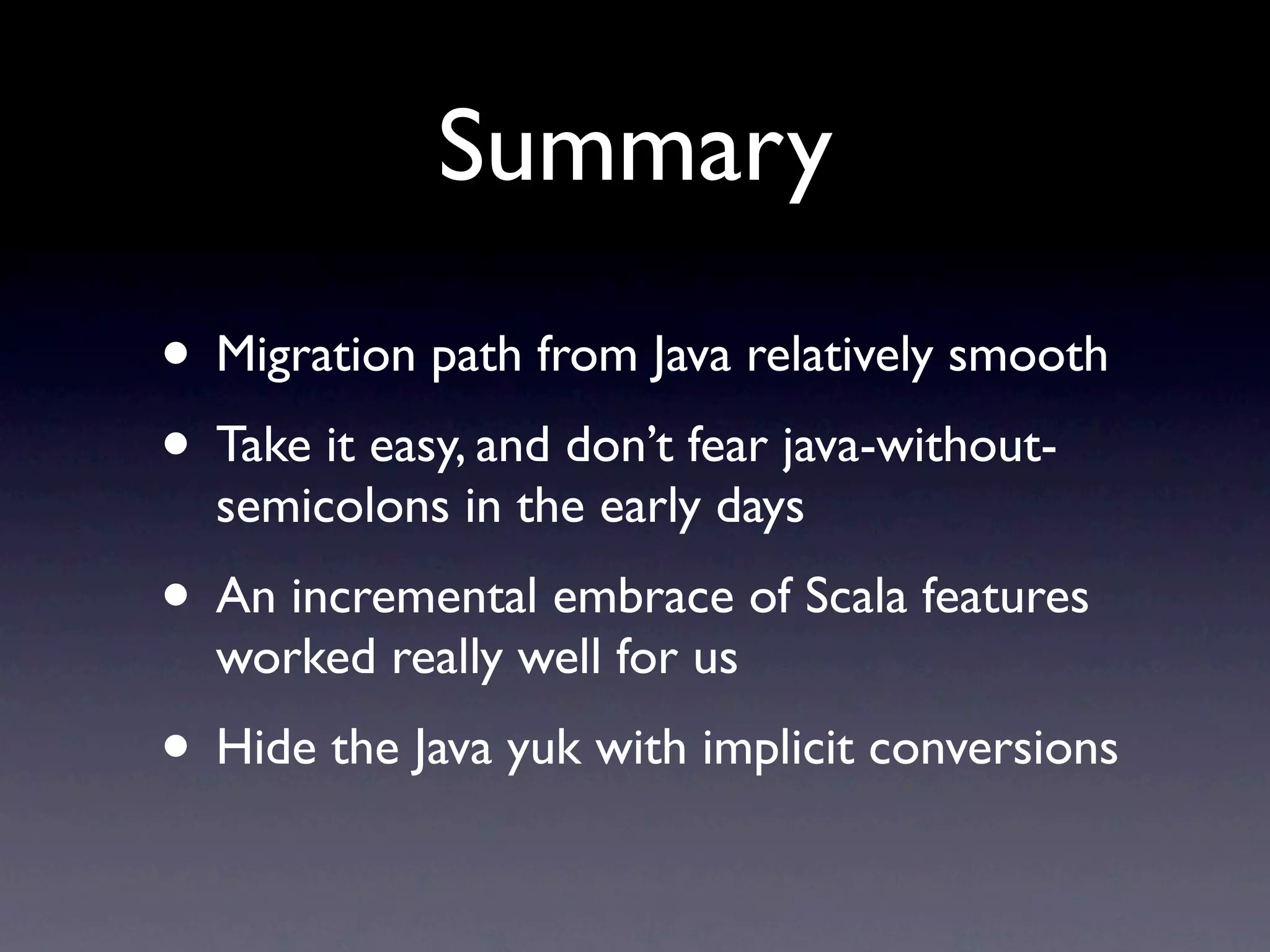
Summary • Migration path from Java relatively smooth • Take it easy, and don’t fear java-without- semicolons in the early days • An incremental embrace of Scala features worked really well for us • Hide the Java yuk with implicit conversions
• http://content.guardianapis.com • http://www.guardian.co.uk/open-platform • http://github.com/guardian/open-platform- content-api-scala-client • And we’re hiring: http://www.gnmcareers.co.uk ref JS323 graham.tackley@guardian.co.uk

LSUG: How we (mostly) moved from Java to Scala

  • 1.
    (mostly) How we movedfrom ^ Java to Scala Graham Tackley guardian.co.uk
  • 2.
    History • Java shopsince 2006 • guardian.co.uk: java + spring + velocity + hibernate + oracle • ~100k lines production java code (and ~35k xml...)
  • 3.
    Content API • ProvideAPI to access all of our website content • Limited beta released early 2009 • Started implementation of final version late 2009 • Live May 2010: http://content.guardianapis.com
  • 4.
    Content API (demo ofhttp://content.guardianapis.com)
  • 5.
    November 2009 • Startednew Content API implementation • java + guice + guice servlets + apache solr
  • 6.
    November 2009 • Afew people had played with scala • No production scala code
  • 7.
    January 2010 • Comprehensiveintegration tests were very important to us • Started writing our integration tests in Scala with the awesome ScalaTest • Already a maven project, so mixed scala- java support easy with maven-scala-plugin demo: mavan-scala-plugin, ScalaTest
  • 8.
  • 9.
    January 2010 • Afair bit of our test code was java- without-semicolons as we learnt about Scala...
  • 10.
  • 11.
    February 2010 • ...despite that we loved it so much that after a month we decided to convert the whole app to Scala • scala + guice + guice servlets + apache solr
  • 12.
    February 2010 Still somevery java-like code...
  • 13.
    February 2010 ... immediatewin with non-IDE generated constructors ...
  • 14.
    February 2010 ... andsome things much more readable than Java
  • 15.
    Our top 5things we loved about scala on day one
  • 16.
    1. Sensible ClassConstructors =>
  • 17.
    2. Type inference/ val & var List<String> myList = new ArrayList<String>(); => import java.util.ArrayList val myList = new ArrayList[String]
  • 18.
    3. No sourcefile naming constraints • Don’t need to be named after package & class name like java • So multiple classes are allowed in a single file e.g. ResponseRenderer.scala
  • 19.
    4. REPL (console) •run “scala” for a scala shell • awesome for experimentation
  • 20.
    5. Same tools,libs, deployment & runtime characteristics as Java • We still use IntelliJ (with the scala plugin) • A scala war file is just a war file • All the experience of running jvm in production still applies • Can still use java libraries e.g. GuiceServletConfig.scala, XmlFormatter.scala
  • 21.
    From Day One Sensibleclass constructors +1 No getters & setters val and var, implict variable typing +4 No filename restrictions No need for semicolons +1 Same tools, lib, depoyment, runtime characteristics as java +1 Less { } object keyword decent collections library “”” string notation list.filter(_.test).map(_.transformation) +1 case classes for value object +2 default parameters regexes: .r & unapply +1 it’s fun! val => encourages immutubility traits +2 match statements library DSLs such as lift-json easy maps and lists REPL +1 write the java you know then refine map, filter etc Far more expressive code Functions as first class objects
  • 22.
    Our top 5things we loved about scala on day one SUMMARY: Scala is great even if you only use it as a more concise java (java-without-semicolons™); for us this was a great way to start.
  • 23.
    July 2010 • Switchedfrom maven to simple-build-tool • Mainly for incremental compilation • ~ test-quick and ~ prepare-webapp also invaluable
  • 24.
    Our top 5things we love about scala one year on
  • 25.
    1. Option or Howwe learned to stop worrying and love the Option We’d read “don’t use nulls, use Option instead” DAY ONE x != null became x.isDefined DAY THREE x match { case None => ... case Some(value) => ... }
  • 26.
    1. Option or How we learned to stop worrying and love the Option WEEK THREE TODAY We now think of Options as lists with zero or one entries
  • 27.
    2. powerful collectionslibrary it took us a while to realise that most of the loops we wrote in Java were actually “map” or “flatMap”
  • 28.
    2. powerful collectionslibrary it took us a while to realise that most of the loops we wrote in Java were actually “map” or “flatMap”
  • 29.
    3. traits asmixins demo: SearchRequest
  • 30.
    4. implicit conversionsto enhance existing classes Content API extensively uses Solr/J, which is good but returns loads of nulls We used implicit conversions to hide the Java yuk demo: RichSolrDocument
  • 32.
    5. pattern matching demo: UserTier
  • 33.
    After a coupleof months Using Option properly Functional programming - i.e. without side effects +1 Powerful collections library traits as mixins +2 json & xml parsing & generation implicit conversions to enhance existing classes +2 regexes apply and unapply methods infix statements learning not to overcomplicate thinking functionally DSLs Actors Rename imported classes Extractors & pattern matching +1 Passing closures all Companion object pattern currying functions default parameters and case class copy methods parser combinators +1 implicits and traits instead of dependency injection partial functions null is not an option
  • 34.
    Summary • Migration pathfrom Java relatively smooth • Take it easy, and don’t fear java-without- semicolons in the early days • An incremental embrace of Scala features worked really well for us • Hide the Java yuk with implicit conversions
  • 35.
    • http://content.guardianapis.com • http://www.guardian.co.uk/open-platform •http://github.com/guardian/open-platform- content-api-scala-client • And we’re hiring: http://www.gnmcareers.co.uk ref JS323 graham.tackley@guardian.co.uk