By: Batch-17 Pradeep Surapaneni Raju Kommula. Under the Guidance of: K V Muthyalu Chaotic Image Encryption Techniques A project seminar on With the Co-ordination of: MD Mir Khasim
Contents  Abstract  Introduction  Objective  Modules  Requirements  Existing System  Proposed System  Experimental Analysis  Security Analysis  Architecture  Design  Screen Shots  Applicability  Conclusion
Abstract  In this paper, we will provide an overview of the mechanisms used in image protection, especially Chaos-based encryption techniques available today. We will see how previously proposed methods such as Data Encryption Standard (DES), Triple Data Encryption Standard (Triple-DES), and International Data Encryption Algorithm (IDEA) have been applied in image protection domain and how new concepts of Chaos-based encryption techniques are superior to traditional methods.  The chaotic system is rich in significance and in implication because of sensitivity to change initial conditions, control parameters, ergodicity, random-like behaviour, repeated processing and very high diffusion and confusion properties that are desirable for cryptography.
Introduction  Advances in space science, data analysis, and communication technologies present new opportunities for users  The chaotic system was a new innovation because it can change To increase productivity Reduce costs Facilitate innovation and Create virtual collaborative environments for addressing the new challenges. Initial conditions Control parameters  Ergodicity, and Very high diffusion and Confusion properties that are desirable for Cryptography.
Objective  The main Objective was to provide a Image encryption mechanism which provides high security level, less computational time and power in reliable and efficient way to deal with balky, difficult and intractable data.
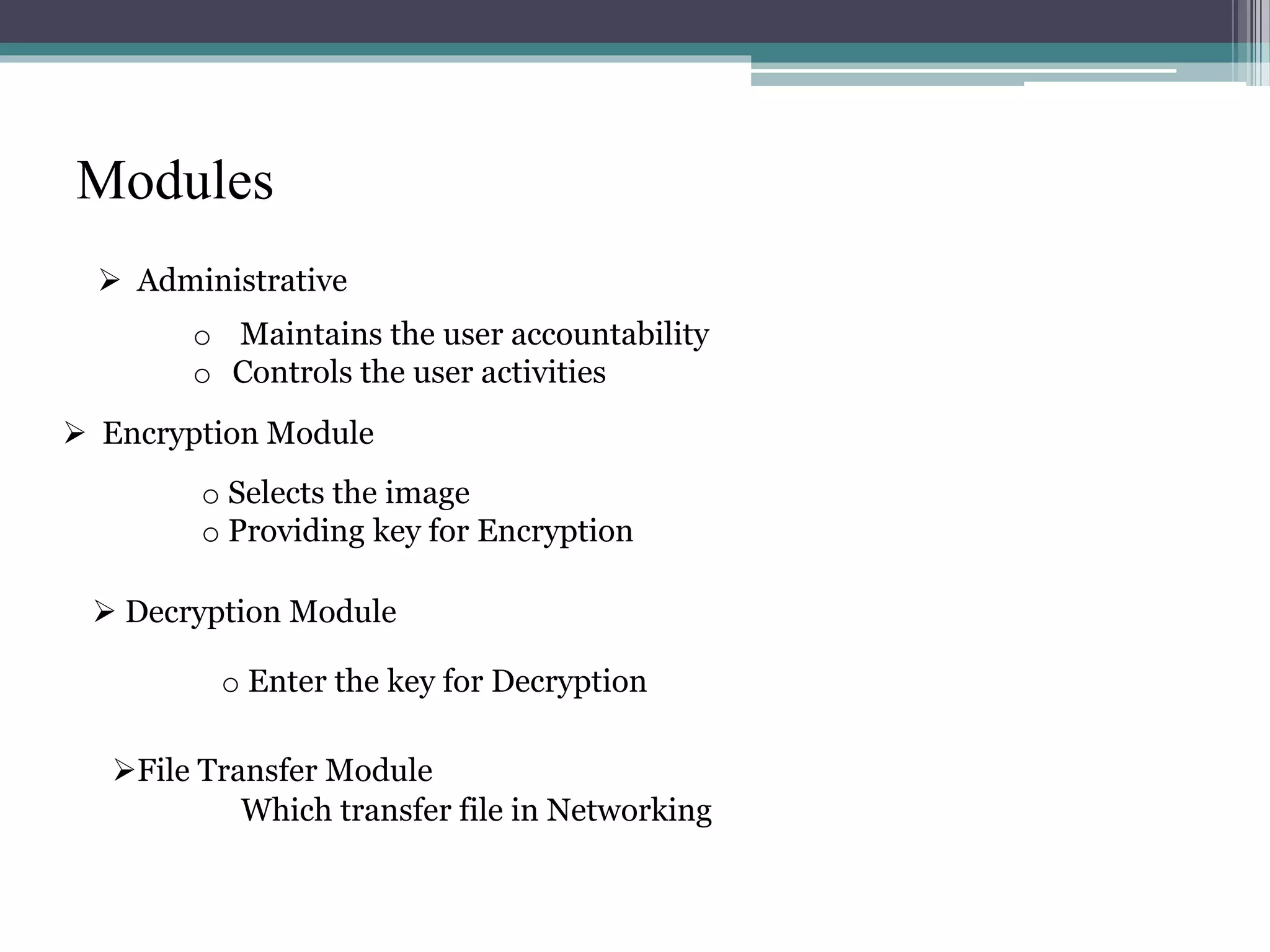
Modules  Administrative o Maintains the user accountability o Controls the user activities  Encryption Module o Selects the image o Providing key for Encryption  Decryption Module o Enter the key for Decryption File Transfer Module Which transfer file in Networking
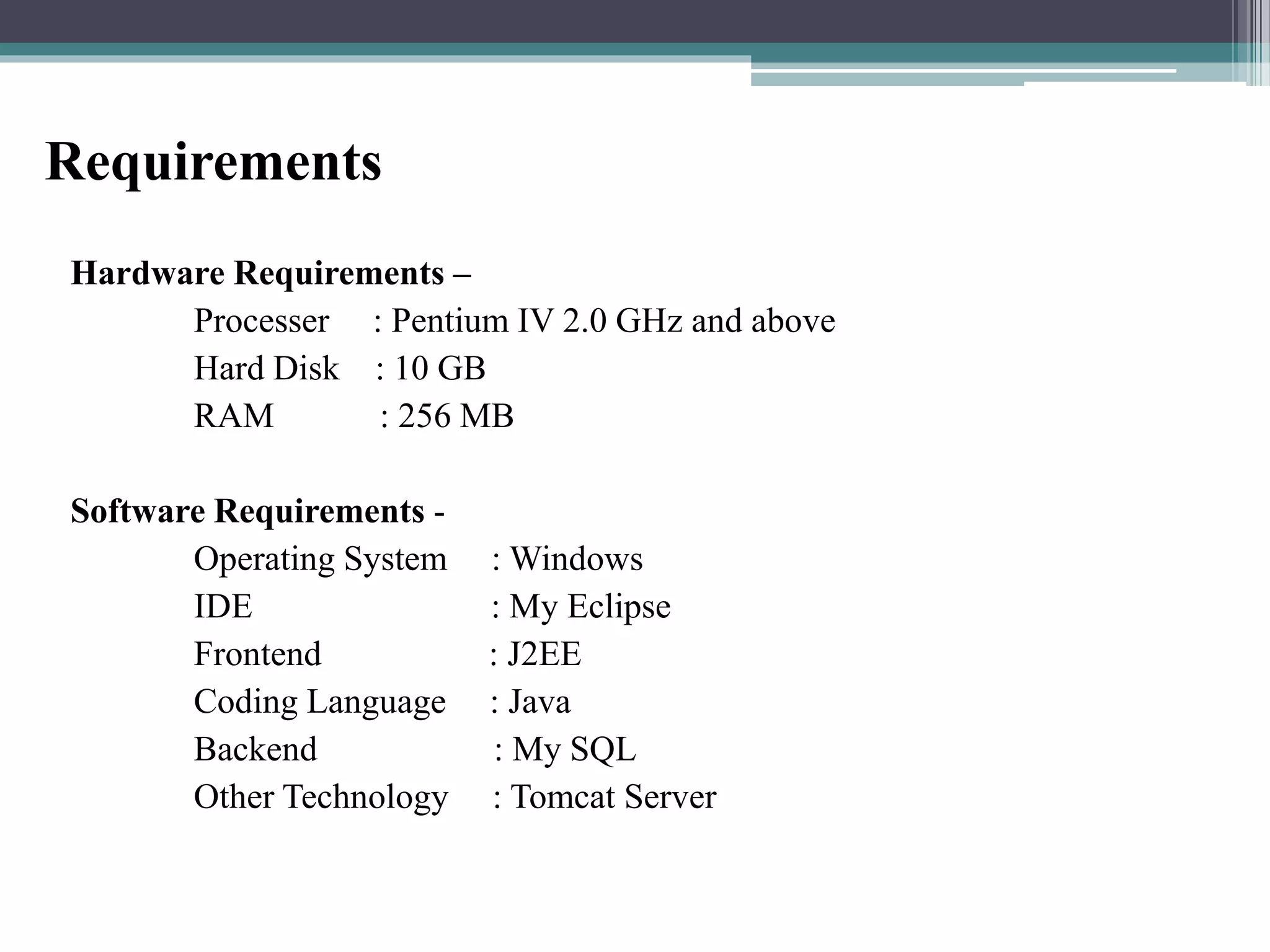
Requirements Hardware Requirements – Processer : Pentium IV 2.0 GHz and above Hard Disk : 10 GB RAM : 256 MB Software Requirements - Operating System : Windows IDE : My Eclipse Frontend : J2EE Coding Language : Java Backend : My SQL Other Technology : Tomcat Server
Existing System  There are traditional image encryption techniques like DES, Triple-DES and IDEA. Limitations • requires large data size • long computational time • high computing power. • not suitable for practical image encryption and for online communications
Proposed System  The conventional cryptographic algorithms are mainly based on discrete mathematics.  chaos-based cryptography is relied on the complex dynamics of nonlinear systems . The image encryption algorithm includes two steps:  Firstly, the image fusion is completed between the original-image and the key-image.  Then the pixel values of the fusion image are encrypted by Henon chaotic system.
Image fusion  Graphics fusion technique can be used in image fusion. According to the image pixel, image fusion can be completed between the same size images. Image fusion is described as following: E(i, j)=w ×(K(i, j)-O(i, j))+O(i, j) Where w is parameter, K(i, j) is the pixel values of the key-image ,O(i, j) is the pixel values of the original-image, and E(i, j) is the pixel values of the fusion-image.
Encryption by Henon chaotic Algorithm  In our scheme, Henon chaotic system is adopted to encrypt the fusion- image.  Step1: The Henon chaotic system is converted into one-dimensional chaotic map which is defined as: Xi+2=1-aX2i+1+bxi Where a = 0.3 , b∈[1.07,1.4] .The parameter a , the parameter b , initial value x0 and initial value x1 may represent the key.  Step2: Set encryption key for the fusion-image, including structural parameters a , b and initial values x0 ,x1 . After image fusion, we adopt Henon chaotic map to change the pixel values of the fusion-image.
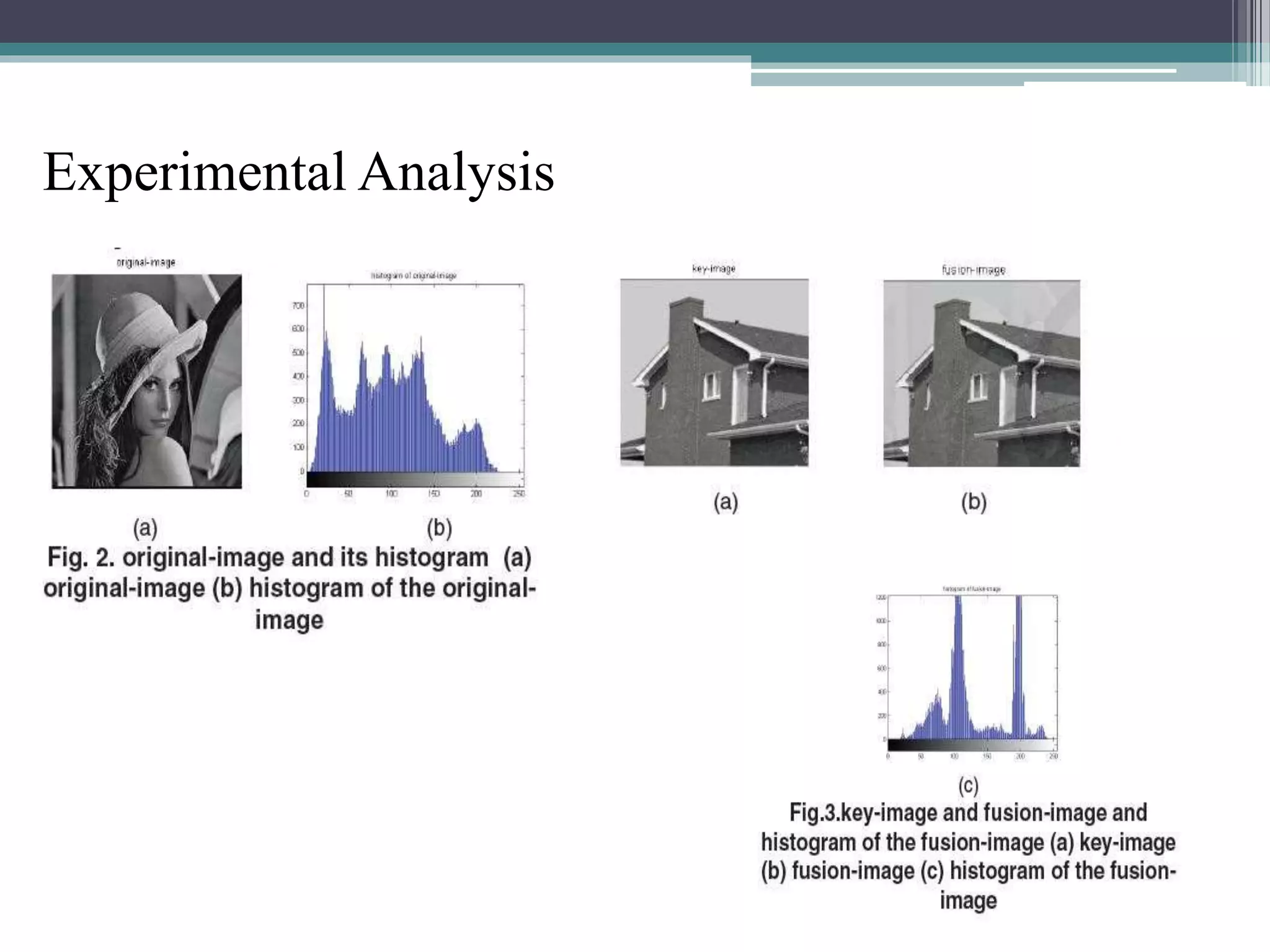
Experimental Analysis
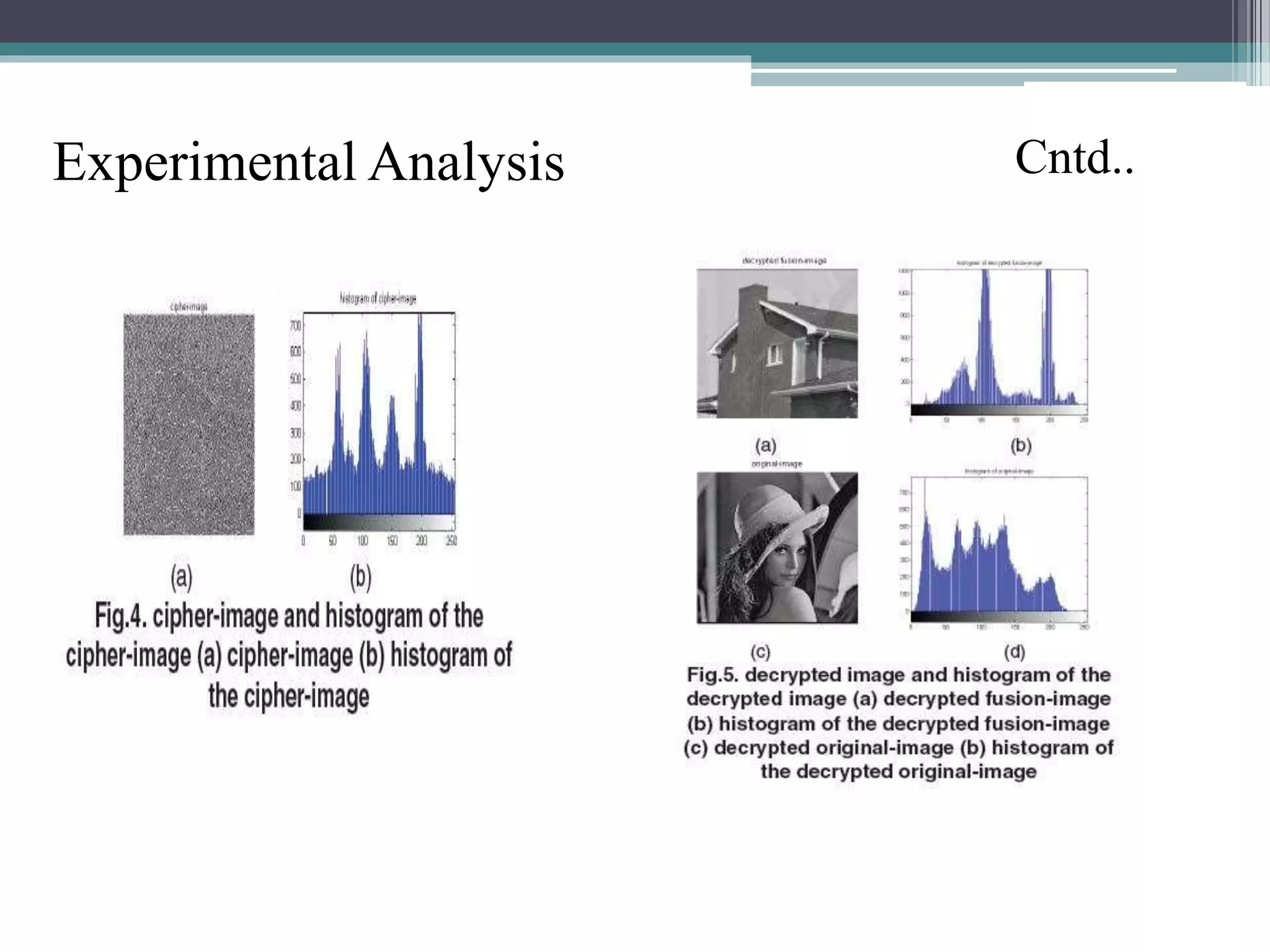
Cntd..Experimental Analysis
Security Analysis A good encryption scheme should be sensitive to the secret keys, and the key space should be large enough to make brute-force attacks infeasible. In our encryption algorithm, the key-image and the initial values of Henon chaotic map are used as secret keys. The key space is large enough to resist all kinds of brute-force attacks. The experimental results also demonstrate that our scheme is very sensitive to the secret key mismatch.
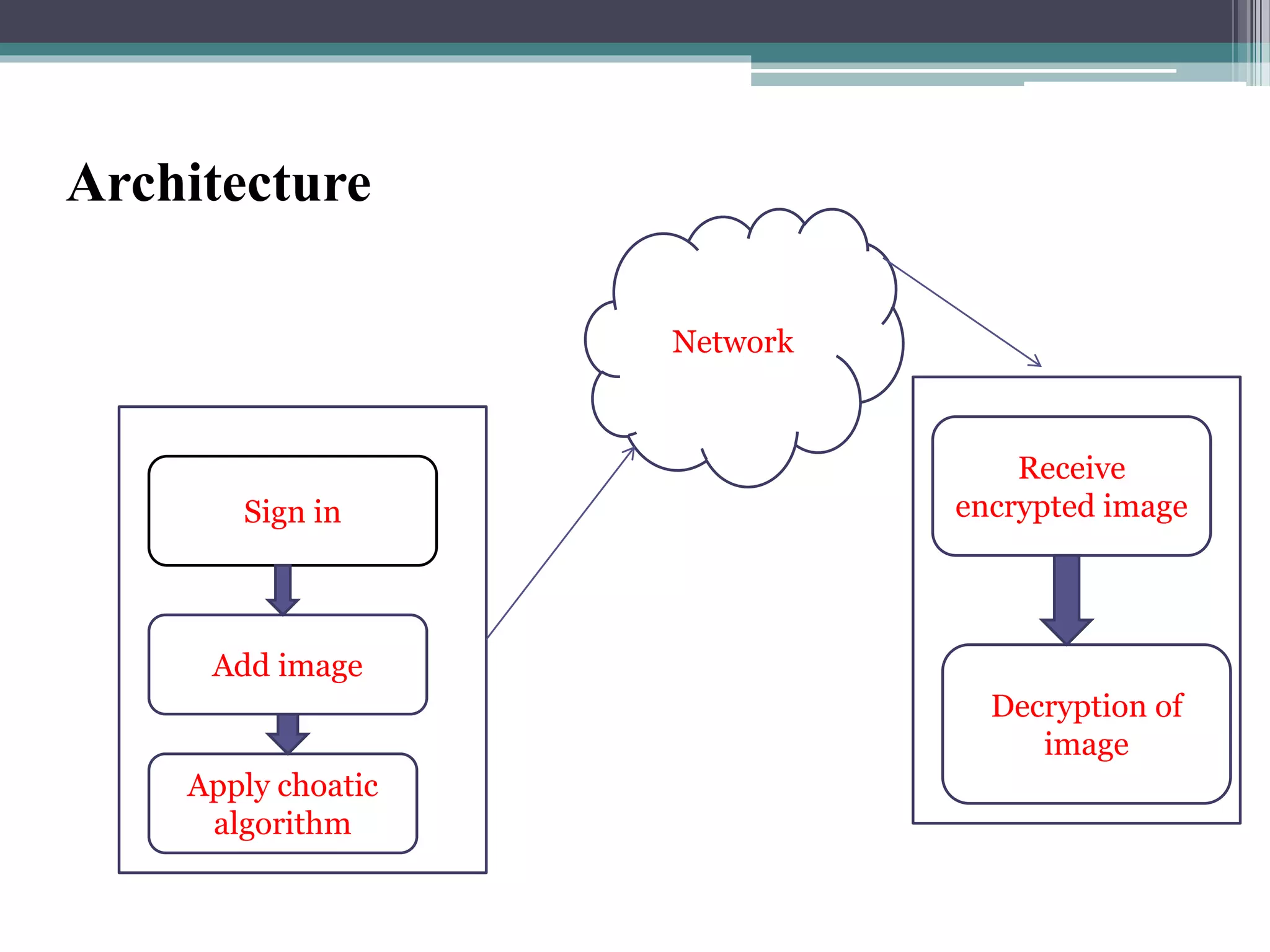
Architecture Sign in Add image Apply choatic algorithm Network Receive encrypted image Decryption of image
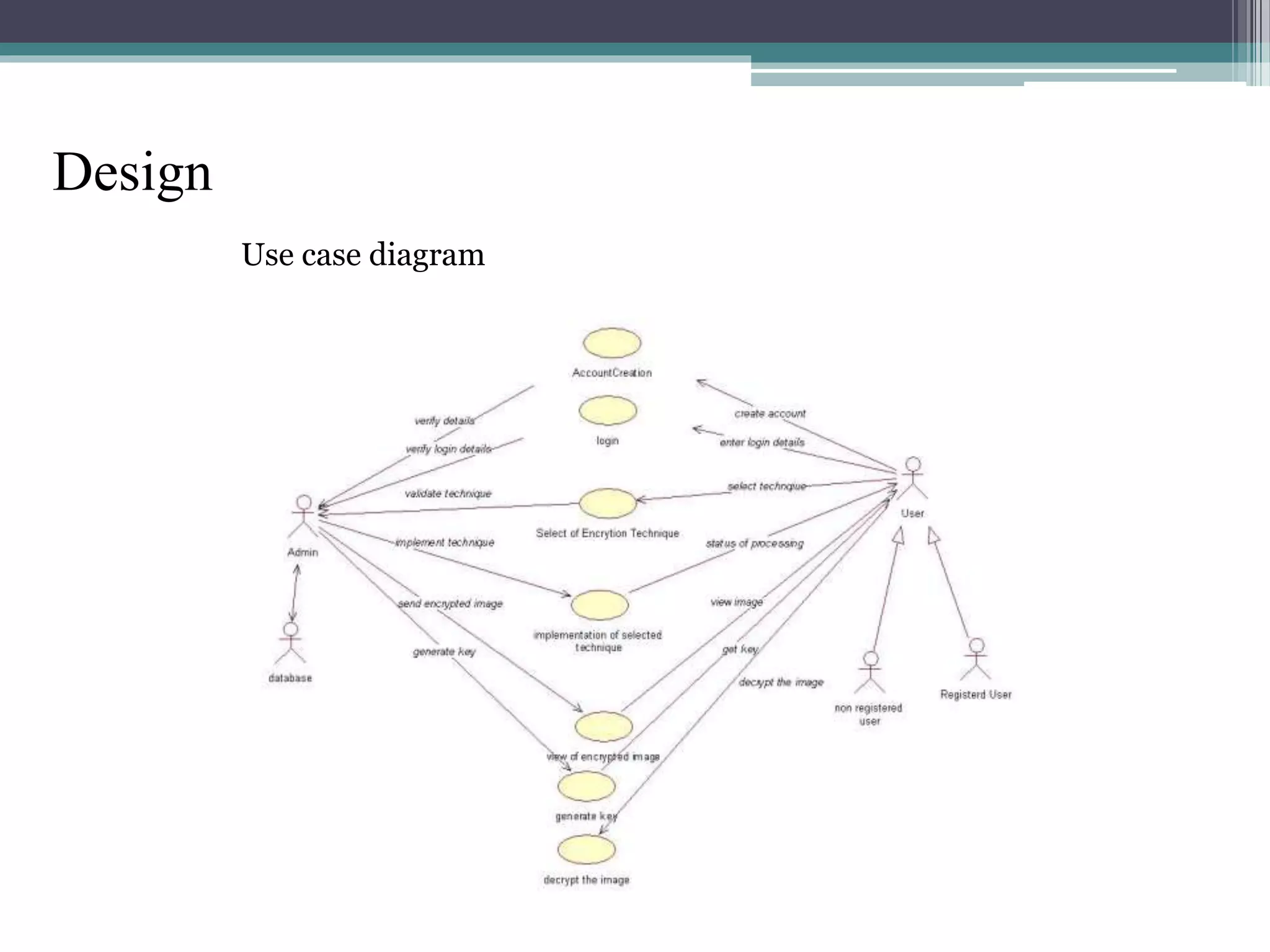
Design Use case diagram
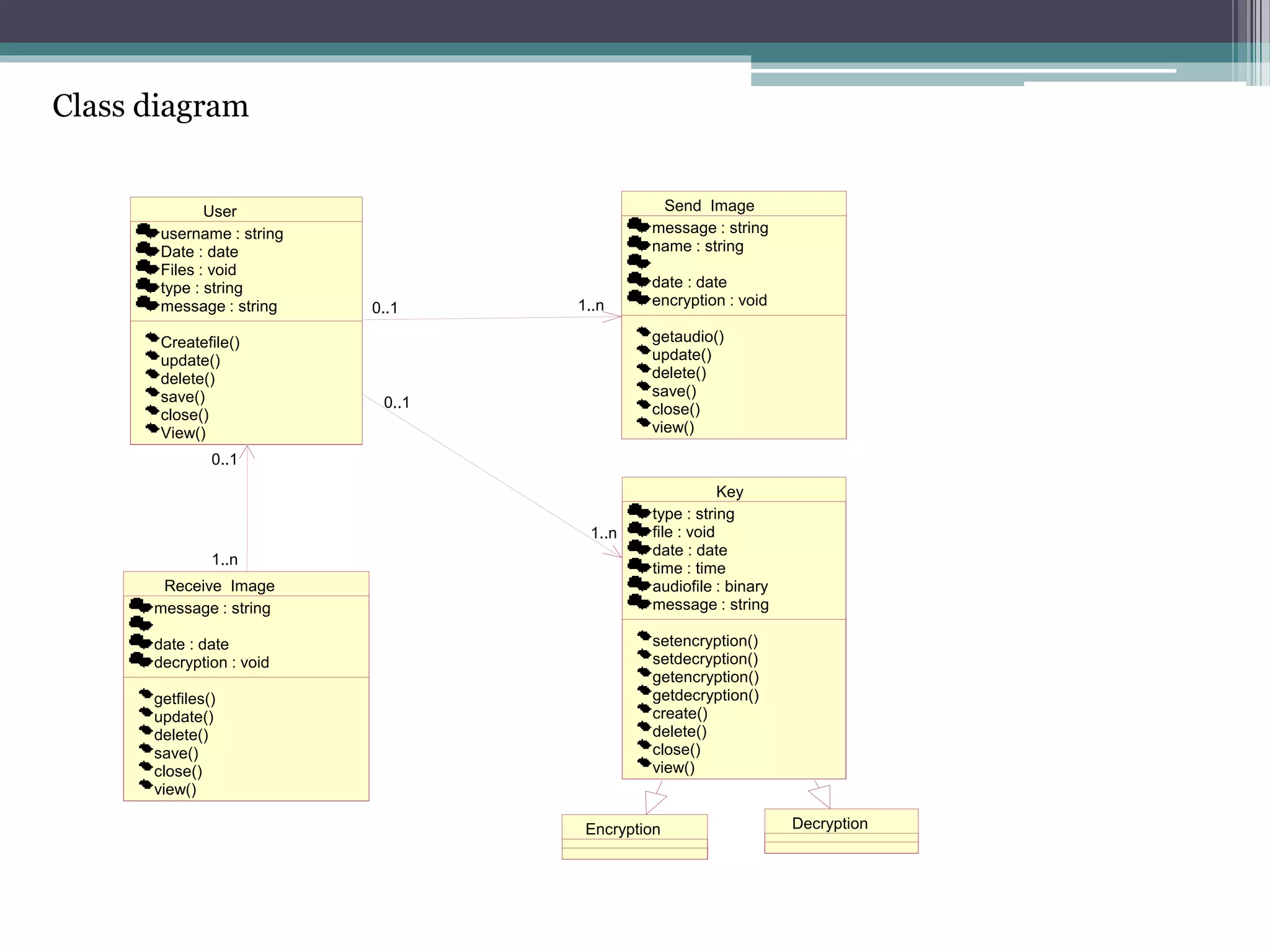
Class diagram User username : string Date : date Files : void type : string message : string Createfile() update() delete() save() close() View() Send Image message : string name : string date : date encryption : void getaudio() update() delete() save() close() view() Receive Image message : string date : date decryption : void getfiles() update() delete() save() close() view() Key type : string file : void date : date time : time audiofile : binary message : string setencryption() setdecryption() getencryption() getdecryption() create() delete() close() view() Encryption Decryption 0..1 1..n 1..n 0..1 0..1 1..n
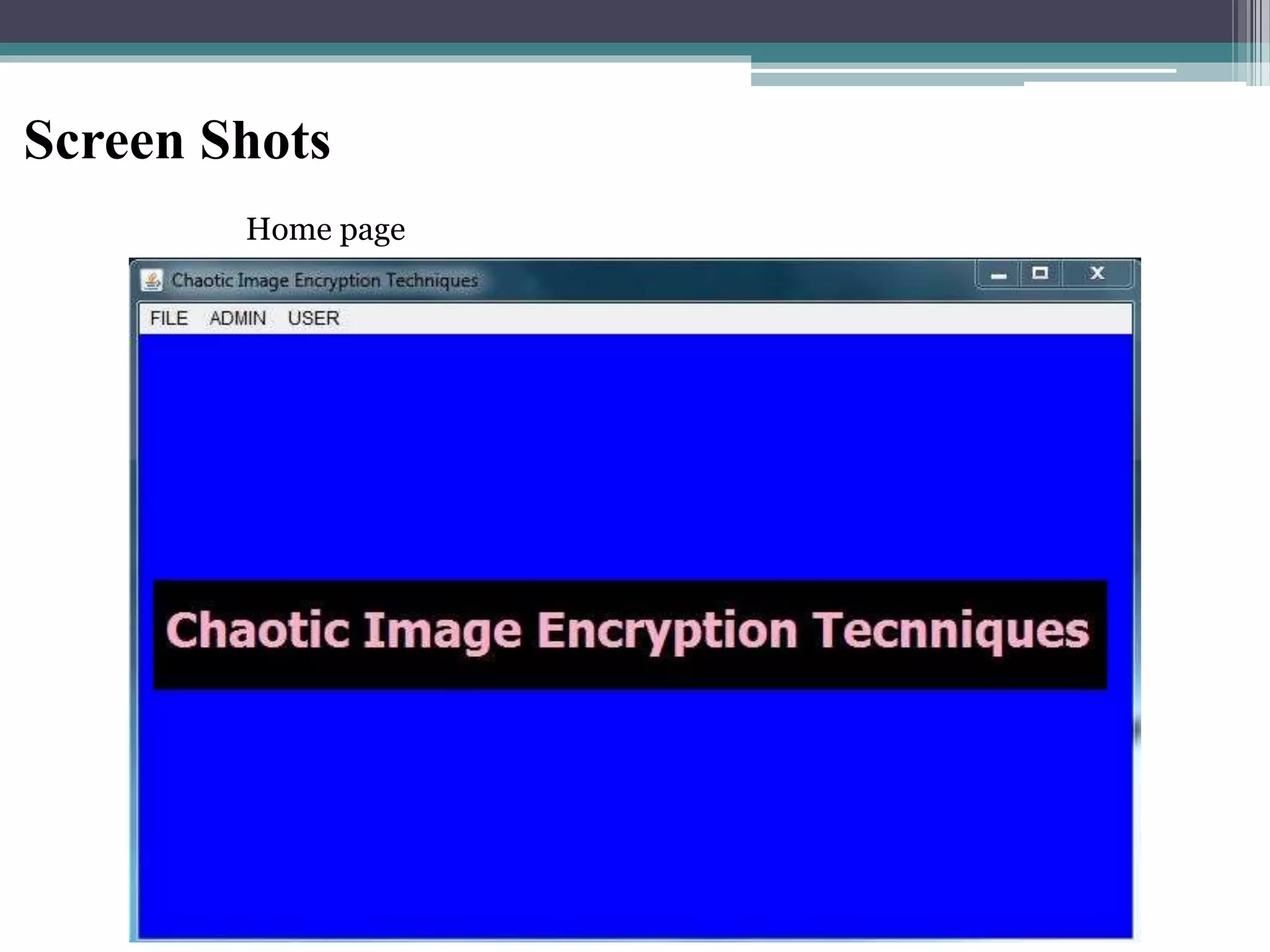
Screen Shots Home page
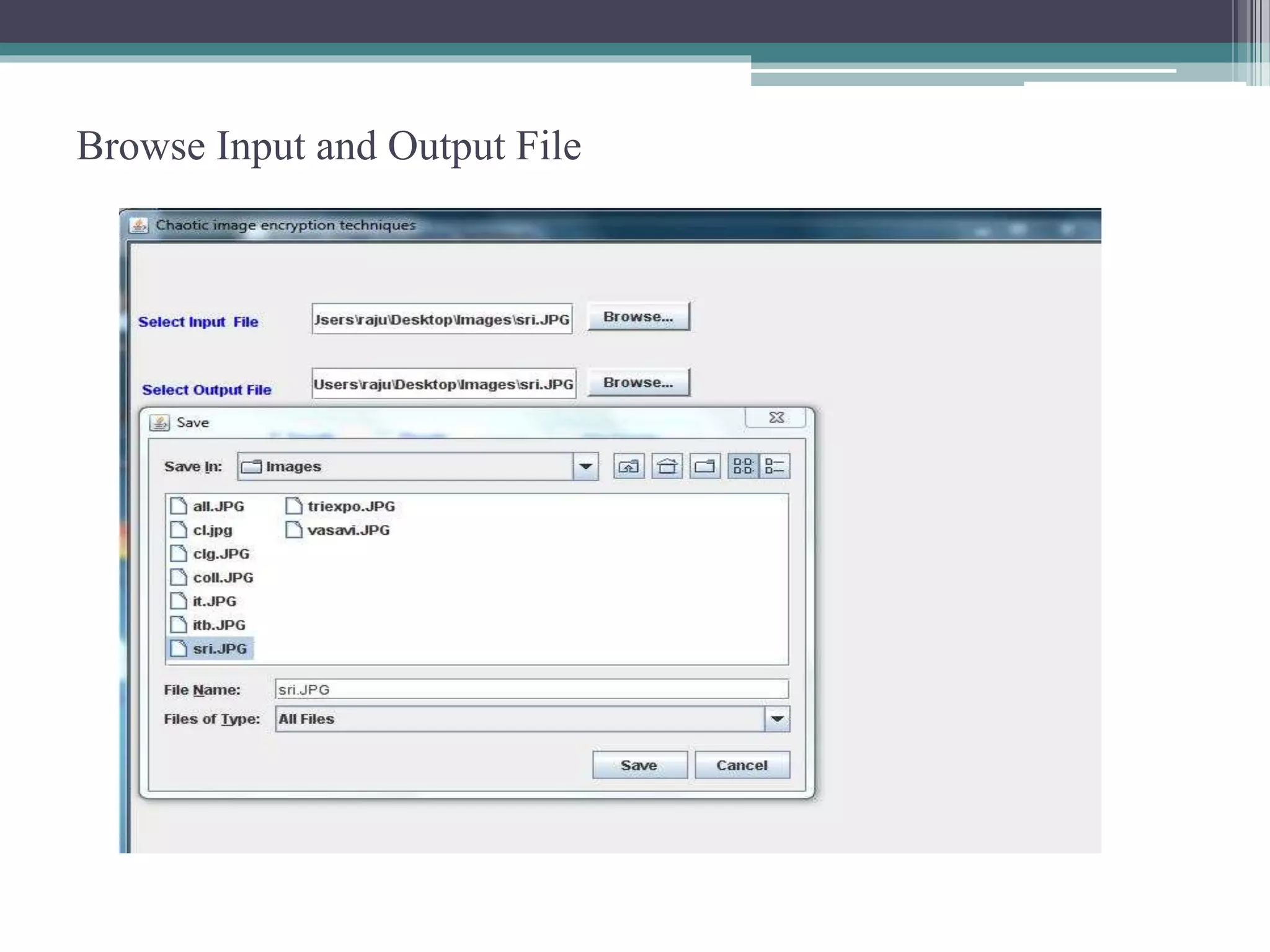
Browse Input and Output File
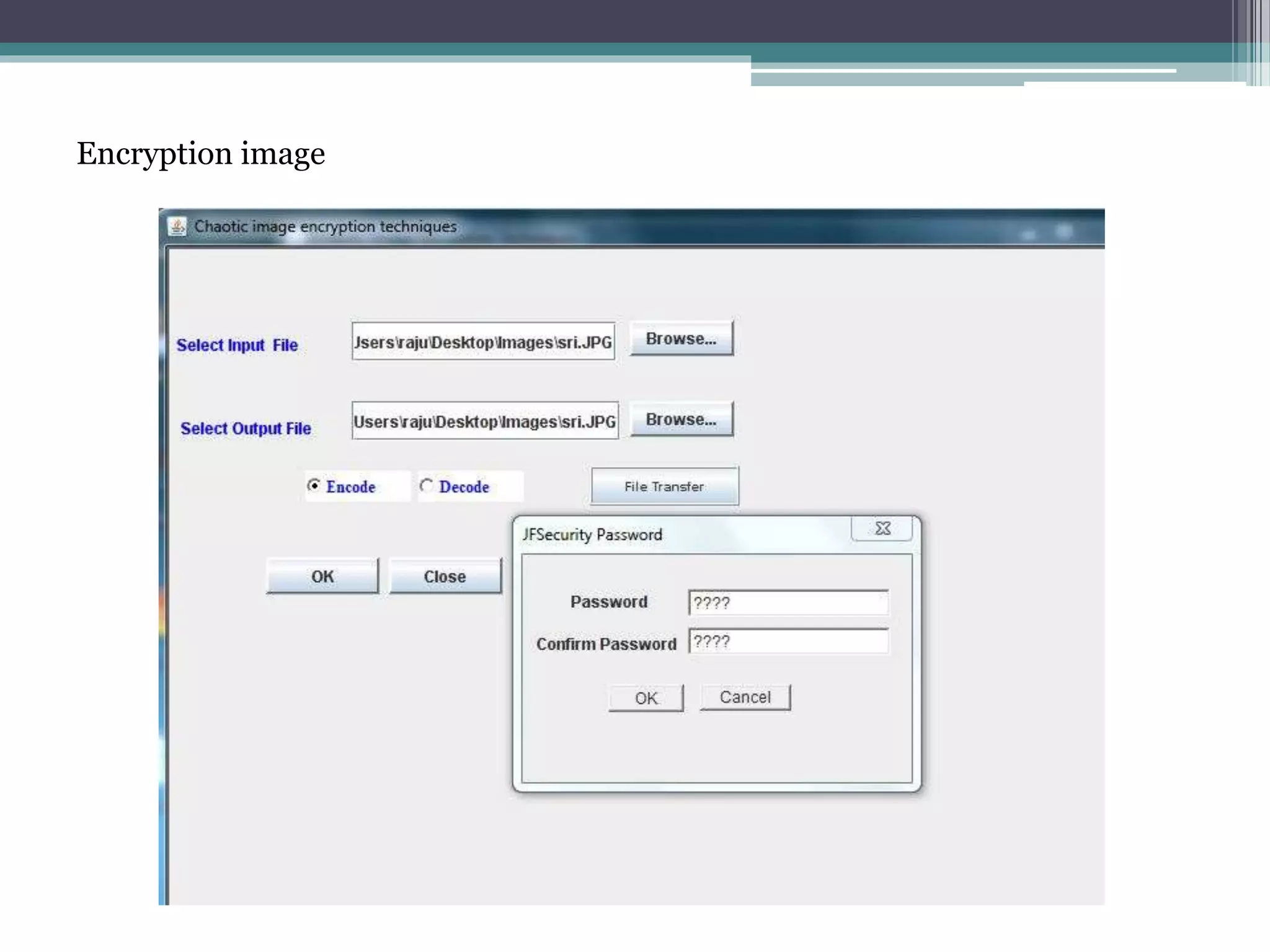
Encryption image
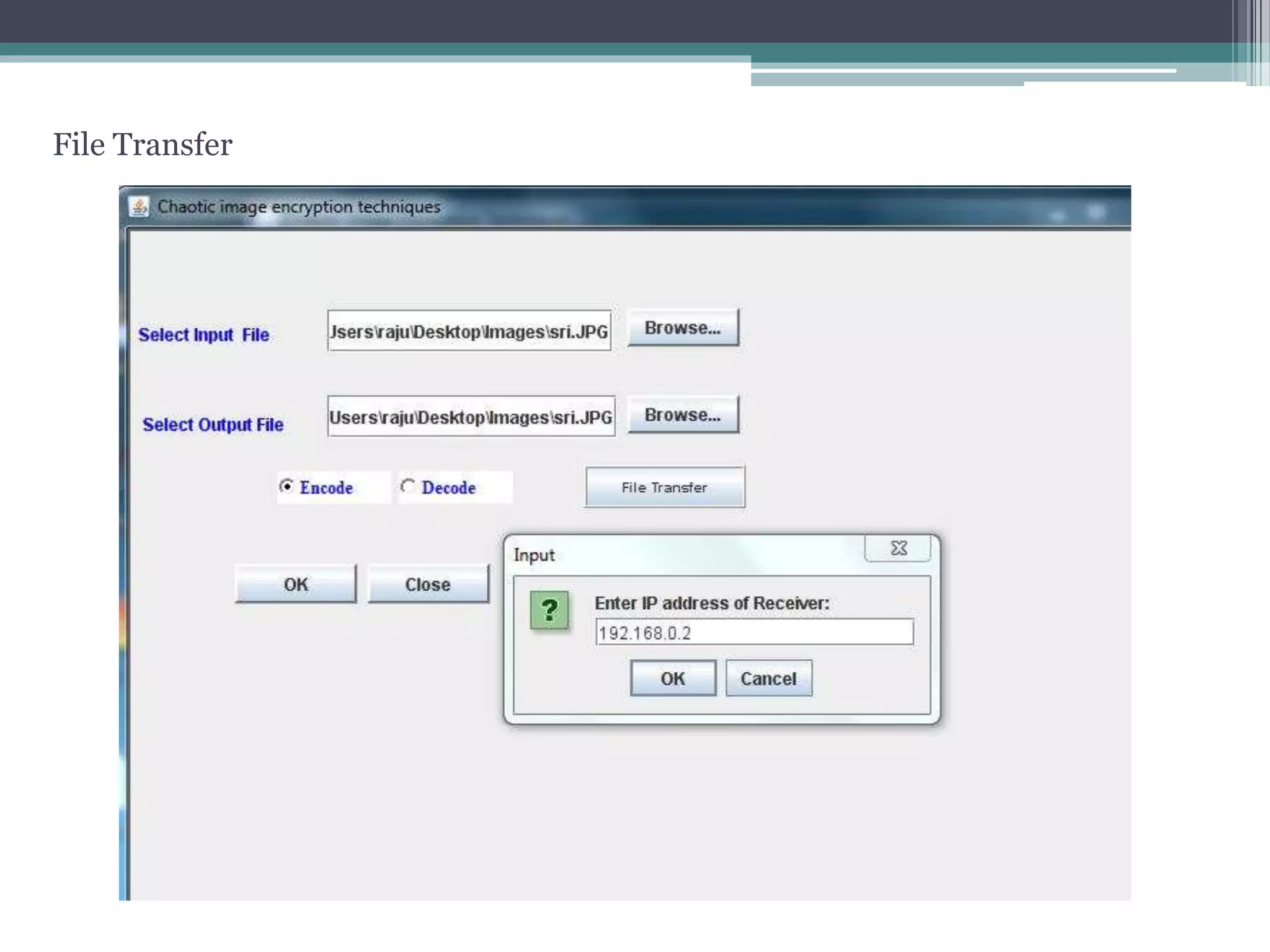
File Transfer
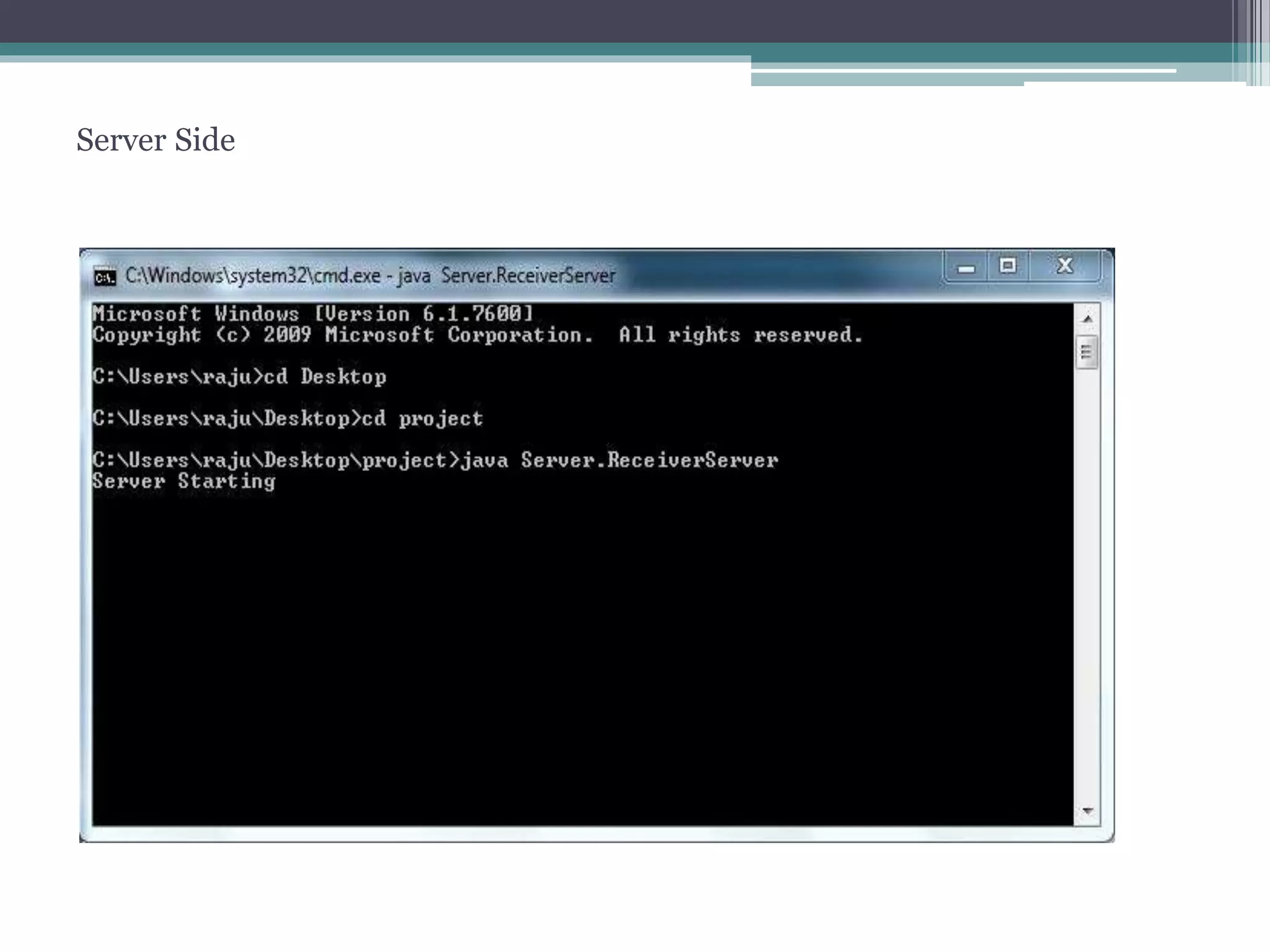
Server Side
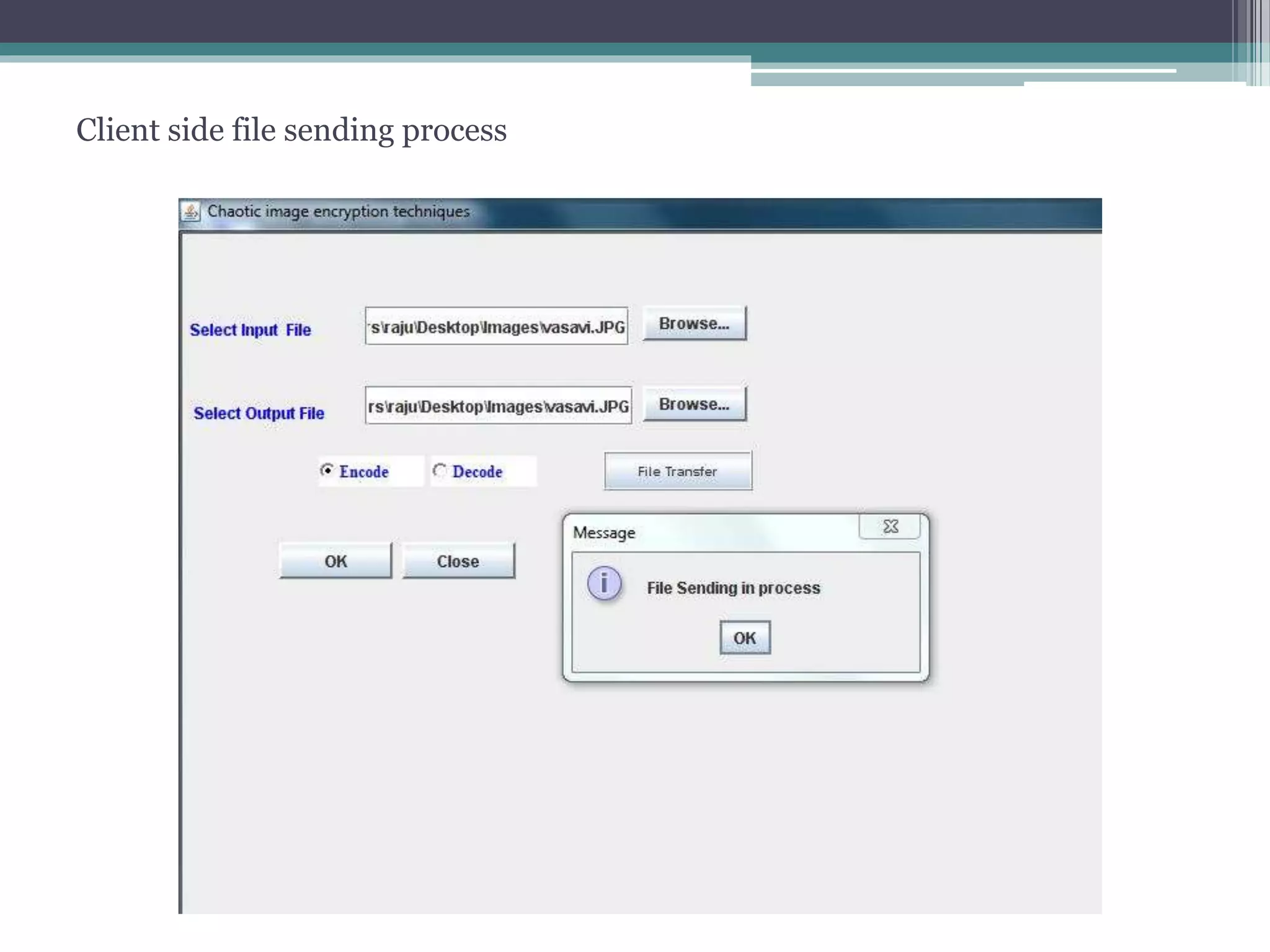
Client side file sending process
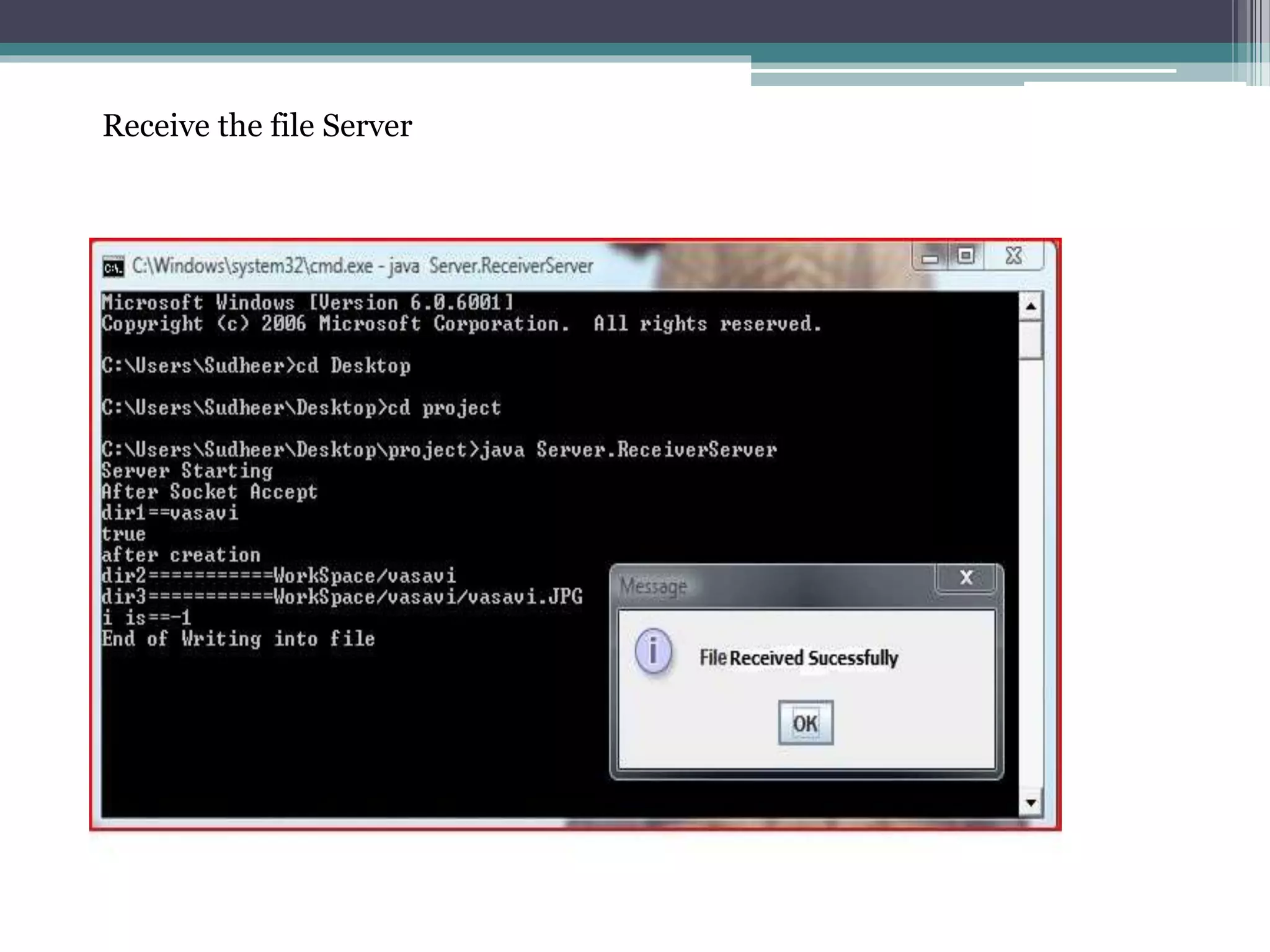
Receive the file Server
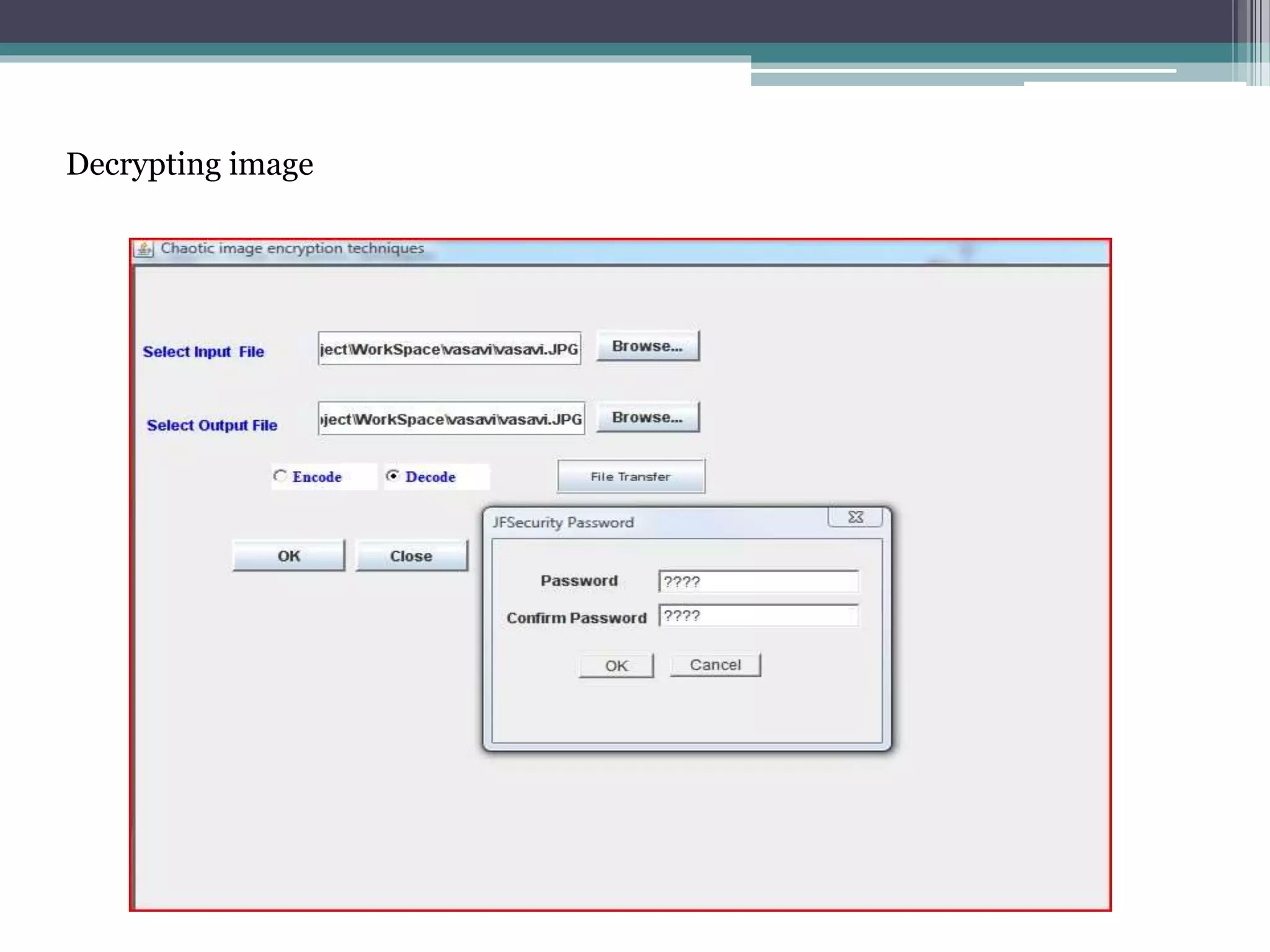
Decrypting image
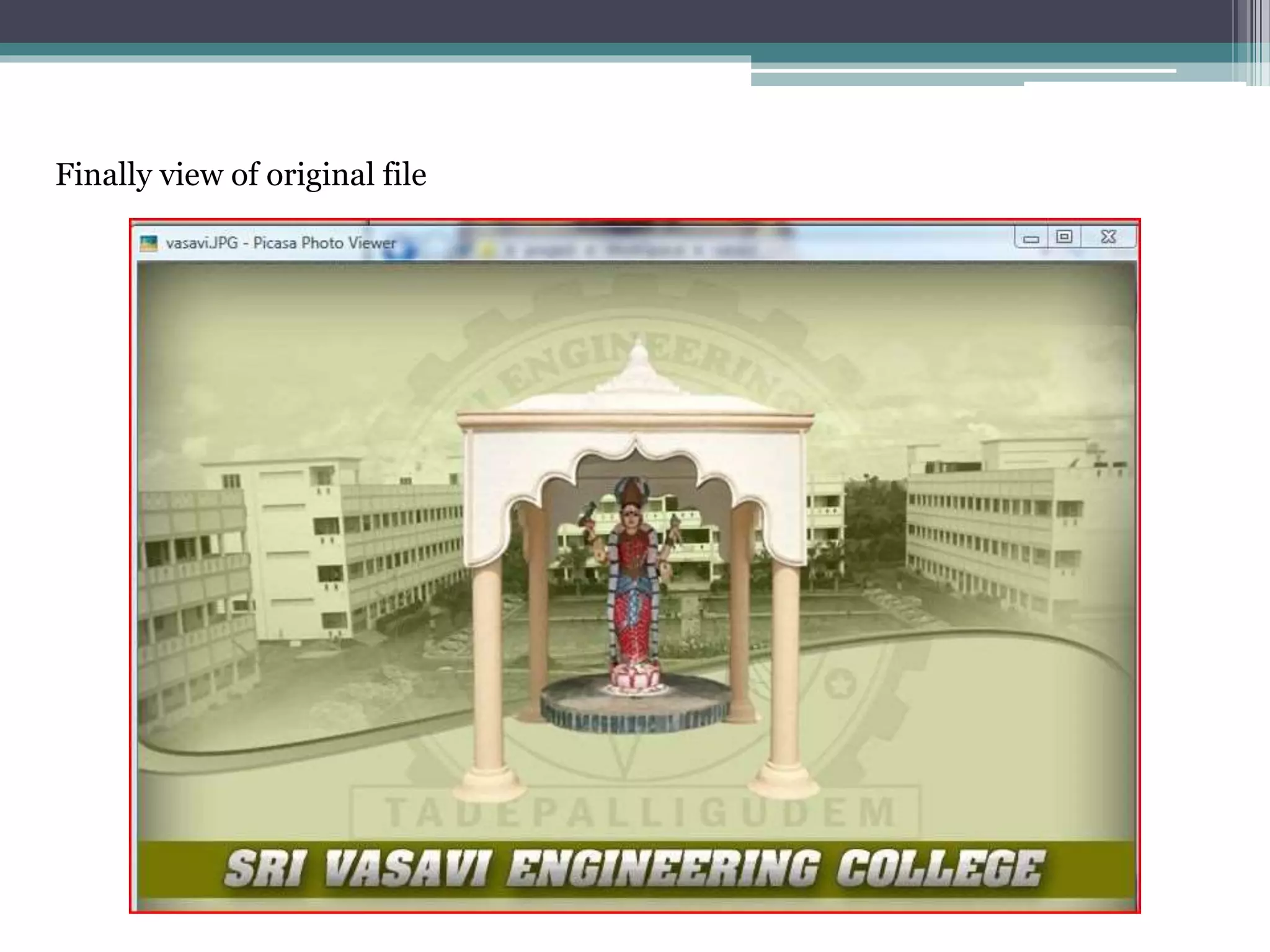
Finally view of original file
Applicability This encryption scheme is suitable for applications like Internet image encryption secure transmission of confidential information in the Internet.
Conclusion  The proposed algorithm has three merits: The proposed algorithm has three merits: o The algorithm has a large enough key space to resist all kinds of brute force attack. o The cipher-image has a good statistical property o The encryption algorithm is very sensitive to the secret keys. o provides high security level o less computational time o Both reliable and efficient way to deal with balky, difficult and intractable data  The only disadvantage is that the application should be at both the sender and receiver in network system.
References  Xiao D, Liao X, Wong K, An efficient entire chaosbased scheme for deniable authentication, Chaos, Solitons & Fractals 23(2005):1327–1331.  Tang G, Liao X, Chen Y, A novel method for designing S-boxes based on chaotic maps, Chaos, Solitons & Fractals 23(2005):413– 419.  www.ieee.org
Image Encryption in java ppt.

Image Encryption in java ppt.

  • 1.
    By: Batch-17 Pradeep Surapaneni Raju Kommula. Underthe Guidance of: K V Muthyalu Chaotic Image Encryption Techniques A project seminar on With the Co-ordination of: MD Mir Khasim
  • 2.
    Contents  Abstract  Introduction Objective  Modules  Requirements  Existing System  Proposed System  Experimental Analysis  Security Analysis  Architecture  Design  Screen Shots  Applicability  Conclusion
  • 3.
    Abstract  In thispaper, we will provide an overview of the mechanisms used in image protection, especially Chaos-based encryption techniques available today. We will see how previously proposed methods such as Data Encryption Standard (DES), Triple Data Encryption Standard (Triple-DES), and International Data Encryption Algorithm (IDEA) have been applied in image protection domain and how new concepts of Chaos-based encryption techniques are superior to traditional methods.  The chaotic system is rich in significance and in implication because of sensitivity to change initial conditions, control parameters, ergodicity, random-like behaviour, repeated processing and very high diffusion and confusion properties that are desirable for cryptography.
  • 4.
    Introduction  Advances inspace science, data analysis, and communication technologies present new opportunities for users  The chaotic system was a new innovation because it can change To increase productivity Reduce costs Facilitate innovation and Create virtual collaborative environments for addressing the new challenges. Initial conditions Control parameters  Ergodicity, and Very high diffusion and Confusion properties that are desirable for Cryptography.
  • 5.
    Objective  The mainObjective was to provide a Image encryption mechanism which provides high security level, less computational time and power in reliable and efficient way to deal with balky, difficult and intractable data.
  • 6.
    Modules  Administrative o Maintainsthe user accountability o Controls the user activities  Encryption Module o Selects the image o Providing key for Encryption  Decryption Module o Enter the key for Decryption File Transfer Module Which transfer file in Networking
  • 7.
    Requirements Hardware Requirements – Processer: Pentium IV 2.0 GHz and above Hard Disk : 10 GB RAM : 256 MB Software Requirements - Operating System : Windows IDE : My Eclipse Frontend : J2EE Coding Language : Java Backend : My SQL Other Technology : Tomcat Server
  • 8.
    Existing System  Thereare traditional image encryption techniques like DES, Triple-DES and IDEA. Limitations • requires large data size • long computational time • high computing power. • not suitable for practical image encryption and for online communications
  • 9.
    Proposed System  Theconventional cryptographic algorithms are mainly based on discrete mathematics.  chaos-based cryptography is relied on the complex dynamics of nonlinear systems . The image encryption algorithm includes two steps:  Firstly, the image fusion is completed between the original-image and the key-image.  Then the pixel values of the fusion image are encrypted by Henon chaotic system.
  • 10.
    Image fusion  Graphicsfusion technique can be used in image fusion. According to the image pixel, image fusion can be completed between the same size images. Image fusion is described as following: E(i, j)=w ×(K(i, j)-O(i, j))+O(i, j) Where w is parameter, K(i, j) is the pixel values of the key-image ,O(i, j) is the pixel values of the original-image, and E(i, j) is the pixel values of the fusion-image.
  • 11.
    Encryption by Henonchaotic Algorithm  In our scheme, Henon chaotic system is adopted to encrypt the fusion- image.  Step1: The Henon chaotic system is converted into one-dimensional chaotic map which is defined as: Xi+2=1-aX2i+1+bxi Where a = 0.3 , b∈[1.07,1.4] .The parameter a , the parameter b , initial value x0 and initial value x1 may represent the key.  Step2: Set encryption key for the fusion-image, including structural parameters a , b and initial values x0 ,x1 . After image fusion, we adopt Henon chaotic map to change the pixel values of the fusion-image.
  • 12.
  • 13.
  • 14.
    Security Analysis A goodencryption scheme should be sensitive to the secret keys, and the key space should be large enough to make brute-force attacks infeasible. In our encryption algorithm, the key-image and the initial values of Henon chaotic map are used as secret keys. The key space is large enough to resist all kinds of brute-force attacks. The experimental results also demonstrate that our scheme is very sensitive to the secret key mismatch.
  • 15.
    Architecture Sign in Add image Applychoatic algorithm Network Receive encrypted image Decryption of image
  • 16.
  • 17.
    Class diagram User username :string Date : date Files : void type : string message : string Createfile() update() delete() save() close() View() Send Image message : string name : string date : date encryption : void getaudio() update() delete() save() close() view() Receive Image message : string date : date decryption : void getfiles() update() delete() save() close() view() Key type : string file : void date : date time : time audiofile : binary message : string setencryption() setdecryption() getencryption() getdecryption() create() delete() close() view() Encryption Decryption 0..1 1..n 1..n 0..1 0..1 1..n
  • 18.
  • 19.
    Browse Input andOutput File
  • 20.
  • 21.
  • 22.
  • 23.
    Client side filesending process
  • 24.
  • 25.
  • 26.
    Finally view oforiginal file
  • 27.
    Applicability This encryption schemeis suitable for applications like Internet image encryption secure transmission of confidential information in the Internet.
  • 28.
    Conclusion  The proposedalgorithm has three merits: The proposed algorithm has three merits: o The algorithm has a large enough key space to resist all kinds of brute force attack. o The cipher-image has a good statistical property o The encryption algorithm is very sensitive to the secret keys. o provides high security level o less computational time o Both reliable and efficient way to deal with balky, difficult and intractable data  The only disadvantage is that the application should be at both the sender and receiver in network system.
  • 29.
    References  Xiao D,Liao X, Wong K, An efficient entire chaosbased scheme for deniable authentication, Chaos, Solitons & Fractals 23(2005):1327–1331.  Tang G, Liao X, Chen Y, A novel method for designing S-boxes based on chaotic maps, Chaos, Solitons & Fractals 23(2005):413– 419.  www.ieee.org