About Me Madhu Babu Sanjeevi, Software Engineer, Languages C, Java, Python Technologies Machine Learning, Deep Learning, NLP, Big data, Mobile dev. Developments Android, Web, Rest API Databases SQL, Mongo DB Madhu Sanjeevi Madhu009 Madhu.ai
Agenda •1.Introduction of Machine learning & Deep learning •2.Various learning algorithms of ML & DL •3.Applications of ML & DL •4.Open Source tools and help •5.Deep Learning Demo
Why Machine Learning???? 1 + 1 =11 2 + 2 =22 3 + 3 =? If 1 + 2 = 10 2 + 3 = 21 7 + 8 = ? • No hard coded rules • No Code change
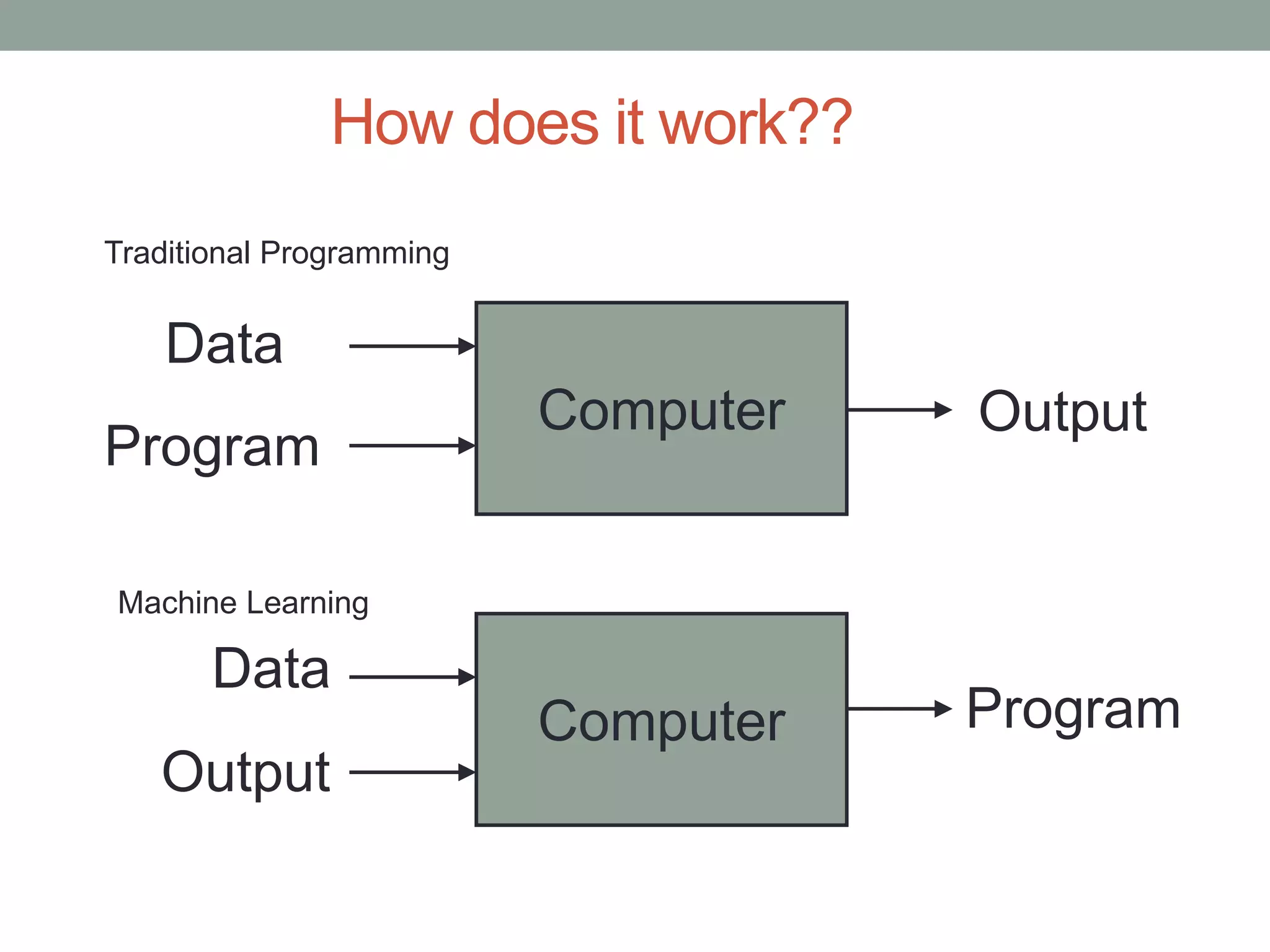
How does it work?? Computer Data Program Output Computer Data Output Program Traditional Programming Machine Learning
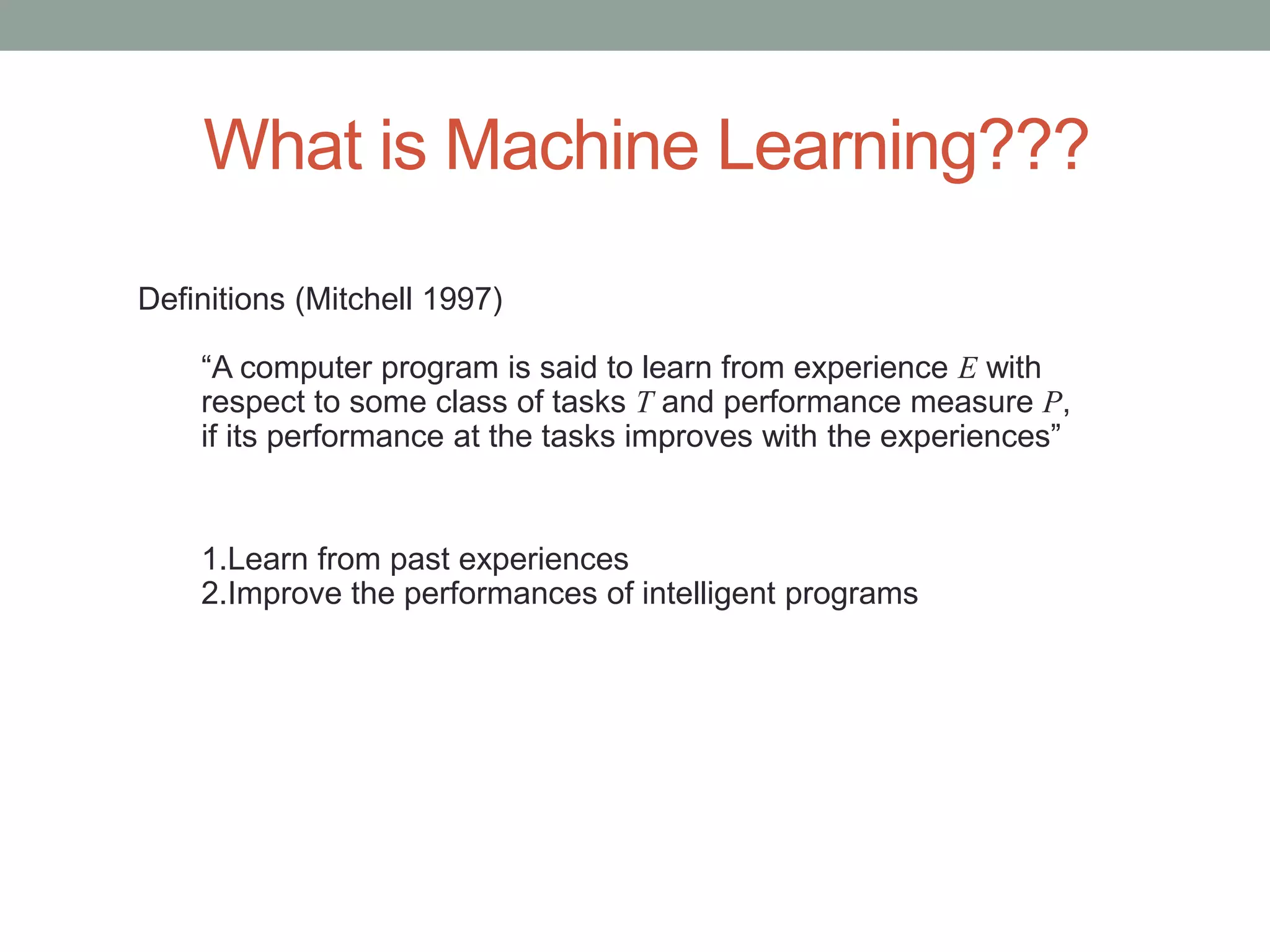
What is Machine Learning??? 1.Learn from past experiences 2.Improve the performances of intelligent programs Definitions (Mitchell 1997) “A computer program is said to learn from experience E with respect to some class of tasks T and performance measure P, if its performance at the tasks improves with the experiences”
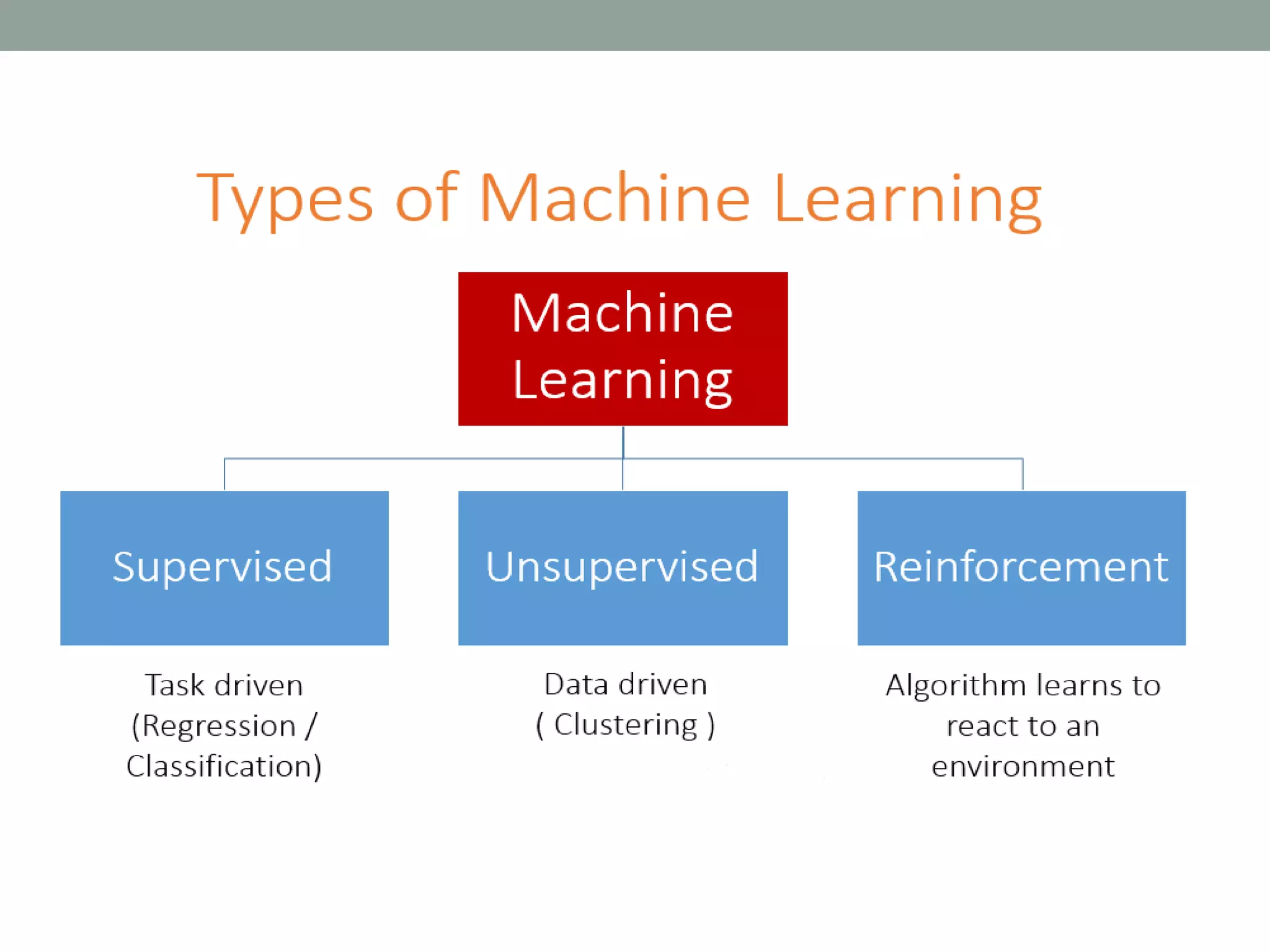
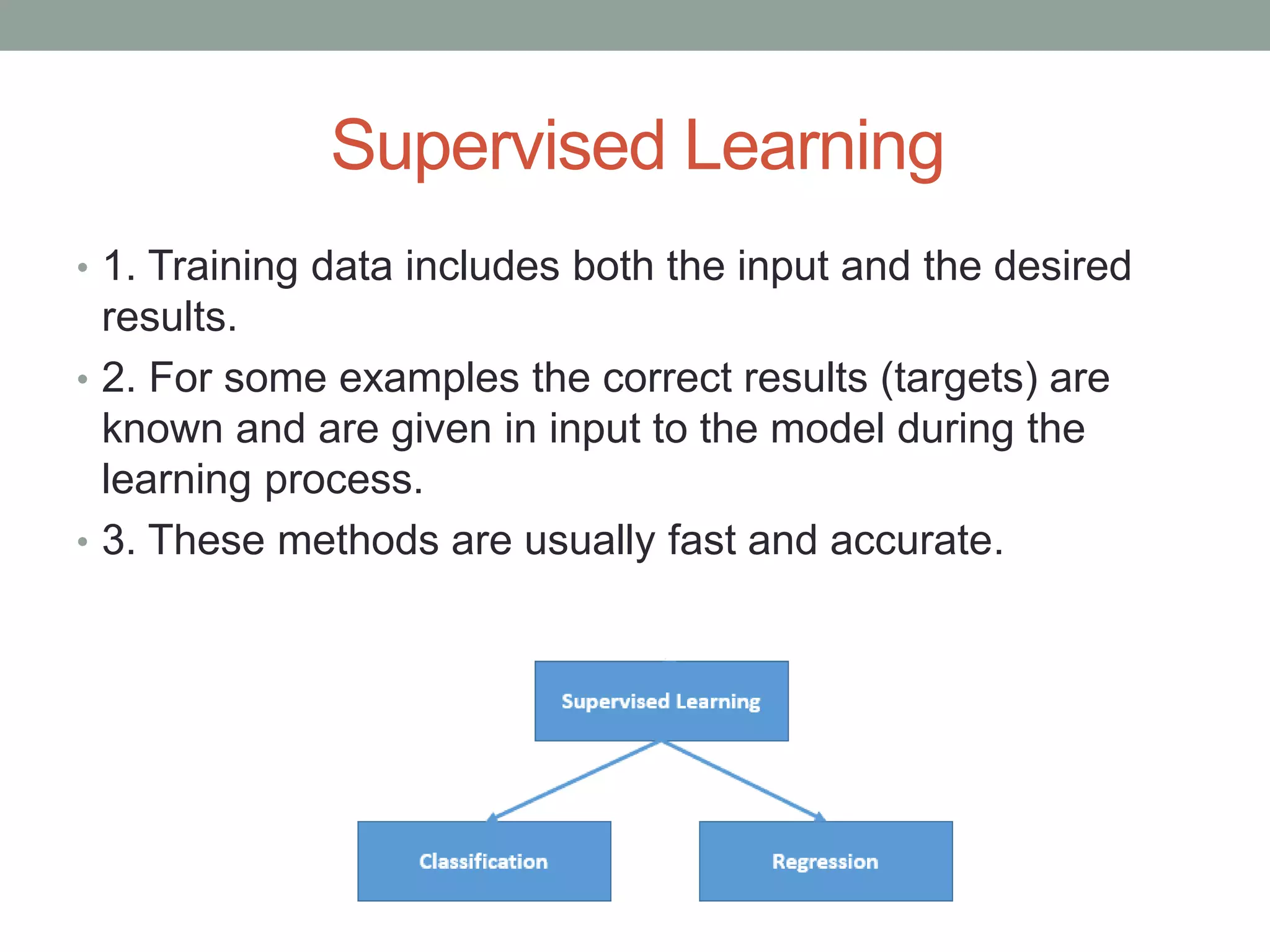
Supervised Learning • 1. Training data includes both the input and the desired results. • 2. For some examples the correct results (targets) are known and are given in input to the model during the learning process. • 3. These methods are usually fast and accurate.
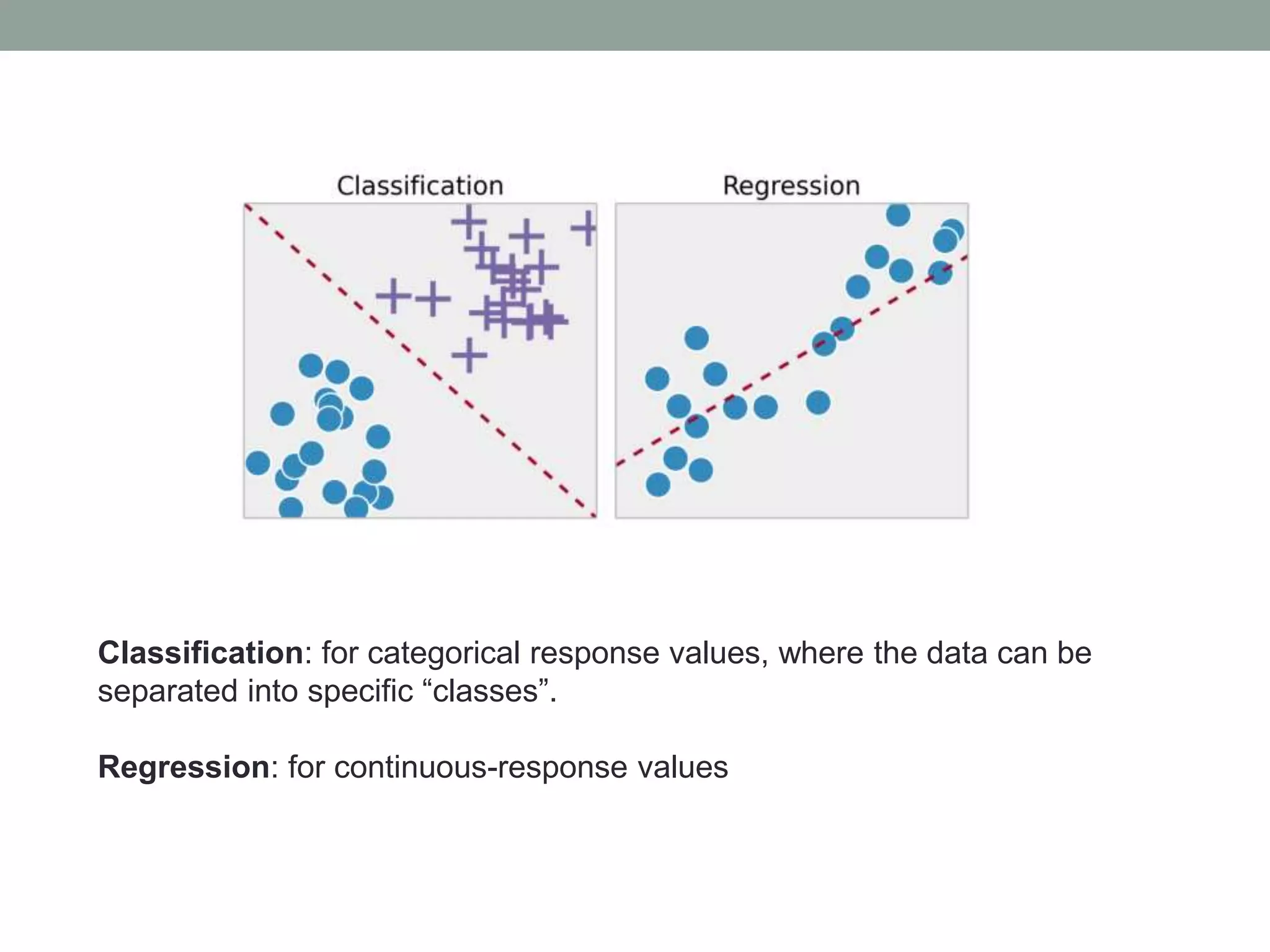
Classification: for categorical response values, where the data can be separated into specific “classes”. Regression: for continuous-response values
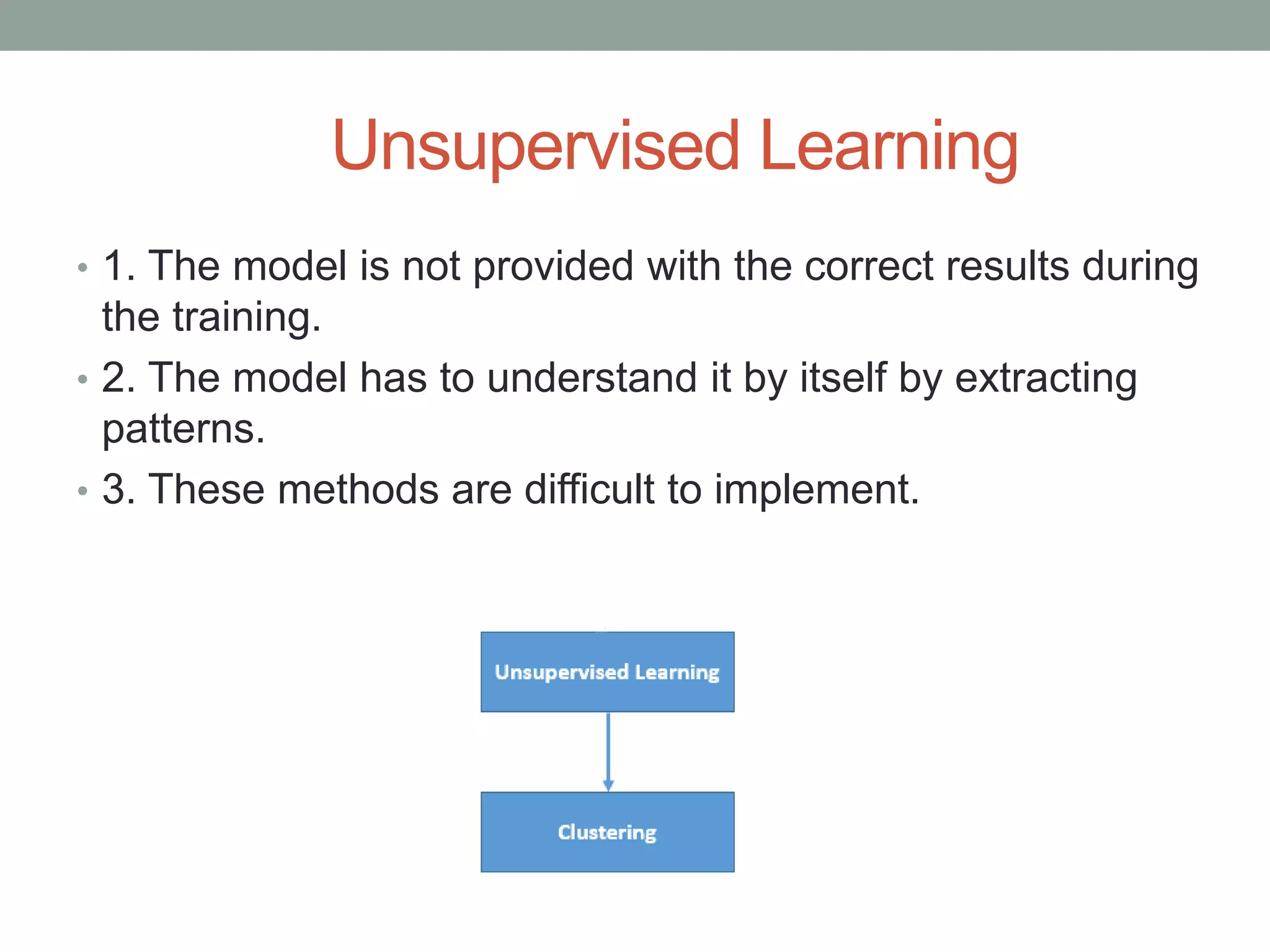
Unsupervised Learning • 1. The model is not provided with the correct results during the training. • 2. The model has to understand it by itself by extracting patterns. • 3. These methods are difficult to implement.
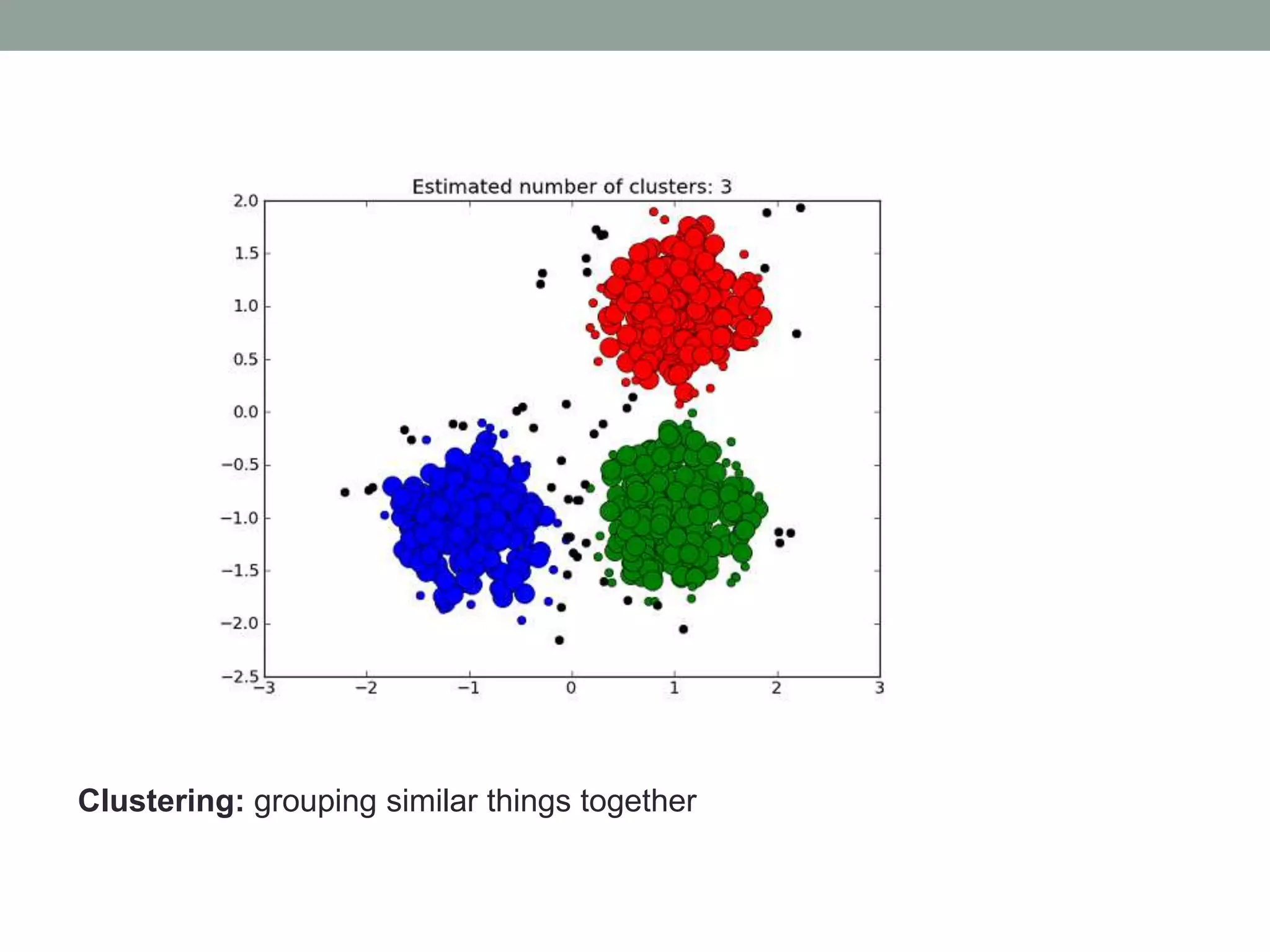
Clustering: grouping similar things together
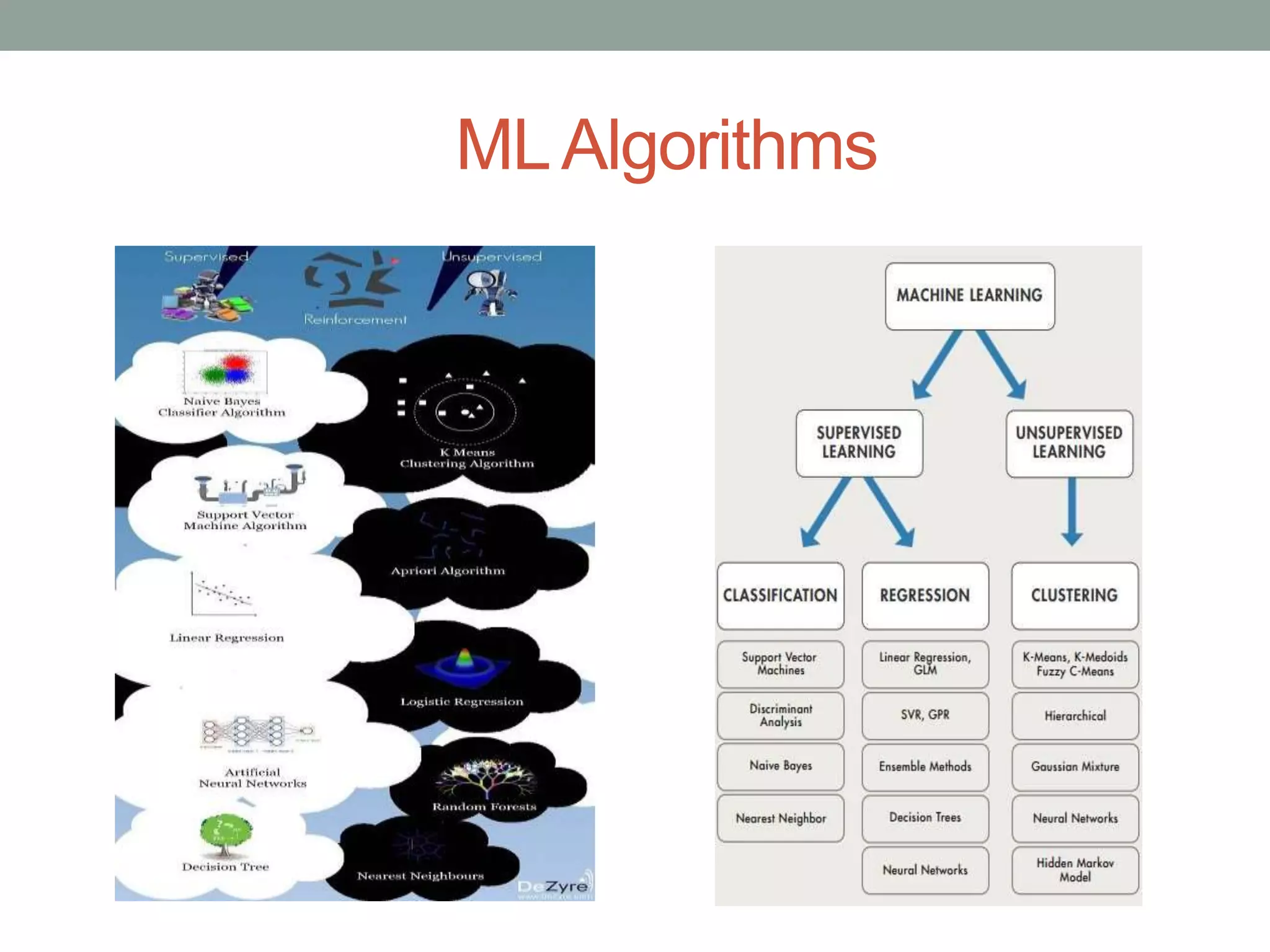
MLAlgorithms
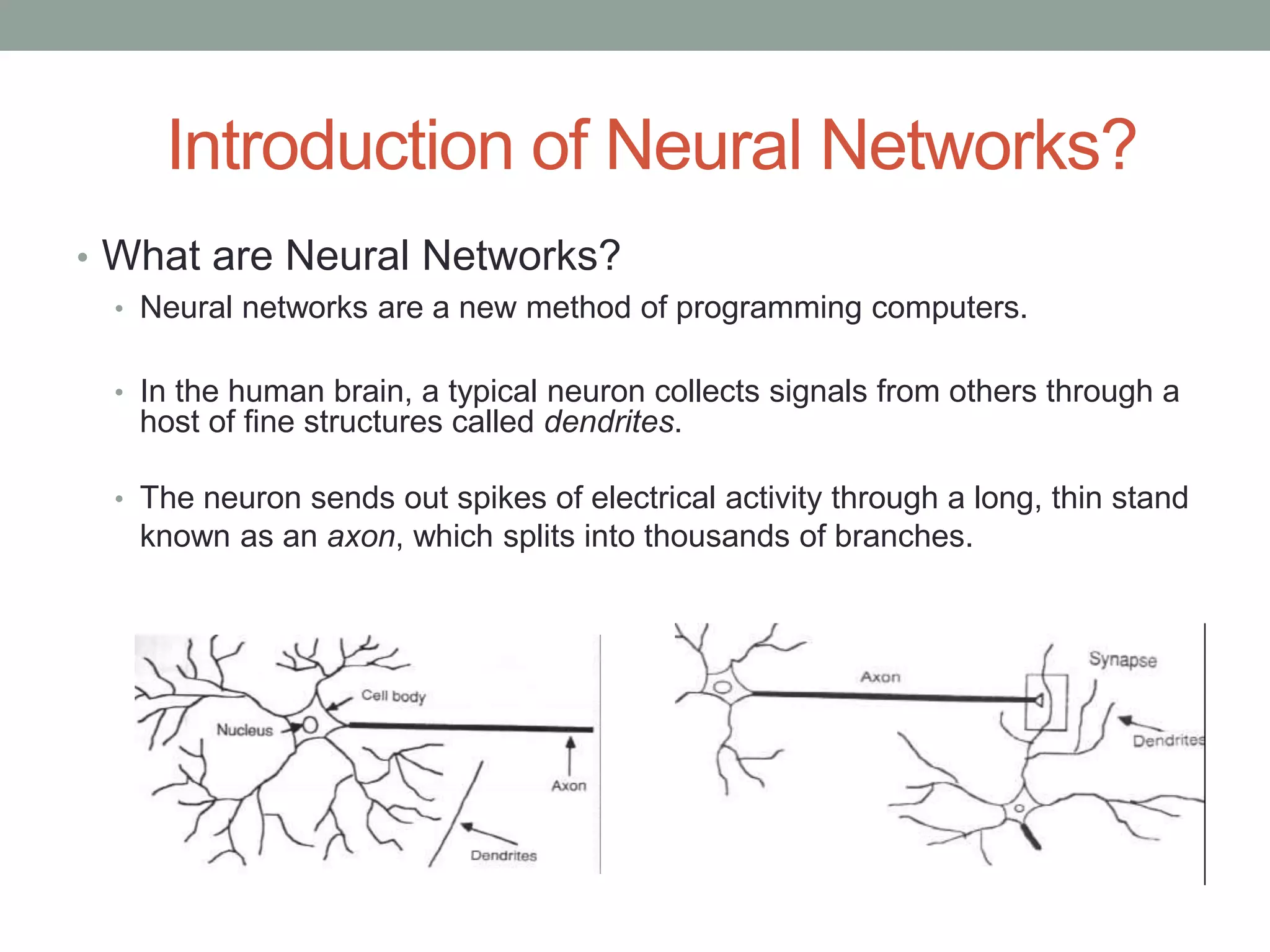
Introduction of Neural Networks? • What are Neural Networks? • Neural networks are a new method of programming computers. • In the human brain, a typical neuron collects signals from others through a host of fine structures called dendrites. • The neuron sends out spikes of electrical activity through a long, thin stand known as an axon, which splits into thousands of branches.
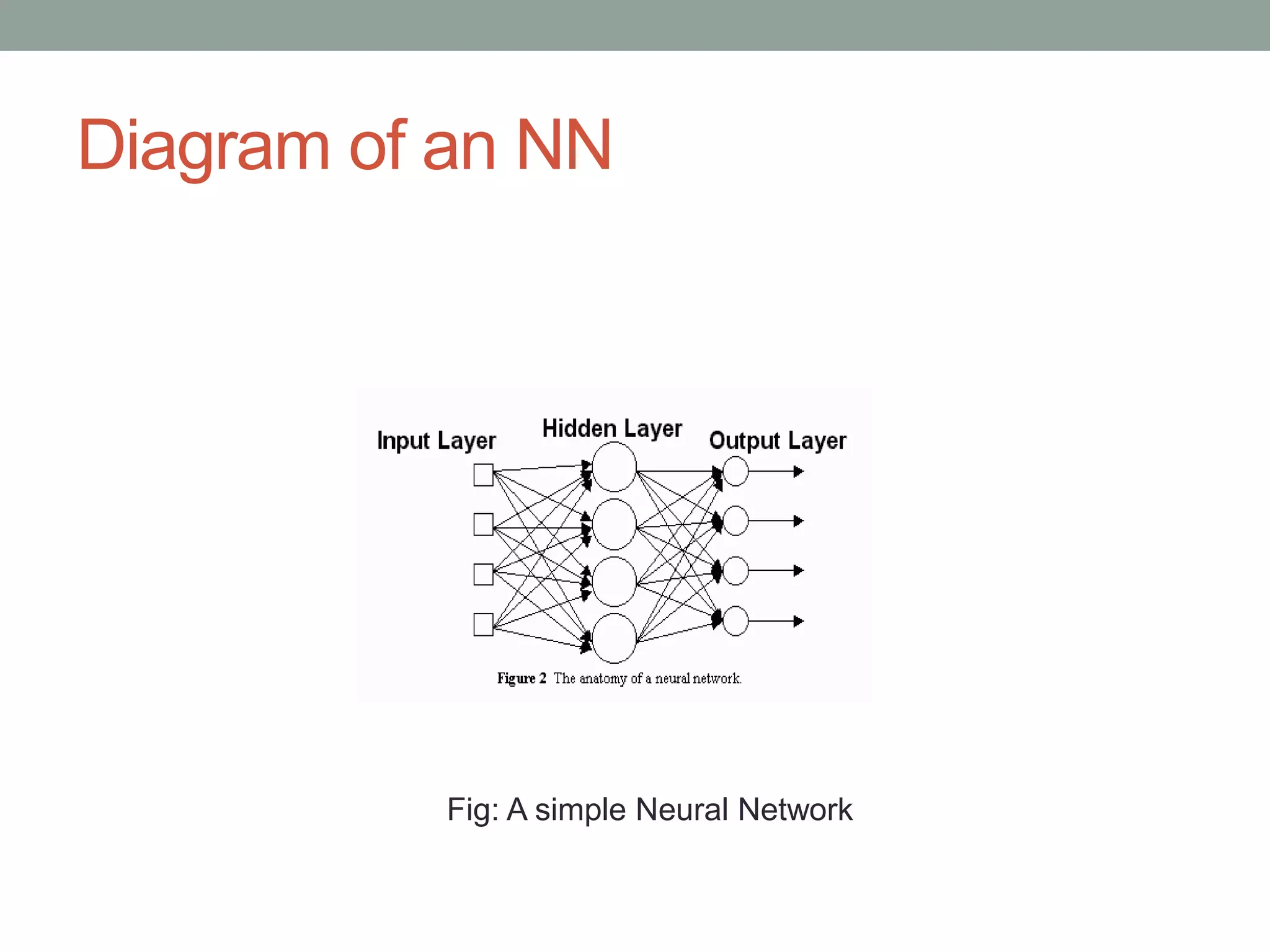
Diagram of an NN Fig: A simple Neural Network
Network Layers • Input Layer - The activity of the input units represents the raw information that is fed into the network. • Hidden Layer - The activity of each hidden unit is determined by the activities of the input units and the weights on the connections between the input and the hidden units. • Output Layer - The behavior of the output units depends on the activity of the hidden units and the weights between the hidden and output units.
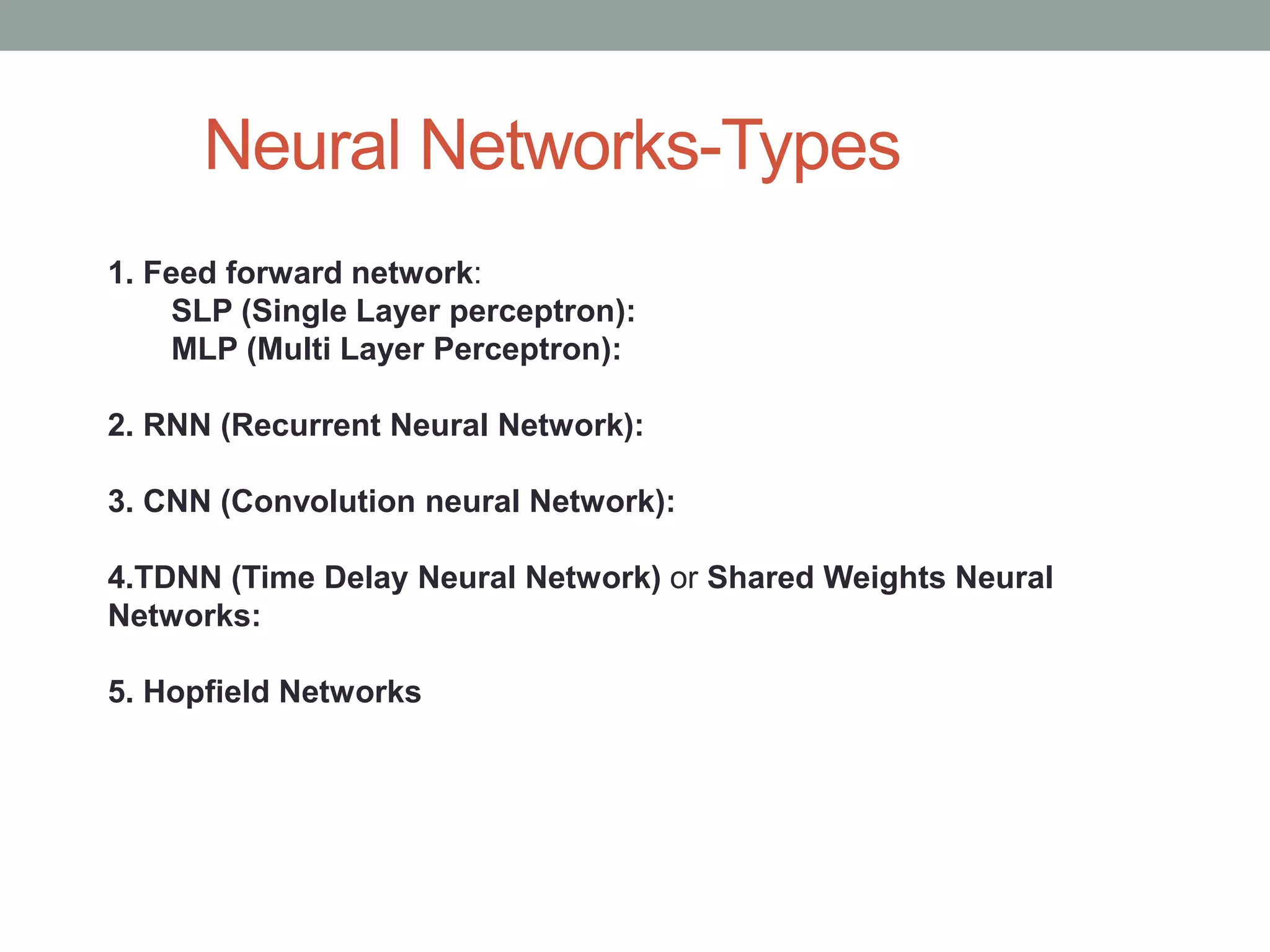
Neural Networks-Types 1. Feed forward network: SLP (Single Layer perceptron): MLP (Multi Layer Perceptron): 2. RNN (Recurrent Neural Network): 3. CNN (Convolution neural Network): 4.TDNN (Time Delay Neural Network) or Shared Weights Neural Networks: 5. Hopfield Networks
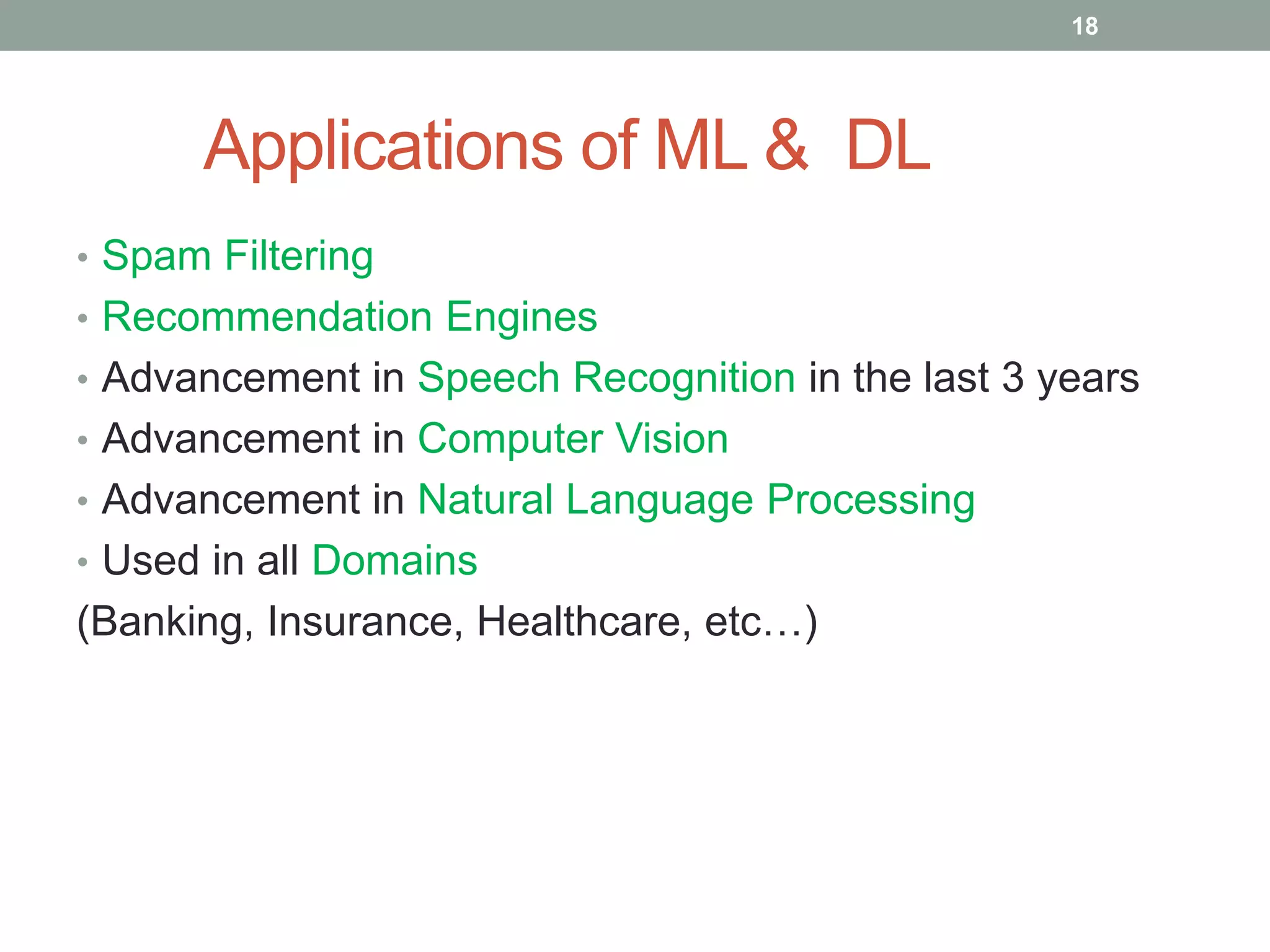
Applications of ML & DL • Spam Filtering • Recommendation Engines • Advancement in Speech Recognition in the last 3 years • Advancement in Computer Vision • Advancement in Natural Language Processing • Used in all Domains (Banking, Insurance, Healthcare, etc…) 18
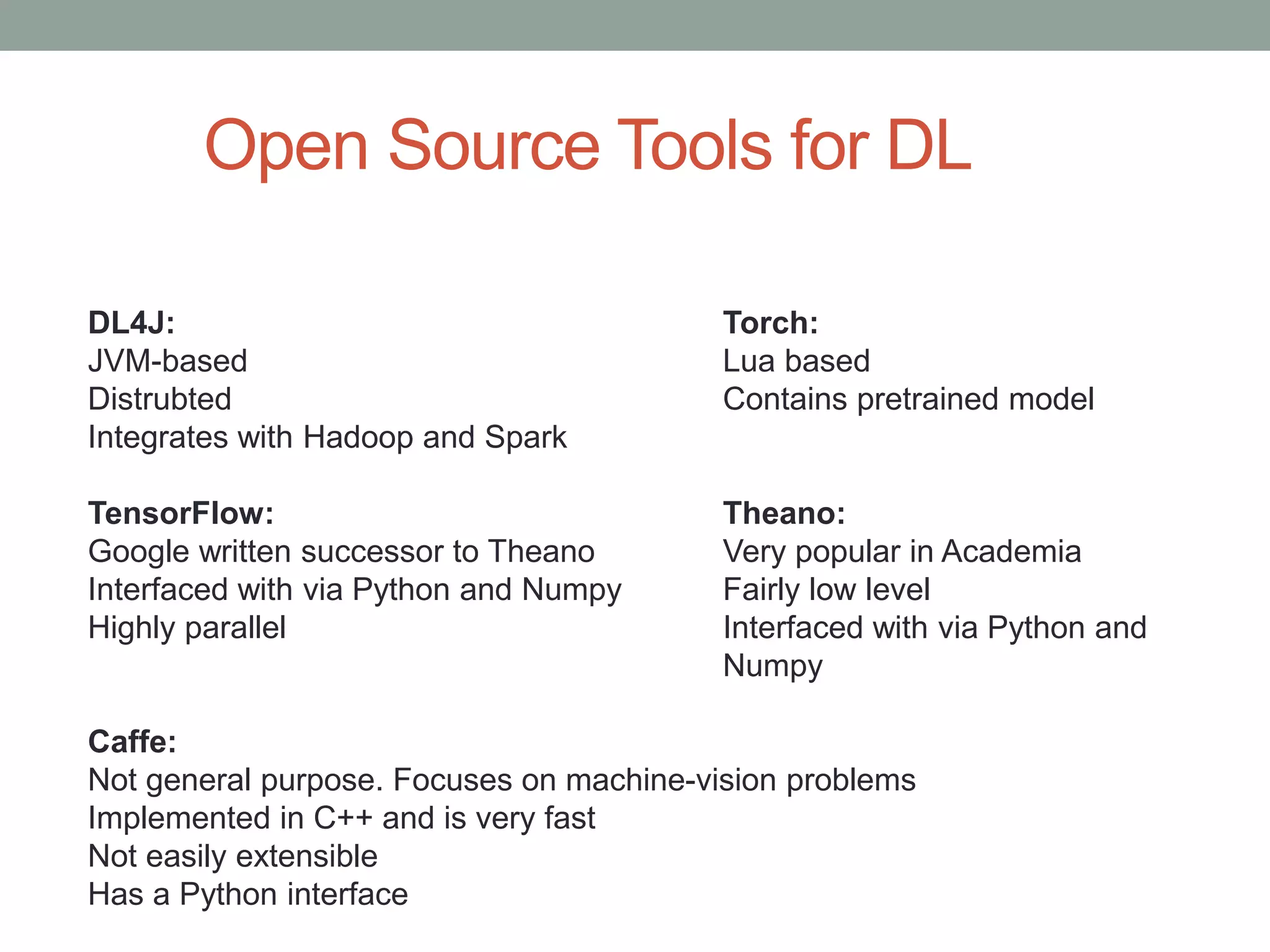
Open Source Tools for DL DL4J: Torch: JVM-based Lua based Distrubted Contains pretrained model Integrates with Hadoop and Spark TensorFlow: Theano: Google written successor to Theano Very popular in Academia Interfaced with via Python and Numpy Fairly low level Highly parallel Interfaced with via Python and Numpy Caffe: Not general purpose. Focuses on machine-vision problems Implemented in C++ and is very fast Not easily extensible Has a Python interface
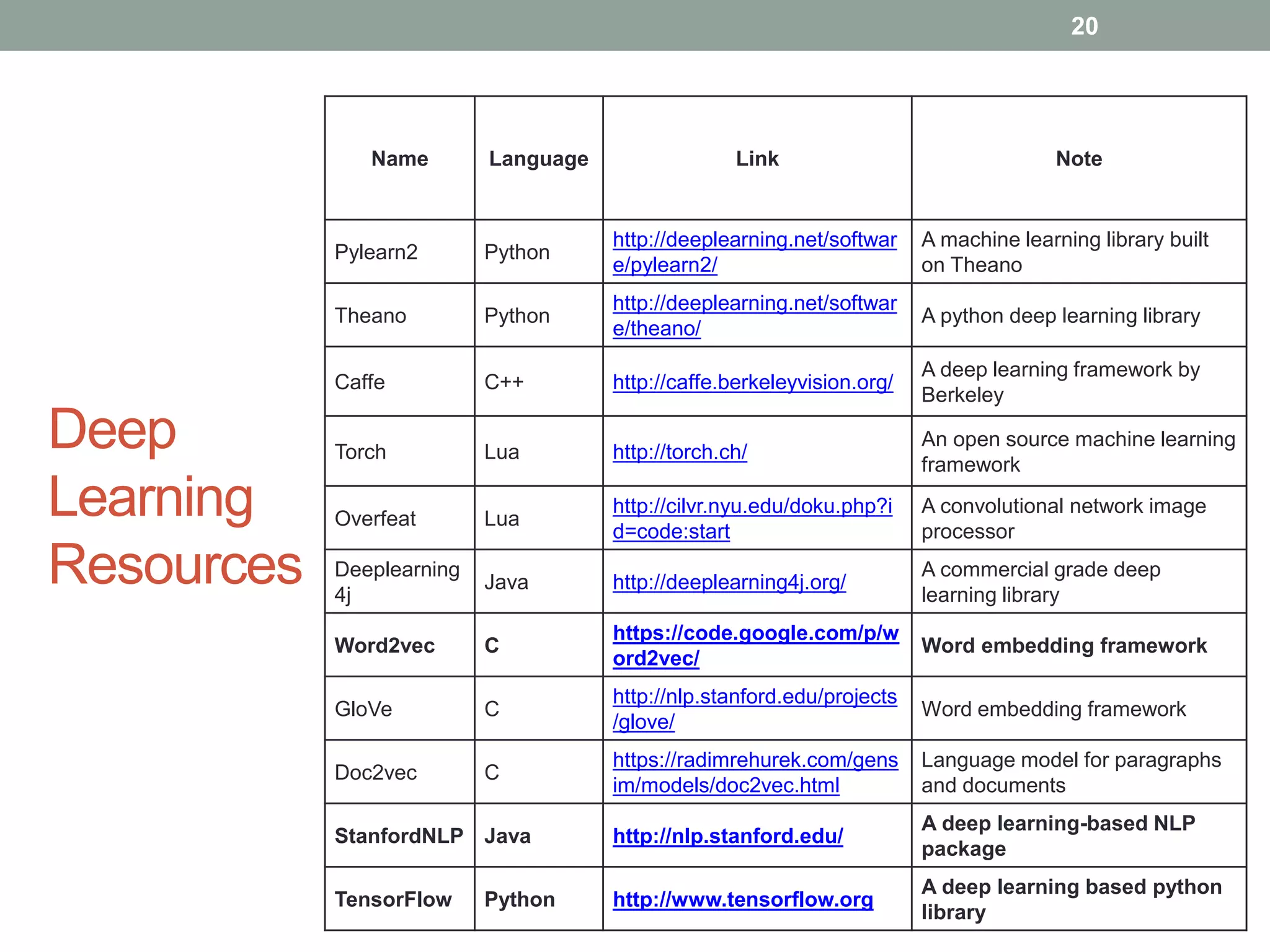
Deep Learning Resources Name Language Link Note Pylearn2 Python http://deeplearning.net/softwar e/pylearn2/ A machine learning library built on Theano Theano Python http://deeplearning.net/softwar e/theano/ A python deep learning library Caffe C++ http://caffe.berkeleyvision.org/ A deep learning framework by Berkeley Torch Lua http://torch.ch/ An open source machine learning framework Overfeat Lua http://cilvr.nyu.edu/doku.php?i d=code:start A convolutional network image processor Deeplearning 4j Java http://deeplearning4j.org/ A commercial grade deep learning library Word2vec C https://code.google.com/p/w ord2vec/ Word embedding framework GloVe C http://nlp.stanford.edu/projects /glove/ Word embedding framework Doc2vec C https://radimrehurek.com/gens im/models/doc2vec.html Language model for paragraphs and documents StanfordNLP Java http://nlp.stanford.edu/ A deep learning-based NLP package TensorFlow Python http://www.tensorflow.org A deep learning based python library 20
Introduction of Machine learning and Deep Learning

Introduction of Machine learning and Deep Learning

  • 1.
    About Me Madhu BabuSanjeevi, Software Engineer, Languages C, Java, Python Technologies Machine Learning, Deep Learning, NLP, Big data, Mobile dev. Developments Android, Web, Rest API Databases SQL, Mongo DB Madhu Sanjeevi Madhu009 Madhu.ai
  • 2.
    Agenda •1.Introduction of Machinelearning & Deep learning •2.Various learning algorithms of ML & DL •3.Applications of ML & DL •4.Open Source tools and help •5.Deep Learning Demo
  • 4.
    Why Machine Learning???? 1+ 1 =11 2 + 2 =22 3 + 3 =? If 1 + 2 = 10 2 + 3 = 21 7 + 8 = ? • No hard coded rules • No Code change
  • 5.
    How does itwork?? Computer Data Program Output Computer Data Output Program Traditional Programming Machine Learning
  • 6.
    What is MachineLearning??? 1.Learn from past experiences 2.Improve the performances of intelligent programs Definitions (Mitchell 1997) “A computer program is said to learn from experience E with respect to some class of tasks T and performance measure P, if its performance at the tasks improves with the experiences”
  • 8.
    Supervised Learning • 1.Training data includes both the input and the desired results. • 2. For some examples the correct results (targets) are known and are given in input to the model during the learning process. • 3. These methods are usually fast and accurate.
  • 9.
    Classification: for categoricalresponse values, where the data can be separated into specific “classes”. Regression: for continuous-response values
  • 10.
    Unsupervised Learning • 1.The model is not provided with the correct results during the training. • 2. The model has to understand it by itself by extracting patterns. • 3. These methods are difficult to implement.
  • 11.
  • 12.
  • 14.
    Introduction of NeuralNetworks? • What are Neural Networks? • Neural networks are a new method of programming computers. • In the human brain, a typical neuron collects signals from others through a host of fine structures called dendrites. • The neuron sends out spikes of electrical activity through a long, thin stand known as an axon, which splits into thousands of branches.
  • 15.
    Diagram of anNN Fig: A simple Neural Network
  • 16.
    Network Layers • InputLayer - The activity of the input units represents the raw information that is fed into the network. • Hidden Layer - The activity of each hidden unit is determined by the activities of the input units and the weights on the connections between the input and the hidden units. • Output Layer - The behavior of the output units depends on the activity of the hidden units and the weights between the hidden and output units.
  • 17.
    Neural Networks-Types 1. Feedforward network: SLP (Single Layer perceptron): MLP (Multi Layer Perceptron): 2. RNN (Recurrent Neural Network): 3. CNN (Convolution neural Network): 4.TDNN (Time Delay Neural Network) or Shared Weights Neural Networks: 5. Hopfield Networks
  • 18.
    Applications of ML& DL • Spam Filtering • Recommendation Engines • Advancement in Speech Recognition in the last 3 years • Advancement in Computer Vision • Advancement in Natural Language Processing • Used in all Domains (Banking, Insurance, Healthcare, etc…) 18
  • 19.
    Open Source Toolsfor DL DL4J: Torch: JVM-based Lua based Distrubted Contains pretrained model Integrates with Hadoop and Spark TensorFlow: Theano: Google written successor to Theano Very popular in Academia Interfaced with via Python and Numpy Fairly low level Highly parallel Interfaced with via Python and Numpy Caffe: Not general purpose. Focuses on machine-vision problems Implemented in C++ and is very fast Not easily extensible Has a Python interface
  • 20.
    Deep Learning Resources Name Language LinkNote Pylearn2 Python http://deeplearning.net/softwar e/pylearn2/ A machine learning library built on Theano Theano Python http://deeplearning.net/softwar e/theano/ A python deep learning library Caffe C++ http://caffe.berkeleyvision.org/ A deep learning framework by Berkeley Torch Lua http://torch.ch/ An open source machine learning framework Overfeat Lua http://cilvr.nyu.edu/doku.php?i d=code:start A convolutional network image processor Deeplearning 4j Java http://deeplearning4j.org/ A commercial grade deep learning library Word2vec C https://code.google.com/p/w ord2vec/ Word embedding framework GloVe C http://nlp.stanford.edu/projects /glove/ Word embedding framework Doc2vec C https://radimrehurek.com/gens im/models/doc2vec.html Language model for paragraphs and documents StanfordNLP Java http://nlp.stanford.edu/ A deep learning-based NLP package TensorFlow Python http://www.tensorflow.org A deep learning based python library 20