IOT BASED PATIENT HEALTH MONITORING SYSTEM USING ARDUINO
CONTENT 01 02 03 04 05 06 07 BLOCK DIAGRAM PROJECT PROGRAM SOFTWARE DIAGRAMS RESULT & CONCLUSION INTRODUCTION CIRCUIT DIAGRAM 08 REFERENCES CONCLUSION
INTRODUCTION INTRODUCTION A REMOTE HEALTH MONITORING SYSTEM IS AN ADD-ON TO HOSPITAL'S MEDICAL SYSTEM THAT ALLOWS DOCTORS TO MONITOR A PATIENT'S VITAL FUNCTIONS FROM AFAR. NOW IN ADVANCED TECHNOLOGIES A GREATER NO. OF SENSORS AND MICROCONTROLLERS ARE PRESENT WHICH IS COST WISE LOW, THE SPEED OF OPERATION IS HIGH AND POWER CONSUMPTION IS LOW. THE PROCESS HAS LED TO REMOTE MONITORING OF IMPORTANT LIFE SIGNS OF PATIENTS, PARTICULARLY THE ELDERLY AND PERSONS IN QUARANTINE WHO ARE ILL. A HOSPITAL'S MEDICAL SYSTEM IS SUPPLEMENTED WITH REMOTE HEALTH MONITORING SYSTEM THAT AALOWS FOR REMOTE MONITORING OF CRUCIAL BODY STATUS OF A PATIENT.
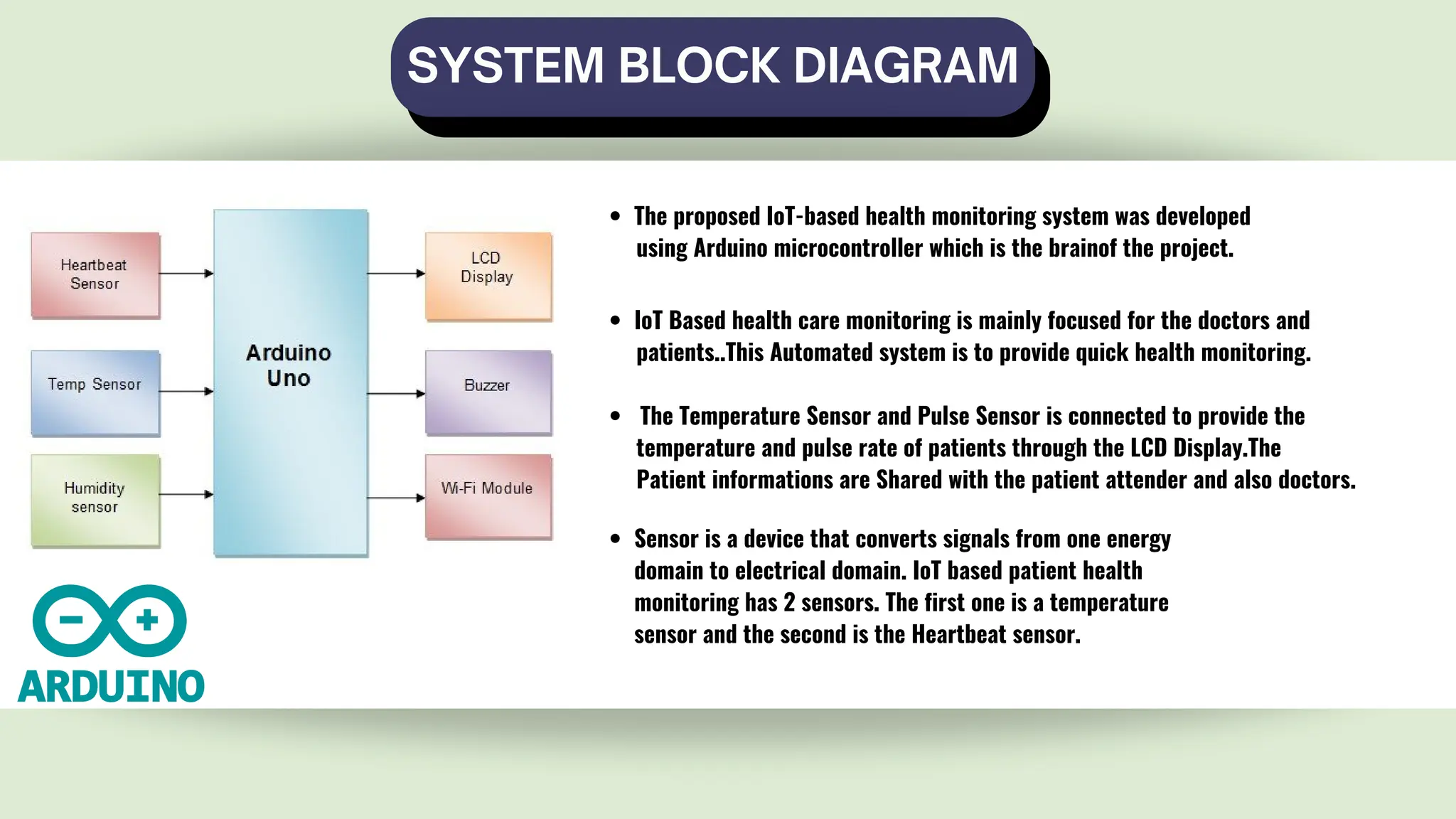
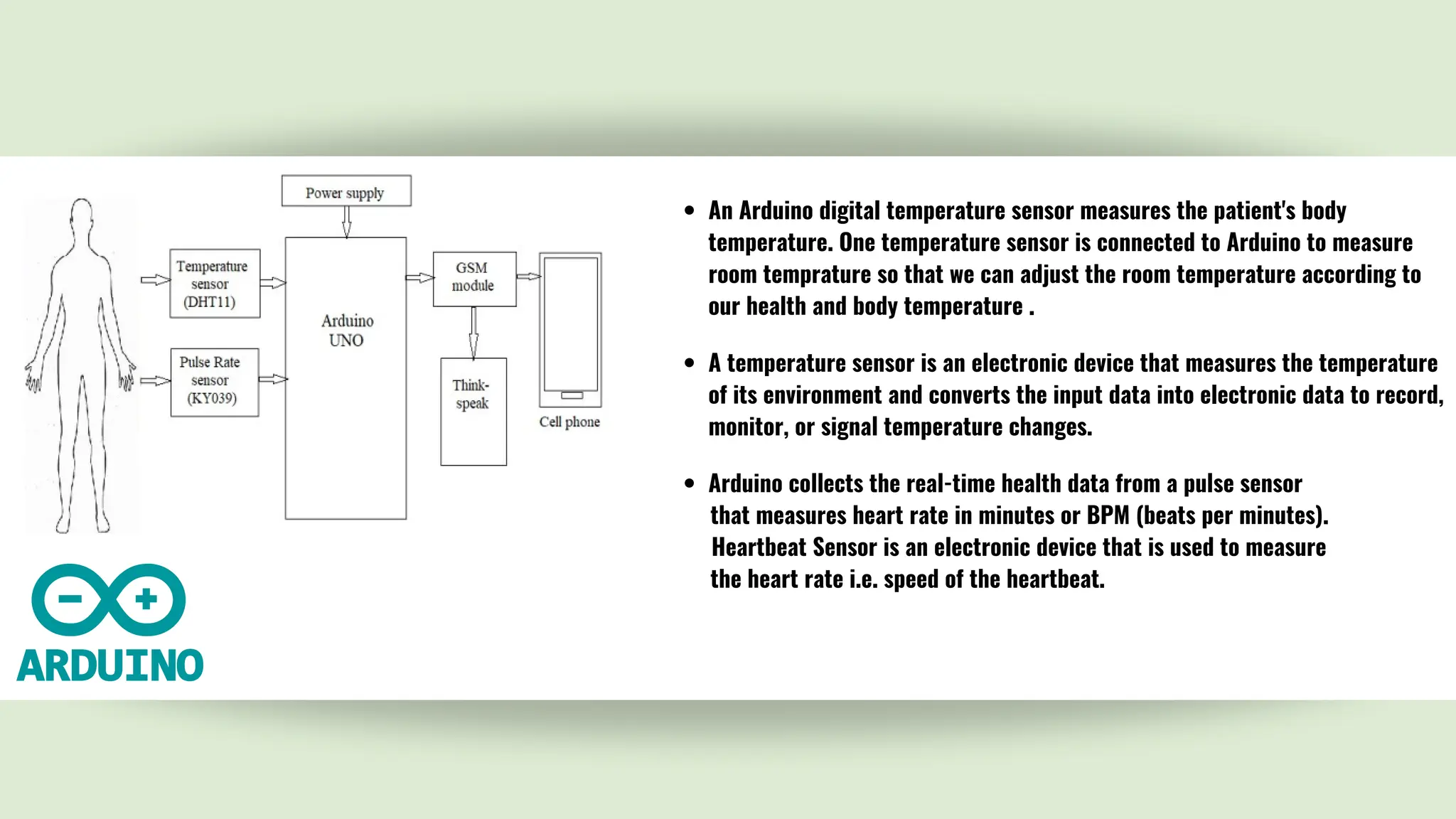
SYSTEM BLOCK DIAGRAM The proposed IoT-based health monitoring system was developed using Arduino microcontroller which is the brainof the project. IoT Based health care monitoring is mainly focused for the doctors and patients..This Automated system is to provide quick health monitoring. The Temperature Sensor and Pulse Sensor is connected to provide the temperature and pulse rate of patients through the LCD Display.The Patient informations are Shared with the patient attender and also doctors. Sensor is a device that converts signals from one energy domain to electrical domain. IoT based patient health monitoring has 2 sensors. The first one is a temperature sensor and the second is the Heartbeat sensor.
An Arduino digital temperature sensor measures the patient's body temperature. One temperature sensor is connected to Arduino to measure room temprature so that we can adjust the room temperature according to our health and body temperature . A temperature sensor is an electronic device that measures the temperature of its environment and converts the input data into electronic data to record, monitor, or signal temperature changes. Arduino collects the real-time health data from a pulse sensor that measures heart rate in minutes or BPM (beats per minutes). Heartbeat Sensor is an electronic device that is used to measure the heart rate i.e. speed of the heartbeat.
CIRCUIT DIAGRAM The circuit diagram of IoT based Patient Health Monitoring system is shown in the figure : THE PATIENT HEALTH MONITORING SYSTEM CONSIST OF THE FOLLOWING: ARDUINO UNO BOARD: It is one of the most popular development boards used for experimental purposes and serves as an Internet of Things (IoT) link. PULSE SENSOR : Pulse sensor that measures heart rate in minutes or BPM (beats per minute). LM35 TEMP. SENSOR : To measure room temperature so that we can adjust the room temperature as per health and body temperature. LCD DISPLAY: LCD is a flat optical display device which uses liquid crystals' light-modulating properties combined with polarizers. LED : Light Emitting Diode to show red,green,blue on different conditions. ESP8266 : The module will work individually as an Associated Objective access point (can display hotspot and as a channel (can connect to Wi-Fi), where it will simply download information and transfer it to the web creating a Web of things as simple as accessibility. OTHERS: Other components like resistor,breadboard,connecting wires etc.
CIRCUIT DIAGRAM ON OTHER SOFTWARE INTERNAL CIRCUIT DIAGRAM ON TINKERCAD SIMULATION CIRCUIT DIAGRAM ON TINKERCAD
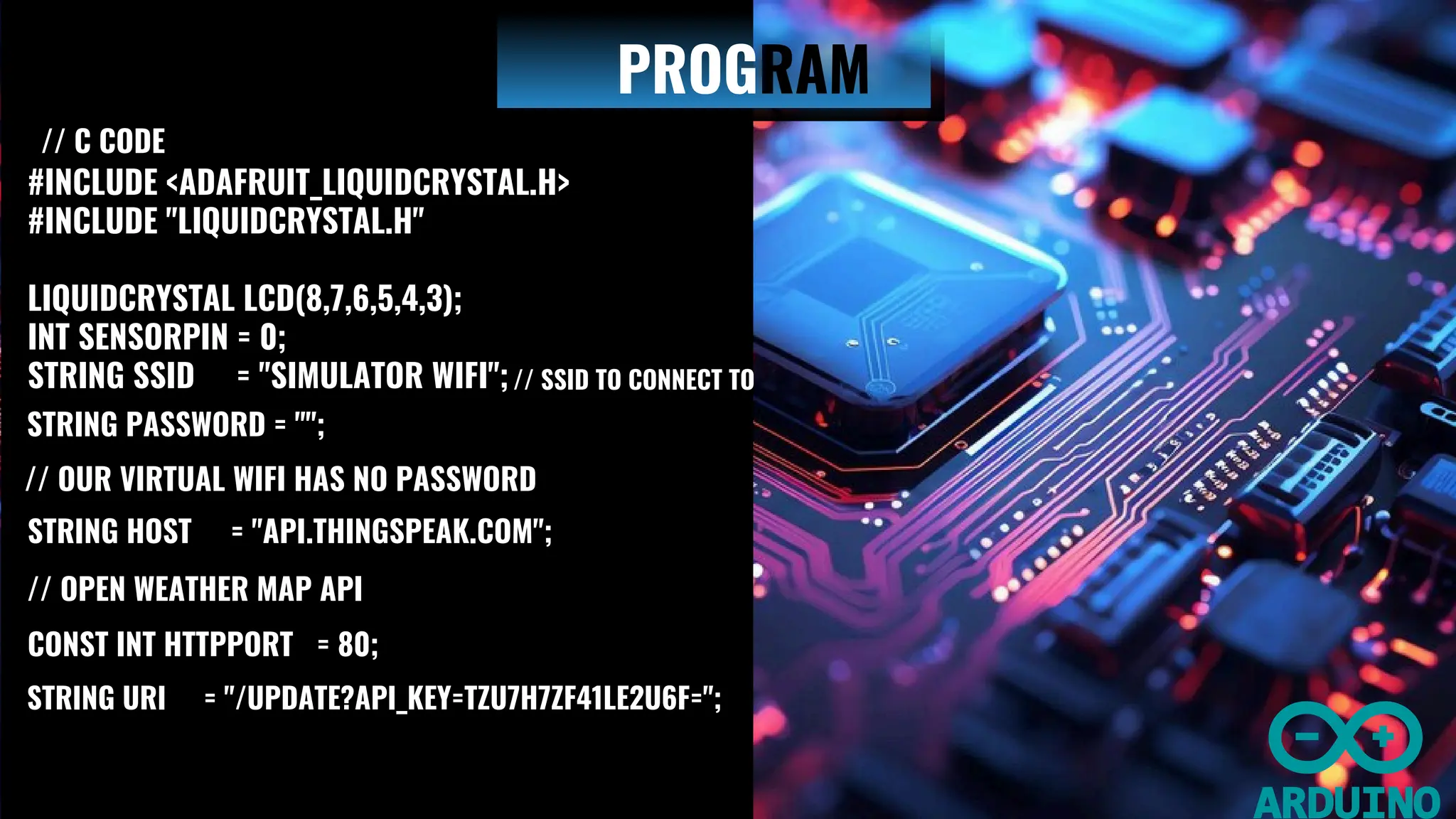
PROGRAM // C CODE #INCLUDE <ADAFRUIT_LIQUIDCRYSTAL.H> #INCLUDE "LIQUIDCRYSTAL.H" LIQUIDCRYSTAL LCD(8,7,6,5,4,3); INT SENSORPIN = 0; STRING SSID = "SIMULATOR WIFI"; STRING PASSWORD = ""; STRING HOST = "API.THINGSPEAK.COM"; CONST INT HTTPPORT = 80; STRING URI = "/UPDATE?API_KEY=TZU7H7ZF41LE2U6F="; // SSID TO CONNECT TO // OUR VIRTUAL WIFI HAS NO PASSWORD // OPEN WEATHER MAP API
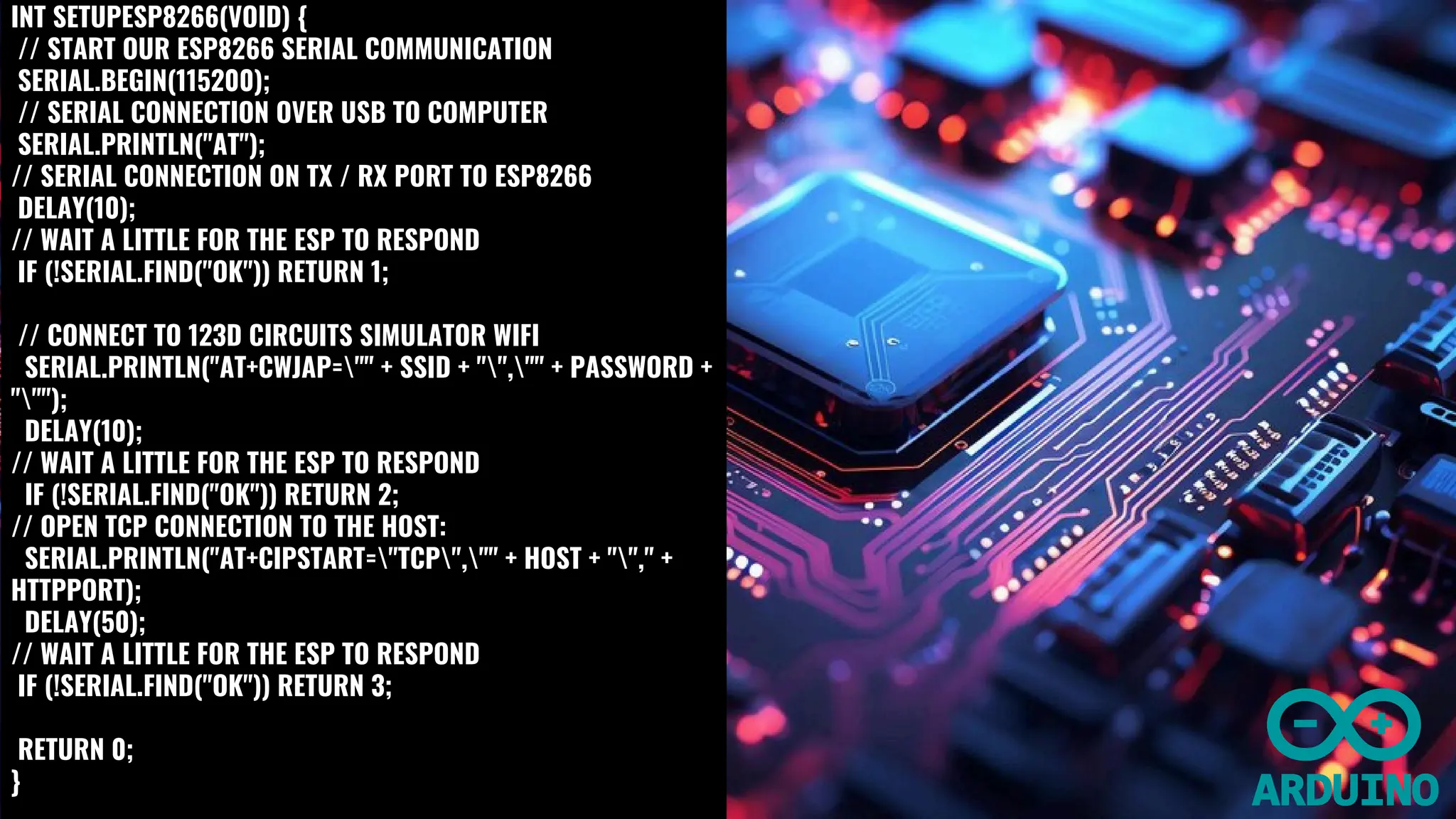
INT SETUPESP8266(VOID) { // START OUR ESP8266 SERIAL COMMUNICATION SERIAL.BEGIN(115200); // SERIAL CONNECTION OVER USB TO COMPUTER SERIAL.PRINTLN("AT"); // SERIAL CONNECTION ON TX / RX PORT TO ESP8266 DELAY(10); // WAIT A LITTLE FOR THE ESP TO RESPOND IF (!SERIAL.FIND("OK")) RETURN 1; // CONNECT TO 123D CIRCUITS SIMULATOR WIFI SERIAL.PRINTLN("AT+CWJAP="" + SSID + "","" + PASSWORD + """); DELAY(10); // WAIT A LITTLE FOR THE ESP TO RESPOND IF (!SERIAL.FIND("OK")) RETURN 2; // OPEN TCP CONNECTION TO THE HOST: SERIAL.PRINTLN("AT+CIPSTART="TCP","" + HOST + ""," + HTTPPORT); DELAY(50); // WAIT A LITTLE FOR THE ESP TO RESPOND IF (!SERIAL.FIND("OK")) RETURN 3; RETURN 0; }
VOID ANYDATA(VOID) { INT TEMP = MAP(ANALOGREAD(A0),20,358,-40,125); // CONSTRUCT OUR HTTP CALL STRING HTTPPACKET = "GET " + URI + STRING(TEMP) + " HTTP/1.1RNHOST: " + HOST + "RNRN"; INT LENGTH = HTTPPACKET.LENGTH(); // SEND OUR MESSAGE LENGTH SERIAL.PRINT("AT+CIPSEND="); SERIAL.PRINTLN(LENGTH); DELAY(10); // WAIT A LITTLE FOR THE ESP TO RESPOND IF (!SERIAL.FIND(">")) RETURN -1; // SEND OUR HTTP REQUEST SERIAL.PRINT(HTTPPACKET); DELAY(10); // WAIT A LITTLE FOR THE ESP TO RESPOND IF (!SERIAL.FIND("SEND OKRN")) RETURN; }
INT TEMP = 0; ADAFRUIT_LIQUIDCRYSTAL LCD_1(0); VOID SETUP() { SERIAL.BEGIN(9600); LCD_1.BEGIN(16, 2); SERIAL.BEGIN(9600); LCD.BEGIN(16,2); PINMODE(A0, INPUT); PINMODE(13,OUTPUT); SETUPESP8266(); }
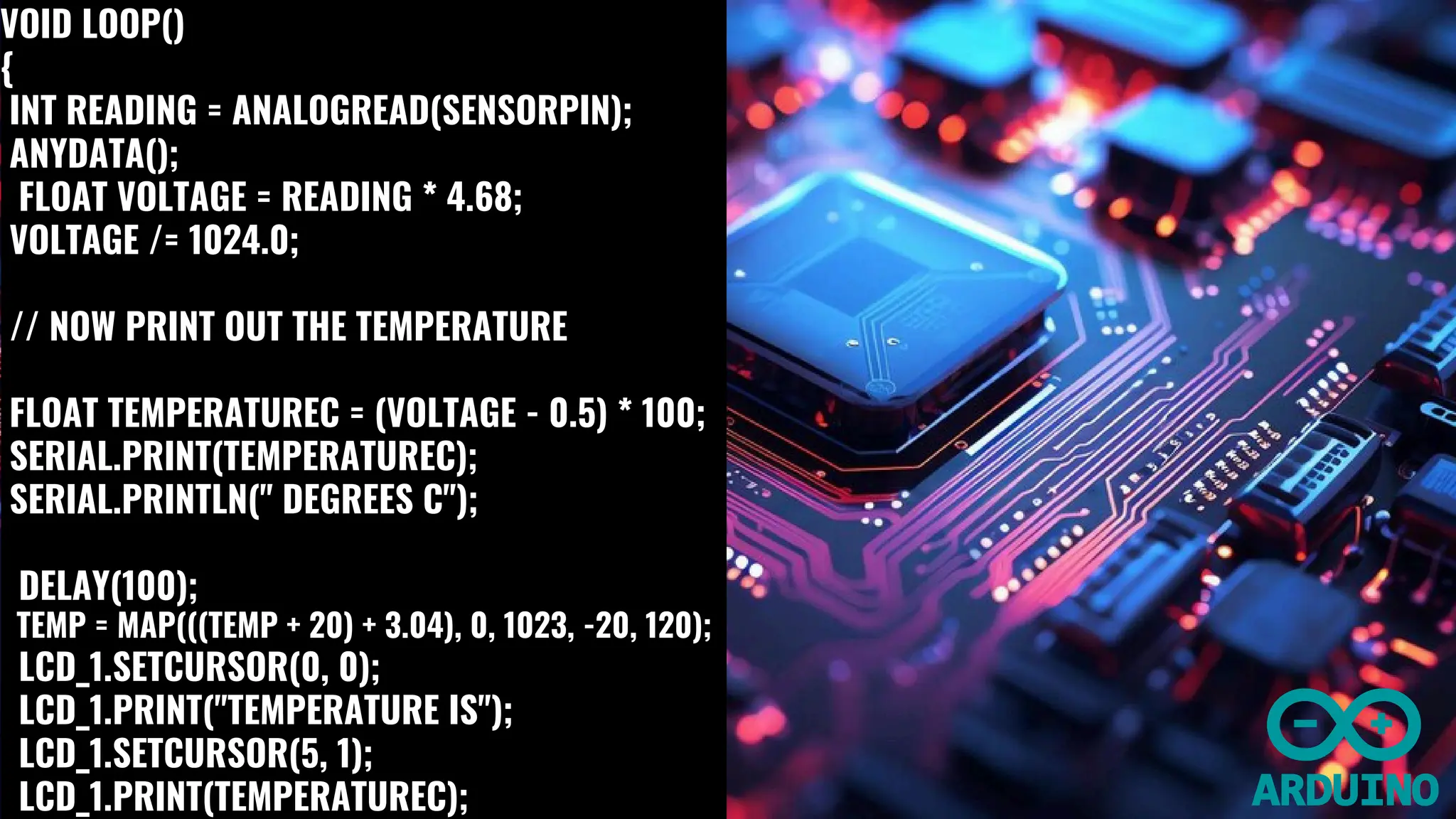
VOID LOOP() { INT READING = ANALOGREAD(SENSORPIN); ANYDATA(); FLOAT VOLTAGE = READING * 4.68; VOLTAGE /= 1024.0; // NOW PRINT OUT THE TEMPERATURE FLOAT TEMPERATUREC = (VOLTAGE - 0.5) * 100; SERIAL.PRINT(TEMPERATUREC); SERIAL.PRINTLN(" DEGREES C"); DELAY(100); TEMP = MAP(((TEMP + 20) + 3.04), 0, 1023, -20, 120); LCD_1.SETCURSOR(0, 0); LCD_1.PRINT("TEMPERATURE IS"); LCD_1.SETCURSOR(5, 1); LCD_1.PRINT(TEMPERATUREC);
DELAY(1000); // WAIT FOR 1000 MILLISECOND(S) IF (TEMPERATUREC>=37){ DIGITALWRITE(13,HIGH); DELAY(500); DIGITALWRITE(13,LOW); DELAY(1000); LCD_1.CLEAR(); } ELSE IF( TEMPERATUREC<=30) { DIGITALWRITE(13,HIGH); DELAY(500); DIGITALWRITE(13,LOW); DELAY(1000); LCD_1.CLEAR();} ELSE { DIGITALWRITE(13,LOW);} }
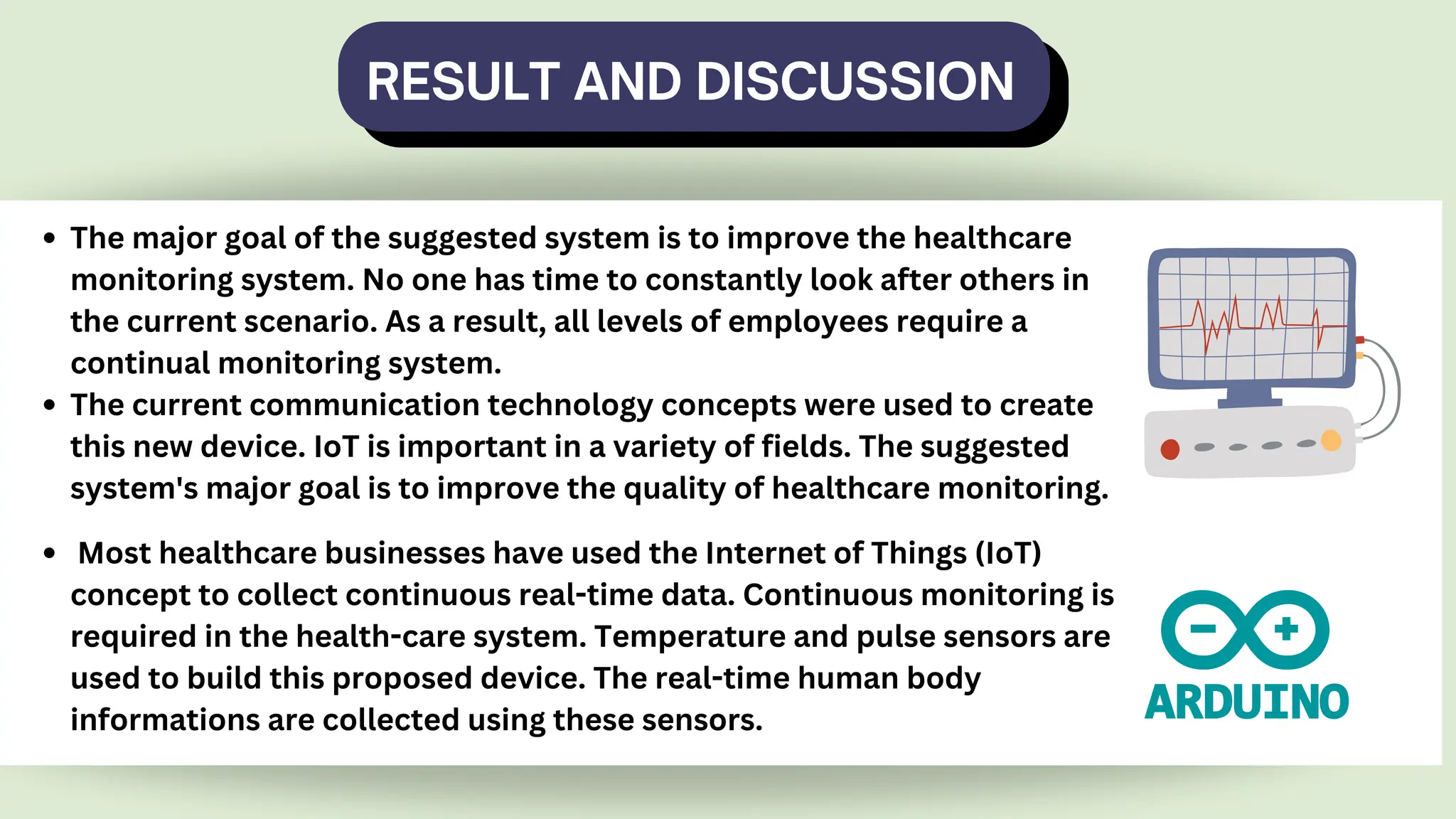
The major goal of the suggested system is to improve the healthcare monitoring system. No one has time to constantly look after others in the current scenario. As a result, all levels of employees require a continual monitoring system. The current communication technology concepts were used to create this new device. IoT is important in a variety of fields. The suggested system's major goal is to improve the quality of healthcare monitoring. RESULT AND DISCUSSION Most healthcare businesses have used the Internet of Things (IoT) concept to collect continuous real-time data. Continuous monitoring is required in the health-care system. Temperature and pulse sensors are used to build this proposed device. The real-time human body informations are collected using these sensors.
The main aim of the proposed system is developing the healthcare monitoring system in better way. This system is very useful for elderly people, physically challenged people and covid affected people in home or hospitals. Compare with other monitoring devices the proposed device provides a better result and easy to use. CONCLUSION The proposed patient health monitoring system can be used extensively in an emergency conditions as they can be monitored daily, recorded and stored as a database. In the future Iot device can be integrated with computer computing so that the database can be shared across intensive care and treatment hospitals.
D. S. R. Krishnan, S. C. Gupta and T. Choudhury, "An IoT based Patient Health Monitoring System," 2018 International Conference on Advances in Computing and Communication Engineering (ICACCE), Paris, France, 2018, pp. 01-07, doi: 10.1109/ICACCE.2018.8441708. REFERENCES REFERENCES : P. Anirudh, G. A. E. S. Kumar, R. P. Vidyadhar, G. Pranav and B. A. Aumar, "Automatic Patient Monitoring and Alerting System based on IoT," 2023 8th International Conference on Communication and Electronics Systems (ICCES), Coimbatore, India, 2023, pp. 328-331, doi: 10.1109/ICCES57224.2023.10192644. K. Rajasekaran, M. S. Chakaravarthi and P. Lokaswar, "Continuous Health Monitoring System for Patients Using IoT," 2023 9th International Conference on Advanced Computing and Communication Systems (ICACCS), Coimbatore, India, 2023, pp. 987-990, doi: 10.1109/ICACCS57279.2023.10112921. A. K. J. G, A. V, A. Varghese, D. Sebastian and N. Johnson, "Low-Cost IOT Based Healthcare Management System In Remote Areas," 2022 IEEE 19th India Council International Conference (INDICON), Kochi, India, 2022, pp. 1-6, doi: 10.1109/INDICON56171.2022.10039801.
THANK YOU!! College of Engineering, Kolhapur

iot based patient health monitoring system using arduino.pdf

  • 1.
    IOT BASED PATIENT HEALTHMONITORING SYSTEM USING ARDUINO
  • 2.
    CONTENT 01 02 03 04 05 06 07 BLOCK DIAGRAM PROJECT PROGRAM SOFTWAREDIAGRAMS RESULT & CONCLUSION INTRODUCTION CIRCUIT DIAGRAM 08 REFERENCES CONCLUSION
  • 3.
    INTRODUCTION INTRODUCTION A REMOTE HEALTHMONITORING SYSTEM IS AN ADD-ON TO HOSPITAL'S MEDICAL SYSTEM THAT ALLOWS DOCTORS TO MONITOR A PATIENT'S VITAL FUNCTIONS FROM AFAR. NOW IN ADVANCED TECHNOLOGIES A GREATER NO. OF SENSORS AND MICROCONTROLLERS ARE PRESENT WHICH IS COST WISE LOW, THE SPEED OF OPERATION IS HIGH AND POWER CONSUMPTION IS LOW. THE PROCESS HAS LED TO REMOTE MONITORING OF IMPORTANT LIFE SIGNS OF PATIENTS, PARTICULARLY THE ELDERLY AND PERSONS IN QUARANTINE WHO ARE ILL. A HOSPITAL'S MEDICAL SYSTEM IS SUPPLEMENTED WITH REMOTE HEALTH MONITORING SYSTEM THAT AALOWS FOR REMOTE MONITORING OF CRUCIAL BODY STATUS OF A PATIENT.
  • 4.
    SYSTEM BLOCK DIAGRAM Theproposed IoT-based health monitoring system was developed using Arduino microcontroller which is the brainof the project. IoT Based health care monitoring is mainly focused for the doctors and patients..This Automated system is to provide quick health monitoring. The Temperature Sensor and Pulse Sensor is connected to provide the temperature and pulse rate of patients through the LCD Display.The Patient informations are Shared with the patient attender and also doctors. Sensor is a device that converts signals from one energy domain to electrical domain. IoT based patient health monitoring has 2 sensors. The first one is a temperature sensor and the second is the Heartbeat sensor.
  • 5.
    An Arduino digitaltemperature sensor measures the patient's body temperature. One temperature sensor is connected to Arduino to measure room temprature so that we can adjust the room temperature according to our health and body temperature . A temperature sensor is an electronic device that measures the temperature of its environment and converts the input data into electronic data to record, monitor, or signal temperature changes. Arduino collects the real-time health data from a pulse sensor that measures heart rate in minutes or BPM (beats per minutes). Heartbeat Sensor is an electronic device that is used to measure the heart rate i.e. speed of the heartbeat.
  • 6.
    CIRCUIT DIAGRAM The circuitdiagram of IoT based Patient Health Monitoring system is shown in the figure : THE PATIENT HEALTH MONITORING SYSTEM CONSIST OF THE FOLLOWING: ARDUINO UNO BOARD: It is one of the most popular development boards used for experimental purposes and serves as an Internet of Things (IoT) link. PULSE SENSOR : Pulse sensor that measures heart rate in minutes or BPM (beats per minute). LM35 TEMP. SENSOR : To measure room temperature so that we can adjust the room temperature as per health and body temperature. LCD DISPLAY: LCD is a flat optical display device which uses liquid crystals' light-modulating properties combined with polarizers. LED : Light Emitting Diode to show red,green,blue on different conditions. ESP8266 : The module will work individually as an Associated Objective access point (can display hotspot and as a channel (can connect to Wi-Fi), where it will simply download information and transfer it to the web creating a Web of things as simple as accessibility. OTHERS: Other components like resistor,breadboard,connecting wires etc.
  • 7.
    CIRCUIT DIAGRAM ON OTHERSOFTWARE INTERNAL CIRCUIT DIAGRAM ON TINKERCAD SIMULATION CIRCUIT DIAGRAM ON TINKERCAD
  • 8.
    PROGRAM // C CODE #INCLUDE<ADAFRUIT_LIQUIDCRYSTAL.H> #INCLUDE "LIQUIDCRYSTAL.H" LIQUIDCRYSTAL LCD(8,7,6,5,4,3); INT SENSORPIN = 0; STRING SSID = "SIMULATOR WIFI"; STRING PASSWORD = ""; STRING HOST = "API.THINGSPEAK.COM"; CONST INT HTTPPORT = 80; STRING URI = "/UPDATE?API_KEY=TZU7H7ZF41LE2U6F="; // SSID TO CONNECT TO // OUR VIRTUAL WIFI HAS NO PASSWORD // OPEN WEATHER MAP API
  • 9.
    INT SETUPESP8266(VOID) { //START OUR ESP8266 SERIAL COMMUNICATION SERIAL.BEGIN(115200); // SERIAL CONNECTION OVER USB TO COMPUTER SERIAL.PRINTLN("AT"); // SERIAL CONNECTION ON TX / RX PORT TO ESP8266 DELAY(10); // WAIT A LITTLE FOR THE ESP TO RESPOND IF (!SERIAL.FIND("OK")) RETURN 1; // CONNECT TO 123D CIRCUITS SIMULATOR WIFI SERIAL.PRINTLN("AT+CWJAP="" + SSID + "","" + PASSWORD + """); DELAY(10); // WAIT A LITTLE FOR THE ESP TO RESPOND IF (!SERIAL.FIND("OK")) RETURN 2; // OPEN TCP CONNECTION TO THE HOST: SERIAL.PRINTLN("AT+CIPSTART="TCP","" + HOST + ""," + HTTPPORT); DELAY(50); // WAIT A LITTLE FOR THE ESP TO RESPOND IF (!SERIAL.FIND("OK")) RETURN 3; RETURN 0; }
  • 10.
    VOID ANYDATA(VOID) { INTTEMP = MAP(ANALOGREAD(A0),20,358,-40,125); // CONSTRUCT OUR HTTP CALL STRING HTTPPACKET = "GET " + URI + STRING(TEMP) + " HTTP/1.1RNHOST: " + HOST + "RNRN"; INT LENGTH = HTTPPACKET.LENGTH(); // SEND OUR MESSAGE LENGTH SERIAL.PRINT("AT+CIPSEND="); SERIAL.PRINTLN(LENGTH); DELAY(10); // WAIT A LITTLE FOR THE ESP TO RESPOND IF (!SERIAL.FIND(">")) RETURN -1; // SEND OUR HTTP REQUEST SERIAL.PRINT(HTTPPACKET); DELAY(10); // WAIT A LITTLE FOR THE ESP TO RESPOND IF (!SERIAL.FIND("SEND OKRN")) RETURN; }
  • 11.
    INT TEMP =0; ADAFRUIT_LIQUIDCRYSTAL LCD_1(0); VOID SETUP() { SERIAL.BEGIN(9600); LCD_1.BEGIN(16, 2); SERIAL.BEGIN(9600); LCD.BEGIN(16,2); PINMODE(A0, INPUT); PINMODE(13,OUTPUT); SETUPESP8266(); }
  • 12.
    VOID LOOP() { INT READING= ANALOGREAD(SENSORPIN); ANYDATA(); FLOAT VOLTAGE = READING * 4.68; VOLTAGE /= 1024.0; // NOW PRINT OUT THE TEMPERATURE FLOAT TEMPERATUREC = (VOLTAGE - 0.5) * 100; SERIAL.PRINT(TEMPERATUREC); SERIAL.PRINTLN(" DEGREES C"); DELAY(100); TEMP = MAP(((TEMP + 20) + 3.04), 0, 1023, -20, 120); LCD_1.SETCURSOR(0, 0); LCD_1.PRINT("TEMPERATURE IS"); LCD_1.SETCURSOR(5, 1); LCD_1.PRINT(TEMPERATUREC);
  • 13.
    DELAY(1000); // WAITFOR 1000 MILLISECOND(S) IF (TEMPERATUREC>=37){ DIGITALWRITE(13,HIGH); DELAY(500); DIGITALWRITE(13,LOW); DELAY(1000); LCD_1.CLEAR(); } ELSE IF( TEMPERATUREC<=30) { DIGITALWRITE(13,HIGH); DELAY(500); DIGITALWRITE(13,LOW); DELAY(1000); LCD_1.CLEAR();} ELSE { DIGITALWRITE(13,LOW);} }
  • 14.
    The major goalof the suggested system is to improve the healthcare monitoring system. No one has time to constantly look after others in the current scenario. As a result, all levels of employees require a continual monitoring system. The current communication technology concepts were used to create this new device. IoT is important in a variety of fields. The suggested system's major goal is to improve the quality of healthcare monitoring. RESULT AND DISCUSSION Most healthcare businesses have used the Internet of Things (IoT) concept to collect continuous real-time data. Continuous monitoring is required in the health-care system. Temperature and pulse sensors are used to build this proposed device. The real-time human body informations are collected using these sensors.
  • 15.
    The main aimof the proposed system is developing the healthcare monitoring system in better way. This system is very useful for elderly people, physically challenged people and covid affected people in home or hospitals. Compare with other monitoring devices the proposed device provides a better result and easy to use. CONCLUSION The proposed patient health monitoring system can be used extensively in an emergency conditions as they can be monitored daily, recorded and stored as a database. In the future Iot device can be integrated with computer computing so that the database can be shared across intensive care and treatment hospitals.
  • 16.
    D. S. R.Krishnan, S. C. Gupta and T. Choudhury, "An IoT based Patient Health Monitoring System," 2018 International Conference on Advances in Computing and Communication Engineering (ICACCE), Paris, France, 2018, pp. 01-07, doi: 10.1109/ICACCE.2018.8441708. REFERENCES REFERENCES : P. Anirudh, G. A. E. S. Kumar, R. P. Vidyadhar, G. Pranav and B. A. Aumar, "Automatic Patient Monitoring and Alerting System based on IoT," 2023 8th International Conference on Communication and Electronics Systems (ICCES), Coimbatore, India, 2023, pp. 328-331, doi: 10.1109/ICCES57224.2023.10192644. K. Rajasekaran, M. S. Chakaravarthi and P. Lokaswar, "Continuous Health Monitoring System for Patients Using IoT," 2023 9th International Conference on Advanced Computing and Communication Systems (ICACCS), Coimbatore, India, 2023, pp. 987-990, doi: 10.1109/ICACCS57279.2023.10112921. A. K. J. G, A. V, A. Varghese, D. Sebastian and N. Johnson, "Low-Cost IOT Based Healthcare Management System In Remote Areas," 2022 IEEE 19th India Council International Conference (INDICON), Kochi, India, 2022, pp. 1-6, doi: 10.1109/INDICON56171.2022.10039801.
  • 17.