©2014 DataStax Confidential. Do not distribute without consent. @helenaedelson Helena Edelson Lambda Architecture with Spark Streaming, Kafka, Cassandra, Akka, Scala 1
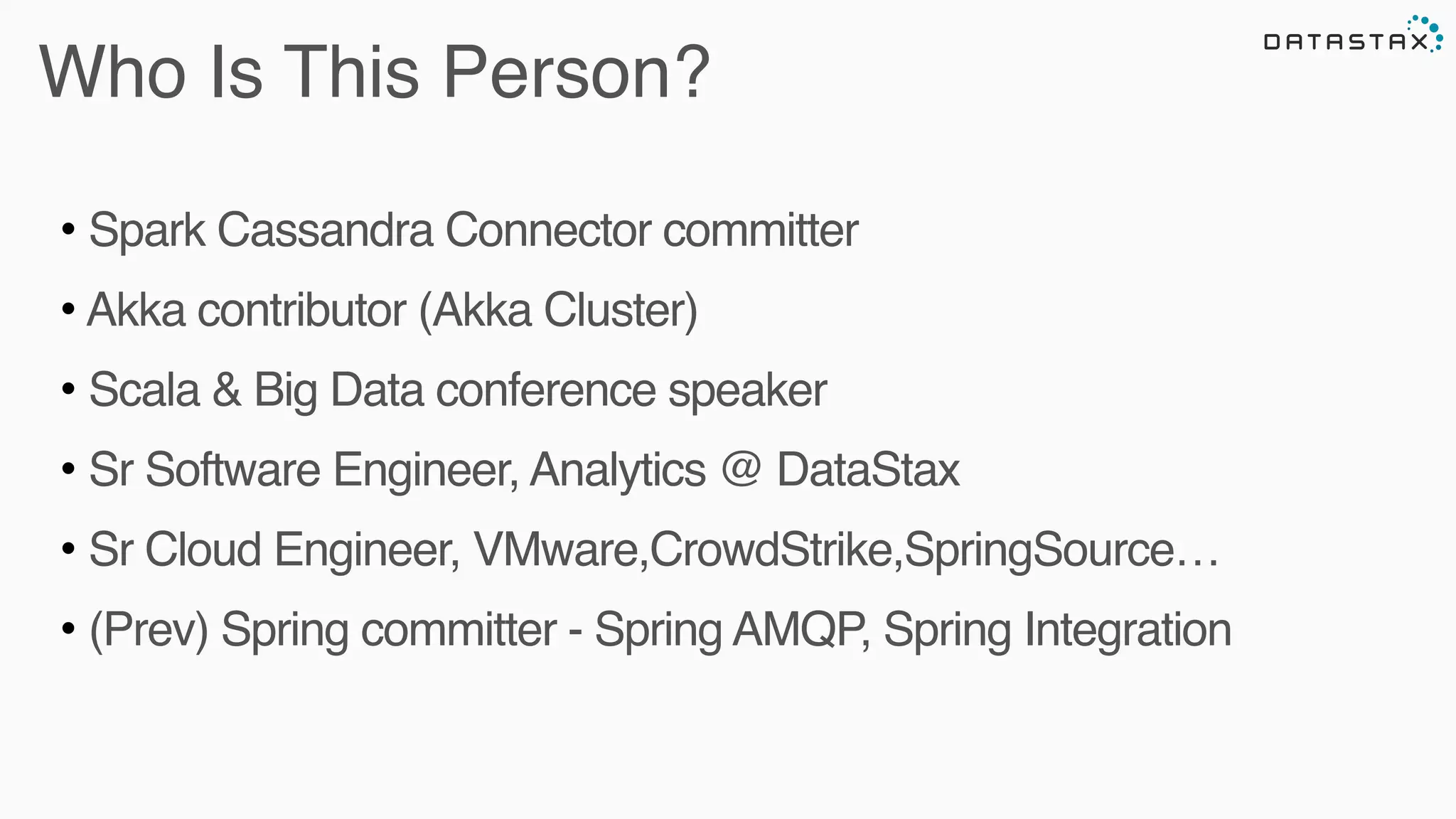
• Spark Cassandra Connector committer • Akka contributor (Akka Cluster) • Scala & Big Data conference speaker • Sr Software Engineer, Analytics @ DataStax • Sr Cloud Engineer, VMware,CrowdStrike,SpringSource… • (Prev) Spring committer - Spring AMQP, Spring Integration Analytic Who Is This Person?
Analytic Analytic Search Use Case: Hadoop + Scalding /** Reads SequenceFile data from S3 buckets, computes then persists to Cassandra. */ class TopSearches(args: Args) extends TopKDailyJob[MyDataType](args) with Cassandra { PailSource.source[Search](rootpath, structure, directories).read .mapTo('pailItem -> 'engines) { e: Search ⇒ results(e) } .filter('engines) { e: String ⇒ e.nonEmpty } .groupBy('engines) { _.size('count).sortBy('engines) } .groupBy('engines) { _.sortedReverseTake[(String, Long)](('engines, 'count) -> 'tcount, k) } .flatMapTo('tcount -> ('key, 'engine, 'topCount)) { t: List[(String, Long)] ⇒ t map { case (k, v) ⇒ (jobKey, k, v) }} .write(CassandraSource(connection, "top_searches", Scheme(‘key, ('engine, ‘topCount)))) }
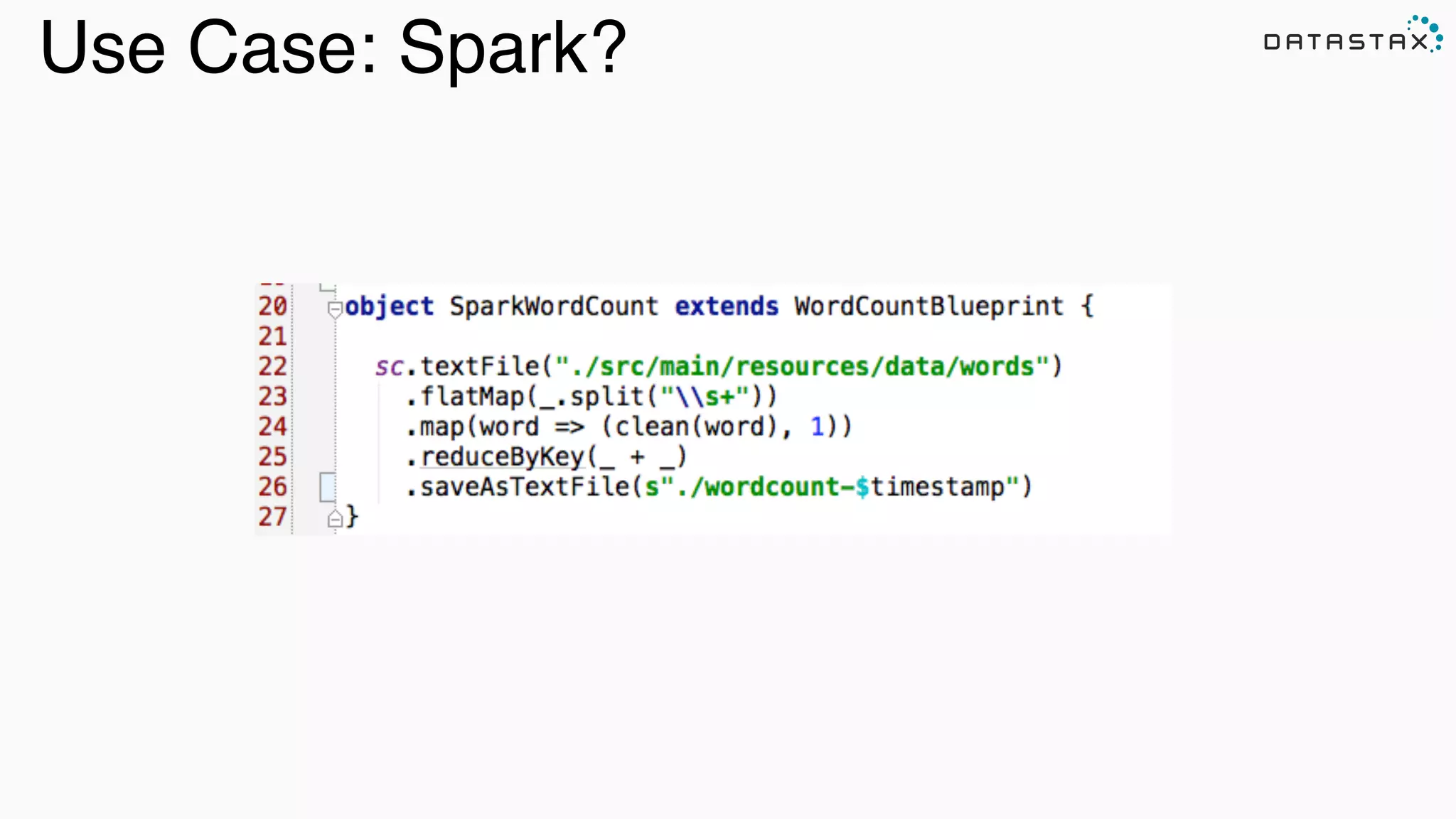
Analytic Analytic Search Use Case: Spark?
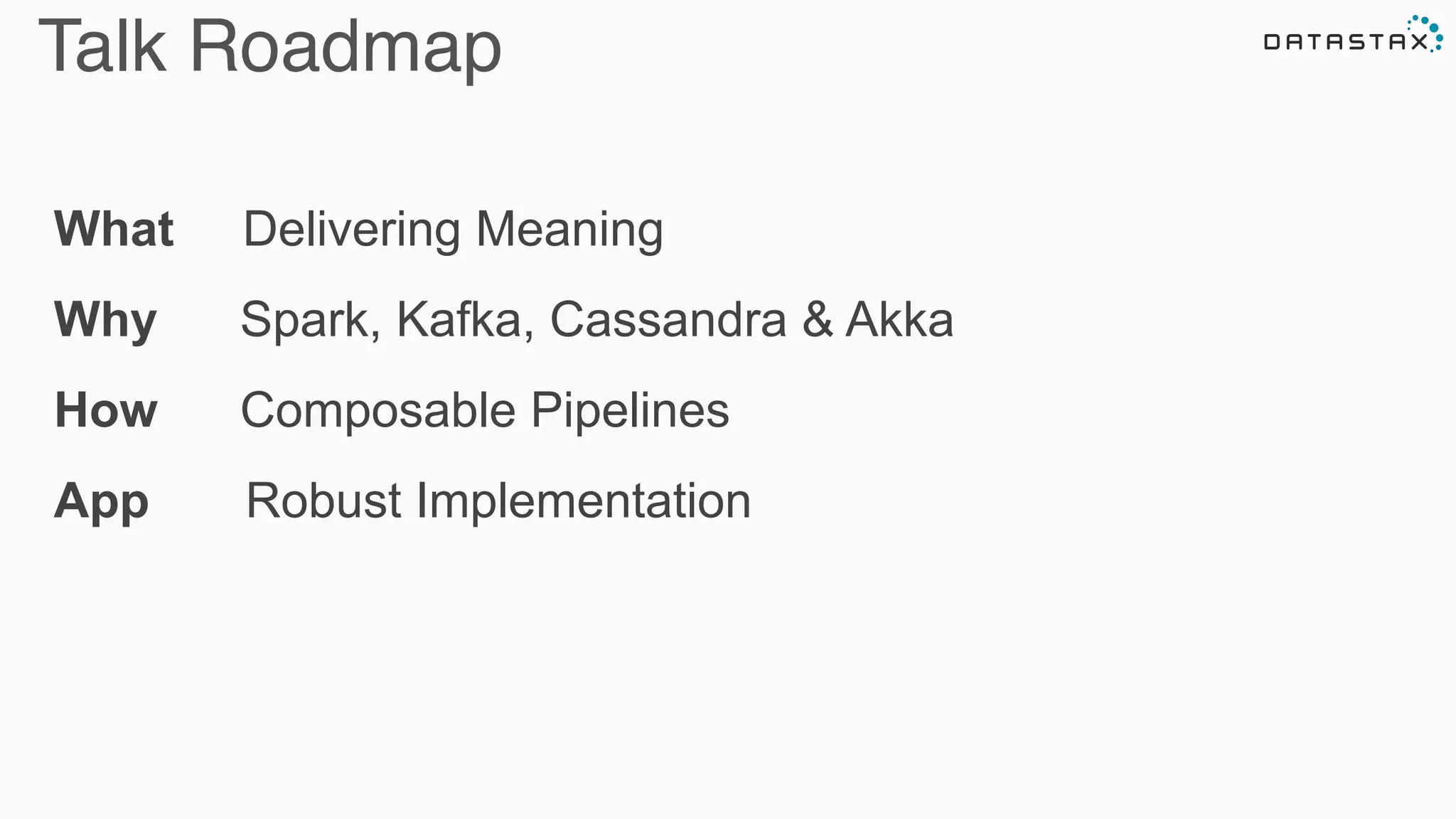
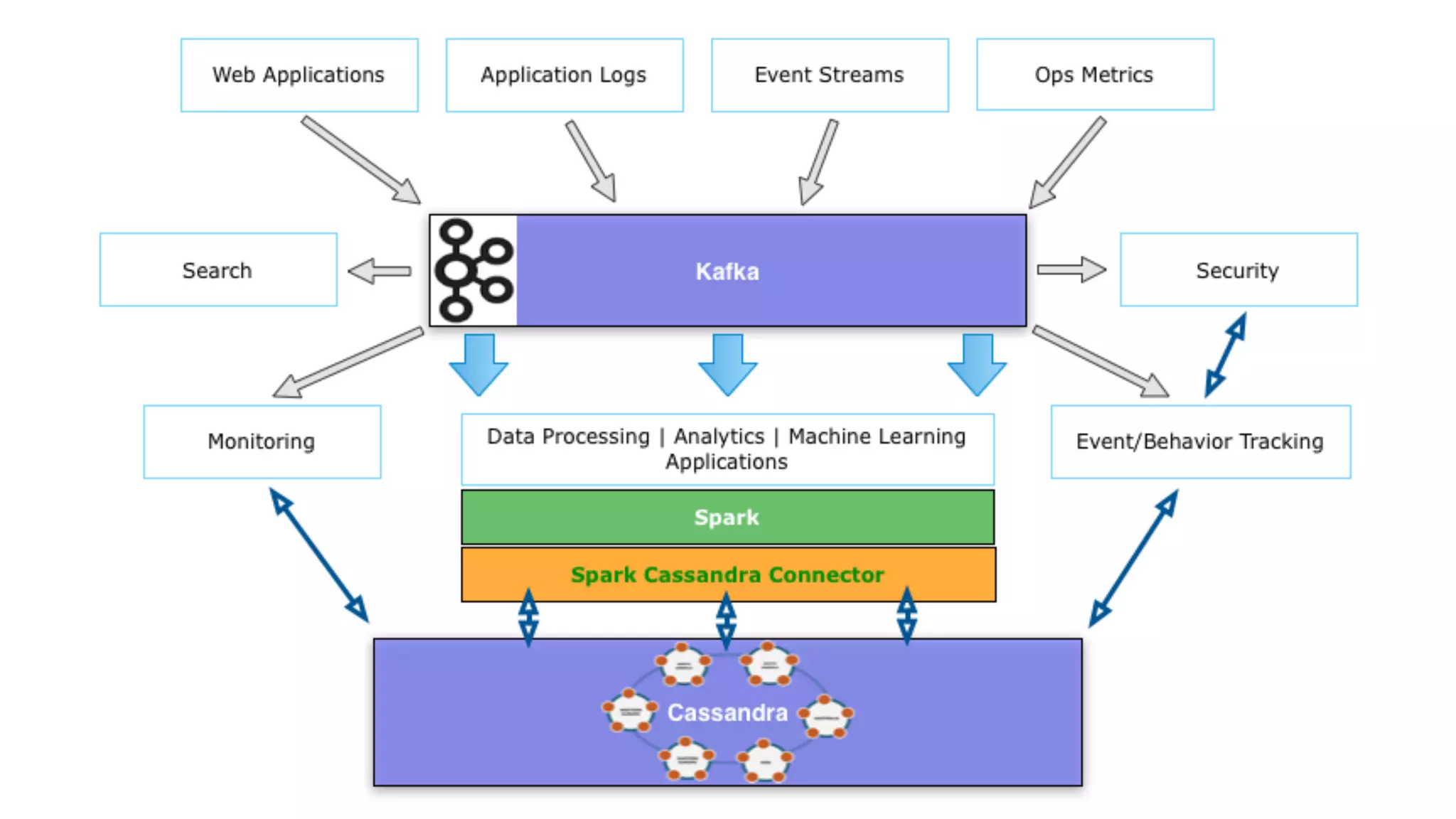
Talk Roadmap What Delivering Meaning Why Spark, Kafka, Cassandra & Akka How Composable Pipelines App Robust Implementation
©2014 DataStax Confidential. Do not distribute without consent. Sending Data Between Systems Is Difficult Risky 6
Strategies • Scalable Infrastructure • Partition For Scale • Replicate For Resiliency • Share Nothing • Asynchronous Message Passing • Parallelism • Isolation • Location Transparency
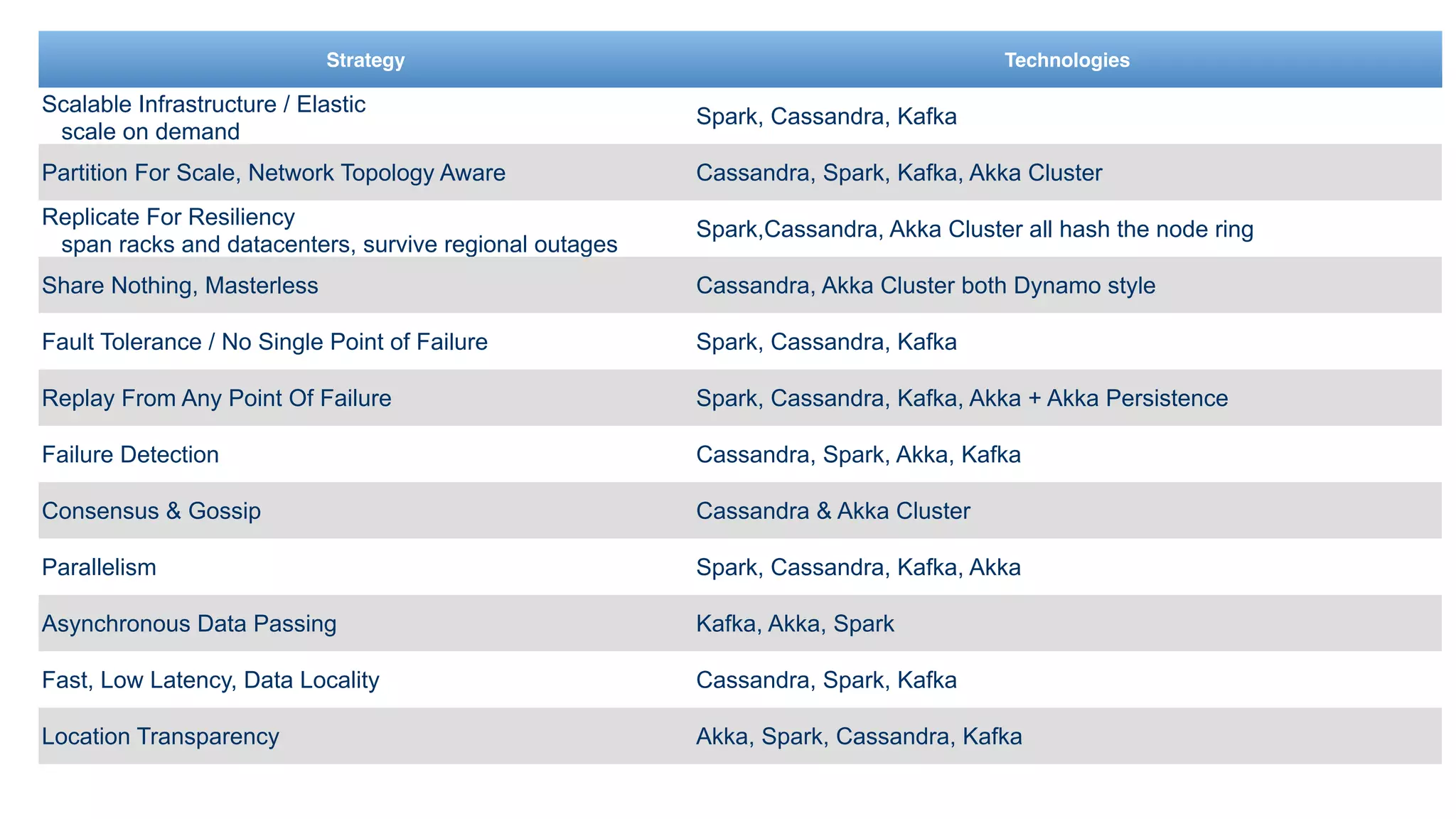
Strategy Technologies Scalable Infrastructure / Elastic scale on demand Spark, Cassandra, Kafka Partition For Scale, Network Topology Aware Cassandra, Spark, Kafka, Akka Cluster Replicate For Resiliency span racks and datacenters, survive regional outages Spark,Cassandra, Akka Cluster all hash the node ring Share Nothing, Masterless Cassandra, Akka Cluster both Dynamo style Fault Tolerance / No Single Point of Failure Spark, Cassandra, Kafka Replay From Any Point Of Failure Spark, Cassandra, Kafka, Akka + Akka Persistence Failure Detection Cassandra, Spark, Akka, Kafka Consensus & Gossip Cassandra & Akka Cluster Parallelism Spark, Cassandra, Kafka, Akka Asynchronous Data Passing Kafka, Akka, Spark Fast, Low Latency, Data Locality Cassandra, Spark, Kafka Location Transparency Akka, Spark, Cassandra, Kafka
Lambda Architecture A data-processing architecture designed to handle massive quantities of data by taking advantage of both batch and stream processing methods. • Spark is one of the few data processing frameworks that allows you to seamlessly integrate batch and stream processing • Of petabytes of data • In the same application
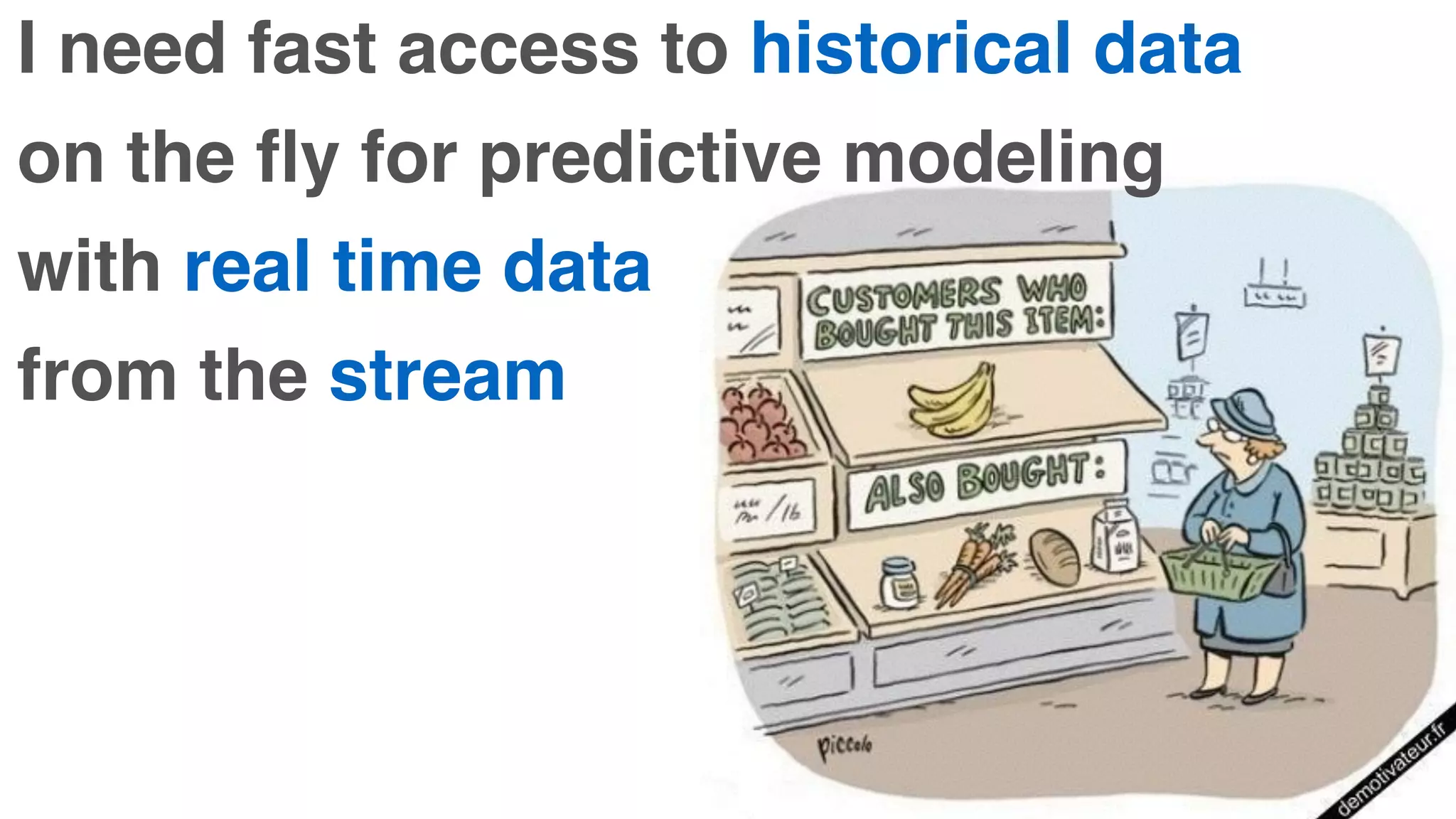
I need fast access to historical data on the fly for predictive modeling with real time data from the stream
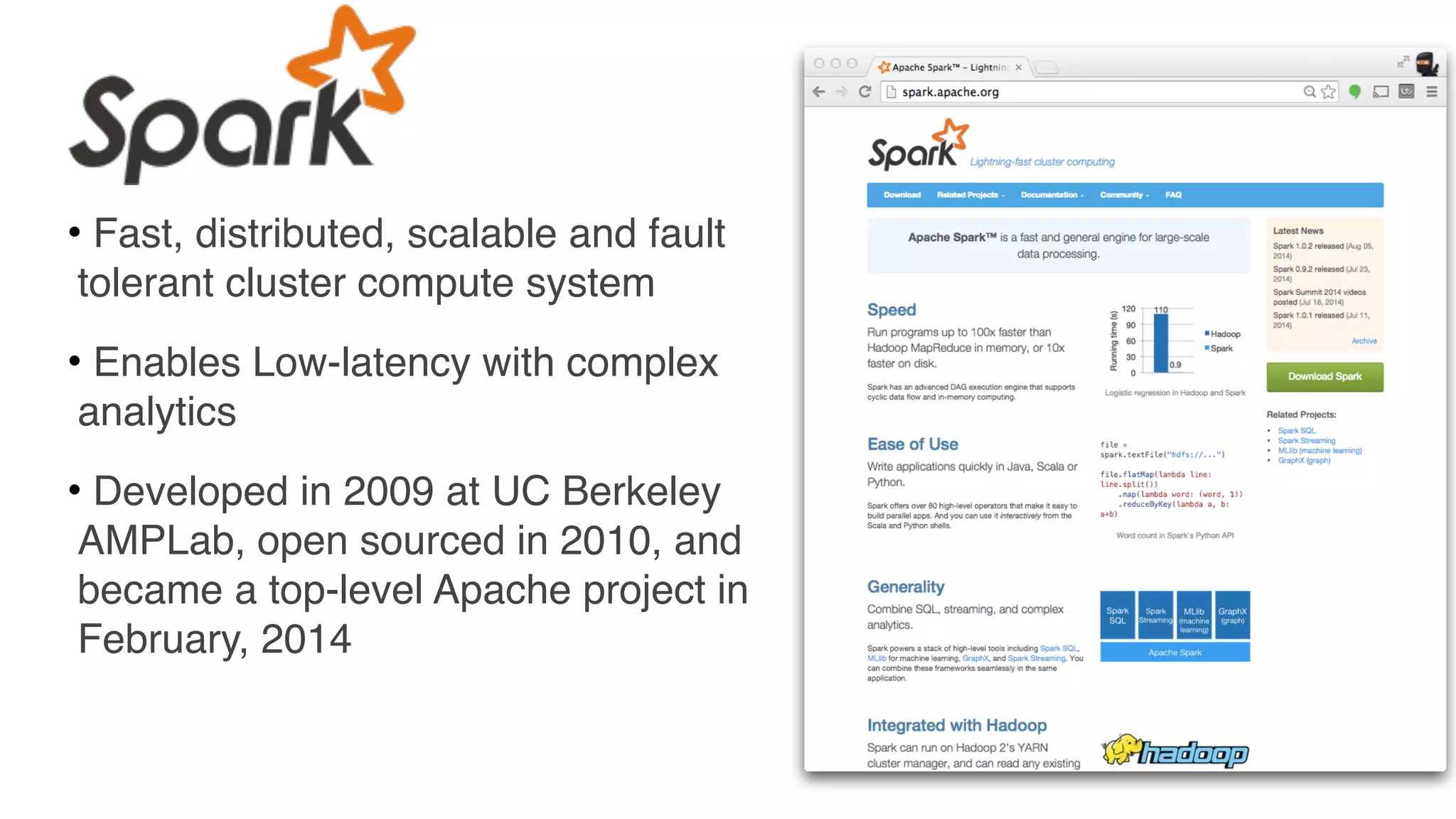
Analytic Analytic Search • Fast, distributed, scalable and fault tolerant cluster compute system • Enables Low-latency with complex analytics • Developed in 2009 at UC Berkeley AMPLab, open sourced in 2010, and became a top-level Apache project in February, 2014
• High Throughput Distributed Messaging • Decouples Data Pipelines • Handles Massive Data Load • Support Massive Number of Consumers • Distribution & partitioning across cluster nodes • Automatic recovery from broker failures
The one thing in your infrastructure you can always rely on.
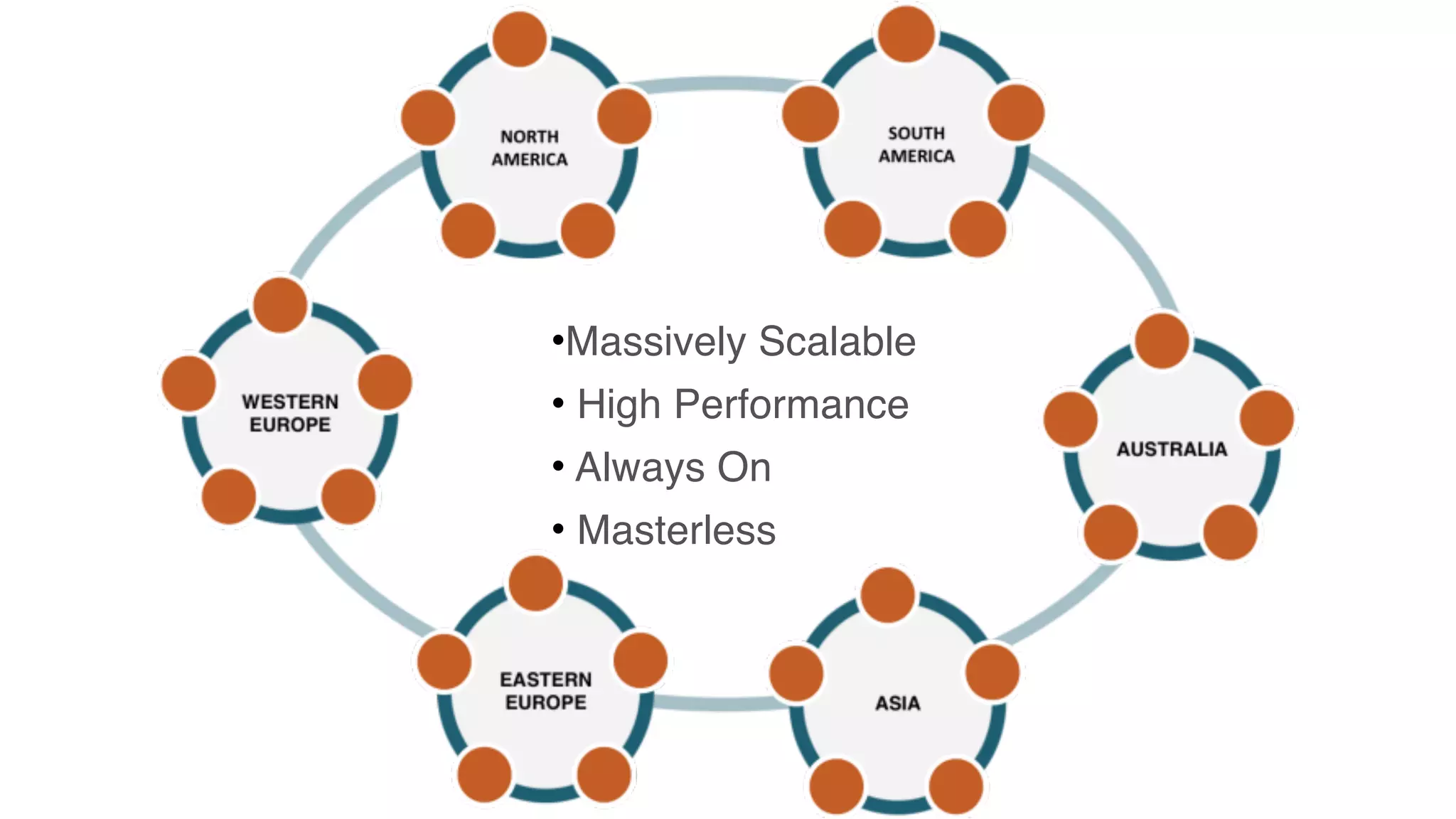
•Massively Scalable • High Performance • Always On • Masterless
Spark Cassandra Connector
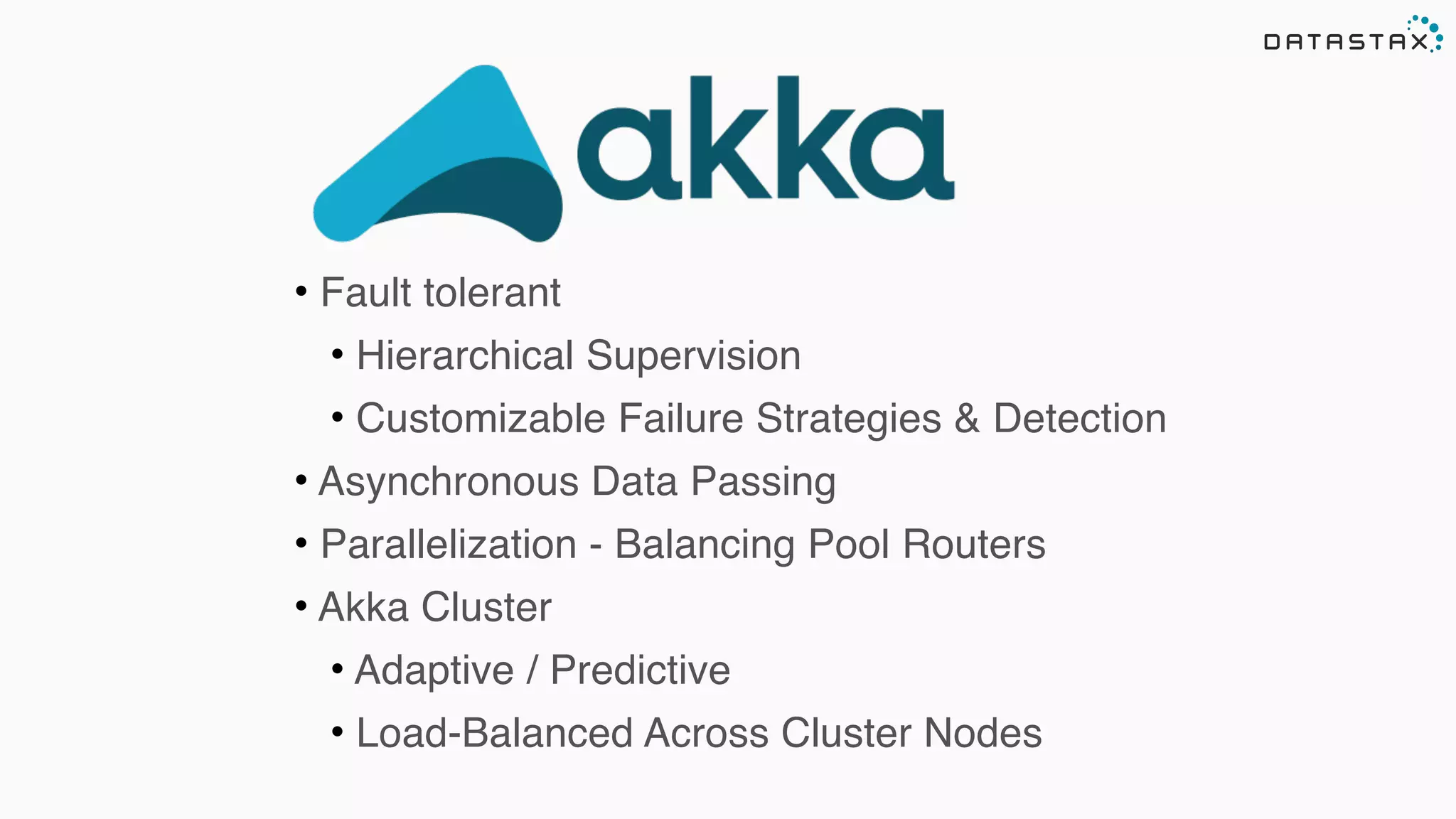
• Fault tolerant • Hierarchical Supervision • Customizable Failure Strategies & Detection • Asynchronous Data Passing • Parallelization - Balancing Pool Routers • Akka Cluster • Adaptive / Predictive • Load-Balanced Across Cluster Nodes
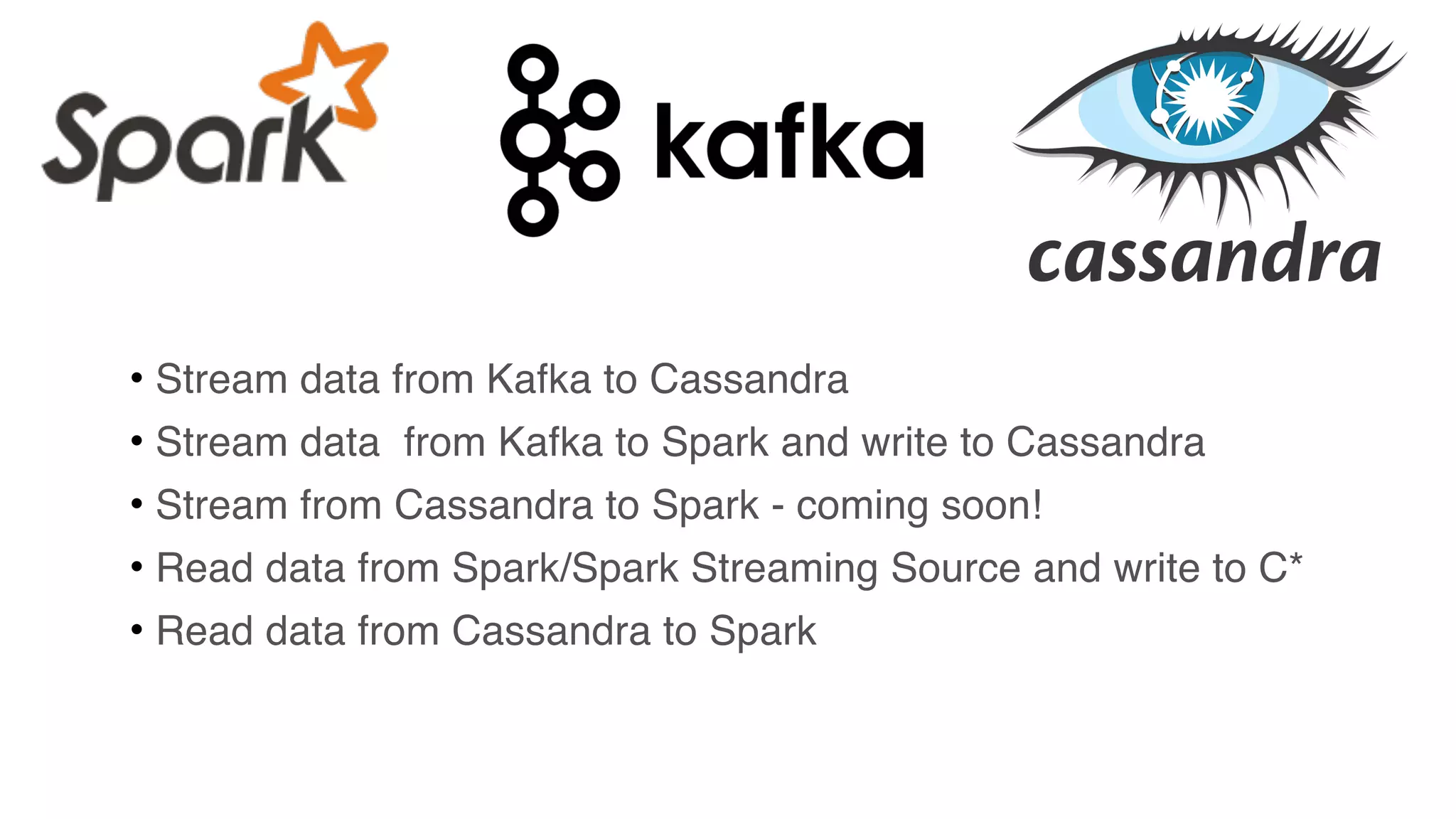
• Stream data from Kafka to Cassandra • Stream data from Kafka to Spark and write to Cassandra • Stream from Cassandra to Spark - coming soon! • Read data from Spark/Spark Streaming Source and write to C* • Read data from Cassandra to Spark
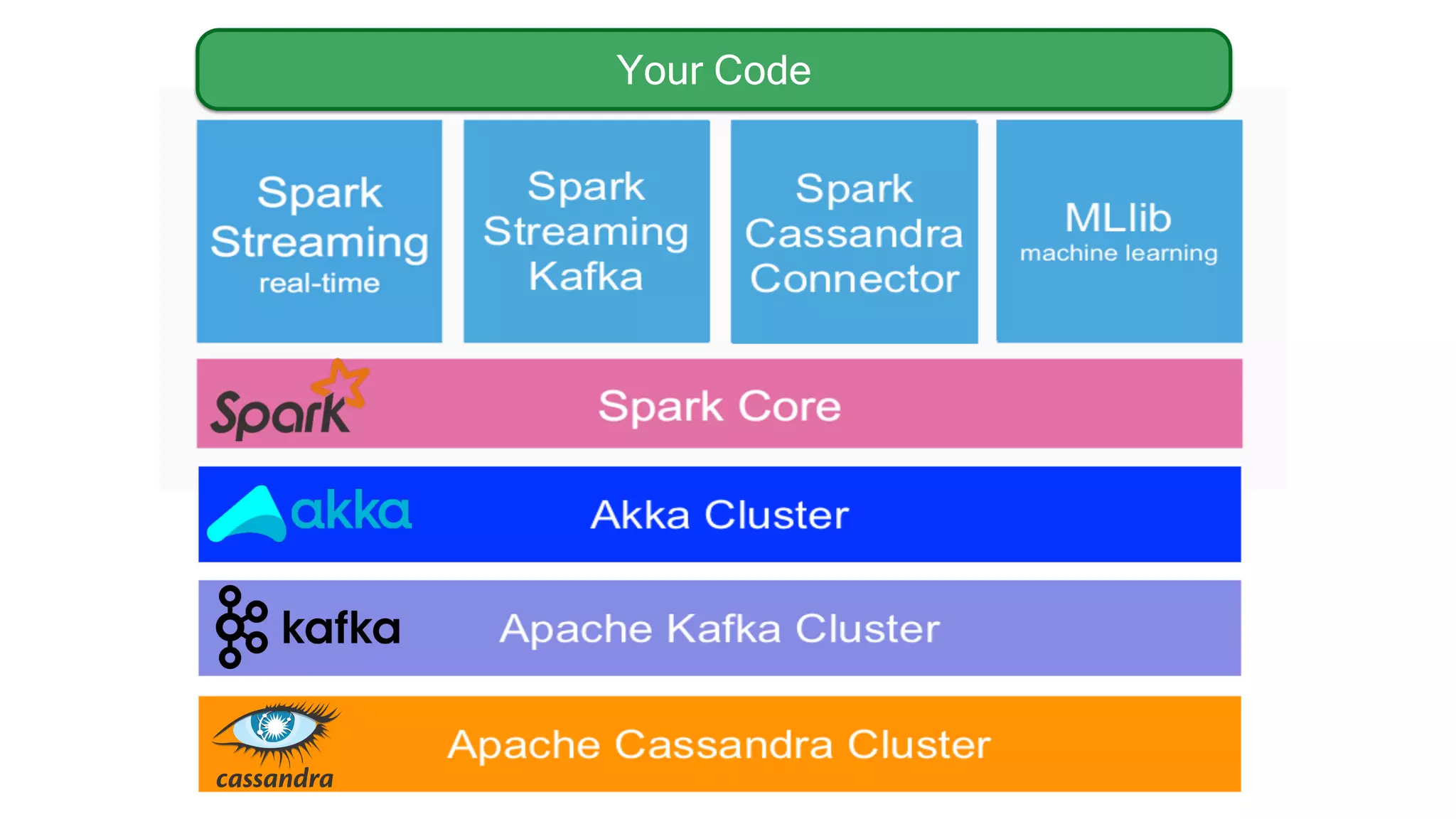
Your Code
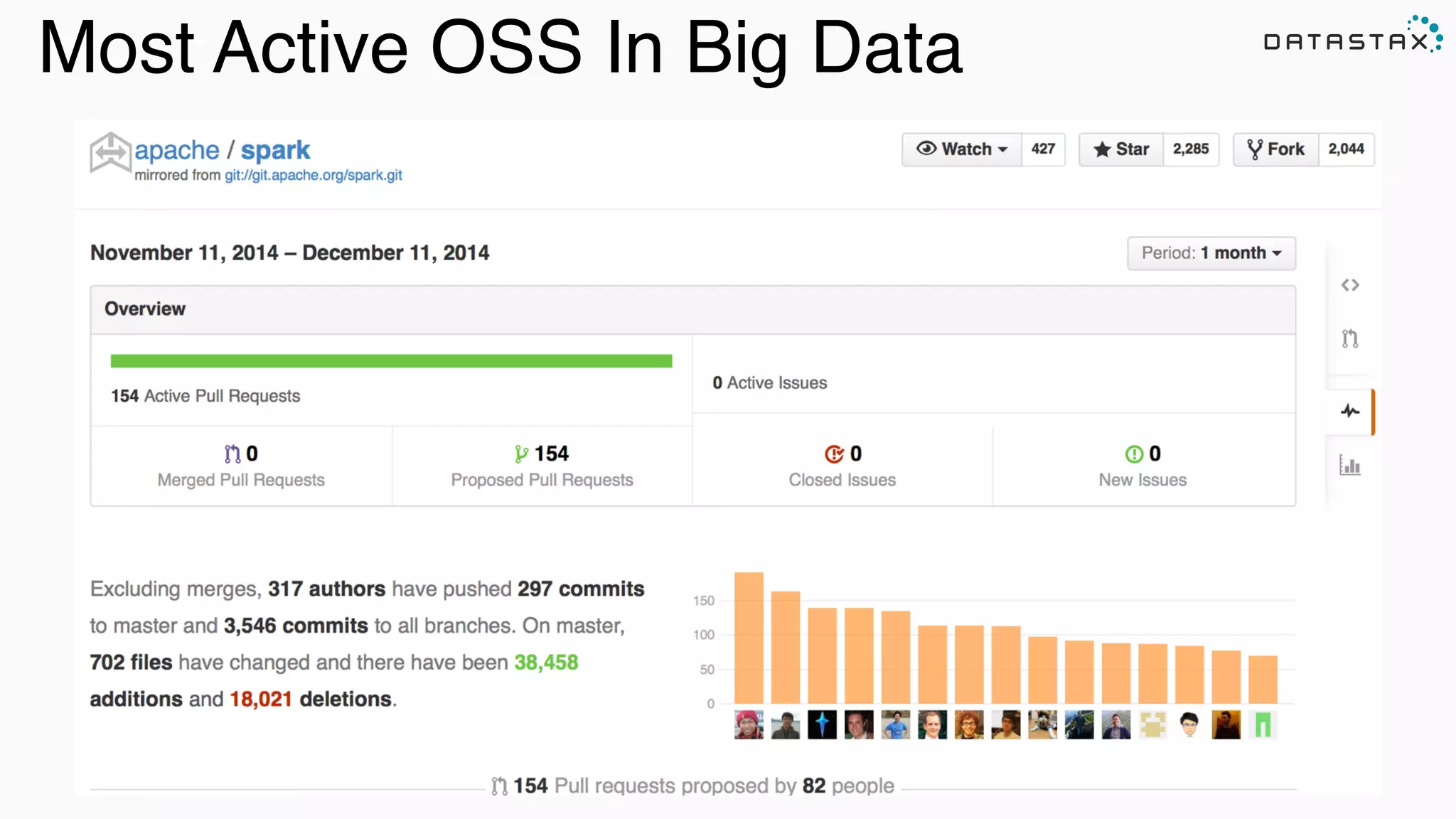
Most Active OSS In Big Data Search
Apache Spark - Easy to Use API Returns the top (k) highest temps for any location in the year def topK(aggregate: Seq[Double]): Seq[Double] = sc.parallelize(aggregate).top(k).collect Returns the top (k) highest temps … in a Future def topK(aggregate: Seq[Double]): Future[Seq[Double]] = sc.parallelize(aggregate).top(k).collectAsync Analytic Analytic Search
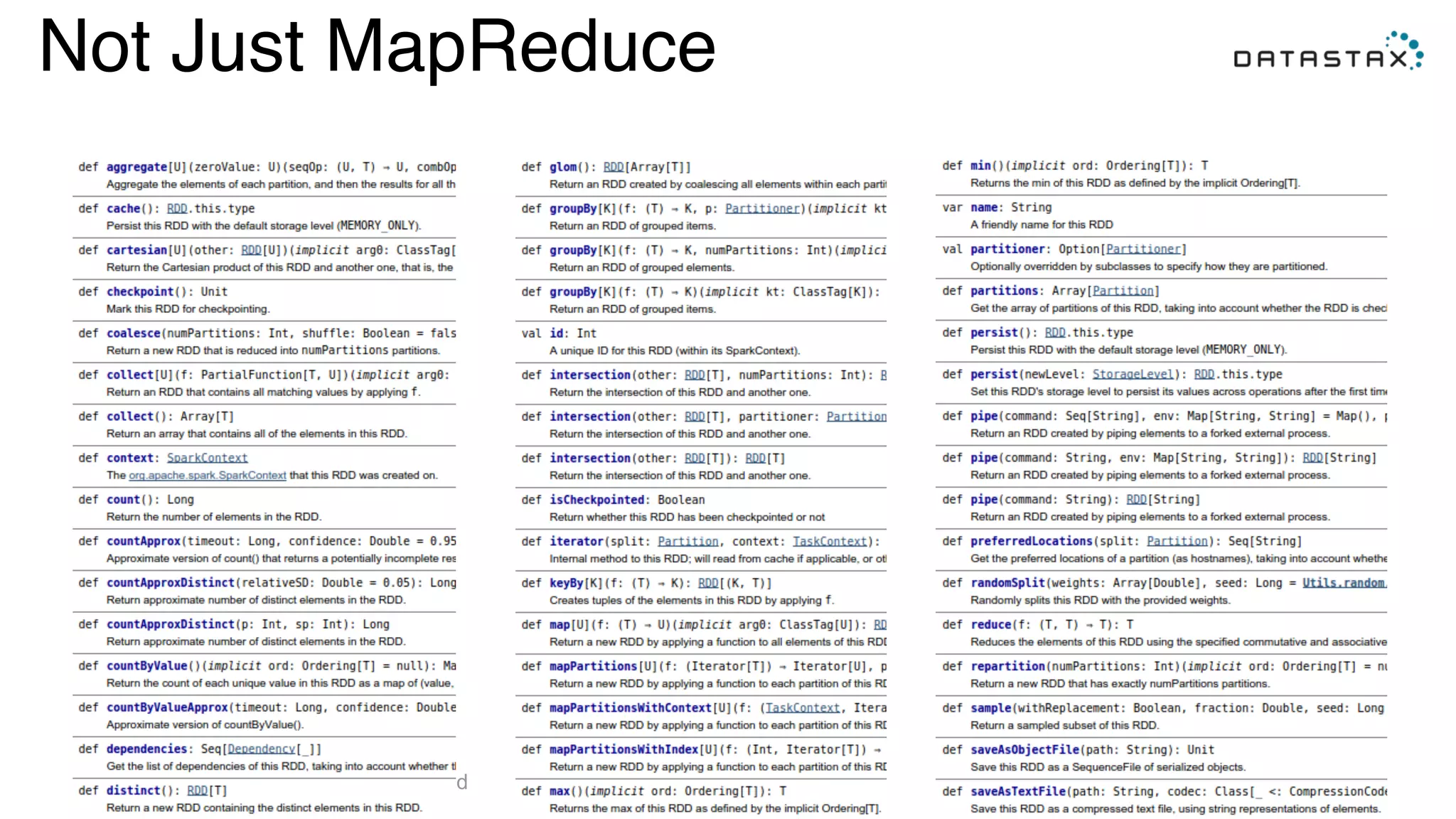
© 2014 DataStax, All Rights Reserved Company Confidential Not Just MapReduce
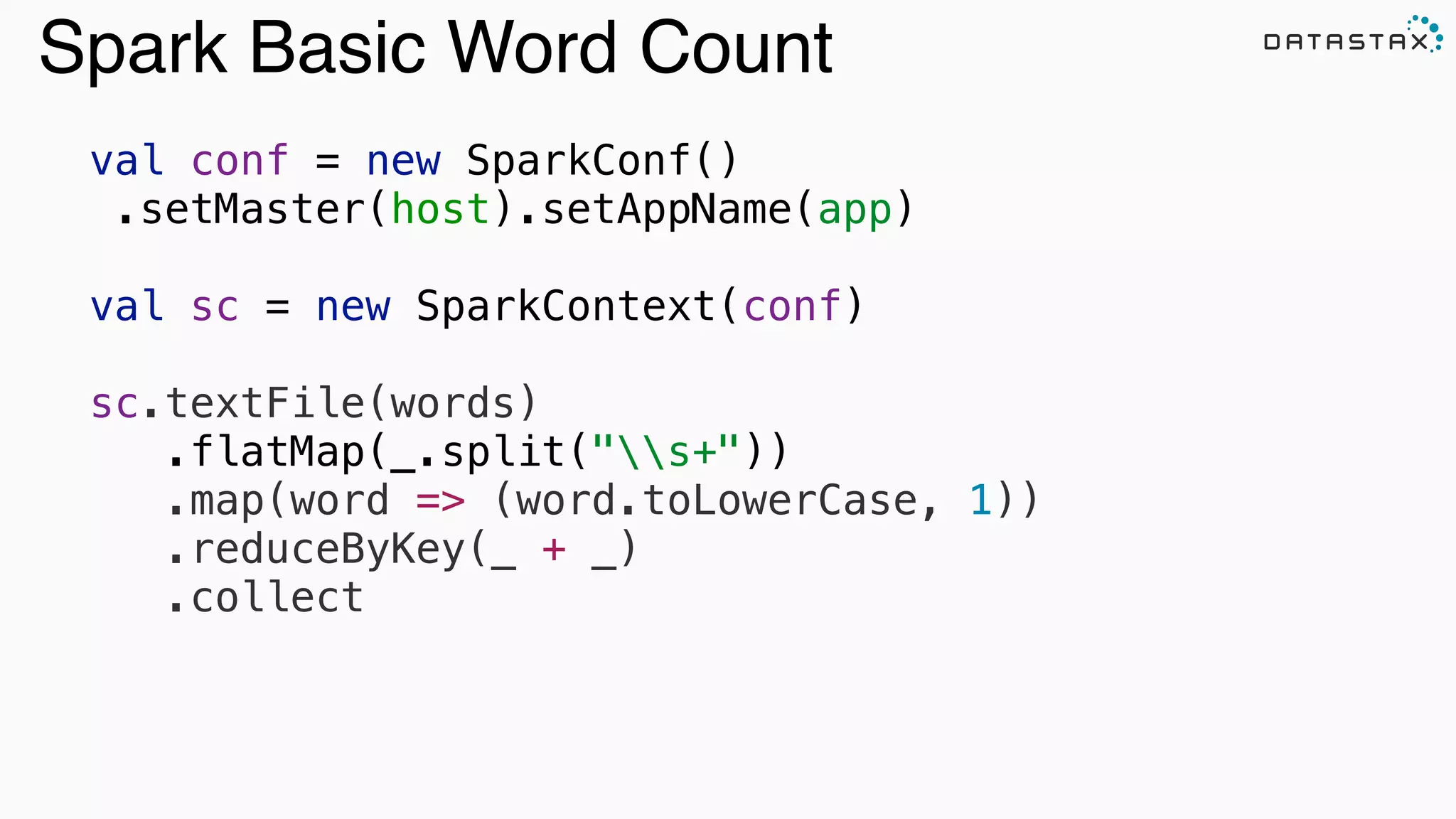
Spark Basic Word Count val conf = new SparkConf() .setMaster(host).setAppName(app)
 
 val sc = new SparkContext(conf) sc.textFile(words) .flatMap(_.split("s+")) .map(word => (word.toLowerCase, 1)) .reduceByKey(_ + _) .collect Analytic Analytic Search
Analytic Analytic Search Collection To RDD scala> val data = Array(1, 2, 3, 4, 5)
 data: Array[Int] = Array(1, 2, 3, 4, 5)
 
 scala> val distributedData = sc.parallelize(data)
 distributedData: spark.RDD[Int] = spark.ParallelCollection@10d13e3e
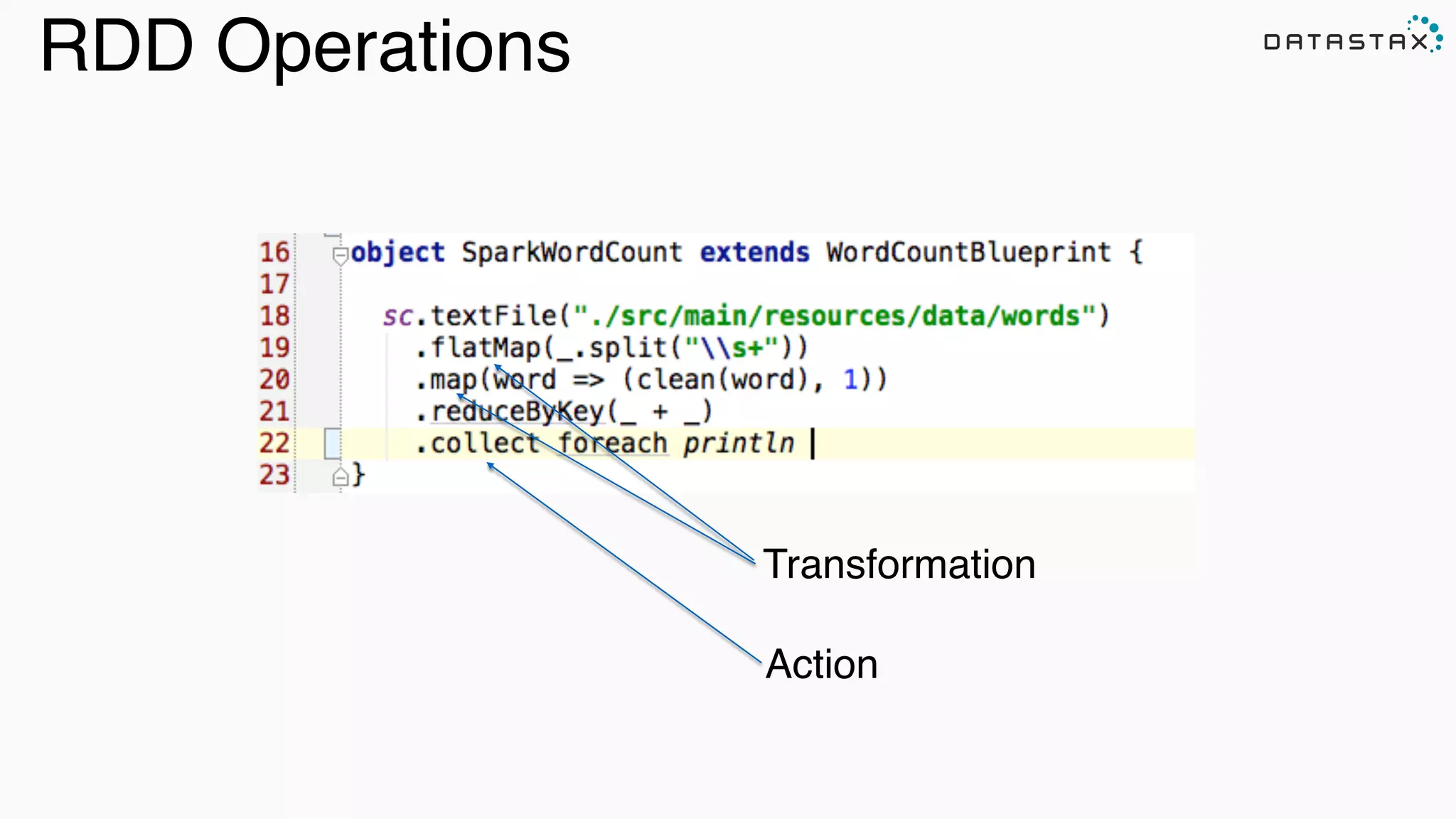
Analytic Analytic Search Transformation Action RDD Operations
When Batch Is Not Enough Analytic Analytic
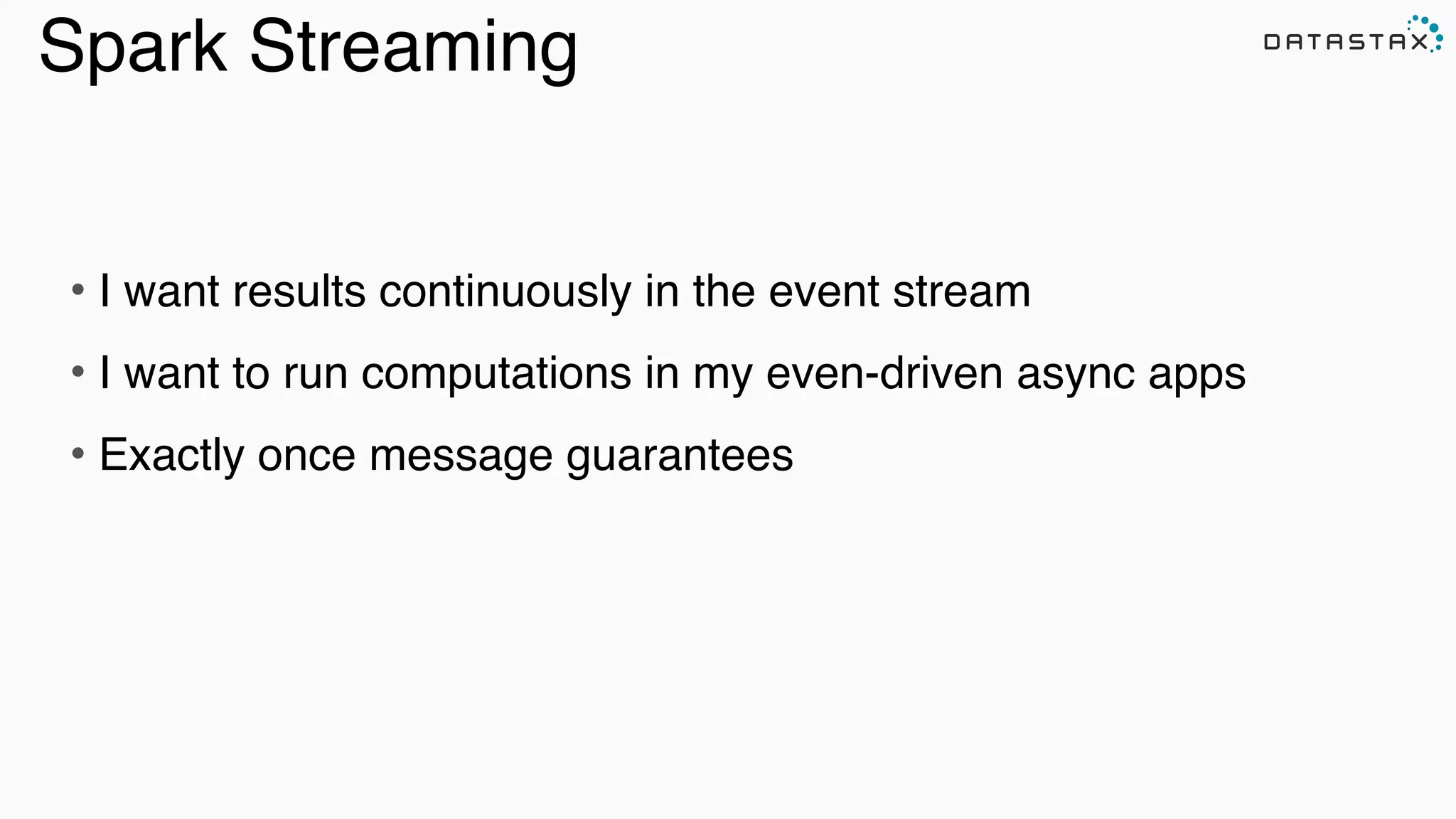
Spark Streaming • I want results continuously in the event stream • I want to run computations in my even-driven async apps • Exactly once message guarantees
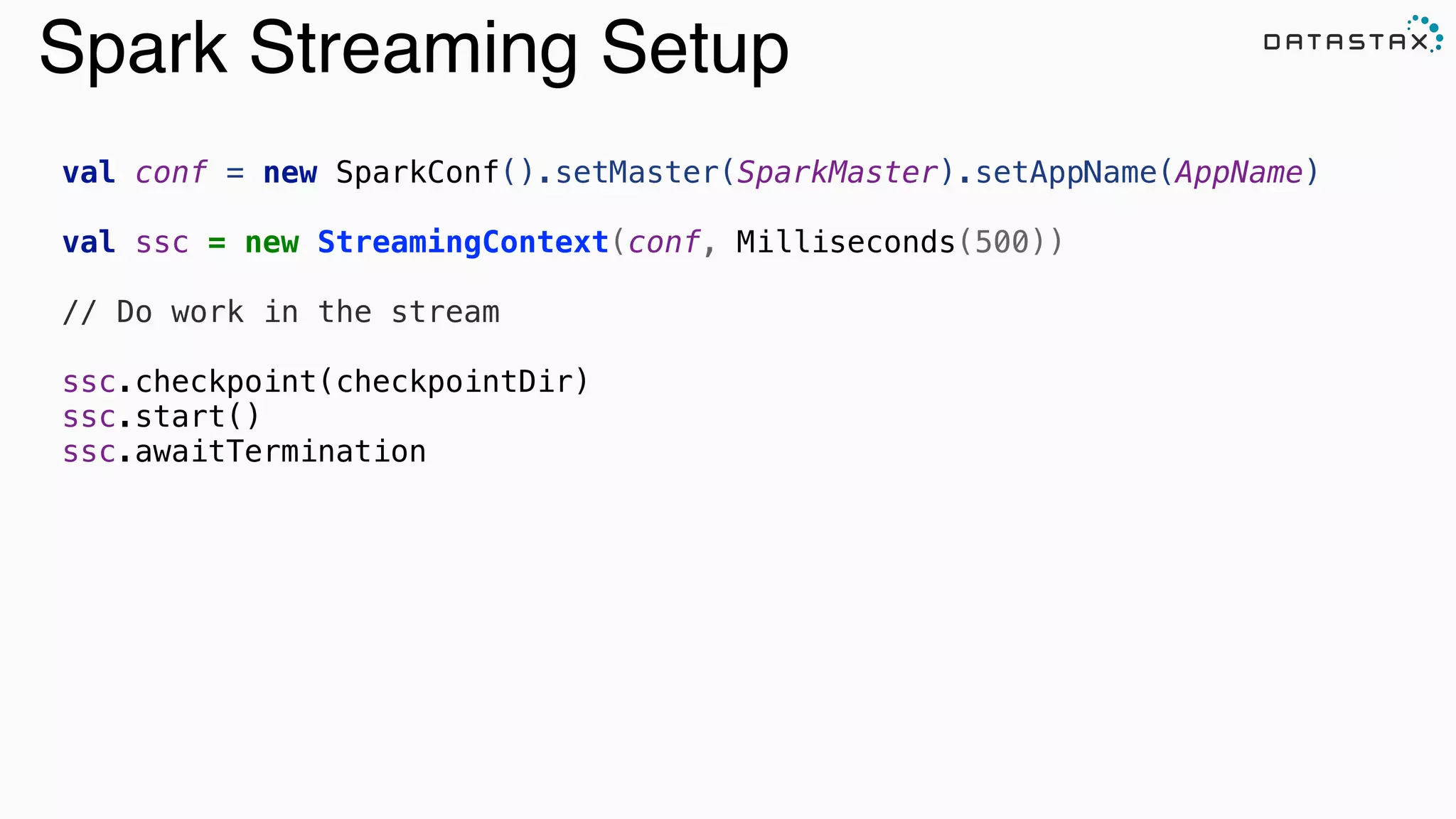
Spark Streaming Setup val conf = new SparkConf().setMaster(SparkMaster).setAppName(AppName) val ssc = new StreamingContext(conf, Milliseconds(500)) // Do work in the stream ssc.checkpoint(checkpointDir) ssc.start() ssc.awaitTermination
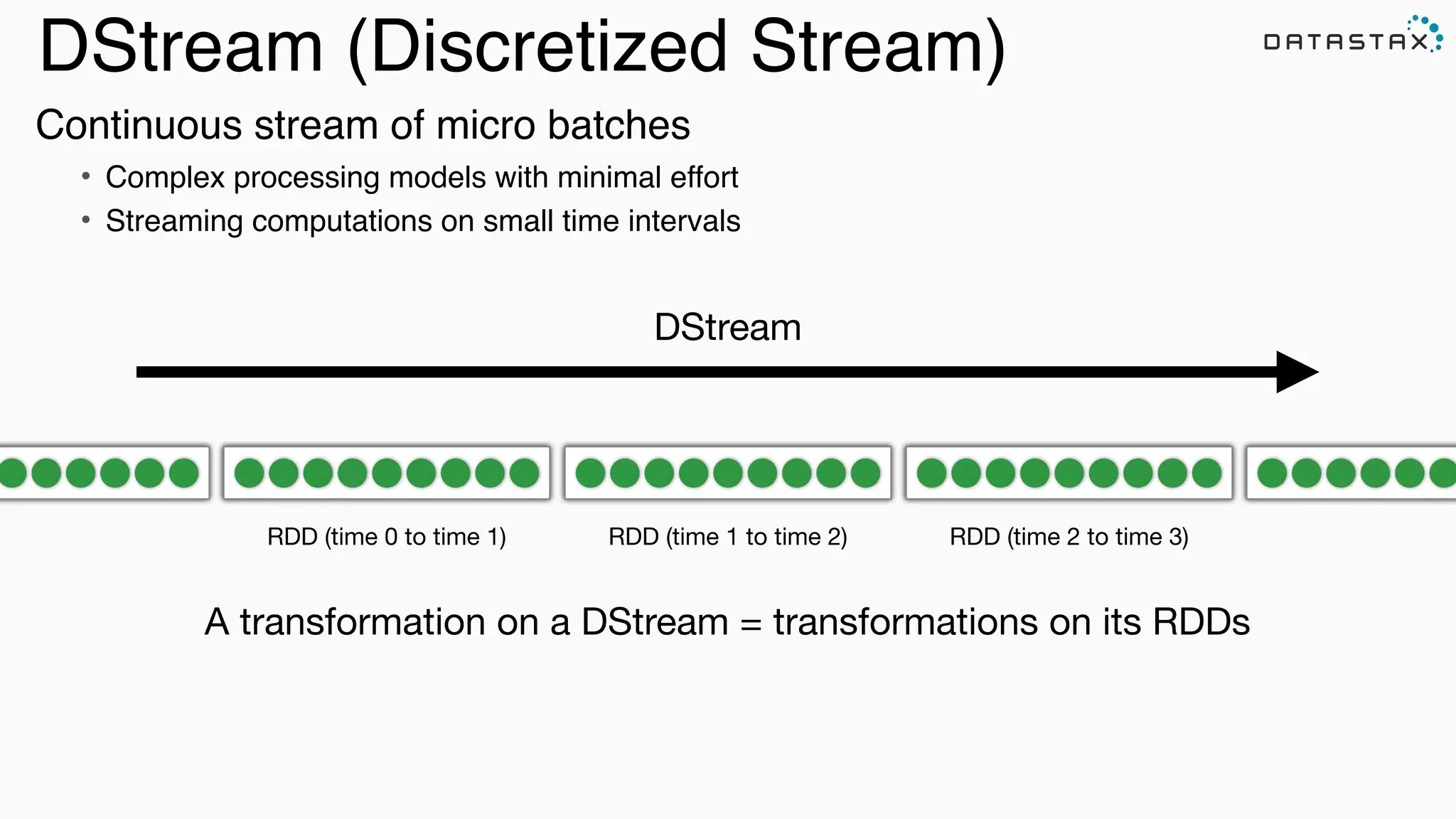
DStream (Discretized Stream) RDD (time 0 to time 1) RDD (time 1 to time 2) RDD (time 2 to time 3) A transformation on a DStream = transformations on its RDDs DStream Continuous stream of micro batches • Complex processing models with minimal effort • Streaming computations on small time intervals
Spark Streaming External Source/Sink
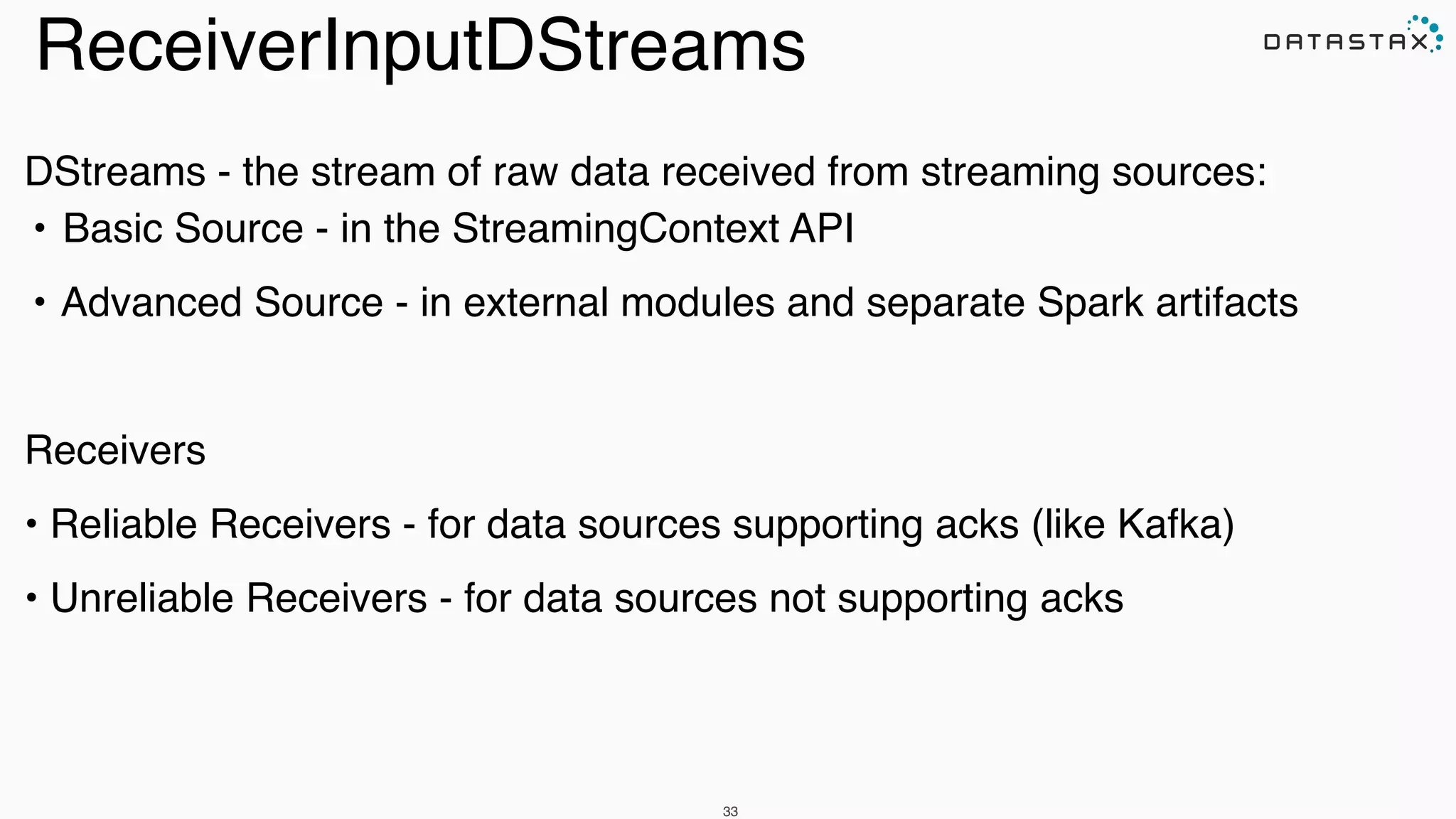
DStreams - the stream of raw data received from streaming sources: • Basic Source - in the StreamingContext API • Advanced Source - in external modules and separate Spark artifacts Receivers • Reliable Receivers - for data sources supporting acks (like Kafka) • Unreliable Receivers - for data sources not supporting acks 33 ReceiverInputDStreams
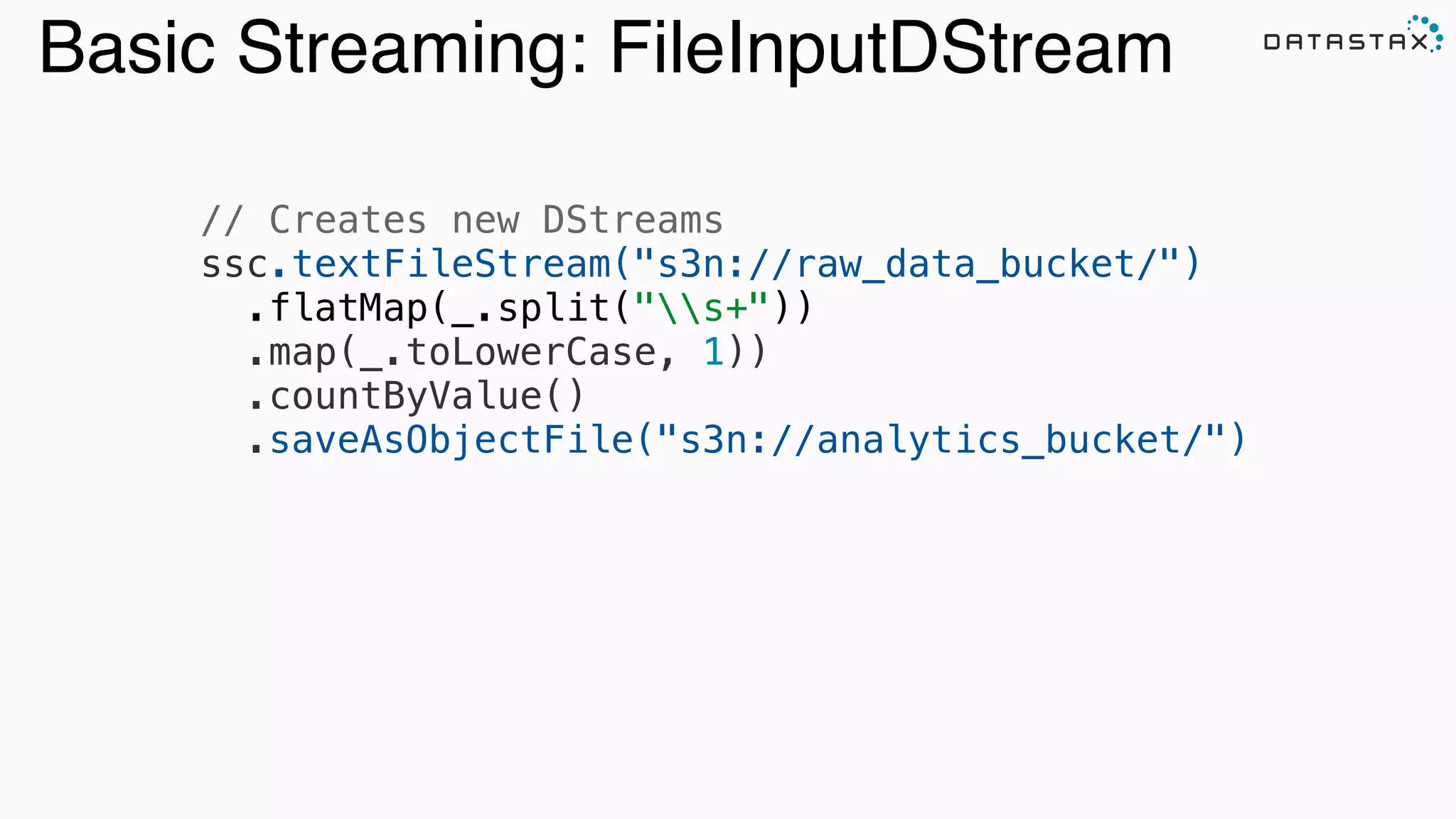
Basic Streaming: FileInputDStream // Creates new DStreams ssc.textFileStream("s3n://raw_data_bucket/") .flatMap(_.split("s+")) .map(_.toLowerCase, 1)) .countByValue() .saveAsObjectFile("s3n://analytics_bucket/") Search
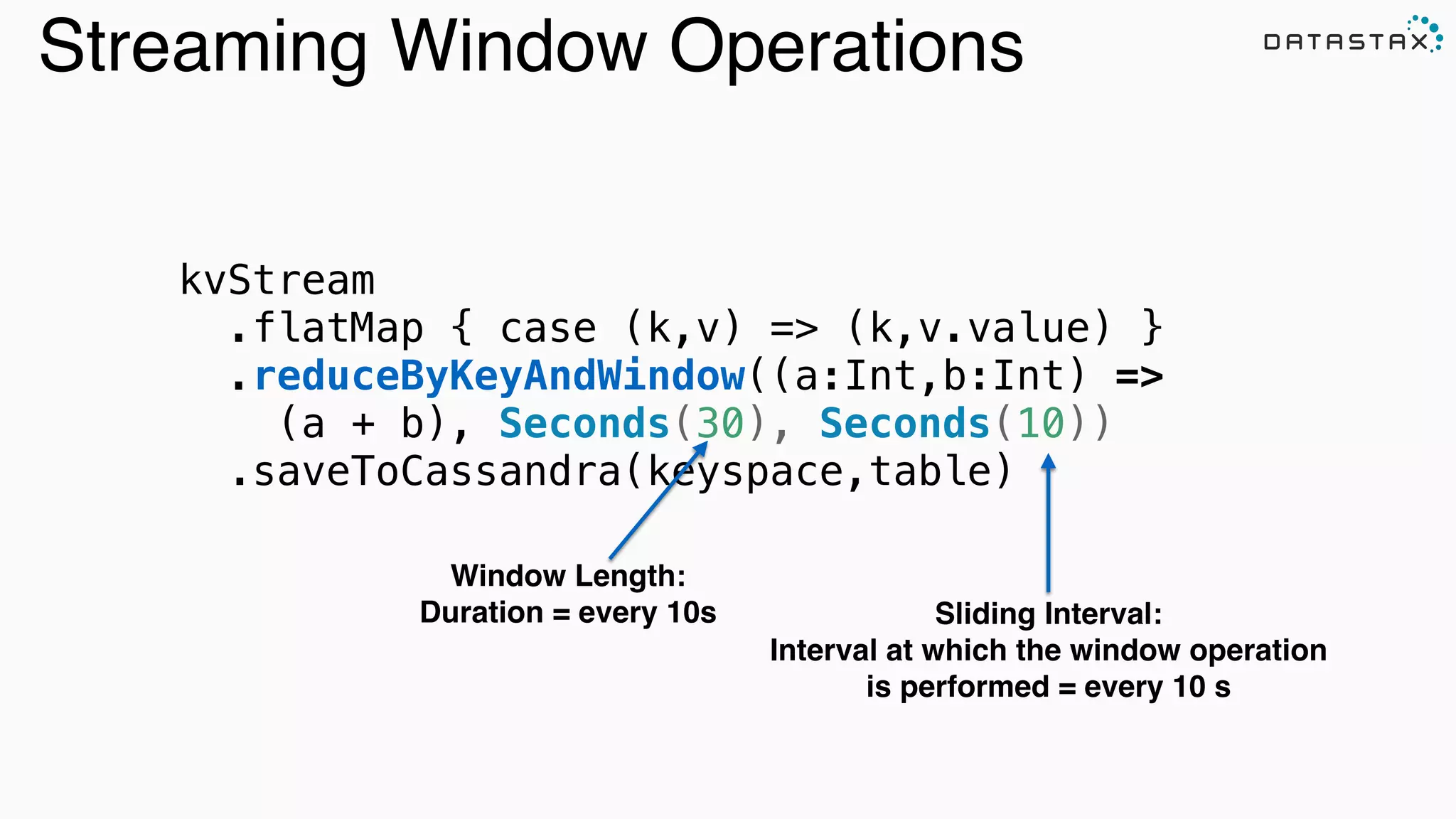
Streaming Window Operations kvStream .flatMap { case (k,v) => (k,v.value) } .reduceByKeyAndWindow((a:Int,b:Int) => (a + b), Seconds(30), Seconds(10)) .saveToCassandra(keyspace,table) Window Length: Duration = every 10s Sliding Interval: Interval at which the window operation is performed = every 10 s
Apache Cassandra • Elasticity - scale to as many nodes as you need, when you need • Always On - No single point of failure, Continuous availability • Masterless peer to peer architecture • Replication Across DataCenters • Flexible Data Storage • Read and write to any node syncs across the cluster • Operational simplicity - all nodes in a cluster are the same • Fast Linear-Scale Performance •Transaction Support
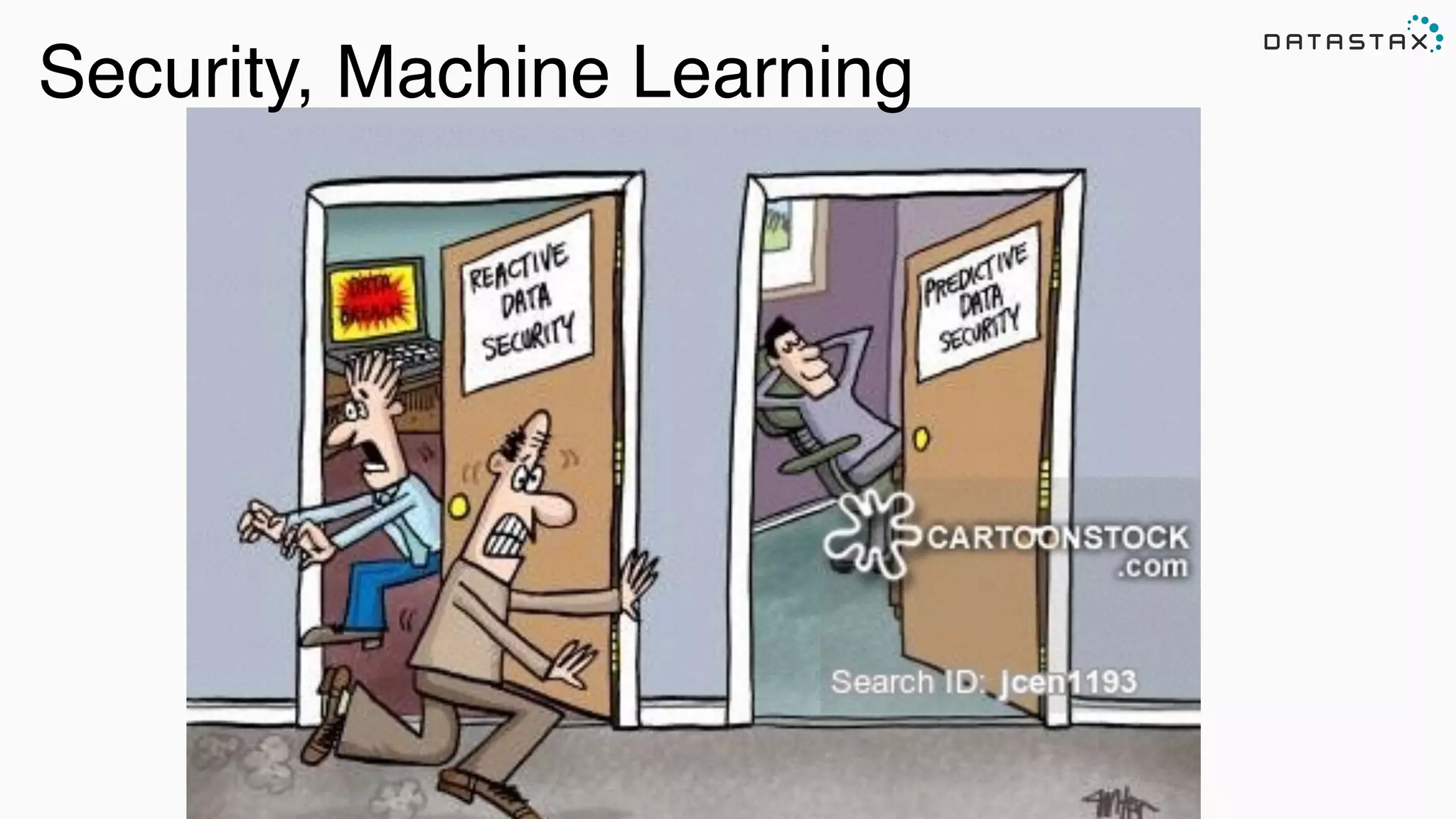
Security, Machine Learning
Science Physics: Astro Physics / Particle Physics..
Genetics / Biological Computations
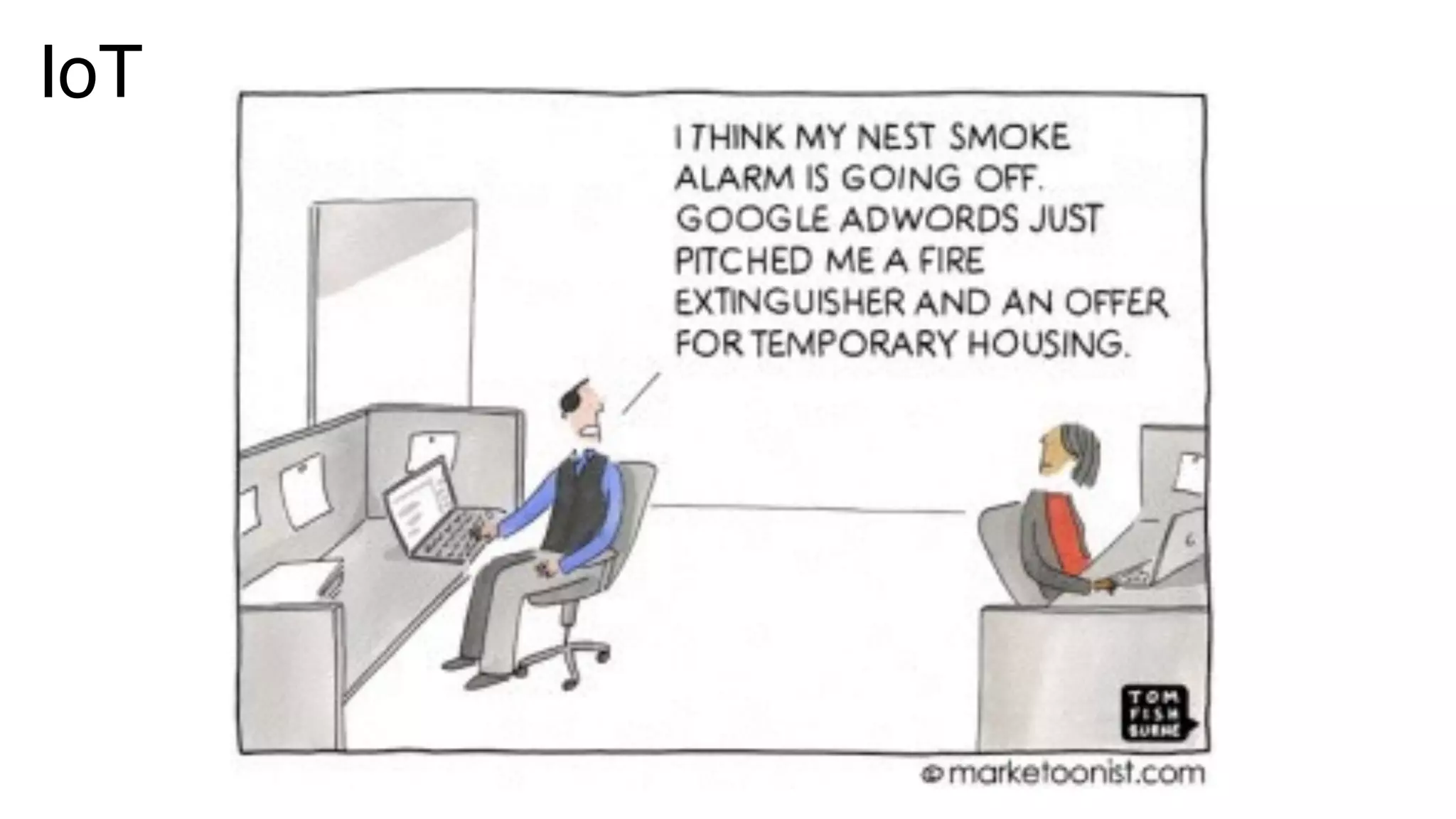
IoT
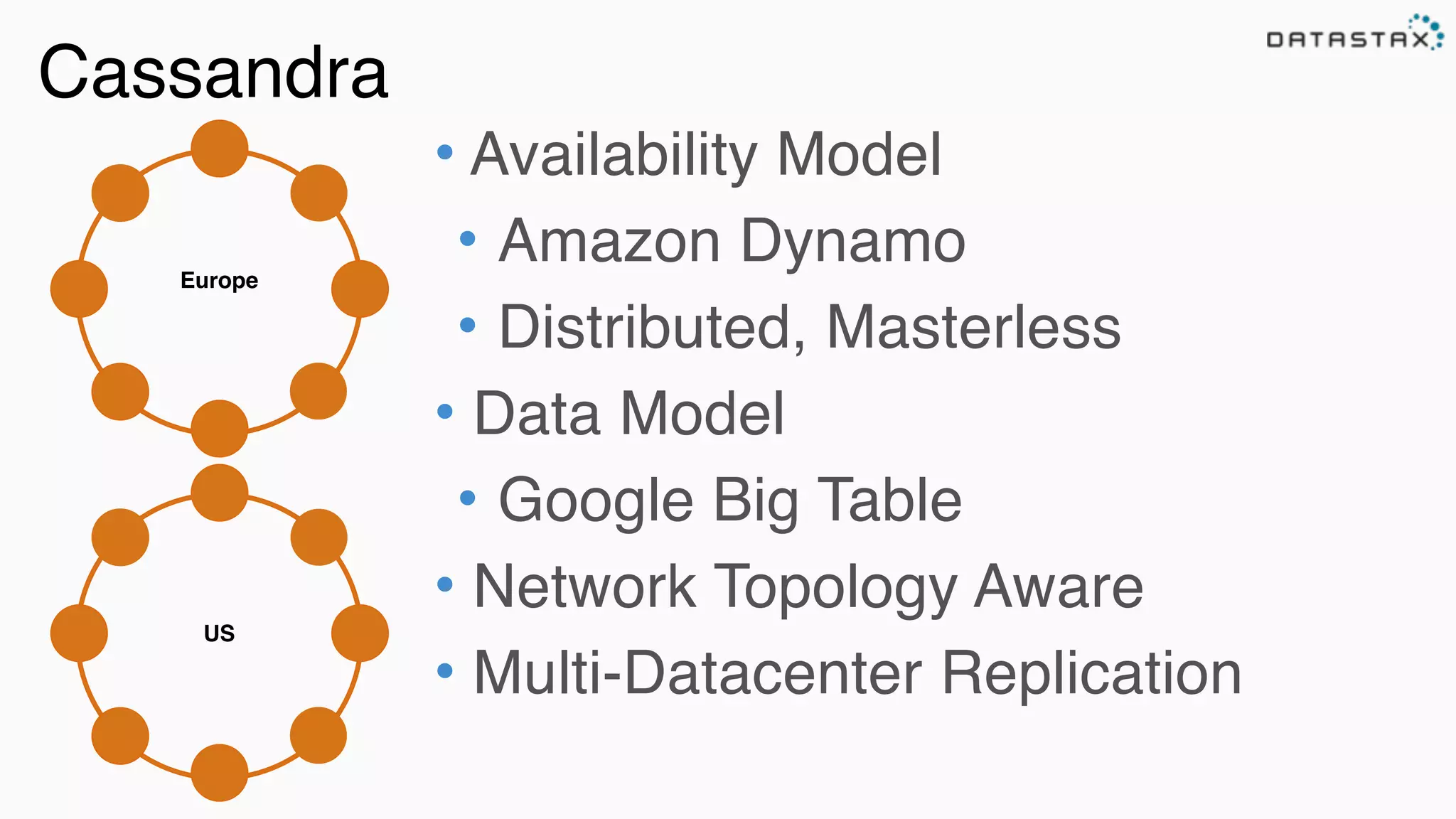
Europe US Cassandra • Availability Model • Amazon Dynamo • Distributed, Masterless • Data Model • Google Big Table • Network Topology Aware • Multi-Datacenter Replication
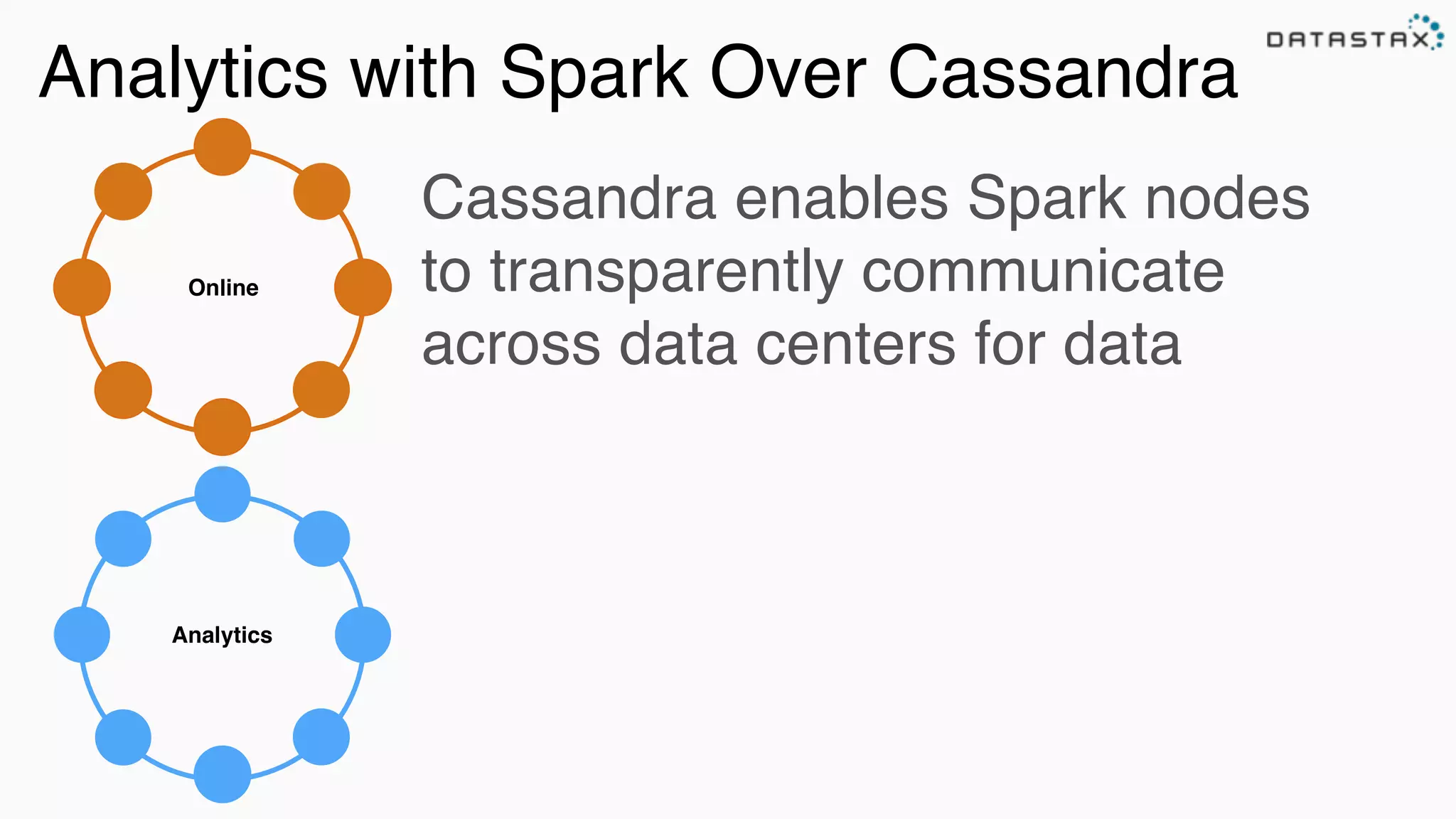
Analytics with Spark Over Cassandra Online Analytics Cassandra enables Spark nodes to transparently communicate across data centers for data
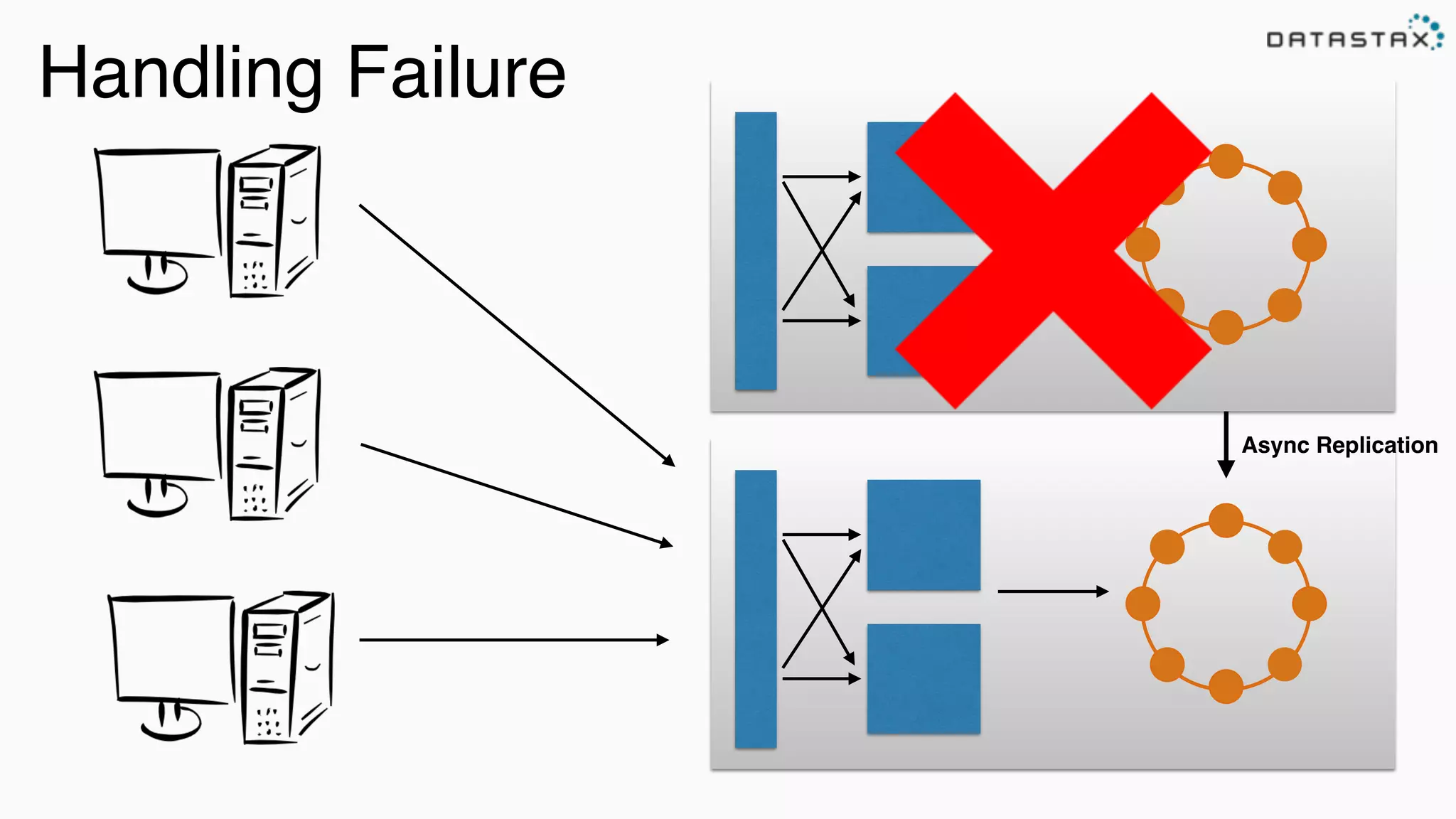
Handling Failure Async Replication
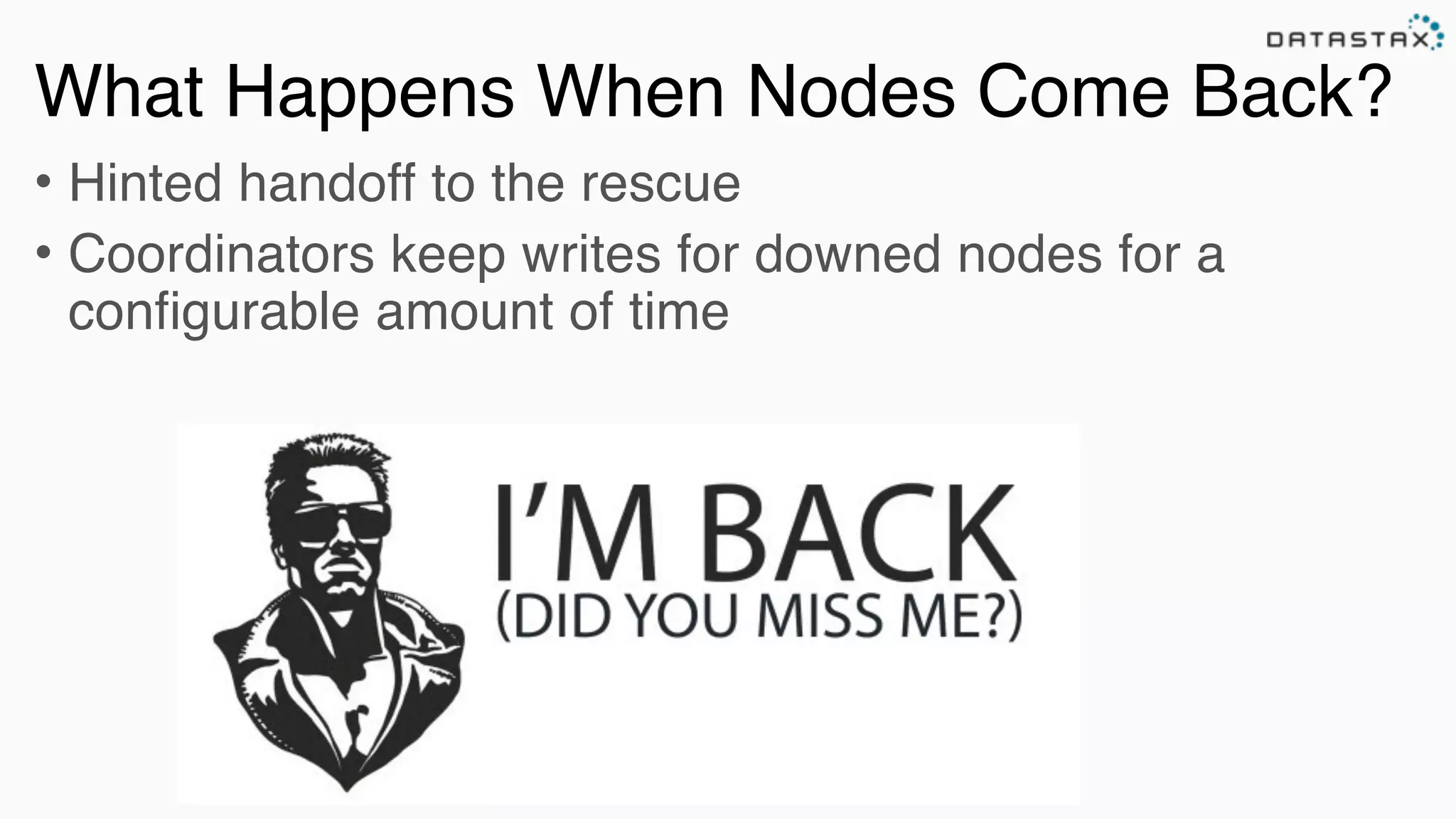
What Happens When Nodes Come Back? • Hinted handoff to the rescue • Coordinators keep writes for downed nodes for a configurable amount of time
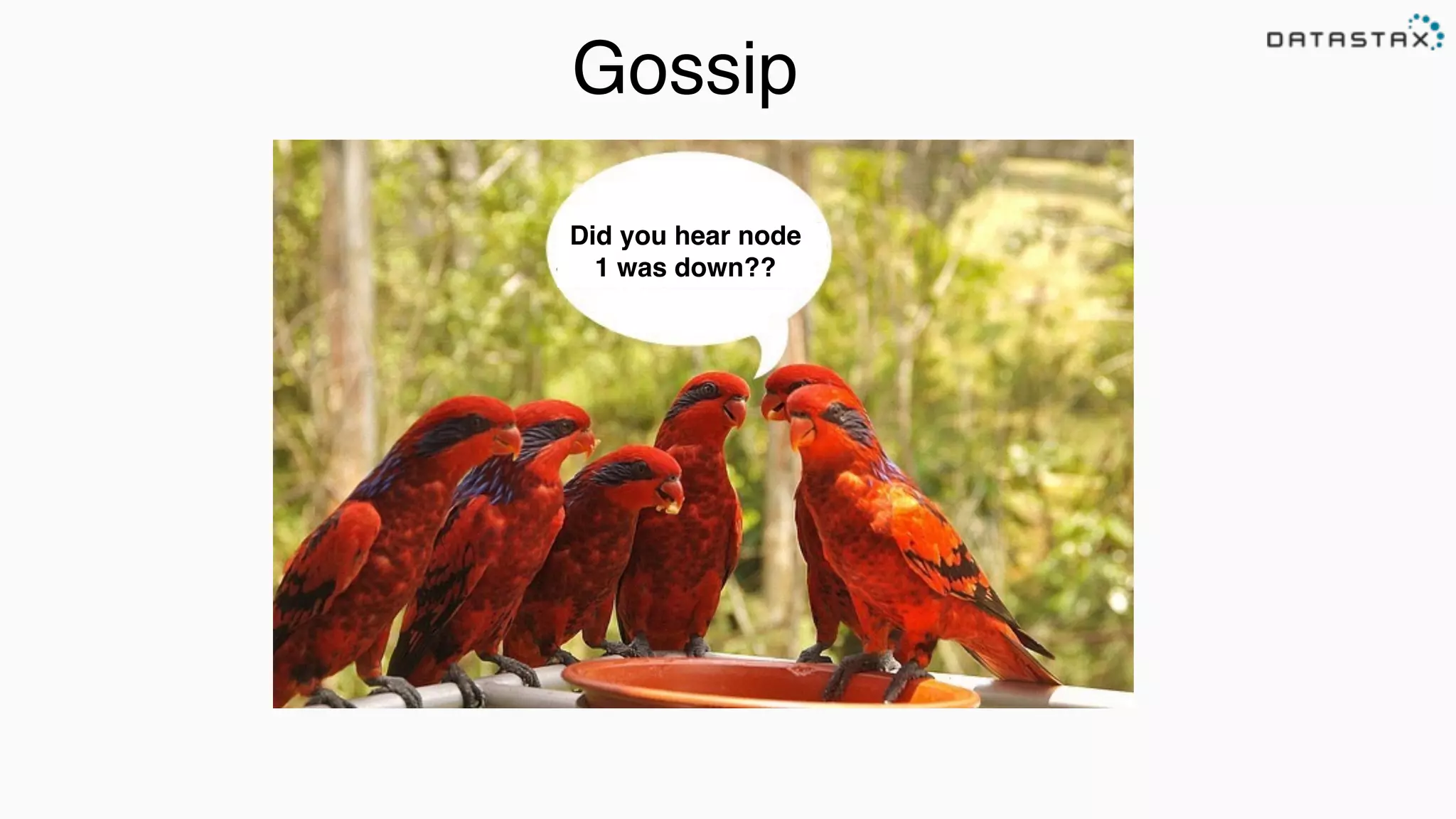
Gossip Did you hear node 1 was down??
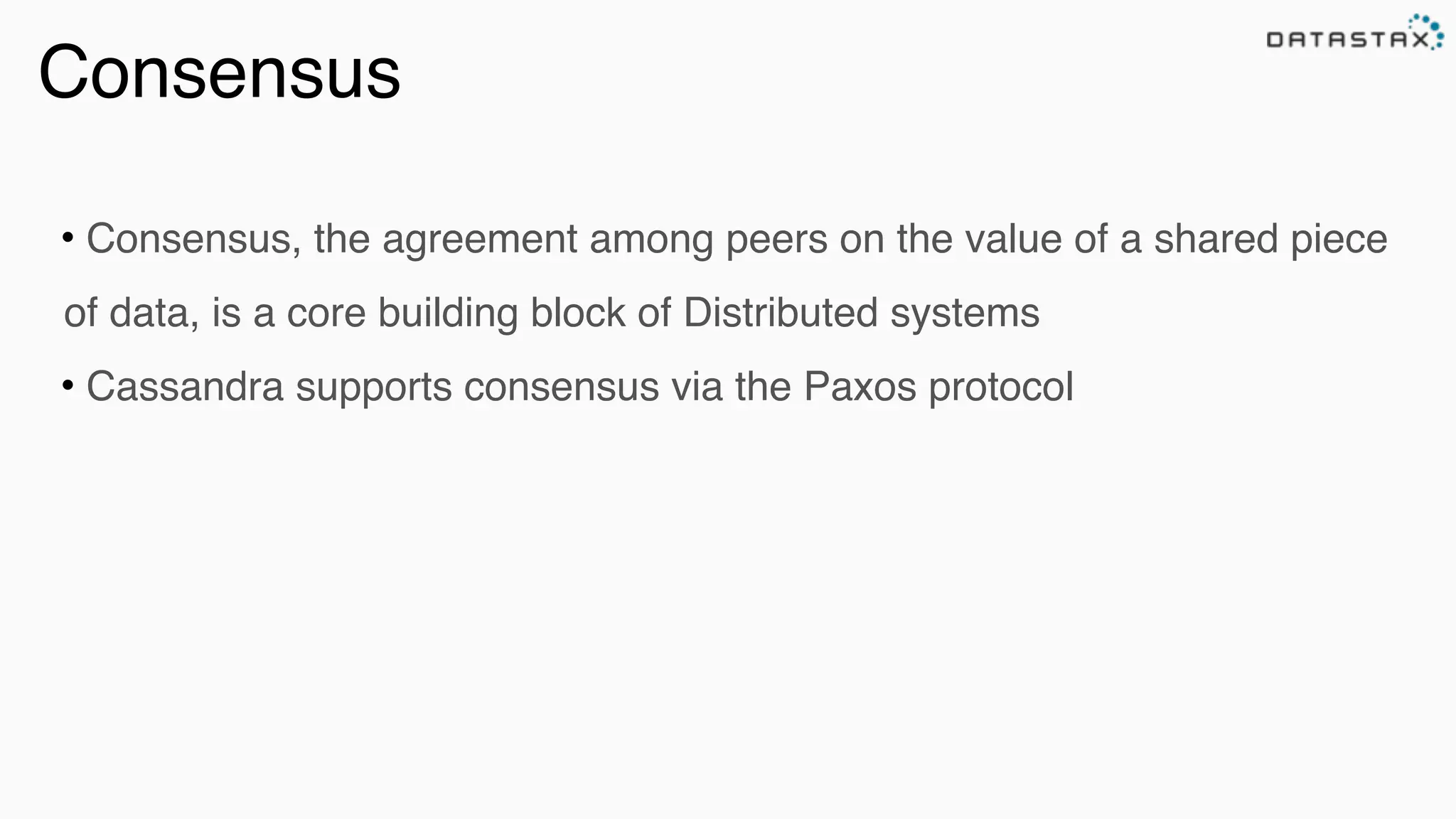
Consensus • Consensus, the agreement among peers on the value of a shared piece of data, is a core building block of Distributed systems • Cassandra supports consensus via the Paxos protocol
CREATE TABLE users ( username varchar, firstname varchar, lastname varchar, email list<varchar>, password varchar, created_date timestamp, PRIMARY KEY (username) ); INSERT INTO users (username, firstname, lastname, email, password, created_date) VALUES ('hedelson','Helena','Edelson', [‘helena.edelson@datastax.com'],'ba27e03fd95e507daf2937c937d499ab','2014-11-15 13:50:00’) IF NOT EXISTS; • Familiar syntax • Many Tools & Drivers • Many Languages • Friendly to programmers • Paxos for locking CQL - Easy
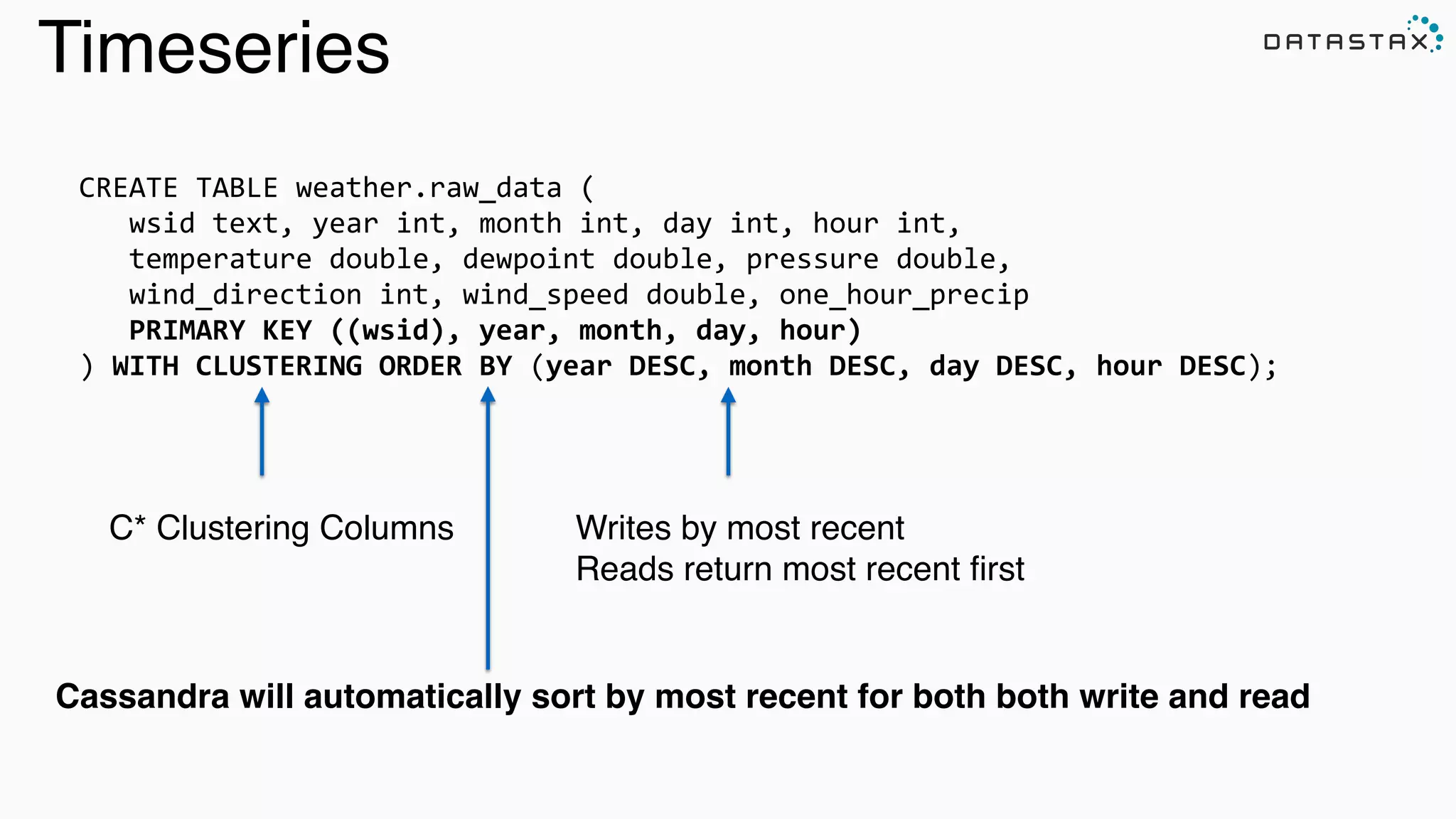
CREATE  TABLE  weather.raw_data  (
      wsid  text,  year  int,  month  int,  day  int,  hour  int,                          
      temperature  double,  dewpoint  double,  pressure  double,          wind_direction  int,  wind_speed  double,  one_hour_precip              PRIMARY  KEY  ((wsid),  year,  month,  day,  hour)
 )  WITH  CLUSTERING  ORDER  BY  (year  DESC,  month  DESC,  day  DESC,  hour  DESC);   C* Clustering Columns Writes by most recent Reads return most recent first Timeseries Cassandra will automatically sort by most recent for both both write and read
val multipleStreams = (1 to numDstreams).map { i => streamingContext.receiverStream[HttpRequest](new HttpReceiver(port)) } streamingContext.union(multipleStreams) .map { httpRequest => TimelineRequestEvent(httpRequest)} .saveToCassandra("requests_ks", "timeline") A record of every event, in order in which it happened, per URL: CREATE TABLE IF NOT EXISTS requests_ks.timeline ( timesegment bigint, url text, t_uuid timeuuid, method text, headers map <text, text>, body text, PRIMARY KEY ((url, timesegment) , t_uuid) ); timeuuid protects from simultaneous events over-writing one another. timesegment protects from writing unbounded partitions.
©2014 DataStax Confidential. Do not distribute without consent. Spark Cassandra Connector 52
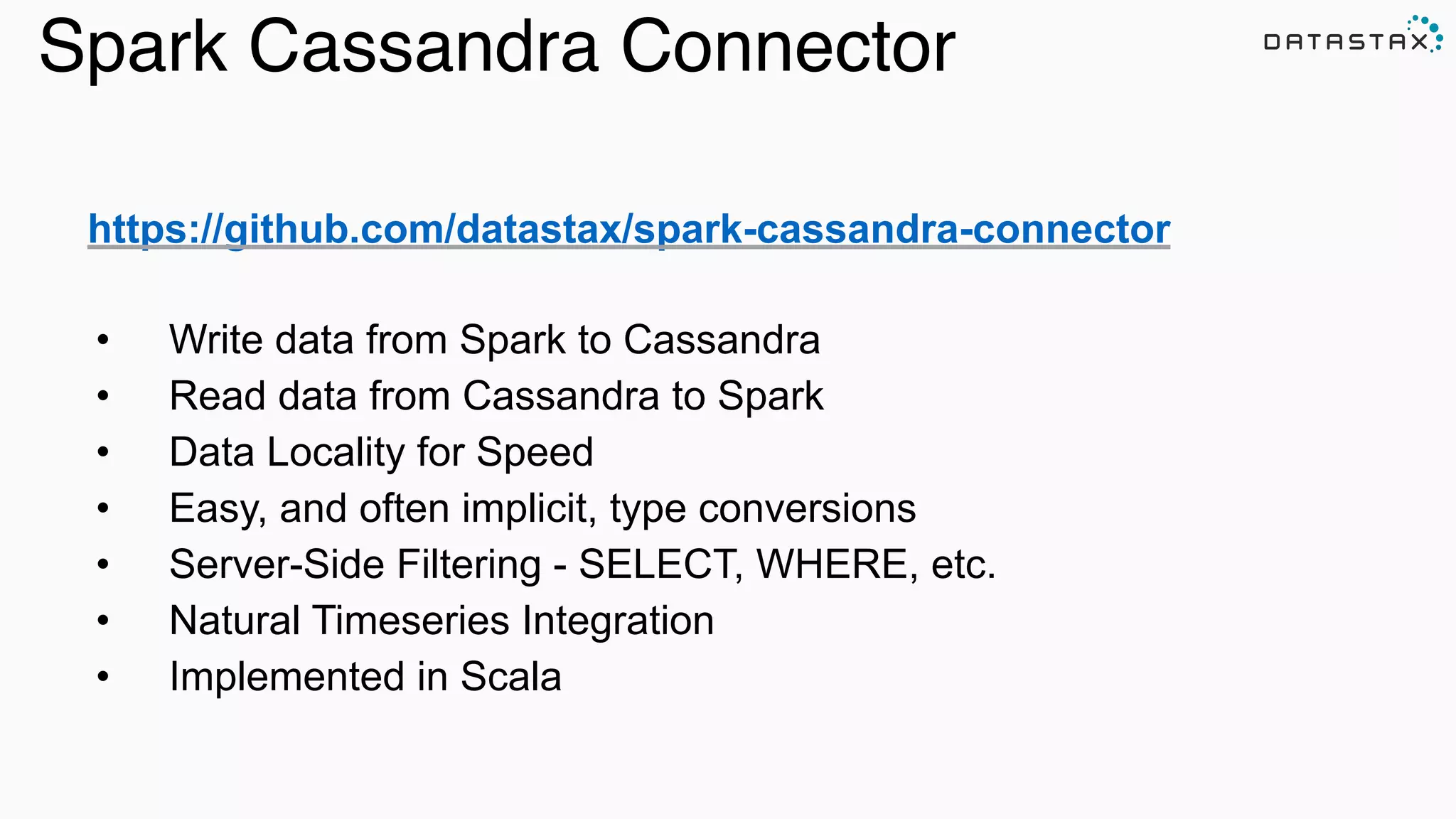
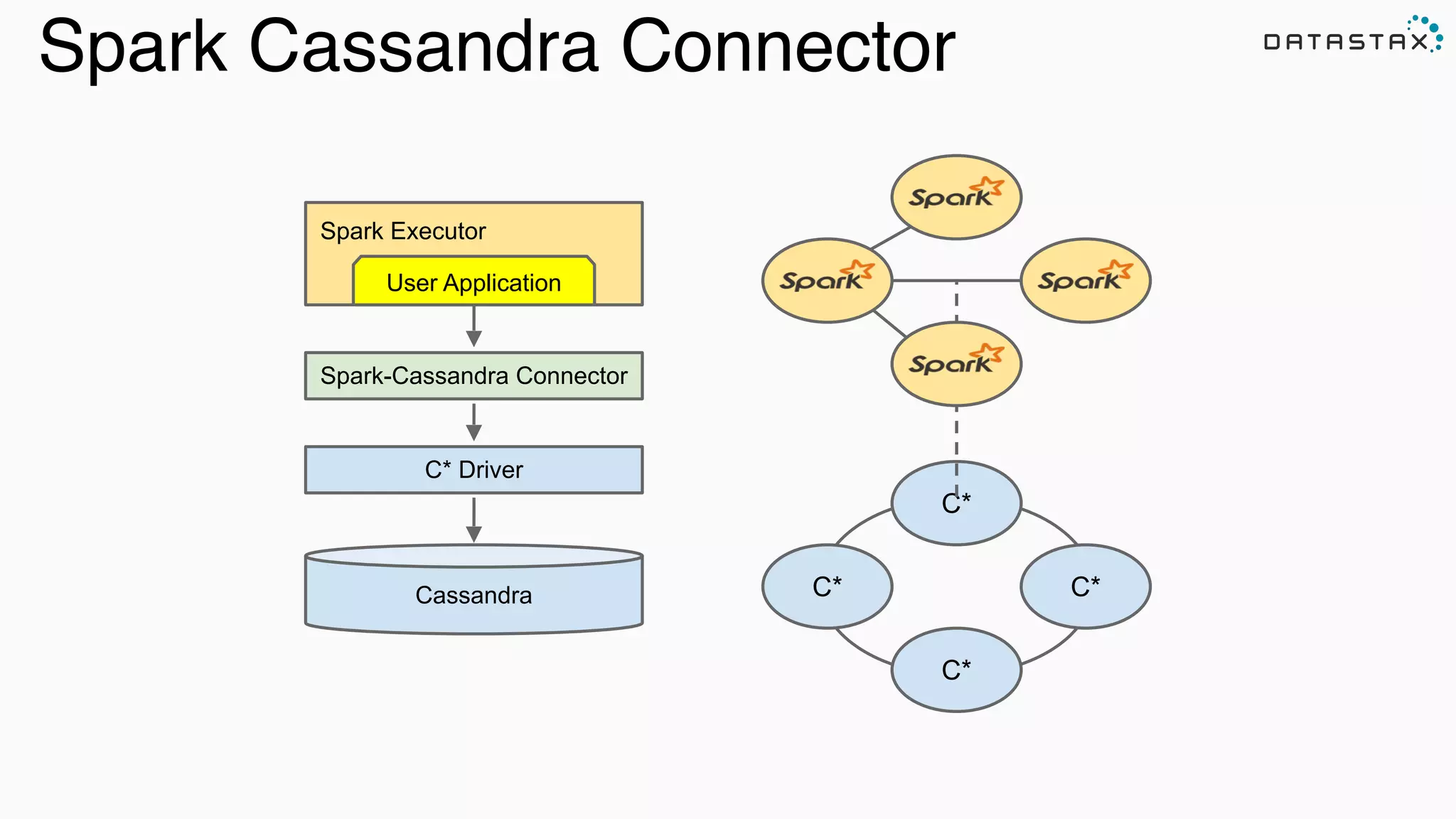
Spark Cassandra Connector https://github.com/datastax/spark-cassandra-connector • Write data from Spark to Cassandra • Read data from Cassandra to Spark • Data Locality for Speed • Easy, and often implicit, type conversions • Server-Side Filtering - SELECT, WHERE, etc. • Natural Timeseries Integration • Implemented in Scala
Spark Cassandra Connector C* C* C*C* Spark Executor C* Driver Spark-Cassandra Connector User Application Cassandra
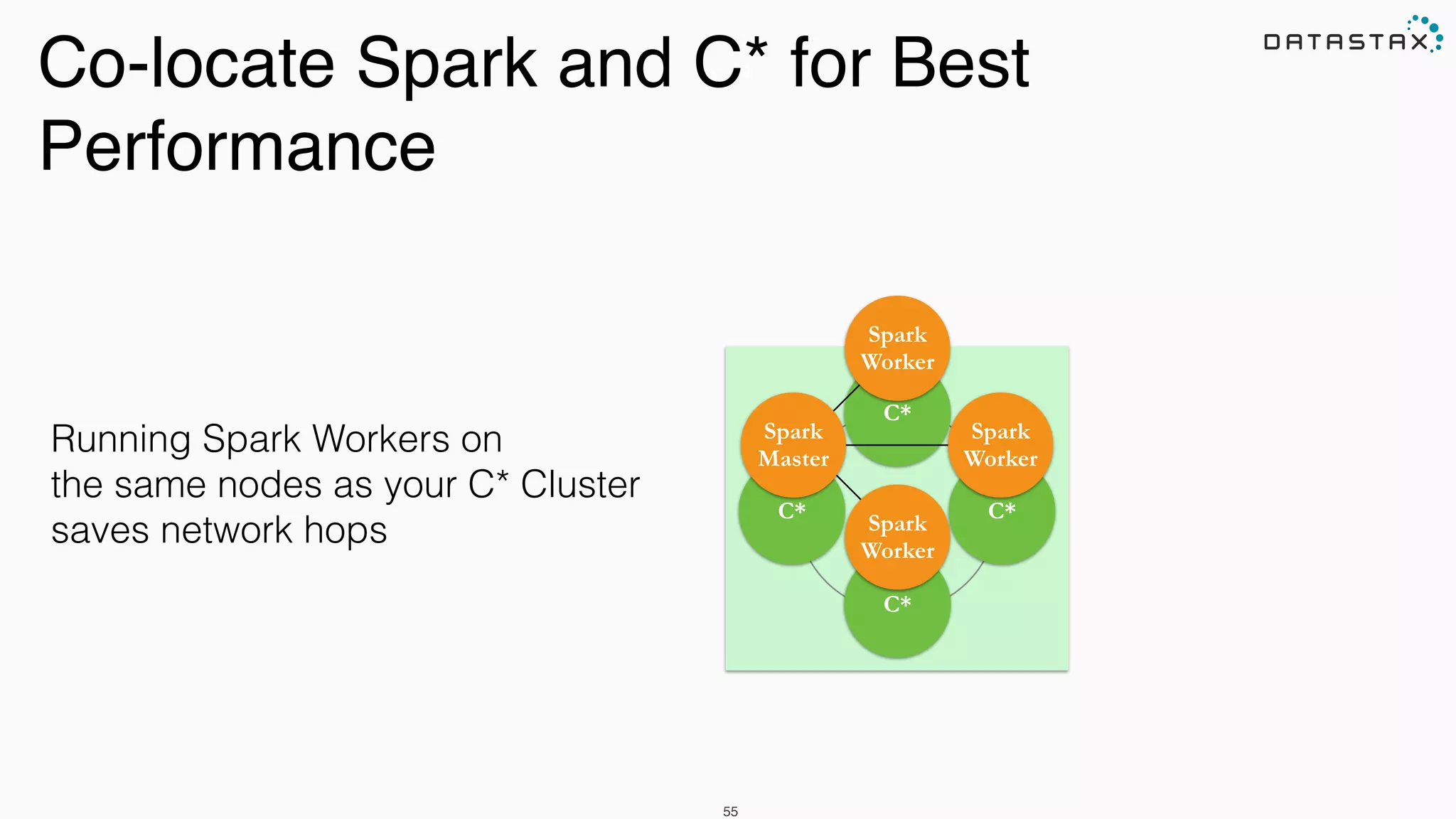
55 Co-locate Spark and C* for Best Performance C* C*C* C* Spark
 Worker Spark
 Worker Spark Master Spark Worker Running Spark Workers on the same nodes as your C* Cluster saves network hops
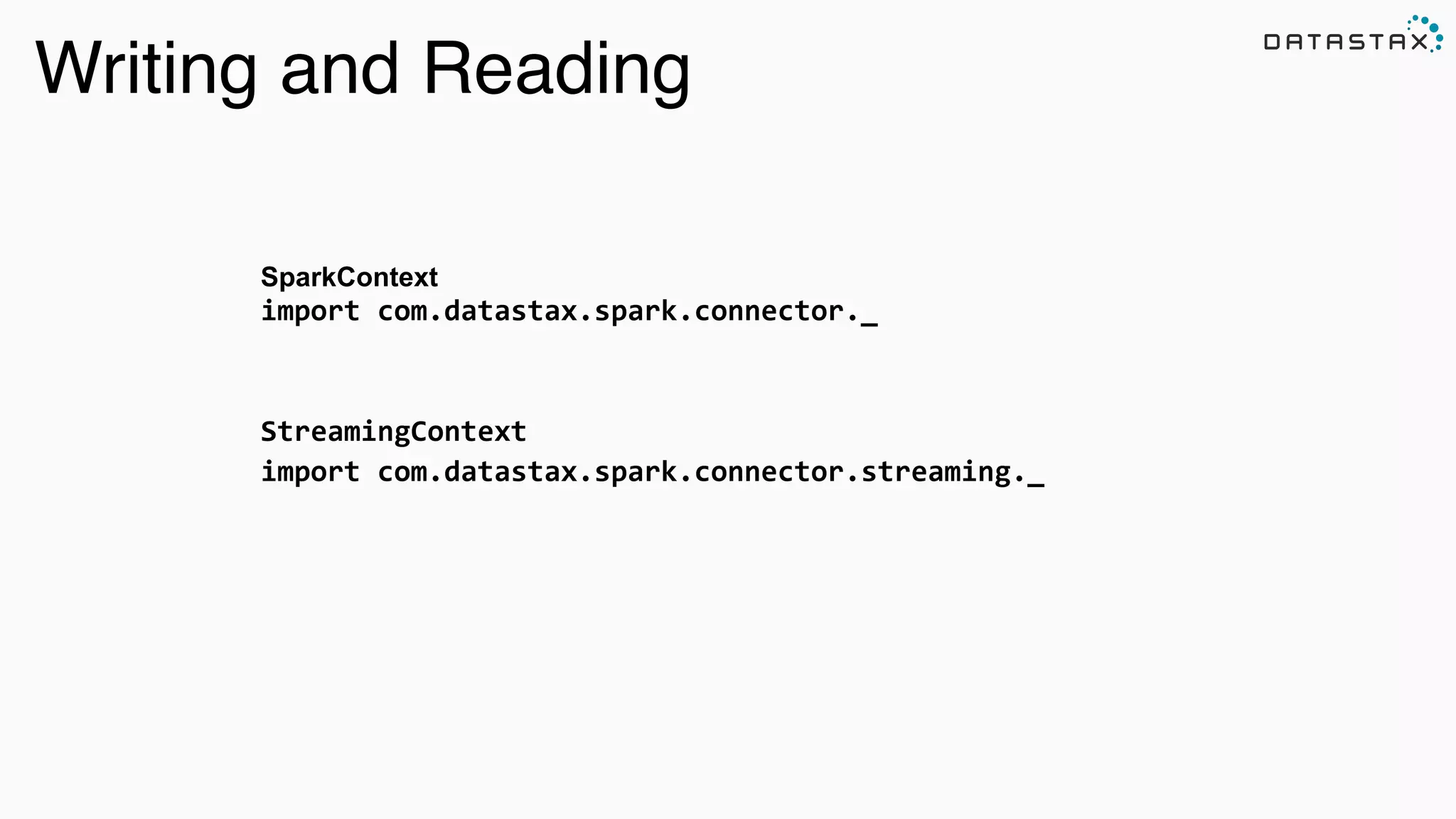
Analytic Search Writing and Reading SparkContext import  com.datastax.spark.connector._   StreamingContext   import  com.datastax.spark.connector.streaming._
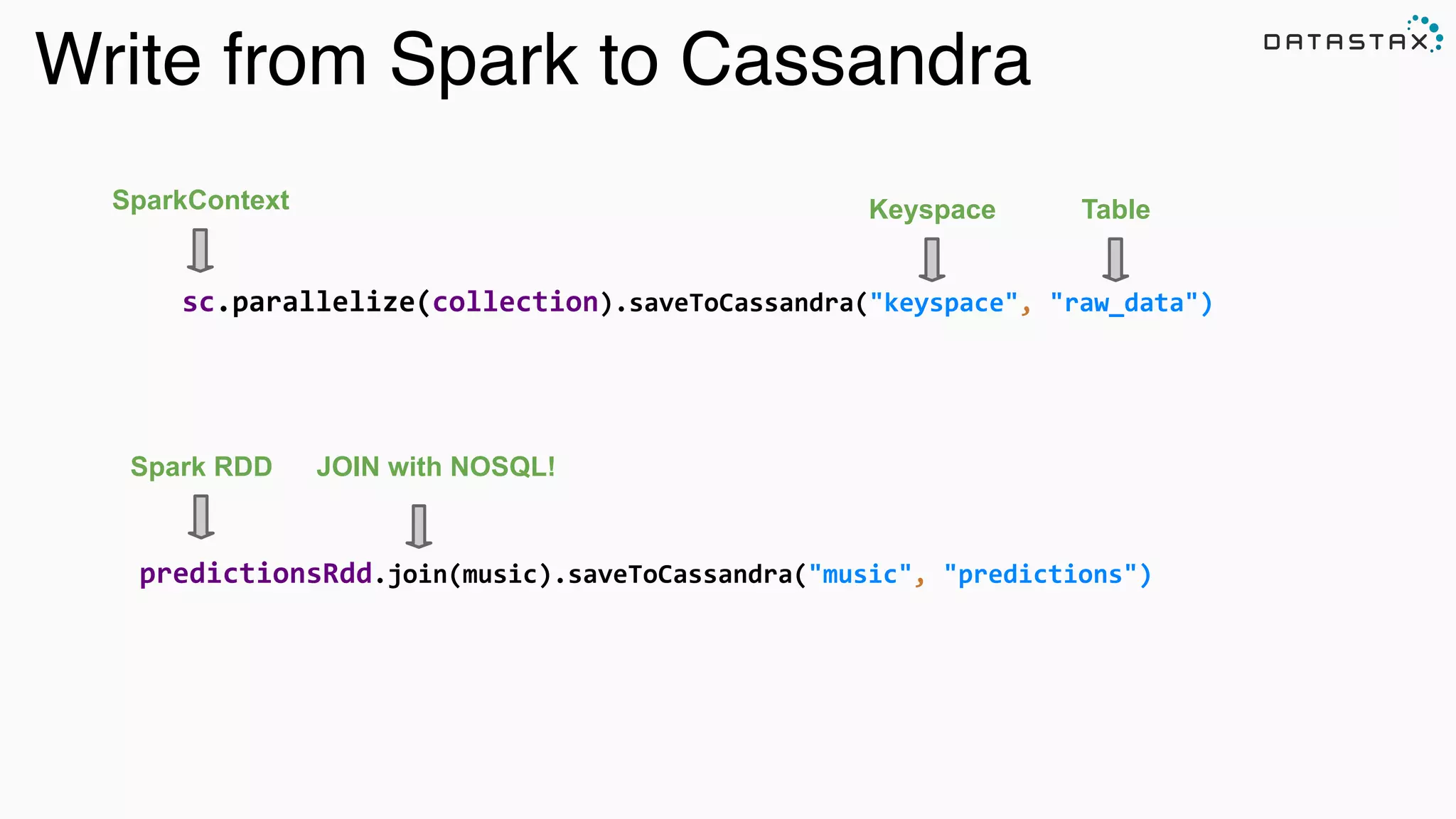
Analytic Write from Spark to Cassandra sc.parallelize(collection).saveToCassandra("keyspace",  "raw_data") SparkContext Keyspace Table Spark RDD JOIN with NOSQL! predictionsRdd.join(music).saveToCassandra("music",  "predictions")
Read From C* to Spark val  rdd  =  sc.cassandraTable("github",  "commits")                                            .select("user","count","year","month")                                            .where("commits  >=  ?  and  year  =  ?",  1000,  2015) CassandraRDD[CassandraRow] Keyspace Table Server-Side Column and Row Filtering SparkContext
val  rdd  =  ssc.cassandraTable[MonthlyCommits]("github",  "commits_aggregate")                            .where("user  =  ?  and  project_name  =  ?  and  year  =  ?",                                    "helena",  "spark-­‐cassandra-­‐connector",  2015) CassandraRow Keyspace TableStreamingContext Rows: Custom Objects
Rows val  tuplesRdd  =  sc.cassandraTable[(Int,Date,String)](db,  tweetsTable)    .select("cluster_id","time",  "cluster_name")    .where("time  >  ?  and  time  <  ?",                  "2014-­‐07-­‐12  20:00:01",  "2014-­‐07-­‐12  20:00:03”)   val  keyValuesPairsRdd  =  sc.cassandraTable[(Key,Value)](keyspace,  table)  
Rows val rdd = ssc.cassandraTable[MyDataType]("stats", "clustering_time") rdd.where("key = 1").limit(10).collect   rdd.where("key = 1").take(10).collect val  rdd  =  ssc.cassandraTable[(Int,DateTime,String)]("stats",  "clustering_time")                            .where("key  =  1").withAscOrder.collect   val  rdd  =  ssc.cassandraTable[(Int,DateTime,String)]("stats",  "clustering_time")                            .where("key  =  1").withDescOrder.collect  
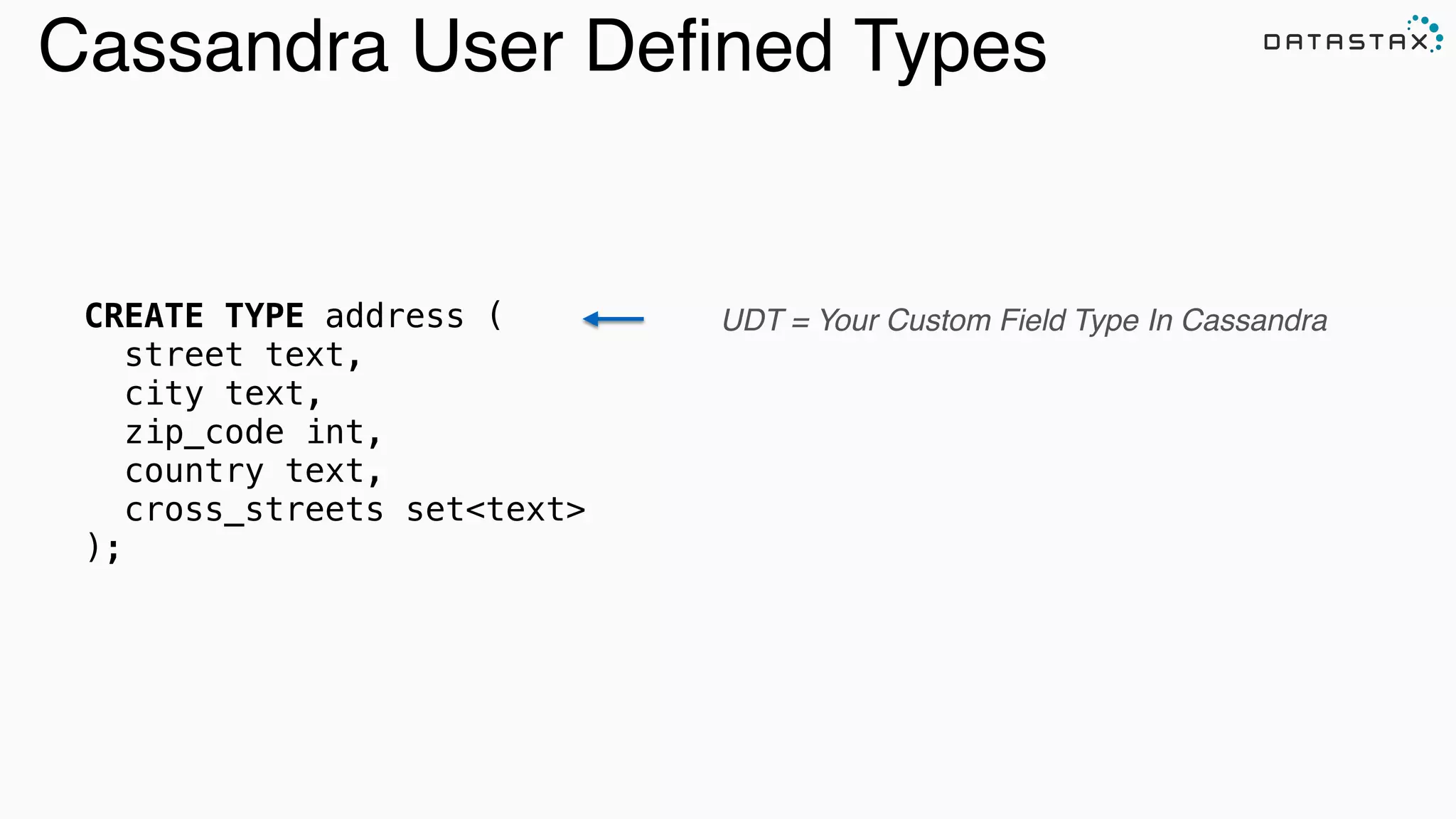
Cassandra User Defined Types CREATE TYPE address ( street text, city text, zip_code int, country text, cross_streets set<text> ); UDT = Your Custom Field Type In Cassandra
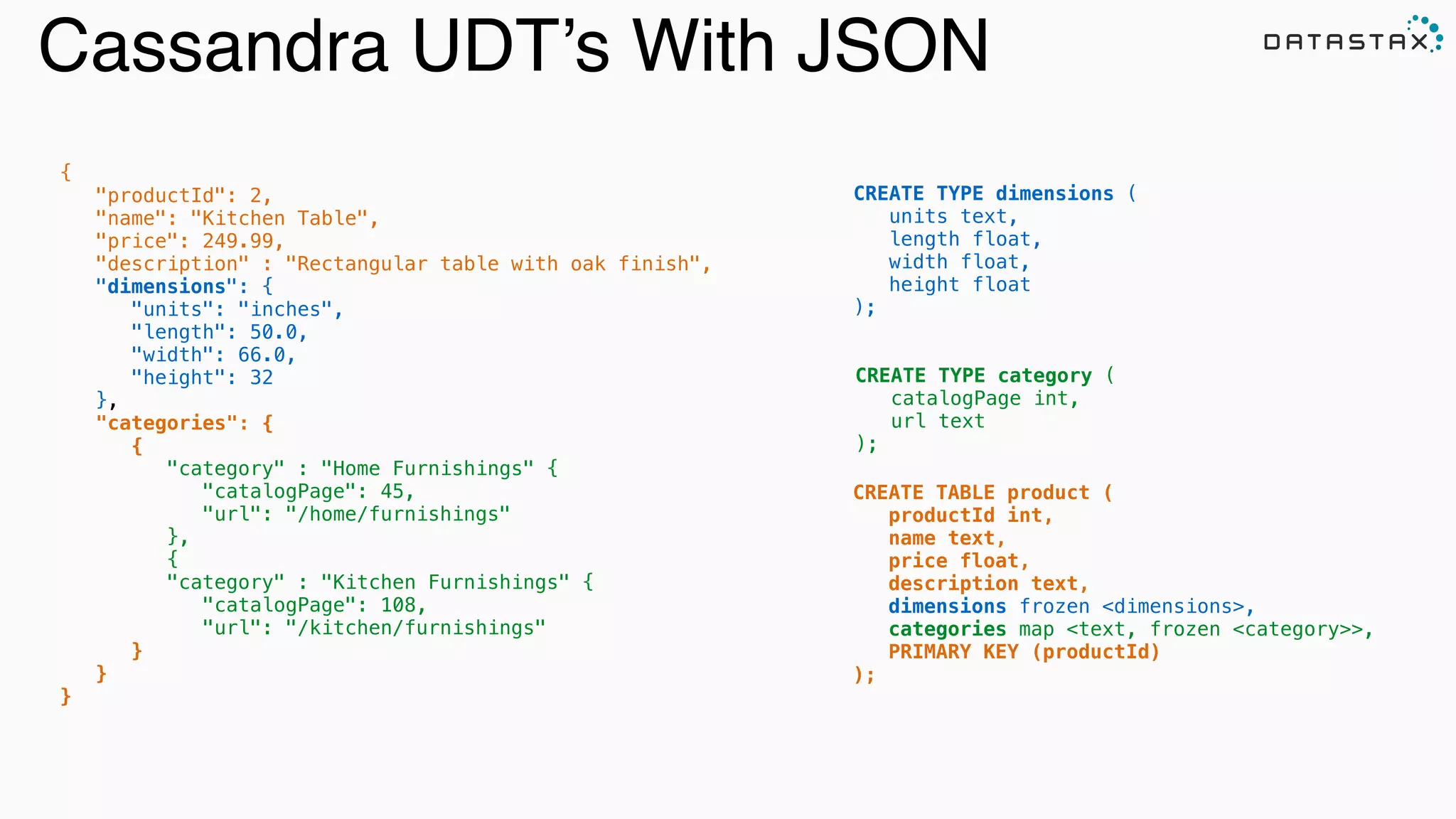
Cassandra UDT’s With JSON { "productId": 2, "name": "Kitchen Table", "price": 249.99, "description" : "Rectangular table with oak finish", "dimensions": { "units": "inches", "length": 50.0, "width": 66.0, "height": 32 }, "categories": { { "category" : "Home Furnishings" { "catalogPage": 45, "url": "/home/furnishings" }, { "category" : "Kitchen Furnishings" { "catalogPage": 108, "url": "/kitchen/furnishings" } } } CREATE TYPE dimensions ( units text, length float, width float, height float ); CREATE TYPE category ( catalogPage int, url text ); CREATE TABLE product ( productId int, name text, price float, description text, dimensions frozen <dimensions>, categories map <text, frozen <category>>, PRIMARY KEY (productId) );
©2014 DataStax Confidential. Do not distribute without consent. Composable Pipelines With Spark, Kafka & Cassandra 64
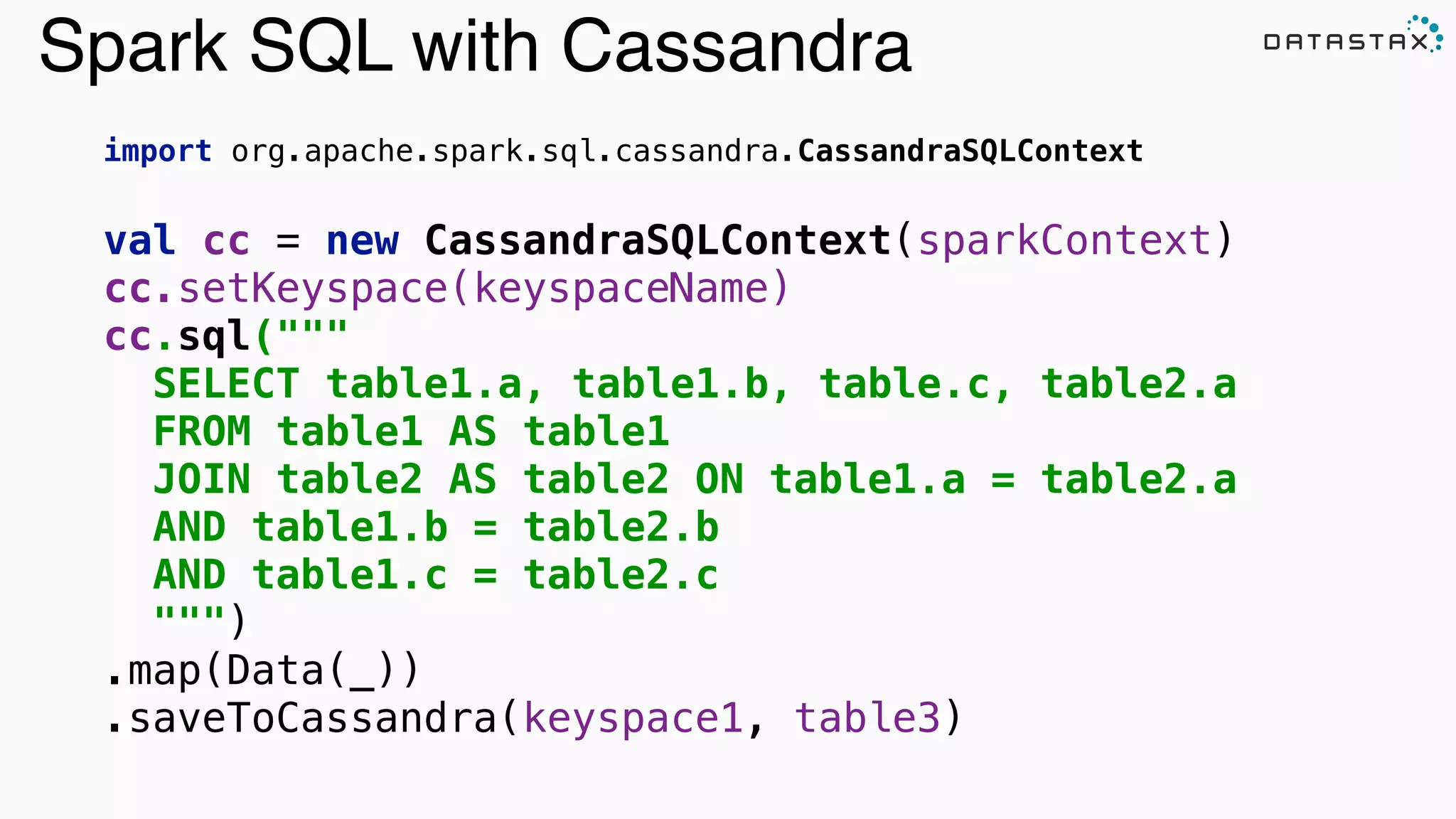
Spark SQL with Cassandra import org.apache.spark.sql.cassandra.CassandraSQLContext val cc = new CassandraSQLContext(sparkContext) cc.setKeyspace(keyspaceName) cc.sql(""" SELECT table1.a, table1.b, table.c, table2.a FROM table1 AS table1 JOIN table2 AS table2 ON table1.a = table2.a AND table1.b = table2.b AND table1.c = table2.c """) .map(Data(_)) .saveToCassandra(keyspace1, table3)
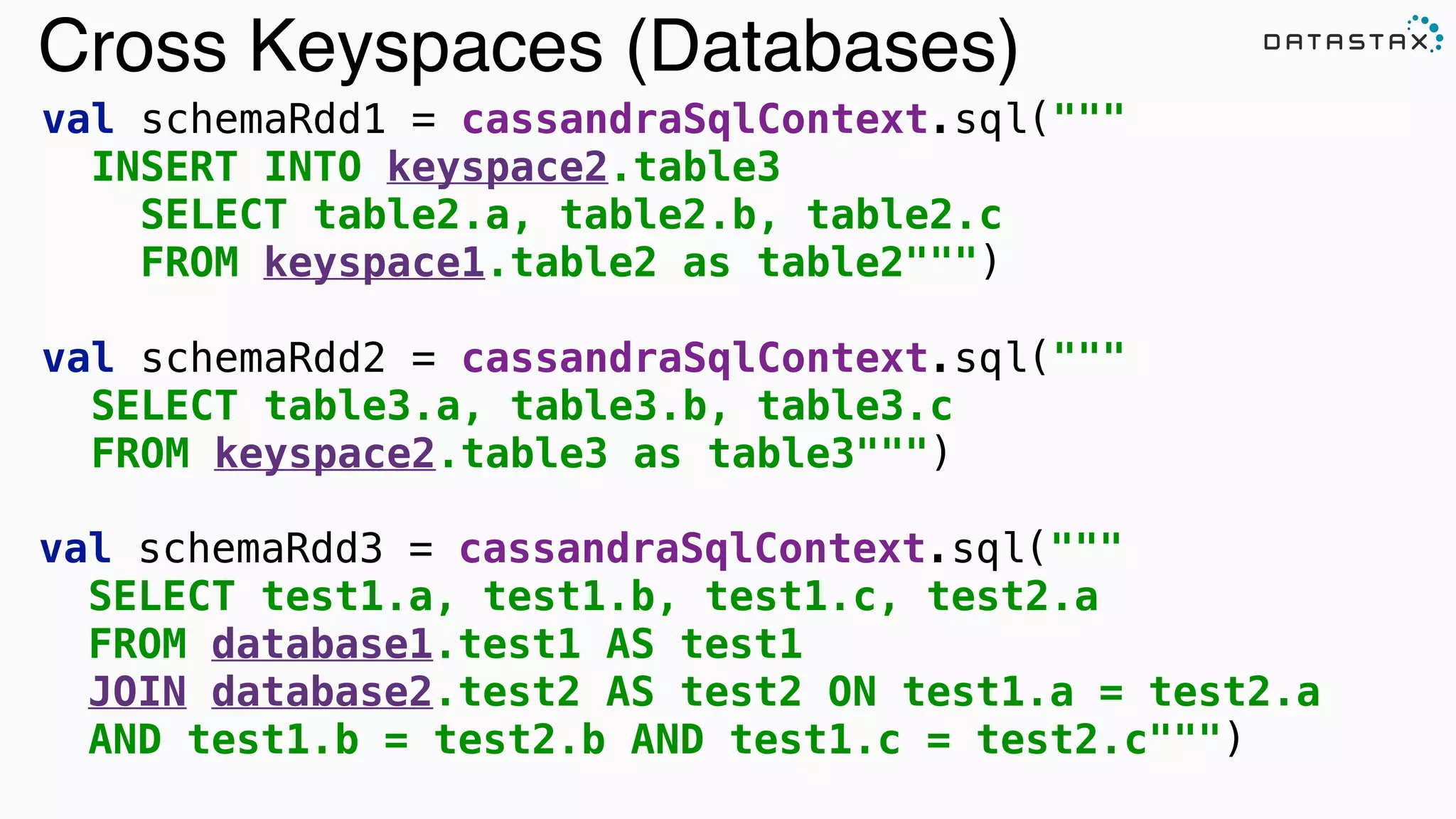
Cross Keyspaces (Databases) val schemaRdd1 = cassandraSqlContext.sql(""" INSERT INTO keyspace2.table3 SELECT table2.a, table2.b, table2.c FROM keyspace1.table2 as table2""") val schemaRdd2 = cassandraSqlContext.sql(""" SELECT table3.a, table3.b, table3.c FROM keyspace2.table3 as table3""") val schemaRdd3 = cassandraSqlContext.sql(""" SELECT test1.a, test1.b, test1.c, test2.a FROM database1.test1 AS test1
 JOIN database2.test2 AS test2 ON test1.a = test2.a AND test1.b = test2.b AND test1.c = test2.c""")

 val sql = new SQLContext(sparkContext) val json = Seq(
 """{"user":"helena","commits":98, "month":3, "year":2015}""",
 """{"user":"jacek-lewandowski", "commits":72, "month":3, "year":2015}""",
 """{"user":"pkolaczk", "commits":42, "month":3, "year":2015}""") // write sql.jsonRDD(json) .map(CommitStats(_)) .flatMap(compute) .saveToCassandra("stats","monthly_commits")
 // read val rdd = sc.cassandraTable[MonthlyCommits]("stats","monthly_commits") cqlsh>  CREATE  TABLE  github_stats.commits_aggr(user  VARCHAR  PRIMARY  KEY,  commits  INT…); Spark SQL with Cassandra & JSON
Analytic Analytic Search Spark Streaming, Kafka, C* and JSON cqlsh>  select  *  from  github_stats.commits_aggr;   
   user | commits | month | year -------------------+---------+-------+------ pkolaczk | 42 | 3 | 2015 jacek-lewandowski | 43 | 3 | 2015 helena | 98 | 3 | 2015
 (3  rows)   KafkaUtils.createStream[String, String, StringDecoder, StringDecoder](
 ssc, kafkaParams, topicMap, StorageLevel.MEMORY_ONLY)
 .map { case (_,json) => JsonParser.parse(json).extract[MonthlyCommits]}
 .saveToCassandra("github_stats","commits_aggr")
Spark Streaming, Kafka & Cassandra sparkConf.set("spark.cassandra.connection.host", "10.20.3.45")
 val streamingContext = new StreamingContext(conf, Seconds(30))
 KafkaUtils.createStream[String, String, StringDecoder, StringDecoder](
 streamingContext, kafkaParams, topicMap, StorageLevel.MEMORY_ONLY) .map(_._2) .countByValue() .saveToCassandra("my_keyspace","wordcount")
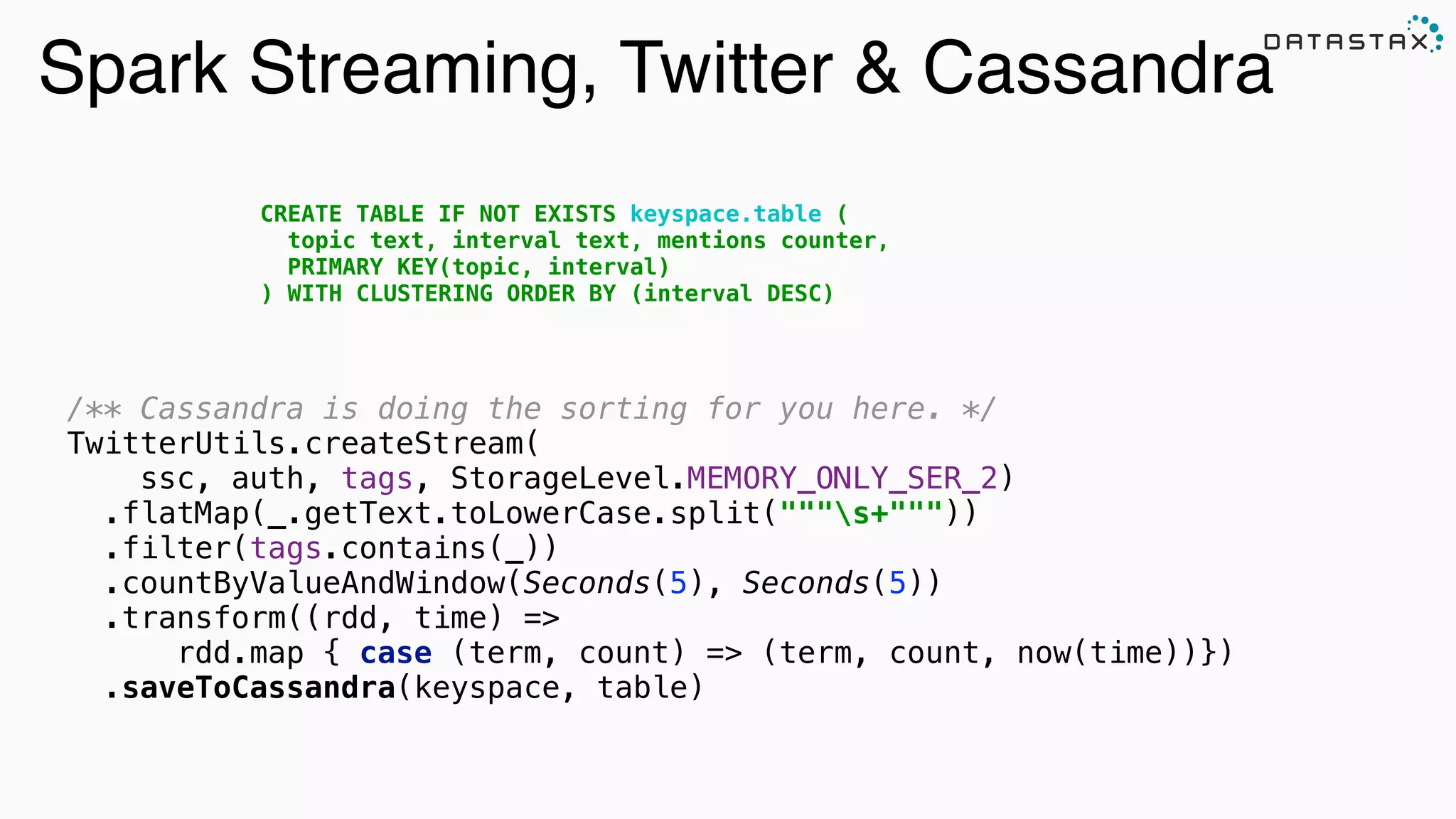
Spark Streaming, Twitter & Cassandra /** Cassandra is doing the sorting for you here. */
 TwitterUtils.createStream( ssc, auth, tags, StorageLevel.MEMORY_ONLY_SER_2)
 .flatMap(_.getText.toLowerCase.split("""s+"""))
 .filter(tags.contains(_))
 .countByValueAndWindow(Seconds(5), Seconds(5))
 .transform((rdd, time) => rdd.map { case (term, count) => (term, count, now(time))})
 .saveToCassandra(keyspace, table) CREATE TABLE IF NOT EXISTS keyspace.table (
 topic text, interval text, mentions counter,
 PRIMARY KEY(topic, interval)
 ) WITH CLUSTERING ORDER BY (interval DESC)
Streaming From Kafka, R/W Cassandra val ssc = new StreamingContext(conf, Seconds(30))
 val stream = KafkaUtils.createStream[K, V, KDecoder, VDecoder](
 ssc, kafkaParams, topicMap, StorageLevel.MEMORY_ONLY) stream.flatMap { detected => ssc.cassandraTable[AdversaryAttack]("behavior_ks",  "observed")              .where("adversary  =  ?  and  ip  =  ?  and  attackType  =  ?",                  detected.adversary,  detected.originIp,  detected.attackType)              .collect }.saveToCassandra("profiling_ks",  "adversary_profiles")
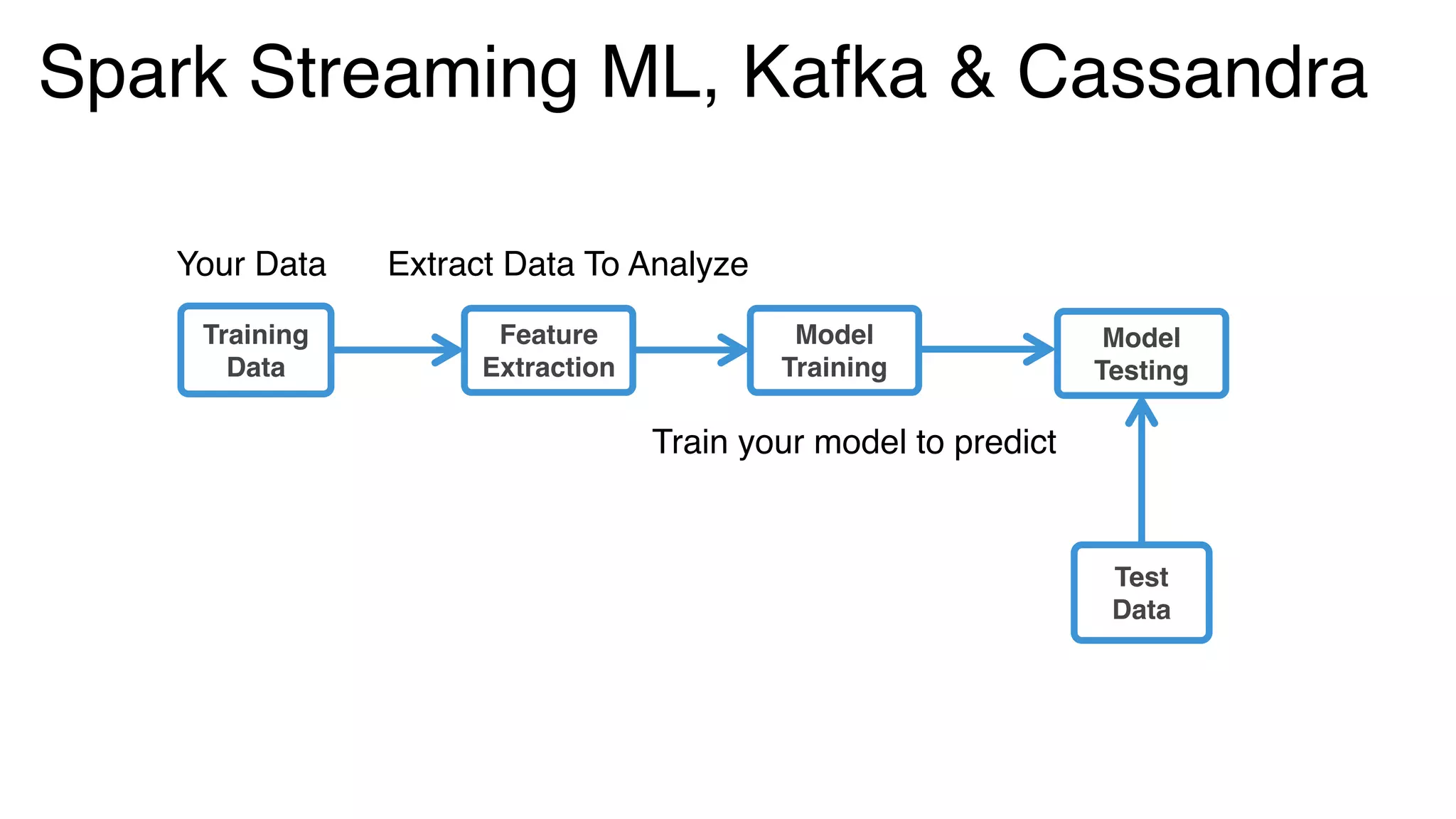
Training Data Feature Extraction Model Training Model Testing Test Data Your Data Extract Data To Analyze Train your model to predict Spark Streaming ML, Kafka & Cassandra
val ssc = new StreamingContext(new SparkConf()…, Seconds(5)
 val testData = ssc.cassandraTable[String](keyspace,table).map(LabeledPoint.parse)
 
 val trainingStream = KafkaUtils.createStream[K, V, KDecoder, VDecoder](
 ssc, kafkaParams, topicMap, StorageLevel.MEMORY_ONLY) .map(_._2).map(LabeledPoint.parse) trainingStream.saveToCassandra("ml_keyspace", “raw_training_data")
 
 val model = new StreamingLinearRegressionWithSGD()
 .setInitialWeights(Vectors.dense(weights))
 .trainOn(trainingStream) 
 //Making predictions on testData model .predictOnValues(testData.map(lp => (lp.label, lp.features))) .saveToCassandra("ml_keyspace", "predictions") Spark Streaming ML, Kafka & C*
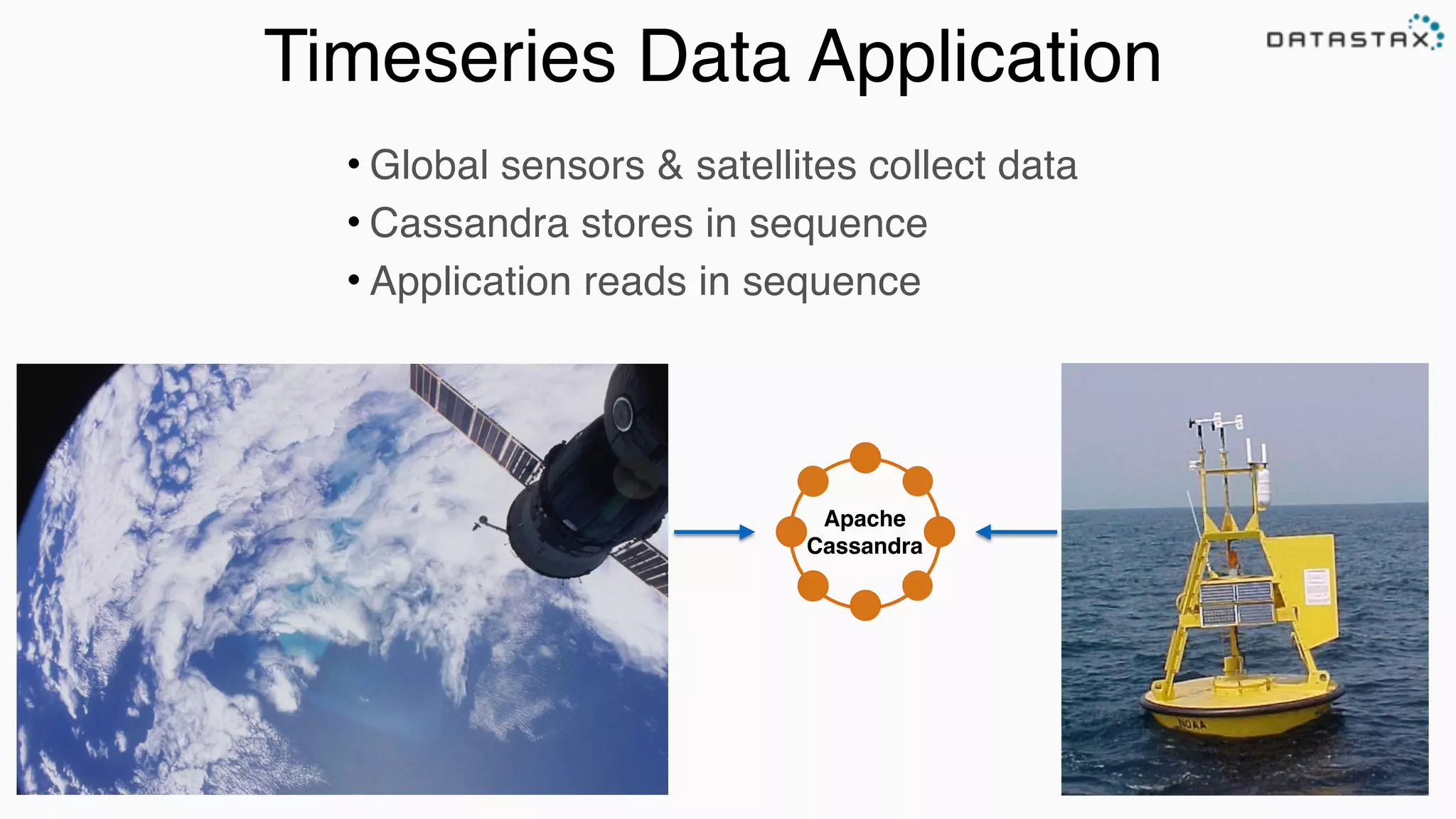
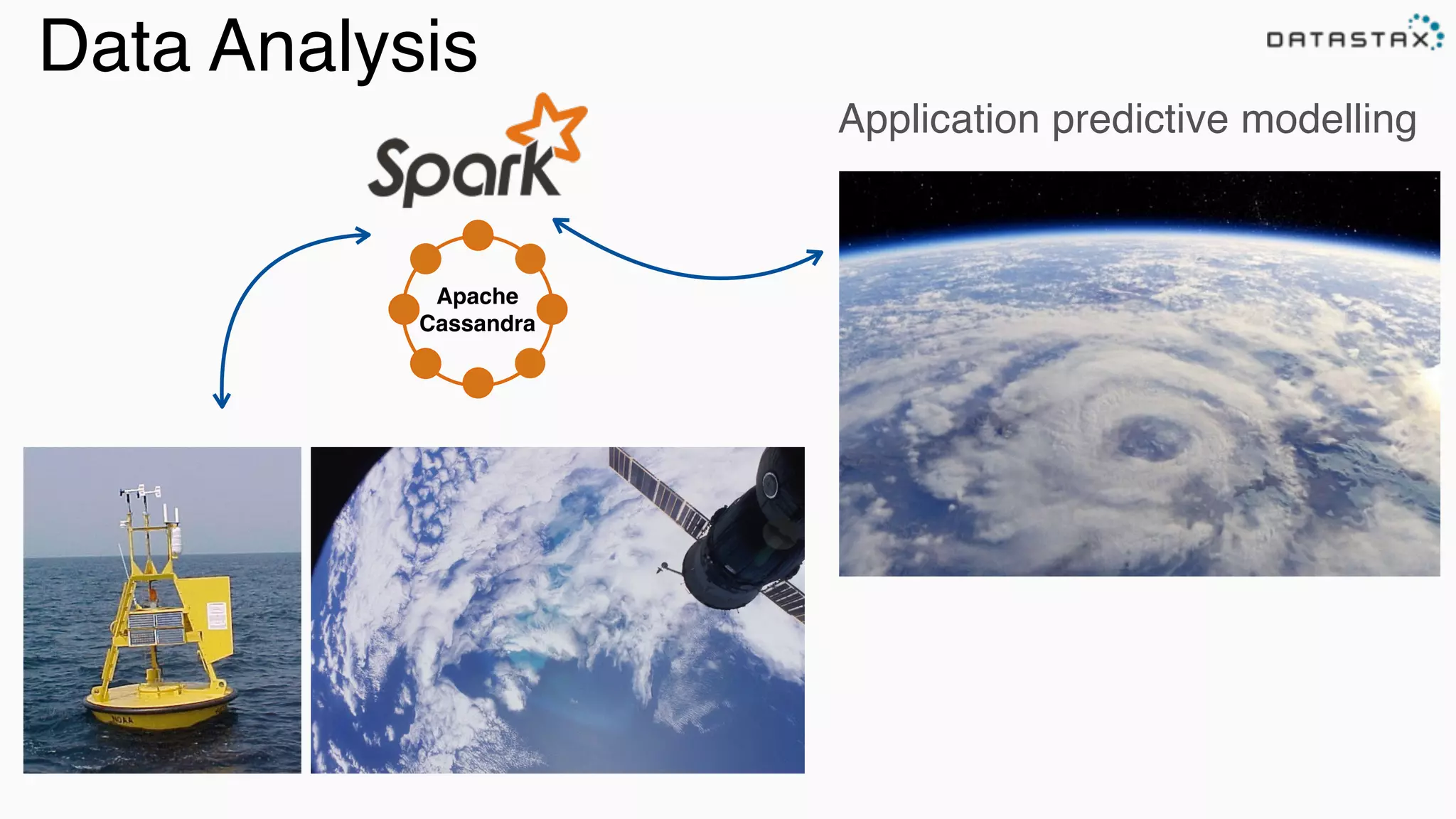
Timeseries Data Application • Global sensors & satellites collect data • Cassandra stores in sequence • Application reads in sequence Apache Cassandra
Data Analysis Application predictive modelling Apache Cassandra
Data model should look like your queries
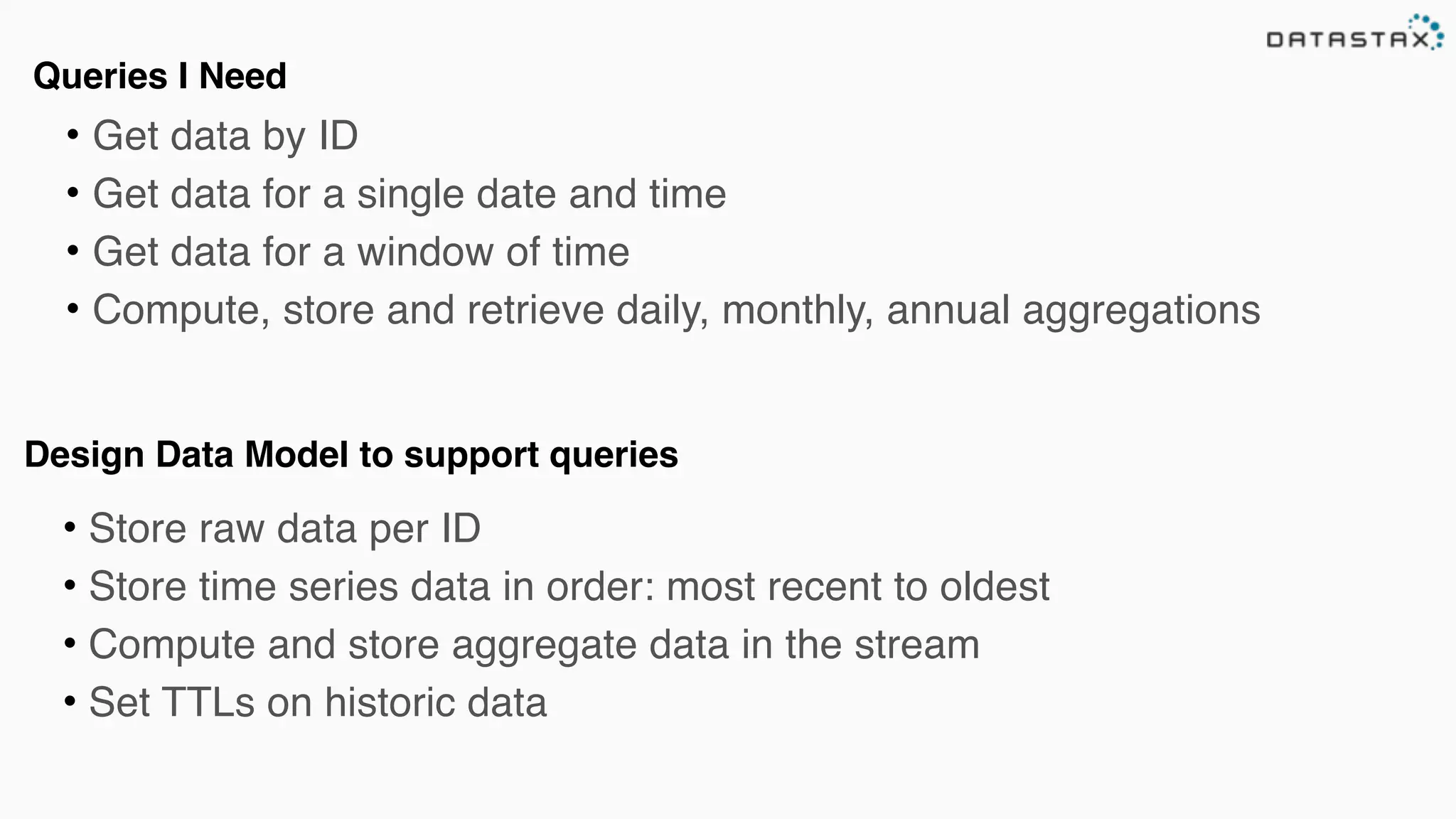
• Store raw data per ID • Store time series data in order: most recent to oldest • Compute and store aggregate data in the stream • Set TTLs on historic data • Get data by ID • Get data for a single date and time • Get data for a window of time • Compute, store and retrieve daily, monthly, annual aggregations Design Data Model to support queries Queries I Need
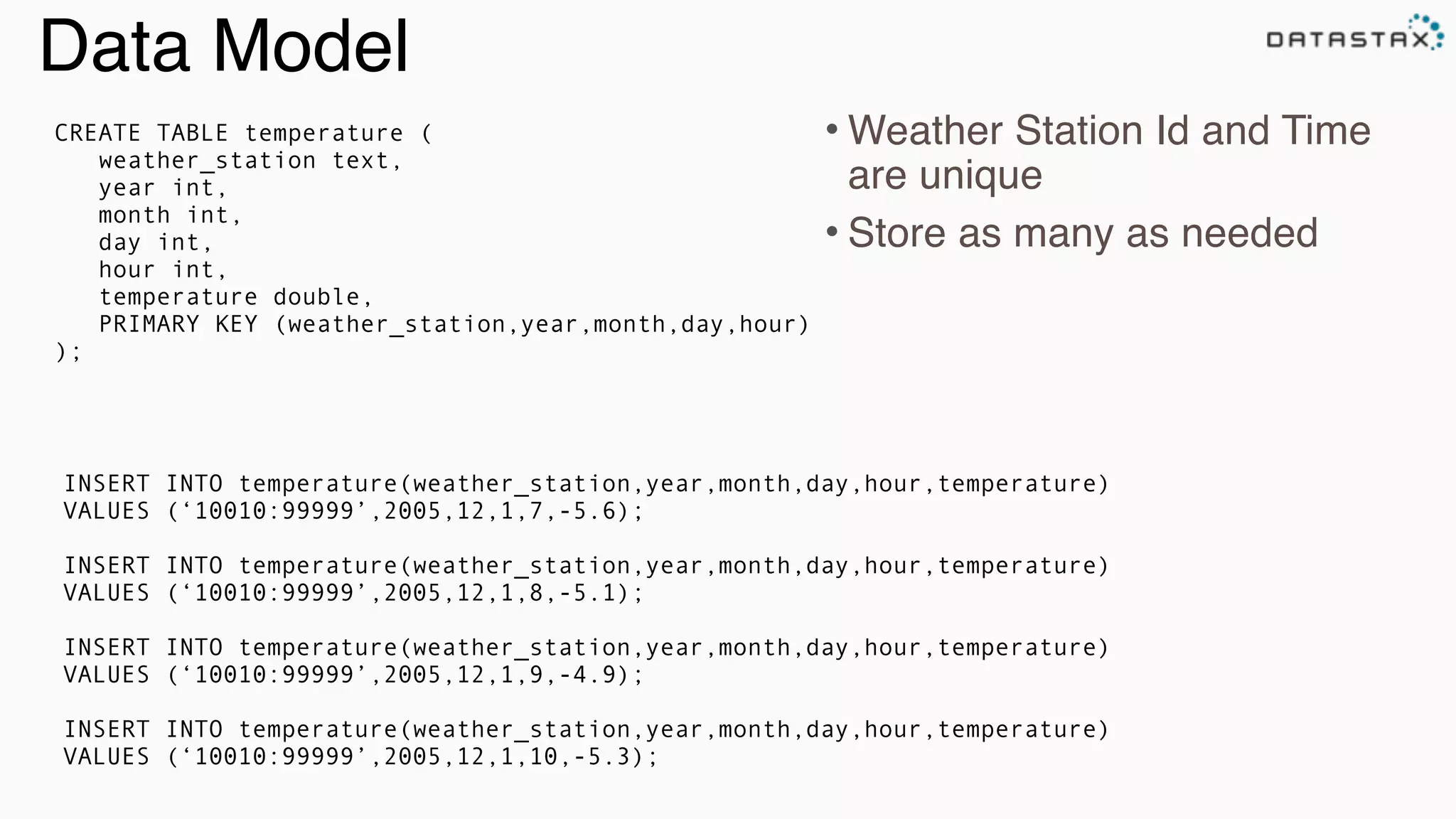
Data Model • Weather Station Id and Time are unique • Store as many as needed CREATE TABLE temperature ( weather_station text, year int, month int, day int, hour int, temperature double, PRIMARY KEY (weather_station,year,month,day,hour) ); INSERT INTO temperature(weather_station,year,month,day,hour,temperature) VALUES (‘10010:99999’,2005,12,1,7,-5.6); INSERT INTO temperature(weather_station,year,month,day,hour,temperature) VALUES (‘10010:99999’,2005,12,1,8,-5.1); INSERT INTO temperature(weather_station,year,month,day,hour,temperature) VALUES (‘10010:99999’,2005,12,1,9,-4.9); INSERT INTO temperature(weather_station,year,month,day,hour,temperature) VALUES (‘10010:99999’,2005,12,1,10,-5.3);
class KafkaProducerActor[K, V](config: ProducerConfig) extends Actor {
 
 override val supervisorStrategy =
 OneForOneStrategy(maxNrOfRetries = 10, withinTimeRange = 1.minute) {
 case _: ActorInitializationException => Stop
 case _: FailedToSendMessageException => Restart case _: ProducerClosedException => Restart case _: NoBrokersForPartitionException => Escalate case _: KafkaException => Escalate
 case _: Exception => Escalate
 } 
 private val producer = new KafkaProducer[K, V](producerConfig)
 
 override def postStop(): Unit = producer.close() 
 def receive = {
 case e: KafkaMessageEnvelope[K,V] => producer.send(e)
 }
 } Kafka Producer as Akka Actor
class HttpReceiverActor(kafka: ActorRef) extends Actor with ActorLogging { implicit val materializer = FlowMaterializer() IO(Http) ! Http.Bind(HttpHost, HttpPort)
 
 val requestHandler: HttpRequest => HttpResponse = {
 case HttpRequest(POST, Uri.Path("/weather/v1/hourly-weather"), headers, entity, _) =>
 HttpSource(headers,entity).collect { case s: HeaderSource => for(s <- source.extract) kafka ! KafkaMessageEnvelope[String, String](topic, key, fs.data:_*)
 HttpResponse(200, entity = HttpEntity(MediaTypes.`text/html`, s"POST $entity"))
 } getOrElse HttpResponse(404, entity = s"Unsupported request") } 
 def receive : Actor.Receive = {
 case Http.ServerBinding(localAddress, stream) => Source(stream).foreach({
 case Http.IncomingConnection(remoteAddress, requestProducer, responseConsumer) =>
 log.info("Accepted new connection from {}.", remoteAddress)
 Source(requestProducer).map(requestHandler).to(Sink(responseConsumer)).run()
 }) }} Akka Actor as REST Endpoint
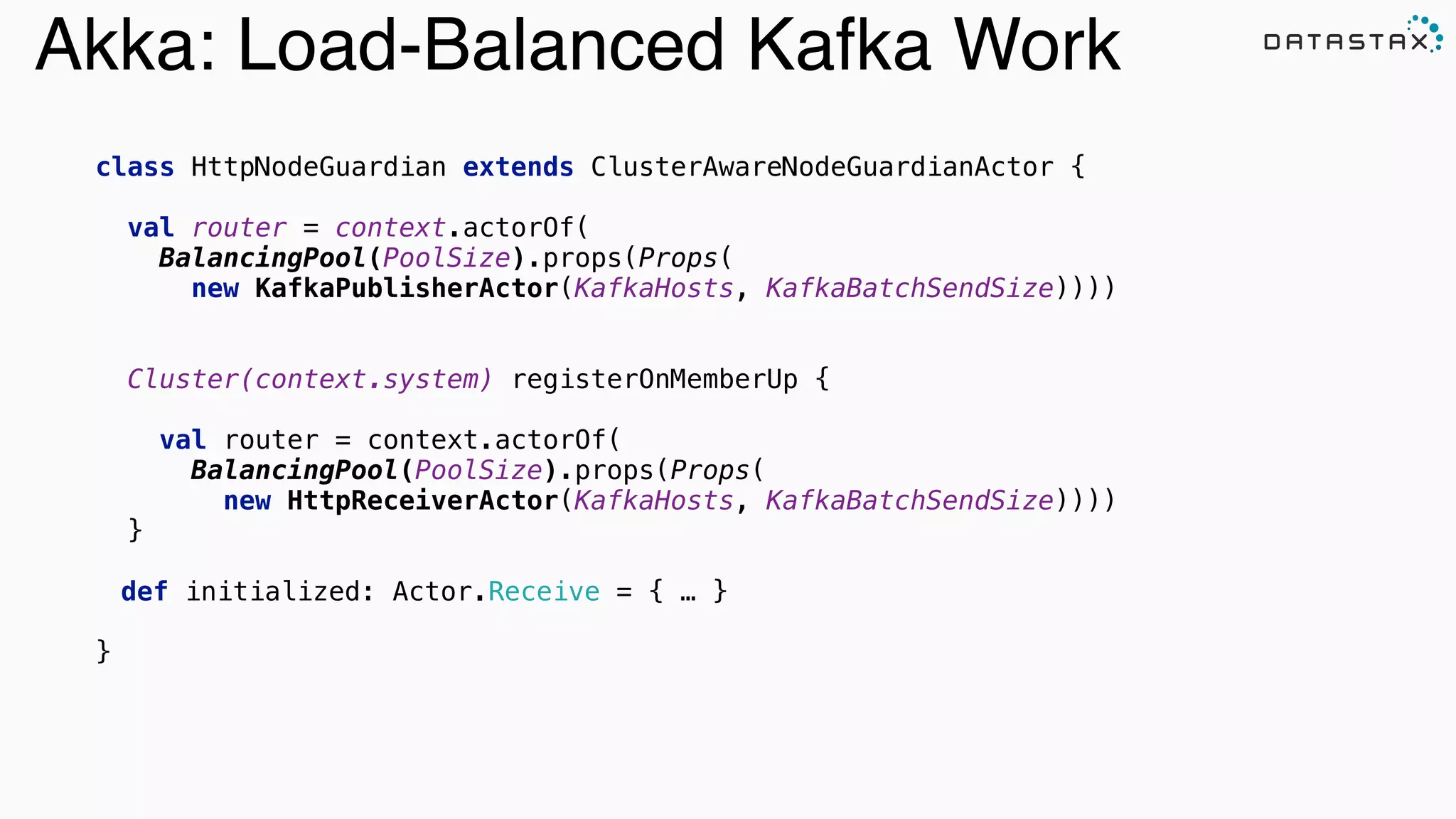
class HttpNodeGuardian extends ClusterAwareNodeGuardianActor {
 
 val router = context.actorOf( BalancingPool(PoolSize).props(Props( new KafkaPublisherActor(KafkaHosts, KafkaBatchSendSize))))
 
 Cluster(context.system) registerOnMemberUp {
 val router = context.actorOf( BalancingPool(PoolSize).props(Props( new HttpReceiverActor(KafkaHosts, KafkaBatchSendSize)))) } def initialized: Actor.Receive = { … } 
 } Akka: Load-Balanced Kafka Work
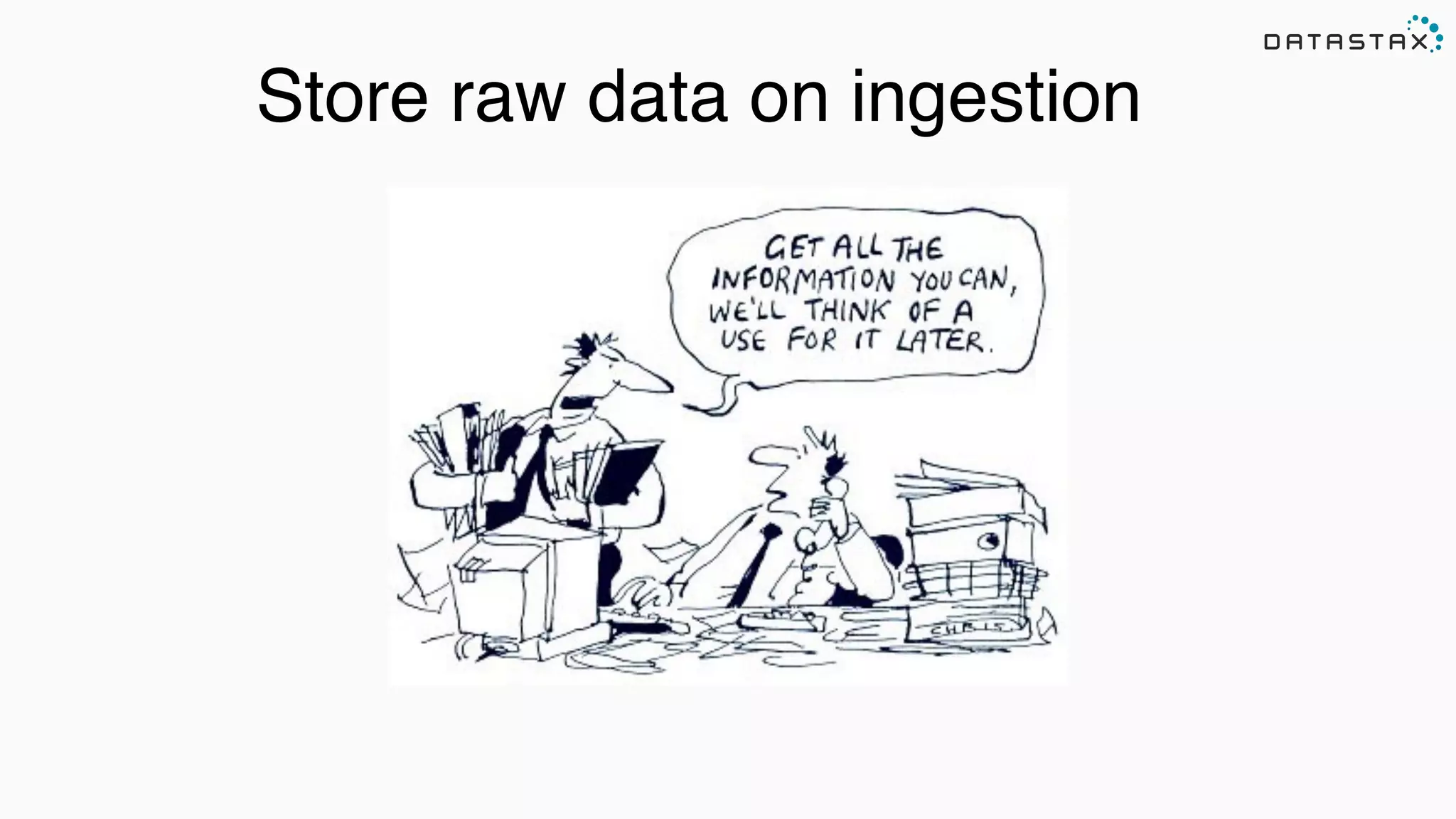
Store raw data on ingestion
val kafkaStream = KafkaUtils.createStream[K, V, KDecoder, VDecoder] (ssc, kafkaParams, topicMap, StorageLevel.DISK_ONLY_2)
 .map(transform)
 .map(RawWeatherData(_))
 
 /** Saves the raw data to Cassandra. */
 kafkaStream.saveToCassandra(keyspace, raw_ws_data) Store Raw Data on Ingestion To Cassandra From Kafka Stream /** Now proceed with computations from the same stream.. */ kafkaStream… Now we can replay: on failure, for later computation, etc
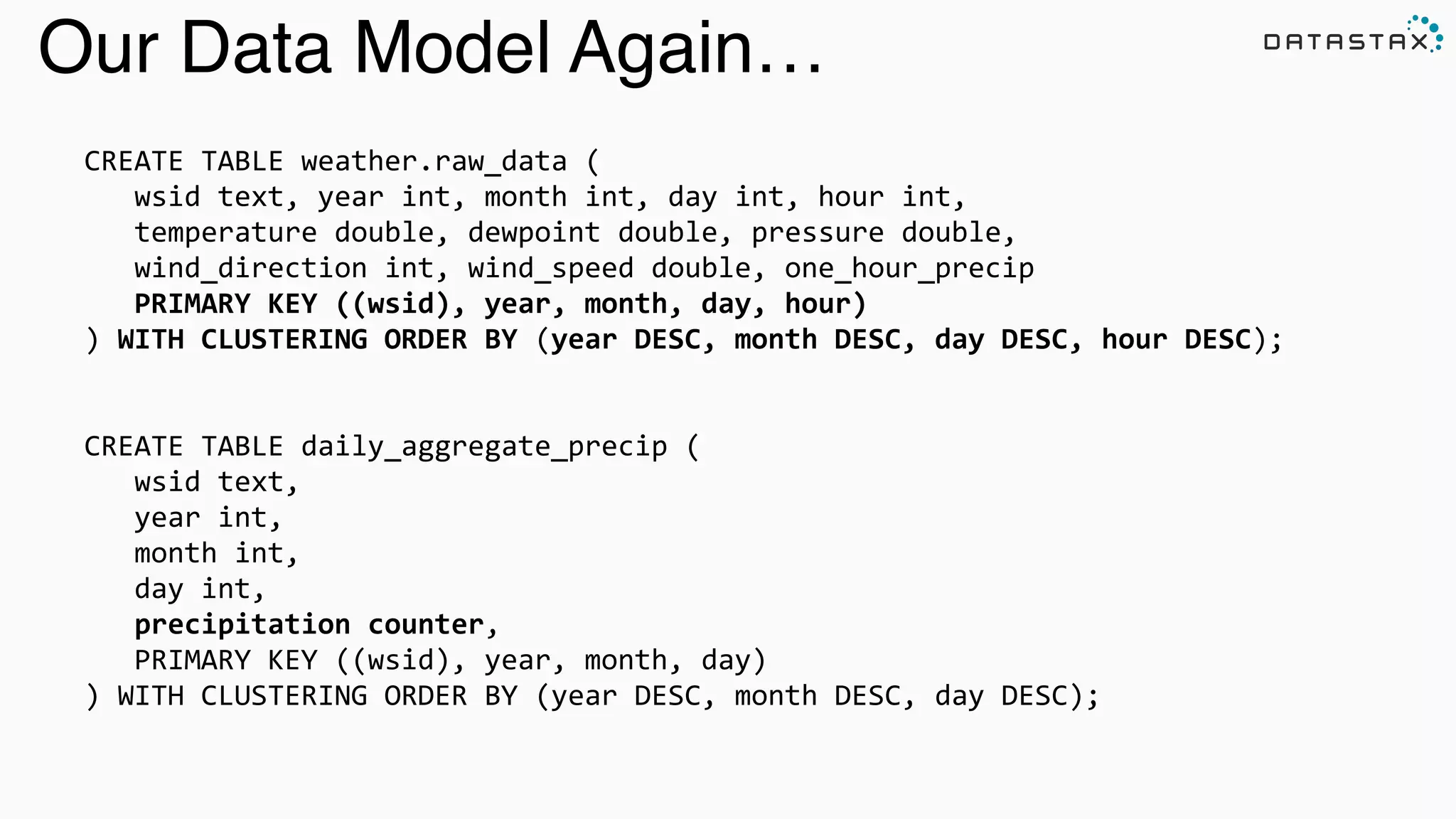
CREATE  TABLE  weather.raw_data  (
      wsid  text,  year  int,  month  int,  day  int,  hour  int,                          
      temperature  double,  dewpoint  double,  pressure  double,          wind_direction  int,  wind_speed  double,  one_hour_precip              PRIMARY  KEY  ((wsid),  year,  month,  day,  hour)
 )  WITH  CLUSTERING  ORDER  BY  (year  DESC,  month  DESC,  day  DESC,  hour  DESC);   CREATE  TABLE  daily_aggregate_precip  (
      wsid  text,
      year  int,
      month  int,
      day  int,
      precipitation  counter,
      PRIMARY  KEY  ((wsid),  year,  month,  day)
 )  WITH  CLUSTERING  ORDER  BY  (year  DESC,  month  DESC,  day  DESC);   Our Data Model Again…
Gets the partition key: Data Locality Spark C* Connector feeds this to Spark Cassandra Counter column in our schema, no expensive `reduceByKey` needed. Simply let C* do it: not expensive and fast. Efficient Stream Computation val kafkaStream = KafkaUtils.createStream[K, V, KDecoder, VDecoder] (ssc, kafkaParams, topicMap, StorageLevel.DISK_ONLY_2)
 .map(transform)
 .map(RawWeatherData(_))
 
 kafkaStream.saveToCassandra(keyspace, raw_ws_data) /** Per `wsid` and timestamp, aggregates hourly pricip by day in the stream. */
 kafkaStream.map { weather =>
 (weather.wsid, weather.year, weather.month, weather.day, weather.oneHourPrecip)
 }.saveToCassandra(keyspace, daily_precipitation_aggregations)
class TemperatureActor(sc: SparkContext, settings: WeatherSettings) extends AggregationActor {
 import akka.pattern.pipe 
 def receive: Actor.Receive = {
 case e: GetMonthlyHiLowTemperature => highLow(e, sender)
 }
 
 def highLow(e: GetMonthlyHiLowTemperature, requester: ActorRef): Unit =
 sc.cassandraTable[DailyTemperature](keyspace, daily_temperature_aggr)
 .where("wsid = ? AND year = ? AND month = ?", e.wsid, e.year, e.month)
 .collectAsync()
 .map(MonthlyTemperature(_, e.wsid, e.year, e.month)) pipeTo requester } C* data is automatically sorted by most recent - due to our data model. Additional Spark or collection sort not needed.
©2014 DataStax Confidential. Do not distribute without consent. 89 @helenaedelson github.com/helena slideshare.net/helenaedelson
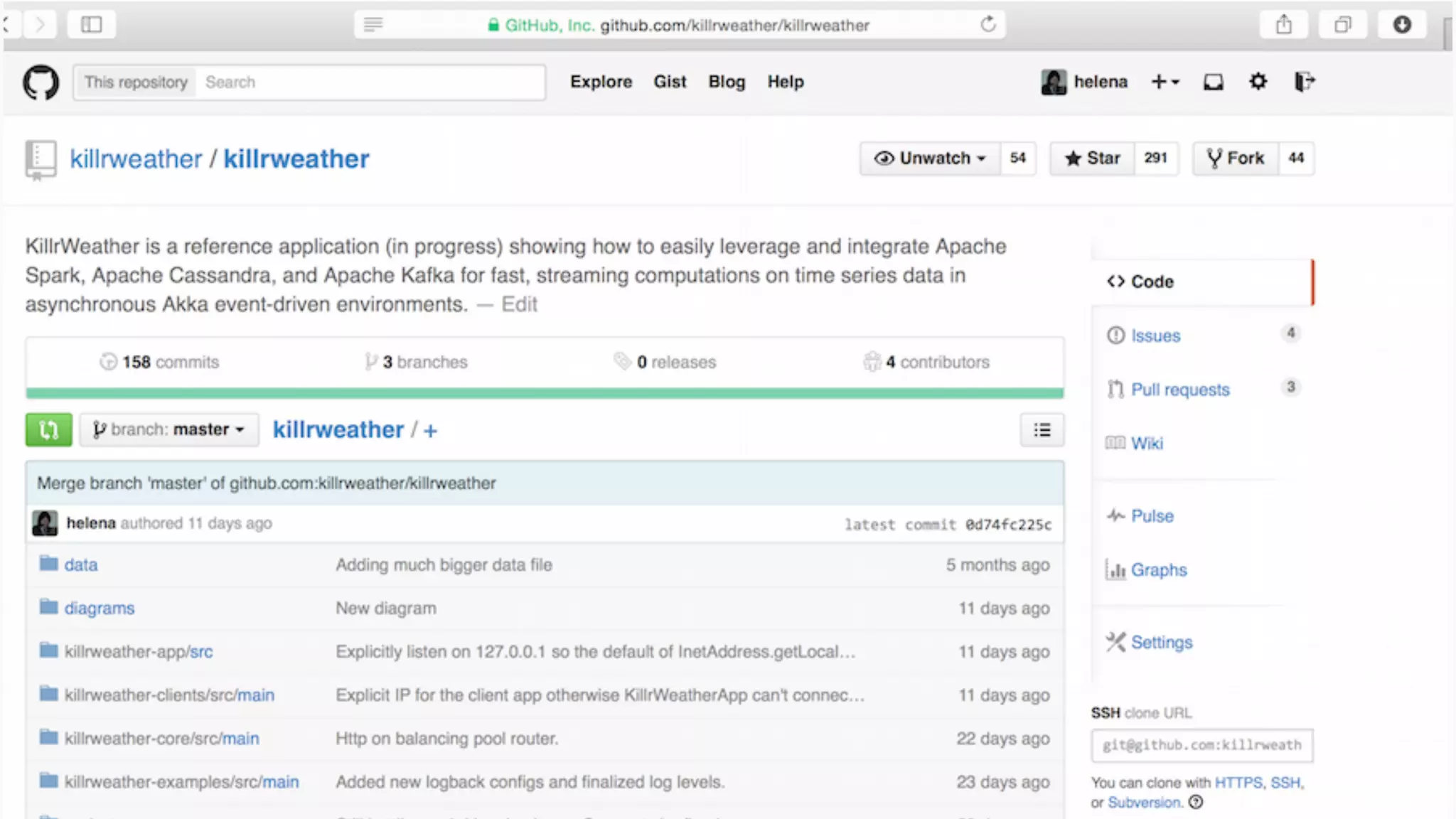
Resources Spark Cassandra Connector github.com/datastax/spark-cassandra-connector github.com/killrweather/killrweather groups.google.com/a/lists.datastax.com/forum/#!forum/spark-connector-user Apache Spark spark.apache.org Apache Cassandra cassandra.apache.org Apache Kafka kafka.apache.org Akka akka.io Analytic Analytic
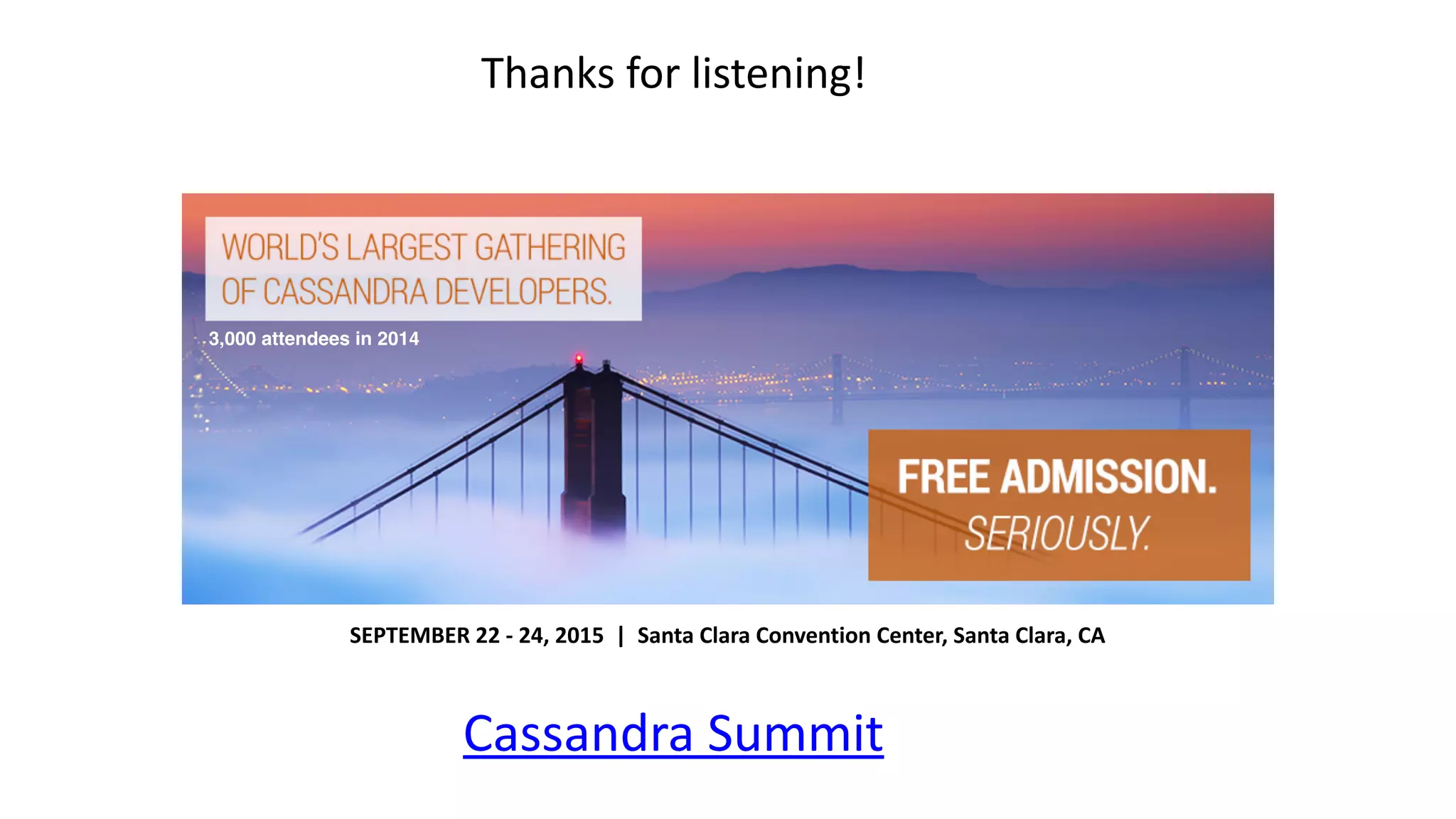
Thanks  for  listening!   Cassandra  Summit SEPTEMBER  22  -­‐  24,  2015    |    Santa  Clara  Convention  Center,  Santa  Clara,  CA 3,000 attendees in 2014

Lambda Architecture with Spark, Spark Streaming, Kafka, Cassandra, Akka and Scala

  • 1.
    ©2014 DataStax Confidential.Do not distribute without consent. @helenaedelson Helena Edelson Lambda Architecture with Spark Streaming, Kafka, Cassandra, Akka, Scala 1
  • 2.
    • Spark CassandraConnector committer • Akka contributor (Akka Cluster) • Scala & Big Data conference speaker • Sr Software Engineer, Analytics @ DataStax • Sr Cloud Engineer, VMware,CrowdStrike,SpringSource… • (Prev) Spring committer - Spring AMQP, Spring Integration Analytic Who Is This Person?
  • 3.
    Analytic Analytic Search Use Case: Hadoop+ Scalding /** Reads SequenceFile data from S3 buckets, computes then persists to Cassandra. */ class TopSearches(args: Args) extends TopKDailyJob[MyDataType](args) with Cassandra { PailSource.source[Search](rootpath, structure, directories).read .mapTo('pailItem -> 'engines) { e: Search ⇒ results(e) } .filter('engines) { e: String ⇒ e.nonEmpty } .groupBy('engines) { _.size('count).sortBy('engines) } .groupBy('engines) { _.sortedReverseTake[(String, Long)](('engines, 'count) -> 'tcount, k) } .flatMapTo('tcount -> ('key, 'engine, 'topCount)) { t: List[(String, Long)] ⇒ t map { case (k, v) ⇒ (jobKey, k, v) }} .write(CassandraSource(connection, "top_searches", Scheme(‘key, ('engine, ‘topCount)))) }
  • 4.
  • 5.
    Talk Roadmap What DeliveringMeaning Why Spark, Kafka, Cassandra & Akka How Composable Pipelines App Robust Implementation
  • 6.
    ©2014 DataStax Confidential.Do not distribute without consent. Sending Data Between Systems Is Difficult Risky 6
  • 8.
    Strategies • Scalable Infrastructure •Partition For Scale • Replicate For Resiliency • Share Nothing • Asynchronous Message Passing • Parallelism • Isolation • Location Transparency
  • 9.
    Strategy Technologies Scalable Infrastructure/ Elastic scale on demand Spark, Cassandra, Kafka Partition For Scale, Network Topology Aware Cassandra, Spark, Kafka, Akka Cluster Replicate For Resiliency span racks and datacenters, survive regional outages Spark,Cassandra, Akka Cluster all hash the node ring Share Nothing, Masterless Cassandra, Akka Cluster both Dynamo style Fault Tolerance / No Single Point of Failure Spark, Cassandra, Kafka Replay From Any Point Of Failure Spark, Cassandra, Kafka, Akka + Akka Persistence Failure Detection Cassandra, Spark, Akka, Kafka Consensus & Gossip Cassandra & Akka Cluster Parallelism Spark, Cassandra, Kafka, Akka Asynchronous Data Passing Kafka, Akka, Spark Fast, Low Latency, Data Locality Cassandra, Spark, Kafka Location Transparency Akka, Spark, Cassandra, Kafka
  • 10.
    Lambda Architecture A data-processingarchitecture designed to handle massive quantities of data by taking advantage of both batch and stream processing methods. • Spark is one of the few data processing frameworks that allows you to seamlessly integrate batch and stream processing • Of petabytes of data • In the same application
  • 11.
    I need fastaccess to historical data on the fly for predictive modeling with real time data from the stream
  • 12.
    Analytic Analytic Search • Fast, distributed,scalable and fault tolerant cluster compute system • Enables Low-latency with complex analytics • Developed in 2009 at UC Berkeley AMPLab, open sourced in 2010, and became a top-level Apache project in February, 2014
  • 13.
    • High ThroughputDistributed Messaging • Decouples Data Pipelines • Handles Massive Data Load • Support Massive Number of Consumers • Distribution & partitioning across cluster nodes • Automatic recovery from broker failures
  • 15.
    The one thingin your infrastructure you can always rely on.
  • 16.
    •Massively Scalable • HighPerformance • Always On • Masterless
  • 17.
  • 18.
    • Fault tolerant •Hierarchical Supervision • Customizable Failure Strategies & Detection • Asynchronous Data Passing • Parallelization - Balancing Pool Routers • Akka Cluster • Adaptive / Predictive • Load-Balanced Across Cluster Nodes
  • 19.
    • Stream datafrom Kafka to Cassandra • Stream data from Kafka to Spark and write to Cassandra • Stream from Cassandra to Spark - coming soon! • Read data from Spark/Spark Streaming Source and write to C* • Read data from Cassandra to Spark
  • 20.
  • 22.
    Most Active OSSIn Big Data Search
  • 23.
    Apache Spark -Easy to Use API Returns the top (k) highest temps for any location in the year def topK(aggregate: Seq[Double]): Seq[Double] = sc.parallelize(aggregate).top(k).collect Returns the top (k) highest temps … in a Future def topK(aggregate: Seq[Double]): Future[Seq[Double]] = sc.parallelize(aggregate).top(k).collectAsync Analytic Analytic Search
  • 24.
    © 2014 DataStax,All Rights Reserved Company Confidential Not Just MapReduce
  • 25.
    Spark Basic WordCount val conf = new SparkConf() .setMaster(host).setAppName(app)
 
 val sc = new SparkContext(conf) sc.textFile(words) .flatMap(_.split("s+")) .map(word => (word.toLowerCase, 1)) .reduceByKey(_ + _) .collect Analytic Analytic Search
  • 26.
    Analytic Analytic Search Collection To RDD scala>val data = Array(1, 2, 3, 4, 5)
 data: Array[Int] = Array(1, 2, 3, 4, 5)
 
 scala> val distributedData = sc.parallelize(data)
 distributedData: spark.RDD[Int] = spark.ParallelCollection@10d13e3e
  • 27.
  • 28.
    When Batch IsNot Enough Analytic Analytic
  • 29.
    Spark Streaming • Iwant results continuously in the event stream • I want to run computations in my even-driven async apps • Exactly once message guarantees
  • 30.
    Spark Streaming Setup valconf = new SparkConf().setMaster(SparkMaster).setAppName(AppName) val ssc = new StreamingContext(conf, Milliseconds(500)) // Do work in the stream ssc.checkpoint(checkpointDir) ssc.start() ssc.awaitTermination
  • 31.
    DStream (Discretized Stream) RDD(time 0 to time 1) RDD (time 1 to time 2) RDD (time 2 to time 3) A transformation on a DStream = transformations on its RDDs DStream Continuous stream of micro batches • Complex processing models with minimal effort • Streaming computations on small time intervals
  • 32.
  • 33.
    DStreams - thestream of raw data received from streaming sources: • Basic Source - in the StreamingContext API • Advanced Source - in external modules and separate Spark artifacts Receivers • Reliable Receivers - for data sources supporting acks (like Kafka) • Unreliable Receivers - for data sources not supporting acks 33 ReceiverInputDStreams
  • 34.
    Basic Streaming: FileInputDStream //Creates new DStreams ssc.textFileStream("s3n://raw_data_bucket/") .flatMap(_.split("s+")) .map(_.toLowerCase, 1)) .countByValue() .saveAsObjectFile("s3n://analytics_bucket/") Search
  • 35.
    Streaming Window Operations kvStream .flatMap{ case (k,v) => (k,v.value) } .reduceByKeyAndWindow((a:Int,b:Int) => (a + b), Seconds(30), Seconds(10)) .saveToCassandra(keyspace,table) Window Length: Duration = every 10s Sliding Interval: Interval at which the window operation is performed = every 10 s
  • 38.
    Apache Cassandra • Elasticity- scale to as many nodes as you need, when you need • Always On - No single point of failure, Continuous availability • Masterless peer to peer architecture • Replication Across DataCenters • Flexible Data Storage • Read and write to any node syncs across the cluster • Operational simplicity - all nodes in a cluster are the same • Fast Linear-Scale Performance •Transaction Support
  • 39.
  • 40.
    Science Physics: Astro Physics/ Particle Physics..
  • 41.
  • 42.
  • 43.
    Europe US Cassandra • Availability Model •Amazon Dynamo • Distributed, Masterless • Data Model • Google Big Table • Network Topology Aware • Multi-Datacenter Replication
  • 44.
    Analytics with SparkOver Cassandra Online Analytics Cassandra enables Spark nodes to transparently communicate across data centers for data
  • 45.
  • 46.
    What Happens WhenNodes Come Back? • Hinted handoff to the rescue • Coordinators keep writes for downed nodes for a configurable amount of time
  • 47.
    Gossip Did you hearnode 1 was down??
  • 48.
    Consensus • Consensus, theagreement among peers on the value of a shared piece of data, is a core building block of Distributed systems • Cassandra supports consensus via the Paxos protocol
  • 49.
    CREATE TABLE users( username varchar, firstname varchar, lastname varchar, email list<varchar>, password varchar, created_date timestamp, PRIMARY KEY (username) ); INSERT INTO users (username, firstname, lastname, email, password, created_date) VALUES ('hedelson','Helena','Edelson', [‘helena.edelson@datastax.com'],'ba27e03fd95e507daf2937c937d499ab','2014-11-15 13:50:00’) IF NOT EXISTS; • Familiar syntax • Many Tools & Drivers • Many Languages • Friendly to programmers • Paxos for locking CQL - Easy
  • 50.
    CREATE  TABLE  weather.raw_data  (
      wsid  text,  year  int,  month  int,  day  int,  hour  int,                          
      temperature  double,  dewpoint  double,  pressure  double,          wind_direction  int,  wind_speed  double,  one_hour_precip              PRIMARY  KEY  ((wsid),  year,  month,  day,  hour)
 )  WITH  CLUSTERING  ORDER  BY  (year  DESC,  month  DESC,  day  DESC,  hour  DESC);   C* Clustering Columns Writes by most recent Reads return most recent first Timeseries Cassandra will automatically sort by most recent for both both write and read
  • 51.
    val multipleStreams =(1 to numDstreams).map { i => streamingContext.receiverStream[HttpRequest](new HttpReceiver(port)) } streamingContext.union(multipleStreams) .map { httpRequest => TimelineRequestEvent(httpRequest)} .saveToCassandra("requests_ks", "timeline") A record of every event, in order in which it happened, per URL: CREATE TABLE IF NOT EXISTS requests_ks.timeline ( timesegment bigint, url text, t_uuid timeuuid, method text, headers map <text, text>, body text, PRIMARY KEY ((url, timesegment) , t_uuid) ); timeuuid protects from simultaneous events over-writing one another. timesegment protects from writing unbounded partitions.
  • 52.
    ©2014 DataStax Confidential.Do not distribute without consent. Spark Cassandra Connector 52
  • 53.
    Spark Cassandra Connector https://github.com/datastax/spark-cassandra-connector •Write data from Spark to Cassandra • Read data from Cassandra to Spark • Data Locality for Speed • Easy, and often implicit, type conversions • Server-Side Filtering - SELECT, WHERE, etc. • Natural Timeseries Integration • Implemented in Scala
  • 54.
    Spark Cassandra Connector C* C* C*C* SparkExecutor C* Driver Spark-Cassandra Connector User Application Cassandra
  • 55.
    55 Co-locate Spark andC* for Best Performance C* C*C* C* Spark
 Worker Spark
 Worker Spark Master Spark Worker Running Spark Workers on the same nodes as your C* Cluster saves network hops
  • 56.
    Analytic Search Writing and Reading SparkContext import  com.datastax.spark.connector._   StreamingContext   import  com.datastax.spark.connector.streaming._
  • 57.
    Analytic Write from Sparkto Cassandra sc.parallelize(collection).saveToCassandra("keyspace",  "raw_data") SparkContext Keyspace Table Spark RDD JOIN with NOSQL! predictionsRdd.join(music).saveToCassandra("music",  "predictions")
  • 58.
    Read From C*to Spark val  rdd  =  sc.cassandraTable("github",  "commits")                                            .select("user","count","year","month")                                            .where("commits  >=  ?  and  year  =  ?",  1000,  2015) CassandraRDD[CassandraRow] Keyspace Table Server-Side Column and Row Filtering SparkContext
  • 59.
    val  rdd  =  ssc.cassandraTable[MonthlyCommits]("github",  "commits_aggregate")                            .where("user  =  ?  and  project_name  =  ?  and  year  =  ?",                                    "helena",  "spark-­‐cassandra-­‐connector",  2015) CassandraRow Keyspace TableStreamingContext Rows: Custom Objects
  • 60.
    Rows val  tuplesRdd  =  sc.cassandraTable[(Int,Date,String)](db,  tweetsTable)    .select("cluster_id","time",  "cluster_name")    .where("time  >  ?  and  time  <  ?",                  "2014-­‐07-­‐12  20:00:01",  "2014-­‐07-­‐12  20:00:03”)   val  keyValuesPairsRdd  =  sc.cassandraTable[(Key,Value)](keyspace,  table)  
  • 61.
    Rows val rdd =ssc.cassandraTable[MyDataType]("stats", "clustering_time") rdd.where("key = 1").limit(10).collect   rdd.where("key = 1").take(10).collect val  rdd  =  ssc.cassandraTable[(Int,DateTime,String)]("stats",  "clustering_time")                            .where("key  =  1").withAscOrder.collect   val  rdd  =  ssc.cassandraTable[(Int,DateTime,String)]("stats",  "clustering_time")                            .where("key  =  1").withDescOrder.collect  
  • 62.
    Cassandra User DefinedTypes CREATE TYPE address ( street text, city text, zip_code int, country text, cross_streets set<text> ); UDT = Your Custom Field Type In Cassandra
  • 63.
    Cassandra UDT’s WithJSON { "productId": 2, "name": "Kitchen Table", "price": 249.99, "description" : "Rectangular table with oak finish", "dimensions": { "units": "inches", "length": 50.0, "width": 66.0, "height": 32 }, "categories": { { "category" : "Home Furnishings" { "catalogPage": 45, "url": "/home/furnishings" }, { "category" : "Kitchen Furnishings" { "catalogPage": 108, "url": "/kitchen/furnishings" } } } CREATE TYPE dimensions ( units text, length float, width float, height float ); CREATE TYPE category ( catalogPage int, url text ); CREATE TABLE product ( productId int, name text, price float, description text, dimensions frozen <dimensions>, categories map <text, frozen <category>>, PRIMARY KEY (productId) );
  • 64.
    ©2014 DataStax Confidential.Do not distribute without consent. Composable Pipelines With Spark, Kafka & Cassandra 64
  • 65.
    Spark SQL withCassandra import org.apache.spark.sql.cassandra.CassandraSQLContext val cc = new CassandraSQLContext(sparkContext) cc.setKeyspace(keyspaceName) cc.sql(""" SELECT table1.a, table1.b, table.c, table2.a FROM table1 AS table1 JOIN table2 AS table2 ON table1.a = table2.a AND table1.b = table2.b AND table1.c = table2.c """) .map(Data(_)) .saveToCassandra(keyspace1, table3)
  • 66.
    Cross Keyspaces (Databases) valschemaRdd1 = cassandraSqlContext.sql(""" INSERT INTO keyspace2.table3 SELECT table2.a, table2.b, table2.c FROM keyspace1.table2 as table2""") val schemaRdd2 = cassandraSqlContext.sql(""" SELECT table3.a, table3.b, table3.c FROM keyspace2.table3 as table3""") val schemaRdd3 = cassandraSqlContext.sql(""" SELECT test1.a, test1.b, test1.c, test2.a FROM database1.test1 AS test1
 JOIN database2.test2 AS test2 ON test1.a = test2.a AND test1.b = test2.b AND test1.c = test2.c""")
  • 67.
    
 val sql =new SQLContext(sparkContext) val json = Seq(
 """{"user":"helena","commits":98, "month":3, "year":2015}""",
 """{"user":"jacek-lewandowski", "commits":72, "month":3, "year":2015}""",
 """{"user":"pkolaczk", "commits":42, "month":3, "year":2015}""") // write sql.jsonRDD(json) .map(CommitStats(_)) .flatMap(compute) .saveToCassandra("stats","monthly_commits")
 // read val rdd = sc.cassandraTable[MonthlyCommits]("stats","monthly_commits") cqlsh>  CREATE  TABLE  github_stats.commits_aggr(user  VARCHAR  PRIMARY  KEY,  commits  INT…); Spark SQL with Cassandra & JSON
  • 68.
    Analytic Analytic Search Spark Streaming, Kafka,C* and JSON cqlsh>  select  *  from  github_stats.commits_aggr;   
   user | commits | month | year -------------------+---------+-------+------ pkolaczk | 42 | 3 | 2015 jacek-lewandowski | 43 | 3 | 2015 helena | 98 | 3 | 2015
 (3  rows)   KafkaUtils.createStream[String, String, StringDecoder, StringDecoder](
 ssc, kafkaParams, topicMap, StorageLevel.MEMORY_ONLY)
 .map { case (_,json) => JsonParser.parse(json).extract[MonthlyCommits]}
 .saveToCassandra("github_stats","commits_aggr")
  • 69.
    Spark Streaming, Kafka& Cassandra sparkConf.set("spark.cassandra.connection.host", "10.20.3.45")
 val streamingContext = new StreamingContext(conf, Seconds(30))
 KafkaUtils.createStream[String, String, StringDecoder, StringDecoder](
 streamingContext, kafkaParams, topicMap, StorageLevel.MEMORY_ONLY) .map(_._2) .countByValue() .saveToCassandra("my_keyspace","wordcount")
  • 70.
    Spark Streaming, Twitter& Cassandra /** Cassandra is doing the sorting for you here. */
 TwitterUtils.createStream( ssc, auth, tags, StorageLevel.MEMORY_ONLY_SER_2)
 .flatMap(_.getText.toLowerCase.split("""s+"""))
 .filter(tags.contains(_))
 .countByValueAndWindow(Seconds(5), Seconds(5))
 .transform((rdd, time) => rdd.map { case (term, count) => (term, count, now(time))})
 .saveToCassandra(keyspace, table) CREATE TABLE IF NOT EXISTS keyspace.table (
 topic text, interval text, mentions counter,
 PRIMARY KEY(topic, interval)
 ) WITH CLUSTERING ORDER BY (interval DESC)
  • 71.
    Streaming From Kafka,R/W Cassandra val ssc = new StreamingContext(conf, Seconds(30))
 val stream = KafkaUtils.createStream[K, V, KDecoder, VDecoder](
 ssc, kafkaParams, topicMap, StorageLevel.MEMORY_ONLY) stream.flatMap { detected => ssc.cassandraTable[AdversaryAttack]("behavior_ks",  "observed")              .where("adversary  =  ?  and  ip  =  ?  and  attackType  =  ?",                  detected.adversary,  detected.originIp,  detected.attackType)              .collect }.saveToCassandra("profiling_ks",  "adversary_profiles")
  • 72.
    Training Data Feature Extraction Model Training Model Testing Test Data Your Data ExtractData To Analyze Train your model to predict Spark Streaming ML, Kafka & Cassandra
  • 73.
    val ssc =new StreamingContext(new SparkConf()…, Seconds(5)
 val testData = ssc.cassandraTable[String](keyspace,table).map(LabeledPoint.parse)
 
 val trainingStream = KafkaUtils.createStream[K, V, KDecoder, VDecoder](
 ssc, kafkaParams, topicMap, StorageLevel.MEMORY_ONLY) .map(_._2).map(LabeledPoint.parse) trainingStream.saveToCassandra("ml_keyspace", “raw_training_data")
 
 val model = new StreamingLinearRegressionWithSGD()
 .setInitialWeights(Vectors.dense(weights))
 .trainOn(trainingStream) 
 //Making predictions on testData model .predictOnValues(testData.map(lp => (lp.label, lp.features))) .saveToCassandra("ml_keyspace", "predictions") Spark Streaming ML, Kafka & C*
  • 74.
    Timeseries Data Application •Global sensors & satellites collect data • Cassandra stores in sequence • Application reads in sequence Apache Cassandra
  • 75.
    Data Analysis Application predictivemodelling Apache Cassandra
  • 76.
    Data model shouldlook like your queries
  • 77.
    • Store rawdata per ID • Store time series data in order: most recent to oldest • Compute and store aggregate data in the stream • Set TTLs on historic data • Get data by ID • Get data for a single date and time • Get data for a window of time • Compute, store and retrieve daily, monthly, annual aggregations Design Data Model to support queries Queries I Need
  • 78.
    Data Model • WeatherStation Id and Time are unique • Store as many as needed CREATE TABLE temperature ( weather_station text, year int, month int, day int, hour int, temperature double, PRIMARY KEY (weather_station,year,month,day,hour) ); INSERT INTO temperature(weather_station,year,month,day,hour,temperature) VALUES (‘10010:99999’,2005,12,1,7,-5.6); INSERT INTO temperature(weather_station,year,month,day,hour,temperature) VALUES (‘10010:99999’,2005,12,1,8,-5.1); INSERT INTO temperature(weather_station,year,month,day,hour,temperature) VALUES (‘10010:99999’,2005,12,1,9,-4.9); INSERT INTO temperature(weather_station,year,month,day,hour,temperature) VALUES (‘10010:99999’,2005,12,1,10,-5.3);
  • 80.
    class KafkaProducerActor[K, V](config:ProducerConfig) extends Actor {
 
 override val supervisorStrategy =
 OneForOneStrategy(maxNrOfRetries = 10, withinTimeRange = 1.minute) {
 case _: ActorInitializationException => Stop
 case _: FailedToSendMessageException => Restart case _: ProducerClosedException => Restart case _: NoBrokersForPartitionException => Escalate case _: KafkaException => Escalate
 case _: Exception => Escalate
 } 
 private val producer = new KafkaProducer[K, V](producerConfig)
 
 override def postStop(): Unit = producer.close() 
 def receive = {
 case e: KafkaMessageEnvelope[K,V] => producer.send(e)
 }
 } Kafka Producer as Akka Actor
  • 81.
    class HttpReceiverActor(kafka: ActorRef)extends Actor with ActorLogging { implicit val materializer = FlowMaterializer() IO(Http) ! Http.Bind(HttpHost, HttpPort)
 
 val requestHandler: HttpRequest => HttpResponse = {
 case HttpRequest(POST, Uri.Path("/weather/v1/hourly-weather"), headers, entity, _) =>
 HttpSource(headers,entity).collect { case s: HeaderSource => for(s <- source.extract) kafka ! KafkaMessageEnvelope[String, String](topic, key, fs.data:_*)
 HttpResponse(200, entity = HttpEntity(MediaTypes.`text/html`, s"POST $entity"))
 } getOrElse HttpResponse(404, entity = s"Unsupported request") } 
 def receive : Actor.Receive = {
 case Http.ServerBinding(localAddress, stream) => Source(stream).foreach({
 case Http.IncomingConnection(remoteAddress, requestProducer, responseConsumer) =>
 log.info("Accepted new connection from {}.", remoteAddress)
 Source(requestProducer).map(requestHandler).to(Sink(responseConsumer)).run()
 }) }} Akka Actor as REST Endpoint
  • 82.
    class HttpNodeGuardian extendsClusterAwareNodeGuardianActor {
 
 val router = context.actorOf( BalancingPool(PoolSize).props(Props( new KafkaPublisherActor(KafkaHosts, KafkaBatchSendSize))))
 
 Cluster(context.system) registerOnMemberUp {
 val router = context.actorOf( BalancingPool(PoolSize).props(Props( new HttpReceiverActor(KafkaHosts, KafkaBatchSendSize)))) } def initialized: Actor.Receive = { … } 
 } Akka: Load-Balanced Kafka Work
  • 83.
    Store raw dataon ingestion
  • 84.
    val kafkaStream =KafkaUtils.createStream[K, V, KDecoder, VDecoder] (ssc, kafkaParams, topicMap, StorageLevel.DISK_ONLY_2)
 .map(transform)
 .map(RawWeatherData(_))
 
 /** Saves the raw data to Cassandra. */
 kafkaStream.saveToCassandra(keyspace, raw_ws_data) Store Raw Data on Ingestion To Cassandra From Kafka Stream /** Now proceed with computations from the same stream.. */ kafkaStream… Now we can replay: on failure, for later computation, etc
  • 85.
    CREATE  TABLE  weather.raw_data  (
      wsid  text,  year  int,  month  int,  day  int,  hour  int,                          
      temperature  double,  dewpoint  double,  pressure  double,          wind_direction  int,  wind_speed  double,  one_hour_precip              PRIMARY  KEY  ((wsid),  year,  month,  day,  hour)
 )  WITH  CLUSTERING  ORDER  BY  (year  DESC,  month  DESC,  day  DESC,  hour  DESC);   CREATE  TABLE  daily_aggregate_precip  (
      wsid  text,
      year  int,
      month  int,
      day  int,
      precipitation  counter,
      PRIMARY  KEY  ((wsid),  year,  month,  day)
 )  WITH  CLUSTERING  ORDER  BY  (year  DESC,  month  DESC,  day  DESC);   Our Data Model Again…
  • 86.
    Gets the partitionkey: Data Locality Spark C* Connector feeds this to Spark Cassandra Counter column in our schema, no expensive `reduceByKey` needed. Simply let C* do it: not expensive and fast. Efficient Stream Computation val kafkaStream = KafkaUtils.createStream[K, V, KDecoder, VDecoder] (ssc, kafkaParams, topicMap, StorageLevel.DISK_ONLY_2)
 .map(transform)
 .map(RawWeatherData(_))
 
 kafkaStream.saveToCassandra(keyspace, raw_ws_data) /** Per `wsid` and timestamp, aggregates hourly pricip by day in the stream. */
 kafkaStream.map { weather =>
 (weather.wsid, weather.year, weather.month, weather.day, weather.oneHourPrecip)
 }.saveToCassandra(keyspace, daily_precipitation_aggregations)
  • 87.
    class TemperatureActor(sc: SparkContext,settings: WeatherSettings) extends AggregationActor {
 import akka.pattern.pipe 
 def receive: Actor.Receive = {
 case e: GetMonthlyHiLowTemperature => highLow(e, sender)
 }
 
 def highLow(e: GetMonthlyHiLowTemperature, requester: ActorRef): Unit =
 sc.cassandraTable[DailyTemperature](keyspace, daily_temperature_aggr)
 .where("wsid = ? AND year = ? AND month = ?", e.wsid, e.year, e.month)
 .collectAsync()
 .map(MonthlyTemperature(_, e.wsid, e.year, e.month)) pipeTo requester } C* data is automatically sorted by most recent - due to our data model. Additional Spark or collection sort not needed.
  • 89.
    ©2014 DataStax Confidential.Do not distribute without consent. 89 @helenaedelson github.com/helena slideshare.net/helenaedelson
  • 90.
  • 91.
    Thanks  for  listening!   Cassandra  Summit SEPTEMBER  22  -­‐  24,  2015    |    Santa  Clara  Convention  Center,  Santa  Clara,  CA 3,000 attendees in 2014