1 Locating Texture Boundaries Using a Fast Unsupervised Approach Based on Clustering Algorithms Fusion and Level Set Slides by: Mehryar Emambakhsh Sahand University of Technology
2 Outline  About image segmentation and its methods  Feature extraction – Color transformation – Non-linear diffusion  Clustering algorithms – Fusion  Level set  Simulation results  Summary  References
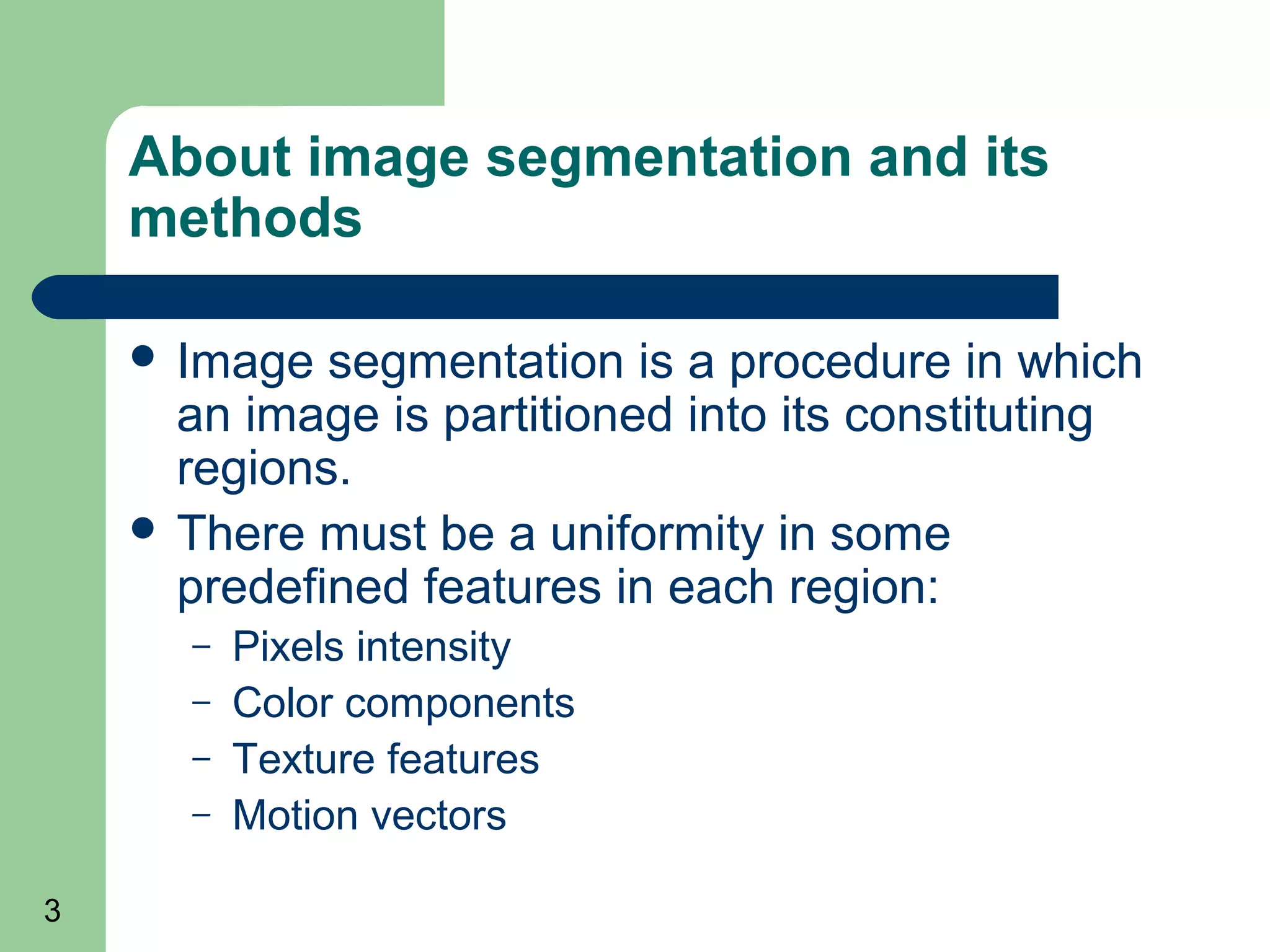
3 About image segmentation and its methods  Image segmentation is a procedure in which an image is partitioned into its constituting regions.  There must be a uniformity in some predefined features in each region: – Pixels intensity – Color components – Texture features – Motion vectors
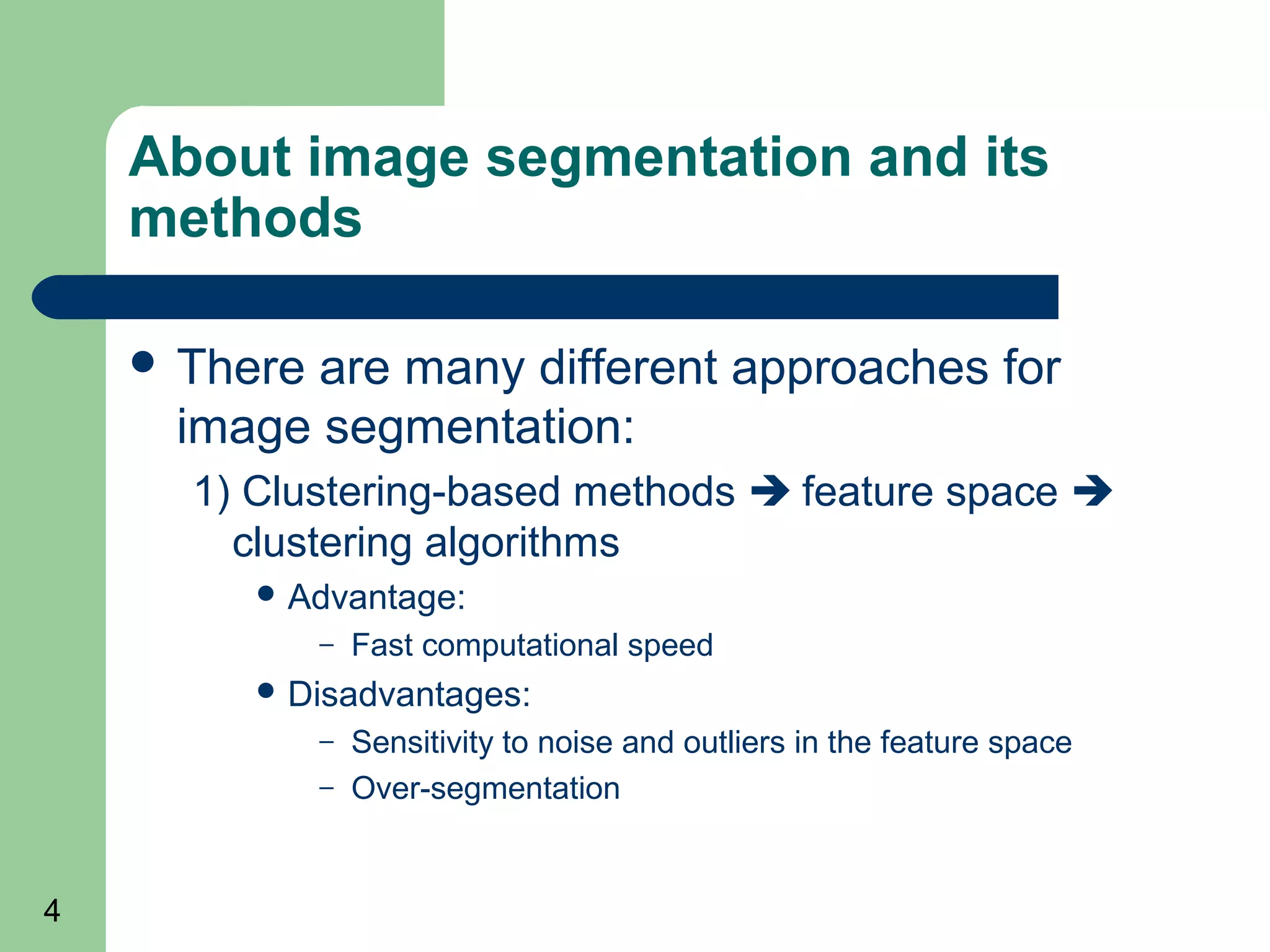
4 About image segmentation and its methods  There are many different approaches for image segmentation: 1) Clustering-based methods  feature space  clustering algorithms  Advantage: – Fast computational speed  Disadvantages: – Sensitivity to noise and outliers in the feature space – Over-segmentation
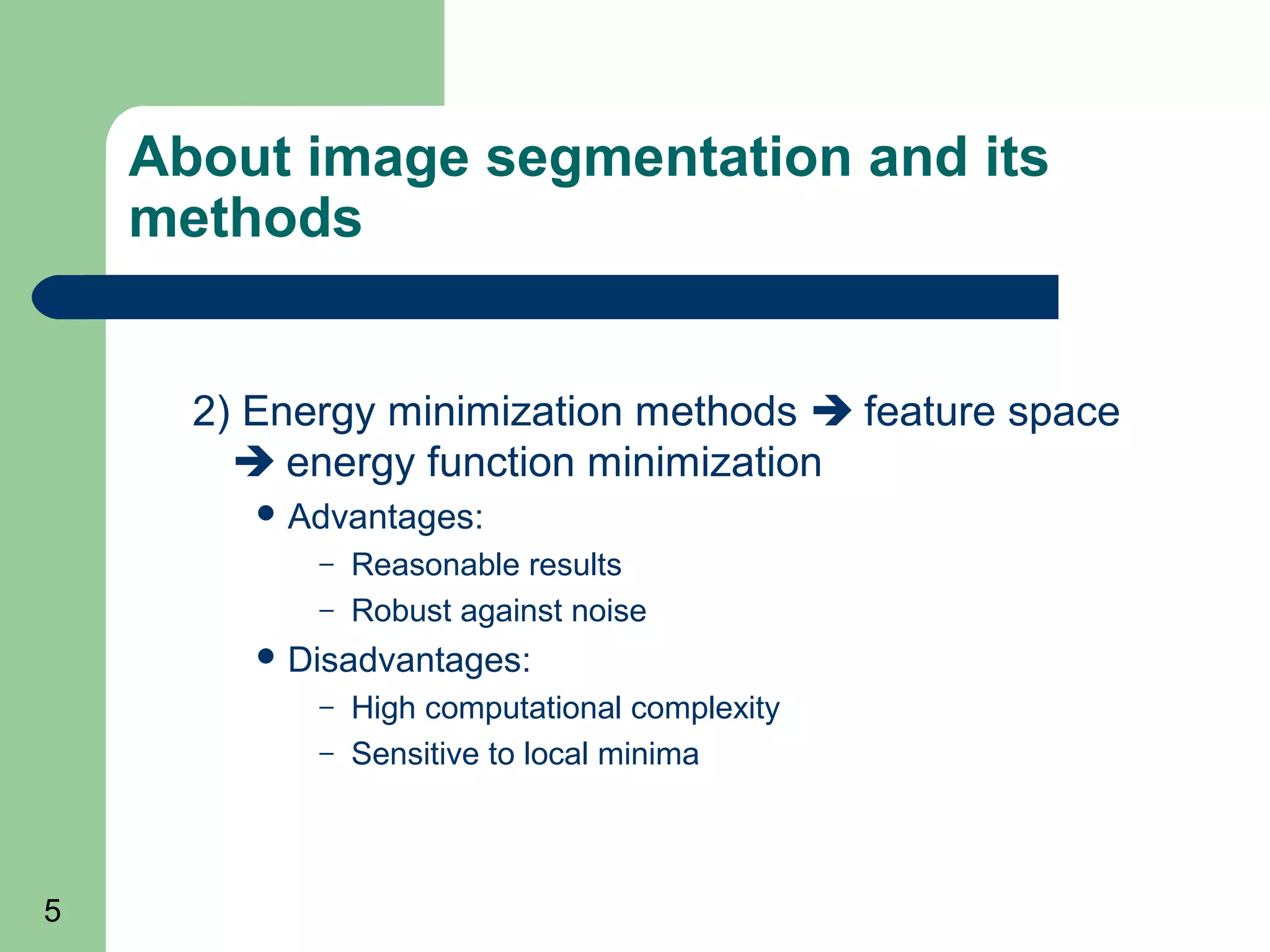
5 About image segmentation and its methods 2) Energy minimization methods  feature space  energy function minimization  Advantages: – Reasonable results – Robust against noise  Disadvantages: – High computational complexity – Sensitive to local minima
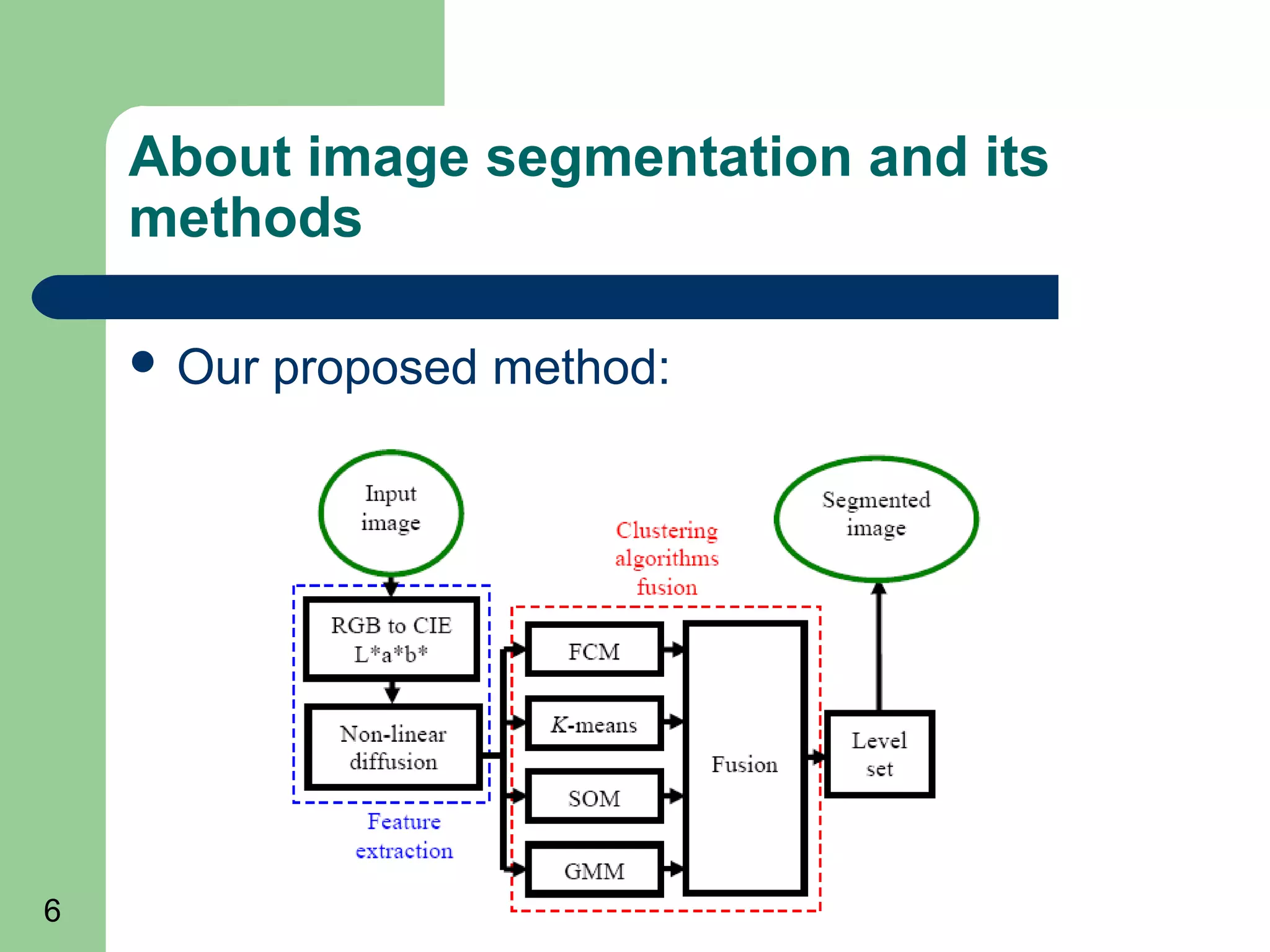
6 About image segmentation and its methods  Our proposed method:
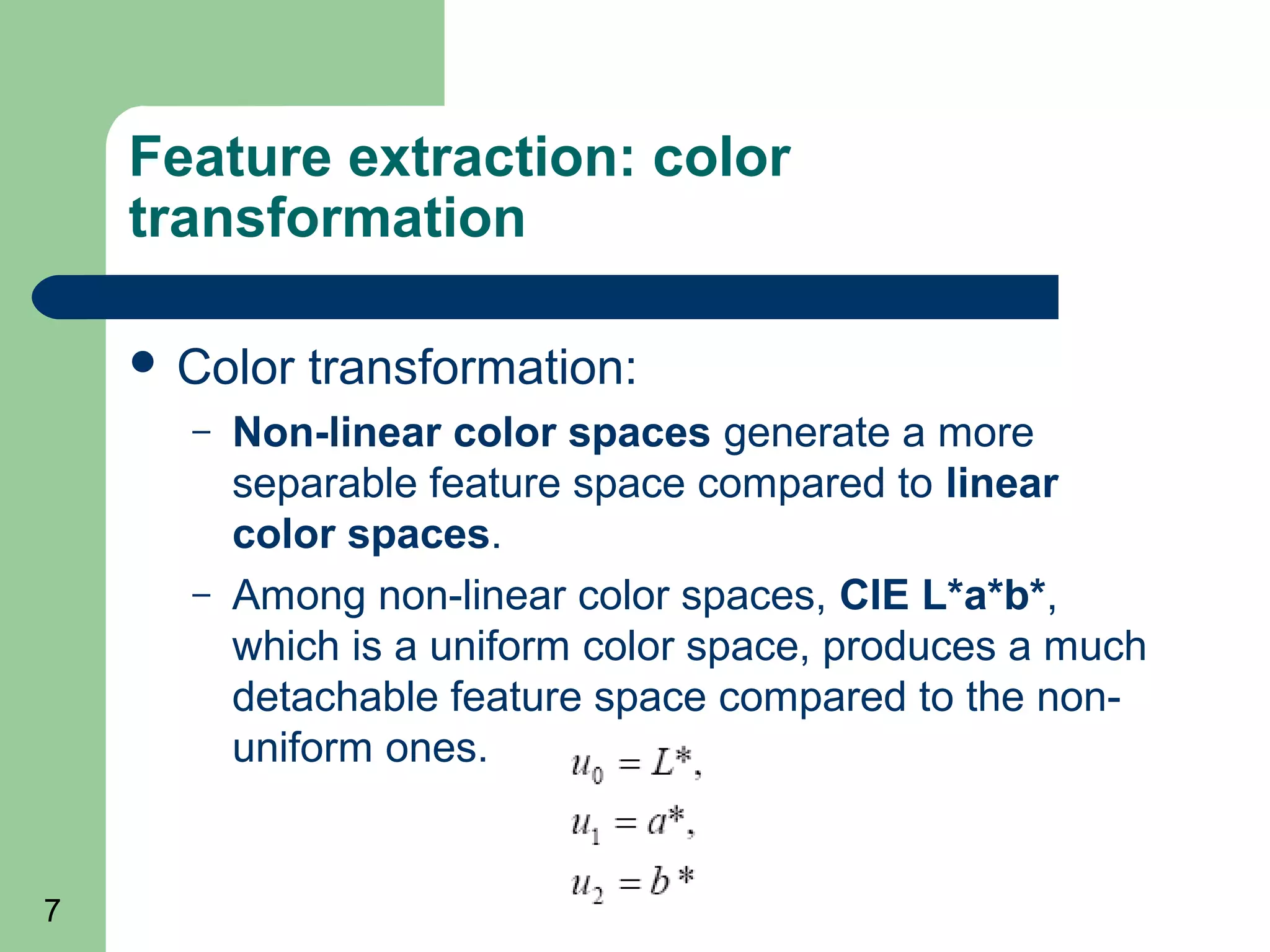
7 Feature extraction: color transformation  Color transformation: – Non-linear color spaces generate a more separable feature space compared to linear color spaces. – Among non-linear color spaces, CIE L*a*b*, which is a uniform color space, produces a much detachable feature space compared to the non- uniform ones.
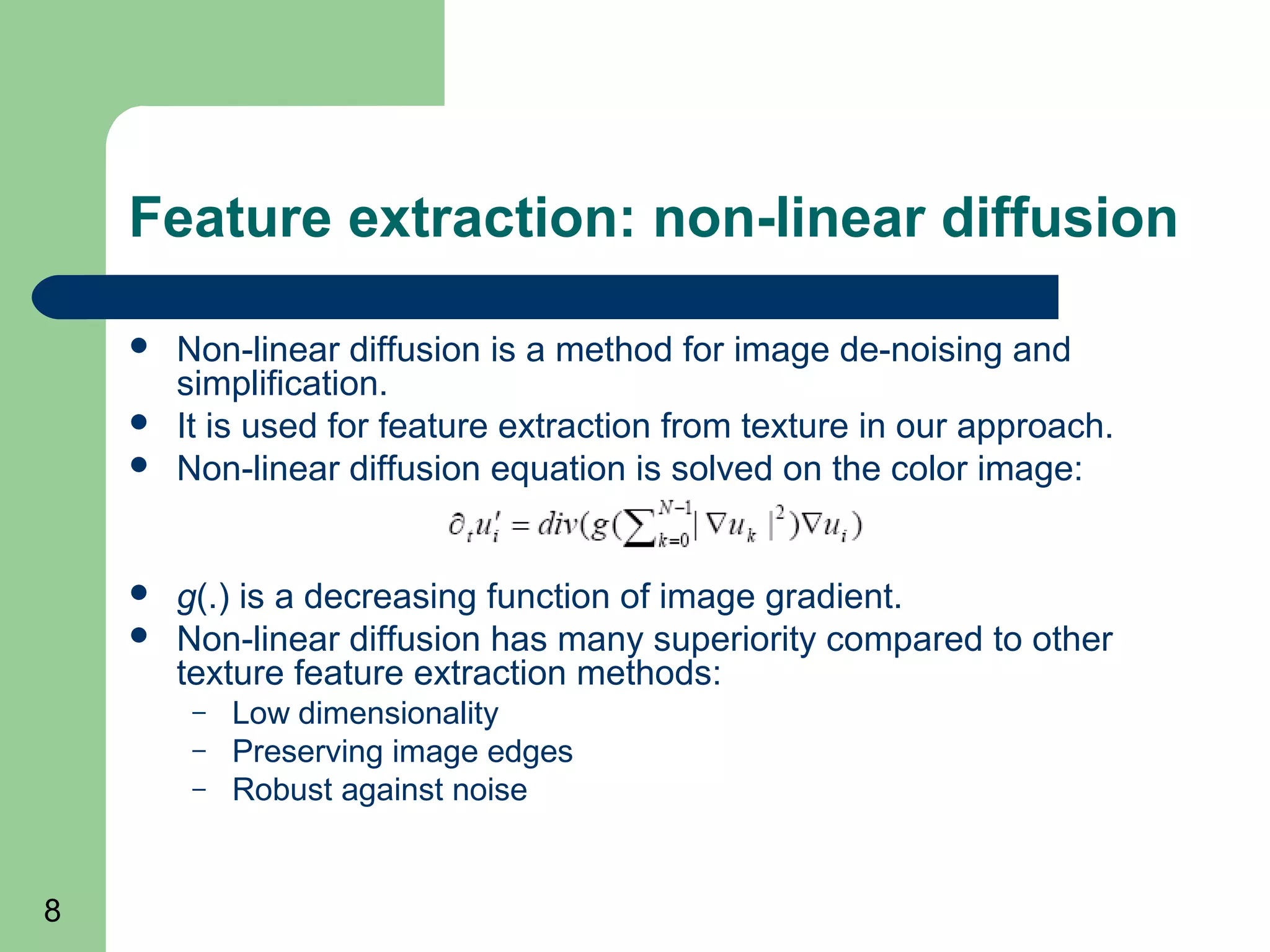
8 Feature extraction: non-linear diffusion  Non-linear diffusion is a method for image de-noising and simplification.  It is used for feature extraction from texture in our approach.  Non-linear diffusion equation is solved on the color image:  g(.) is a decreasing function of image gradient.  Non-linear diffusion has many superiority compared to other texture feature extraction methods: – Low dimensionality – Preserving image edges – Robust against noise
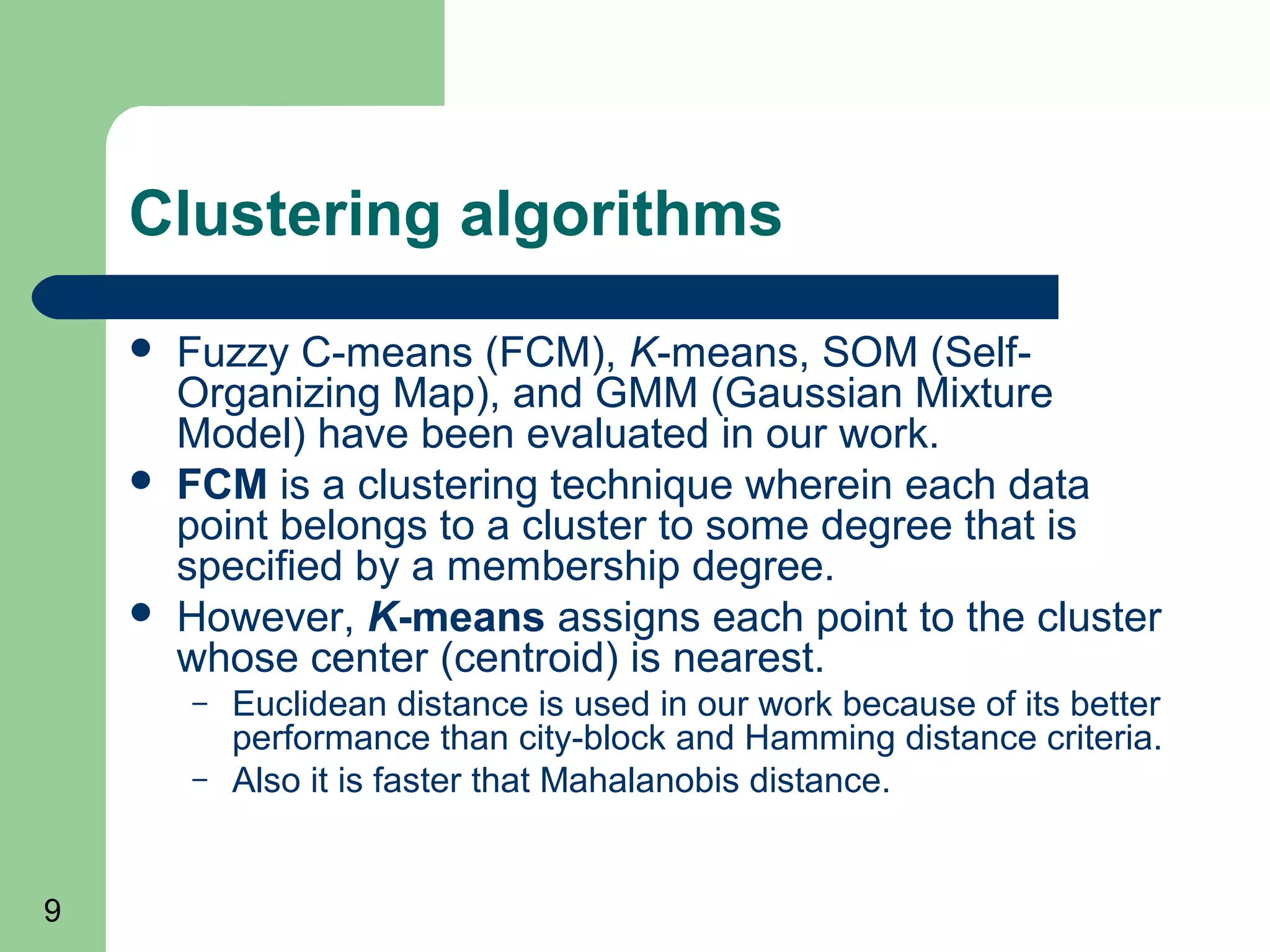
9 Clustering algorithms  Fuzzy C-means (FCM), K-means, SOM (Self- Organizing Map), and GMM (Gaussian Mixture Model) have been evaluated in our work.  FCM is a clustering technique wherein each data point belongs to a cluster to some degree that is specified by a membership degree.  However, K-means assigns each point to the cluster whose center (centroid) is nearest. – Euclidean distance is used in our work because of its better performance than city-block and Hamming distance criteria. – Also it is faster that Mahalanobis distance.
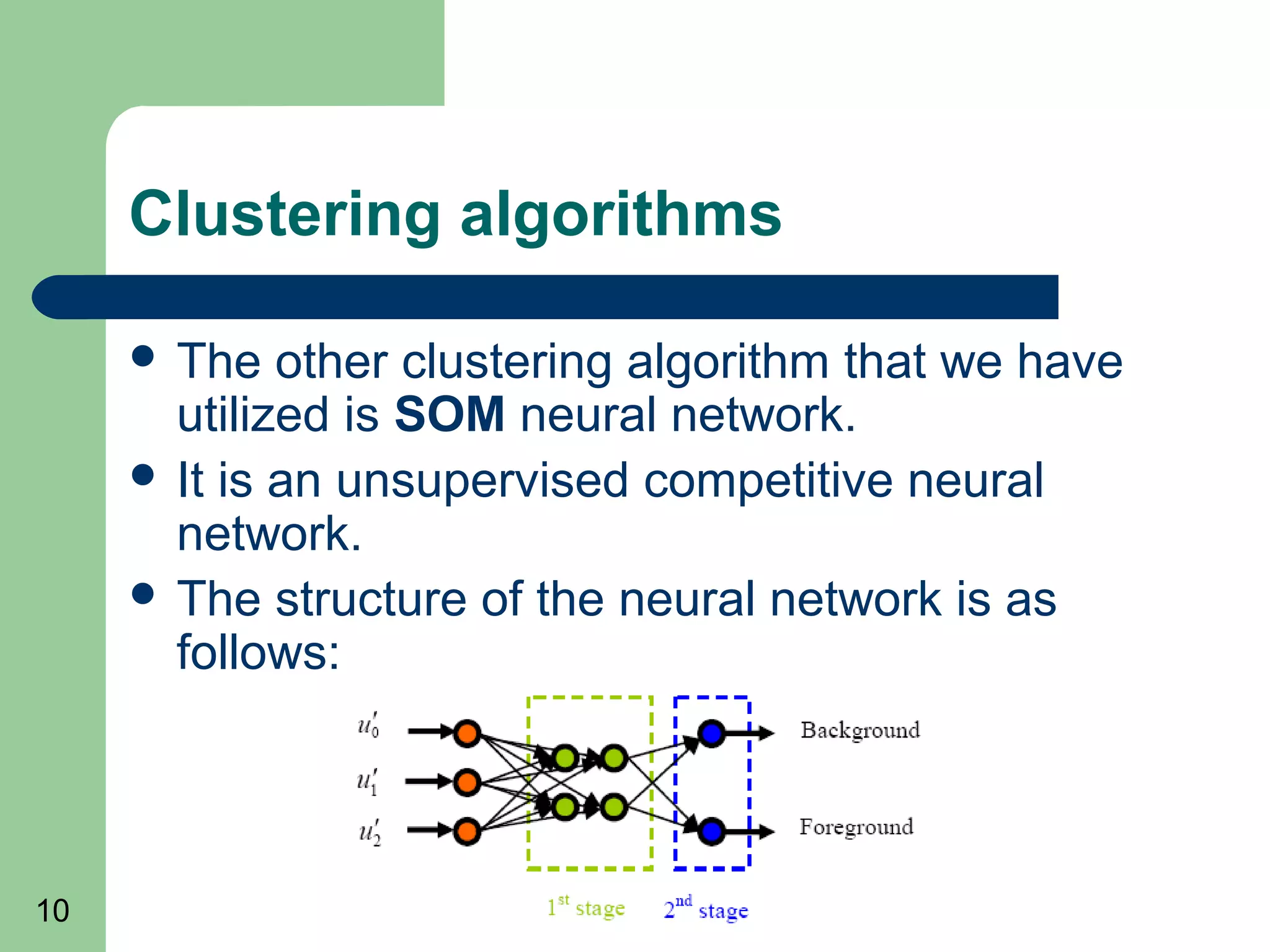
10 Clustering algorithms  The other clustering algorithm that we have utilized is SOM neural network.  It is an unsupervised competitive neural network.  The structure of the neural network is as follows:
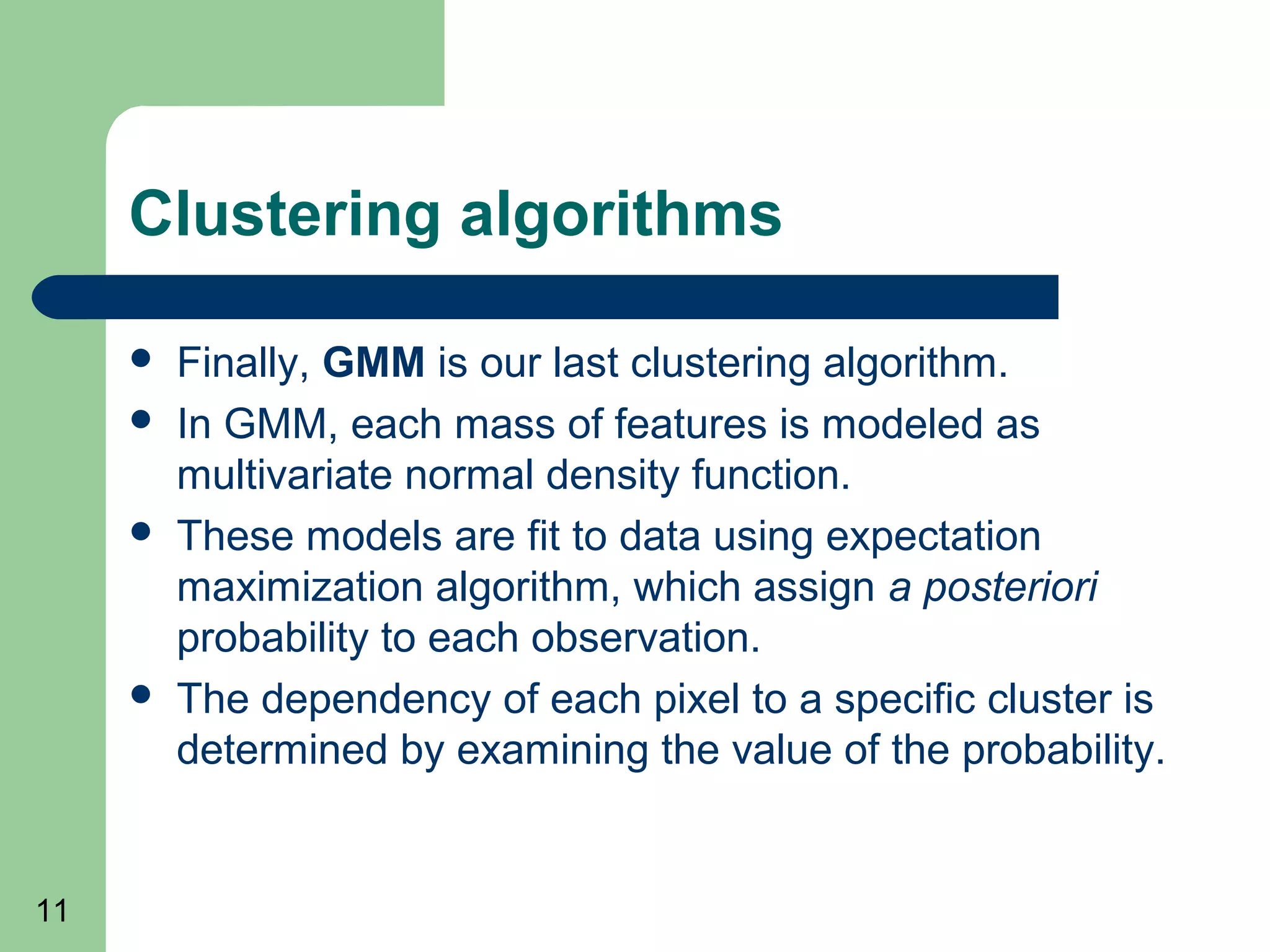
11 Clustering algorithms  Finally, GMM is our last clustering algorithm.  In GMM, each mass of features is modeled as multivariate normal density function.  These models are fit to data using expectation maximization algorithm, which assign a posteriori probability to each observation.  The dependency of each pixel to a specific cluster is determined by examining the value of the probability.
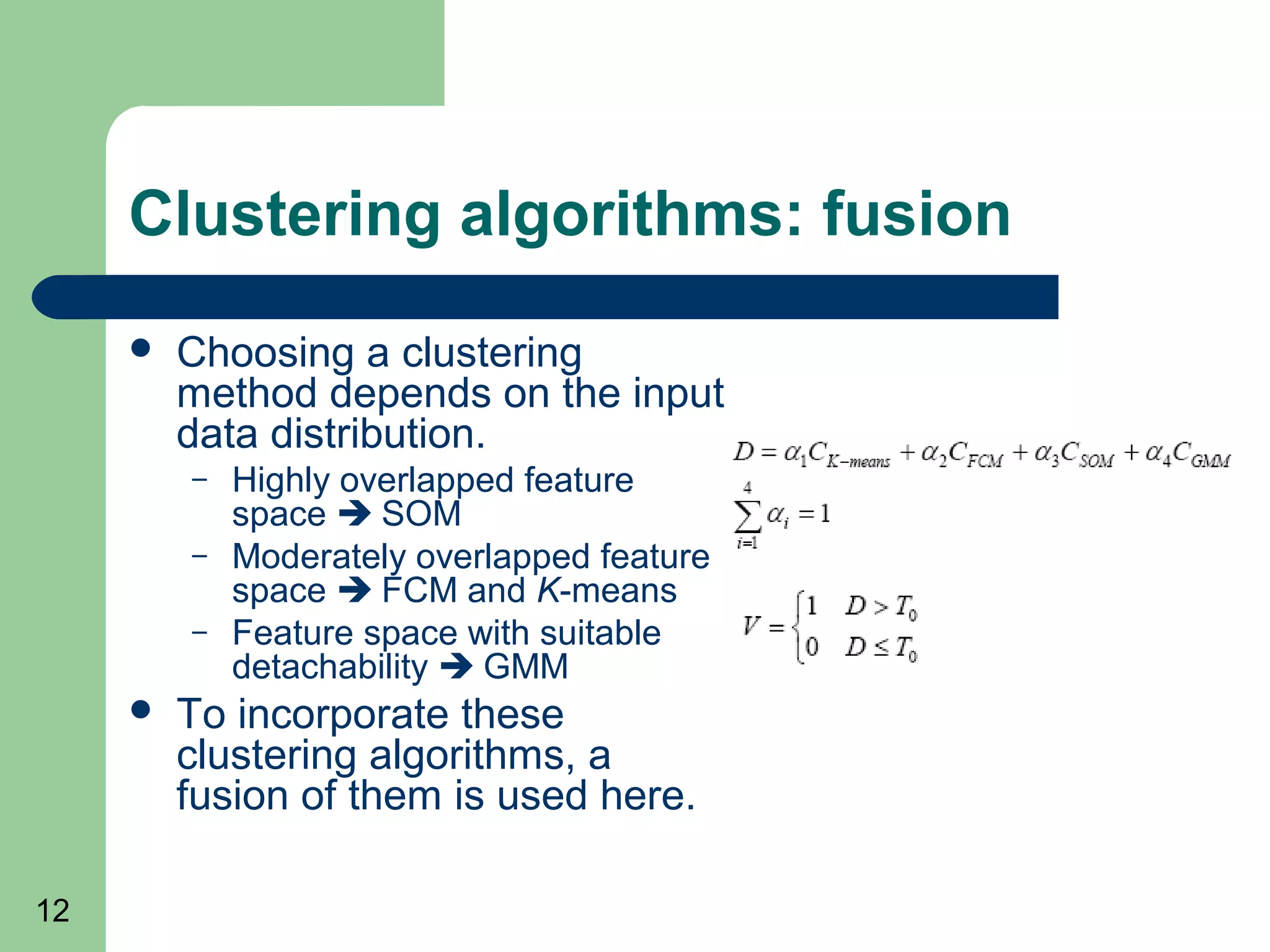
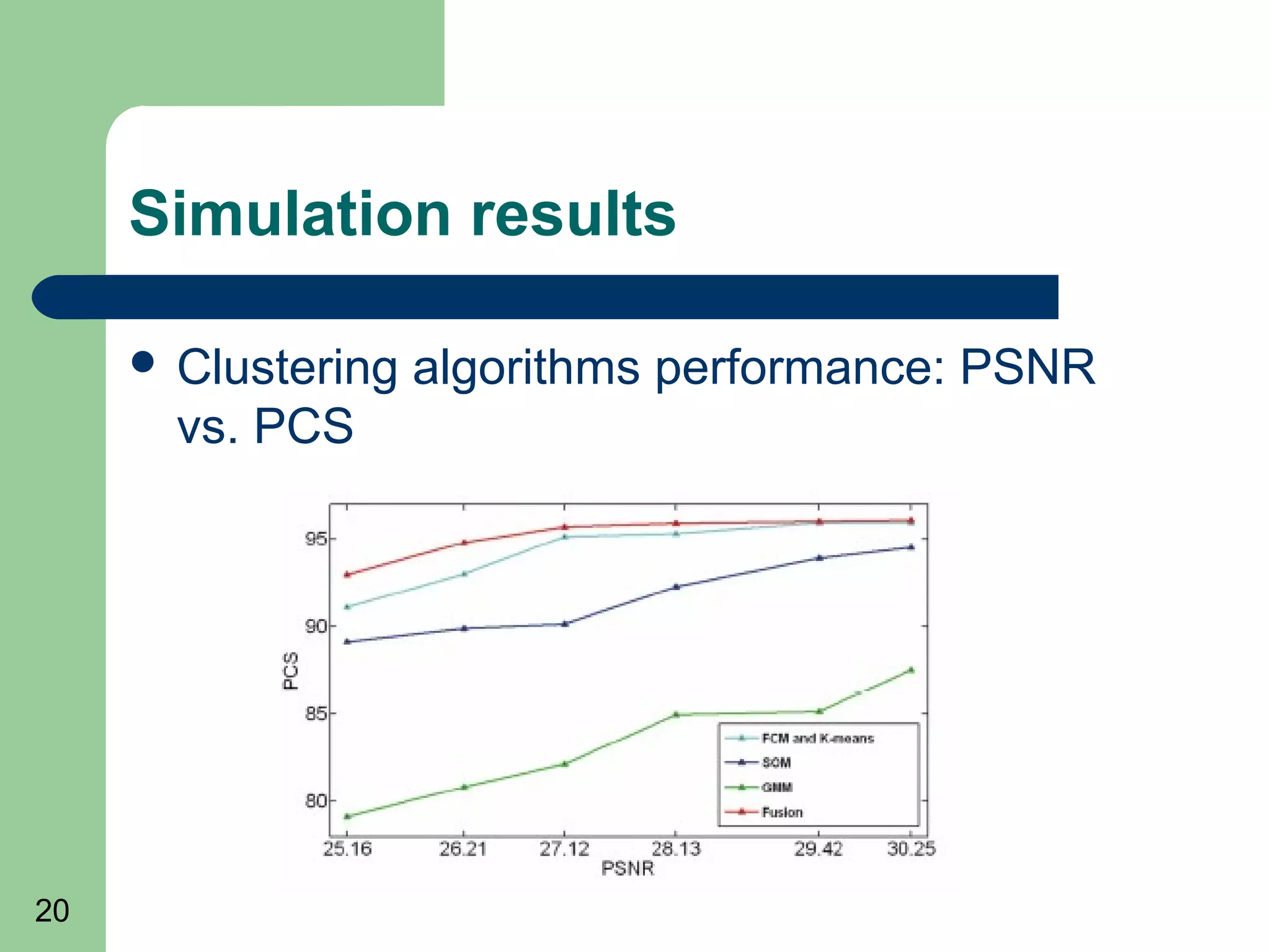
12 Clustering algorithms: fusion  Choosing a clustering method depends on the input data distribution. – Highly overlapped feature space  SOM – Moderately overlapped feature space  FCM and K-means – Feature space with suitable detachability  GMM  To incorporate these clustering algorithms, a fusion of them is used here.
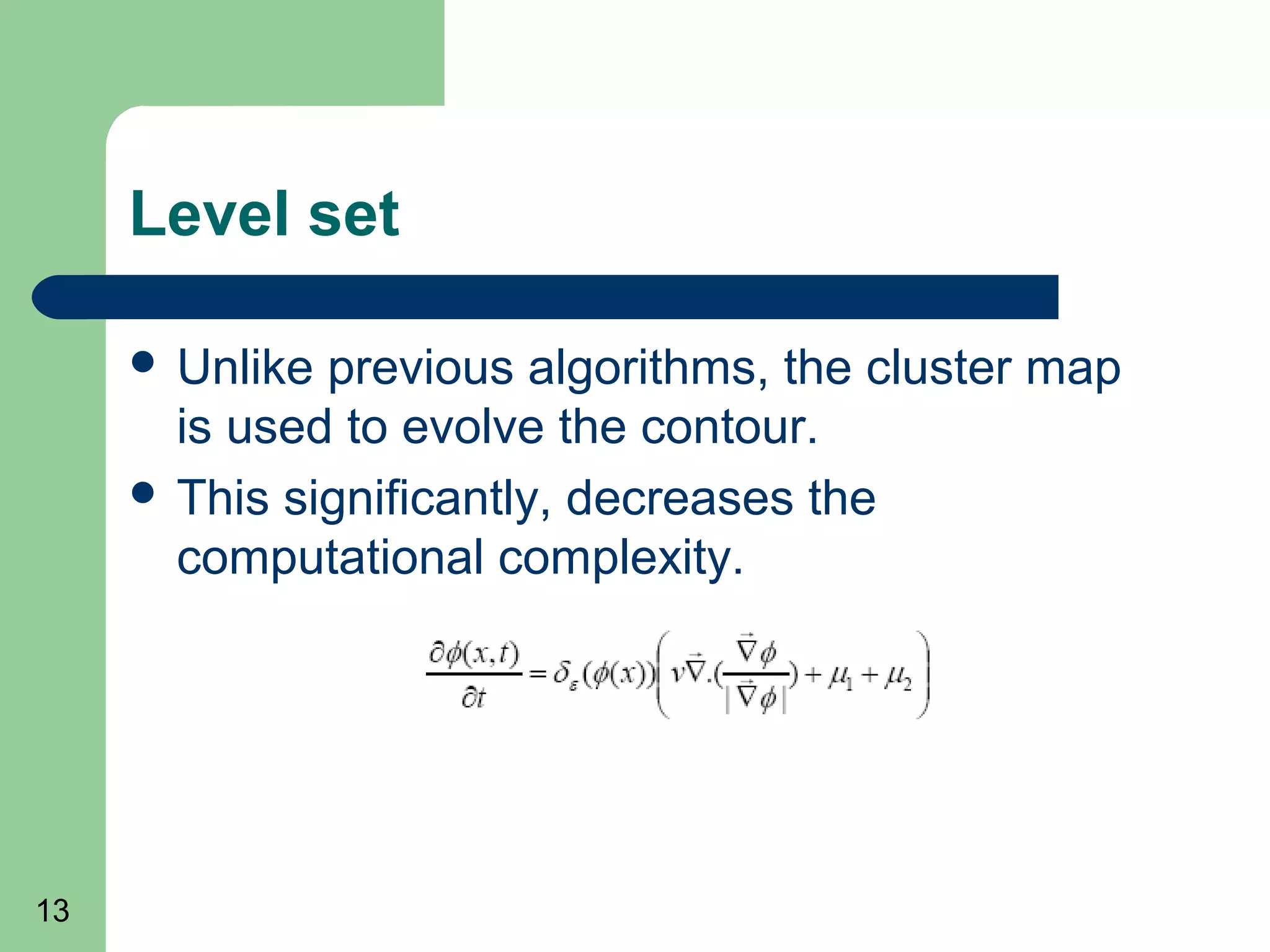
13 Level set  Unlike previous algorithms, the cluster map is used to evolve the contour.  This significantly, decreases the computational complexity.
14 Simulation results  Our algorithm has been evaluated on an Intel Core 2 Due CPU (T7250).  59 images from Corel texture dataset has been used.  The average values for :  120 and 80 epochs for training the first and the second SOM stages, respectively. 1543.0,2462.0,3176.0,2819.0 4321 ==== αααα iα
15 Simulation results  The input image and the ground truth  Color transformation result  Non-linear diffusion result
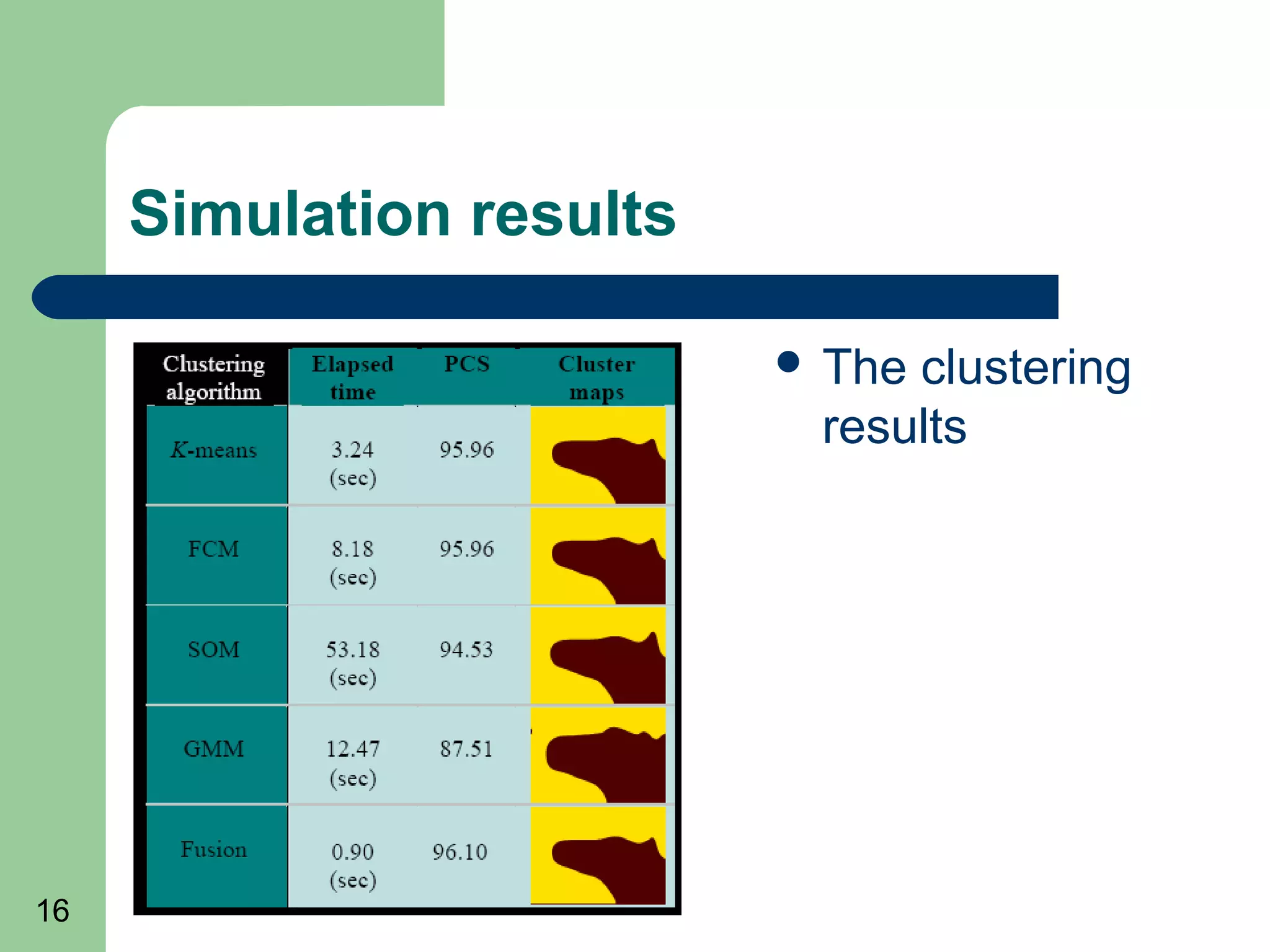
16 Simulation results  The clustering results
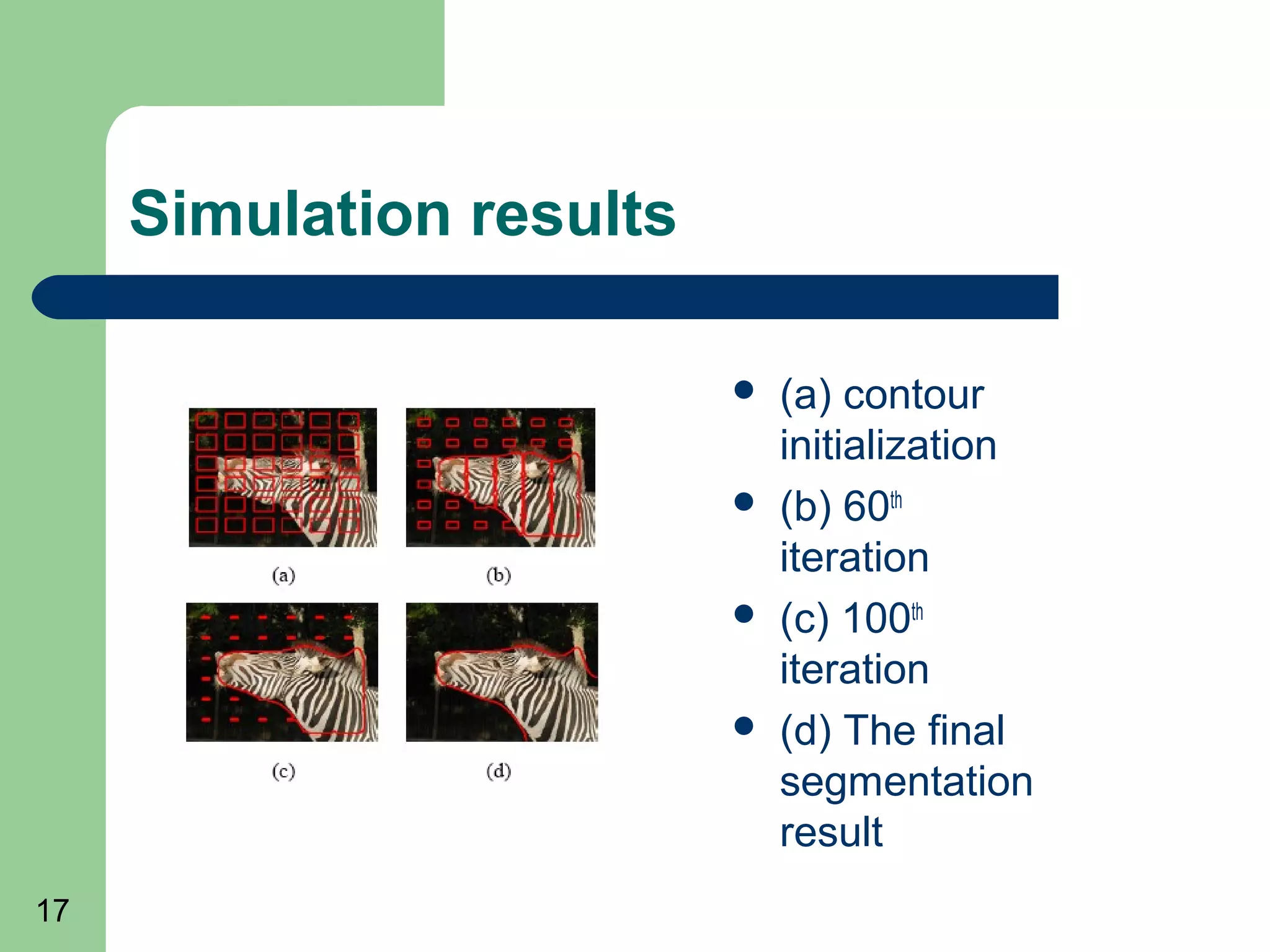
17 Simulation results  (a) contour initialization  (b) 60th iteration  (c) 100th iteration  (d) The final segmentation result
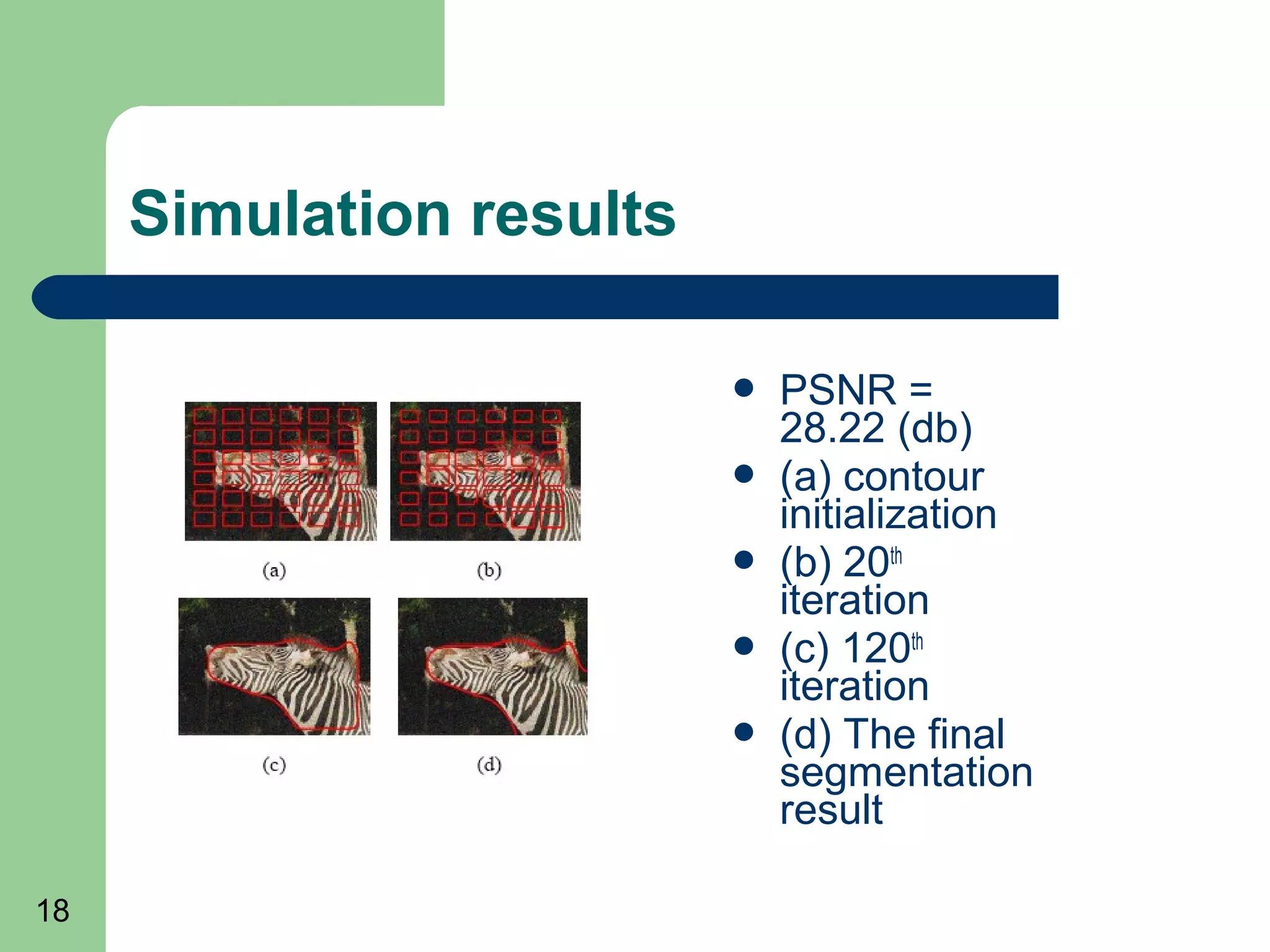
18 Simulation results  PSNR = 28.22 (db)  (a) contour initialization  (b) 20th iteration  (c) 120th iteration  (d) The final segmentation result
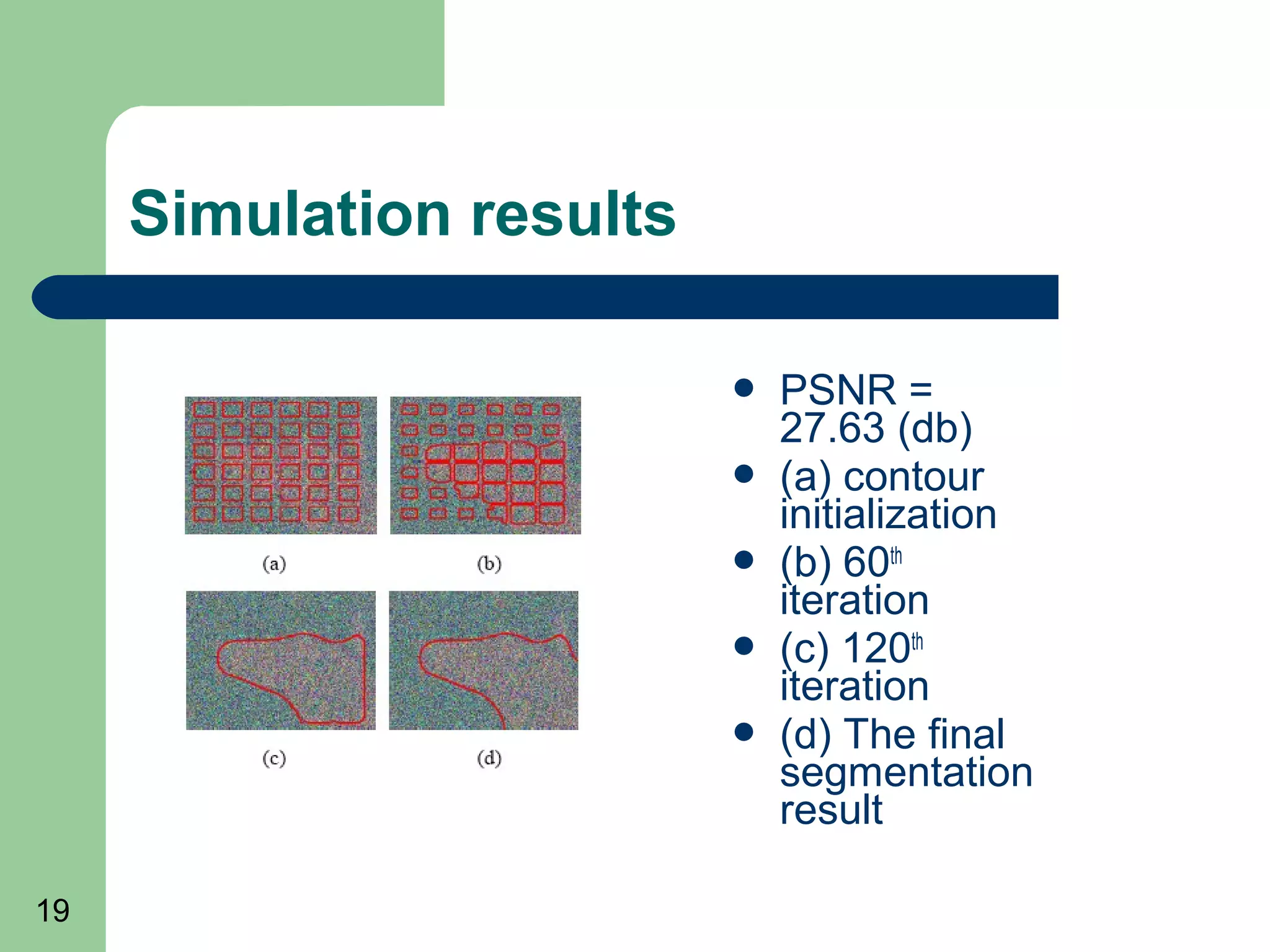
19 Simulation results  PSNR = 27.63 (db)  (a) contour initialization  (b) 60th iteration  (c) 120th iteration  (d) The final segmentation result
20 Simulation results  Clustering algorithms performance: PSNR vs. PCS
21 Simulation results  Comparison between our algorithm and traditional level set methods proposed in [1 and 2]
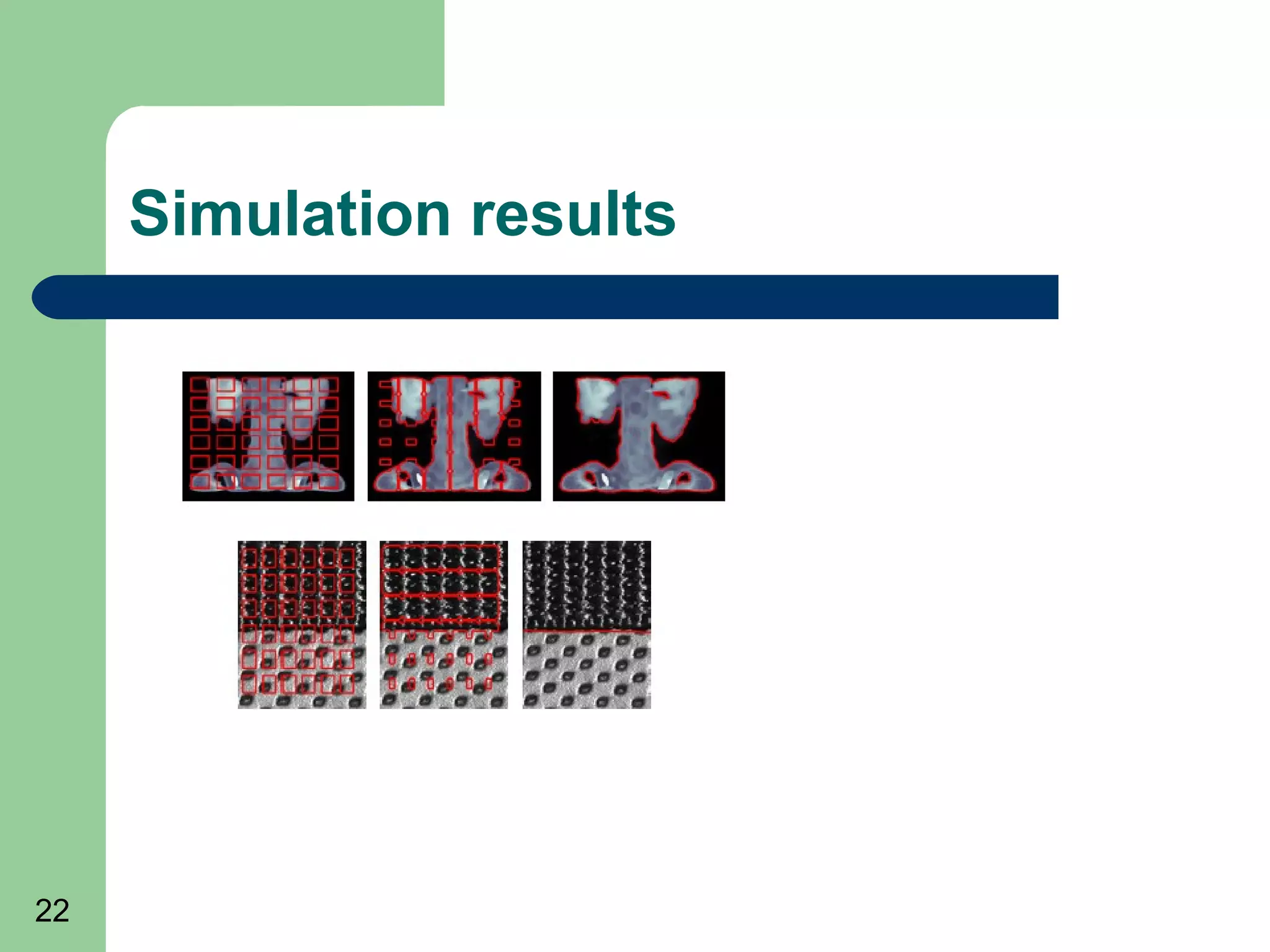
22 Simulation results
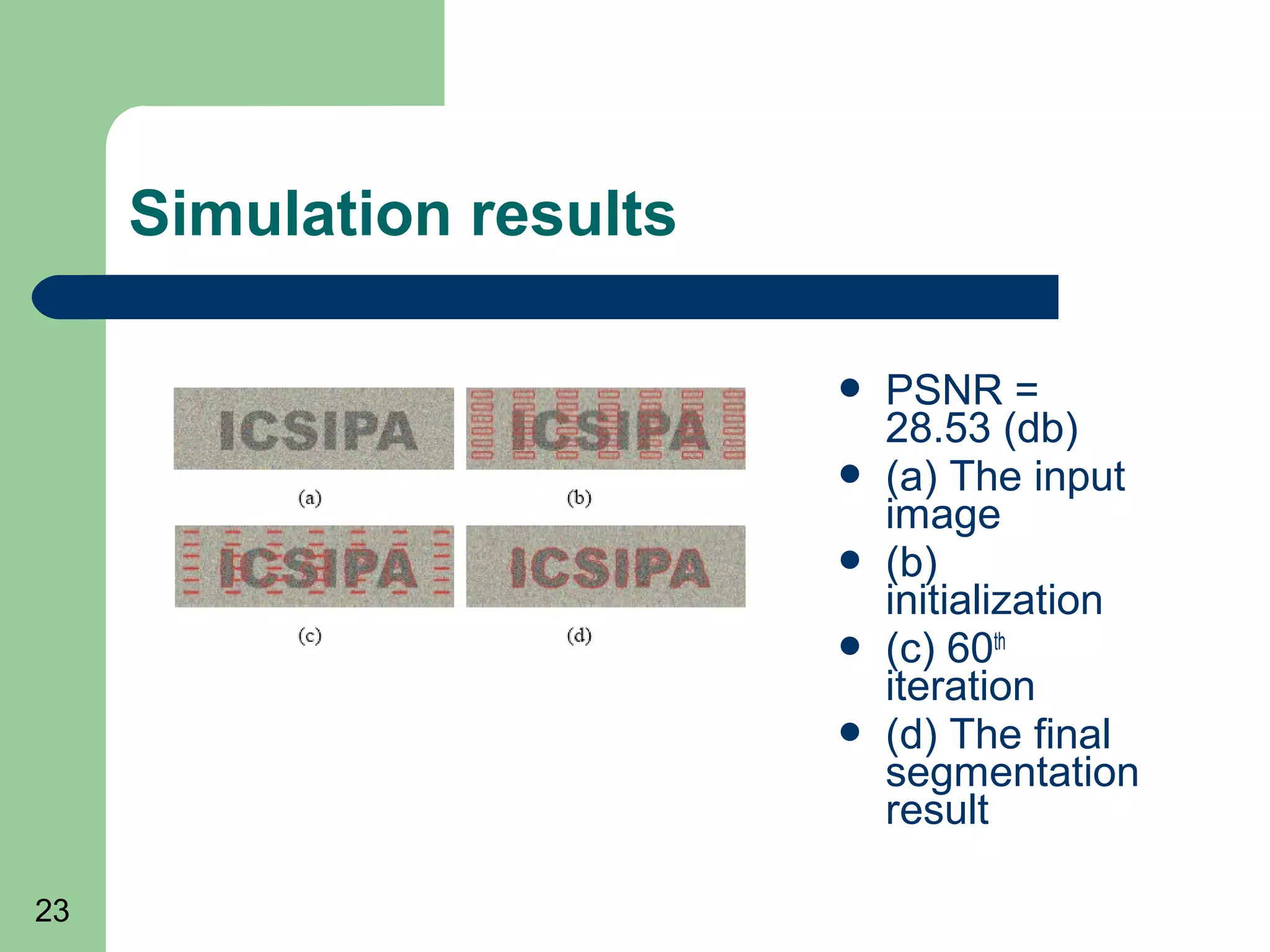
23 Simulation results  PSNR = 28.53 (db)  (a) The input image  (b) initialization  (c) 60th iteration  (d) The final segmentation result
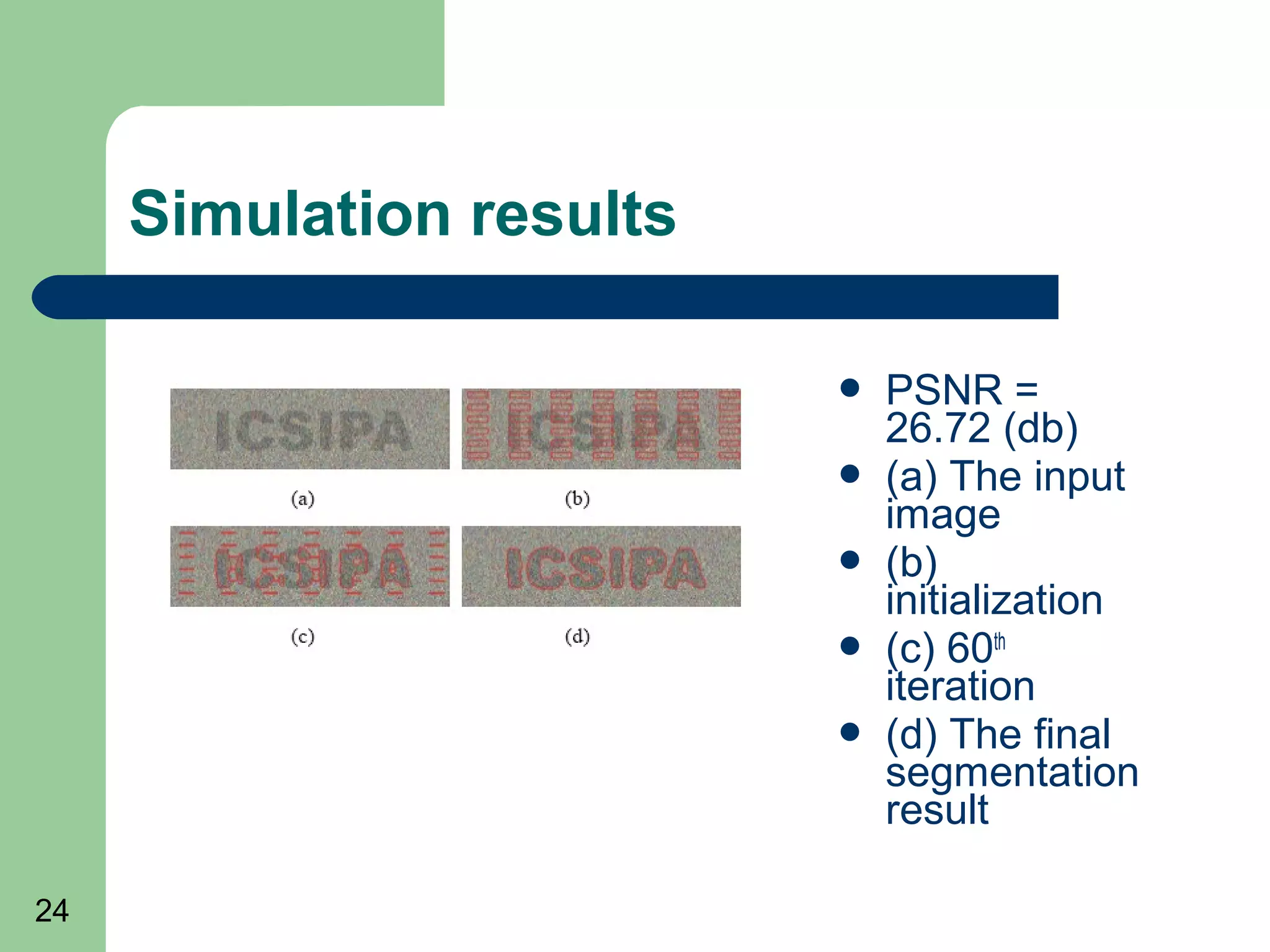
24 Simulation results  PSNR = 26.72 (db)  (a) The input image  (b) initialization  (c) 60th iteration  (d) The final segmentation result
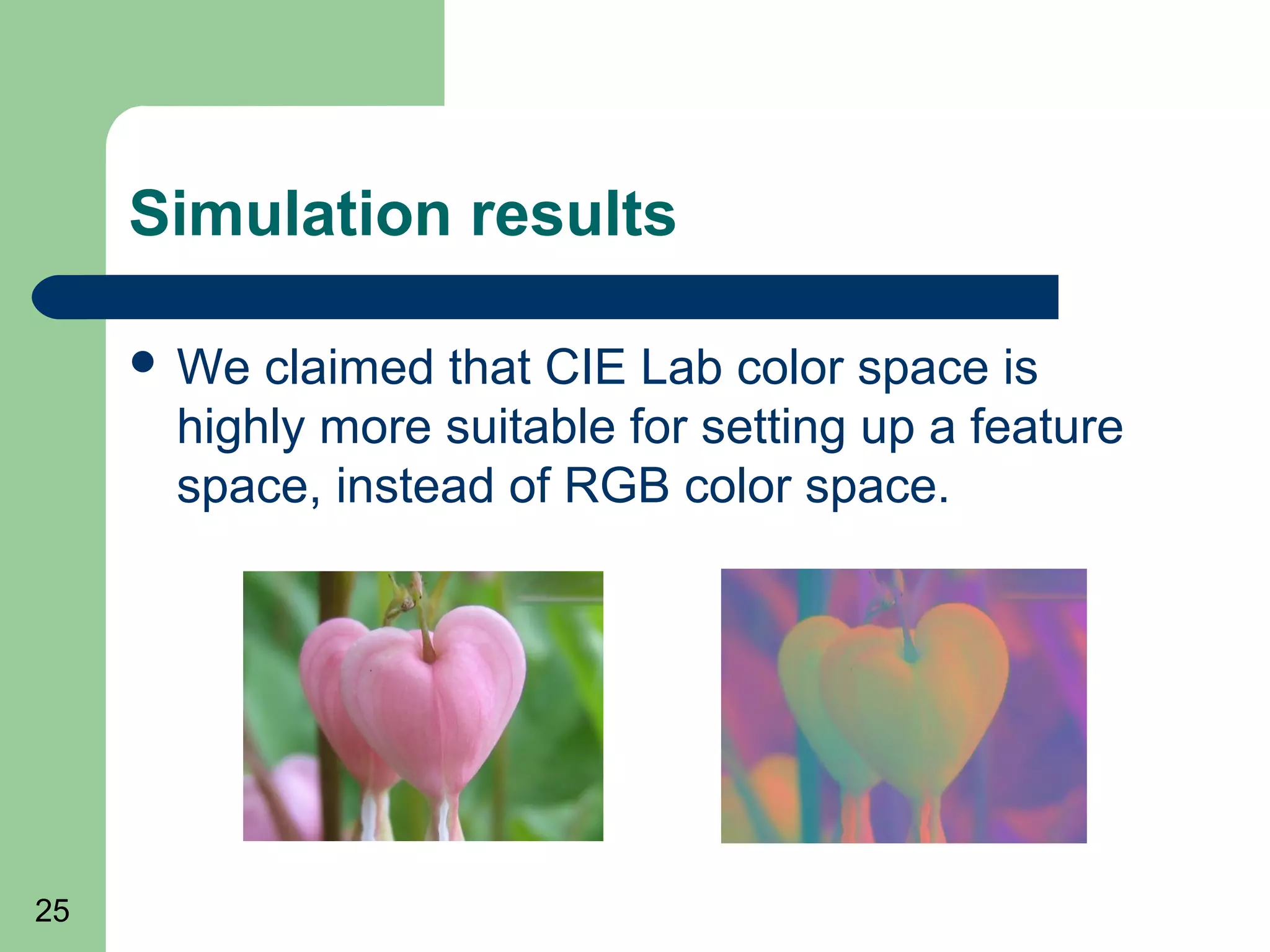
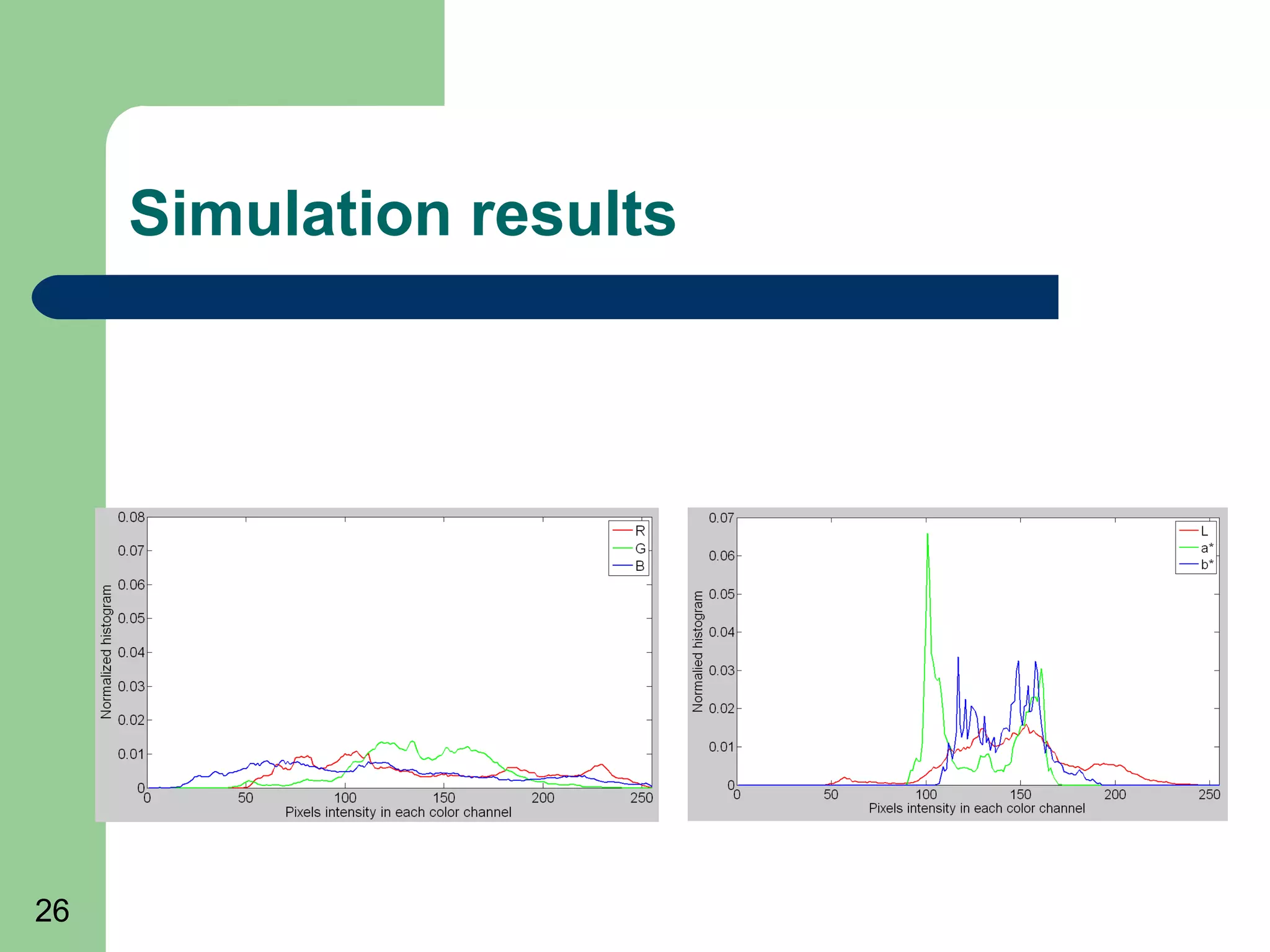
25 Simulation results  We claimed that CIE Lab color space is highly more suitable for setting up a feature space, instead of RGB color space.
26 Simulation results
27 Summary  In this paper, a fast level set based method has been proposed for image segmentation.  Our algorithm is robust against noise.  The proposed feature space has much less dimensionality compared to Gabor and structure tensors.  Unlike [1], image gradients have not been calculated, which decreases the effects of noise.  Using fusion, significantly increases the generalization of the clustering algorithms.
28 References [1] S. Daniel Cremers, M. Rousson, and R. Deriche, "A Review of Statistical Approaches to level sets Segmentation: Integrating Colour, Texture, Motion and Shape", 2007, International Journal of Computer Vision 72(2), 195–215 [2] M. Rousson, T. Brox, and R. Deriche, "Active Unsupervised Texture Segmentation on a Diffusion Based Feature Space", 2003, Proceedings of the 2003 IEEE Computer Society Conference on Computer Vision and Pattern Recognition (CVPR’03)
29 Thanks for your attention!

Locating texture boundaries using a fast unsupervised approach based on clustering algorithms fusion and level set

  • 1.
    1 Locating Texture BoundariesUsing a Fast Unsupervised Approach Based on Clustering Algorithms Fusion and Level Set Slides by: Mehryar Emambakhsh Sahand University of Technology
  • 2.
    2 Outline  About imagesegmentation and its methods  Feature extraction – Color transformation – Non-linear diffusion  Clustering algorithms – Fusion  Level set  Simulation results  Summary  References
  • 3.
    3 About image segmentationand its methods  Image segmentation is a procedure in which an image is partitioned into its constituting regions.  There must be a uniformity in some predefined features in each region: – Pixels intensity – Color components – Texture features – Motion vectors
  • 4.
    4 About image segmentationand its methods  There are many different approaches for image segmentation: 1) Clustering-based methods  feature space  clustering algorithms  Advantage: – Fast computational speed  Disadvantages: – Sensitivity to noise and outliers in the feature space – Over-segmentation
  • 5.
    5 About image segmentationand its methods 2) Energy minimization methods  feature space  energy function minimization  Advantages: – Reasonable results – Robust against noise  Disadvantages: – High computational complexity – Sensitive to local minima
  • 6.
    6 About image segmentationand its methods  Our proposed method:
  • 7.
    7 Feature extraction: color transformation Color transformation: – Non-linear color spaces generate a more separable feature space compared to linear color spaces. – Among non-linear color spaces, CIE L*a*b*, which is a uniform color space, produces a much detachable feature space compared to the non- uniform ones.
  • 8.
    8 Feature extraction: non-lineardiffusion  Non-linear diffusion is a method for image de-noising and simplification.  It is used for feature extraction from texture in our approach.  Non-linear diffusion equation is solved on the color image:  g(.) is a decreasing function of image gradient.  Non-linear diffusion has many superiority compared to other texture feature extraction methods: – Low dimensionality – Preserving image edges – Robust against noise
  • 9.
    9 Clustering algorithms  FuzzyC-means (FCM), K-means, SOM (Self- Organizing Map), and GMM (Gaussian Mixture Model) have been evaluated in our work.  FCM is a clustering technique wherein each data point belongs to a cluster to some degree that is specified by a membership degree.  However, K-means assigns each point to the cluster whose center (centroid) is nearest. – Euclidean distance is used in our work because of its better performance than city-block and Hamming distance criteria. – Also it is faster that Mahalanobis distance.
  • 10.
    10 Clustering algorithms  Theother clustering algorithm that we have utilized is SOM neural network.  It is an unsupervised competitive neural network.  The structure of the neural network is as follows:
  • 11.
    11 Clustering algorithms  Finally,GMM is our last clustering algorithm.  In GMM, each mass of features is modeled as multivariate normal density function.  These models are fit to data using expectation maximization algorithm, which assign a posteriori probability to each observation.  The dependency of each pixel to a specific cluster is determined by examining the value of the probability.
  • 12.
    12 Clustering algorithms: fusion Choosing a clustering method depends on the input data distribution. – Highly overlapped feature space  SOM – Moderately overlapped feature space  FCM and K-means – Feature space with suitable detachability  GMM  To incorporate these clustering algorithms, a fusion of them is used here.
  • 13.
    13 Level set  Unlikeprevious algorithms, the cluster map is used to evolve the contour.  This significantly, decreases the computational complexity.
  • 14.
    14 Simulation results  Ouralgorithm has been evaluated on an Intel Core 2 Due CPU (T7250).  59 images from Corel texture dataset has been used.  The average values for :  120 and 80 epochs for training the first and the second SOM stages, respectively. 1543.0,2462.0,3176.0,2819.0 4321 ==== αααα iα
  • 15.
    15 Simulation results  Theinput image and the ground truth  Color transformation result  Non-linear diffusion result
  • 16.
  • 17.
    17 Simulation results  (a)contour initialization  (b) 60th iteration  (c) 100th iteration  (d) The final segmentation result
  • 18.
    18 Simulation results  PSNR= 28.22 (db)  (a) contour initialization  (b) 20th iteration  (c) 120th iteration  (d) The final segmentation result
  • 19.
    19 Simulation results  PSNR= 27.63 (db)  (a) contour initialization  (b) 60th iteration  (c) 120th iteration  (d) The final segmentation result
  • 20.
    20 Simulation results  Clusteringalgorithms performance: PSNR vs. PCS
  • 21.
    21 Simulation results  Comparisonbetween our algorithm and traditional level set methods proposed in [1 and 2]
  • 22.
  • 23.
    23 Simulation results  PSNR= 28.53 (db)  (a) The input image  (b) initialization  (c) 60th iteration  (d) The final segmentation result
  • 24.
    24 Simulation results  PSNR= 26.72 (db)  (a) The input image  (b) initialization  (c) 60th iteration  (d) The final segmentation result
  • 25.
    25 Simulation results  Weclaimed that CIE Lab color space is highly more suitable for setting up a feature space, instead of RGB color space.
  • 26.
  • 27.
    27 Summary  In thispaper, a fast level set based method has been proposed for image segmentation.  Our algorithm is robust against noise.  The proposed feature space has much less dimensionality compared to Gabor and structure tensors.  Unlike [1], image gradients have not been calculated, which decreases the effects of noise.  Using fusion, significantly increases the generalization of the clustering algorithms.
  • 28.
    28 References [1] S. DanielCremers, M. Rousson, and R. Deriche, "A Review of Statistical Approaches to level sets Segmentation: Integrating Colour, Texture, Motion and Shape", 2007, International Journal of Computer Vision 72(2), 195–215 [2] M. Rousson, T. Brox, and R. Deriche, "Active Unsupervised Texture Segmentation on a Diffusion Based Feature Space", 2003, Proceedings of the 2003 IEEE Computer Society Conference on Computer Vision and Pattern Recognition (CVPR’03)
  • 29.