Migrating From Java EE To Cloud-Native Reactive Systems With Markus Eisele, Director of Developer Advocacy at Lightbend, Inc. WEBINAR | THURSDAY JUN 6TH, 9:00 AM PT / 12:00 ET / 16:00 GMT / 18:00 CET
@myfear
3
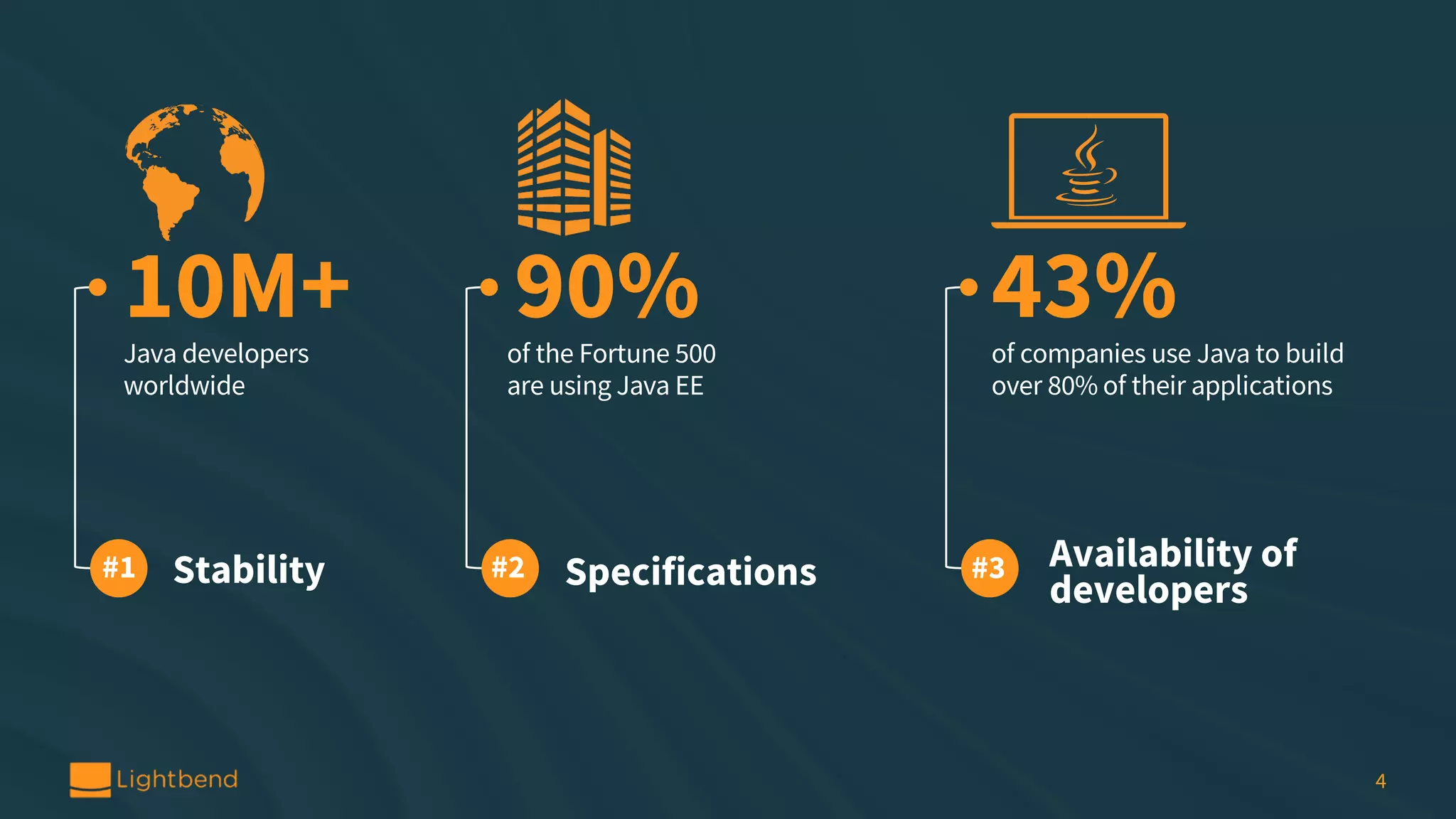
4 Java developers worldwide of the Fortune 500 are using Java EE of companies use Java to build over 80% of their applications 10M+ 90% 43% Stability Specifications Availability of developers #1 #2 #3
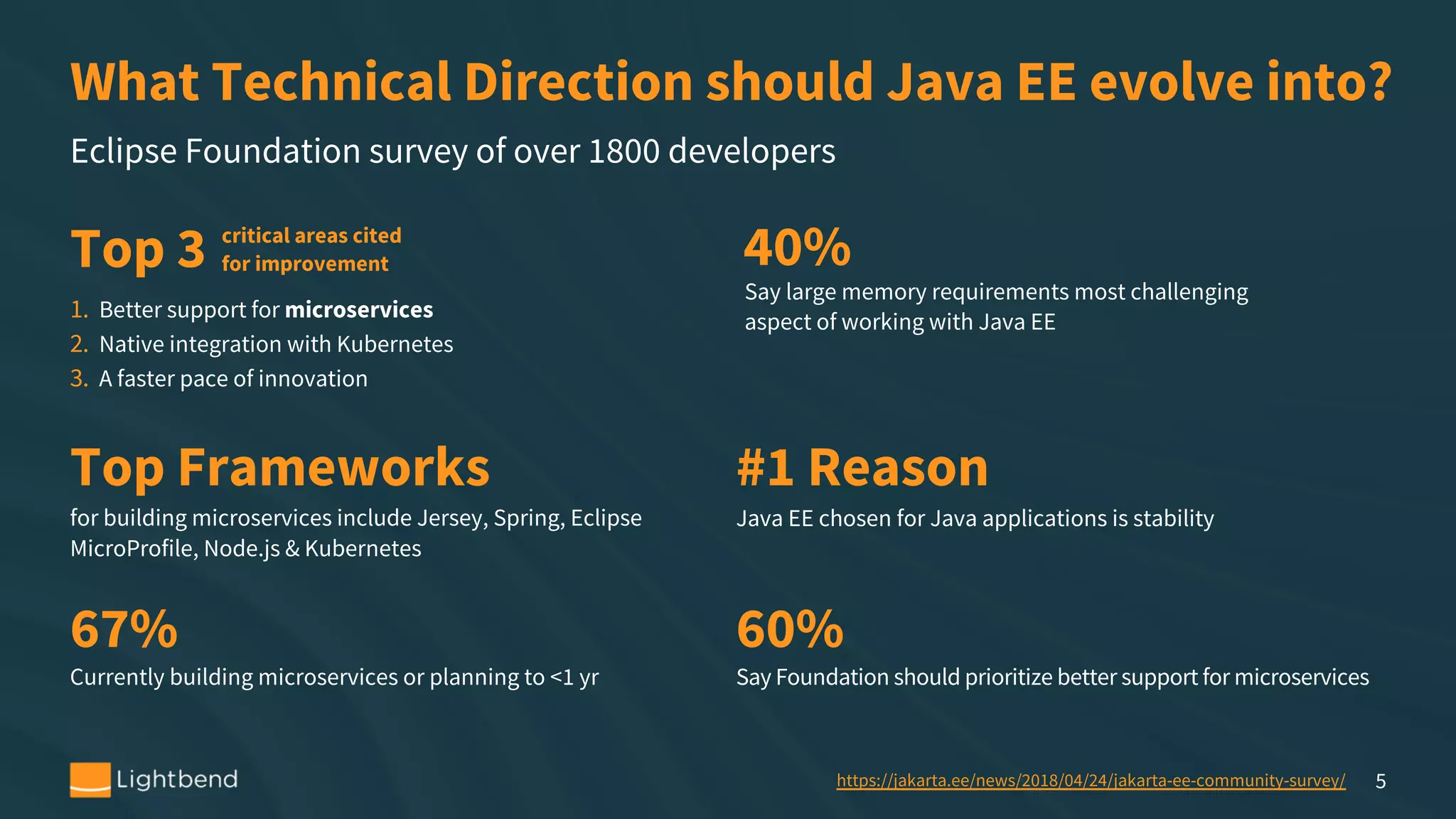
What Technical Direction should Java EE evolve into? Eclipse Foundation survey of over 1800 developers 5 Top 3 for building microservices include Jersey, Spring, Eclipse MicroProfile, Node.js & Kubernetes Currently building microservices or planning to <1 yr Say large memory requirements most challenging aspect of working with Java EE Java EE chosen for Java applications is stability Say Foundation should prioritize better support for microservices https://jakarta.ee/news/2018/04/24/jakarta-ee-community-survey/ 67% Top Frameworks 1. Better support for microservices 2. Native integration with Kubernetes 3. A faster pace of innovation 40% #1 Reason 60% critical areas cited for improvement
But are Java EE Applications Still Suitable Today?
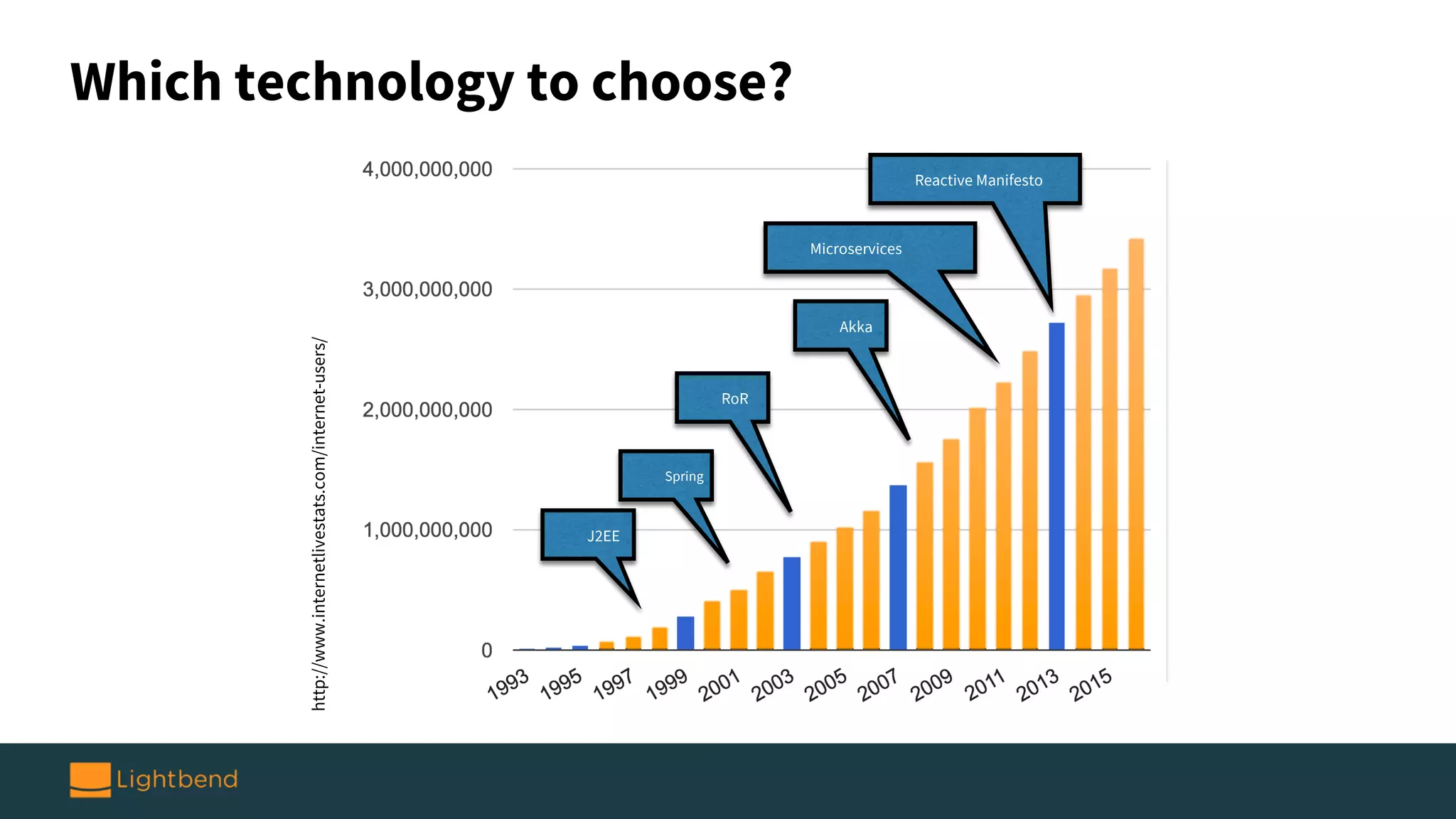
http://www.internetlivestats.com/internet-users/ J2EE Spring RoR Akka Reactive Manifesto Microservices Which technology to choose?
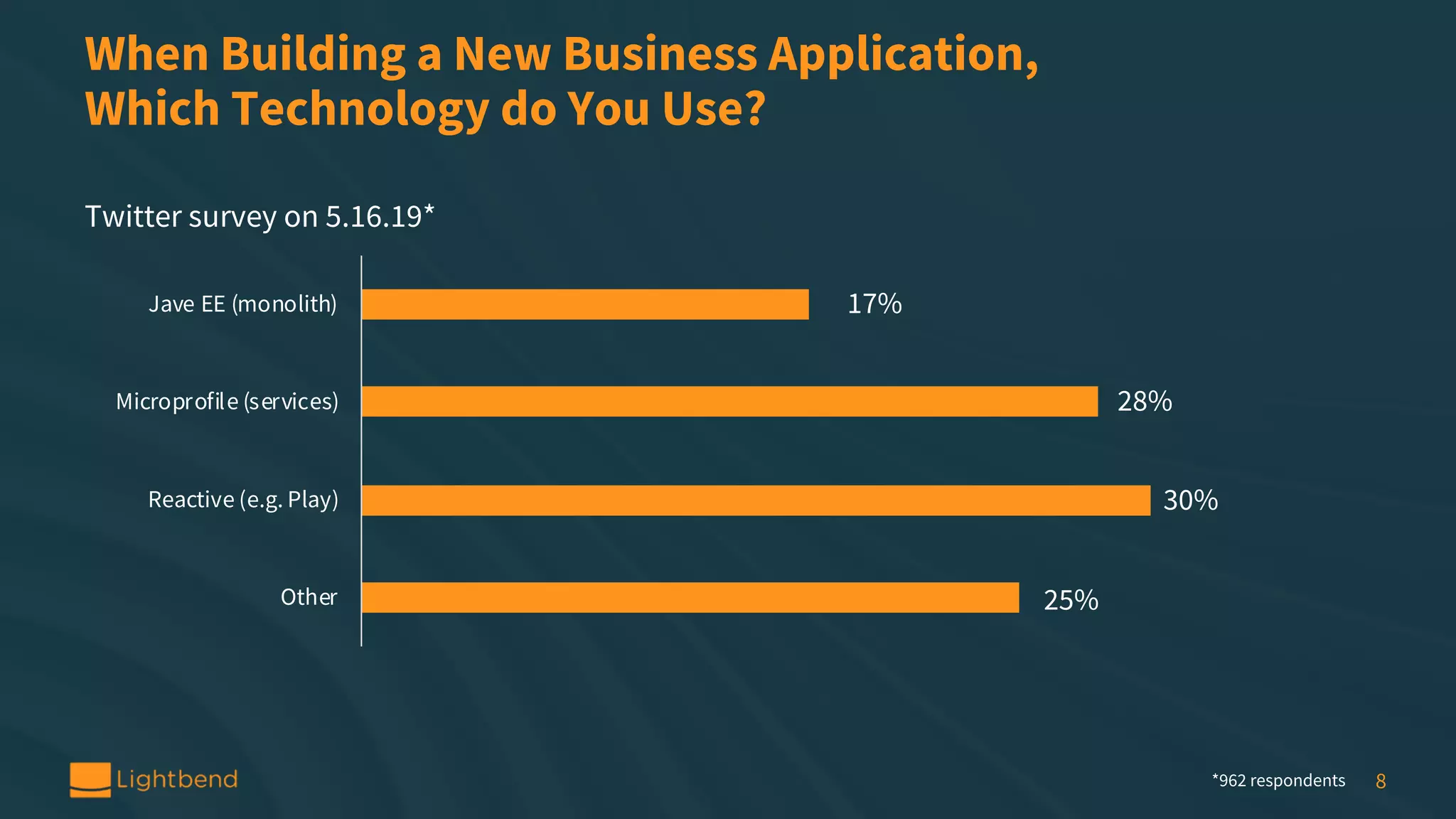
When Building a New Business Application, Which Technology do You Use? Twitter survey on 5.16.19* 8 Other Reactive (e.g. Play) Microprofile (services) Jave EE (monolith) 17% 28% 30% 25% *962 respondents
Cloud Native And The Future Of Java EE Complexity kills development velocity and only fosters infrequent releases • Development team agility is constantly blocked. • Big teams and heavy apps create long release cycles. • Complex code bases and fearful engineers lead to technical debt. Scaling monoliths is too expensive for the cloud • Monoliths are difficult and expensive to scale. • Monoliths lead to resource inefficiency. 9
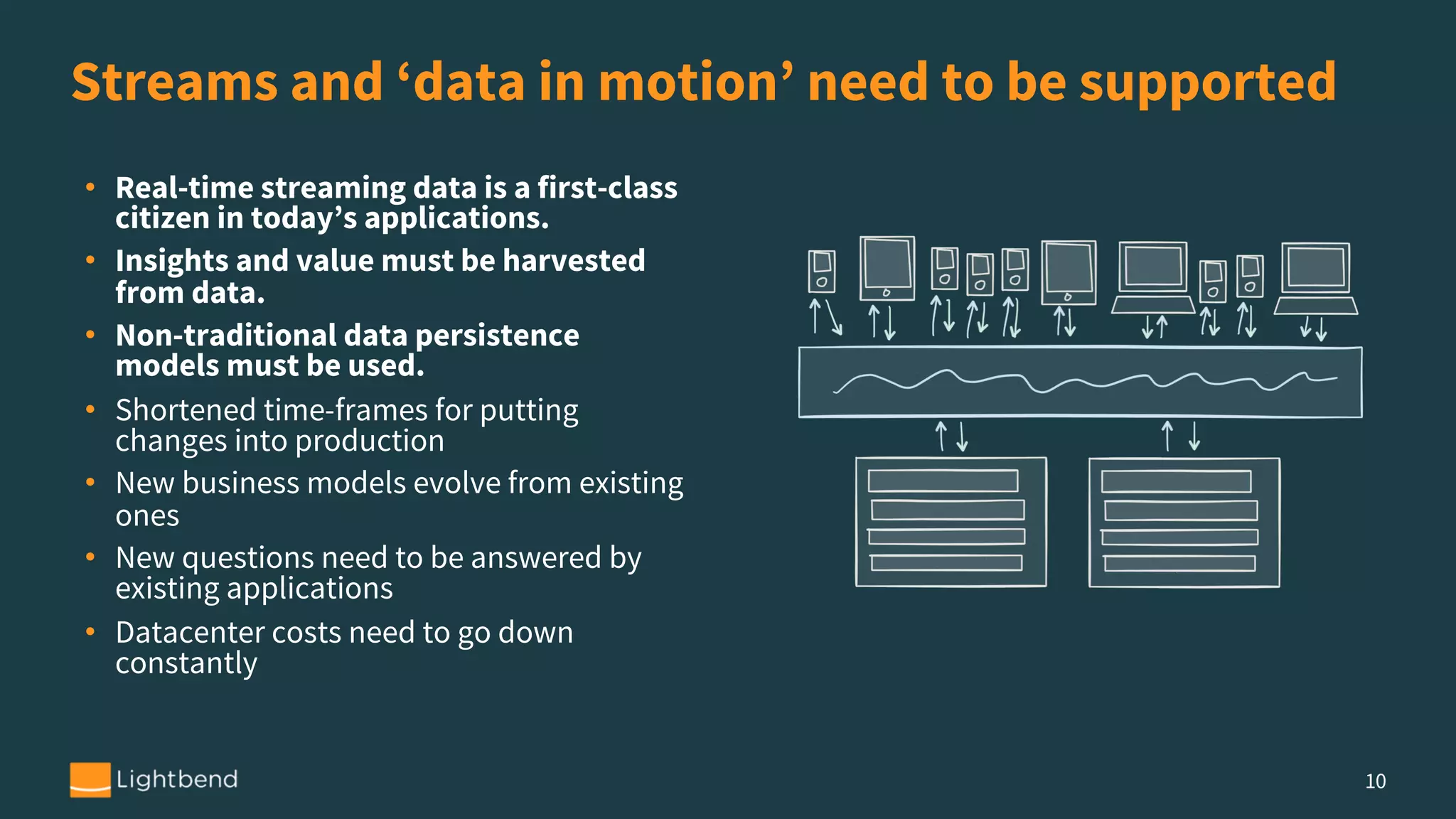
Streams and ‘data in motion’ need to be supported • Real-time streaming data is a first-class citizen in today’s applications. • Insights and value must be harvested from data. • Non-traditional data persistence models must be used. • Shortened time-frames for putting changes into production • New business models evolve from existing ones • New questions need to be answered by existing applications • Datacenter costs need to go down constantly 10
11 It’s increasingly obvious that the old, linear, three-tier architecture model is obsolete. - Gartner “
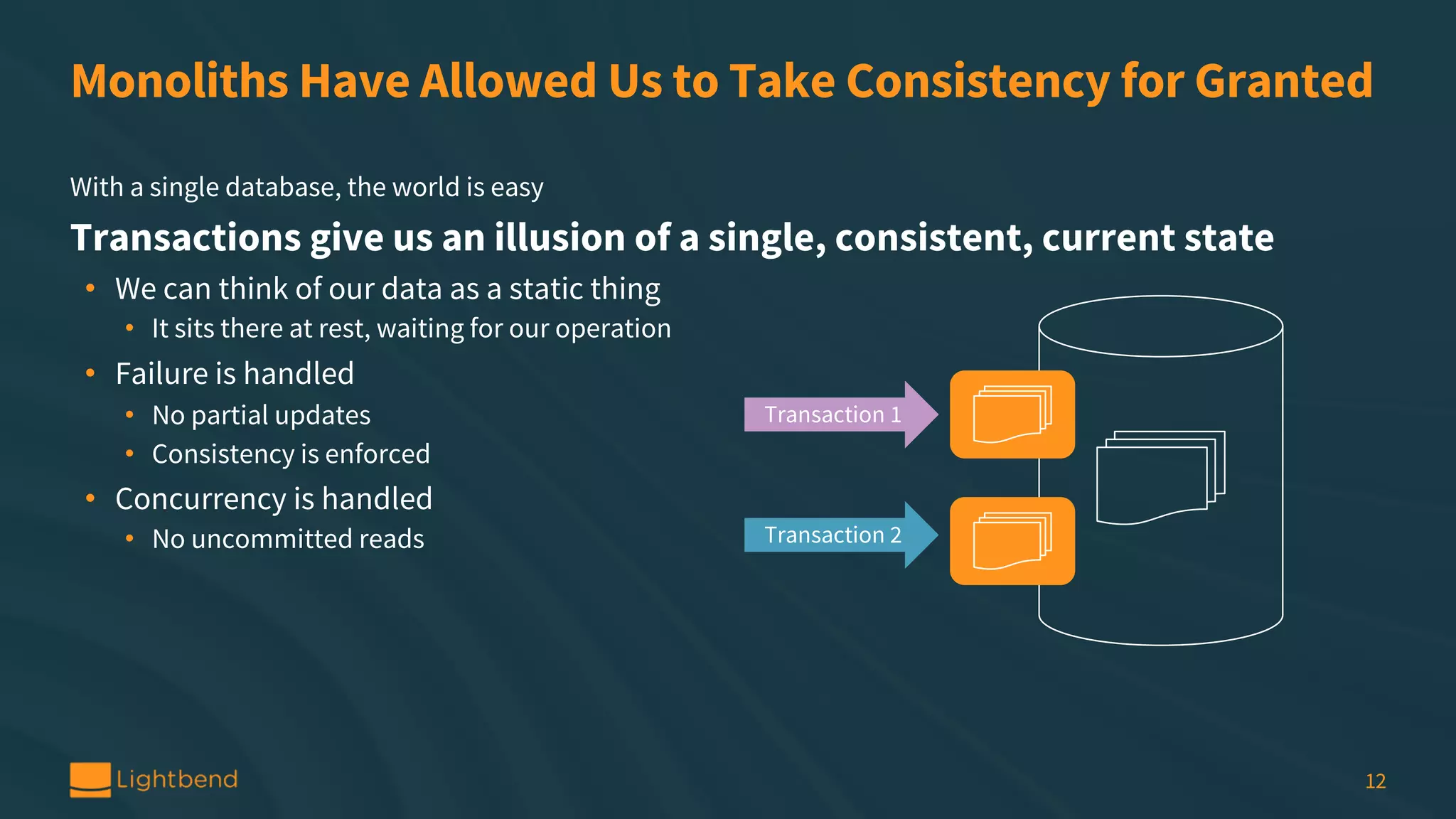
Monoliths Have Allowed Us to Take Consistency for Granted With a single database, the world is easy Transactions give us an illusion of a single, consistent, current state • We can think of our data as a static thing • It sits there at rest, waiting for our operation • Failure is handled • No partial updates • Consistency is enforced • Concurrency is handled • No uncommitted reads 12 Transaction 1 Transaction 2
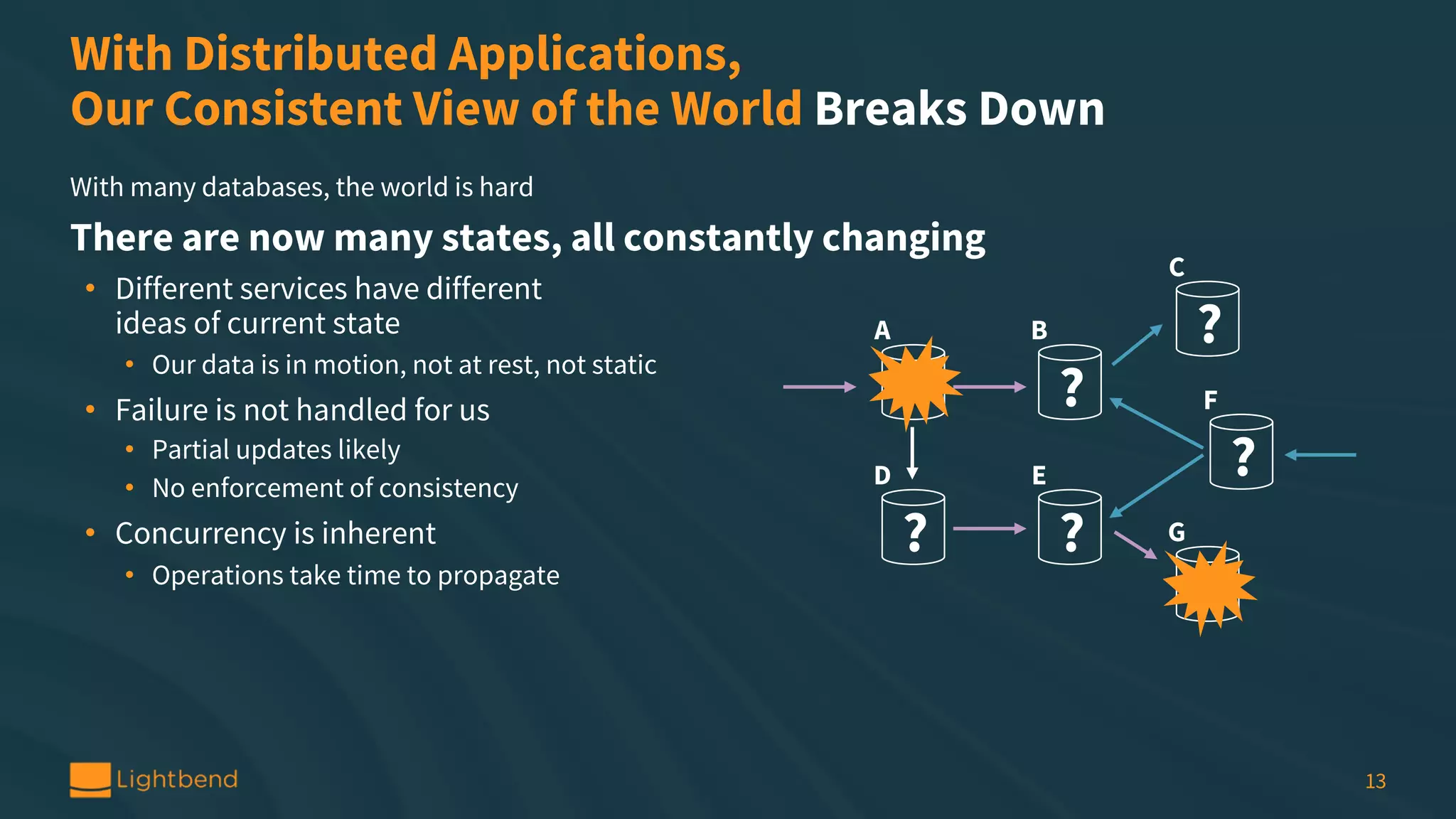
With Distributed Applications, Our Consistent View of the World Breaks Down With many databases, the world is hard There are now many states, all constantly changing • Different services have different ideas of current state • Our data is in motion, not at rest, not static • Failure is not handled for us • Partial updates likely • No enforcement of consistency • Concurrency is inherent • Operations take time to propagate 13 G ? C ? F ? B ? E ? A ? D ?
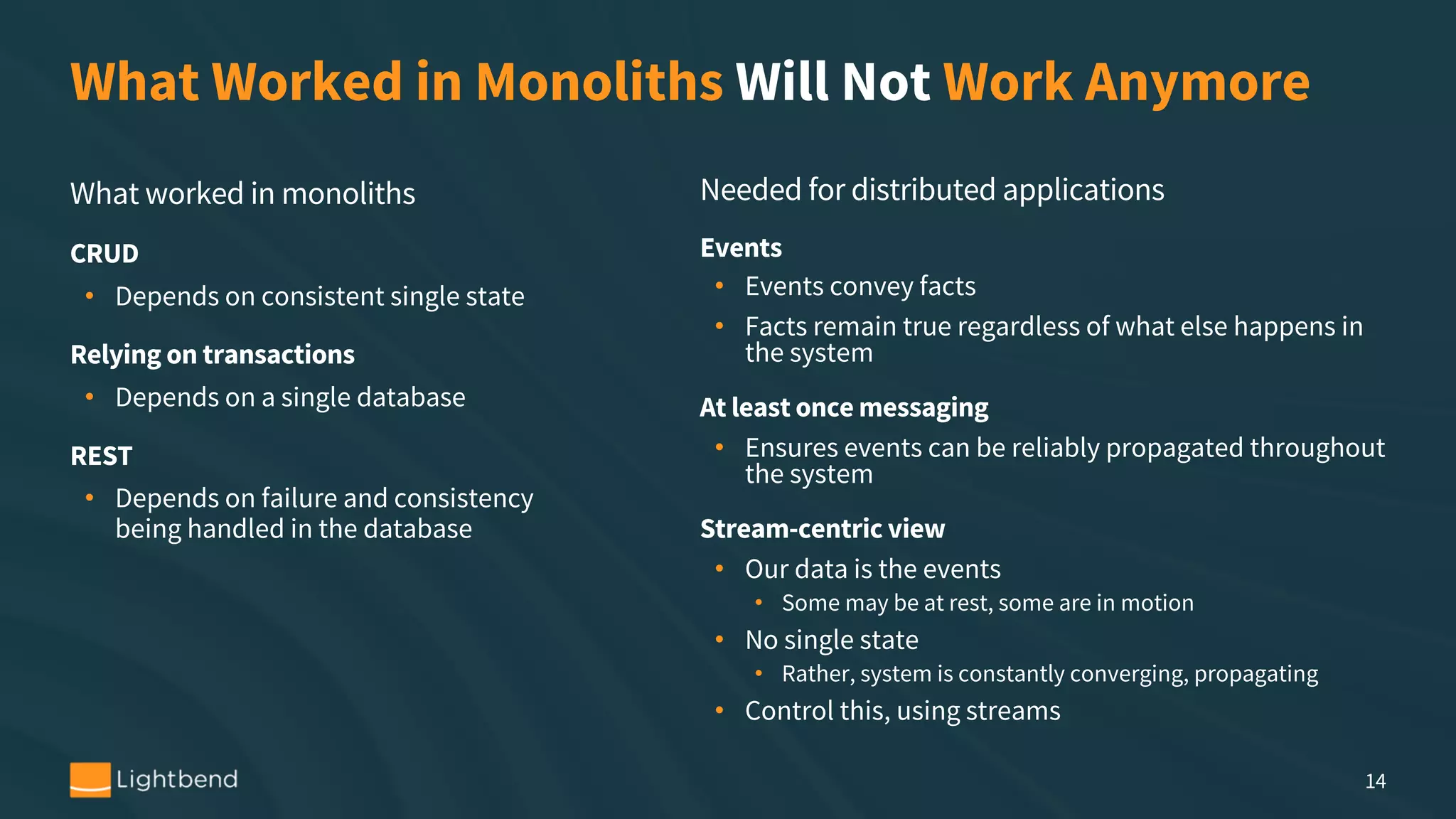
What worked in monoliths CRUD • Depends on consistent single state Relying on transactions • Depends on a single database REST • Depends on failure and consistency being handled in the database 14 Needed for distributed applications Events • Events convey facts • Facts remain true regardless of what else happens in the system At least once messaging • Ensures events can be reliably propagated throughout the system Stream-centric view • Our data is the events • Some may be at rest, some are in motion • No single state • Rather, system is constantly converging, propagating • Control this, using streams What Worked in Monoliths Will Not Work Anymore
The Shift Towards Real-Time Streaming Systems
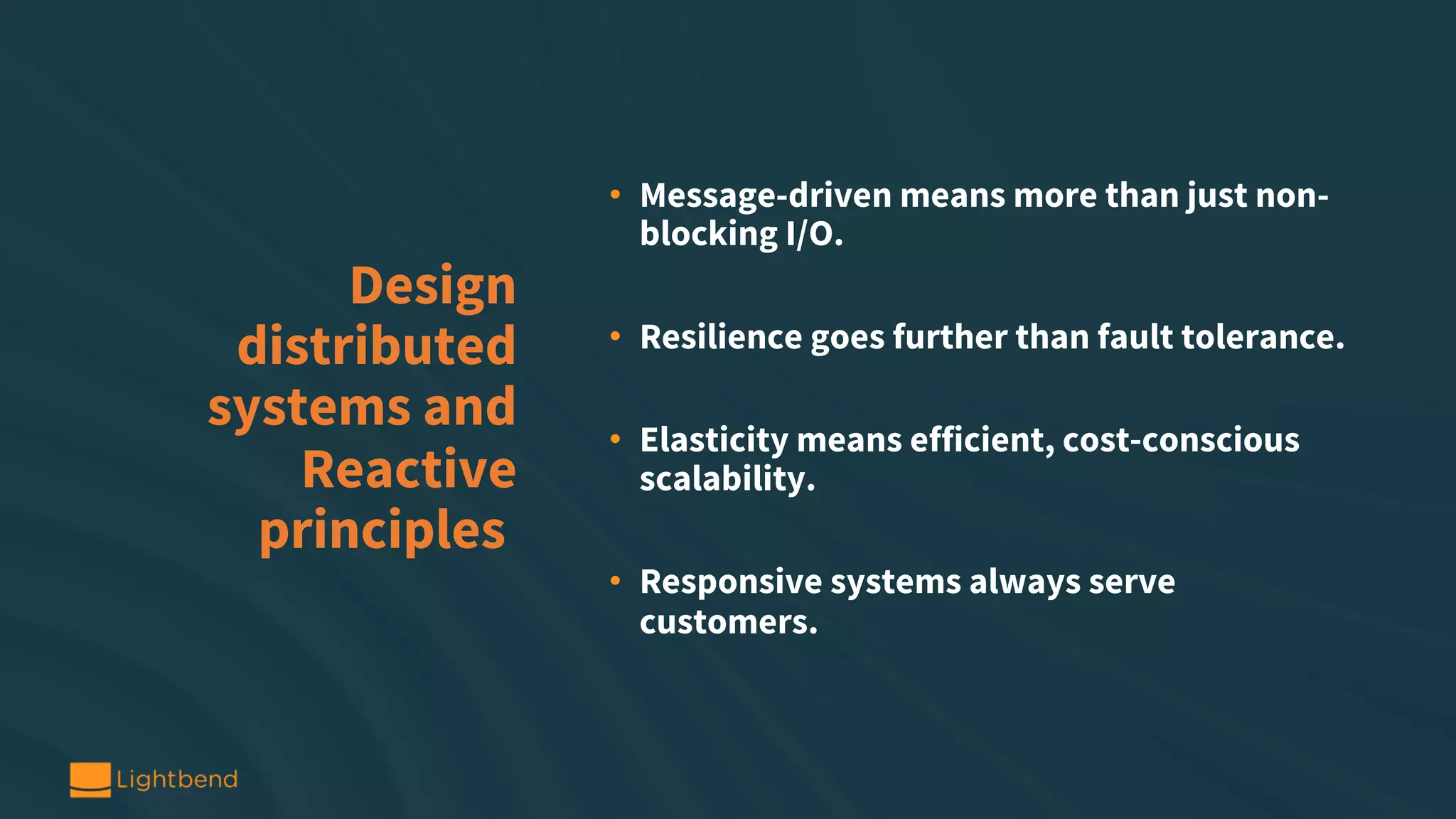
Design distributed systems and Reactive principles • Message-driven means more than just non- blocking I/O. • Resilience goes further than fault tolerance. • Elasticity means efficient, cost-conscious scalability. • Responsive systems always serve customers.
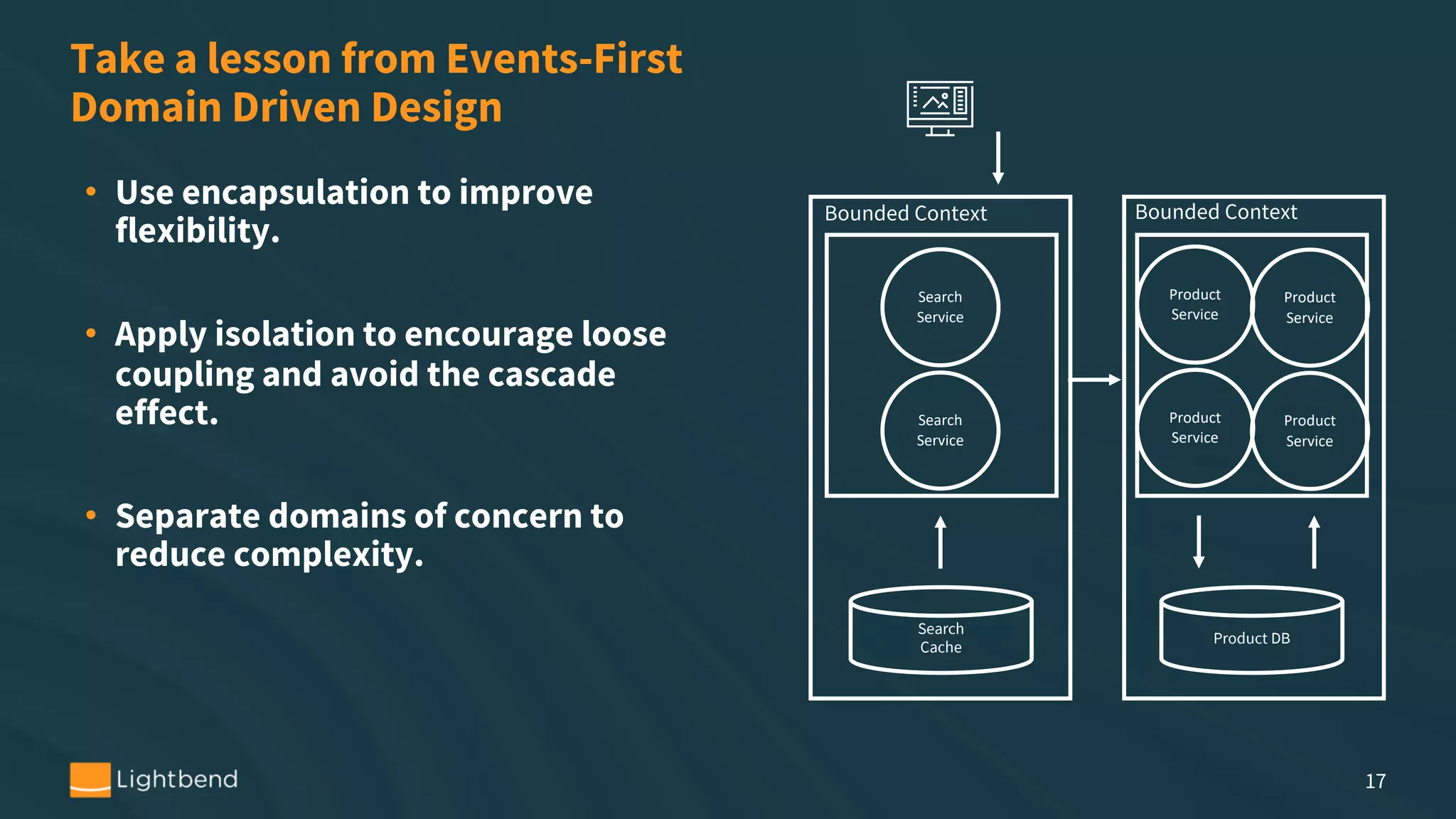
Take a lesson from Events-First Domain Driven Design • Use encapsulation to improve flexibility. • Apply isolation to encourage loose coupling and avoid the cascade effect. • Separate domains of concern to reduce complexity. 17 Bounded Context Bounded Context Search Service Search Service Product Service Product Service Product Service Product Service Search Cache Product DB
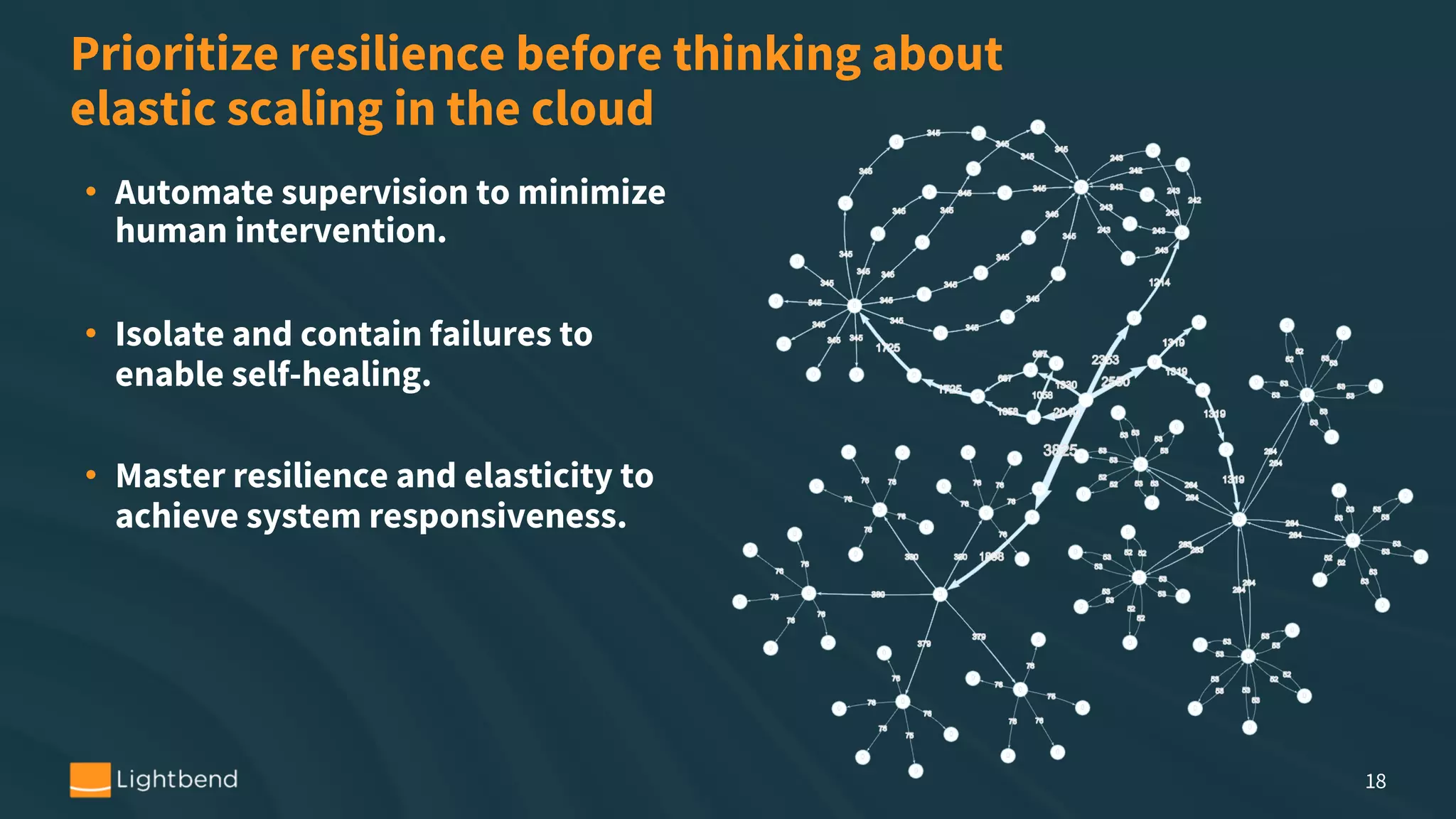
Prioritize resilience before thinking about elastic scaling in the cloud • Automate supervision to minimize human intervention. • Isolate and contain failures to enable self-healing. • Master resilience and elasticity to achieve system responsiveness. 18
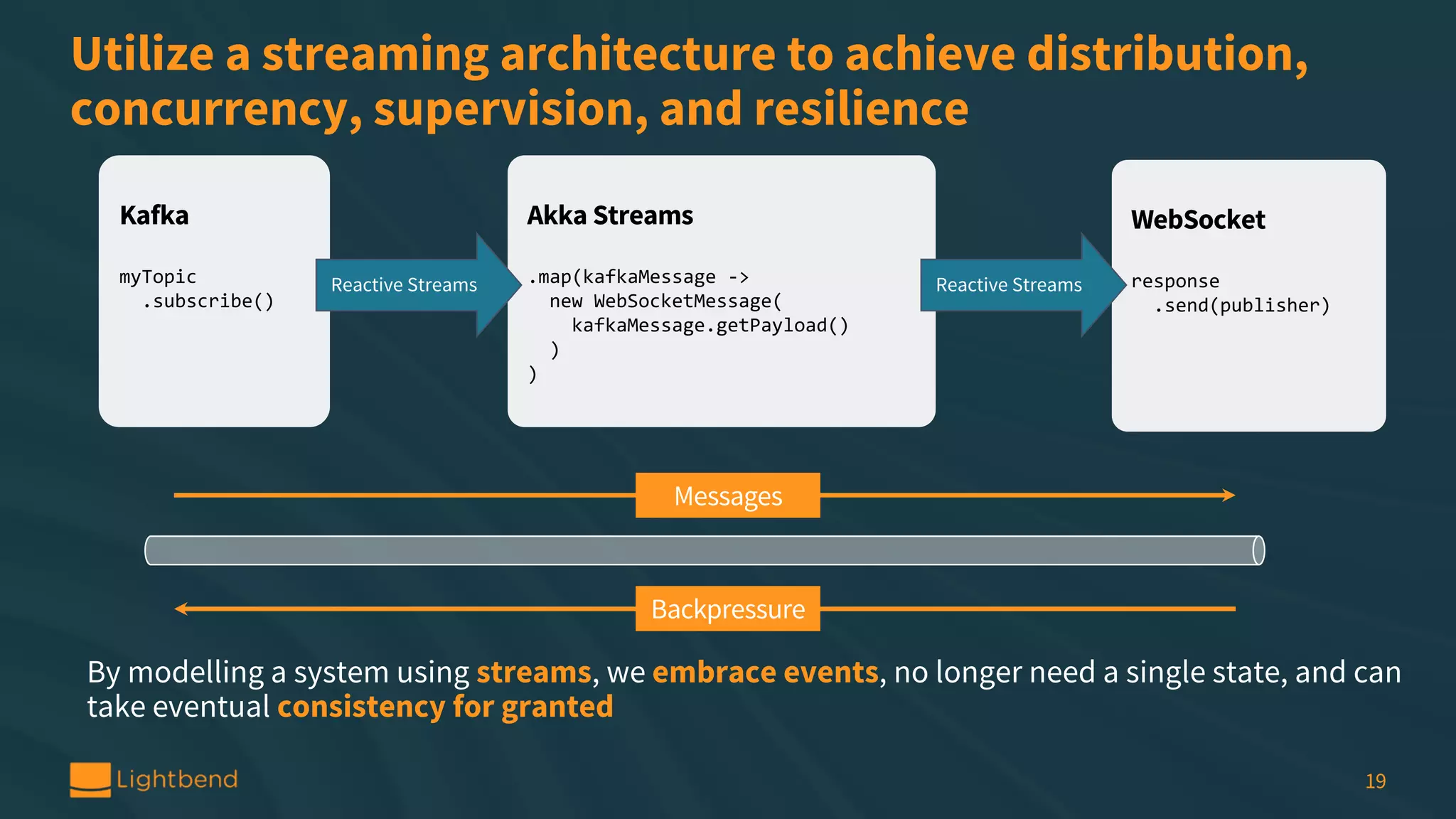
Utilize a streaming architecture to achieve distribution, concurrency, supervision, and resilience 19 Kafka myTopic .subscribe() Akka Streams .map(kafkaMessage -> new WebSocketMessage( kafkaMessage.getPayload() ) ) WebSocket response .send(publisher) Reactive Streams Backpressure Reactive Streams Messages By modelling a system using streams, we embrace events, no longer need a single state, and can take eventual consistency for granted
Distributed, Reactive Systems Unlock Higher Cloud ROI
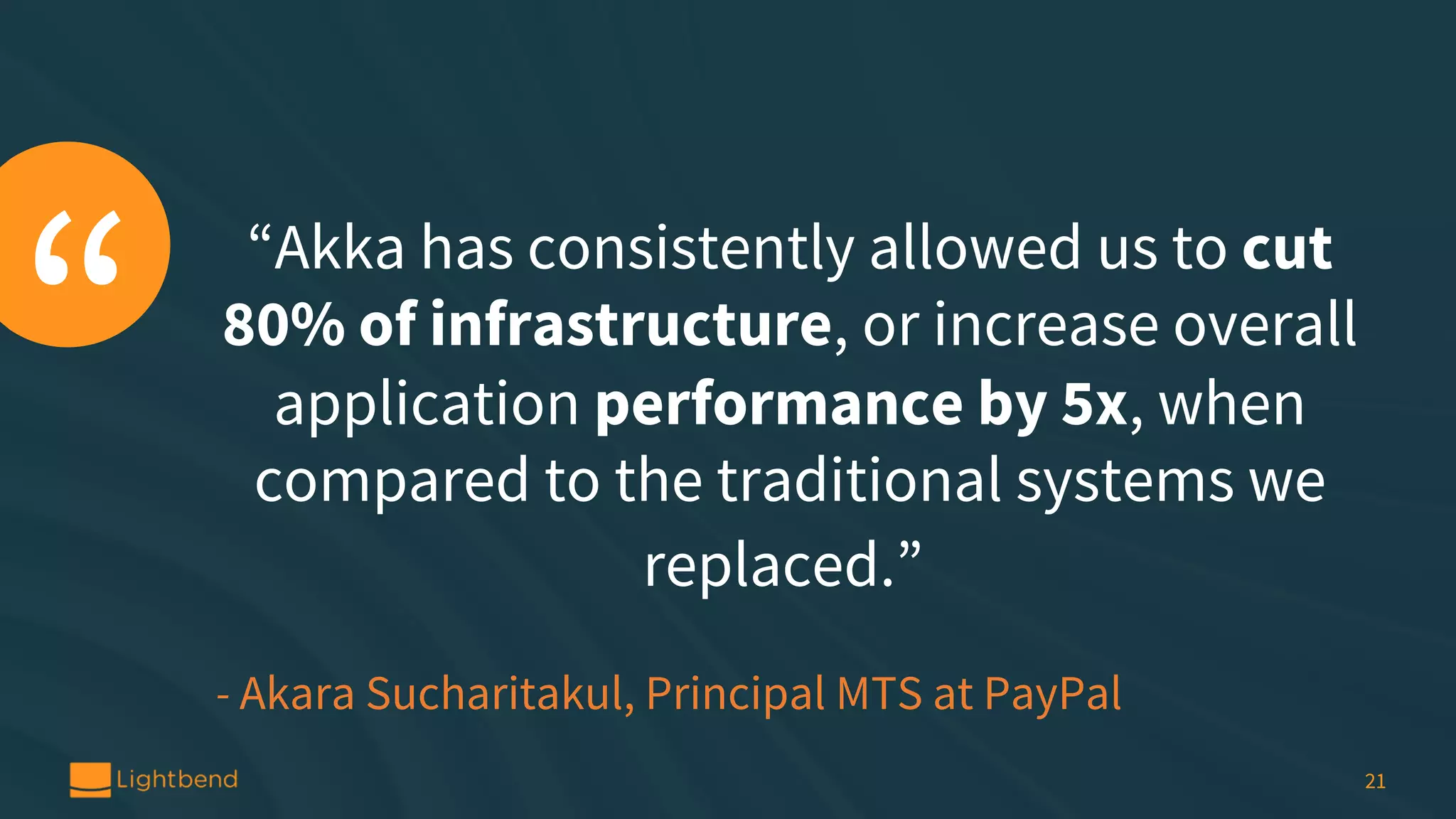
21 “Akka has consistently allowed us to cut 80% of infrastructure, or increase overall application performance by 5x, when compared to the traditional systems we replaced.” - Akara Sucharitakul, Principal MTS at PayPal “
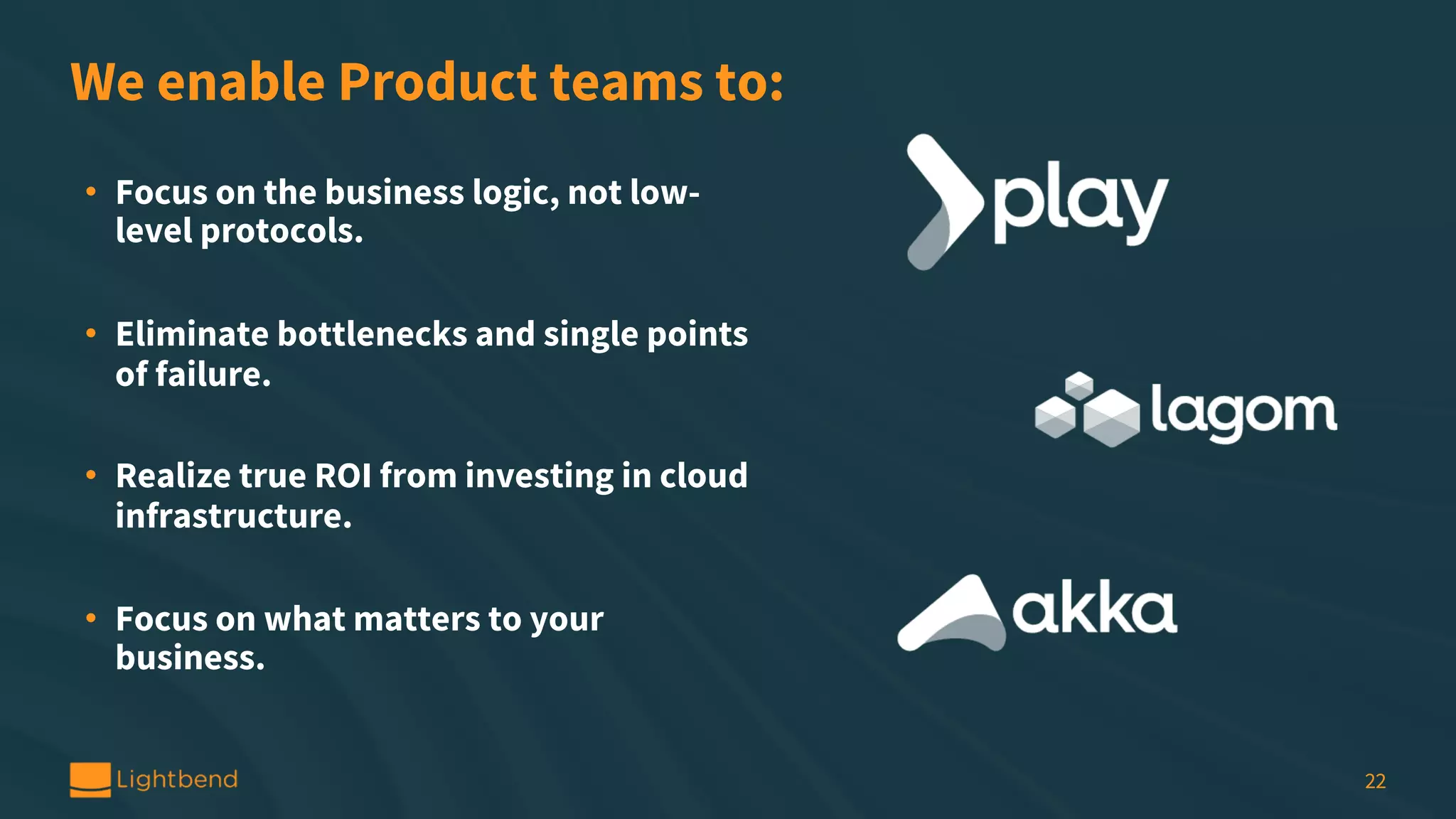
We enable Product teams to: • Focus on the business logic, not low- level protocols. • Eliminate bottlenecks and single points of failure. • Realize true ROI from investing in cloud infrastructure. • Focus on what matters to your business. 22
Instant Advantages with Lightbend
We enable Product teams to: • Enhancing customer engagement with data-driven insights • Unleashing innovation to protect or capture markets • Improving agility and time to value • Reducing compute costs while scaling elastically • Increasing developer happiness and productivity 24
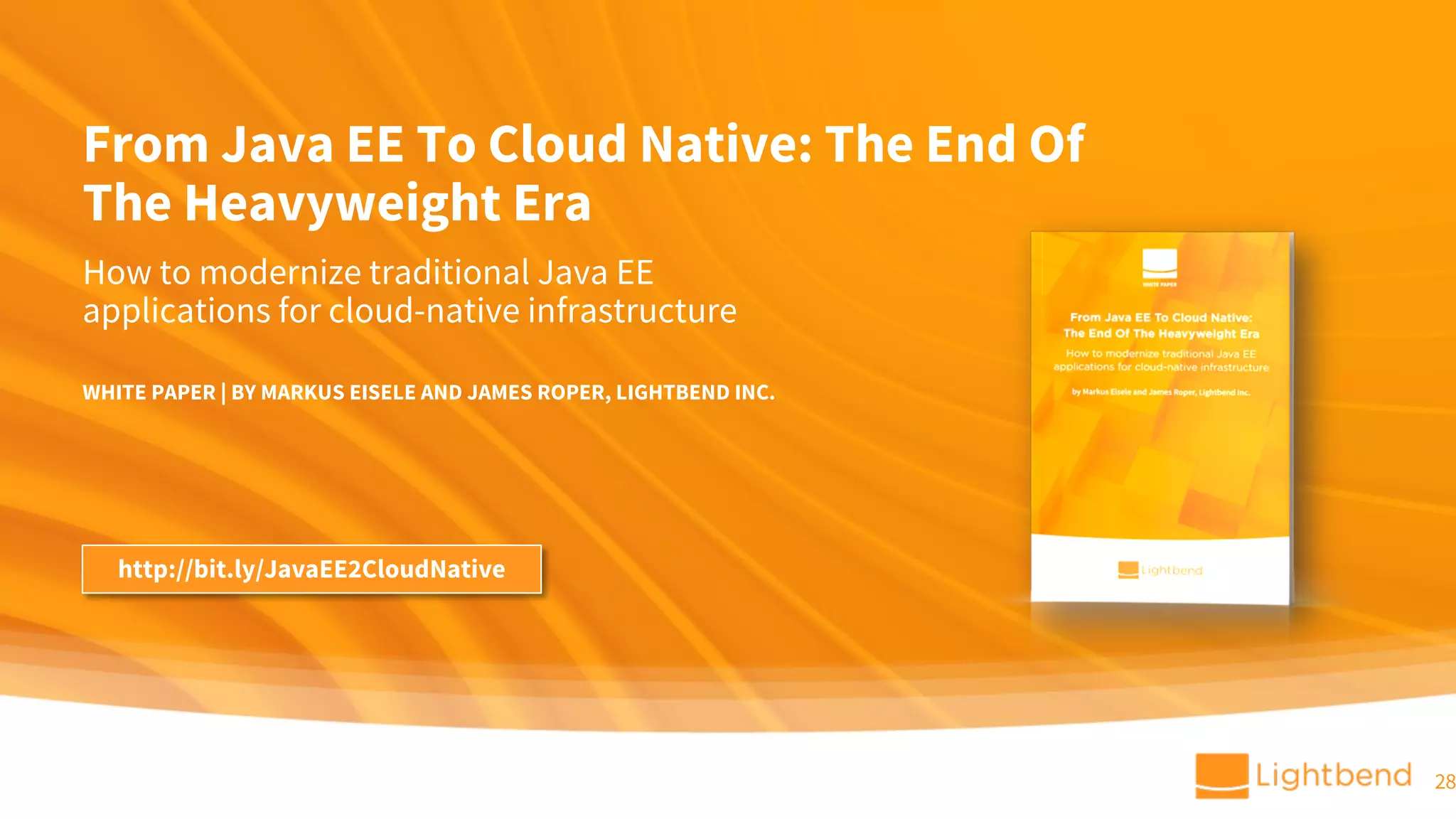
From Java EE To Cloud Native: The End Of The Heavyweight Era How to modernize traditional Java EE applications for cloud-native infrastructure WHITE PAPER | BY MARKUS EISELE AND JAMES ROPER, LIGHTBEND INC. 28 http://bit.ly/JavaEE2CloudNative
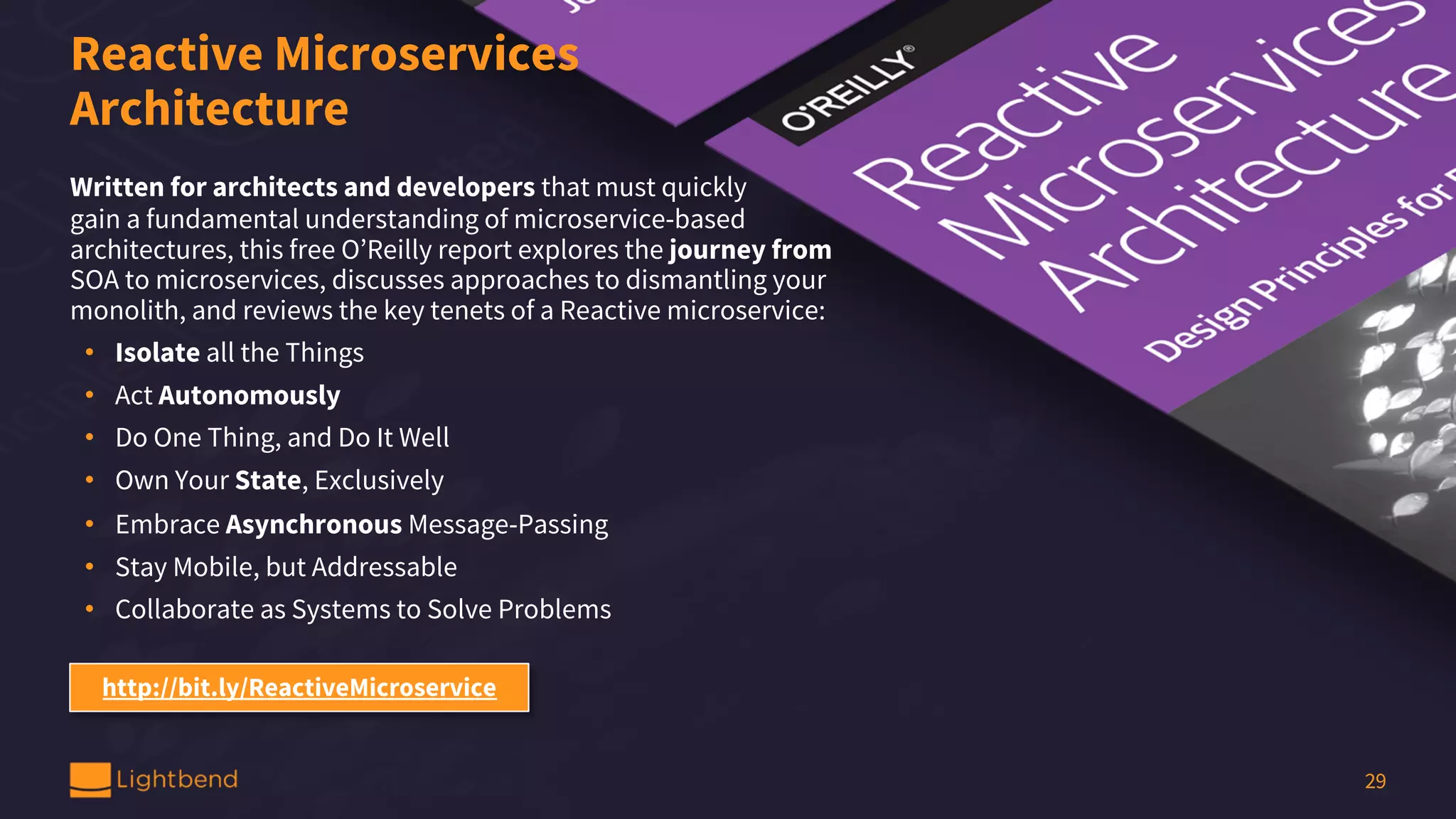
Reactive Microservices Architecture 29 Written for architects and developers that must quickly gain a fundamental understanding of microservice-based architectures, this free O’Reilly report explores the journey from SOA to microservices, discusses approaches to dismantling your monolith, and reviews the key tenets of a Reactive microservice: • Isolate all the Things • Act Autonomously • Do One Thing, and Do It Well • Own Your State, Exclusively • Embrace Asynchronous Message-Passing • Stay Mobile, but Addressable • Collaborate as Systems to Solve Problems http://bit.ly/ReactiveMicroservice
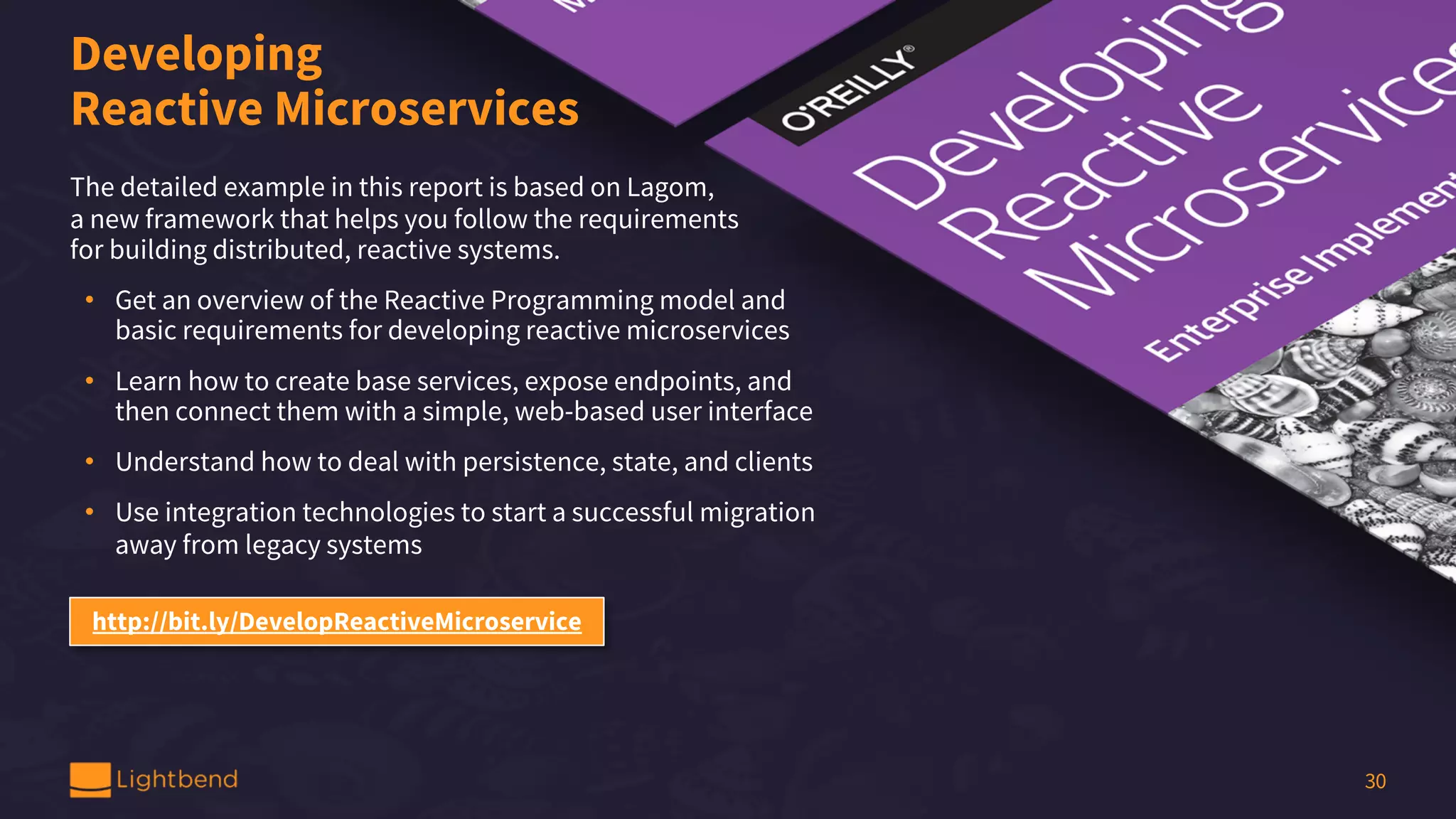
Developing Reactive Microservices 30 The detailed example in this report is based on Lagom, a new framework that helps you follow the requirements for building distributed, reactive systems. • Get an overview of the Reactive Programming model and basic requirements for developing reactive microservices • Learn how to create base services, expose endpoints, and then connect them with a simple, web-based user interface • Understand how to deal with persistence, state, and clients • Use integration technologies to start a successful migration away from legacy systems http://bit.ly/DevelopReactiveMicroservice
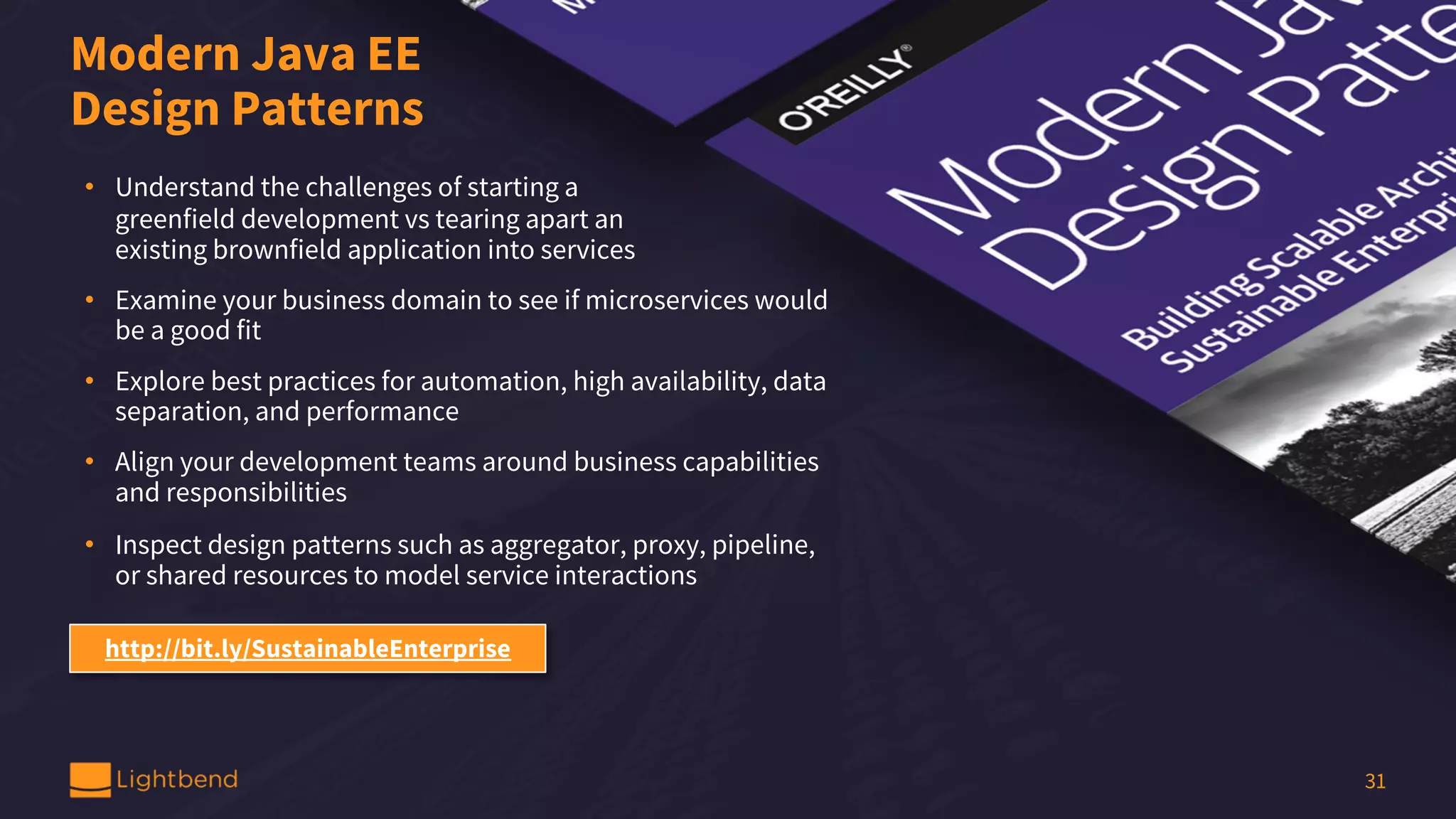
Modern Java EE Design Patterns • Understand the challenges of starting a greenfield development vs tearing apart an existing brownfield application into services • Examine your business domain to see if microservices would be a good fit • Explore best practices for automation, high availability, data separation, and performance • Align your development teams around business capabilities and responsibilities • Inspect design patterns such as aggregator, proxy, pipeline, or shared resources to model service interactions 31 http://bit.ly/SustainableEnterprise
Thank You Page Markus Eisele @myfear blog.eisele.net

Migrating from Java EE to cloud-native Reactive systems

  • 1.
    Migrating From JavaEE To Cloud-Native Reactive Systems With Markus Eisele, Director of Developer Advocacy at Lightbend, Inc. WEBINAR | THURSDAY JUN 6TH, 9:00 AM PT / 12:00 ET / 16:00 GMT / 18:00 CET
  • 2.
  • 3.
  • 4.
    4 Java developers worldwide of theFortune 500 are using Java EE of companies use Java to build over 80% of their applications 10M+ 90% 43% Stability Specifications Availability of developers #1 #2 #3
  • 5.
    What Technical Directionshould Java EE evolve into? Eclipse Foundation survey of over 1800 developers 5 Top 3 for building microservices include Jersey, Spring, Eclipse MicroProfile, Node.js & Kubernetes Currently building microservices or planning to <1 yr Say large memory requirements most challenging aspect of working with Java EE Java EE chosen for Java applications is stability Say Foundation should prioritize better support for microservices https://jakarta.ee/news/2018/04/24/jakarta-ee-community-survey/ 67% Top Frameworks 1. Better support for microservices 2. Native integration with Kubernetes 3. A faster pace of innovation 40% #1 Reason 60% critical areas cited for improvement
  • 6.
    But are JavaEE Applications Still Suitable Today?
  • 7.
  • 8.
    When Building aNew Business Application, Which Technology do You Use? Twitter survey on 5.16.19* 8 Other Reactive (e.g. Play) Microprofile (services) Jave EE (monolith) 17% 28% 30% 25% *962 respondents
  • 9.
    Cloud Native AndThe Future Of Java EE Complexity kills development velocity and only fosters infrequent releases • Development team agility is constantly blocked. • Big teams and heavy apps create long release cycles. • Complex code bases and fearful engineers lead to technical debt. Scaling monoliths is too expensive for the cloud • Monoliths are difficult and expensive to scale. • Monoliths lead to resource inefficiency. 9
  • 10.
    Streams and ‘datain motion’ need to be supported • Real-time streaming data is a first-class citizen in today’s applications. • Insights and value must be harvested from data. • Non-traditional data persistence models must be used. • Shortened time-frames for putting changes into production • New business models evolve from existing ones • New questions need to be answered by existing applications • Datacenter costs need to go down constantly 10
  • 11.
    11 It’s increasingly obviousthat the old, linear, three-tier architecture model is obsolete. - Gartner “
  • 12.
    Monoliths Have AllowedUs to Take Consistency for Granted With a single database, the world is easy Transactions give us an illusion of a single, consistent, current state • We can think of our data as a static thing • It sits there at rest, waiting for our operation • Failure is handled • No partial updates • Consistency is enforced • Concurrency is handled • No uncommitted reads 12 Transaction 1 Transaction 2
  • 13.
    With Distributed Applications, OurConsistent View of the World Breaks Down With many databases, the world is hard There are now many states, all constantly changing • Different services have different ideas of current state • Our data is in motion, not at rest, not static • Failure is not handled for us • Partial updates likely • No enforcement of consistency • Concurrency is inherent • Operations take time to propagate 13 G ? C ? F ? B ? E ? A ? D ?
  • 14.
    What worked inmonoliths CRUD • Depends on consistent single state Relying on transactions • Depends on a single database REST • Depends on failure and consistency being handled in the database 14 Needed for distributed applications Events • Events convey facts • Facts remain true regardless of what else happens in the system At least once messaging • Ensures events can be reliably propagated throughout the system Stream-centric view • Our data is the events • Some may be at rest, some are in motion • No single state • Rather, system is constantly converging, propagating • Control this, using streams What Worked in Monoliths Will Not Work Anymore
  • 15.
    The Shift TowardsReal-Time Streaming Systems
  • 16.
    Design distributed systems and Reactive principles • Message-drivenmeans more than just non- blocking I/O. • Resilience goes further than fault tolerance. • Elasticity means efficient, cost-conscious scalability. • Responsive systems always serve customers.
  • 17.
    Take a lessonfrom Events-First Domain Driven Design • Use encapsulation to improve flexibility. • Apply isolation to encourage loose coupling and avoid the cascade effect. • Separate domains of concern to reduce complexity. 17 Bounded Context Bounded Context Search Service Search Service Product Service Product Service Product Service Product Service Search Cache Product DB
  • 18.
    Prioritize resilience beforethinking about elastic scaling in the cloud • Automate supervision to minimize human intervention. • Isolate and contain failures to enable self-healing. • Master resilience and elasticity to achieve system responsiveness. 18
  • 19.
    Utilize a streamingarchitecture to achieve distribution, concurrency, supervision, and resilience 19 Kafka myTopic .subscribe() Akka Streams .map(kafkaMessage -> new WebSocketMessage( kafkaMessage.getPayload() ) ) WebSocket response .send(publisher) Reactive Streams Backpressure Reactive Streams Messages By modelling a system using streams, we embrace events, no longer need a single state, and can take eventual consistency for granted
  • 20.
    Distributed, Reactive SystemsUnlock Higher Cloud ROI
  • 21.
    21 “Akka has consistentlyallowed us to cut 80% of infrastructure, or increase overall application performance by 5x, when compared to the traditional systems we replaced.” - Akara Sucharitakul, Principal MTS at PayPal “
  • 22.
    We enable Productteams to: • Focus on the business logic, not low- level protocols. • Eliminate bottlenecks and single points of failure. • Realize true ROI from investing in cloud infrastructure. • Focus on what matters to your business. 22
  • 23.
  • 24.
    We enable Productteams to: • Enhancing customer engagement with data-driven insights • Unleashing innovation to protect or capture markets • Improving agility and time to value • Reducing compute costs while scaling elastically • Increasing developer happiness and productivity 24
  • 25.
    From Java EETo Cloud Native: The End Of The Heavyweight Era How to modernize traditional Java EE applications for cloud-native infrastructure WHITE PAPER | BY MARKUS EISELE AND JAMES ROPER, LIGHTBEND INC. 28 http://bit.ly/JavaEE2CloudNative
  • 26.
    Reactive Microservices Architecture 29 Written forarchitects and developers that must quickly gain a fundamental understanding of microservice-based architectures, this free O’Reilly report explores the journey from SOA to microservices, discusses approaches to dismantling your monolith, and reviews the key tenets of a Reactive microservice: • Isolate all the Things • Act Autonomously • Do One Thing, and Do It Well • Own Your State, Exclusively • Embrace Asynchronous Message-Passing • Stay Mobile, but Addressable • Collaborate as Systems to Solve Problems http://bit.ly/ReactiveMicroservice
  • 27.
    Developing Reactive Microservices 30 The detailedexample in this report is based on Lagom, a new framework that helps you follow the requirements for building distributed, reactive systems. • Get an overview of the Reactive Programming model and basic requirements for developing reactive microservices • Learn how to create base services, expose endpoints, and then connect them with a simple, web-based user interface • Understand how to deal with persistence, state, and clients • Use integration technologies to start a successful migration away from legacy systems http://bit.ly/DevelopReactiveMicroservice
  • 28.
    Modern Java EE DesignPatterns • Understand the challenges of starting a greenfield development vs tearing apart an existing brownfield application into services • Examine your business domain to see if microservices would be a good fit • Explore best practices for automation, high availability, data separation, and performance • Align your development teams around business capabilities and responsibilities • Inspect design patterns such as aggregator, proxy, pipeline, or shared resources to model service interactions 31 http://bit.ly/SustainableEnterprise
  • 29.
    Thank You Page MarkusEisele @myfear blog.eisele.net