Softroniics Softroniics www.softroniics.in Calicut||Coimbatore||Palakkad 9037291113, 9037061113 Mobile Data Gathering with Load Balanced Clustering and Dual Data Uploading in Wireless Sensor Networks ABSTRACT: In this paper, a three-layer framework is proposed for mobile data collection in wireless sensor networks, which includes the sensor layer, cluster head layer, and mobile collector (called SenCar) layer. The framework employs distributed load balanced clustering and dual data uploading, which is referred to as LBC-DDU. The objective is to achieve good scalability, long network lifetime and low data collection latency. At the sensor layer, a distributed load balanced clustering (LBC) algorithm is proposed for sensors to self-organize themselves into clusters. In contrast to existing clustering methods, our scheme generates multiple cluster heads in each cluster to balance the work load and facilitate dual data uploading. At the cluster head layer, the inter-cluster transmission range is carefully chosen to guarantee the connectivity among the clusters. Multiple cluster heads within a cluster cooperate with each other to perform energy-saving inter-cluster communications. Through inter-cluster transmissions, cluster head information is forwarded to SenCar for its moving trajectory planning. At the mobile collector layer, SenCar is equipped with two antennas, which enables two cluster heads to simultaneously upload data to SenCar in each time by utilizing multi-user multiple- input and multiple-output (MU-MIMO) technique. The trajectory planning for SenCar is optimized to fully utilize dual data uploading capability by properly selecting polling points in each cluster. By visiting each selected polling point, SenCar can efficiently gather data from cluster heads and transport the data to the
Softroniics Softroniics www.softroniics.in Calicut||Coimbatore||Palakkad 9037291113, 9037061113 static data sink. Extensive simulations are conducted to evaluate the effectiveness of the proposed LBC-DDU scheme. The results show that when each cluster has at most two cluster heads, LBC-DDU achieves over 50 percent energy saving per node and 60 percent energy saving on cluster heads comparing with data collection through multi-hop relay to the static data sink, and 20 percent shorter data collection time compared to traditional mobile data gathering. EXISTING SYSTEM:  Several approaches have been proposed for efficient data collection in the literature. Based on the focus of these works, we can roughly divide them into three categories.  The first category is the enhanced relay routing, in which data are relayed among sensors. Besides relaying, some other factors, such as load balance, schedule pattern and data redundancy, are also considered.  The second category organizes sensors into clusters and allows cluster heads to take the responsibility for forwarding data to the data sink. Clustering is particularly useful for applications with scalability requirement and is very effective in local data aggregation since it can reduce the collisions and balance load among sensors.  The third category is to make use of mobile collectors to take the burden of data routing from sensors. DISADVANTAGES OF EXISTING SYSTEM:
Softroniics Softroniics www.softroniics.in Calicut||Coimbatore||Palakkad 9037291113, 9037061113  In relay routing schemes, minimizing energy consumption on the forwarding path does not necessarily prolong network lifetime, since some critical sensors on the path may run out of energy faster than others.  In cluster-based schemes, cluster heads will inevitably consume much more energy than other sensors due to handling intra-cluster aggregation and inter- cluster data forwarding.  Though using mobile collectors may alleviate non-uniform energy consumption, it may result in unsatisfactory data collection latency. PROPOSED SYSTEM:  We propose a three-layer mobile data collection framework, named Load Balanced Clustering and Dual Data Uploading (LBC-DDU).  The main motivation is to utilize distributed clustering for scalability, to employ mobility for energy saving and uniform energy consumption, and to exploit Multi-User Multiple-Input and Multiple-Output (MU-MIMO) technique for concurrent data uploading to shorten latency. The main contributions of this work can be summarized as follows.  First, we propose a distributed algorithm to organize sensors into clusters, where each cluster has multiple cluster heads.  Second, multiple cluster heads within a cluster can collaborate with each other to perform energy efficient inter-cluster transmissions.  Third, we deploy a mobile collector with two antennas (called SenCar in this paper) to allow concurrent uploading from two cluster heads by using MU- MIMO communication. The SenCar collects data from the cluster heads by visiting each cluster. It chooses the stop locations inside each cluster and
Softroniics Softroniics www.softroniics.in Calicut||Coimbatore||Palakkad 9037291113, 9037061113 determines the sequence to visit them, such that data collection can be done in minimum time. ADVANTAGES OF PROPOSED SYSTEM:  In contrast to clustering techniques proposed in previous works, our algorithm balances the load of intra-cluster aggregation and enables dual data uploading between multiple cluster heads and the mobile collector.  Different from other hierarchical schemes, in our algorithm, cluster heads do not relay data packets from other clusters, which effectively alleviates the burden of each cluster head. Instead, forwarding paths among clusters are only used to route small-sized identification (ID) information of cluster heads to the mobile collector for optimizing the data collection tour.  Our work mainly distinguishes from other mobile collection schemes in the utilization of MUMIMO technique, which enables dual data uploading to shorten data transmission latency. We coordinate the mobility of SenCar to fully enjoy the benefits of dual data uploading, which ultimately leads to a data collection tour with both short moving trajectory and short data uploading time.
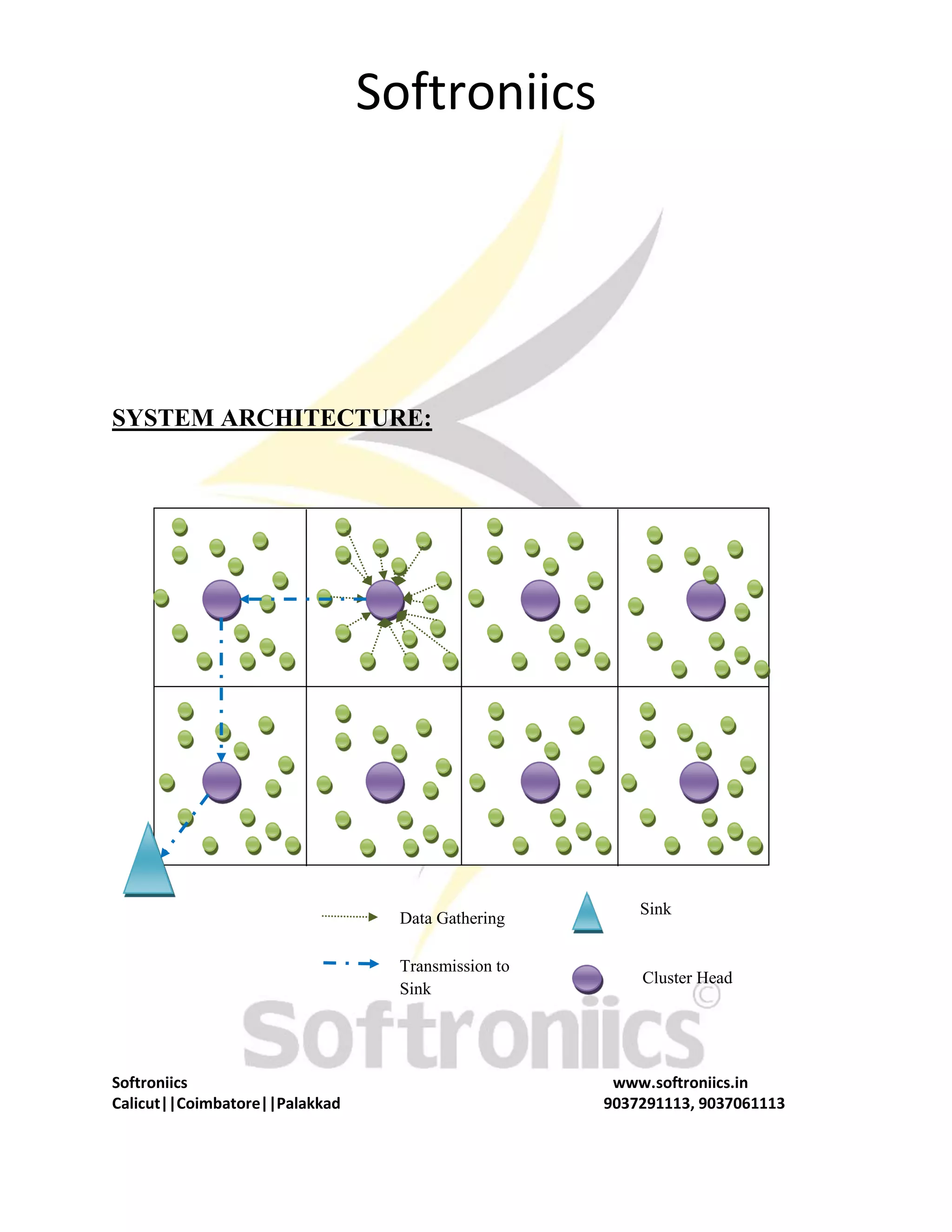
Softroniics Softroniics www.softroniics.in Calicut||Coimbatore||Palakkad 9037291113, 9037061113 SYSTEM ARCHITECTURE: Sink Cluster Head Data Gathering Transmission to Sink
Softroniics Softroniics www.softroniics.in Calicut||Coimbatore||Palakkad 9037291113, 9037061113 SYSTEM REQUIREMENTS: HARDWARE REQUIREMENTS:  System : Pentium IV 2.4 GHz.  Hard Disk : 40 GB.  Floppy Drive : 1.44 Mb.  Monitor : 15 VGA Colour.  Mouse : Logitech.  Ram : 512 Mb. SOFTWARE REQUIREMENTS:  Operating system : Windows XP/7.  Coding Language : C#.net  Tool : Visual Studio 2010  Database : SQL SERVER 2008 REFERENCE: Miao Zhao, Member, IEEE, Yuanyuan Yang, Fellow, IEEE, and Cong Wang, “Mobile Data Gathering with Load Balanced Clustering and Dual Data Uploading in Wireless Sensor Networks”, IEEE TRANSACTIONS ON MOBILE COMPUTING, VOL. 14, NO. 4, APRIL 2015.

Mobile data gathering with load balanced clustering and dual data uploading in wireless sensor networks

  • 1.
    Softroniics Softroniics www.softroniics.in Calicut||Coimbatore||Palakkad 9037291113,9037061113 Mobile Data Gathering with Load Balanced Clustering and Dual Data Uploading in Wireless Sensor Networks ABSTRACT: In this paper, a three-layer framework is proposed for mobile data collection in wireless sensor networks, which includes the sensor layer, cluster head layer, and mobile collector (called SenCar) layer. The framework employs distributed load balanced clustering and dual data uploading, which is referred to as LBC-DDU. The objective is to achieve good scalability, long network lifetime and low data collection latency. At the sensor layer, a distributed load balanced clustering (LBC) algorithm is proposed for sensors to self-organize themselves into clusters. In contrast to existing clustering methods, our scheme generates multiple cluster heads in each cluster to balance the work load and facilitate dual data uploading. At the cluster head layer, the inter-cluster transmission range is carefully chosen to guarantee the connectivity among the clusters. Multiple cluster heads within a cluster cooperate with each other to perform energy-saving inter-cluster communications. Through inter-cluster transmissions, cluster head information is forwarded to SenCar for its moving trajectory planning. At the mobile collector layer, SenCar is equipped with two antennas, which enables two cluster heads to simultaneously upload data to SenCar in each time by utilizing multi-user multiple- input and multiple-output (MU-MIMO) technique. The trajectory planning for SenCar is optimized to fully utilize dual data uploading capability by properly selecting polling points in each cluster. By visiting each selected polling point, SenCar can efficiently gather data from cluster heads and transport the data to the
  • 2.
    Softroniics Softroniics www.softroniics.in Calicut||Coimbatore||Palakkad 9037291113,9037061113 static data sink. Extensive simulations are conducted to evaluate the effectiveness of the proposed LBC-DDU scheme. The results show that when each cluster has at most two cluster heads, LBC-DDU achieves over 50 percent energy saving per node and 60 percent energy saving on cluster heads comparing with data collection through multi-hop relay to the static data sink, and 20 percent shorter data collection time compared to traditional mobile data gathering. EXISTING SYSTEM:  Several approaches have been proposed for efficient data collection in the literature. Based on the focus of these works, we can roughly divide them into three categories.  The first category is the enhanced relay routing, in which data are relayed among sensors. Besides relaying, some other factors, such as load balance, schedule pattern and data redundancy, are also considered.  The second category organizes sensors into clusters and allows cluster heads to take the responsibility for forwarding data to the data sink. Clustering is particularly useful for applications with scalability requirement and is very effective in local data aggregation since it can reduce the collisions and balance load among sensors.  The third category is to make use of mobile collectors to take the burden of data routing from sensors. DISADVANTAGES OF EXISTING SYSTEM:
  • 3.
    Softroniics Softroniics www.softroniics.in Calicut||Coimbatore||Palakkad 9037291113,9037061113  In relay routing schemes, minimizing energy consumption on the forwarding path does not necessarily prolong network lifetime, since some critical sensors on the path may run out of energy faster than others.  In cluster-based schemes, cluster heads will inevitably consume much more energy than other sensors due to handling intra-cluster aggregation and inter- cluster data forwarding.  Though using mobile collectors may alleviate non-uniform energy consumption, it may result in unsatisfactory data collection latency. PROPOSED SYSTEM:  We propose a three-layer mobile data collection framework, named Load Balanced Clustering and Dual Data Uploading (LBC-DDU).  The main motivation is to utilize distributed clustering for scalability, to employ mobility for energy saving and uniform energy consumption, and to exploit Multi-User Multiple-Input and Multiple-Output (MU-MIMO) technique for concurrent data uploading to shorten latency. The main contributions of this work can be summarized as follows.  First, we propose a distributed algorithm to organize sensors into clusters, where each cluster has multiple cluster heads.  Second, multiple cluster heads within a cluster can collaborate with each other to perform energy efficient inter-cluster transmissions.  Third, we deploy a mobile collector with two antennas (called SenCar in this paper) to allow concurrent uploading from two cluster heads by using MU- MIMO communication. The SenCar collects data from the cluster heads by visiting each cluster. It chooses the stop locations inside each cluster and
  • 4.
    Softroniics Softroniics www.softroniics.in Calicut||Coimbatore||Palakkad 9037291113,9037061113 determines the sequence to visit them, such that data collection can be done in minimum time. ADVANTAGES OF PROPOSED SYSTEM:  In contrast to clustering techniques proposed in previous works, our algorithm balances the load of intra-cluster aggregation and enables dual data uploading between multiple cluster heads and the mobile collector.  Different from other hierarchical schemes, in our algorithm, cluster heads do not relay data packets from other clusters, which effectively alleviates the burden of each cluster head. Instead, forwarding paths among clusters are only used to route small-sized identification (ID) information of cluster heads to the mobile collector for optimizing the data collection tour.  Our work mainly distinguishes from other mobile collection schemes in the utilization of MUMIMO technique, which enables dual data uploading to shorten data transmission latency. We coordinate the mobility of SenCar to fully enjoy the benefits of dual data uploading, which ultimately leads to a data collection tour with both short moving trajectory and short data uploading time.
  • 5.
    Softroniics Softroniics www.softroniics.in Calicut||Coimbatore||Palakkad 9037291113,9037061113 SYSTEM ARCHITECTURE: Sink Cluster Head Data Gathering Transmission to Sink
  • 6.
    Softroniics Softroniics www.softroniics.in Calicut||Coimbatore||Palakkad 9037291113,9037061113 SYSTEM REQUIREMENTS: HARDWARE REQUIREMENTS:  System : Pentium IV 2.4 GHz.  Hard Disk : 40 GB.  Floppy Drive : 1.44 Mb.  Monitor : 15 VGA Colour.  Mouse : Logitech.  Ram : 512 Mb. SOFTWARE REQUIREMENTS:  Operating system : Windows XP/7.  Coding Language : C#.net  Tool : Visual Studio 2010  Database : SQL SERVER 2008 REFERENCE: Miao Zhao, Member, IEEE, Yuanyuan Yang, Fellow, IEEE, and Cong Wang, “Mobile Data Gathering with Load Balanced Clustering and Dual Data Uploading in Wireless Sensor Networks”, IEEE TRANSACTIONS ON MOBILE COMPUTING, VOL. 14, NO. 4, APRIL 2015.