

















































TTA FINAL YEAR PROJECTS TITLES WITH ABSTRACT IEEE 2011, 2010, 2009, 2008 , etc… Projects for B.E/B.Tech/M.E/Bsc/Msc For complete base paper, call now and talk to our expert 89397 22135 | 89397 22145 | 044 4218 1385
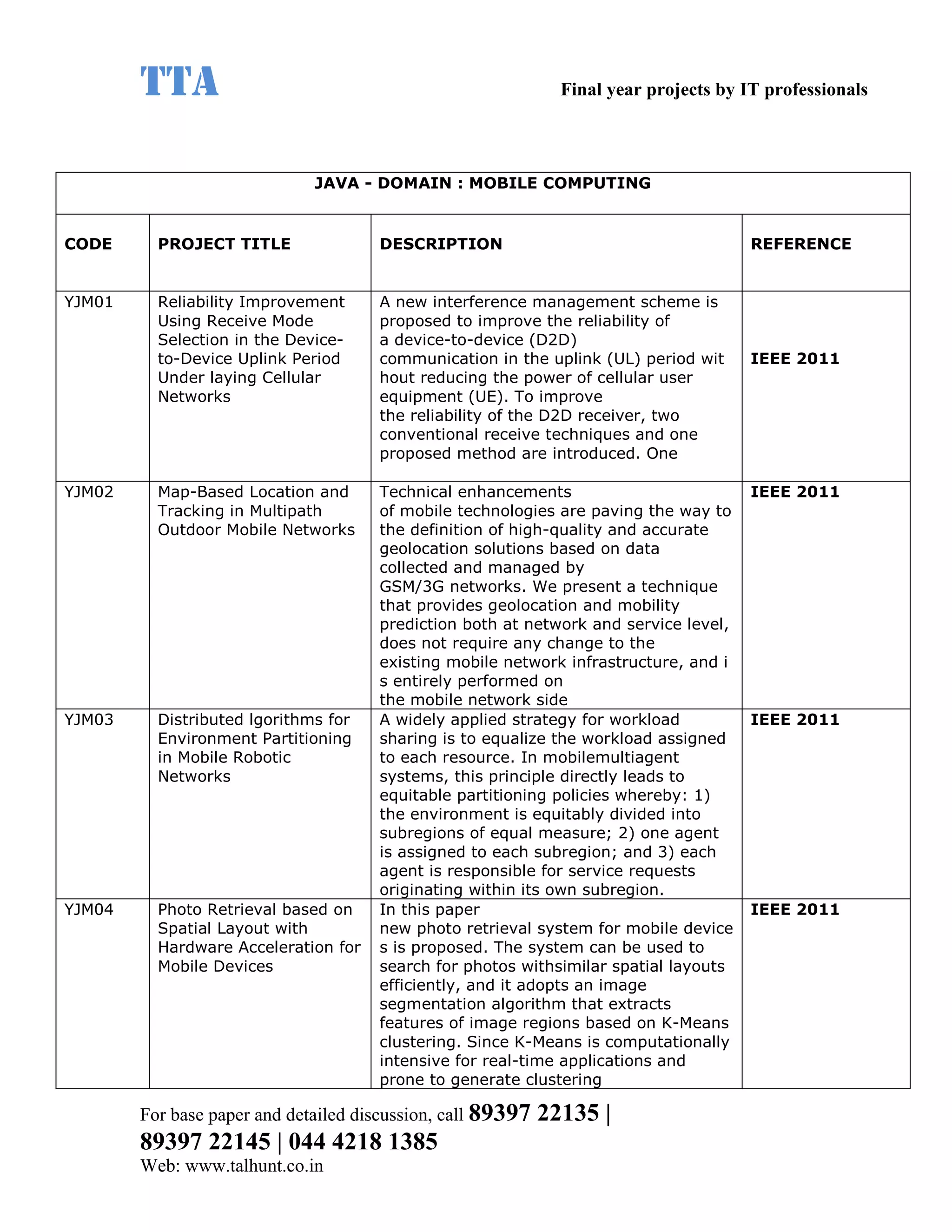
TTA Final year projects by IT professionals JAVA - DOMAIN : MOBILE COMPUTING CODE PROJECT TITLE DESCRIPTION REFERENCE YJM01 Reliability Improvement A new interference management scheme is Using Receive Mode proposed to improve the reliability of Selection in the Device- a device-to-device (D2D) to-Device Uplink Period communication in the uplink (UL) period wit IEEE 2011 Under laying Cellular hout reducing the power of cellular user Networks equipment (UE). To improve the reliability of the D2D receiver, two conventional receive techniques and one proposed method are introduced. One YJM02 Map-Based Location and Technical enhancements IEEE 2011 Tracking in Multipath of mobile technologies are paving the way to Outdoor Mobile Networks the definition of high-quality and accurate geolocation solutions based on data collected and managed by GSM/3G networks. We present a technique that provides geolocation and mobility prediction both at network and service level, does not require any change to the existing mobile network infrastructure, and i s entirely performed on the mobile network side YJM03 Distributed lgorithms for A widely applied strategy for workload IEEE 2011 Environment Partitioning sharing is to equalize the workload assigned in Mobile Robotic to each resource. In mobilemultiagent Networks systems, this principle directly leads to equitable partitioning policies whereby: 1) the environment is equitably divided into subregions of equal measure; 2) one agent is assigned to each subregion; and 3) each agent is responsible for service requests originating within its own subregion. YJM04 Photo Retrieval based on In this paper IEEE 2011 Spatial Layout with new photo retrieval system for mobile device Hardware Acceleration for s is proposed. The system can be used to Mobile Devices search for photos withsimilar spatial layouts efficiently, and it adopts an image segmentation algorithm that extracts features of image regions based on K-Means clustering. Since K-Means is computationally intensive for real-time applications and prone to generate clustering For base paper and detailed discussion, call 89397 22135 | 89397 22145 | 044 4218 1385 Web: www.talhunt.co.in
TTA Final year projects by IT professionals results with local optima, parallel hardware architectures are designed to meet the real-time requirement of the retrieval process. YJM05 Hop-by-hop Routing in Wireless Mesh Network (WMN) has become IEEE 2011 Wireless Mesh Networks an important edge network to provide with Bandwidth Internet access to remote areas Guarantees and wireless connections in a metropolitan scale. In this paper, we study the problem of identifying the maximum available bandwidth path, a fundamental issue in supporting quality-of- service in WMNs YJM06 Cooperating with The use of smart antennas in multi- IEEE 2011 Smartness: Using hop wireless networks (MWNs) has garnered Heterogeneous Smart significant attention over the last few years. Antennas in Multi-hop While homogeneous MWNs with all nodes Wireless Networks having the same antenna capabilities will have certain applications, we argue that MWNs with nodes having heterogeneous antenna capabilities are more likely to be the norm due to a variety of motivating factors. YJM07 Local Greedy In recent years, there has been a significant IEEE 2011 Approximation for amount of work done in developing low- Scheduling in Multi-hop complexity schedulingschemes to achieve Wireless Networks high performance in multi- hop wireless networks. A centralized sub- optimal schedulingpolicy, called Greedy Maximal Scheduling (GMS) is a good candidate because its empirically observed performance is close to optimal in a variety of network settings. YJM08 Network Connectivity We investigate the communication IEEE 2011 with a Family of Group range of the nodes necessary Mobility Models for network connectivity, which we call bi- directional connectivity, in a simple setting. Unlike in most of existing studies, however, the locations ormobilities of the nodes may be correlated through group mobility: Nodes are broken into groups, with each groupcomprising the same number of nodes, and lie on a unit circle. The locations of the nodes in the same group are not mutually independent, but are instead conditionally independent given the location of the group. We examine the distribution of the smallest communication For base paper and detailed discussion, call 89397 22135 | 89397 22145 | 044 4218 1385 Web: www.talhunt.co.in
TTA Final year projects by IT professionals YJM09 Towards Reliable Data This paper addresses the problem of IEEE 2011 Delivery for Highly delivering data packets for highly dynamic m Dynamic Mobile Ad Hoc obile ad hoc networks in areliable and timely Networks manner. Most existing ad hoc routing protocols are susceptible to node mobility, especially forlarge-scale networks. Driven by this issue, we propose an efficient Position based Opportunistic Routing protocol (POR) which takes advantage of the stateless property of geographic routing and the broadcast nature of wireless medium. YJM10 Local Broadcast There are two main approaches, static and IEEE 2011 Algorithms in Wireless Ad dynamic, in broadcast algorithms in wireless Hoc Networks: Reducing ad hoc networks. In thestatic the Number of approach, local algorithms determine the sta Transmissions tus (forwarding/non-forwarding) of each node proactively based on local topology information and a globally known priority function. In this paper, we first show that localbroadcast algorithms based on the static approach cannot achieve a good approximation factor to the optimum solution (an NP-hard problem). YJM11 A Privacy-Preserving Monitoring personal locations with a potentia IEEE 2011 Location Monitoring lly untrusted server poses privacy threats to System for Wireless the monitored individuals. To this end, we Sensor Networks propose a privacy- preserving location monitoring system for wi reless sensornetworks. In our system, we design two in- network location anonymization algorithms, namely, resource and quality-aware algorithms, that aim to enable the system to provide high- quality location monitoring services forsyste m users, while preserving personal location privacy YJM12 Optimal Stochastic We consider IEEE 2011 Location Updates in the location service in a mobile ad- Mobile Ad Hoc Networks hoc network (MANET), where each node needs to maintain itslocation information by 1) frequently updating its location information within its neighboring region, which is called neighborhood update (NU), and 2) occasionally updating its location information to certain distributedlocation server in the network, which is called location server update (LSU). For base paper and detailed discussion, call 89397 22135 | 89397 22145 | 044 4218 1385 Web: www.talhunt.co.in
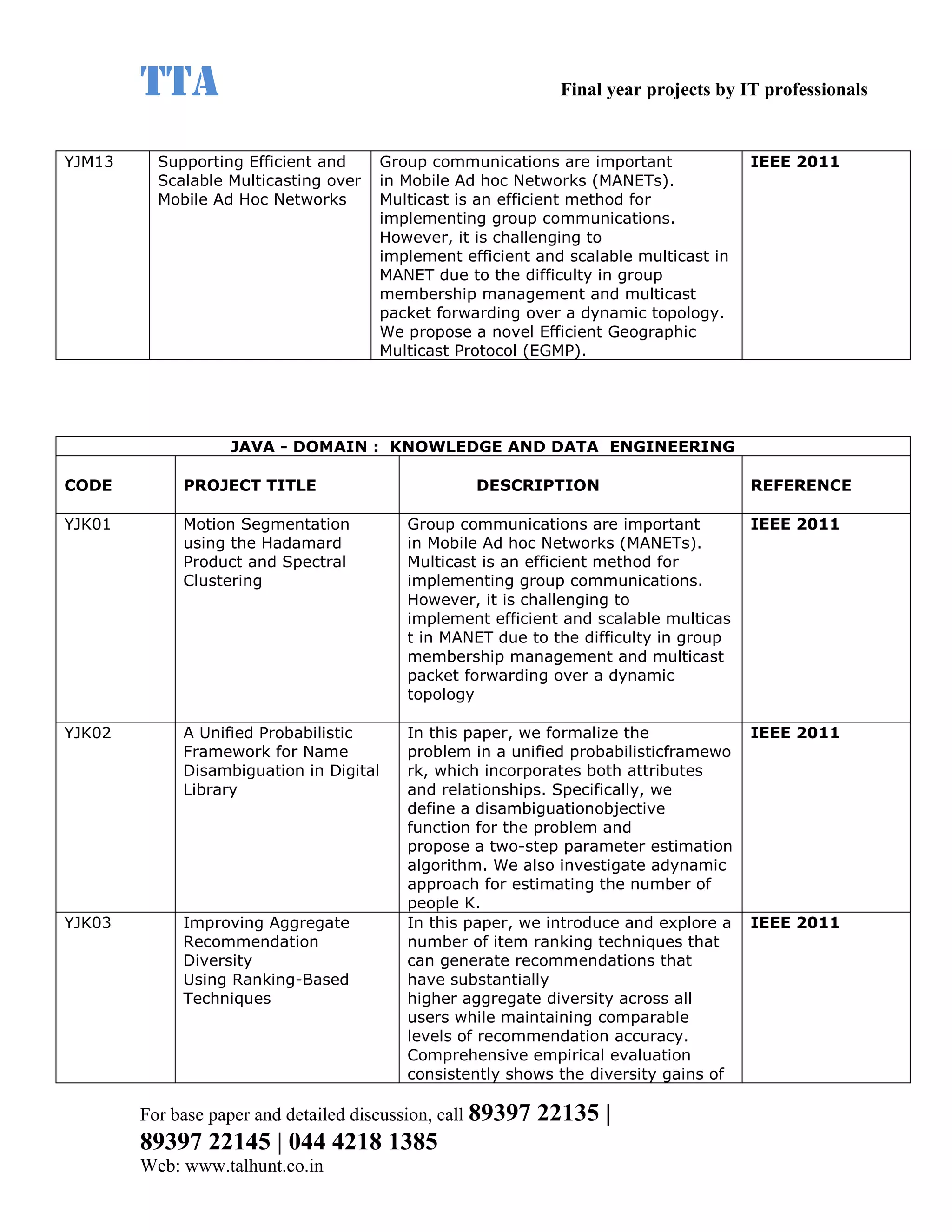
TTA Final year projects by IT professionals YJM13 Supporting Efficient and Group communications are important IEEE 2011 Scalable Multicasting over in Mobile Ad hoc Networks (MANETs). Mobile Ad Hoc Networks Multicast is an efficient method for implementing group communications. However, it is challenging to implement efficient and scalable multicast in MANET due to the difficulty in group membership management and multicast packet forwarding over a dynamic topology. We propose a novel Efficient Geographic Multicast Protocol (EGMP). JAVA - DOMAIN : KNOWLEDGE AND DATA ENGINEERING CODE PROJECT TITLE DESCRIPTION REFERENCE YJK01 Motion Segmentation Group communications are important IEEE 2011 using the Hadamard in Mobile Ad hoc Networks (MANETs). Product and Spectral Multicast is an efficient method for Clustering implementing group communications. However, it is challenging to implement efficient and scalable multicas t in MANET due to the difficulty in group membership management and multicast packet forwarding over a dynamic topology YJK02 A Unified Probabilistic In this paper, we formalize the IEEE 2011 Framework for Name problem in a unified probabilisticframewo Disambiguation in Digital rk, which incorporates both attributes Library and relationships. Specifically, we define a disambiguationobjective function for the problem and propose a two-step parameter estimation algorithm. We also investigate adynamic approach for estimating the number of people K. YJK03 Improving Aggregate In this paper, we introduce and explore a IEEE 2011 Recommendation number of item ranking techniques that Diversity can generate recommendations that Using Ranking-Based have substantially Techniques higher aggregate diversity across all users while maintaining comparable levels of recommendation accuracy. Comprehensive empirical evaluation consistently shows the diversity gains of For base paper and detailed discussion, call 89397 22135 | 89397 22145 | 044 4218 1385 Web: www.talhunt.co.in
TTA Final year projects by IT professionals the proposed techniques using several real-world rating datasets and different rating prediction algorithms. YJK04 Publishing Search Logs – In this paper we analyze algorithms IEEE 2011 A Comparative Study of for publishing frequent keywords, queries Privacy Guarantees and clicks of a search log. We first show how methods that achieve variants of k- anonymity are vulnerable to active attacks. We then demonstrate that the stronger guarantee ensured by epsilon- differential privacy unfortunately does not provide any utility for this problem. We then propose a novel algorithm ZEALOUS and show how to set its parameters to achieve (epsilon, delta)- probabilistic privacy. YJK05 Cluster Oriented This paper presents a IEEE 2011 Ensemble Classifier: novel cluster oriented ensemble classifier Impact of Multi-cluster . The proposed ensemble classifier is Characterization on based onoriginal concepts such Ensemble Classifier as learning of cluster boundaries by the Learning. base classifiers and mapping of clusterconfidences to class decision using a fusion classifier. The categorised data set is characterised into multipleclusters and fed to a number of distinctive base classifiers. YJK06 Visual Role Mining: A This paper offers a new role engineering IEEE 2011 Picture Is Worth a approach to Role-Based Access Control Thousand Roles (RBAC), referred to as visualrole mining. The key idea is to graphically represent user-permission assignments to enable quick analysis and elicitation of meaningful roles. First, we formally define the problem by introducing a metric for the quality of the visualization. YJK07 A Knowledge-Driven This paper introduces a knowledge- IEEE 2011 Approach to Activity driven approach to real-time, Recognition in Smart continuous activity recognition based on Homes multi-sensor data streams in smart homes. The approach goes beyond the traditional data-centric methods for activityrecognition in three ways. Firstly, it makes extensive use of domain knowledge in the lifecycle of activityrecognition. Secondly, it uses For base paper and detailed discussion, call 89397 22135 | 89397 22145 | 044 4218 1385 Web: www.talhunt.co.in
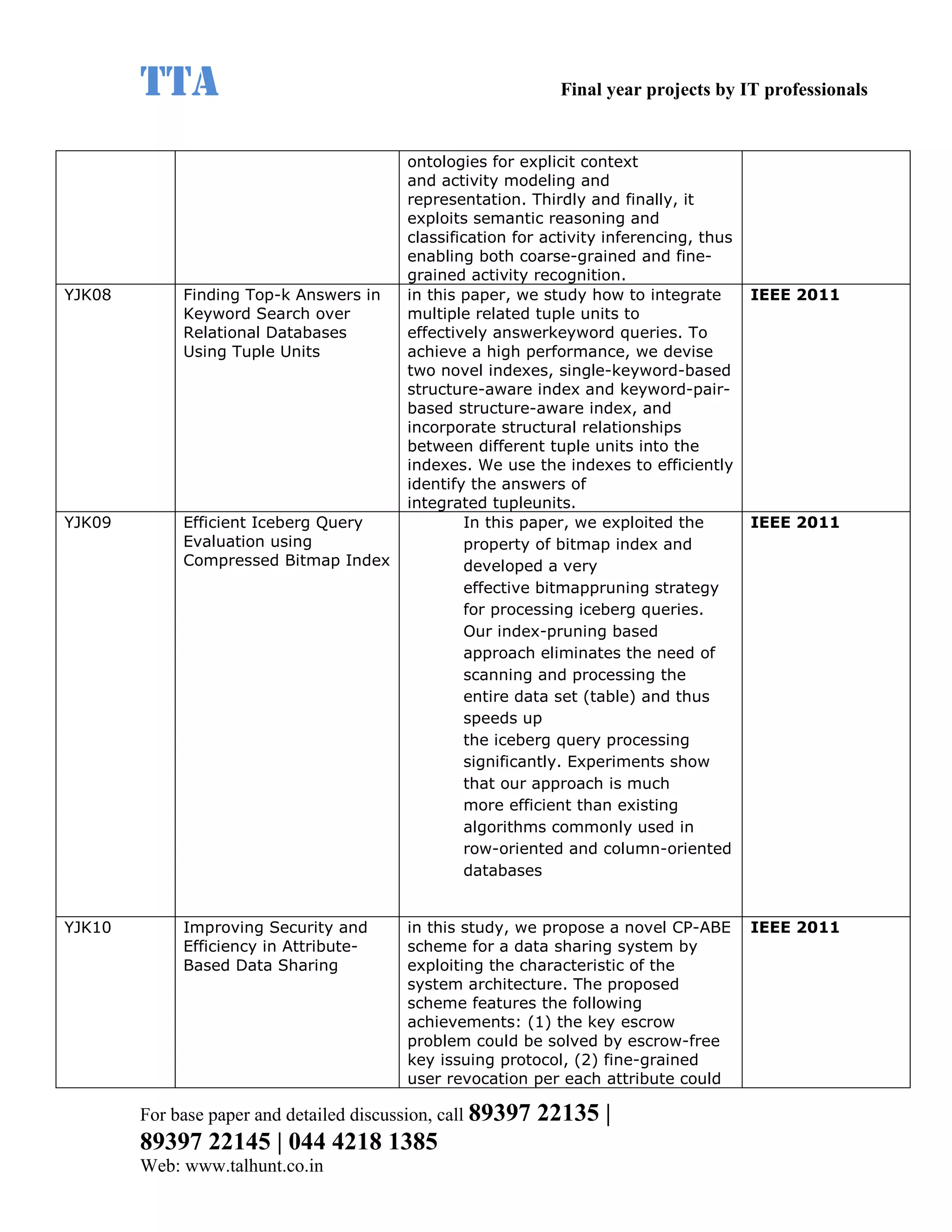
TTA Final year projects by IT professionals ontologies for explicit context and activity modeling and representation. Thirdly and finally, it exploits semantic reasoning and classification for activity inferencing, thus enabling both coarse-grained and fine- grained activity recognition. YJK08 Finding Top-k Answers in in this paper, we study how to integrate IEEE 2011 Keyword Search over multiple related tuple units to Relational Databases effectively answerkeyword queries. To Using Tuple Units achieve a high performance, we devise two novel indexes, single-keyword-based structure-aware index and keyword-pair- based structure-aware index, and incorporate structural relationships between different tuple units into the indexes. We use the indexes to efficiently identify the answers of integrated tupleunits. YJK09 Efficient Iceberg Query In this paper, we exploited the IEEE 2011 Evaluation using property of bitmap index and Compressed Bitmap Index developed a very effective bitmappruning strategy for processing iceberg queries. Our index-pruning based approach eliminates the need of scanning and processing the entire data set (table) and thus speeds up the iceberg query processing significantly. Experiments show that our approach is much more efficient than existing algorithms commonly used in row-oriented and column-oriented databases YJK10 Improving Security and in this study, we propose a novel CP-ABE IEEE 2011 Efficiency in Attribute- scheme for a data sharing system by Based Data Sharing exploiting the characteristic of the system architecture. The proposed scheme features the following achievements: (1) the key escrow problem could be solved by escrow-free key issuing protocol, (2) fine-grained user revocation per each attribute could For base paper and detailed discussion, call 89397 22135 | 89397 22145 | 044 4218 1385 Web: www.talhunt.co.in
TTA Final year projects by IT professionals be done by proxy encryption which takes advantage of the selective attribute group key distribution on top of the ABE. YJK11 Clustering with Multi- In this paper, we introduce a IEEE 2011 Viewpoint based novel multi- Similarity Measure viewpoint based similarity measure and two related clustering methods. The major difference between a traditional dissimilarity/similarity measure and ours is that the former uses only a single viewpoint, which is the origin, while the latter utilizes many different viewpoints, which are objects assumed to not be in the same cluster with the two objects being measured. Using multiple viewpoints, more informative assessment of similarity could be achieved. YJK12 Manifold Adaptive In this paper, we propose a novel active IEEE 2011 Experimental Design for learning algorithm which is performed in Text Categorization the data manifold adaptive kernel space. The manifold structure is incorporated into the kernel space by using graph Laplacian. This way, the manifold adaptive kernel space reflects the underlying geometry of the data. YJK13 Multi-resolution Web link In this paper, we generalize the IEEE 2011 analysis using generalised multiresolution popularity analysis to use link relations any form of Web page link relations. We provide results for both the PageRank relations and the In- degree relations. By utilizing the multiresolution popularity lists, we achieve a 13 percent and 25 percent improvement in mean average precision over In-degree and PageRank, respectively. YJK14 Distributed Processing of In this paper, we introduce the IEEE 2011 Probabilistic Top-k notion of sufficient set and necessary set Queries in Wireless for distributed processing ofprobabilistic t Sensor Networks op-k queries in cluster- based wireless sensor networks. These two concepts have very nice properties that can facilitate localized data pruning in clusters. Accordingly, we develop a suite of algorithms, namely, sufficient set-based (SSB), necessary For base paper and detailed discussion, call 89397 22135 | 89397 22145 | 044 4218 1385 Web: www.talhunt.co.in
TTA Final year projects by IT professionals set-based (NSB) and boundary-based (BB), for inter- cluster queryprocessing with bounded rounds of communications. YJK15 Cost-aware rank join with We address the problem of joining IEEE 2011 random and sorted access ranked results produced by two or more services on the Web. We consider services endowed with two kinds of access that are often available: i) sorted access, which returns tuplessorted by score; ii) random access, which returns tuples matching a given join attribute value. Rank joinoperators combine objects of multiple relations and output the K combinations with the highest aggregate score. YJK16 Joint Top-K Spatial Web users and content are increasingly IEEE 2011 Keyword Query being geo-positioned, and increased Processing focus is being given to serving local content in response to web queries. This development calls for spatial keyword queries that take into account both the locations and textual descriptions of content. We study the efficient, joint processing of multiple top- kspatial keyword queries. Such joint processing is attractive during high query loads and also occurs when multiplequeries are used to obfuscate a user's true query. YJK17 Adaptive Provisioning of IEEE 2011 Human Expertise in Service-oriented Systems YJK18 Improving Aggregate In this paper, we introduce and explore a IEEE 2011 Recommendation number of item ranking techniques that Diversity Using Ranking- can generate recommendations that Based Techniques have substantially higher aggregate diversity across all users while maintaining comparable levels of recommendation accuracy. Comprehensive empirical evaluation consistently shows the diversity gains of the proposed techniques using several real-world rating datasets and different rating prediction algorithms. YJK19 Publishing Search Logs – In this paper we analyze algorithms IEEE 2011 A Comparative Study of for publishing frequent keywords, queries For base paper and detailed discussion, call 89397 22135 | 89397 22145 | 044 4218 1385 Web: www.talhunt.co.in
TTA Final year projects by IT professionals Privacy Guarantees and clicks of a search log. We first show how methods that achieve variants of k- anonymity are vulnerable to active attacks. We then demonstrate that the stronger guarantee ensured by epsilon- differential privacy unfortunately does not provide any utility for this problem. YJK20 A Link-Analysis Extension This work IEEE 2011 of Correspondence introduces a link analysis procedure for d Analysis for Mining iscovering relationships Relational Databases in a relational database or a graph, generalizing both simple and multiple correspondence analysis. It is based on a random walk model through thedatabase defining a Markov chain having as many states as elements in the database. Suppose we are interested in analyzing the relationships between some elements (or records) contained in two different tables ofthe relational database YJK21 Adaptive Cluster Distance We consider approaches for similarity IEEE 2011 Bounding for High search in correlated, high- Dimensional Indexing dimensional data sets, which are derived within a clustering framework. We note that indexing by “vector approximation” (VA-File), which was proposed as a technique to combat the “Curse of Dimensionality,” employs scalar quantization, and hence necessarily ignores dependencies across dimensions, which represents a source of suboptimality. YJK22 Discovering Conditional In this paper, we present the BioNav IEEE 2011 Functional Dependencies system, a novel search interface that enables the user to navigate large number of query results by organizing them using the MeSH concept hierarchy. First, the query results are organized into a navigation tree. At each node expansion step, BioNav reveals only a small subset of the concept nodes, selected such that the expected user navigationcost is minimized. YJK23 Effective Navigation of In this paper, we propose a novel IEEE 2011 Query Results Based on algorithm, called Semisupervised Semi- Concept Hierarchies RiemannianMetric Map (S3RMM), following the geometric framework of semi Riemannian manifolds. S3RMM For base paper and detailed discussion, call 89397 22135 | 89397 22145 | 044 4218 1385 Web: www.talhunt.co.in
TTA Final year projects by IT professionals maximizes the discrepancy of the separability and similarity measures of scatters formulated by using semi- Riemannian metric tensors. YJK24 Learning Semi- In this paper, we propose a novel IEEE 2011 Riemannian Metrics for algorithm, called Semisupervised Semi- Semi supervised Feature RiemannianMetric Map (S3RMM), Extraction following the geometric framework of semi Riemannian manifolds. S3RMM maximizes the discrepancy of the separability and similarity measures of scatters formulated by using semi- Riemannian metric tensors. The metric tensor of each sample is learned via semisupervised regression YJK25 Load Shedding in Mobile IEEE 2011 Systems with Mobi Qual YJK26 Ranking Spatial Data by A spatial preference query ranks objects IEEE 2011 Quality Preferences based on the qualities of features in their spatial neighborhood. For example, using a real estate agency database of flats for lease, a customer may want to rank the flats with respect to the appropriateness of their location, defined after aggregating the qualities of other features (e.g., restaurants, cafes, hospital, market, etc.) within their spatial neighborhood. Such a neighborhood concept can be specified by the user via different functions DOMAIN : NETWORK SECURITY CODE PROJECT TITLE DESCRIPTION REFERENCE YJS01 Secret Key Agreement IEEE 2011 from Vector Gaussian We investigate Sources by Rate Limited the secret key agreement from correlate Public Communication d vector Gaussian sources in which legitimate parties can use public communication with limited ra te. For the class of protocols with one- way public communication, we show that For base paper and detailed discussion, call 89397 22135 | 89397 22145 | 044 4218 1385 Web: www.talhunt.co.in
TTA Final year projects by IT professionals the optimal trade-off between the rate of key generation and the rate of the publiccommunication is characterized as an optimization problem of a Gaussian random variable. YJS02 Detecting Recompression In this paper, we present a new IEEE 2011 of JPEG Images via technique to discover traces caused Periodicity Analysis of by recompression. We assume all Compression Artifacts for source images are in JPEG format and Tampering Detection propose to formulate the periodic characteristics of JPEG images both in spatial and transform domains. Using theoretical analysis, we design a robust detection approach which is able to detect either block-aligned or misaligned recompression. YJS03 Privacy-Preserving ECG The paper deals with all the IEEE 2011 Classification With requirements anddifficulties related to Branching Programs and working with data that must stay Neural Networks encrypted during all the computation steps, including the necessity of working with fixed point arithmetic with no truncation while guaranteeing the same performance of a floating point implementation in the plain domain. YJS04 Restoring Degraded Face The purpose of this paper is to illustrate IEEE 2011 Images: A Case Study in the complexity Matching Faxed, Printed, of face recognition in such realistic and Scanned Photos scenarios and to provide a viable solution to it. The contributions of this work are two-fold. First, a database of face images is assembled and used to illustrate the challenges associated with matching severely degraded face im ages. Second, a preprocessing scheme with low computational complexity is developed in order to eliminate the noise present in degraded images and restore their quality. YJS05 Keys Through ARQ: This paper develops a novel framework IEEE 2011 Theory and Practice for sharing secret keys using the Automatic Repeat reQuest (ARQ) protocol. We first characterize the underlying information theoretic limits, under different assumptions on the channel spatial and temporal correlation function. Our analysis reveals a novel role of “dumb antennas” in overcoming For base paper and detailed discussion, call 89397 22135 | 89397 22145 | 044 4218 1385 Web: www.talhunt.co.in
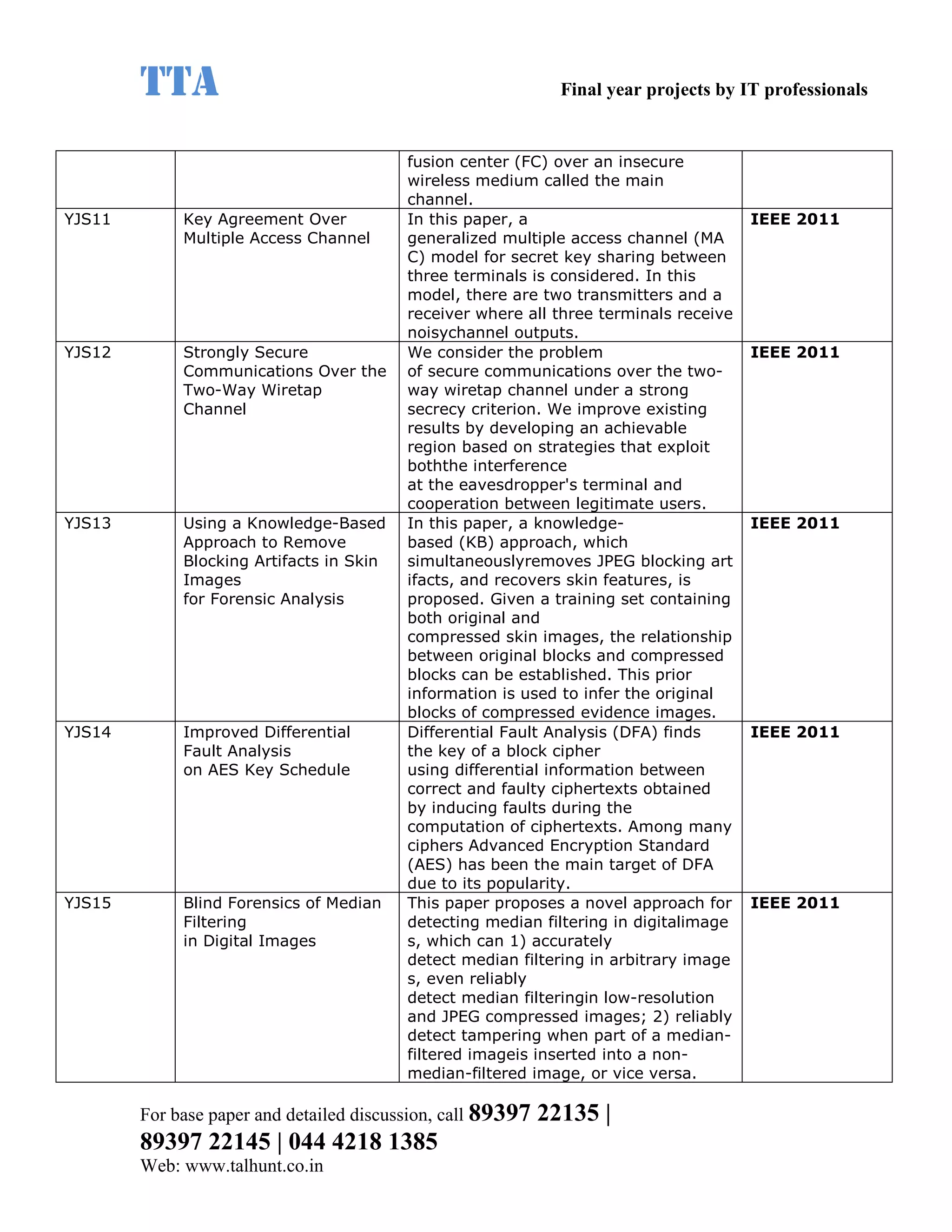
TTA Final year projects by IT professionals the negative impact of spatial correlation on the achievable secrecy rates. YJS06 Digital Image It is often desirable to determine if IEEE 2011 Authentication From JPEG an image has been modified in any Headers way from its original recording. The JPEGformat affords engineers many implementation trade-offs which give rise to widely varying JPEG headers. We exploit these variations for image authentication. YJS07 A Message-Passing We propose a new paradigm for blind IEEE 2011 Approach to Combating watermark decoding in the presence Desynchronization Attacks of desynchronization attacks. Employing Forney-style factor graphs to model the watermarking system, we cast the blind watermark decoding problem as a probabilistic inference problem on a graph, and solve it via message- passing. YJS08 Nonlinearity Estimation We present a radio frequency (RF) front- IEEE 2011 for Specific Emitter end nonlinearity estimator that is based Identification in Multipath on the knowledge of a training sequence Channels to perform specific emitter identification (SE I), which discerns radio emitters of interest. Design and fabrication variations provide unique signal signatures for each emitter, and we extract those characteristics through the estimation of transmitter nonlinearity coefficients. YJS09 Physical-Layer Secret Key In thissystem, Alice and Bob IEEE 2011 Agreement in Two-Way share secret keys generated from Wireless Relaying measured radio propagation Systems characteristics with the help of the relay in the presence of an eavesdropper. We present four secret key agreement schemes: an amplify-and-forward (AF) scheme, a signal-combining amplify-and-forward (SC-AF) scheme, a multiple-access amplify-and-forward (MA-AF) scheme, and an amplify-and-forward with artificial noise (AF with AN) scheme YJS10 Secure Type-Based We consider data confidentiality in a IEEE 2011 Multiple Access distributed detection scenario with a type-based multiple-access (TBMA) protocol where a large set of sensors sends local measurements to an ally For base paper and detailed discussion, call 89397 22135 | 89397 22145 | 044 4218 1385 Web: www.talhunt.co.in
TTA Final year projects by IT professionals fusion center (FC) over an insecure wireless medium called the main channel. YJS11 Key Agreement Over In this paper, a IEEE 2011 Multiple Access Channel generalized multiple access channel (MA C) model for secret key sharing between three terminals is considered. In this model, there are two transmitters and a receiver where all three terminals receive noisychannel outputs. YJS12 Strongly Secure We consider the problem IEEE 2011 Communications Over the of secure communications over the two- Two-Way Wiretap way wiretap channel under a strong Channel secrecy criterion. We improve existing results by developing an achievable region based on strategies that exploit boththe interference at the eavesdropper's terminal and cooperation between legitimate users. YJS13 Using a Knowledge-Based In this paper, a knowledge- IEEE 2011 Approach to Remove based (KB) approach, which Blocking Artifacts in Skin simultaneouslyremoves JPEG blocking art Images ifacts, and recovers skin features, is for Forensic Analysis proposed. Given a training set containing both original and compressed skin images, the relationship between original blocks and compressed blocks can be established. This prior information is used to infer the original blocks of compressed evidence images. YJS14 Improved Differential Differential Fault Analysis (DFA) finds IEEE 2011 Fault Analysis the key of a block cipher on AES Key Schedule using differential information between correct and faulty ciphertexts obtained by inducing faults during the computation of ciphertexts. Among many ciphers Advanced Encryption Standard (AES) has been the main target of DFA due to its popularity. YJS15 Blind Forensics of Median This paper proposes a novel approach for IEEE 2011 Filtering detecting median filtering in digitalimage in Digital Images s, which can 1) accurately detect median filtering in arbitrary image s, even reliably detect median filteringin low-resolution and JPEG compressed images; 2) reliably detect tampering when part of a median- filtered imageis inserted into a non- median-filtered image, or vice versa. For base paper and detailed discussion, call 89397 22135 | 89397 22145 | 044 4218 1385 Web: www.talhunt.co.in
TTA Final year projects by IT professionals YJS16 Improved Radiometric This paper experimentally IEEE 2011 Identification of demonstratesimproved identification acc Wireless Devices using uracy and reduced sensitivity MIMO Transmission to identification parameters when such techniques are applied to the multiple transmitters within multiple-input multiple-output devices. It further studies an information theoretic technique for determining which radiometric features are most effective in discriminating devices and analyzes the identification performance as a function of the number of features used. YJS17 Robust Image We propose a robust quantization- IEEE 2011 Watermarking Based on based image watermarking scheme, Multi scale Gradient called Direction Quantization the gradient direction watermarking(GD WM), based on the uniform quantization of the direction of gradient vectors. In GDWM, the watermark bits are embedded by quantizing the angles of significant gradient vectors at multiple wavelet scales. DOMAIN : NETWORKING CODE PROJECT TITLE REFERENCE YJS01 Cluster-Based Back-Pressure the back-pressure algorithmrequires IEEE 2011 Routing Algorithm routers to maintain a separate queue for each destination, which precludes its implementation in large-scale networks. In this paper, we propose a distributed cluster-based back- pressure routing algorithm that retains the adaptability of back- pressure routing while significantly reducing the number of queues that have to be maintained at each node. YJS02 Impact of Correlated Mobility on We extend the analysis of the scaling IEEE 2011 Delay-Throughput laws of wireless ad hoc networks to the Performance in Mobile Ad-Hoc case of correlated nodes movements, Networks which are commonly found in real mobility processes. We For base paper and detailed discussion, call 89397 22135 | 89397 22145 | 044 4218 1385 Web: www.talhunt.co.in
TTA Final year projects by IT professionals consider a simple version of the Reference Point Group Mobility model, in which nodes belonging to the same group are constrained to lie in a disc area, whose center moves uniformly across the network YJS03 On the Price of Security in In this paper, based on a general IEEE 2011 Large-Scale Wireless Ad Hoc random network model, theasymptotic Networks behaviors of secure throughput and delay with the common transmission range rn and the probability pf of neighboring nodes having a primary security association are quantified when the network size n is sufficiently large. The costs and benefits of secure-link-augmentation operations on the secure throughput and delay are also analyzed. YJS04 Cross-Layer Designs in Coded A cross-layer design along with an IEEE 2011 Wireless Fading optimal resource allocation framework is Networks With Multicast formulated for wireless fadingnetworks, where the nodes are allowed to perform network coding. The aim is to jointly optimize end-to-end transport- layer rates, network code design variabl es, broadcast link flows, link capacities, average power consumption, and short- term power allocation policies. YJS05 Link-State Routing With Hop- This paper settles an open IEEE 2011 by-Hop Forwarding Can Achieve question with a positive Optimal Traffic Engineering answer: Optimal traffic engineering (or optimalmulticommodity flow) can be realized using just link- state routing protocols with hop-by- hop forwarding. Today's typical versions of these protocols, Open Shortest Path First (OSPF) and Intermediate System- Intermediate System (IS-IS), split traffic evenly over shortest paths based on link weights. YJS06 Stability and Benefits of Network utility maximization has been IEEE 2011 For base paper and detailed discussion, call 89397 22135 | 89397 22145 | 044 4218 1385 Web: www.talhunt.co.in
TTA Final year projects by IT professionals Suboptimal Utility Maximization widely used to model resource allocation and network architectures. However, in practice, often it cannot be solved optimally due to complexity reasons. Thus motivated, we address the following two questions in this paper: 1) Can suboptimal utility maximization mai ntain queue stability? 2) Can underoptimization of utility objective function in fact benefit other network design objectives? YJS07 A New Estimation Scheme for Many congestion control protocols have IEEE 2011 the Effective Number been recently proposed in order to of Users in Internet Congestion alleviate the problems encountered by Control TCP in high-speed networks and wireless links. Protocols utilizing an architecture that is in the same spirit asthe ABR service in ATM networks require estimates of the effective number of use rs utilizing each link in thenetwork to maintain stability in the presence of delays. In thi s paper, we propose a novel estimation algorithm that is based on online parameter identification techniques and is shown through analysis and simulations to converge to the effective number of users utilizing each link YJS08 Multichannel Scheduling and In this paper, we utilize multiple IEEE 2011 Spanning Trees: Throughput– frequency channels and design an Delay Tradeoff for Fast efficient link scheduling protocol that DataCollection in Sensor gives a constant factor approximation Networks on the optimal throughput in delivering aggregated data from all the nodes to the sink. To minimize the maximum delay subject to a given throughput bound, we also design an $(alpha, beta)$-bicriteria approximation algorithm to construct a Bounded-Degree Minimum- Radius Spanning Tree, with the radius of thetree at most $beta$ times the minimum possible radius for a given degree bound $Delta^*$, and the For base paper and detailed discussion, call 89397 22135 | 89397 22145 | 044 4218 1385 Web: www.talhunt.co.in
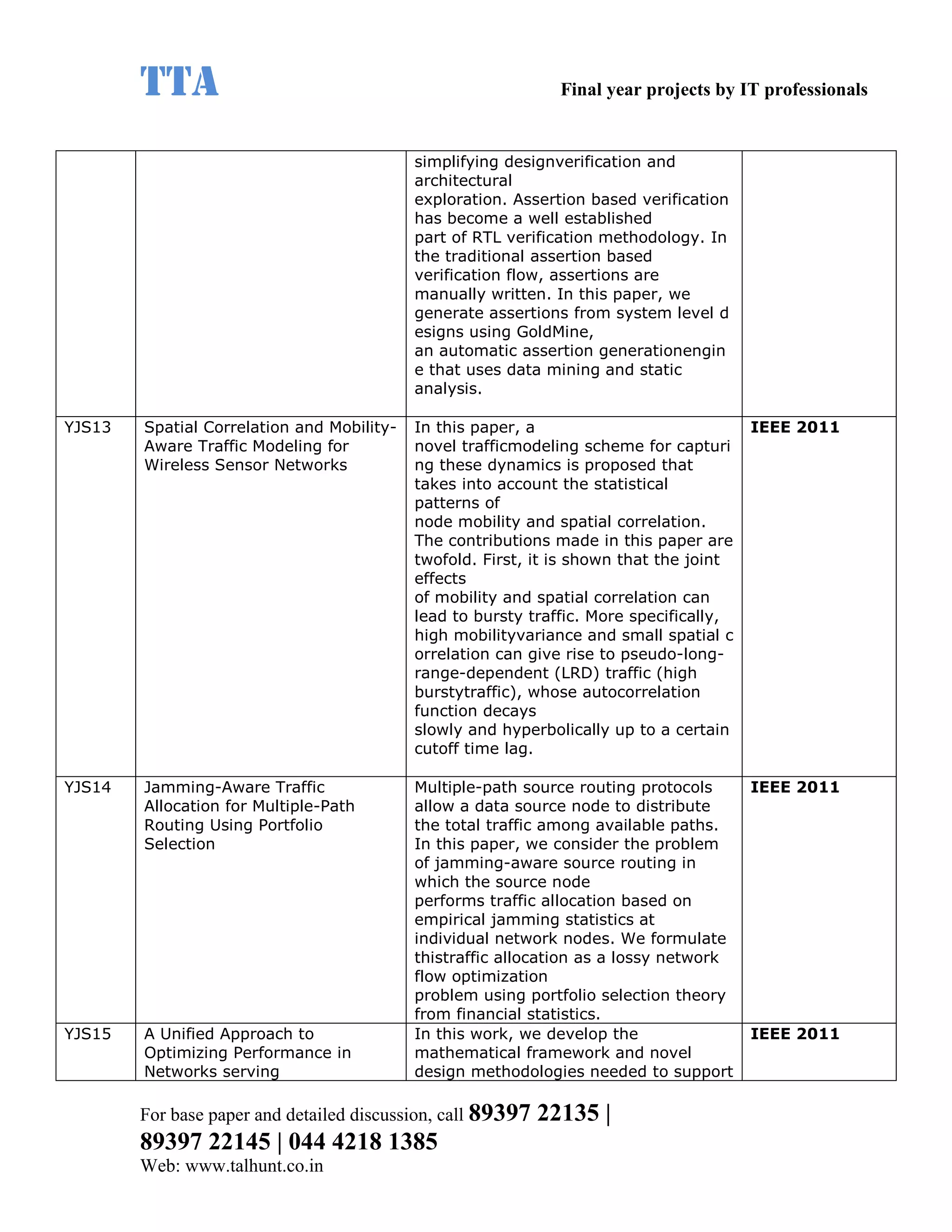
TTA Final year projects by IT professionals degree of any node at most $Delta^* + alpha$ , where $alpha$ and $beta$ are positive constants. YJS09 DAC: Generic and Automatic In this paper, we present DAC, IEEE 2011 Address Configuration for Data a generic andautomatic Data center Add Center Networks ress Configuration system. With an automatically generated blueprint that defines the connections of servers and switches labeled by logical IDs, e.g., IP addresses, DAC first learns the physical topology labeled by device IDs, e.g., MAC addresses. YJS10 Distributed -Optimal User In this paper, we develop a framework IEEE 2011 Association and Cell Load for user association in infrastructure- Balancing in Wireless Networks based wireless networks, specifically focused on flow- level cell load balancing under spatially inhomogeneous traffic distributions. Our work encompasses several different user association policies: rate- optimal, throughput-optimal, delay- optimal, andload-equalizing, which we collectively denote $alpha$- optimal user association. YJS11 MeasuRouting: A Framework for Monitoring transit traffic at one or more IEEE 2011 Routing Assisted Traffic points in a network is of interest to Monitoring network operators for reasons oftraffic accounting, debugging or troubleshooting, forensics, and traffic engineering. Previous research in the area has focused on deriving a placement of monitors across the network toward the end of maximizing the monitoringutility of the network operator for a given traffic routing. However, both traffic characteristics and measurement objectives can dynamically change over time, rendering a previously optimal placement of monitors suboptimal. YJS12 Automatic Generation of System level modeling is widely IEEE 2011 Assertions from System Level employed at early Design Using Data Mining stages of system development for For base paper and detailed discussion, call 89397 22135 | 89397 22145 | 044 4218 1385 Web: www.talhunt.co.in
TTA Final year projects by IT professionals simplifying designverification and architectural exploration. Assertion based verification has become a well established part of RTL verification methodology. In the traditional assertion based verification flow, assertions are manually written. In this paper, we generate assertions from system level d esigns using GoldMine, an automatic assertion generationengin e that uses data mining and static analysis. YJS13 Spatial Correlation and Mobility- In this paper, a IEEE 2011 Aware Traffic Modeling for novel trafficmodeling scheme for capturi Wireless Sensor Networks ng these dynamics is proposed that takes into account the statistical patterns of node mobility and spatial correlation. The contributions made in this paper are twofold. First, it is shown that the joint effects of mobility and spatial correlation can lead to bursty traffic. More specifically, high mobilityvariance and small spatial c orrelation can give rise to pseudo-long- range-dependent (LRD) traffic (high burstytraffic), whose autocorrelation function decays slowly and hyperbolically up to a certain cutoff time lag. YJS14 Jamming-Aware Traffic Multiple-path source routing protocols IEEE 2011 Allocation for Multiple-Path allow a data source node to distribute Routing Using Portfolio the total traffic among available paths. Selection In this paper, we consider the problem of jamming-aware source routing in which the source node performs traffic allocation based on empirical jamming statistics at individual network nodes. We formulate thistraffic allocation as a lossy network flow optimization problem using portfolio selection theory from financial statistics. YJS15 A Unified Approach to In this work, we develop the IEEE 2011 Optimizing Performance in mathematical framework and novel Networks serving design methodologies needed to support For base paper and detailed discussion, call 89397 22135 | 89397 22145 | 044 4218 1385 Web: www.talhunt.co.in
TTA Final year projects by IT professionals Heterogeneous Flows such heterogeneous requirements and propose provably optimal network algorithms that account for the multilevel interactions between the flows. To that end, we first formulate a network optimization problem that incorporates the above throughput and service prioritization requirements of the two traffic types. We, then develop a distributed joint load-balancing and congestion control algorithm that achieves the dual goal of maximizing the aggregate utility gained by the elastic flows while satisfying the fixed throughput and prioritization requirements of the inelastic flows YJS16 Delay Analysis and Optimality This paper focuses on IEEE 2011 of Scheduling Policies for designing and analyzing throughput- Multi-Hop Wireless Networks optimal scheduling policies that avoid using per-flow or per-destination information, maintain a single data queue for each link, exploit only local information, andpotentially improve the delay performance, for multi- hop wireless networks under general interference constraints YJS17 Selfish Overlay Network In this paper, we unify the IEEE 2011 Creation and Maintenance aforementioned thrusts by defining and studying the selfish neighbor selection (SNS) game and its application to overlay routing. At the heart of SNS stands the restriction that peers are allowed up to a certain number of neighbors. This makes SNS substantially different from existingnetwork formation games that impose no bounds on peer degrees. Having bounded degrees has important practical consequences as it permits the creation of overlay structures that require $O(n)$ instead of $O(n^2)$link monitoring overhead. For base paper and detailed discussion, call 89397 22135 | 89397 22145 | 044 4218 1385 Web: www.talhunt.co.in
TTA Final year projects by IT professionals DOMAIN : PARALLEL DISTRIBUTION CODE PROJECT TITLE REFERENCE YJP01 EBRP: Energy-Balanced n this paper, enlightened by the IEEE 2011 Routing Protocol for Data concept of potential in common Gathering in Wireless Sensor physics, we design an Energy- Networks Balanced Routing Protocol (EBRP) by constructing a mixed virtual potential field, including depth, energy density and residual energy to force packets to move towards the sink through the dense energy area so as to protect the nodes with relatively low residual energy. The design principle and guidelines are presented in detail. YJP02 Effective Delay-Controlled This paper proposes a IEEE 2011 Load Distribution over new load distribution model aiming to Multipath Networks minimize the difference among end-to- end delays, thereby reducing packet delay variation and risk of packet reordering without additional network overhead. In general, the lower the risk of packet reordering, the smaller the delay induced by the packet reordering recovery process, i.e., extra delay induced by the packet reordering recovery process is expected to decrease. YJP03 Tracking Dynamic Boundaries We examine the problem IEEE 2011 using Sensor Network of tracking dynamic boundaries occurri ng in natural phenomena using a network of range sensors. Two main challenges of the boundary tracking problem are accurate boundary estimation from noisy observations and continuous tracking of the boundary. We propose Dynamic Boundary Tracking ( DBTR), an algorithm that combines the spatial estimation and temporal For base paper and detailed discussion, call 89397 22135 | 89397 22145 | 044 4218 1385 Web: www.talhunt.co.in
TTA Final year projects by IT professionals estimation techniques. YJP04 CACAO: Distributed Client- In CACAO, the clients feed back traffic IEEE 2011 Assisted Channel Assignment information to their APs. This leads to Optimizationfor better network condition knowledge Uncoordinated WLANs and betterchannel assignment decisions at the APs. We conduct extensive simulation study and comparisons using Network Simulator 2 (NS2). Our results show that CACAO outperforms other traditional and recent schemes in terms of TCP and UDP throughputs with a similar level of fairness. YJP05 Athanasia: A User- This article presents Athanasia, a user- IEEE 2011 Transparent and Fault- transparent and fault- Tolerant System tolerant system, for parallel application for Parallel Applications s running on large-scale cluster systems. Cluster systems have been regarded as a de facto standard to achieve multitera-flop computing power. These cluster systems, as we know, have an inherent failure factor that can cause computation failure. The reliability issue in parallel computing systems, therefore, has been studied for arelatively long time in the literature, and we have seen many theoretical promises arise from the extensive research. YJP06 BECAN: A Bandwidth-Efficient Inthis paper, we IEEE 2011 Cooperative Authentication propose a novel bandwidth- Scheme for Filtering Injected efficient cooperative authentication (BE False Data in Wireless Sensor CAN) scheme for filteringinjected false Networks data. Based on the random graph characteristics of sensor node deployment and the cooperativebit- compressed authentication technique, the proposed BECAN scheme can save energy by early detecting andfiltering the majority of injected false data with minor extra overheads at the en-route nodes. For base paper and detailed discussion, call 89397 22135 | 89397 22145 | 044 4218 1385 Web: www.talhunt.co.in
TTA Final year projects by IT professionals YJP07 Delay Constrained Subtree Virtual world and other IEEE 2011 Homeomorphism Problem collaborative applications are with Applications increasingly becoming popular among Internet users. In such applications, users interact with each other through digital entities or avatars. In order to preserve the user experience, it is important that certain Quality of Service (QoS) requirements (e.g. delay, bandwidth) are satisfied by the interactions. These QoS requirements are usually defined by the application designer. Whenapplications with such QoS requirements are being deployed on a network of servers, an appropriate set of servers capable of satisfying the QoS constraints of the interactions must be identified. YJP08 Efficient communication In this article we show IEEE 2011 algorithms in hexagonal the hexagonal mesh networks develope mesh interconnection d in the early 1990s are a special case networks of the EJnetworks that have been considered more recently. Using a node addressing scheme based on the EJ number system, we give a shortest path routing algorithm for hexagonal mesh n etworks. YJP09 An Efficient Prediction-based This paper proposes predict and relay IEEE 2011 Routing in Disruption- (PER), an efficient routing algorithm for Tolerant Networks DTNs, where nodes determine the probability distribution of future contact times and choose a proper next- hop in order to improve the end-to-end delivery probability. The algorithm is based on two observations: one is that nodes usually move around a set of well-visited landmark points instead of moving randomly; the other is that node mobility behavior is semi- deterministic and could be predicted once there is sufficient mobility history information. YJP10 Bounding the Impact of Self-stabilization is a versatile approach IEEE 2011 For base paper and detailed discussion, call 89397 22135 | 89397 22145 | 044 4218 1385 Web: www.talhunt.co.in
TTA Final year projects by IT professionals Unbounded Attacks to fault-tolerance since it permits a in Stabilization distributed system to recover from any transient fault that arbitrarily corrupts the contents of all memories in the system. Byzantine tolerance is an attractive feature of distributed systems that permits to cope with arbitrary malicious behaviors. Combining these two properties proved difficult: it is impossible to contain the spatial impact of Byzantine nodes in a self-stabilizing context for global tasks such as tree orientation and tree construction. YJP11 Stability Analysis of In this paper, we propose a policy that IEEE 2011 Reservation-Based allows links to transmit data in any Scheduling Policies in future frame by means of frame Wireless Networks reservations. The new, reservation- based distributed scheduling approach will improve the capacity of the system and provide greater throughput. YJP12 Fast Secure Communications This paper proposes three IEEE 2011 in Shared Memory authentication schemes to remove Multiprocessor Systems those security vulnerabilities. First, we prevent replay attacks on data messages by inserting Request Counter (RC) into request messages. Second, we also use RC to detect integrity attacks on control messages. Third, we propose a new counter, referred to as GCC Counter (GC), to protect the global counter messages. We simulated our design with SPLASH-2 benchmarks on up to 16- processor sharedmemory multiprocess or systems by using Simics with Wisconsin multifacet General Execution- drivenMultiprocessor Simulator (GEMS). For base paper and detailed discussion, call 89397 22135 | 89397 22145 | 044 4218 1385 Web: www.talhunt.co.in
TTA Final year projects by IT professionals DOMAIN : IMAGE PROCESSING CODE PROJECT TITLE DESCRIPTION REFERENCE YJI01 A Generalized Accelerated This paper IEEE 2011 Proximal Gradient Approach proposes a generalized accelerated for Total Variation-Based proximal gradient (GAPG) approach Image Restoration for solving total variation(TV)- based image restoration problems. The GAPG algorithm generalizes the original APG algorithm by replacing the Lipschitz constant with an appropriate positive-definite matrix, resulting in faster convergence. For TV- basedimage restoration problems, we further introduce two auxiliary variables that approximate the partial derivatives. Constraints on the variables can easily be imposed without modifying the algorithm much, and the TV regularization can be either isotropic or anisotropic. YJI02 Residues Cluster Based In this paper, IEEE 2011 Segmentation and Outlier- the phase unwrappingproblem is Detection Method for Large- abstracted as solving a large- Scale Phase Unwrapping scale system of inconsistent linear equations. With the difficulties oflarge- scale phase unwrapping analyzed, L 0 -norm criterion is found to have potentials in efficient image tiling andsplicing. Making use of the clustering characteristic of residue distribution, a tiling strategy is proposed for L0-norm criterion. Unfortunately, L0-norm is an NP-hard problem, which is very difficult to find an exact solution in a polynomial time. YJI03 An a priori shading correction Digital imaging devices are increasingly IEEE 2011 technique for contact imaging used for color measurements in fields devices such as forensics, the food industry, and ecological and medical research. Especially concerning the skin, in the follow-up of benign or malignant For base paper and detailed discussion, call 89397 22135 | 89397 22145 | 044 4218 1385 Web: www.talhunt.co.in
TTA Final year projects by IT professionals lesions, it is crucial to ensure that the measured colors are accurate and reproducible. Several color calibration methods having been presented over the last few years YJI04 Spread Spectrum Image Efficient image watermark calls for IEEE 2011 Watermarking Based on full exploitation of Perceptual Quality Metric the perceptual distortion constraint. Second-order statistics of visual stimuli are regarded as critical features for perception. This paper proposes a second-order statistics (SOS) based image quality metric, which considers the texture masking effect and the contrast sensitivity in Karhunen-Loève transform domain. YJI05 Memory-Efficient Architecture Hysteresis thresholding is a method IEEE 2011 for Hysteresis Thresholding that offers and Object Feature Extraction enhanced object detection. Due to its recursive nature, it is time consuming and requires a lot of memory resources. This makes it avoided in streaming processors with limitedmemory. We propose two versions of a memory- efficient and fast architecture for hy steresis thresholding: a high- accuracy pixel- based architecture and a faster block-based one at the expense of some loss in the accuracy. YJI06 Generalized Random Walks In this paper, we propose a novel IEEE 2011 for Fusion of Multi-Exposure probabilistic model- Images based fusion technique for multi- exposure images. Unlike previousmulti- exposure fusion methods, our method aims to achieve an optimal balance between two quality measures, i.e., local contrast and color consistency, while combining the scene details revealed under different exposures. YJI07 Edge Strength Filter Based We propose an orientation- IEEE 2011 Color Filter Array free edge strength lter and apply it For base paper and detailed discussion, call 89397 22135 | 89397 22145 | 044 4218 1385 Web: www.talhunt.co.in
TTA Final year projects by IT professionals Interpolation to the demosaicing problem. Edge strength lter output is utilized both to improve the initial green channel interpolation and to apply the constant color dierence rule adaptively. This simple edge directed method yields visually pleasing results with high CPSNR. YJI08 Towards a Unified Color mage processing methods that IEEE 2011 Space for Perception-Based utilize characteristics of the human Image Processing visual system require color spaces with certain properties to operate effectively. After analyzing different types of perception- based image processingproblems, we present a list of properties a unified color space sho uld have. Due to contradictory perceptual phenomena and geometric issues a color space cannot incorporate all these properties. YJI09 Model-guided Adaptive In compressive sensing (CS) a IEEE 2011 Recovery of Compressive challenge is to find a space in which Sensing the signal is sparse and hence recoverable faithfully. Since many natural signals such as images have locally varying statistics, the sparse space varies in time/spatial domain. As such, CS recovery should be conducted in locally adaptive, signal-dependent spaces to counter the fact that the CS measurements are global and irrespective of signal structures DOMAIN : MOBILE COMPUTING CODE PROJECT TITLE REFERENCE YDM01 Providing Secure Integrity in IEEE Peer-to-peer Oriented Mobile Environments YDM02 RAM: Rate Adaptation in IIEEE Mobile Environments For base paper and detailed discussion, call 89397 22135 | 89397 22145 | 044 4218 1385 Web: www.talhunt.co.in
TTA Final year projects by IT professionals YDM03 Robust Relative Location IEEE Estimation in Wireless Sensor Networks with Inexact Position Problems YDM04 On the Cost of Knowledge of IEEE Mobility in Dynamic Networks: An Information-Theoretic Approach YDM05 A Novel MAC Scheme for IEEE Multi-Channel Cognitive Radio Ad Hoc Networks YDM06 Efficient Virtual Backbone IEEE Construction with Routing Cost Constraint in Wireless Networks using Directional Antennas YDM07 Color Based Fruits IIEEE Classification Using GPU YDM08 Wireless Multicast IEEE Optimization : A Cross-Layer Approach YDM09 Web Content Recommender IEEE System based on Consumer Behavior Modeling YDM10 STORM: A Framework for IEEE Integrated Routing, Scheduling and Traffic Management in Ad Hoc Networks YDM11 Throughput Optimization in IEEE Mobile Backbone Networks DOMAIN : KNOWLEDGE AND DATA ENGINEERING CODE PROJECT TITLE DESCRIPTION REFERENCE YDK01 Motion Segmentation in the IEEE Presence of Outlying, Incomplete, or Corrupted Trajectories YDK02 Segmentation and Sampling IIEEE of Moving Object Trajectories based on Representativeness YDK03 A Query Formulation IEEE Language for the Data Web YDK04 Optimizing Multiway Joins in IEEE For base paper and detailed discussion, call 89397 22135 | 89397 22145 | 044 4218 1385 Web: www.talhunt.co.in
TTA Final year projects by IT professionals a Map-Reduce Environment YDK05 A Survey on Graphical IEEE Methods for Classification Predictive Performance Evaluation YDK06 Efficient and Accurate IEEE Discovery of Patterns in Sequence Data Sets YDK07 Energy Efficient Schemes for IIEEE Accuracy-Guaranteed Sensor Data Aggregation using Scalable Counting YDK08 Optimizing the Calculation of IEEE Conditional Probability Tables in Hybrid BayesianNetworks using Binary Factorization YDK09 A performance anomaly IEEE detection and analysis framework for DBMS development YDK10 Increasing retrieval quality in IEEE conversational recommenders YDK11 Optimizing Multiway Joins in IEEE a Map-Reduce Environment YDK12 Coupled Behavior Analysis IEEE with Applications YDK13 Cascading spatio-temporal IEEE pattern discovery YDK14 Mining Order-Preserving IIEEE Submatrices from Data with Repeated Measurements YDK15 Network Similarity IEEE Decomposition (NSD): A Fast and Scalable Approach to NetworkAlignment YDK16 Data Integrity Proofs in Cloud IEEE Storage YDK17 Efficient Computation of IEEE Range Aggregates against Uncertain Location Based Queries YDK18 Exploring Application-Level IEEE Semantics for Data Compression YDK19 Monitoring Service Systems IEEE from a Language-Action Perspective For base paper and detailed discussion, call 89397 22135 | 89397 22145 | 044 4218 1385 Web: www.talhunt.co.in
TTA Final year projects by IT professionals YDK20 One Size Does Not Fit All: IEEE Towards User- and Query- Dependent Ranking For Web Databases YDK21 Optimal service pricing for a IIEEE cloud cache YDK22 A Personalized Ontology IEEE Model for Web Information Gathering YDK23 Scalable Learning of IEEE Collective Behavior YDK24 The World in a Nutshell: IIEEE Concise Range Queries YDK25 Decision Trees for Uncertain IEEE Data YDK26 The CoQUOS Approach to IEEE Continuous Queries in Unstructured Overlays DOMAIN : MOBILE COMPUTING(j) CODE PROJECT TITLE DESCRIPTION REFERENCE SJM01 Continuous Monitoring IEEE-2009 of Spatial Queries in Wireless Broadcast SJM02 Energy Maps For IEEE-2009 Mobile Wireless networks coherence Time Versues Spreding Period SJM03 Energy-Efficient SINR- IEEE-2009 Based Routing for Multihop Wireless SJM04 Mitigation of Control IEEE-2009 Channel Jamming Under Node Capture Attacks SJM05 Mobility Management IEEE-2009 For base paper and detailed discussion, call 89397 22135 | 89397 22145 | 044 4218 1385 Web: www.talhunt.co.in
TTA Final year projects by IT professionals Approaches for Mobile IP Networks SJM06 SIMPS Using IEEE-2009 Sociology for Personal Mobility SJM07 Intrusion Detection in IEEE-2008 Homogeneous and Heterogeneous Wireless Sensor Networks SJM08 Bandwidth Estimation IEEE-2008 for IEEE 802.11- Based Ad Hoc Networks SJM09 Location Based IEEE-2008 Spatial Query Processing In Wireless Broadcast Environments SJM10 Bandwidth Efficient IEEE-2008 Video Multicasting in Multiradio Muilticellular Wireless DOMAIN : NETWORK COMPUTING CODE PROJECT TITLE DESCRIPTION REFERENCE SJN01 Measuring Capacity IEEE-2009 Bandwidth of Targeted Path Segments SJN02 Evaluating the IEEE-2009 Vulnerability of Network Traffic Using Joint For base paper and detailed discussion, call 89397 22135 | 89397 22145 | 044 4218 1385 Web: www.talhunt.co.in
TTA Final year projects by IT professionals SJN03 Capturing Router IEEE-2009 Congestion and Delay SJN04 Multiple Routing IEEE-2009 Configurations for Fast IP Network Recovery SJN05 Residual-Based IEEE-2009 Estimation of Peer and Link Lifetimes in P2P Networks SJN06 Spatio-Temporal IEEE-2009 Network Anomaly Detection by Assessing Deviations of Empirical Measures SJN07 A Geometric Approach IEEE-2009 to Improving Active Packet Loss Measurement SJN08 Benefit Based Data IEEE-2009 Caching In Ad Hoc Networks SJN09 Minimizing File IEEE-2009 Download Time in Stochastic Peer-to- Peer Networks SJN10 Rate & Delay IEEE-2009 Guarantees Provided By Close Packet Switches with Load Balancing SJN11 Performance of a IEEE-2009 Speculative Transmission Scheme for Scheduling- Latency Reduction For base paper and detailed discussion, call 89397 22135 | 89397 22145 | 044 4218 1385 Web: www.talhunt.co.in
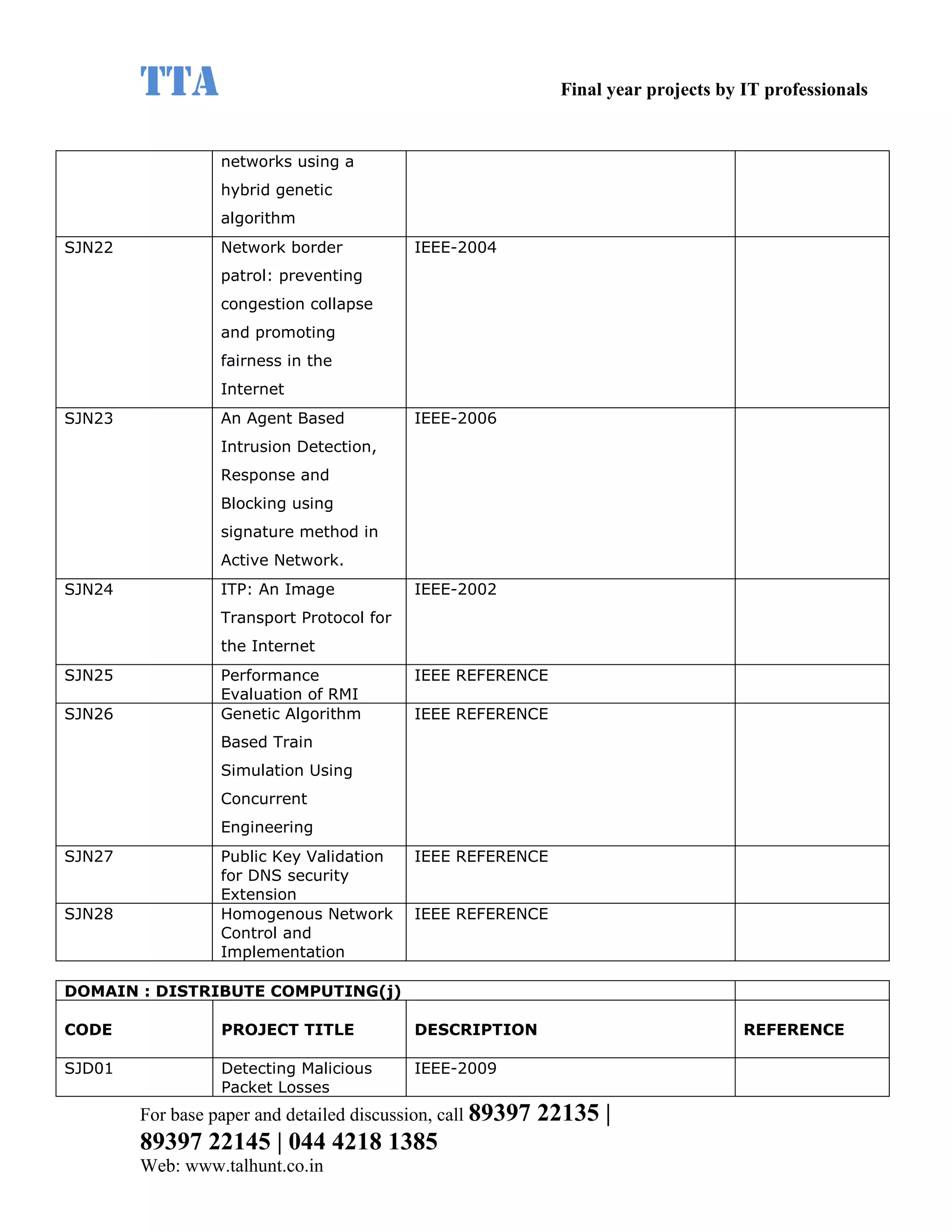
TTA Final year projects by IT professionals SJN12 Dual-Link Failure IEEE-2009 Resiliency through Backup Link Mutual Exclusion SJN13 BRA A Bidirectional IEEE-2009 Routing Abstraction for Asymmetric Mobile Ad Hoc Networks SJN14 Securing User- IEEE-2009 Controlled Routing Infrastructures SJN15 Two Techniques for IEEE 2008 Fast Computation of Constrained Shortest Paths SJN16 Predictive Job IEEE-2005 Scheduling in a Connection Limited System using Parallel Genetic Algorithm SJN17 A Distributed IEEE-2004 Database Architecture for Global Roaming in Next-Generation Mobile Networks SJN18 Location Aided IEEE-2004 Routing In Mobile AD- HOC Networks SJN19 IEEE-2007 An Acknowledgment- Based Approach For The Detection Of Routing Misbehavior In MANETs SJN20 XTC: A Practical IEEE-2004 Topology Control Algorithm for Ad-Hoc Networks SJN21 A near-optimal IEEE-2005 multicast scheme for mobile ad hoc For base paper and detailed discussion, call 89397 22135 | 89397 22145 | 044 4218 1385 Web: www.talhunt.co.in
TTA Final year projects by IT professionals networks using a hybrid genetic algorithm SJN22 Network border IEEE-2004 patrol: preventing congestion collapse and promoting fairness in the Internet SJN23 An Agent Based IEEE-2006 Intrusion Detection, Response and Blocking using signature method in Active Network. SJN24 ITP: An Image IEEE-2002 Transport Protocol for the Internet SJN25 Performance IEEE REFERENCE Evaluation of RMI SJN26 Genetic Algorithm IEEE REFERENCE Based Train Simulation Using Concurrent Engineering SJN27 Public Key Validation IEEE REFERENCE for DNS security Extension SJN28 Homogenous Network IEEE REFERENCE Control and Implementation DOMAIN : DISTRIBUTE COMPUTING(j) CODE PROJECT TITLE DESCRIPTION REFERENCE SJD01 Detecting Malicious IEEE-2009 Packet Losses For base paper and detailed discussion, call 89397 22135 | 89397 22145 | 044 4218 1385 Web: www.talhunt.co.in
TTA Final year projects by IT professionals SJD02 A Distributed Stream IEEE-2009 Query Optimization Framework through Integrated Planning and Deployment SJD03 QUIVER Consistent IEEE-2008 Object Sharing For Edge Services SJD04 Efficient and Secure IEEE-2008 Content Processing and Distribution by Cooperative Intermediaries SJD05 Efficient and Secure IEEE-2008 Content Processing and Distribution by Cooperative Intermediaries SJD06 Distributed cache IEEE-2006 updating for the Dynamic source routing protocol DOMAIN : SECURE COMPUTING CODE PROJECT TITLE DESCRIPTION REFERENCE SJS01 Flexible Rollback IEEE-2009 Recovery in Dynamic Heterogeneous Grid Computing SJS02 Dynamic Routing with IEEE-2009 Security Considerations SJS03 Modeling & IEEE-2008 Automated Containment of Worms SJS04 Controlling IP IEEE-2008 For base paper and detailed discussion, call 89397 22135 | 89397 22145 | 044 4218 1385 Web: www.talhunt.co.in
TTA Final year projects by IT professionals Spoofing Through Inter Domain Packet Filters SJS05 Protection of IEEE-2008 Database Security via Collaborative Inference Detection SJS06 A Precise Termination IEEE-2008 Condition of the Probabilistic Packet Marking Algorithm SJS07 An Adaptive IEEE-2007 Programming Model for Fault-Tolerant Distributed Computing SJS08 Hybrid Intrusion IEEE-2007 Detection with Weighted Signature Generation over Anomalous Internet Episodes (HIDS) SJS09 Application of BPCS IEEE-2004 steganography to wavelet compressed video DOMAIN : IMAGE PROCESSING CODE PROJECT TITLE REFERENCE SJI01 Adaptive Fuzzy IEEE-2009 For base paper and detailed discussion, call 89397 22135 | 89397 22145 | 044 4218 1385 Web: www.talhunt.co.in
TTA Final year projects by IT professionals Filtering for Artifact Reduction in Compressed Images and Videos SJI01 Facial Recognition IEEE-2009 using multisensor images based on localized kernel eigen spaces SJI03 Face Recognition IEEE-2005 Using Laplacian faces SJI04 Noise Reduction by IEEE-2006 Fuzzy Image Filtering Image Processing SJI05 Online Handwritten IEEE-2004 Script Recognition Image Processing SJI06 Structure and Texture IEEE-2004 Filling-In of Missing Image Blocks in Wireless Transmission and Compression App SJI07 Image Stream IEEE-2006 Transfer Using Real- Time Transmission Protocol SJI08 Personal Identification IEEE-2003 Based On Iris Texture Analysis SJI09 Personal IEEE-2006 Authentication Using 3-D Finger Geometry SJI10 Image Compression IEEE REFERENCE For base paper and detailed discussion, call 89397 22135 | 89397 22145 | 044 4218 1385 Web: www.talhunt.co.in
TTA Final year projects by IT professionals and De-compression SJI11 Java water marking IEEE REFERNCE and image combustion DOMAIN : DATA MINING SJDM01 Online Index IEEE-2008 Recommendations for High-Dimensional Databases Using Query Workloads SJDM02 A Signature-Based IEEE-2008 Indexing Method for Efficient Content- Based Retrieval of Relative Temporal Pattern SJDM03 An Efficient IEEE-2008 Association Rule Mining Algorithm In Distributed Databases SJDM04 Truth Discovery with IEEE-2008 multiple Conflicting Information Providers on web SJDM05 ODAM: An Optimized IEEE-2004 Distributed Association Rule Mining Algorithm SJDM06 GHIC A Hierarchical IEEE-2005 Pattern-Based Clustering Algorithm for Grouping Web Transactions DOMAIN : MULTIMEDIA CODE PROJECT TITLE DESCRIPTION REFERENCE For base paper and detailed discussion, call 89397 22135 | 89397 22145 | 044 4218 1385 Web: www.talhunt.co.in
TTA Final year projects by IT professionals SJMUO1 Mobile Agents In IEEE-2004 Distributed Multimedia Database Systems DOMAIN : MOBILE COMPUTING CODE PROJECT TITLE DESCRIPTION REFERENCE SDM01 A Gen2-based RFID IEEE-2009 Authentication Protocol for Security and Privacy SDM02 A Tabu Searching IEEE Algorithm For Cluster Building in Wireless Sensor Networks SDM03 Biased Random Walks IEEE in Uniform Wireless Networks SDM04 Cell Breathing IEEE Techniques for Load Balancing in Wireless LANs SDM05 Greedy Routing with IEEE Anti-Void Traversal for Wirless Sensor Networks SDM06 Information Content- IEEE Based Sensor Selection and Transmission Power Adjustment for Collaborative Target For base paper and detailed discussion, call 89397 22135 | 89397 22145 | 044 4218 1385 Web: www.talhunt.co.in
TTA Final year projects by IT professionals Tracking SDM07 Local Construction of IEEE Near-Optimal Power Spanners for Wireless Ad Hoc Networks SDM08 On the Planning of IEEE Wireless Sensor Networks Energy- Efficient Clustering under the Joint Rout SDM09 Random Cast An IEEE Energy Efficient Communication Scheme for Mobile Ad Hoc Networks SDM10 Route Stability in IEEE MANETs under the Random Direction Mobility Model SDM11 Large Connectivity for IEEE Dynamic Random Geometric Graphs DOMAIN : NETWORK COMPUTING CODE PROJECT TITLE DESCRIPTION REFERENCE SDN01 Analysis of Shortest IEEE-2009 Path Routing for Large Multi-Hop Wireless Networks SDN02 Delay Analysis for IEEE-2009 Maximal Scheduling With Flow Control in Wireless Networks With Bursty Traffic SDN03 Explicit Load IEEE-2009 Balancing Technique for NGEO Satellite Ip Networks With On- Board Processing Capabilities SDN04 Resequencing Analysis IEEE-2009 of Stop-and-Wait ARQ For base paper and detailed discussion, call 89397 22135 | 89397 22145 | 044 4218 1385 Web: www.talhunt.co.in
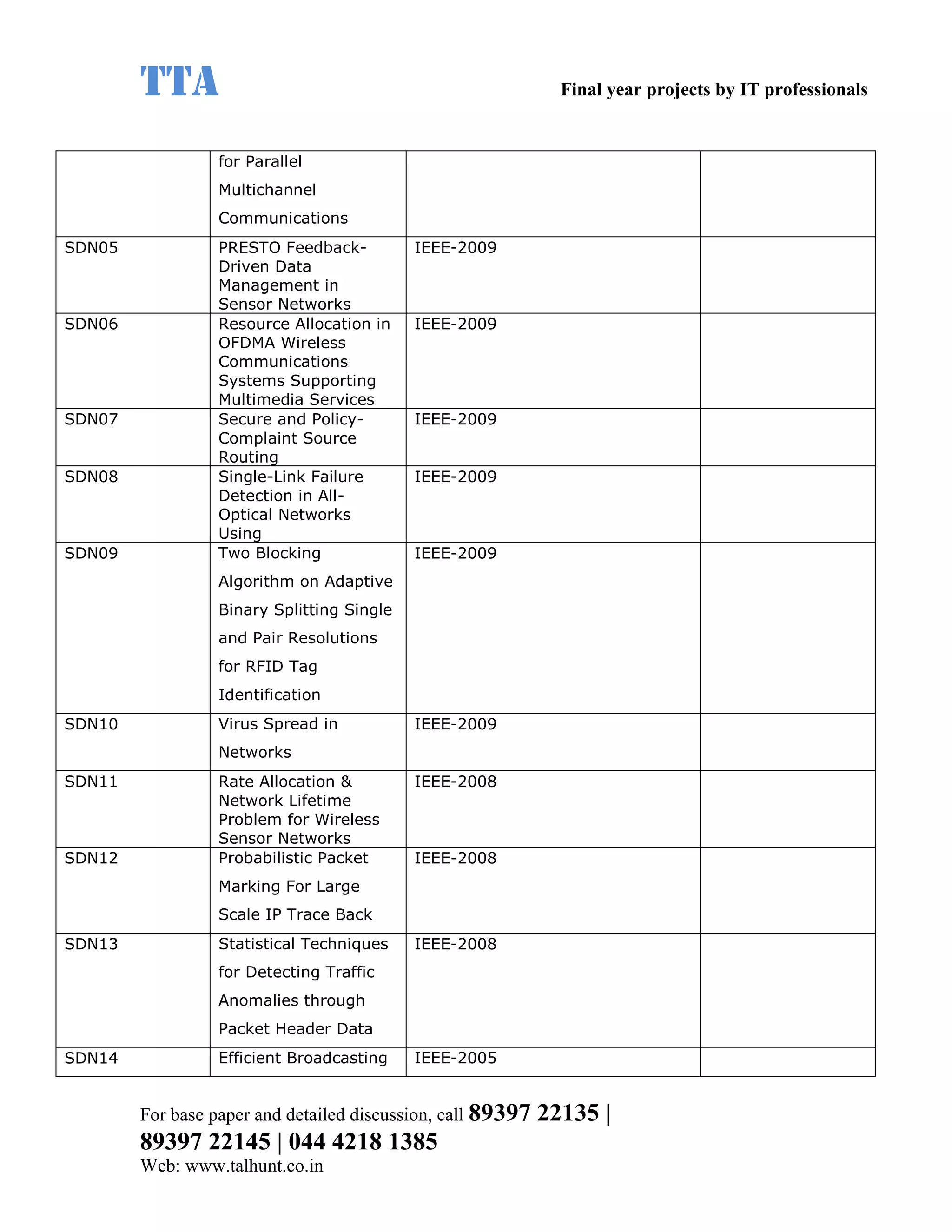
TTA Final year projects by IT professionals for Parallel Multichannel Communications SDN05 PRESTO Feedback- IEEE-2009 Driven Data Management in Sensor Networks SDN06 Resource Allocation in IEEE-2009 OFDMA Wireless Communications Systems Supporting Multimedia Services SDN07 Secure and Policy- IEEE-2009 Complaint Source Routing SDN08 Single-Link Failure IEEE-2009 Detection in All- Optical Networks Using SDN09 Two Blocking IEEE-2009 Algorithm on Adaptive Binary Splitting Single and Pair Resolutions for RFID Tag Identification SDN10 Virus Spread in IEEE-2009 Networks SDN11 Rate Allocation & IEEE-2008 Network Lifetime Problem for Wireless Sensor Networks SDN12 Probabilistic Packet IEEE-2008 Marking For Large Scale IP Trace Back SDN13 Statistical Techniques IEEE-2008 for Detecting Traffic Anomalies through Packet Header Data SDN14 Efficient Broadcasting IEEE-2005 For base paper and detailed discussion, call 89397 22135 | 89397 22145 | 044 4218 1385 Web: www.talhunt.co.in
TTA Final year projects by IT professionals with Guaranteed Coverage in Mobile Ad Hoc Networks SDN15 Multiple Ant Colonies IEEE REFERNCE Optimization for Load Balancing in Distributed Systems DOMAIN : DISTRIBUTE COMPUTING CODE PROJECT TITLE DESCRIPTION REFERENCE SDD01 Compaction of IEEE-2009 Schedules and a Two- Stage Approach for Duplication-Based DAG Scheduling SDD02 Enforcing Minimum- IEEE-2009 Cost Multicast Routing against Shelfish Information Flows SDD03 Movement-Assisted IEEE-2009 Connectivity Restoration in Wireless Sensor and SDD04 HBA Distributed IEEE Metadata Management for Large Cluster- Based Storage Systems DOMAIN : SECURE COMPUTING CODE PROJECT TITLE DESCRIPTION REFERENCE SDS01 Performance of IEEE-2009 Orthogonal Fingerprinting Codes under Worst-Case Noise SDS02 Spread-Spectrum IEEE-2009 Watermarking Security For base paper and detailed discussion, call 89397 22135 | 89397 22145 | 044 4218 1385 Web: www.talhunt.co.in
TTA Final year projects by IT professionals SDS03 The Effectiveness of IEEE-2009 Checksums for Embedded Control Networks SDS04 On the Security of IEEE-2009 Route Discovery in MANETs SDS05 Steganography for IEEE REFERNCE Hiding Data in Wave Audio Files SDS06 Hiding messages in IEEE REFERNCE the Noise of a Picture DOMAIN : IMAGE PROCESSING CODE PROJECT TITLE DESCRIPTION REFERENCE SDJ01 Adaptive Fuzzy IEEE-2009 Filtering for Artifact Reduction in Compressed Images and Videos SDJ02 Facial Recognition IEEE-2009 using multisensor images based on localized kernel eigen spaces SDJ03 Active Learning IEEE-2008 Methods for Interactive Image Retrieval SDJ04 Vision Based IEEE-2008 Processing For Real- Time 3-D Data Acquisition Based On Coded Structured Light For base paper and detailed discussion, call 89397 22135 | 89397 22145 | 044 4218 1385 Web: www.talhunt.co.in
TTA Final year projects by IT professionals SDJ05 Efficient 2-D IEEE-2008 Grayscale Morphological Transformations With Arbitraly Flat Structuring Elements SDJ06 Image Processing IEEE-2006 Techniques for the Detection and Removal of Cracks in Digitized Paintings SDJ07 Neural Networks IEEE-2004 for Unicode Optical Character Recognition SDJ08 Back Propagation IEEE REFERENCE Neural Network for Image Recognition SDJ09 Image Processing for IEEE REFERENCE Edge Detection SDJ10 Hopfield model of IEEE REFERENCE neural network for pattern recognition DOMAIN : CODE PROJECT TITLE DESCRIPTION REFERENCE SDDM01 Hardware enhanced IEEE-2008 association rule mining with Hashing and Pipelining SDDM02 Watermarking IEEE-2008 Relational Databases Using Optimization Based Techniques SDDM03 Workflow Mining IEEE-2004 Discovering Process Models from Event Logs For base paper and detailed discussion, call 89397 22135 | 89397 22145 | 044 4218 1385 Web: www.talhunt.co.in
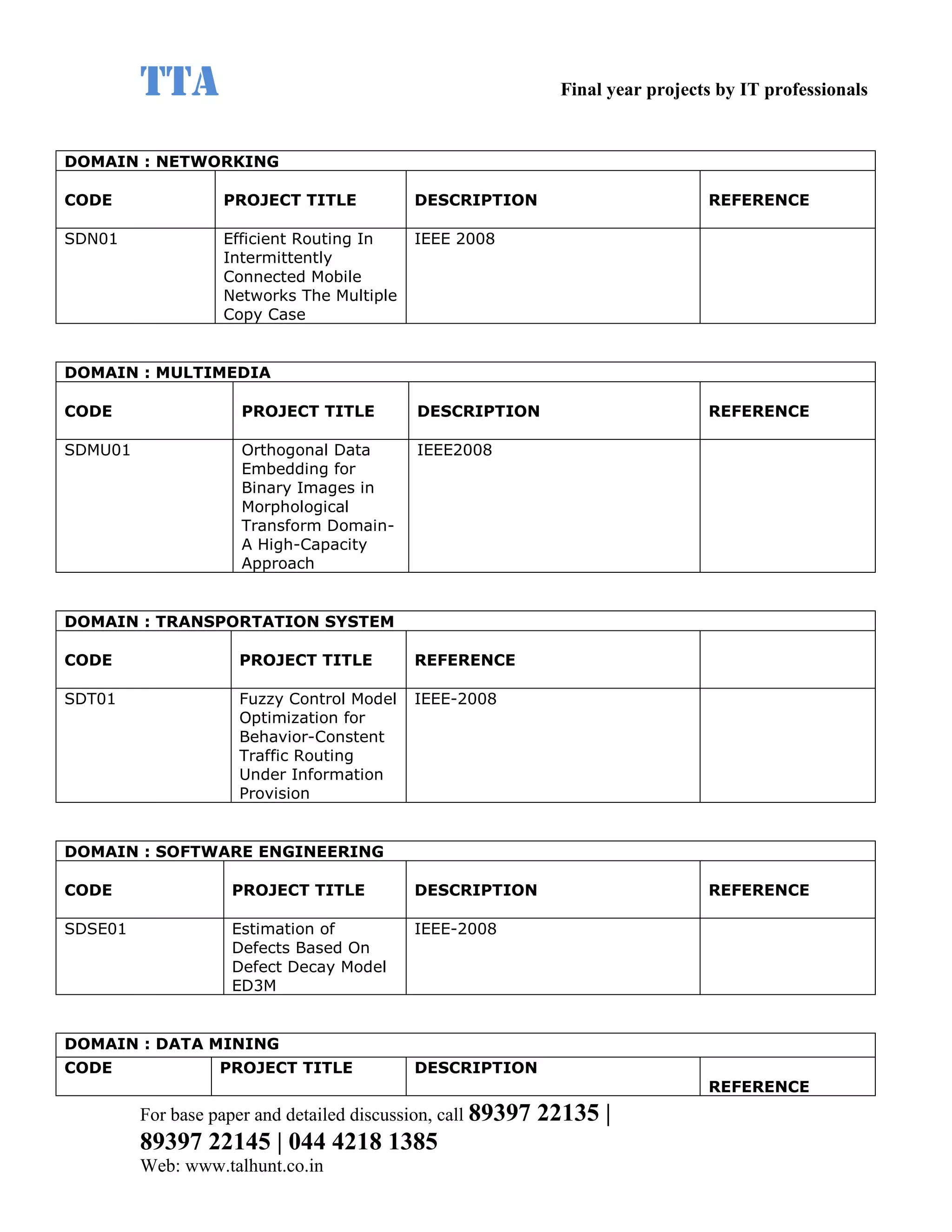
TTA Final year projects by IT professionals DOMAIN : NETWORKING CODE PROJECT TITLE DESCRIPTION REFERENCE SDN01 Efficient Routing In IEEE 2008 Intermittently Connected Mobile Networks The Multiple Copy Case DOMAIN : MULTIMEDIA CODE PROJECT TITLE DESCRIPTION REFERENCE SDMU01 Orthogonal Data IEEE2008 Embedding for Binary Images in Morphological Transform Domain- A High-Capacity Approach DOMAIN : TRANSPORTATION SYSTEM CODE PROJECT TITLE REFERENCE SDT01 Fuzzy Control Model IEEE-2008 Optimization for Behavior-Constent Traffic Routing Under Information Provision DOMAIN : SOFTWARE ENGINEERING CODE PROJECT TITLE DESCRIPTION REFERENCE SDSE01 Estimation of IEEE-2008 Defects Based On Defect Decay Model ED3M DOMAIN : DATA MINING CODE PROJECT TITLE DESCRIPTION REFERENCE For base paper and detailed discussion, call 89397 22135 | 89397 22145 | 044 4218 1385 Web: www.talhunt.co.in
TTA Final year projects by IT professionals JJD01 Answering Frequent IEEE Probabilistic Inference Queries in Databases JJD02 A Dual Framework and IEEE Algorithms for Targeted Online Data Delivery JJD03 A Fuzzy Self- IEEE Constructing Feature Clustering Algorithm for Text Classification JJD04 A Link-Analysis IEEE Extension of Correspondence Analysis for Mining RDs JJD05 Adaptive Cluster IEEE Distance Bounding for High Dimensional Indexing JJD06 Adaptive Provisioning IEEE of Human Expertise in Service-oriented Systems JJD07 Data Integrity Proofs IEEE in Cloud Storage JJD08 Decision Trees for IEEE Uncertain Data JJD09 Discovering IEEE Conditional Functional Dependencies JJD10 Effective Navigation of IEEE Query Results Based on Concept Hierarchies JJD11 Efficient Computation IEEE of Range Aggregates against Uncertain Location Based Queries JJD12 Exploring Application- IEEE Level Semantics for Data Compression JJD13 Extended XML Tree IEEE Pattern Matching: Theories and Algorithms JJD14 Improving Aggregate IEEE Recommendation For base paper and detailed discussion, call 89397 22135 | 89397 22145 | 044 4218 1385 Web: www.talhunt.co.in
TTA Final year projects by IT professionals Diversity Using Ranking-Based Techniques JJD15 Integration of Sound IEEE Signature in Graphical Password Authentication System JJD16 Learning Semi- IEEE Riemannian Metrics for Semi supervised Feature Extraction JJD17 One Size Does Not Fit IEEE All: Towards User- and Query-Dependent Ranking For Web Databases JJD18 Ranking Spatial Data IEEE by Quality Preferences JJD19 Scalable Learning of IEEE Collective Behavior JJD20 The CoQUOS IEEE Approach to Continuous Queries in Unstructured Overlays JJD21 The World in a IEEE Nutshell:Concise Range Queries JJD22 Estimating the IEEE Helpfulness and Economic Impact of Product Reviews: MiningText and Reviewer Characteristics JJD23 Publishing Search IEEE Logs – A Comparative Study of Privacy Guarantees For base paper and detailed discussion, call 89397 22135 | 89397 22145 | 044 4218 1385 Web: www.talhunt.co.in
TTA Final year projects by IT professionals DOMAIN : CLOUD COMPUTING CODE PROJECT TITLE DESCRIPTION REFERENCE JJC01 Going Back and Forth: IEEE Efficient Multideployment and Multisnapshotting on Clouds JJC02 Improving Utilization IEEE of Infrastructure JJC03 26 Secure and IEEE Practical Outsourcing of Linear Programming in Cloud Computing JJC04 Optimal service pricing IEEE for a cloud cache JJC05 Automated IEEE Certification for Compliant Cloud- based Business Processes DOMAIN : SERVICE COMPUTING CODE PROJECT TITLE DESCRIPTION REFERENCE JJS01 Vulnerability Analysis IEEE in SOA-based Business Processes DOMAIN : WEB SERVICE CODE PROJECT TITLE DESCRIPTION REFERENCE JJW01 A Personalized IEEE Ontology Model for Web Information Gathering For base paper and detailed discussion, call 89397 22135 | 89397 22145 | 044 4218 1385 Web: www.talhunt.co.in
TTA Final year projects by IT professionals DOMAIN : MOBILE COMPUTING CODE PROJECT TITLE DESCRIPTION REFERENCE JJM01 A Privacy-Preserving IEEE Location Monitoring System for Wireless Sensor Networks JJM02 Optimal Stochastic IEEE Location Updates in Mobile Ad Hoc Networks JJM03 Supporting Efficient IEEE and Scalable Multicasting over Mobile Ad Hoc Networks JJM04 Throughput IEEE Optimization in Mobile Backbone Networks JJM05 Load Shedding in IEEE Mobile Systems with MobiQual JJM06 Cognitive Radio based IEEE Wireless Sensor Network Architecture for Smart Grid Utility JJM07 A Cooperative IEEE Diversity- Based Robust MAC Protocol in Wireless Ad Hoc JJM08 Performance C IEEE haracterization for IEEE 802.11p Network With Single Channel Devices JJM09 Energy Efficiency of IEEE MAC protocols in Wireless Sensor Networks JJM10 Energy efficient IEEE localized routing algorithm for Wireless Sensor Networks JJM011 Energy Efficient IEEE Routing Protocol for Wireless Sensor Networks with Node and Sink Mobility For base paper and detailed discussion, call 89397 22135 | 89397 22145 | 044 4218 1385 Web: www.talhunt.co.in
TTA Final year projects by IT professionals JJM012 Dynamic Location IEEE Update Scheme for Mobile Sinks in Wireless Sensor Networks JJM013 98 Modeling and IEEE Improving TCP Performance over Cellular Link with Variable Bandwidth JJM014 Expected Routing IEEE Overhead for Location Service in MANETs under Flat Geographic Routing JJM015 Temporal Link IEEE Signature Measurements for Location Distinction DOMAIN : NETWORK AND SERVICE MANAGEMENT CODE PROJECT TITLE DESCRIPTION REFERENCE JJN01 Locating Equivalent IEEE Servants over P2P Networks DOMAIN : NETWORK COMPUTING CODE PROJECT TITLE DESCRIPTION REFERENCE JJN01 Improved division by IEEE invariant integers DOMAIN : PARALLEL AND DISTRIBUTED COMPUTING CODE PROJECT TITLE DESCRIPTION REFERENCE For base paper and detailed discussion, call 89397 22135 | 89397 22145 | 044 4218 1385 Web: www.talhunt.co.in
TTA Final year projects by IT professionals JJP01 A Generic Framework IEEE for Three-Factor Authentication: Preserving Security and Privacy in Distributed Systems JJP02 Exploiting Dynamic IEEE Resource Allocation for Efficient Parallel Data Processing in the Cloud DOMAIN : SECURE COMPUTING CODE PROJECT TITLE DESCRIPTION REFERENCE JJS01 A Distributed Algorithm IEEE for Finding All Best Swap Edges of a Minimum Diameter Spanning Tree JJS02 A Fault-Tolerant Token- IEEE Based Atomic Broadcast Algorithm JJS03 A Policy Enforcing IEEE Mechanism for Trusted Ad Hoc Networks JJS04 A Tamper-Resistant IEEE Programming Language System JJS05 Adaptive Fault Tolerant IEEE QoS Control Algorithms for Maximizing System Lifetime of Query-Based Wireless Sensor Networks JJS06 Balancing Revocation IEEE and Storage Trade-Offs in Secure Group Communication For base paper and detailed discussion, call 89397 22135 | 89397 22145 | 044 4218 1385 Web: www.talhunt.co.in
TTA Final year projects by IT professionals JJS07 Chip Self-Organization IEEE and Fault-Tolerance in Massively Defective Multicore Arrays JJS08 Comparative Evaluation IEEE of Spoofing Defenses JJS09 48 Mechanism Design- IEEE Based Secure Leader Election Model for Intrusion Detection in MANET JJS10 Modeling and Detection IEEE of Camouflaging Worm JJS11 Nymble: Blocking IEEE Misbehaving Users in Anonymizing Networks JJS12 RITAS: Services for IEEE Randomized Intrusion Tolerance JJS13 Robust Correlation of IEEE Encrypted Attack Traffic through Stepping Stones by Flow Watermarking JJS14 SAT: A Security IEEE Architecture AchievingAnonymity and Traceability in Wireless Mesh Networks JJS15 The Geometric Efficient IEEE Matching Algorithm for Firewalls JJS16 Analyzing a Family of IEEE Key Protection Schemes against Modification Attacks JJS17 Distributed Detection of IEEE Clone Attacks in Wireless Sensor Network JJS18 Prime: Byzantine IEEE Replication under Attack JJS19 Securing Topology IEEE Maintenance Protocols for Sensor Networks JJS20 ELMO: Energy Aware IEEE Local Monitoring in For base paper and detailed discussion, call 89397 22135 | 89397 22145 | 044 4218 1385 Web: www.talhunt.co.in
TTA Final year projects by IT professionals Sensor Networks DOMAIN : SOFTWARE ENGINEERING CODE PROJECT TITLE DESCRIPTION REFERENCE JJSE01 A Comparative Study of IEEE Software Model Checkers as Unit Testing Tools:An Industrial Case Study JJSE02 Developing a Single IEEE Model and Test Prioritization Strategies for Event-Driven Software JJSE03 Genetic Algorithms for IEEE Randomized Unit Testing JJSE04 Semi-Proving: An IEEE Integrated Method for Program Proving, Testing, and Debugging JJSE05 Software Module IEEE Clustering as a Multi– Objective Search Problem JJSE06 The Awareness IEEE Network, To Whom Should I Display My Actions? And, Whose Actions Should I Monitor? JJSE07 Verifying the Evolution IEEE of Probability Distributions Governed by a DTMC DOMAIN : WIRELESS COMMUNICATION For base paper and detailed discussion, call 89397 22135 | 89397 22145 | 044 4218 1385 Web: www.talhunt.co.in
TTA Final year projects by IT professionals CODE PROJECT TITLE DESCRIPTION REFERENCE JJW01 A Spatiotemporal IEEE Approach for Secure Range Queries in Tiered Sensor Networks JJW02 A Threshold-Selective IEEE Multiuser Downlink MACscheme for 802.11n Wireless Networks JJW03 Blind Channel IEEE Estimation for STBC Systems Using Higher- Order Statistics JJW04 Distributed Adaptation IEEE of Quantized Feedback for Downlink Network MIMO Systems JJW05 Fundamental Limits of IEEE Information Dissemination in Wireless Ad Hoc Networks–Part II: Multi-Packet Reception JJW06 Generalized Analysis of IEEE a Distributed Energy Efficient Algorithm for Change Detection JJW07 Improving the IEEE Performance of Wireless Ad Hoc Networks Through MAC Layer Design JJW08 Network Coding Based IEEE Privacy Preservation against Traffic Analysis in Multi-hop Wireless Networks JJW09 Throughput IEEE Optimization in High Speed DownlinkPacket Access (HSDPA) JJW10 Utility-Optimal Multi- IEEE Pattern Reuse in Multi- Cell Networks JJW11 Weighted Energy IEEE Detection for Noncoherent Ultra- Wideband Receiver For base paper and detailed discussion, call 89397 22135 | 89397 22145 | 044 4218 1385 Web: www.talhunt.co.in
TTA Final year projects by IT professionals Design DOMAIN : NETWORKING CODE PROJECT TITLE DESCRIPTION REFERENCE JJN01 A Unified Approach to IEEE Optimizing Performance in Networks serving Heterogeneous Flows JJN02 Buffer Sizing for 802.11 IEEE Based Networks JJN03 Continuous Neighbor IEEE Discovery in Asynchronous Sensor Networks JJN04 Delay Analysis and IEEE Optimality of Scheduling Policies for Multi-Hop Wireless Networks JJN05 Is Cloned Code older IEEE than Non-Cloned Code? JJN06 Jamming-Aware Traffic IEEE Allocation for Multiple- Path Routing Using Portfolio Selection JJN07 Live Streaming with IEEE Receiver-based Peer- division Multiplexing JJN08 Monitoring Service IEEE Systems from a Language-Action Perspective JJN09 ProgME: Towards IEEE Programmable Network Measurement JJN10 Selfish Overlay Network IEEE Creation and Maintenance JJN11 SPAF: Stateless FSA- IEEE based Packet Filters JJN12 Topological IEEE Transformation Approaches to TCAM- Based Packet Classification JJN13 Achieving Bounded IEEE For base paper and detailed discussion, call 89397 22135 | 89397 22145 | 044 4218 1385 Web: www.talhunt.co.in
TTA Final year projects by IT professionals Matching Delay and Maximized Throughput in Information MATLAB Scalable Face Image Retrieval with Identity- JM01 Based IEEE 2011 Quantization and Multi-Reference Re-ranking No-Reference Metric Design With Machine JM02 Learning for Local Video Compression Artifact IEEE 2011 Level Enhanced Assessment of the Wound-Healing JM03 Process by Accurate Multiview Tissue IEEE 2011 Classification Enhanced Assessment of the Wound-Healing JM04 Process by Accurate Multiview Tissue IEEE 2011 Classification Face Recognition by Exploring Information JM05 Jointly in Space, Scale and Orientation IEEE 2011 Mixture of Gaussians-Based Background JM06 Subtraction for Bayer-Pattern Image IEEE 2011 Sequences A Novel 3-D Color Histogram Equalization JM07 Method With Uniform 1-D Gray Scale IEEE 2011 Histogram Color Extended Visual Cryptography JM08 Using Error Diffusion IEEE 2011 Using a Visual Discrimination Model for the JM09 Detection of Compression Artifacts in Virtual IEEE 2011 Pathology Images Detection of Architectural Distortion JM10 in Prior Mammograms IEEE 2011 A Differential Geometric Approach to JM11 Automated Segmentation of Human Airway IEEE 2011 Tree For base paper and detailed discussion, call 89397 22135 | 89397 22145 | 044 4218 1385 Web: www.talhunt.co.in
TTA Final year projects by IT professionals A Supervised Framework for the JM12 Registration and Segmentation of White IEEE 2011 Matter Fiber Tracts Curvature Interpolation Method for Image JM13 Zooming IEEE 2011 IMAGE Resolution Enhancement by Using JM14 Discrete and IEEE 2011 Stationary Wavelet Decomposition Text Segmentation for MRC Document JM16 Compression IEEE 2011 NON IEEE JNIEEJD01 Airline Reservation System JNIEEJD02 Appointment Scheduler JNIEEJD03 B2C-Ecommerce Portal JNIEEJD04 E RP for Small Business JNIEEJD05 Workflow Automation System JNIEEJD06 Website Search Engine JNIEEJD07 Web portal for Internet and Intranet JNIEEJD08 Warehouse Management System JNIEEJD09 Webportal on online community System JNIEEJD10 Travel Management System JNIEEJD11 Payroll Processing System JNIEEJD12 Resume Tracking Sys tem JNIEEJD13 Purchase Order System JNIEEJD14 Online File Uploading System JNIEEJD15 Quality Function Deployment JNIEEJD16 Operation Scheduling JNIEEJD17 Online-Shopping JNIEEJD18 Banking JNIEEJD19 Browsing Centre Automation JNIEEJD20 Boutique Management System For base paper and detailed discussion, call 89397 22135 | 89397 22145 | 044 4218 1385 Web: www.talhunt.co.in
TTA Final year projects by IT professionals JNIEEJD21 Call Management System JNIEEJD22 Cement Dealer Management System JNIEEJD23 Civil supply maintenance System JNIEEJD24 Consensus of commission agency JNIEEJD25 Electricity JNIEEJD26 Firm Management system JNIEEJD27 Hotel Management System JNIEEJD28 Insurance JNIEEJD29 Journal Management JNIEEJD30 L IC JNIEEJD31 Management Information System JNIEEJD32 Mobile service Provider System JNIEEJD33 Multiplexx JNIEEJD34 Production and Planning Control JNIEEJD35 Project Cargo JNIEEJD36 Stock Inventory System JNIEEJD37 Super Market JNIEEJD38 Trade Management System JNIEEJD39 B U S Reservation System JNIEEJD40 IT Tutor Automation JNIEEJD41 Online Certification Exam JNIEEJD42 Civil Registry System JNIEEJD43 Hospital Medi Fedora JNIEEJD44 Budget Analyzer JNIEEJD45 Centralized Vendor Management Portal JNIEEJD46 Digital Library Management System JNIEEJD47 Railway Management System JNIEEJD48 Sniffer Mail JNIEEJD49 Bar Coding System JNIEEJD50 E-Fund Transfer JNIEEJD51 Chat Engine in E-Banking JNIEEJD52 FTP and S MTP Server SYSTEM /NETWORK PROJECT TITLE For base paper and detailed discussion, call 89397 22135 | 89397 22145 | 044 4218 1385 Web: www.talhunt.co.in
TTA Final year projects by IT professionals JNIEENS01 Advanced File Splitter and Merger(System) JNIEENS02 ATM Network Simulation(System) JNIEENS03 Communication Management Protocol Library JNIEENS04 COOL-PIE(System) JNIEENS05 Enumerating Login Session(System) JNIEENS06 Execute Application on Remote System(System) JNIEENS07 Firewall Protection(System) JNIEENS08 File Management(System) JNIEENS09 File Transfer(System) JNIEENS10 File Watch(System) JNIEENS11 File Spy(System) JNIEENS12 HTTP Tunneling(System) JNIEENS13 Image Compression(System) JNIEENS14 Image Compression Using Port (System) JNIEENS15 HTML Editor (Application) JNIEENS16 J-Messenger(Application) JNIEENS17 Net Watchman(System) JNIEENS18 NetBIOS Enumerator(System) JNIEENS19 Network Analyzer(System) JNIEENS20 Mini Server(System) JNIEENS21 Port Scanner(System) JNIEENS22 Proxy Server JNIEENS23 Remote Control PC Through Internet JNIEENS24 Remote Control PC Through LAN JNIEENS25 Remote Processes and Machine Control We are open to prepare and guide any new ideas on any domain/Technology. If you have any topics that should be done, please send the topic to leads@talhunt.co.in For base paper and detailed discussion, call 89397 22135 | 89397 22145 | 044 4218 1385 Web: www.talhunt.co.in

.Net project titles 2011, Real time projects in .net, Java Final year projects, .Net Final year projects,

  • 1.
    TTA FINAL YEAR PROJECTS TITLES WITH ABSTRACT IEEE 2011, 2010, 2009, 2008 , etc… Projects for B.E/B.Tech/M.E/Bsc/Msc For complete base paper, call now and talk to our expert 89397 22135 | 89397 22145 | 044 4218 1385
  • 2.
    TTA Final year projects by IT professionals JAVA - DOMAIN : MOBILE COMPUTING CODE PROJECT TITLE DESCRIPTION REFERENCE YJM01 Reliability Improvement A new interference management scheme is Using Receive Mode proposed to improve the reliability of Selection in the Device- a device-to-device (D2D) to-Device Uplink Period communication in the uplink (UL) period wit IEEE 2011 Under laying Cellular hout reducing the power of cellular user Networks equipment (UE). To improve the reliability of the D2D receiver, two conventional receive techniques and one proposed method are introduced. One YJM02 Map-Based Location and Technical enhancements IEEE 2011 Tracking in Multipath of mobile technologies are paving the way to Outdoor Mobile Networks the definition of high-quality and accurate geolocation solutions based on data collected and managed by GSM/3G networks. We present a technique that provides geolocation and mobility prediction both at network and service level, does not require any change to the existing mobile network infrastructure, and i s entirely performed on the mobile network side YJM03 Distributed lgorithms for A widely applied strategy for workload IEEE 2011 Environment Partitioning sharing is to equalize the workload assigned in Mobile Robotic to each resource. In mobilemultiagent Networks systems, this principle directly leads to equitable partitioning policies whereby: 1) the environment is equitably divided into subregions of equal measure; 2) one agent is assigned to each subregion; and 3) each agent is responsible for service requests originating within its own subregion. YJM04 Photo Retrieval based on In this paper IEEE 2011 Spatial Layout with new photo retrieval system for mobile device Hardware Acceleration for s is proposed. The system can be used to Mobile Devices search for photos withsimilar spatial layouts efficiently, and it adopts an image segmentation algorithm that extracts features of image regions based on K-Means clustering. Since K-Means is computationally intensive for real-time applications and prone to generate clustering For base paper and detailed discussion, call 89397 22135 | 89397 22145 | 044 4218 1385 Web: www.talhunt.co.in
  • 3.
    TTA Final year projects by IT professionals results with local optima, parallel hardware architectures are designed to meet the real-time requirement of the retrieval process. YJM05 Hop-by-hop Routing in Wireless Mesh Network (WMN) has become IEEE 2011 Wireless Mesh Networks an important edge network to provide with Bandwidth Internet access to remote areas Guarantees and wireless connections in a metropolitan scale. In this paper, we study the problem of identifying the maximum available bandwidth path, a fundamental issue in supporting quality-of- service in WMNs YJM06 Cooperating with The use of smart antennas in multi- IEEE 2011 Smartness: Using hop wireless networks (MWNs) has garnered Heterogeneous Smart significant attention over the last few years. Antennas in Multi-hop While homogeneous MWNs with all nodes Wireless Networks having the same antenna capabilities will have certain applications, we argue that MWNs with nodes having heterogeneous antenna capabilities are more likely to be the norm due to a variety of motivating factors. YJM07 Local Greedy In recent years, there has been a significant IEEE 2011 Approximation for amount of work done in developing low- Scheduling in Multi-hop complexity schedulingschemes to achieve Wireless Networks high performance in multi- hop wireless networks. A centralized sub- optimal schedulingpolicy, called Greedy Maximal Scheduling (GMS) is a good candidate because its empirically observed performance is close to optimal in a variety of network settings. YJM08 Network Connectivity We investigate the communication IEEE 2011 with a Family of Group range of the nodes necessary Mobility Models for network connectivity, which we call bi- directional connectivity, in a simple setting. Unlike in most of existing studies, however, the locations ormobilities of the nodes may be correlated through group mobility: Nodes are broken into groups, with each groupcomprising the same number of nodes, and lie on a unit circle. The locations of the nodes in the same group are not mutually independent, but are instead conditionally independent given the location of the group. We examine the distribution of the smallest communication For base paper and detailed discussion, call 89397 22135 | 89397 22145 | 044 4218 1385 Web: www.talhunt.co.in
  • 4.
    TTA Final year projects by IT professionals YJM09 Towards Reliable Data This paper addresses the problem of IEEE 2011 Delivery for Highly delivering data packets for highly dynamic m Dynamic Mobile Ad Hoc obile ad hoc networks in areliable and timely Networks manner. Most existing ad hoc routing protocols are susceptible to node mobility, especially forlarge-scale networks. Driven by this issue, we propose an efficient Position based Opportunistic Routing protocol (POR) which takes advantage of the stateless property of geographic routing and the broadcast nature of wireless medium. YJM10 Local Broadcast There are two main approaches, static and IEEE 2011 Algorithms in Wireless Ad dynamic, in broadcast algorithms in wireless Hoc Networks: Reducing ad hoc networks. In thestatic the Number of approach, local algorithms determine the sta Transmissions tus (forwarding/non-forwarding) of each node proactively based on local topology information and a globally known priority function. In this paper, we first show that localbroadcast algorithms based on the static approach cannot achieve a good approximation factor to the optimum solution (an NP-hard problem). YJM11 A Privacy-Preserving Monitoring personal locations with a potentia IEEE 2011 Location Monitoring lly untrusted server poses privacy threats to System for Wireless the monitored individuals. To this end, we Sensor Networks propose a privacy- preserving location monitoring system for wi reless sensornetworks. In our system, we design two in- network location anonymization algorithms, namely, resource and quality-aware algorithms, that aim to enable the system to provide high- quality location monitoring services forsyste m users, while preserving personal location privacy YJM12 Optimal Stochastic We consider IEEE 2011 Location Updates in the location service in a mobile ad- Mobile Ad Hoc Networks hoc network (MANET), where each node needs to maintain itslocation information by 1) frequently updating its location information within its neighboring region, which is called neighborhood update (NU), and 2) occasionally updating its location information to certain distributedlocation server in the network, which is called location server update (LSU). For base paper and detailed discussion, call 89397 22135 | 89397 22145 | 044 4218 1385 Web: www.talhunt.co.in
  • 5.
    TTA Final year projects by IT professionals YJM13 Supporting Efficient and Group communications are important IEEE 2011 Scalable Multicasting over in Mobile Ad hoc Networks (MANETs). Mobile Ad Hoc Networks Multicast is an efficient method for implementing group communications. However, it is challenging to implement efficient and scalable multicast in MANET due to the difficulty in group membership management and multicast packet forwarding over a dynamic topology. We propose a novel Efficient Geographic Multicast Protocol (EGMP). JAVA - DOMAIN : KNOWLEDGE AND DATA ENGINEERING CODE PROJECT TITLE DESCRIPTION REFERENCE YJK01 Motion Segmentation Group communications are important IEEE 2011 using the Hadamard in Mobile Ad hoc Networks (MANETs). Product and Spectral Multicast is an efficient method for Clustering implementing group communications. However, it is challenging to implement efficient and scalable multicas t in MANET due to the difficulty in group membership management and multicast packet forwarding over a dynamic topology YJK02 A Unified Probabilistic In this paper, we formalize the IEEE 2011 Framework for Name problem in a unified probabilisticframewo Disambiguation in Digital rk, which incorporates both attributes Library and relationships. Specifically, we define a disambiguationobjective function for the problem and propose a two-step parameter estimation algorithm. We also investigate adynamic approach for estimating the number of people K. YJK03 Improving Aggregate In this paper, we introduce and explore a IEEE 2011 Recommendation number of item ranking techniques that Diversity can generate recommendations that Using Ranking-Based have substantially Techniques higher aggregate diversity across all users while maintaining comparable levels of recommendation accuracy. Comprehensive empirical evaluation consistently shows the diversity gains of For base paper and detailed discussion, call 89397 22135 | 89397 22145 | 044 4218 1385 Web: www.talhunt.co.in
  • 6.
    TTA Final year projects by IT professionals the proposed techniques using several real-world rating datasets and different rating prediction algorithms. YJK04 Publishing Search Logs – In this paper we analyze algorithms IEEE 2011 A Comparative Study of for publishing frequent keywords, queries Privacy Guarantees and clicks of a search log. We first show how methods that achieve variants of k- anonymity are vulnerable to active attacks. We then demonstrate that the stronger guarantee ensured by epsilon- differential privacy unfortunately does not provide any utility for this problem. We then propose a novel algorithm ZEALOUS and show how to set its parameters to achieve (epsilon, delta)- probabilistic privacy. YJK05 Cluster Oriented This paper presents a IEEE 2011 Ensemble Classifier: novel cluster oriented ensemble classifier Impact of Multi-cluster . The proposed ensemble classifier is Characterization on based onoriginal concepts such Ensemble Classifier as learning of cluster boundaries by the Learning. base classifiers and mapping of clusterconfidences to class decision using a fusion classifier. The categorised data set is characterised into multipleclusters and fed to a number of distinctive base classifiers. YJK06 Visual Role Mining: A This paper offers a new role engineering IEEE 2011 Picture Is Worth a approach to Role-Based Access Control Thousand Roles (RBAC), referred to as visualrole mining. The key idea is to graphically represent user-permission assignments to enable quick analysis and elicitation of meaningful roles. First, we formally define the problem by introducing a metric for the quality of the visualization. YJK07 A Knowledge-Driven This paper introduces a knowledge- IEEE 2011 Approach to Activity driven approach to real-time, Recognition in Smart continuous activity recognition based on Homes multi-sensor data streams in smart homes. The approach goes beyond the traditional data-centric methods for activityrecognition in three ways. Firstly, it makes extensive use of domain knowledge in the lifecycle of activityrecognition. Secondly, it uses For base paper and detailed discussion, call 89397 22135 | 89397 22145 | 044 4218 1385 Web: www.talhunt.co.in
  • 7.
    TTA Final year projects by IT professionals ontologies for explicit context and activity modeling and representation. Thirdly and finally, it exploits semantic reasoning and classification for activity inferencing, thus enabling both coarse-grained and fine- grained activity recognition. YJK08 Finding Top-k Answers in in this paper, we study how to integrate IEEE 2011 Keyword Search over multiple related tuple units to Relational Databases effectively answerkeyword queries. To Using Tuple Units achieve a high performance, we devise two novel indexes, single-keyword-based structure-aware index and keyword-pair- based structure-aware index, and incorporate structural relationships between different tuple units into the indexes. We use the indexes to efficiently identify the answers of integrated tupleunits. YJK09 Efficient Iceberg Query In this paper, we exploited the IEEE 2011 Evaluation using property of bitmap index and Compressed Bitmap Index developed a very effective bitmappruning strategy for processing iceberg queries. Our index-pruning based approach eliminates the need of scanning and processing the entire data set (table) and thus speeds up the iceberg query processing significantly. Experiments show that our approach is much more efficient than existing algorithms commonly used in row-oriented and column-oriented databases YJK10 Improving Security and in this study, we propose a novel CP-ABE IEEE 2011 Efficiency in Attribute- scheme for a data sharing system by Based Data Sharing exploiting the characteristic of the system architecture. The proposed scheme features the following achievements: (1) the key escrow problem could be solved by escrow-free key issuing protocol, (2) fine-grained user revocation per each attribute could For base paper and detailed discussion, call 89397 22135 | 89397 22145 | 044 4218 1385 Web: www.talhunt.co.in
  • 8.
    TTA Final year projects by IT professionals be done by proxy encryption which takes advantage of the selective attribute group key distribution on top of the ABE. YJK11 Clustering with Multi- In this paper, we introduce a IEEE 2011 Viewpoint based novel multi- Similarity Measure viewpoint based similarity measure and two related clustering methods. The major difference between a traditional dissimilarity/similarity measure and ours is that the former uses only a single viewpoint, which is the origin, while the latter utilizes many different viewpoints, which are objects assumed to not be in the same cluster with the two objects being measured. Using multiple viewpoints, more informative assessment of similarity could be achieved. YJK12 Manifold Adaptive In this paper, we propose a novel active IEEE 2011 Experimental Design for learning algorithm which is performed in Text Categorization the data manifold adaptive kernel space. The manifold structure is incorporated into the kernel space by using graph Laplacian. This way, the manifold adaptive kernel space reflects the underlying geometry of the data. YJK13 Multi-resolution Web link In this paper, we generalize the IEEE 2011 analysis using generalised multiresolution popularity analysis to use link relations any form of Web page link relations. We provide results for both the PageRank relations and the In- degree relations. By utilizing the multiresolution popularity lists, we achieve a 13 percent and 25 percent improvement in mean average precision over In-degree and PageRank, respectively. YJK14 Distributed Processing of In this paper, we introduce the IEEE 2011 Probabilistic Top-k notion of sufficient set and necessary set Queries in Wireless for distributed processing ofprobabilistic t Sensor Networks op-k queries in cluster- based wireless sensor networks. These two concepts have very nice properties that can facilitate localized data pruning in clusters. Accordingly, we develop a suite of algorithms, namely, sufficient set-based (SSB), necessary For base paper and detailed discussion, call 89397 22135 | 89397 22145 | 044 4218 1385 Web: www.talhunt.co.in
  • 9.
    TTA Final year projects by IT professionals set-based (NSB) and boundary-based (BB), for inter- cluster queryprocessing with bounded rounds of communications. YJK15 Cost-aware rank join with We address the problem of joining IEEE 2011 random and sorted access ranked results produced by two or more services on the Web. We consider services endowed with two kinds of access that are often available: i) sorted access, which returns tuplessorted by score; ii) random access, which returns tuples matching a given join attribute value. Rank joinoperators combine objects of multiple relations and output the K combinations with the highest aggregate score. YJK16 Joint Top-K Spatial Web users and content are increasingly IEEE 2011 Keyword Query being geo-positioned, and increased Processing focus is being given to serving local content in response to web queries. This development calls for spatial keyword queries that take into account both the locations and textual descriptions of content. We study the efficient, joint processing of multiple top- kspatial keyword queries. Such joint processing is attractive during high query loads and also occurs when multiplequeries are used to obfuscate a user's true query. YJK17 Adaptive Provisioning of IEEE 2011 Human Expertise in Service-oriented Systems YJK18 Improving Aggregate In this paper, we introduce and explore a IEEE 2011 Recommendation number of item ranking techniques that Diversity Using Ranking- can generate recommendations that Based Techniques have substantially higher aggregate diversity across all users while maintaining comparable levels of recommendation accuracy. Comprehensive empirical evaluation consistently shows the diversity gains of the proposed techniques using several real-world rating datasets and different rating prediction algorithms. YJK19 Publishing Search Logs – In this paper we analyze algorithms IEEE 2011 A Comparative Study of for publishing frequent keywords, queries For base paper and detailed discussion, call 89397 22135 | 89397 22145 | 044 4218 1385 Web: www.talhunt.co.in
  • 10.
    TTA Final year projects by IT professionals Privacy Guarantees and clicks of a search log. We first show how methods that achieve variants of k- anonymity are vulnerable to active attacks. We then demonstrate that the stronger guarantee ensured by epsilon- differential privacy unfortunately does not provide any utility for this problem. YJK20 A Link-Analysis Extension This work IEEE 2011 of Correspondence introduces a link analysis procedure for d Analysis for Mining iscovering relationships Relational Databases in a relational database or a graph, generalizing both simple and multiple correspondence analysis. It is based on a random walk model through thedatabase defining a Markov chain having as many states as elements in the database. Suppose we are interested in analyzing the relationships between some elements (or records) contained in two different tables ofthe relational database YJK21 Adaptive Cluster Distance We consider approaches for similarity IEEE 2011 Bounding for High search in correlated, high- Dimensional Indexing dimensional data sets, which are derived within a clustering framework. We note that indexing by “vector approximation” (VA-File), which was proposed as a technique to combat the “Curse of Dimensionality,” employs scalar quantization, and hence necessarily ignores dependencies across dimensions, which represents a source of suboptimality. YJK22 Discovering Conditional In this paper, we present the BioNav IEEE 2011 Functional Dependencies system, a novel search interface that enables the user to navigate large number of query results by organizing them using the MeSH concept hierarchy. First, the query results are organized into a navigation tree. At each node expansion step, BioNav reveals only a small subset of the concept nodes, selected such that the expected user navigationcost is minimized. YJK23 Effective Navigation of In this paper, we propose a novel IEEE 2011 Query Results Based on algorithm, called Semisupervised Semi- Concept Hierarchies RiemannianMetric Map (S3RMM), following the geometric framework of semi Riemannian manifolds. S3RMM For base paper and detailed discussion, call 89397 22135 | 89397 22145 | 044 4218 1385 Web: www.talhunt.co.in
  • 11.
    TTA Final year projects by IT professionals maximizes the discrepancy of the separability and similarity measures of scatters formulated by using semi- Riemannian metric tensors. YJK24 Learning Semi- In this paper, we propose a novel IEEE 2011 Riemannian Metrics for algorithm, called Semisupervised Semi- Semi supervised Feature RiemannianMetric Map (S3RMM), Extraction following the geometric framework of semi Riemannian manifolds. S3RMM maximizes the discrepancy of the separability and similarity measures of scatters formulated by using semi- Riemannian metric tensors. The metric tensor of each sample is learned via semisupervised regression YJK25 Load Shedding in Mobile IEEE 2011 Systems with Mobi Qual YJK26 Ranking Spatial Data by A spatial preference query ranks objects IEEE 2011 Quality Preferences based on the qualities of features in their spatial neighborhood. For example, using a real estate agency database of flats for lease, a customer may want to rank the flats with respect to the appropriateness of their location, defined after aggregating the qualities of other features (e.g., restaurants, cafes, hospital, market, etc.) within their spatial neighborhood. Such a neighborhood concept can be specified by the user via different functions DOMAIN : NETWORK SECURITY CODE PROJECT TITLE DESCRIPTION REFERENCE YJS01 Secret Key Agreement IEEE 2011 from Vector Gaussian We investigate Sources by Rate Limited the secret key agreement from correlate Public Communication d vector Gaussian sources in which legitimate parties can use public communication with limited ra te. For the class of protocols with one- way public communication, we show that For base paper and detailed discussion, call 89397 22135 | 89397 22145 | 044 4218 1385 Web: www.talhunt.co.in
  • 12.
    TTA Final year projects by IT professionals the optimal trade-off between the rate of key generation and the rate of the publiccommunication is characterized as an optimization problem of a Gaussian random variable. YJS02 Detecting Recompression In this paper, we present a new IEEE 2011 of JPEG Images via technique to discover traces caused Periodicity Analysis of by recompression. We assume all Compression Artifacts for source images are in JPEG format and Tampering Detection propose to formulate the periodic characteristics of JPEG images both in spatial and transform domains. Using theoretical analysis, we design a robust detection approach which is able to detect either block-aligned or misaligned recompression. YJS03 Privacy-Preserving ECG The paper deals with all the IEEE 2011 Classification With requirements anddifficulties related to Branching Programs and working with data that must stay Neural Networks encrypted during all the computation steps, including the necessity of working with fixed point arithmetic with no truncation while guaranteeing the same performance of a floating point implementation in the plain domain. YJS04 Restoring Degraded Face The purpose of this paper is to illustrate IEEE 2011 Images: A Case Study in the complexity Matching Faxed, Printed, of face recognition in such realistic and Scanned Photos scenarios and to provide a viable solution to it. The contributions of this work are two-fold. First, a database of face images is assembled and used to illustrate the challenges associated with matching severely degraded face im ages. Second, a preprocessing scheme with low computational complexity is developed in order to eliminate the noise present in degraded images and restore their quality. YJS05 Keys Through ARQ: This paper develops a novel framework IEEE 2011 Theory and Practice for sharing secret keys using the Automatic Repeat reQuest (ARQ) protocol. We first characterize the underlying information theoretic limits, under different assumptions on the channel spatial and temporal correlation function. Our analysis reveals a novel role of “dumb antennas” in overcoming For base paper and detailed discussion, call 89397 22135 | 89397 22145 | 044 4218 1385 Web: www.talhunt.co.in
  • 13.
    TTA Final year projects by IT professionals the negative impact of spatial correlation on the achievable secrecy rates. YJS06 Digital Image It is often desirable to determine if IEEE 2011 Authentication From JPEG an image has been modified in any Headers way from its original recording. The JPEGformat affords engineers many implementation trade-offs which give rise to widely varying JPEG headers. We exploit these variations for image authentication. YJS07 A Message-Passing We propose a new paradigm for blind IEEE 2011 Approach to Combating watermark decoding in the presence Desynchronization Attacks of desynchronization attacks. Employing Forney-style factor graphs to model the watermarking system, we cast the blind watermark decoding problem as a probabilistic inference problem on a graph, and solve it via message- passing. YJS08 Nonlinearity Estimation We present a radio frequency (RF) front- IEEE 2011 for Specific Emitter end nonlinearity estimator that is based Identification in Multipath on the knowledge of a training sequence Channels to perform specific emitter identification (SE I), which discerns radio emitters of interest. Design and fabrication variations provide unique signal signatures for each emitter, and we extract those characteristics through the estimation of transmitter nonlinearity coefficients. YJS09 Physical-Layer Secret Key In thissystem, Alice and Bob IEEE 2011 Agreement in Two-Way share secret keys generated from Wireless Relaying measured radio propagation Systems characteristics with the help of the relay in the presence of an eavesdropper. We present four secret key agreement schemes: an amplify-and-forward (AF) scheme, a signal-combining amplify-and-forward (SC-AF) scheme, a multiple-access amplify-and-forward (MA-AF) scheme, and an amplify-and-forward with artificial noise (AF with AN) scheme YJS10 Secure Type-Based We consider data confidentiality in a IEEE 2011 Multiple Access distributed detection scenario with a type-based multiple-access (TBMA) protocol where a large set of sensors sends local measurements to an ally For base paper and detailed discussion, call 89397 22135 | 89397 22145 | 044 4218 1385 Web: www.talhunt.co.in
  • 14.
    TTA Final year projects by IT professionals fusion center (FC) over an insecure wireless medium called the main channel. YJS11 Key Agreement Over In this paper, a IEEE 2011 Multiple Access Channel generalized multiple access channel (MA C) model for secret key sharing between three terminals is considered. In this model, there are two transmitters and a receiver where all three terminals receive noisychannel outputs. YJS12 Strongly Secure We consider the problem IEEE 2011 Communications Over the of secure communications over the two- Two-Way Wiretap way wiretap channel under a strong Channel secrecy criterion. We improve existing results by developing an achievable region based on strategies that exploit boththe interference at the eavesdropper's terminal and cooperation between legitimate users. YJS13 Using a Knowledge-Based In this paper, a knowledge- IEEE 2011 Approach to Remove based (KB) approach, which Blocking Artifacts in Skin simultaneouslyremoves JPEG blocking art Images ifacts, and recovers skin features, is for Forensic Analysis proposed. Given a training set containing both original and compressed skin images, the relationship between original blocks and compressed blocks can be established. This prior information is used to infer the original blocks of compressed evidence images. YJS14 Improved Differential Differential Fault Analysis (DFA) finds IEEE 2011 Fault Analysis the key of a block cipher on AES Key Schedule using differential information between correct and faulty ciphertexts obtained by inducing faults during the computation of ciphertexts. Among many ciphers Advanced Encryption Standard (AES) has been the main target of DFA due to its popularity. YJS15 Blind Forensics of Median This paper proposes a novel approach for IEEE 2011 Filtering detecting median filtering in digitalimage in Digital Images s, which can 1) accurately detect median filtering in arbitrary image s, even reliably detect median filteringin low-resolution and JPEG compressed images; 2) reliably detect tampering when part of a median- filtered imageis inserted into a non- median-filtered image, or vice versa. For base paper and detailed discussion, call 89397 22135 | 89397 22145 | 044 4218 1385 Web: www.talhunt.co.in
  • 15.
    TTA Final year projects by IT professionals YJS16 Improved Radiometric This paper experimentally IEEE 2011 Identification of demonstratesimproved identification acc Wireless Devices using uracy and reduced sensitivity MIMO Transmission to identification parameters when such techniques are applied to the multiple transmitters within multiple-input multiple-output devices. It further studies an information theoretic technique for determining which radiometric features are most effective in discriminating devices and analyzes the identification performance as a function of the number of features used. YJS17 Robust Image We propose a robust quantization- IEEE 2011 Watermarking Based on based image watermarking scheme, Multi scale Gradient called Direction Quantization the gradient direction watermarking(GD WM), based on the uniform quantization of the direction of gradient vectors. In GDWM, the watermark bits are embedded by quantizing the angles of significant gradient vectors at multiple wavelet scales. DOMAIN : NETWORKING CODE PROJECT TITLE REFERENCE YJS01 Cluster-Based Back-Pressure the back-pressure algorithmrequires IEEE 2011 Routing Algorithm routers to maintain a separate queue for each destination, which precludes its implementation in large-scale networks. In this paper, we propose a distributed cluster-based back- pressure routing algorithm that retains the adaptability of back- pressure routing while significantly reducing the number of queues that have to be maintained at each node. YJS02 Impact of Correlated Mobility on We extend the analysis of the scaling IEEE 2011 Delay-Throughput laws of wireless ad hoc networks to the Performance in Mobile Ad-Hoc case of correlated nodes movements, Networks which are commonly found in real mobility processes. We For base paper and detailed discussion, call 89397 22135 | 89397 22145 | 044 4218 1385 Web: www.talhunt.co.in
  • 16.
    TTA Final year projects by IT professionals consider a simple version of the Reference Point Group Mobility model, in which nodes belonging to the same group are constrained to lie in a disc area, whose center moves uniformly across the network YJS03 On the Price of Security in In this paper, based on a general IEEE 2011 Large-Scale Wireless Ad Hoc random network model, theasymptotic Networks behaviors of secure throughput and delay with the common transmission range rn and the probability pf of neighboring nodes having a primary security association are quantified when the network size n is sufficiently large. The costs and benefits of secure-link-augmentation operations on the secure throughput and delay are also analyzed. YJS04 Cross-Layer Designs in Coded A cross-layer design along with an IEEE 2011 Wireless Fading optimal resource allocation framework is Networks With Multicast formulated for wireless fadingnetworks, where the nodes are allowed to perform network coding. The aim is to jointly optimize end-to-end transport- layer rates, network code design variabl es, broadcast link flows, link capacities, average power consumption, and short- term power allocation policies. YJS05 Link-State Routing With Hop- This paper settles an open IEEE 2011 by-Hop Forwarding Can Achieve question with a positive Optimal Traffic Engineering answer: Optimal traffic engineering (or optimalmulticommodity flow) can be realized using just link- state routing protocols with hop-by- hop forwarding. Today's typical versions of these protocols, Open Shortest Path First (OSPF) and Intermediate System- Intermediate System (IS-IS), split traffic evenly over shortest paths based on link weights. YJS06 Stability and Benefits of Network utility maximization has been IEEE 2011 For base paper and detailed discussion, call 89397 22135 | 89397 22145 | 044 4218 1385 Web: www.talhunt.co.in
  • 17.
    TTA Final year projects by IT professionals Suboptimal Utility Maximization widely used to model resource allocation and network architectures. However, in practice, often it cannot be solved optimally due to complexity reasons. Thus motivated, we address the following two questions in this paper: 1) Can suboptimal utility maximization mai ntain queue stability? 2) Can underoptimization of utility objective function in fact benefit other network design objectives? YJS07 A New Estimation Scheme for Many congestion control protocols have IEEE 2011 the Effective Number been recently proposed in order to of Users in Internet Congestion alleviate the problems encountered by Control TCP in high-speed networks and wireless links. Protocols utilizing an architecture that is in the same spirit asthe ABR service in ATM networks require estimates of the effective number of use rs utilizing each link in thenetwork to maintain stability in the presence of delays. In thi s paper, we propose a novel estimation algorithm that is based on online parameter identification techniques and is shown through analysis and simulations to converge to the effective number of users utilizing each link YJS08 Multichannel Scheduling and In this paper, we utilize multiple IEEE 2011 Spanning Trees: Throughput– frequency channels and design an Delay Tradeoff for Fast efficient link scheduling protocol that DataCollection in Sensor gives a constant factor approximation Networks on the optimal throughput in delivering aggregated data from all the nodes to the sink. To minimize the maximum delay subject to a given throughput bound, we also design an $(alpha, beta)$-bicriteria approximation algorithm to construct a Bounded-Degree Minimum- Radius Spanning Tree, with the radius of thetree at most $beta$ times the minimum possible radius for a given degree bound $Delta^*$, and the For base paper and detailed discussion, call 89397 22135 | 89397 22145 | 044 4218 1385 Web: www.talhunt.co.in
  • 18.
    TTA Final year projects by IT professionals degree of any node at most $Delta^* + alpha$ , where $alpha$ and $beta$ are positive constants. YJS09 DAC: Generic and Automatic In this paper, we present DAC, IEEE 2011 Address Configuration for Data a generic andautomatic Data center Add Center Networks ress Configuration system. With an automatically generated blueprint that defines the connections of servers and switches labeled by logical IDs, e.g., IP addresses, DAC first learns the physical topology labeled by device IDs, e.g., MAC addresses. YJS10 Distributed -Optimal User In this paper, we develop a framework IEEE 2011 Association and Cell Load for user association in infrastructure- Balancing in Wireless Networks based wireless networks, specifically focused on flow- level cell load balancing under spatially inhomogeneous traffic distributions. Our work encompasses several different user association policies: rate- optimal, throughput-optimal, delay- optimal, andload-equalizing, which we collectively denote $alpha$- optimal user association. YJS11 MeasuRouting: A Framework for Monitoring transit traffic at one or more IEEE 2011 Routing Assisted Traffic points in a network is of interest to Monitoring network operators for reasons oftraffic accounting, debugging or troubleshooting, forensics, and traffic engineering. Previous research in the area has focused on deriving a placement of monitors across the network toward the end of maximizing the monitoringutility of the network operator for a given traffic routing. However, both traffic characteristics and measurement objectives can dynamically change over time, rendering a previously optimal placement of monitors suboptimal. YJS12 Automatic Generation of System level modeling is widely IEEE 2011 Assertions from System Level employed at early Design Using Data Mining stages of system development for For base paper and detailed discussion, call 89397 22135 | 89397 22145 | 044 4218 1385 Web: www.talhunt.co.in
  • 19.
    TTA Final year projects by IT professionals simplifying designverification and architectural exploration. Assertion based verification has become a well established part of RTL verification methodology. In the traditional assertion based verification flow, assertions are manually written. In this paper, we generate assertions from system level d esigns using GoldMine, an automatic assertion generationengin e that uses data mining and static analysis. YJS13 Spatial Correlation and Mobility- In this paper, a IEEE 2011 Aware Traffic Modeling for novel trafficmodeling scheme for capturi Wireless Sensor Networks ng these dynamics is proposed that takes into account the statistical patterns of node mobility and spatial correlation. The contributions made in this paper are twofold. First, it is shown that the joint effects of mobility and spatial correlation can lead to bursty traffic. More specifically, high mobilityvariance and small spatial c orrelation can give rise to pseudo-long- range-dependent (LRD) traffic (high burstytraffic), whose autocorrelation function decays slowly and hyperbolically up to a certain cutoff time lag. YJS14 Jamming-Aware Traffic Multiple-path source routing protocols IEEE 2011 Allocation for Multiple-Path allow a data source node to distribute Routing Using Portfolio the total traffic among available paths. Selection In this paper, we consider the problem of jamming-aware source routing in which the source node performs traffic allocation based on empirical jamming statistics at individual network nodes. We formulate thistraffic allocation as a lossy network flow optimization problem using portfolio selection theory from financial statistics. YJS15 A Unified Approach to In this work, we develop the IEEE 2011 Optimizing Performance in mathematical framework and novel Networks serving design methodologies needed to support For base paper and detailed discussion, call 89397 22135 | 89397 22145 | 044 4218 1385 Web: www.talhunt.co.in
  • 20.
    TTA Final year projects by IT professionals Heterogeneous Flows such heterogeneous requirements and propose provably optimal network algorithms that account for the multilevel interactions between the flows. To that end, we first formulate a network optimization problem that incorporates the above throughput and service prioritization requirements of the two traffic types. We, then develop a distributed joint load-balancing and congestion control algorithm that achieves the dual goal of maximizing the aggregate utility gained by the elastic flows while satisfying the fixed throughput and prioritization requirements of the inelastic flows YJS16 Delay Analysis and Optimality This paper focuses on IEEE 2011 of Scheduling Policies for designing and analyzing throughput- Multi-Hop Wireless Networks optimal scheduling policies that avoid using per-flow or per-destination information, maintain a single data queue for each link, exploit only local information, andpotentially improve the delay performance, for multi- hop wireless networks under general interference constraints YJS17 Selfish Overlay Network In this paper, we unify the IEEE 2011 Creation and Maintenance aforementioned thrusts by defining and studying the selfish neighbor selection (SNS) game and its application to overlay routing. At the heart of SNS stands the restriction that peers are allowed up to a certain number of neighbors. This makes SNS substantially different from existingnetwork formation games that impose no bounds on peer degrees. Having bounded degrees has important practical consequences as it permits the creation of overlay structures that require $O(n)$ instead of $O(n^2)$link monitoring overhead. For base paper and detailed discussion, call 89397 22135 | 89397 22145 | 044 4218 1385 Web: www.talhunt.co.in
  • 21.
    TTA Final year projects by IT professionals DOMAIN : PARALLEL DISTRIBUTION CODE PROJECT TITLE REFERENCE YJP01 EBRP: Energy-Balanced n this paper, enlightened by the IEEE 2011 Routing Protocol for Data concept of potential in common Gathering in Wireless Sensor physics, we design an Energy- Networks Balanced Routing Protocol (EBRP) by constructing a mixed virtual potential field, including depth, energy density and residual energy to force packets to move towards the sink through the dense energy area so as to protect the nodes with relatively low residual energy. The design principle and guidelines are presented in detail. YJP02 Effective Delay-Controlled This paper proposes a IEEE 2011 Load Distribution over new load distribution model aiming to Multipath Networks minimize the difference among end-to- end delays, thereby reducing packet delay variation and risk of packet reordering without additional network overhead. In general, the lower the risk of packet reordering, the smaller the delay induced by the packet reordering recovery process, i.e., extra delay induced by the packet reordering recovery process is expected to decrease. YJP03 Tracking Dynamic Boundaries We examine the problem IEEE 2011 using Sensor Network of tracking dynamic boundaries occurri ng in natural phenomena using a network of range sensors. Two main challenges of the boundary tracking problem are accurate boundary estimation from noisy observations and continuous tracking of the boundary. We propose Dynamic Boundary Tracking ( DBTR), an algorithm that combines the spatial estimation and temporal For base paper and detailed discussion, call 89397 22135 | 89397 22145 | 044 4218 1385 Web: www.talhunt.co.in
  • 22.
    TTA Final year projects by IT professionals estimation techniques. YJP04 CACAO: Distributed Client- In CACAO, the clients feed back traffic IEEE 2011 Assisted Channel Assignment information to their APs. This leads to Optimizationfor better network condition knowledge Uncoordinated WLANs and betterchannel assignment decisions at the APs. We conduct extensive simulation study and comparisons using Network Simulator 2 (NS2). Our results show that CACAO outperforms other traditional and recent schemes in terms of TCP and UDP throughputs with a similar level of fairness. YJP05 Athanasia: A User- This article presents Athanasia, a user- IEEE 2011 Transparent and Fault- transparent and fault- Tolerant System tolerant system, for parallel application for Parallel Applications s running on large-scale cluster systems. Cluster systems have been regarded as a de facto standard to achieve multitera-flop computing power. These cluster systems, as we know, have an inherent failure factor that can cause computation failure. The reliability issue in parallel computing systems, therefore, has been studied for arelatively long time in the literature, and we have seen many theoretical promises arise from the extensive research. YJP06 BECAN: A Bandwidth-Efficient Inthis paper, we IEEE 2011 Cooperative Authentication propose a novel bandwidth- Scheme for Filtering Injected efficient cooperative authentication (BE False Data in Wireless Sensor CAN) scheme for filteringinjected false Networks data. Based on the random graph characteristics of sensor node deployment and the cooperativebit- compressed authentication technique, the proposed BECAN scheme can save energy by early detecting andfiltering the majority of injected false data with minor extra overheads at the en-route nodes. For base paper and detailed discussion, call 89397 22135 | 89397 22145 | 044 4218 1385 Web: www.talhunt.co.in
  • 23.
    TTA Final year projects by IT professionals YJP07 Delay Constrained Subtree Virtual world and other IEEE 2011 Homeomorphism Problem collaborative applications are with Applications increasingly becoming popular among Internet users. In such applications, users interact with each other through digital entities or avatars. In order to preserve the user experience, it is important that certain Quality of Service (QoS) requirements (e.g. delay, bandwidth) are satisfied by the interactions. These QoS requirements are usually defined by the application designer. Whenapplications with such QoS requirements are being deployed on a network of servers, an appropriate set of servers capable of satisfying the QoS constraints of the interactions must be identified. YJP08 Efficient communication In this article we show IEEE 2011 algorithms in hexagonal the hexagonal mesh networks develope mesh interconnection d in the early 1990s are a special case networks of the EJnetworks that have been considered more recently. Using a node addressing scheme based on the EJ number system, we give a shortest path routing algorithm for hexagonal mesh n etworks. YJP09 An Efficient Prediction-based This paper proposes predict and relay IEEE 2011 Routing in Disruption- (PER), an efficient routing algorithm for Tolerant Networks DTNs, where nodes determine the probability distribution of future contact times and choose a proper next- hop in order to improve the end-to-end delivery probability. The algorithm is based on two observations: one is that nodes usually move around a set of well-visited landmark points instead of moving randomly; the other is that node mobility behavior is semi- deterministic and could be predicted once there is sufficient mobility history information. YJP10 Bounding the Impact of Self-stabilization is a versatile approach IEEE 2011 For base paper and detailed discussion, call 89397 22135 | 89397 22145 | 044 4218 1385 Web: www.talhunt.co.in
  • 24.
    TTA Final year projects by IT professionals Unbounded Attacks to fault-tolerance since it permits a in Stabilization distributed system to recover from any transient fault that arbitrarily corrupts the contents of all memories in the system. Byzantine tolerance is an attractive feature of distributed systems that permits to cope with arbitrary malicious behaviors. Combining these two properties proved difficult: it is impossible to contain the spatial impact of Byzantine nodes in a self-stabilizing context for global tasks such as tree orientation and tree construction. YJP11 Stability Analysis of In this paper, we propose a policy that IEEE 2011 Reservation-Based allows links to transmit data in any Scheduling Policies in future frame by means of frame Wireless Networks reservations. The new, reservation- based distributed scheduling approach will improve the capacity of the system and provide greater throughput. YJP12 Fast Secure Communications This paper proposes three IEEE 2011 in Shared Memory authentication schemes to remove Multiprocessor Systems those security vulnerabilities. First, we prevent replay attacks on data messages by inserting Request Counter (RC) into request messages. Second, we also use RC to detect integrity attacks on control messages. Third, we propose a new counter, referred to as GCC Counter (GC), to protect the global counter messages. We simulated our design with SPLASH-2 benchmarks on up to 16- processor sharedmemory multiprocess or systems by using Simics with Wisconsin multifacet General Execution- drivenMultiprocessor Simulator (GEMS). For base paper and detailed discussion, call 89397 22135 | 89397 22145 | 044 4218 1385 Web: www.talhunt.co.in
  • 25.
    TTA Final year projects by IT professionals DOMAIN : IMAGE PROCESSING CODE PROJECT TITLE DESCRIPTION REFERENCE YJI01 A Generalized Accelerated This paper IEEE 2011 Proximal Gradient Approach proposes a generalized accelerated for Total Variation-Based proximal gradient (GAPG) approach Image Restoration for solving total variation(TV)- based image restoration problems. The GAPG algorithm generalizes the original APG algorithm by replacing the Lipschitz constant with an appropriate positive-definite matrix, resulting in faster convergence. For TV- basedimage restoration problems, we further introduce two auxiliary variables that approximate the partial derivatives. Constraints on the variables can easily be imposed without modifying the algorithm much, and the TV regularization can be either isotropic or anisotropic. YJI02 Residues Cluster Based In this paper, IEEE 2011 Segmentation and Outlier- the phase unwrappingproblem is Detection Method for Large- abstracted as solving a large- Scale Phase Unwrapping scale system of inconsistent linear equations. With the difficulties oflarge- scale phase unwrapping analyzed, L 0 -norm criterion is found to have potentials in efficient image tiling andsplicing. Making use of the clustering characteristic of residue distribution, a tiling strategy is proposed for L0-norm criterion. Unfortunately, L0-norm is an NP-hard problem, which is very difficult to find an exact solution in a polynomial time. YJI03 An a priori shading correction Digital imaging devices are increasingly IEEE 2011 technique for contact imaging used for color measurements in fields devices such as forensics, the food industry, and ecological and medical research. Especially concerning the skin, in the follow-up of benign or malignant For base paper and detailed discussion, call 89397 22135 | 89397 22145 | 044 4218 1385 Web: www.talhunt.co.in
  • 26.
    TTA Final year projects by IT professionals lesions, it is crucial to ensure that the measured colors are accurate and reproducible. Several color calibration methods having been presented over the last few years YJI04 Spread Spectrum Image Efficient image watermark calls for IEEE 2011 Watermarking Based on full exploitation of Perceptual Quality Metric the perceptual distortion constraint. Second-order statistics of visual stimuli are regarded as critical features for perception. This paper proposes a second-order statistics (SOS) based image quality metric, which considers the texture masking effect and the contrast sensitivity in Karhunen-Loève transform domain. YJI05 Memory-Efficient Architecture Hysteresis thresholding is a method IEEE 2011 for Hysteresis Thresholding that offers and Object Feature Extraction enhanced object detection. Due to its recursive nature, it is time consuming and requires a lot of memory resources. This makes it avoided in streaming processors with limitedmemory. We propose two versions of a memory- efficient and fast architecture for hy steresis thresholding: a high- accuracy pixel- based architecture and a faster block-based one at the expense of some loss in the accuracy. YJI06 Generalized Random Walks In this paper, we propose a novel IEEE 2011 for Fusion of Multi-Exposure probabilistic model- Images based fusion technique for multi- exposure images. Unlike previousmulti- exposure fusion methods, our method aims to achieve an optimal balance between two quality measures, i.e., local contrast and color consistency, while combining the scene details revealed under different exposures. YJI07 Edge Strength Filter Based We propose an orientation- IEEE 2011 Color Filter Array free edge strength lter and apply it For base paper and detailed discussion, call 89397 22135 | 89397 22145 | 044 4218 1385 Web: www.talhunt.co.in
  • 27.
    TTA Final year projects by IT professionals Interpolation to the demosaicing problem. Edge strength lter output is utilized both to improve the initial green channel interpolation and to apply the constant color dierence rule adaptively. This simple edge directed method yields visually pleasing results with high CPSNR. YJI08 Towards a Unified Color mage processing methods that IEEE 2011 Space for Perception-Based utilize characteristics of the human Image Processing visual system require color spaces with certain properties to operate effectively. After analyzing different types of perception- based image processingproblems, we present a list of properties a unified color space sho uld have. Due to contradictory perceptual phenomena and geometric issues a color space cannot incorporate all these properties. YJI09 Model-guided Adaptive In compressive sensing (CS) a IEEE 2011 Recovery of Compressive challenge is to find a space in which Sensing the signal is sparse and hence recoverable faithfully. Since many natural signals such as images have locally varying statistics, the sparse space varies in time/spatial domain. As such, CS recovery should be conducted in locally adaptive, signal-dependent spaces to counter the fact that the CS measurements are global and irrespective of signal structures DOMAIN : MOBILE COMPUTING CODE PROJECT TITLE REFERENCE YDM01 Providing Secure Integrity in IEEE Peer-to-peer Oriented Mobile Environments YDM02 RAM: Rate Adaptation in IIEEE Mobile Environments For base paper and detailed discussion, call 89397 22135 | 89397 22145 | 044 4218 1385 Web: www.talhunt.co.in
  • 28.
    TTA Final year projects by IT professionals YDM03 Robust Relative Location IEEE Estimation in Wireless Sensor Networks with Inexact Position Problems YDM04 On the Cost of Knowledge of IEEE Mobility in Dynamic Networks: An Information-Theoretic Approach YDM05 A Novel MAC Scheme for IEEE Multi-Channel Cognitive Radio Ad Hoc Networks YDM06 Efficient Virtual Backbone IEEE Construction with Routing Cost Constraint in Wireless Networks using Directional Antennas YDM07 Color Based Fruits IIEEE Classification Using GPU YDM08 Wireless Multicast IEEE Optimization : A Cross-Layer Approach YDM09 Web Content Recommender IEEE System based on Consumer Behavior Modeling YDM10 STORM: A Framework for IEEE Integrated Routing, Scheduling and Traffic Management in Ad Hoc Networks YDM11 Throughput Optimization in IEEE Mobile Backbone Networks DOMAIN : KNOWLEDGE AND DATA ENGINEERING CODE PROJECT TITLE DESCRIPTION REFERENCE YDK01 Motion Segmentation in the IEEE Presence of Outlying, Incomplete, or Corrupted Trajectories YDK02 Segmentation and Sampling IIEEE of Moving Object Trajectories based on Representativeness YDK03 A Query Formulation IEEE Language for the Data Web YDK04 Optimizing Multiway Joins in IEEE For base paper and detailed discussion, call 89397 22135 | 89397 22145 | 044 4218 1385 Web: www.talhunt.co.in
  • 29.
    TTA Final year projects by IT professionals a Map-Reduce Environment YDK05 A Survey on Graphical IEEE Methods for Classification Predictive Performance Evaluation YDK06 Efficient and Accurate IEEE Discovery of Patterns in Sequence Data Sets YDK07 Energy Efficient Schemes for IIEEE Accuracy-Guaranteed Sensor Data Aggregation using Scalable Counting YDK08 Optimizing the Calculation of IEEE Conditional Probability Tables in Hybrid BayesianNetworks using Binary Factorization YDK09 A performance anomaly IEEE detection and analysis framework for DBMS development YDK10 Increasing retrieval quality in IEEE conversational recommenders YDK11 Optimizing Multiway Joins in IEEE a Map-Reduce Environment YDK12 Coupled Behavior Analysis IEEE with Applications YDK13 Cascading spatio-temporal IEEE pattern discovery YDK14 Mining Order-Preserving IIEEE Submatrices from Data with Repeated Measurements YDK15 Network Similarity IEEE Decomposition (NSD): A Fast and Scalable Approach to NetworkAlignment YDK16 Data Integrity Proofs in Cloud IEEE Storage YDK17 Efficient Computation of IEEE Range Aggregates against Uncertain Location Based Queries YDK18 Exploring Application-Level IEEE Semantics for Data Compression YDK19 Monitoring Service Systems IEEE from a Language-Action Perspective For base paper and detailed discussion, call 89397 22135 | 89397 22145 | 044 4218 1385 Web: www.talhunt.co.in
  • 30.
    TTA Final year projects by IT professionals YDK20 One Size Does Not Fit All: IEEE Towards User- and Query- Dependent Ranking For Web Databases YDK21 Optimal service pricing for a IIEEE cloud cache YDK22 A Personalized Ontology IEEE Model for Web Information Gathering YDK23 Scalable Learning of IEEE Collective Behavior YDK24 The World in a Nutshell: IIEEE Concise Range Queries YDK25 Decision Trees for Uncertain IEEE Data YDK26 The CoQUOS Approach to IEEE Continuous Queries in Unstructured Overlays DOMAIN : MOBILE COMPUTING(j) CODE PROJECT TITLE DESCRIPTION REFERENCE SJM01 Continuous Monitoring IEEE-2009 of Spatial Queries in Wireless Broadcast SJM02 Energy Maps For IEEE-2009 Mobile Wireless networks coherence Time Versues Spreding Period SJM03 Energy-Efficient SINR- IEEE-2009 Based Routing for Multihop Wireless SJM04 Mitigation of Control IEEE-2009 Channel Jamming Under Node Capture Attacks SJM05 Mobility Management IEEE-2009 For base paper and detailed discussion, call 89397 22135 | 89397 22145 | 044 4218 1385 Web: www.talhunt.co.in
  • 31.
    TTA Final year projects by IT professionals Approaches for Mobile IP Networks SJM06 SIMPS Using IEEE-2009 Sociology for Personal Mobility SJM07 Intrusion Detection in IEEE-2008 Homogeneous and Heterogeneous Wireless Sensor Networks SJM08 Bandwidth Estimation IEEE-2008 for IEEE 802.11- Based Ad Hoc Networks SJM09 Location Based IEEE-2008 Spatial Query Processing In Wireless Broadcast Environments SJM10 Bandwidth Efficient IEEE-2008 Video Multicasting in Multiradio Muilticellular Wireless DOMAIN : NETWORK COMPUTING CODE PROJECT TITLE DESCRIPTION REFERENCE SJN01 Measuring Capacity IEEE-2009 Bandwidth of Targeted Path Segments SJN02 Evaluating the IEEE-2009 Vulnerability of Network Traffic Using Joint For base paper and detailed discussion, call 89397 22135 | 89397 22145 | 044 4218 1385 Web: www.talhunt.co.in
  • 32.
    TTA Final year projects by IT professionals SJN03 Capturing Router IEEE-2009 Congestion and Delay SJN04 Multiple Routing IEEE-2009 Configurations for Fast IP Network Recovery SJN05 Residual-Based IEEE-2009 Estimation of Peer and Link Lifetimes in P2P Networks SJN06 Spatio-Temporal IEEE-2009 Network Anomaly Detection by Assessing Deviations of Empirical Measures SJN07 A Geometric Approach IEEE-2009 to Improving Active Packet Loss Measurement SJN08 Benefit Based Data IEEE-2009 Caching In Ad Hoc Networks SJN09 Minimizing File IEEE-2009 Download Time in Stochastic Peer-to- Peer Networks SJN10 Rate & Delay IEEE-2009 Guarantees Provided By Close Packet Switches with Load Balancing SJN11 Performance of a IEEE-2009 Speculative Transmission Scheme for Scheduling- Latency Reduction For base paper and detailed discussion, call 89397 22135 | 89397 22145 | 044 4218 1385 Web: www.talhunt.co.in
  • 33.
    TTA Final year projects by IT professionals SJN12 Dual-Link Failure IEEE-2009 Resiliency through Backup Link Mutual Exclusion SJN13 BRA A Bidirectional IEEE-2009 Routing Abstraction for Asymmetric Mobile Ad Hoc Networks SJN14 Securing User- IEEE-2009 Controlled Routing Infrastructures SJN15 Two Techniques for IEEE 2008 Fast Computation of Constrained Shortest Paths SJN16 Predictive Job IEEE-2005 Scheduling in a Connection Limited System using Parallel Genetic Algorithm SJN17 A Distributed IEEE-2004 Database Architecture for Global Roaming in Next-Generation Mobile Networks SJN18 Location Aided IEEE-2004 Routing In Mobile AD- HOC Networks SJN19 IEEE-2007 An Acknowledgment- Based Approach For The Detection Of Routing Misbehavior In MANETs SJN20 XTC: A Practical IEEE-2004 Topology Control Algorithm for Ad-Hoc Networks SJN21 A near-optimal IEEE-2005 multicast scheme for mobile ad hoc For base paper and detailed discussion, call 89397 22135 | 89397 22145 | 044 4218 1385 Web: www.talhunt.co.in
  • 34.
    TTA Final year projects by IT professionals networks using a hybrid genetic algorithm SJN22 Network border IEEE-2004 patrol: preventing congestion collapse and promoting fairness in the Internet SJN23 An Agent Based IEEE-2006 Intrusion Detection, Response and Blocking using signature method in Active Network. SJN24 ITP: An Image IEEE-2002 Transport Protocol for the Internet SJN25 Performance IEEE REFERENCE Evaluation of RMI SJN26 Genetic Algorithm IEEE REFERENCE Based Train Simulation Using Concurrent Engineering SJN27 Public Key Validation IEEE REFERENCE for DNS security Extension SJN28 Homogenous Network IEEE REFERENCE Control and Implementation DOMAIN : DISTRIBUTE COMPUTING(j) CODE PROJECT TITLE DESCRIPTION REFERENCE SJD01 Detecting Malicious IEEE-2009 Packet Losses For base paper and detailed discussion, call 89397 22135 | 89397 22145 | 044 4218 1385 Web: www.talhunt.co.in
  • 35.
    TTA Final year projects by IT professionals SJD02 A Distributed Stream IEEE-2009 Query Optimization Framework through Integrated Planning and Deployment SJD03 QUIVER Consistent IEEE-2008 Object Sharing For Edge Services SJD04 Efficient and Secure IEEE-2008 Content Processing and Distribution by Cooperative Intermediaries SJD05 Efficient and Secure IEEE-2008 Content Processing and Distribution by Cooperative Intermediaries SJD06 Distributed cache IEEE-2006 updating for the Dynamic source routing protocol DOMAIN : SECURE COMPUTING CODE PROJECT TITLE DESCRIPTION REFERENCE SJS01 Flexible Rollback IEEE-2009 Recovery in Dynamic Heterogeneous Grid Computing SJS02 Dynamic Routing with IEEE-2009 Security Considerations SJS03 Modeling & IEEE-2008 Automated Containment of Worms SJS04 Controlling IP IEEE-2008 For base paper and detailed discussion, call 89397 22135 | 89397 22145 | 044 4218 1385 Web: www.talhunt.co.in
  • 36.
    TTA Final year projects by IT professionals Spoofing Through Inter Domain Packet Filters SJS05 Protection of IEEE-2008 Database Security via Collaborative Inference Detection SJS06 A Precise Termination IEEE-2008 Condition of the Probabilistic Packet Marking Algorithm SJS07 An Adaptive IEEE-2007 Programming Model for Fault-Tolerant Distributed Computing SJS08 Hybrid Intrusion IEEE-2007 Detection with Weighted Signature Generation over Anomalous Internet Episodes (HIDS) SJS09 Application of BPCS IEEE-2004 steganography to wavelet compressed video DOMAIN : IMAGE PROCESSING CODE PROJECT TITLE REFERENCE SJI01 Adaptive Fuzzy IEEE-2009 For base paper and detailed discussion, call 89397 22135 | 89397 22145 | 044 4218 1385 Web: www.talhunt.co.in
  • 37.
    TTA Final year projects by IT professionals Filtering for Artifact Reduction in Compressed Images and Videos SJI01 Facial Recognition IEEE-2009 using multisensor images based on localized kernel eigen spaces SJI03 Face Recognition IEEE-2005 Using Laplacian faces SJI04 Noise Reduction by IEEE-2006 Fuzzy Image Filtering Image Processing SJI05 Online Handwritten IEEE-2004 Script Recognition Image Processing SJI06 Structure and Texture IEEE-2004 Filling-In of Missing Image Blocks in Wireless Transmission and Compression App SJI07 Image Stream IEEE-2006 Transfer Using Real- Time Transmission Protocol SJI08 Personal Identification IEEE-2003 Based On Iris Texture Analysis SJI09 Personal IEEE-2006 Authentication Using 3-D Finger Geometry SJI10 Image Compression IEEE REFERENCE For base paper and detailed discussion, call 89397 22135 | 89397 22145 | 044 4218 1385 Web: www.talhunt.co.in
  • 38.
    TTA Final year projects by IT professionals and De-compression SJI11 Java water marking IEEE REFERNCE and image combustion DOMAIN : DATA MINING SJDM01 Online Index IEEE-2008 Recommendations for High-Dimensional Databases Using Query Workloads SJDM02 A Signature-Based IEEE-2008 Indexing Method for Efficient Content- Based Retrieval of Relative Temporal Pattern SJDM03 An Efficient IEEE-2008 Association Rule Mining Algorithm In Distributed Databases SJDM04 Truth Discovery with IEEE-2008 multiple Conflicting Information Providers on web SJDM05 ODAM: An Optimized IEEE-2004 Distributed Association Rule Mining Algorithm SJDM06 GHIC A Hierarchical IEEE-2005 Pattern-Based Clustering Algorithm for Grouping Web Transactions DOMAIN : MULTIMEDIA CODE PROJECT TITLE DESCRIPTION REFERENCE For base paper and detailed discussion, call 89397 22135 | 89397 22145 | 044 4218 1385 Web: www.talhunt.co.in
  • 39.
    TTA Final year projects by IT professionals SJMUO1 Mobile Agents In IEEE-2004 Distributed Multimedia Database Systems DOMAIN : MOBILE COMPUTING CODE PROJECT TITLE DESCRIPTION REFERENCE SDM01 A Gen2-based RFID IEEE-2009 Authentication Protocol for Security and Privacy SDM02 A Tabu Searching IEEE Algorithm For Cluster Building in Wireless Sensor Networks SDM03 Biased Random Walks IEEE in Uniform Wireless Networks SDM04 Cell Breathing IEEE Techniques for Load Balancing in Wireless LANs SDM05 Greedy Routing with IEEE Anti-Void Traversal for Wirless Sensor Networks SDM06 Information Content- IEEE Based Sensor Selection and Transmission Power Adjustment for Collaborative Target For base paper and detailed discussion, call 89397 22135 | 89397 22145 | 044 4218 1385 Web: www.talhunt.co.in
  • 40.
    TTA Final year projects by IT professionals Tracking SDM07 Local Construction of IEEE Near-Optimal Power Spanners for Wireless Ad Hoc Networks SDM08 On the Planning of IEEE Wireless Sensor Networks Energy- Efficient Clustering under the Joint Rout SDM09 Random Cast An IEEE Energy Efficient Communication Scheme for Mobile Ad Hoc Networks SDM10 Route Stability in IEEE MANETs under the Random Direction Mobility Model SDM11 Large Connectivity for IEEE Dynamic Random Geometric Graphs DOMAIN : NETWORK COMPUTING CODE PROJECT TITLE DESCRIPTION REFERENCE SDN01 Analysis of Shortest IEEE-2009 Path Routing for Large Multi-Hop Wireless Networks SDN02 Delay Analysis for IEEE-2009 Maximal Scheduling With Flow Control in Wireless Networks With Bursty Traffic SDN03 Explicit Load IEEE-2009 Balancing Technique for NGEO Satellite Ip Networks With On- Board Processing Capabilities SDN04 Resequencing Analysis IEEE-2009 of Stop-and-Wait ARQ For base paper and detailed discussion, call 89397 22135 | 89397 22145 | 044 4218 1385 Web: www.talhunt.co.in
  • 41.
    TTA Final year projects by IT professionals for Parallel Multichannel Communications SDN05 PRESTO Feedback- IEEE-2009 Driven Data Management in Sensor Networks SDN06 Resource Allocation in IEEE-2009 OFDMA Wireless Communications Systems Supporting Multimedia Services SDN07 Secure and Policy- IEEE-2009 Complaint Source Routing SDN08 Single-Link Failure IEEE-2009 Detection in All- Optical Networks Using SDN09 Two Blocking IEEE-2009 Algorithm on Adaptive Binary Splitting Single and Pair Resolutions for RFID Tag Identification SDN10 Virus Spread in IEEE-2009 Networks SDN11 Rate Allocation & IEEE-2008 Network Lifetime Problem for Wireless Sensor Networks SDN12 Probabilistic Packet IEEE-2008 Marking For Large Scale IP Trace Back SDN13 Statistical Techniques IEEE-2008 for Detecting Traffic Anomalies through Packet Header Data SDN14 Efficient Broadcasting IEEE-2005 For base paper and detailed discussion, call 89397 22135 | 89397 22145 | 044 4218 1385 Web: www.talhunt.co.in
  • 42.
    TTA Final year projects by IT professionals with Guaranteed Coverage in Mobile Ad Hoc Networks SDN15 Multiple Ant Colonies IEEE REFERNCE Optimization for Load Balancing in Distributed Systems DOMAIN : DISTRIBUTE COMPUTING CODE PROJECT TITLE DESCRIPTION REFERENCE SDD01 Compaction of IEEE-2009 Schedules and a Two- Stage Approach for Duplication-Based DAG Scheduling SDD02 Enforcing Minimum- IEEE-2009 Cost Multicast Routing against Shelfish Information Flows SDD03 Movement-Assisted IEEE-2009 Connectivity Restoration in Wireless Sensor and SDD04 HBA Distributed IEEE Metadata Management for Large Cluster- Based Storage Systems DOMAIN : SECURE COMPUTING CODE PROJECT TITLE DESCRIPTION REFERENCE SDS01 Performance of IEEE-2009 Orthogonal Fingerprinting Codes under Worst-Case Noise SDS02 Spread-Spectrum IEEE-2009 Watermarking Security For base paper and detailed discussion, call 89397 22135 | 89397 22145 | 044 4218 1385 Web: www.talhunt.co.in
  • 43.
    TTA Final year projects by IT professionals SDS03 The Effectiveness of IEEE-2009 Checksums for Embedded Control Networks SDS04 On the Security of IEEE-2009 Route Discovery in MANETs SDS05 Steganography for IEEE REFERNCE Hiding Data in Wave Audio Files SDS06 Hiding messages in IEEE REFERNCE the Noise of a Picture DOMAIN : IMAGE PROCESSING CODE PROJECT TITLE DESCRIPTION REFERENCE SDJ01 Adaptive Fuzzy IEEE-2009 Filtering for Artifact Reduction in Compressed Images and Videos SDJ02 Facial Recognition IEEE-2009 using multisensor images based on localized kernel eigen spaces SDJ03 Active Learning IEEE-2008 Methods for Interactive Image Retrieval SDJ04 Vision Based IEEE-2008 Processing For Real- Time 3-D Data Acquisition Based On Coded Structured Light For base paper and detailed discussion, call 89397 22135 | 89397 22145 | 044 4218 1385 Web: www.talhunt.co.in
  • 44.
    TTA Final year projects by IT professionals SDJ05 Efficient 2-D IEEE-2008 Grayscale Morphological Transformations With Arbitraly Flat Structuring Elements SDJ06 Image Processing IEEE-2006 Techniques for the Detection and Removal of Cracks in Digitized Paintings SDJ07 Neural Networks IEEE-2004 for Unicode Optical Character Recognition SDJ08 Back Propagation IEEE REFERENCE Neural Network for Image Recognition SDJ09 Image Processing for IEEE REFERENCE Edge Detection SDJ10 Hopfield model of IEEE REFERENCE neural network for pattern recognition DOMAIN : CODE PROJECT TITLE DESCRIPTION REFERENCE SDDM01 Hardware enhanced IEEE-2008 association rule mining with Hashing and Pipelining SDDM02 Watermarking IEEE-2008 Relational Databases Using Optimization Based Techniques SDDM03 Workflow Mining IEEE-2004 Discovering Process Models from Event Logs For base paper and detailed discussion, call 89397 22135 | 89397 22145 | 044 4218 1385 Web: www.talhunt.co.in
  • 45.
    TTA Final year projects by IT professionals DOMAIN : NETWORKING CODE PROJECT TITLE DESCRIPTION REFERENCE SDN01 Efficient Routing In IEEE 2008 Intermittently Connected Mobile Networks The Multiple Copy Case DOMAIN : MULTIMEDIA CODE PROJECT TITLE DESCRIPTION REFERENCE SDMU01 Orthogonal Data IEEE2008 Embedding for Binary Images in Morphological Transform Domain- A High-Capacity Approach DOMAIN : TRANSPORTATION SYSTEM CODE PROJECT TITLE REFERENCE SDT01 Fuzzy Control Model IEEE-2008 Optimization for Behavior-Constent Traffic Routing Under Information Provision DOMAIN : SOFTWARE ENGINEERING CODE PROJECT TITLE DESCRIPTION REFERENCE SDSE01 Estimation of IEEE-2008 Defects Based On Defect Decay Model ED3M DOMAIN : DATA MINING CODE PROJECT TITLE DESCRIPTION REFERENCE For base paper and detailed discussion, call 89397 22135 | 89397 22145 | 044 4218 1385 Web: www.talhunt.co.in
  • 46.
    TTA Final year projects by IT professionals JJD01 Answering Frequent IEEE Probabilistic Inference Queries in Databases JJD02 A Dual Framework and IEEE Algorithms for Targeted Online Data Delivery JJD03 A Fuzzy Self- IEEE Constructing Feature Clustering Algorithm for Text Classification JJD04 A Link-Analysis IEEE Extension of Correspondence Analysis for Mining RDs JJD05 Adaptive Cluster IEEE Distance Bounding for High Dimensional Indexing JJD06 Adaptive Provisioning IEEE of Human Expertise in Service-oriented Systems JJD07 Data Integrity Proofs IEEE in Cloud Storage JJD08 Decision Trees for IEEE Uncertain Data JJD09 Discovering IEEE Conditional Functional Dependencies JJD10 Effective Navigation of IEEE Query Results Based on Concept Hierarchies JJD11 Efficient Computation IEEE of Range Aggregates against Uncertain Location Based Queries JJD12 Exploring Application- IEEE Level Semantics for Data Compression JJD13 Extended XML Tree IEEE Pattern Matching: Theories and Algorithms JJD14 Improving Aggregate IEEE Recommendation For base paper and detailed discussion, call 89397 22135 | 89397 22145 | 044 4218 1385 Web: www.talhunt.co.in
  • 47.
    TTA Final year projects by IT professionals Diversity Using Ranking-Based Techniques JJD15 Integration of Sound IEEE Signature in Graphical Password Authentication System JJD16 Learning Semi- IEEE Riemannian Metrics for Semi supervised Feature Extraction JJD17 One Size Does Not Fit IEEE All: Towards User- and Query-Dependent Ranking For Web Databases JJD18 Ranking Spatial Data IEEE by Quality Preferences JJD19 Scalable Learning of IEEE Collective Behavior JJD20 The CoQUOS IEEE Approach to Continuous Queries in Unstructured Overlays JJD21 The World in a IEEE Nutshell:Concise Range Queries JJD22 Estimating the IEEE Helpfulness and Economic Impact of Product Reviews: MiningText and Reviewer Characteristics JJD23 Publishing Search IEEE Logs – A Comparative Study of Privacy Guarantees For base paper and detailed discussion, call 89397 22135 | 89397 22145 | 044 4218 1385 Web: www.talhunt.co.in
  • 48.
    TTA Final year projects by IT professionals DOMAIN : CLOUD COMPUTING CODE PROJECT TITLE DESCRIPTION REFERENCE JJC01 Going Back and Forth: IEEE Efficient Multideployment and Multisnapshotting on Clouds JJC02 Improving Utilization IEEE of Infrastructure JJC03 26 Secure and IEEE Practical Outsourcing of Linear Programming in Cloud Computing JJC04 Optimal service pricing IEEE for a cloud cache JJC05 Automated IEEE Certification for Compliant Cloud- based Business Processes DOMAIN : SERVICE COMPUTING CODE PROJECT TITLE DESCRIPTION REFERENCE JJS01 Vulnerability Analysis IEEE in SOA-based Business Processes DOMAIN : WEB SERVICE CODE PROJECT TITLE DESCRIPTION REFERENCE JJW01 A Personalized IEEE Ontology Model for Web Information Gathering For base paper and detailed discussion, call 89397 22135 | 89397 22145 | 044 4218 1385 Web: www.talhunt.co.in
  • 49.
    TTA Final year projects by IT professionals DOMAIN : MOBILE COMPUTING CODE PROJECT TITLE DESCRIPTION REFERENCE JJM01 A Privacy-Preserving IEEE Location Monitoring System for Wireless Sensor Networks JJM02 Optimal Stochastic IEEE Location Updates in Mobile Ad Hoc Networks JJM03 Supporting Efficient IEEE and Scalable Multicasting over Mobile Ad Hoc Networks JJM04 Throughput IEEE Optimization in Mobile Backbone Networks JJM05 Load Shedding in IEEE Mobile Systems with MobiQual JJM06 Cognitive Radio based IEEE Wireless Sensor Network Architecture for Smart Grid Utility JJM07 A Cooperative IEEE Diversity- Based Robust MAC Protocol in Wireless Ad Hoc JJM08 Performance C IEEE haracterization for IEEE 802.11p Network With Single Channel Devices JJM09 Energy Efficiency of IEEE MAC protocols in Wireless Sensor Networks JJM10 Energy efficient IEEE localized routing algorithm for Wireless Sensor Networks JJM011 Energy Efficient IEEE Routing Protocol for Wireless Sensor Networks with Node and Sink Mobility For base paper and detailed discussion, call 89397 22135 | 89397 22145 | 044 4218 1385 Web: www.talhunt.co.in
  • 50.
    TTA Final year projects by IT professionals JJM012 Dynamic Location IEEE Update Scheme for Mobile Sinks in Wireless Sensor Networks JJM013 98 Modeling and IEEE Improving TCP Performance over Cellular Link with Variable Bandwidth JJM014 Expected Routing IEEE Overhead for Location Service in MANETs under Flat Geographic Routing JJM015 Temporal Link IEEE Signature Measurements for Location Distinction DOMAIN : NETWORK AND SERVICE MANAGEMENT CODE PROJECT TITLE DESCRIPTION REFERENCE JJN01 Locating Equivalent IEEE Servants over P2P Networks DOMAIN : NETWORK COMPUTING CODE PROJECT TITLE DESCRIPTION REFERENCE JJN01 Improved division by IEEE invariant integers DOMAIN : PARALLEL AND DISTRIBUTED COMPUTING CODE PROJECT TITLE DESCRIPTION REFERENCE For base paper and detailed discussion, call 89397 22135 | 89397 22145 | 044 4218 1385 Web: www.talhunt.co.in
  • 51.
    TTA Final year projects by IT professionals JJP01 A Generic Framework IEEE for Three-Factor Authentication: Preserving Security and Privacy in Distributed Systems JJP02 Exploiting Dynamic IEEE Resource Allocation for Efficient Parallel Data Processing in the Cloud DOMAIN : SECURE COMPUTING CODE PROJECT TITLE DESCRIPTION REFERENCE JJS01 A Distributed Algorithm IEEE for Finding All Best Swap Edges of a Minimum Diameter Spanning Tree JJS02 A Fault-Tolerant Token- IEEE Based Atomic Broadcast Algorithm JJS03 A Policy Enforcing IEEE Mechanism for Trusted Ad Hoc Networks JJS04 A Tamper-Resistant IEEE Programming Language System JJS05 Adaptive Fault Tolerant IEEE QoS Control Algorithms for Maximizing System Lifetime of Query-Based Wireless Sensor Networks JJS06 Balancing Revocation IEEE and Storage Trade-Offs in Secure Group Communication For base paper and detailed discussion, call 89397 22135 | 89397 22145 | 044 4218 1385 Web: www.talhunt.co.in
  • 52.
    TTA Final year projects by IT professionals JJS07 Chip Self-Organization IEEE and Fault-Tolerance in Massively Defective Multicore Arrays JJS08 Comparative Evaluation IEEE of Spoofing Defenses JJS09 48 Mechanism Design- IEEE Based Secure Leader Election Model for Intrusion Detection in MANET JJS10 Modeling and Detection IEEE of Camouflaging Worm JJS11 Nymble: Blocking IEEE Misbehaving Users in Anonymizing Networks JJS12 RITAS: Services for IEEE Randomized Intrusion Tolerance JJS13 Robust Correlation of IEEE Encrypted Attack Traffic through Stepping Stones by Flow Watermarking JJS14 SAT: A Security IEEE Architecture AchievingAnonymity and Traceability in Wireless Mesh Networks JJS15 The Geometric Efficient IEEE Matching Algorithm for Firewalls JJS16 Analyzing a Family of IEEE Key Protection Schemes against Modification Attacks JJS17 Distributed Detection of IEEE Clone Attacks in Wireless Sensor Network JJS18 Prime: Byzantine IEEE Replication under Attack JJS19 Securing Topology IEEE Maintenance Protocols for Sensor Networks JJS20 ELMO: Energy Aware IEEE Local Monitoring in For base paper and detailed discussion, call 89397 22135 | 89397 22145 | 044 4218 1385 Web: www.talhunt.co.in
  • 53.
    TTA Final year projects by IT professionals Sensor Networks DOMAIN : SOFTWARE ENGINEERING CODE PROJECT TITLE DESCRIPTION REFERENCE JJSE01 A Comparative Study of IEEE Software Model Checkers as Unit Testing Tools:An Industrial Case Study JJSE02 Developing a Single IEEE Model and Test Prioritization Strategies for Event-Driven Software JJSE03 Genetic Algorithms for IEEE Randomized Unit Testing JJSE04 Semi-Proving: An IEEE Integrated Method for Program Proving, Testing, and Debugging JJSE05 Software Module IEEE Clustering as a Multi– Objective Search Problem JJSE06 The Awareness IEEE Network, To Whom Should I Display My Actions? And, Whose Actions Should I Monitor? JJSE07 Verifying the Evolution IEEE of Probability Distributions Governed by a DTMC DOMAIN : WIRELESS COMMUNICATION For base paper and detailed discussion, call 89397 22135 | 89397 22145 | 044 4218 1385 Web: www.talhunt.co.in
  • 54.
    TTA Final year projects by IT professionals CODE PROJECT TITLE DESCRIPTION REFERENCE JJW01 A Spatiotemporal IEEE Approach for Secure Range Queries in Tiered Sensor Networks JJW02 A Threshold-Selective IEEE Multiuser Downlink MACscheme for 802.11n Wireless Networks JJW03 Blind Channel IEEE Estimation for STBC Systems Using Higher- Order Statistics JJW04 Distributed Adaptation IEEE of Quantized Feedback for Downlink Network MIMO Systems JJW05 Fundamental Limits of IEEE Information Dissemination in Wireless Ad Hoc Networks–Part II: Multi-Packet Reception JJW06 Generalized Analysis of IEEE a Distributed Energy Efficient Algorithm for Change Detection JJW07 Improving the IEEE Performance of Wireless Ad Hoc Networks Through MAC Layer Design JJW08 Network Coding Based IEEE Privacy Preservation against Traffic Analysis in Multi-hop Wireless Networks JJW09 Throughput IEEE Optimization in High Speed DownlinkPacket Access (HSDPA) JJW10 Utility-Optimal Multi- IEEE Pattern Reuse in Multi- Cell Networks JJW11 Weighted Energy IEEE Detection for Noncoherent Ultra- Wideband Receiver For base paper and detailed discussion, call 89397 22135 | 89397 22145 | 044 4218 1385 Web: www.talhunt.co.in
  • 55.
    TTA Final year projects by IT professionals Design DOMAIN : NETWORKING CODE PROJECT TITLE DESCRIPTION REFERENCE JJN01 A Unified Approach to IEEE Optimizing Performance in Networks serving Heterogeneous Flows JJN02 Buffer Sizing for 802.11 IEEE Based Networks JJN03 Continuous Neighbor IEEE Discovery in Asynchronous Sensor Networks JJN04 Delay Analysis and IEEE Optimality of Scheduling Policies for Multi-Hop Wireless Networks JJN05 Is Cloned Code older IEEE than Non-Cloned Code? JJN06 Jamming-Aware Traffic IEEE Allocation for Multiple- Path Routing Using Portfolio Selection JJN07 Live Streaming with IEEE Receiver-based Peer- division Multiplexing JJN08 Monitoring Service IEEE Systems from a Language-Action Perspective JJN09 ProgME: Towards IEEE Programmable Network Measurement JJN10 Selfish Overlay Network IEEE Creation and Maintenance JJN11 SPAF: Stateless FSA- IEEE based Packet Filters JJN12 Topological IEEE Transformation Approaches to TCAM- Based Packet Classification JJN13 Achieving Bounded IEEE For base paper and detailed discussion, call 89397 22135 | 89397 22145 | 044 4218 1385 Web: www.talhunt.co.in
  • 56.
    TTA Final year projects by IT professionals Matching Delay and Maximized Throughput in Information MATLAB Scalable Face Image Retrieval with Identity- JM01 Based IEEE 2011 Quantization and Multi-Reference Re-ranking No-Reference Metric Design With Machine JM02 Learning for Local Video Compression Artifact IEEE 2011 Level Enhanced Assessment of the Wound-Healing JM03 Process by Accurate Multiview Tissue IEEE 2011 Classification Enhanced Assessment of the Wound-Healing JM04 Process by Accurate Multiview Tissue IEEE 2011 Classification Face Recognition by Exploring Information JM05 Jointly in Space, Scale and Orientation IEEE 2011 Mixture of Gaussians-Based Background JM06 Subtraction for Bayer-Pattern Image IEEE 2011 Sequences A Novel 3-D Color Histogram Equalization JM07 Method With Uniform 1-D Gray Scale IEEE 2011 Histogram Color Extended Visual Cryptography JM08 Using Error Diffusion IEEE 2011 Using a Visual Discrimination Model for the JM09 Detection of Compression Artifacts in Virtual IEEE 2011 Pathology Images Detection of Architectural Distortion JM10 in Prior Mammograms IEEE 2011 A Differential Geometric Approach to JM11 Automated Segmentation of Human Airway IEEE 2011 Tree For base paper and detailed discussion, call 89397 22135 | 89397 22145 | 044 4218 1385 Web: www.talhunt.co.in
  • 57.
    TTA Final year projects by IT professionals A Supervised Framework for the JM12 Registration and Segmentation of White IEEE 2011 Matter Fiber Tracts Curvature Interpolation Method for Image JM13 Zooming IEEE 2011 IMAGE Resolution Enhancement by Using JM14 Discrete and IEEE 2011 Stationary Wavelet Decomposition Text Segmentation for MRC Document JM16 Compression IEEE 2011 NON IEEE JNIEEJD01 Airline Reservation System JNIEEJD02 Appointment Scheduler JNIEEJD03 B2C-Ecommerce Portal JNIEEJD04 E RP for Small Business JNIEEJD05 Workflow Automation System JNIEEJD06 Website Search Engine JNIEEJD07 Web portal for Internet and Intranet JNIEEJD08 Warehouse Management System JNIEEJD09 Webportal on online community System JNIEEJD10 Travel Management System JNIEEJD11 Payroll Processing System JNIEEJD12 Resume Tracking Sys tem JNIEEJD13 Purchase Order System JNIEEJD14 Online File Uploading System JNIEEJD15 Quality Function Deployment JNIEEJD16 Operation Scheduling JNIEEJD17 Online-Shopping JNIEEJD18 Banking JNIEEJD19 Browsing Centre Automation JNIEEJD20 Boutique Management System For base paper and detailed discussion, call 89397 22135 | 89397 22145 | 044 4218 1385 Web: www.talhunt.co.in
  • 58.
    TTA Final year projects by IT professionals JNIEEJD21 Call Management System JNIEEJD22 Cement Dealer Management System JNIEEJD23 Civil supply maintenance System JNIEEJD24 Consensus of commission agency JNIEEJD25 Electricity JNIEEJD26 Firm Management system JNIEEJD27 Hotel Management System JNIEEJD28 Insurance JNIEEJD29 Journal Management JNIEEJD30 L IC JNIEEJD31 Management Information System JNIEEJD32 Mobile service Provider System JNIEEJD33 Multiplexx JNIEEJD34 Production and Planning Control JNIEEJD35 Project Cargo JNIEEJD36 Stock Inventory System JNIEEJD37 Super Market JNIEEJD38 Trade Management System JNIEEJD39 B U S Reservation System JNIEEJD40 IT Tutor Automation JNIEEJD41 Online Certification Exam JNIEEJD42 Civil Registry System JNIEEJD43 Hospital Medi Fedora JNIEEJD44 Budget Analyzer JNIEEJD45 Centralized Vendor Management Portal JNIEEJD46 Digital Library Management System JNIEEJD47 Railway Management System JNIEEJD48 Sniffer Mail JNIEEJD49 Bar Coding System JNIEEJD50 E-Fund Transfer JNIEEJD51 Chat Engine in E-Banking JNIEEJD52 FTP and S MTP Server SYSTEM /NETWORK PROJECT TITLE For base paper and detailed discussion, call 89397 22135 | 89397 22145 | 044 4218 1385 Web: www.talhunt.co.in
  • 59.
    TTA Final year projects by IT professionals JNIEENS01 Advanced File Splitter and Merger(System) JNIEENS02 ATM Network Simulation(System) JNIEENS03 Communication Management Protocol Library JNIEENS04 COOL-PIE(System) JNIEENS05 Enumerating Login Session(System) JNIEENS06 Execute Application on Remote System(System) JNIEENS07 Firewall Protection(System) JNIEENS08 File Management(System) JNIEENS09 File Transfer(System) JNIEENS10 File Watch(System) JNIEENS11 File Spy(System) JNIEENS12 HTTP Tunneling(System) JNIEENS13 Image Compression(System) JNIEENS14 Image Compression Using Port (System) JNIEENS15 HTML Editor (Application) JNIEENS16 J-Messenger(Application) JNIEENS17 Net Watchman(System) JNIEENS18 NetBIOS Enumerator(System) JNIEENS19 Network Analyzer(System) JNIEENS20 Mini Server(System) JNIEENS21 Port Scanner(System) JNIEENS22 Proxy Server JNIEENS23 Remote Control PC Through Internet JNIEENS24 Remote Control PC Through LAN JNIEENS25 Remote Processes and Machine Control We are open to prepare and guide any new ideas on any domain/Technology. If you have any topics that should be done, please send the topic to leads@talhunt.co.in For base paper and detailed discussion, call 89397 22135 | 89397 22145 | 044 4218 1385 Web: www.talhunt.co.in