PHP and Web Services Bruno Pedro <bpedro@computer.org> CITOT - May 20th 2007
PHP andWeb Services Summary • What is PHP? • Web Services • SOAP • REST • JSON • Conclusions 2
PHP andWeb Services What is PHP? • PHP: Hypertext Preprocessor • Open Source Web scripting language • Created in 1994 • Syntax inherited from C, Java and Perl • Powerful, yet easy to learn 3
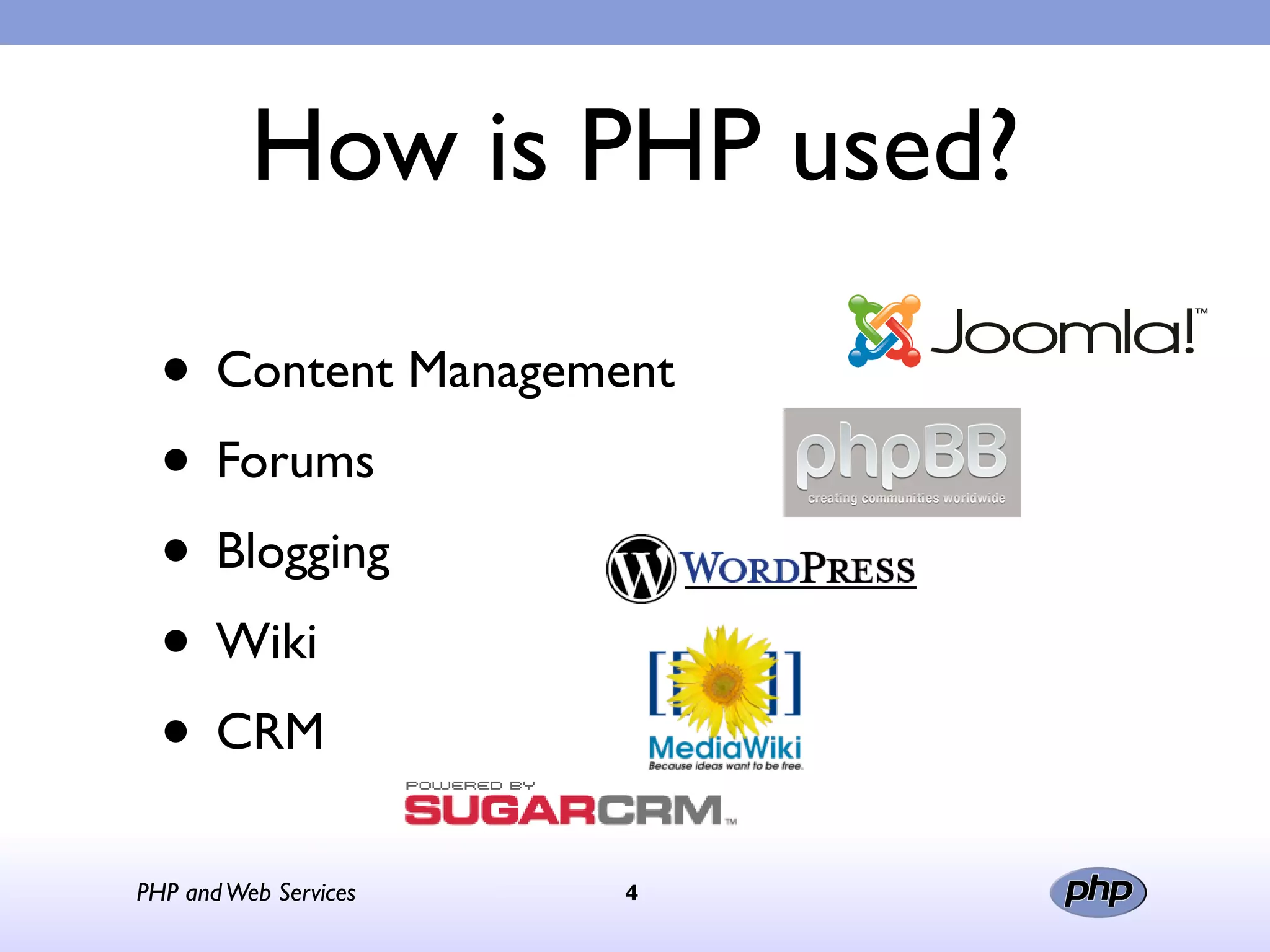
PHP andWeb Services How is PHP used? • Content Management • Forums • Blogging • Wiki • CRM 4
PHP andWeb Services Who uses PHP? Source: Zend 5
PHP andWeb Services Why use PHP? • Used by 20M+ Web Sites around the globe • Community-maintained documentation • Code runs on UNIX, OSX and Windows • Backed commercially by Zend • Easy syntax 6
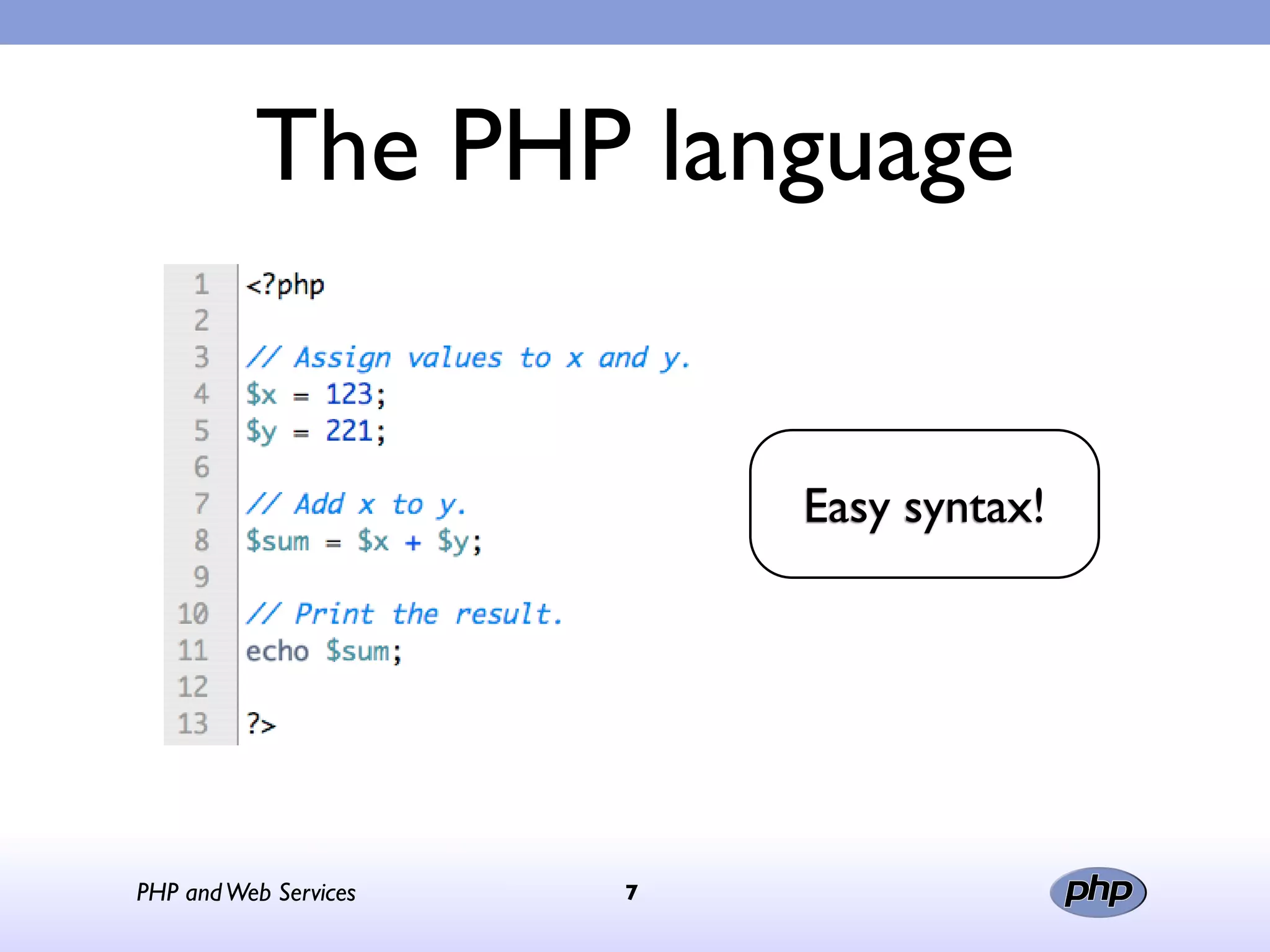
PHP andWeb Services The PHP language 7 Easy syntax!
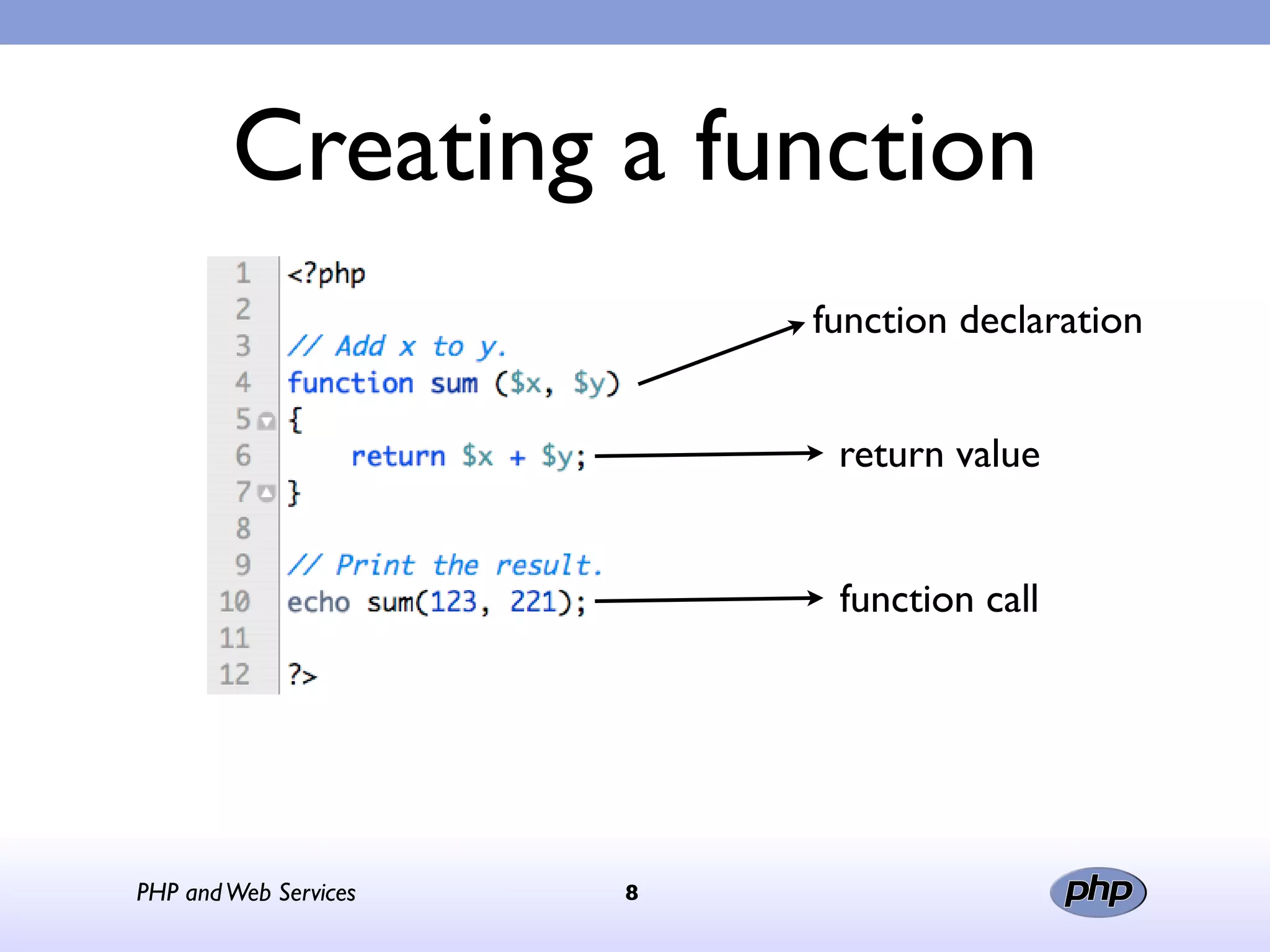
PHP andWeb Services Creating a function 8 function declaration return value function call
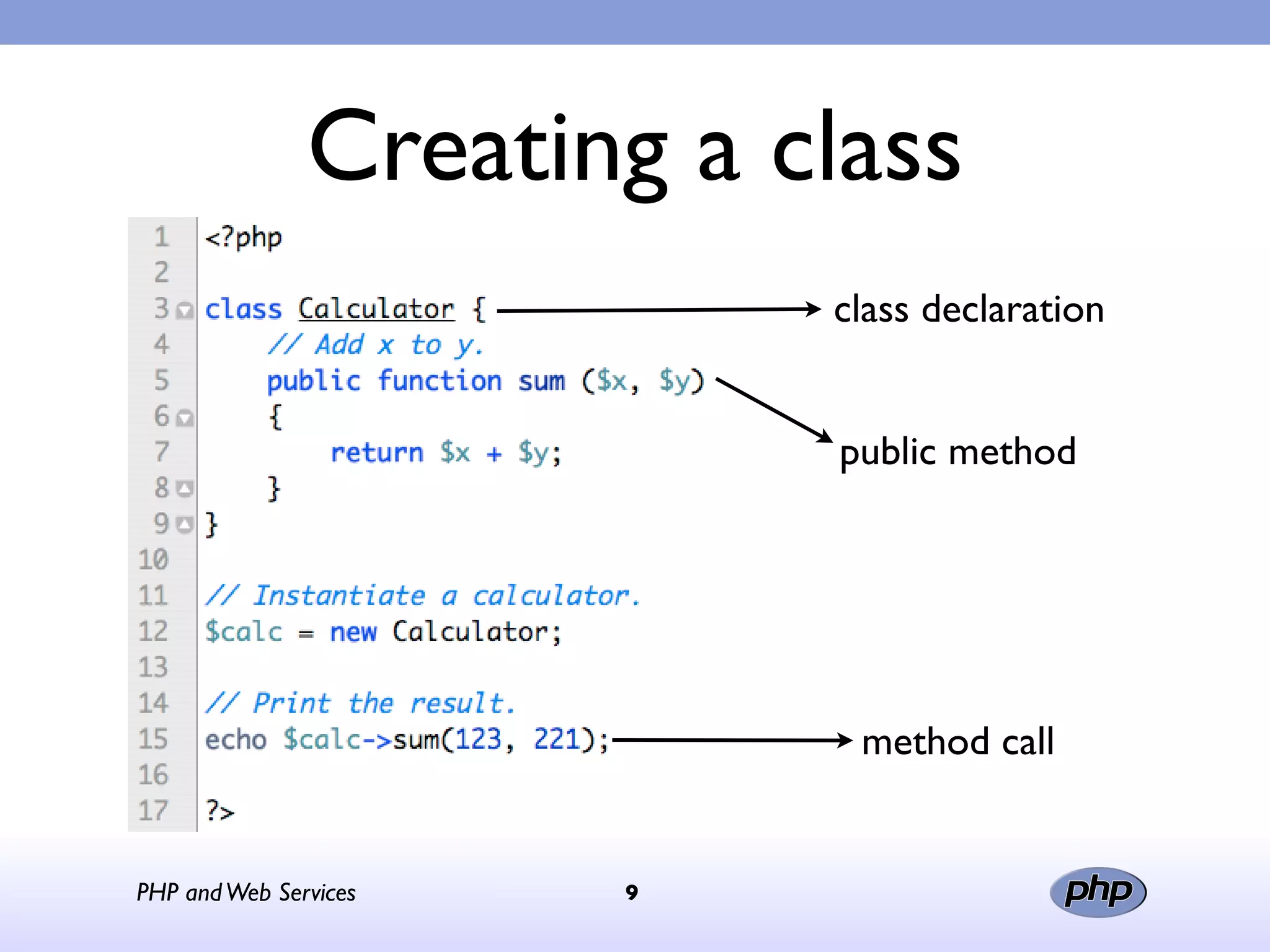
PHP andWeb Services Creating a class 9 class declaration public method method call
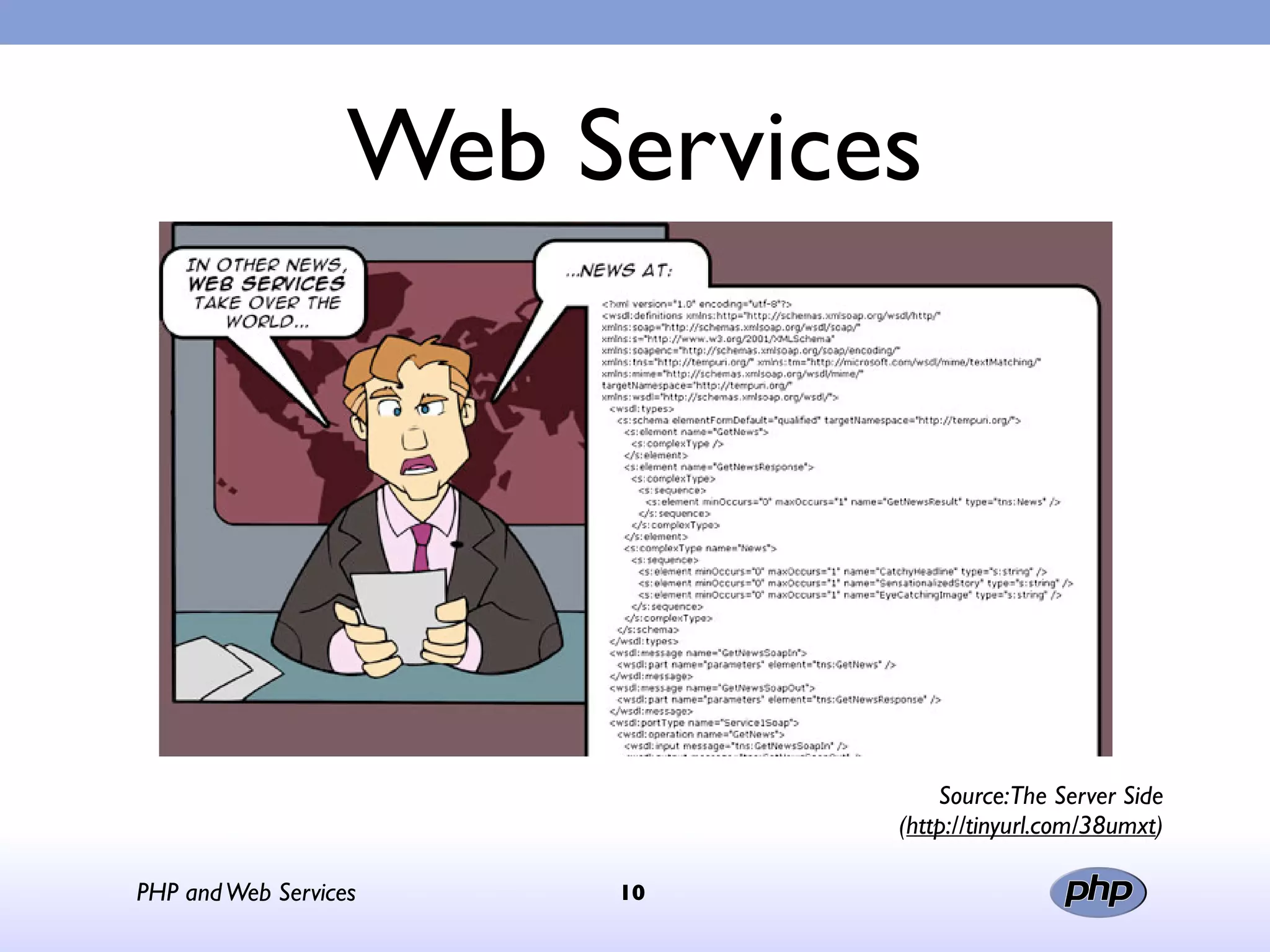
PHP andWeb Services Web Services 10 Source:The Server Side (http://tinyurl.com/38umxt)
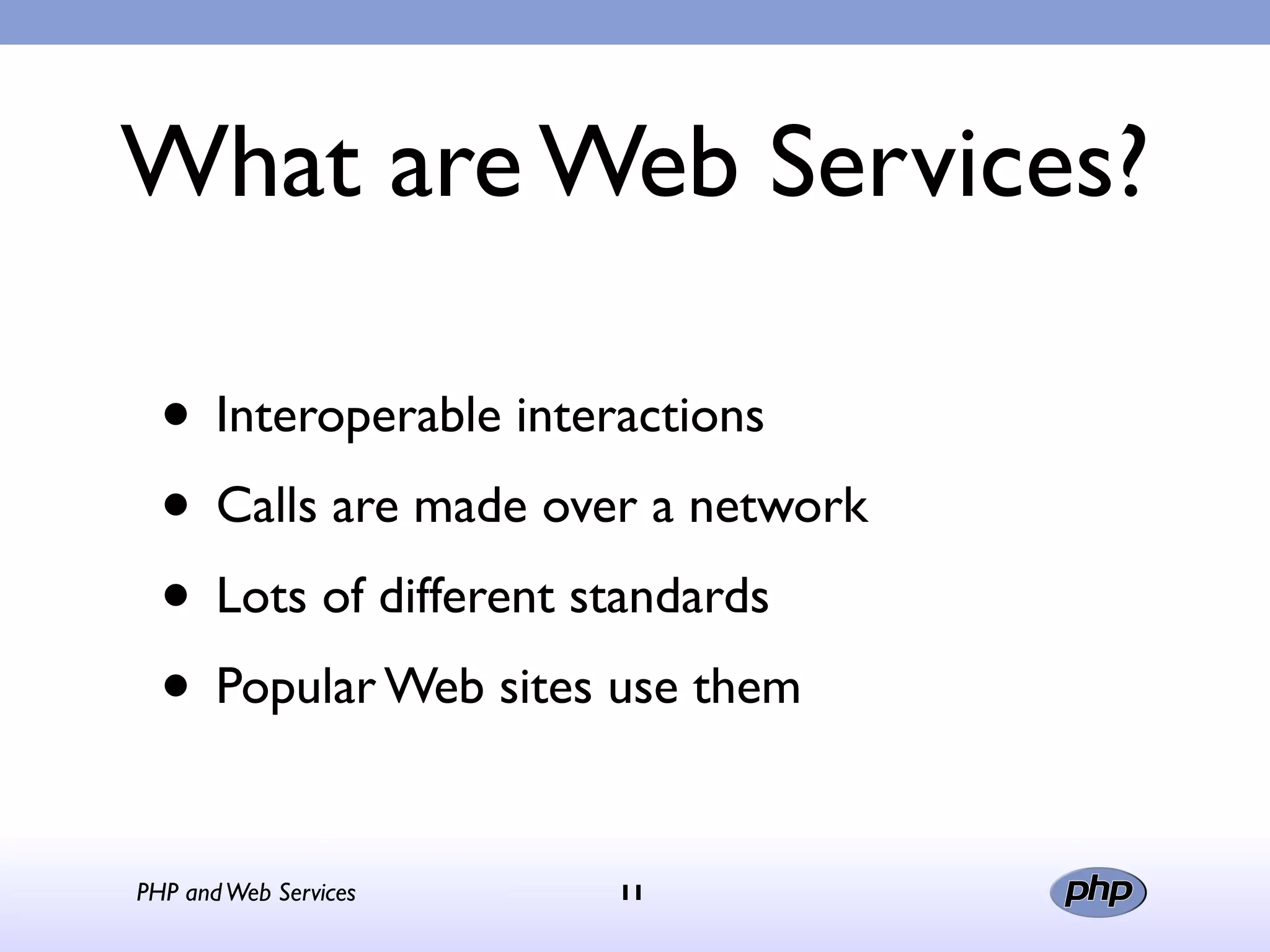
PHP andWeb Services What are Web Services? • Interoperable interactions • Calls are made over a network • Lots of different standards • Popular Web sites use them 11
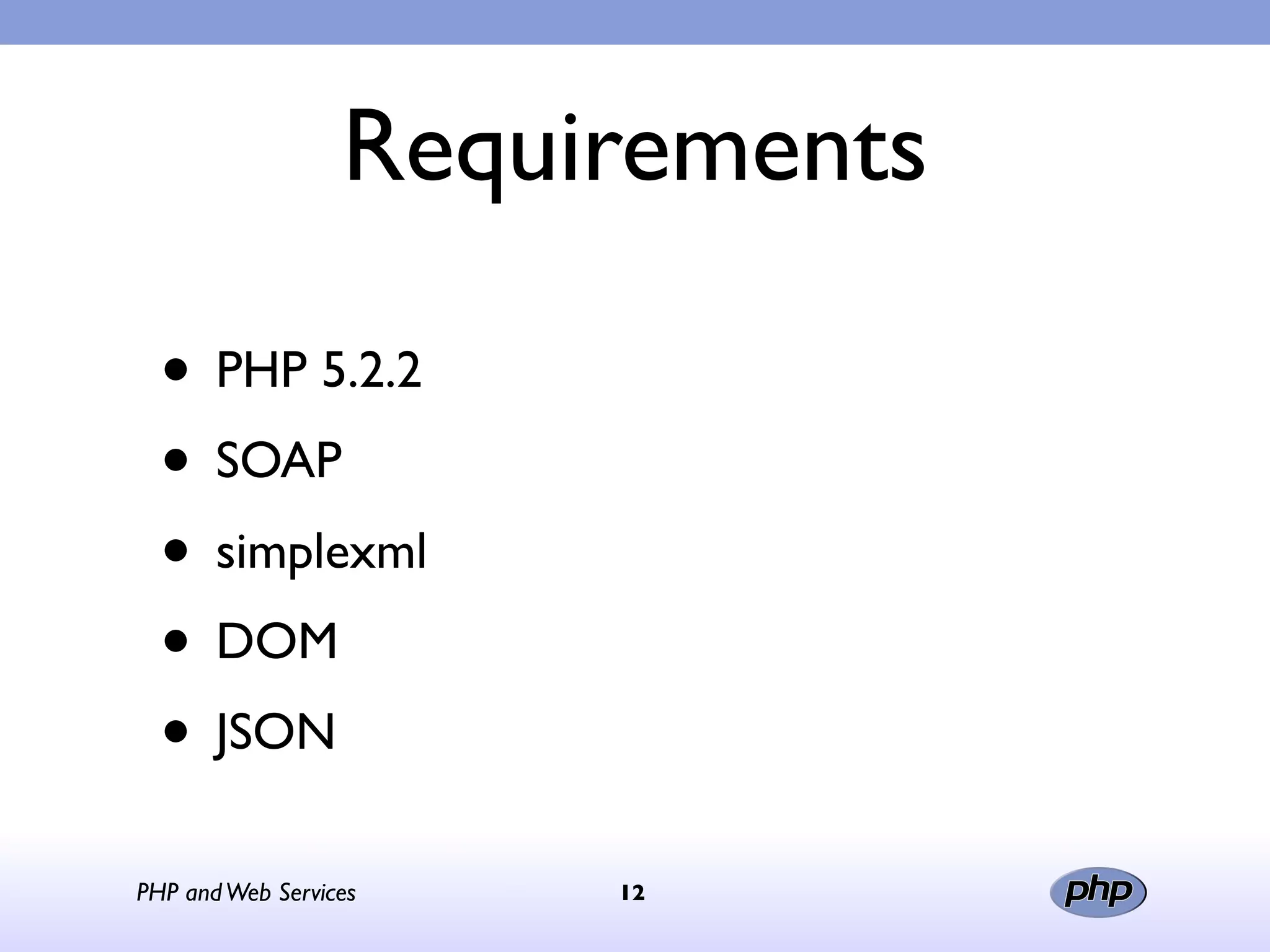
PHP andWeb Services Requirements • PHP 5.2.2 • SOAP • simplexml • DOM • JSON 12
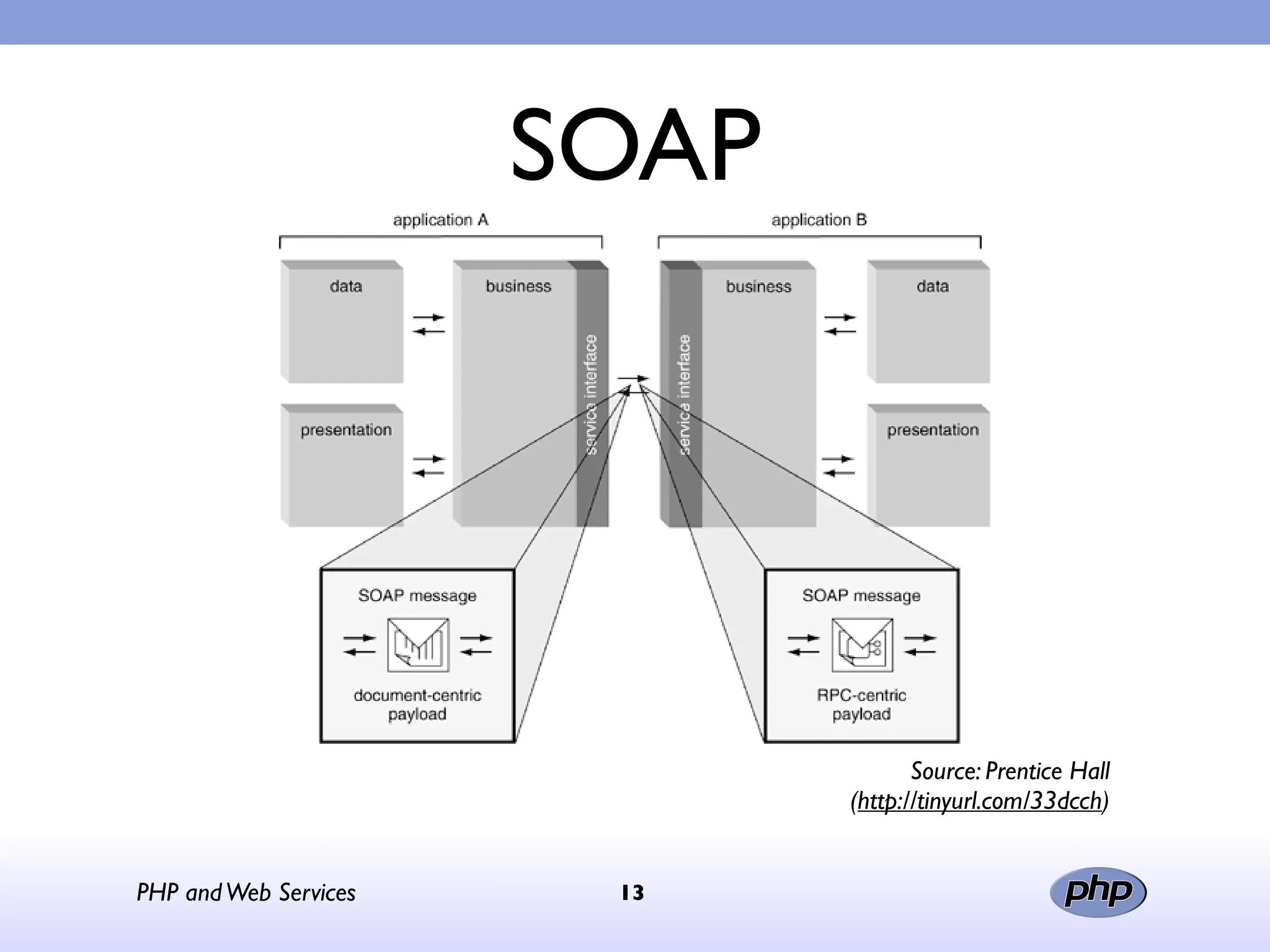
PHP andWeb Services SOAP Source: Prentice Hall (http://tinyurl.com/33dcch) 13
PHP andWeb Services SOAP • Simple Object Access Protocol • Usually an HTTP POST request • Call is encapsulated in XML • Response is an XML document • PHP handles everything 14
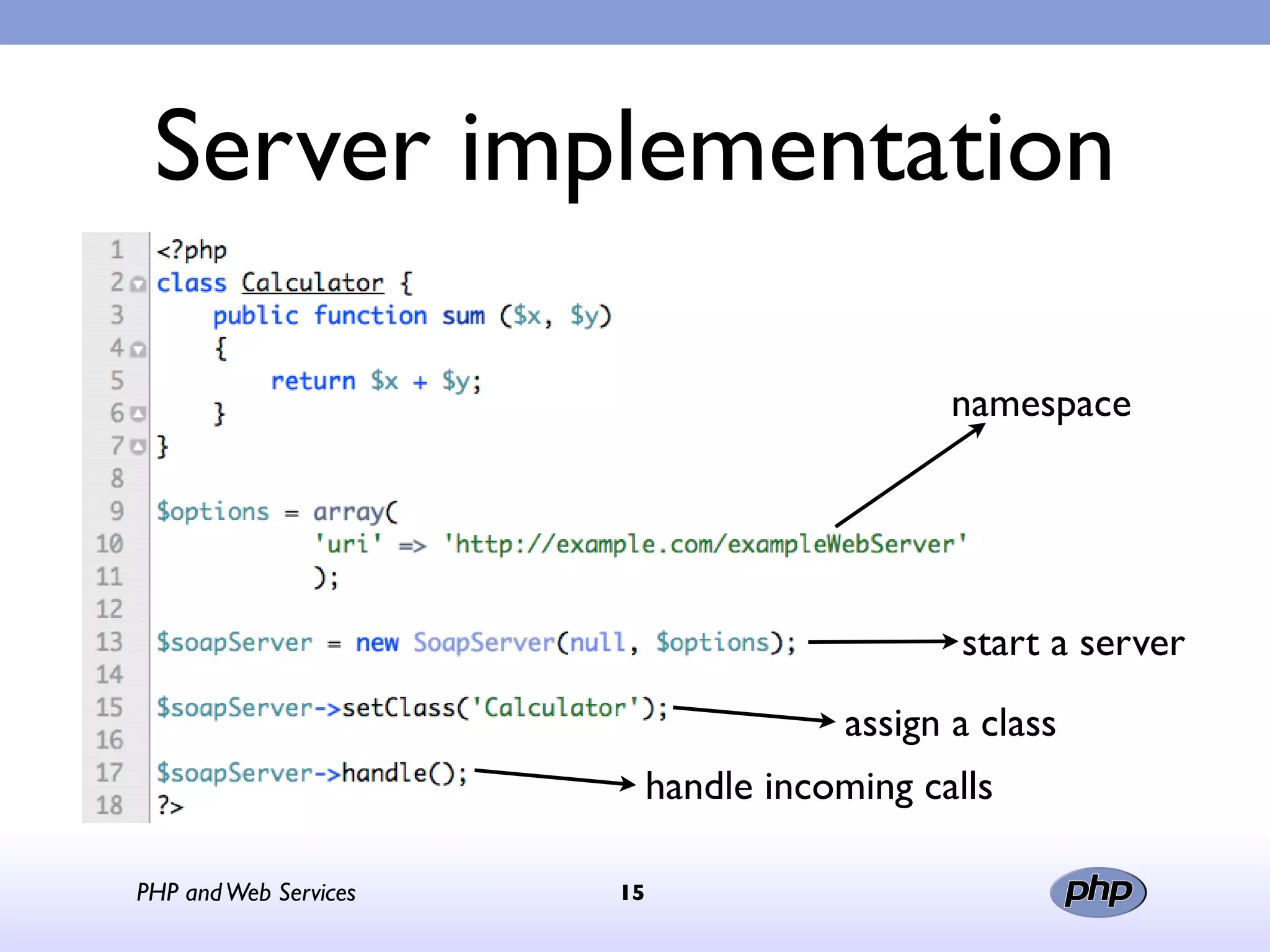
PHP andWeb Services Server implementation 15 namespace start a server assign a class handle incoming calls
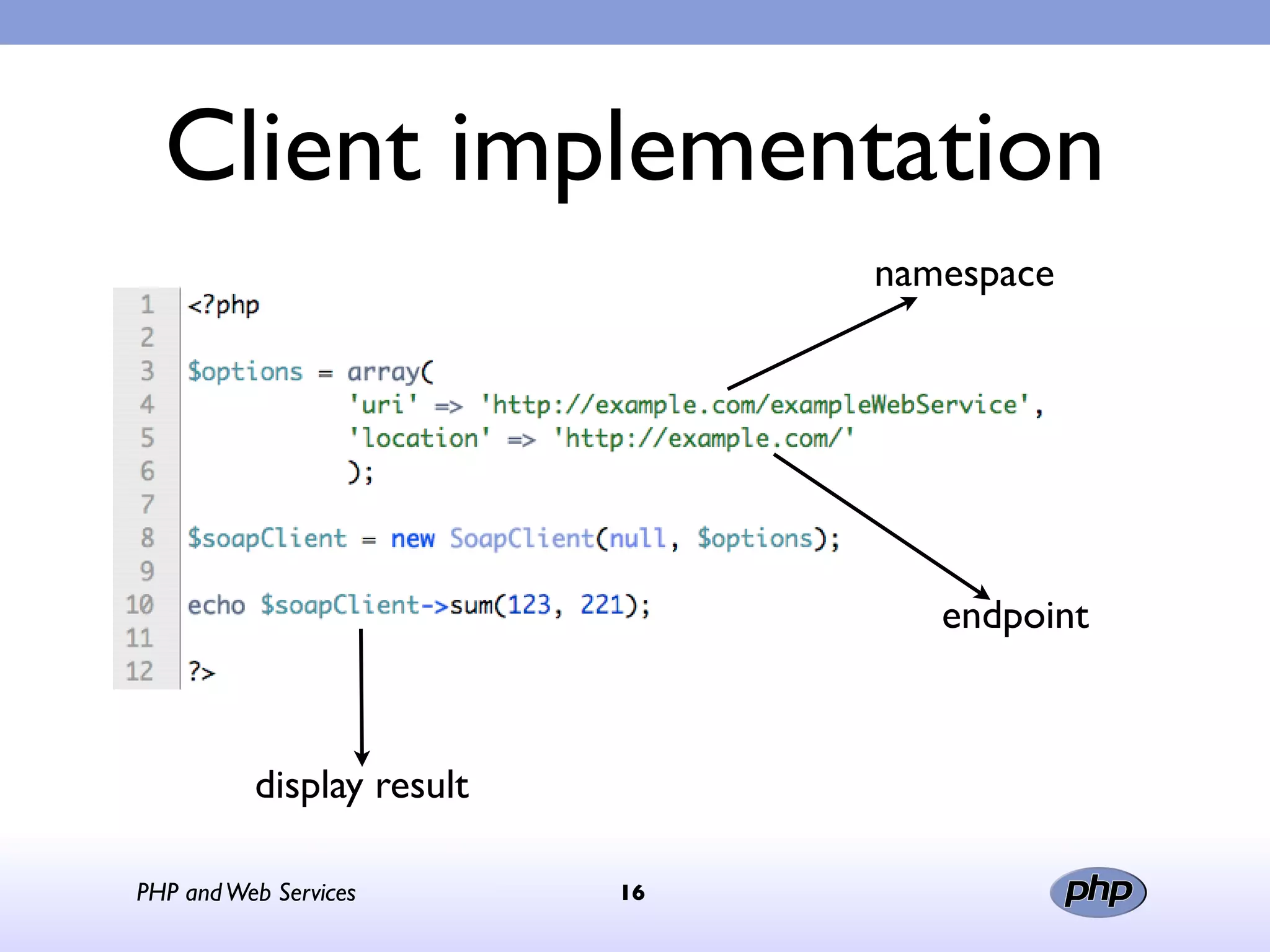
PHP andWeb Services Client implementation 16 namespace endpoint display result
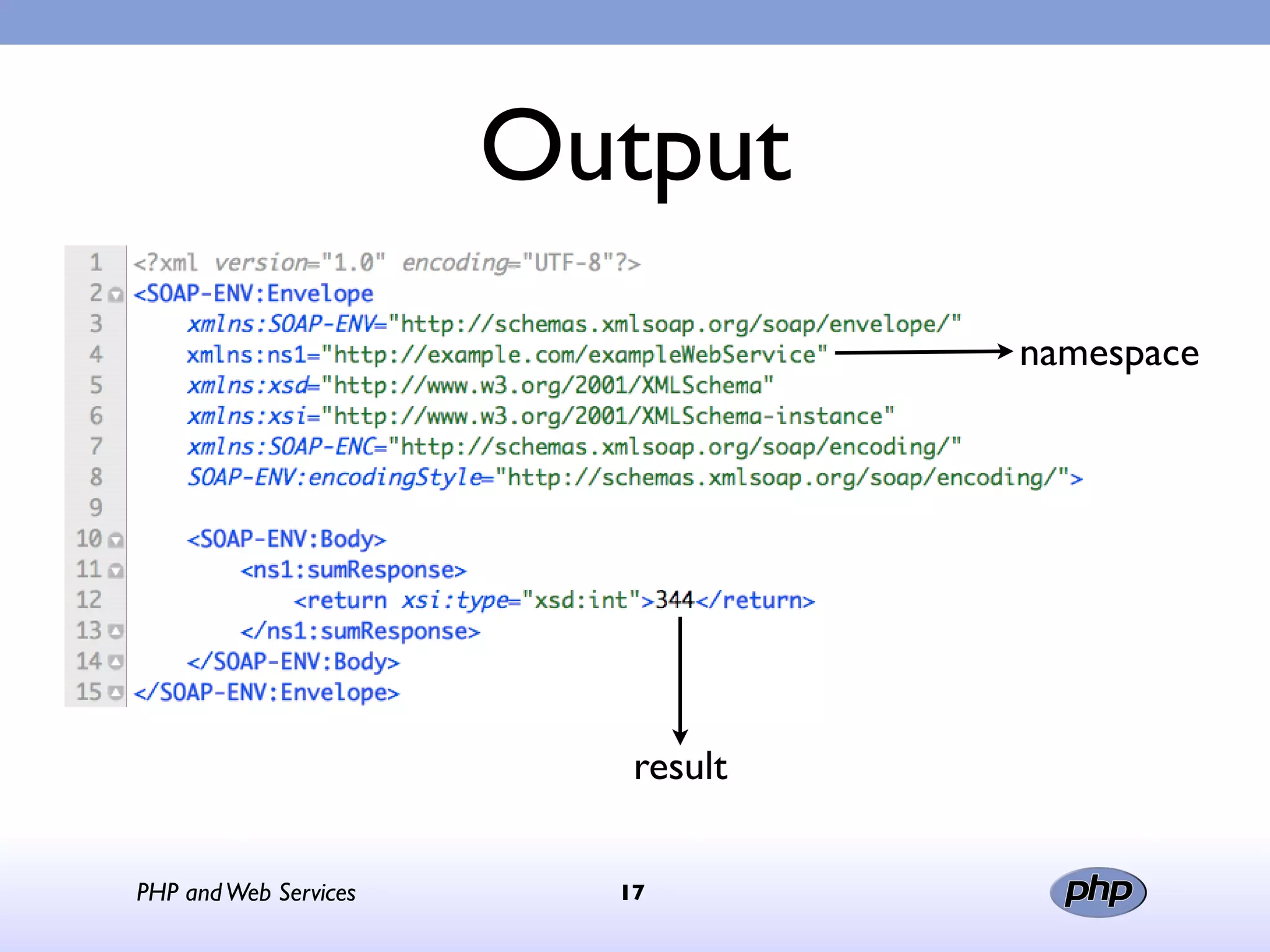
PHP andWeb Services Output 17 namespace result
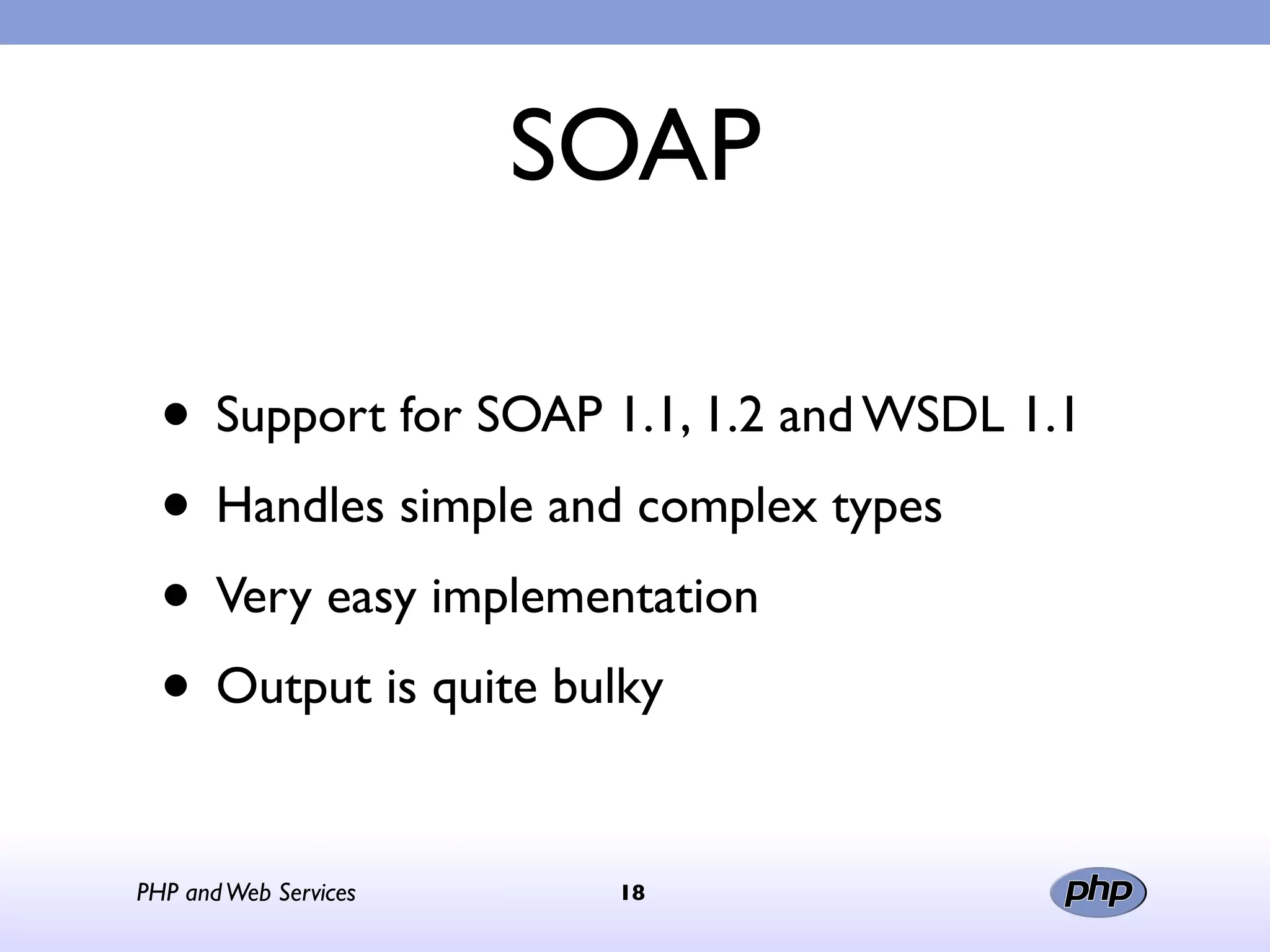
PHP andWeb Services SOAP 18 • Support for SOAP 1.1, 1.2 and WSDL 1.1 • Handles simple and complex types • Very easy implementation • Output is quite bulky
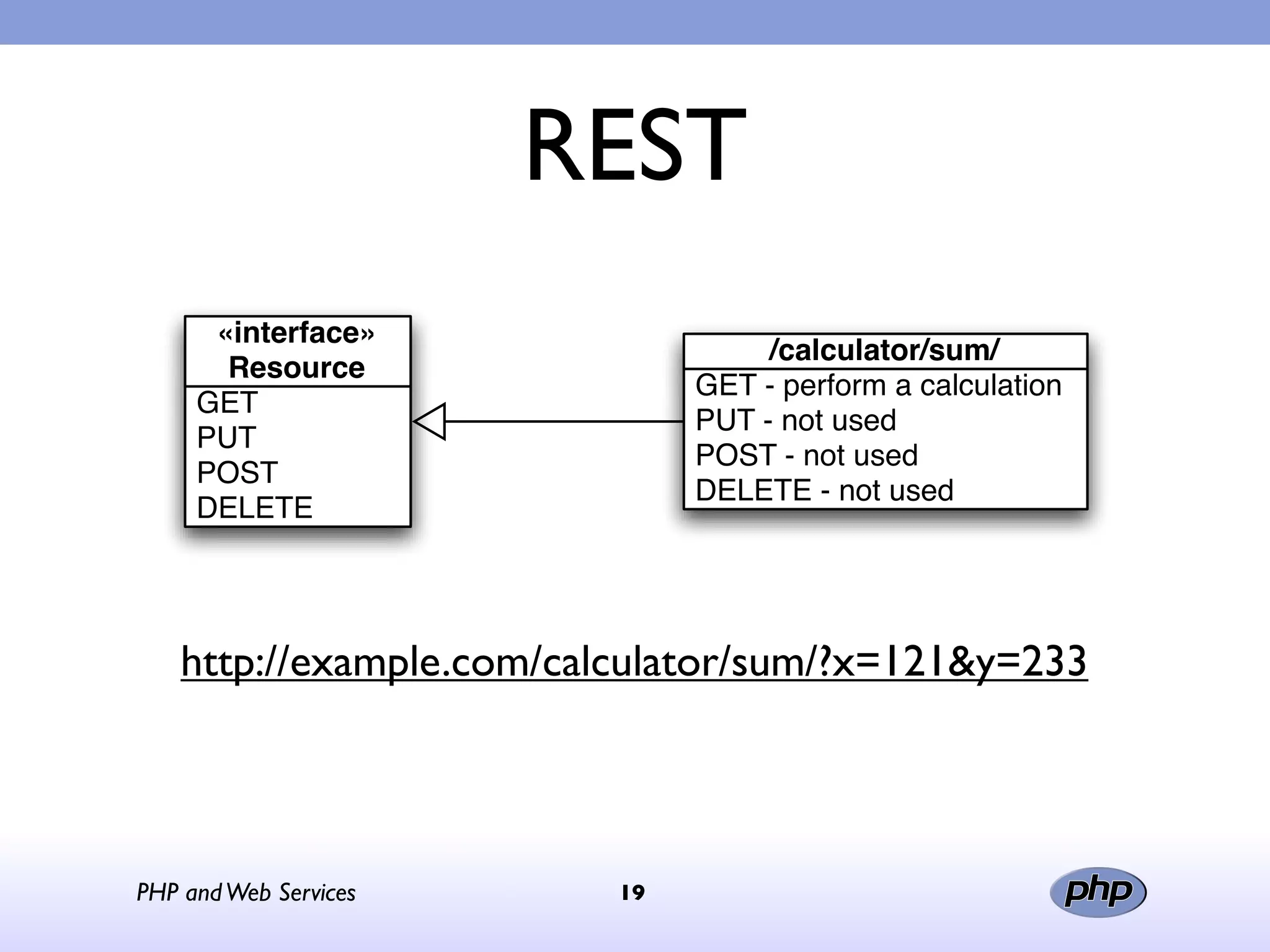
PHP andWeb Services REST http://example.com/calculator/sum/?x=121&y=233 GET PUT POST DELETE «interface» Resource GET - perform a calculation PUT - not used POST - not used DELETE - not used /calculator/sum/ 19
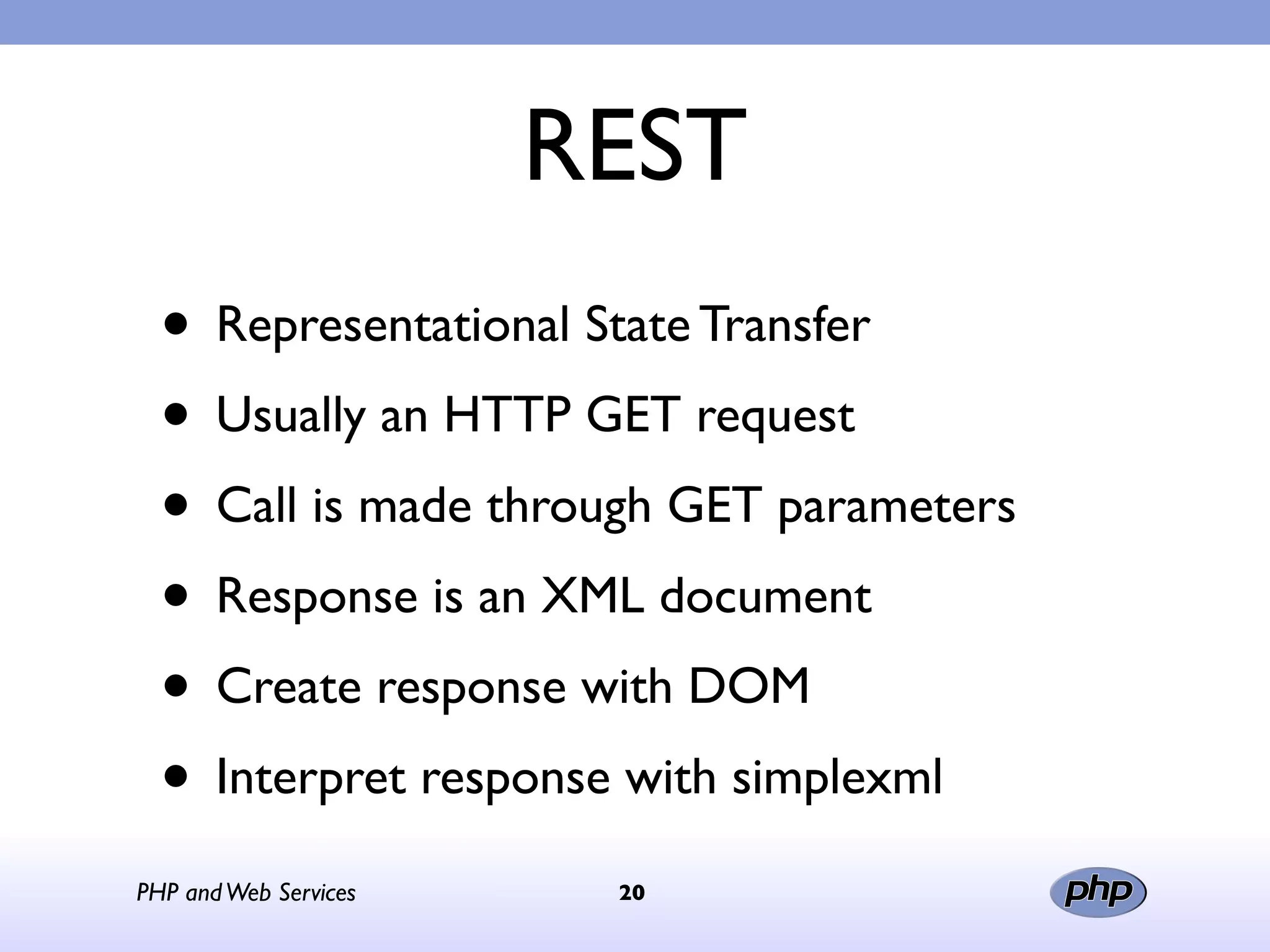
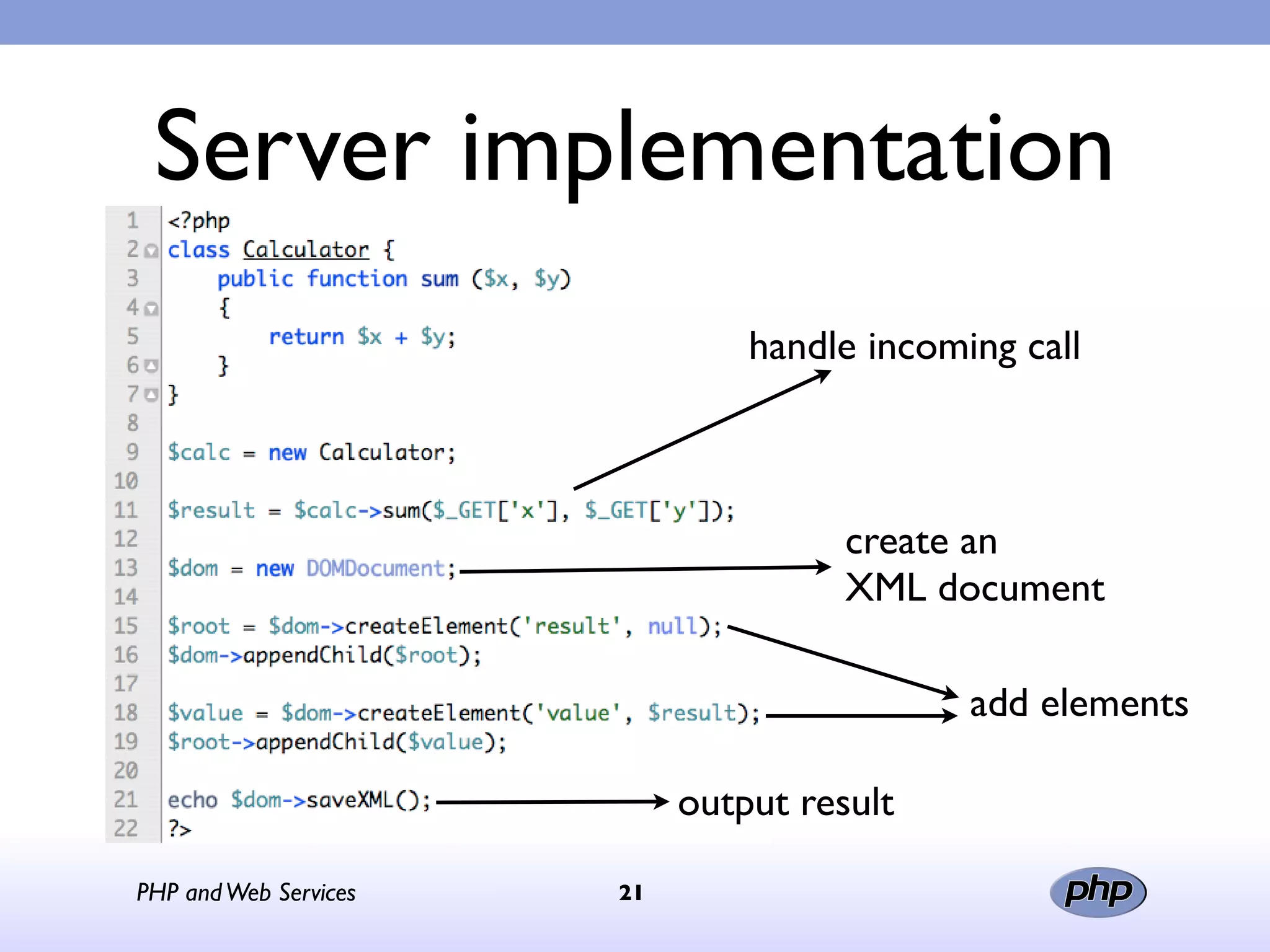
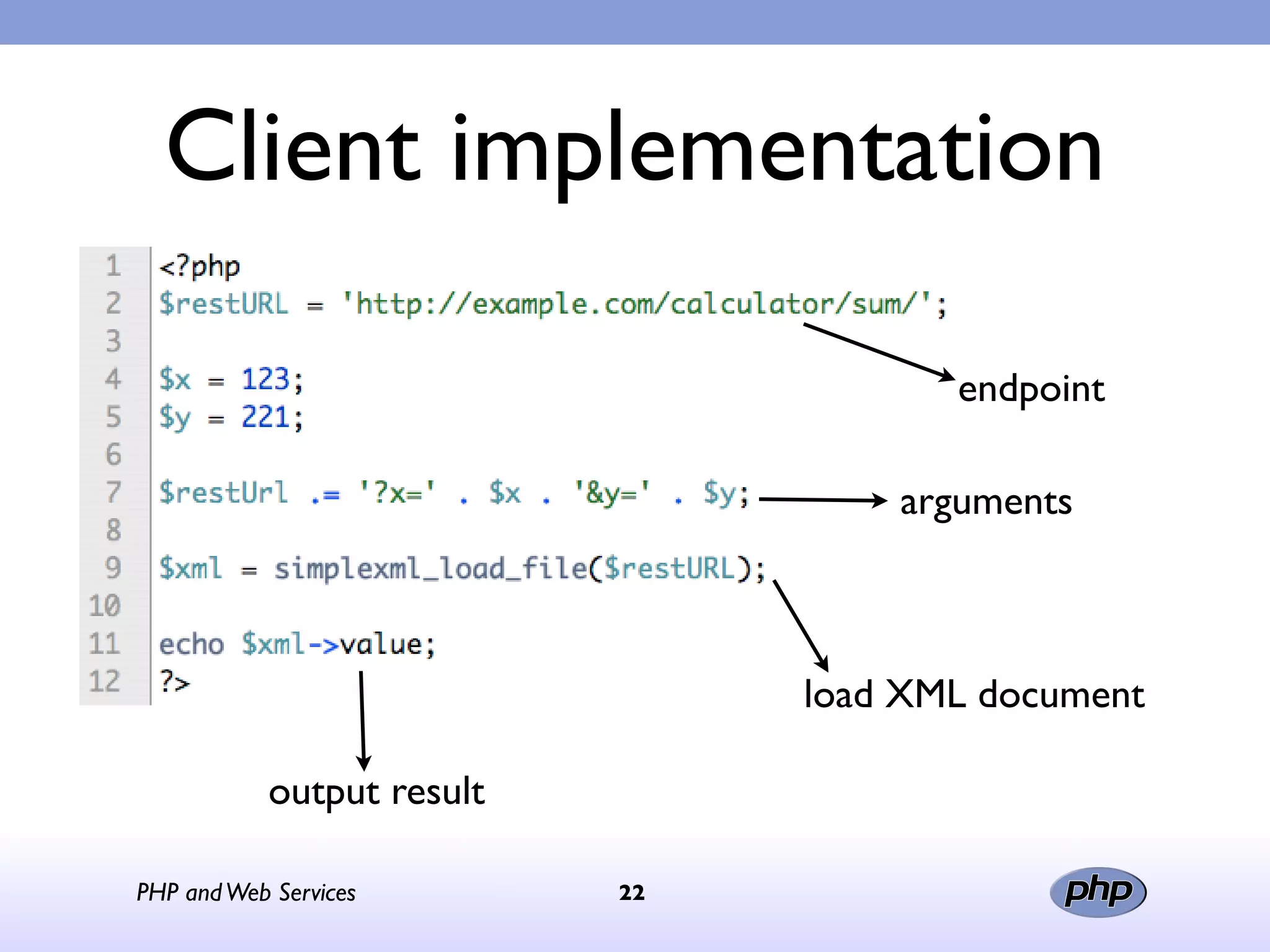
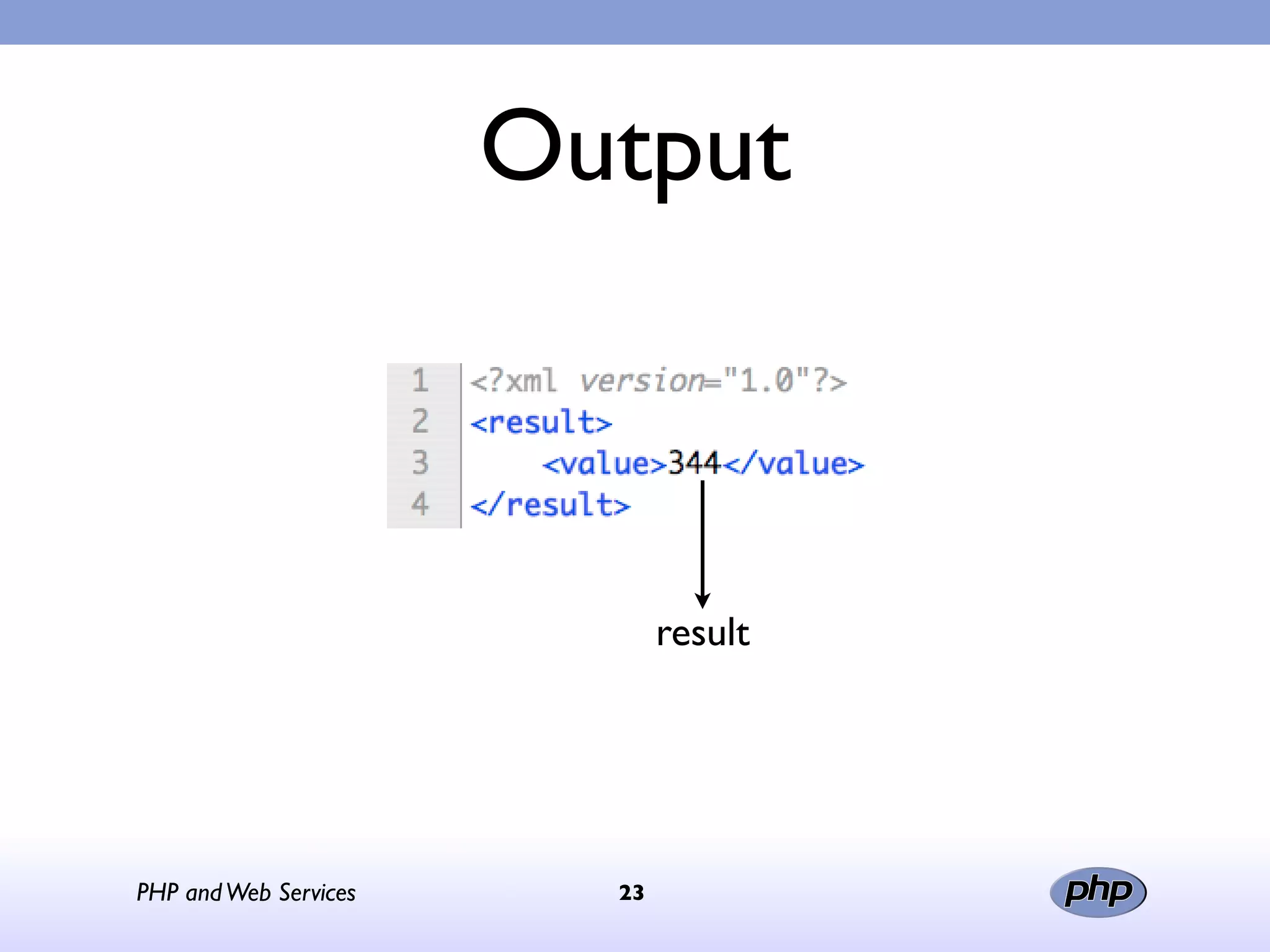
PHP andWeb Services REST • Representational State Transfer • Usually an HTTP GET request • Call is made through GET parameters • Response is an XML document • Create response with DOM • Interpret response with simplexml 20
PHP andWeb Services Server implementation 21 handle incoming call create an XML document add elements output result
PHP andWeb Services Client implementation 22 endpoint arguments load XML document output result
PHP andWeb Services Output 23 result
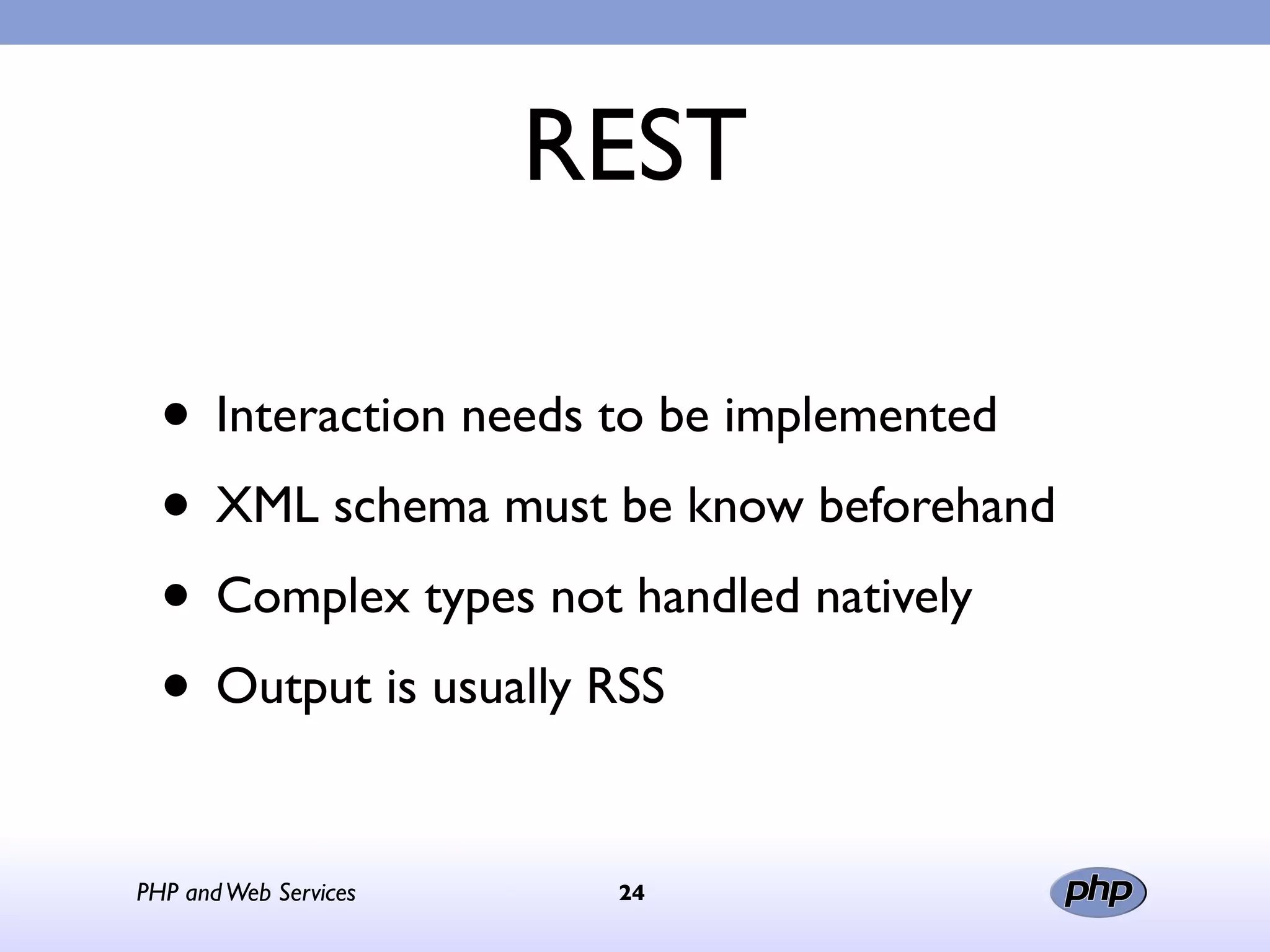
PHP andWeb Services REST 24 • Interaction needs to be implemented • XML schema must be know beforehand • Complex types not handled natively • Output is usually RSS
PHP andWeb Services JSON 25 JSON Logo Source: json.org
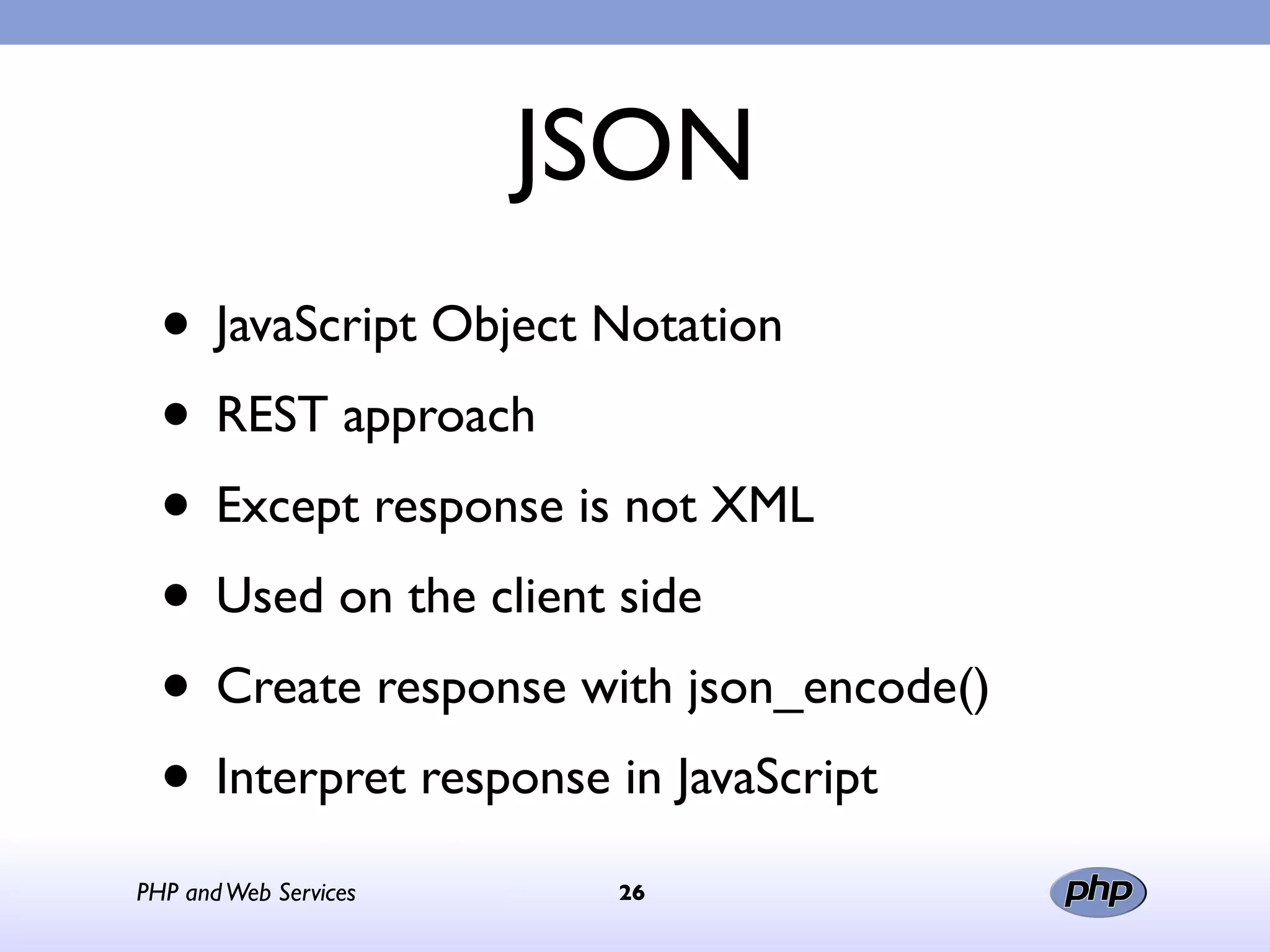
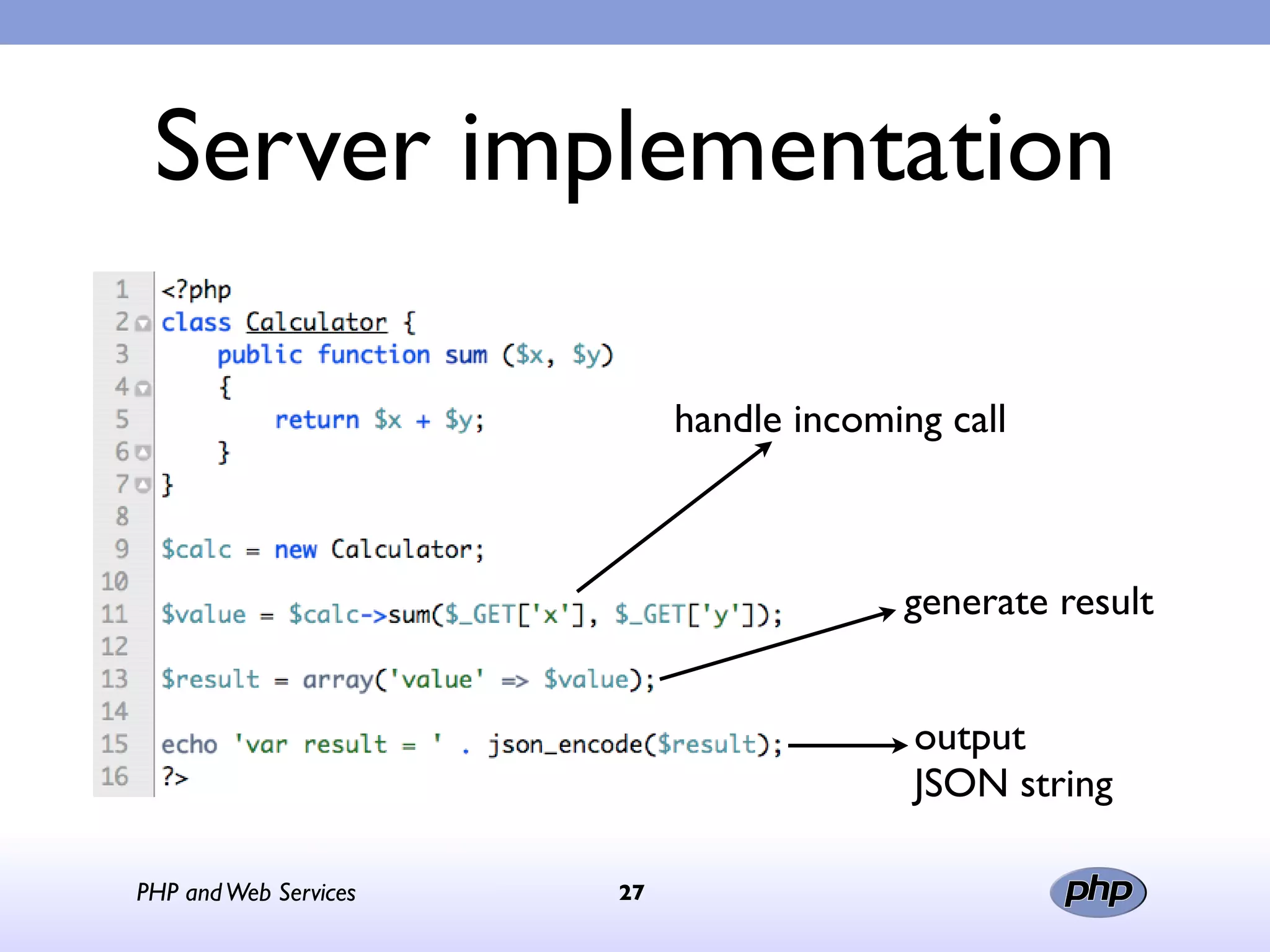
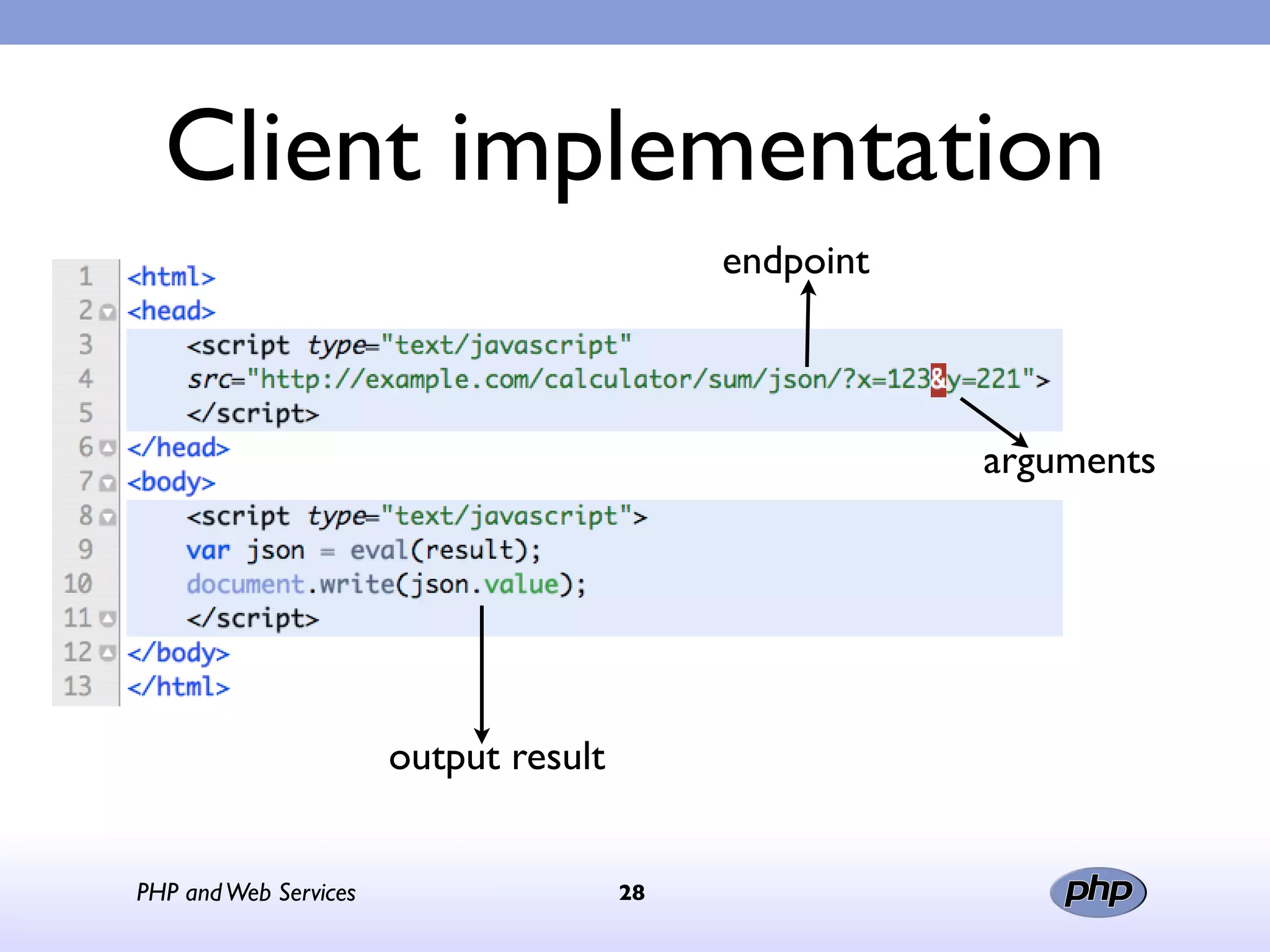
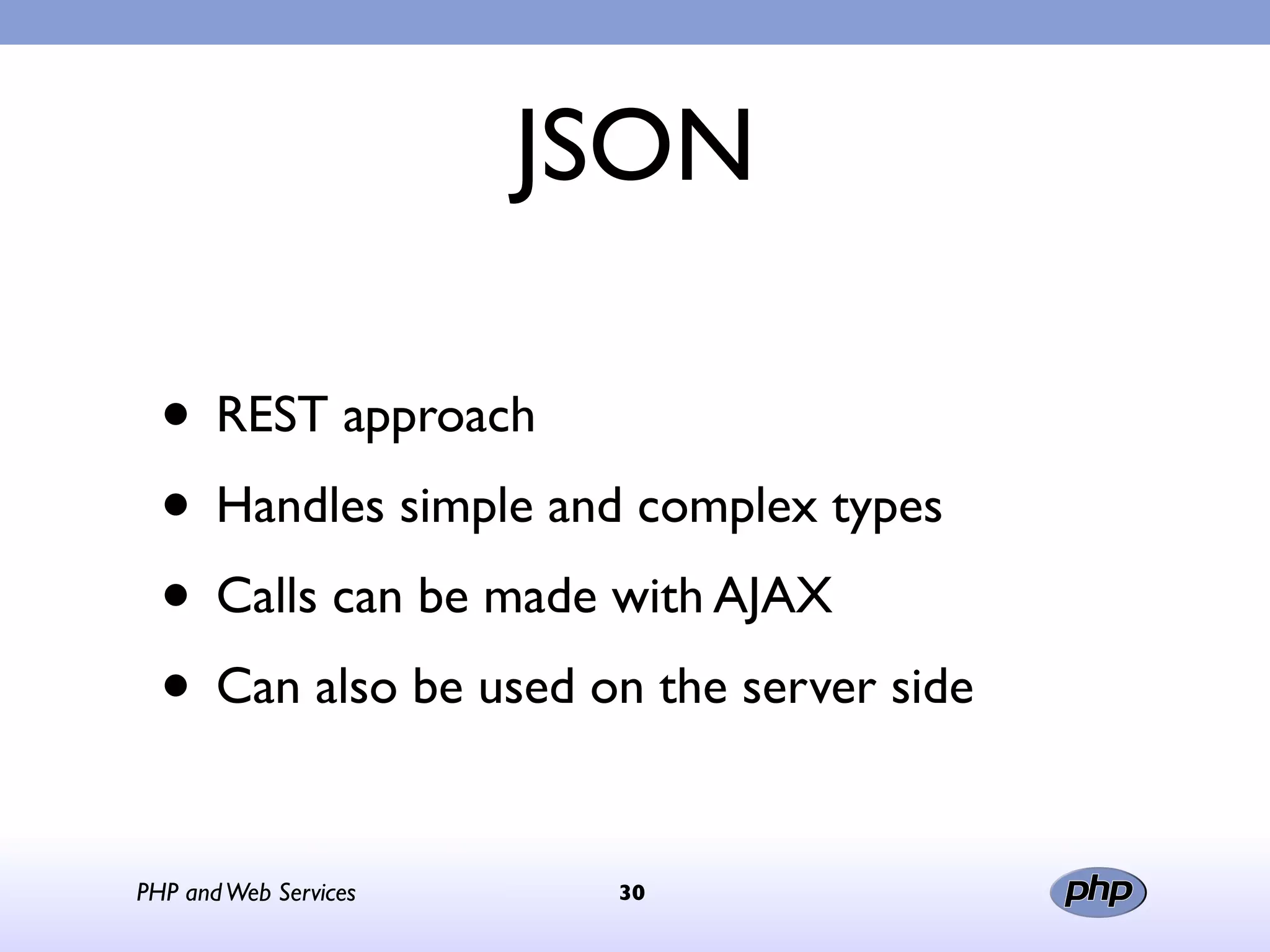
PHP andWeb Services JSON • JavaScript Object Notation • REST approach • Except response is not XML • Used on the client side • Create response with json_encode() • Interpret response in JavaScript 26
PHP andWeb Services Server implementation 27 handle incoming call generate result output JSON string
PHP andWeb Services Client implementation 28 endpoint arguments output result
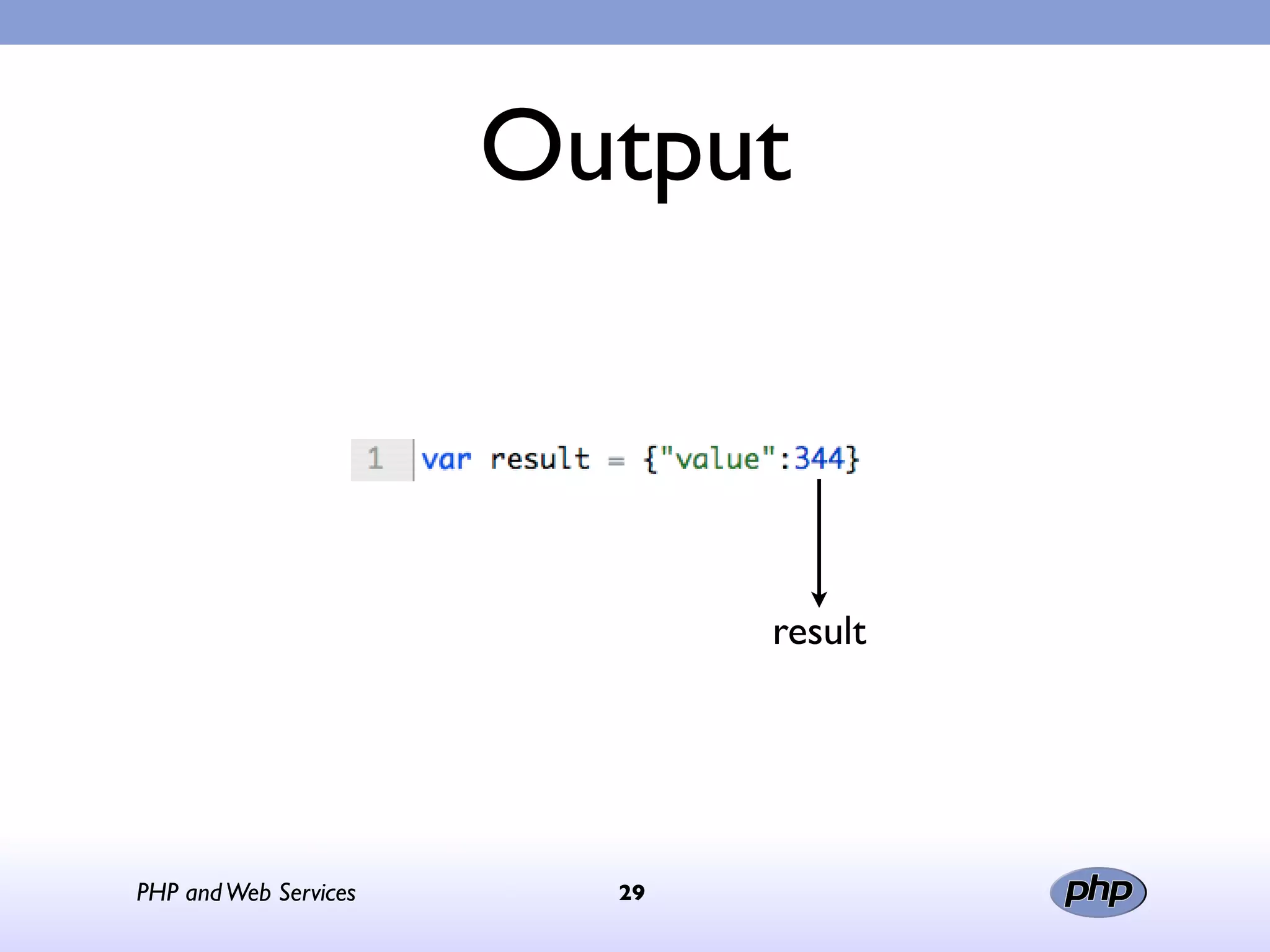
PHP andWeb Services Output 29 result
PHP andWeb Services JSON 30 • REST approach • Handles simple and complex types • Calls can be made with AJAX • Can also be used on the server side
PHP andWeb Services Conclusions • PHP is a powerful web scripting language • Too many Web Services standards • PHP handles all the internals • REST requires more coding than SOAP • Use JSON for client side applications • XML-RPC support is still experimental 31
PHP andWeb Services Questions? 32
PHP andWeb Services Resources 33 • My blog: http://unfoldingtheweb.com/ • PHP Manual: http://www.php.net/ • SOAP: http://www.w3.org/TR/soap/ • REST: http://tinyurl.com/akhc7 • JSON: http://www.json.org/

Php and webservices