Ulf Wendel, Oracle PHP mysqlnd Connection Multiplexing PECL/mysqlnd_mux 1.0.0-prototype
The speaker says... When fast is not fast enough, you pull all triggers. This includes attempts to optimize an already reasonable fast operation: connect time to MySQL. The PHP mysqlnd connection multiplexing plugin, shares a physical connection among multiple user handles. Thus, connection overhead is saved on the client side and the number of opened connection is reduced on the server side. PECL/mysqlnd_mux is an Oracle open source development available from pecl.php.net. Developed by Andrey Hristov.
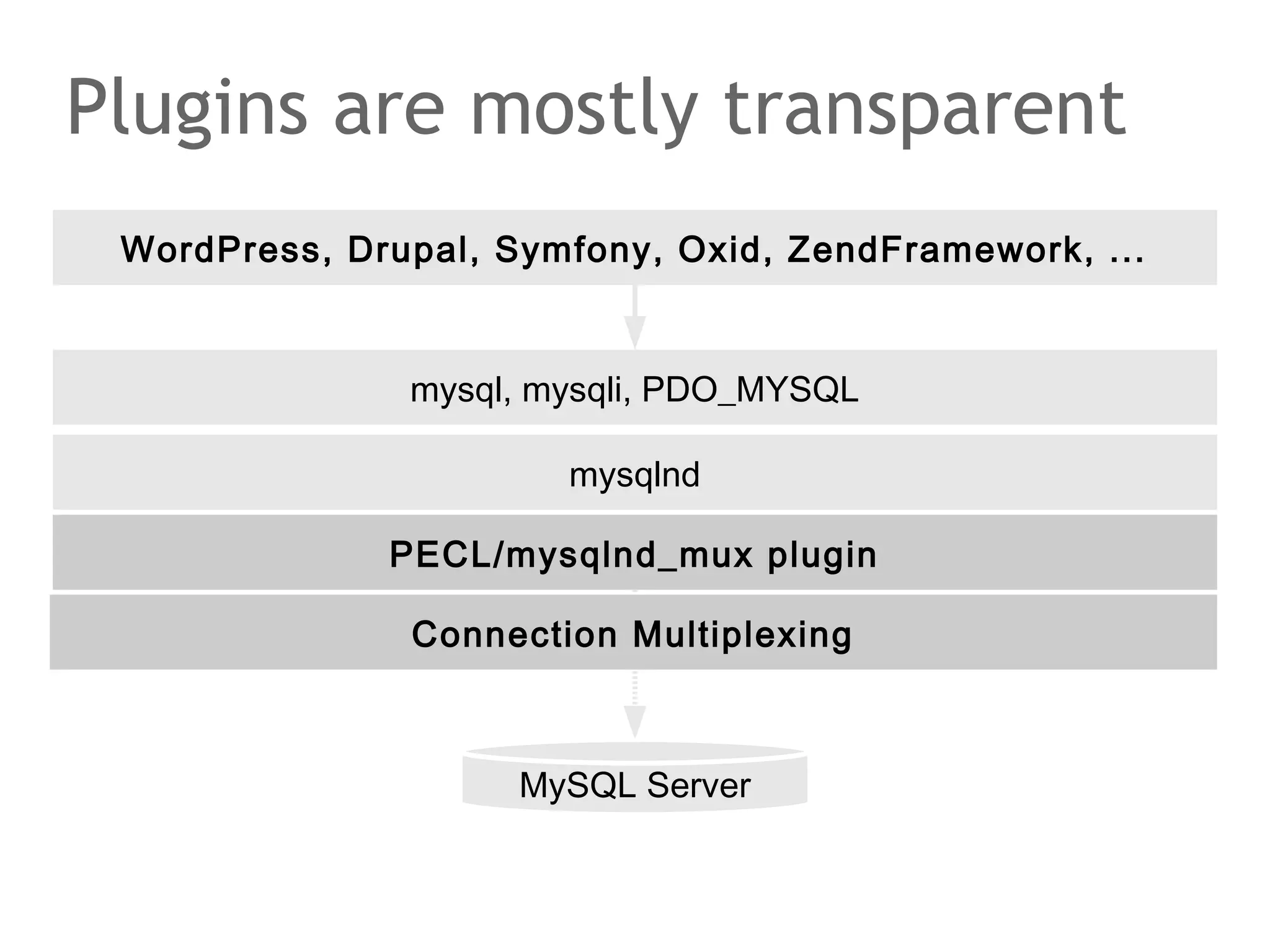
Plugins are mostly transparent WordPress, Drupal, Symfony, Oxid, ZendFramework, ... mysql, mysqli, PDO_MYSQL mysqlnd PECL/mysqlnd_mux plugin Connection Multiplexing MySQL Server
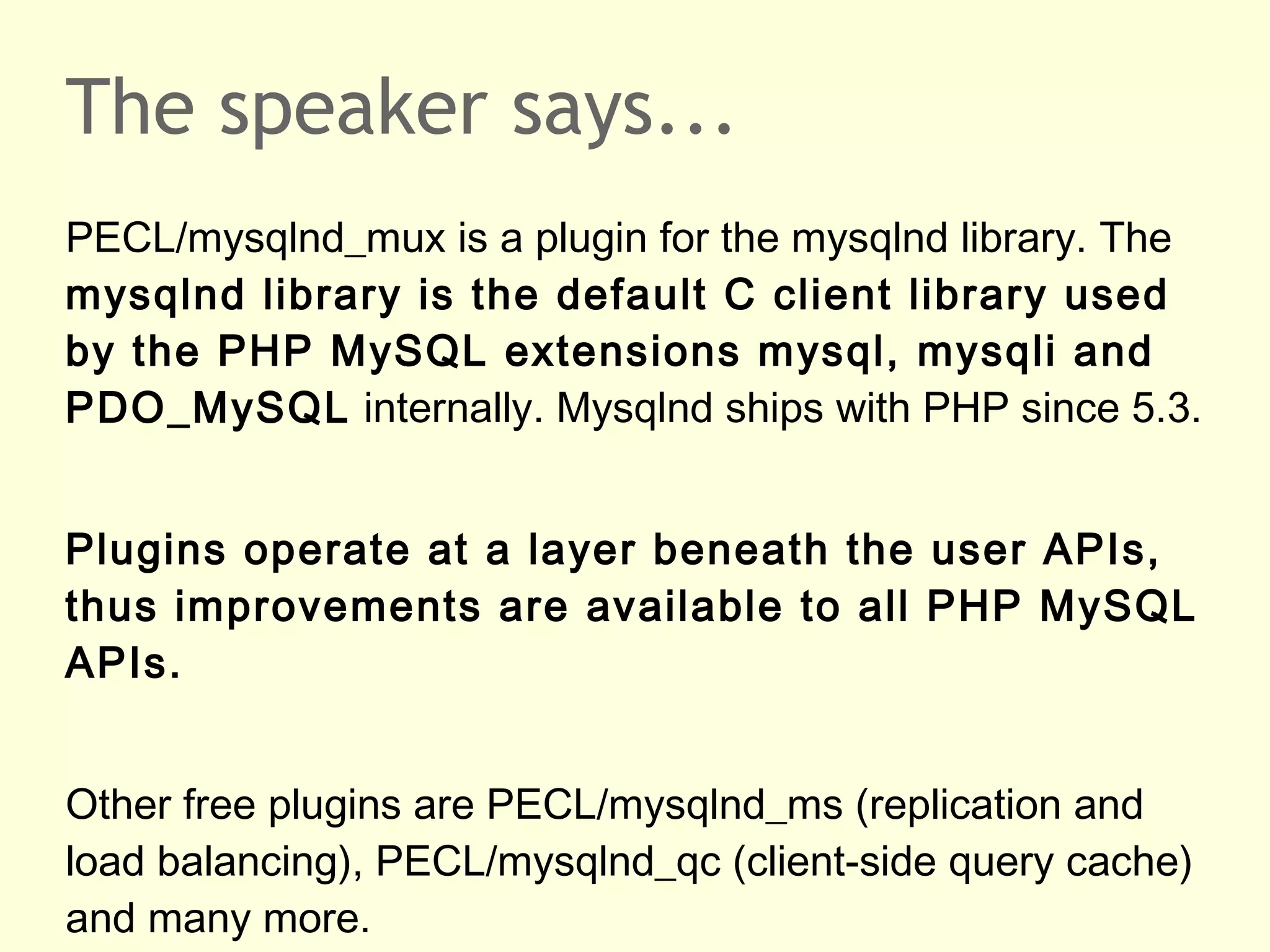
The speaker says... PECL/mysqlnd_mux is a plugin for the mysqlnd library. The mysqlnd library is the default C client library used by the PHP MySQL extensions mysql, mysqli and PDO_MySQL internally. Mysqlnd ships with PHP since 5.3. Plugins operate at a layer beneath the user APIs, thus improvements are available to all PHP MySQL APIs. Other free plugins are PECL/mysqlnd_ms (replication and load balancing), PECL/mysqlnd_qc (client-side query cache) and many more.
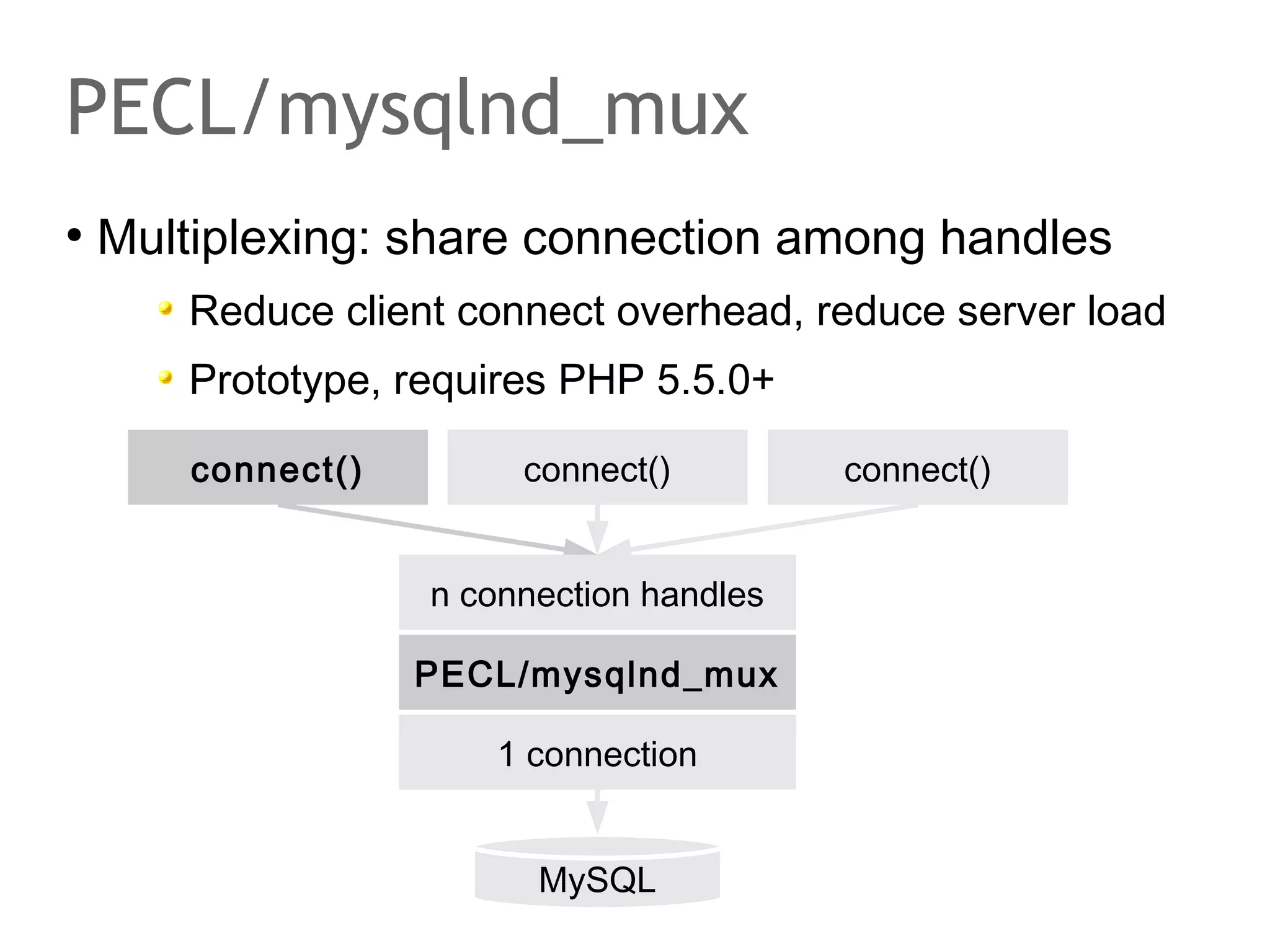
PECL/mysqlnd_mux ● Multiplexing: share connection among handles Reduce client connect overhead, reduce server load Prototype, requires PHP 5.5.0+ connect() connect() connect() n connection handles PECL/mysqlnd_mux 1 connection MySQL
The speaker says... The PHP mysqlnd connection multiplexing proxies MySQL connections. Whenever a client attempts to open a connection to a host, the plugin checks whether there is already a cached network connection to the host in question. If not, a new connection is established and associated with the users' connection handle. Otherwise, the users' connection handle is linked with an already opened network connection. This way, multiple user handles can point to the same network connection and share it. Connection overhead is saved and fewer connections are opened.
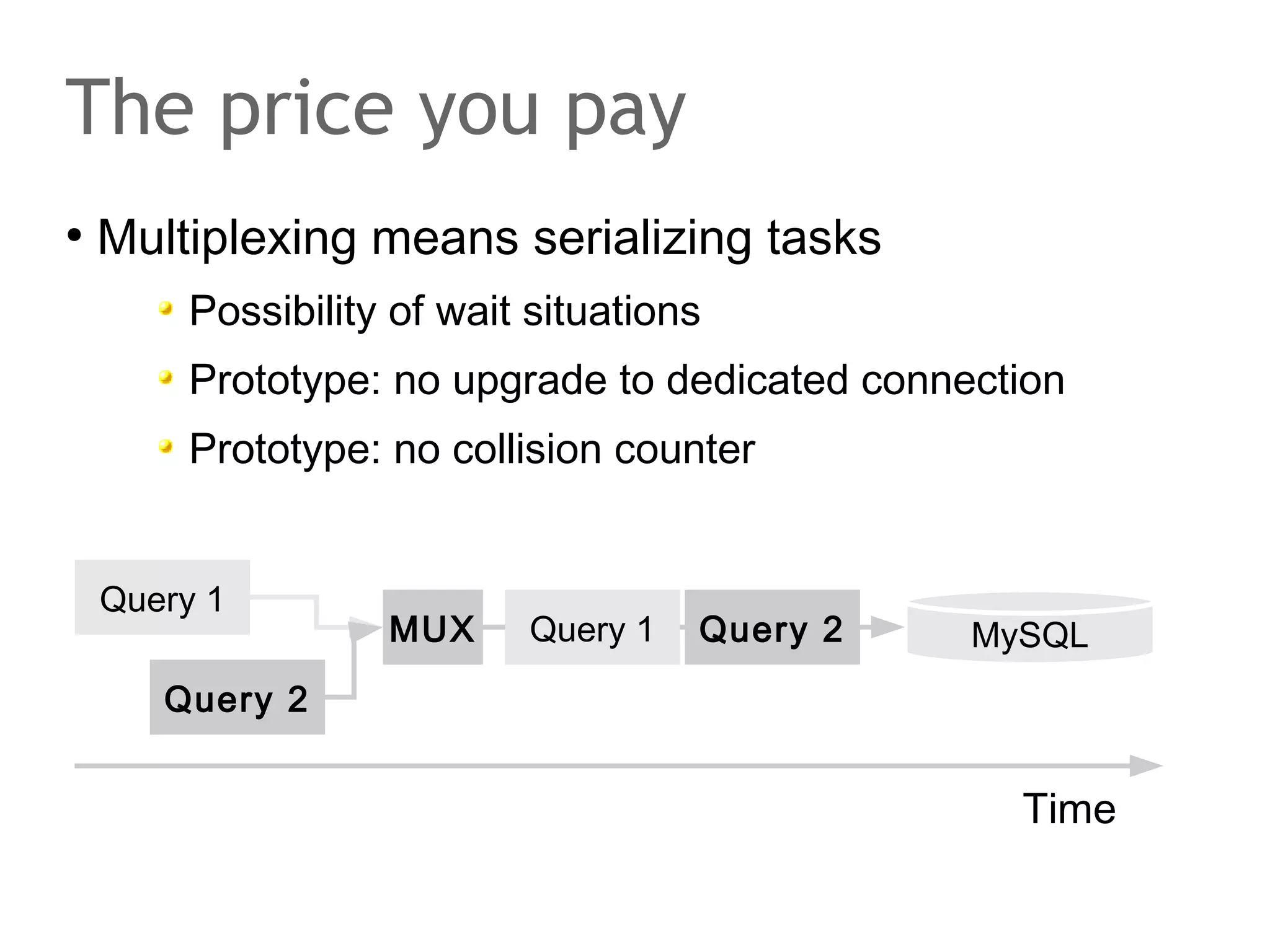
The price you pay ● Multiplexing means serializing tasks Possibility of wait situations Prototype: no upgrade to dedicated connection Prototype: no collision counter Query 1 MUX Query 1 Query 2 MySQL Query 2 Time
The speaker says... Sharing a resource often requires serializing access to it. This is also the case with a shared connection of the PHP mysqlnd connection multiplexing plugin. Serializing actions bares the risks of collisions and wait situations. In the example, a clients query has to wait for completion of another clients query before it can be executed. Query 2 waits for query 1 to finish. The prototype is using a mutex to synchronize access to a shared connection.
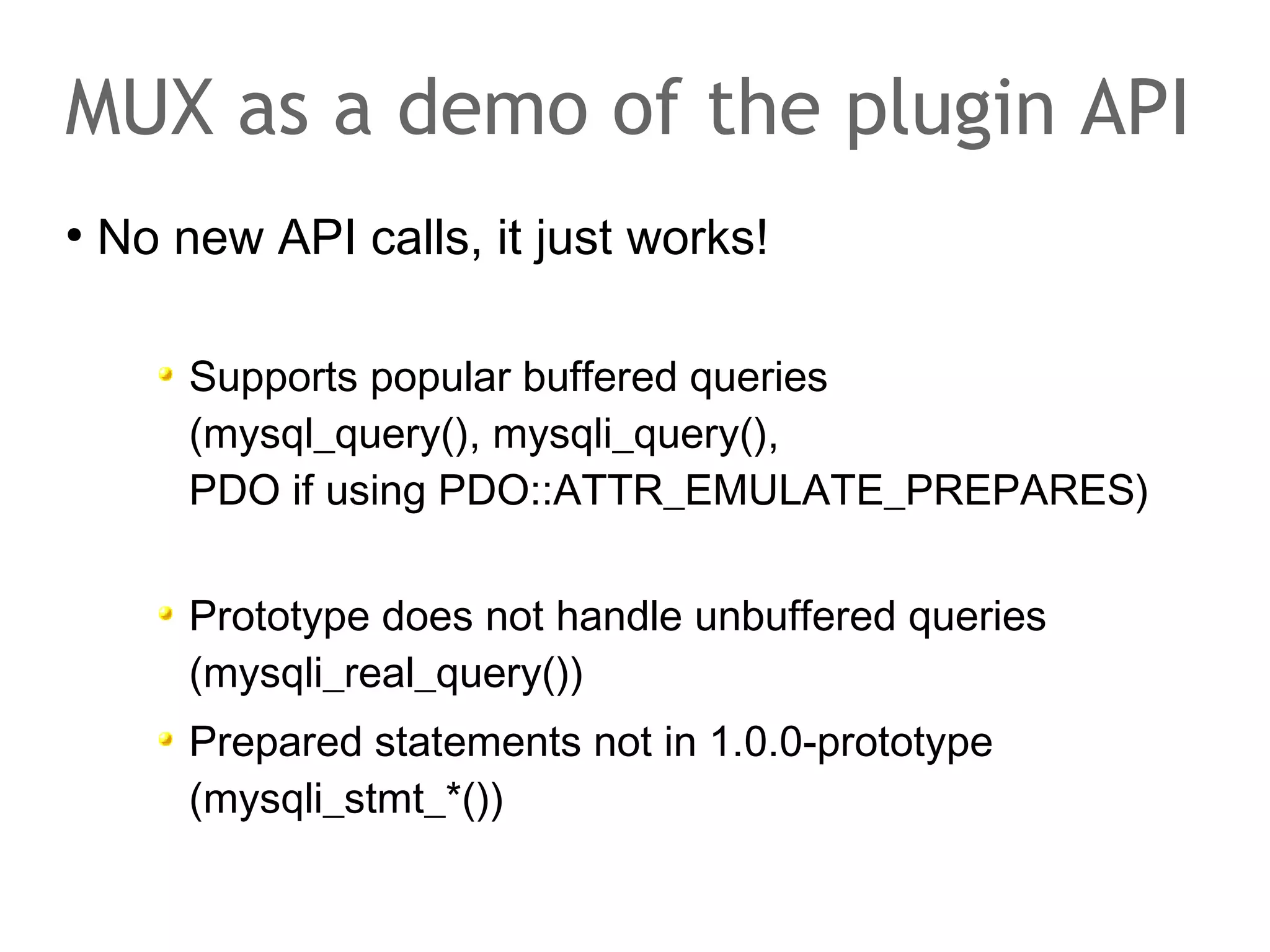
MUX as a demo of the plugin API ● No new API calls, it just works! Supports popular buffered queries (mysql_query(), mysqli_query(), PDO if using PDO::ATTR_EMULATE_PREPARES) Prototype does not handle unbuffered queries (mysqli_real_query()) Prepared statements not in 1.0.0-prototype (mysqli_stmt_*())
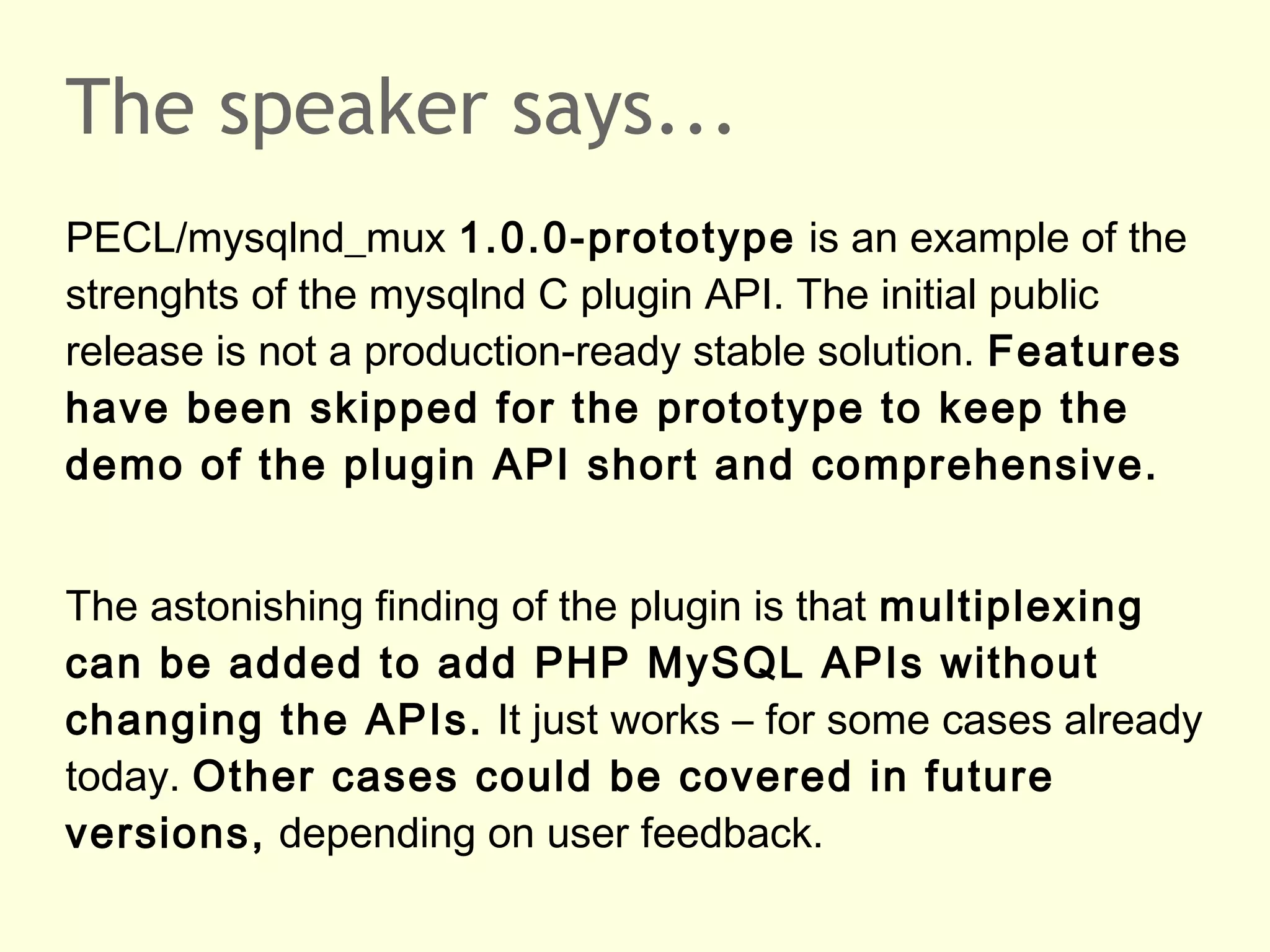
The speaker says... PECL/mysqlnd_mux 1.0.0-prototype is an example of the strenghts of the mysqlnd C plugin API. The initial public release is not a production-ready stable solution. Features have been skipped for the prototype to keep the demo of the plugin API short and comprehensive. The astonishing finding of the plugin is that multiplexing can be added to add PHP MySQL APIs without changing the APIs. It just works – for some cases already today. Other cases could be covered in future versions, depending on user feedback.
THAT'S IT FOLKS?
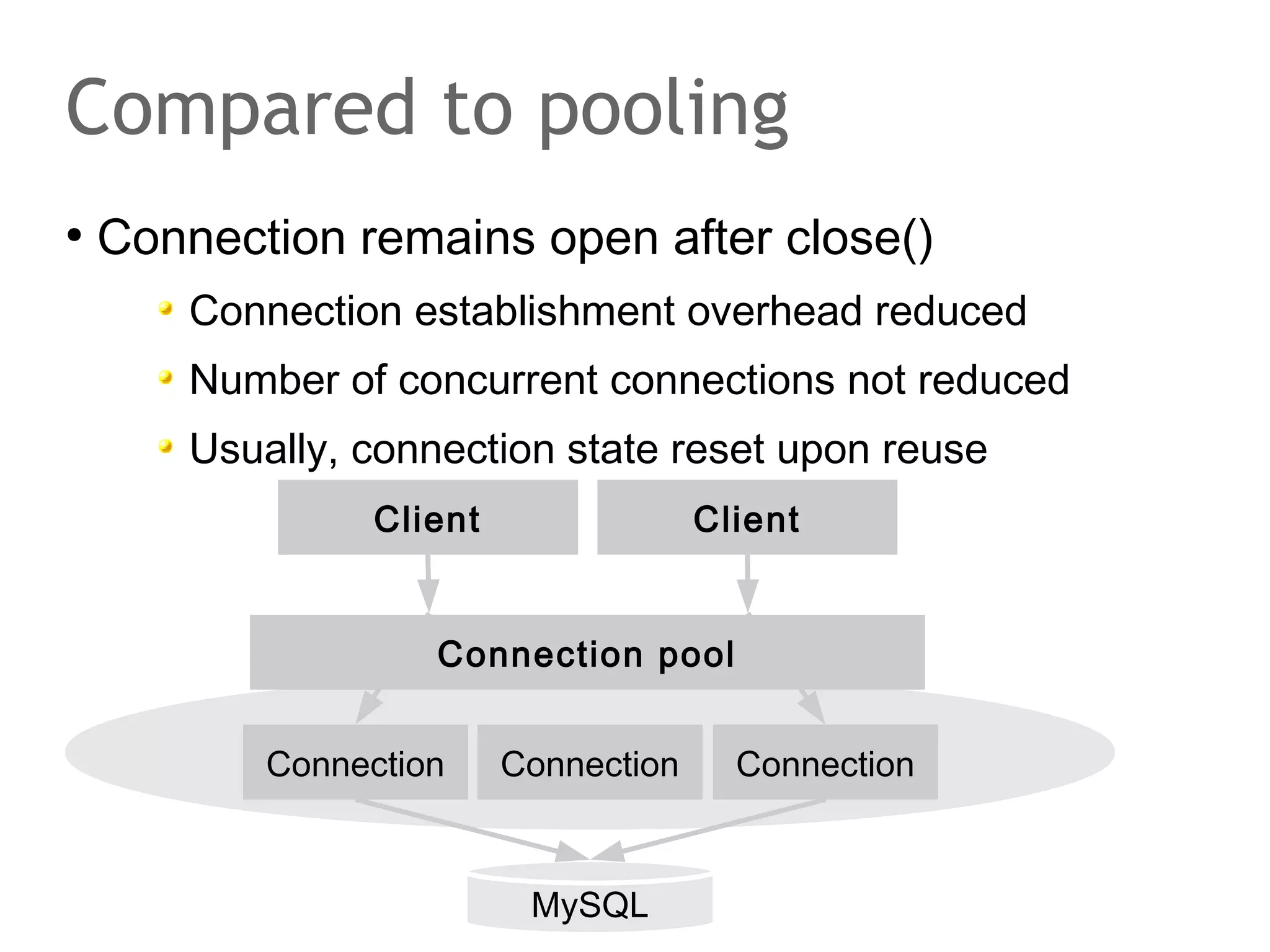
Compared to pooling ● Connection remains open after close() Connection establishment overhead reduced Number of concurrent connections not reduced Usually, connection state reset upon reuse Client Client Connection pool Connection Connection Connection MySQL
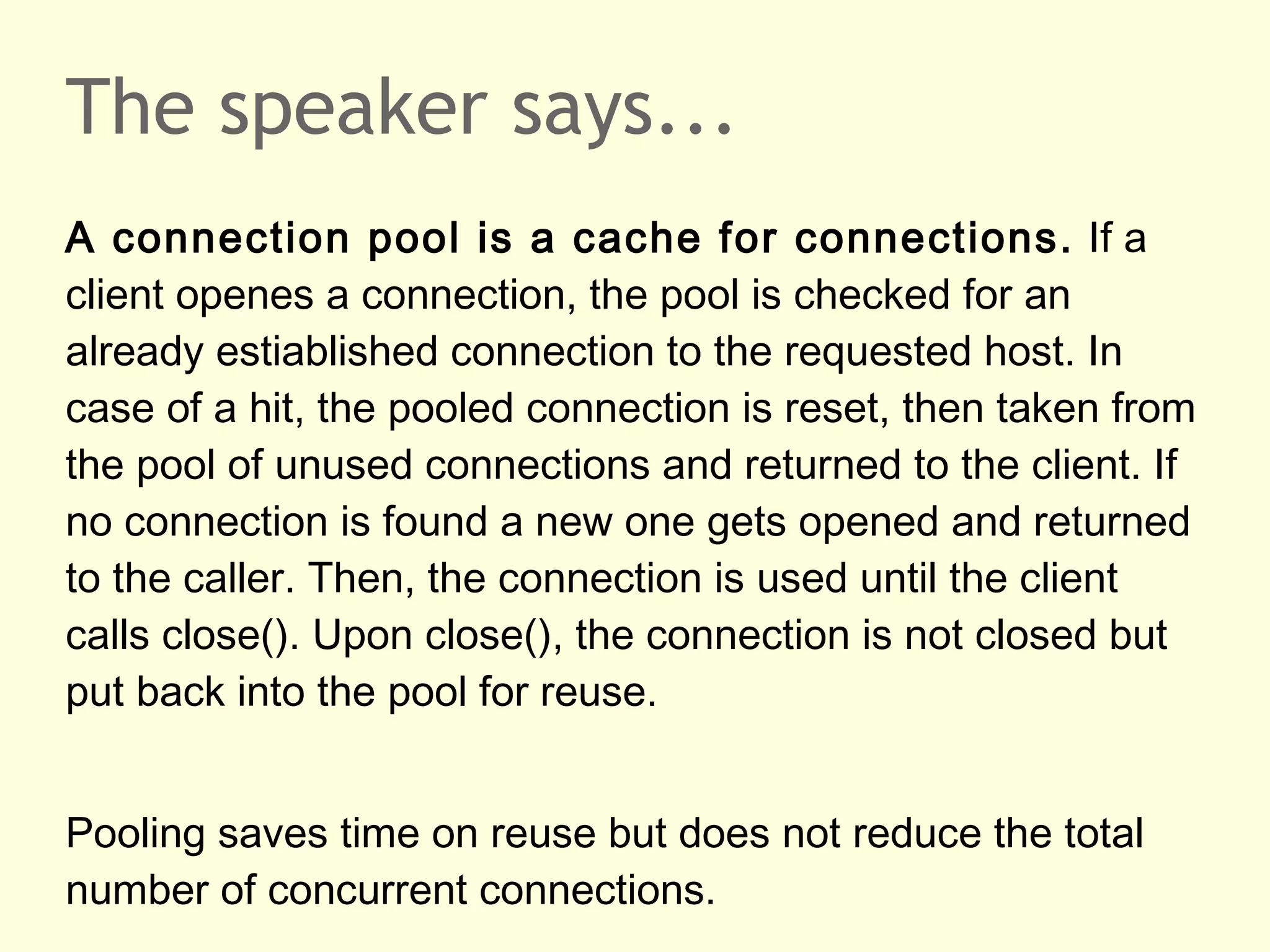
The speaker says... A connection pool is a cache for connections. If a client openes a connection, the pool is checked for an already estiablished connection to the requested host. In case of a hit, the pooled connection is reset, then taken from the pool of unused connections and returned to the client. If no connection is found a new one gets opened and returned to the caller. Then, the connection is used until the client calls close(). Upon close(), the connection is not closed but put back into the pool for reuse. Pooling saves time on reuse but does not reduce the total number of concurrent connections.
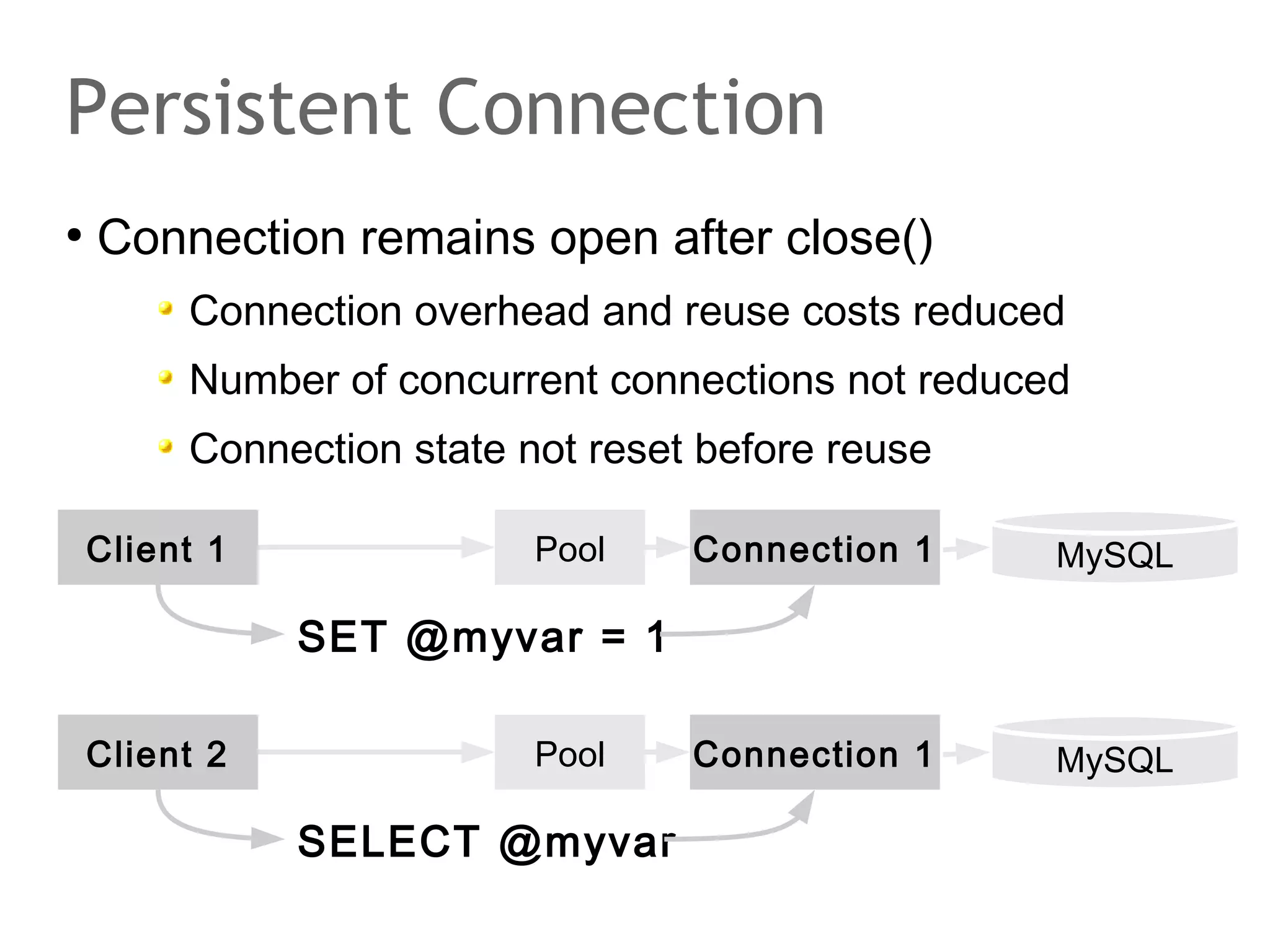
Persistent Connection ● Connection remains open after close() Connection overhead and reuse costs reduced Number of concurrent connections not reduced Connection state not reset before reuse Client 1 Pool Connection 1 MySQL SET @myvar = 1 Client 2 Pool Connection 1 MySQL SELECT @myvar
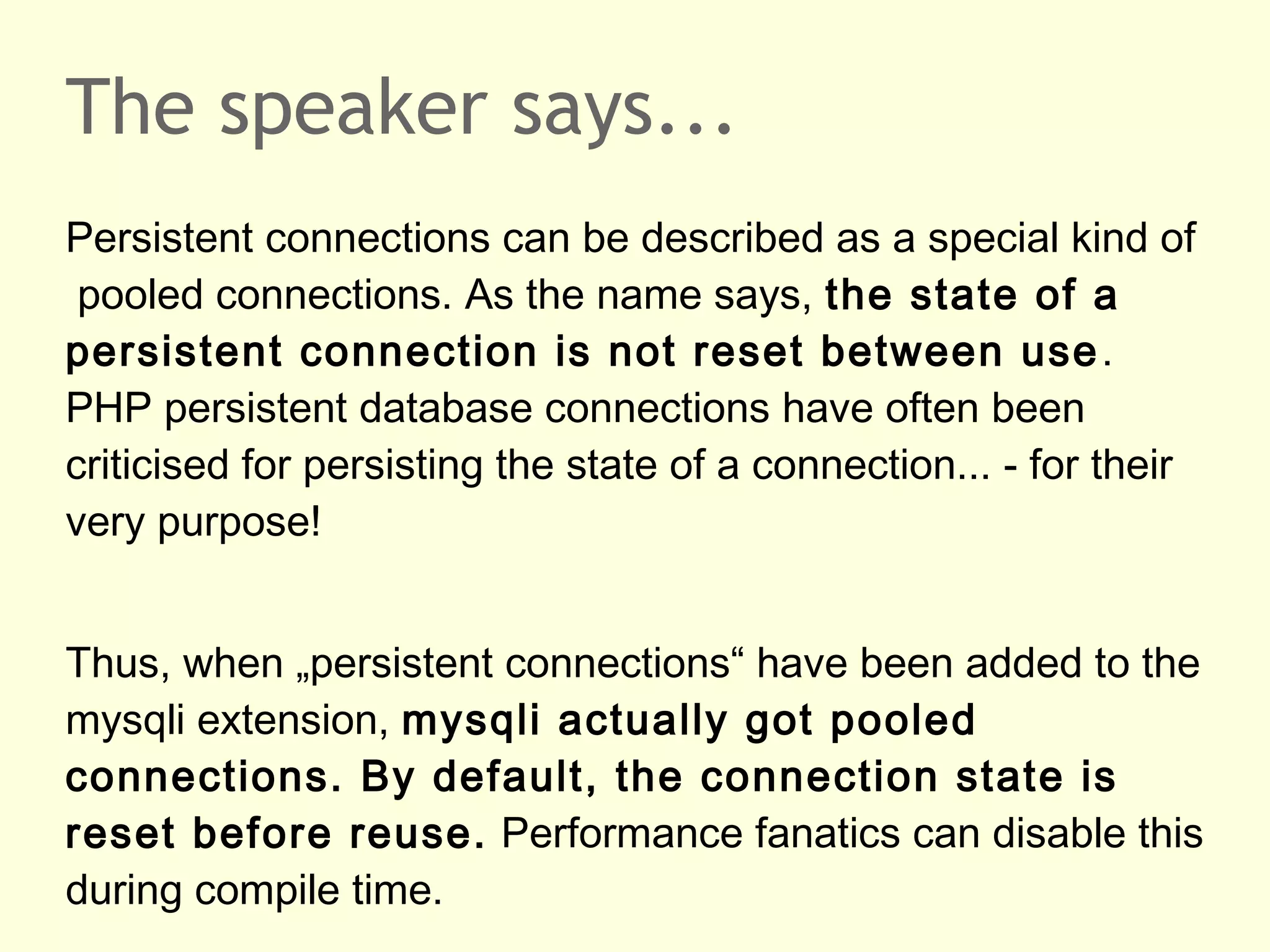
The speaker says... Persistent connections can be described as a special kind of pooled connections. As the name says, the state of a persistent connection is not reset between use . PHP persistent database connections have often been criticised for persisting the state of a connection... - for their very purpose! Thus, when „persistent connections“ have been added to the mysqli extension, mysqli actually got pooled connections. By default, the connection state is reset before reuse. Performance fanatics can disable this during compile time.
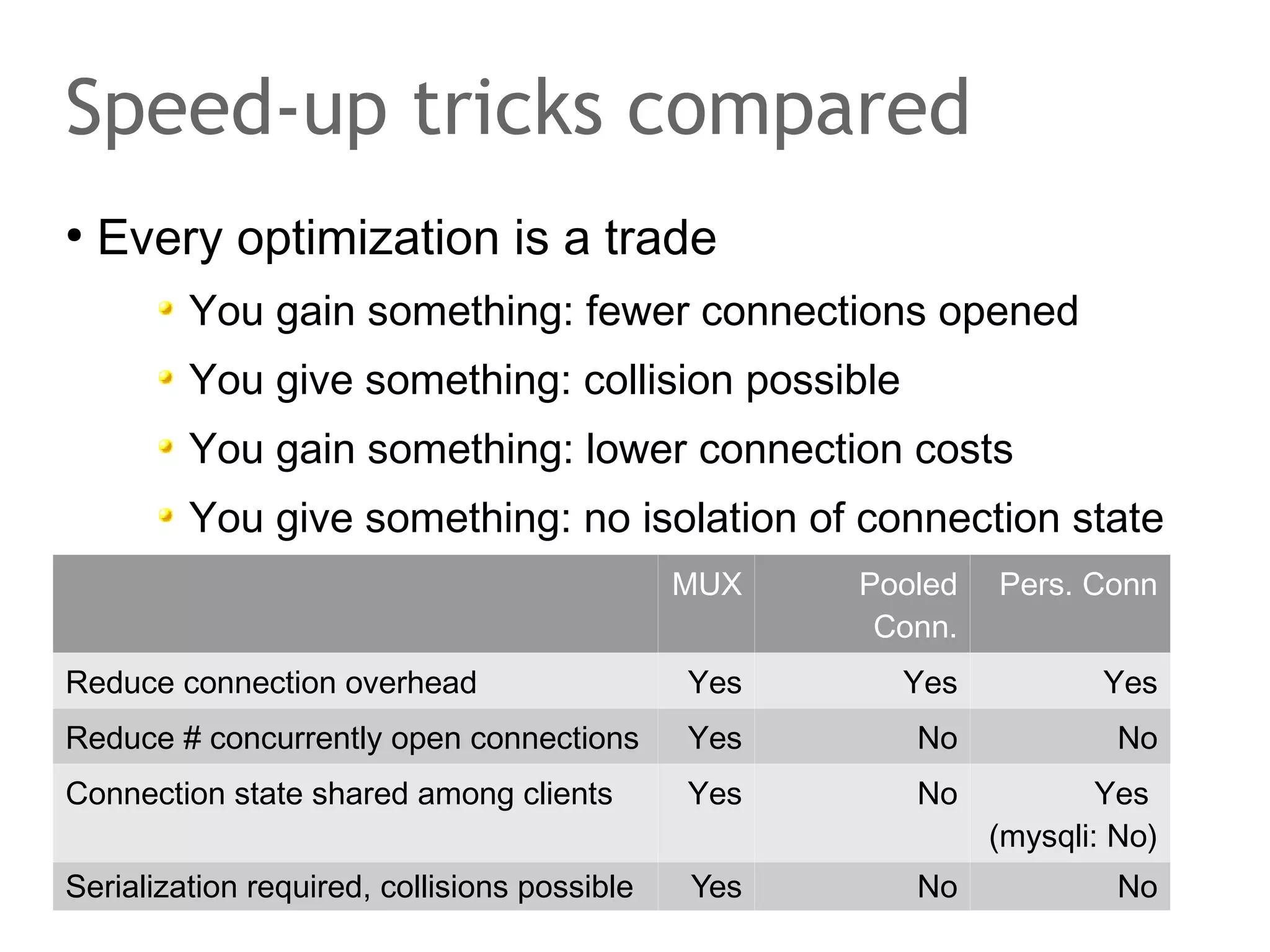
Speed-up tricks compared ● Every optimization is a trade You gain something: fewer connections opened You give something: collision possible You gain something: lower connection costs You give something: no isolation of connection state MUX Pooled Pers. Conn Conn. Reduce connection overhead Yes Yes Yes Reduce # concurrently open connections Yes No No Connection state shared among clients Yes No Yes (mysqli: No) Serialization required, collisions possible Yes No No
The speaker says... Optimizations, such as multiplexing, pooling or persistent connections come at a price. There is no one-fits all trick. Please, try to understand the properties of each option. Then, decide on a case-by-case basis which technology to use.
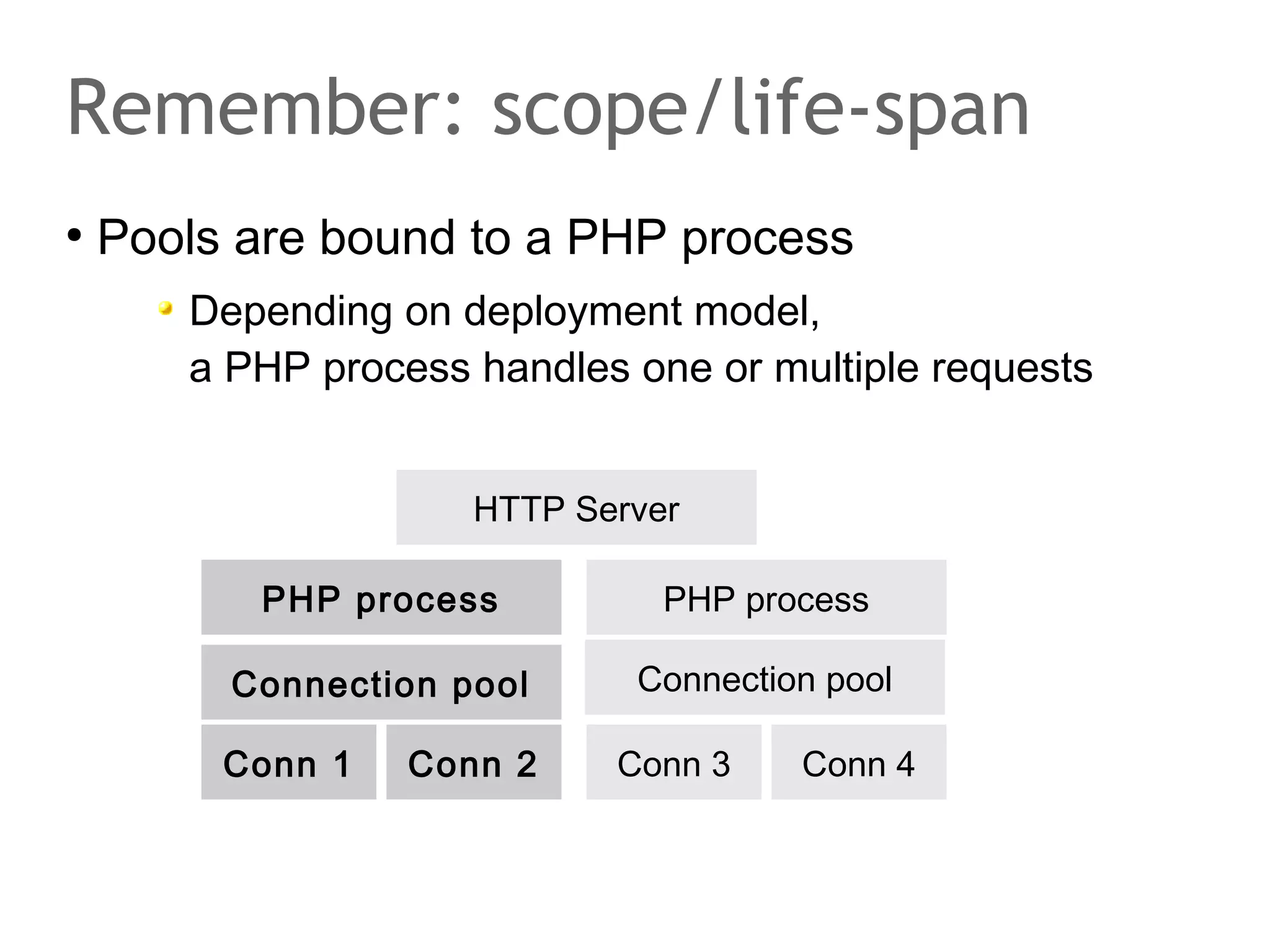
Remember: scope/life-span ● Pools are bound to a PHP process Depending on deployment model, a PHP process handles one or multiple requests HTTP Server PHP process PHP process Connection pool Connection pool Conn 1 Conn 2 Conn 3 Conn 4
The speaker says... Operating systems associate file descriptors, including network connections, with processes. At the end of the process, the network connections are closed. Thus, the life-span of every client-side cache/pool of a PHP process is that of the PHP process. No matter whether we are discussing connections cached for multiplexing or persistent connections as found in any of the PHP MySQL APIs (mysql, mysqli, PDO_MySQL). Depending on the web server deployment model, a PHP process handles one or multiple requests (script runs).
THE END http://www.slideshare.net/nixnutz/ Contact: ulf.wendel@oracle.com, @Ulf_Wendel

PHP mysqlnd connection multiplexing plugin

  • 1.
    Ulf Wendel, Oracle PHP mysqlnd Connection Multiplexing PECL/mysqlnd_mux 1.0.0-prototype
  • 2.
    The speaker says... Whenfast is not fast enough, you pull all triggers. This includes attempts to optimize an already reasonable fast operation: connect time to MySQL. The PHP mysqlnd connection multiplexing plugin, shares a physical connection among multiple user handles. Thus, connection overhead is saved on the client side and the number of opened connection is reduced on the server side. PECL/mysqlnd_mux is an Oracle open source development available from pecl.php.net. Developed by Andrey Hristov.
  • 3.
    Plugins are mostlytransparent WordPress, Drupal, Symfony, Oxid, ZendFramework, ... mysql, mysqli, PDO_MYSQL mysqlnd PECL/mysqlnd_mux plugin Connection Multiplexing MySQL Server
  • 4.
    The speaker says... PECL/mysqlnd_muxis a plugin for the mysqlnd library. The mysqlnd library is the default C client library used by the PHP MySQL extensions mysql, mysqli and PDO_MySQL internally. Mysqlnd ships with PHP since 5.3. Plugins operate at a layer beneath the user APIs, thus improvements are available to all PHP MySQL APIs. Other free plugins are PECL/mysqlnd_ms (replication and load balancing), PECL/mysqlnd_qc (client-side query cache) and many more.
  • 5.
    PECL/mysqlnd_mux ● Multiplexing: share connection among handles Reduce client connect overhead, reduce server load Prototype, requires PHP 5.5.0+ connect() connect() connect() n connection handles PECL/mysqlnd_mux 1 connection MySQL
  • 6.
    The speaker says... ThePHP mysqlnd connection multiplexing proxies MySQL connections. Whenever a client attempts to open a connection to a host, the plugin checks whether there is already a cached network connection to the host in question. If not, a new connection is established and associated with the users' connection handle. Otherwise, the users' connection handle is linked with an already opened network connection. This way, multiple user handles can point to the same network connection and share it. Connection overhead is saved and fewer connections are opened.
  • 7.
    The price youpay ● Multiplexing means serializing tasks Possibility of wait situations Prototype: no upgrade to dedicated connection Prototype: no collision counter Query 1 MUX Query 1 Query 2 MySQL Query 2 Time
  • 8.
    The speaker says... Sharinga resource often requires serializing access to it. This is also the case with a shared connection of the PHP mysqlnd connection multiplexing plugin. Serializing actions bares the risks of collisions and wait situations. In the example, a clients query has to wait for completion of another clients query before it can be executed. Query 2 waits for query 1 to finish. The prototype is using a mutex to synchronize access to a shared connection.
  • 9.
    MUX as ademo of the plugin API ● No new API calls, it just works! Supports popular buffered queries (mysql_query(), mysqli_query(), PDO if using PDO::ATTR_EMULATE_PREPARES) Prototype does not handle unbuffered queries (mysqli_real_query()) Prepared statements not in 1.0.0-prototype (mysqli_stmt_*())
  • 10.
    The speaker says... PECL/mysqlnd_mux1.0.0-prototype is an example of the strenghts of the mysqlnd C plugin API. The initial public release is not a production-ready stable solution. Features have been skipped for the prototype to keep the demo of the plugin API short and comprehensive. The astonishing finding of the plugin is that multiplexing can be added to add PHP MySQL APIs without changing the APIs. It just works – for some cases already today. Other cases could be covered in future versions, depending on user feedback.
  • 11.
  • 12.
    Compared to pooling ● Connection remains open after close() Connection establishment overhead reduced Number of concurrent connections not reduced Usually, connection state reset upon reuse Client Client Connection pool Connection Connection Connection MySQL
  • 13.
    The speaker says... Aconnection pool is a cache for connections. If a client openes a connection, the pool is checked for an already estiablished connection to the requested host. In case of a hit, the pooled connection is reset, then taken from the pool of unused connections and returned to the client. If no connection is found a new one gets opened and returned to the caller. Then, the connection is used until the client calls close(). Upon close(), the connection is not closed but put back into the pool for reuse. Pooling saves time on reuse but does not reduce the total number of concurrent connections.
  • 14.
    Persistent Connection ● Connection remains open after close() Connection overhead and reuse costs reduced Number of concurrent connections not reduced Connection state not reset before reuse Client 1 Pool Connection 1 MySQL SET @myvar = 1 Client 2 Pool Connection 1 MySQL SELECT @myvar
  • 15.
    The speaker says... Persistentconnections can be described as a special kind of pooled connections. As the name says, the state of a persistent connection is not reset between use . PHP persistent database connections have often been criticised for persisting the state of a connection... - for their very purpose! Thus, when „persistent connections“ have been added to the mysqli extension, mysqli actually got pooled connections. By default, the connection state is reset before reuse. Performance fanatics can disable this during compile time.
  • 16.
    Speed-up tricks compared ● Every optimization is a trade You gain something: fewer connections opened You give something: collision possible You gain something: lower connection costs You give something: no isolation of connection state MUX Pooled Pers. Conn Conn. Reduce connection overhead Yes Yes Yes Reduce # concurrently open connections Yes No No Connection state shared among clients Yes No Yes (mysqli: No) Serialization required, collisions possible Yes No No
  • 17.
    The speaker says... Optimizations,such as multiplexing, pooling or persistent connections come at a price. There is no one-fits all trick. Please, try to understand the properties of each option. Then, decide on a case-by-case basis which technology to use.
  • 18.
    Remember: scope/life-span ● Pools are bound to a PHP process Depending on deployment model, a PHP process handles one or multiple requests HTTP Server PHP process PHP process Connection pool Connection pool Conn 1 Conn 2 Conn 3 Conn 4
  • 19.
    The speaker says... Operatingsystems associate file descriptors, including network connections, with processes. At the end of the process, the network connections are closed. Thus, the life-span of every client-side cache/pool of a PHP process is that of the PHP process. No matter whether we are discussing connections cached for multiplexing or persistent connections as found in any of the PHP MySQL APIs (mysql, mysqli, PDO_MySQL). Depending on the web server deployment model, a PHP process handles one or multiple requests (script runs).
  • 20.
    THE END http://www.slideshare.net/nixnutz/ Contact: ulf.wendel@oracle.com, @Ulf_Wendel