Our Environment Challenges and Solutions Conclusions PostgreSQL at 20TB and Beyond Analytics at a Massive Scale Chris Travers Adjust GmbH January 25, 2018
Our Environment Challenges and Solutions Conclusions About Adjust Adjust is a market leader in mobile advertisement attribution. We basically act as a referee in pay-per-install advertising. We focus on fairness, fraud-prevention and other ways of ensuring that advertisers pay for the services they receiving fairly and with accountability.
Our Environment Challenges and Solutions Conclusions Our Environment About Adjust Traffic Statistics Analytics Environment Challenges and Solutions Staffing Throughput Autovacuum Data Modeling Backups and Operations Conclusions
Our Environment Challenges and Solutions Conclusions Basic Facts About Us • We are a PostgreSQL/Kafka shop • Around 200 employees worldwide • Link advertisements to installs • Delivering near-real-time analytics to software vendors • Our Data is “Big Data”
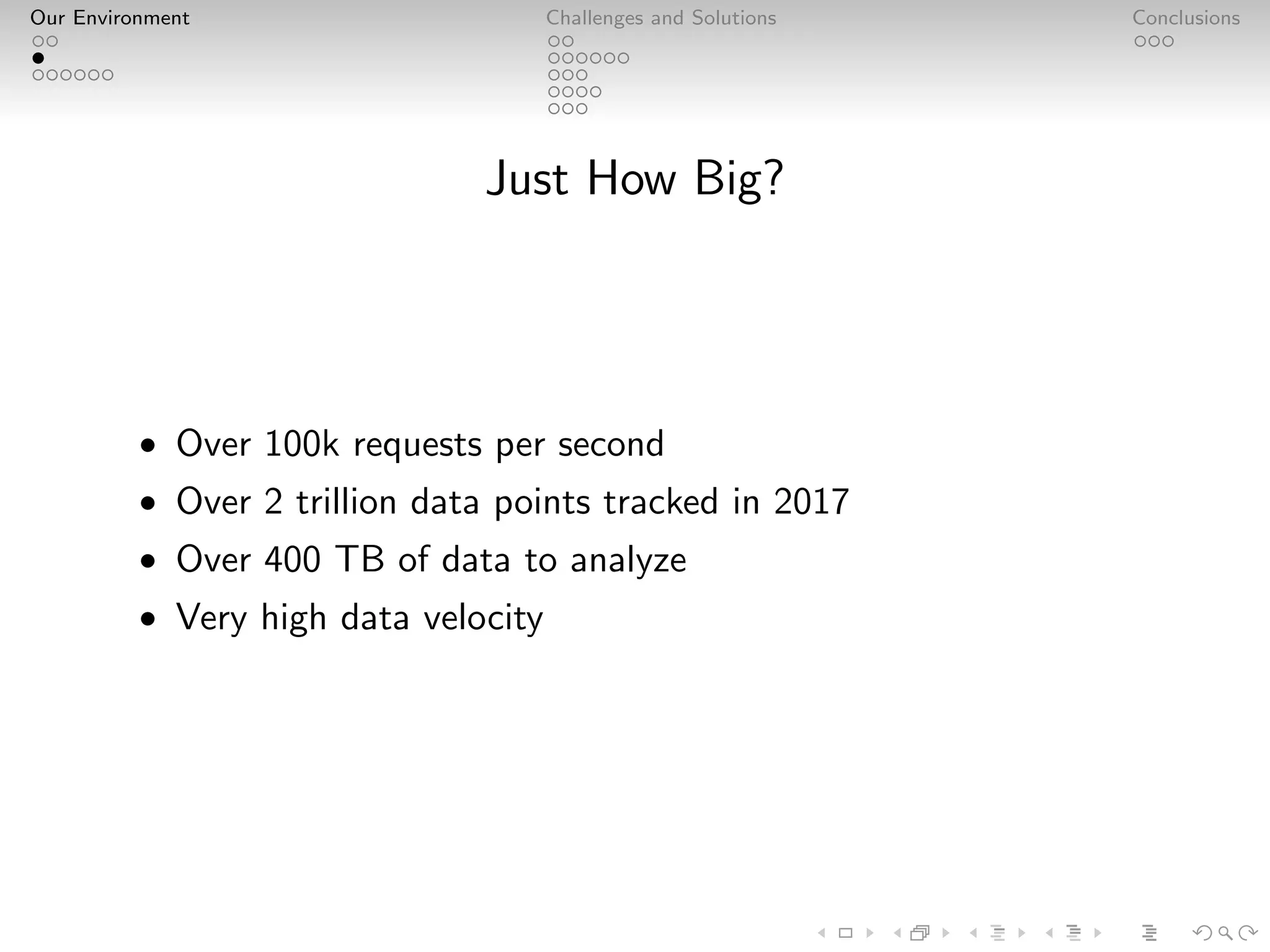
Our Environment Challenges and Solutions Conclusions Just How Big? • Over 100k requests per second • Over 2 trillion data points tracked in 2017 • Over 400 TB of data to analyze • Very high data velocity
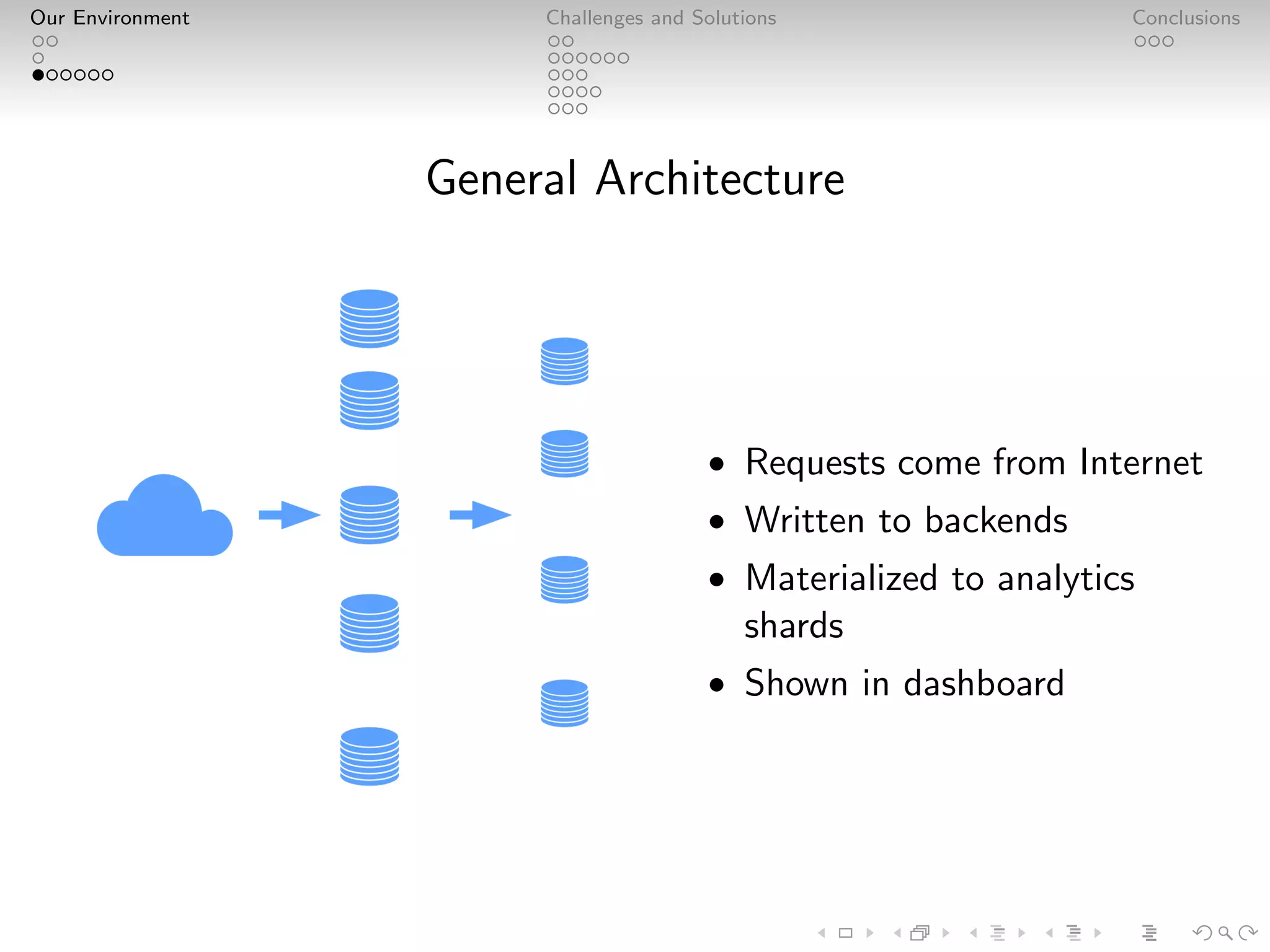
Our Environment Challenges and Solutions Conclusions General Architecture • Requests come from Internet • Written to backends • Materialized to analytics shards • Shown in dashboard
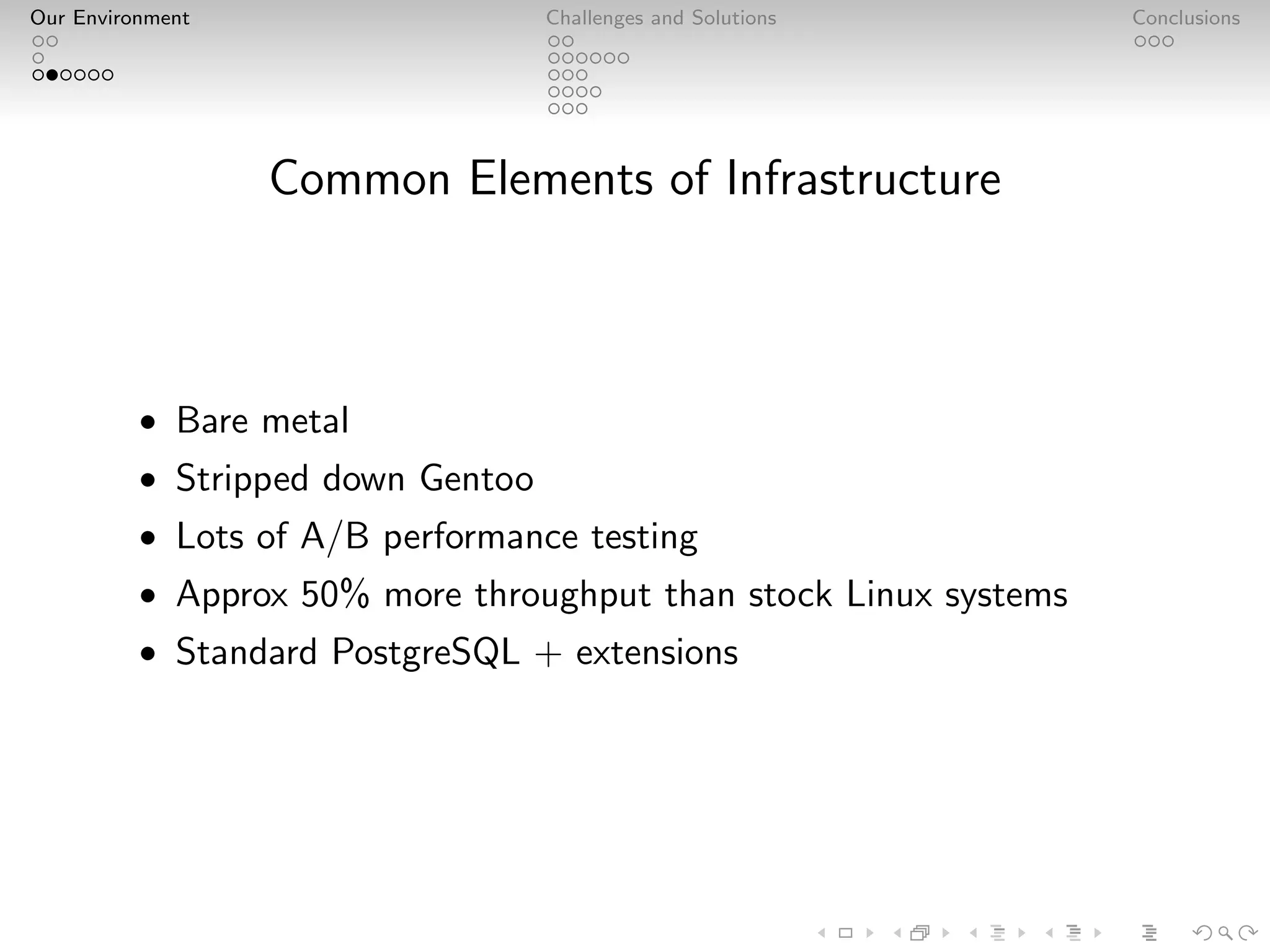
Our Environment Challenges and Solutions Conclusions Common Elements of Infrastructure • Bare metal • Stripped down Gentoo • Lots of A/B performance testing • Approx 50% more throughput than stock Linux systems • Standard PostgreSQL + extensions
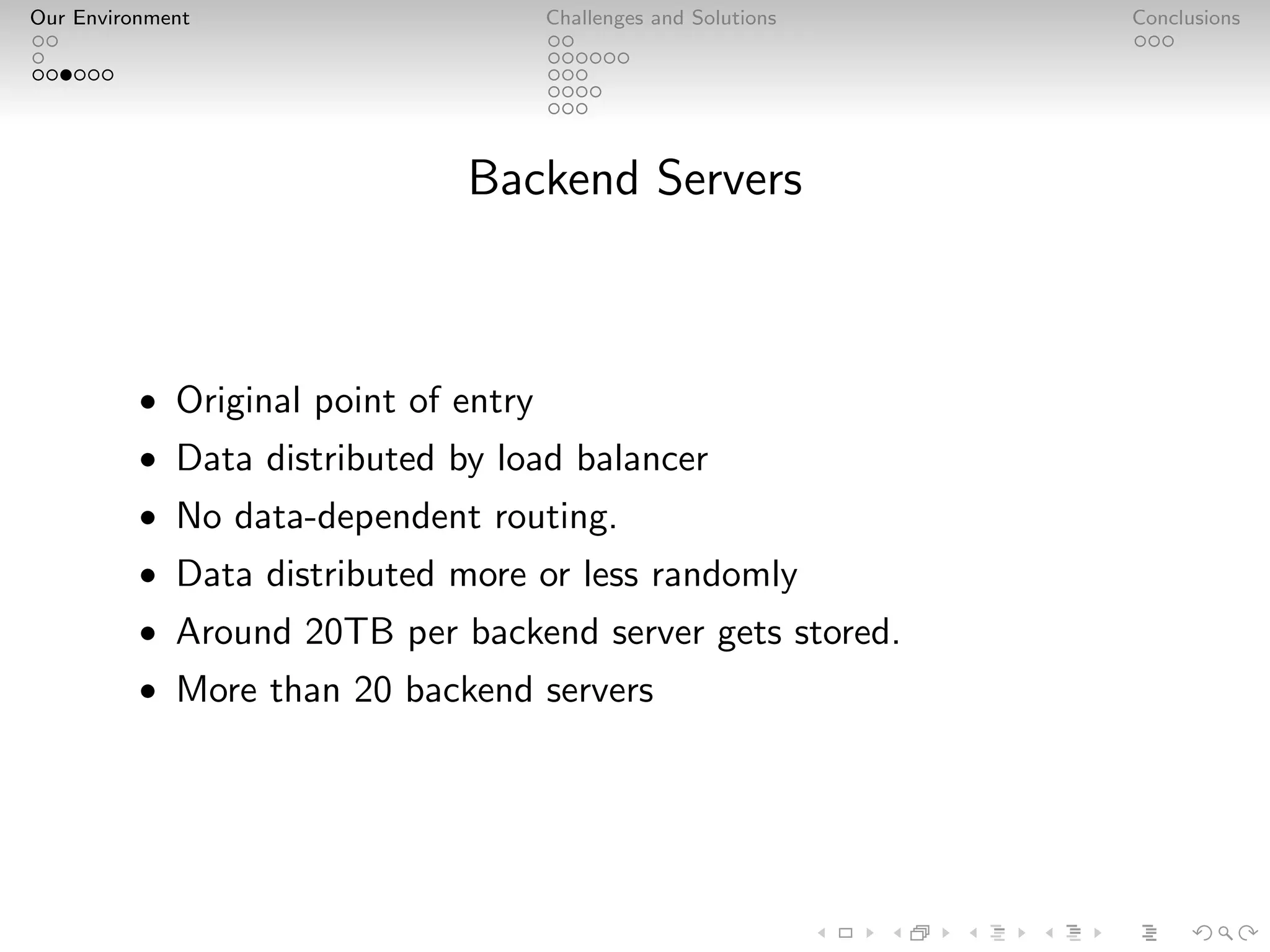
Our Environment Challenges and Solutions Conclusions Backend Servers • Original point of entry • Data distributed by load balancer • No data-dependent routing. • Data distributed more or less randomly • Around 20TB per backend server gets stored. • More than 20 backend servers
Our Environment Challenges and Solutions Conclusions Materializer • Aggregates new events • Copies the aggregations to the shards • Runs every few minutes • New data only
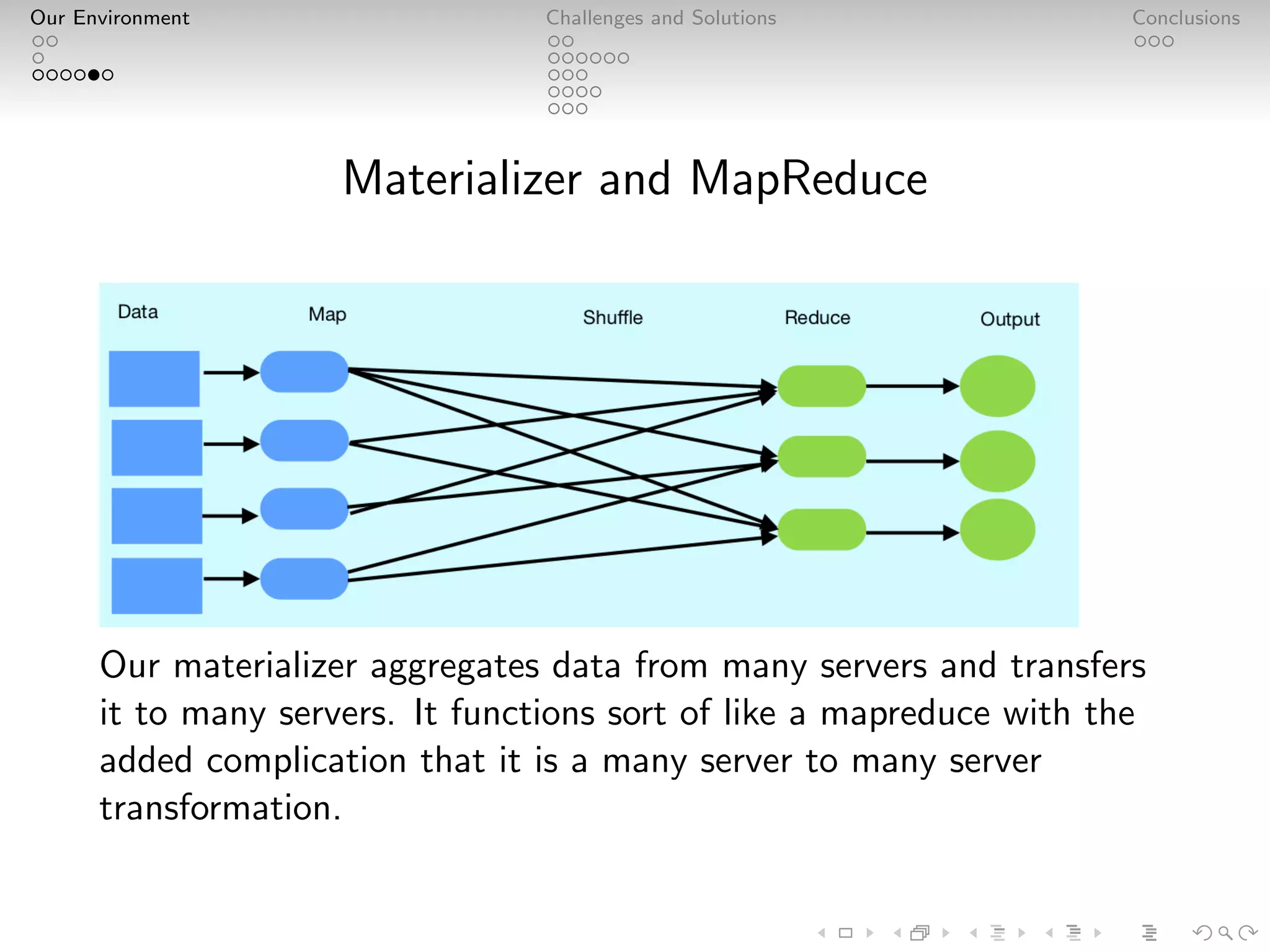
Our Environment Challenges and Solutions Conclusions Materializer and MapReduce Our materializer aggregates data from many servers and transfers it to many servers. It functions sort of like a mapreduce with the added complication that it is a many server to many server transformation.
Our Environment Challenges and Solutions Conclusions Analytics Shards • Each about 2TB each • 16 shards currently, may grow • Our own custom analytics software for managing and querying • Custom sharding/locating software • Paired for redundancy
Our Environment Challenges and Solutions Conclusions Staffing: Challenges • No Junior Database Folks • Demanding environment • Very little room for error • Need people who are deeply grounded in both theory and practice
Our Environment Challenges and Solutions Conclusions Staffing: Solutions • Look for people with enough relevant experience they can learn • Be picky with what we are willing to teach new folks • Look for self-learners with enough knowledge to participate • Expect people to grow into the role • We also use code challenges
Our Environment Challenges and Solutions Conclusions Throughput challenges • Most data is new • It is a lot of data • Lots of btrees with lots of random inserts • Ideally, every wrote inserted once and updated once • Long-term retention
Our Environment Challenges and Solutions Conclusions Throughput Solutions Backend Servers • Each point of entry server has its own database • Transactional processing is separate. • Careful attention to alignment issues • We write our own data types in C to help • Tables partitioned by event time
Our Environment Challenges and Solutions Conclusions Throughput Solutions Analytics Shards • Pre-aggregated data for client-facing metrics • Sharded at roughly 2TB per shard • 16 shards currently • Custom sharding framework optimized to reduce network usage • Goal is to have dashboards load fast. • We know where data is on these shards.
Our Environment Challenges and Solutions Conclusions Throughput Solutions Materializer • Two phases • First phase runs on original entry servers • Aggregates and copies data to analytics shards • Second phase runs on analytics shards • further aggregates and copies.
Our Environment Challenges and Solutions Conclusions Materializer: A Special Problem • Works great when you only have one data center • Foreign data wrapper bulk writes are very slow across data centers • This is a known issue with the Postgres FDW • This is a blocking issue.
Our Environment Challenges and Solutions Conclusions Materializer: Solution • C extension using COPY • Acts as libpq client • Wrote a global transaction manager • Throughput restored.
Our Environment Challenges and Solutions Conclusions Introducing Autovacuum • Queries have to provide consistent snapshots • All updates in PostgreSQL are copy-on-write • In our case, we write once and then update once. • Have to clean up old data at some point • By default, 50 rows plus 20% of table being “dead” triggers autovacuum
Our Environment Challenges and Solutions Conclusions Autovacuum problems • For small tables, great but we have tables with 200M rows • 20% of 200M rows is 40 million dead tuples.... • Autovacuum does nothing and then undertakes a heavy task.... • performance suffers and tables bloat.
Our Environment Challenges and Solutions Conclusions Autovacuum Solutions • Change to 150k rows plus 0% • Tuning requires a lot of hand-holding • Roll out change to servers gradually to avoid overloading system.
Our Environment Challenges and Solutions Conclusions Why it Matters • Under heavy load, painful to change • Want to avoid rewriting tables • Want to minimize disk usage • Want to maximize alignment to pages • Lots of little details really matter
Our Environment Challenges and Solutions Conclusions Custom 1-byte Enums • Country • Language • OS Name • Device Type
Our Environment Challenges and Solutions Conclusions IStore Like HStore but for Integers • Like HStore but for integers • Supports addition, etc, between values of same key • Useful for time series and other modelling problems • Supports GIN indexing among others
Our Environment Challenges and Solutions Conclusions The Elephant in the Room How do we aggregate that much data? • Basically incremental Map Reduce • Map and first phase aggregation on backends • Reduce and second phase aggregation on shards • Further reduction and aggregation possible on demand
Our Environment Challenges and Solutions Conclusions Operations Tools • Sqitch • Rex • Our own custom tools
Our Environment Challenges and Solutions Conclusions Backups • Home grown system • Base backup plus WAL • Runs as a Rex task • We can also do logical backups (but...)
Our Environment Challenges and Solutions Conclusions Ongoing Distributed Challenges • Major Upgrades • Storage Space • Multi-datacenter challenges • Making it all fast
Our Environment Challenges and Solutions Conclusions Overview This environment is all about careful attention to detail and being willing to write C code when needed. Space savings, better alignment, and other seemingly small gains add up over tens of billions of rows.
Our Environment Challenges and Solutions Conclusions Major Points of Interest • We are using PostgreSQL as a big data platform. • We expect this architecture to scale very far. • Provides near-real-time analytics on user actions.
Our Environment Challenges and Solutions Conclusions PostgreSQL makes all this Possible In buiding our 400TB analytics environment we have yet to outgrow PostgreSQL. In fact, this is one of the few pieces of our infrastructure we are perfectly confident in scaling.

PostgreSQL at 20TB and Beyond

  • 1.
    Our Environment Challengesand Solutions Conclusions PostgreSQL at 20TB and Beyond Analytics at a Massive Scale Chris Travers Adjust GmbH January 25, 2018
  • 2.
    Our Environment Challengesand Solutions Conclusions About Adjust Adjust is a market leader in mobile advertisement attribution. We basically act as a referee in pay-per-install advertising. We focus on fairness, fraud-prevention and other ways of ensuring that advertisers pay for the services they receiving fairly and with accountability.
  • 3.
    Our Environment Challengesand Solutions Conclusions Our Environment About Adjust Traffic Statistics Analytics Environment Challenges and Solutions Staffing Throughput Autovacuum Data Modeling Backups and Operations Conclusions
  • 4.
    Our Environment Challengesand Solutions Conclusions Basic Facts About Us • We are a PostgreSQL/Kafka shop • Around 200 employees worldwide • Link advertisements to installs • Delivering near-real-time analytics to software vendors • Our Data is “Big Data”
  • 5.
    Our Environment Challengesand Solutions Conclusions Just How Big? • Over 100k requests per second • Over 2 trillion data points tracked in 2017 • Over 400 TB of data to analyze • Very high data velocity
  • 6.
    Our Environment Challengesand Solutions Conclusions General Architecture • Requests come from Internet • Written to backends • Materialized to analytics shards • Shown in dashboard
  • 7.
    Our Environment Challengesand Solutions Conclusions Common Elements of Infrastructure • Bare metal • Stripped down Gentoo • Lots of A/B performance testing • Approx 50% more throughput than stock Linux systems • Standard PostgreSQL + extensions
  • 8.
    Our Environment Challengesand Solutions Conclusions Backend Servers • Original point of entry • Data distributed by load balancer • No data-dependent routing. • Data distributed more or less randomly • Around 20TB per backend server gets stored. • More than 20 backend servers
  • 9.
    Our Environment Challengesand Solutions Conclusions Materializer • Aggregates new events • Copies the aggregations to the shards • Runs every few minutes • New data only
  • 10.
    Our Environment Challengesand Solutions Conclusions Materializer and MapReduce Our materializer aggregates data from many servers and transfers it to many servers. It functions sort of like a mapreduce with the added complication that it is a many server to many server transformation.
  • 11.
    Our Environment Challengesand Solutions Conclusions Analytics Shards • Each about 2TB each • 16 shards currently, may grow • Our own custom analytics software for managing and querying • Custom sharding/locating software • Paired for redundancy
  • 12.
    Our Environment Challengesand Solutions Conclusions Staffing: Challenges • No Junior Database Folks • Demanding environment • Very little room for error • Need people who are deeply grounded in both theory and practice
  • 13.
    Our Environment Challengesand Solutions Conclusions Staffing: Solutions • Look for people with enough relevant experience they can learn • Be picky with what we are willing to teach new folks • Look for self-learners with enough knowledge to participate • Expect people to grow into the role • We also use code challenges
  • 14.
    Our Environment Challengesand Solutions Conclusions Throughput challenges • Most data is new • It is a lot of data • Lots of btrees with lots of random inserts • Ideally, every wrote inserted once and updated once • Long-term retention
  • 15.
    Our Environment Challengesand Solutions Conclusions Throughput Solutions Backend Servers • Each point of entry server has its own database • Transactional processing is separate. • Careful attention to alignment issues • We write our own data types in C to help • Tables partitioned by event time
  • 16.
    Our Environment Challengesand Solutions Conclusions Throughput Solutions Analytics Shards • Pre-aggregated data for client-facing metrics • Sharded at roughly 2TB per shard • 16 shards currently • Custom sharding framework optimized to reduce network usage • Goal is to have dashboards load fast. • We know where data is on these shards.
  • 17.
    Our Environment Challengesand Solutions Conclusions Throughput Solutions Materializer • Two phases • First phase runs on original entry servers • Aggregates and copies data to analytics shards • Second phase runs on analytics shards • further aggregates and copies.
  • 18.
    Our Environment Challengesand Solutions Conclusions Materializer: A Special Problem • Works great when you only have one data center • Foreign data wrapper bulk writes are very slow across data centers • This is a known issue with the Postgres FDW • This is a blocking issue.
  • 19.
    Our Environment Challengesand Solutions Conclusions Materializer: Solution • C extension using COPY • Acts as libpq client • Wrote a global transaction manager • Throughput restored.
  • 20.
    Our Environment Challengesand Solutions Conclusions Introducing Autovacuum • Queries have to provide consistent snapshots • All updates in PostgreSQL are copy-on-write • In our case, we write once and then update once. • Have to clean up old data at some point • By default, 50 rows plus 20% of table being “dead” triggers autovacuum
  • 21.
    Our Environment Challengesand Solutions Conclusions Autovacuum problems • For small tables, great but we have tables with 200M rows • 20% of 200M rows is 40 million dead tuples.... • Autovacuum does nothing and then undertakes a heavy task.... • performance suffers and tables bloat.
  • 22.
    Our Environment Challengesand Solutions Conclusions Autovacuum Solutions • Change to 150k rows plus 0% • Tuning requires a lot of hand-holding • Roll out change to servers gradually to avoid overloading system.
  • 23.
    Our Environment Challengesand Solutions Conclusions Why it Matters • Under heavy load, painful to change • Want to avoid rewriting tables • Want to minimize disk usage • Want to maximize alignment to pages • Lots of little details really matter
  • 24.
    Our Environment Challengesand Solutions Conclusions Custom 1-byte Enums • Country • Language • OS Name • Device Type
  • 25.
    Our Environment Challengesand Solutions Conclusions IStore Like HStore but for Integers • Like HStore but for integers • Supports addition, etc, between values of same key • Useful for time series and other modelling problems • Supports GIN indexing among others
  • 26.
    Our Environment Challengesand Solutions Conclusions The Elephant in the Room How do we aggregate that much data? • Basically incremental Map Reduce • Map and first phase aggregation on backends • Reduce and second phase aggregation on shards • Further reduction and aggregation possible on demand
  • 27.
    Our Environment Challengesand Solutions Conclusions Operations Tools • Sqitch • Rex • Our own custom tools
  • 28.
    Our Environment Challengesand Solutions Conclusions Backups • Home grown system • Base backup plus WAL • Runs as a Rex task • We can also do logical backups (but...)
  • 29.
    Our Environment Challengesand Solutions Conclusions Ongoing Distributed Challenges • Major Upgrades • Storage Space • Multi-datacenter challenges • Making it all fast
  • 30.
    Our Environment Challengesand Solutions Conclusions Overview This environment is all about careful attention to detail and being willing to write C code when needed. Space savings, better alignment, and other seemingly small gains add up over tens of billions of rows.
  • 31.
    Our Environment Challengesand Solutions Conclusions Major Points of Interest • We are using PostgreSQL as a big data platform. • We expect this architecture to scale very far. • Provides near-real-time analytics on user actions.
  • 32.
    Our Environment Challengesand Solutions Conclusions PostgreSQL makes all this Possible In buiding our 400TB analytics environment we have yet to outgrow PostgreSQL. In fact, this is one of the few pieces of our infrastructure we are perfectly confident in scaling.