Introduction A classifieris used to predict an outcome of a test data Such a prediction is useful in many applications Business forecasting, cause-and-effect analysis, etc. A number of classifiers have been evolved to support the activities. Each has their own merits and demerits There is a need to estimate the accuracy and performance of the classifier with respect to few controlling parameters in data sensitivity As a task of sensitivity analysis, we have to focus on Estimation strategy Metrics for measuring accuracy Metrics for measuring performance 3
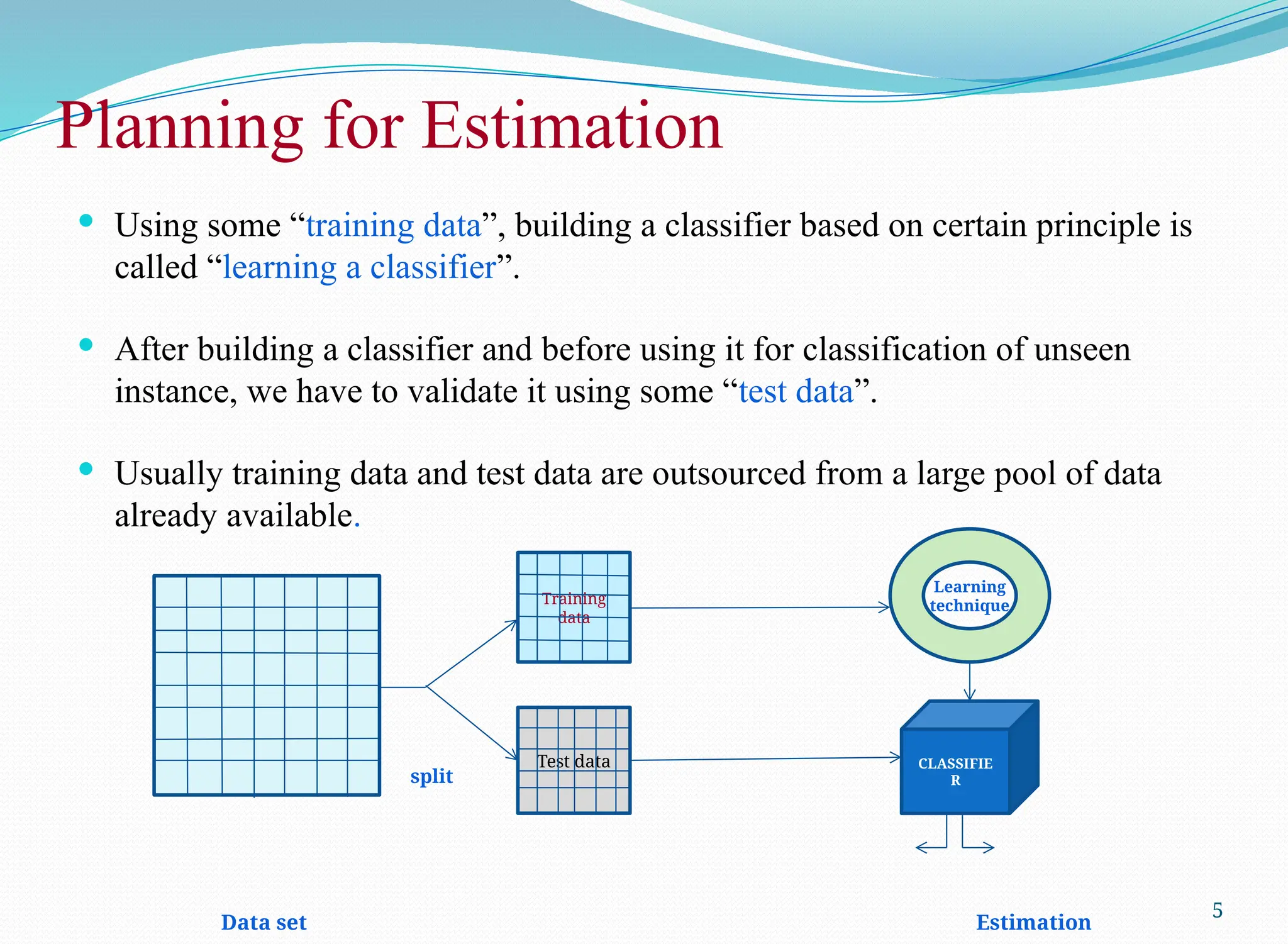
Planning for Estimation Using some “training data”, building a classifier based on certain principle is called “learning a classifier”. After building a classifier and before using it for classification of unseen instance, we have to validate it using some “test data”. Usually training data and test data are outsourced from a large pool of data already available. split Data set Estimation 5 Training data Test data Learning technique CLASSIFIE R
6.
Estimation Strategies Accuracyand performance measurement should follow a strategy. As the topic is important, many strategies have been advocated so far. Most widely used strategies are Holdout method Random subsampling Cross-validation Bootstrap approach 6
7.
Holdout Method Thisis a basic concept of estimating a prediction. Given a dataset, it is partitioned into two disjoint sets called training set and testing set. Classifier is learned based on the training set and get evaluated with testing set. Proportion of training and testing sets is at the discretion of analyst; typically 1:1 or 2:1, and there is a trade-off between these sizes of these two sets. If the training set is too large, then model may be good enough, but estimation may be less reliable due to small testing set and vice-versa. 7
8.
Random Subsampling Itis a variation of Holdout method to overcome the drawback of over- presenting a class in one set thus under-presenting it in the other set and vice-versa. In this method, Holdout method is repeated k times, and in each time, two disjoint sets are chosen at random with a predefined sizes. Overall estimation is taken as the average of estimations obtained from each iteration. 8
9.
Cross-Validation The maindrawback of Random subsampling is, it does not have control over the number of times each tuple is used for training and testing. Cross-validation is proposed to overcome this problem. There are two variations in the cross-validation method. k-fold cross-validation N-fold cross-validation 9
10.
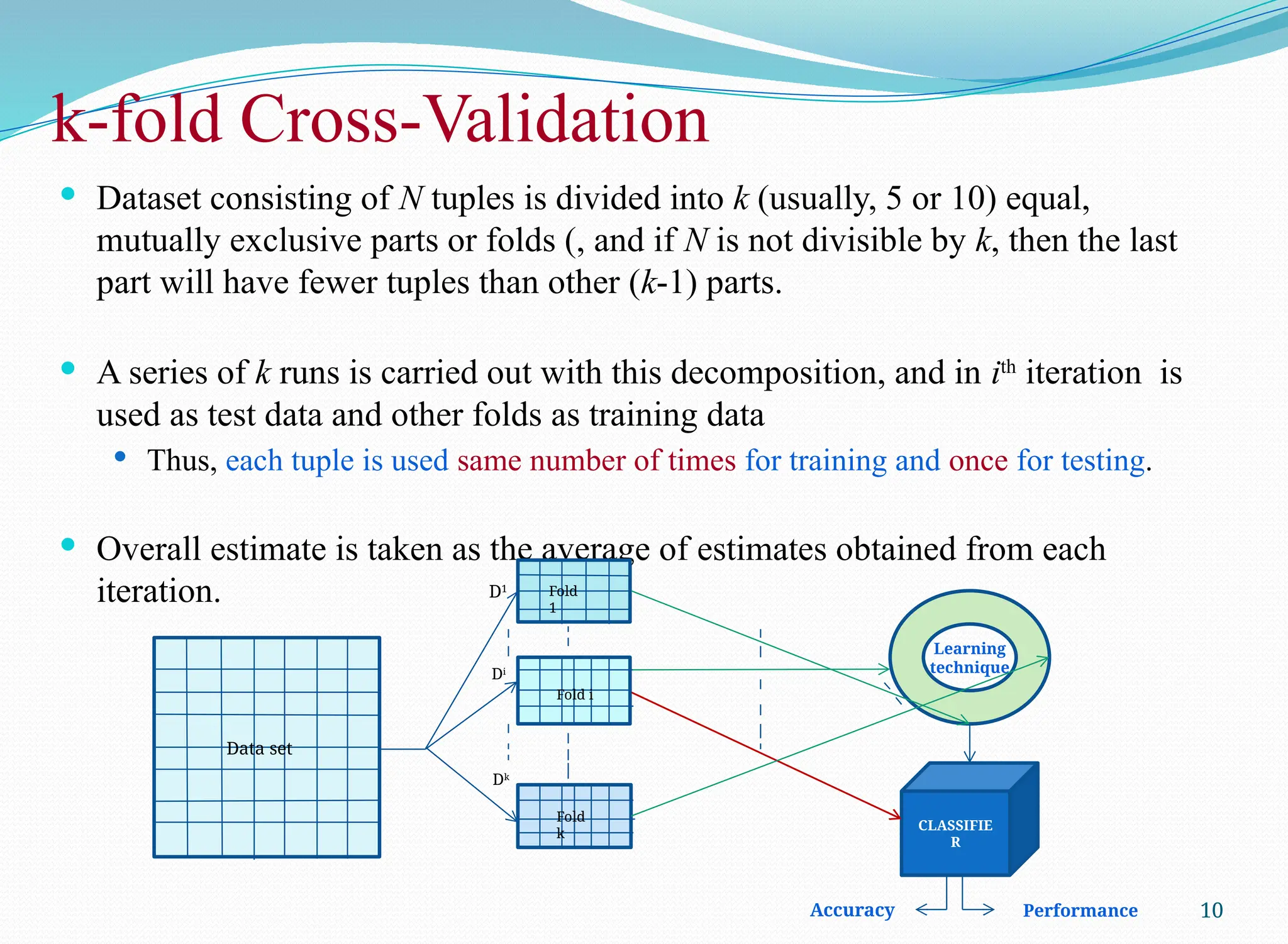
k-fold Cross-Validation Datasetconsisting of N tuples is divided into k (usually, 5 or 10) equal, mutually exclusive parts or folds (, and if N is not divisible by k, then the last part will have fewer tuples than other (k-1) parts. A series of k runs is carried out with this decomposition, and in ith iteration is used as test data and other folds as training data Thus, each tuple is used same number of times for training and once for testing. Overall estimate is taken as the average of estimates obtained from each iteration. 10 Learning technique CLASSIFIE R D1 Di Dk Data set Fold 1 Fold i Fold k Accuracy Performance
11.
N-fold Cross-Validation Ink-fold cross-validation method, part of the given data is used in training with k-tests. N-fold cross-validation is an extreme case of k-fold cross validation, often known as “Leave-one-out’’ cross-validation. Here, dataset is divided into as many folds as there are instances; thus, all most each tuple forming a training set, building N classifiers. In this method, therefore, N classifiers are built each with N-1 instances, and one tuple is used to classify with a single test instance. Test sets are mutually exclusive and effectively cover the entire set (in sequence). This is as if trained by entire data as well as tested by entire data set. Overall estimation is then averaged out of the results of N classifiers. 11
12.
N-fold Cross-Validation :Issue So far the estimation of accuracy and performance of a classifier model is concerned, the N-fold cross-validation is comparable to the others we have just discussed. The drawback of N-fold cross validation strategy is that it is computationally expensive, as here we have to repeat the run N times; this is practically infeasible when data set is large. In practice, the method is extremely beneficial with very small data set only, where as much data as possible to need to be used to train a classifier. 12
13.
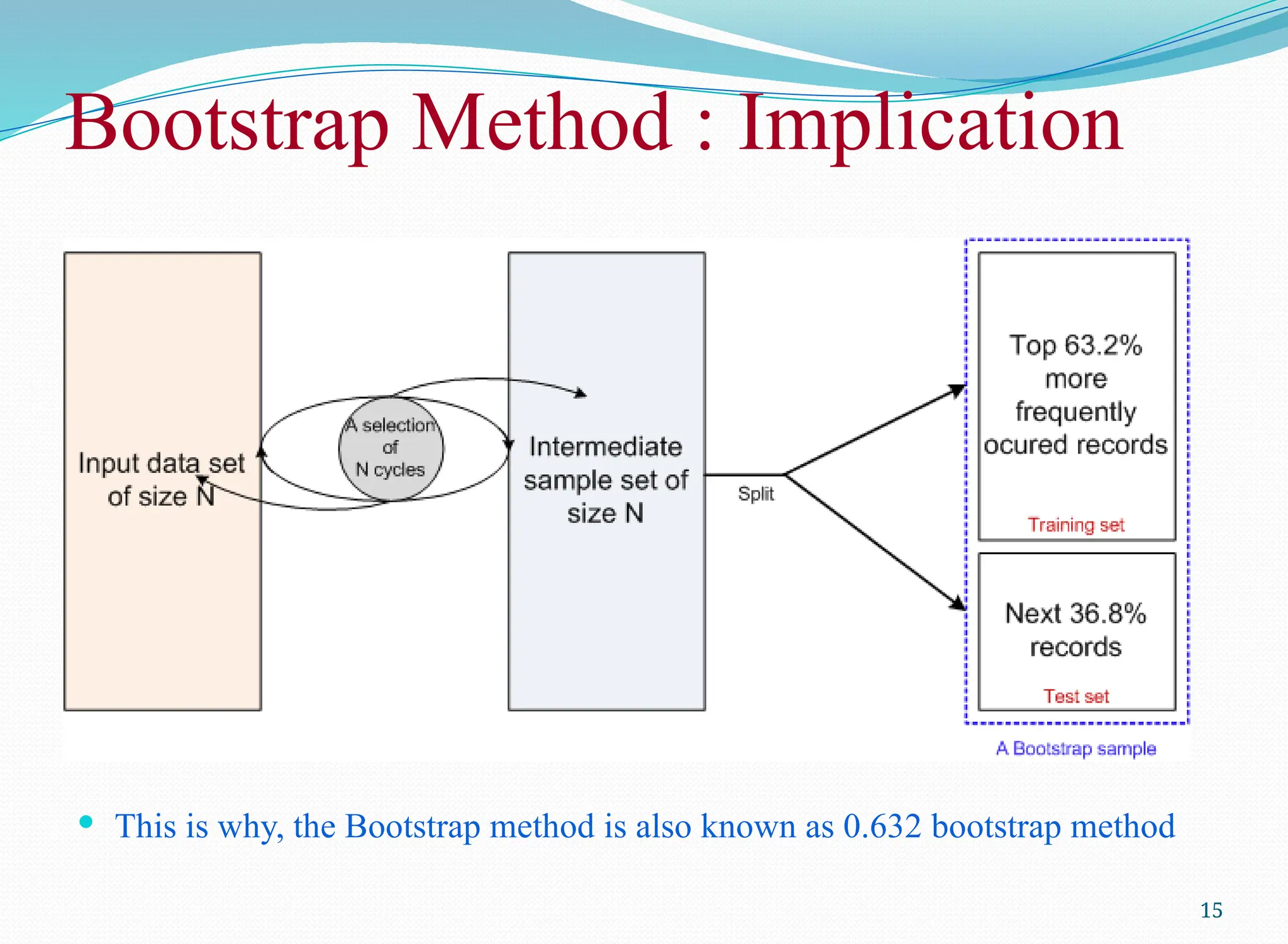
Bootstrap Method TheBootstrap method is a variation of repeated version of Random sampling method. The method suggests the sampling of training records with replacement. Each time a record is selected for training set, is put back into the original pool of records, so that it is equally likely to be redrawn in the next run. In other words, the Bootstrap method samples the given data set uniformly with replacement. The rational of having this strategy is that let some records be occur more than once in the samples of both training as well as testing. What is the probability that a record will be selected more than once? 13
14.
Bootstrap Method Suppose,we have given a data set of N records. The data set is sampled N times with replacement, resulting in a bootstrap sample (i.e., training set) of I samples. Note that the entire runs are called a bootstrap sample in this method. There are certain chance (i.e., probability) that a particular tuple occurs one or more times in the training set If they do not appear in the training set, then they will end up in the test set. Each tuple has a probability of being selected (and the probability of not being selected is . We have to select N times, so the probability that a record will not be chosen during the whole run is Thus, the probability that a record is chosen by a bootstrap sample is For a large value of N, it can be proved that record chosen in a bootstrap sample is = 0.632 14
15.
Bootstrap Method :Implication 15 This is why, the Bootstrap method is also known as 0.632 bootstrap method
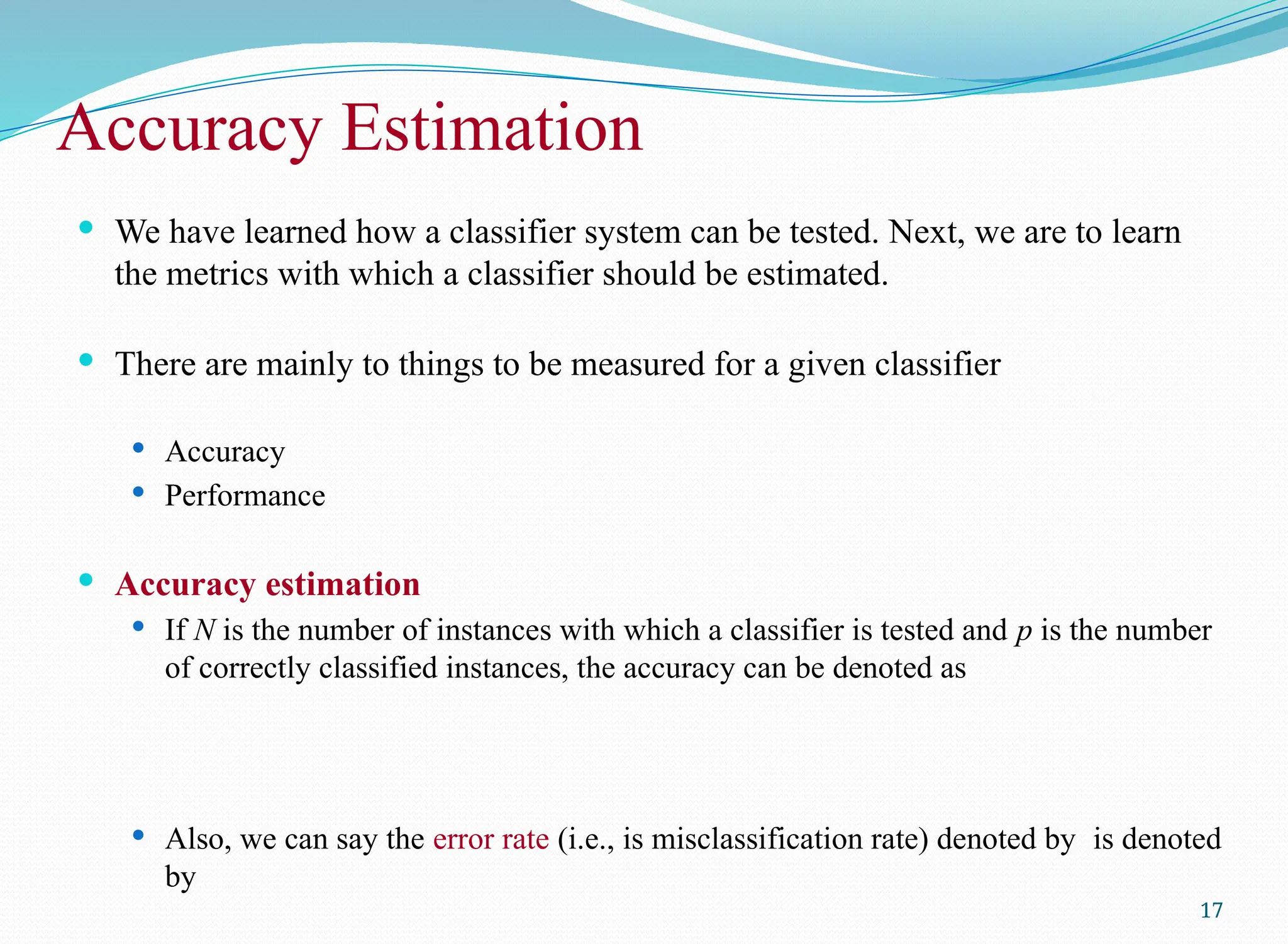
Accuracy Estimation Wehave learned how a classifier system can be tested. Next, we are to learn the metrics with which a classifier should be estimated. There are mainly to things to be measured for a given classifier Accuracy Performance Accuracy estimation If N is the number of instances with which a classifier is tested and p is the number of correctly classified instances, the accuracy can be denoted as Also, we can say the error rate (i.e., is misclassification rate) denoted by is denoted by 17
18.
Accuracy : Trueand Predictive Now, this accuracy may be true (or absolute) accuracy or predicted (or optimistic) accuracy. True accuracy of a classifier is the accuracy when the classifier is tested with all possible unseen instances in the given classification space. However, the number of possible unseen instances is potentially very large (if it is not infinite) For example, classifying a hand-written character Hence, measuring the true accuracy beyond the dispute is impractical. Predictive accuracy of a classifier is an accuracy estimation for a given test data (which are mutually exclusive with training data). If the predictive accuracy for test set is and if we test the classifier with a different test set it is very likely that a different accuracy would be obtained. The predictive accuracy when estimated with a given test set it should be acceptable without any objection 18
19.
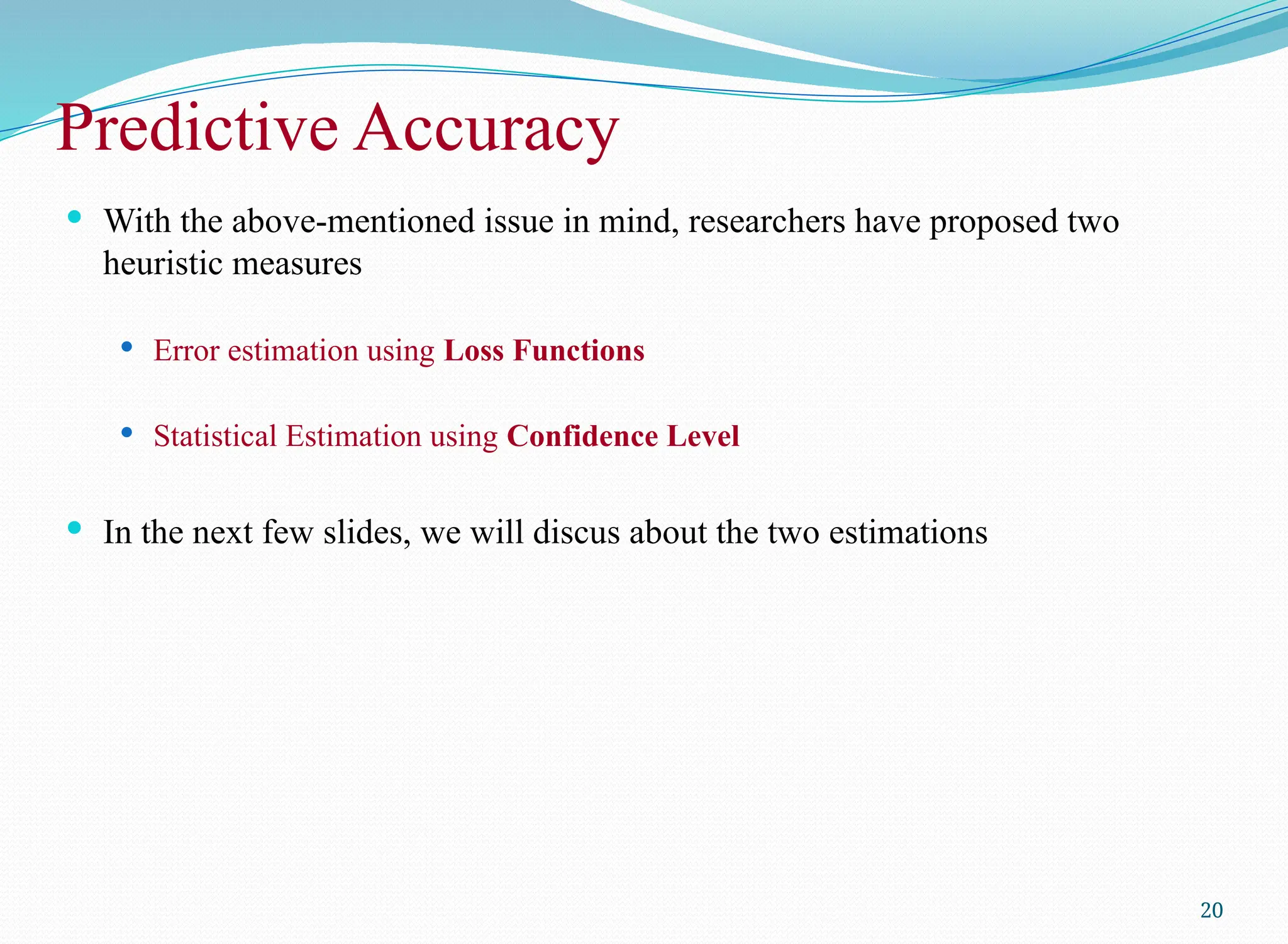
Predictive Accuracy Example 11.1: Universality of predictive accuracy Consider a classifier model MD developed with a training set D using an algorithm M. Two predictive accuracies when MD is estimated with two different training sets T1 and T2 are (MD )T1 = 95% (MD )T2 = 70% Further, assume the size of T1 and T2 are |T1| = 100 records |T2| = 5000 records. Based on the above mentioned estimations, neither estimation is acceptable beyond doubt. 19
20.
With theabove-mentioned issue in mind, researchers have proposed two heuristic measures Error estimation using Loss Functions Statistical Estimation using Confidence Level In the next few slides, we will discus about the two estimations 20 Predictive Accuracy
21.
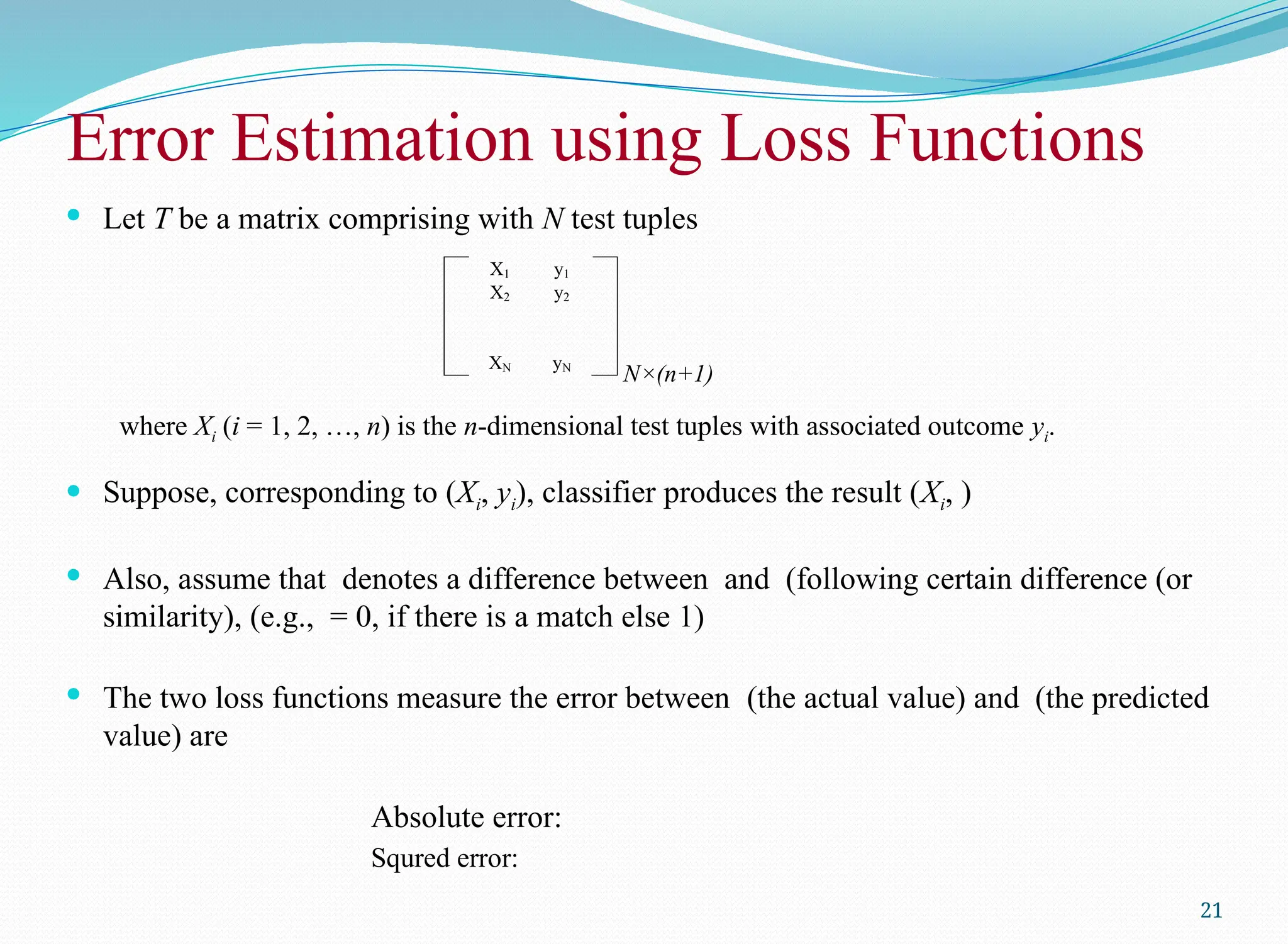
Let Tbe a matrix comprising with N test tuples where Xi (i = 1, 2, …, n) is the n-dimensional test tuples with associated outcome yi. Suppose, corresponding to (Xi, yi), classifier produces the result (Xi, ) Also, assume that denotes a difference between and (following certain difference (or similarity), (e.g., = 0, if there is a match else 1) The two loss functions measure the error between (the actual value) and (the predicted value) are Absolute error: Squred error: 21 Error Estimation using Loss Functions N×(n+1) X1 y1 X2 y2 XN yN
22.
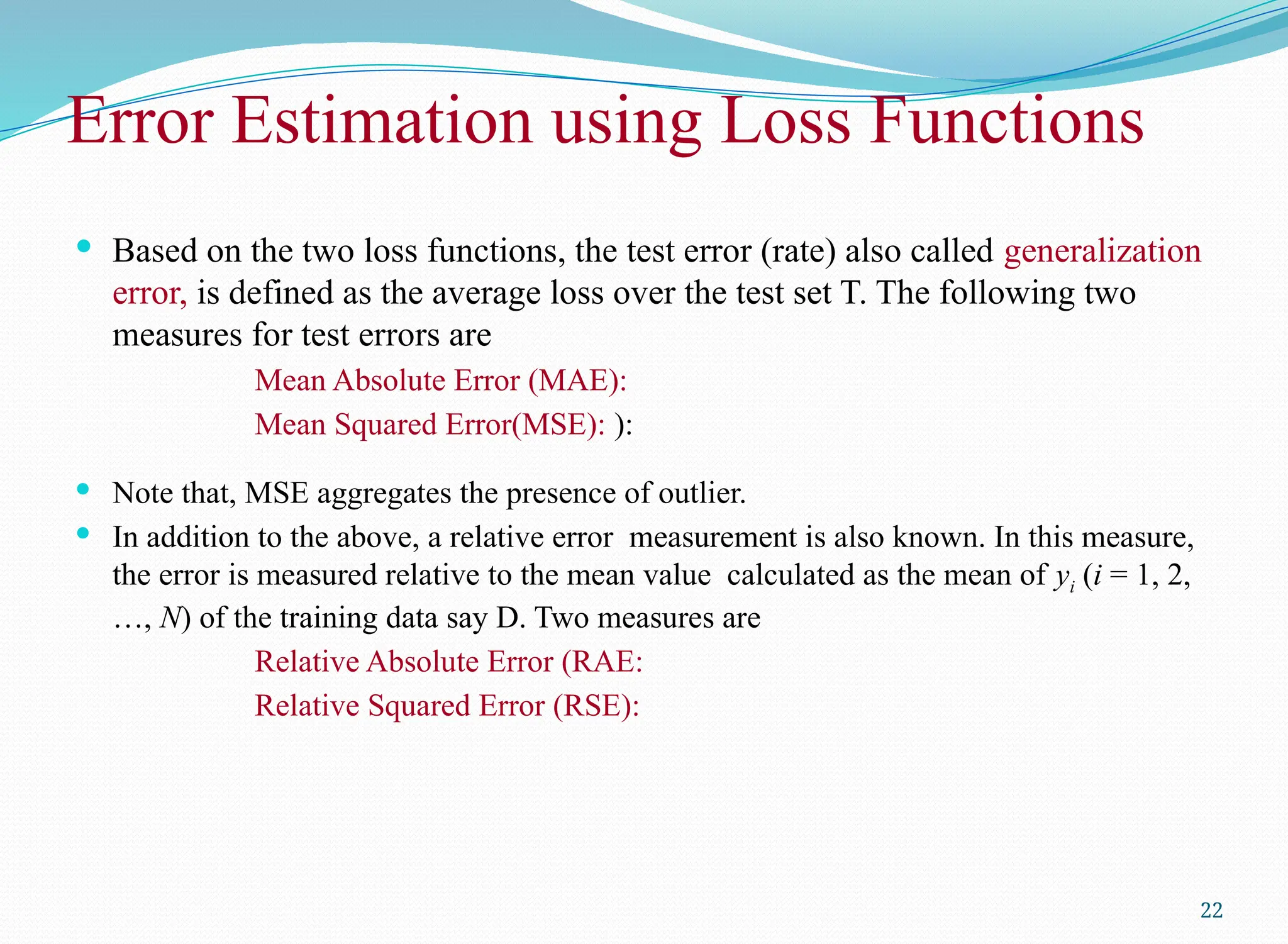
Based onthe two loss functions, the test error (rate) also called generalization error, is defined as the average loss over the test set T. The following two measures for test errors are Mean Absolute Error (MAE): Mean Squared Error(MSE): ): Note that, MSE aggregates the presence of outlier. In addition to the above, a relative error measurement is also known. In this measure, the error is measured relative to the mean value calculated as the mean of yi (i = 1, 2, …, N) of the training data say D. Two measures are Relative Absolute Error (RAE: Relative Squared Error (RSE): 22 Error Estimation using Loss Functions
23.
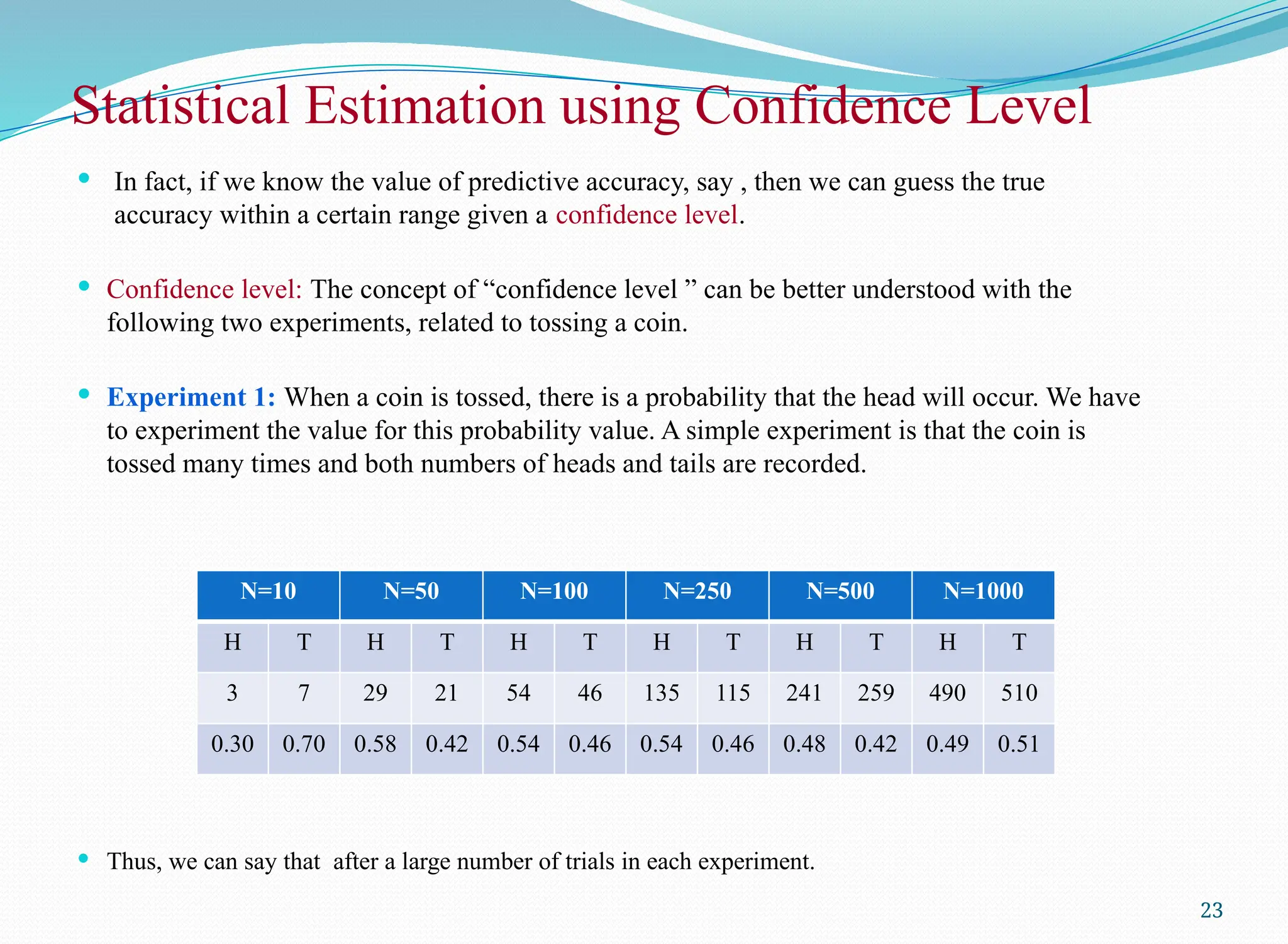
In fact,if we know the value of predictive accuracy, say , then we can guess the true accuracy within a certain range given a confidence level. Confidence level: The concept of “confidence level ” can be better understood with the following two experiments, related to tossing a coin. Experiment 1: When a coin is tossed, there is a probability that the head will occur. We have to experiment the value for this probability value. A simple experiment is that the coin is tossed many times and both numbers of heads and tails are recorded. Thus, we can say that after a large number of trials in each experiment. N=10 N=50 N=100 N=250 N=500 N=1000 H T H T H T H T H T H T 3 7 29 21 54 46 135 115 241 259 490 510 0.30 0.70 0.58 0.42 0.54 0.46 0.54 0.46 0.48 0.42 0.49 0.51 Statistical Estimation using Confidence Level 23
24.
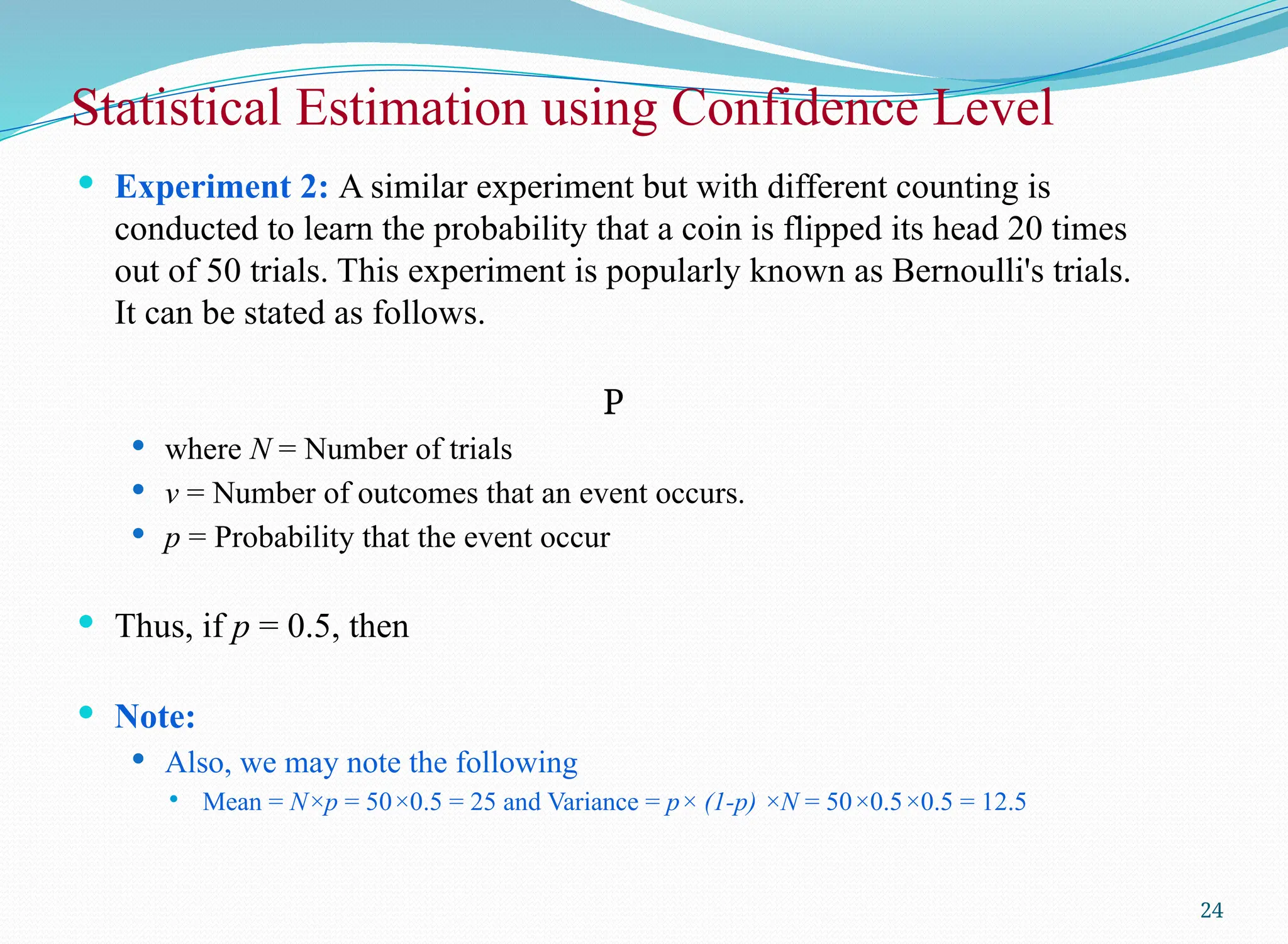
Experiment 2:A similar experiment but with different counting is conducted to learn the probability that a coin is flipped its head 20 times out of 50 trials. This experiment is popularly known as Bernoulli's trials. It can be stated as follows. P where N = Number of trials v = Number of outcomes that an event occurs. p = Probability that the event occur Thus, if p = 0.5, then Note: Also, we may note the following Mean = N×p = 50×0.5 = 25 and Variance = p× (1-p) ×N = 50×0.5×0.5 = 12.5 Statistical Estimation using Confidence Level 24
25.
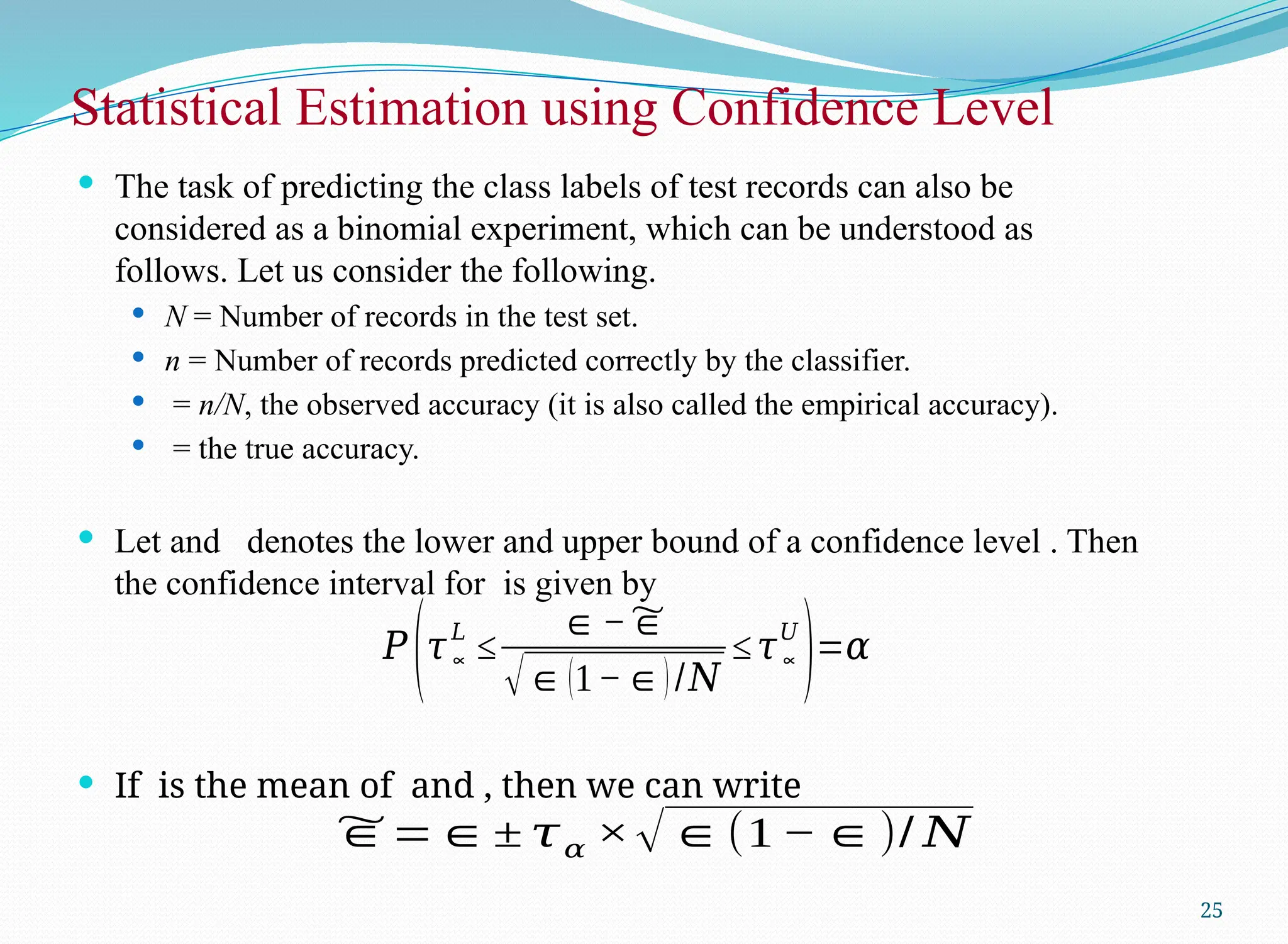
The taskof predicting the class labels of test records can also be considered as a binomial experiment, which can be understood as follows. Let us consider the following. N = Number of records in the test set. n = Number of records predicted correctly by the classifier. = n/N, the observed accuracy (it is also called the empirical accuracy). = the true accuracy. Let and denotes the lower and upper bound of a confidence level . Then the confidence interval for is given by If is the mean of and , then we can write Statistical Estimation using Confidence Level 25 𝑃 (𝜏∝ 𝐿 ≤ ∈−~ ∈ √∈(1−∈)/𝑁 ≤𝜏∝ 𝑈 )=𝛼 ~ ∈=∈± 𝜏𝛼 ×√∈(1 −∈)/ 𝑁
26.
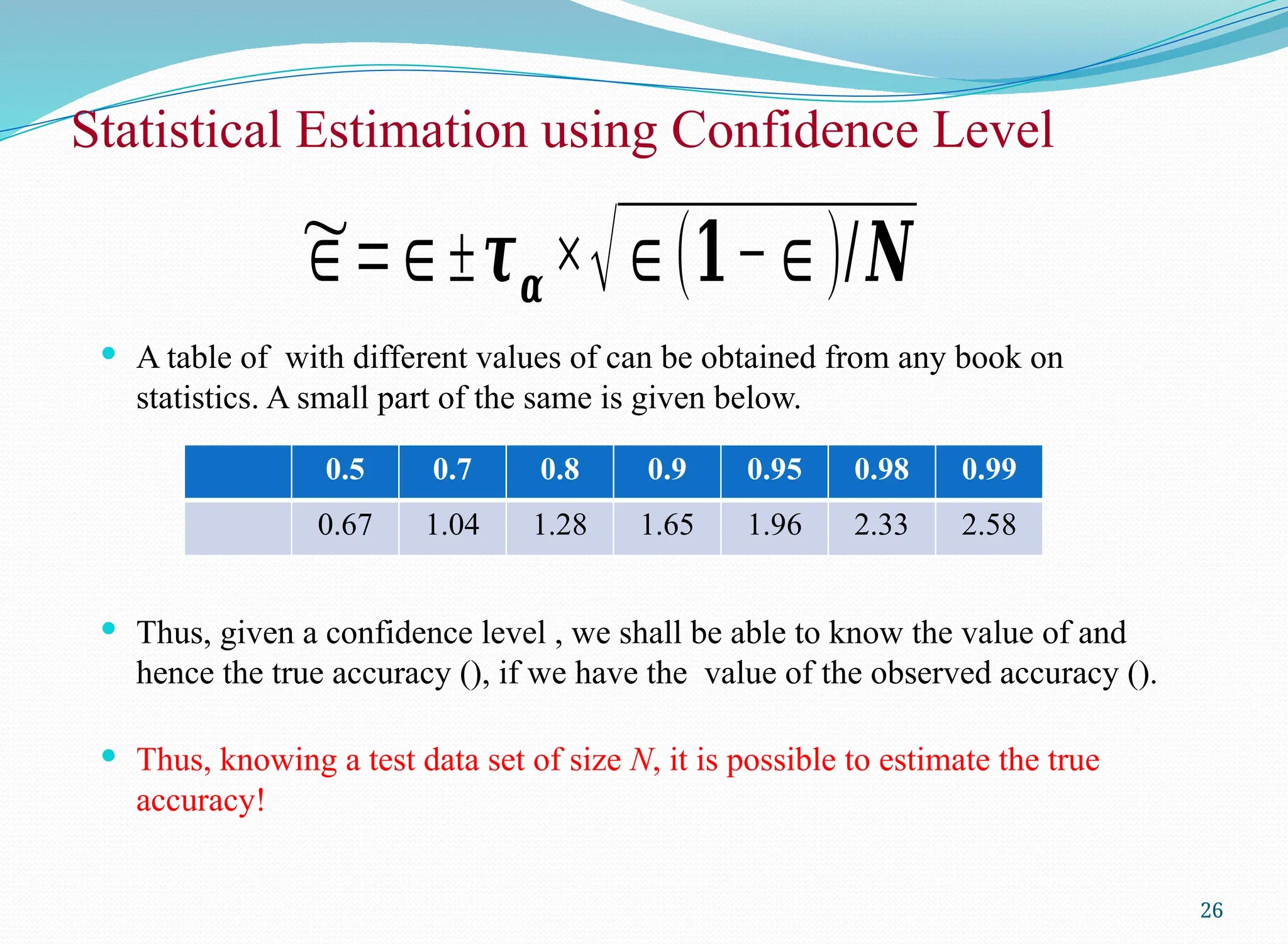
A tableof with different values of can be obtained from any book on statistics. A small part of the same is given below. Thus, given a confidence level , we shall be able to know the value of and hence the true accuracy (), if we have the value of the observed accuracy (). Thus, knowing a test data set of size N, it is possible to estimate the true accuracy! Statistical Estimation using Confidence Level 26 0.5 0.7 0.8 0.9 0.95 0.98 0.99 0.67 1.04 1.28 1.65 1.96 2.33 2.58 ~ ∈=∈±𝝉𝜶 ×√∈(𝟏−∈)/𝑵
27.
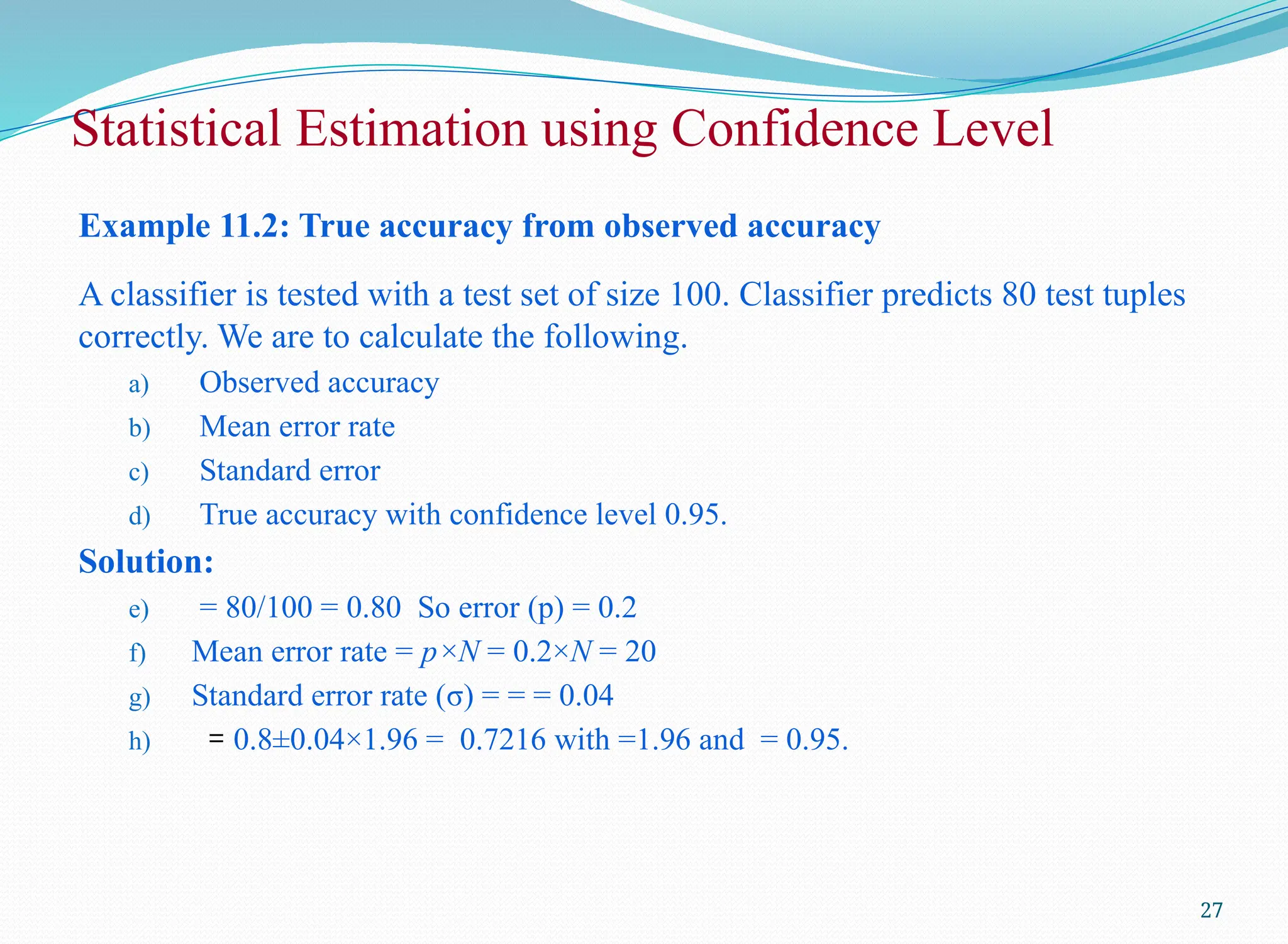
Example 11.2: Trueaccuracy from observed accuracy A classifier is tested with a test set of size 100. Classifier predicts 80 test tuples correctly. We are to calculate the following. a) Observed accuracy b) Mean error rate c) Standard error d) True accuracy with confidence level 0.95. Solution: e) = 80/100 = 0.80 So error (p) = 0.2 f) Mean error rate = p×N = 0.2×N = 20 g) Standard error rate (σ) = = = 0.04 h) = 0.8±0.04×1.96 = 0.7216 with =1.96 and = 0.95. 27 Statistical Estimation using Confidence Level
28.
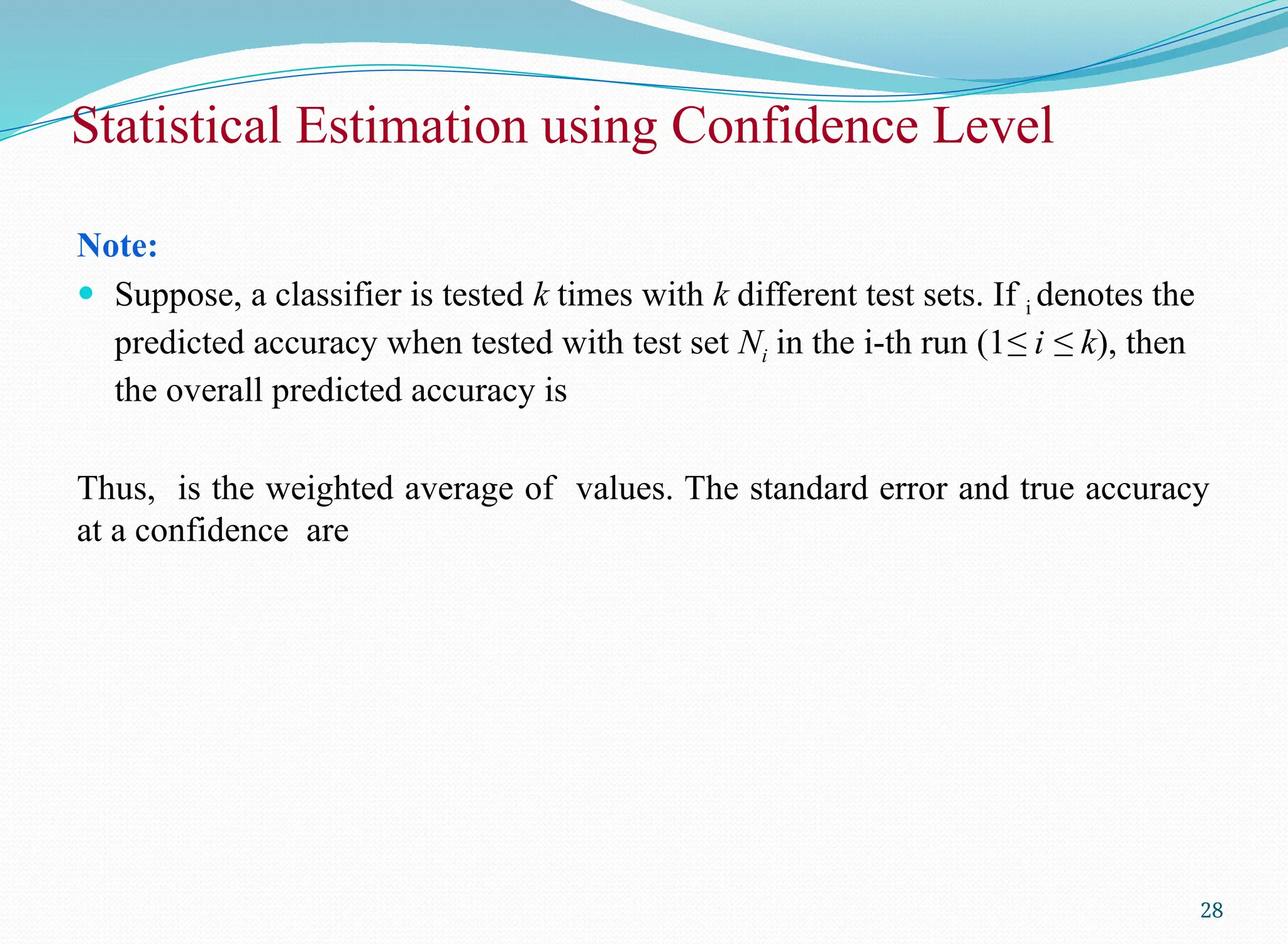
Note: Suppose, aclassifier is tested k times with k different test sets. If i denotes the predicted accuracy when tested with test set Ni in the i-th run (1≤ i ≤ k), then the overall predicted accuracy is Thus, is the weighted average of values. The standard error and true accuracy at a confidence are 28 Statistical Estimation using Confidence Level
Performance Estimation ofa Classifier Predictive accuracy works fine, when the classes are balanced That is, every class in the data set are equally important In fact, data sets with imbalanced class distributions are quite common in many real life applications When the classifier classified a test data set with imbalanced class distributions then, predictive accuracy on its own is not a reliable indicator of a classifier’s effectiveness. Example 11.3: Effectiveness of Predictive Accuracy Given a data set of stock markets, we are to classify them as “good” and “worst”. Suppose, in the data set, out of 100 entries, 98 belong to “good” class and only 2 are in “worst” class. With this data set, if classifier’s predictive accuracy is 0.98, a very high value! Here, there is a high chance that 2 “worst” stock markets may incorrectly be classified as “good” 30
31.
Performance Estimation ofa Classifier Thus, when the classifier classified a test data set with imbalanced class distributions, then predictive accuracy on its own is not a reliable indicator of a classifier’s effectiveness. This necessitates an alternative metrics to judge the classifier. Before exploring them, we introduce the concept of Confusion matrix. 31
32.
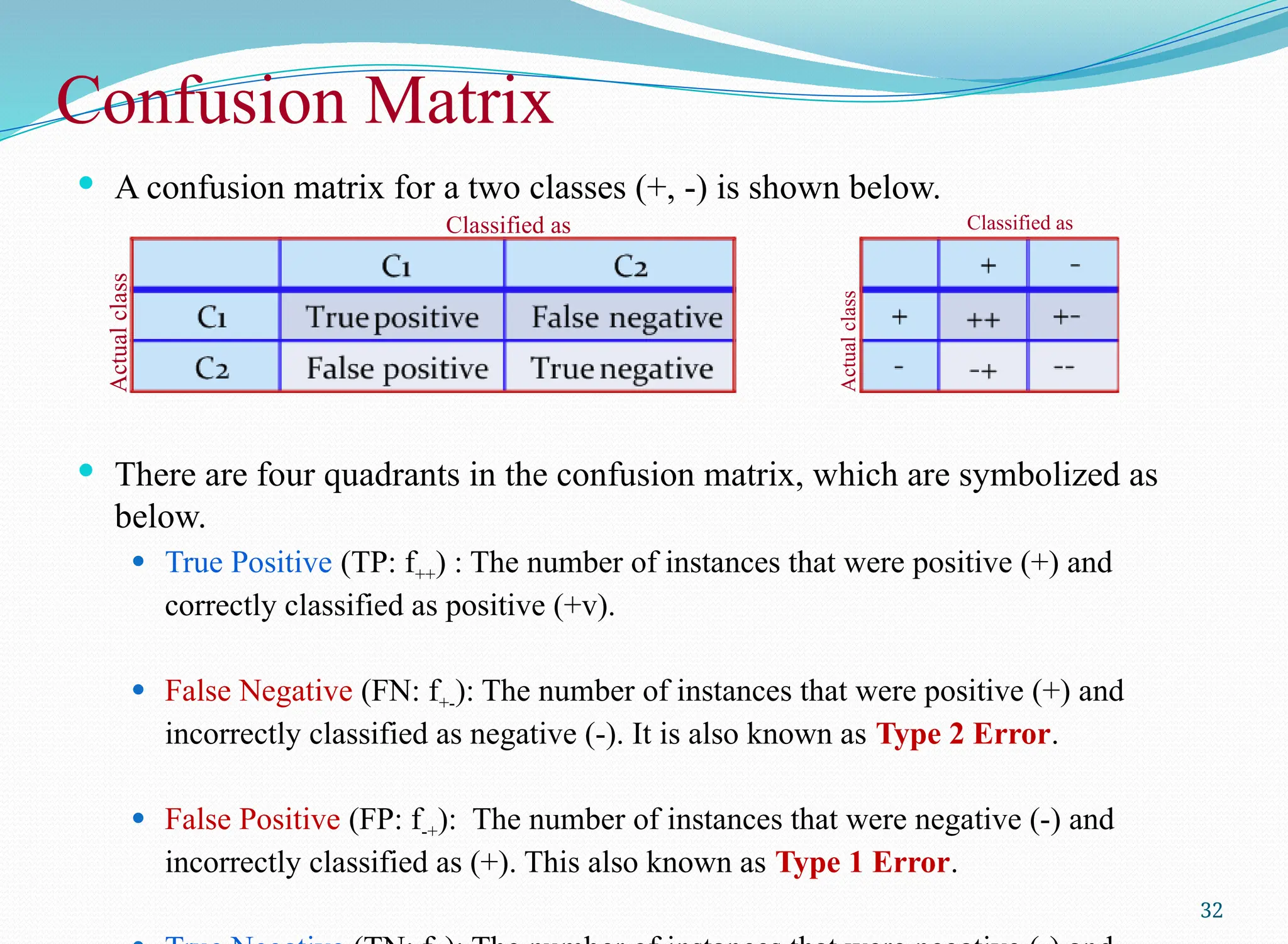
Confusion Matrix Aconfusion matrix for a two classes (+, -) is shown below. There are four quadrants in the confusion matrix, which are symbolized as below. True Positive (TP: f++) : The number of instances that were positive (+) and correctly classified as positive (+v). False Negative (FN: f+-): The number of instances that were positive (+) and incorrectly classified as negative (-). It is also known as Type 2 Error. False Positive (FP: f-+): The number of instances that were negative (-) and incorrectly classified as (+). This also known as Type 1 Error. 32 Classified as Actual class Classified as Actual class
33.
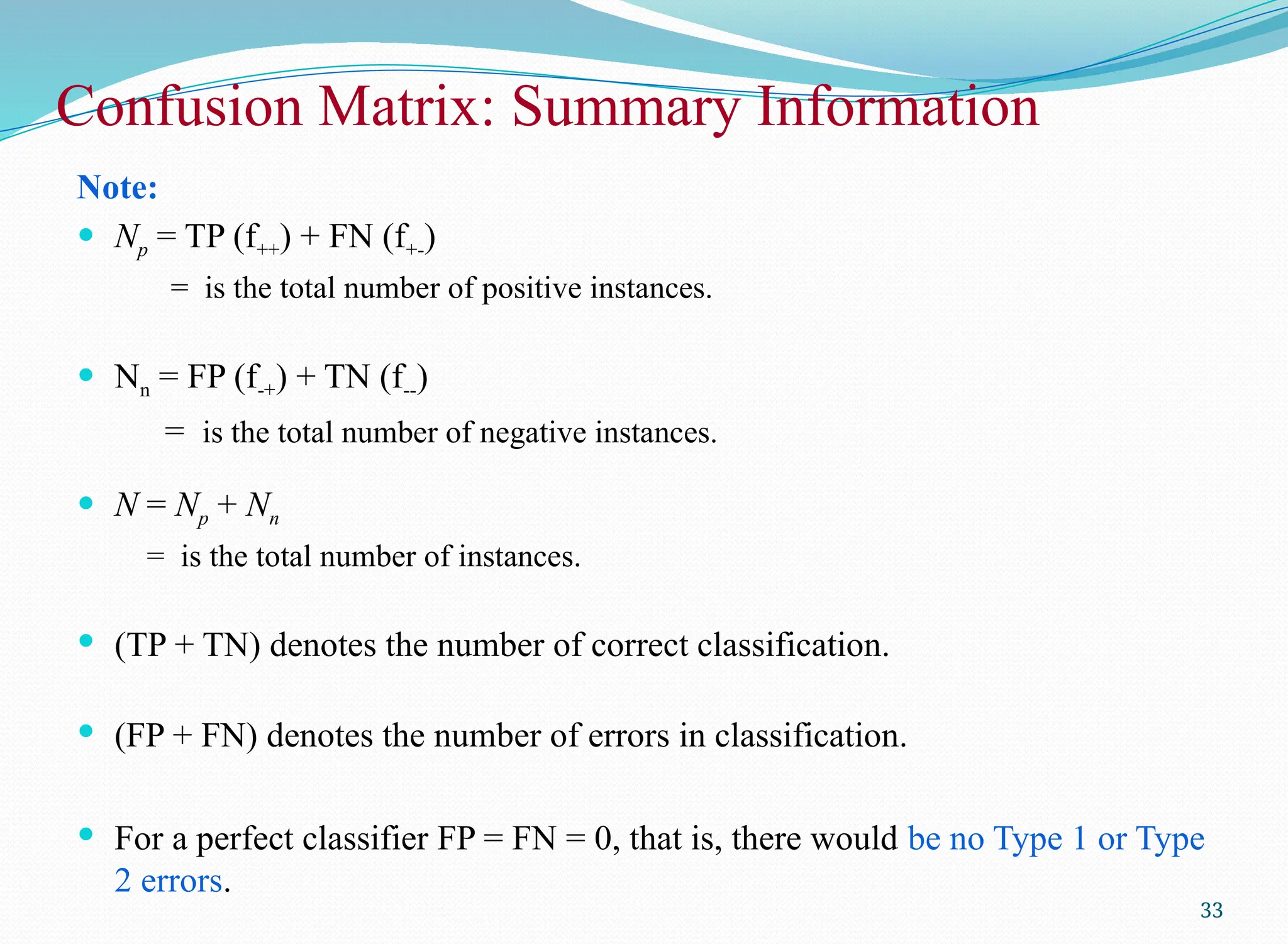
Confusion Matrix: SummaryInformation Note: Np = TP (f++) + FN (f+-) = is the total number of positive instances. Nn = FP (f-+) + TN (f--) = is the total number of negative instances. N = Np + Nn = is the total number of instances. (TP + TN) denotes the number of correct classification. (FP + FN) denotes the number of errors in classification. For a perfect classifier FP = FN = 0, that is, there would be no Type 1 or Type 2 errors. 33
34.
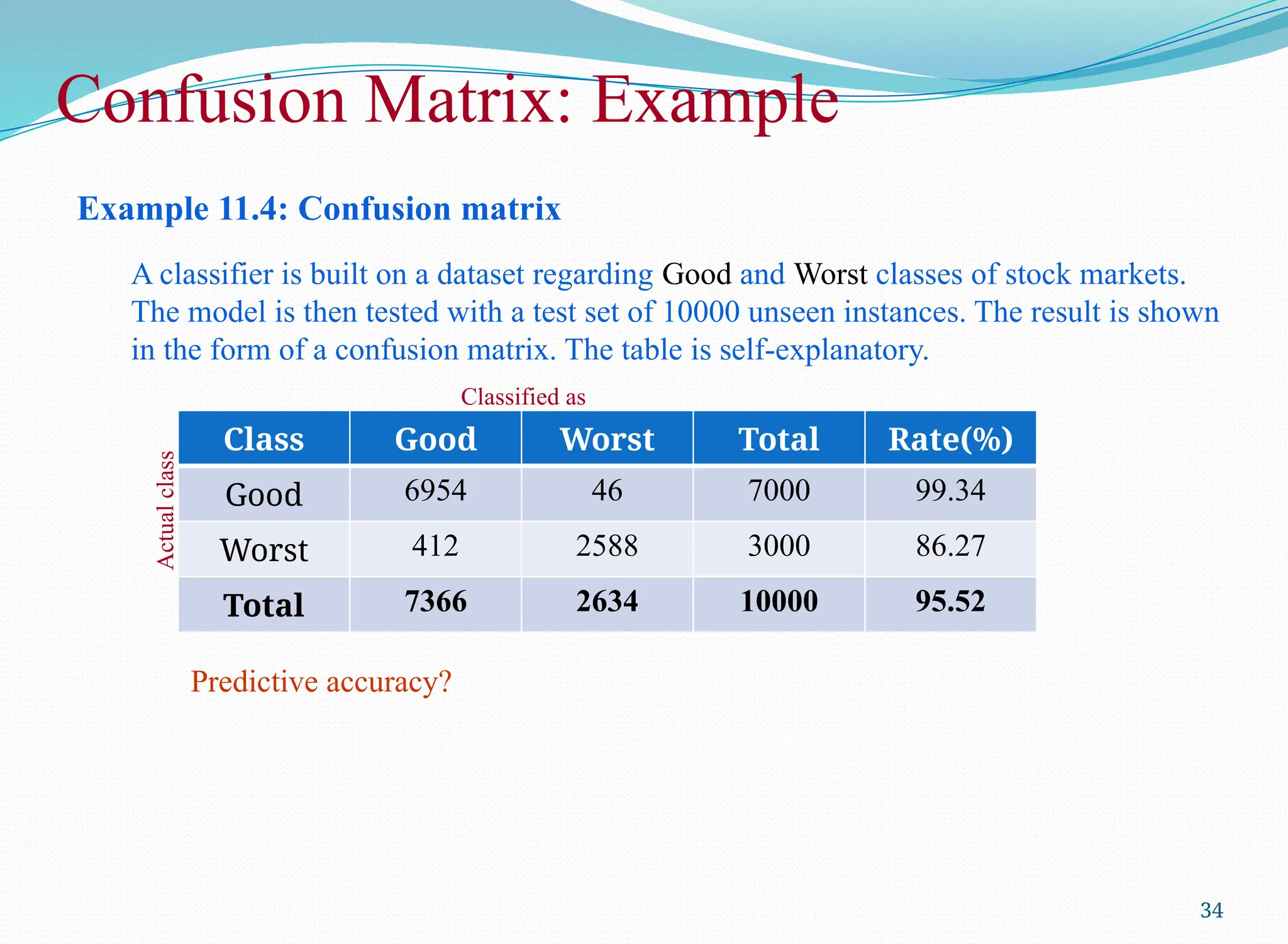
Example 11.4: Confusionmatrix A classifier is built on a dataset regarding Good and Worst classes of stock markets. The model is then tested with a test set of 10000 unseen instances. The result is shown in the form of a confusion matrix. The table is self-explanatory. 34 Class Good Worst Total Rate(%) Good 6954 46 7000 99.34 Worst 412 2588 3000 86.27 Total 7366 2634 10000 95.52 Confusion Matrix: Example Predictive accuracy? Classified as Actual class
35.
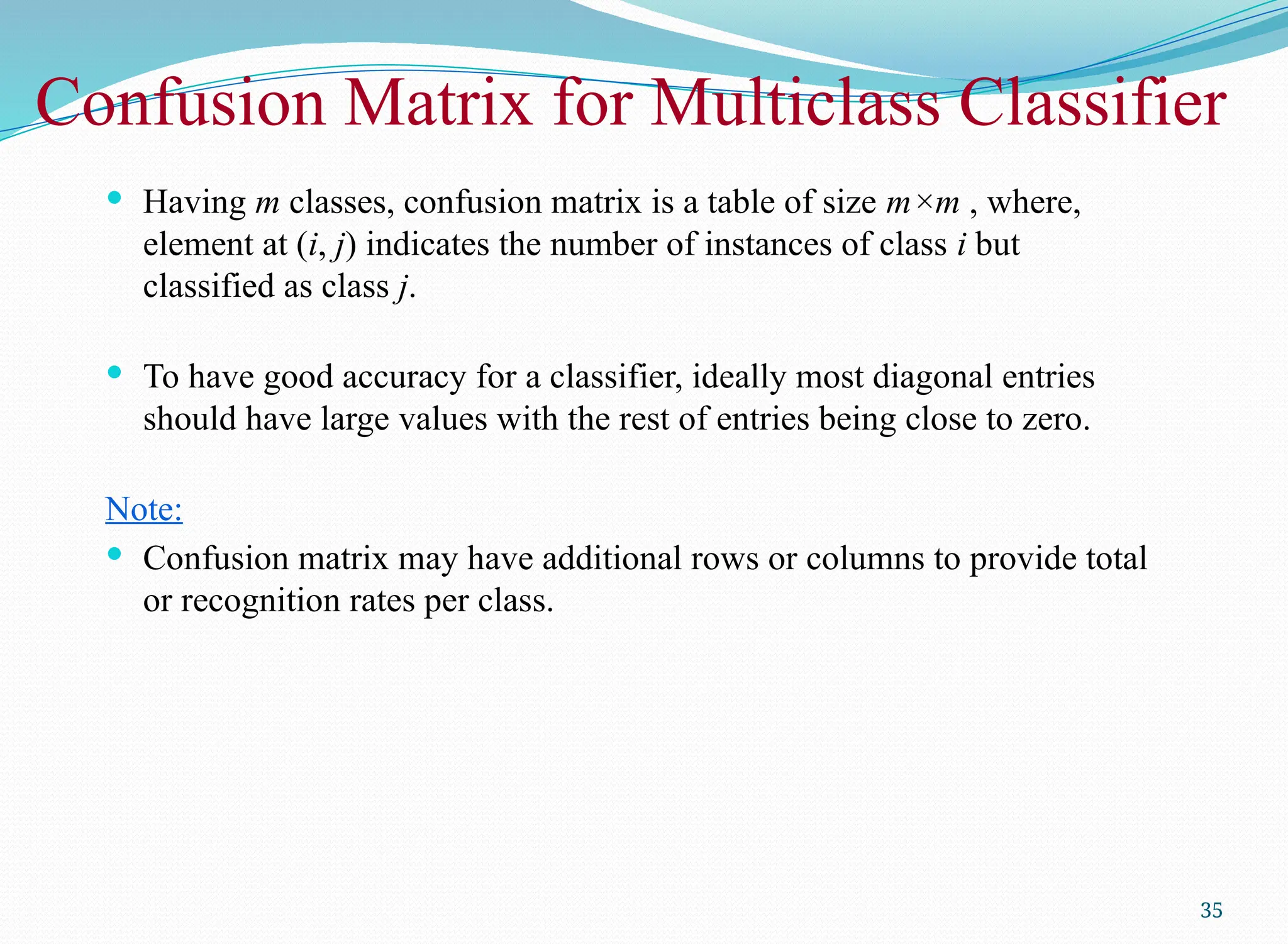
Confusion Matrix forMulticlass Classifier Having m classes, confusion matrix is a table of size m×m , where, element at (i, j) indicates the number of instances of class i but classified as class j. To have good accuracy for a classifier, ideally most diagonal entries should have large values with the rest of entries being close to zero. Note: Confusion matrix may have additional rows or columns to provide total or recognition rates per class. 35
36.
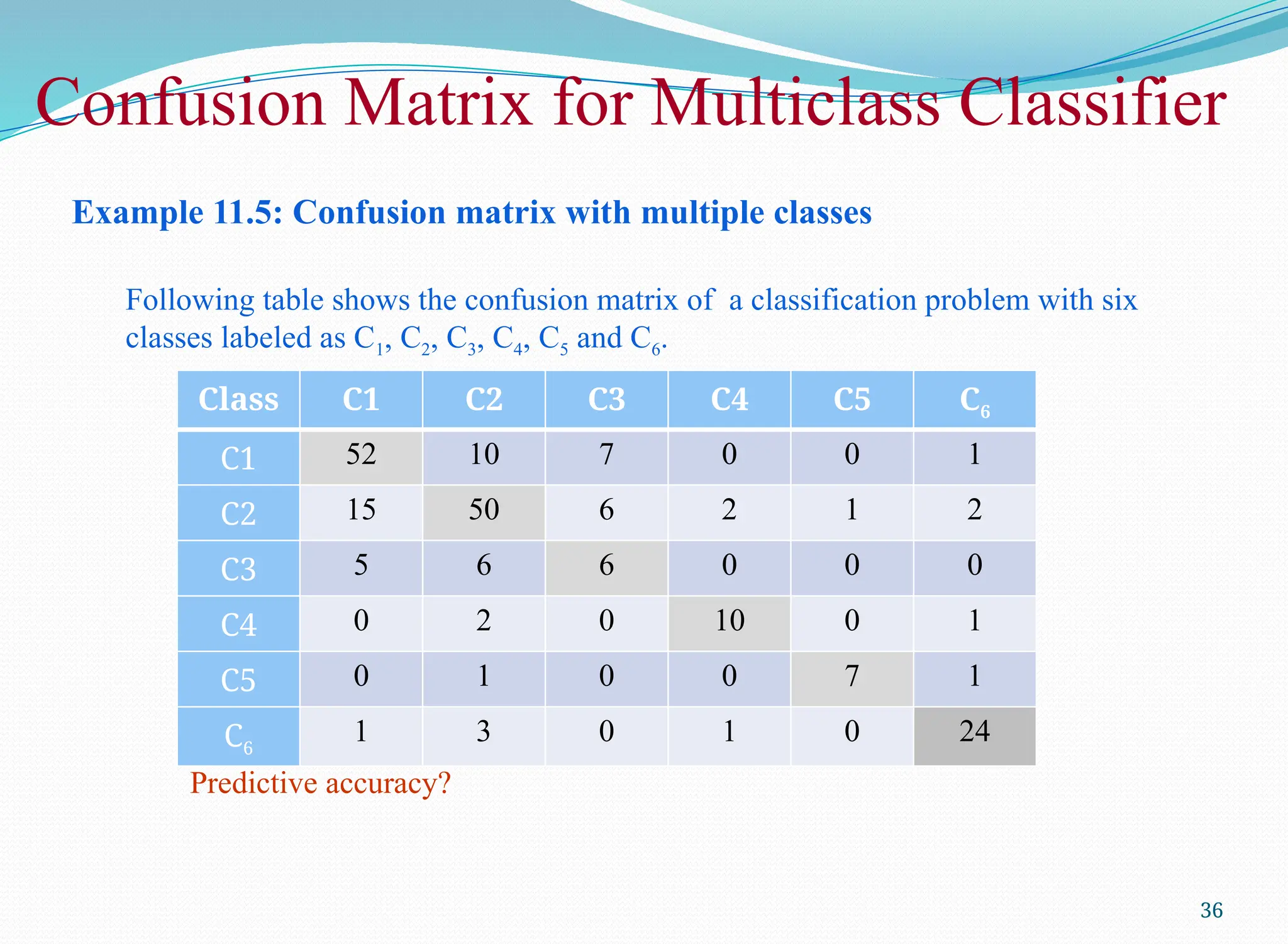
Example 11.5: Confusionmatrix with multiple classes Following table shows the confusion matrix of a classification problem with six classes labeled as C1, C2, C3, C4, C5 and C6. 36 Class C1 C2 C3 C4 C5 C6 C1 52 10 7 0 0 1 C2 15 50 6 2 1 2 C3 5 6 6 0 0 0 C4 0 2 0 10 0 1 C5 0 1 0 0 7 1 C6 1 3 0 1 0 24 Confusion Matrix for Multiclass Classifier Predictive accuracy?
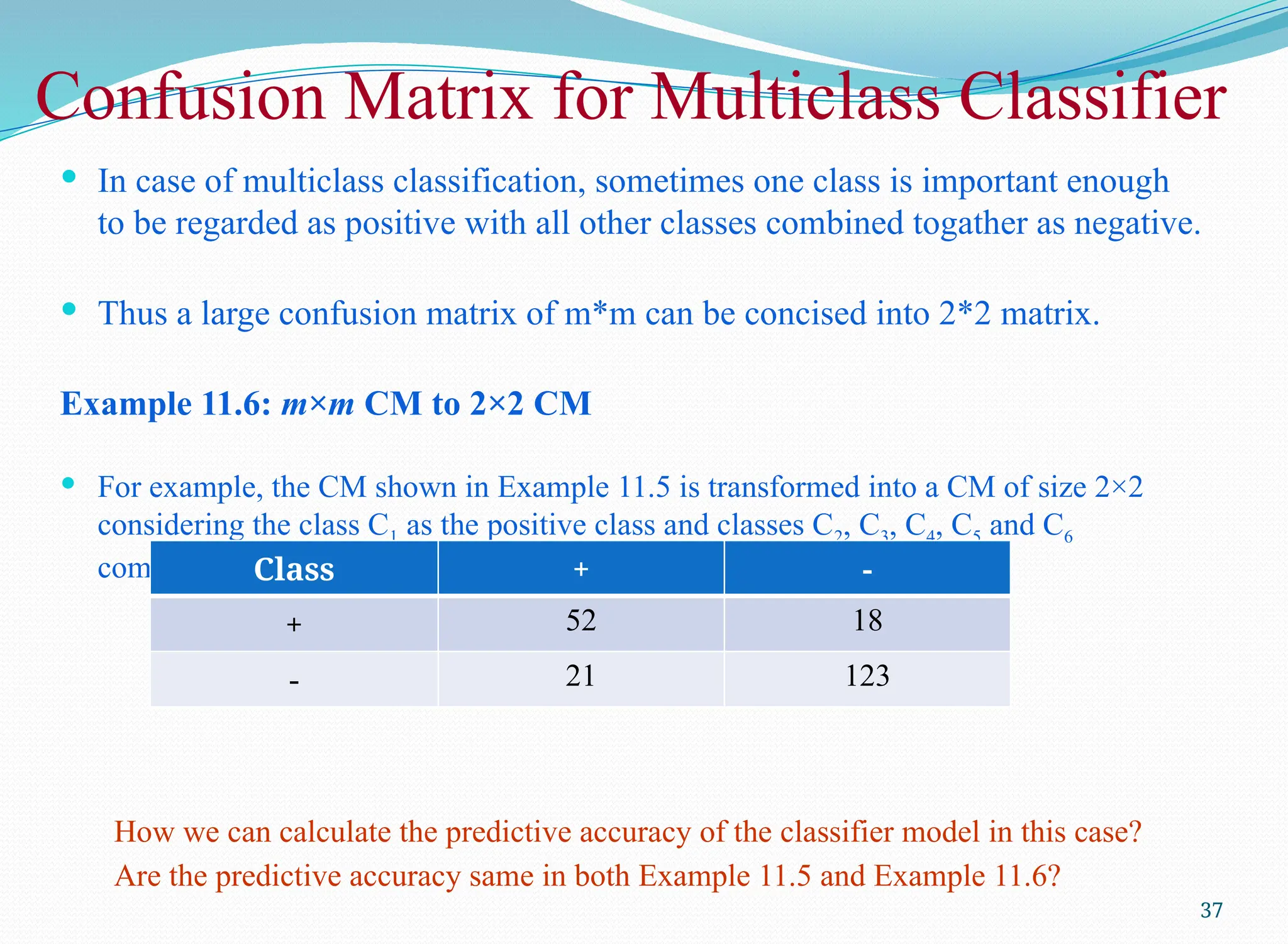
37.
In caseof multiclass classification, sometimes one class is important enough to be regarded as positive with all other classes combined togather as negative. Thus a large confusion matrix of m*m can be concised into 2*2 matrix. Example 11.6: m×m CM to 2×2 CM For example, the CM shown in Example 11.5 is transformed into a CM of size 2×2 considering the class C1 as the positive class and classes C2, C3, C4, C5 and C6 combined together as negative. How we can calculate the predictive accuracy of the classifier model in this case? Are the predictive accuracy same in both Example 11.5 and Example 11.6? 37 Class + - + 52 18 - 21 123 Confusion Matrix for Multiclass Classifier
38.
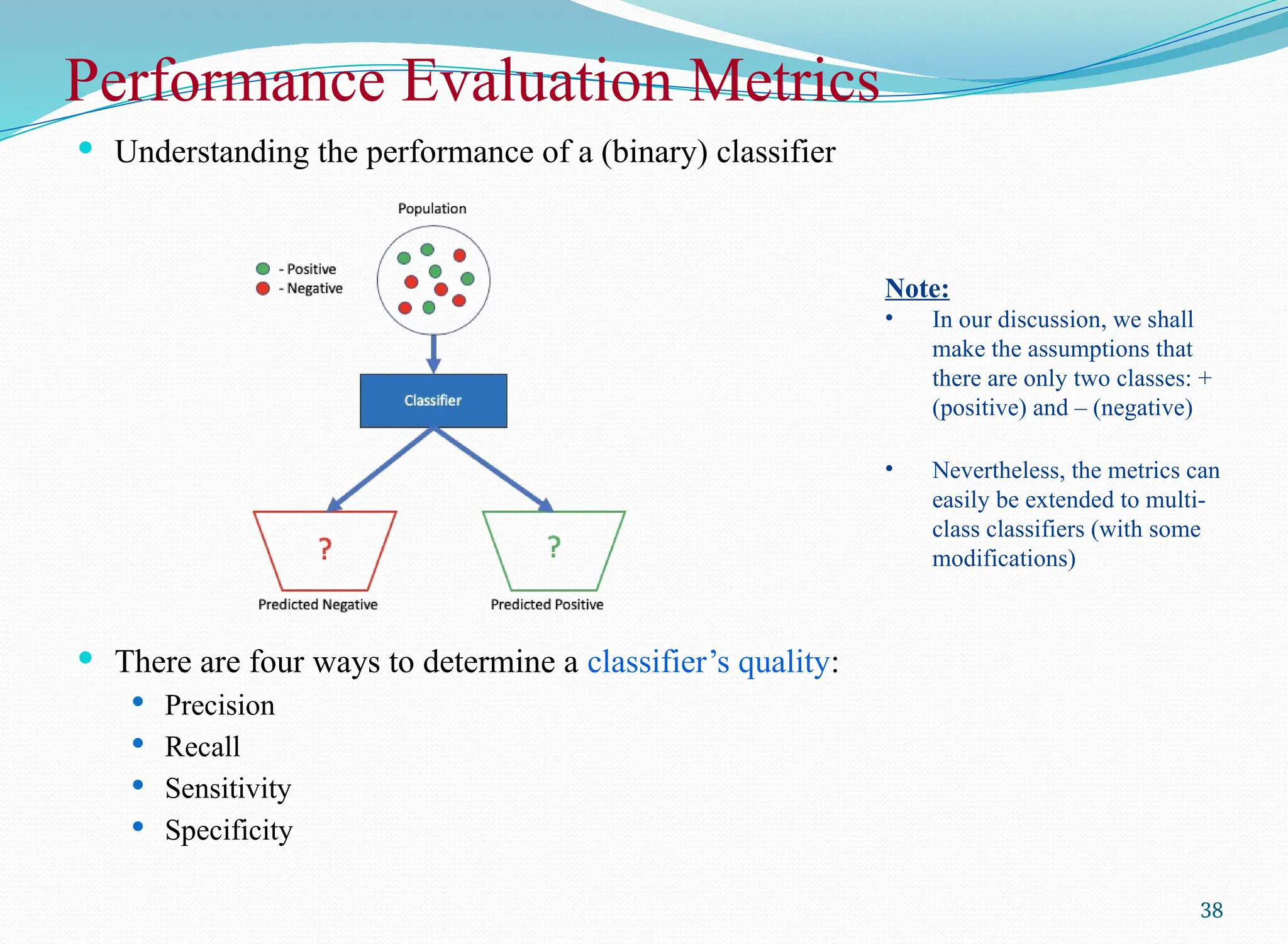
Performance Evaluation Metrics Understanding the performance of a (binary) classifier There are four ways to determine a classifier’s quality: Precision Recall Sensitivity Specificity 38 Note: • In our discussion, we shall make the assumptions that there are only two classes: + (positive) and – (negative) • Nevertheless, the metrics can easily be extended to multi- class classifiers (with some modifications)
39.
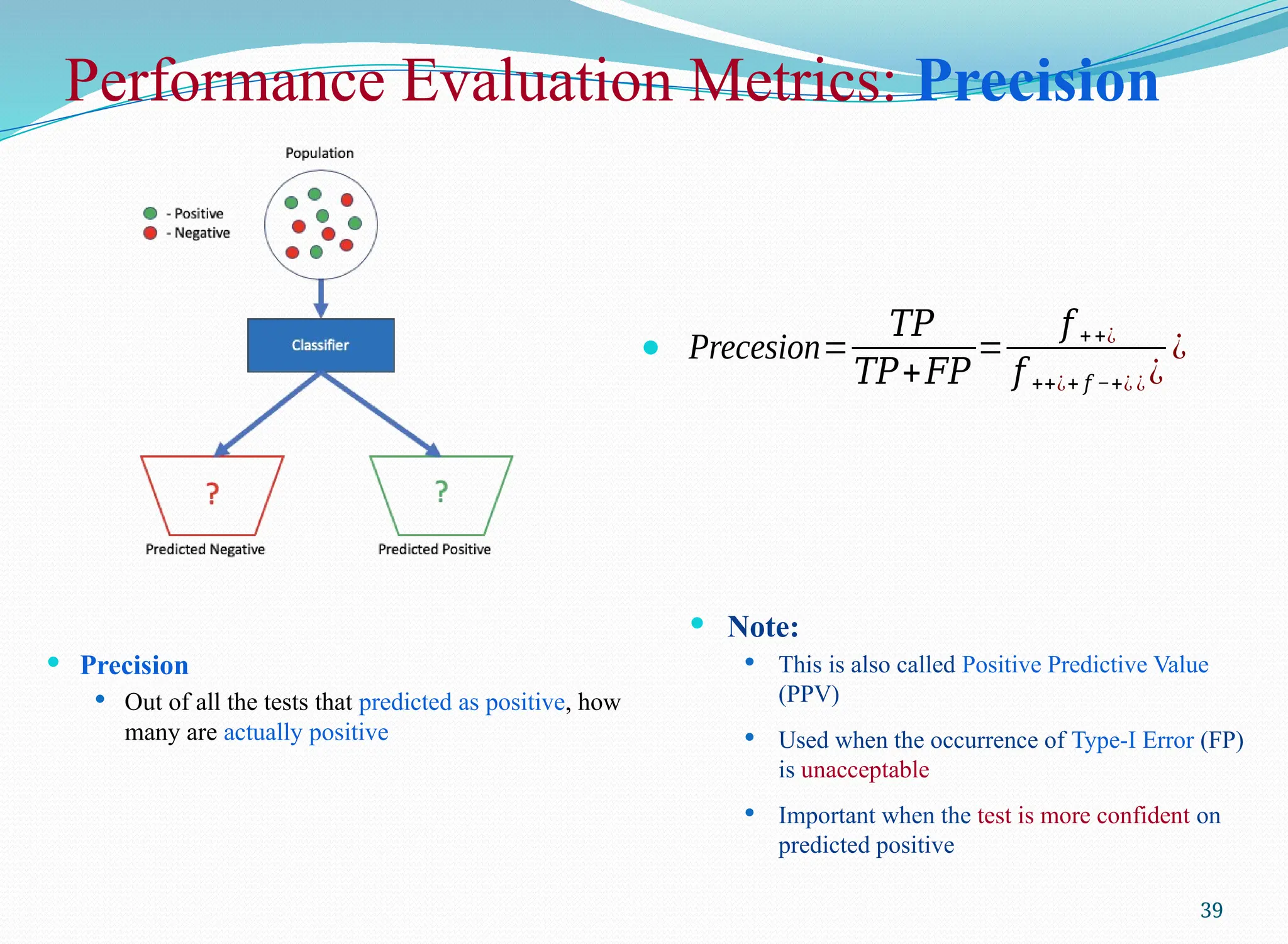
Performance Evaluation Metrics:Precision Precision Out of all the tests that predicted as positive, how many are actually positive 39 Precesion= 𝑇𝑃 𝑇𝑃+𝐹𝑃 = 𝑓 ++¿ 𝑓 ++¿+ 𝑓 −+¿ ¿ ¿ ¿ Note: This is also called Positive Predictive Value (PPV) Used when the occurrence of Type-I Error (FP) is unacceptable Important when the test is more confident on predicted positive
40.
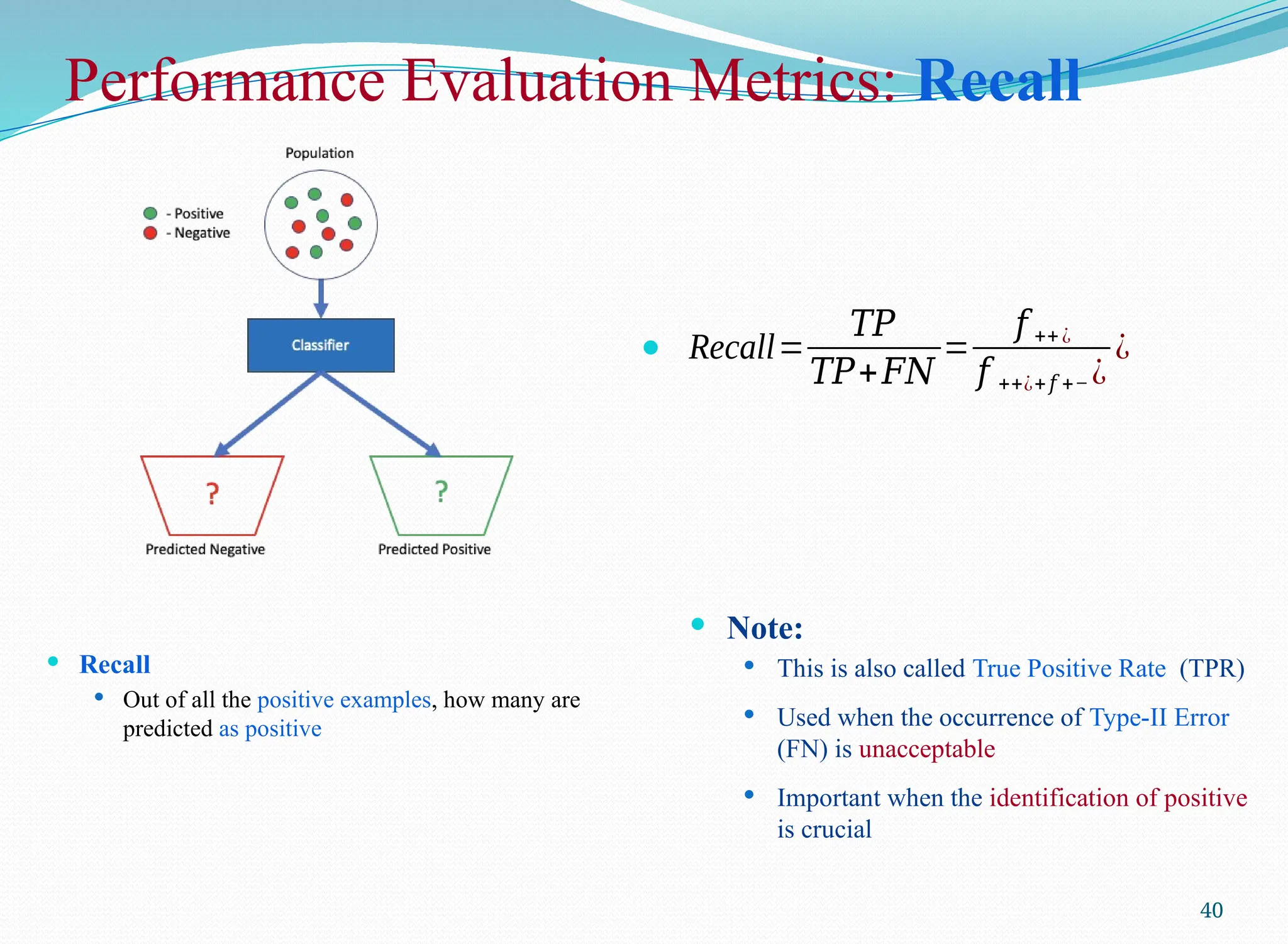
Performance Evaluation Metrics:Recall Recall Out of all the positive examples, how many are predicted as positive 40 Recall= 𝑇𝑃 𝑇𝑃+𝐹𝑁 = 𝑓 ++¿ 𝑓 ++¿+𝑓 +− ¿ ¿ Note: This is also called True Positive Rate (TPR) Used when the occurrence of Type-II Error (FN) is unacceptable Important when the identification of positive is crucial
41.
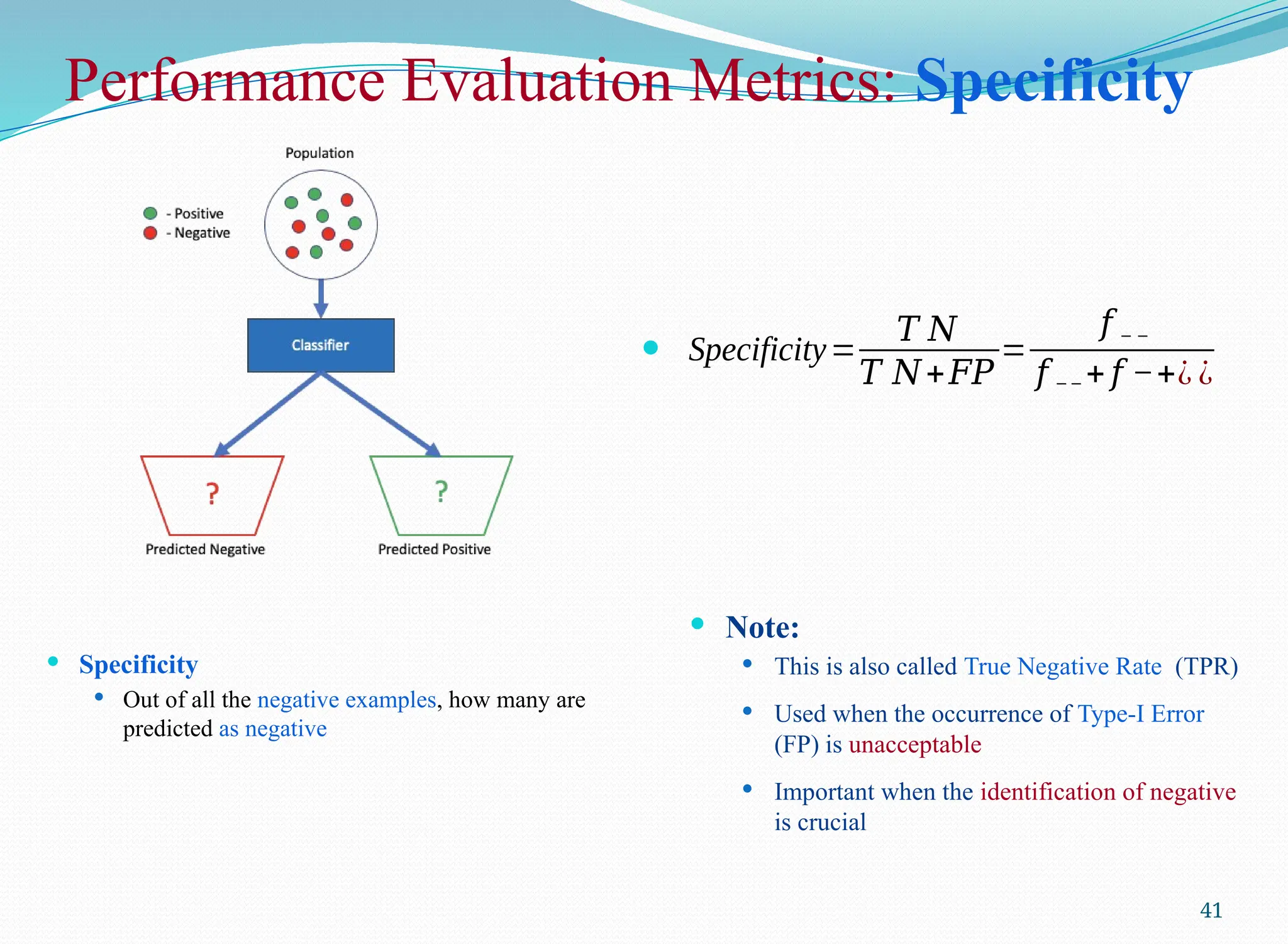
Performance Evaluation Metrics:Specificity Specificity Out of all the negative examples, how many are predicted as negative 41 Specificity= 𝑇 𝑁 𝑇 𝑁+𝐹𝑃 = 𝑓 − − 𝑓 −− + 𝑓 −+¿ ¿ Note: This is also called True Negative Rate (TPR) Used when the occurrence of Type-I Error (FP) is unacceptable Important when the identification of negative is crucial
42.
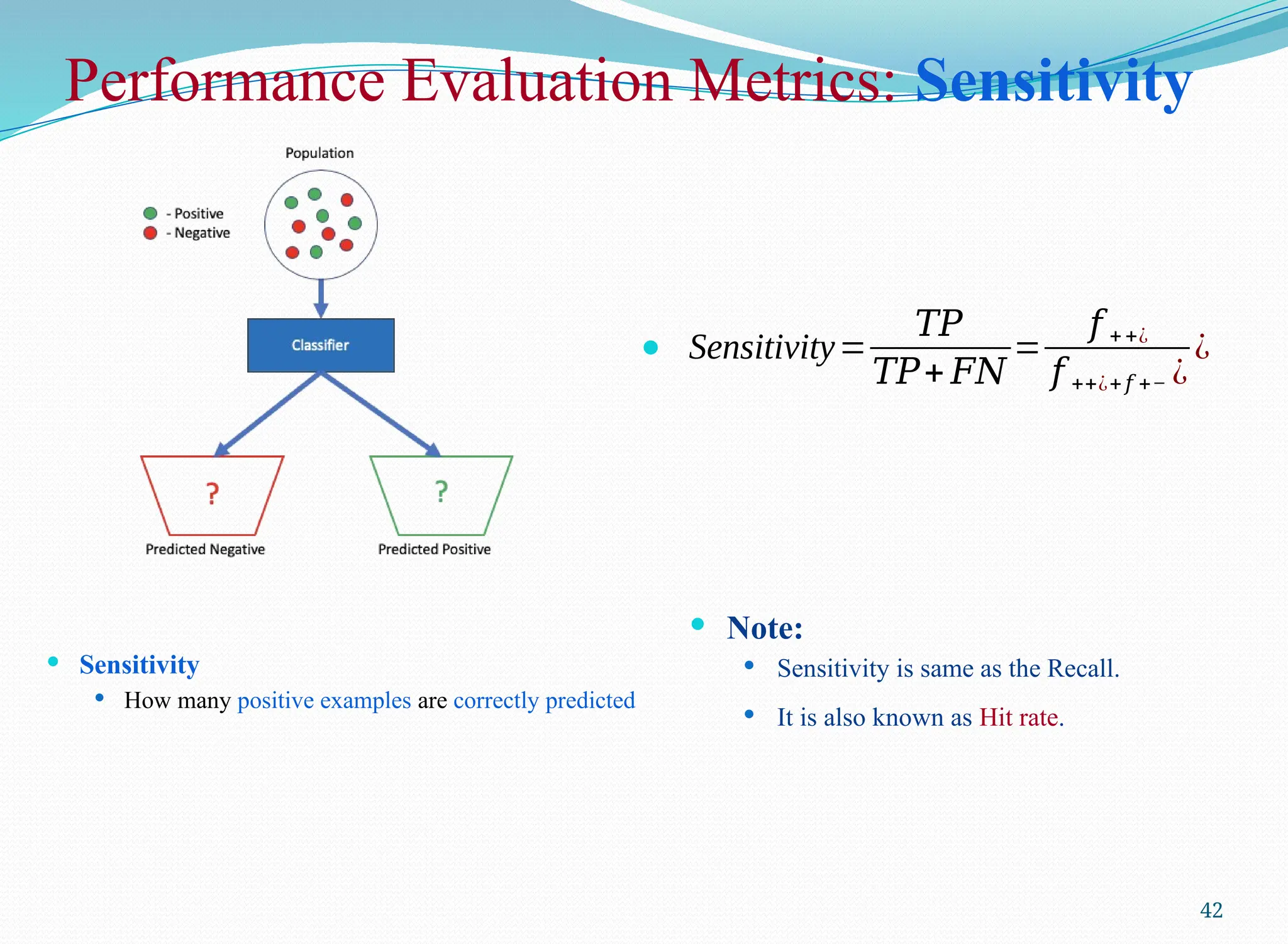
Performance Evaluation Metrics:Sensitivity Sensitivity How many positive examples are correctly predicted 42 Sensitivity= 𝑇𝑃 𝑇𝑃+ 𝐹𝑁 = 𝑓 ++¿ 𝑓 ++¿+𝑓 +− ¿ ¿ Note: Sensitivity is same as the Recall. It is also known as Hit rate.
43.
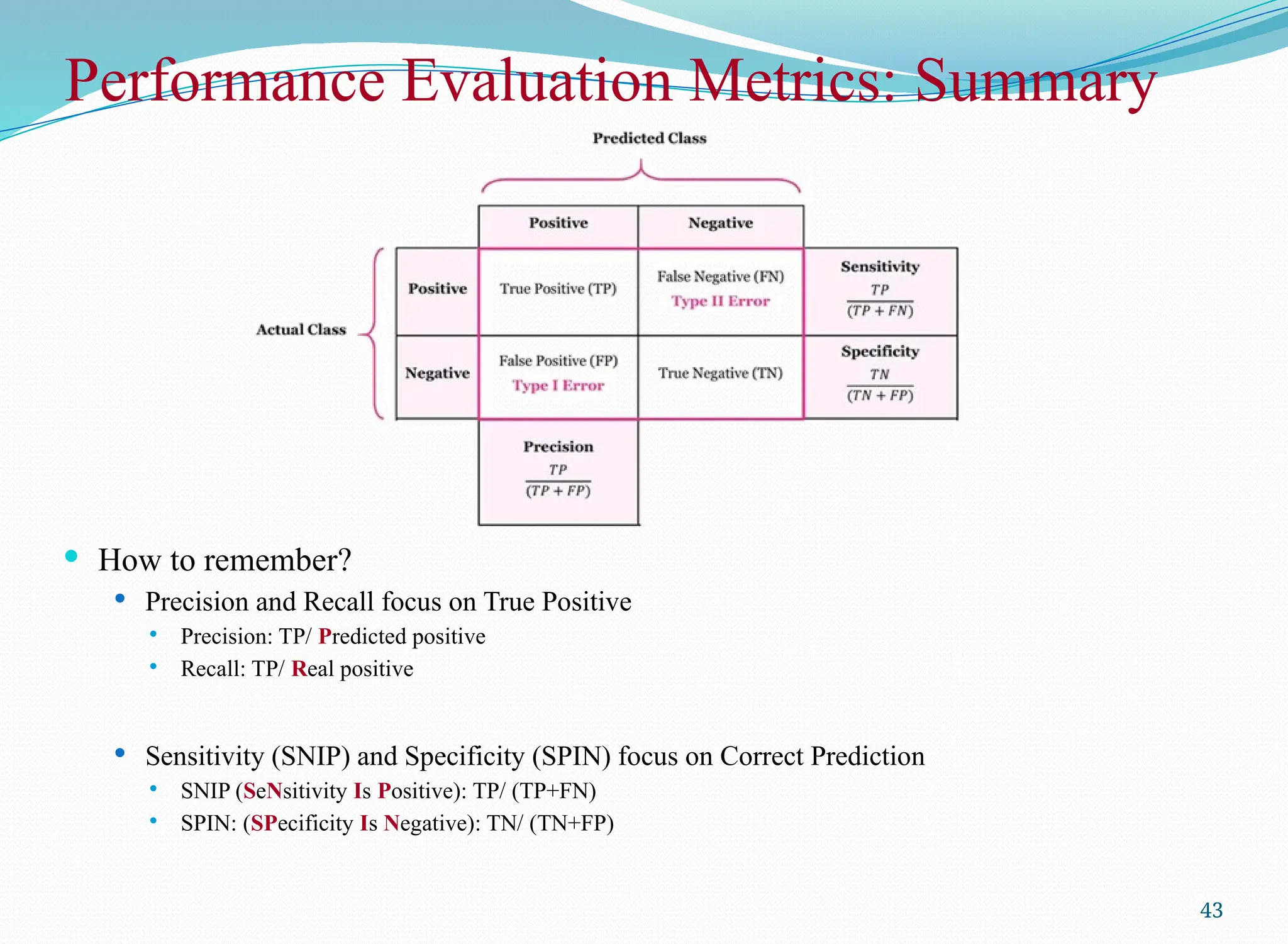
Performance Evaluation Metrics:Summary How to remember? Precision and Recall focus on True Positive Precision: TP/ Predicted positive Recall: TP/ Real positive Sensitivity (SNIP) and Specificity (SPIN) focus on Correct Prediction SNIP (SeNsitivity Is Positive): TP/ (TP+FN) SPIN: (SPecificity Is Negative): TN/ (TN+FP) 43
44.
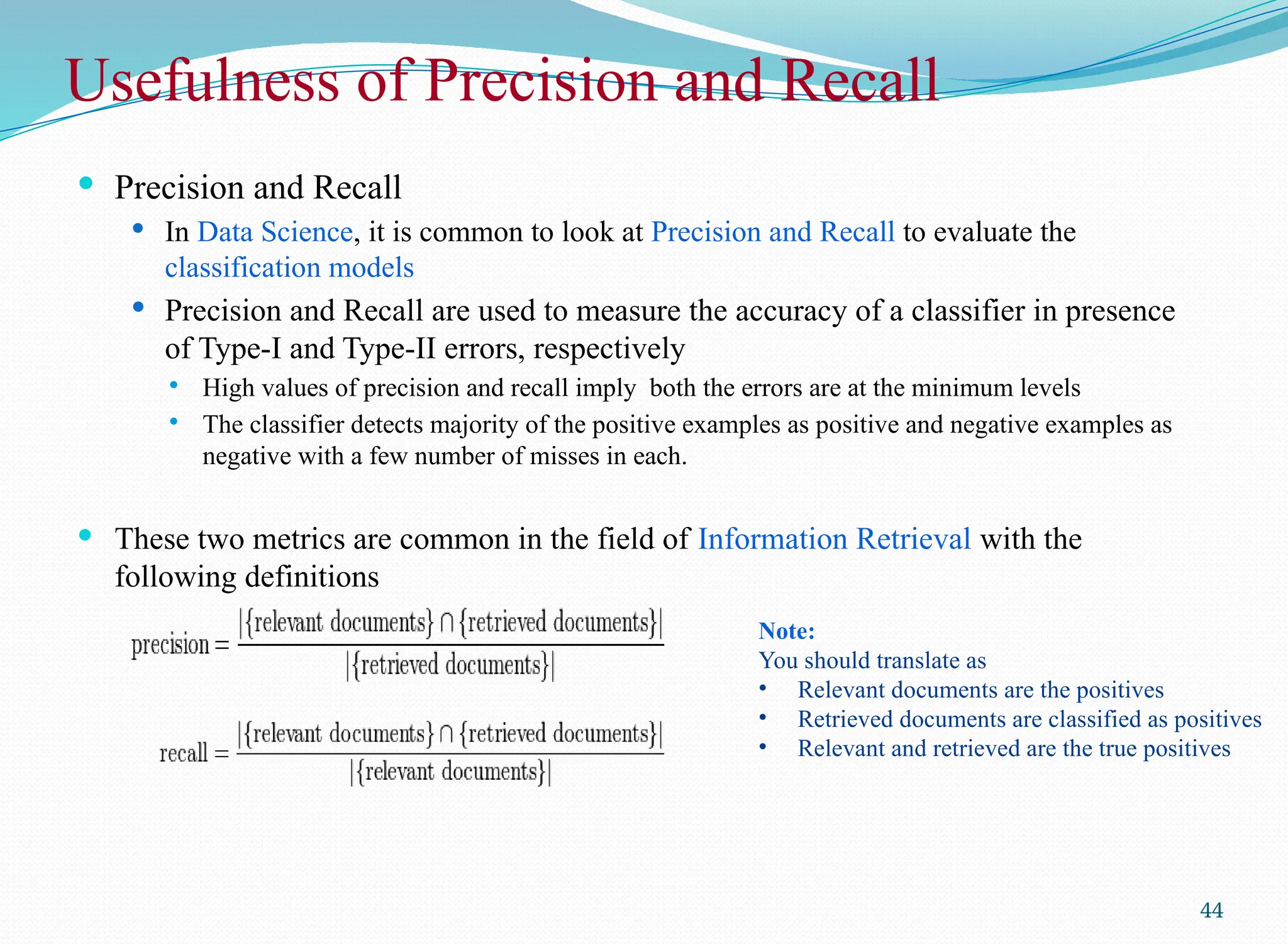
Usefulness of Precisionand Recall Precision and Recall In Data Science, it is common to look at Precision and Recall to evaluate the classification models Precision and Recall are used to measure the accuracy of a classifier in presence of Type-I and Type-II errors, respectively High values of precision and recall imply both the errors are at the minimum levels The classifier detects majority of the positive examples as positive and negative examples as negative with a few number of misses in each. These two metrics are common in the field of Information Retrieval with the following definitions 44 Note: You should translate as • Relevant documents are the positives • Retrieved documents are classified as positives • Relevant and retrieved are the true positives
45.
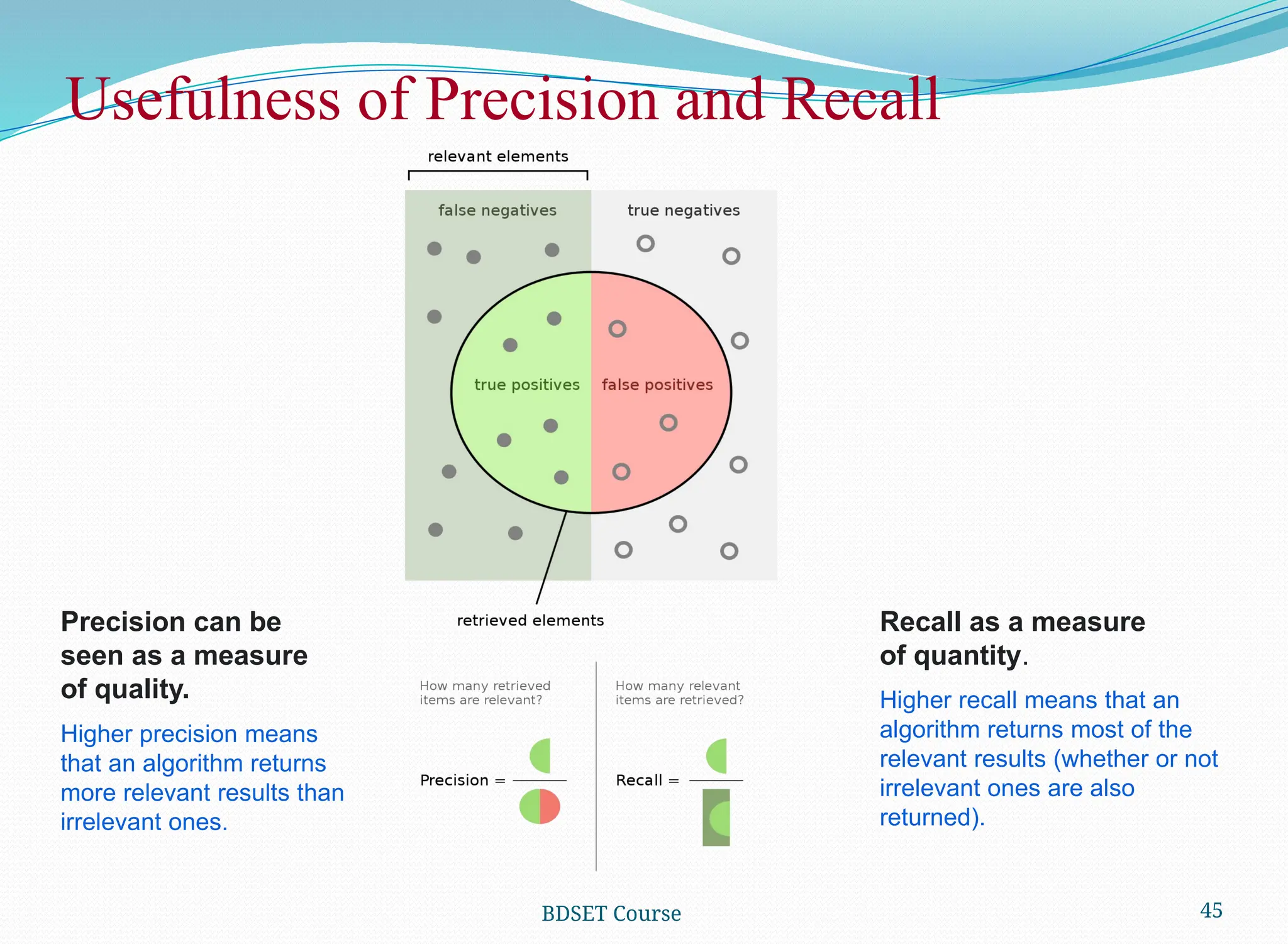
45 Usefulness of Precisionand Recall BDSET Course Precision can be seen as a measure of quality. Recall as a measure of quantity. Higher precision means that an algorithm returns more relevant results than irrelevant ones. Higher recall means that an algorithm returns most of the relevant results (whether or not irrelevant ones are also returned).
46.
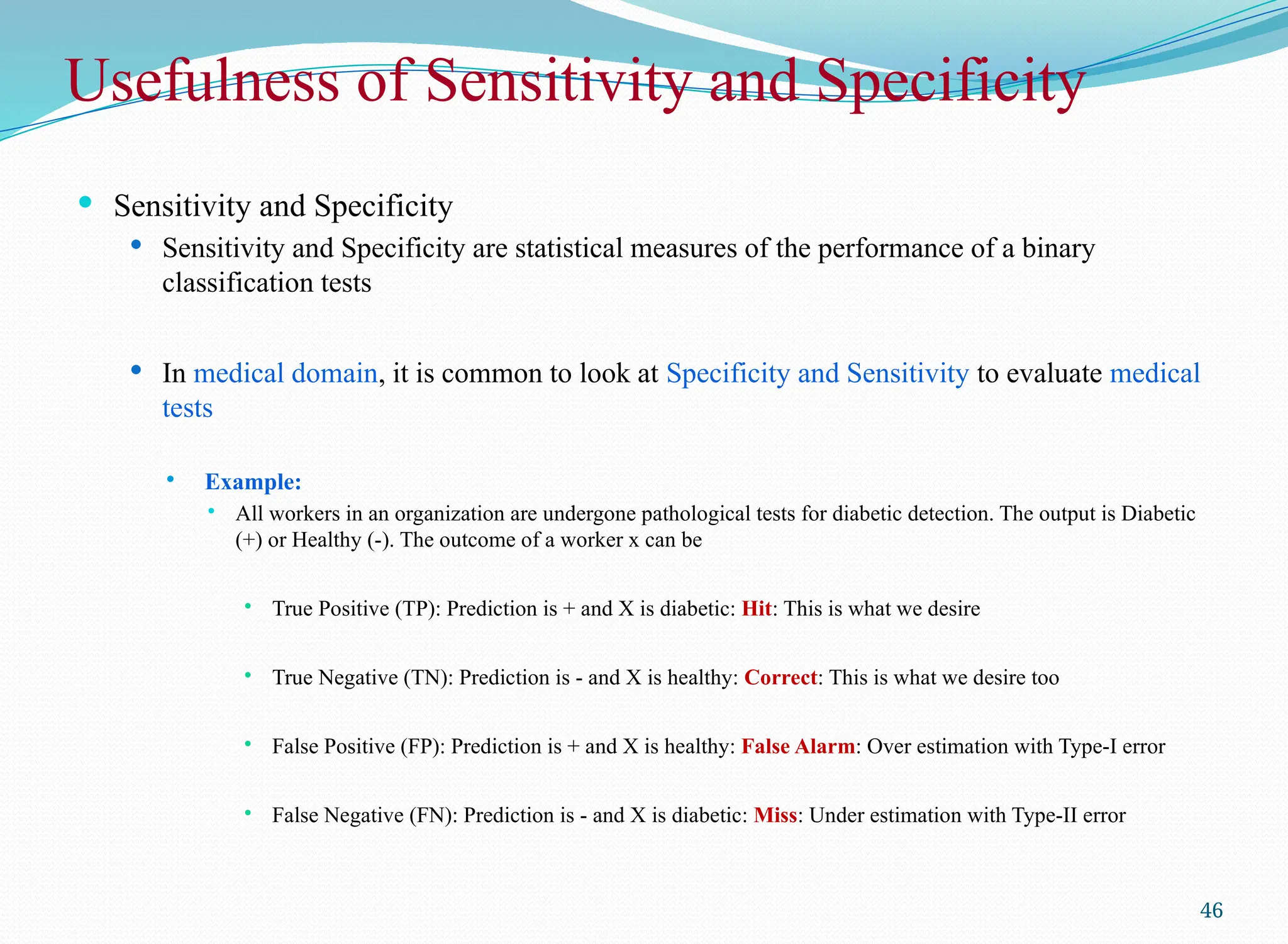
Usefulness of Sensitivityand Specificity Sensitivity and Specificity Sensitivity and Specificity are statistical measures of the performance of a binary classification tests In medical domain, it is common to look at Specificity and Sensitivity to evaluate medical tests Example: All workers in an organization are undergone pathological tests for diabetic detection. The output is Diabetic (+) or Healthy (-). The outcome of a worker x can be True Positive (TP): Prediction is + and X is diabetic: Hit: This is what we desire True Negative (TN): Prediction is - and X is healthy: Correct: This is what we desire too False Positive (FP): Prediction is + and X is healthy: False Alarm: Over estimation with Type-I error False Negative (FN): Prediction is - and X is diabetic: Miss: Under estimation with Type-II error 46
47.
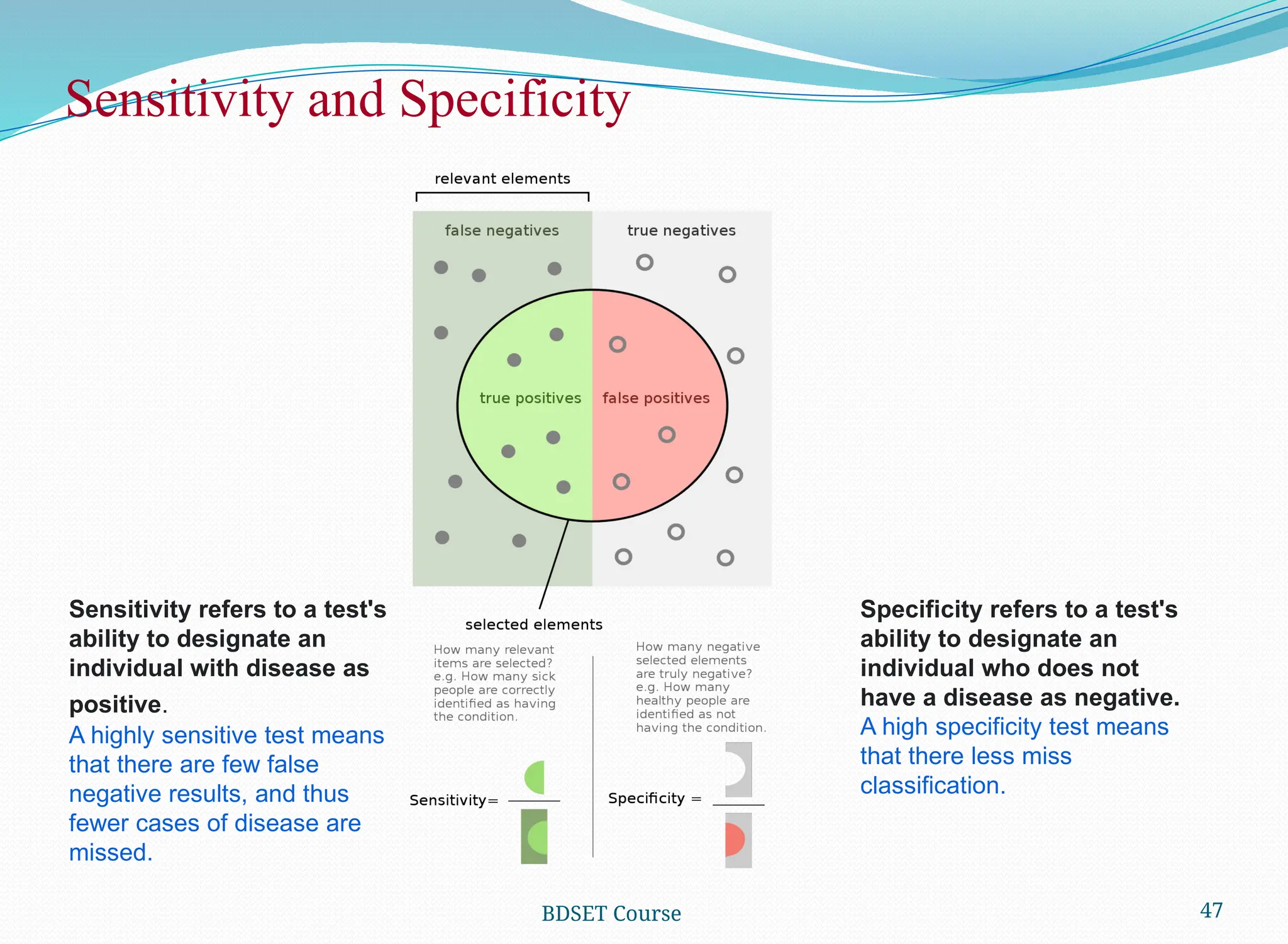
47 Sensitivity and Specificity BDSETCourse Sensitivity refers to a test's ability to designate an individual with disease as positive. A highly sensitive test means that there are few false negative results, and thus fewer cases of disease are missed. Specificity refers to a test's ability to designate an individual who does not have a disease as negative. A high specificity test means that there less miss classification.
48.
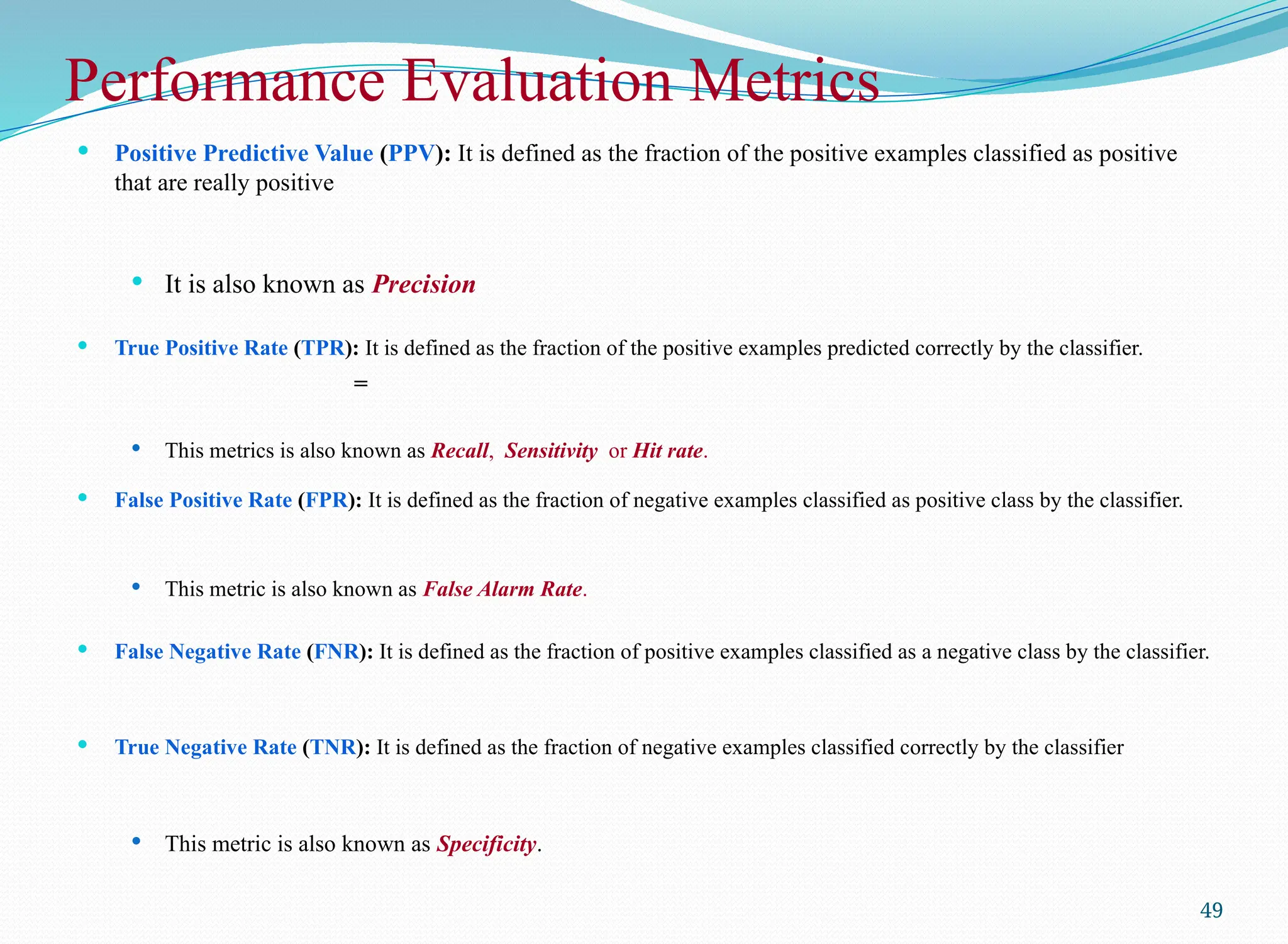
Understanding Precision, Recall/Sensitivityand Specificity Example: All workers in an organization are undergone pathological tests for diabetic detection. The output is Diabetic (+) or Healthy (-). Precision offers us the answer to the question How many of workers we tested as diabetics are truly diabetic? Recall (also known as Sensitivity) answer to the question Of all the workers who are diabetic, how many of them did we properly predict? Specificity tells us about How many workers who are healthy did we accurately predict? 48
49.
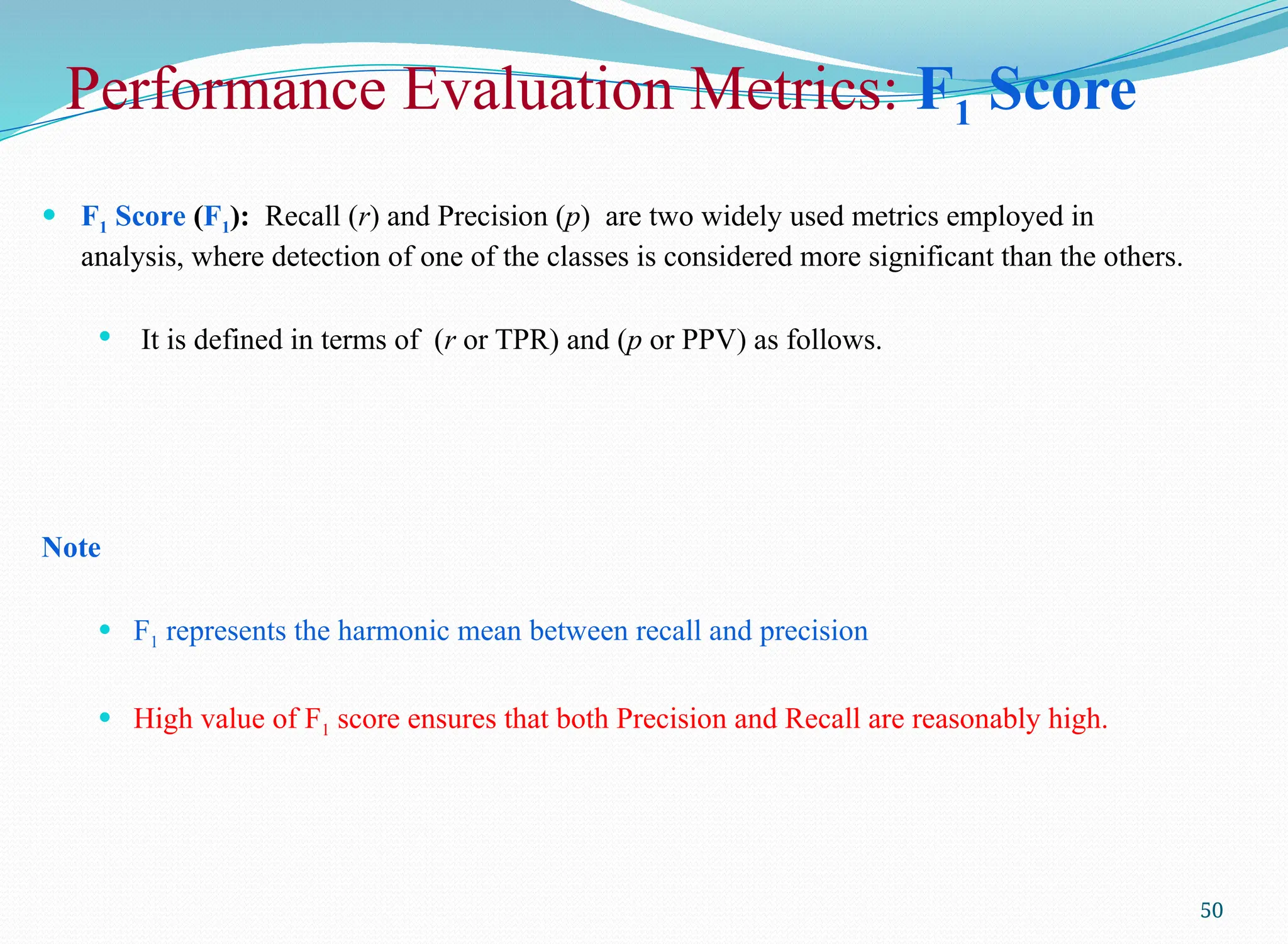
Performance Evaluation Metrics Positive Predictive Value (PPV): It is defined as the fraction of the positive examples classified as positive that are really positive It is also known as Precision True Positive Rate (TPR): It is defined as the fraction of the positive examples predicted correctly by the classifier. = This metrics is also known as Recall, Sensitivity or Hit rate. False Positive Rate (FPR): It is defined as the fraction of negative examples classified as positive class by the classifier. This metric is also known as False Alarm Rate. False Negative Rate (FNR): It is defined as the fraction of positive examples classified as a negative class by the classifier. True Negative Rate (TNR): It is defined as the fraction of negative examples classified correctly by the classifier This metric is also known as Specificity. 49
50.
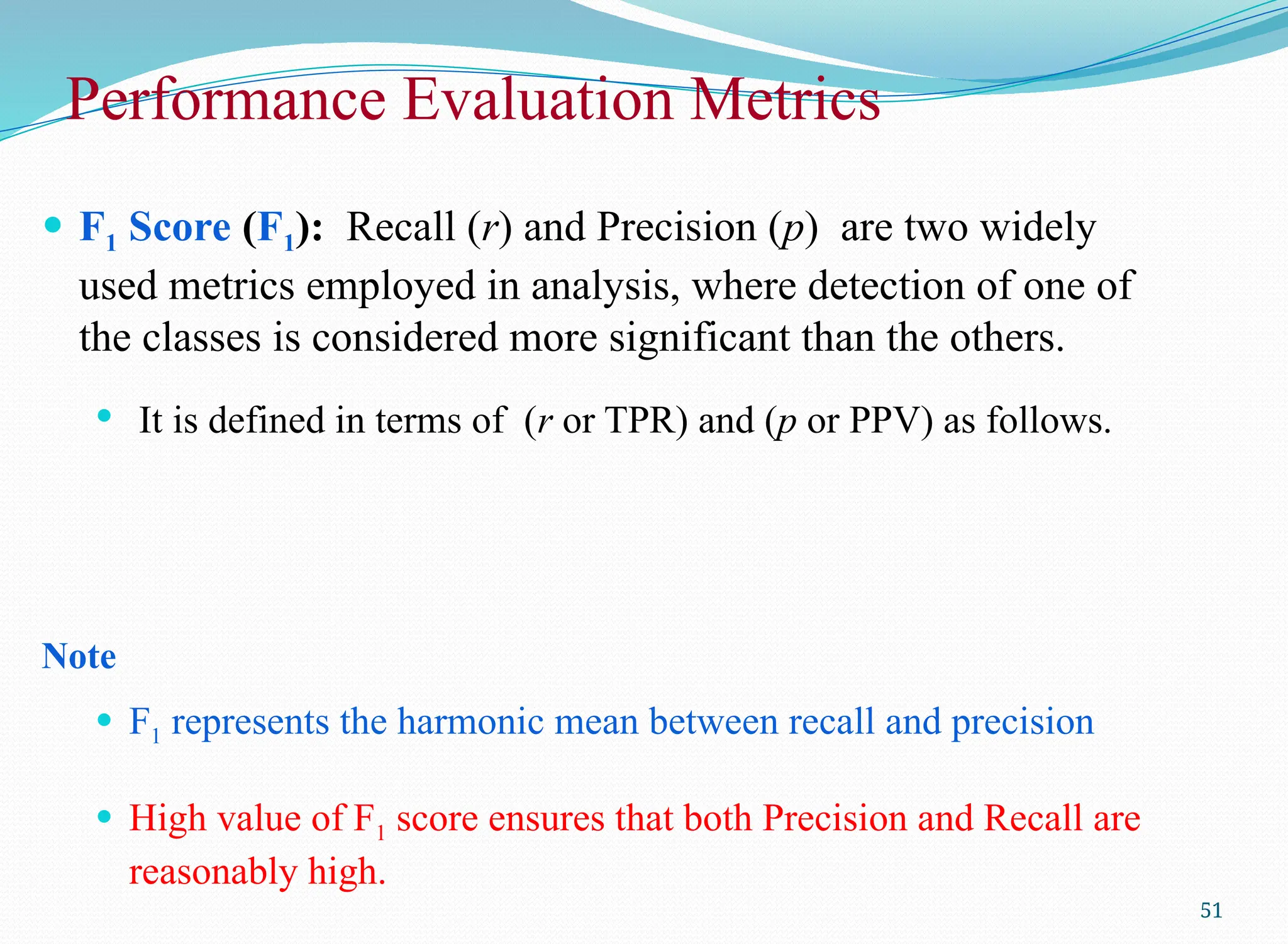
50 F1 Score(F1): Recall (r) and Precision (p) are two widely used metrics employed in analysis, where detection of one of the classes is considered more significant than the others. It is defined in terms of (r or TPR) and (p or PPV) as follows. Note F1 represents the harmonic mean between recall and precision High value of F1 score ensures that both Precision and Recall are reasonably high. Performance Evaluation Metrics: F1 Score
51.
51 F1 Score(F1): Recall (r) and Precision (p) are two widely used metrics employed in analysis, where detection of one of the classes is considered more significant than the others. It is defined in terms of (r or TPR) and (p or PPV) as follows. Note F1 represents the harmonic mean between recall and precision High value of F1 score ensures that both Precision and Recall are reasonably high. Performance Evaluation Metrics
52.
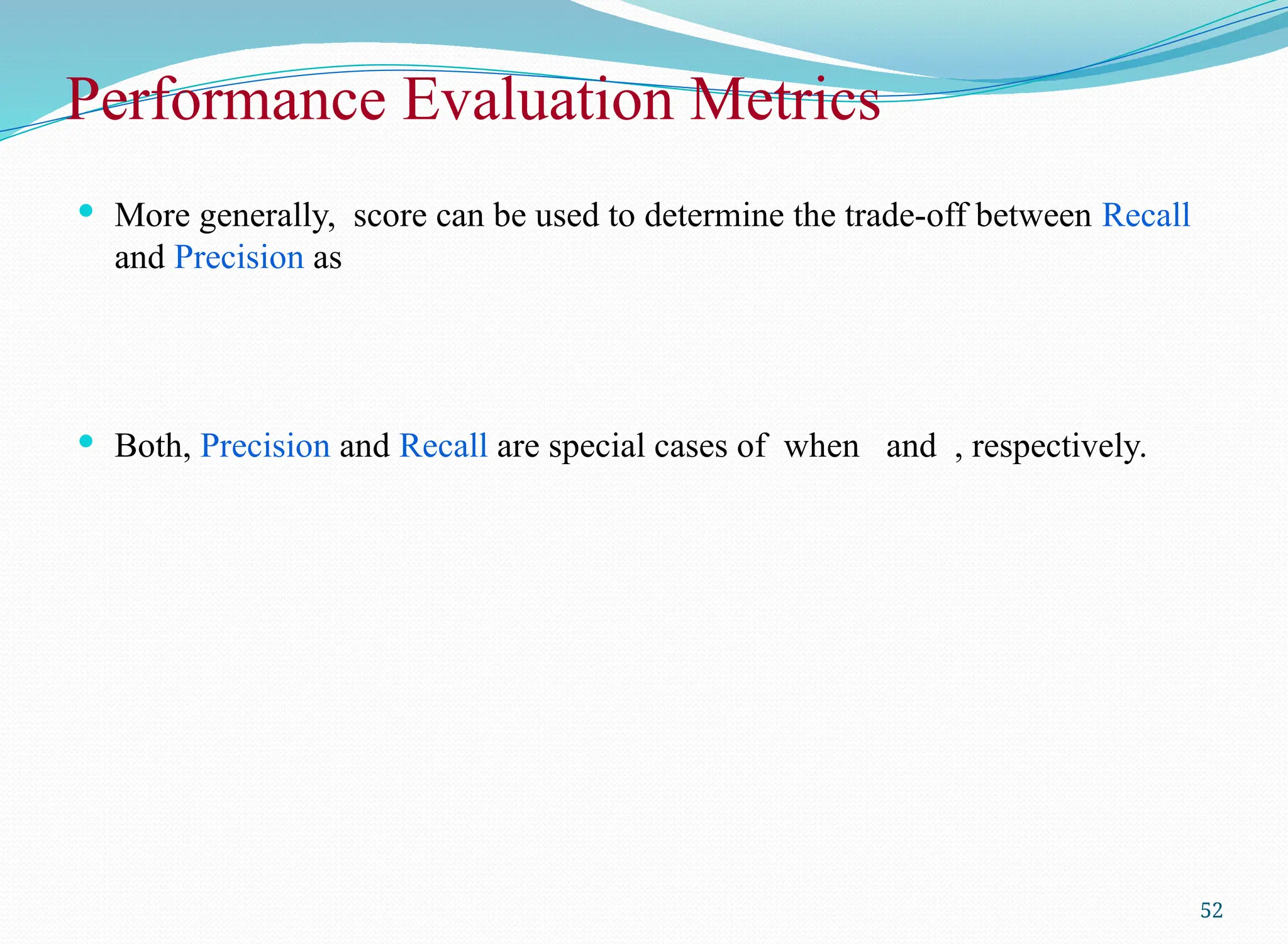
More generally,score can be used to determine the trade-off between Recall and Precision as Both, Precision and Recall are special cases of when and , respectively. 52 Performance Evaluation Metrics
53.
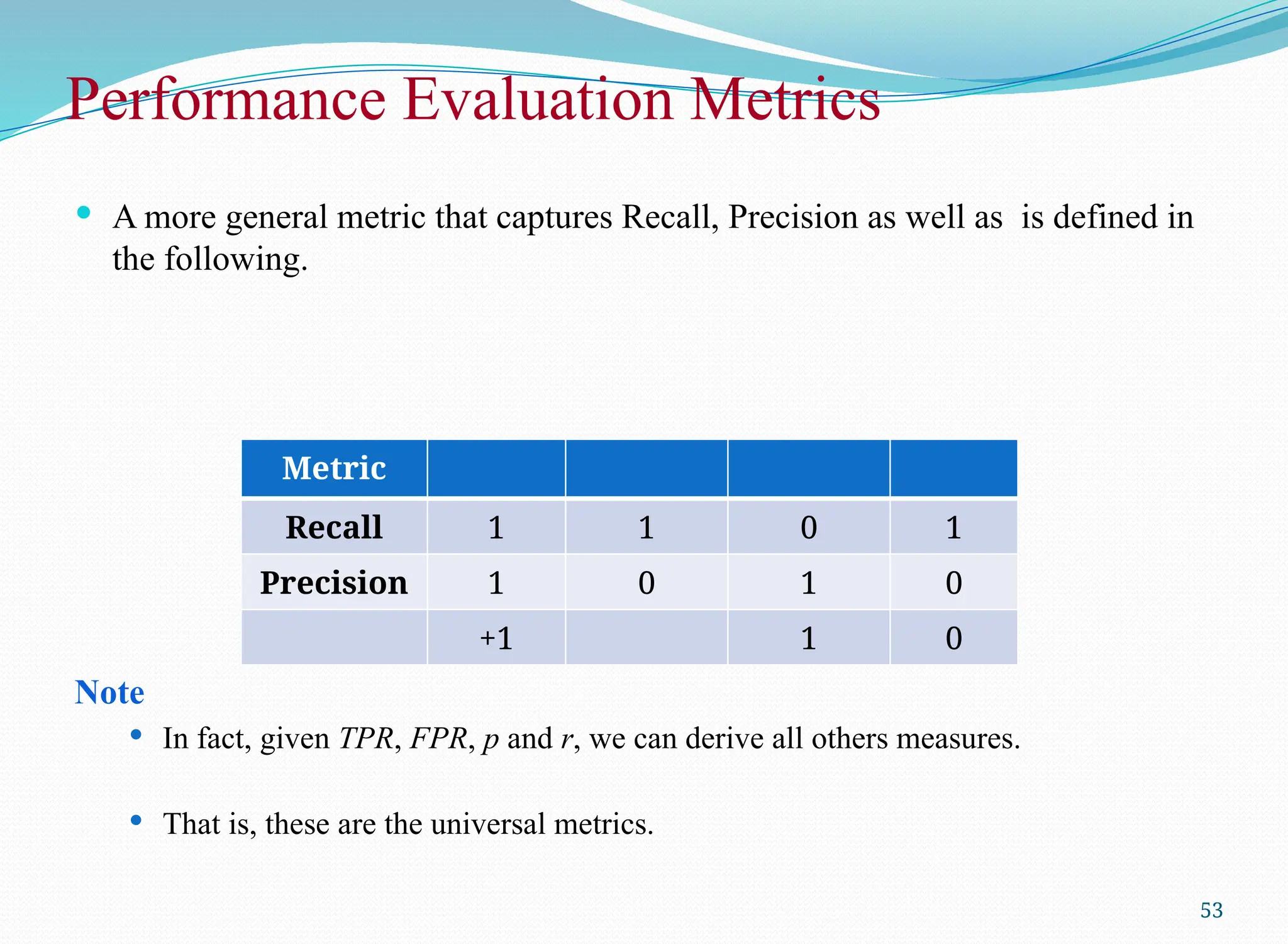
A moregeneral metric that captures Recall, Precision as well as is defined in the following. Note In fact, given TPR, FPR, p and r, we can derive all others measures. That is, these are the universal metrics. 53 Metric Recall 1 1 0 1 Precision 1 0 1 0 +1 1 0 Performance Evaluation Metrics
54.
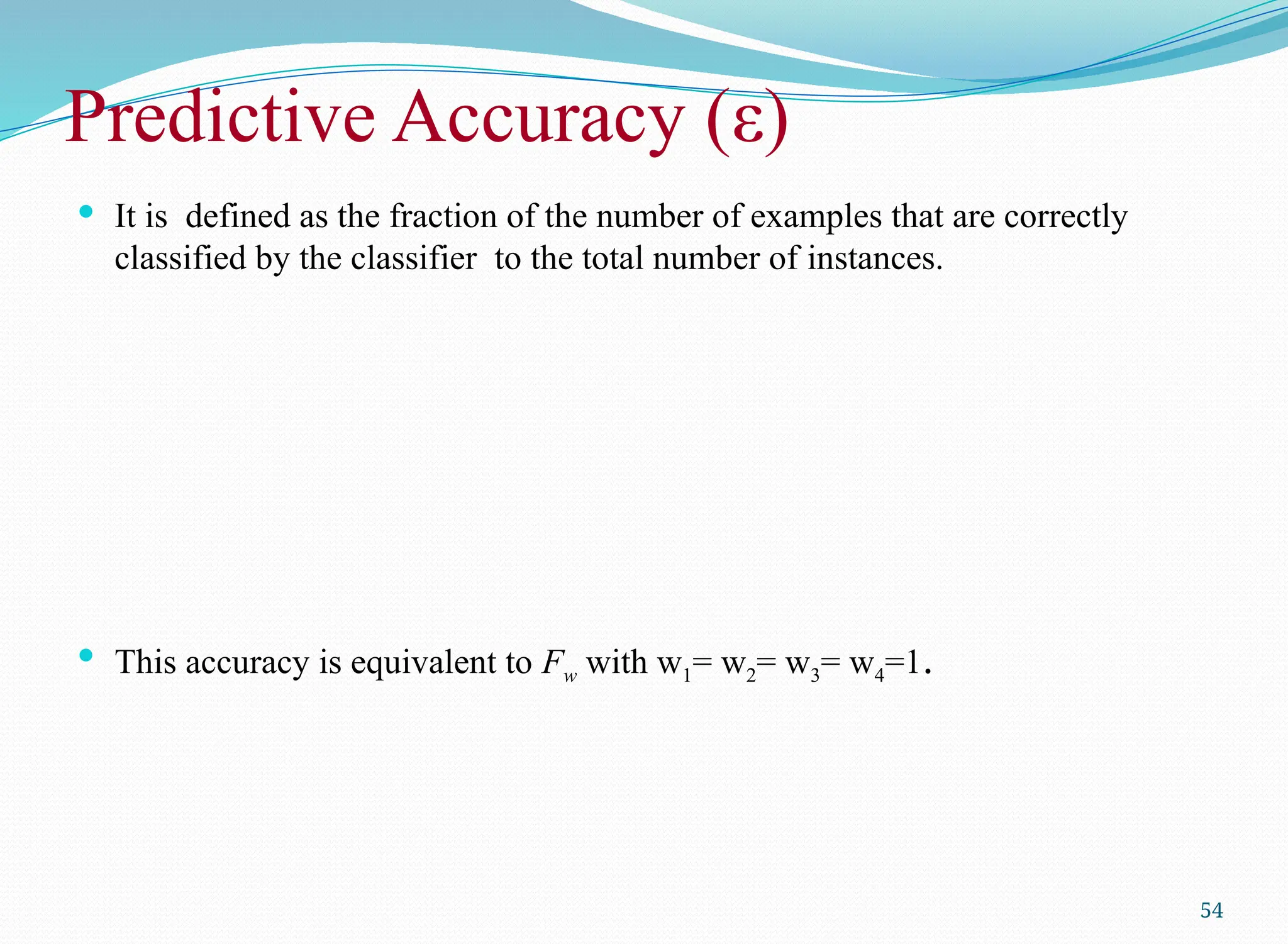
Predictive Accuracy (ε) It is defined as the fraction of the number of examples that are correctly classified by the classifier to the total number of instances. This accuracy is equivalent to Fw with w1= w2= w3= w4=1. 54
55.
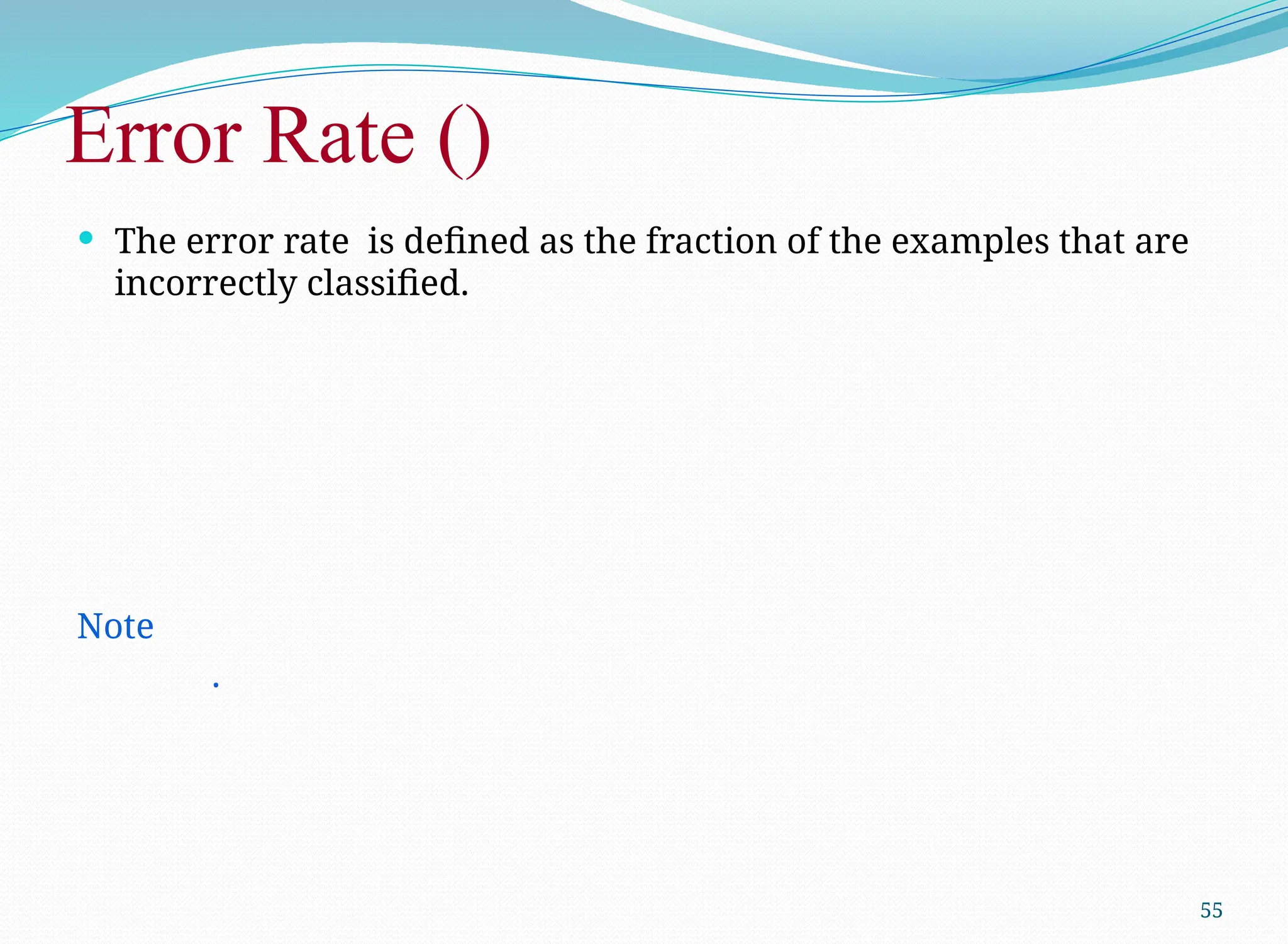
Error Rate () The error rate is defined as the fraction of the examples that are incorrectly classified. Note . 55
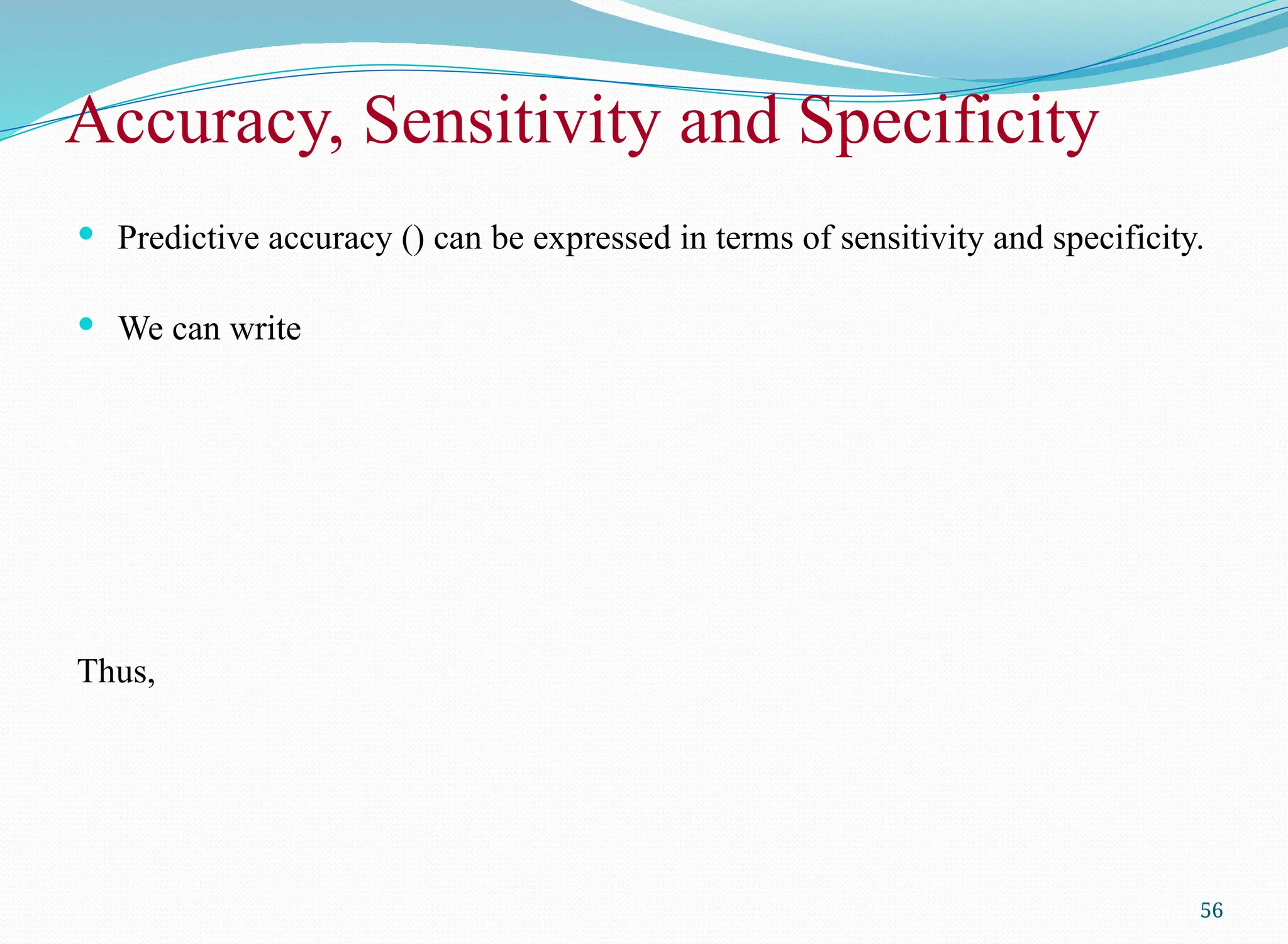
56.
Predictive accuracy() can be expressed in terms of sensitivity and specificity. We can write Thus, 56 Accuracy, Sensitivity and Specificity
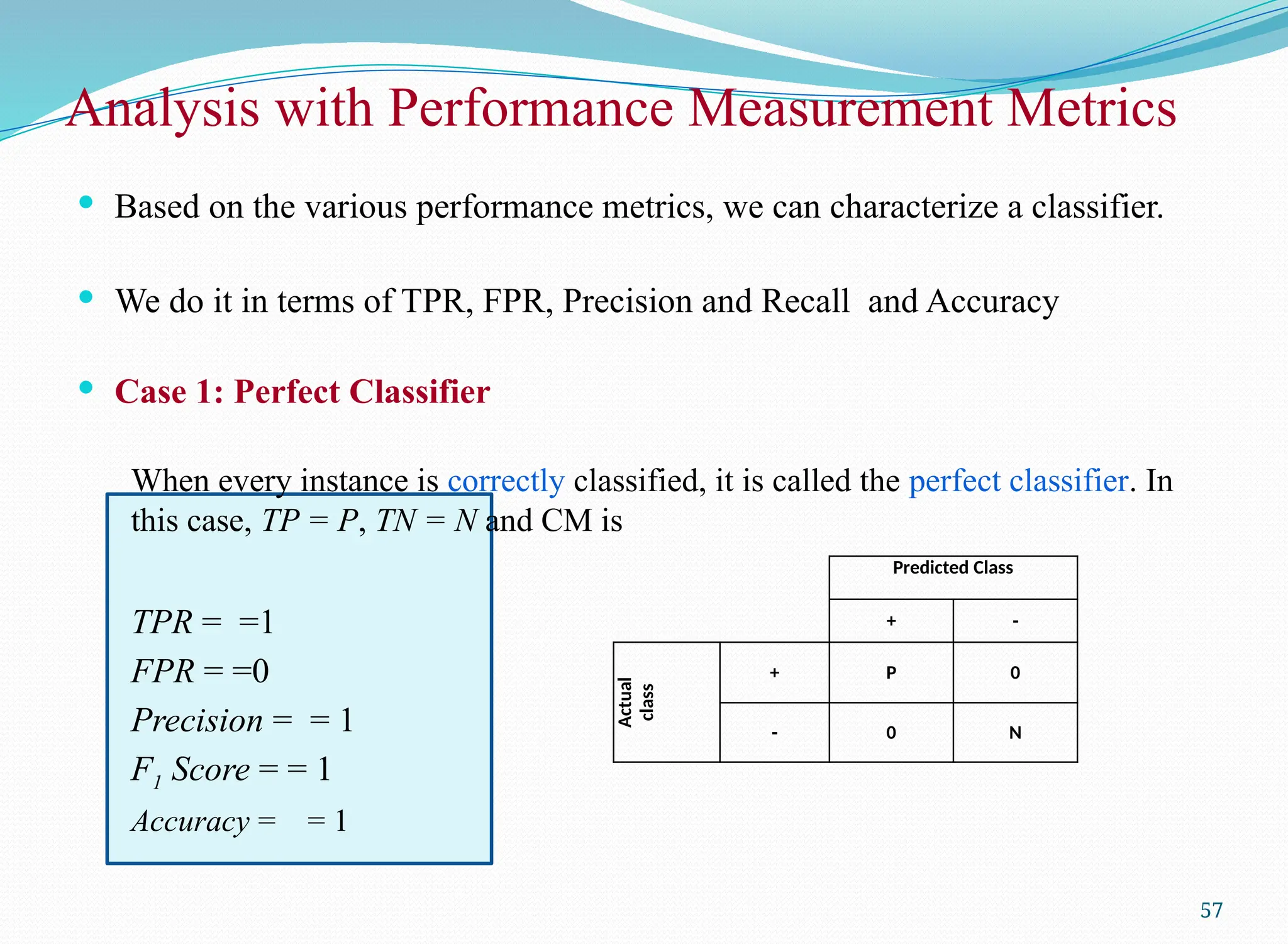
57.
Analysis with PerformanceMeasurement Metrics Based on the various performance metrics, we can characterize a classifier. We do it in terms of TPR, FPR, Precision and Recall and Accuracy Case 1: Perfect Classifier When every instance is correctly classified, it is called the perfect classifier. In this case, TP = P, TN = N and CM is TPR = =1 FPR = =0 Precision = = 1 F1 Score = = 1 Accuracy = = 1 57 Predicted Class + - Actual class + P 0 - 0 N
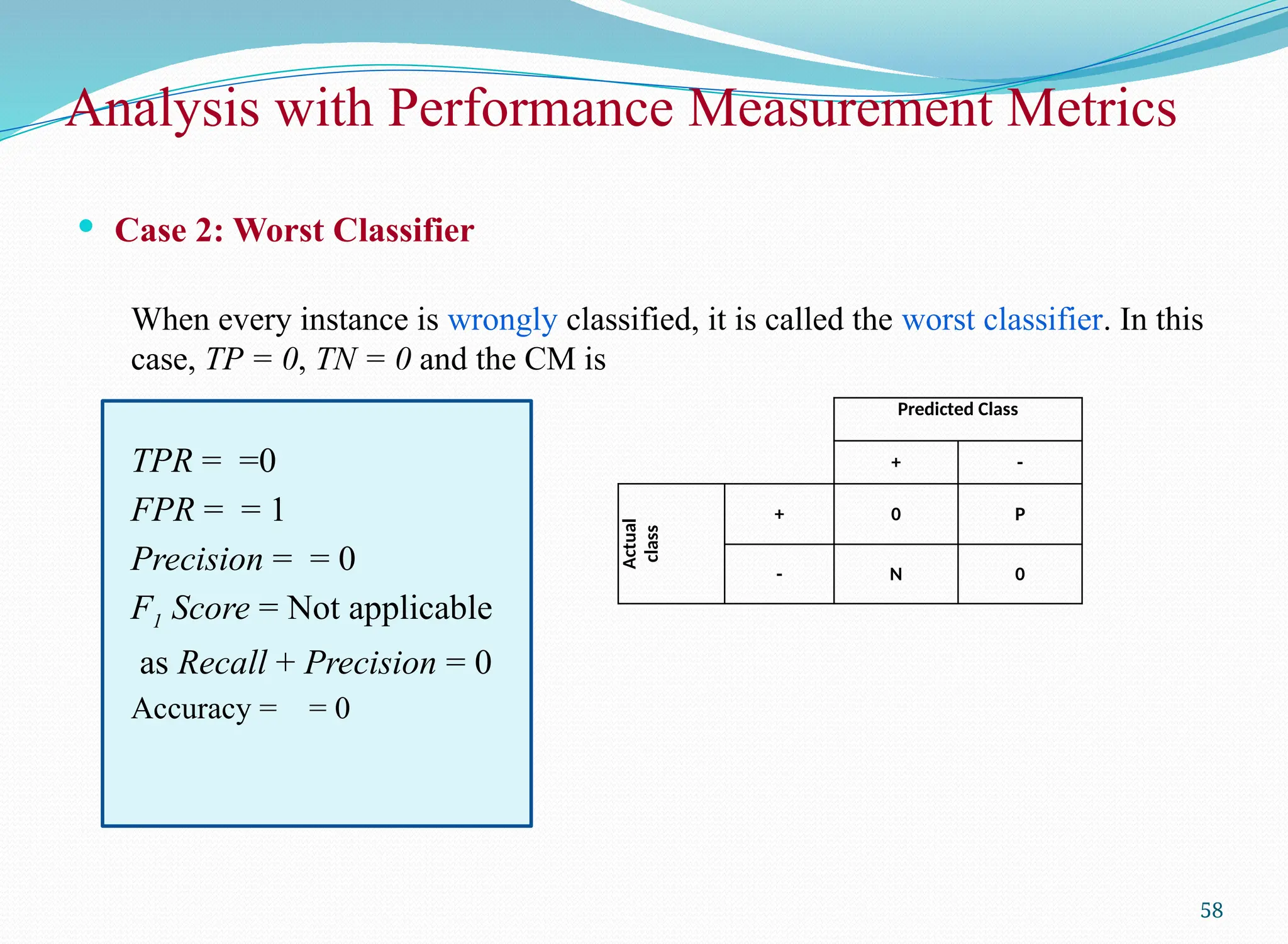
58.
Analysis with PerformanceMeasurement Metrics Case 2: Worst Classifier When every instance is wrongly classified, it is called the worst classifier. In this case, TP = 0, TN = 0 and the CM is TPR = =0 FPR = = 1 Precision = = 0 F1 Score = Not applicable as Recall + Precision = 0 Accuracy = = 0 58 Predicted Class + - Actual class + 0 P - N 0
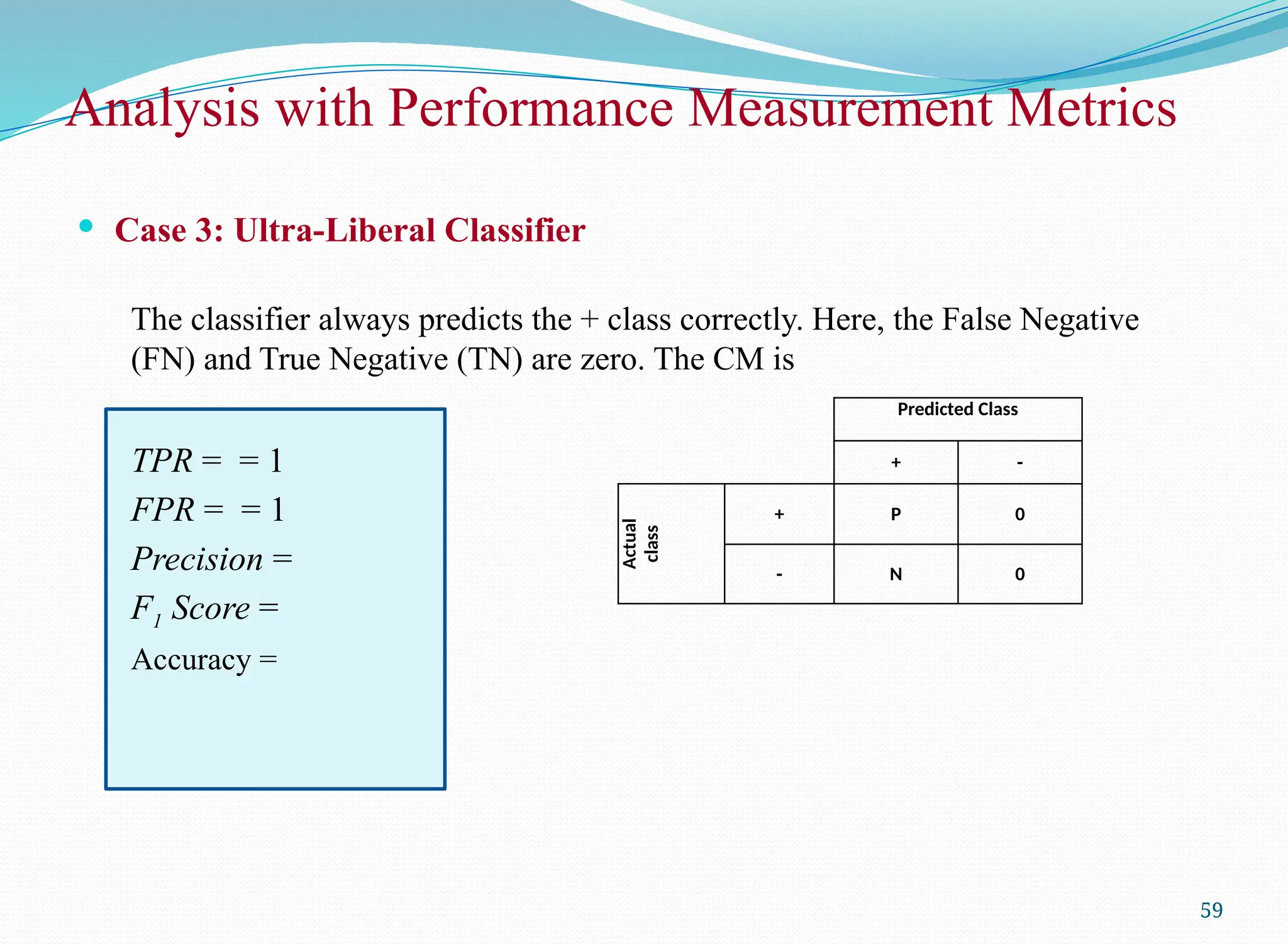
59.
Analysis with PerformanceMeasurement Metrics Case 3: Ultra-Liberal Classifier The classifier always predicts the + class correctly. Here, the False Negative (FN) and True Negative (TN) are zero. The CM is TPR = = 1 FPR = = 1 Precision = F1 Score = Accuracy = 59 Predicted Class + - Actual class + P 0 - N 0
60.
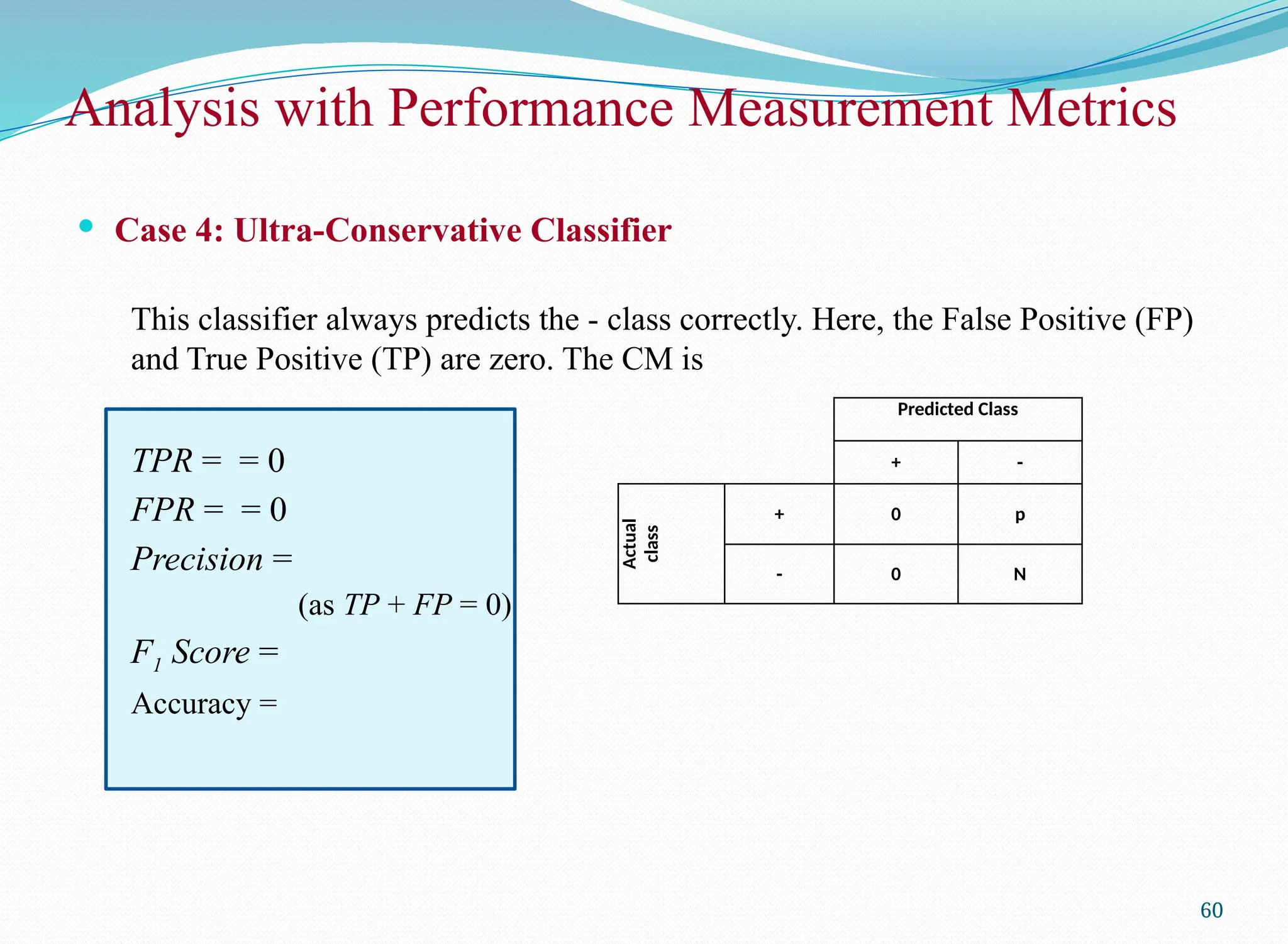
Analysis with PerformanceMeasurement Metrics Case 4: Ultra-Conservative Classifier This classifier always predicts the - class correctly. Here, the False Positive (FP) and True Positive (TP) are zero. The CM is TPR = = 0 FPR = = 0 Precision = (as TP + FP = 0) F1 Score = Accuracy = 60 Predicted Class + - Actual class + 0 p - 0 N
61.
Predictive Accuracy versusTPR and FPR One strength of characterizing a classifier by its TPR and FPR is that they do not depend on the relative size of P and N. The same is also applicable for FNR and TNR and others measures from CM. In contrast, the Predictive Accuracy, Precision, Error Rate, F1 Score, etc. are affected by the relative size of P and N. FPR, TPR, FNR and TNR are calculated from the different rows of the CM. On the other hand Predictive Accuracy, etc. are derived from the values in both rows. This suggests that FPR, TPR, FNR and TNR are more effective than Predictive Accuracy, etc. 61
ROC Curves ROCis an abbreviation of Receiver Operating Characteristic come from the signal detection theory, developed during World War 2 for analysis of radar images. In the context of classifier, ROC plot is a useful tool to study the behaviour of a classifier or comparing two or more classifiers. A ROC plot is a two-dimensional graph, where, X-axis represents FP rate (FPR) and Y-axis represents TP rate (TPR). Since, the values of FPR and TPR varies from 0 to 1 both inclusive, the two axes thus from 0 to 1 only. Each point (x, y) on the plot indicating that the FPR has value x and the TPR value y. 63
64.
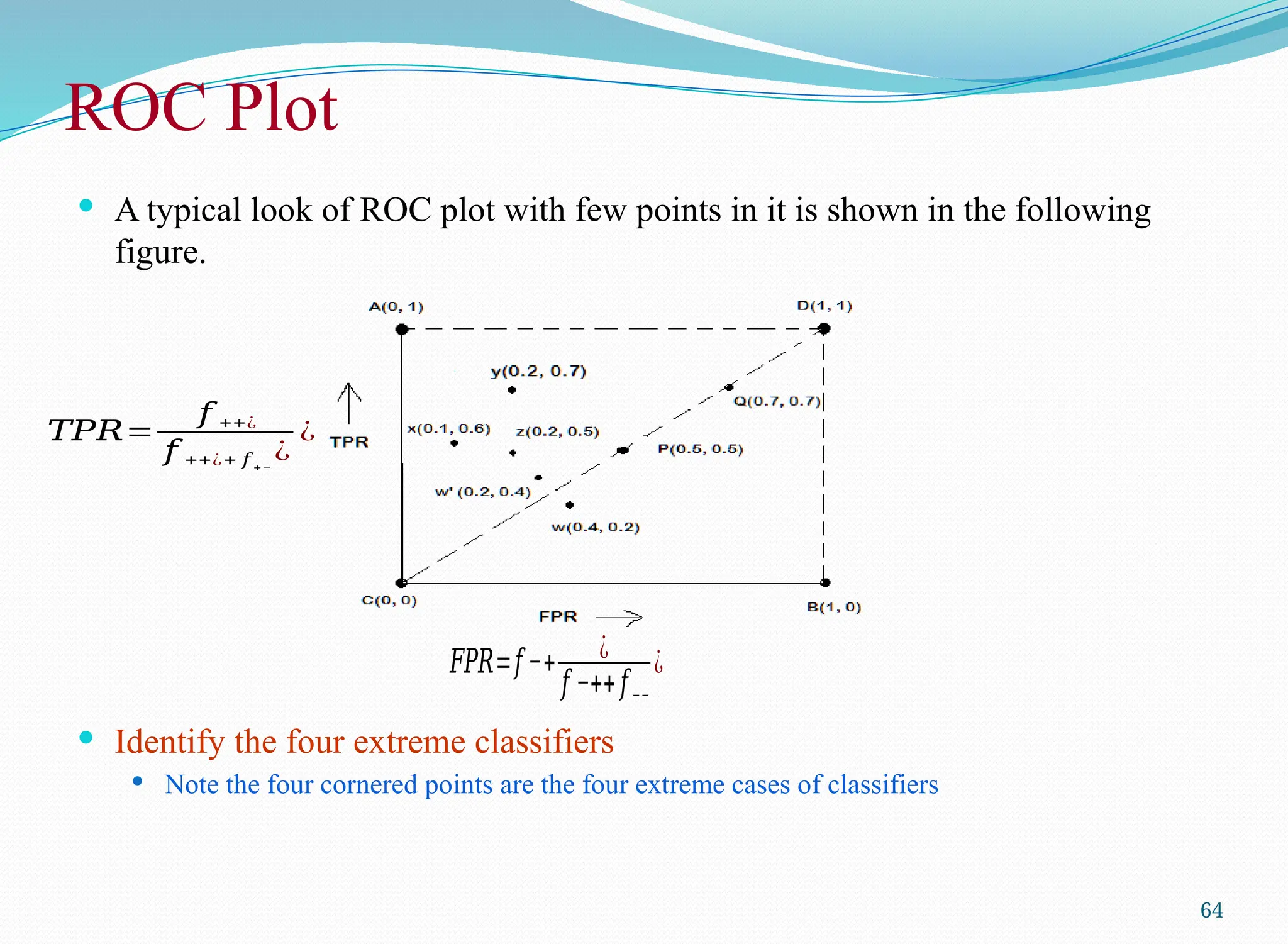
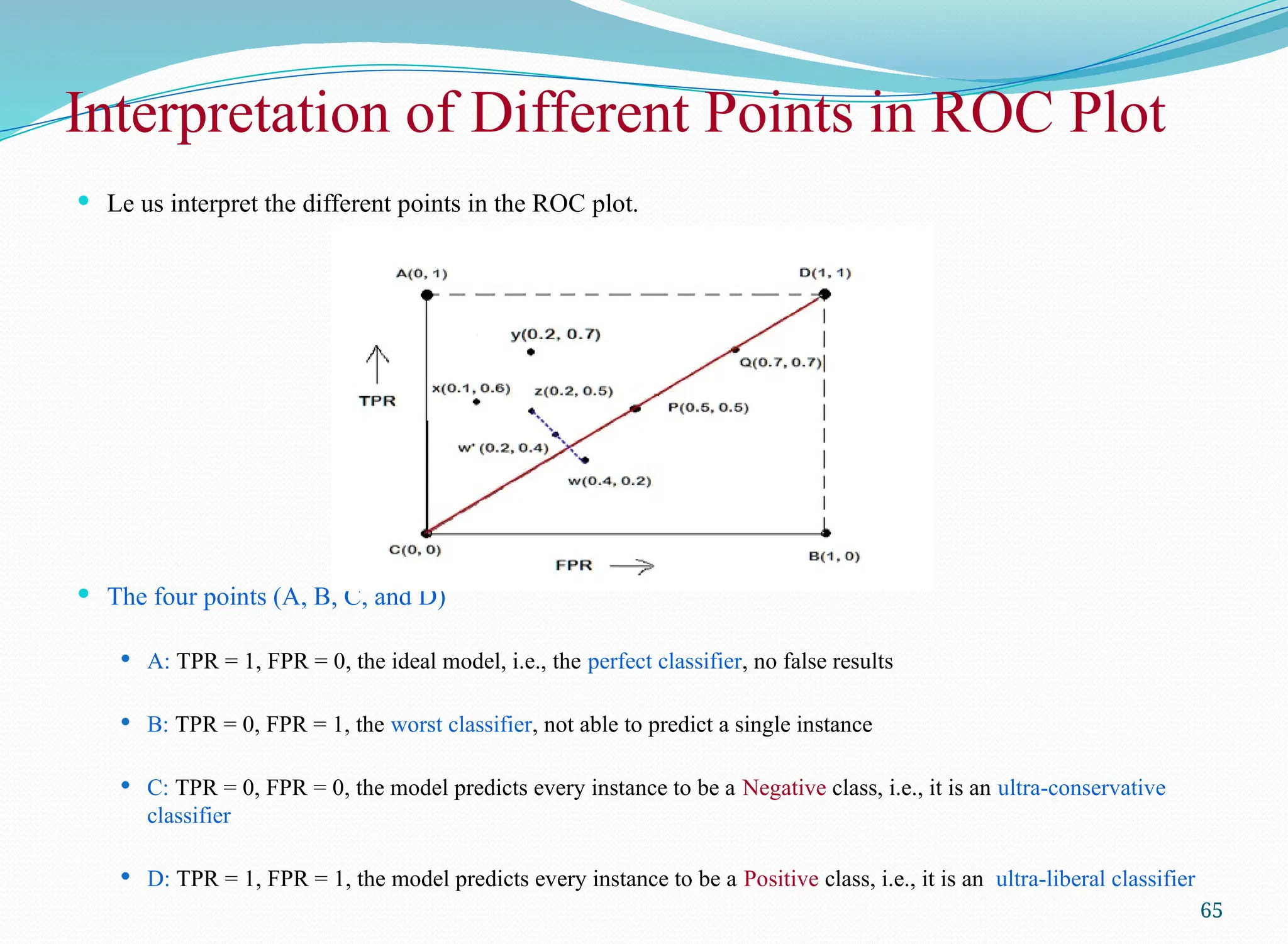
ROC Plot Atypical look of ROC plot with few points in it is shown in the following figure. Identify the four extreme classifiers Note the four cornered points are the four extreme cases of classifiers 64 𝑇𝑃𝑅= 𝑓 ++¿ 𝑓 ++¿+ 𝑓 +− ¿ ¿ 𝐹𝑃𝑅=𝑓 −+ ¿ 𝑓 −++𝑓−− ¿
65.
Interpretation of DifferentPoints in ROC Plot Le us interpret the different points in the ROC plot. The four points (A, B, C, and D) A: TPR = 1, FPR = 0, the ideal model, i.e., the perfect classifier, no false results B: TPR = 0, FPR = 1, the worst classifier, not able to predict a single instance C: TPR = 0, FPR = 0, the model predicts every instance to be a Negative class, i.e., it is an ultra-conservative classifier D: TPR = 1, FPR = 1, the model predicts every instance to be a Positive class, i.e., it is an ultra-liberal classifier 65
66.
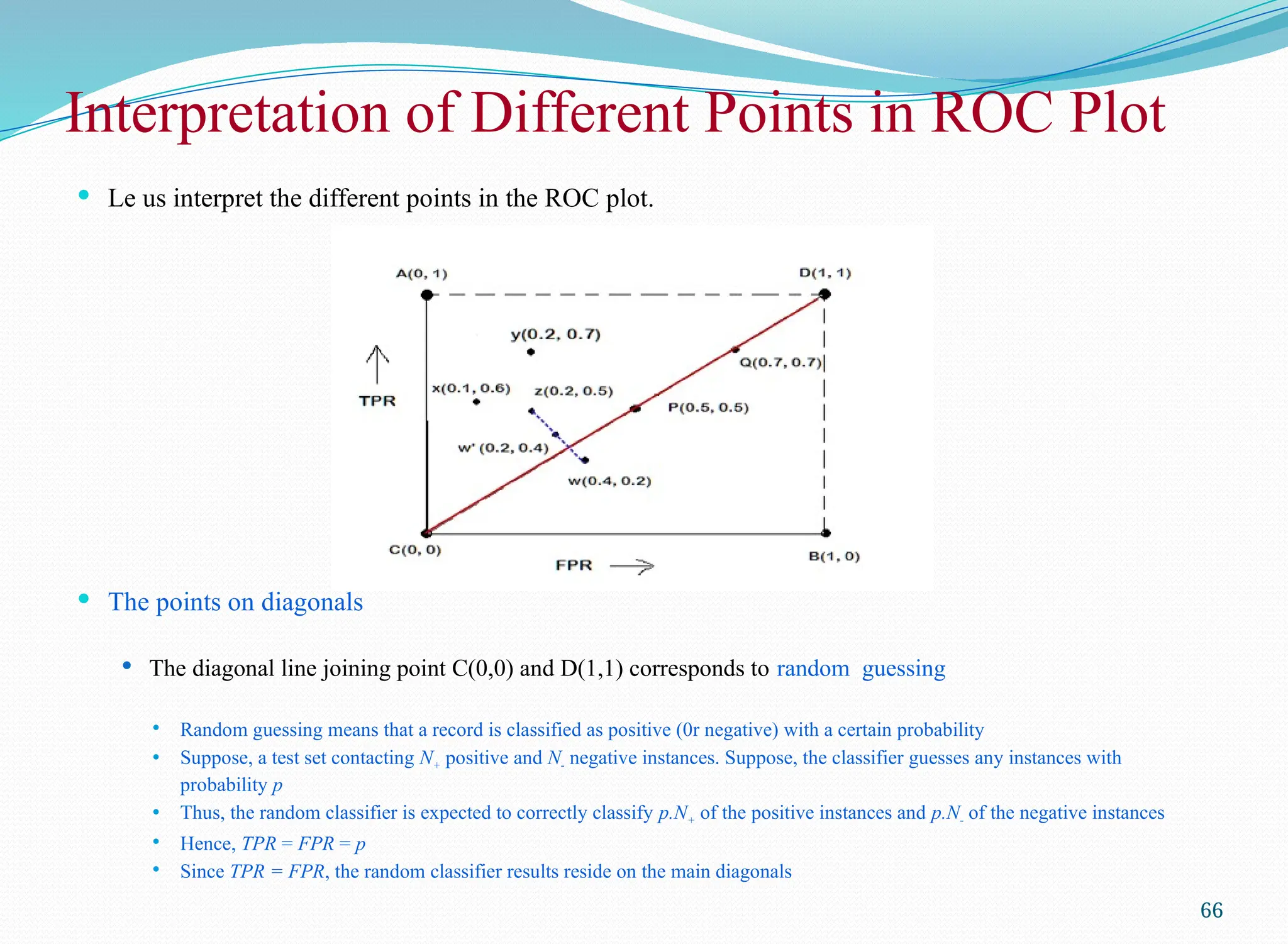
Interpretation of DifferentPoints in ROC Plot Le us interpret the different points in the ROC plot. The points on diagonals The diagonal line joining point C(0,0) and D(1,1) corresponds to random guessing Random guessing means that a record is classified as positive (0r negative) with a certain probability Suppose, a test set contacting N+ positive and N- negative instances. Suppose, the classifier guesses any instances with probability p Thus, the random classifier is expected to correctly classify p.N+ of the positive instances and p.N- of the negative instances Hence, TPR = FPR = p Since TPR = FPR, the random classifier results reside on the main diagonals 66
67.
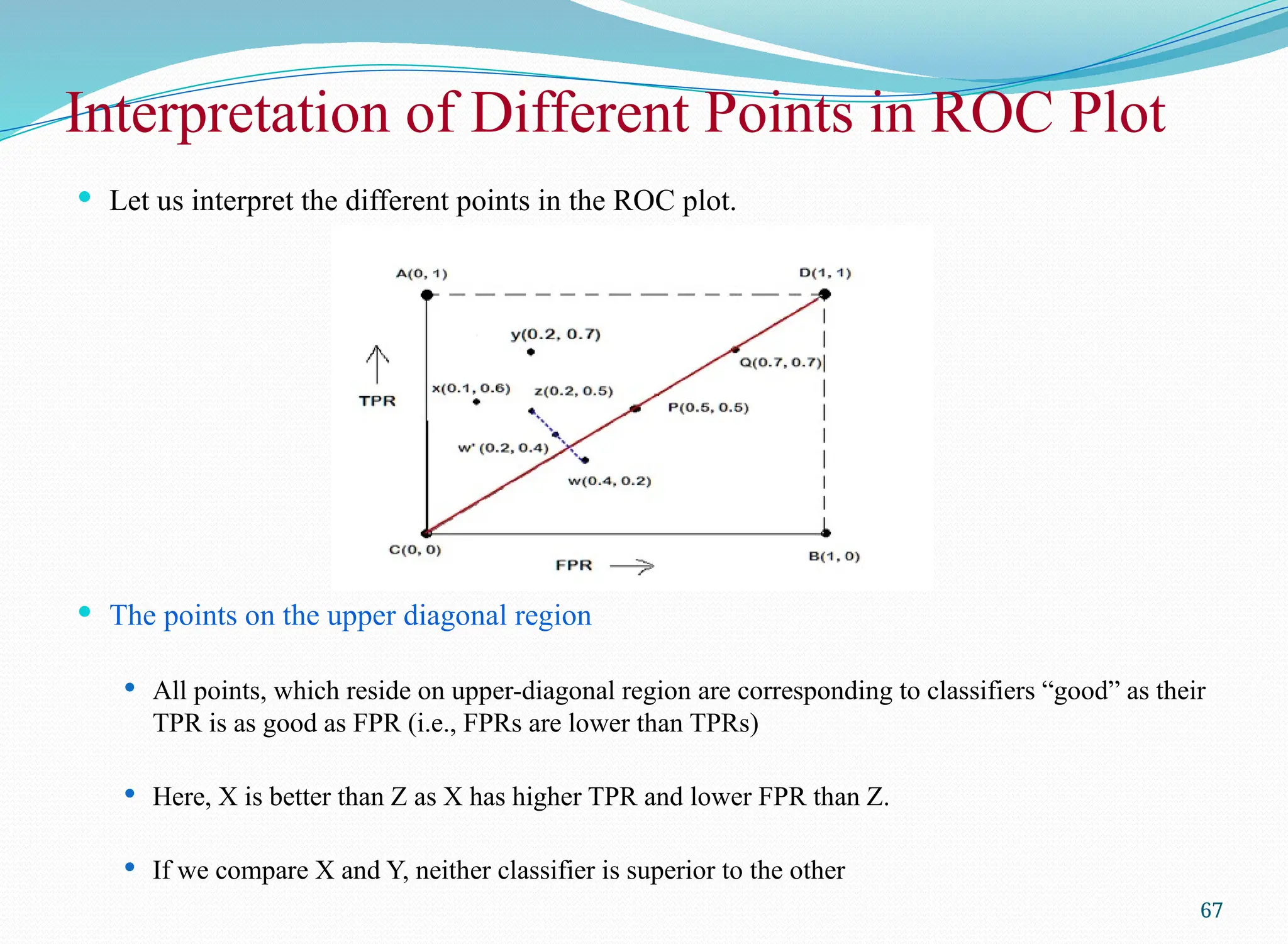
Interpretation of DifferentPoints in ROC Plot Let us interpret the different points in the ROC plot. The points on the upper diagonal region All points, which reside on upper-diagonal region are corresponding to classifiers “good” as their TPR is as good as FPR (i.e., FPRs are lower than TPRs) Here, X is better than Z as X has higher TPR and lower FPR than Z. If we compare X and Y, neither classifier is superior to the other 67
68.
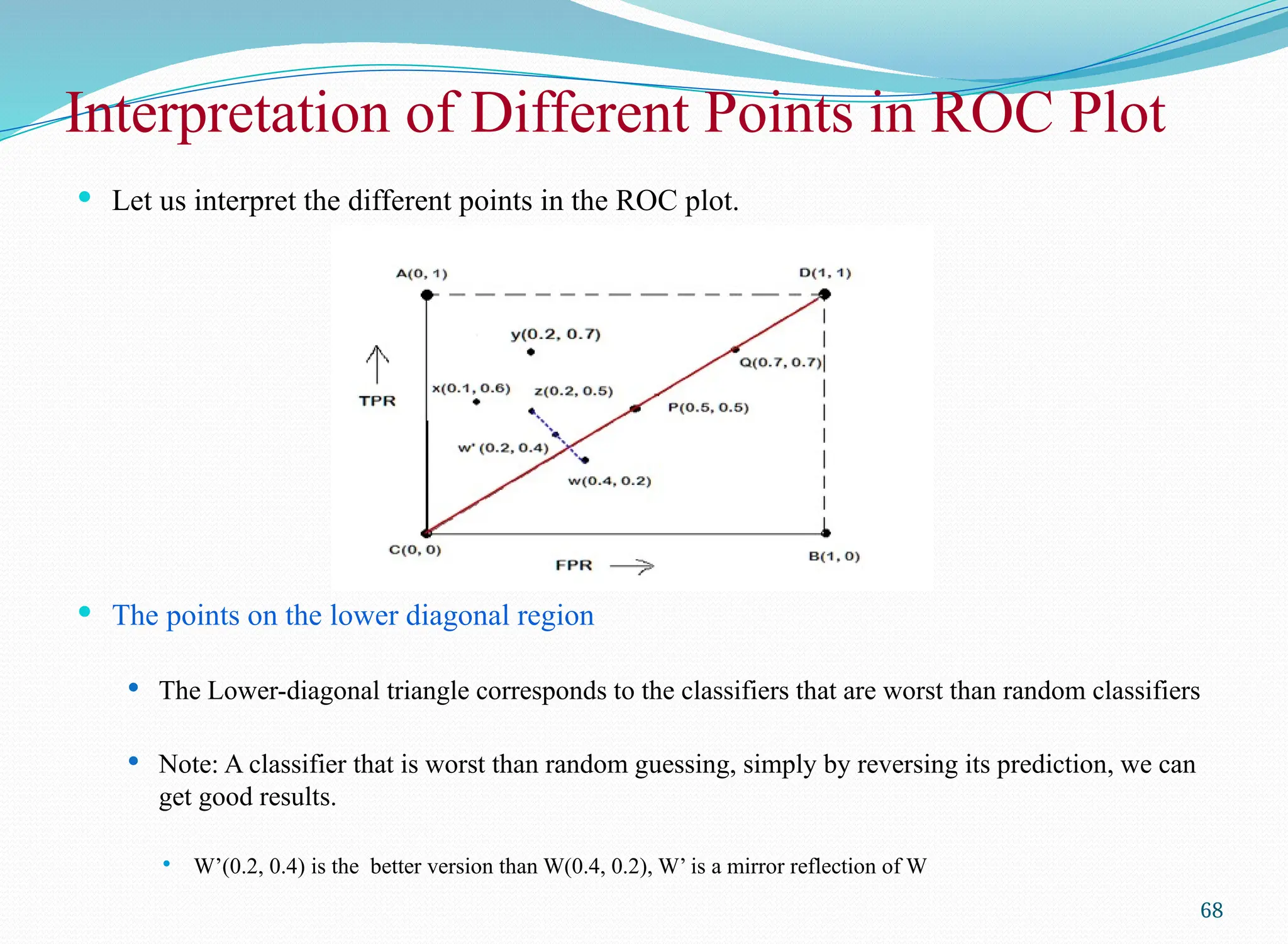
Interpretation of DifferentPoints in ROC Plot Let us interpret the different points in the ROC plot. The points on the lower diagonal region The Lower-diagonal triangle corresponds to the classifiers that are worst than random classifiers Note: A classifier that is worst than random guessing, simply by reversing its prediction, we can get good results. W’(0.2, 0.4) is the better version than W(0.4, 0.2), W’ is a mirror reflection of W 68
69.
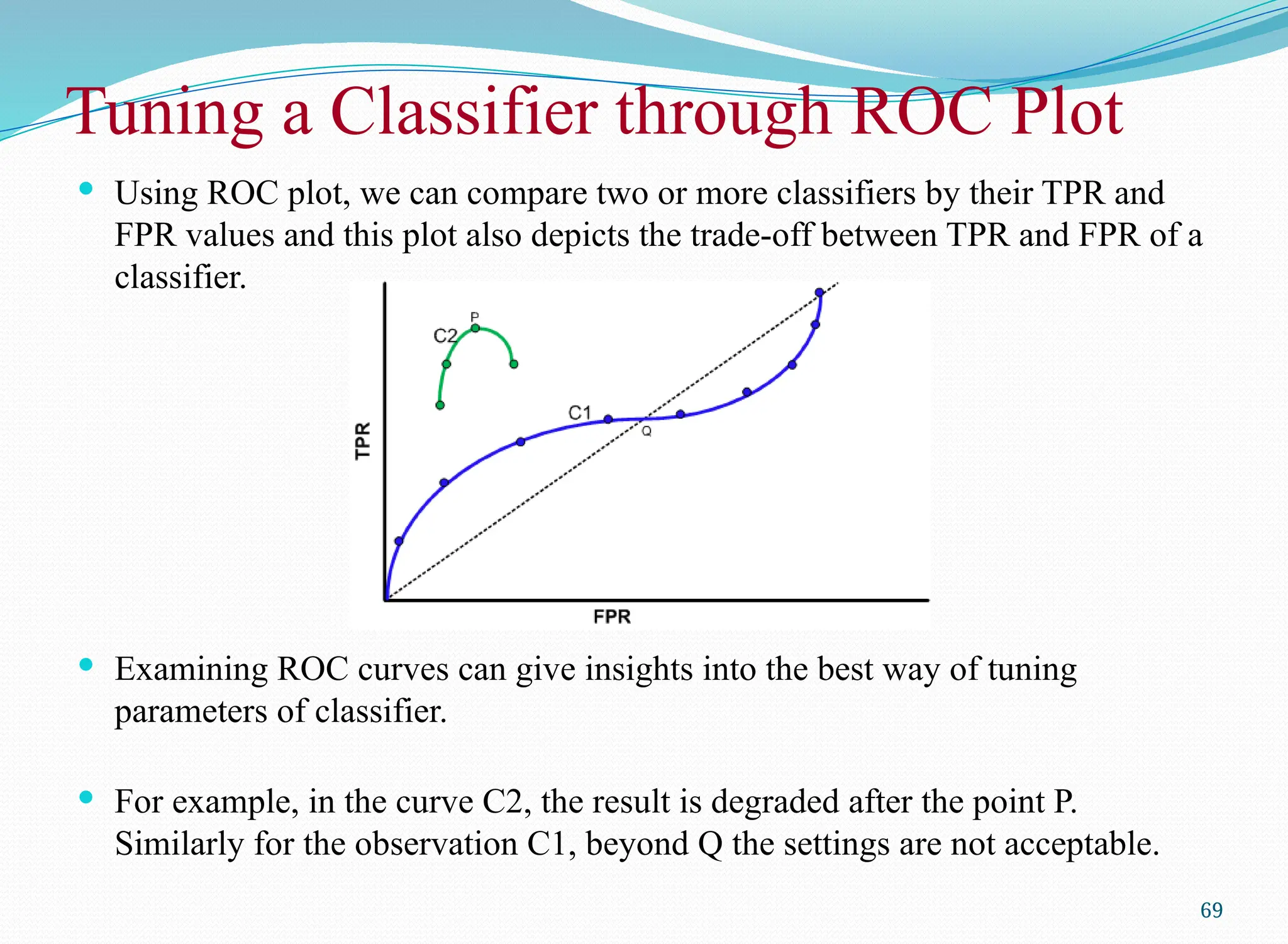
Tuning a Classifierthrough ROC Plot Using ROC plot, we can compare two or more classifiers by their TPR and FPR values and this plot also depicts the trade-off between TPR and FPR of a classifier. Examining ROC curves can give insights into the best way of tuning parameters of classifier. For example, in the curve C2, the result is degraded after the point P. Similarly for the observation C1, beyond Q the settings are not acceptable. 69
70.
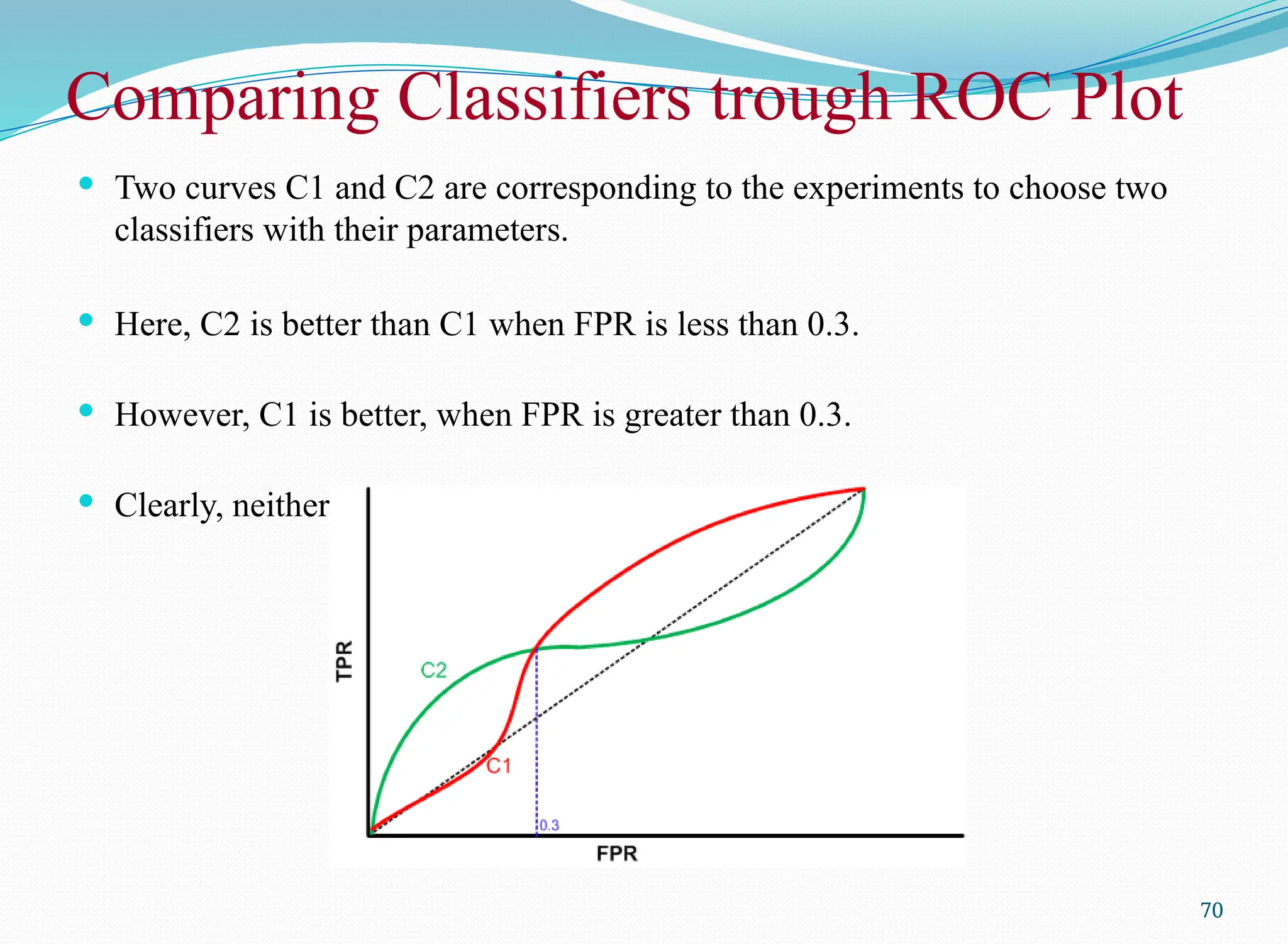
Comparing Classifiers troughROC Plot Two curves C1 and C2 are corresponding to the experiments to choose two classifiers with their parameters. Here, C2 is better than C1 when FPR is less than 0.3. However, C1 is better, when FPR is greater than 0.3. Clearly, neither of these two classifiers dominates the other. 70
71.
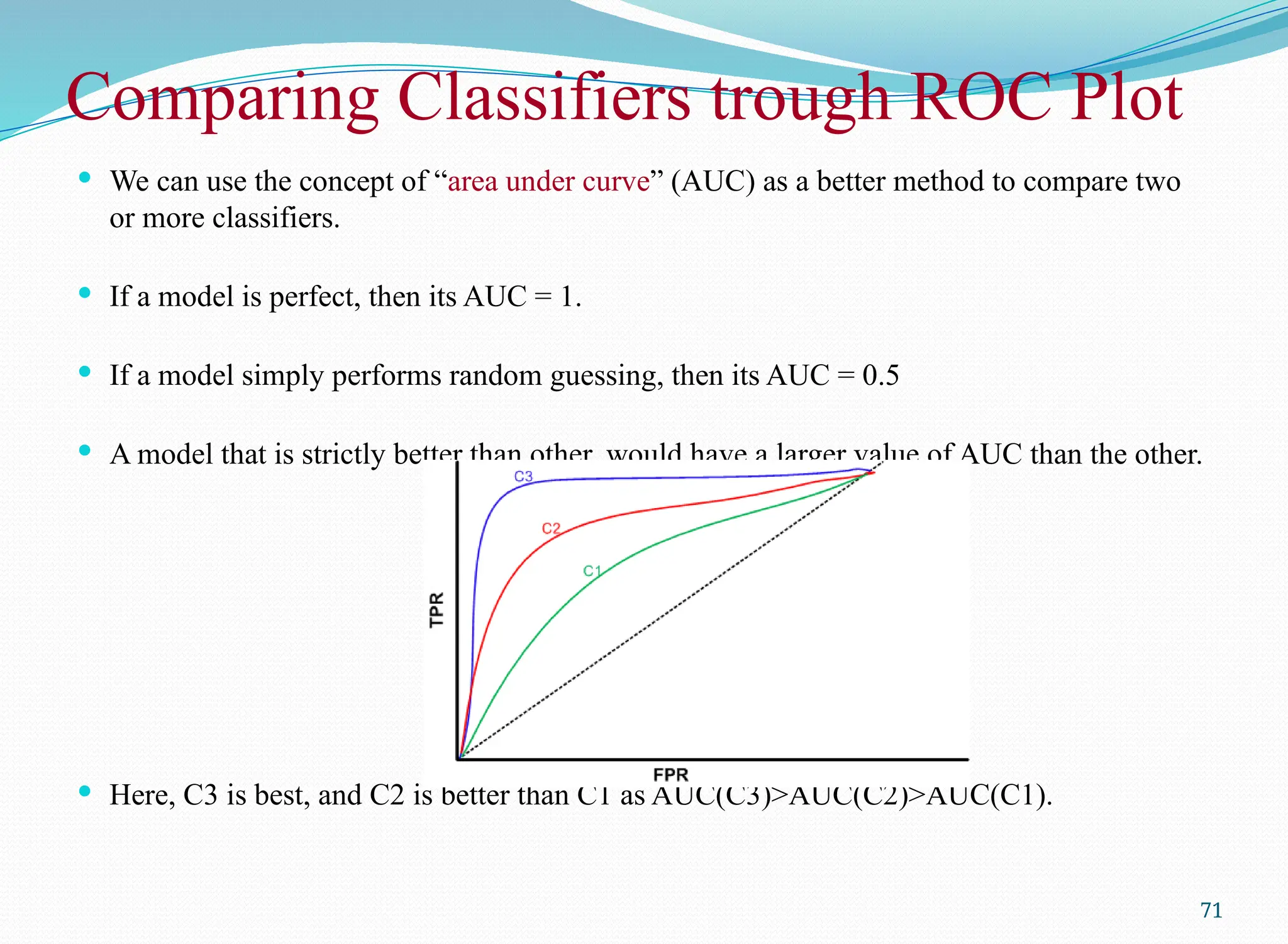
We canuse the concept of “area under curve” (AUC) as a better method to compare two or more classifiers. If a model is perfect, then its AUC = 1. If a model simply performs random guessing, then its AUC = 0.5 A model that is strictly better than other, would have a larger value of AUC than the other. Here, C3 is best, and C2 is better than C1 as AUC(C3)>AUC(C2)>AUC(C1). 71 Comparing Classifiers trough ROC Plot
72.
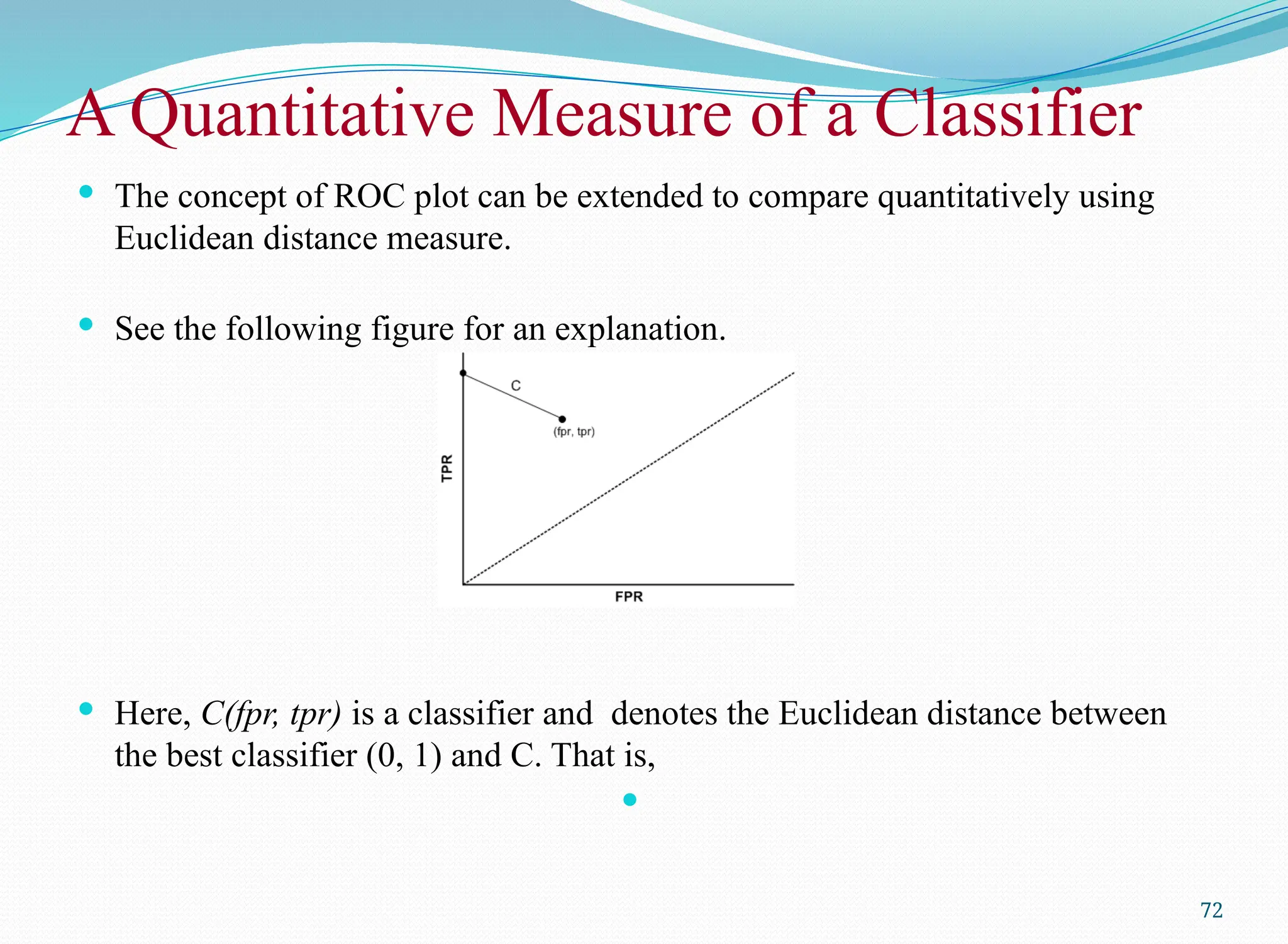
A Quantitative Measureof a Classifier The concept of ROC plot can be extended to compare quantitatively using Euclidean distance measure. See the following figure for an explanation. Here, C(fpr, tpr) is a classifier and denotes the Euclidean distance between the best classifier (0, 1) and C. That is, 72
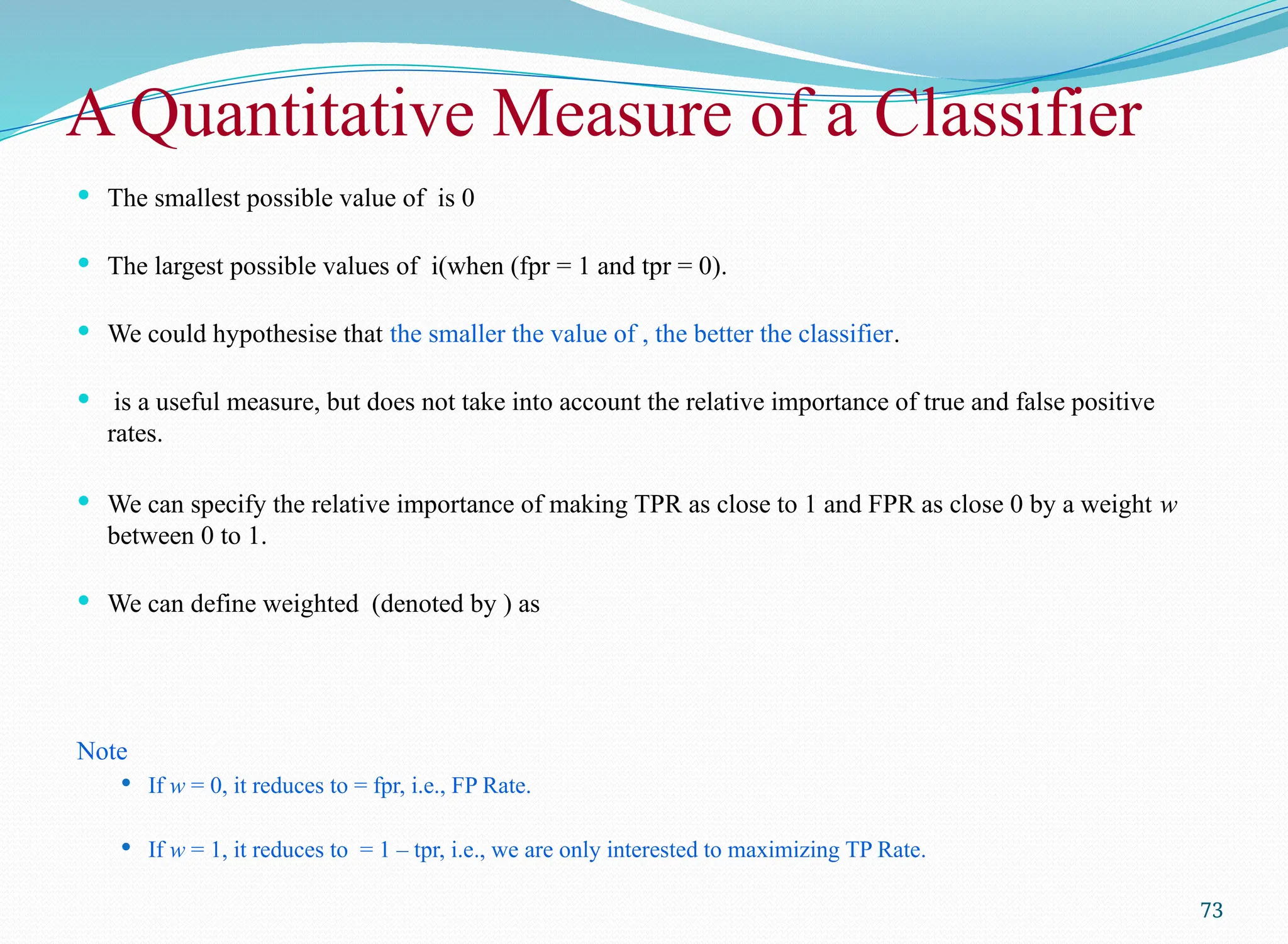
73.
A Quantitative Measureof a Classifier The smallest possible value of is 0 The largest possible values of i(when (fpr = 1 and tpr = 0). We could hypothesise that the smaller the value of , the better the classifier. is a useful measure, but does not take into account the relative importance of true and false positive rates. We can specify the relative importance of making TPR as close to 1 and FPR as close 0 by a weight w between 0 to 1. We can define weighted (denoted by ) as Note If w = 0, it reduces to = fpr, i.e., FP Rate. If w = 1, it reduces to = 1 – tpr, i.e., we are only interested to maximizing TP Rate. 73
74.
Reference 74 The detailmaterial related to this lecture can be found in Data Mining: Concepts and Techniques, (3rd Edn.), Jiawei Han, Micheline Kamber, Morgan Kaufmann, 2015. Introduction to Data Mining, Pang-Ning Tan, Michael Steinbach, and Vipin Kumar, Addison-Wesley, 2014