Apache Cassandra
1. Introduction to NoSQL systems, Extensible Record Stores and Amazon’s Dynamo + Google Bigtable 2. What Cassandra is and how it is compared with other similar systems 3. What applications are better supported - examples, case studies 4. Technical Description, architecture, internals 5. How is it used and installed, requirements and in what platforms does it run on 6. Demo 7. References Contents
Background NoSQL, Extensible Record Stores, Cassandra’s Parents 1.
NoSQL or Not-Only-SQL systems: Next Generation Databases. The initial movement started in 2009 with the goal of creating modern, web-scale DBs. Currently, they exist more than 225 NoSQL systems. In general, they share the following features: • Schema-free databases • Easy replication support • Simple API • Distributed • Open Source NoSQL Systems • BASE (instead of ACID) • Huge amount of data • Horizontally scalable
• Motivated by Google’s Big Table. • Basic Data Model: Rows and Columns • Basic Scalability Model: Rows and Columns are splitted into nodes. • Rows: split across nodes through sharding on the primary key. • Columns: distributed over multiple nodes by using ‘column groups’. • Other systems that use this technology: Hypertable, HBase. Extensible Record Stores (or Wide Column Stores)
What is it? A highly-available and scalable storage system used by Amazon to store and retrieve user shopping charts and other core services. It pioneered the idea of eventual consistency. Key-Value Store. How it works? Allows read and write operations to continue even during network partitions and resolves update conflicts using different conflict resolution mechanisms. Sacrifices consistency for availability. Allows customization to meet desired preference. Consistent Hashing, Vector Clocks (not in Cassandra), Gossip Protocol, Hinted Handoff, Read Repair Cassandra’s Parents - Amazon Dynamo
Cassandra’s Parents - Google Bigtable What is it? A high performance data storage system built on Google File System and other Google technologies. How it works? Provides both structure and data distribution but relies on a distributed file system for durability. Richer data model from Dynamo. One key, many values. Fast sequential access. Columnar, SSTable Storage, Append-only, Memtable, Compaction
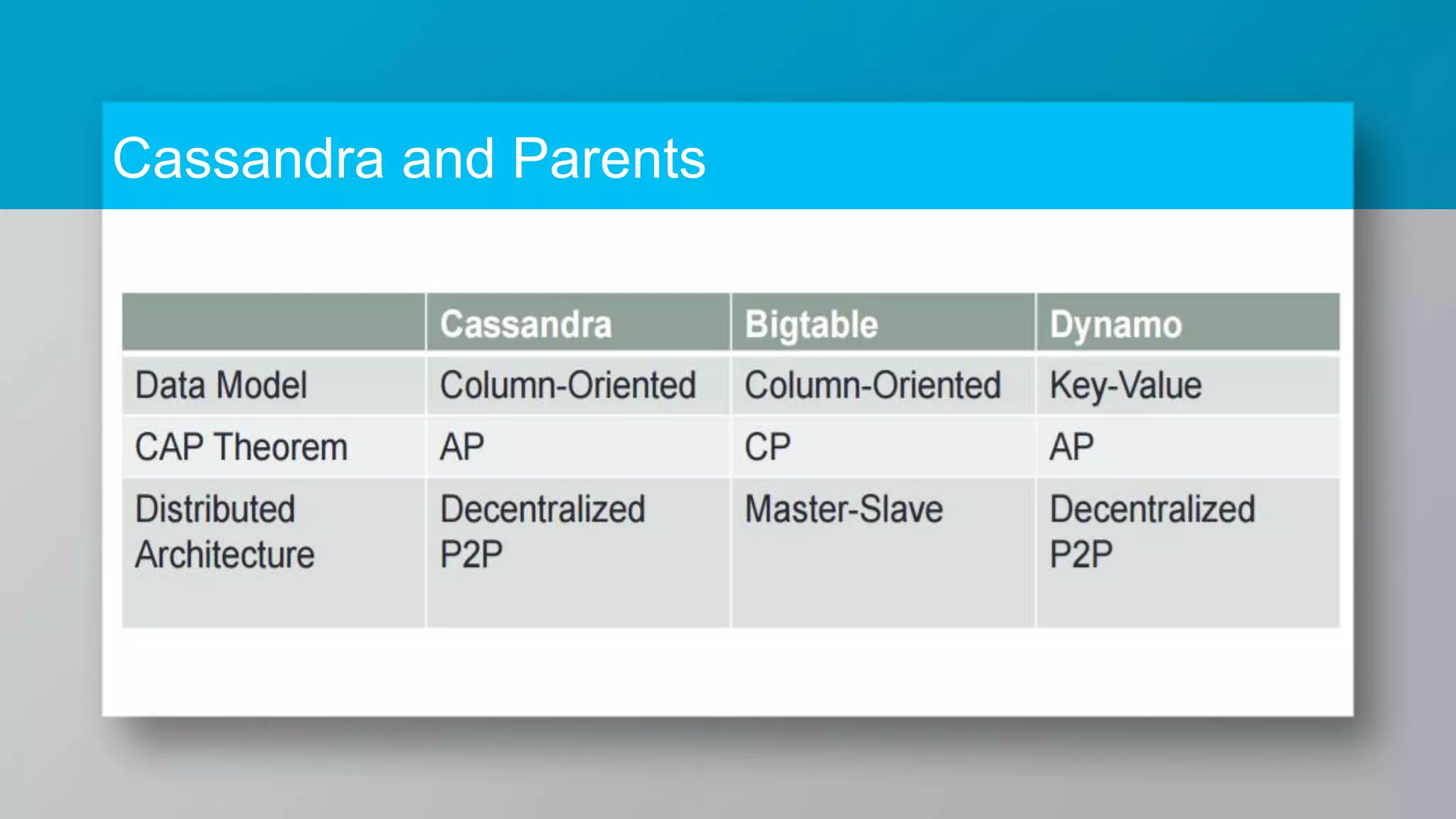
What features does Cassandra use from Google’s BigTable? 1. Column Families 2. Memtables 3. SSTables What features does Cassandra use from Amazon Dynamo? 1. Consistent hashing 2. Partitioning 3. Replication Cassandra’s Parents
Cassandra and Parents
Description and Comparisons What Cassandra is and how it is compared with other similar systems 2.
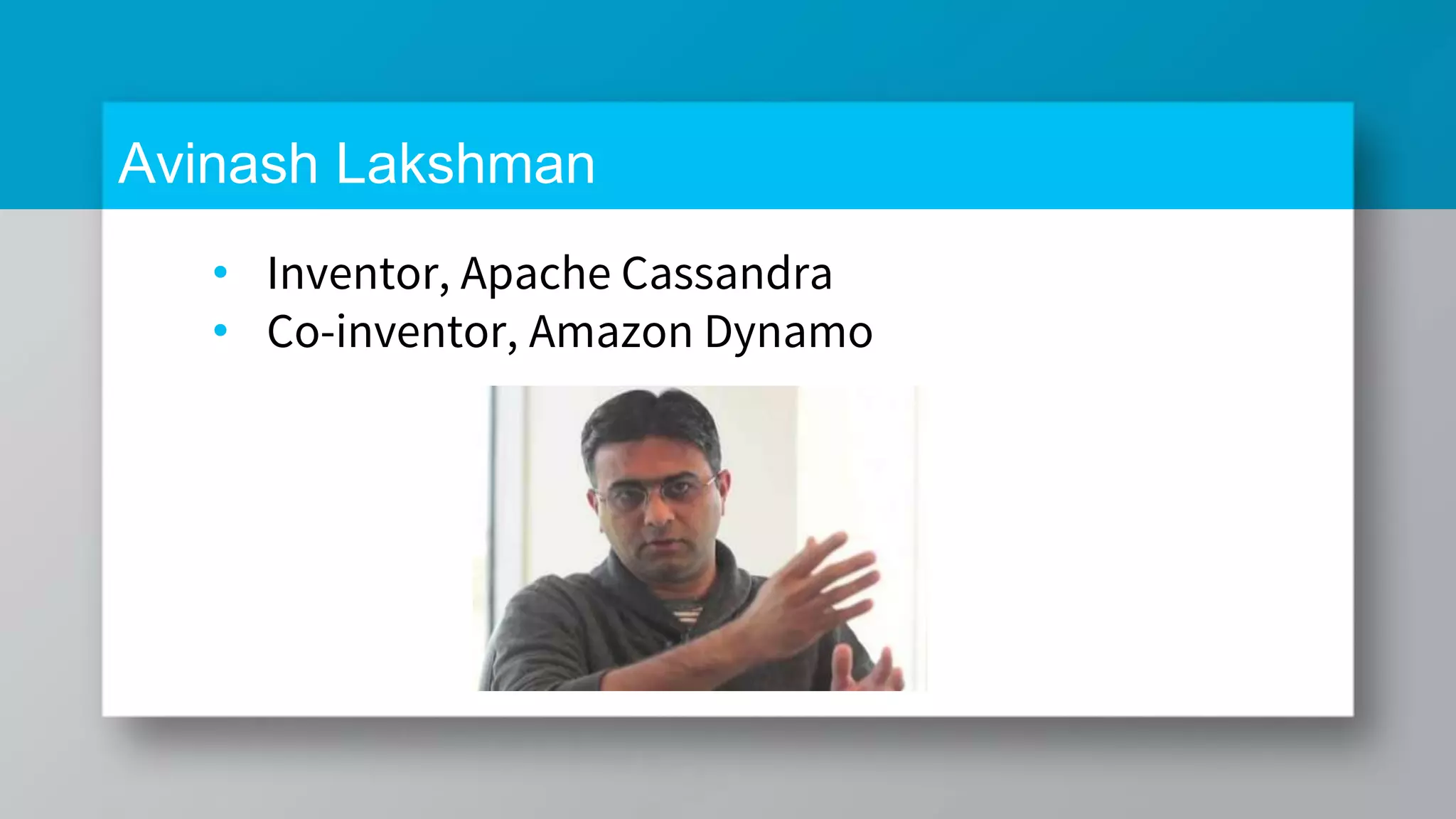
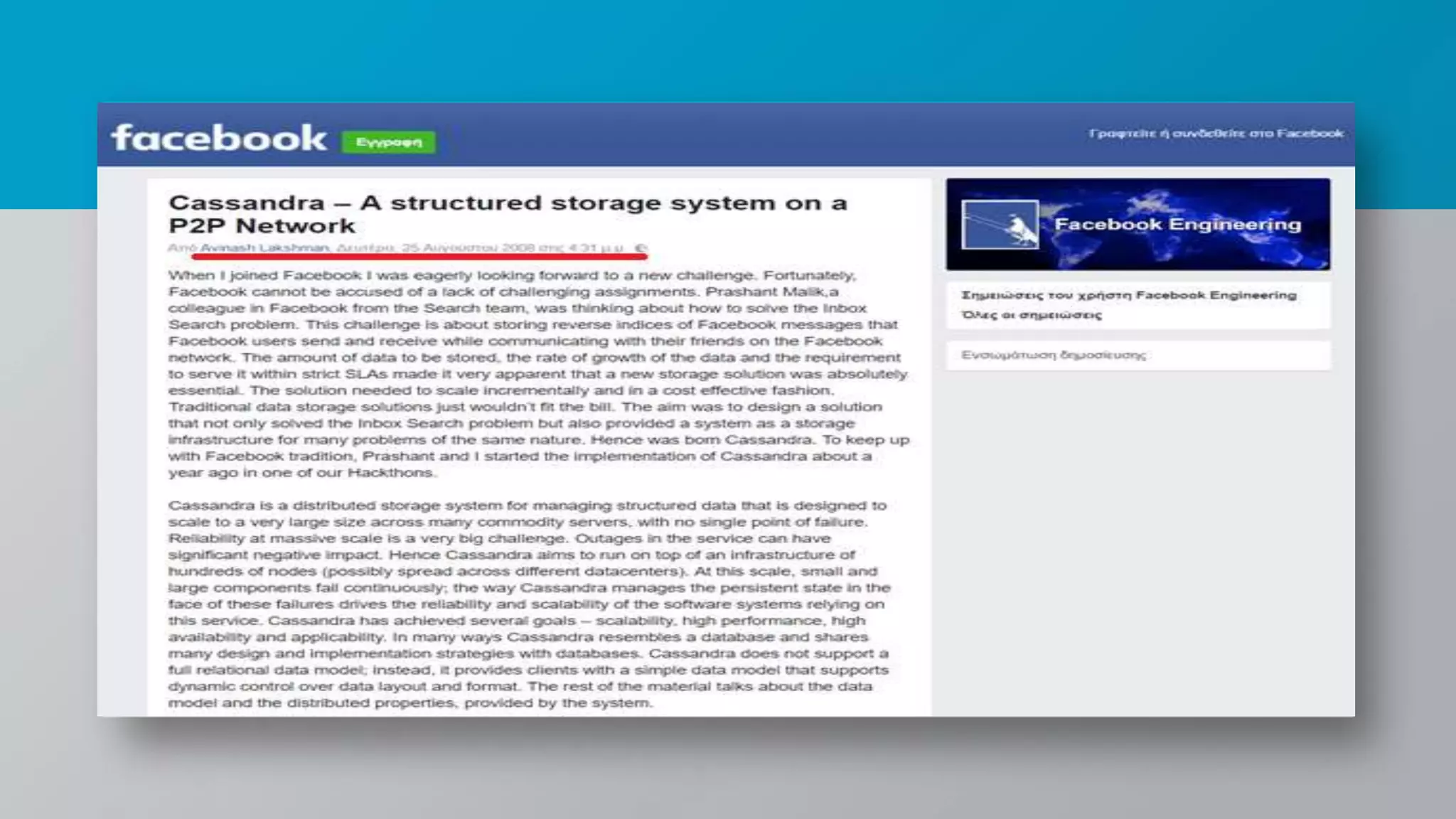
Avinash Lakshman • Inventor, Apache Cassandra • Co-inventor, Amazon Dynamo
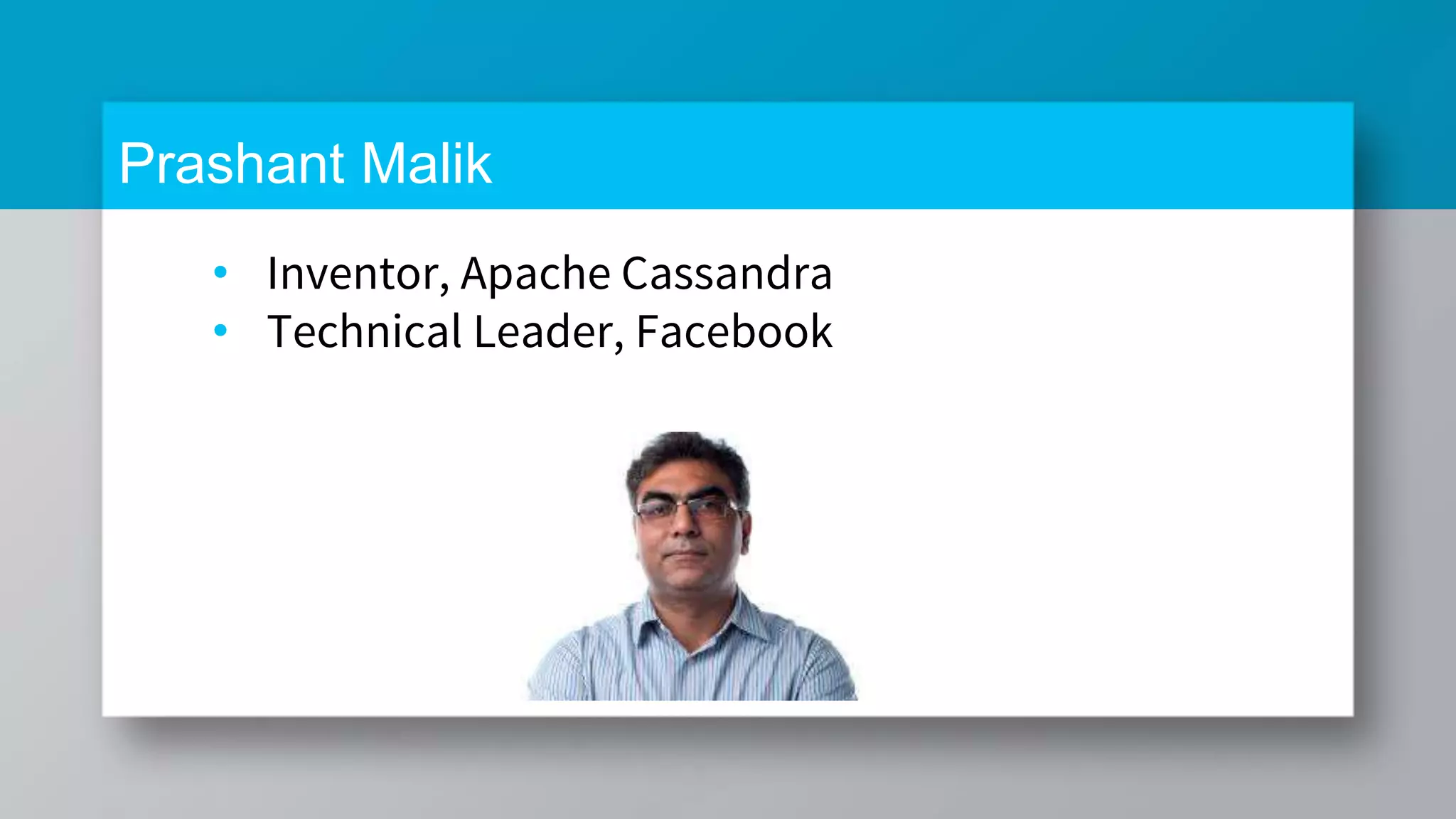
Prashant Malik • Inventor, Apache Cassandra • Technical Leader, Facebook
What is cassandra?
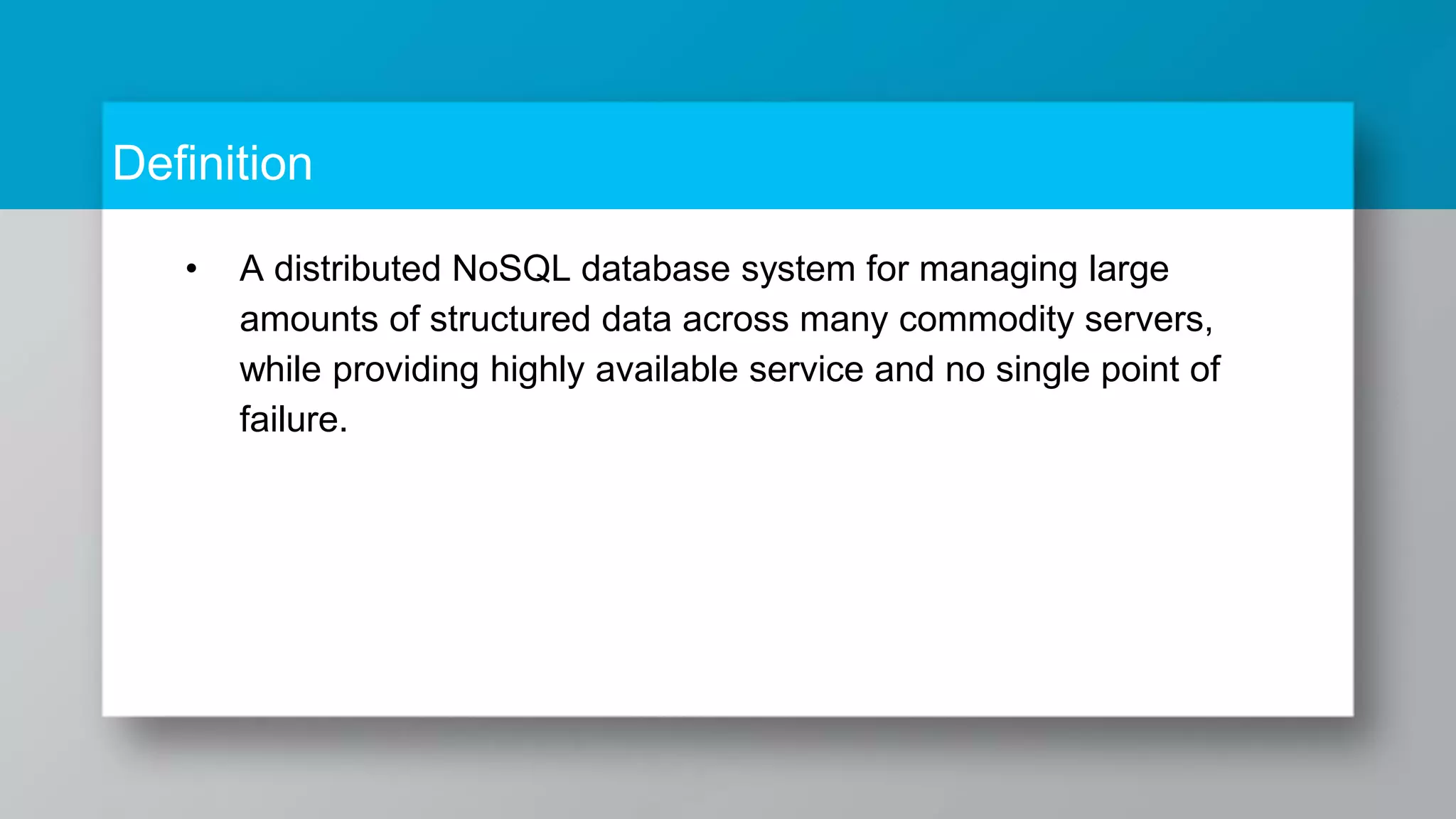
Definition • A distributed NoSQL database system for managing large amounts of structured data across many commodity servers, while providing highly available service and no single point of failure.
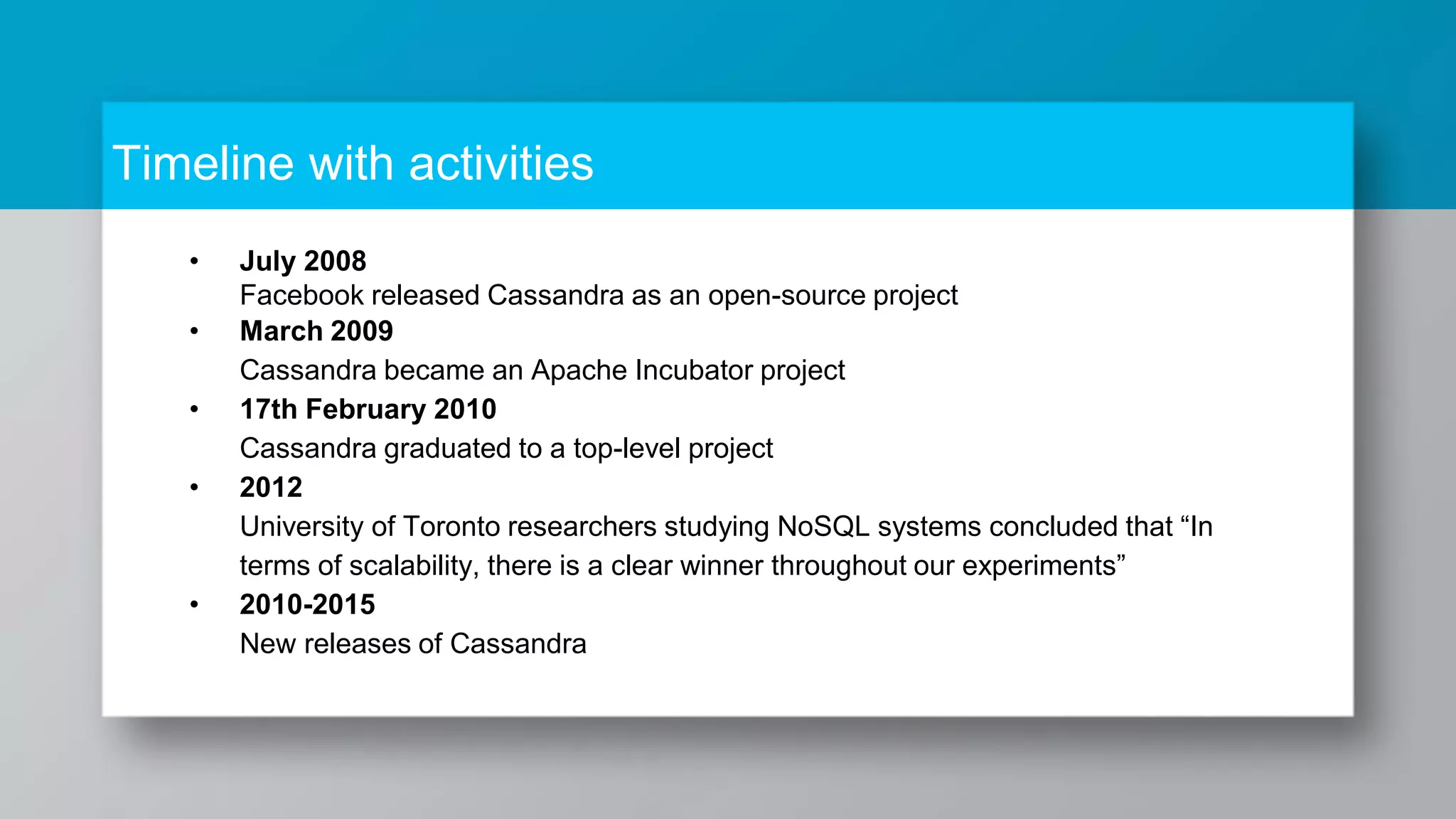
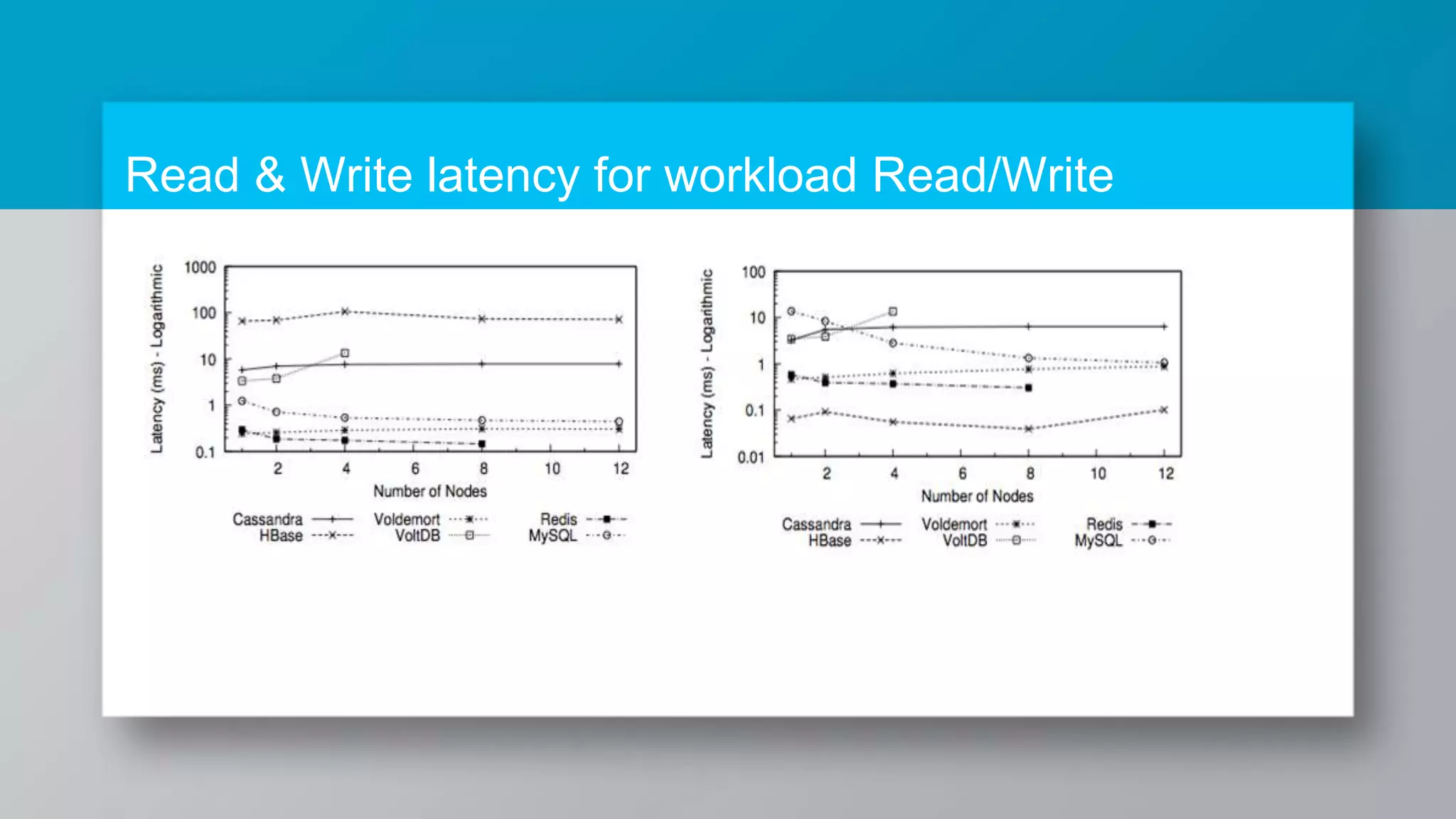
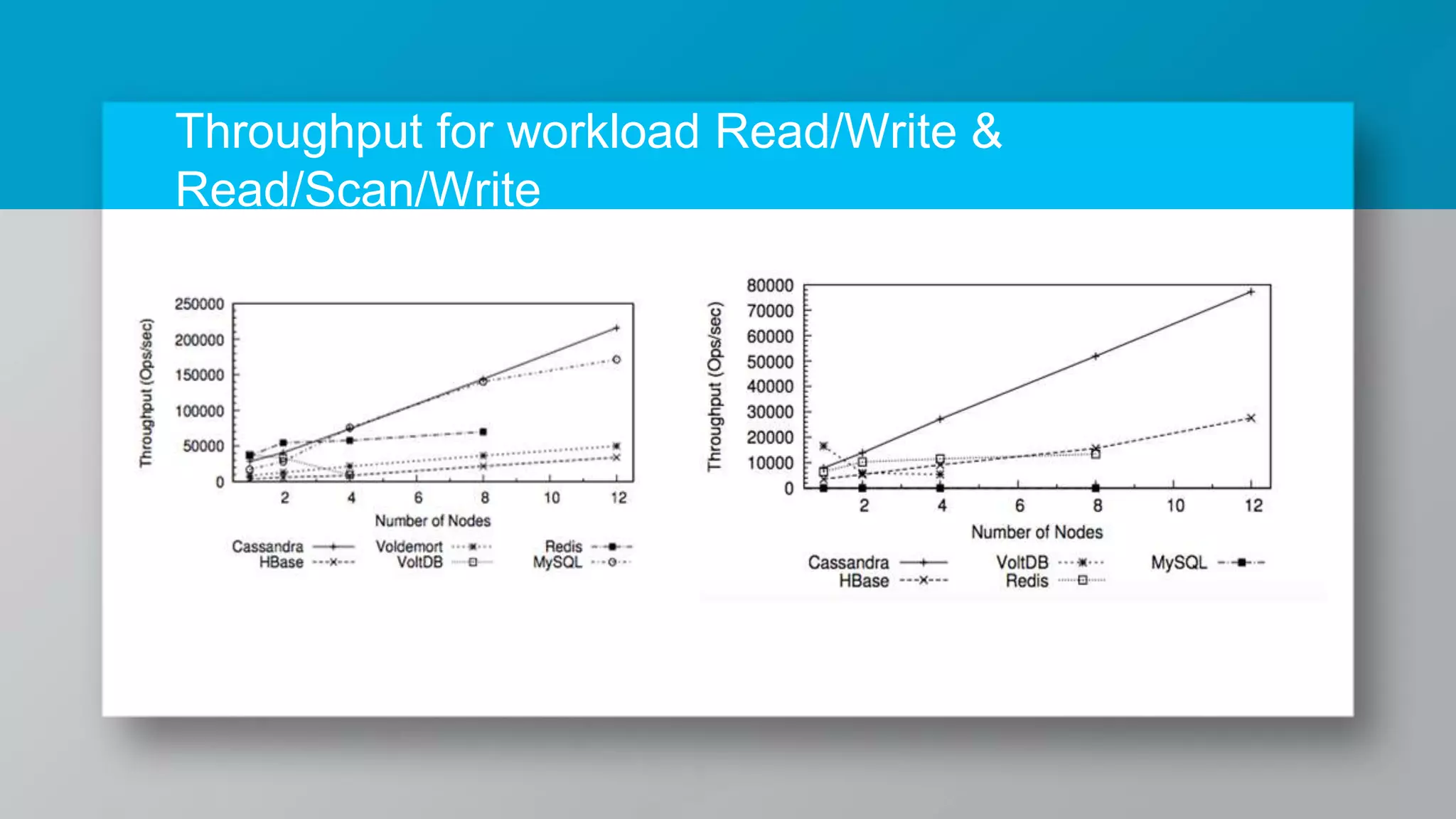
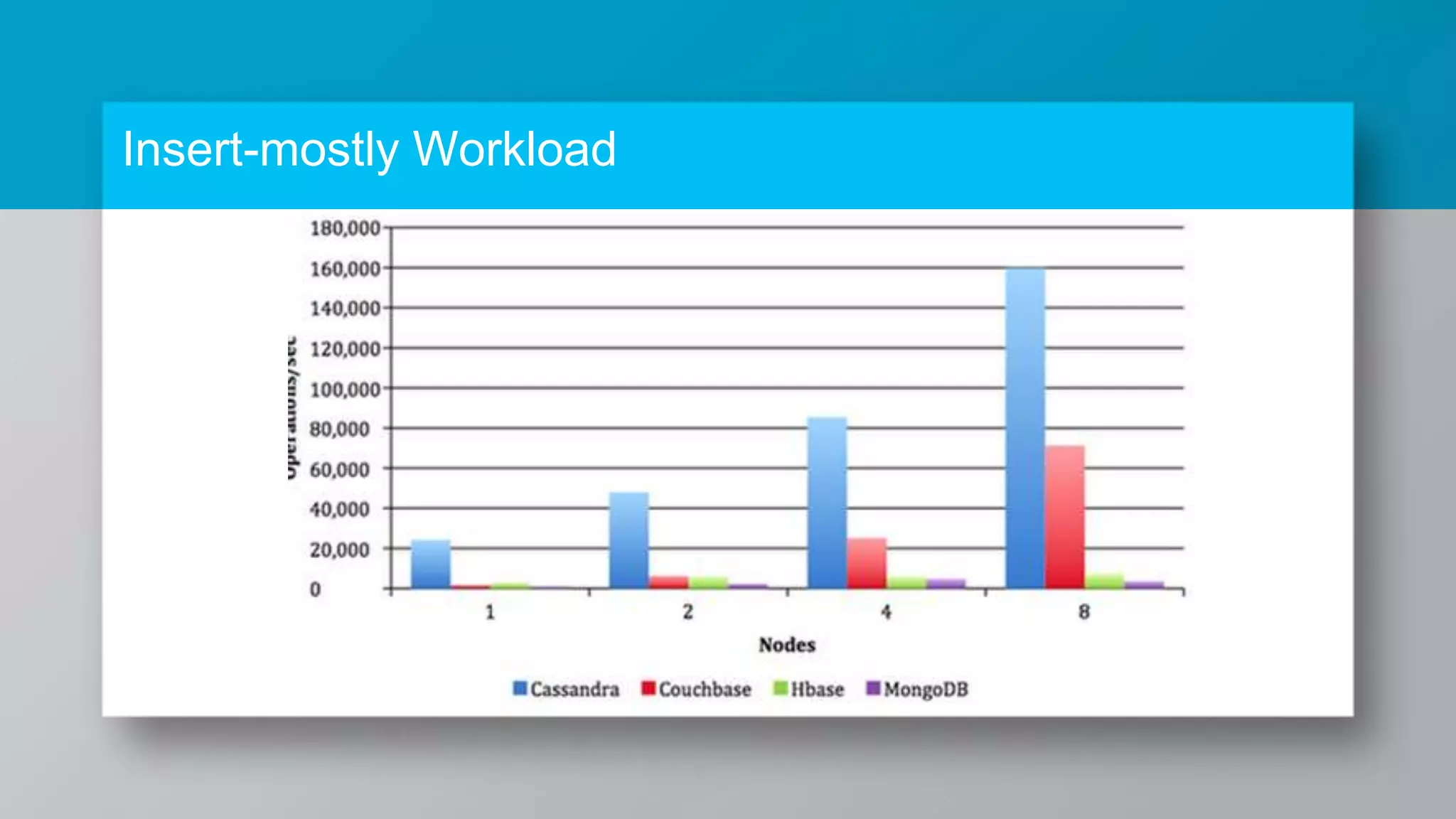
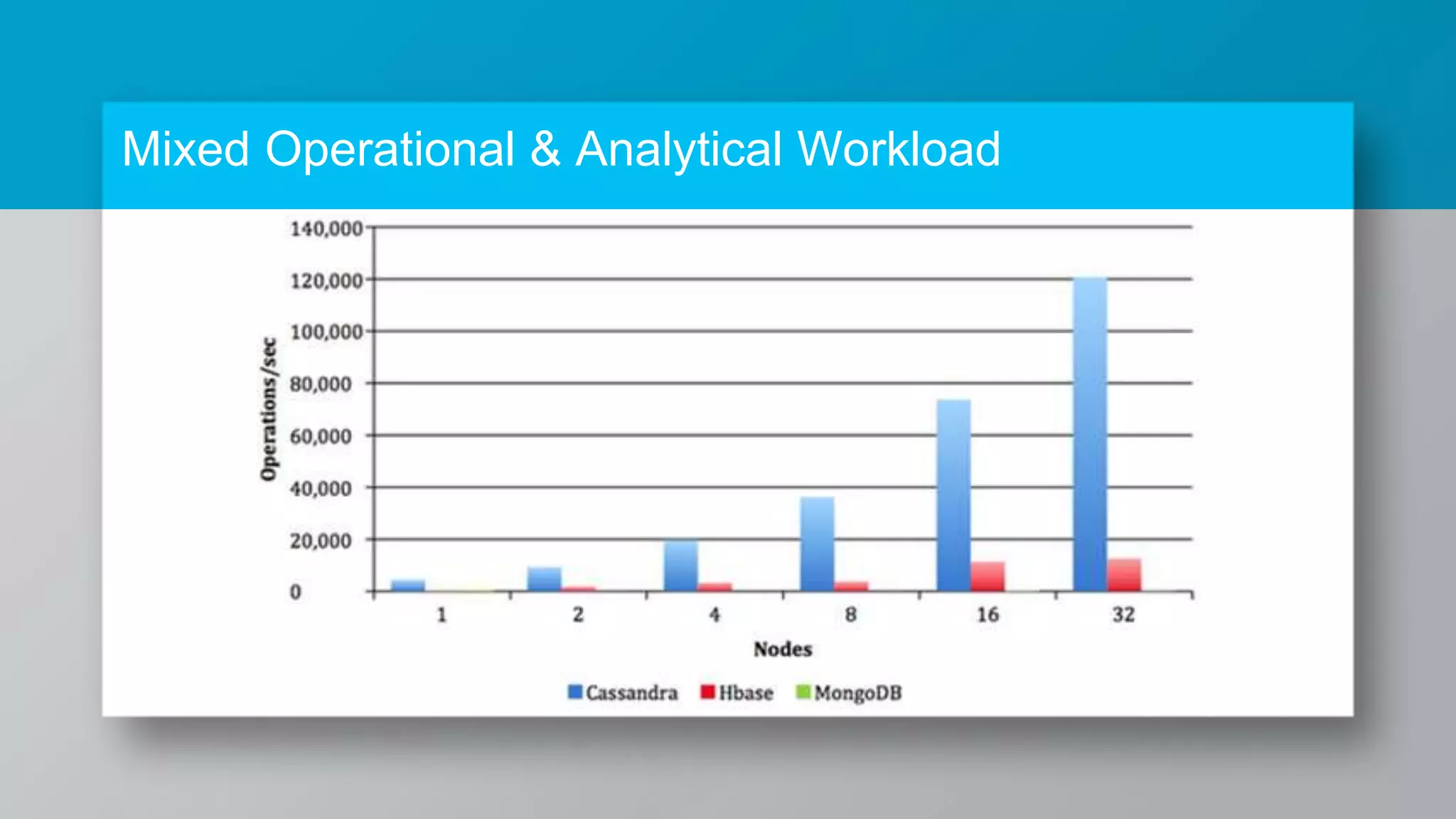
Timeline with activities • July 2008 Facebook released Cassandra as an open-source project • March 2009 Cassandra became an Apache Incubator project • 17th February 2010 Cassandra graduated to a top-level project • 2012 University of Toronto researchers studying NoSQL systems concluded that “In terms of scalability, there is a clear winner throughout our experiments” • 2010-2015 New releases of Cassandra
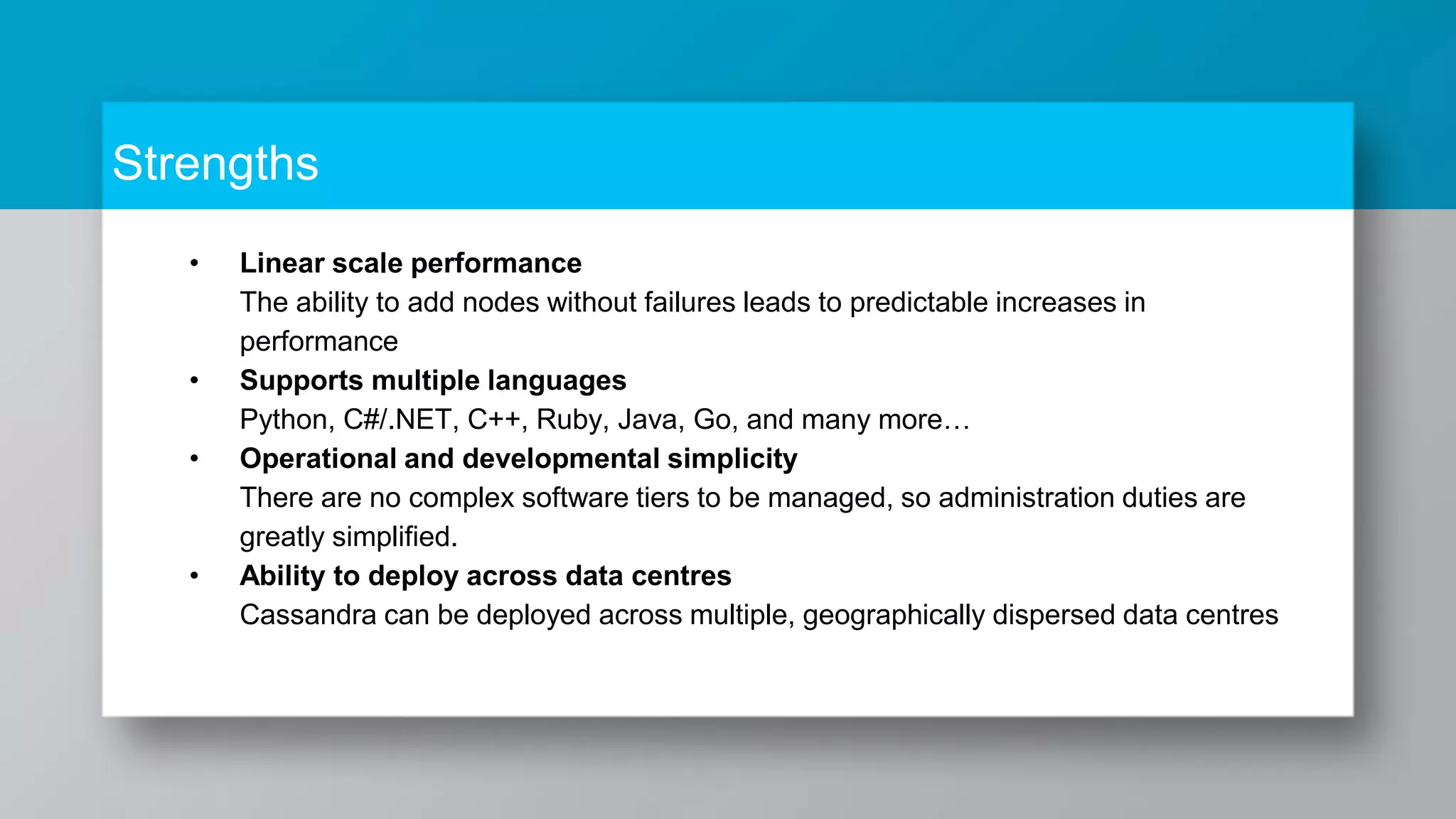
Strengths • Linear scale performance The ability to add nodes without failures leads to predictable increases in performance • Supports multiple languages Python, C#/.NET, C++, Ruby, Java, Go, and many more… • Operational and developmental simplicity There are no complex software tiers to be managed, so administration duties are greatly simplified. • Ability to deploy across data centres Cassandra can be deployed across multiple, geographically dispersed data centres
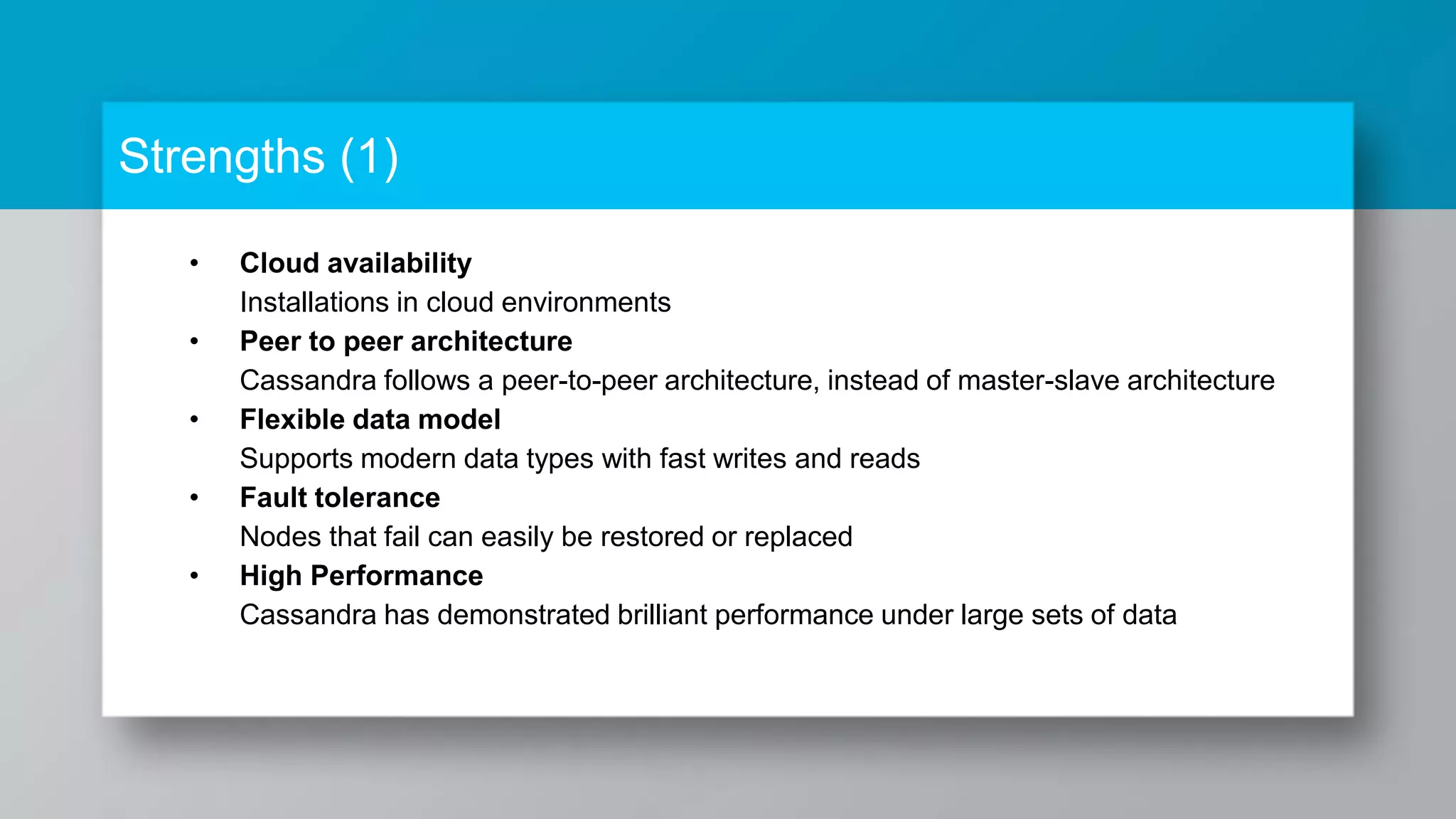
• Cloud availability Installations in cloud environments • Peer to peer architecture Cassandra follows a peer-to-peer architecture, instead of master-slave architecture • Flexible data model Supports modern data types with fast writes and reads • Fault tolerance Nodes that fail can easily be restored or replaced • High Performance Cassandra has demonstrated brilliant performance under large sets of data Strengths (1)
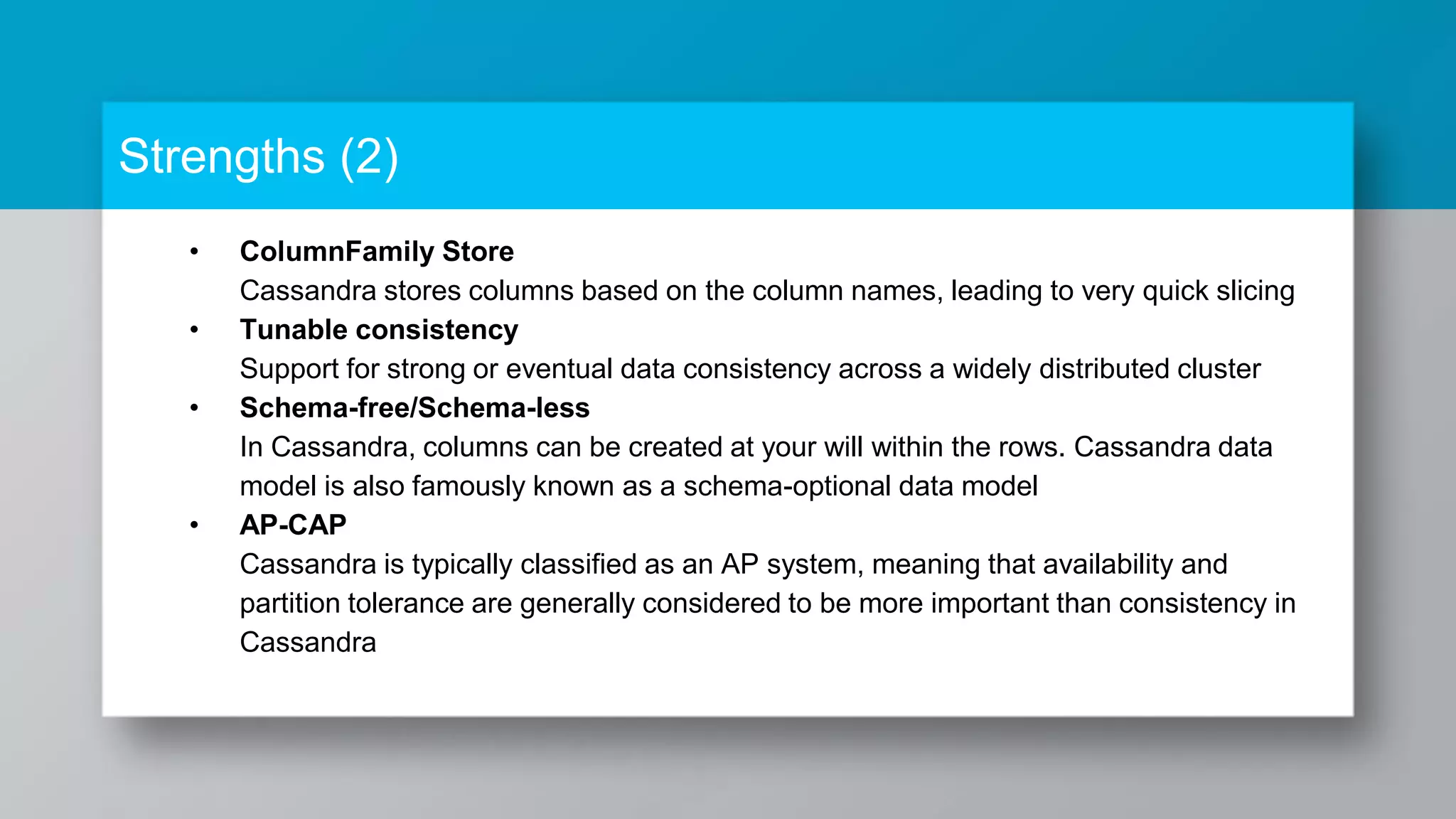
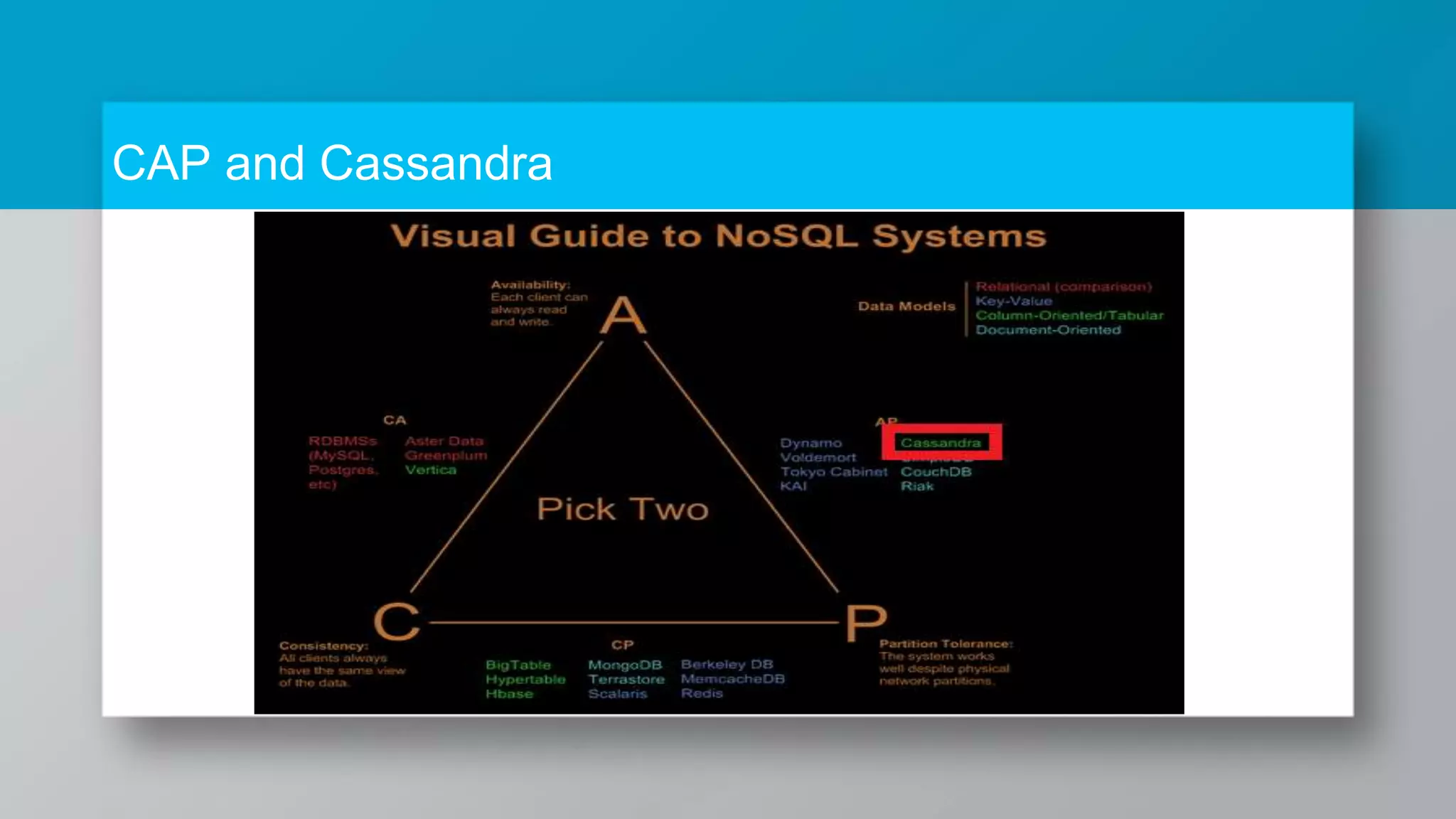
• ColumnFamily Store Cassandra stores columns based on the column names, leading to very quick slicing • Tunable consistency Support for strong or eventual data consistency across a widely distributed cluster • Schema-free/Schema-less In Cassandra, columns can be created at your will within the rows. Cassandra data model is also famously known as a schema-optional data model • AP-CAP Cassandra is typically classified as an AP system, meaning that availability and partition tolerance are generally considered to be more important than consistency in Cassandra Strengths (2)
CAP and Cassandra
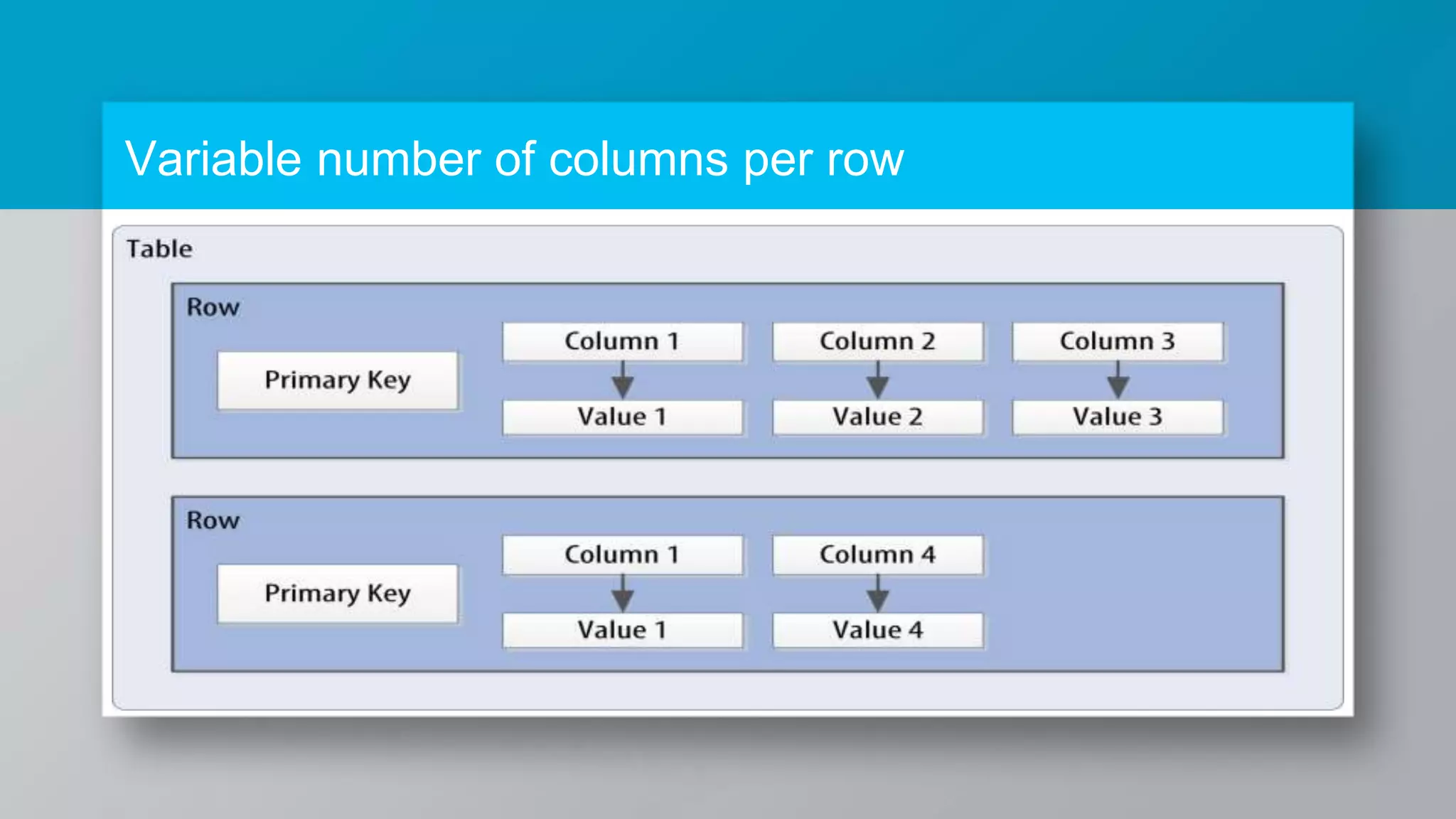
Variable number of columns per row
Weaknesses Use Cases where is better to avoid using Cassandra • If there are too many joins required to retrieve the data • To store configuration data • During compaction, things slow down and throughput degrades • Basic things like aggregation operators are not supported • Range queries on partition key are not supported • If there are transactional data which require 100% consistency • Cassandra can update and delete data but it is not designed to do so
Business Insider “The basic problem Cassandra solved is that when you have a lot of data sitting on a lot of servers, as Facebook does, you end up with a house of cards. A single server going down can collapse the whole stack.”
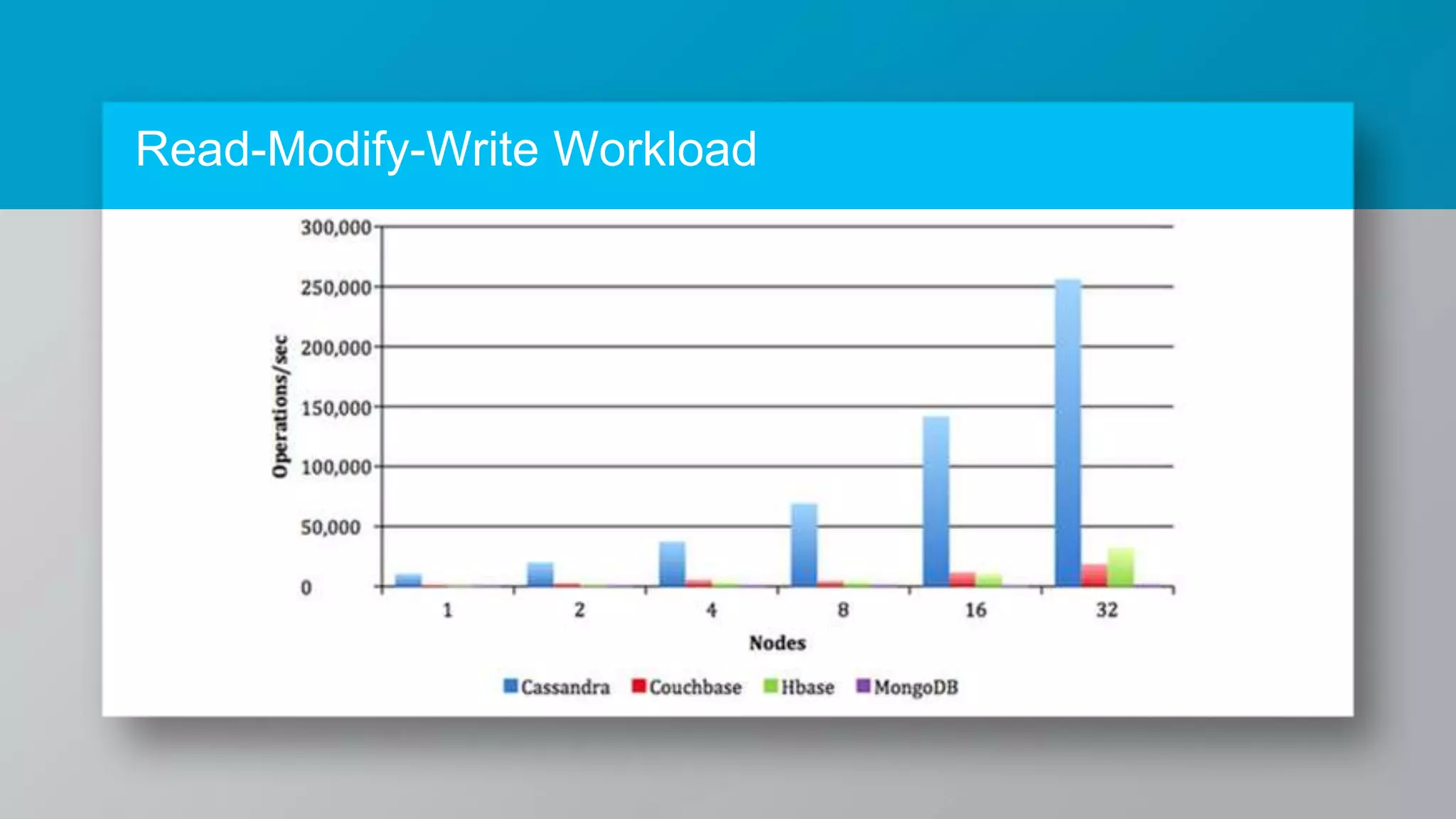
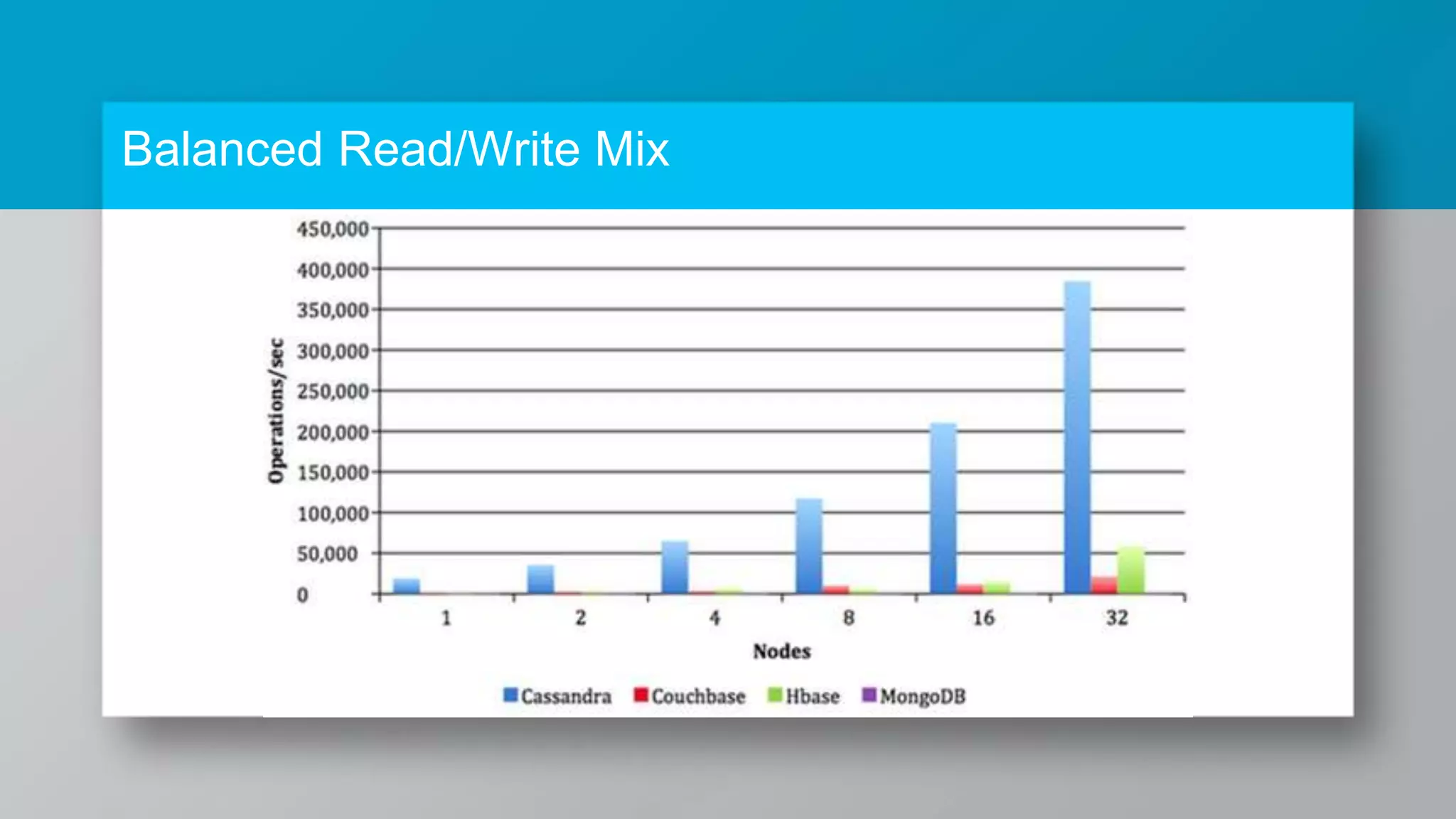
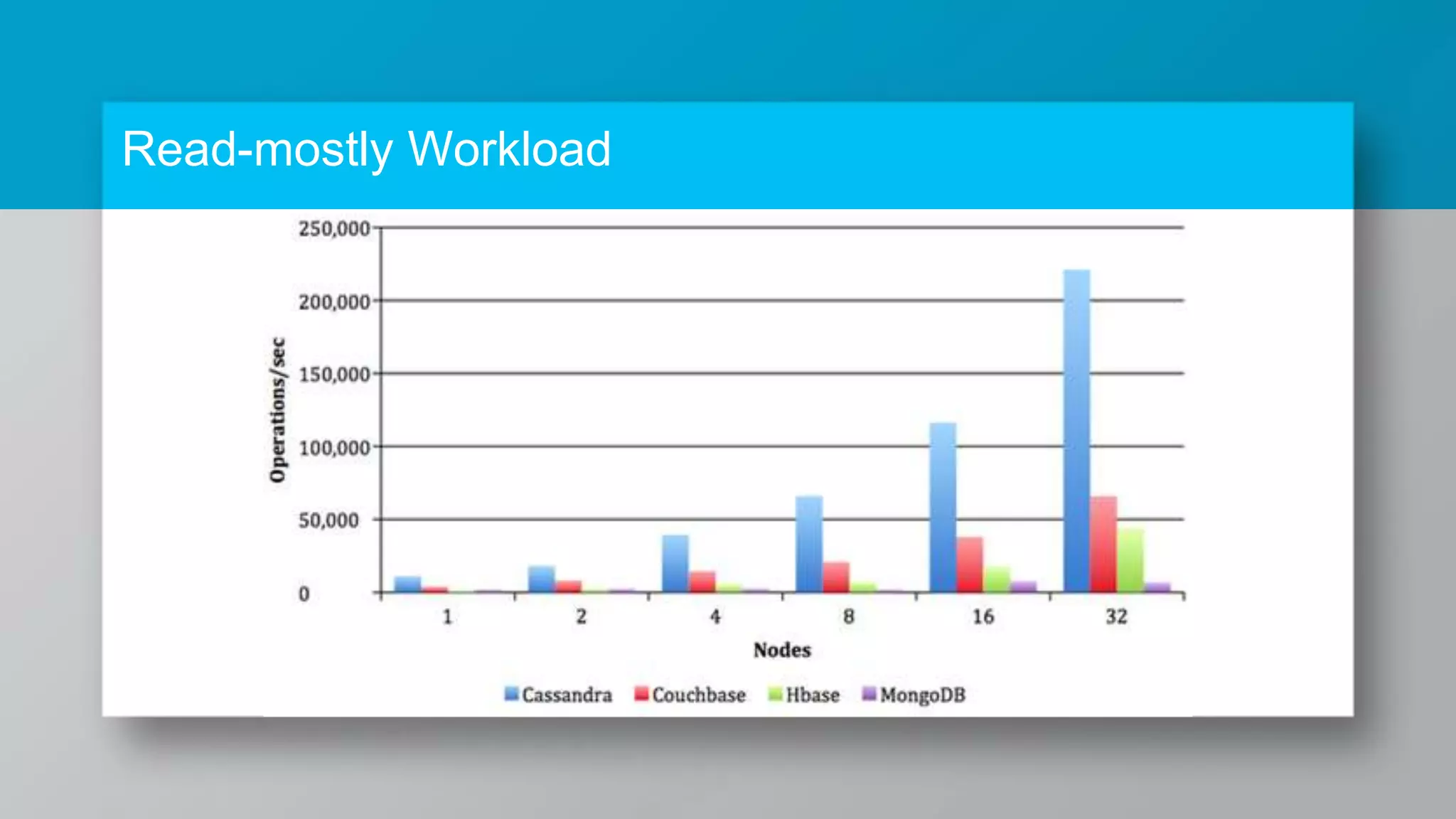
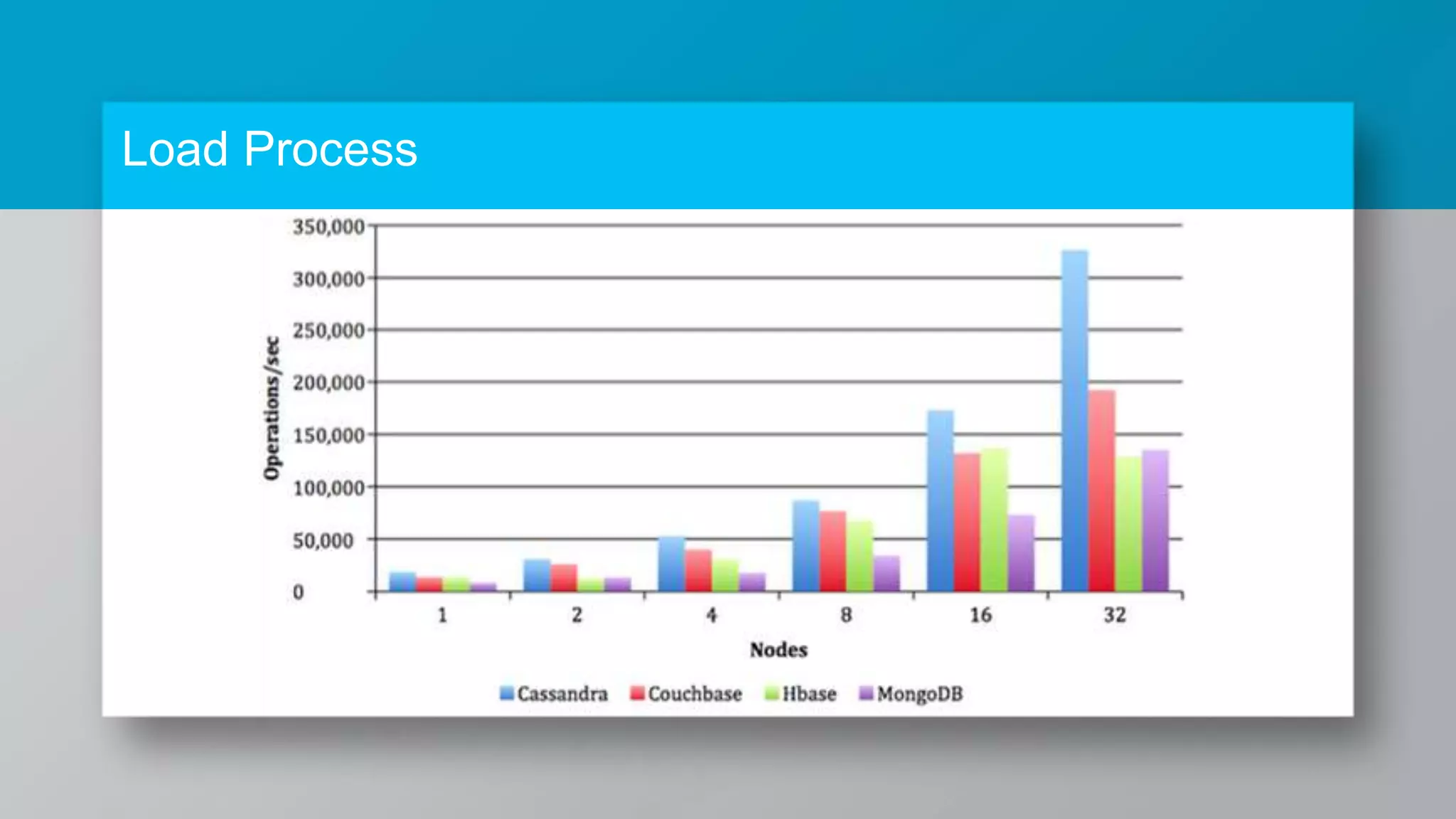
Cassandra compared to other NoSQL Systems
Read & Write latency for workload Read/Write
Throughput for workload Read/Write & Read/Scan/Write
Insert-mostly Workload
Mixed Operational & Analytical Workload
Read-Modify-Write Workload
Balanced Read/Write Mix
Read-mostly Workload
Load Process
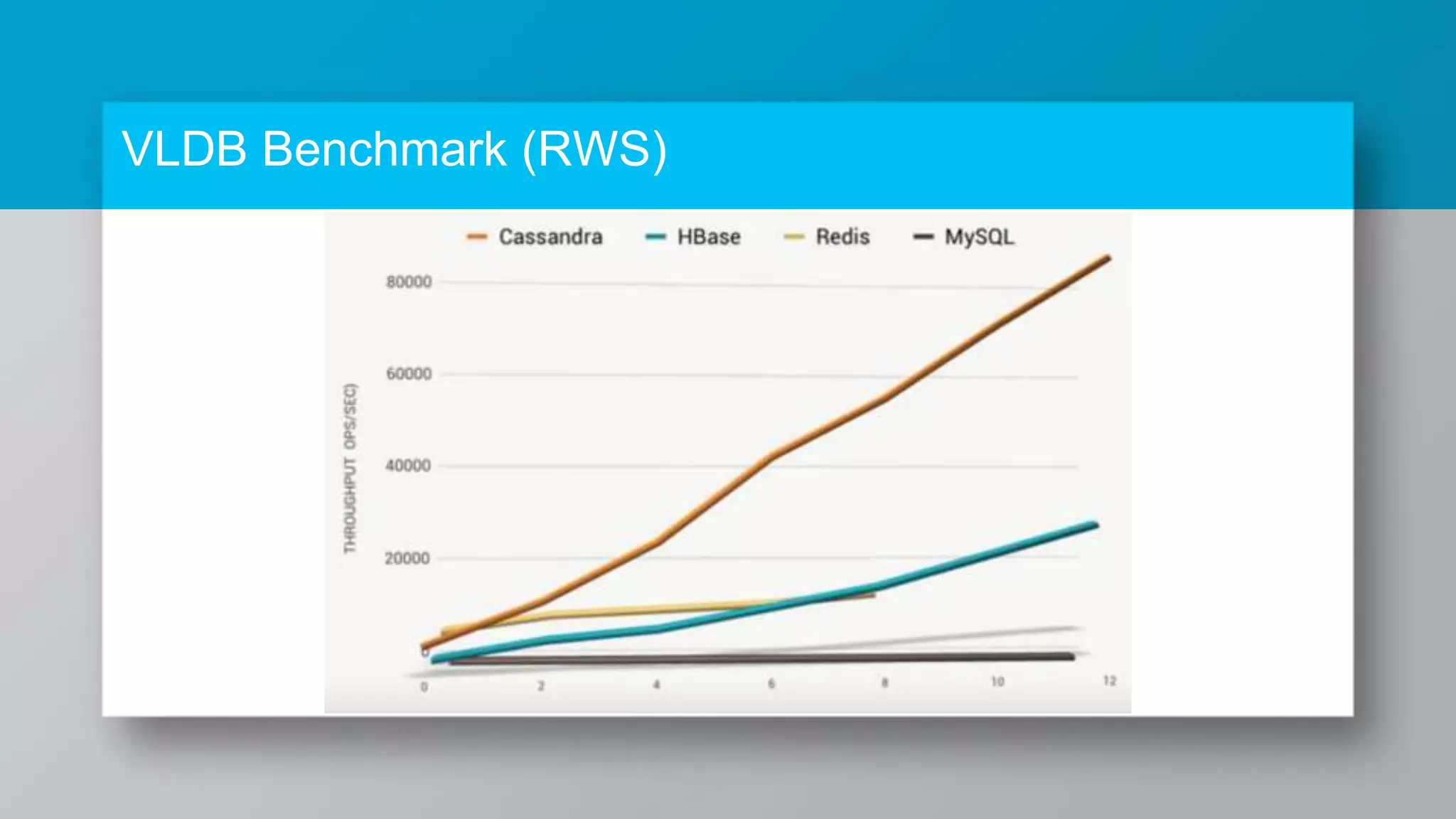
VLDB Benchmark (RWS)
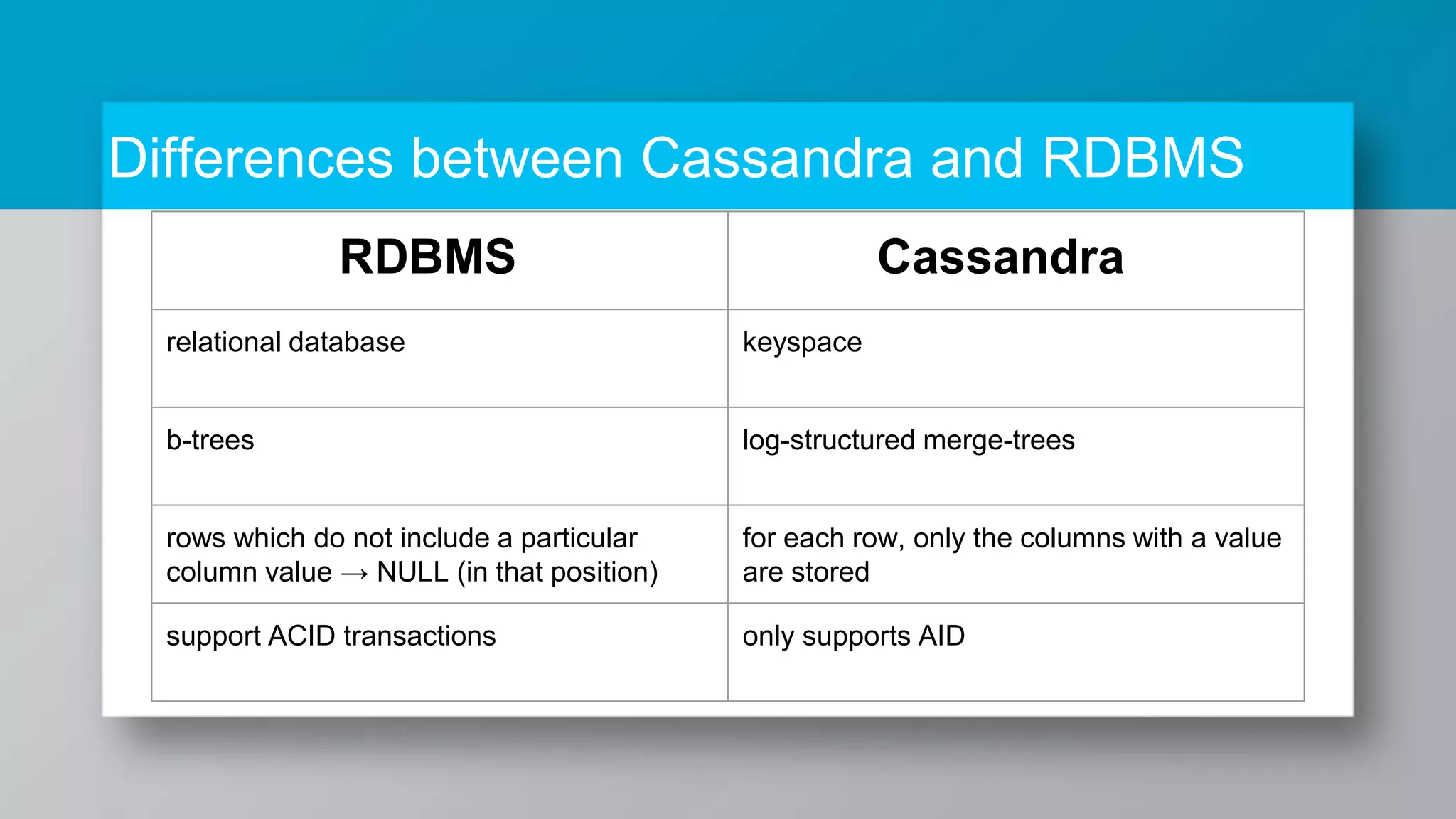
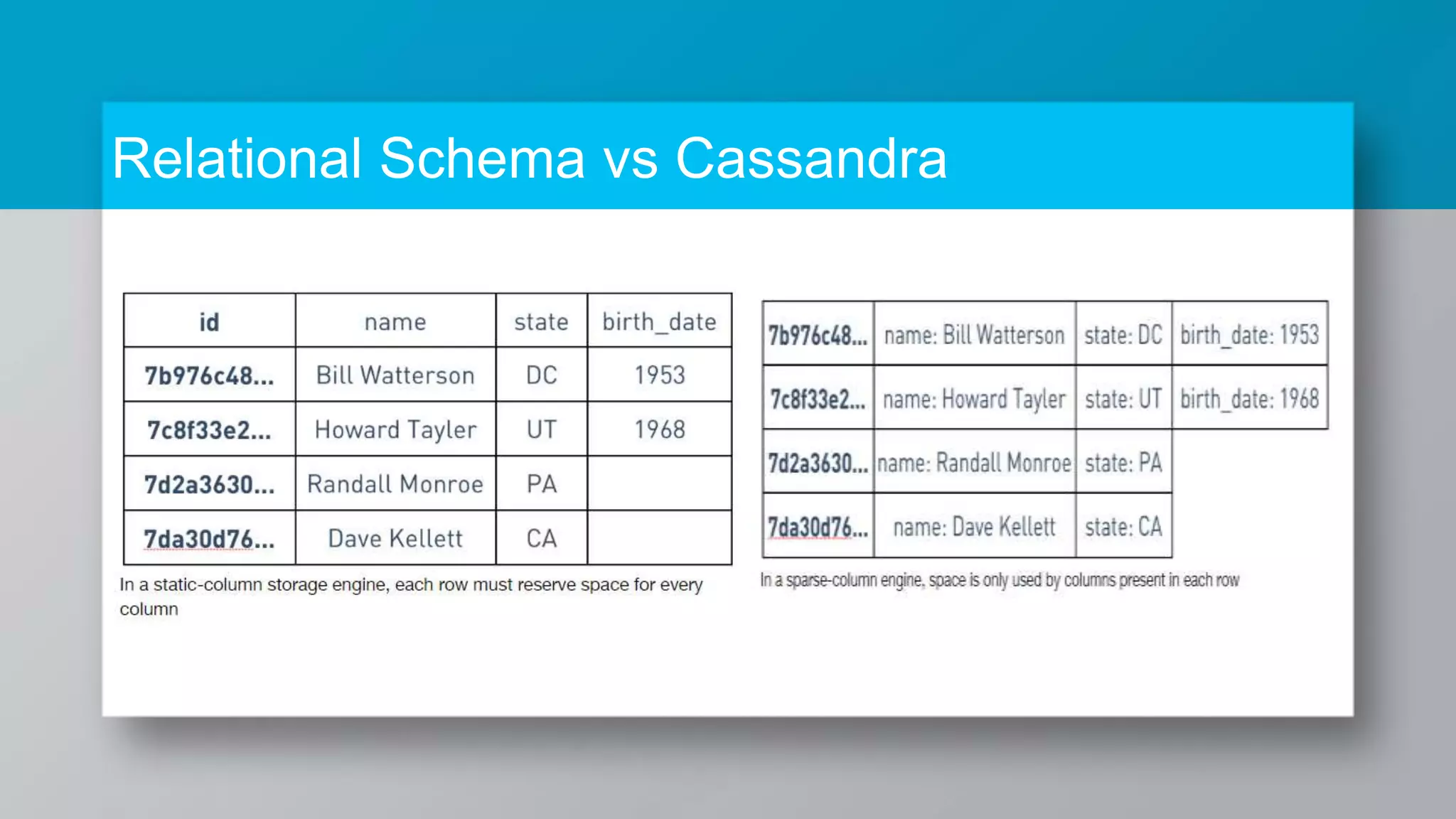
Differences between Cassandra and RDBMS RDBMS Cassandra relational database keyspace b-trees log-structured merge-trees rows which do not include a particular column value → NULL (in that position) for each row, only the columns with a value are stored support ACID transactions only supports AID
Supported Applications - Customers - Case Studies 3.
What kind of applications are supported by Cassandra >80% of the clients fit into one of the next categories: I. Product Catalog/Playlist II. Recommendation/Personalization Engine III. Sensor Data/Internet of Things IV. Messaging (and generally time-series data) V. Fraud Detection
In other words, applications that need to... • store and handle time-series data (most common use case) • store and handle large volumes of data • scale predictably • be continuously available • protect their data
Datastax • A software company that develops and provides support for a commercial edition of Cassandra. • Massively scalable NoSQL platform able to run online applications for innovative and data-intensive companies (e.g. Netflix). • Faster to deploy and less expensive to maintain than other database platforms. • Powered by Cassandra and contains only selected releases of it, chosen by its expert staff.
Datastax (1) • Supports businesses that need a progressive data management. • Can serve as a real-time datastore for online production. • Delivers a unique, smart data platform, suitable for the cloud.
Customers • Over 3.000 companies around the world use (or have used) Apache Cassandra in production. • Most famous:
Cassandra Summit • Organized by DataStax for 7 consecutive years (in both US and Europe). • New product releases are announced. • Customers describe their usage of Cassandra
Key Terms • Cluster • Distributed Location • Node
CASE STUDIES
Category: Messaging
Facebook Inbox Search - Requirements “The system was required to handle a very high write throughput, billions of writes per day, and also scale with the number of users” “Since users are served from data centres that are geographically distributed, being able to replicate data across data centres was key to keep search latencies down” • Lakshman, Malik
Facebook Inbox Search The reason why Cassandra was initially built. Facebook maintains a per user index of all messages that have been exchanged between the senders and the recipients of the message. Two kinds of search features enabled at 2008: I. term search II. interactions - given a person’s name, returns all the messages have been sent/received from that person
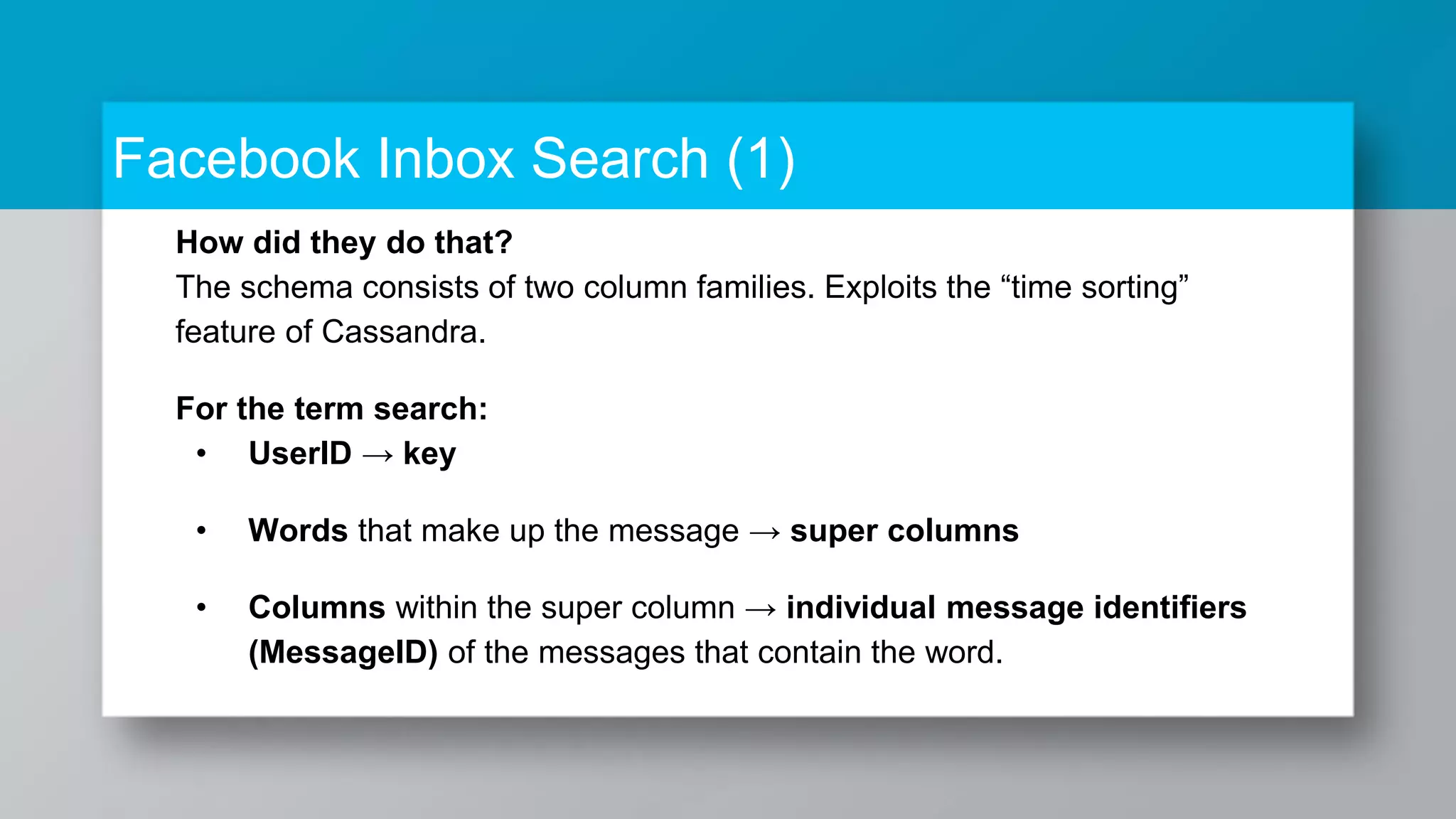
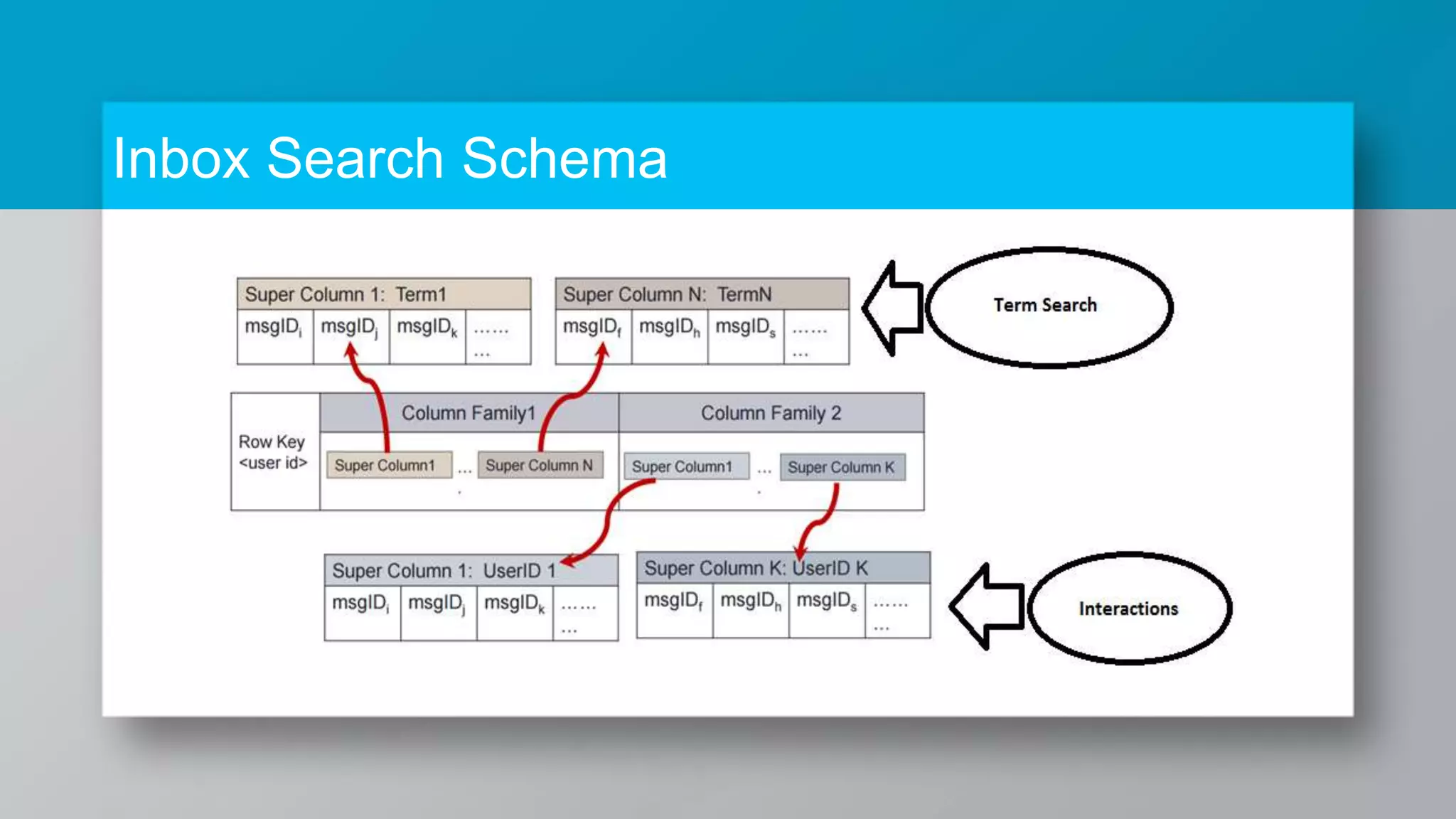
Facebook Inbox Search (1) How did they do that? The schema consists of two column families. Exploits the “time sorting” feature of Cassandra. For the term search: • UserID → key • Words that make up the message → super columns • Columns within the super column → individual message identifiers (MessageID) of the messages that contain the word.
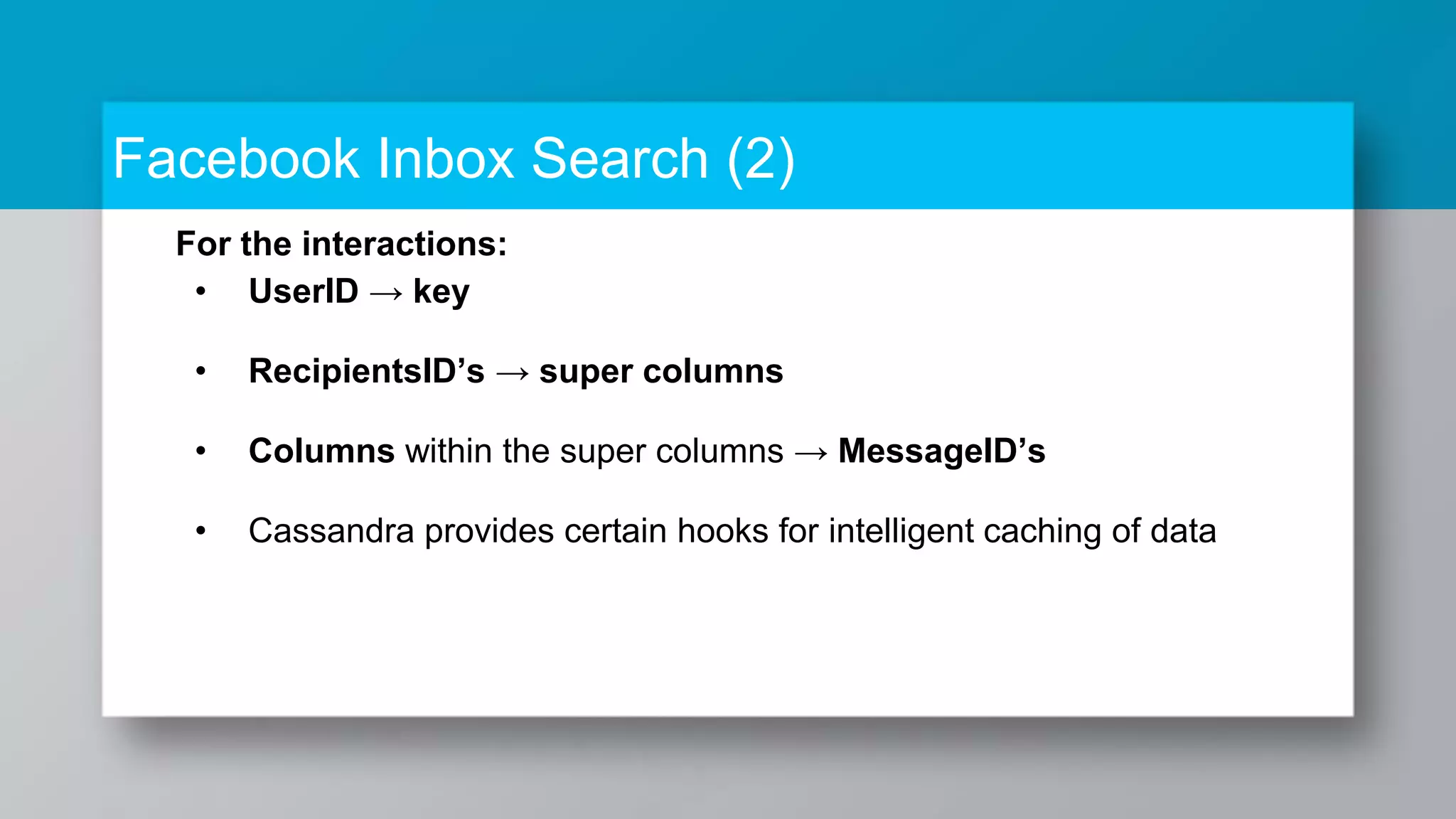
Facebook Inbox Search (2) For the interactions: • UserID → key • RecipientsID’s → super columns • Columns within the super columns → MessageID’s • Cassandra provides certain hooks for intelligent caching of data
Inbox Search Schema
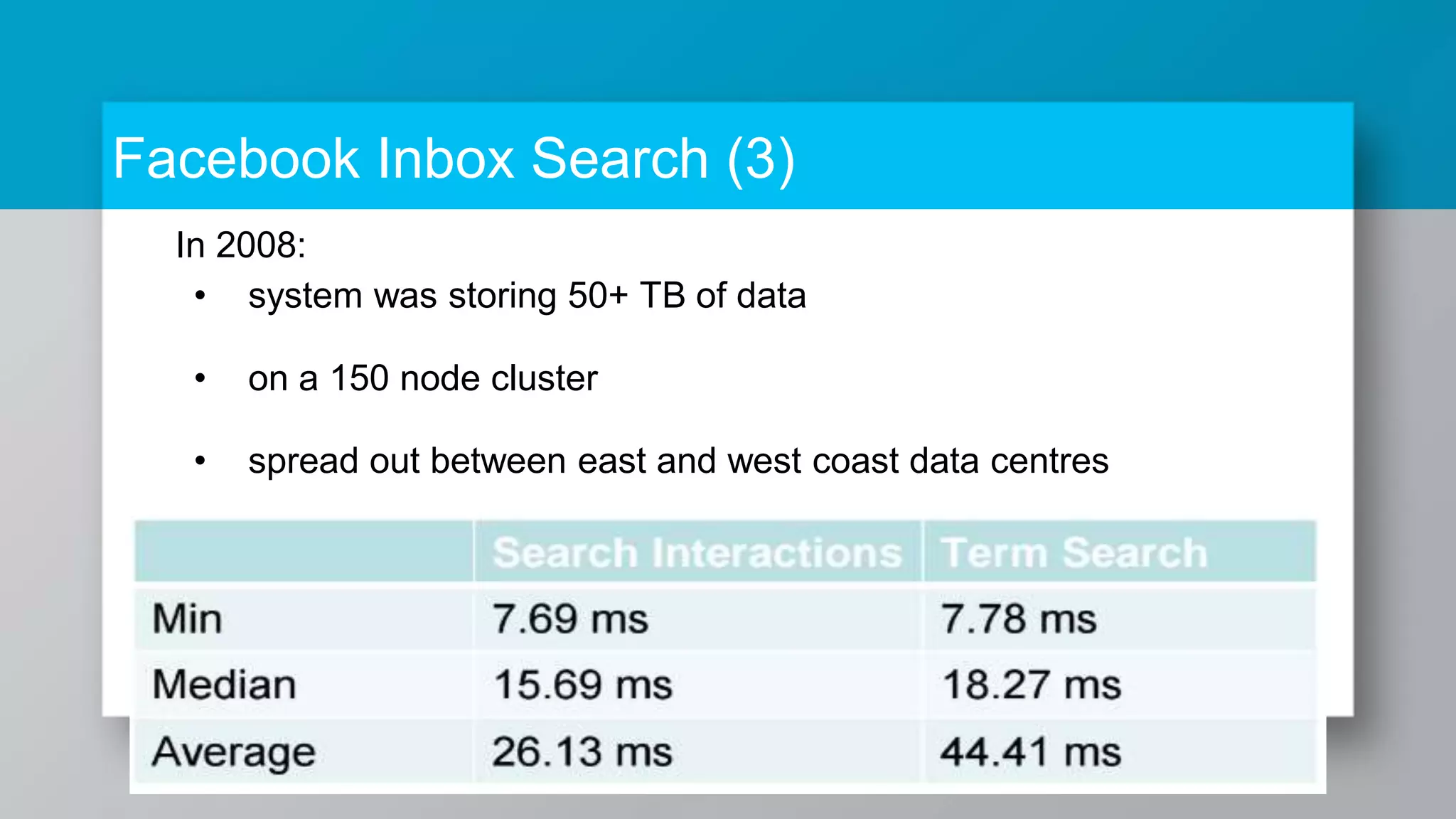
Facebook Inbox Search (3) In 2008: • system was storing 50+ TB of data • on a 150 node cluster • spread out between east and west coast data centres Performance:
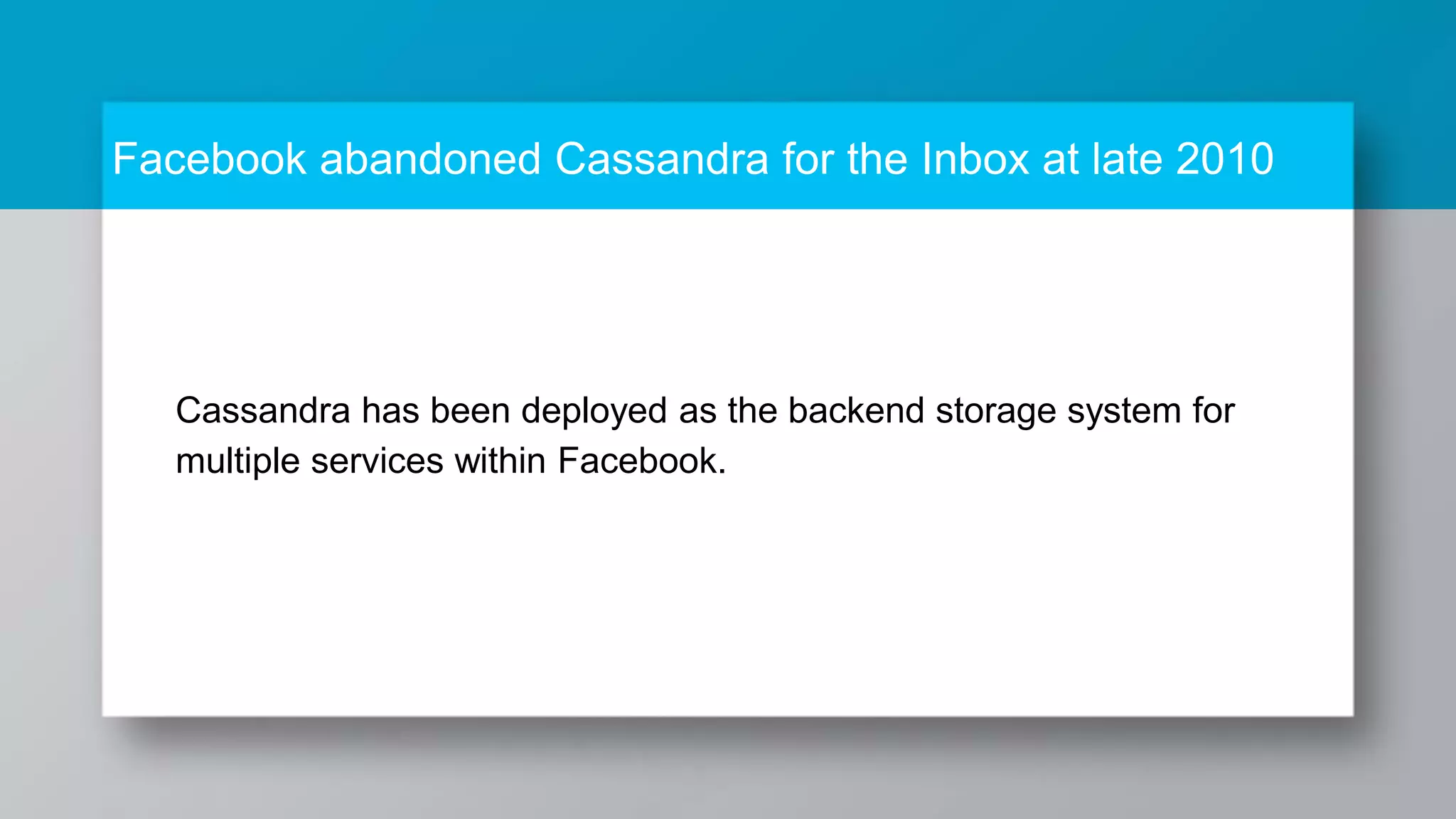
Facebook abandoned Cassandra for the Inbox at late 2010 Cassandra has been deployed as the backend storage system for multiple services within Facebook.
Categories: Fraud Detection and Time-series data
Instagram Fraud Detection Initially was using Redis for auditing information related to security and site integrity purposes (e.g. fighting spam, finding abusive users). But… • data size was growing too quickly • high write and low read rate • keeping the data in memory was too costly So… Cassandra
Instagram Fraud Detection (1) • Started with 3 nodes and very soon they had grown to a 12 node cluster. • No need to store very large instances in memory → put everything on disks. “Implementing Cassandra cut our costs to the point where we were paying around a quarter of what we were paying before. Not only that, but it also freed us to just throw data at the cluster because it was much more scalable and we could add nodes whenever needed.” - Brick Branson, Software Engineer at Instagram
Instagram “Inbox” Newsfeed or inbox part of Instagram: a feed of all the activity that would be associated with a given user’s account. Previously in Redis, with the same (memory) limitations as in the Fraud Detection case. Instagram’s Cassandra Cluster: • 12 nodes on EC2 (AWS) • 1.2 TB of data stored • 20.000 writes/sec. • 15.000 reads/sec.
Category: Sensors and IoT
i2O Water Description: i2O Water helps utility companies operate more efficiently through the use of IoT aiming at solving the water crisis. Challenges: • Massive volumes of time-series data (>1.5 TB and growing) • Need for search and analysis of high velocity, streaming data in near real-time • SQL Server (previously used) has limitations on scalability and performance
i2O Water (1) Solution: After evaluating many common NoSQL technologies, they chose Cassandra. Why? I. performance (50-60.000 writes and 20-40.000 reads/sec instead of 0.5 writes/sec and 5 reads/sec with SQL Server) II. easy to maintain III. easy to upgrade IV. ability to handle structured and unstructured real-time streaming data V. continuous availability and reliability VI. operationally simple to manage
i2O Water (2) Results: I. 235 m. lt. of water saved per day II. successfully handling massive volumes of data from 15.000 devices without latency or downtime III. fault tolerance even during upgrades (99.9% availability)
Category: Product Catalogs and Playlists
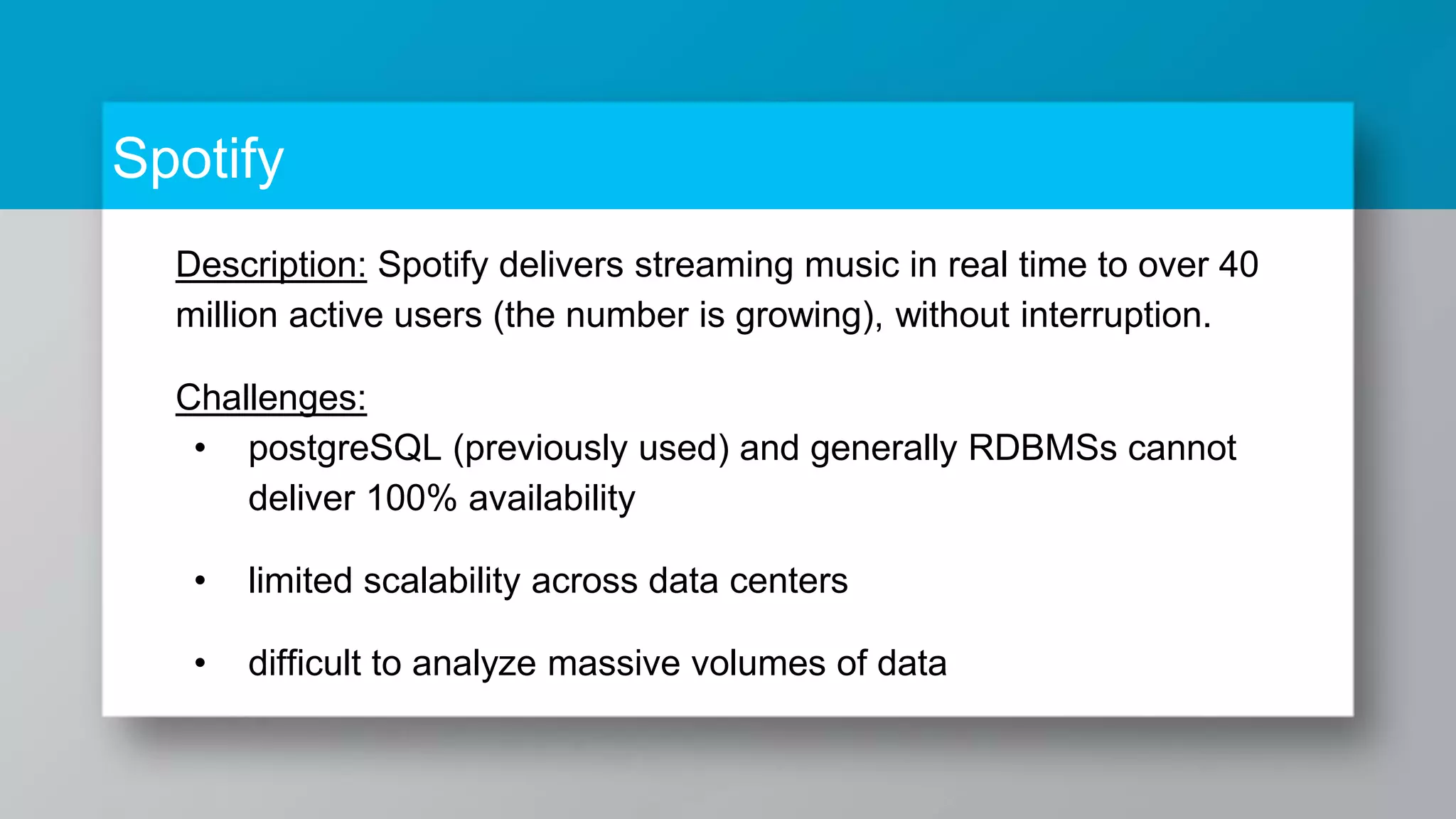
Spotify Description: Spotify delivers streaming music in real time to over 40 million active users (the number is growing), without interruption. Challenges: • postgreSQL (previously used) and generally RDBMSs cannot deliver 100% availability • limited scalability across data centers • difficult to analyze massive volumes of data
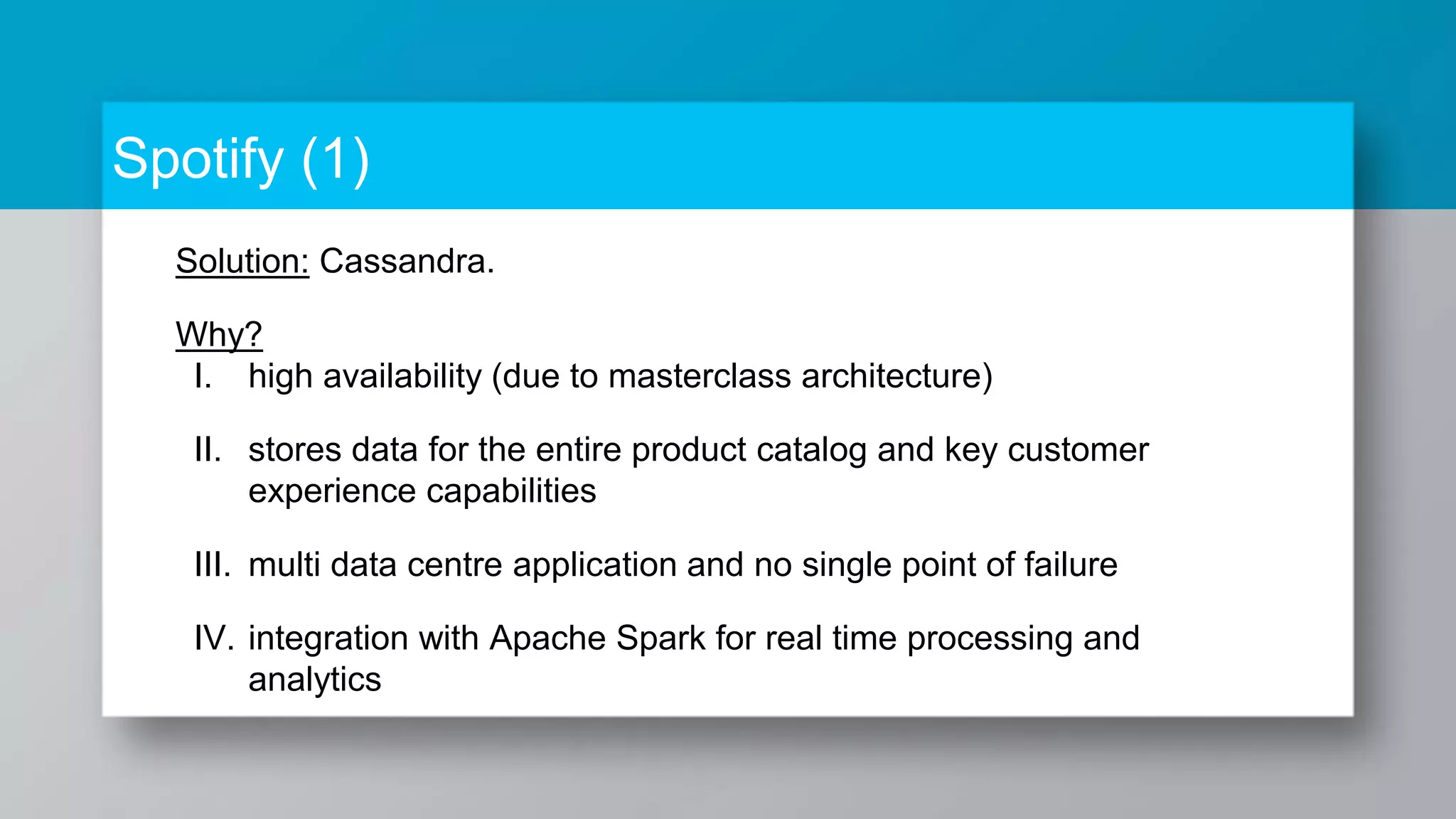
Spotify (1) Solution: Cassandra. Why? I. high availability (due to masterclass architecture) II. stores data for the entire product catalog and key customer experience capabilities III. multi data centre application and no single point of failure IV. integration with Apache Spark for real time processing and analytics
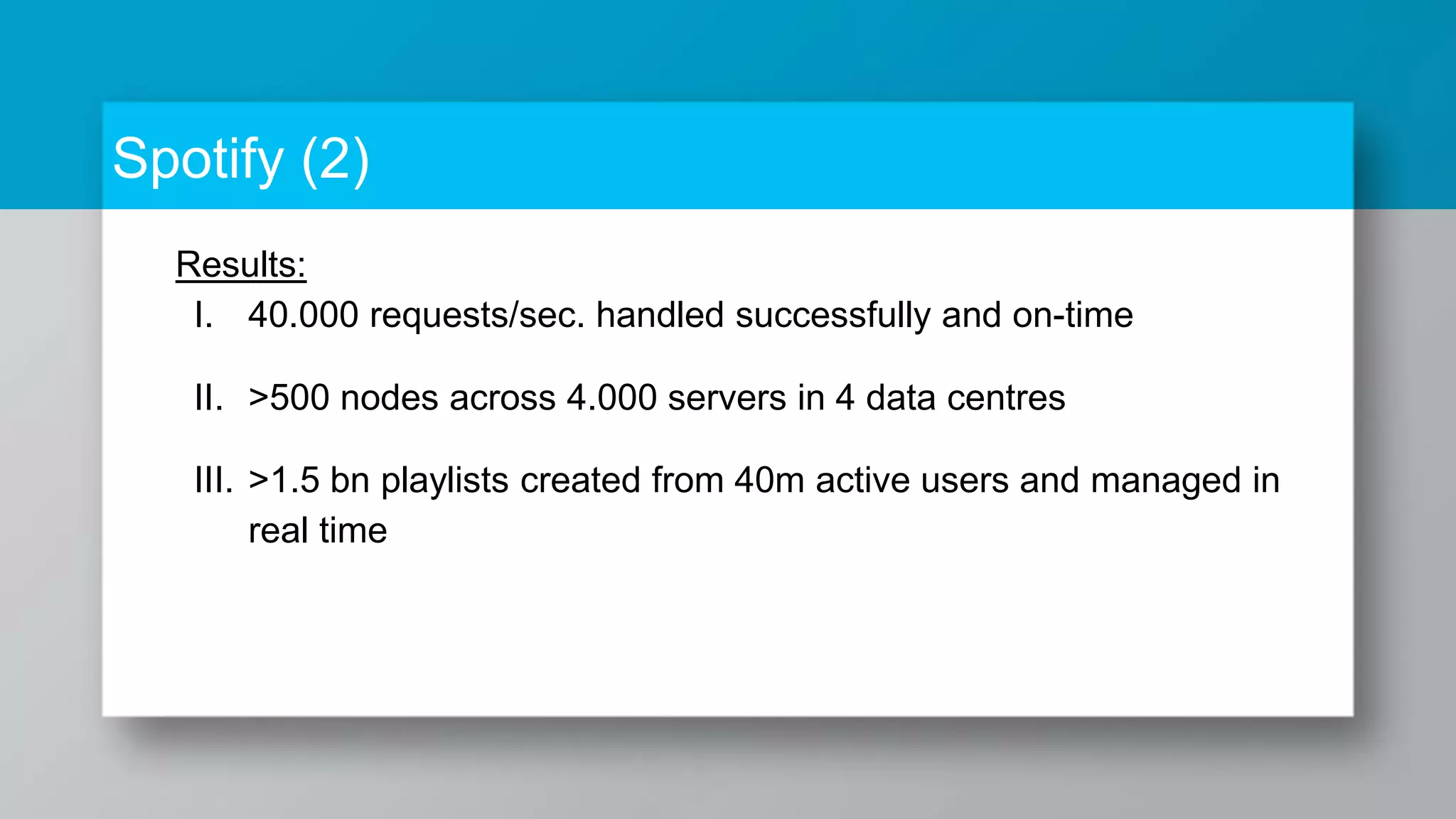
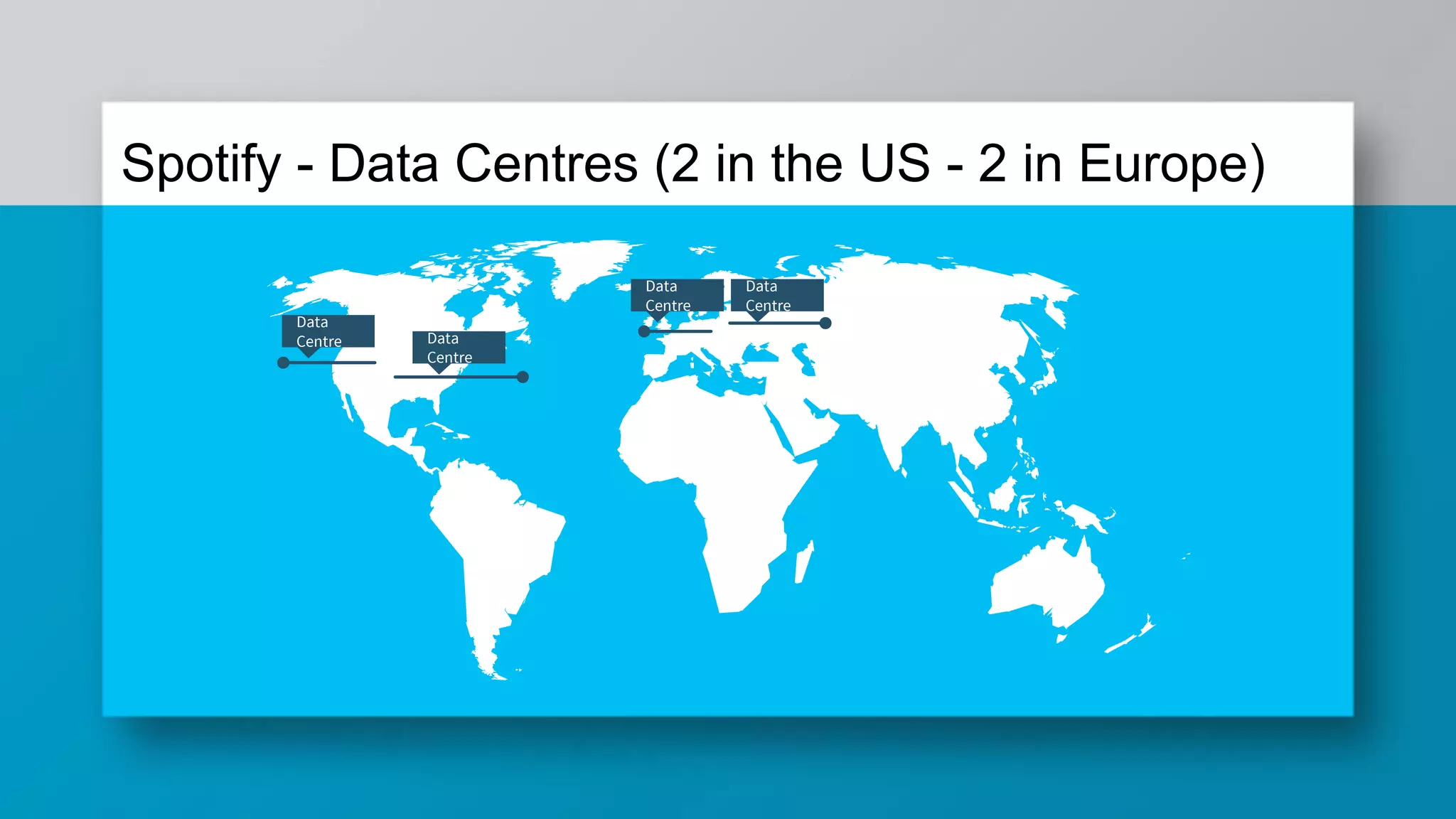
Spotify (2) Results: I. 40.000 requests/sec. handled successfully and on-time II. >500 nodes across 4.000 servers in 4 data centres III. >1.5 bn playlists created from 40m active users and managed in real time
Data Centre Data Centre Data Centre Data Centre Spotify - Data Centres (2 in the US - 2 in Europe)
Category: Recommendation/Personalization Engine
Netflix Description: Netflix is the world’s leading internet television network with more than 48 million users in 40 countries. Challenges: • Oracle database (was used until 2010) was approaching its limits on traffic and capacity • single centre → single point of failure • system downtime every two weeks for schema changes • need for reliability and flexibility for international expansion
Netflix (1) Solution: Cassandra (on the Cloud, AWS) was the clear winner of the extensive evaluation of NoSQL DB options. (Later on, Netflix migrated to DataStax Enterprise for security and production.) Why? I. persistent datastore, 100% uptime and cost-effective scalability II. ability to create a cluster in any region in 10’ III. expert support
Netflix (2) Results: I. throughput of >10 m. transactions/sec. II. process of >2.1 bn. reads and 4.3 bn. writes/day III. delivers >76.000 genre types and captures every detail of customers’ habits for tailoring the customer experience
Category: Product Catalogs and Playlists
Coursera Description: Coursera is an education platform which partners with top universities and organizations worldwide, to offer courses online for anyone to take, for free. Challenges: • MySQL (previously used for class interaction) was insufficient: • unstable performance, • unexpected downtime, • limitation in introducing new features
Coursera (1) Solution: After evaluating emerging database technologies, it chose Cassandra (DataStax). Why? • 100% application uptime needed (customers from all over the world) • Scalability (enabling storage of growing user data)
Coursera (2) Results: I. 3 nodes on AWS in the US East region and plans to expand to multiple data centers across different regions II. 24x7 availability to the users III. Helps innovation IV. Reduced time to market on new features “High availability with reliable performance is a big win for us. With Datastax Enterprise, our customers around the world are able to take any course, anytime through our on- demand model.” • Daniel Chia, Software Engineer at Coursera
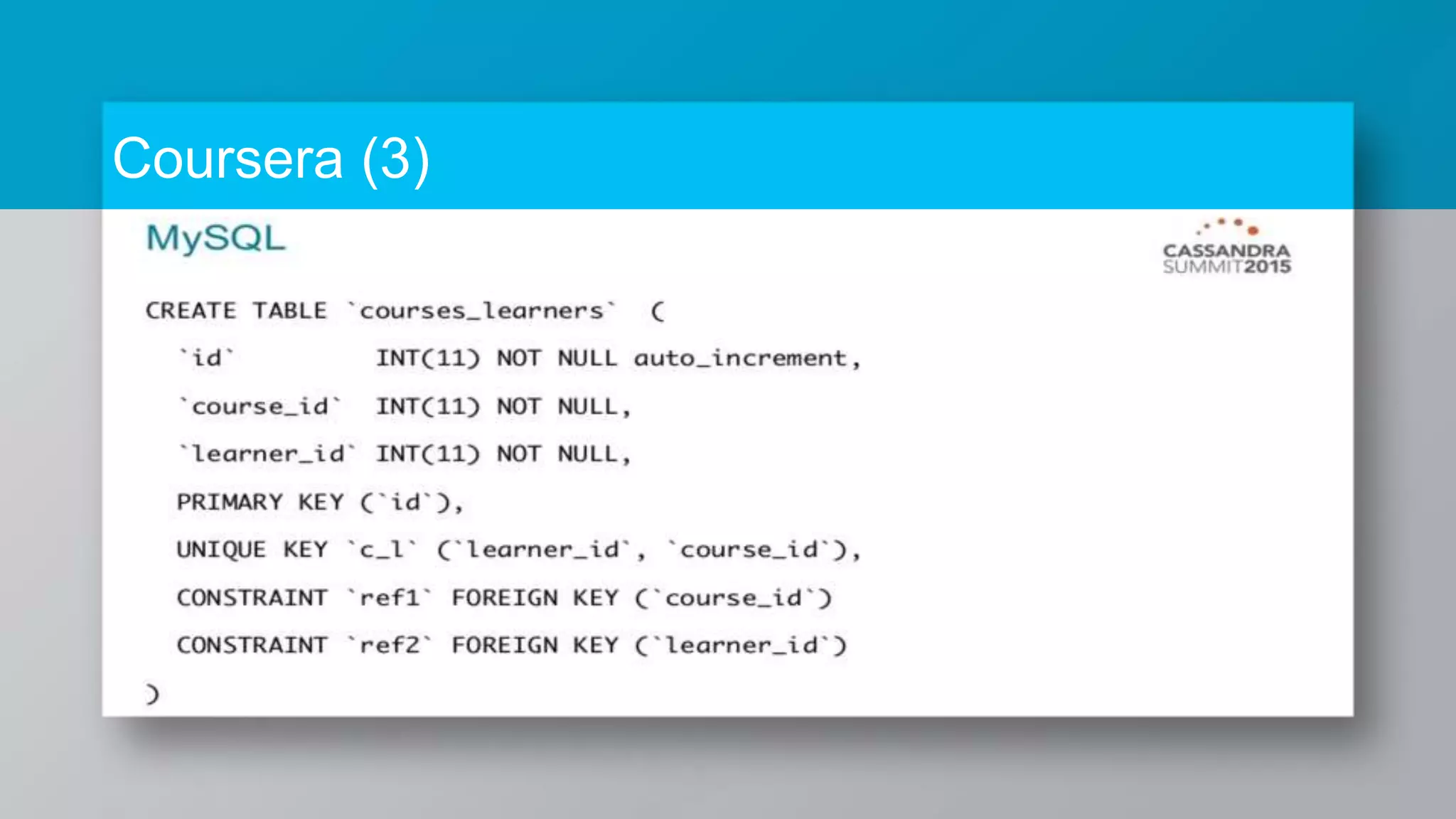
Coursera (3)
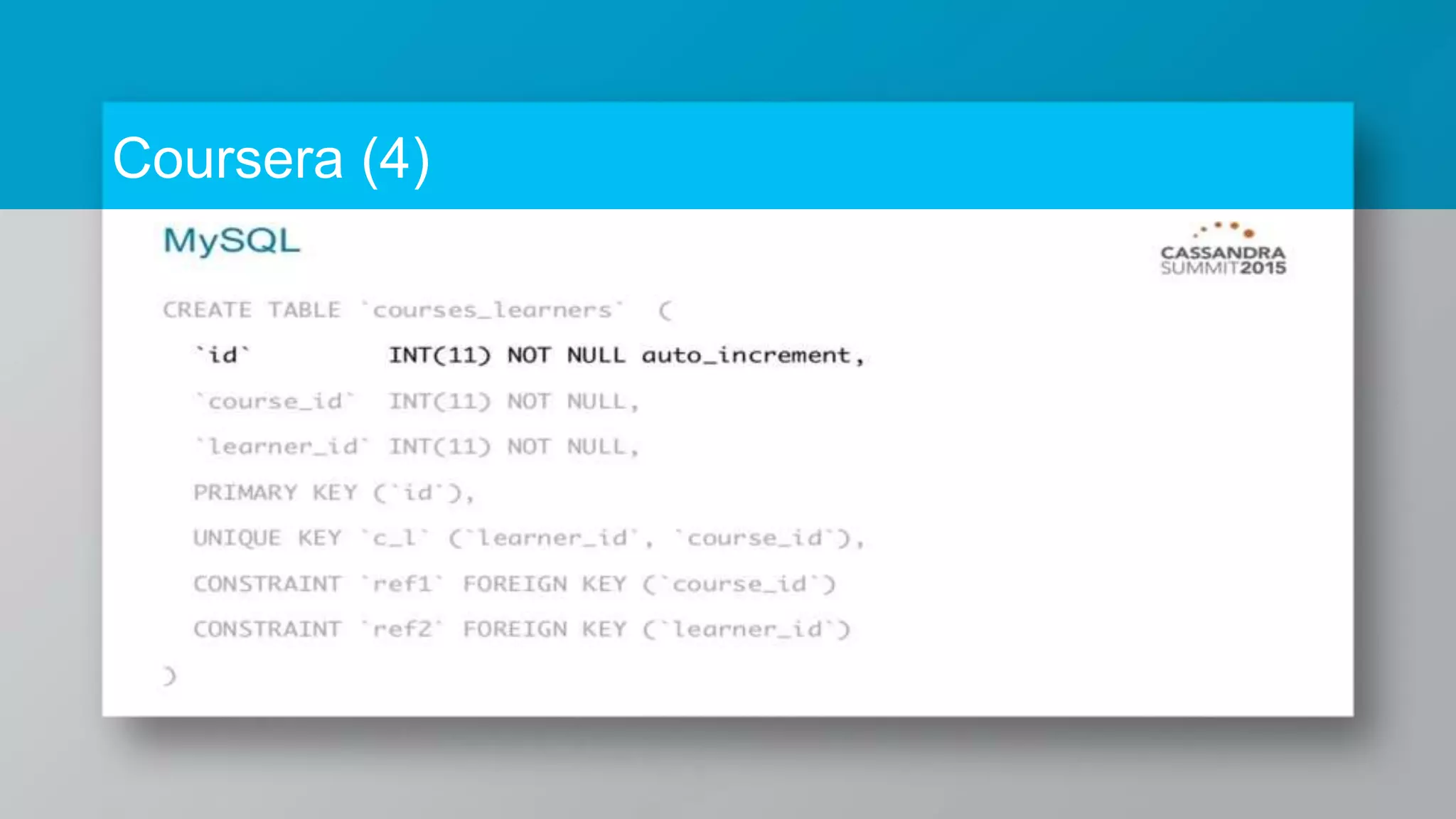
Coursera (4)
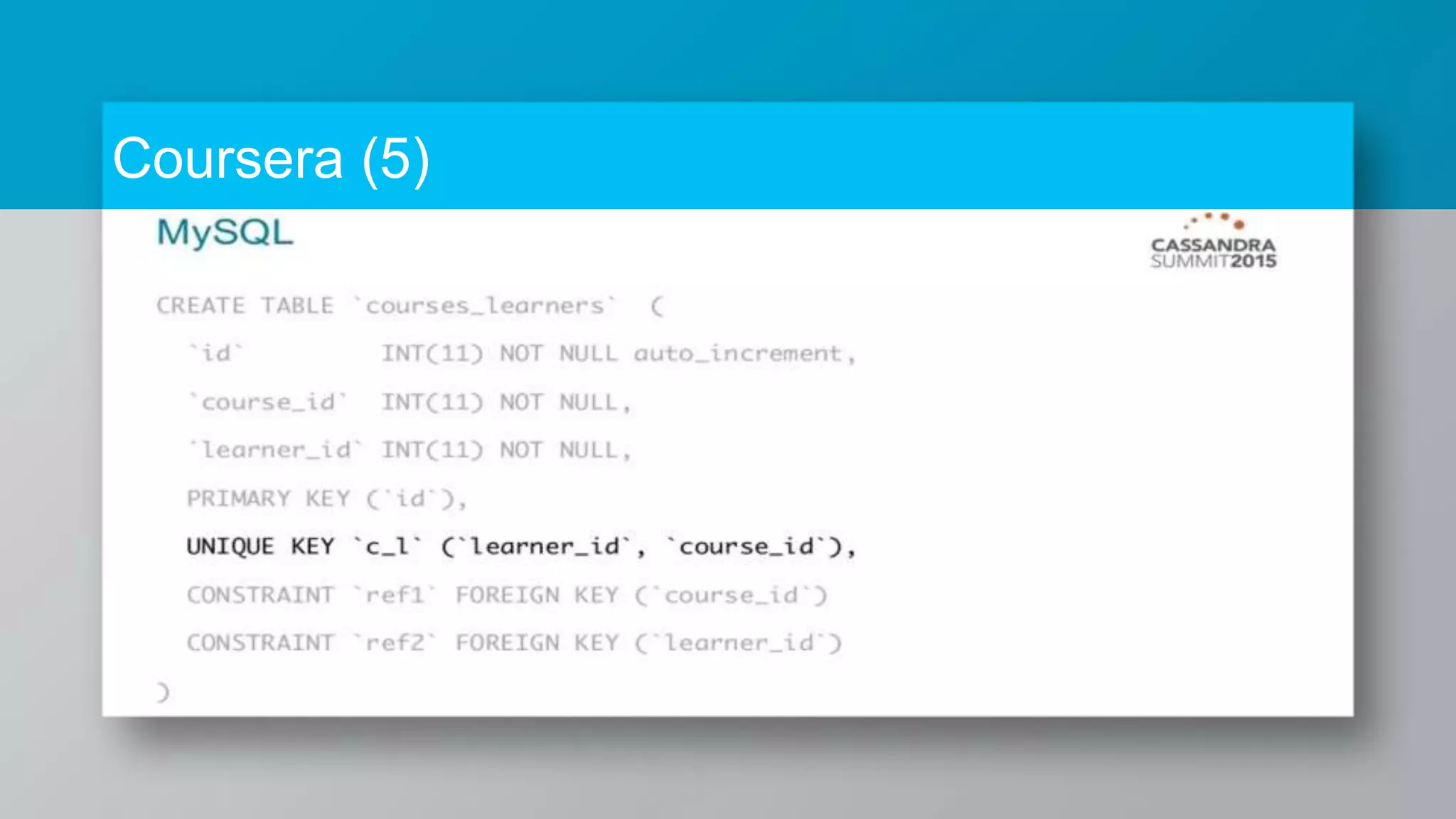
Coursera (5)
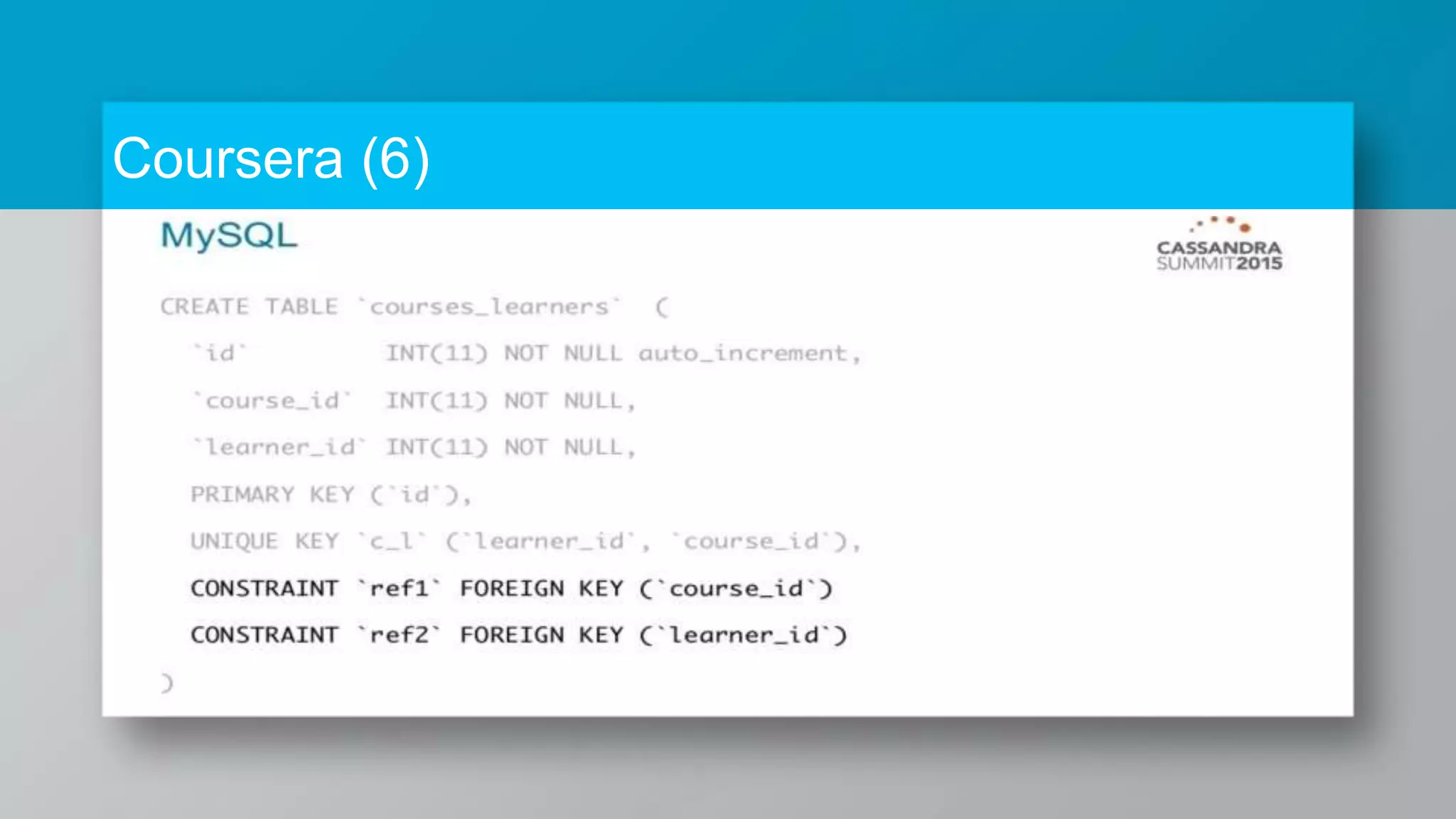
Coursera (6)
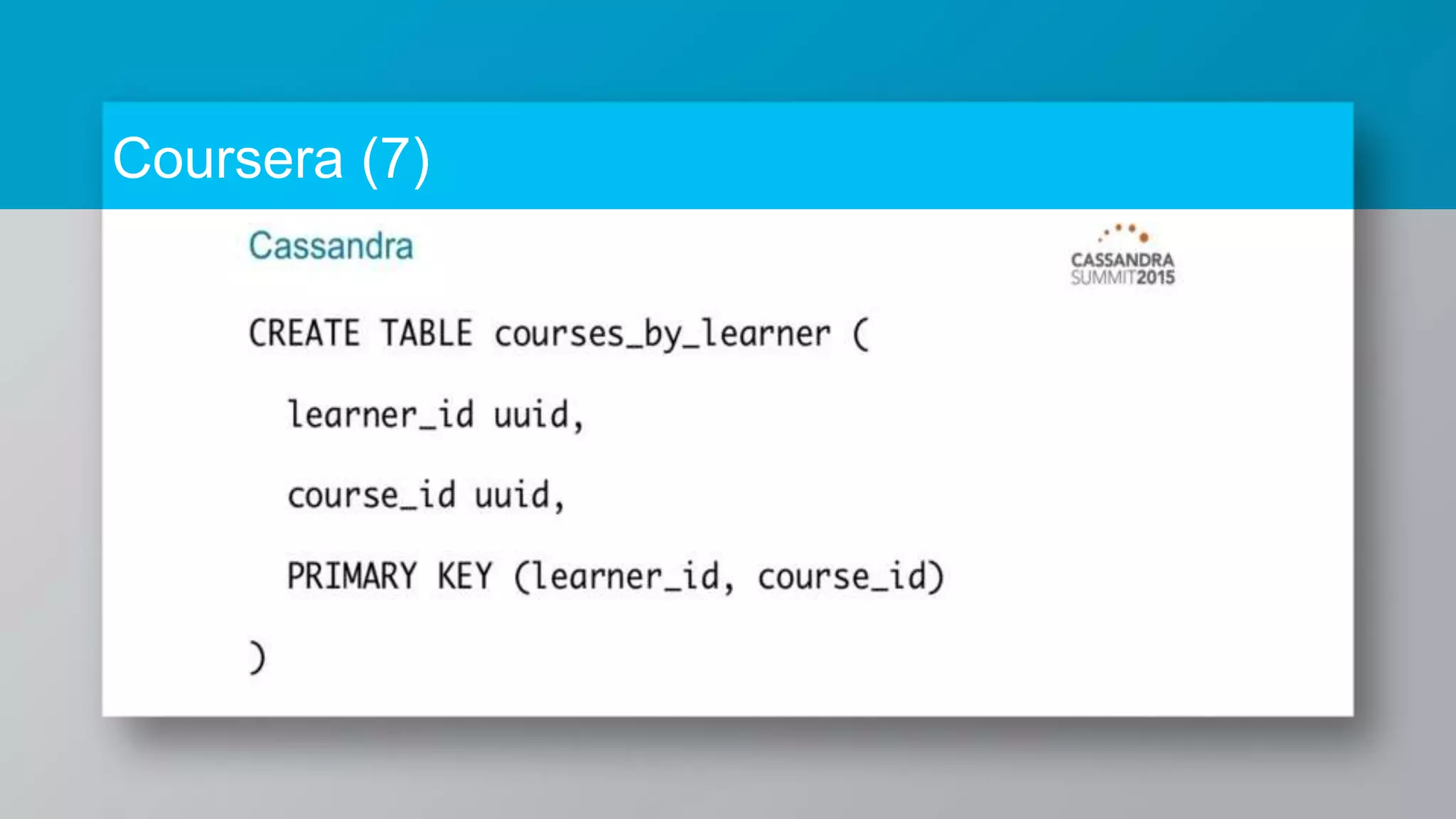
Coursera (7)
Category: Messaging
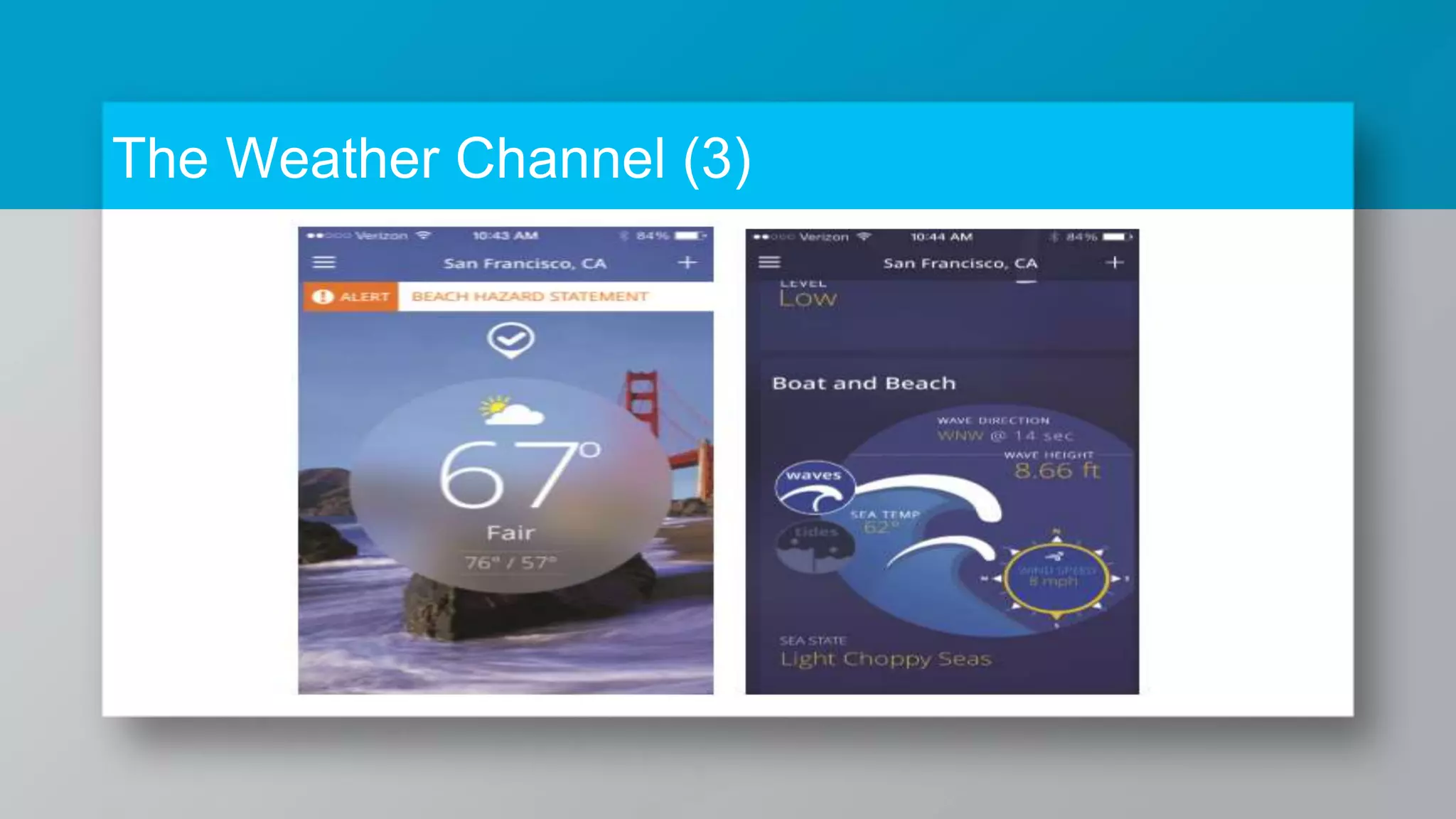
The Weather Channel Description: The Weather Channel delivers breaking news to countless viewers and users from web, desktop and mobile applications. Challenges: • Customer experience in the center of attention (continuous availability, global and diverse users) • New capabilities including statistics from unstructured data, CGS for customer engagement etc.
The Weather Channel (1) Solution: Cassandra Why? I. linear scalability II. 100% uptime III. supports almost all possible types of content (e.g. observations, forecasts, marine data, ads)
The Weather Channel (2) Results: I. billions requests/month are processed - no fear of downtime II. node count was grown from 3 to 36 in AWS in 1 year across 3 data centers (US East and West and Western Europe). III. capability for new offerings (e.g. social weather)
The Weather Channel (3)
Technical Description, Architecture, Internals 4.
Key Terms – Data Structures • Commit Log • Memtable • Sorted String Table (SST) • Bloom Filter • Index File
Key Terms • Gossip protocol: helps each node learn about the topology of the cluster (communication and detection of faulty nodes). • Snitch: indicates which node is closest to the current location.
Log-Structured Merge-Tree (LSM-Tree) What is it? • A disk-based data structure designed to provide low-cost indexing for a file experiencing a high rate of record inserts. • A simple LSM-Tree comprises of two tree-like structures: Co (in memory) and C1 (disk). • Maintains key-value pairs. • In Cassandra, each value represents a row. Used in: • BigTable, HBase, MongoDB, SQLite, RocksDB, InfluxDB
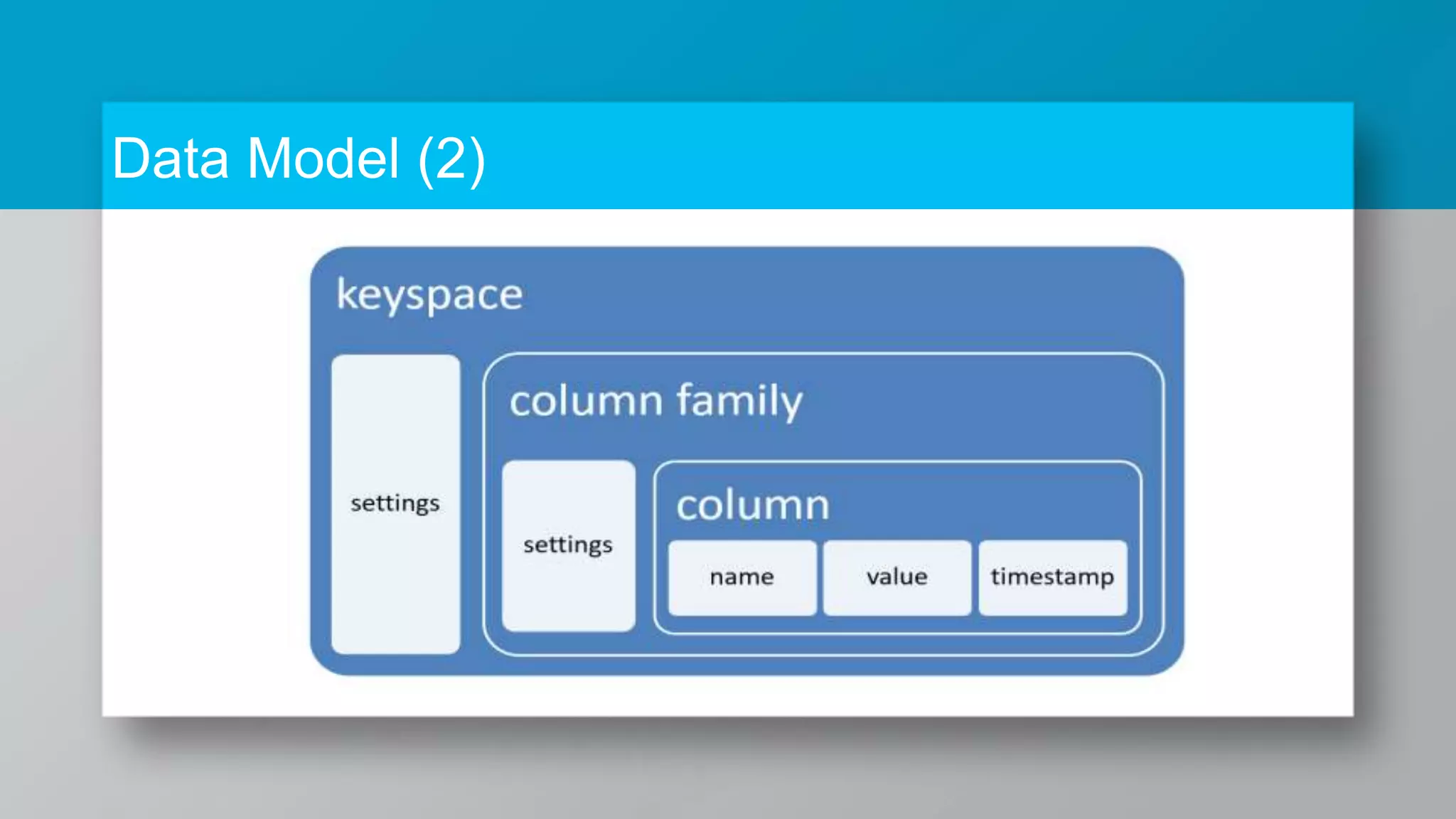
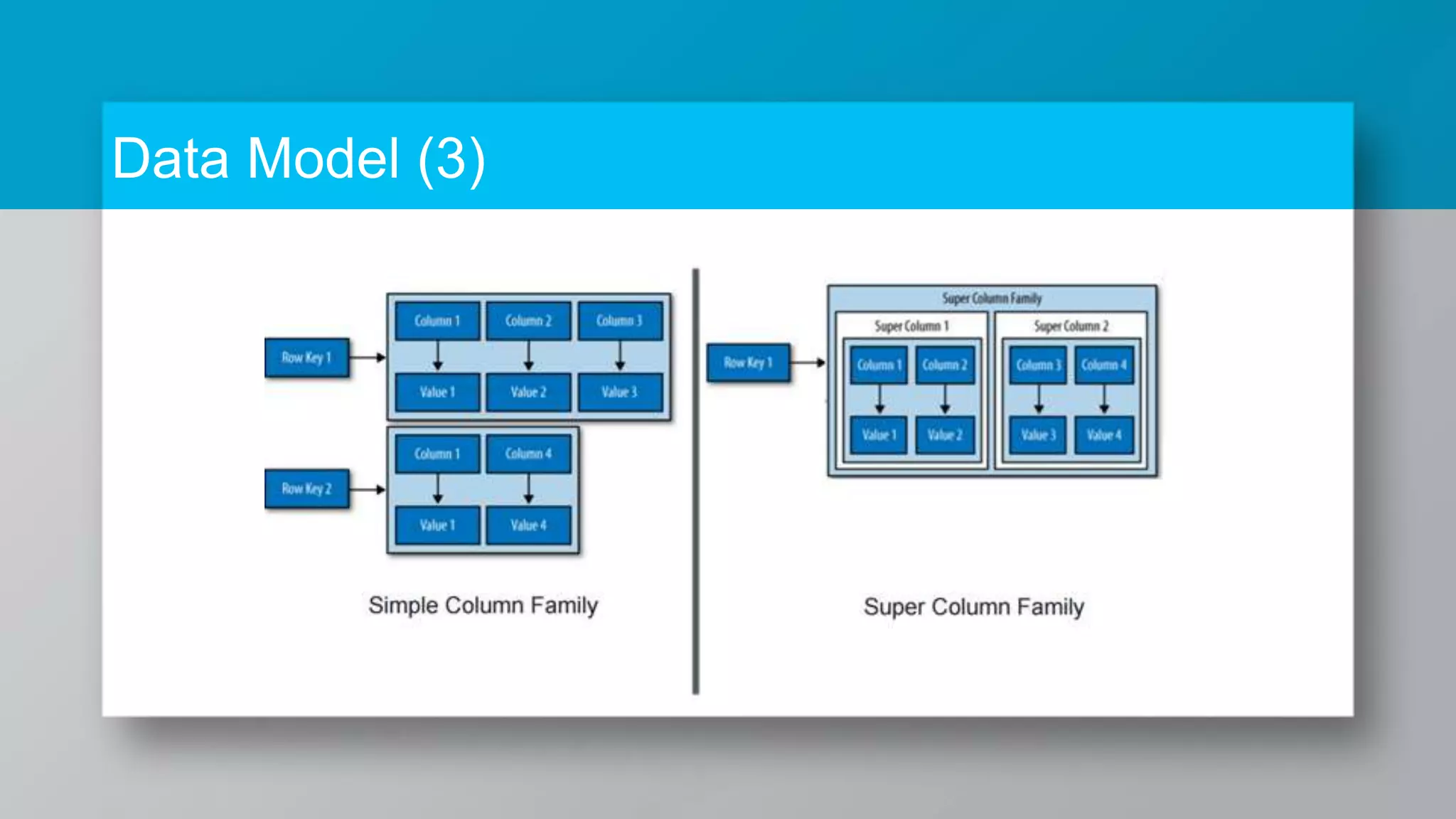
Data Model • Each Row → Identified by a Unique Key (Primary Key) • Keyspace → Outermost container for data (one or more column families) • Column Family → Contains Supercolumns or Columns (but not both) • Column → Basic data structures with: key, value, timestamp • Supercolumn → Special column, stores a map of sub-columns. Columns that you are likely to query together should be placed in the same column family. • Columns could be of variable number per key. For instance, key K1 could have 1024 columns/supercolumns while K2 could have 64 columns/supercolumns
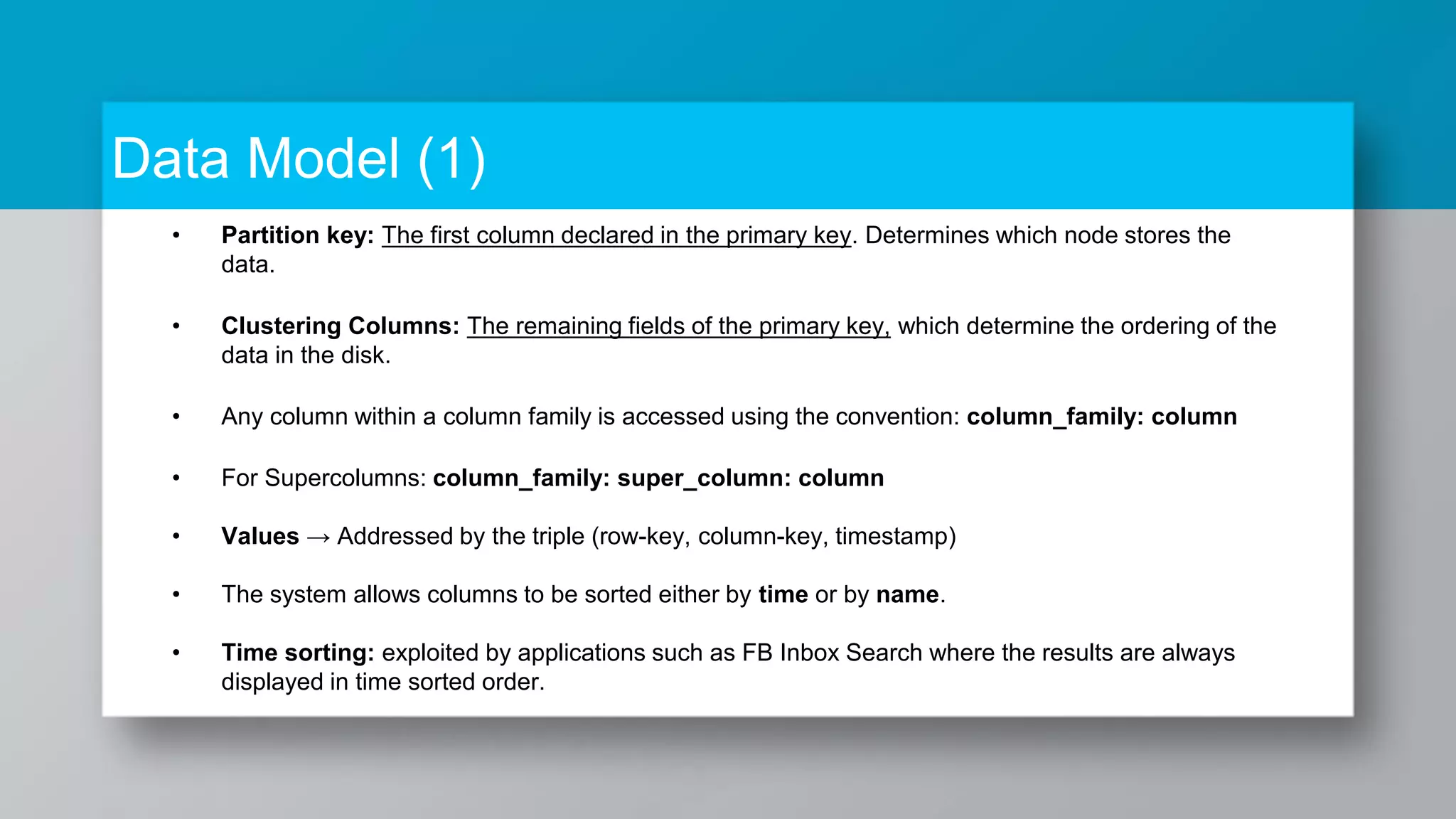
Data Model (1) • Partition key: The first column declared in the primary key. Determines which node stores the data. • Clustering Columns: The remaining fields of the primary key, which determine the ordering of the data in the disk. • Any column within a column family is accessed using the convention: column_family: column • For Supercolumns: column_family: super_column: column • Values → Addressed by the triple (row-key, column-key, timestamp) • The system allows columns to be sorted either by time or by name. • Time sorting: exploited by applications such as FB Inbox Search where the results are always displayed in time sorted order.
Data Model (2)
Data Model (3)
Relational Schema vs Cassandra
SYSTEM ARCHITECTURE
Introduction The architecture of a storage system that needs to operate in a production setting is complex. We will focus on the core distributed systems techniques used in Cassandra: I. Partitioning II. Replication III. Membership IV. Failure Handling V. Scaling All these modules work in synchrony to handle read/write requests.
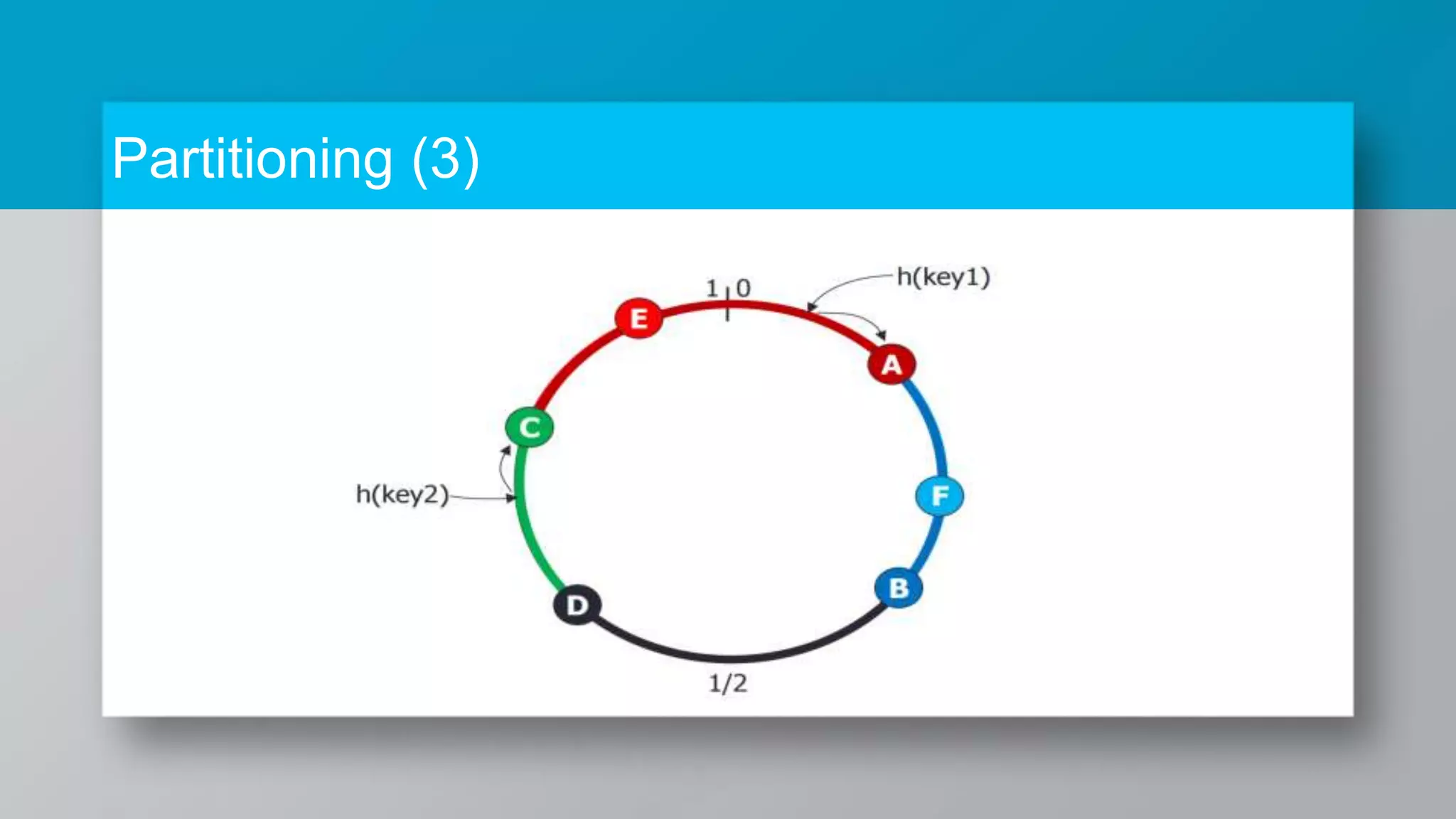
Partitioning Offers the ability to scale incrementally. How? • Dynamically partition the data over the set of nodes in the cluster. • Consistent hashing (order preserving hash function). • Output range: a ring. • Each node: is assigned a random value which determines its place on the ring.
Partitioning (1) • Each data item: is assigned to a node by hashing its key to yield its position on the ring and then walking the ring clockwise to find the first node with a position larger than the item’s position. • Each node becomes responsible for the region in the ring between it and its predecessor node on the ring. • Departure or arrival of a node only affects the immediate neighbours.
Partitioning (2) Challenges: I. Random positioning of each node leads to non-uniform data and load distribution. II. The basic algorithm is oblivious to the heterogeneity in the performance of nodes. Addressed by: Analysing load information on the ring and having lightly loaded nodes move on the ring to alleviate heavily loaded ones.
Partitioning (3)
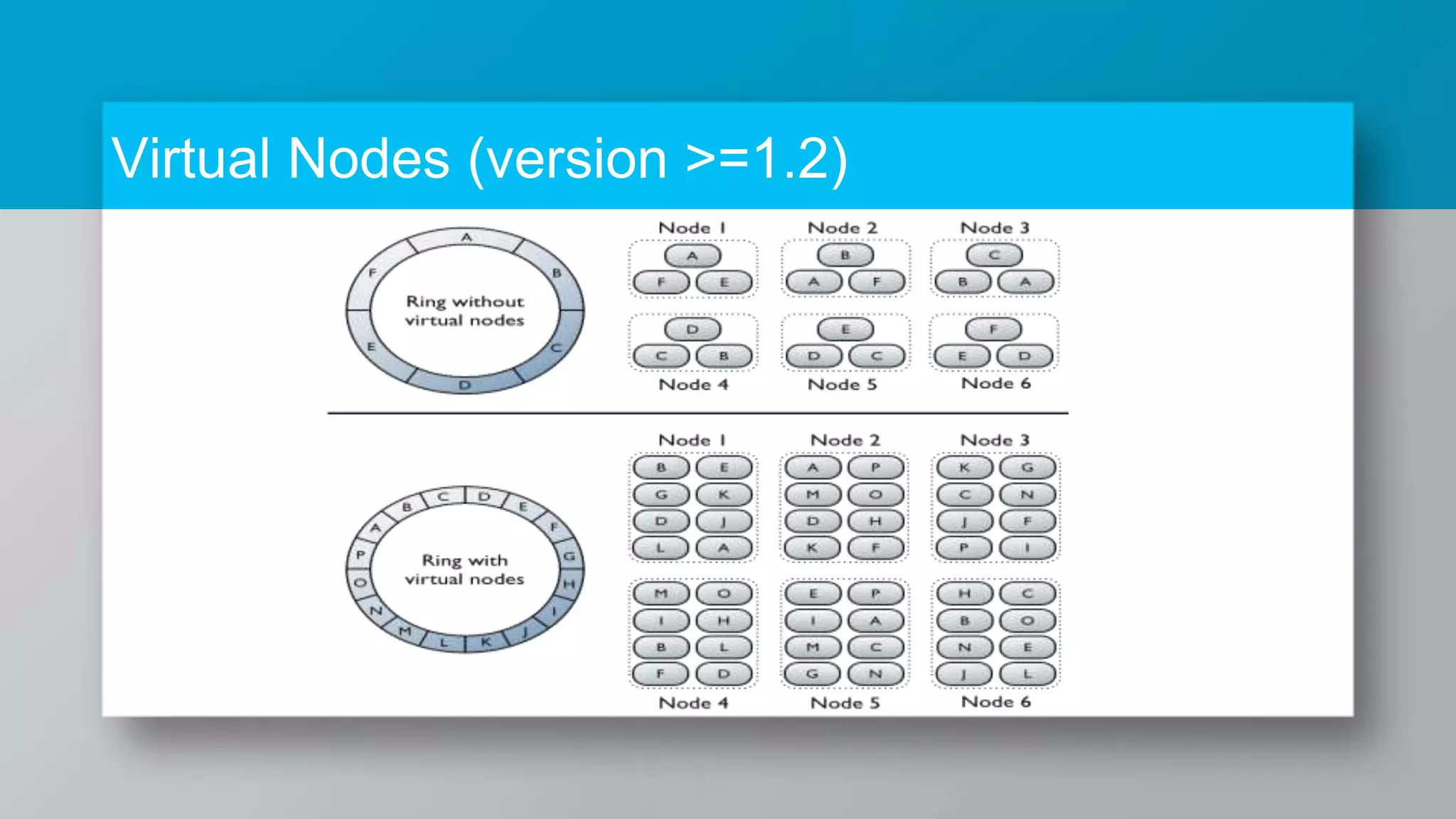
Node: Storage layer within a server Before: ● 1 server/machine (machine: physical server or EC2 instance-AWS) ● 1 node/server (server: an installation of Cassandra) Now: ● 256 vnodes/server (virtual nodes) Vnodes or Virtual Nodes or Tokens: Define the section of the ring (token ranges) the node will become responsible for Why? Much easier and faster in case of a node failure
Virtual Nodes (version >=1.2)
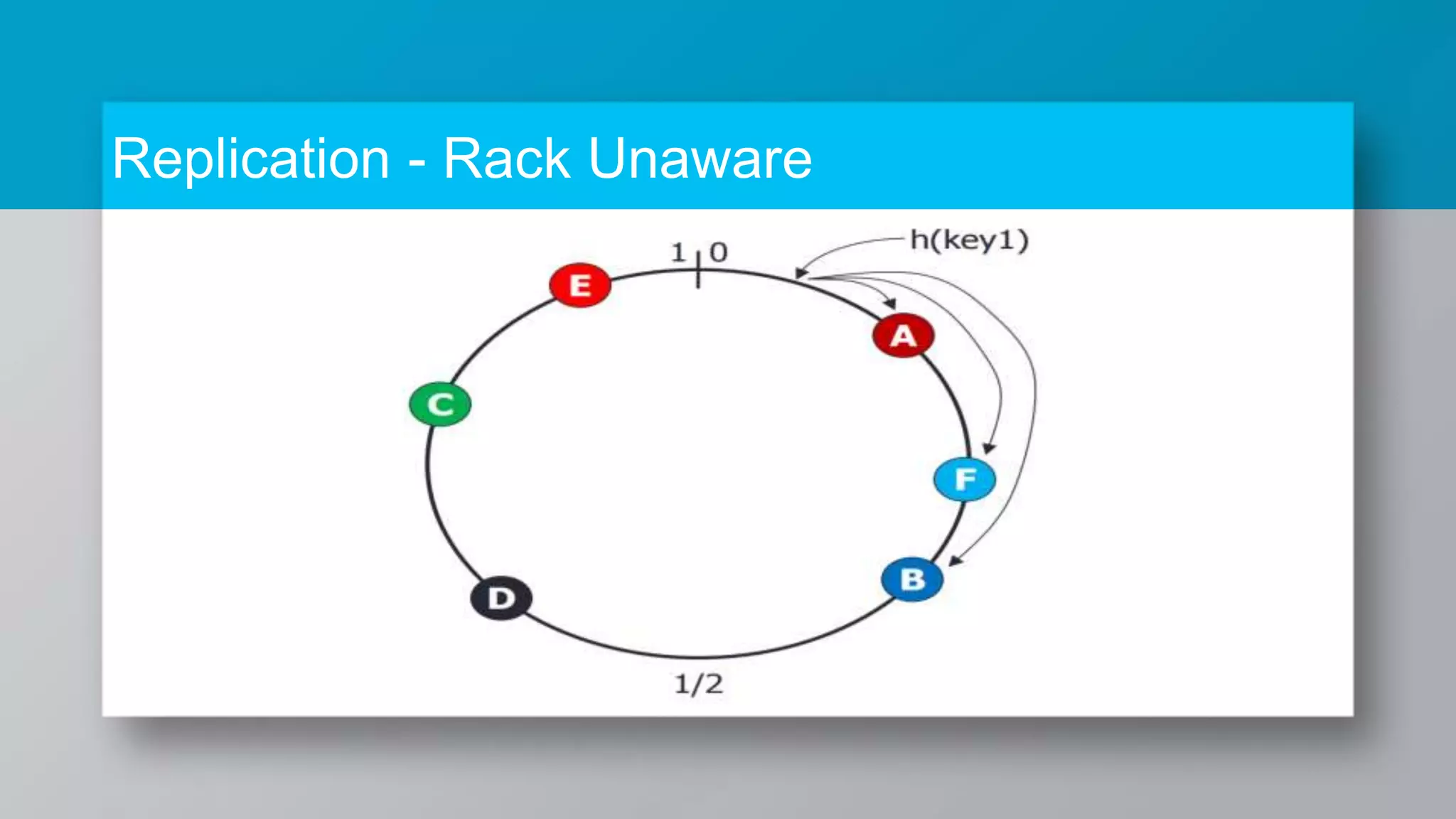
Replication Used to achieve high availability and durability. How? • Replication factor: determines how many copies of your data exist. • Each data item: is replicated at N hosts (N=replication factor). • Coordinator node: in charge of the replication of the data items that fall within its range. • Consistency level: refers to how much up-to-date and synchronized a row of Cassandra is in all of its replicas e.g. quorum → replication_factor/2 + 1. • Various replication policies: Rack Unaware, Rack Aware and Datacentre Aware. • Each row is replicated across multiple datacentres which are connected through high speed network links.
Replication - Rack Unaware
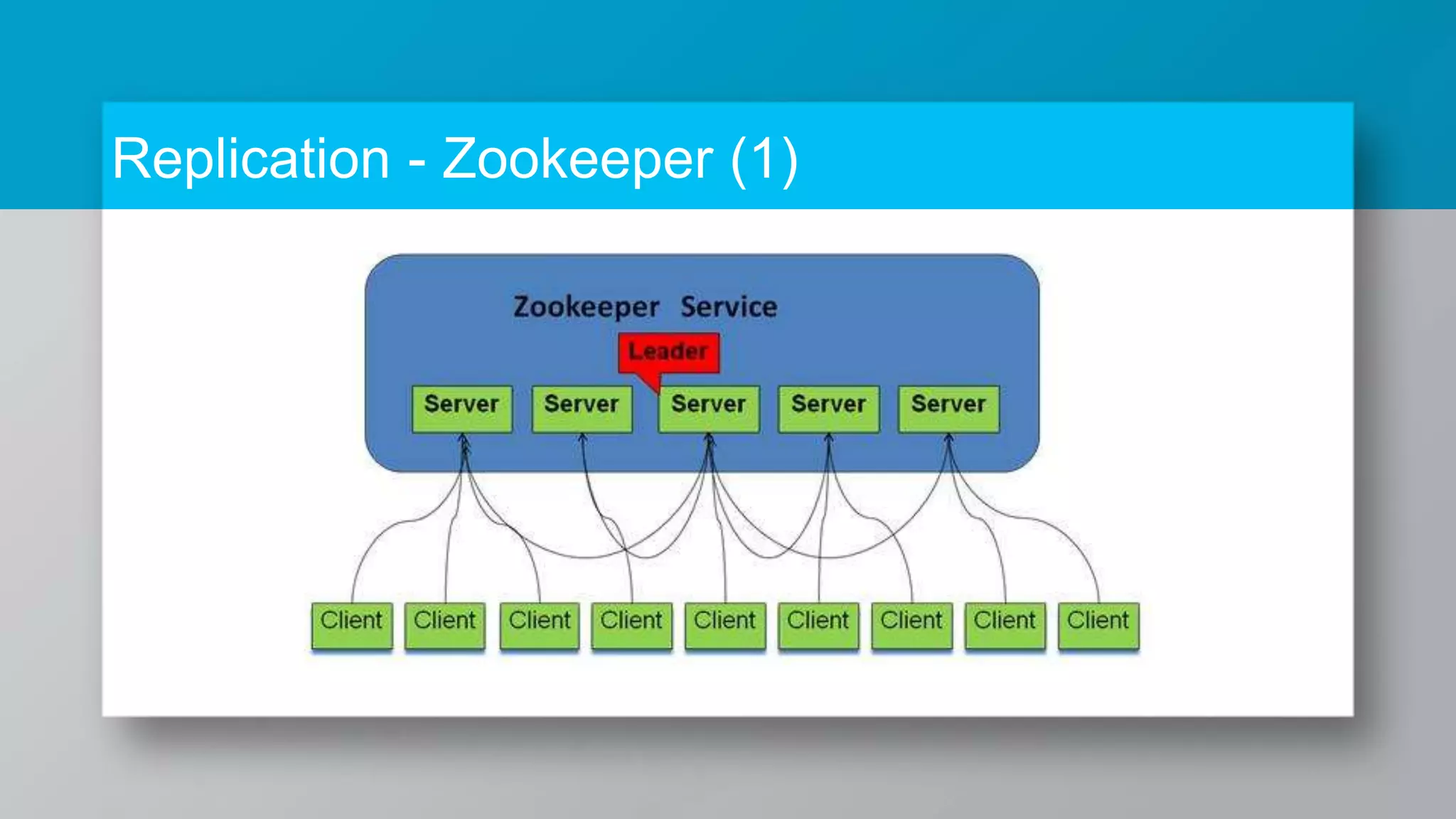
Replication - Zookeeper • Cassandra elects a leader amongst its nodes using Zookeeper. • All nodes on joining the cluster contact the leader who tells them for what ranges they are replicas for. • Leader tries to maintain the invariant that no node is responsible for more than N-1 ranges in the ring.
Replication - Zookeeper • Cassandra elects a leader amongst its nodes using Zookeeper. • All nodes on joining the cluster contact the leader who tells them for what ranges they are replicas for. • Leader tries to maintain the invariant that no node is responsible for more than N-1 ranges in the ring. • Metadata about the ranges a node is responsible is 1) cached locally at each node and 2) in a fault-tolerant manner inside Zookeeper. • This way, a node that crashes and comes back knows what ranges it was responsible for.
Replication - Zookeeper (1)
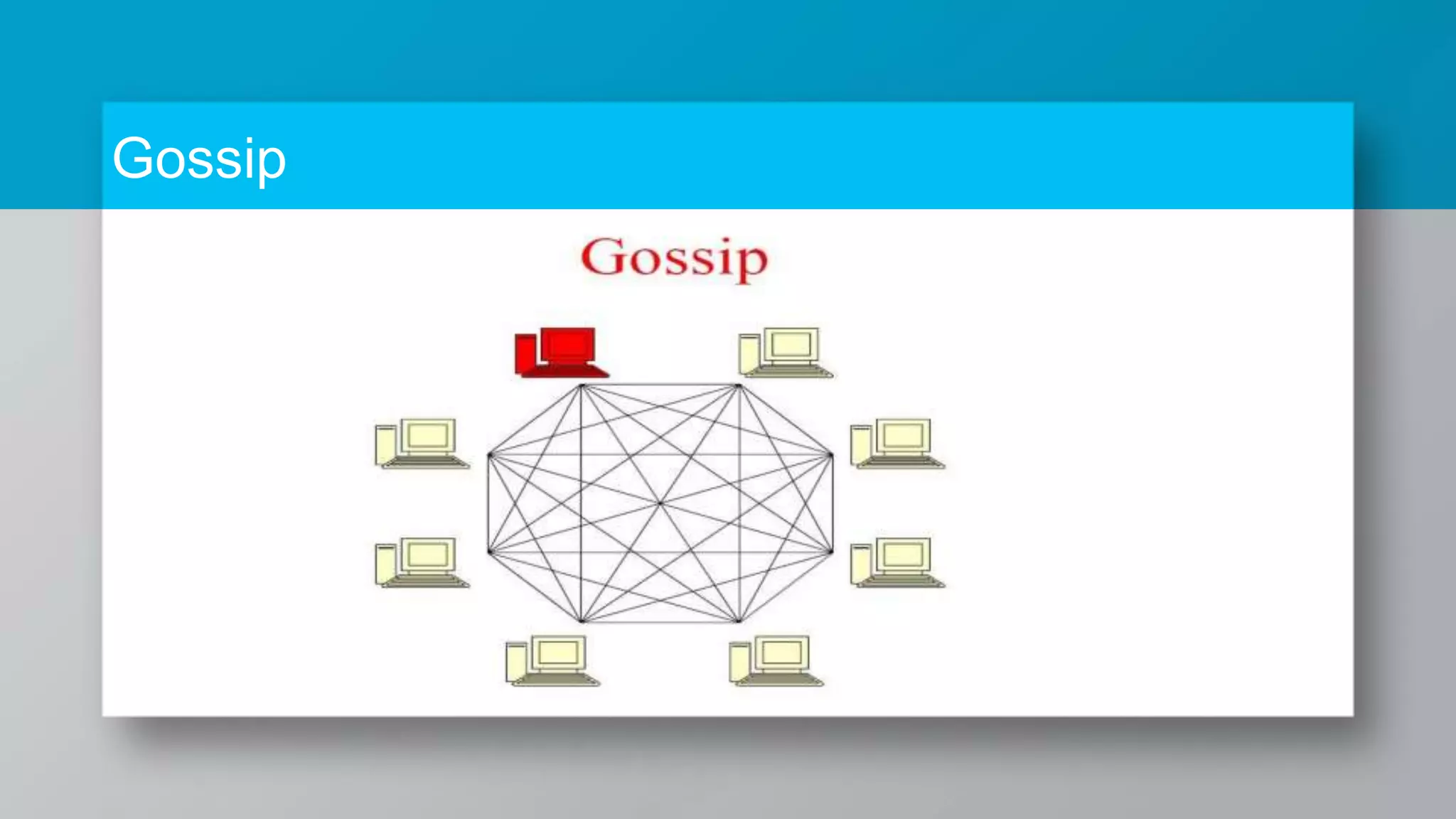
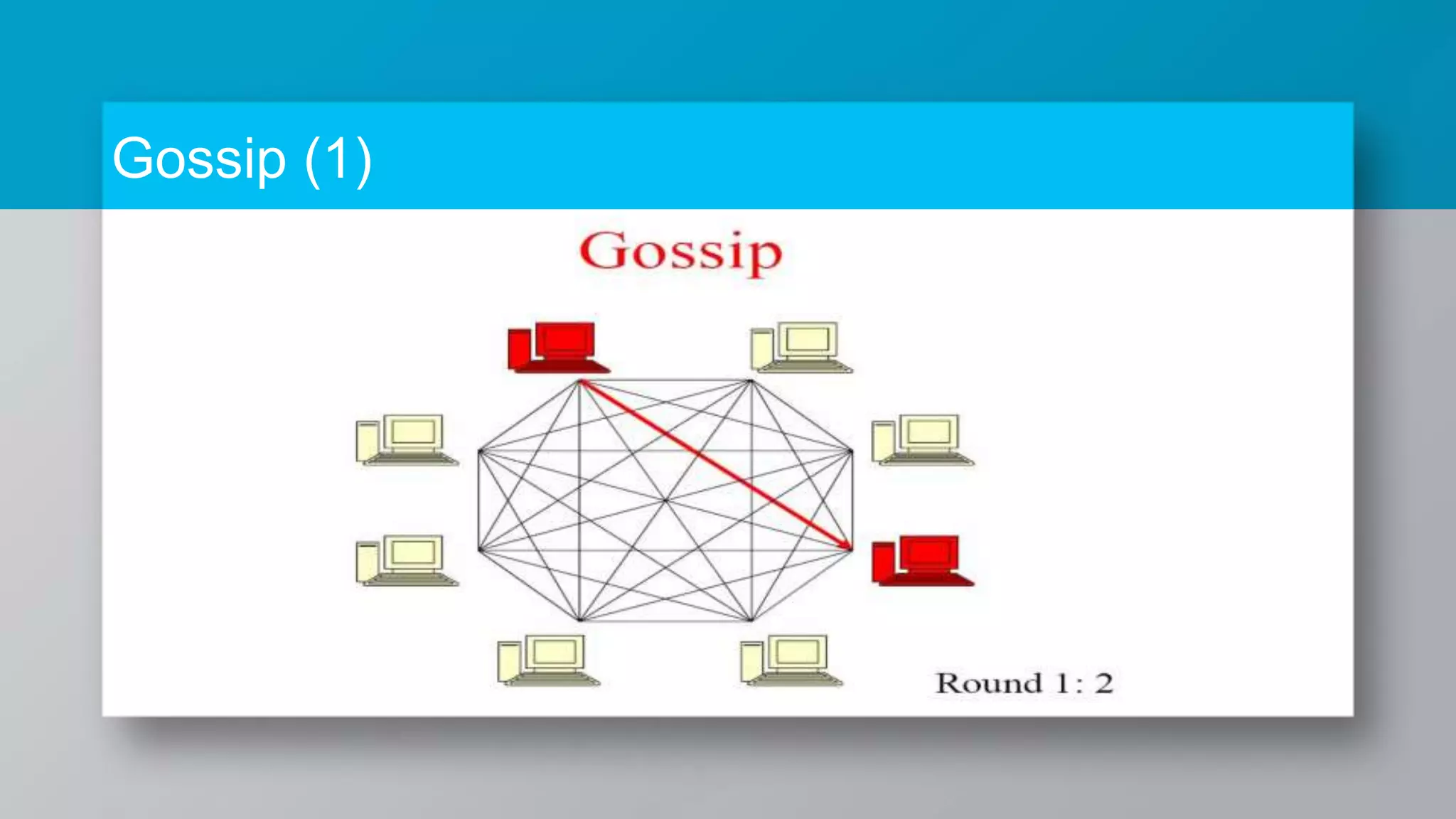
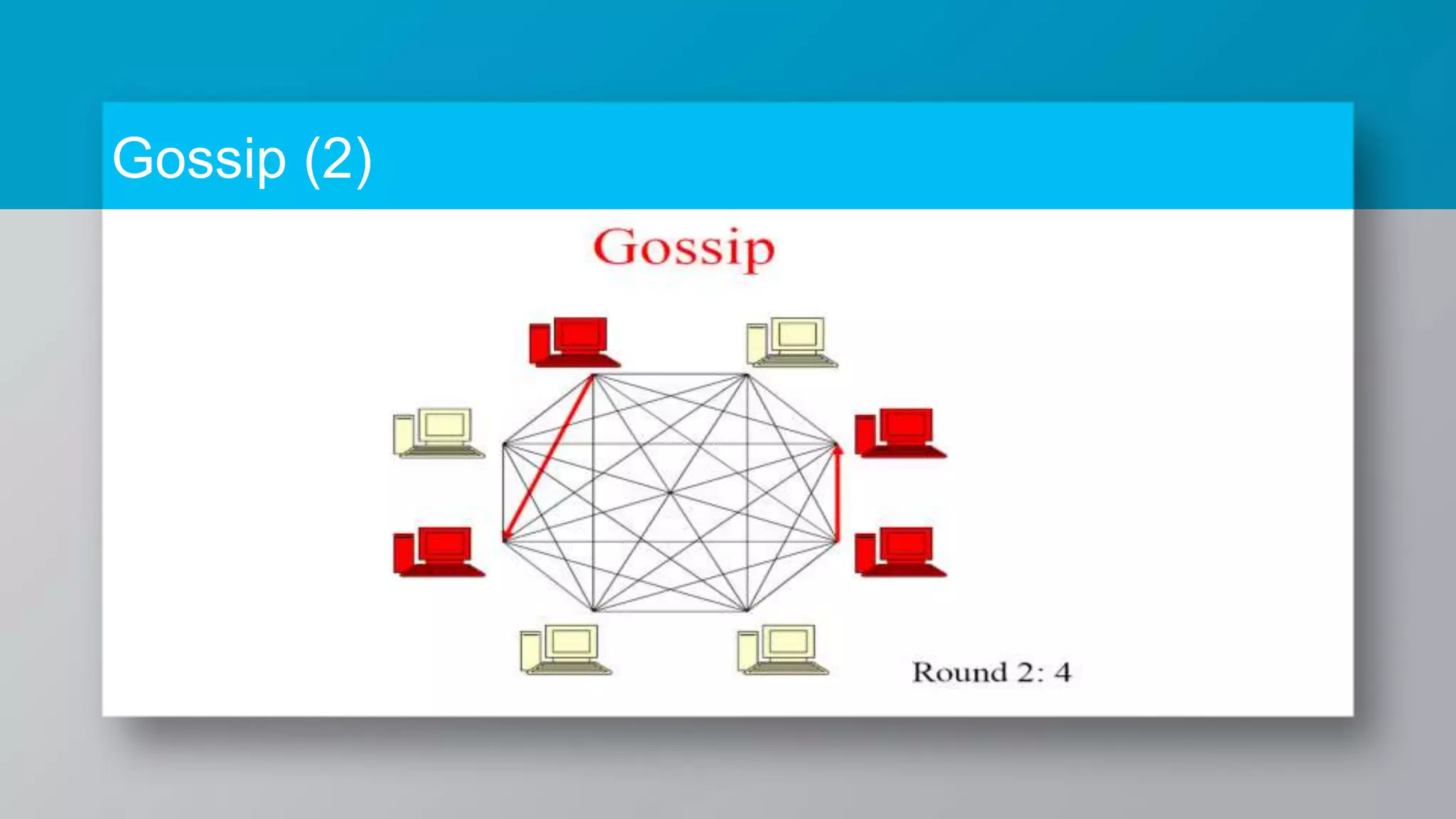
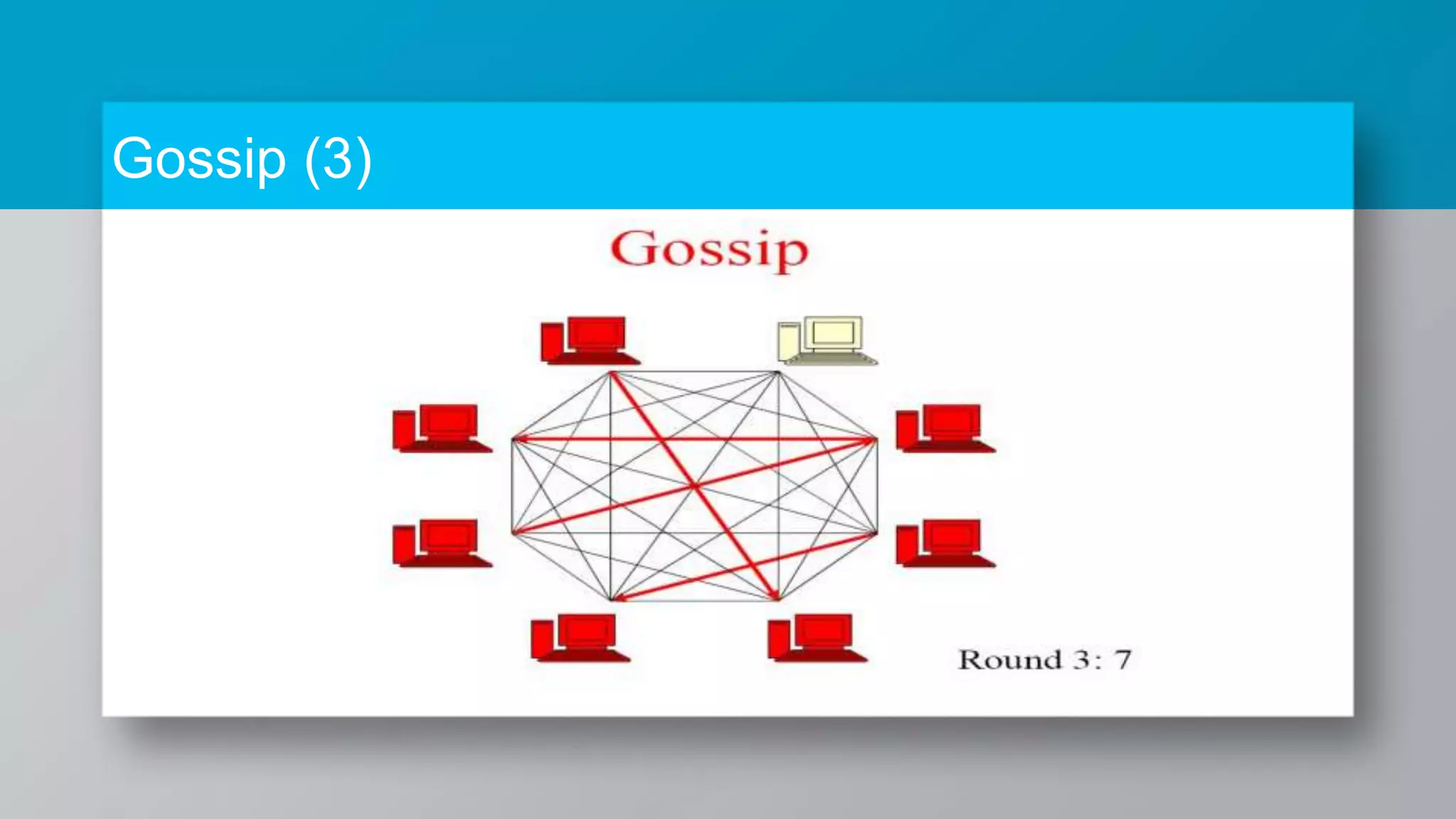
Membership Based on Scuttle-butt, a very efficient anti-entropy Gossip based mechanism. Benefits: I. Efficient CPU utilization. II. Efficient utilization of the Gossip Channel. Gossip: a P2P communication protocol to discover and share location and state information about the other nodes in a Cassandra cluster. Gossip information is also persisted locally by each node to use immediately when a node restarts.
Gossip
Gossip (1)
Gossip (2)
Gossip (3)
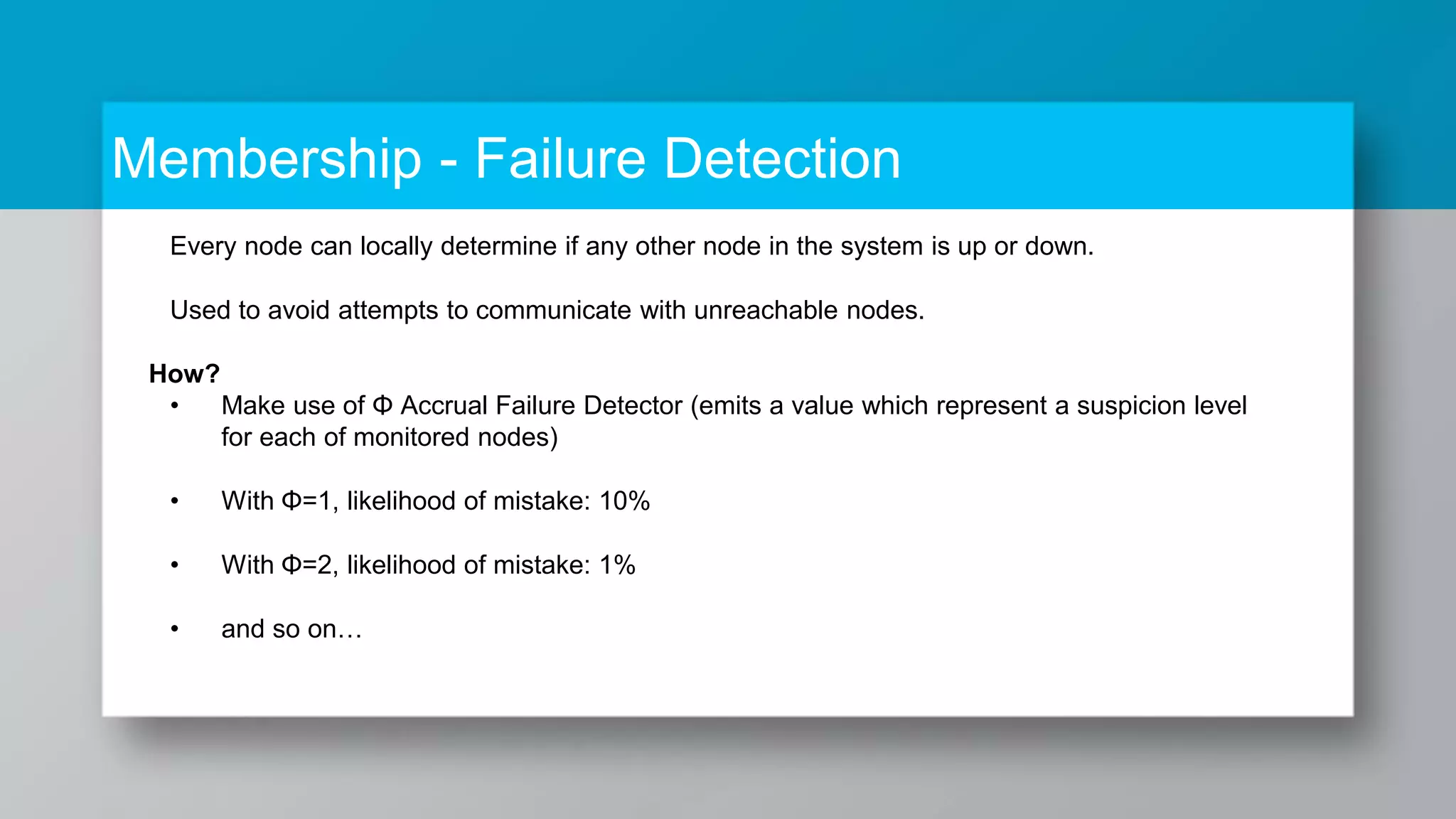
Membership - Failure Detection Every node can locally determine if any other node in the system is up or down. Used to avoid attempts to communicate with unreachable nodes. How? • Make use of Φ Accrual Failure Detector (emits a value which represent a suspicion level for each of monitored nodes) • With Φ=1, likelihood of mistake: 10% • With Φ=2, likelihood of mistake: 1% • and so on…
Bootstrapping (adding a new node in the cluster) Process of getting data from other nodes in the ring for a new node that starts for the first time. How? • When the new node enters the cluster, it chooses a random token for its position in the ring. • It also reads its configuration file which contains the seeds (initial contact points) of the cluster. • Token information is then gossiped around the cluster enabling any node to route a request for a key to the correct node.
Bootstrapping (adding a new node in the cluster) (1) In Facebook’s environment… • Node outages are often transient but may last for extended intervals. • Failures can be of various forms such as disk failures, bad CPU, etc. • A node failure rarely signifies a permanent departure and therefore should not result in re- balancing of the partition assignment. • Manual error could result in the unintentional startup of new nodes. • To that effect, every message contains the cluster name of each Cassandra instance. • An admin uses a cmd tool or a browser to connect to a Cassandra node and issue a membership change to join or leave a cluster.
Scaling the Cluster Adding a new node on the system in order to alleviate another heavily loaded node. How? • Gets assigned a token. • Splits the responsibility range of the other node. • Data are streamed between the nodes using kernel-kernel copy techniques. • Data are transferred at approximately the rate of 40 MB/sec.
Local Persistence • Cassandra relies on the local file system for data persistence. • The data is represented on disk using a format that lends itself to efficient data retrieval.
Implementation Details The Cassandra process on a single machine primarily consists of: I. A partitioning module, II. The cluster membership and failure detection module, III. The storage engine module. Each of these modules has been implemented from the ground up using Java. The II) is built on top of a network layer which uses non-blocking I/O. Application relate messages for replication and request routing relies on TCP.
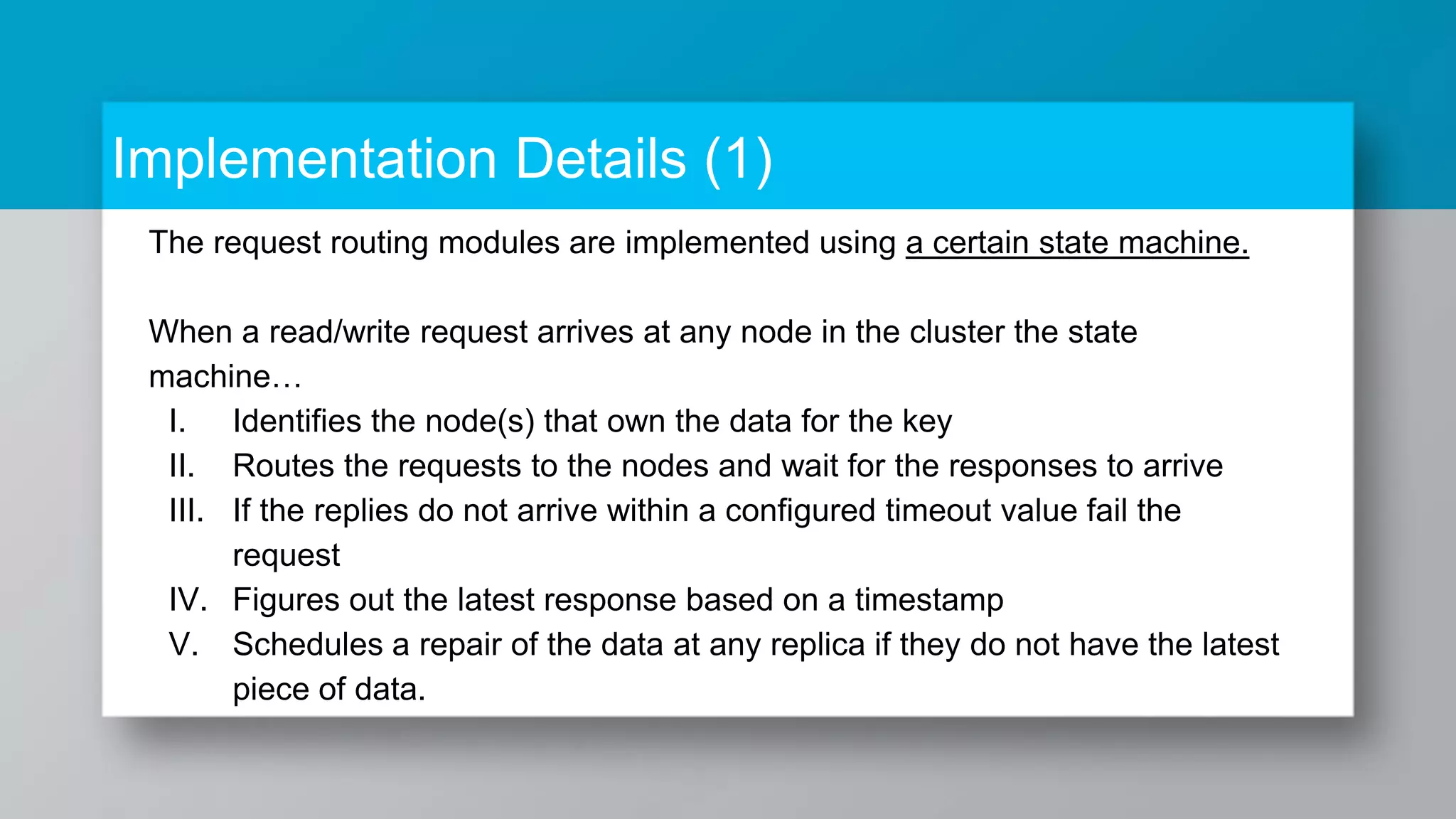
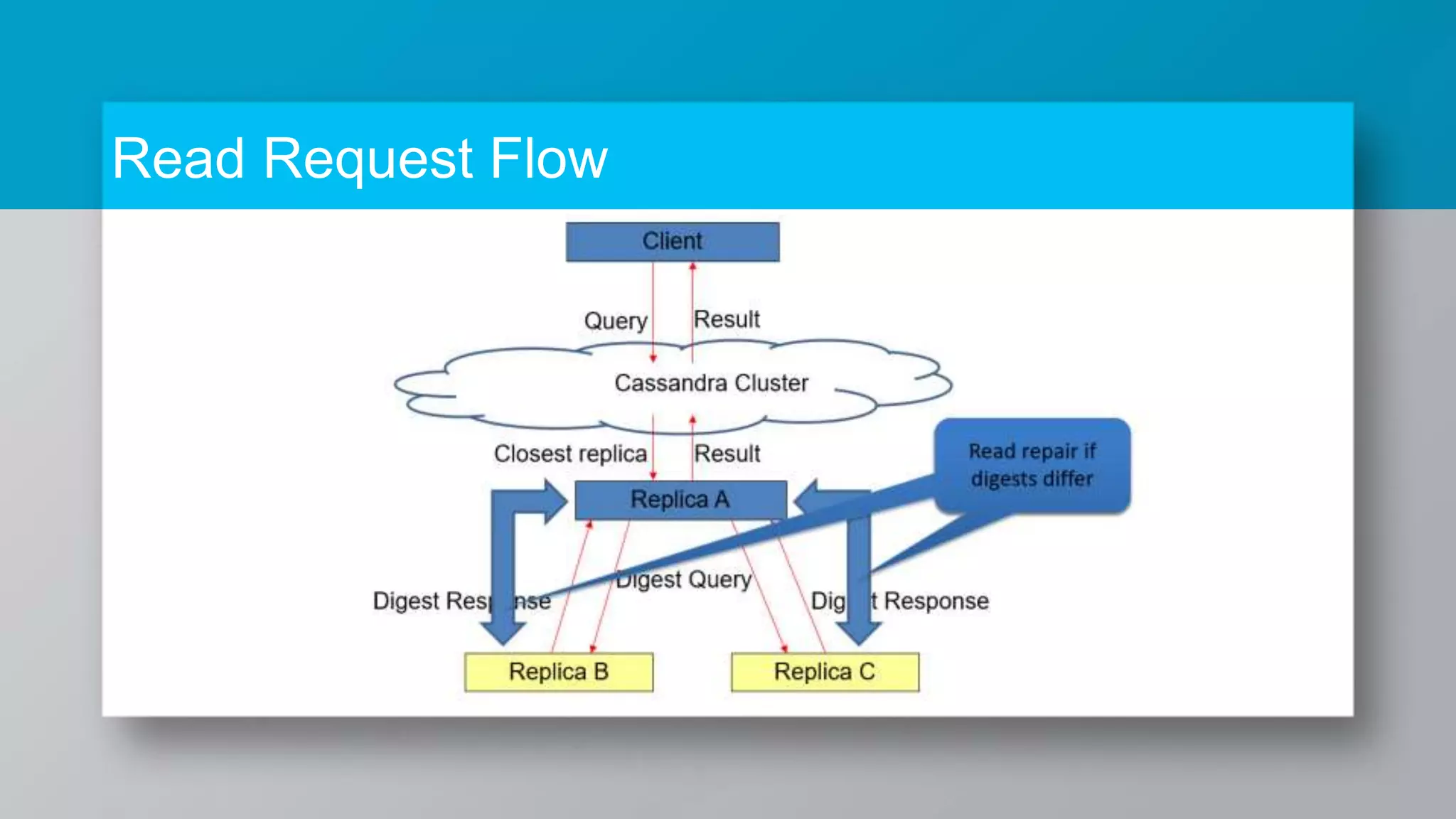
Implementation Details (1) The request routing modules are implemented using a certain state machine. When a read/write request arrives at any node in the cluster the state machine… I. Identifies the node(s) that own the data for the key II. Routes the requests to the nodes and wait for the responses to arrive III. If the replies do not arrive within a configured timeout value fail the request IV. Figures out the latest response based on a timestamp V. Schedules a repair of the data at any replica if they do not have the latest piece of data.
No coordination at all? “We have learnt that having some amount of coordination is essential to making the implementation of some distributed features tractable” -Lakshman & Malik • Integration with Zookeeper → can be used for various tasks in large scale distributed systems.
WRITE/READ REQUESTS
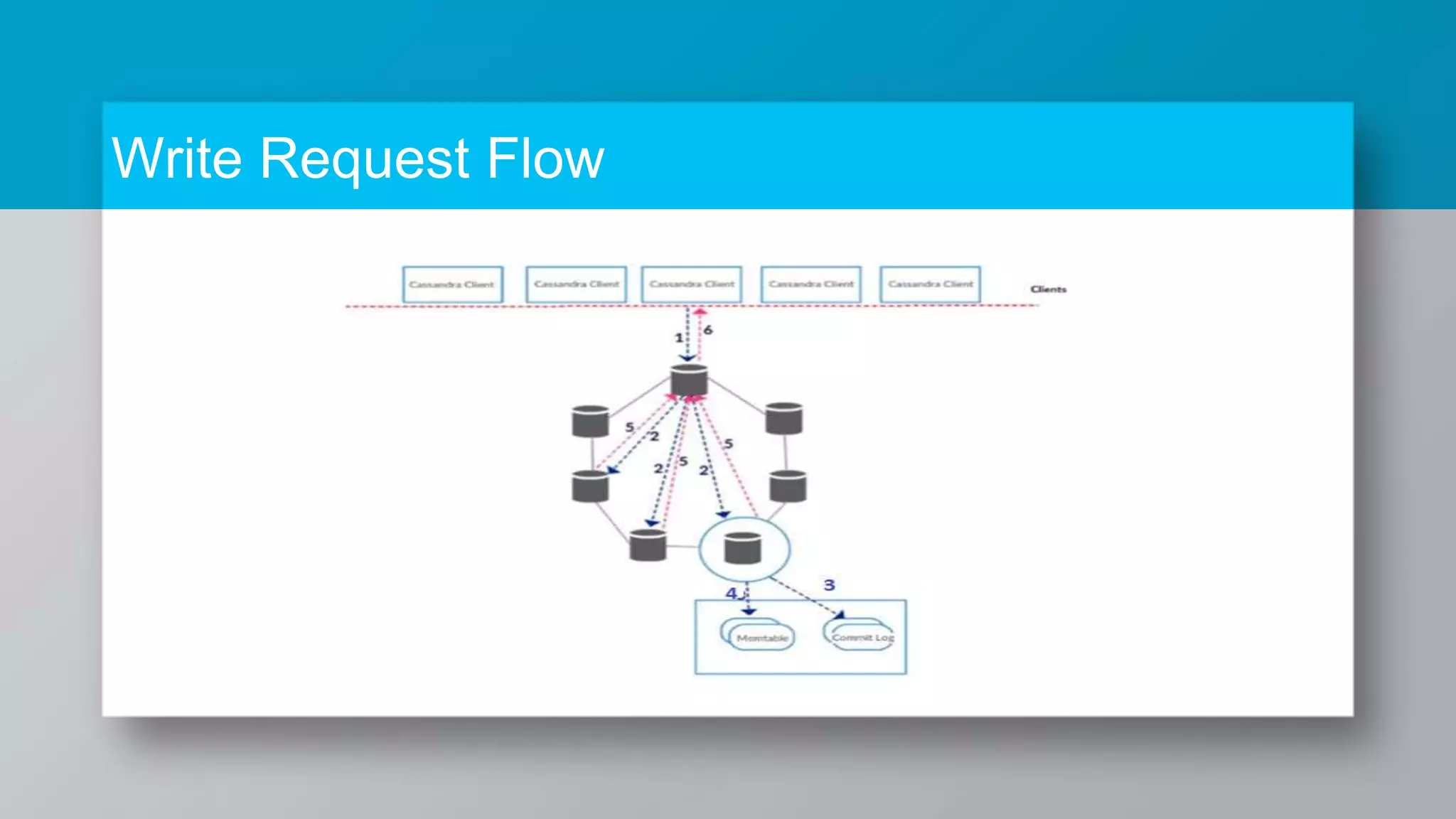
Write Request Flow
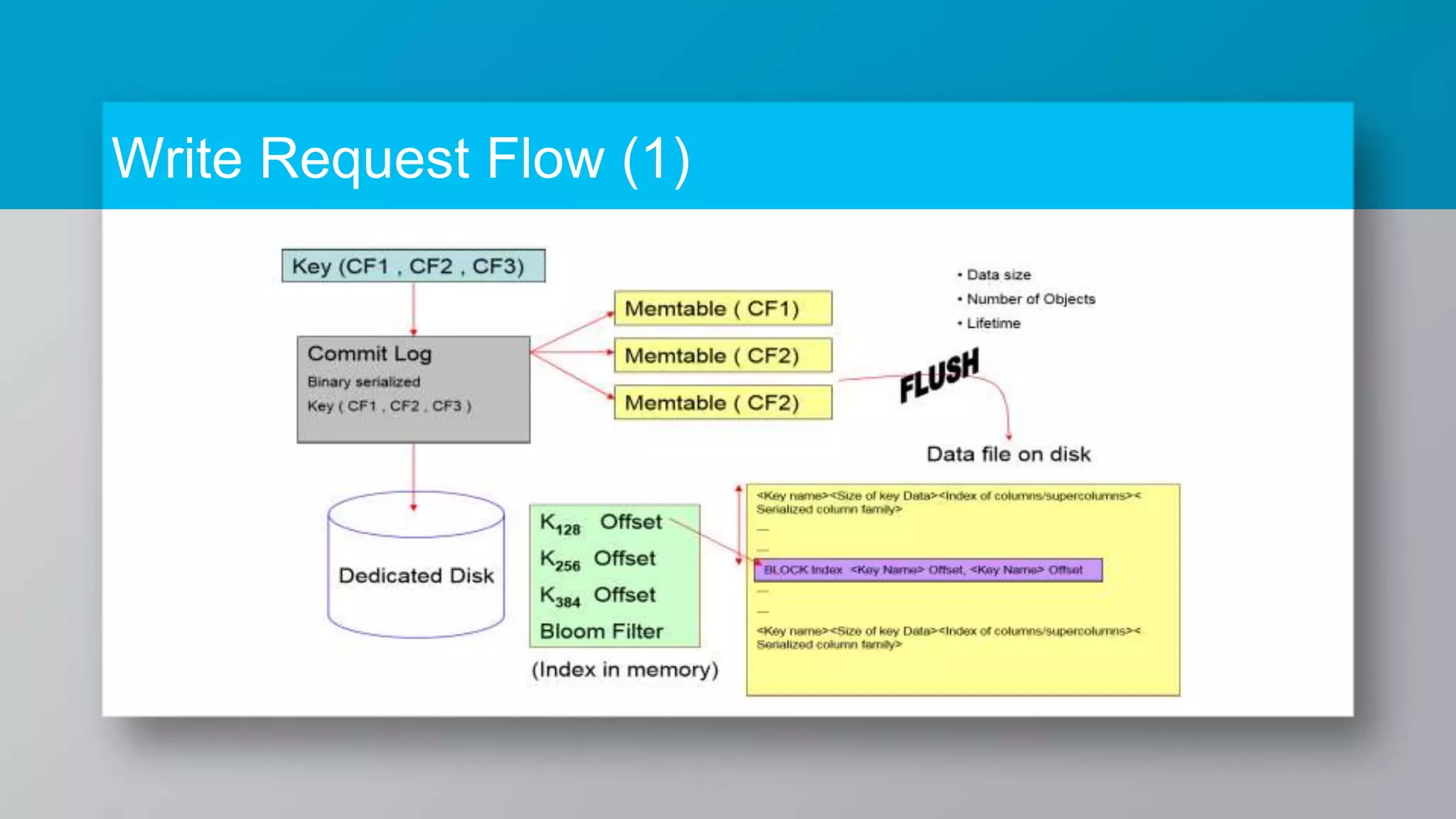
Write Request Flow (1)
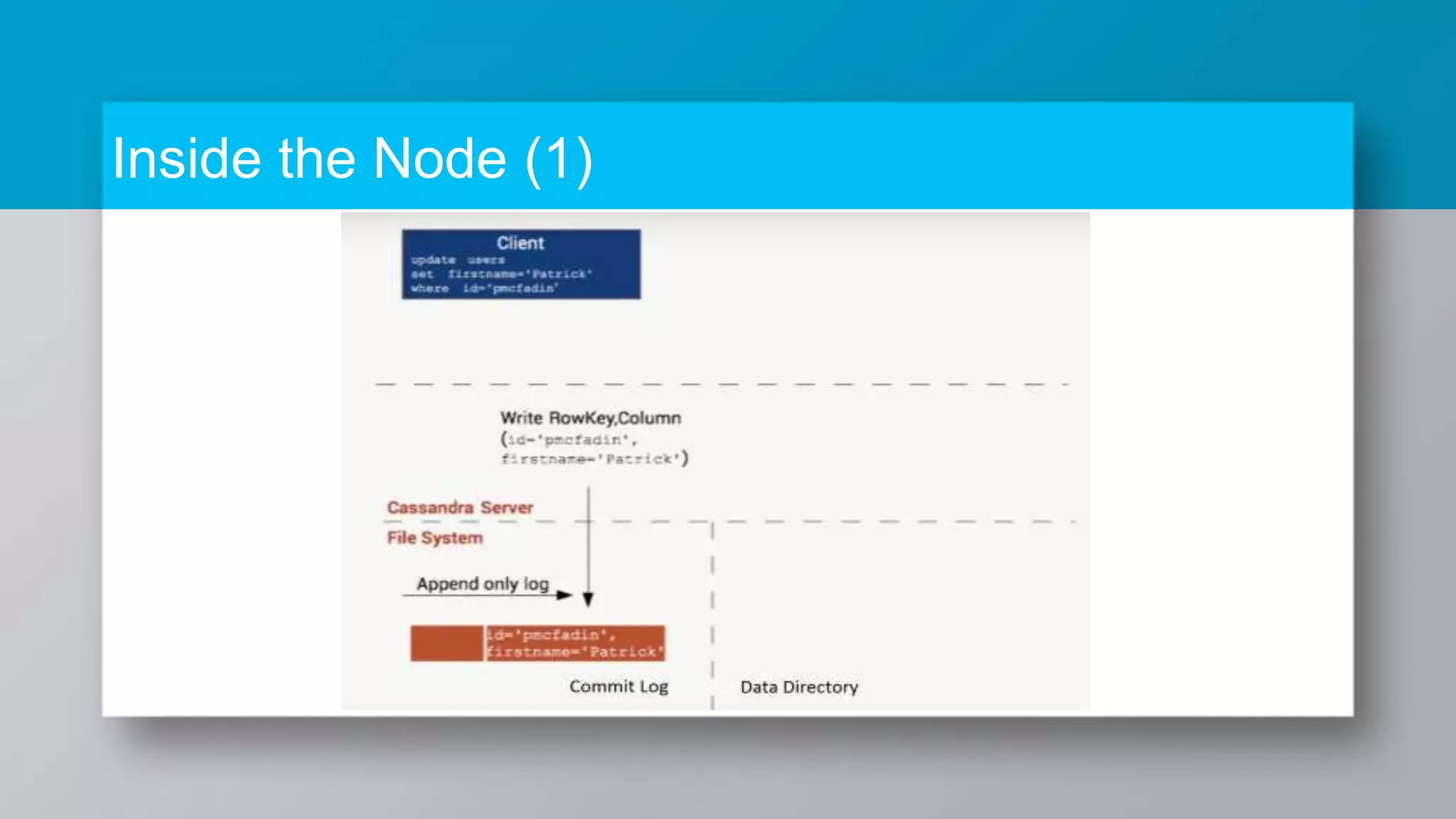
Inside the Node (1)
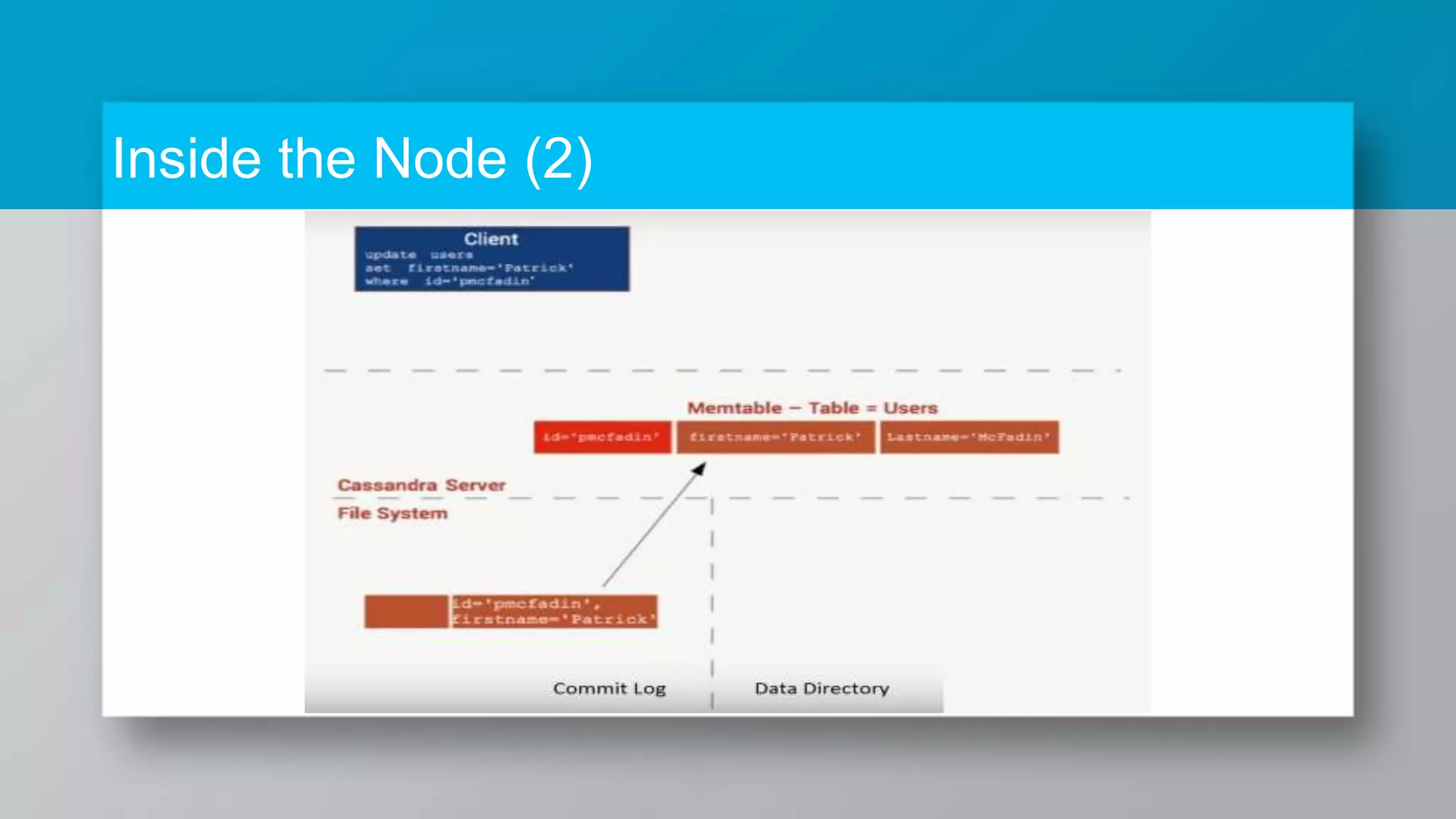
Inside the Node (2)
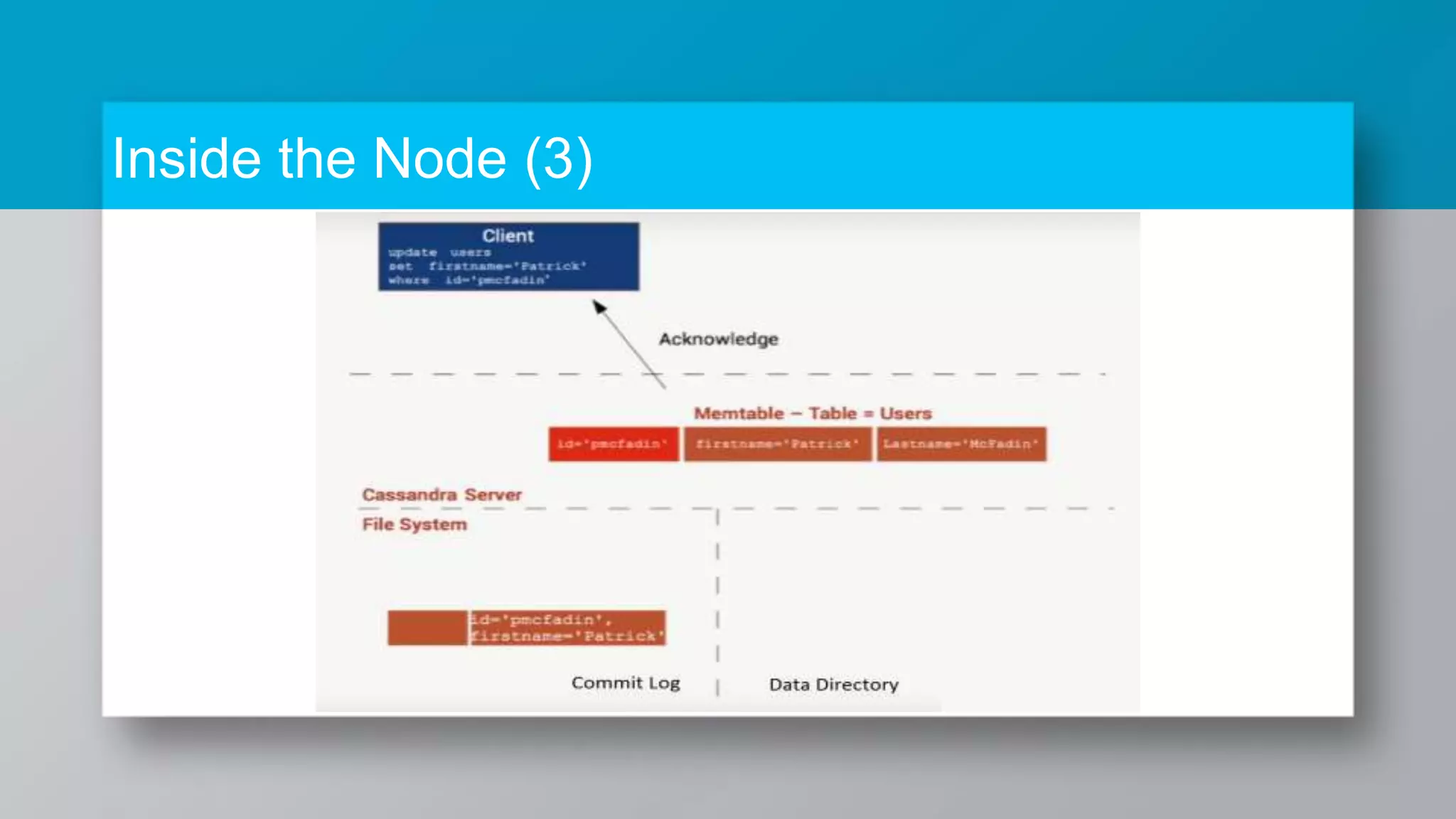
Inside the Node (3)
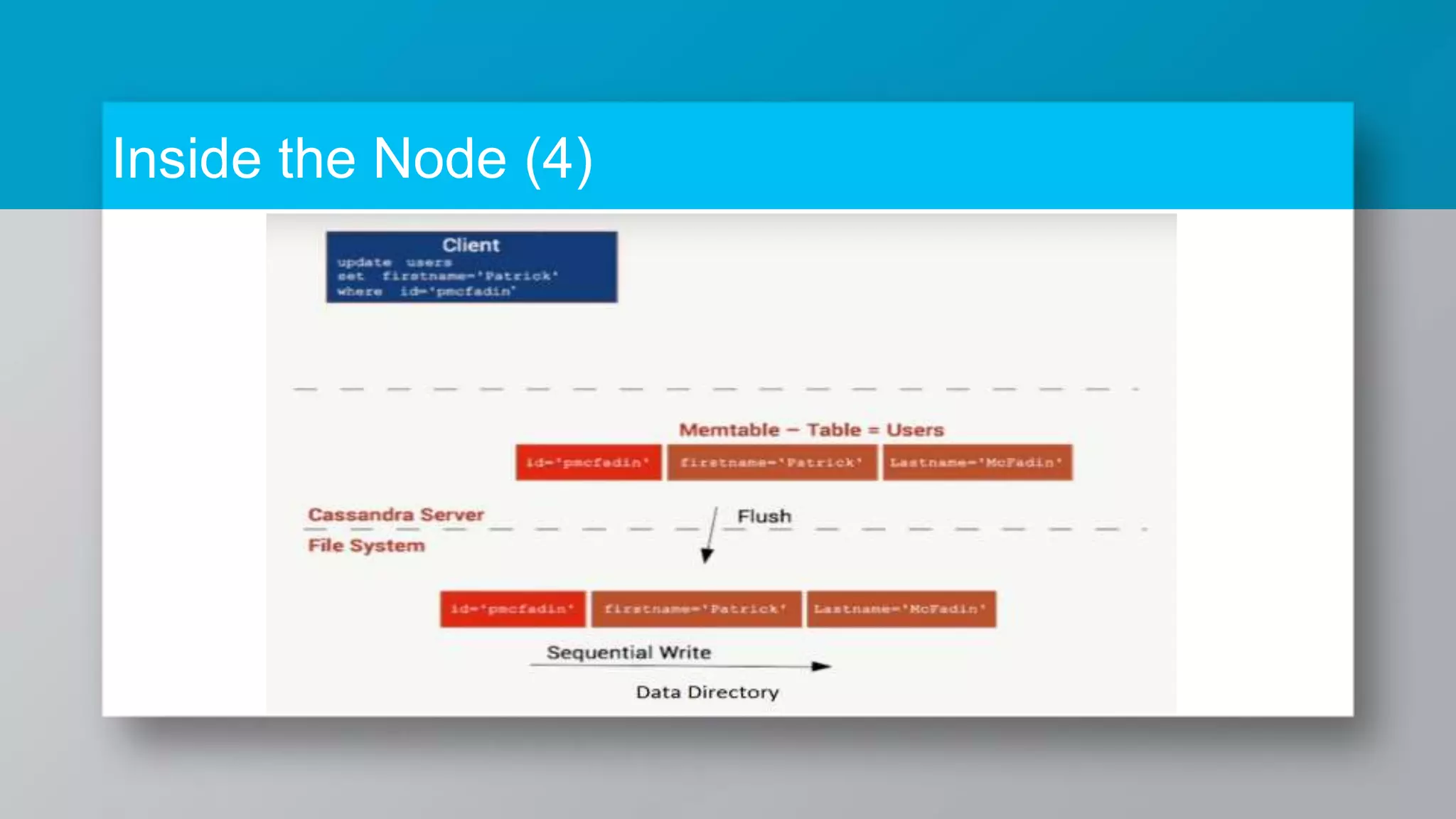
Inside the Node (4)
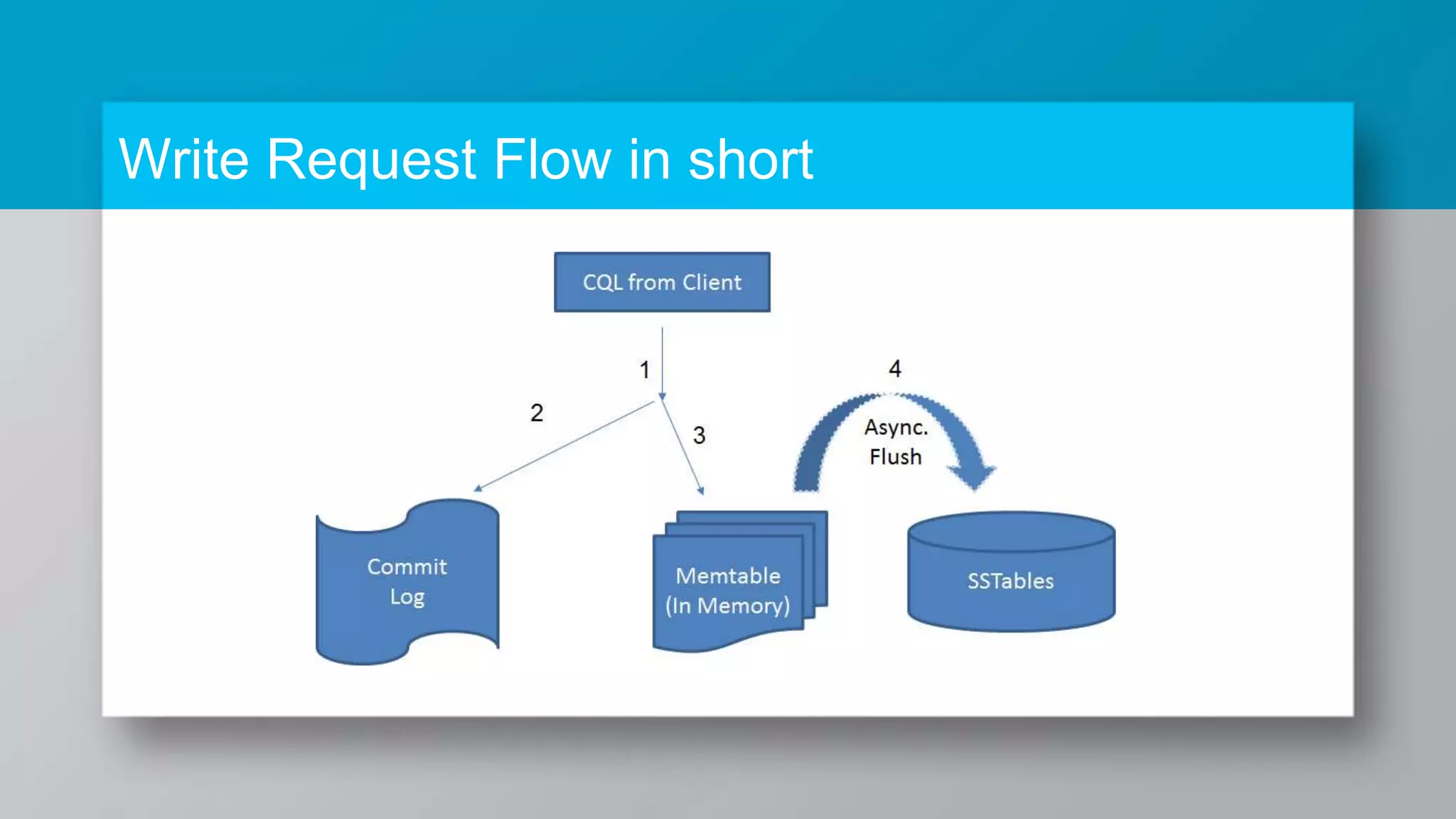
Write Request Flow in short
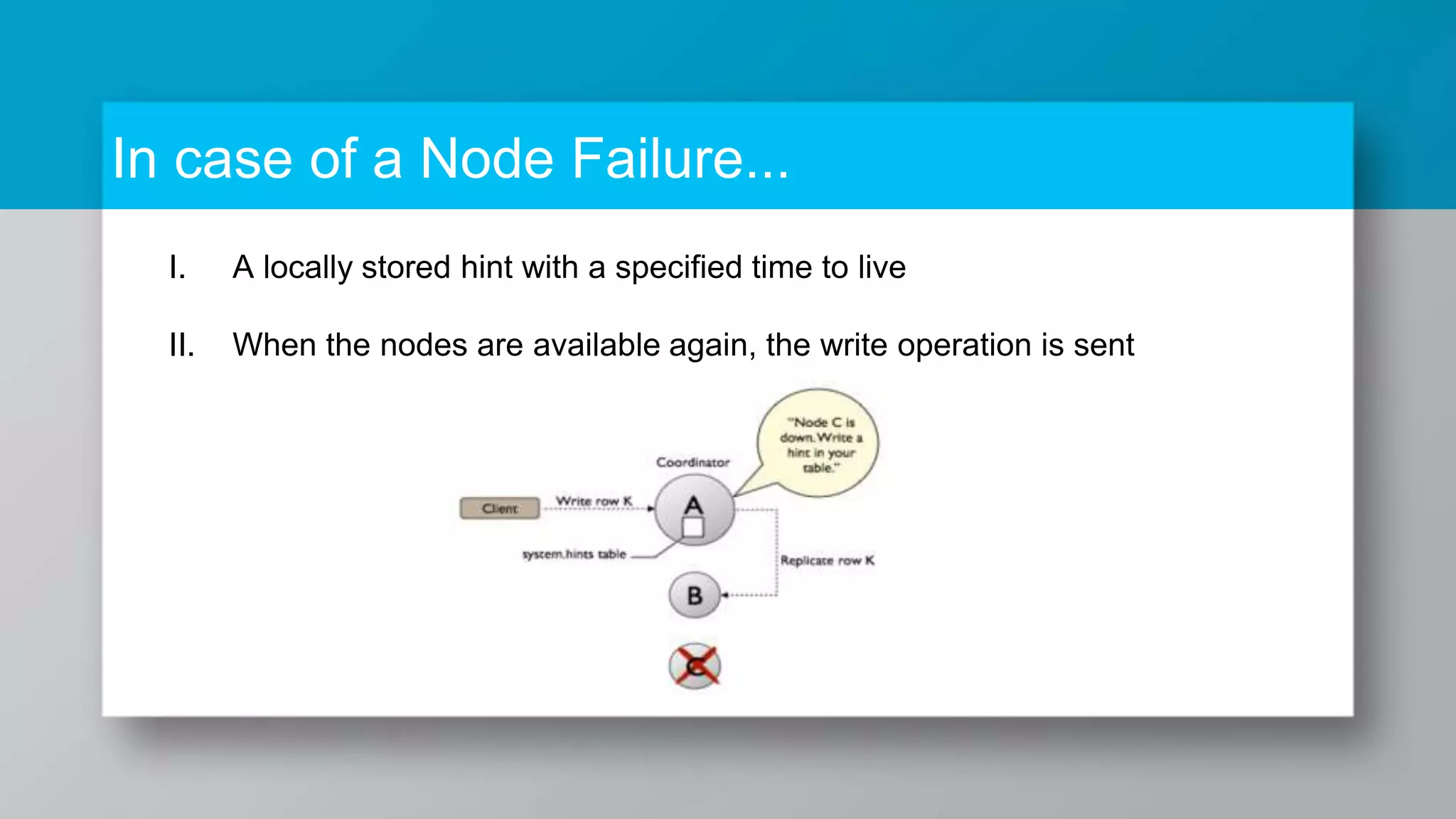
In case of a Node Failure... I. A locally stored hint with a specified time to live II. When the nodes are available again, the write operation is sent
How is a Memtable flushed on the disk? • A background thread keeps checking the size of all the Memtables while the clients keep writing on the cluster • If one of the above conditions is met, a new Memtable is created and the previous one is marked for flushing. i. node’s global memory thresholds have been reached, ii. commit log is full, iii. a table level interval has been reached
How is a Memtable flushed on the disk? (1) • Another thread (or multiple threads) flushes all the marked Memtables on the disc. • The commit log segments corresponding to the entries of the flushed Memtable are marked for recycling. • A bloom filter and an index file are created.
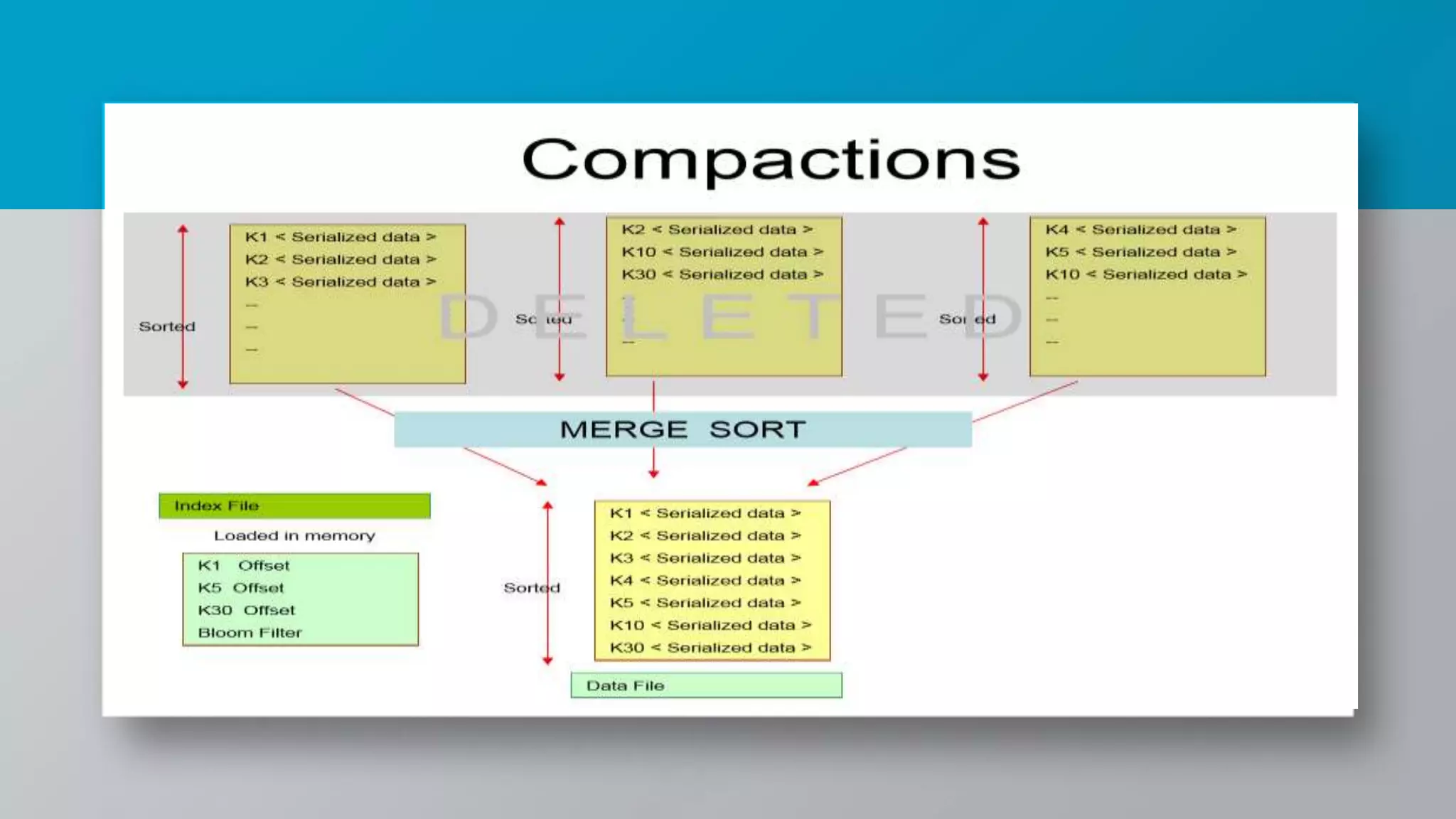
Compaction When the number of SStables has been increased, Cassandra automatically merges multiple SStables, based on an algorithm, specified in the compaction strategy. • Optimizes read requests.
Compaction
Read Request Flow
Read Request Flow (1)
Installation, Usage, Requirements, Platforms 5.
Client Interfaces and Language Support • CQL (Cassandra Query Language) and Thrift • Internal API: StorageProxy API available to JVM-based clients (internal use, highly specialized use-cases) • Spark • Hadoop (Map/Reduce jobs) • Client Libraries for: Python, Java, .Net, Ruby, PHP, Perl, C++ etc.
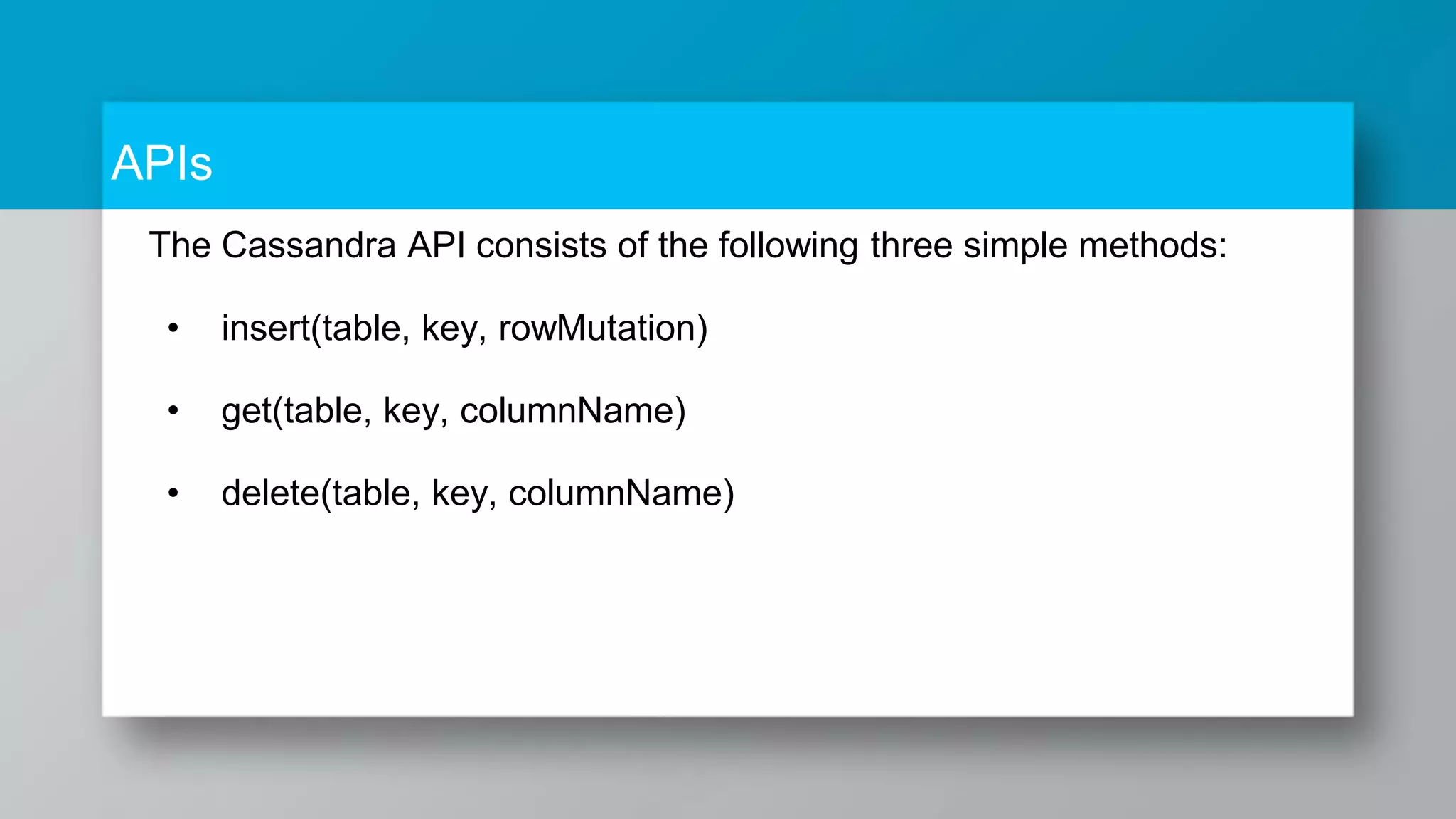
APIs The Cassandra API consists of the following three simple methods: • insert(table, key, rowMutation) • get(table, key, columnName) • delete(table, key, columnName)
Thrift to CQL - An ongoing transition from 2012 Where the legacy Thrift API exposes the internal storage structure of Cassandra pretty much directly, CQL provides a thin abstraction layer over this internal structure.
CQL • The primary language for communicating with the Cassandra database. • Most basic way to interact with Cassandra is using the CQL shell, cqlsh. • Very similar syntax with SQL. • Does not support creation of supercolumns.
Cassandra as a Cloud Database Meets all the requirements of a Cloud Database: • Transparent elasticity • Transparent scalability • High availability • Security • Easy data distribution • Data redundancy • Support all data formats • Low cost • Simple manageability
Integration with other tools BI Tools: • MS Excel • Pentaho • Tableau • Jaspersoft • Talend
Monitoring Cassandra • Integration with Ganglia (distributed performance tool). • Several system level metrics have been exposed to Gaglia. • Helps in understanding the system’s behavior in production conditions.
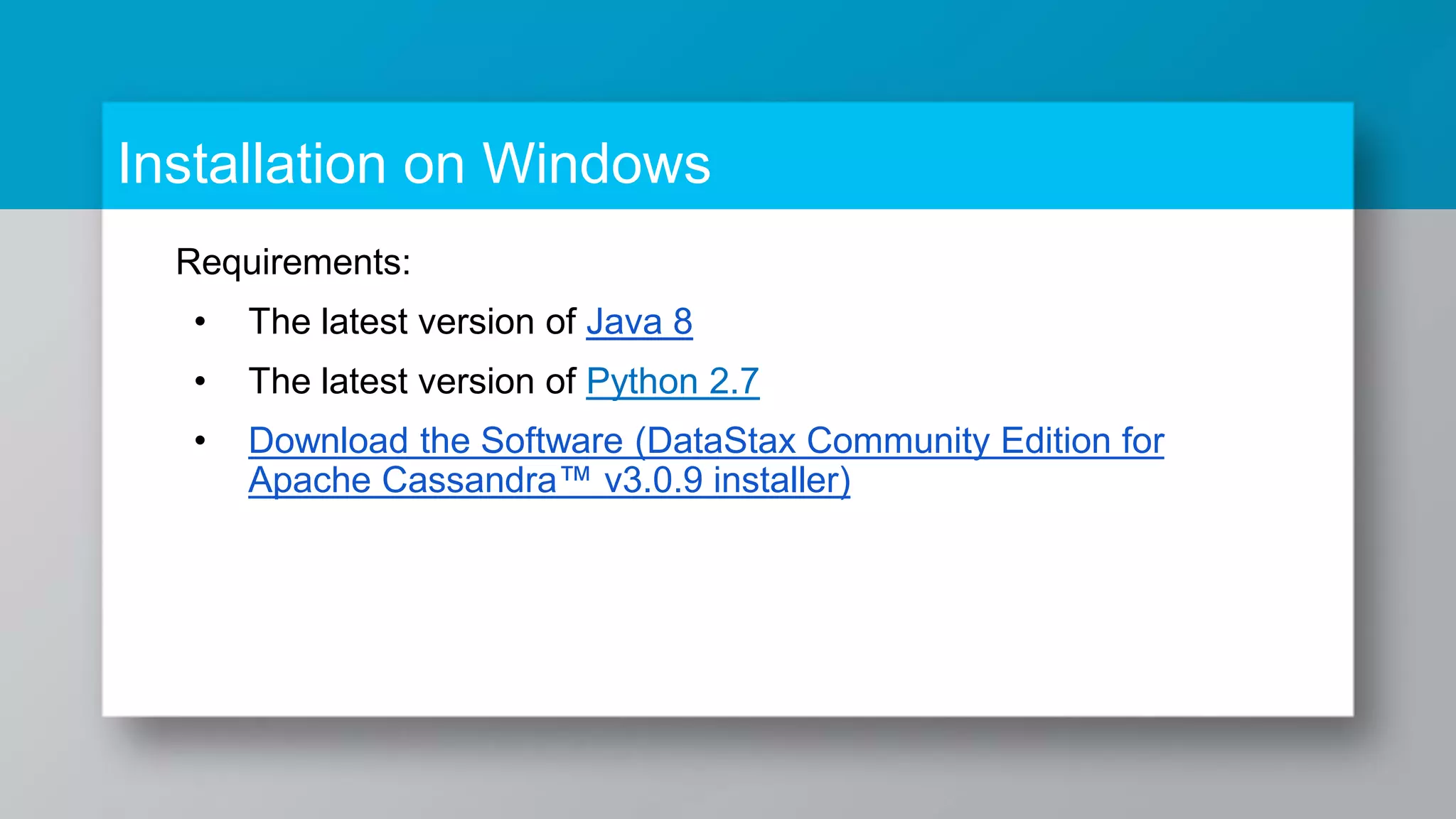
Installation on Windows Requirements: • The latest version of Java 8 • The latest version of Python 2.7 • Download the Software (DataStax Community Edition for Apache Cassandra™ v3.0.9 installer)
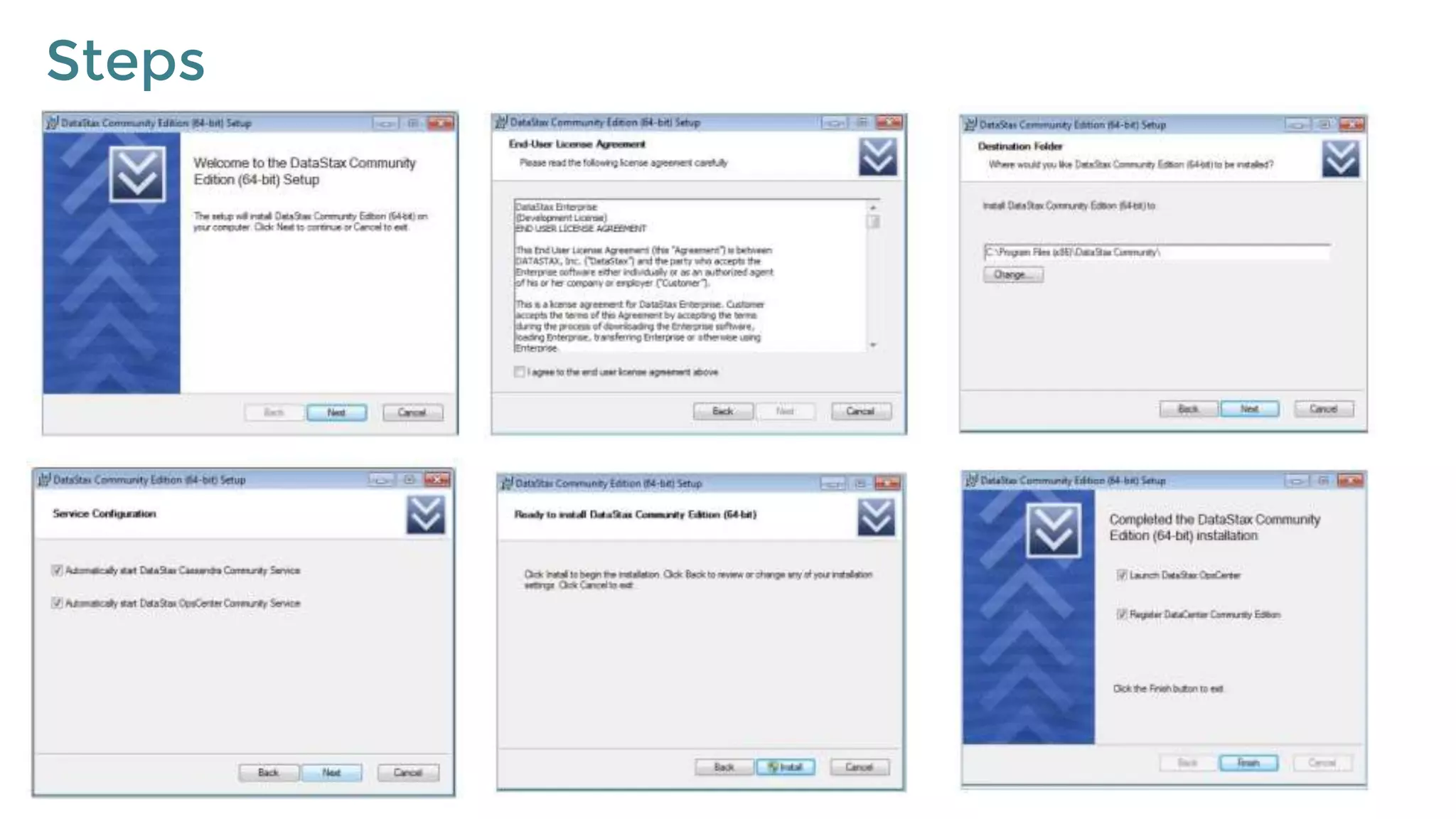
Steps
Creating a Virtual Machine Requirements: • Install Ubuntu Server 12.04 LTS 64 bit OS (any linux system with linux kernel -2.6.x or later) • Update the OS • sudo apt-get update (Internet Connection is mandatory)
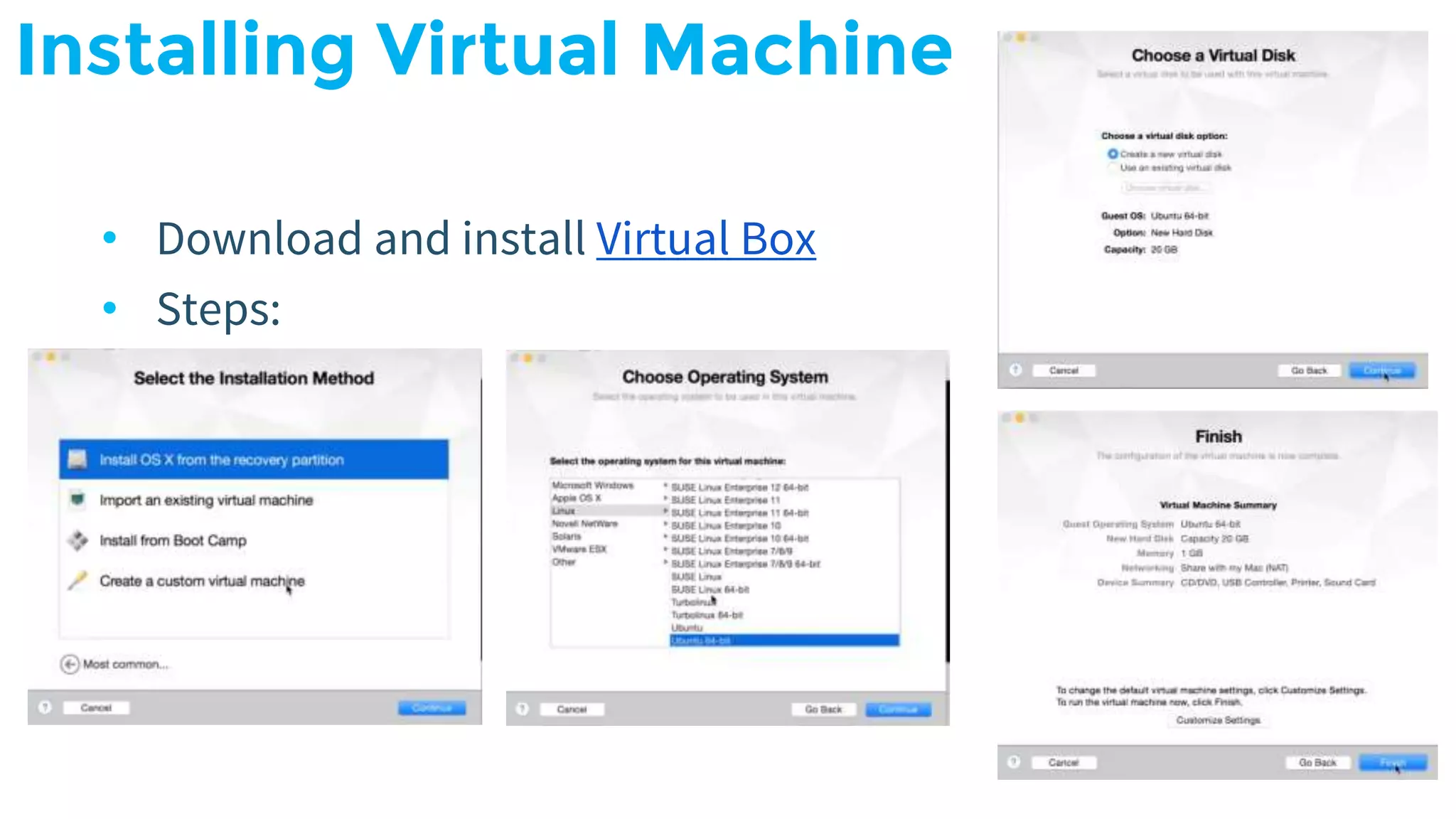
Installing Virtual Machine • Download and install Virtual Box • Steps:
Installation on Mac Requirements: • The latest version of Java 8 • The latest version of Python 2.7 • Download the software(DataStax Community Edition for Apache Cassandra™ v3.0.9 Tarball)
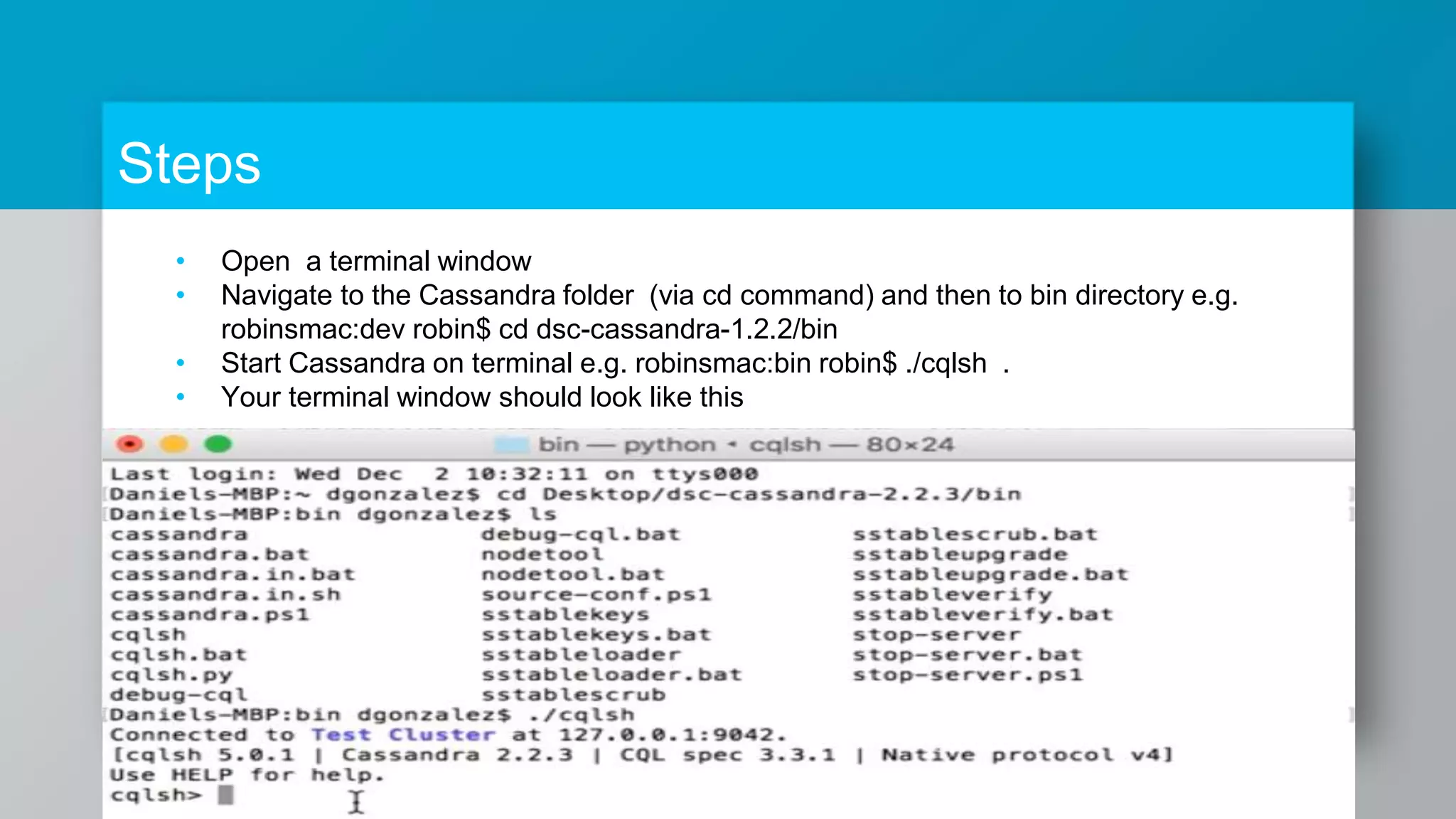
Steps • Open a terminal window • Navigate to the Cassandra folder (via cd command) and then to bin directory e.g. robinsmac:dev robin$ cd dsc-cassandra-1.2.2/bin • Start Cassandra on terminal e.g. robinsmac:bin robin$ ./cqlsh . • Your terminal window should look like this
Installation on Ubuntu Requirements: • The latest version of Java 8 • The latest version of Python 2.7 • Download the software(DataStax Community Edition for Apache Cassandra™ v3.0.9 Tarball)
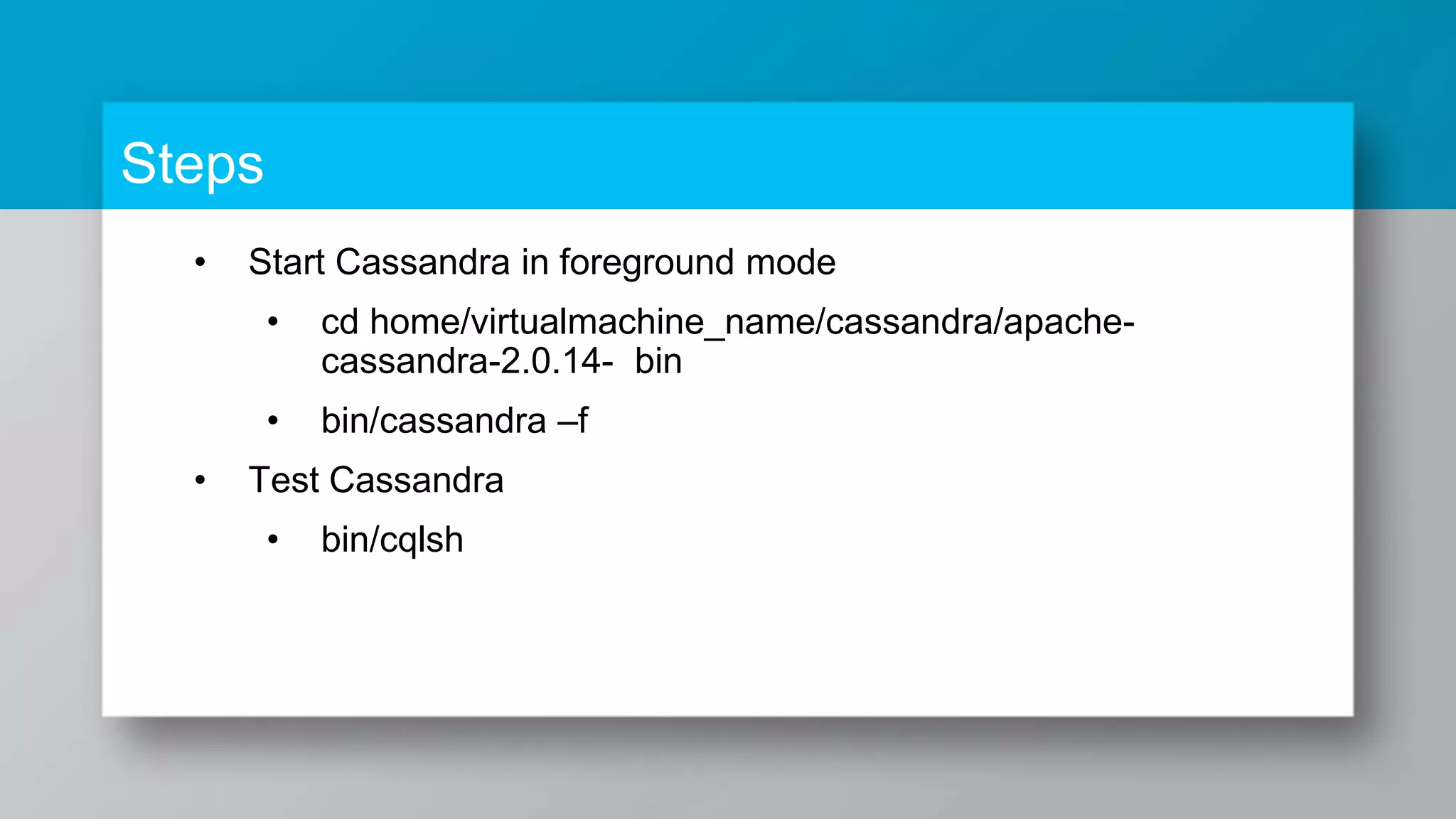
Steps • Start Cassandra in foreground mode • cd home/virtualmachine_name/cassandra/apache- cassandra-2.0.14- bin • bin/cassandra –f • Test Cassandra • bin/cqlsh
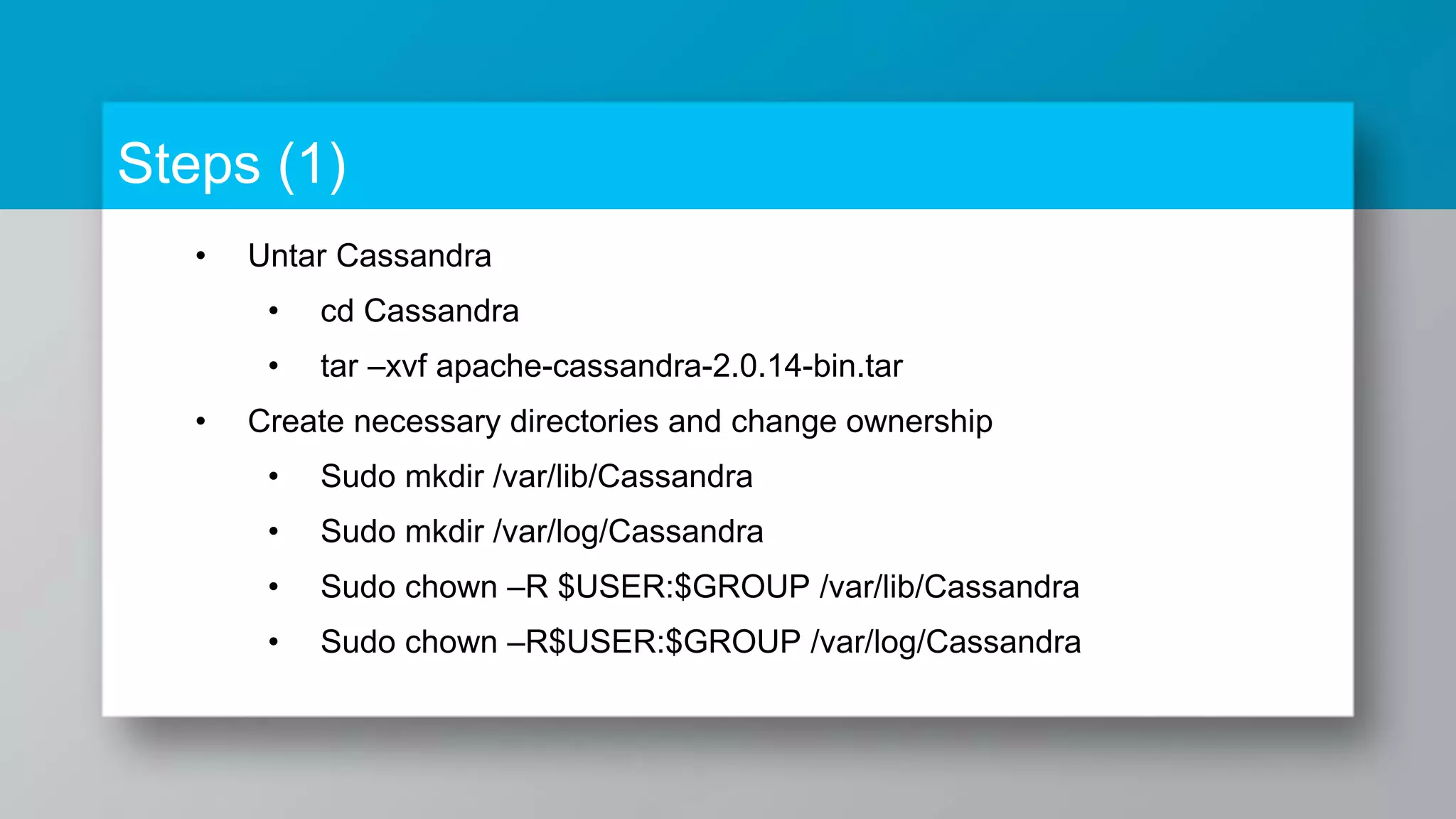
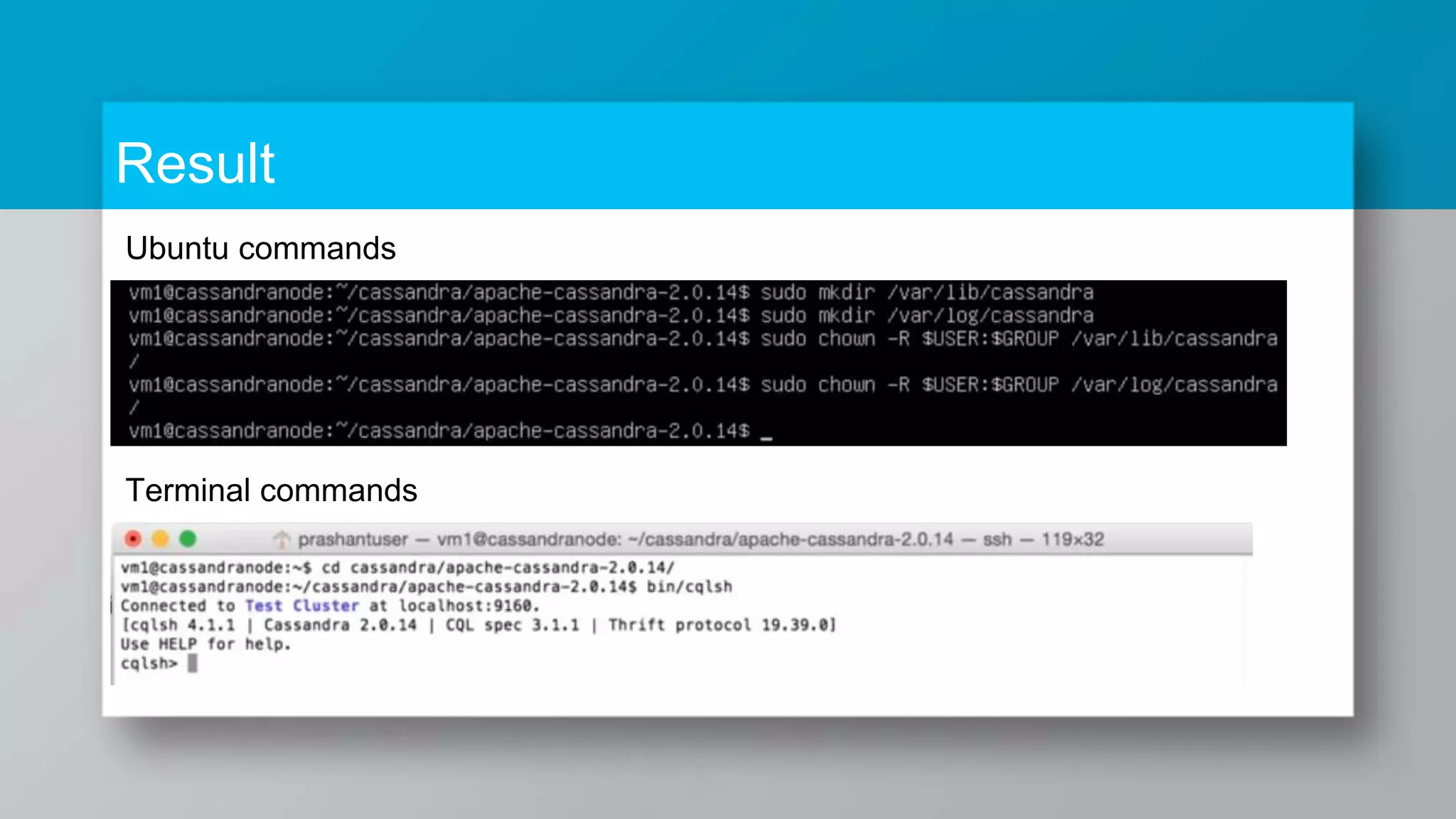
Steps (1) • Untar Cassandra • cd Cassandra • tar –xvf apache-cassandra-2.0.14-bin.tar • Create necessary directories and change ownership • Sudo mkdir /var/lib/Cassandra • Sudo mkdir /var/log/Cassandra • Sudo chown –R $USER:$GROUP /var/lib/Cassandra • Sudo chown –R$USER:$GROUP /var/log/Cassandra
Ubuntu commands Terminal commands Result
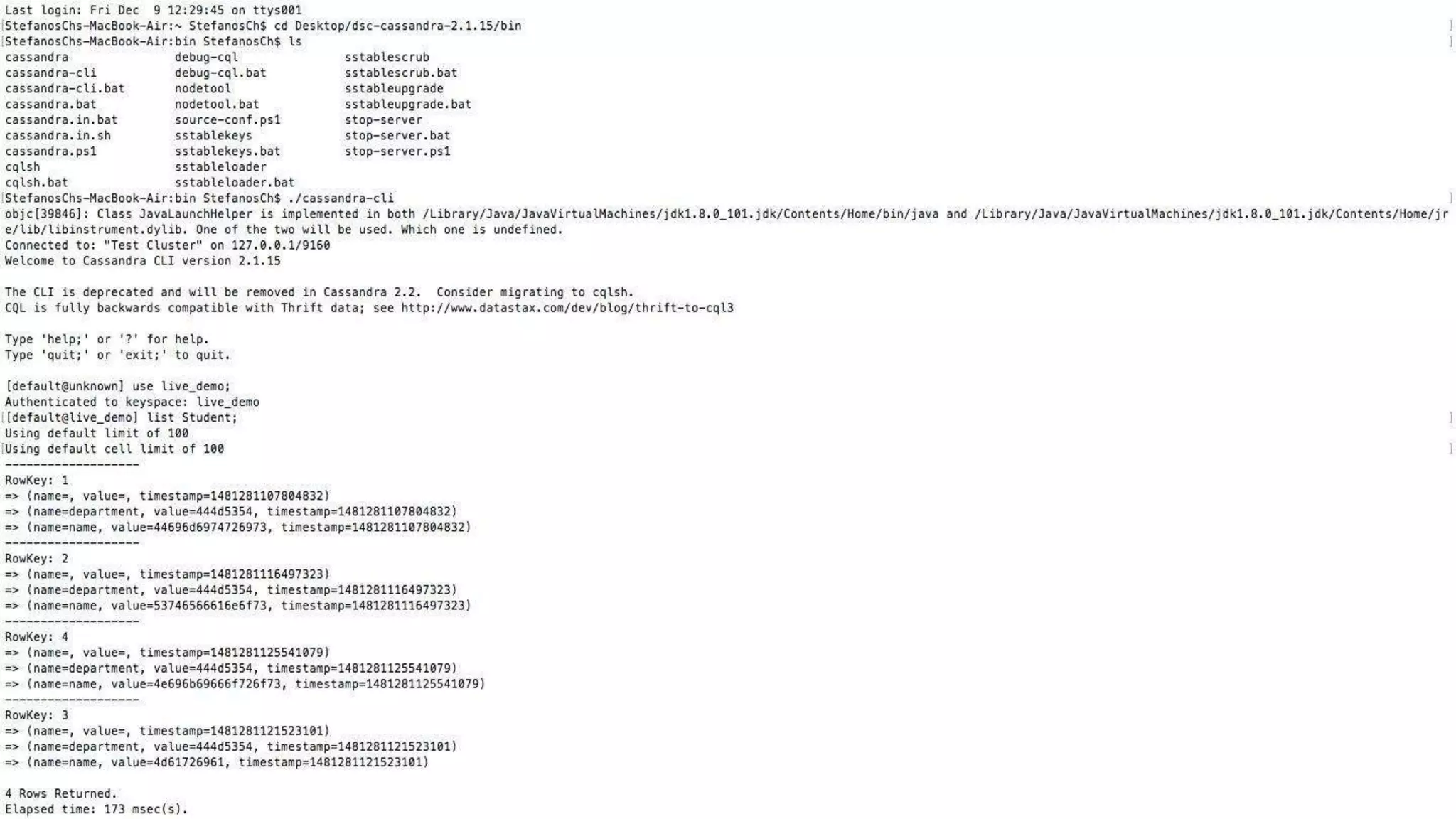
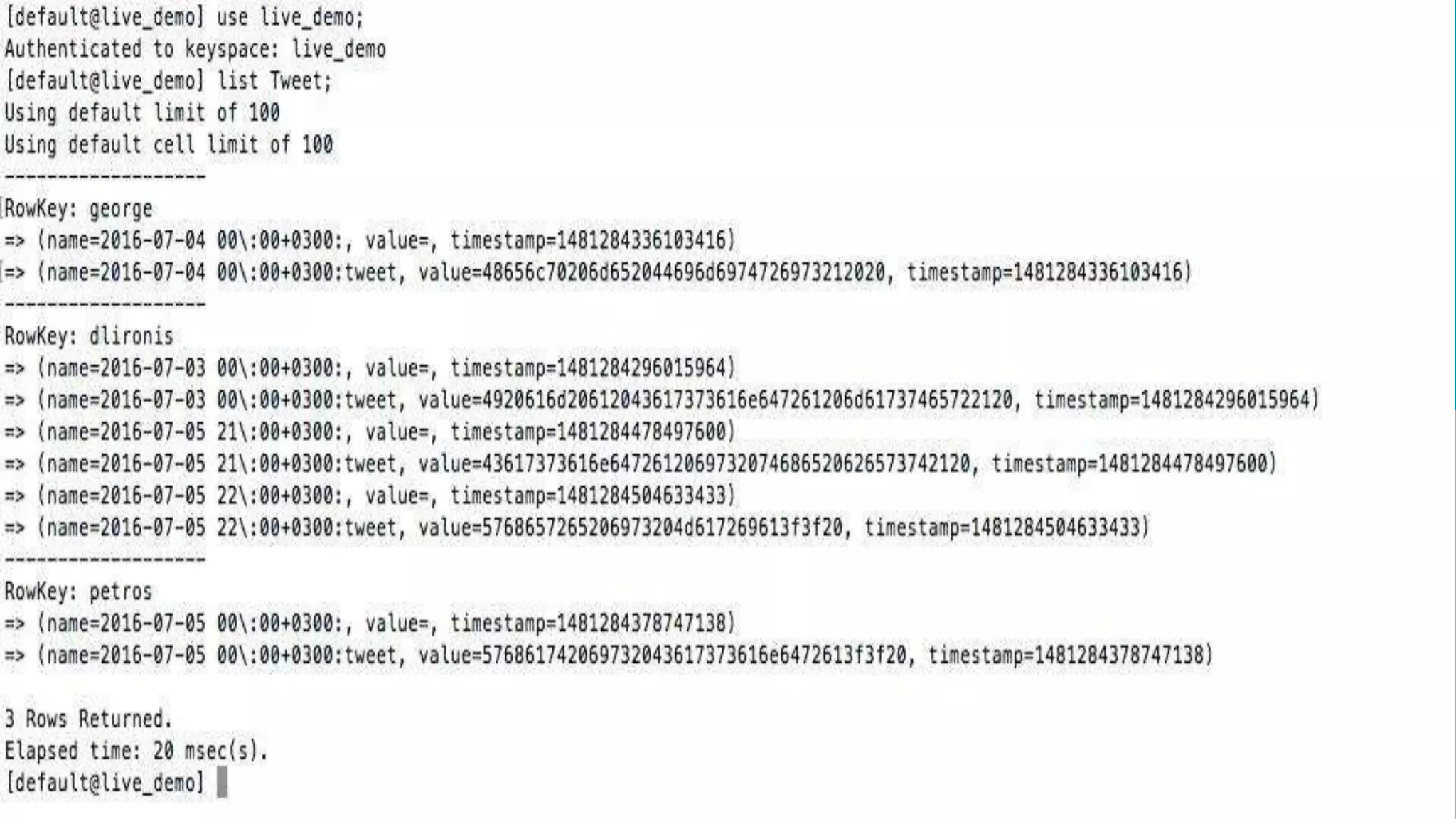
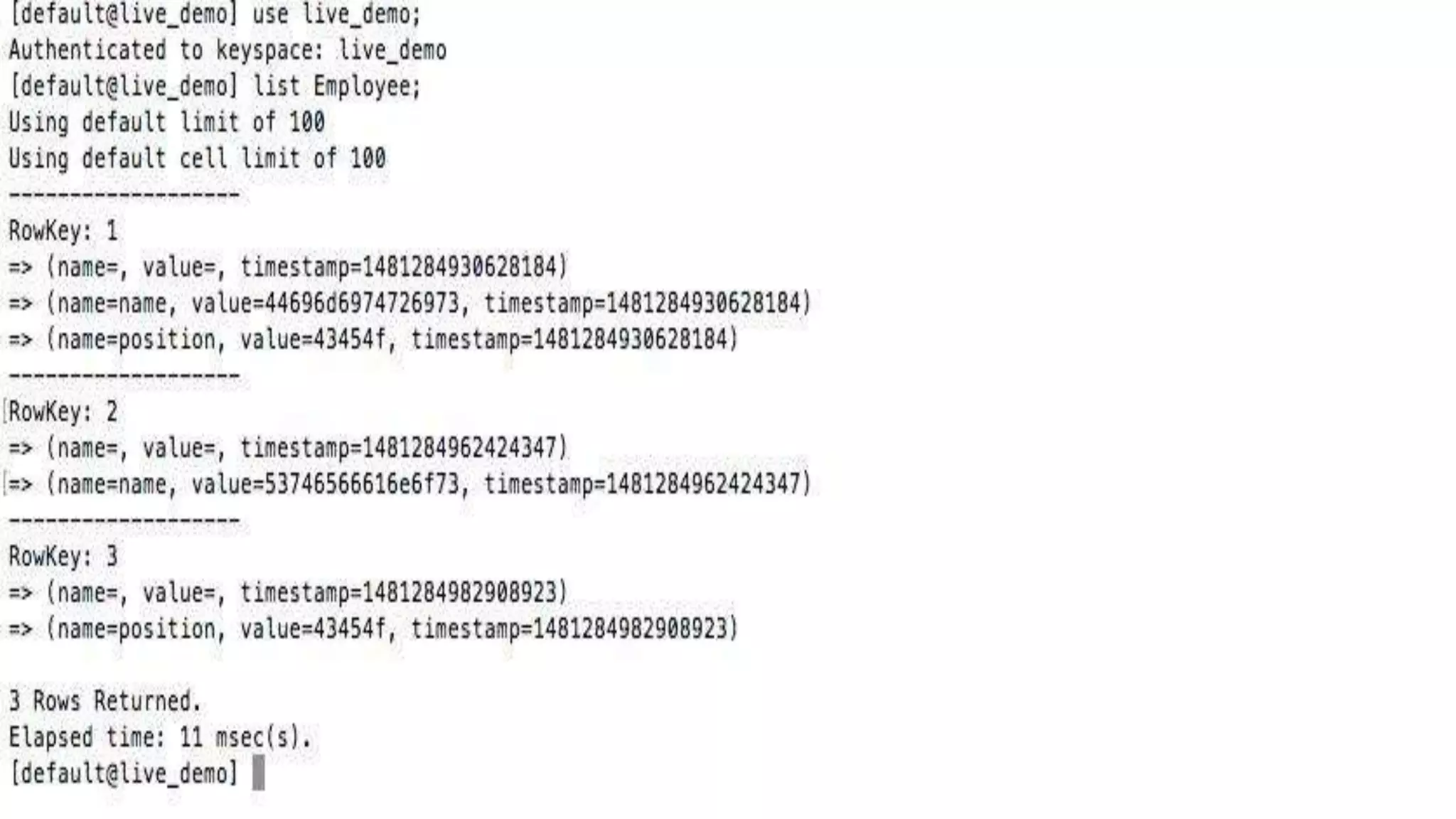
Demo 6.
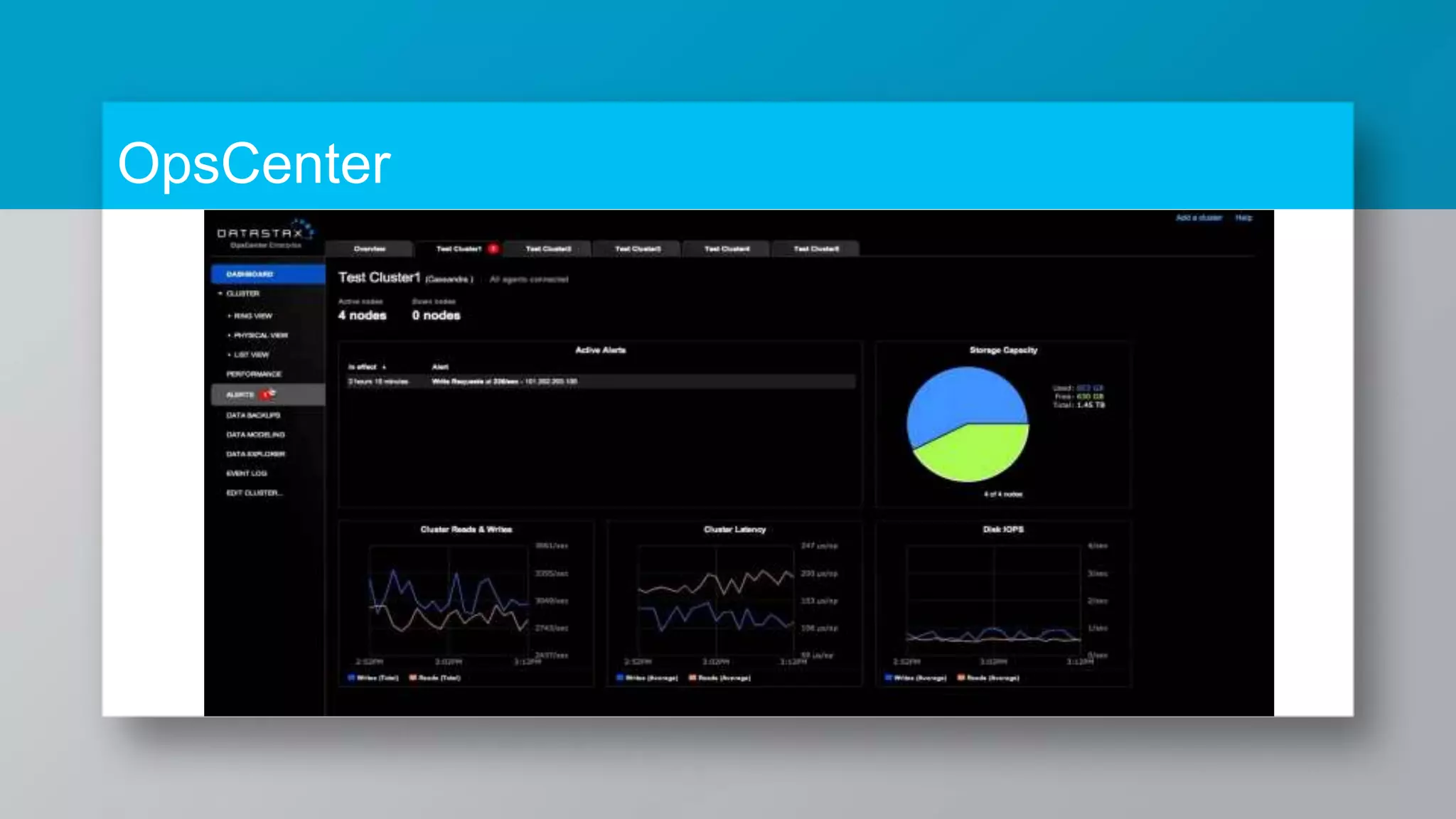
OpsCenter
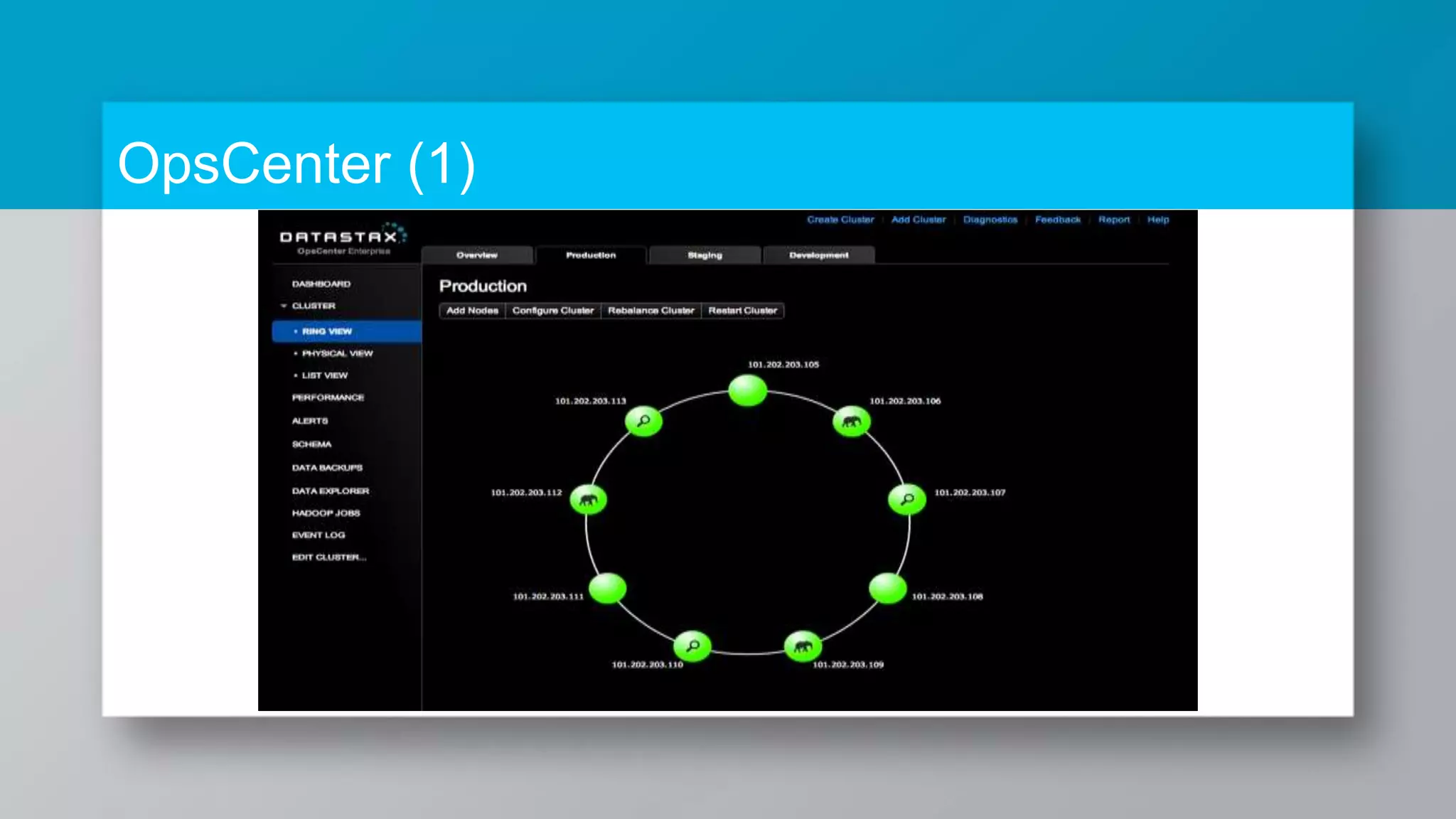
OpsCenter (1)
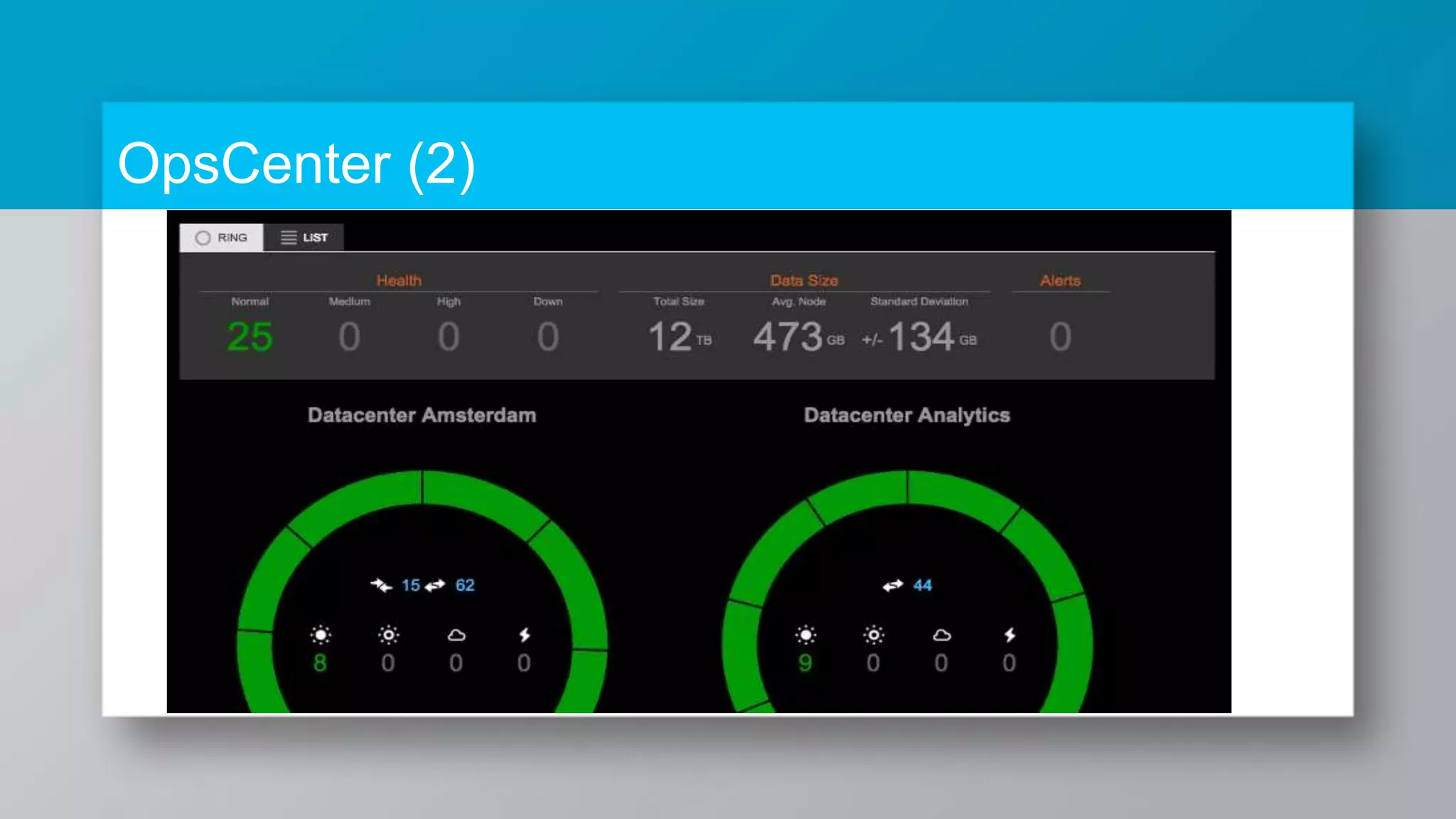
OpsCenter (2)
References 7.
Main Reference
References 1. A. Lakshman and P. Malik. Cassandra: a decentralized structured storage system. SIGOPS Oper. Syst. Rev., 44(2): 35-40, 2010 2. Cassandra.apache.org. (2016). Apache Cassandra. [online] Available at: http://cassandra.apache.org/ 3. Cattell, R. (2011). Scalable SQL and NoSQL data stores. ACM SIGMOD Record, 39(4), p.12. 4. Cockcroft, A. (2011). Benchmarking Cassandra Scalability on AWS - Over a million writes per second. [online] Techblog.netflix.com. Available at: http://techblog.netflix.com/2011/11/benchmarking-cassandra-scalability- on.html 5. Cs.uwaterloo.ca. (2016). [online] Available at: https://cs.uwaterloo.ca/~tozsu/courses/CS848/W15/presentations/Cassandra.pdf 6. Chang, F., Dean, J., Ghemawat, S., Hsieh, W., Wallach, D., Burrows, M., Chandra, T., Fikes, A. and Gruber, R. (2008). Bigtable. ACM Transactions on Computer Systems, 26(2), pp.1-26. 7. DataStax. (2016). Case Studies. [online] Available at: http://www.datastax.com/resources/casestudies
References (1) 8. Docs.datastax.com. (2016). About hinted handoff writes. [online] Available at: https://docs.datastax.com/en/cassandra/2.0/cassandra/dml/dml_about_hh_c.html 9. DataStax. (2016). Customers. [online] Available at: http://www.datastax.com/customers 10. Docs.datastax.com. (2016). Introduction to Cassandra Query Language. [online] Available at: https://docs.datastax.com/en/cql/3.1/cql/cql_intro_c.html 11. DataStax. (2014). What on earth are people using Cassandra for anyway?. [online] Available at: http://www.datastax.com/2014/06/what-are-people-using-cassandra-for 12. DataStax. (2012). A thrift to CQL3 upgrade guide. [online] Available at: http://www.datastax.com/dev/blog/thrift-to-cql3 13. DataStax. (2012). Virtual nodes in Cassandra 1.2. [online] Available at: http://www.datastax.com/dev/blog/virtual-nodes-in-cassandra-1-2 14. DataStax. (2012). Schema in Cassandra 1.1. [online] Available at: http://www.datastax.com/dev/blog/schema- in-cassandra-1-1
References (2) 15. DeCandia, G., Hastorun, D., Jampani, M., Kakulapati, G., Lakshman, A., Pilchin, A., Sivasubramanian, S., Vosshall, P. and Vogels, W. (2007). Dynamo. ACM SIGOPS Operating Systems Review, 41(6), p.205. 16. Docs.datastax.com. (2016). Architecture in brief. [online] Available at: https://docs.datastax.com/en/cassandra/2.0/cassandra/architecture/architectureIntro_c.html 17. Docs.datastax.com. (2016). How data is distributed across a cluster (using virtual nodes). [online] Available at: http://docs.datastax.com/en/cassandra/2.0/cassandra/architecture/architectureDataDistributeDistribute_c.html 18. Docs.datastax.com. (2016). Internode communications (gossip). [online] Available at: https://docs.datastax.com/en/cassandra/2.0/cassandra/architecture/architectureGossipAbout_c.html 19. D0.awsstatic.com. (2016). [online] Available at: https://d0.awsstatic.com/whitepapers/Cassandra_on_AWS.pdf 20. Edlich, P. (2016). NOSQL Databases. [online] Nosql-database.org. Available at: http://nosql-database.org/
References (3) 21. Edu.dmst.aueb.gr. (2016). Πύλη Τηλεκπαίδευσης Τμήματος Διοικητικής Επιστήμης & Τεχνολογίας: Είσοδος στο δικτυακό τόπο. [online] Available at: https://edu.dmst.aueb.gr/pluginfile.php/3614/mod_resource/content/0/BigDataSystems.pdf 22. En.wikipedia.org. (2016). Apache Cassandra. [online] Available at: https://en.wikipedia.org/wiki/Apache_Cassandra 23. En.wikipedia.org. (2016). DataStax. [online] Available at: https://en.wikipedia.org/wiki/DataStax 24. En.wikipedia.org. (2016). Log-structured merge-tree. [online] Available at: https://en.wikipedia.org/wiki/Log- structured_merge-tree 25. Exponential.io. (2016). Cassandra terminology - Exponential.io . [online] Available at: http://exponential.io/blog/2015/01/08/cassandra-terminology/
References (4) 26. Facebook.com. (2016). Cassandra – A structured storage system on a P2P Network. [online] Available at: https://www.facebook.com/notes/facebook-engineering/cassandra-a-structured-storage-system-on-a-p2p- network/24413138919/ 27. O&#039, P. and Neil, E. (2016). The Log-Structured Merge-Tree (LSM-Tree). [online] Citeseerx.ist.psu.edu. Available at: http://citeseerx.ist.psu.edu/viewdoc/summary?doi=10.1.1.44.2782 28. YouTube. (2016). Getting Started with Cassandra CQL on a Mac. [online] Available at: https://www.youtube.com/watch?v=9zQc959w6Ho 29. YouTube. (2016). Installing Apache Cassandra In Windows. [online] Available at: https://www.youtube.com/watch?v=fspXzjwfii0 30. YouTube. (2016). Part 1 - Apache Cassandra Installation From Scratch - Ubuntu. [online] Available at: https://www.youtube.com/watch?v=ToztU48UxYE
References (5) 31. Weinberger, M. (2016). The Facebook engineer who taught its data how to dance is solving a new complicated problem. [online] Business Insider. Available at: http://www.businessinsider.com/hedvig-avinash- lakshman-facebook-cassandra-data-storage-2015-3 32. Wiki.apache.org. (2016). FrontPage - Cassandra Wiki. [online] Available at: https://wiki.apache.org/cassandra/ 33. www.tutorialspoint.com. (2016). Cassandra Introduction. [online] Available at: https://www.tutorialspoint.com/cassandra/cassandra_introduction.htm

Presentation of Apache Cassandra

  • 1.
  • 2.
    1. Introduction toNoSQL systems, Extensible Record Stores and Amazon’s Dynamo + Google Bigtable 2. What Cassandra is and how it is compared with other similar systems 3. What applications are better supported - examples, case studies 4. Technical Description, architecture, internals 5. How is it used and installed, requirements and in what platforms does it run on 6. Demo 7. References Contents
  • 3.
    Background NoSQL, Extensible RecordStores, Cassandra’s Parents 1.
  • 4.
    NoSQL or Not-Only-SQLsystems: Next Generation Databases. The initial movement started in 2009 with the goal of creating modern, web-scale DBs. Currently, they exist more than 225 NoSQL systems. In general, they share the following features: • Schema-free databases • Easy replication support • Simple API • Distributed • Open Source NoSQL Systems • BASE (instead of ACID) • Huge amount of data • Horizontally scalable
  • 5.
    • Motivated byGoogle’s Big Table. • Basic Data Model: Rows and Columns • Basic Scalability Model: Rows and Columns are splitted into nodes. • Rows: split across nodes through sharding on the primary key. • Columns: distributed over multiple nodes by using ‘column groups’. • Other systems that use this technology: Hypertable, HBase. Extensible Record Stores (or Wide Column Stores)
  • 6.
    What is it? Ahighly-available and scalable storage system used by Amazon to store and retrieve user shopping charts and other core services. It pioneered the idea of eventual consistency. Key-Value Store. How it works? Allows read and write operations to continue even during network partitions and resolves update conflicts using different conflict resolution mechanisms. Sacrifices consistency for availability. Allows customization to meet desired preference. Consistent Hashing, Vector Clocks (not in Cassandra), Gossip Protocol, Hinted Handoff, Read Repair Cassandra’s Parents - Amazon Dynamo
  • 7.
    Cassandra’s Parents -Google Bigtable What is it? A high performance data storage system built on Google File System and other Google technologies. How it works? Provides both structure and data distribution but relies on a distributed file system for durability. Richer data model from Dynamo. One key, many values. Fast sequential access. Columnar, SSTable Storage, Append-only, Memtable, Compaction
  • 8.
    What features doesCassandra use from Google’s BigTable? 1. Column Families 2. Memtables 3. SSTables What features does Cassandra use from Amazon Dynamo? 1. Consistent hashing 2. Partitioning 3. Replication Cassandra’s Parents
  • 9.
  • 10.
    Description and Comparisons WhatCassandra is and how it is compared with other similar systems 2.
  • 11.
    Avinash Lakshman • Inventor,Apache Cassandra • Co-inventor, Amazon Dynamo
  • 12.
    Prashant Malik • Inventor,Apache Cassandra • Technical Leader, Facebook
  • 14.
  • 15.
    Definition • A distributedNoSQL database system for managing large amounts of structured data across many commodity servers, while providing highly available service and no single point of failure.
  • 16.
    Timeline with activities •July 2008 Facebook released Cassandra as an open-source project • March 2009 Cassandra became an Apache Incubator project • 17th February 2010 Cassandra graduated to a top-level project • 2012 University of Toronto researchers studying NoSQL systems concluded that “In terms of scalability, there is a clear winner throughout our experiments” • 2010-2015 New releases of Cassandra
  • 17.
    Strengths • Linear scaleperformance The ability to add nodes without failures leads to predictable increases in performance • Supports multiple languages Python, C#/.NET, C++, Ruby, Java, Go, and many more… • Operational and developmental simplicity There are no complex software tiers to be managed, so administration duties are greatly simplified. • Ability to deploy across data centres Cassandra can be deployed across multiple, geographically dispersed data centres
  • 18.
    • Cloud availability Installationsin cloud environments • Peer to peer architecture Cassandra follows a peer-to-peer architecture, instead of master-slave architecture • Flexible data model Supports modern data types with fast writes and reads • Fault tolerance Nodes that fail can easily be restored or replaced • High Performance Cassandra has demonstrated brilliant performance under large sets of data Strengths (1)
  • 19.
    • ColumnFamily Store Cassandrastores columns based on the column names, leading to very quick slicing • Tunable consistency Support for strong or eventual data consistency across a widely distributed cluster • Schema-free/Schema-less In Cassandra, columns can be created at your will within the rows. Cassandra data model is also famously known as a schema-optional data model • AP-CAP Cassandra is typically classified as an AP system, meaning that availability and partition tolerance are generally considered to be more important than consistency in Cassandra Strengths (2)
  • 20.
  • 21.
    Variable number ofcolumns per row
  • 22.
    Weaknesses Use Cases whereis better to avoid using Cassandra • If there are too many joins required to retrieve the data • To store configuration data • During compaction, things slow down and throughput degrades • Basic things like aggregation operators are not supported • Range queries on partition key are not supported • If there are transactional data which require 100% consistency • Cassandra can update and delete data but it is not designed to do so
  • 23.
    Business Insider “The basicproblem Cassandra solved is that when you have a lot of data sitting on a lot of servers, as Facebook does, you end up with a house of cards. A single server going down can collapse the whole stack.”
  • 24.
    Cassandra compared toother NoSQL Systems
  • 25.
    Read & Writelatency for workload Read/Write
  • 26.
    Throughput for workloadRead/Write & Read/Scan/Write
  • 27.
  • 28.
    Mixed Operational &Analytical Workload
  • 29.
  • 30.
  • 31.
  • 32.
  • 33.
  • 34.
    Differences between Cassandraand RDBMS RDBMS Cassandra relational database keyspace b-trees log-structured merge-trees rows which do not include a particular column value → NULL (in that position) for each row, only the columns with a value are stored support ACID transactions only supports AID
  • 36.
  • 37.
    What kind ofapplications are supported by Cassandra >80% of the clients fit into one of the next categories: I. Product Catalog/Playlist II. Recommendation/Personalization Engine III. Sensor Data/Internet of Things IV. Messaging (and generally time-series data) V. Fraud Detection
  • 38.
    In other words,applications that need to... • store and handle time-series data (most common use case) • store and handle large volumes of data • scale predictably • be continuously available • protect their data
  • 39.
    Datastax • A softwarecompany that develops and provides support for a commercial edition of Cassandra. • Massively scalable NoSQL platform able to run online applications for innovative and data-intensive companies (e.g. Netflix). • Faster to deploy and less expensive to maintain than other database platforms. • Powered by Cassandra and contains only selected releases of it, chosen by its expert staff.
  • 40.
    Datastax (1) • Supportsbusinesses that need a progressive data management. • Can serve as a real-time datastore for online production. • Delivers a unique, smart data platform, suitable for the cloud.
  • 41.
    Customers • Over 3.000companies around the world use (or have used) Apache Cassandra in production. • Most famous:
  • 42.
    Cassandra Summit • Organizedby DataStax for 7 consecutive years (in both US and Europe). • New product releases are announced. • Customers describe their usage of Cassandra
  • 43.
    Key Terms • Cluster •Distributed Location • Node
  • 44.
  • 45.
  • 46.
    Facebook Inbox Search- Requirements “The system was required to handle a very high write throughput, billions of writes per day, and also scale with the number of users” “Since users are served from data centres that are geographically distributed, being able to replicate data across data centres was key to keep search latencies down” • Lakshman, Malik
  • 47.
    Facebook Inbox Search Thereason why Cassandra was initially built. Facebook maintains a per user index of all messages that have been exchanged between the senders and the recipients of the message. Two kinds of search features enabled at 2008: I. term search II. interactions - given a person’s name, returns all the messages have been sent/received from that person
  • 48.
    Facebook Inbox Search(1) How did they do that? The schema consists of two column families. Exploits the “time sorting” feature of Cassandra. For the term search: • UserID → key • Words that make up the message → super columns • Columns within the super column → individual message identifiers (MessageID) of the messages that contain the word.
  • 49.
    Facebook Inbox Search(2) For the interactions: • UserID → key • RecipientsID’s → super columns • Columns within the super columns → MessageID’s • Cassandra provides certain hooks for intelligent caching of data
  • 50.
  • 51.
    Facebook Inbox Search(3) In 2008: • system was storing 50+ TB of data • on a 150 node cluster • spread out between east and west coast data centres Performance:
  • 52.
    Facebook abandoned Cassandrafor the Inbox at late 2010 Cassandra has been deployed as the backend storage system for multiple services within Facebook.
  • 53.
    Categories: Fraud Detectionand Time-series data
  • 54.
    Instagram Fraud Detection Initiallywas using Redis for auditing information related to security and site integrity purposes (e.g. fighting spam, finding abusive users). But… • data size was growing too quickly • high write and low read rate • keeping the data in memory was too costly So… Cassandra
  • 55.
    Instagram Fraud Detection(1) • Started with 3 nodes and very soon they had grown to a 12 node cluster. • No need to store very large instances in memory → put everything on disks. “Implementing Cassandra cut our costs to the point where we were paying around a quarter of what we were paying before. Not only that, but it also freed us to just throw data at the cluster because it was much more scalable and we could add nodes whenever needed.” - Brick Branson, Software Engineer at Instagram
  • 56.
    Instagram “Inbox” Newsfeed orinbox part of Instagram: a feed of all the activity that would be associated with a given user’s account. Previously in Redis, with the same (memory) limitations as in the Fraud Detection case. Instagram’s Cassandra Cluster: • 12 nodes on EC2 (AWS) • 1.2 TB of data stored • 20.000 writes/sec. • 15.000 reads/sec.
  • 57.
  • 58.
    i2O Water Description: i2OWater helps utility companies operate more efficiently through the use of IoT aiming at solving the water crisis. Challenges: • Massive volumes of time-series data (>1.5 TB and growing) • Need for search and analysis of high velocity, streaming data in near real-time • SQL Server (previously used) has limitations on scalability and performance
  • 59.
    i2O Water (1) Solution:After evaluating many common NoSQL technologies, they chose Cassandra. Why? I. performance (50-60.000 writes and 20-40.000 reads/sec instead of 0.5 writes/sec and 5 reads/sec with SQL Server) II. easy to maintain III. easy to upgrade IV. ability to handle structured and unstructured real-time streaming data V. continuous availability and reliability VI. operationally simple to manage
  • 60.
    i2O Water (2) Results: I.235 m. lt. of water saved per day II. successfully handling massive volumes of data from 15.000 devices without latency or downtime III. fault tolerance even during upgrades (99.9% availability)
  • 61.
  • 62.
    Spotify Description: Spotify deliversstreaming music in real time to over 40 million active users (the number is growing), without interruption. Challenges: • postgreSQL (previously used) and generally RDBMSs cannot deliver 100% availability • limited scalability across data centers • difficult to analyze massive volumes of data
  • 63.
    Spotify (1) Solution: Cassandra. Why? I.high availability (due to masterclass architecture) II. stores data for the entire product catalog and key customer experience capabilities III. multi data centre application and no single point of failure IV. integration with Apache Spark for real time processing and analytics
  • 64.
    Spotify (2) Results: I. 40.000requests/sec. handled successfully and on-time II. >500 nodes across 4.000 servers in 4 data centres III. >1.5 bn playlists created from 40m active users and managed in real time
  • 65.
    Data Centre Data Centre Data Centre Data Centre Spotify -Data Centres (2 in the US - 2 in Europe)
  • 66.
  • 67.
    Netflix Description: Netflix isthe world’s leading internet television network with more than 48 million users in 40 countries. Challenges: • Oracle database (was used until 2010) was approaching its limits on traffic and capacity • single centre → single point of failure • system downtime every two weeks for schema changes • need for reliability and flexibility for international expansion
  • 68.
    Netflix (1) Solution: Cassandra(on the Cloud, AWS) was the clear winner of the extensive evaluation of NoSQL DB options. (Later on, Netflix migrated to DataStax Enterprise for security and production.) Why? I. persistent datastore, 100% uptime and cost-effective scalability II. ability to create a cluster in any region in 10’ III. expert support
  • 69.
    Netflix (2) Results: I. throughputof >10 m. transactions/sec. II. process of >2.1 bn. reads and 4.3 bn. writes/day III. delivers >76.000 genre types and captures every detail of customers’ habits for tailoring the customer experience
  • 70.
  • 71.
    Coursera Description: Coursera isan education platform which partners with top universities and organizations worldwide, to offer courses online for anyone to take, for free. Challenges: • MySQL (previously used for class interaction) was insufficient: • unstable performance, • unexpected downtime, • limitation in introducing new features
  • 72.
    Coursera (1) Solution: Afterevaluating emerging database technologies, it chose Cassandra (DataStax). Why? • 100% application uptime needed (customers from all over the world) • Scalability (enabling storage of growing user data)
  • 73.
    Coursera (2) Results: I. 3nodes on AWS in the US East region and plans to expand to multiple data centers across different regions II. 24x7 availability to the users III. Helps innovation IV. Reduced time to market on new features “High availability with reliable performance is a big win for us. With Datastax Enterprise, our customers around the world are able to take any course, anytime through our on- demand model.” • Daniel Chia, Software Engineer at Coursera
  • 74.
  • 75.
  • 76.
  • 77.
  • 78.
  • 79.
  • 80.
    The Weather Channel Description:The Weather Channel delivers breaking news to countless viewers and users from web, desktop and mobile applications. Challenges: • Customer experience in the center of attention (continuous availability, global and diverse users) • New capabilities including statistics from unstructured data, CGS for customer engagement etc.
  • 81.
    The Weather Channel(1) Solution: Cassandra Why? I. linear scalability II. 100% uptime III. supports almost all possible types of content (e.g. observations, forecasts, marine data, ads)
  • 82.
    The Weather Channel(2) Results: I. billions requests/month are processed - no fear of downtime II. node count was grown from 3 to 36 in AWS in 1 year across 3 data centers (US East and West and Western Europe). III. capability for new offerings (e.g. social weather)
  • 83.
  • 84.
  • 85.
    Key Terms –Data Structures • Commit Log • Memtable • Sorted String Table (SST) • Bloom Filter • Index File
  • 86.
    Key Terms • Gossipprotocol: helps each node learn about the topology of the cluster (communication and detection of faulty nodes). • Snitch: indicates which node is closest to the current location.
  • 87.
    Log-Structured Merge-Tree (LSM-Tree) Whatis it? • A disk-based data structure designed to provide low-cost indexing for a file experiencing a high rate of record inserts. • A simple LSM-Tree comprises of two tree-like structures: Co (in memory) and C1 (disk). • Maintains key-value pairs. • In Cassandra, each value represents a row. Used in: • BigTable, HBase, MongoDB, SQLite, RocksDB, InfluxDB
  • 88.
    Data Model • EachRow → Identified by a Unique Key (Primary Key) • Keyspace → Outermost container for data (one or more column families) • Column Family → Contains Supercolumns or Columns (but not both) • Column → Basic data structures with: key, value, timestamp • Supercolumn → Special column, stores a map of sub-columns. Columns that you are likely to query together should be placed in the same column family. • Columns could be of variable number per key. For instance, key K1 could have 1024 columns/supercolumns while K2 could have 64 columns/supercolumns
  • 89.
    Data Model (1) •Partition key: The first column declared in the primary key. Determines which node stores the data. • Clustering Columns: The remaining fields of the primary key, which determine the ordering of the data in the disk. • Any column within a column family is accessed using the convention: column_family: column • For Supercolumns: column_family: super_column: column • Values → Addressed by the triple (row-key, column-key, timestamp) • The system allows columns to be sorted either by time or by name. • Time sorting: exploited by applications such as FB Inbox Search where the results are always displayed in time sorted order.
  • 90.
  • 91.
  • 92.
  • 93.
  • 94.
    Introduction The architecture ofa storage system that needs to operate in a production setting is complex. We will focus on the core distributed systems techniques used in Cassandra: I. Partitioning II. Replication III. Membership IV. Failure Handling V. Scaling All these modules work in synchrony to handle read/write requests.
  • 95.
    Partitioning Offers the abilityto scale incrementally. How? • Dynamically partition the data over the set of nodes in the cluster. • Consistent hashing (order preserving hash function). • Output range: a ring. • Each node: is assigned a random value which determines its place on the ring.
  • 96.
    Partitioning (1) • Eachdata item: is assigned to a node by hashing its key to yield its position on the ring and then walking the ring clockwise to find the first node with a position larger than the item’s position. • Each node becomes responsible for the region in the ring between it and its predecessor node on the ring. • Departure or arrival of a node only affects the immediate neighbours.
  • 97.
    Partitioning (2) Challenges: I. Randompositioning of each node leads to non-uniform data and load distribution. II. The basic algorithm is oblivious to the heterogeneity in the performance of nodes. Addressed by: Analysing load information on the ring and having lightly loaded nodes move on the ring to alleviate heavily loaded ones.
  • 98.
  • 99.
    Node: Storage layerwithin a server Before: ● 1 server/machine (machine: physical server or EC2 instance-AWS) ● 1 node/server (server: an installation of Cassandra) Now: ● 256 vnodes/server (virtual nodes) Vnodes or Virtual Nodes or Tokens: Define the section of the ring (token ranges) the node will become responsible for Why? Much easier and faster in case of a node failure
  • 100.
  • 101.
    Replication Used to achievehigh availability and durability. How? • Replication factor: determines how many copies of your data exist. • Each data item: is replicated at N hosts (N=replication factor). • Coordinator node: in charge of the replication of the data items that fall within its range. • Consistency level: refers to how much up-to-date and synchronized a row of Cassandra is in all of its replicas e.g. quorum → replication_factor/2 + 1. • Various replication policies: Rack Unaware, Rack Aware and Datacentre Aware. • Each row is replicated across multiple datacentres which are connected through high speed network links.
  • 102.
  • 103.
    Replication - Zookeeper •Cassandra elects a leader amongst its nodes using Zookeeper. • All nodes on joining the cluster contact the leader who tells them for what ranges they are replicas for. • Leader tries to maintain the invariant that no node is responsible for more than N-1 ranges in the ring.
  • 104.
    Replication - Zookeeper •Cassandra elects a leader amongst its nodes using Zookeeper. • All nodes on joining the cluster contact the leader who tells them for what ranges they are replicas for. • Leader tries to maintain the invariant that no node is responsible for more than N-1 ranges in the ring. • Metadata about the ranges a node is responsible is 1) cached locally at each node and 2) in a fault-tolerant manner inside Zookeeper. • This way, a node that crashes and comes back knows what ranges it was responsible for.
  • 105.
  • 106.
    Membership Based on Scuttle-butt,a very efficient anti-entropy Gossip based mechanism. Benefits: I. Efficient CPU utilization. II. Efficient utilization of the Gossip Channel. Gossip: a P2P communication protocol to discover and share location and state information about the other nodes in a Cassandra cluster. Gossip information is also persisted locally by each node to use immediately when a node restarts.
  • 107.
  • 108.
  • 109.
  • 110.
  • 111.
    Membership - FailureDetection Every node can locally determine if any other node in the system is up or down. Used to avoid attempts to communicate with unreachable nodes. How? • Make use of Φ Accrual Failure Detector (emits a value which represent a suspicion level for each of monitored nodes) • With Φ=1, likelihood of mistake: 10% • With Φ=2, likelihood of mistake: 1% • and so on…
  • 112.
    Bootstrapping (adding anew node in the cluster) Process of getting data from other nodes in the ring for a new node that starts for the first time. How? • When the new node enters the cluster, it chooses a random token for its position in the ring. • It also reads its configuration file which contains the seeds (initial contact points) of the cluster. • Token information is then gossiped around the cluster enabling any node to route a request for a key to the correct node.
  • 113.
    Bootstrapping (adding anew node in the cluster) (1) In Facebook’s environment… • Node outages are often transient but may last for extended intervals. • Failures can be of various forms such as disk failures, bad CPU, etc. • A node failure rarely signifies a permanent departure and therefore should not result in re- balancing of the partition assignment. • Manual error could result in the unintentional startup of new nodes. • To that effect, every message contains the cluster name of each Cassandra instance. • An admin uses a cmd tool or a browser to connect to a Cassandra node and issue a membership change to join or leave a cluster.
  • 114.
    Scaling the Cluster Addinga new node on the system in order to alleviate another heavily loaded node. How? • Gets assigned a token. • Splits the responsibility range of the other node. • Data are streamed between the nodes using kernel-kernel copy techniques. • Data are transferred at approximately the rate of 40 MB/sec.
  • 115.
    Local Persistence • Cassandrarelies on the local file system for data persistence. • The data is represented on disk using a format that lends itself to efficient data retrieval.
  • 116.
    Implementation Details The Cassandraprocess on a single machine primarily consists of: I. A partitioning module, II. The cluster membership and failure detection module, III. The storage engine module. Each of these modules has been implemented from the ground up using Java. The II) is built on top of a network layer which uses non-blocking I/O. Application relate messages for replication and request routing relies on TCP.
  • 117.
    Implementation Details (1) Therequest routing modules are implemented using a certain state machine. When a read/write request arrives at any node in the cluster the state machine… I. Identifies the node(s) that own the data for the key II. Routes the requests to the nodes and wait for the responses to arrive III. If the replies do not arrive within a configured timeout value fail the request IV. Figures out the latest response based on a timestamp V. Schedules a repair of the data at any replica if they do not have the latest piece of data.
  • 118.
    No coordination atall? “We have learnt that having some amount of coordination is essential to making the implementation of some distributed features tractable” -Lakshman & Malik • Integration with Zookeeper → can be used for various tasks in large scale distributed systems.
  • 119.
  • 120.
  • 121.
  • 122.
  • 123.
  • 124.
  • 125.
  • 126.
  • 127.
    In case ofa Node Failure... I. A locally stored hint with a specified time to live II. When the nodes are available again, the write operation is sent
  • 128.
    How is aMemtable flushed on the disk? • A background thread keeps checking the size of all the Memtables while the clients keep writing on the cluster • If one of the above conditions is met, a new Memtable is created and the previous one is marked for flushing. i. node’s global memory thresholds have been reached, ii. commit log is full, iii. a table level interval has been reached
  • 129.
    How is aMemtable flushed on the disk? (1) • Another thread (or multiple threads) flushes all the marked Memtables on the disc. • The commit log segments corresponding to the entries of the flushed Memtable are marked for recycling. • A bloom filter and an index file are created.
  • 130.
    Compaction When the numberof SStables has been increased, Cassandra automatically merges multiple SStables, based on an algorithm, specified in the compaction strategy. • Optimizes read requests.
  • 131.
  • 132.
  • 133.
  • 134.
  • 135.
    Client Interfaces andLanguage Support • CQL (Cassandra Query Language) and Thrift • Internal API: StorageProxy API available to JVM-based clients (internal use, highly specialized use-cases) • Spark • Hadoop (Map/Reduce jobs) • Client Libraries for: Python, Java, .Net, Ruby, PHP, Perl, C++ etc.
  • 136.
    APIs The Cassandra APIconsists of the following three simple methods: • insert(table, key, rowMutation) • get(table, key, columnName) • delete(table, key, columnName)
  • 137.
    Thrift to CQL- An ongoing transition from 2012 Where the legacy Thrift API exposes the internal storage structure of Cassandra pretty much directly, CQL provides a thin abstraction layer over this internal structure.
  • 138.
    CQL • The primarylanguage for communicating with the Cassandra database. • Most basic way to interact with Cassandra is using the CQL shell, cqlsh. • Very similar syntax with SQL. • Does not support creation of supercolumns.
  • 139.
    Cassandra as aCloud Database Meets all the requirements of a Cloud Database: • Transparent elasticity • Transparent scalability • High availability • Security • Easy data distribution • Data redundancy • Support all data formats • Low cost • Simple manageability
  • 140.
    Integration with othertools BI Tools: • MS Excel • Pentaho • Tableau • Jaspersoft • Talend
  • 141.
    Monitoring Cassandra • Integrationwith Ganglia (distributed performance tool). • Several system level metrics have been exposed to Gaglia. • Helps in understanding the system’s behavior in production conditions.
  • 142.
    Installation on Windows Requirements: •The latest version of Java 8 • The latest version of Python 2.7 • Download the Software (DataStax Community Edition for Apache Cassandra™ v3.0.9 installer)
  • 143.
  • 144.
    Creating a VirtualMachine Requirements: • Install Ubuntu Server 12.04 LTS 64 bit OS (any linux system with linux kernel -2.6.x or later) • Update the OS • sudo apt-get update (Internet Connection is mandatory)
  • 145.
    Installing Virtual Machine •Download and install Virtual Box • Steps:
  • 146.
    Installation on Mac Requirements: •The latest version of Java 8 • The latest version of Python 2.7 • Download the software(DataStax Community Edition for Apache Cassandra™ v3.0.9 Tarball)
  • 147.
    Steps • Open aterminal window • Navigate to the Cassandra folder (via cd command) and then to bin directory e.g. robinsmac:dev robin$ cd dsc-cassandra-1.2.2/bin • Start Cassandra on terminal e.g. robinsmac:bin robin$ ./cqlsh . • Your terminal window should look like this
  • 148.
    Installation on Ubuntu Requirements: •The latest version of Java 8 • The latest version of Python 2.7 • Download the software(DataStax Community Edition for Apache Cassandra™ v3.0.9 Tarball)
  • 149.
    Steps • Start Cassandrain foreground mode • cd home/virtualmachine_name/cassandra/apache- cassandra-2.0.14- bin • bin/cassandra –f • Test Cassandra • bin/cqlsh
  • 150.
    Steps (1) • UntarCassandra • cd Cassandra • tar –xvf apache-cassandra-2.0.14-bin.tar • Create necessary directories and change ownership • Sudo mkdir /var/lib/Cassandra • Sudo mkdir /var/log/Cassandra • Sudo chown –R $USER:$GROUP /var/lib/Cassandra • Sudo chown –R$USER:$GROUP /var/log/Cassandra
  • 151.
  • 152.
  • 156.
  • 157.
  • 158.
  • 159.
  • 160.
  • 161.
    References 1. A. Lakshmanand P. Malik. Cassandra: a decentralized structured storage system. SIGOPS Oper. Syst. Rev., 44(2): 35-40, 2010 2. Cassandra.apache.org. (2016). Apache Cassandra. [online] Available at: http://cassandra.apache.org/ 3. Cattell, R. (2011). Scalable SQL and NoSQL data stores. ACM SIGMOD Record, 39(4), p.12. 4. Cockcroft, A. (2011). Benchmarking Cassandra Scalability on AWS - Over a million writes per second. [online] Techblog.netflix.com. Available at: http://techblog.netflix.com/2011/11/benchmarking-cassandra-scalability- on.html 5. Cs.uwaterloo.ca. (2016). [online] Available at: https://cs.uwaterloo.ca/~tozsu/courses/CS848/W15/presentations/Cassandra.pdf 6. Chang, F., Dean, J., Ghemawat, S., Hsieh, W., Wallach, D., Burrows, M., Chandra, T., Fikes, A. and Gruber, R. (2008). Bigtable. ACM Transactions on Computer Systems, 26(2), pp.1-26. 7. DataStax. (2016). Case Studies. [online] Available at: http://www.datastax.com/resources/casestudies
  • 162.
    References (1) 8. Docs.datastax.com.(2016). About hinted handoff writes. [online] Available at: https://docs.datastax.com/en/cassandra/2.0/cassandra/dml/dml_about_hh_c.html 9. DataStax. (2016). Customers. [online] Available at: http://www.datastax.com/customers 10. Docs.datastax.com. (2016). Introduction to Cassandra Query Language. [online] Available at: https://docs.datastax.com/en/cql/3.1/cql/cql_intro_c.html 11. DataStax. (2014). What on earth are people using Cassandra for anyway?. [online] Available at: http://www.datastax.com/2014/06/what-are-people-using-cassandra-for 12. DataStax. (2012). A thrift to CQL3 upgrade guide. [online] Available at: http://www.datastax.com/dev/blog/thrift-to-cql3 13. DataStax. (2012). Virtual nodes in Cassandra 1.2. [online] Available at: http://www.datastax.com/dev/blog/virtual-nodes-in-cassandra-1-2 14. DataStax. (2012). Schema in Cassandra 1.1. [online] Available at: http://www.datastax.com/dev/blog/schema- in-cassandra-1-1
  • 163.
    References (2) 15. DeCandia,G., Hastorun, D., Jampani, M., Kakulapati, G., Lakshman, A., Pilchin, A., Sivasubramanian, S., Vosshall, P. and Vogels, W. (2007). Dynamo. ACM SIGOPS Operating Systems Review, 41(6), p.205. 16. Docs.datastax.com. (2016). Architecture in brief. [online] Available at: https://docs.datastax.com/en/cassandra/2.0/cassandra/architecture/architectureIntro_c.html 17. Docs.datastax.com. (2016). How data is distributed across a cluster (using virtual nodes). [online] Available at: http://docs.datastax.com/en/cassandra/2.0/cassandra/architecture/architectureDataDistributeDistribute_c.html 18. Docs.datastax.com. (2016). Internode communications (gossip). [online] Available at: https://docs.datastax.com/en/cassandra/2.0/cassandra/architecture/architectureGossipAbout_c.html 19. D0.awsstatic.com. (2016). [online] Available at: https://d0.awsstatic.com/whitepapers/Cassandra_on_AWS.pdf 20. Edlich, P. (2016). NOSQL Databases. [online] Nosql-database.org. Available at: http://nosql-database.org/
  • 164.
    References (3) 21. Edu.dmst.aueb.gr.(2016). Πύλη Τηλεκπαίδευσης Τμήματος Διοικητικής Επιστήμης & Τεχνολογίας: Είσοδος στο δικτυακό τόπο. [online] Available at: https://edu.dmst.aueb.gr/pluginfile.php/3614/mod_resource/content/0/BigDataSystems.pdf 22. En.wikipedia.org. (2016). Apache Cassandra. [online] Available at: https://en.wikipedia.org/wiki/Apache_Cassandra 23. En.wikipedia.org. (2016). DataStax. [online] Available at: https://en.wikipedia.org/wiki/DataStax 24. En.wikipedia.org. (2016). Log-structured merge-tree. [online] Available at: https://en.wikipedia.org/wiki/Log- structured_merge-tree 25. Exponential.io. (2016). Cassandra terminology - Exponential.io . [online] Available at: http://exponential.io/blog/2015/01/08/cassandra-terminology/
  • 165.
    References (4) 26. Facebook.com.(2016). Cassandra – A structured storage system on a P2P Network. [online] Available at: https://www.facebook.com/notes/facebook-engineering/cassandra-a-structured-storage-system-on-a-p2p- network/24413138919/ 27. O&#039, P. and Neil, E. (2016). The Log-Structured Merge-Tree (LSM-Tree). [online] Citeseerx.ist.psu.edu. Available at: http://citeseerx.ist.psu.edu/viewdoc/summary?doi=10.1.1.44.2782 28. YouTube. (2016). Getting Started with Cassandra CQL on a Mac. [online] Available at: https://www.youtube.com/watch?v=9zQc959w6Ho 29. YouTube. (2016). Installing Apache Cassandra In Windows. [online] Available at: https://www.youtube.com/watch?v=fspXzjwfii0 30. YouTube. (2016). Part 1 - Apache Cassandra Installation From Scratch - Ubuntu. [online] Available at: https://www.youtube.com/watch?v=ToztU48UxYE
  • 166.
    References (5) 31. Weinberger,M. (2016). The Facebook engineer who taught its data how to dance is solving a new complicated problem. [online] Business Insider. Available at: http://www.businessinsider.com/hedvig-avinash- lakshman-facebook-cassandra-data-storage-2015-3 32. Wiki.apache.org. (2016). FrontPage - Cassandra Wiki. [online] Available at: https://wiki.apache.org/cassandra/ 33. www.tutorialspoint.com. (2016). Cassandra Introduction. [online] Available at: https://www.tutorialspoint.com/cassandra/cassandra_introduction.htm

Editor's Notes

  • #5 Sources: http://nosql-database.org/ BASE: Basic Availability, Soft state, Eventual consistency ACID (Atomicity, Consistency, Isolation, Durability)
  • #6 Source: noSql paper http://nosql-database.org/
  • #7 Source: dynamo paper, cassandra paper, nosql paper Data fetched are not guaranteed to be up-to-date but updates are guaranteed to be propagated to all nodes eventually.
  • #16 https://en.wikipedia.org/wiki/Apache_Cassandra
  • #24 www.businessinsider.com/hedvig-avinash-lakshman-facebook-cassandra-data-storage-2015-3
  • #35 ACID (Atomicity, Consistency, Isolation, Durability)
  • #36 Stats provided by authors using Facebook data
  • #40 Source: cloud_cassandra paper
  • #51 Adjusted from: https://cs.uwaterloo.ca/~tozsu/courses/CS848/W15/presentations/Cassandra.pdf
  • #52 Source: Cassandra paper
  • #56 http://www.datastax.com/dev/blog/facebooks-instagram-making-the-switch-to-cassandra-from-redis-a-75-insta-savings
  • #76 Taken from: http://www.slideshare.net/planetcassandra/courseras-adoption-of-cassandra
  • #77 Taken from: http://www.slideshare.net/planetcassandra/courseras-adoption-of-cassandra
  • #78 Taken from: http://www.slideshare.net/planetcassandra/courseras-adoption-of-cassandra
  • #79 Taken from: http://www.slideshare.net/planetcassandra/courseras-adoption-of-cassandra
  • #80 Taken from: http://www.slideshare.net/planetcassandra/courseras-adoption-of-cassandra
  • #89 http://citeseerx.ist.psu.edu/viewdoc/summary?doi=10.1.1.44.2782
  • #90 Sources: cassandra paper, slides (eduportal), fb post: https://www.facebook.com/notes/facebook-engineering/cassandra-a-structured-storage-system-on-a-p2p-network/24413138919/
  • #91 Sources: cassandra paper, slides (eduportal), fb post: https://www.facebook.com/notes/facebook-engineering/cassandra-a-structured-storage-system-on-a-p2p-network/24413138919/
  • #92 Figure taken from Eben Hewitt’s (author of Oreilly’s Cassandra book) slides.
  • #93 Source: https://cs.uwaterloo.ca/~tozsu/courses/CS848/W15/presentations/Cassandra.pdf
  • #94 Source: http://www.datastax.com/dev/blog/schema-in-cassandra-1-1
  • #96 Source: cassandra paper
  • #97 Source: cassandra paper
  • #98 Source: cassandra paper
  • #99 Source: cassandra paper
  • #100 Figure taken from Avinash Lakshman and Prashant Malik slides
  • #101 Source: http://cassandra.apache.org/doc/latest/operating/topo_changes.html#bootstrap
  • #102 Source: http://docs.datastax.com/en/cassandra/2.0/cassandra/architecture/architectureDataDistributeDistribute_c.html
  • #103 Source: cassandra paper
  • #104 Figure taken from Avinash Lakshman and Prashant Malik slides
  • #105 Source: cassandra paper
  • #106 Source: cassandra paper
  • #107 Figure taken from Avinash Lakshman and Prashant Malik slides
  • #108 Sources: Source: cassandra paper https://docs.datastax.com/en/cassandra/2.0/cassandra/architecture/architectureGossipAbout_c.html https://docs.datastax.com/en/cassandra/2.0/cassandra/architecture/architectureIntro_c.html
  • #109 Figure taken from Avinash Lakshman and Prashant Malik slides
  • #110 Figure taken from Avinash Lakshman and Prashant Malik slides
  • #111 Figure taken from Avinash Lakshman and Prashant Malik slides
  • #112 Figure taken from Avinash Lakshman and Prashant Malik slides
  • #113 Source: cassandra paper
  • #114 Source: cassandra paper
  • #115 Source: cassandra paper
  • #116 Source: cassandra paper
  • #117 Source: cassandra paper
  • #118 Source: cassandra paper
  • #119 Source: cassandra paper
  • #120 Source: cassandra paper
  • #122 Source: https://d0.awsstatic.com/whitepapers/Cassandra_on_AWS.pdf
  • #123 Figure taken from Avinash Lakshman and Prashant Malik slides
  • #124 Taken from a Cassandra video (screenshots)
  • #125 Taken from a Cassandra video (screenshots)
  • #126 Taken from a Cassandra video (screenshots)
  • #127 Taken from a Cassandra video (screenshots)
  • #129 Source: cassandra paper
  • #130 Source: cassandra paper
  • #131 Source: cassandra paper
  • #132 Source: AWS whitepaper
  • #133 Figure taken from Avinash Lakshman and Prashant Malik slides
  • #134 Figure taken from Avinash Lakshman and Prashant Malik slides
  • #135 Source: https://d0.awsstatic.com/whitepapers/Cassandra_on_AWS.pdf
  • #137 Sources: cassandra wiki
  • #138 Source: Cassandra paper
  • #139 Source: http://www.datastax.com/dev/blog/thrift-to-cql3
  • #140 https://docs.datastax.com/en/cql/3.1/cql/cql_intro_c.html
  • #141 Source: Cloud_Cassandra paper
  • #142 Source: datastax
  • #143 Source: Cassandra paper
  • #155 Photo created by ourselves
  • #156 Photo created by ourselves
  • #157 Photo created by ourselves