Francesco Bruni PyConSette - Florence, April '16 Notebook @ http://ern.is/fp @brunifrancesco Rethink programming: a functional approach
Who I am MSc in Telecommunication Engineering @ Poliba Despite a Java background, I prefer Python whenever possible I'm not a computer scientist :)
Agenda Why functional programming Everything's object Laziness: why evaluation matters Immutable data Recursion and/or cycles Pattern matching Mixing OOP with FP FP "patterns" Conclusions
Disclaimer I'm not a vacuum cleaner salesman.
Why functional programming Think in terms of functions Function evaluation instead of state change and/or mutable objects Testing is easy A new viewpoint is required
(MATH) What is a function? A relation from a set of inputs (X) to a set of possible outputs (Y) where each input is related to exactly one output.
In [1]: import random def sum_imperative(): res = 0 for n in [random.random() for _ in range(100)]: res += n return res def sum_functional(): return sum(random.random() for _ in range(100)) print(sum_imperative()) print(sum_functional()) assert True 42.90290739224947 54.64527198535234
Functional features in Python Not all functional patterns apply to Python Hybrid approach is often requested Other libraries needs to be (eventually) integrated
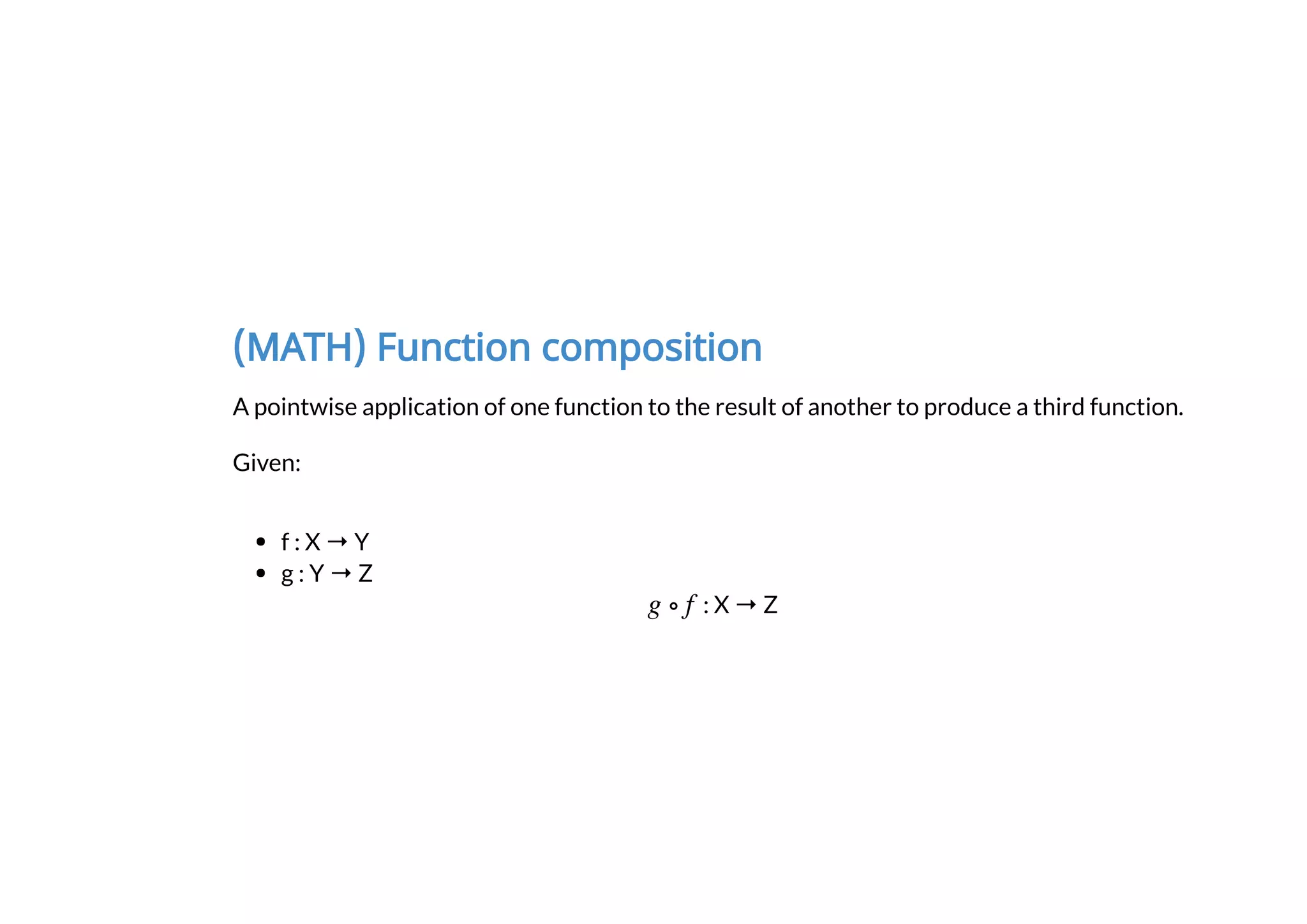
(MATH) Function composition A pointwise application of one function to the result of another to produce a third function. Given: f : X → Y g : Y → Z : X → Z
First class (or high order) functions Since everything's object Functions are objects too (with elds and methods)
In [2]: class Fn: pass def fn(): """ Dummy function """ return 1+2 print(fn.__doc__.strip()) print(Fn.__name__) Dummy function Fn
High order functions Functions accepting functions as params Functions returning other functions lter, map, reduce (now in functools module)
In [3]: def mapper_func(lst, reduce_func): """ Apply a function to each member of <lst> """ return map(reduce_func, lst) def check_if_neg(value): """ Check if values is neg """ return value > 0 assert list(mapper_func([1,2,3], str)) == ["1", "2", "3"] assert list(mapper_func(["1","2","3"], int)) == [1, 2, 3]
In [4]: def v3(v): return v**3 def v2(v): return v**2 def my_awesome_function(v,h): return(h(v)) assert my_awesome_function(3,v2) == 9 assert my_awesome_function(3,v3) == 27
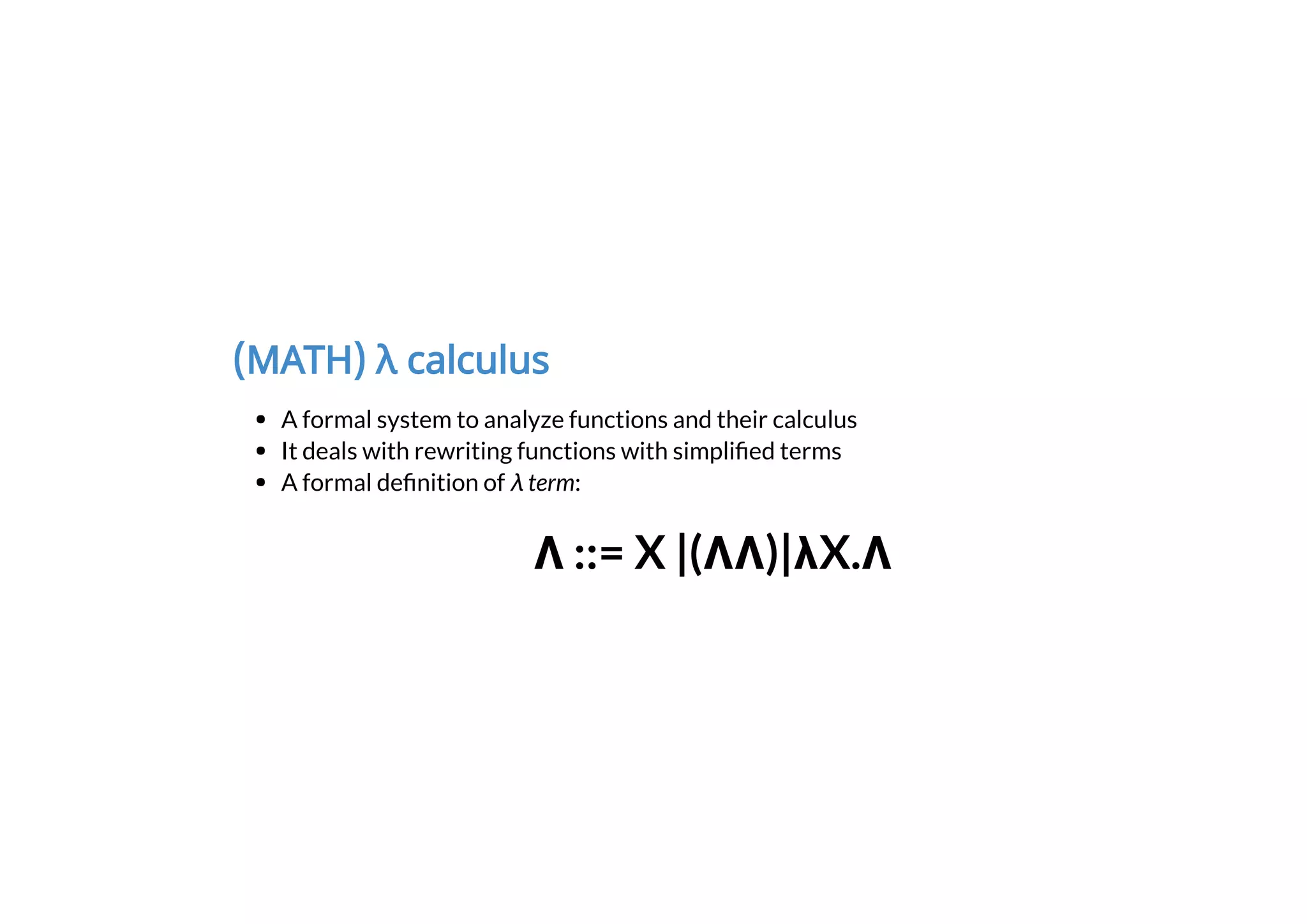
(MATH) λ calculus A formal system to analyze functions and their calculus It deals with rewriting functions with simpli ed terms A formal de nition of λ term: Λ ::= X |(ΛΛ)|λX.Λ
In [5]: from functools import reduce def filter_negative_numbers(lst): """ Filter negative numbers from <lst> """ return filter(check_if_neg, lst) def reduce_sum(lst): """ Reduce list summing up consecutives elements """ return reduce(lambda x, y: x+y, lst) assert list(filter_negative_numbers([-3, 4, 5, -10, 20])) == [4, 5, 20] assert reduce_sum([-3, 4, 5, -10, 20]) == 16
More about function composition Use class like syntax to compose complex functions
In [6]: from collections.abc import Callable from random import random from statistics import mean class MapReduceFunction(Callable): """ 'Chain' two functions to perform map reduce; the class returns a new callable object """ def __init__(self, map_function, reduce_function): self.map_function = map_function self.reduce_function = reduce_function def __call__(self, value): return map(lambda item: self.reduce_function(item), self.map_function(valu e)) data = [round(random()*10, 3) for _ in range(0, 23)] mr = MapReduceFunction( map_function=lambda item: zip(*[iter(data)] * 7), reduce_function=lambda item: max(item) )
Pure functions Functions that cannot include any assignement statement No side effects What about default param values? Is a IO based function pure by default?
In [7]: import random def filter_out(result=[random.random() for _ in range(0, 5)]): exclude = map(lambda item: item ** 2, range(30)) result = filter(lambda item: item not in exclude, result) sorted_result = sorted(result, key=lambda item: str(item)[1]) return map(lambda item: round(item, 2), sorted_result) filter_out() Out[7]: <map at 0x108dd5630>
Practical considerations of λ functions Inline functions Concise No need of de ning one time functions Overusing them is not a solution λ function assignment is discouraged (PEP8)
Immutable vs mutable data structure Can a variable don't vary anymore?
In [8]: value = 100 def change_f_value(new_f_value=5): value = new_f_value print("Value in function %s" %value) print("Initialized value %s "%value) change_f_value() print("Final value %s "%value) Initialized value 100 Value in function 5 Final value 100
Function scopes and closures "If a name is bound anywhere within a code block, all uses of the name within the block are treated as references to the current block." (PEP 227) What if we wanted change the value variable?
In [9]: class Foo: def __init__(self, value): self.value = value foo_obj = Foo(value=10) def func(obj): obj.value = 3 print("Object ID: %i" %id(foo_obj)) print("Object 'value' field before applying function: %i" %foo_obj.value) func(foo_obj) print("Object 'value' field after applying function: %i" %foo_obj.value) print("Object ID: %i" %id(foo_obj)) Object ID: 4443530520 Object 'value' field before applying function: 10 Object 'value' field after applying function: 3 Object ID: 4443530520
Data mutation foo_obj didn't change foo_obj.value changed! So, foo_obj changed or not? If so, can you always determine who changed it?
Immutability Don't change existing objects, use new ones :)
In [10]: import random import pprint from collections import namedtuple data = str(random.random() + 4) MyObj = namedtuple("MyClassReplacement",("some_string", "my_smart_function",)) o = MyObj( some_string=data, my_smart_function=lambda item: float(item)*3) some_string, some_function = o o2 = o._replace(some_string="a new dummy string") assert(o.my_smart_function(o.some_string) == float(o.some_string) * 3) assert (some_string == data) assert not id(o) == id(o2)
Strict vs not strict evaluation Strict evaluation requires that all operators needs to be evaluated Non strict (or lazy) evaluation, evaluates expression if and when requested Careful with lazy evaluated structures
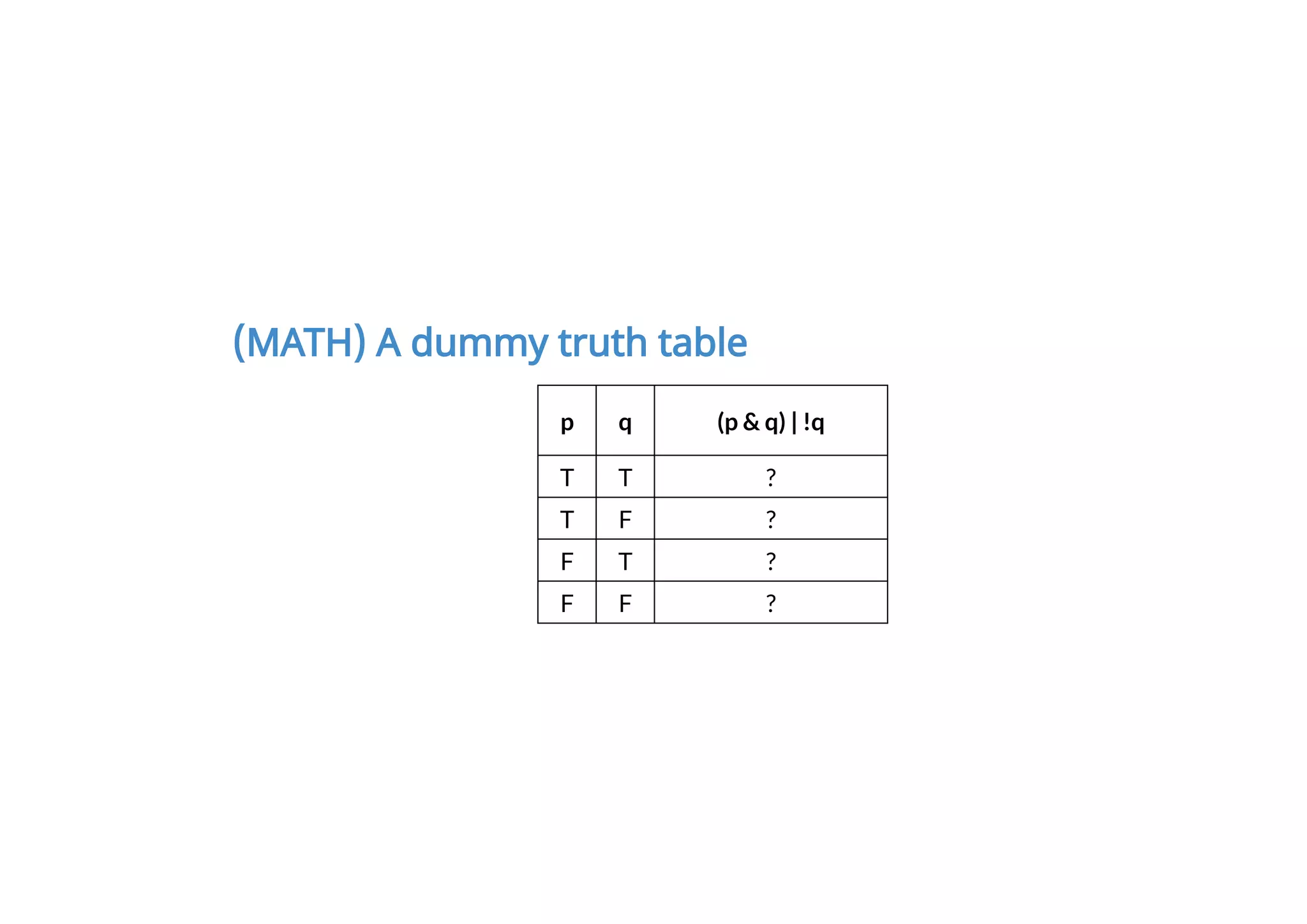
(MATH) A dummy truth table p q (p & q) | !q T T ? T F ? F T ? F F ?
In [11]: import random generate_random_list = lambda size: [random.choice([True, False]) for _ in range(0, size)] def all_true_values(lst): print("evaluating ALL true values") return all(lst) def any_true_value(lst): print("evaluating ANY true values") return any(lst) all_true_values(generate_random_list(size=10)) and any_true_value(generate_random_ list(size=10)) print("+++++++++++") all_true_values(generate_random_list(size=10)) or any_true_value(generate_random_l ist(size=10)) Out[11]: evaluating ALL true values +++++++++++ evaluating ALL true values evaluating ANY true values True
Use case: Python iterables structures Creating lists requires time/space What if you don't need it anymore? Be lazy: use functions to generate the next element you need asyncio was inspired by the generator approach :)
In [12]: import random def lc(): return [random.random() for _ in range(0, 10)] def _iter(): return iter([random.random() for _ in range(0, 10)]) def lazy_1(): for item in range(10, size): if not item % 2 and not str(item).endswith("4"): yield item def lazy_2(): yield from (r for r in range(0, 10) if not r % 2 and not str(r).endswith("4")) print(lc()) print(_iter()) print(lazy_1()) print(lazy_2()) [0.3715365641589854, 0.21968153174666838, 0.5694550450864405, 0.67849617189266 75, 0.12265891948697638, 0.9803208951269902, 0.9661576370333822, 0.69911857951 80963, 0.9940147002373155, 0.4647425397290714] <list_iterator object at 0x108e2fdd8> <generator object lazy_1 at 0x108dd36c0> <generator object lazy_2 at 0x108dd36c0>
Recursion vs loop Functional programming relies on recursion instead of iteration Python suffers by recursion limit Python doesn't offer any tail call optimization Use iterations :)
In [13]: def facti(n): if n == 0: return 1 f= 1 for i in range(2,n): f *= i return f def fact_nt(n): if n == 0: return 1 else: return n*fact(n-1) def fact(n, acc=1): if n == 0: return acc return fact(n-1, acc*n)
Currying Multiple arguments functions mapped to single arguments functions
In [14]: In [15]: def mult(a): def wrapper_1(b): def wrapper_2(c): return a*b*c return wrapper_2 return wrapper_1 def mult2(a, b, c): return a*b*c assert(mult(2)(3)(4) == mult2(2,3,4)) mult1 = mult(2) mult12 = mult1(3) mult12(4) Out[15]: 24
Partials Python provides "partial" functions for manual currying
In [16]: from functools import reduce, partial import operator def sum_random_numbers(size): return reduce(operator.add, (random.random())*size) def mul_random_numbers(size): return reduce(operator.mul, (random.random())*size) def handle_random_numbers(size, function): return reduce(function, (random.random())*size) two_random_sum = partial(sum_random_numbers, size=2) three_random_sum = partial(sum_random_numbers, size=3) two_random_pow = partial(mul_random_numbers, size=2) five_random_product = partial(mul_random_numbers, size=5) three_random_sum = partial(handle_random_numbers, function=operator.add, size=3) three_random_mod = partial(handle_random_numbers, function=operator.mod, size=3)
Decorators Return a modi ed version of a decorated function Add properties at runtime, before using the actual decorated function
In [17]: from functools import wraps from functools import partial def get_ned_data(n): def get_doubled_data(func, *args, **kwargs): @wraps(func) def _inner(*args, **kwargs): kwargs["multiplied_by_n_param"] = kwargs["initial_param"]*n return func(*args, **kwargs) return _inner return get_doubled_data
In [18]: @get_ned_data(n=2) def double_func(*args, **kwargs): assert(kwargs["multiplied_by_n_param"] == kwargs["initial_param"]*2) @get_ned_data(n=3) def triple_func(*args, **kwargs): assert(kwargs["multiplied_by_n_param"] == kwargs["initial_param"]*3) double_func(initial_param=3) triple_func(initial_param=5)
FP patterns OOP and FP Monads Memoization Actor model Pattern matching OOP and FP Use functions to set the strategy Use decorators to change function behaviour
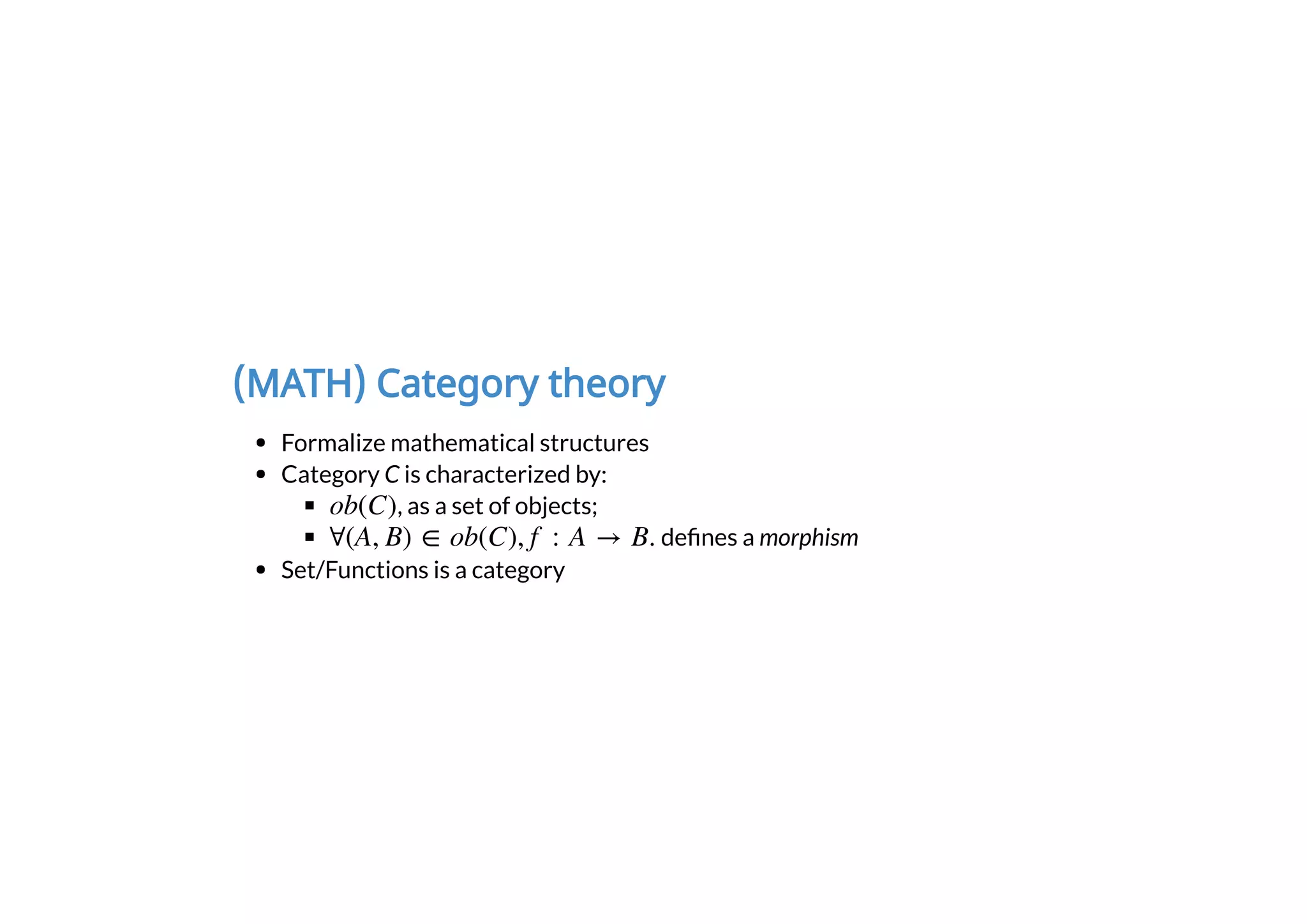
(MATH) Category theory Formalize mathematical structures Category C is characterized by: , as a set of objects; de nes a morphism Set/Functions is a category
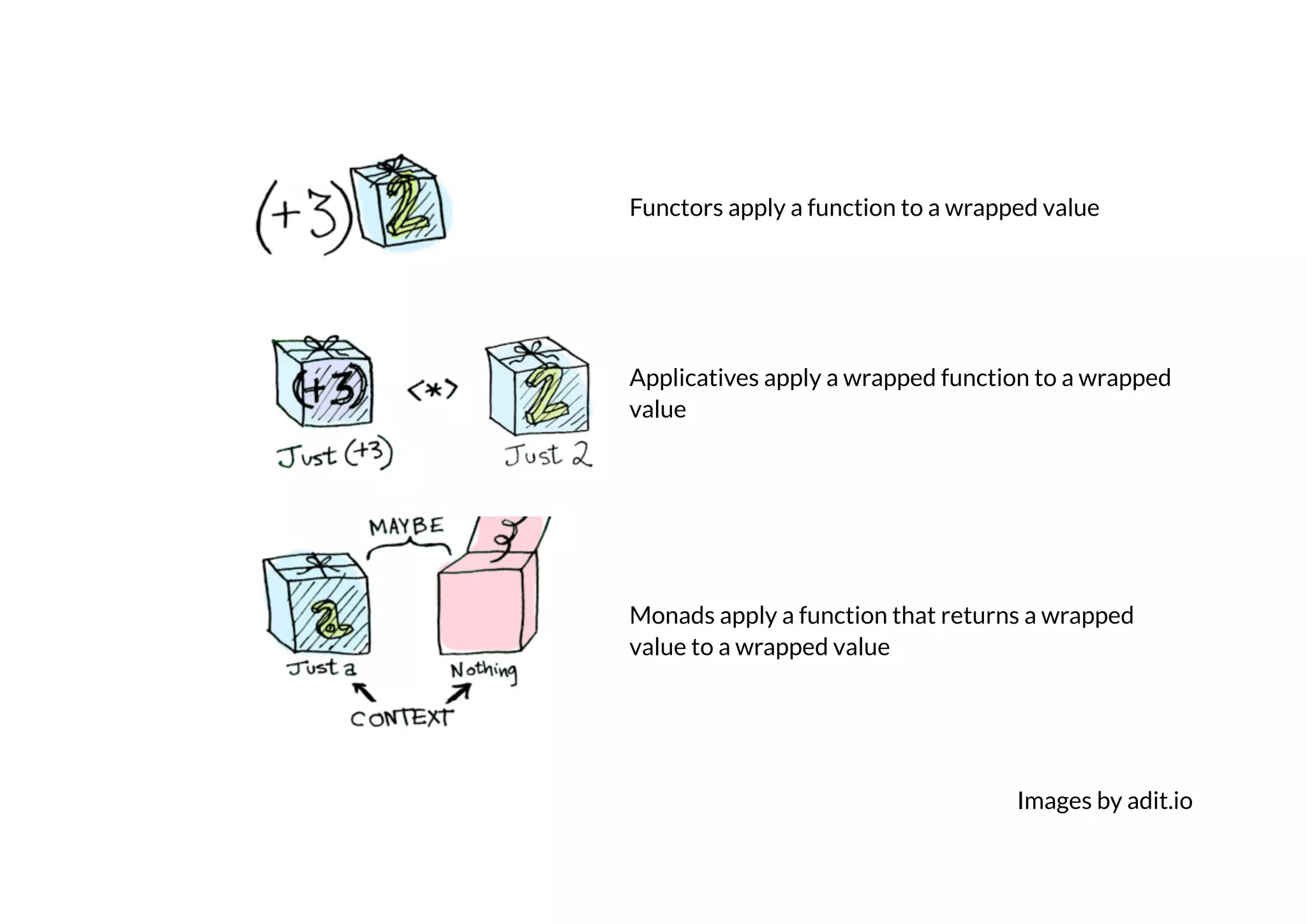
Images by adit.io Functors apply a function to a wrapped value Applicatives apply a wrapped function to a wrapped value Monads apply a function that returns a wrapped value to a wrapped value
In [19]: class Container: def __init__(self, value=None): self.value = value def map(self, function): try: return Full(function(self.value)) except Exception as e: return Empty() class Empty(Container): def map(self, value): return Empty() def __str__(self): return "Container's empty" class Full(Container): def __str__(self): return self.value def get_or(self, none_value=None): return self.value or none_value
In [20]: from fn.monad import optionable from collections import namedtuple def get(request, *args, **kwargs): @optionable def _get_values(data): return data.get("values", None) _split = lambda item: item.split(",") _strip = lambda item: item.replace(" ", "") _filter = lambda item: list(filter(lambda i: i, item)) return _get_values(request.body) .map(_strip) .map(_split) .map(_filter) .get_or(["v1,v2"]) req_class = namedtuple("Request", ("body",)) request_1 = req_class(dict(values="v1, v2,v3")) request_2 = req_class(dict(values="v1,v2,v3 ")) request_3 = req_class(dict(values="v1, v2,v3, ")) assert(get(request_1) == ['v1', 'v2', 'v3']) assert(get(request_2) == ['v1', 'v2', 'v3']) assert(get(request_3) == ['v1', 'v2', 'v3'])
In [21]: from pymonad import List _strip = lambda item: List(item.replace(" ", "")) _slice = lambda item: List(item[:-1] if item[-1] =="," else item) _split = lambda item: List(*item.split(",")) List("v1, v2,v3, ") >> _strip >> _slice >> _split Out[21]: ['v1', 'v2', 'v3']
Memoization Enjoy referential transparency: do not compute functions for the same input
In [22]: import functools def memoize(obj): cache = obj.cache = {} @functools.wraps(obj) def memoizer(*args, **kwargs): if args not in cache: cache[args] = obj(*args, **kwargs) return cache[args] return memoizer @memoize def fact_m(n, acc=1): if n == 0: return acc return fact(n-1, acc*n)
In [28]: from bokeh.plotting import figure, output_file, show, output_notebook from cmp import get_data, DEF_VALUES y = get_data() p = figure(title="Computing factorial", x_axis_label='number', y_axis_label='spent time' ,tools="pan,box_zoom,reset, save",plot_width=1000, plot_height=300) p.line(DEF_VALUES, y[0][1], legend=y[0][0], line_width=1,line_color="blue") p.circle(DEF_VALUES, y[0][1],fill_color="blue", size=8) p.line(DEF_VALUES, y[1][1], legend=y[1][0], line_width=1,line_color="red") p.circle(DEF_VALUES, y[1][1],fill_color="red", size=8) p.line(DEF_VALUES, y[2][1], legend=y[2][0], line_width=1,line_color="green") p.circle(DEF_VALUES, y[2][1],fill_color="green", size=8) p.line(DEF_VALUES, y[3][1], legend=y[3][0], line_width=1,line_color="black") p.circle(DEF_VALUES, y[3][1],fill_color="black", size=8) output_notebook(hide_banner=True) show(p) (http://bokeh.pydata.org/)
Actors Message passing pattern Actors receive a message, do something, return new messages (or None) They behave like humans
In [29]: Pattern matching Match data over patterns and apply a function Scala's pattern matching involve types/expressions/object deconstruction Implemented via multimethods, a kind of method overloading %run ./actors.py 21:54:55 [p=12010, t=140736514905024, INFO, pulsar.arbiter] mailbox serving on 127.0.0.1:58006 21:54:55 [p=12010, t=140736514905024, INFO, pulsar.arbiter] started 21:54:56 [p=12047, t=140736514905024, INFO, pulsar.actor1] started 21:54:56 [p=12048, t=140736514905024, INFO, pulsar.actor2] started Got the message <Task finished coro=<request() done, defined at /Users/boss/git/talk3/lib/pyth on3.4/site-packages/pulsar/async/mailbox.py:279> result=None> Message sent 21:54:57 [p=12010, t=140736514905024, INFO, pulsar.arbiter] Stopping actor1(ia 7a6e0c). 21:54:57 [p=12010, t=140736514905024, INFO, pulsar.arbiter] Stopping actor2(if eb7f3c). 21:54:57 [p=12047, t=140736514905024, INFO, pulsar.actor1] Bye from "actor1(ia 7a6e0c)" 21:54:57 [p=12048, t=140736514905024, INFO, pulsar.actor2] Bye from "actor2(if eb7f3c)" 21:54:58 [p=12010, t=140736514905024, WARNING, pulsar.arbiter] Removed actor1 (ia7a6e0c) 21:54:58 [p=12010, t=140736514905024, WARNING, pulsar.arbiter] Removed actor2 (ifeb7f3c) Bye (exit code = 0)
Useful libraries fn.py pyMonad pyrsistent toolz pykka pulsar cleveland underscore.py (ported from underscore_js)
Useful readings Functional Python Programming Becoming functional Learn Haskell at your own good Functional Javascript Functional programming in Scala Going functional is not just about coding Lambda Architecture FAAS: AWS lambda
Summary “The point is not that imperative programming is broken in some way, or that functional programming offers such a vastly superior technology. The point is that functional programming leads to a change in viewpoint that can—in many cases—be very helpful.”
Questions? map(answer, questions)

Rethink programming: a functional approach

  • 1.
    Francesco Bruni PyConSette -Florence, April '16 Notebook @ http://ern.is/fp @brunifrancesco Rethink programming: a functional approach
  • 2.
    Who I am MSc in TelecommunicationEngineering @ Poliba Despite a Java background, I prefer Python whenever possible I'm not a computer scientist :)
  • 3.
    Agenda Why functional programming Everything'sobject Laziness: why evaluation matters Immutable data Recursion and/or cycles Pattern matching Mixing OOP with FP FP "patterns" Conclusions
  • 4.
    Disclaimer I'm not avacuum cleaner salesman.
  • 5.
    Why functional programming Think in termsof functions Function evaluation instead of state change and/or mutable objects Testing is easy A new viewpoint is required
  • 6.
    (MATH) What is a function? A relation froma set of inputs (X) to a set of possible outputs (Y) where each input is related to exactly one output.
  • 7.
    In [1]: import random defsum_imperative(): res = 0 for n in [random.random() for _ in range(100)]: res += n return res def sum_functional(): return sum(random.random() for _ in range(100)) print(sum_imperative()) print(sum_functional()) assert True 42.90290739224947 54.64527198535234
  • 8.
    Functional features in Python Not all functionalpatterns apply to Python Hybrid approach is often requested Other libraries needs to be (eventually) integrated
  • 9.
    (MATH) Function composition A pointwise applicationof one function to the result of another to produce a third function. Given: f : X → Y g : Y → Z : X → Z
  • 10.
  • 11.
    In [2]: class Fn: pass deffn(): """ Dummy function """ return 1+2 print(fn.__doc__.strip()) print(Fn.__name__) Dummy function Fn
  • 12.
    High order functions Functions accepting functionsas params Functions returning other functions lter, map, reduce (now in functools module)
  • 13.
    In [3]: def mapper_func(lst,reduce_func): """ Apply a function to each member of <lst> """ return map(reduce_func, lst) def check_if_neg(value): """ Check if values is neg """ return value > 0 assert list(mapper_func([1,2,3], str)) == ["1", "2", "3"] assert list(mapper_func(["1","2","3"], int)) == [1, 2, 3]
  • 14.
    In [4]: def v3(v): returnv**3 def v2(v): return v**2 def my_awesome_function(v,h): return(h(v)) assert my_awesome_function(3,v2) == 9 assert my_awesome_function(3,v3) == 27
  • 15.
    (MATH) λ calculus A formal systemto analyze functions and their calculus It deals with rewriting functions with simpli ed terms A formal de nition of λ term: Λ ::= X |(ΛΛ)|λX.Λ
  • 16.
    In [5]: from functoolsimport reduce def filter_negative_numbers(lst): """ Filter negative numbers from <lst> """ return filter(check_if_neg, lst) def reduce_sum(lst): """ Reduce list summing up consecutives elements """ return reduce(lambda x, y: x+y, lst) assert list(filter_negative_numbers([-3, 4, 5, -10, 20])) == [4, 5, 20] assert reduce_sum([-3, 4, 5, -10, 20]) == 16
  • 17.
    More about function composition Use class likesyntax to compose complex functions
  • 18.
    In [6]: from collections.abcimport Callable from random import random from statistics import mean class MapReduceFunction(Callable): """ 'Chain' two functions to perform map reduce; the class returns a new callable object """ def __init__(self, map_function, reduce_function): self.map_function = map_function self.reduce_function = reduce_function def __call__(self, value): return map(lambda item: self.reduce_function(item), self.map_function(valu e)) data = [round(random()*10, 3) for _ in range(0, 23)] mr = MapReduceFunction( map_function=lambda item: zip(*[iter(data)] * 7), reduce_function=lambda item: max(item) )
  • 19.
    Pure functions Functions that cannotinclude any assignement statement No side effects What about default param values? Is a IO based function pure by default?
  • 20.
    In [7]: import random deffilter_out(result=[random.random() for _ in range(0, 5)]): exclude = map(lambda item: item ** 2, range(30)) result = filter(lambda item: item not in exclude, result) sorted_result = sorted(result, key=lambda item: str(item)[1]) return map(lambda item: round(item, 2), sorted_result) filter_out() Out[7]: <map at 0x108dd5630>
  • 21.
    Practical considerations of λ functions Inline functions Concise No needof de ning one time functions Overusing them is not a solution λ function assignment is discouraged (PEP8)
  • 22.
  • 23.
    In [8]: value =100 def change_f_value(new_f_value=5): value = new_f_value print("Value in function %s" %value) print("Initialized value %s "%value) change_f_value() print("Final value %s "%value) Initialized value 100 Value in function 5 Final value 100
  • 24.
    Function scopes and closures "If a nameis bound anywhere within a code block, all uses of the name within the block are treated as references to the current block." (PEP 227) What if we wanted change the value variable?
  • 25.
    In [9]: class Foo: def__init__(self, value): self.value = value foo_obj = Foo(value=10) def func(obj): obj.value = 3 print("Object ID: %i" %id(foo_obj)) print("Object 'value' field before applying function: %i" %foo_obj.value) func(foo_obj) print("Object 'value' field after applying function: %i" %foo_obj.value) print("Object ID: %i" %id(foo_obj)) Object ID: 4443530520 Object 'value' field before applying function: 10 Object 'value' field after applying function: 3 Object ID: 4443530520
  • 26.
    Data mutation foo_obj didn't change foo_obj.valuechanged! So, foo_obj changed or not? If so, can you always determine who changed it?
  • 27.
    Immutability Don't change existingobjects, use new ones :)
  • 28.
    In [10]: import random importpprint from collections import namedtuple data = str(random.random() + 4) MyObj = namedtuple("MyClassReplacement",("some_string", "my_smart_function",)) o = MyObj( some_string=data, my_smart_function=lambda item: float(item)*3) some_string, some_function = o o2 = o._replace(some_string="a new dummy string") assert(o.my_smart_function(o.some_string) == float(o.some_string) * 3) assert (some_string == data) assert not id(o) == id(o2)
  • 29.
    Strict vs not strict evaluation Strict evaluation requiresthat all operators needs to be evaluated Non strict (or lazy) evaluation, evaluates expression if and when requested Careful with lazy evaluated structures
  • 30.
    (MATH) A dummy truth table p q (p& q) | !q T T ? T F ? F T ? F F ?
  • 31.
    In [11]: import random generate_random_list= lambda size: [random.choice([True, False]) for _ in range(0, size)] def all_true_values(lst): print("evaluating ALL true values") return all(lst) def any_true_value(lst): print("evaluating ANY true values") return any(lst) all_true_values(generate_random_list(size=10)) and any_true_value(generate_random_ list(size=10)) print("+++++++++++") all_true_values(generate_random_list(size=10)) or any_true_value(generate_random_l ist(size=10)) Out[11]: evaluating ALL true values +++++++++++ evaluating ALL true values evaluating ANY true values True
  • 32.
    Use case: Python iterables structures Creating lists requirestime/space What if you don't need it anymore? Be lazy: use functions to generate the next element you need asyncio was inspired by the generator approach :)
  • 33.
    In [12]: import random deflc(): return [random.random() for _ in range(0, 10)] def _iter(): return iter([random.random() for _ in range(0, 10)]) def lazy_1(): for item in range(10, size): if not item % 2 and not str(item).endswith("4"): yield item def lazy_2(): yield from (r for r in range(0, 10) if not r % 2 and not str(r).endswith("4")) print(lc()) print(_iter()) print(lazy_1()) print(lazy_2()) [0.3715365641589854, 0.21968153174666838, 0.5694550450864405, 0.67849617189266 75, 0.12265891948697638, 0.9803208951269902, 0.9661576370333822, 0.69911857951 80963, 0.9940147002373155, 0.4647425397290714] <list_iterator object at 0x108e2fdd8> <generator object lazy_1 at 0x108dd36c0> <generator object lazy_2 at 0x108dd36c0>
  • 34.
    Recursion vs loop Functional programming relieson recursion instead of iteration Python suffers by recursion limit Python doesn't offer any tail call optimization Use iterations :)
  • 35.
    In [13]: def facti(n): ifn == 0: return 1 f= 1 for i in range(2,n): f *= i return f def fact_nt(n): if n == 0: return 1 else: return n*fact(n-1) def fact(n, acc=1): if n == 0: return acc return fact(n-1, acc*n)
  • 36.
    Currying Multiple arguments functionsmapped to single arguments functions
  • 37.
    In [14]: In [15]: def mult(a): def wrapper_1(b): defwrapper_2(c): return a*b*c return wrapper_2 return wrapper_1 def mult2(a, b, c): return a*b*c assert(mult(2)(3)(4) == mult2(2,3,4)) mult1 = mult(2) mult12 = mult1(3) mult12(4) Out[15]: 24
  • 38.
    Partials Python provides "partial"functions for manual currying
  • 39.
    In [16]: from functoolsimport reduce, partial import operator def sum_random_numbers(size): return reduce(operator.add, (random.random())*size) def mul_random_numbers(size): return reduce(operator.mul, (random.random())*size) def handle_random_numbers(size, function): return reduce(function, (random.random())*size) two_random_sum = partial(sum_random_numbers, size=2) three_random_sum = partial(sum_random_numbers, size=3) two_random_pow = partial(mul_random_numbers, size=2) five_random_product = partial(mul_random_numbers, size=5) three_random_sum = partial(handle_random_numbers, function=operator.add, size=3) three_random_mod = partial(handle_random_numbers, function=operator.mod, size=3)
  • 40.
    Decorators Return a modied version of a decorated function Add properties at runtime, before using the actual decorated function
  • 41.
    In [17]: from functoolsimport wraps from functools import partial def get_ned_data(n): def get_doubled_data(func, *args, **kwargs): @wraps(func) def _inner(*args, **kwargs): kwargs["multiplied_by_n_param"] = kwargs["initial_param"]*n return func(*args, **kwargs) return _inner return get_doubled_data
  • 42.
    In [18]: @get_ned_data(n=2) def double_func(*args,**kwargs): assert(kwargs["multiplied_by_n_param"] == kwargs["initial_param"]*2) @get_ned_data(n=3) def triple_func(*args, **kwargs): assert(kwargs["multiplied_by_n_param"] == kwargs["initial_param"]*3) double_func(initial_param=3) triple_func(initial_param=5)
  • 43.
    FP patterns OOP and FP Monads Memoization Actormodel Pattern matching OOP and FP Use functions to set the strategy Use decorators to change function behaviour
  • 44.
    (MATH) Category theory Formalize mathematical structures CategoryC is characterized by: , as a set of objects; de nes a morphism Set/Functions is a category
  • 45.
    Images by adit.io Functorsapply a function to a wrapped value Applicatives apply a wrapped function to a wrapped value Monads apply a function that returns a wrapped value to a wrapped value
  • 46.
    In [19]: class Container: def__init__(self, value=None): self.value = value def map(self, function): try: return Full(function(self.value)) except Exception as e: return Empty() class Empty(Container): def map(self, value): return Empty() def __str__(self): return "Container's empty" class Full(Container): def __str__(self): return self.value def get_or(self, none_value=None): return self.value or none_value
  • 47.
    In [20]: from fn.monadimport optionable from collections import namedtuple def get(request, *args, **kwargs): @optionable def _get_values(data): return data.get("values", None) _split = lambda item: item.split(",") _strip = lambda item: item.replace(" ", "") _filter = lambda item: list(filter(lambda i: i, item)) return _get_values(request.body) .map(_strip) .map(_split) .map(_filter) .get_or(["v1,v2"]) req_class = namedtuple("Request", ("body",)) request_1 = req_class(dict(values="v1, v2,v3")) request_2 = req_class(dict(values="v1,v2,v3 ")) request_3 = req_class(dict(values="v1, v2,v3, ")) assert(get(request_1) == ['v1', 'v2', 'v3']) assert(get(request_2) == ['v1', 'v2', 'v3']) assert(get(request_3) == ['v1', 'v2', 'v3'])
  • 48.
    In [21]: from pymonadimport List _strip = lambda item: List(item.replace(" ", "")) _slice = lambda item: List(item[:-1] if item[-1] =="," else item) _split = lambda item: List(*item.split(",")) List("v1, v2,v3, ") >> _strip >> _slice >> _split Out[21]: ['v1', 'v2', 'v3']
  • 49.
    Memoization Enjoy referential transparency:do not compute functions for the same input
  • 50.
    In [22]: import functools defmemoize(obj): cache = obj.cache = {} @functools.wraps(obj) def memoizer(*args, **kwargs): if args not in cache: cache[args] = obj(*args, **kwargs) return cache[args] return memoizer @memoize def fact_m(n, acc=1): if n == 0: return acc return fact(n-1, acc*n)
  • 51.
    In [28]: from bokeh.plottingimport figure, output_file, show, output_notebook from cmp import get_data, DEF_VALUES y = get_data() p = figure(title="Computing factorial", x_axis_label='number', y_axis_label='spent time' ,tools="pan,box_zoom,reset, save",plot_width=1000, plot_height=300) p.line(DEF_VALUES, y[0][1], legend=y[0][0], line_width=1,line_color="blue") p.circle(DEF_VALUES, y[0][1],fill_color="blue", size=8) p.line(DEF_VALUES, y[1][1], legend=y[1][0], line_width=1,line_color="red") p.circle(DEF_VALUES, y[1][1],fill_color="red", size=8) p.line(DEF_VALUES, y[2][1], legend=y[2][0], line_width=1,line_color="green") p.circle(DEF_VALUES, y[2][1],fill_color="green", size=8) p.line(DEF_VALUES, y[3][1], legend=y[3][0], line_width=1,line_color="black") p.circle(DEF_VALUES, y[3][1],fill_color="black", size=8) output_notebook(hide_banner=True) show(p) (http://bokeh.pydata.org/)
  • 53.
    Actors Message passing pattern Actorsreceive a message, do something, return new messages (or None) They behave like humans
  • 54.
    In [29]: Pattern matching Match data overpatterns and apply a function Scala's pattern matching involve types/expressions/object deconstruction Implemented via multimethods, a kind of method overloading %run ./actors.py 21:54:55 [p=12010, t=140736514905024, INFO, pulsar.arbiter] mailbox serving on 127.0.0.1:58006 21:54:55 [p=12010, t=140736514905024, INFO, pulsar.arbiter] started 21:54:56 [p=12047, t=140736514905024, INFO, pulsar.actor1] started 21:54:56 [p=12048, t=140736514905024, INFO, pulsar.actor2] started Got the message <Task finished coro=<request() done, defined at /Users/boss/git/talk3/lib/pyth on3.4/site-packages/pulsar/async/mailbox.py:279> result=None> Message sent 21:54:57 [p=12010, t=140736514905024, INFO, pulsar.arbiter] Stopping actor1(ia 7a6e0c). 21:54:57 [p=12010, t=140736514905024, INFO, pulsar.arbiter] Stopping actor2(if eb7f3c). 21:54:57 [p=12047, t=140736514905024, INFO, pulsar.actor1] Bye from "actor1(ia 7a6e0c)" 21:54:57 [p=12048, t=140736514905024, INFO, pulsar.actor2] Bye from "actor2(if eb7f3c)" 21:54:58 [p=12010, t=140736514905024, WARNING, pulsar.arbiter] Removed actor1 (ia7a6e0c) 21:54:58 [p=12010, t=140736514905024, WARNING, pulsar.arbiter] Removed actor2 (ifeb7f3c) Bye (exit code = 0)
  • 55.
  • 56.
    Useful readings Functional Python Programming Becomingfunctional Learn Haskell at your own good Functional Javascript Functional programming in Scala Going functional is not just about coding Lambda Architecture FAAS: AWS lambda
  • 57.
    Summary “The point isnot that imperative programming is broken in some way, or that functional programming offers such a vastly superior technology. The point is that functional programming leads to a change in viewpoint that can—in many cases—be very helpful.”
  • 58.