Salesforce API Series: Fast Parallel Data Loading with the Bulk API Webinar
This document summarizes a Salesforce webinar about loading data in parallel using the Bulk API. It discusses how parallel processing can significantly increase data load throughput compared to serial loads. However, locks and other inhibitors can prevent optimal parallelism. The webinar demonstrates approaches to identify and manage locks, such as modifying the data schema, ordering the load file, and using a controlled parallel approach. Managing locks is key to achieving high parallelism and throughput during large data loads.
Safe Harbor Safe harborstatement under the Private Securities Litigation Reform Act of 1995: This presentation may contain forward-looking statements that involve risks, uncertainties, and assumptions. If any such uncertainties materialize or if any of the assumptions proves incorrect, the results of salesforce.com, inc. could differ materially from the results expressed or implied by the forward-looking statements we make. All statements other than statements of historical fact could be deemed forward-looking, including any projections of product or service availability, subscriber growth, earnings, revenues, or other financial items and any statements regarding strategies or plans of management for future operations, statements of belief, any statements concerning new, planned, or upgraded services or technology developments and customer contracts or use of our services. The risks and uncertainties referred to above include – but are not limited to – risks associated with developing and delivering new functionality for our service, new products and services, our new business model, our past operating losses, possible fluctuations in our operating results and rate of growth, interruptions or delays in our Web hosting, breach of our security measures, the outcome of intellectual property and other litigation, risks associated with possible mergers and acquisitions, the immature market in which we operate, our relatively limited operating history, our ability to expand, retain, and motivate our employees and manage our growth, new releases of our service and successful customer deployment, our limited history reselling nonsalesforce.com products, and utilization and selling to larger enterprise customers. Further information on potential factors that could affect the financial results of salesforce.com, inc. is included in our annual report on Form 10-Q for the most recent fiscal quarter ended July 31, 2012. This documents and others containing important disclosures are available on the SEC Filings section of the Investor Information section of our Web site. Any unreleased services or features referenced in this or other presentations, press releases or public statements are not currently available and may not be delivered on time or at all. Customers who purchase our services should make the purchase decisions based upon features that are currently available. Salesforce.com, inc. assumes no obligation and does not intend to update these forward-looking statements. #forcewebinar
Follow Developer Forcefor the Latest News @forcedotcom / #forcewebinar Developer Force – Force.com Community +Developer Force – Force.com Community Developer Force Developer Force Group #forcewebinar
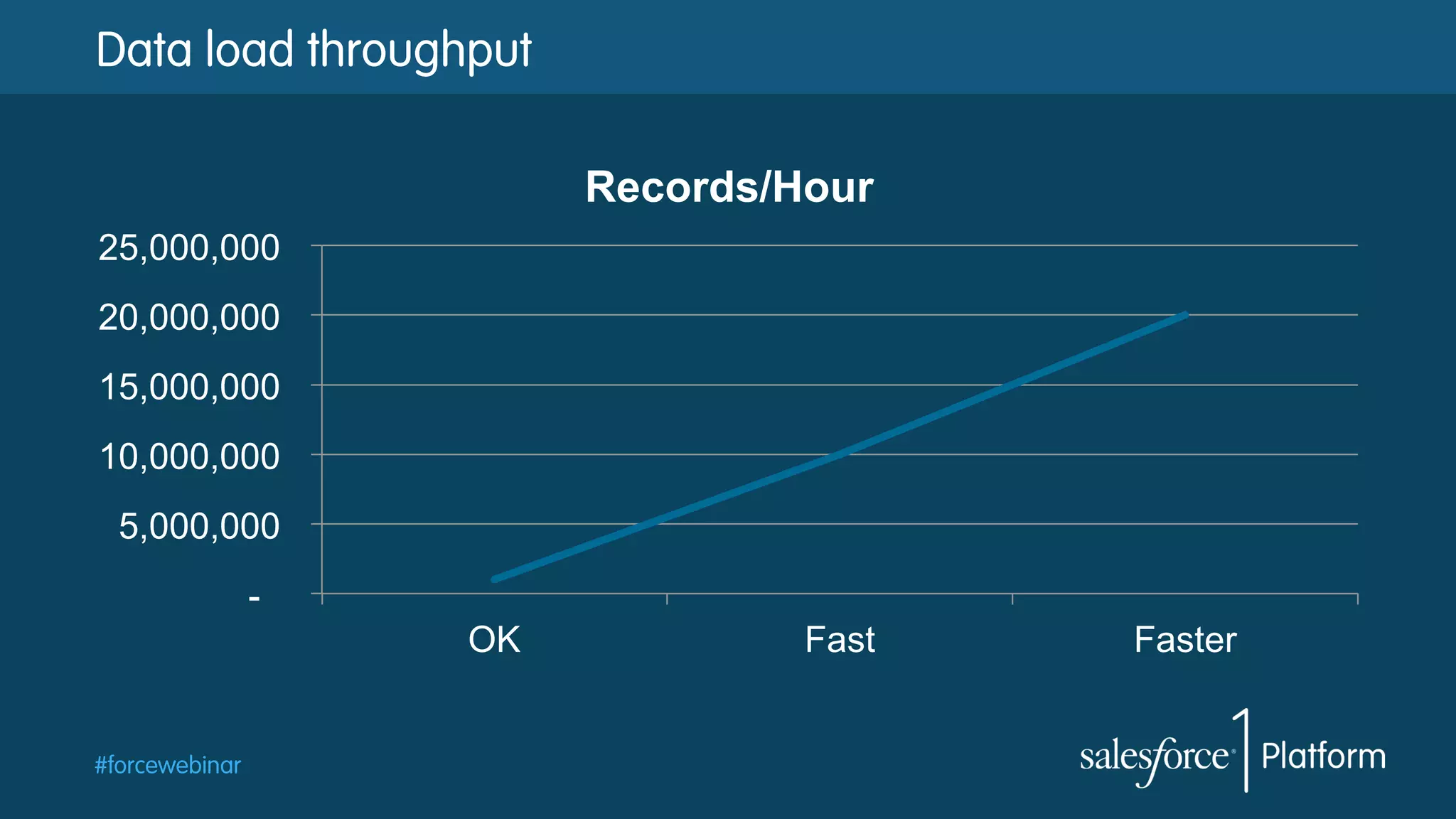
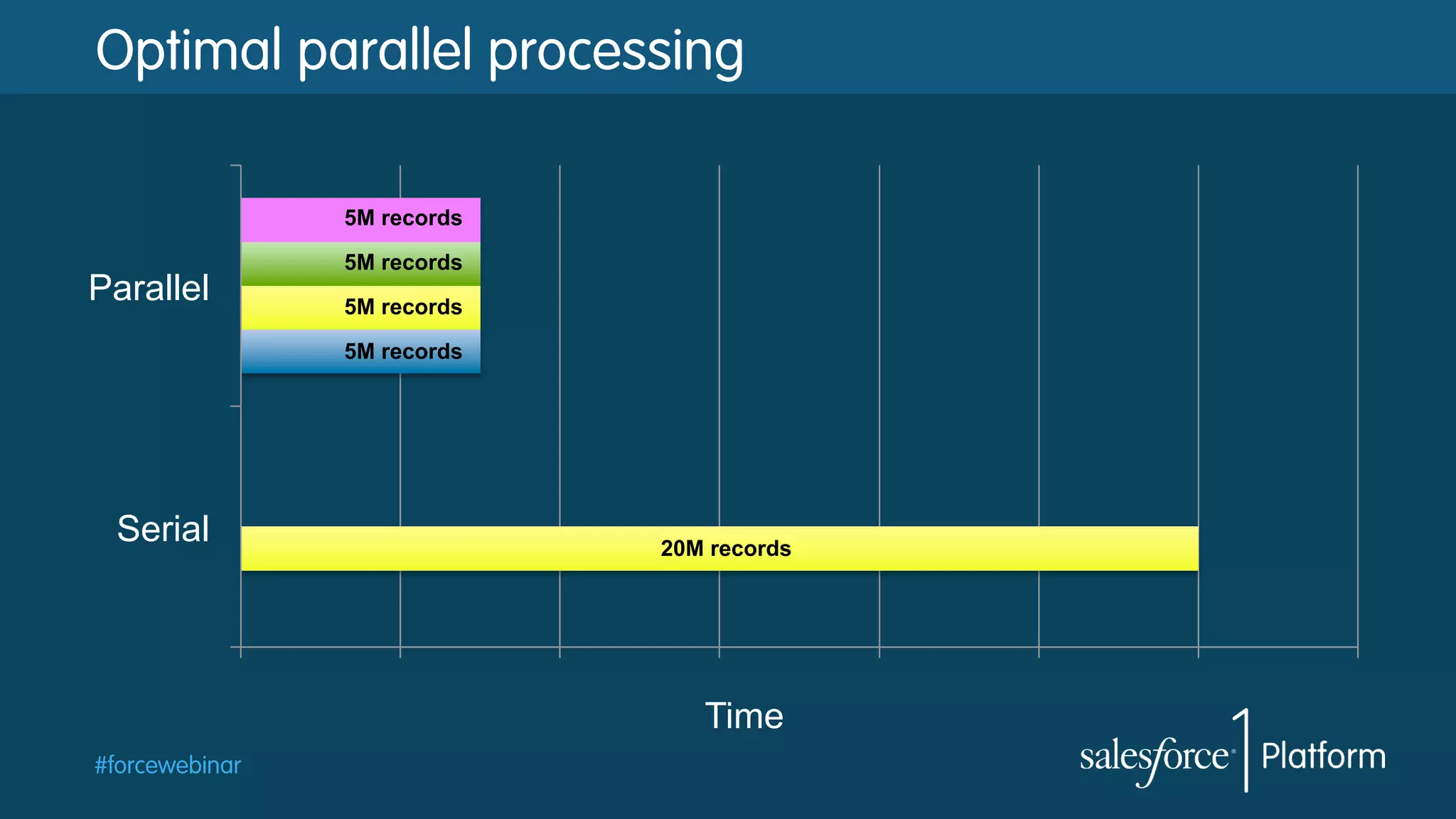
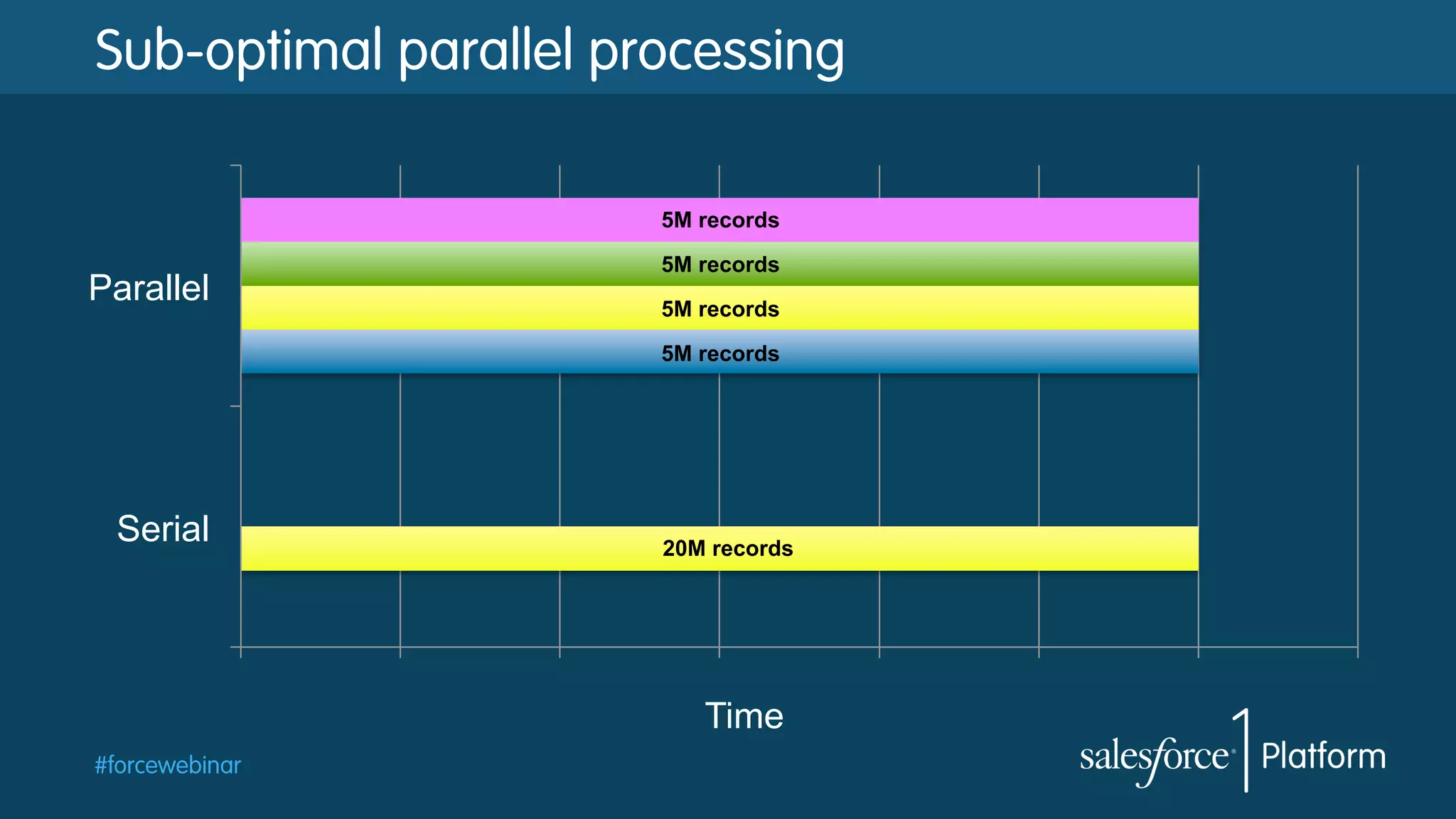
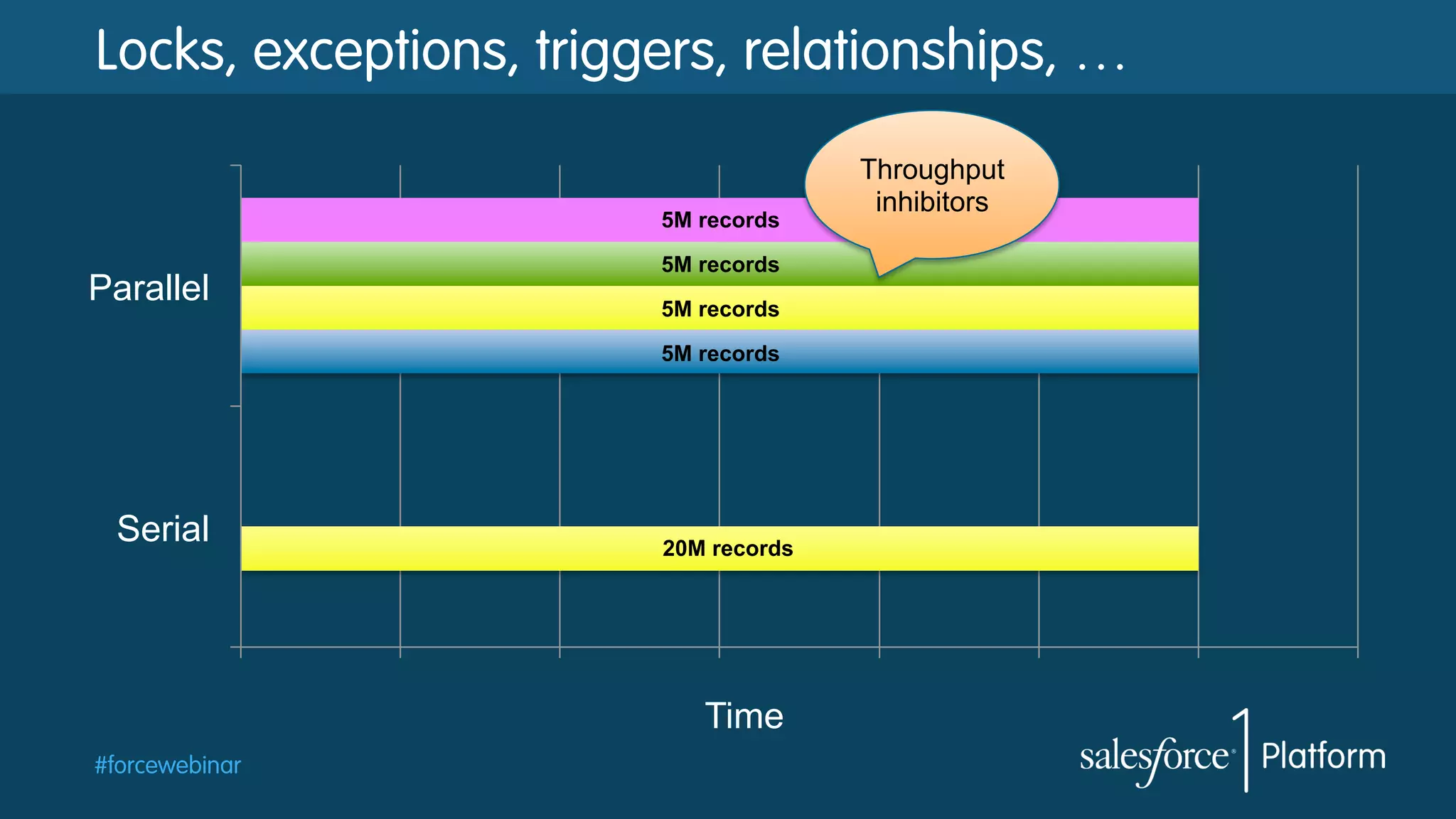
Locks, exceptions, triggers,relationships, … 5M records Parallel 5M records 5M records 5M records Serial 20M records Time #forcewebinar Throughput inhibitors
16.
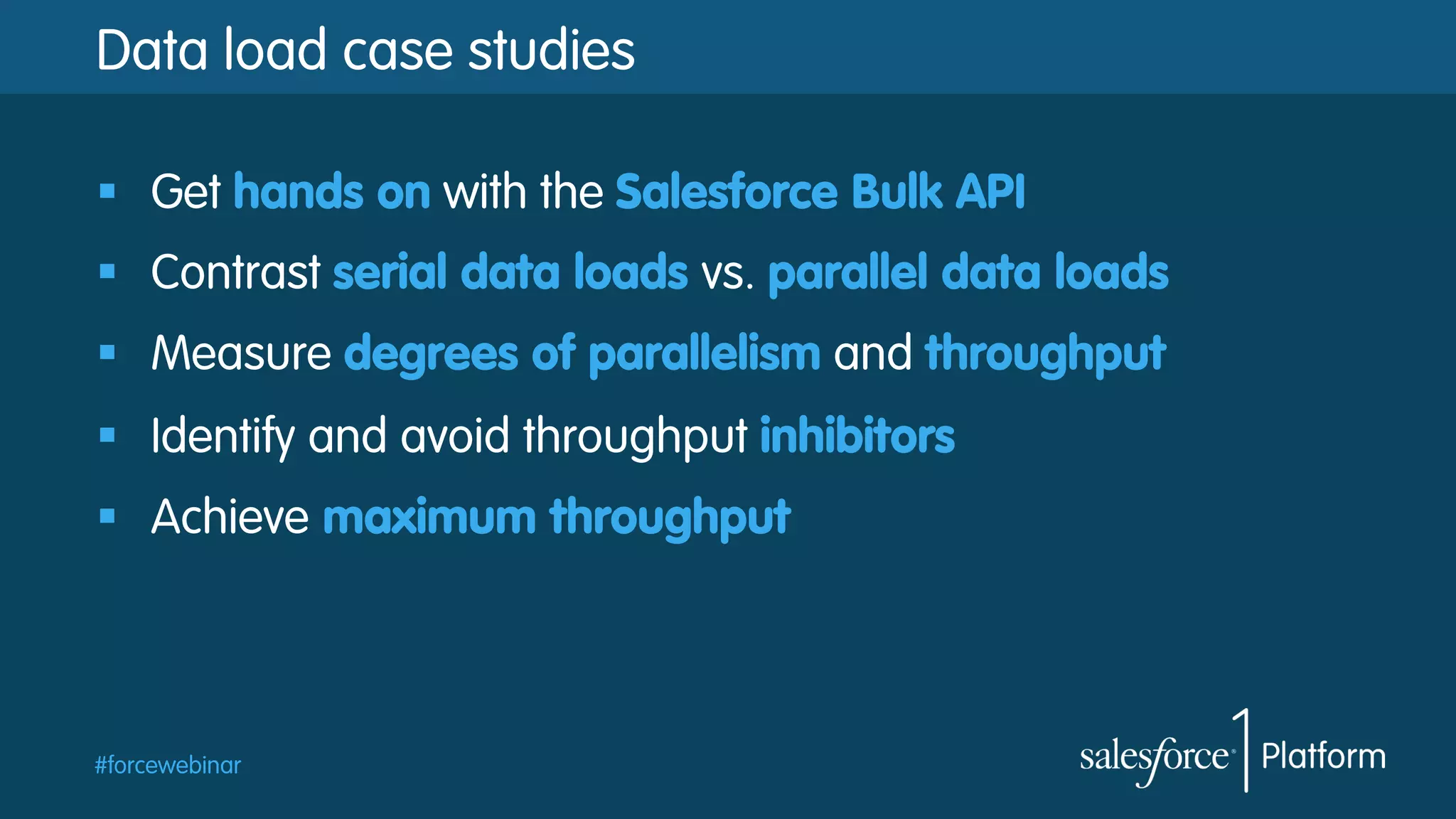
Data load casestudies § Get hands on with the Salesforce Bulk API § Contrast serial data loads vs. parallel data loads § Measure degrees of parallelism and throughput § Identify and avoid throughput inhibitors § Achieve maximum throughput #forcewebinar
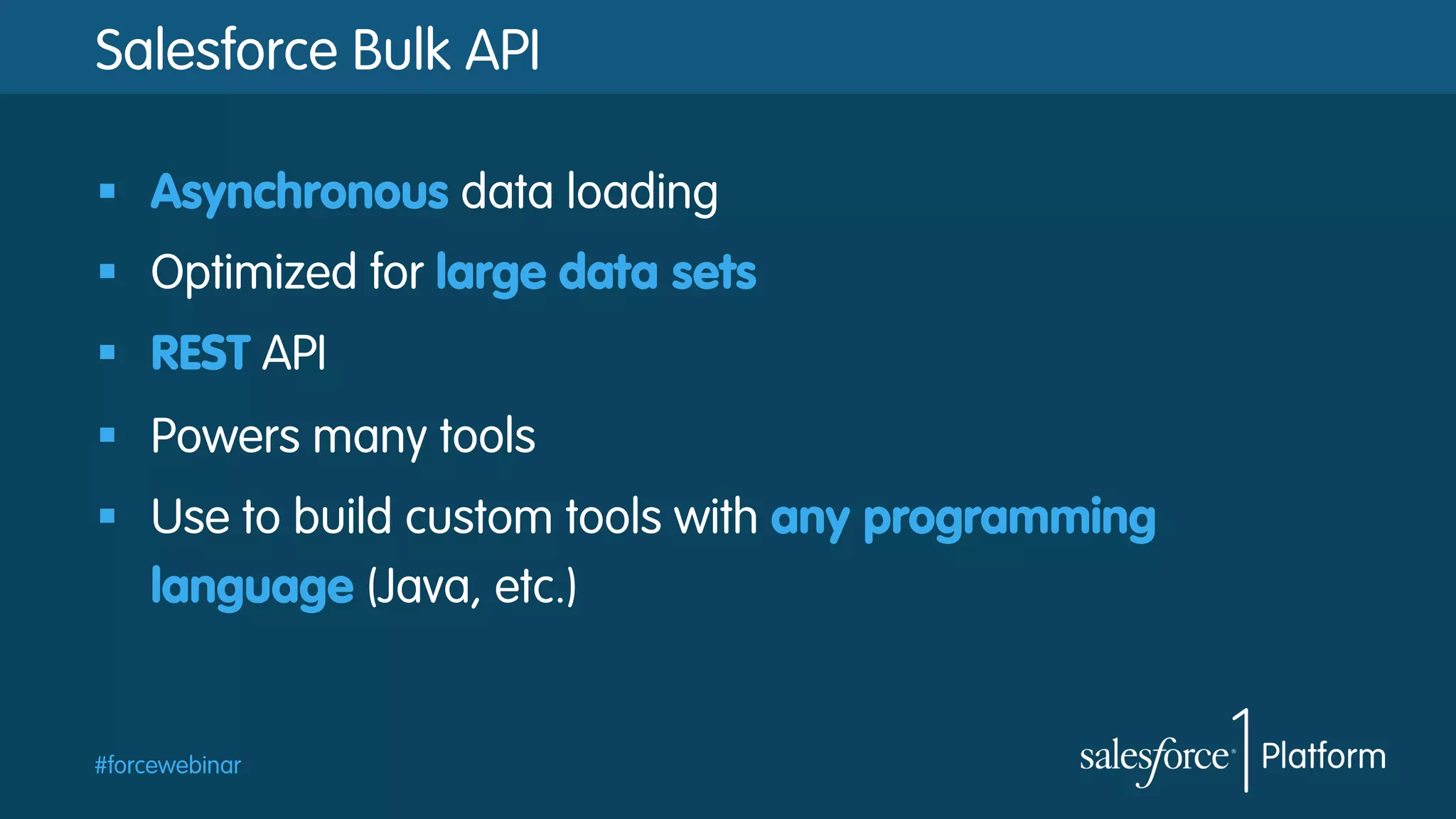
Salesforce Bulk API § Asynchronous data loading § Optimized for large data sets § REST API § Powers many tools § Use to build custom tools with any programming language (Java, etc.) #forcewebinar
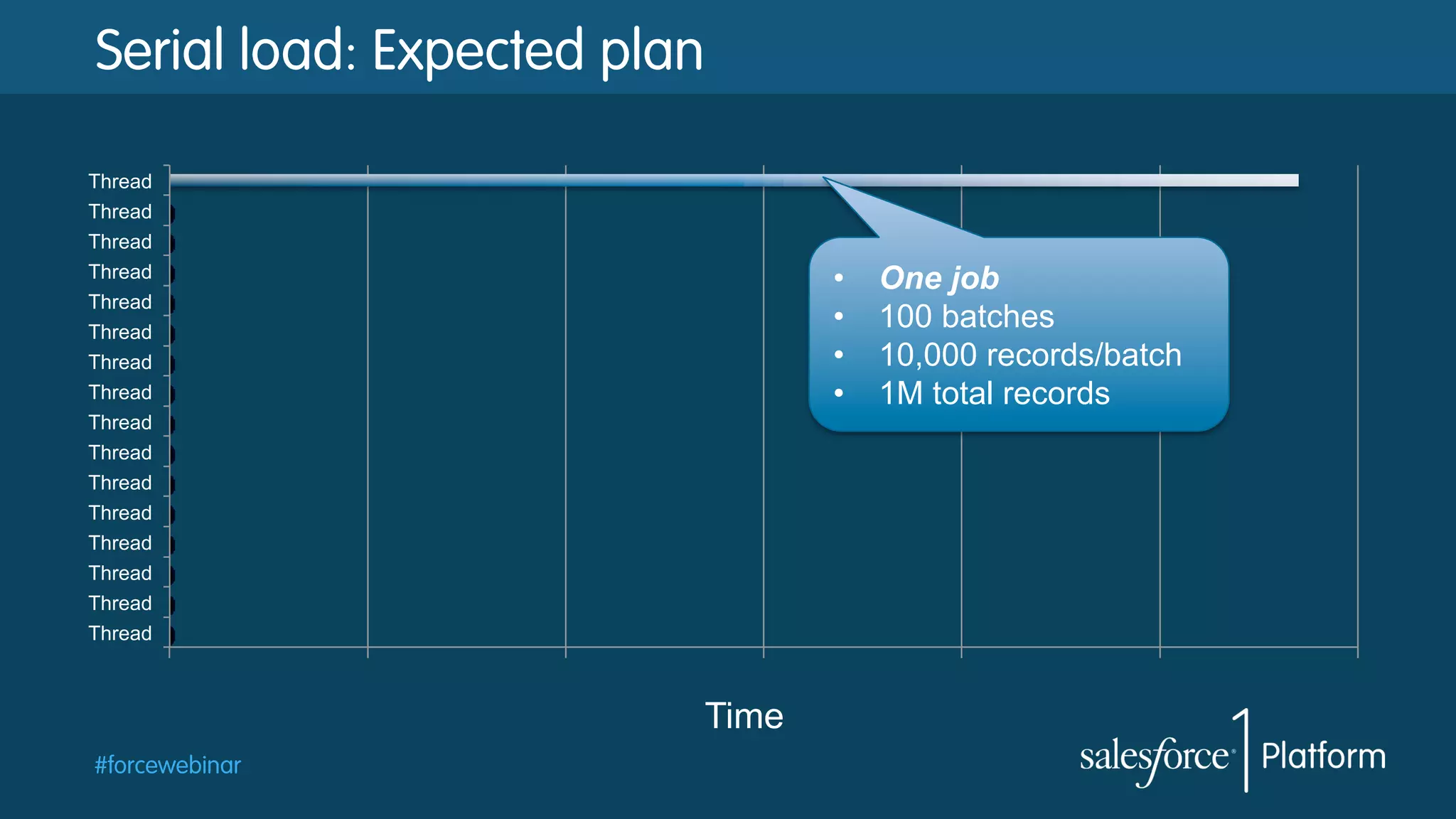
Serial load summary ConcurrencyMode Records Loaded Records Failed Serial 1 million 0 Run Time 52 minutes Work Completed 48 minutes Throughput Degree of Parallelism Key Problem Solution 19,500 records per minute 0.94 Degree of parallelism explicitly limited to ~1. Explore parallel load for increased throughput. #forcewebinar
29.
Throughput Records/Min Parallelism vs.Throughput of a Single Job 350000 Serial Run • Low degree of parallelism 300000 250000 200000 150000 100000 50000 Serial 0 1 2 3 4 5 6 7 8 9 10 11 12 13 14 15 16 17 18 19 20 Degree of Parallelism #forcewebinar
Things to watchfor § Locks can significantly affect parallel loads – Wasted processing capacity – Reduced throughput – Failures § Retry logic is not all its cracked up to be #forcewebinar
Parallel load 1summary Concurrency Mode Records Loaded Records Failed Parallel 125,000 875,000 Run Time 10 minutes Work Completed 2 hours and 30 minutes Throughput Degree of Parallelism Key Problem Solution 20,000 records per minute 15.79 Lock Exceptions. Server worked significantly harder but no increase in throughput. Run the load in serial mode or manage locks. #forcewebinar
36.
Throughput Records/Min Parallelism vs.throughput of a single job 350000 Parallel Run 1 • High degree of parallelism • Low throughput due to locks 300000 250000 200000 150000 100000 50000 Serial Parallel 1 0 1 2 3 4 5 6 7 8 9 10 11 12 13 14 15 16 17 18 19 20 Degree of Parallelism #forcewebinar
37.
Time to optimize § § Let’smake your data load ealize – Locks inhibit parallelism and throughput § nvestigate – What is causing the locks § lan – Manage the locks #forcewebinar
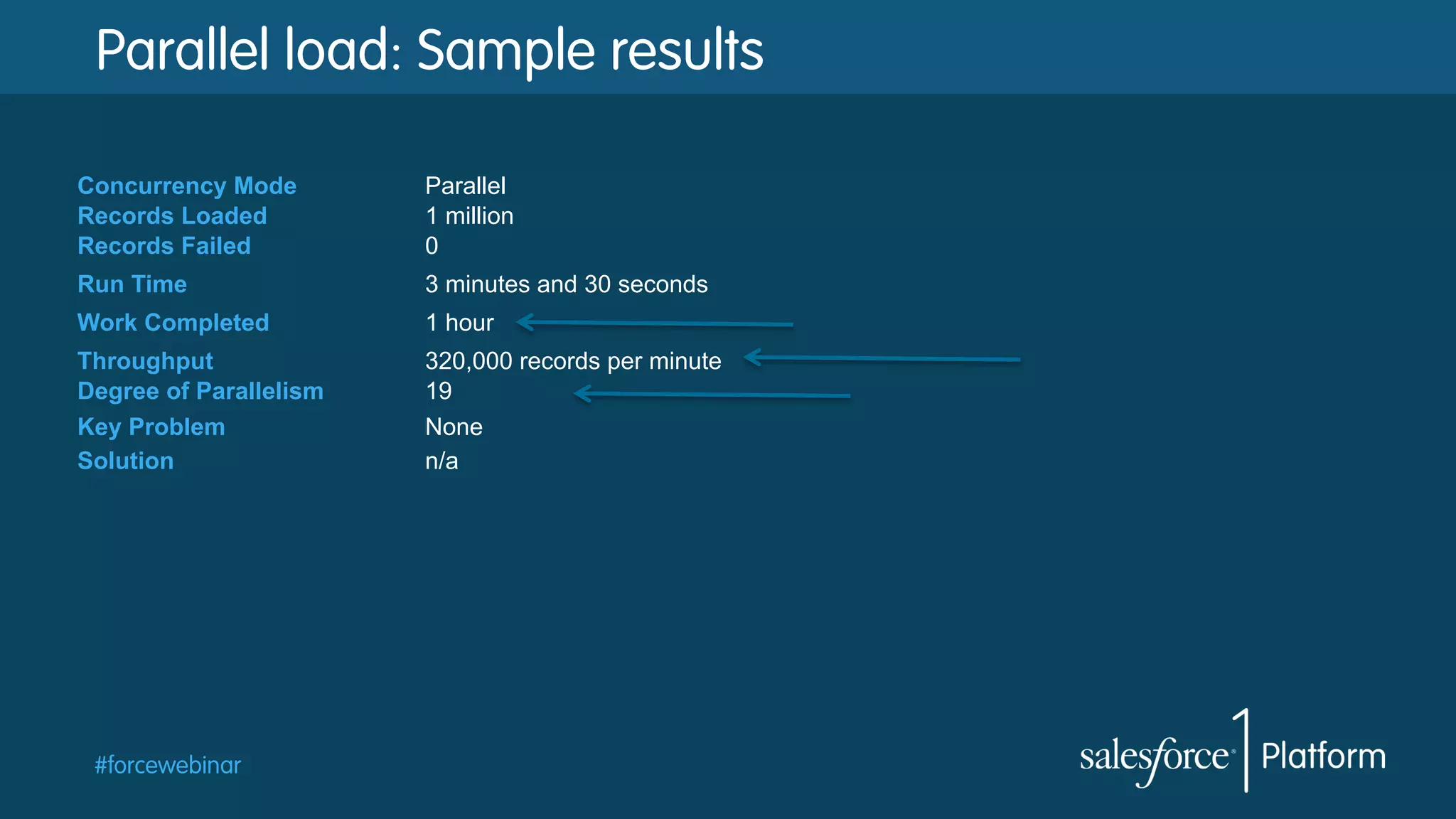
Parallel load: Sampleresults Concurrency Mode Records Loaded Records Failed Parallel 1 million 0 Run Time 3 minutes and 30 seconds Work Completed 1 hour Throughput Degree of Parallelism Key Problem Solution 320,000 records per minute 19 None n/a #forcewebinar
40.
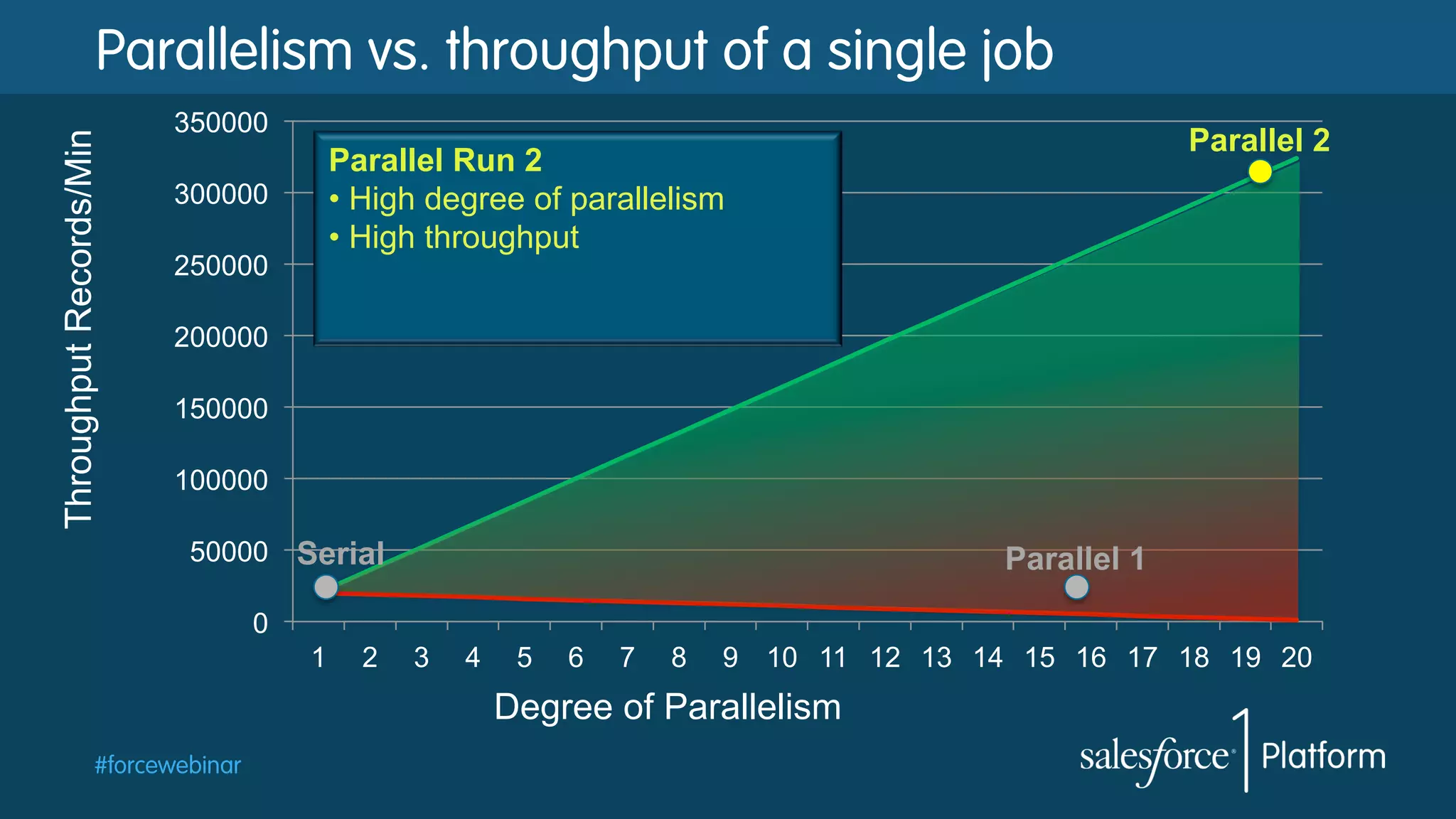
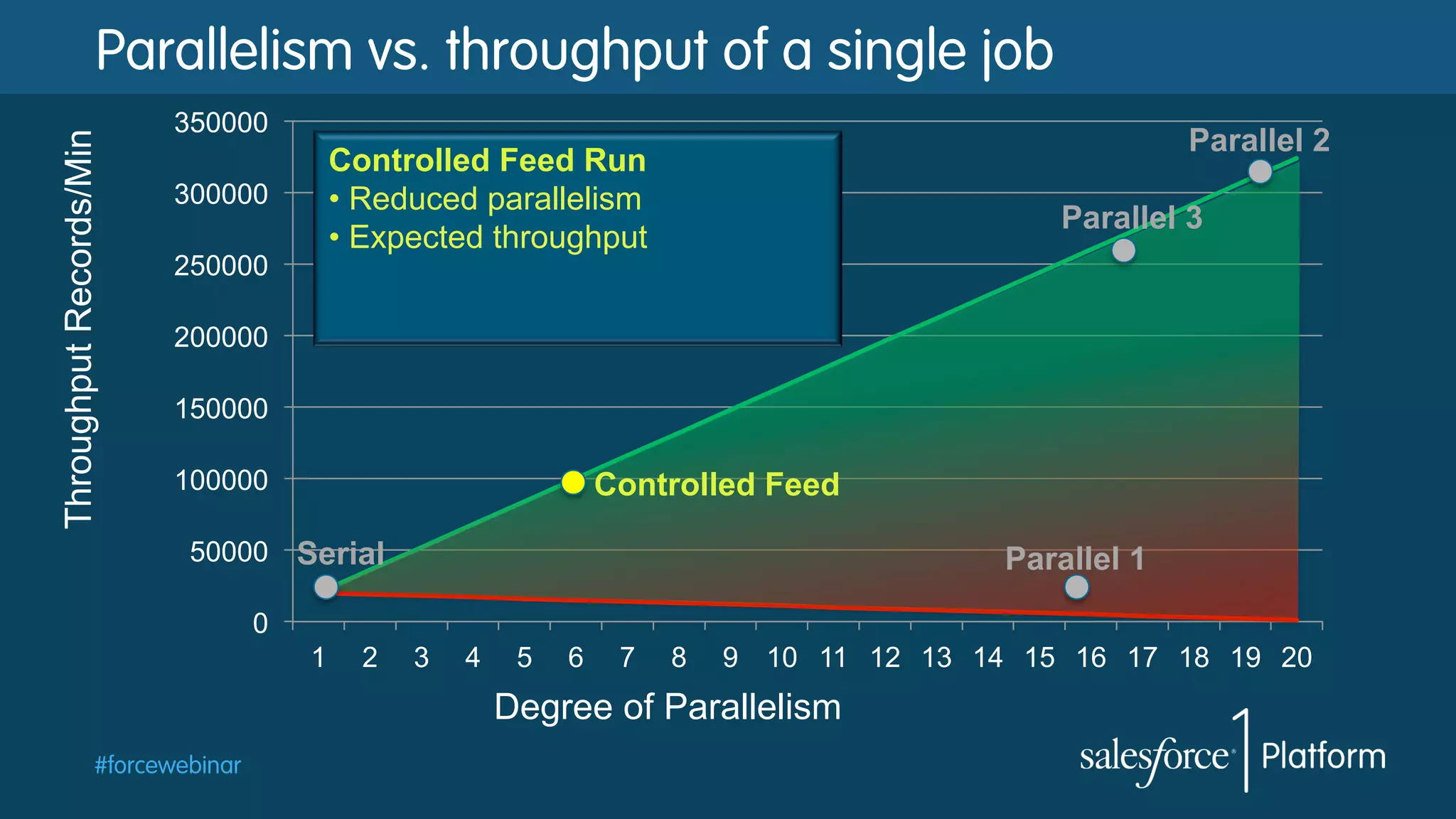
Throughput Records/Min Parallelism vs.throughput of a single job 350000 Parallel 2 Parallel Run 2 • High degree of parallelism • High throughput 300000 250000 200000 150000 100000 50000 Serial Parallel 1 0 1 2 3 4 5 6 7 8 9 10 11 12 13 14 15 16 17 18 19 20 Degree of Parallelism #forcewebinar
41.
Locks can bemanaged by § Elimination § Ordering load file #forcewebinar
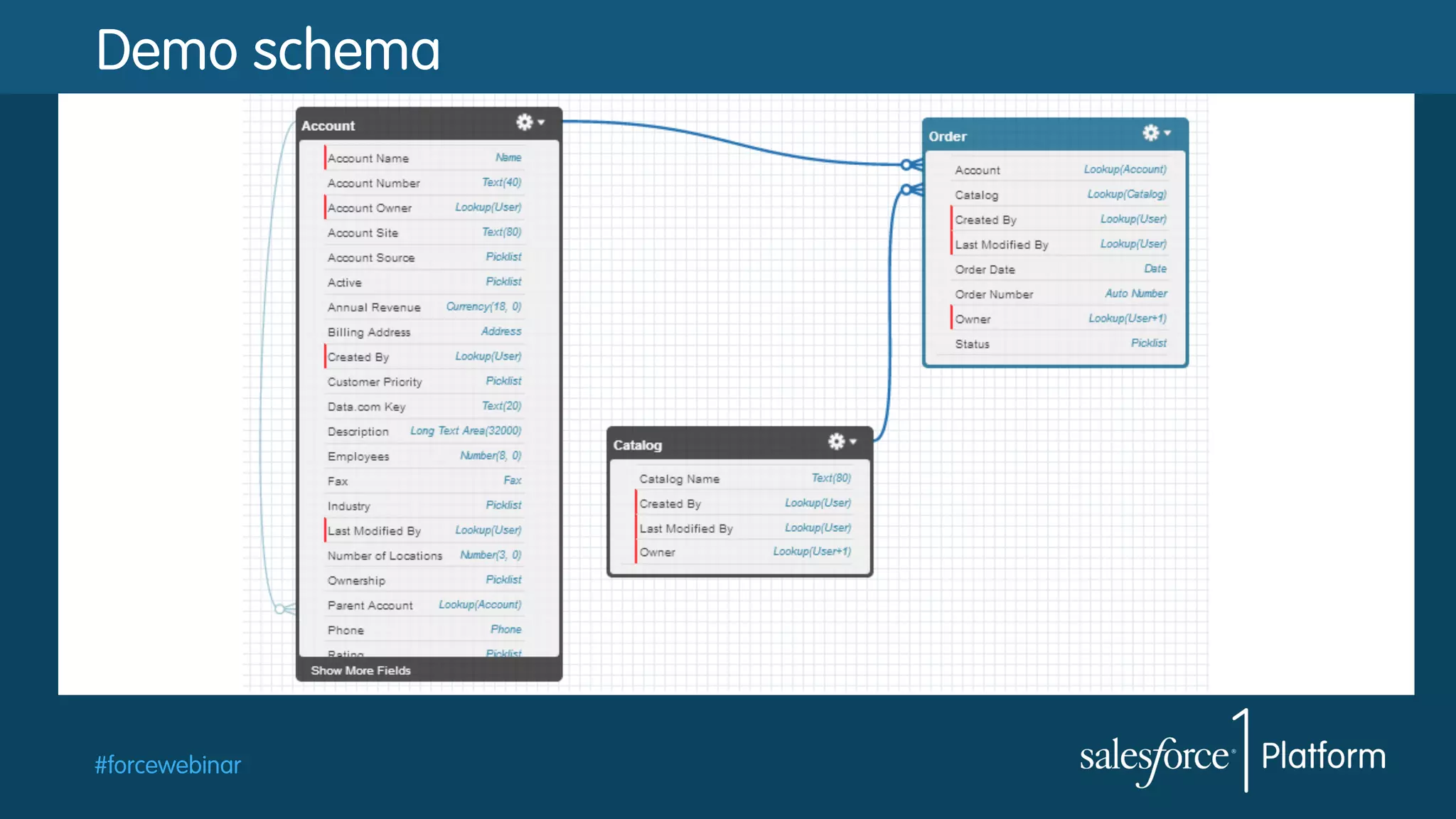
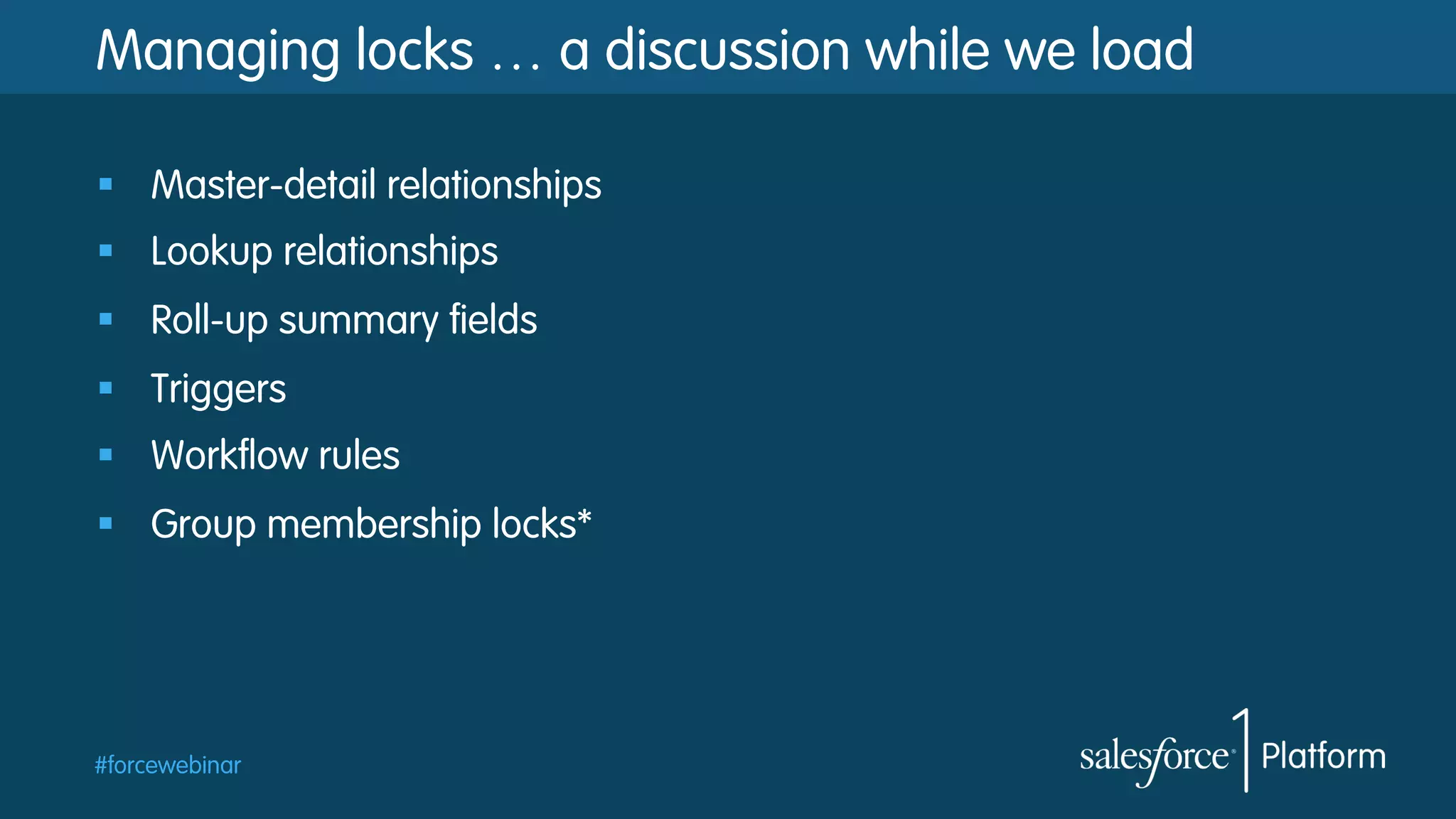
Managing locks …a discussion while we load § Master-detail relationships § Lookup relationships § Roll-up summary fields § Triggers § Workflow rules § Group membership locks* #forcewebinar
44.
Parallel load: Sampleresults Concurrency Mode Records Loaded Records Failed Parallel 1 million 0 Run Time 4 minutes Work Completed 1 hour Throughput Degree of Parallelism Key Problem Solution 250,000 records per minute 16.5 Minimal overhead due to locks Remove all unnecessary locks #forcewebinar
45.
Throughput Records/Min Parallelism vs.throughput of a single job 350000 Parallel Run 3 • High degree of parallelism • High throughput 300000 250000 Parallel 2 Parallel 3 200000 150000 100000 50000 Serial Parallel 1 0 1 2 3 4 5 6 7 8 9 10 11 12 13 14 15 16 17 18 19 20 Degree of Parallelism #forcewebinar
Controlled feed loadmethodology § Explicit throttling on parallelism and throughput – Parallel extraction and loading – Prioritization of asynchronous processing capacity § Manage inhibitors in complex jobs – Data Skews – Multiple Locks #forcewebinar
48.
Throughput Records/Min Parallelism vs.throughput of a single job 350000 Parallel 2 Controlled Feed Run • Reduced parallelism • Expected throughput 300000 250000 Parallel 3 200000 150000 100000 Controlled Feed 50000 Serial Parallel 1 0 1 2 3 4 5 6 7 8 9 10 11 12 13 14 15 16 17 18 19 20 Degree of Parallelism #forcewebinar
Recap § § Make your paralleldata loads ealize – Locks inhibit parallelism and throughput § nvestigate – What is causing the locks § lan – Manage the locks #forcewebinar