Student2student: Arduino Project- based Learning TEEM’16 - Track 1 November 2, 2016 · Salamanca
Authors & Institutions PABLO MARTÍN RAMOS EPSH, Universidad de Zaragoza pmr@unizar.es MARIA JOÃO LOPES & M. MARGARIDA LIMA DA SILVA jeKnowledge, Universidade de Coimbra lopes.mjoao004@gmail.com, mariamargaridals@gmail.com MANUELA RAMOS SILVA CFisUC, Universidade de Coimbra manuela@pollux.fis.uc.pt Presentation template by SlidesCarnival
1. Introduction jeKnowledge student-led initiative & Arduino-based learning
jeKnowledge ◎ Júnior Empresa da Faculdade de Ciências e Tecnologias da Universidade de Coimbra ◎ Student-led initiative started in 2008 ◎ Aimed at offering students the possibility of applying the knowledge acquired in their higher education degrees to the global market ◎ Different internal and external projects http://jeknowledge.pt/
jeKnowledge Academy ◎ jeKnowledge not only works as a start-up incubator… ◎ Also organizes summer schools for 14 to 17 year- old students: jeKnowledge Academy ◎ Aimed at actively engaging Portuguese high- school students in STEM education ◎ Student2student-based approach
Why teach a basic microcontroller at early stages? ◎ To expose the students at this stage to tools that will lead them to ideation, innovation, energy awareness and problem solving skills ◎ Will enable them to become part of a very competitive workforce in the future → the ubiquitous embedded systems are an optimum platform ◎ Steve Jobs once said: “Everybody in this country should learn how to program a computer, because it teaches how to think”
Why choose the Arduino platform? ◎ OpenSource ◎ Ease to program in assembly language and high level languages ◎ Ease to perform graphical system programming and configuration ◎ Possibility to apply it in project-based learning ◎ Affordable ◎ Useable later in their degree program ◎ Prior knowledge of programming or robotics is not a pre-requisite, only the desire to learn!
“ “You don’t need anyone’s permission to create something great” Massimo Banzi, Co-Founder of Arduino
“ “It’s sort of like cooking. You don’t need to be a chef to cook but almost everyone cooks something” Michael Shiloh, Arduino
Even more reasons… ◎ Can provide an introduction to microcontrollers without dwelling much into programming aspect of it or the architecture aspect of it ◎ The implementation of Processing used in Arduino IDE would be a C/C++ ‘dialect’ ◎ Many graphical languages available (Visuino, Ardublock, mBlock, miniblock, Snap4Arduino, Embrio…) ◎ Adding peripherals is not difficult ◎ Huge amount of online tutorials and a large user base to ask questions to!
Arduino Great start for creating interactive objects or environments
2. Methodology Teaching approach and equipment
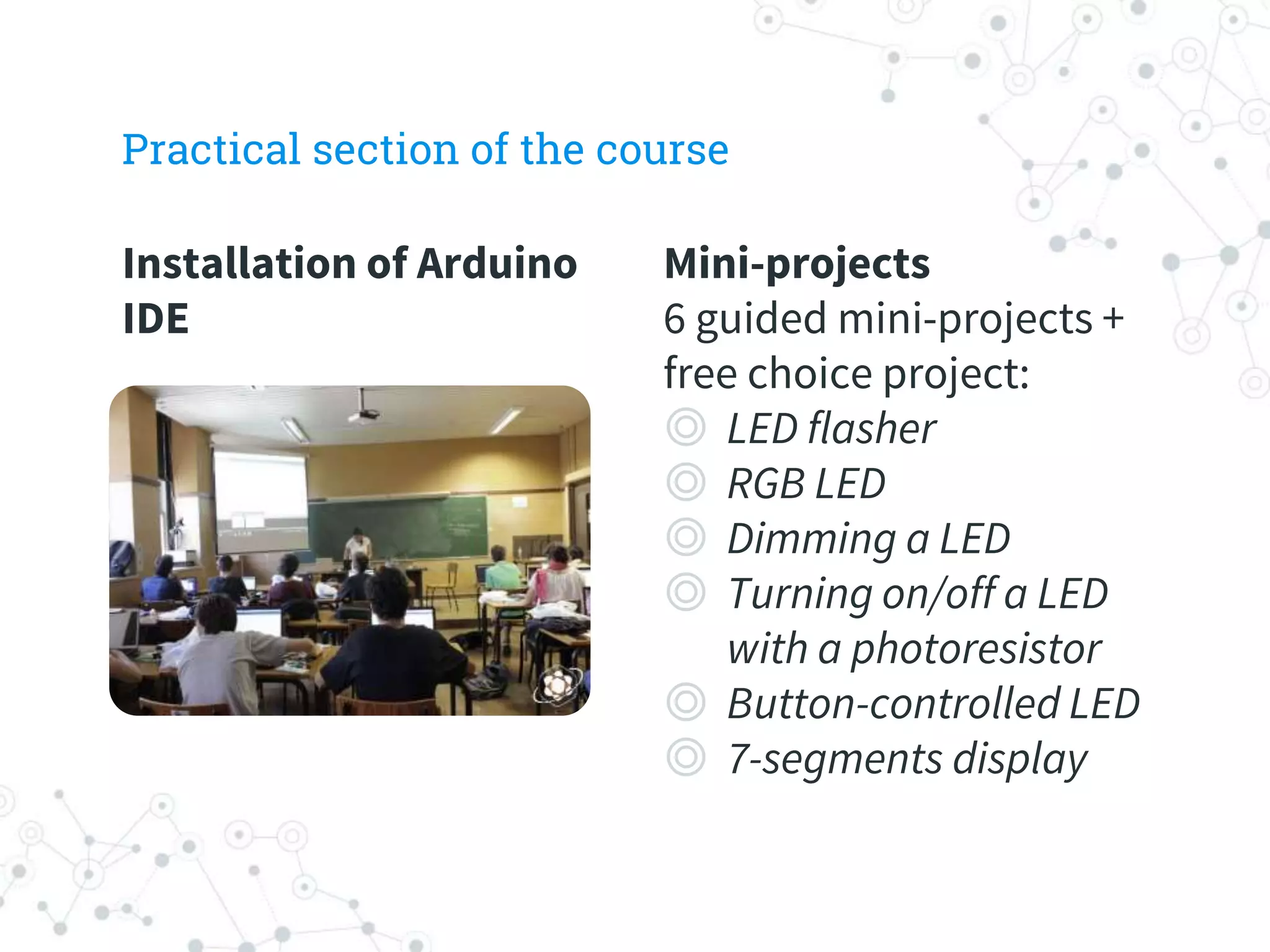
Students and… “students-teachers” ◎ 18 students, 9th to the 12th grade ◎ 7 h seminar → split into 2 sessions, on 2 days ◎ Small attendance fee → students received an Arduino starter kit and several other pieces to take home ◎ Seminar taught by 2nd to 4th-year students from the Physics Engineering and the Design and Multimedia degrees
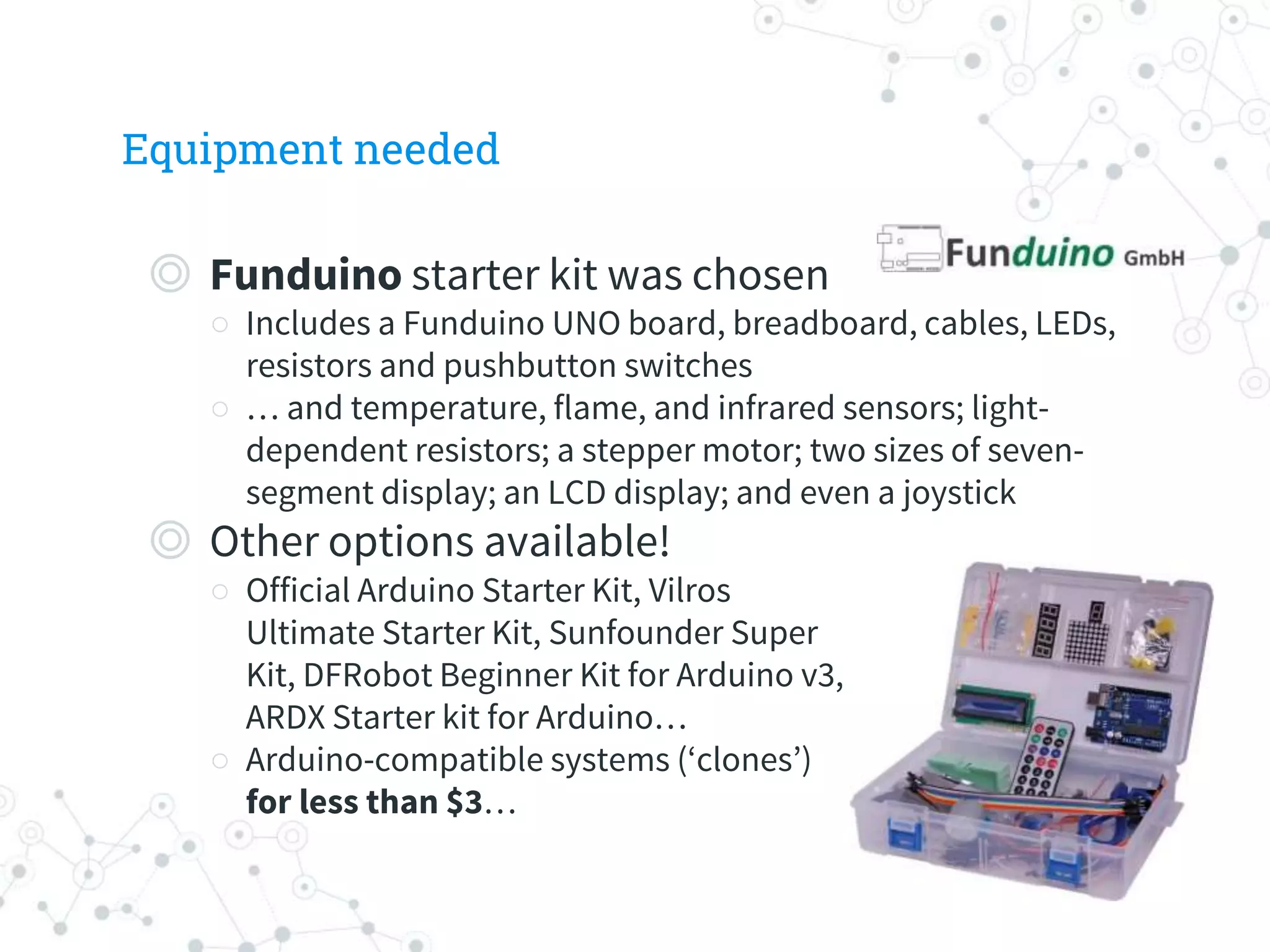
Equipment needed ◎ Funduino starter kit was chosen ○ Includes a Funduino UNO board, breadboard, cables, LEDs, resistors and pushbutton switches ○ … and temperature, flame, and infrared sensors; light- dependent resistors; a stepper motor; two sizes of seven- segment display; an LCD display; and even a joystick ◎ Other options available! ○ Official Arduino Starter Kit, Vilros Ultimate Starter Kit, Sunfounder Super Kit, DFRobot Beginner Kit for Arduino v3, ARDX Starter kit for Arduino… ○ Arduino-compatible systems (‘clones’) for less than $3…
3. Course organization Theoretical introduction + hands- on sessions
Theoretical section Introduction General aspects about open-source hardware philosophy, Arduino’s make of, models and characteristics. Selected sequences from “Arduino: The documentary (2010)” (CC-SA) were played. Fundamentals of Arduino programming Only variables, functions and structures that were needed to understand the code of the mini-project examples were covered. Avoiding… The aspects that could be more overwhelming (memory mapping, peripheral interfacing, using timers and counters, serial and parallel communications, opcodes and operands, polling and interrupts, etc.) were safely skipped!
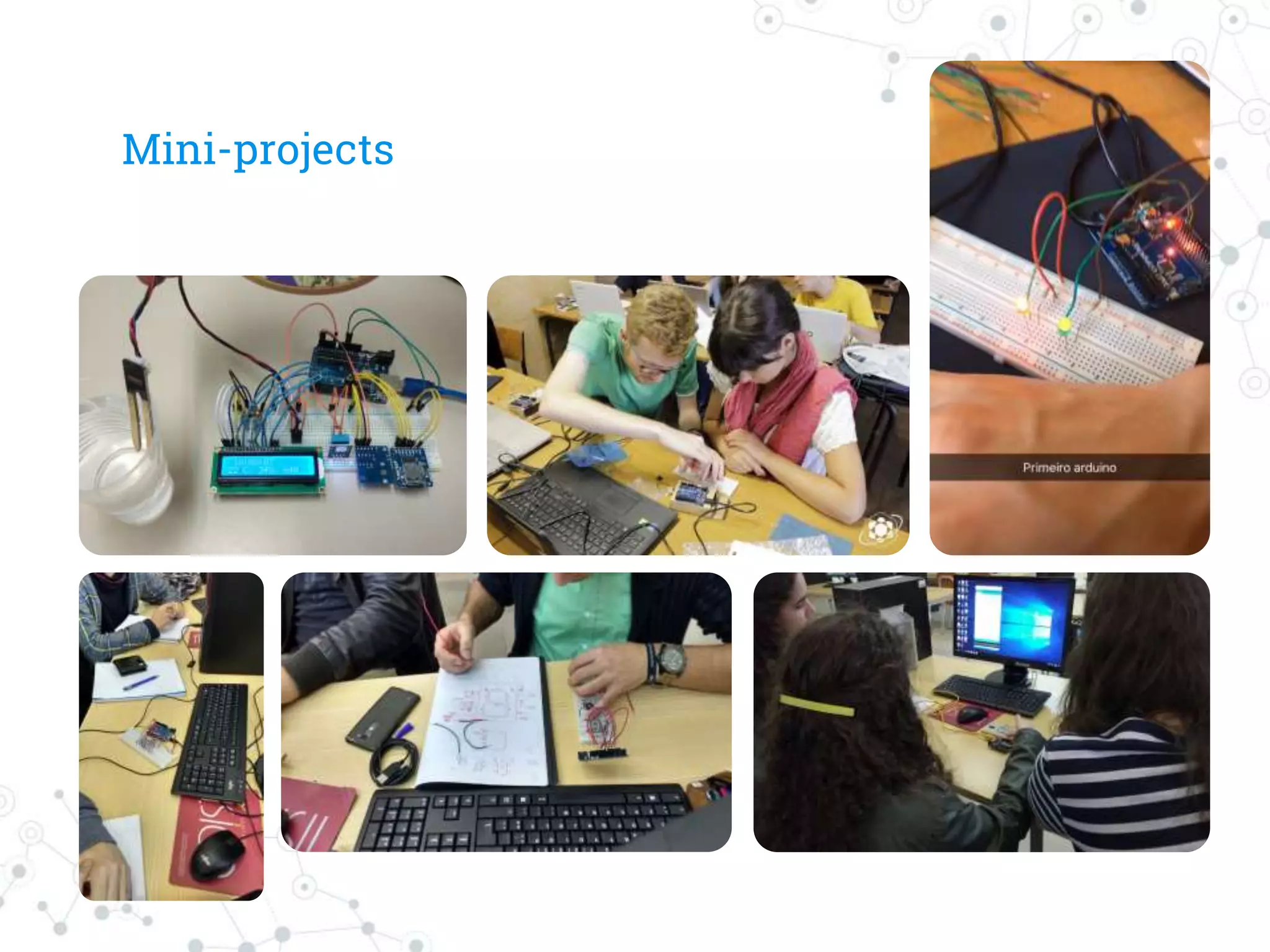
Installation of Arduino IDE Practical section of the course Mini-projects 6 guided mini-projects + free choice project: ◎ LED flasher ◎ RGB LED ◎ Dimming a LED ◎ Turning on/off a LED with a photoresistor ◎ Button-controlled LED ◎ 7-segments display
Mini-projects
Follow-up ◎ Upon completion of the course, a follow-up was conducted through a blog ○ New tutorials were posted: a virtual dice, a LED interface with Processing and Arduino, a memory game, a rain gauge, etc. ○ Aimed at encouraging the students that had taken part in the Summer Course to contribute with their comments. ◎ Student2Student Arduino workshops were included in the first-year syllabus of the Physics Engineering Course
“ “…The course was definitely a wonderful experience for me! The lessons were challenging, but thrilling as well. The more I learned, the more I wanted to discover and explore, which I find incredible. It certainly helped me decide that I want to pursue an Engineering degree in the future. In my opinion, learning through technologies such as computers as opposed to textbooks also helps because they're more interactive…” Luis Silva, 16 y.o.
“ “Well, for me it was a good experience to have younger teachers talking to us. I really enjoyed it because as they are not much older than us, and we are able to communicate easily with them, using some expressions and slang that we wouldn’t use with older teachers. I definitely felt more relaxed too, I didn´t feel the sort of pressure you would feel in a normal class, probably because they understand us better than any adult and they know how we think.” Miguel Galvão, 16 y.o.
4. Conclusions Outcomes from the course
Outcomes ◎ Was a success: just one drop-out. ◎ Young students were engaged in learning and motivated to increase the complexity of the project step by step. ◎ The feeling of achievement after completing a project reinforced student motivation to pursue a STEM education. ◎ The advantages of peer-coaching were also highlighted by the younger students, who stated that it facilitated the communication and relaxed the classroom atmosphere.
Future plans Plans are currently underway for the 3rd edition → adding a challenge-type activity may be conducted, in which students would work in teams to develop a certain project over a period one/two weeks. More meaningful experience!
Thanks! Any questions? You can find me at: pmr@unizar.es

Student2student: Arduino Project-based Learning

  • 1.
    Student2student: Arduino Project- based Learning TEEM’16- Track 1 November 2, 2016 · Salamanca
  • 2.
    Authors & Institutions PABLOMARTÍN RAMOS EPSH, Universidad de Zaragoza pmr@unizar.es MARIA JOÃO LOPES & M. MARGARIDA LIMA DA SILVA jeKnowledge, Universidade de Coimbra lopes.mjoao004@gmail.com, mariamargaridals@gmail.com MANUELA RAMOS SILVA CFisUC, Universidade de Coimbra manuela@pollux.fis.uc.pt Presentation template by SlidesCarnival
  • 3.
  • 4.
    jeKnowledge ◎ Júnior Empresada Faculdade de Ciências e Tecnologias da Universidade de Coimbra ◎ Student-led initiative started in 2008 ◎ Aimed at offering students the possibility of applying the knowledge acquired in their higher education degrees to the global market ◎ Different internal and external projects http://jeknowledge.pt/
  • 5.
    jeKnowledge Academy ◎ jeKnowledgenot only works as a start-up incubator… ◎ Also organizes summer schools for 14 to 17 year- old students: jeKnowledge Academy ◎ Aimed at actively engaging Portuguese high- school students in STEM education ◎ Student2student-based approach
  • 6.
    Why teach abasic microcontroller at early stages? ◎ To expose the students at this stage to tools that will lead them to ideation, innovation, energy awareness and problem solving skills ◎ Will enable them to become part of a very competitive workforce in the future → the ubiquitous embedded systems are an optimum platform ◎ Steve Jobs once said: “Everybody in this country should learn how to program a computer, because it teaches how to think”
  • 7.
    Why choose theArduino platform? ◎ OpenSource ◎ Ease to program in assembly language and high level languages ◎ Ease to perform graphical system programming and configuration ◎ Possibility to apply it in project-based learning ◎ Affordable ◎ Useable later in their degree program ◎ Prior knowledge of programming or robotics is not a pre-requisite, only the desire to learn!
  • 8.
    “ “You don’t needanyone’s permission to create something great” Massimo Banzi, Co-Founder of Arduino
  • 9.
    “ “It’s sort oflike cooking. You don’t need to be a chef to cook but almost everyone cooks something” Michael Shiloh, Arduino
  • 10.
    Even more reasons… ◎Can provide an introduction to microcontrollers without dwelling much into programming aspect of it or the architecture aspect of it ◎ The implementation of Processing used in Arduino IDE would be a C/C++ ‘dialect’ ◎ Many graphical languages available (Visuino, Ardublock, mBlock, miniblock, Snap4Arduino, Embrio…) ◎ Adding peripherals is not difficult ◎ Huge amount of online tutorials and a large user base to ask questions to!
  • 11.
    Arduino Great start forcreating interactive objects or environments
  • 12.
  • 13.
    Students and… “students-teachers” ◎18 students, 9th to the 12th grade ◎ 7 h seminar → split into 2 sessions, on 2 days ◎ Small attendance fee → students received an Arduino starter kit and several other pieces to take home ◎ Seminar taught by 2nd to 4th-year students from the Physics Engineering and the Design and Multimedia degrees
  • 14.
    Equipment needed ◎ Funduinostarter kit was chosen ○ Includes a Funduino UNO board, breadboard, cables, LEDs, resistors and pushbutton switches ○ … and temperature, flame, and infrared sensors; light- dependent resistors; a stepper motor; two sizes of seven- segment display; an LCD display; and even a joystick ◎ Other options available! ○ Official Arduino Starter Kit, Vilros Ultimate Starter Kit, Sunfounder Super Kit, DFRobot Beginner Kit for Arduino v3, ARDX Starter kit for Arduino… ○ Arduino-compatible systems (‘clones’) for less than $3…
  • 15.
  • 16.
    Theoretical section Introduction General aspects aboutopen-source hardware philosophy, Arduino’s make of, models and characteristics. Selected sequences from “Arduino: The documentary (2010)” (CC-SA) were played. Fundamentals of Arduino programming Only variables, functions and structures that were needed to understand the code of the mini-project examples were covered. Avoiding… The aspects that could be more overwhelming (memory mapping, peripheral interfacing, using timers and counters, serial and parallel communications, opcodes and operands, polling and interrupts, etc.) were safely skipped!
  • 17.
    Installation of Arduino IDE Practicalsection of the course Mini-projects 6 guided mini-projects + free choice project: ◎ LED flasher ◎ RGB LED ◎ Dimming a LED ◎ Turning on/off a LED with a photoresistor ◎ Button-controlled LED ◎ 7-segments display
  • 18.
  • 19.
    Follow-up ◎ Upon completionof the course, a follow-up was conducted through a blog ○ New tutorials were posted: a virtual dice, a LED interface with Processing and Arduino, a memory game, a rain gauge, etc. ○ Aimed at encouraging the students that had taken part in the Summer Course to contribute with their comments. ◎ Student2Student Arduino workshops were included in the first-year syllabus of the Physics Engineering Course
  • 20.
    “ “…The course wasdefinitely a wonderful experience for me! The lessons were challenging, but thrilling as well. The more I learned, the more I wanted to discover and explore, which I find incredible. It certainly helped me decide that I want to pursue an Engineering degree in the future. In my opinion, learning through technologies such as computers as opposed to textbooks also helps because they're more interactive…” Luis Silva, 16 y.o.
  • 21.
    “ “Well, for meit was a good experience to have younger teachers talking to us. I really enjoyed it because as they are not much older than us, and we are able to communicate easily with them, using some expressions and slang that we wouldn’t use with older teachers. I definitely felt more relaxed too, I didn´t feel the sort of pressure you would feel in a normal class, probably because they understand us better than any adult and they know how we think.” Miguel Galvão, 16 y.o.
  • 22.
  • 23.
    Outcomes ◎ Was asuccess: just one drop-out. ◎ Young students were engaged in learning and motivated to increase the complexity of the project step by step. ◎ The feeling of achievement after completing a project reinforced student motivation to pursue a STEM education. ◎ The advantages of peer-coaching were also highlighted by the younger students, who stated that it facilitated the communication and relaxed the classroom atmosphere.
  • 24.
    Future plans Plans arecurrently underway for the 3rd edition → adding a challenge-type activity may be conducted, in which students would work in teams to develop a certain project over a period one/two weeks. More meaningful experience!
  • 25.
    Thanks! Any questions? You canfind me at: pmr@unizar.es