THEFT PROOF-JAVA EE Markus Eisele markus@jboss.org @myfear blog.eisele.net Securing your Java EE applications
YOU KNOW JAVA EE
BUT WHAT DO YOU KNOW ABOUT SECURITY?
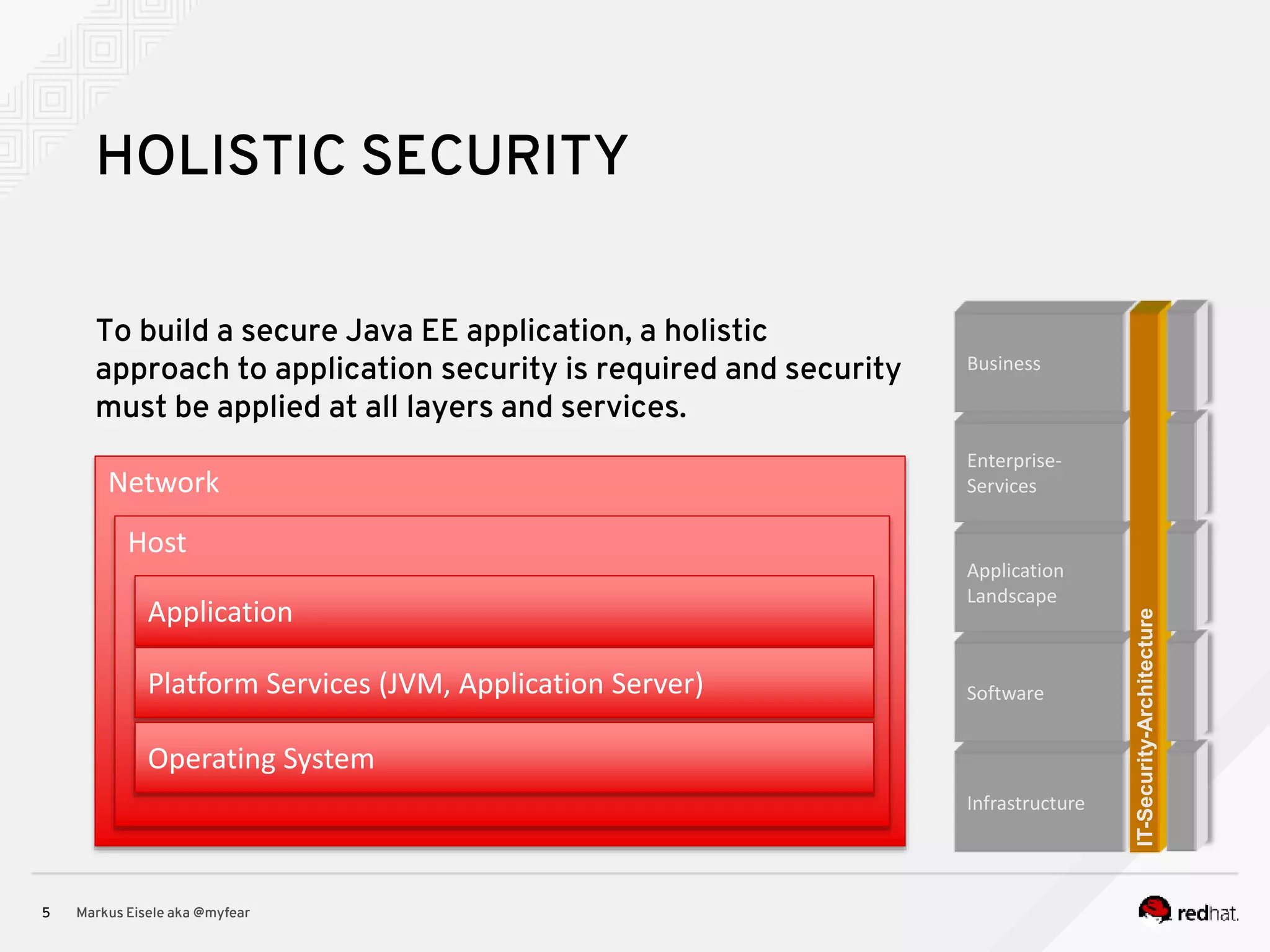
Markus Eisele aka @myfear5 HOLISTIC SECURITY To build a secure Java EE application, a holistic approach to application security is required and security must be applied at all layers and services. Network Host Application Platform Services (JVM, Application Server) Operating System Infrastructure Software Application Landscape Enterprise- Services Business IT-Security-Architecture
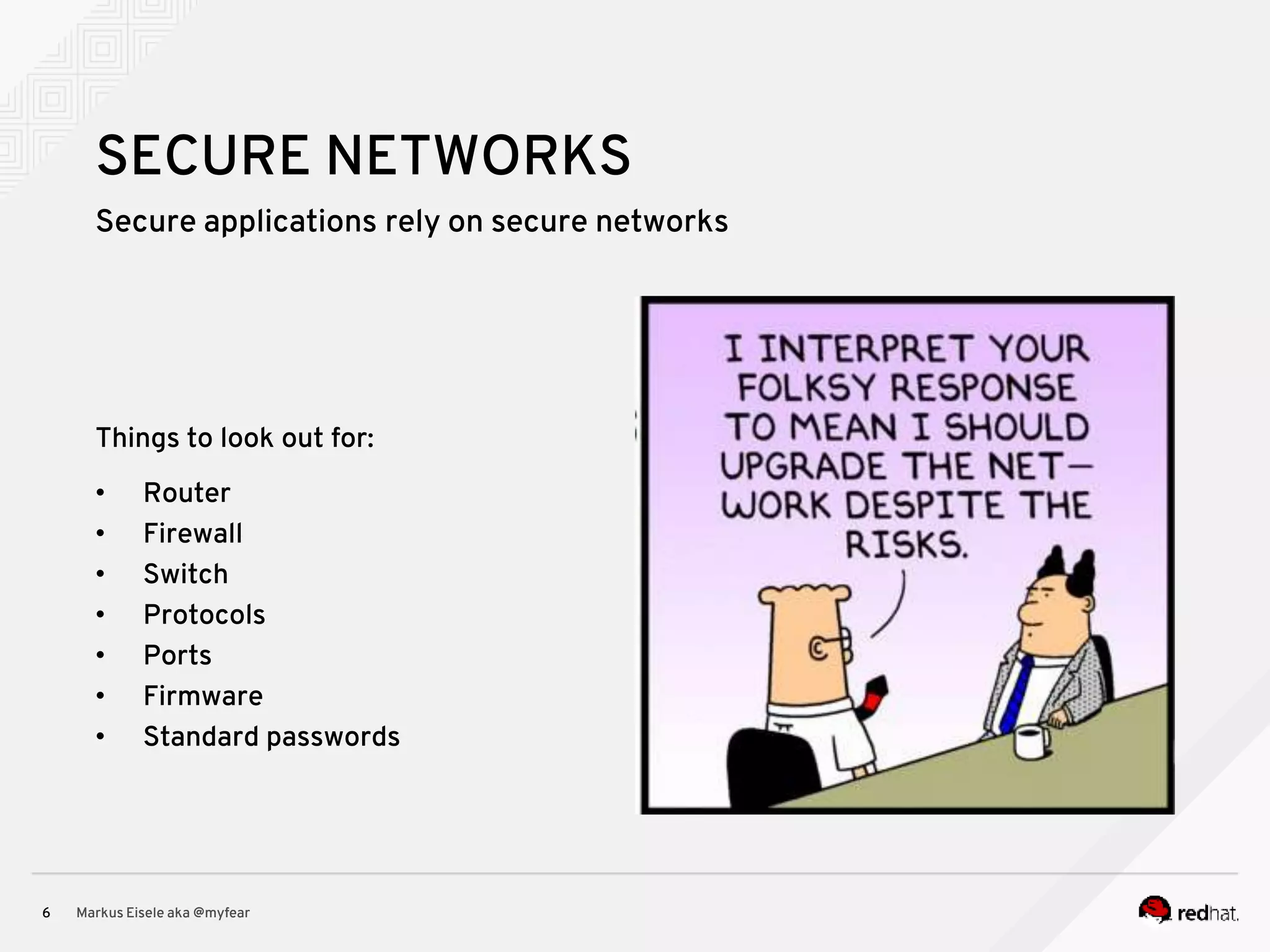
Secure applications rely on secure networks Markus Eisele aka @myfear6 SECURE NETWORKS Things to look out for: • Router • Firewall • Switch • Protocols • Ports • Firmware • Standard passwords
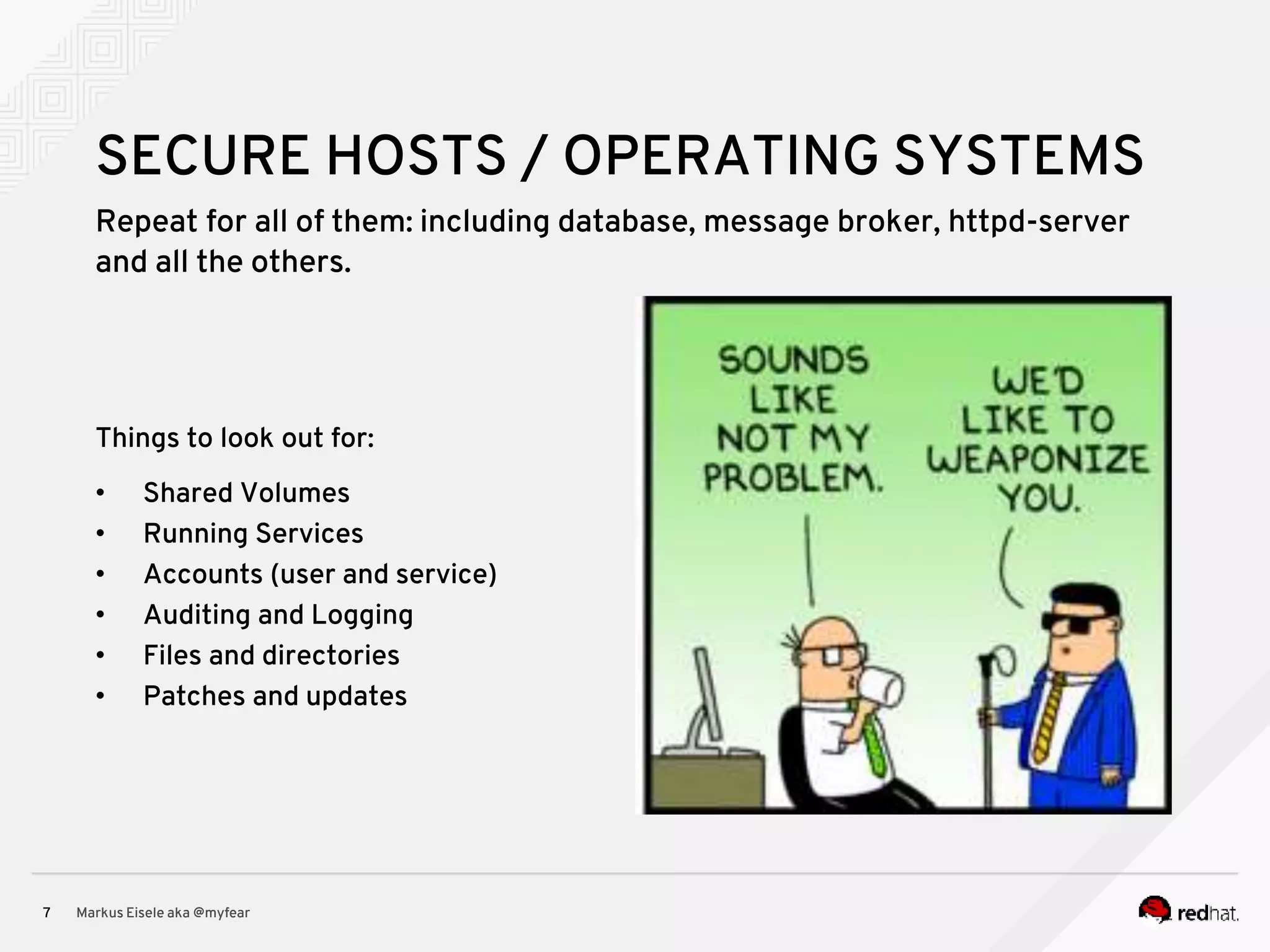
Repeat for all of them: including database, message broker, httpd-server and all the others. Markus Eisele aka @myfear7 SECURE HOSTS / OPERATING SYSTEMS Things to look out for: • Shared Volumes • Running Services • Accounts (user and service) • Auditing and Logging • Files and directories • Patches and updates
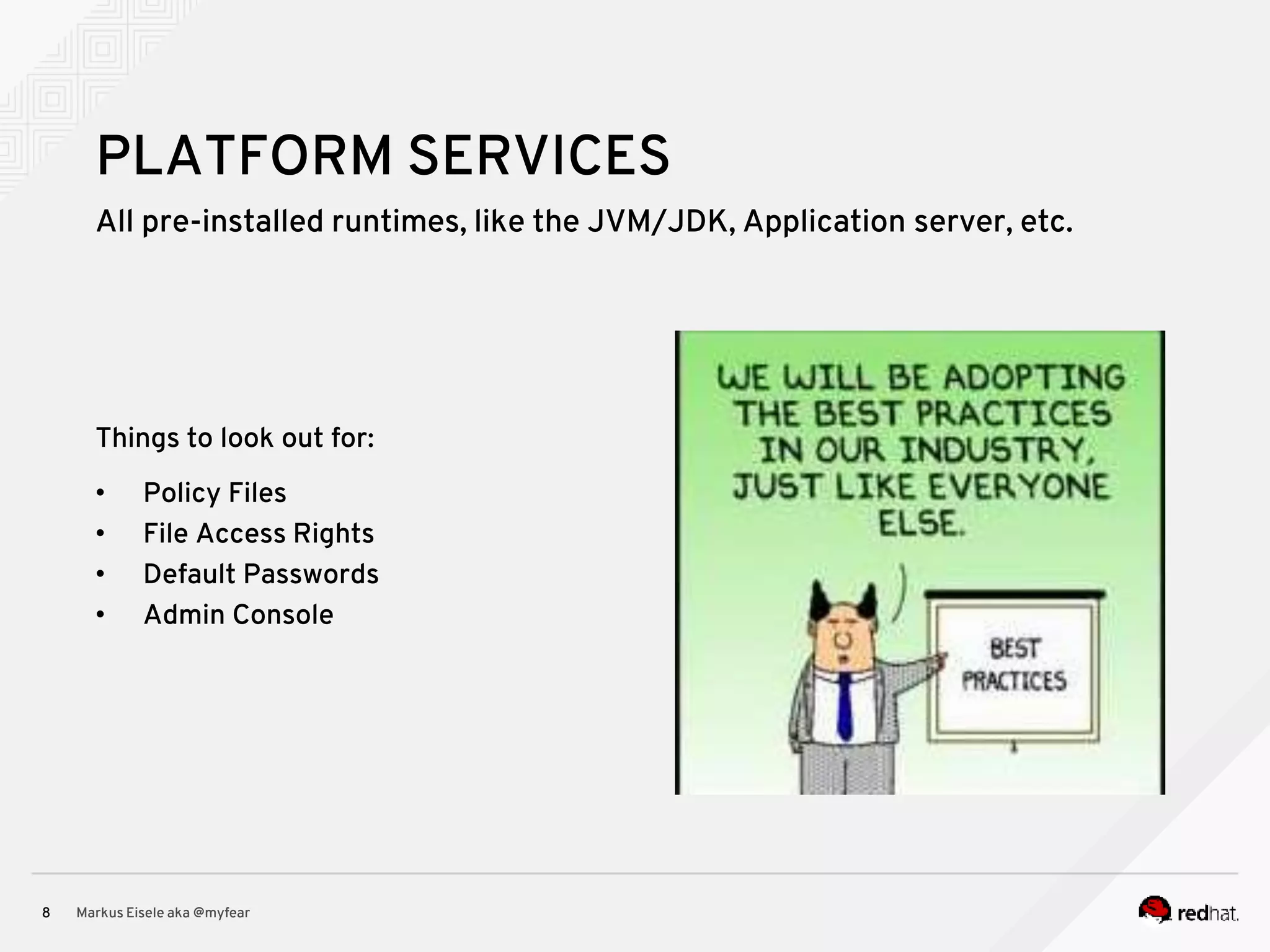
All pre-installed runtimes, like the JVM/JDK, Application server, etc. Markus Eisele aka @myfear8 PLATFORM SERVICES Things to look out for: • Policy Files • File Access Rights • Default Passwords • Admin Console
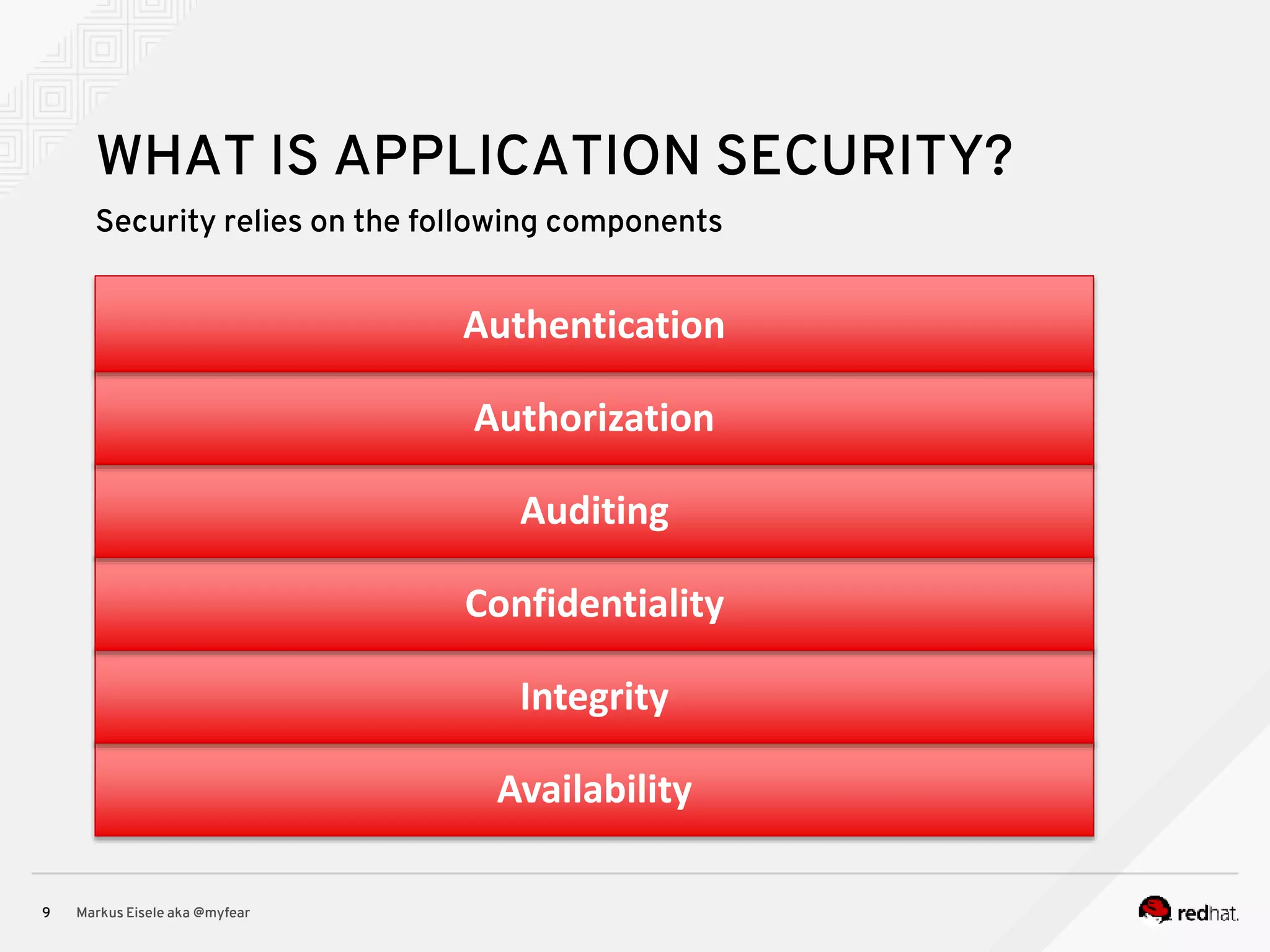
Security relies on the following components WHAT IS APPLICATION SECURITY? Availability Integrity Confidentiality Auditing Authorization Authentication Markus Eisele aka @myfear9
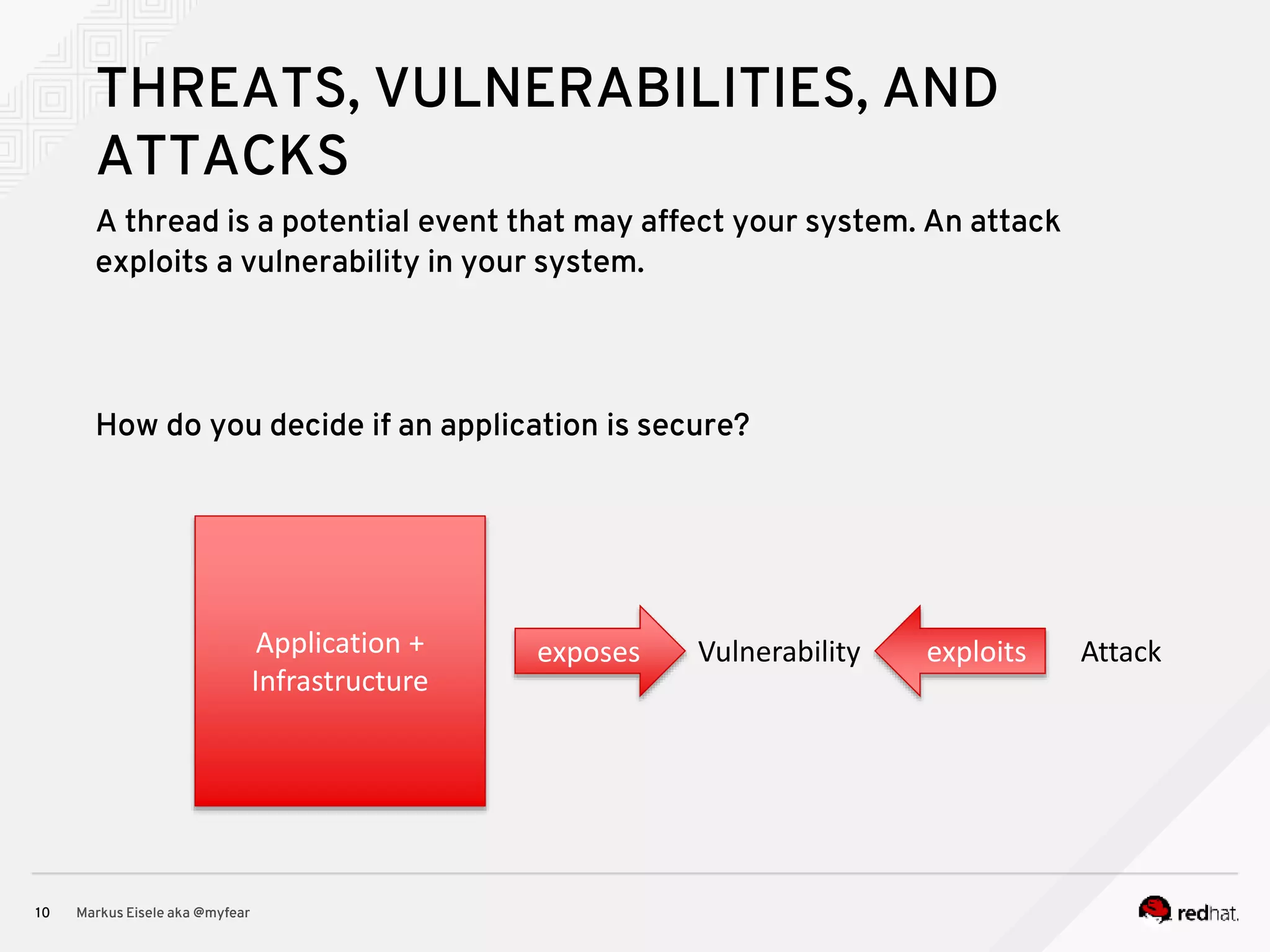
A thread is a potential event that may affect your system. An attack exploits a vulnerability in your system. Markus Eisele aka @myfear10 THREATS, VULNERABILITIES, AND ATTACKS How do you decide if an application is secure? Application + Infrastructure exposes Vulnerability exploits Attack
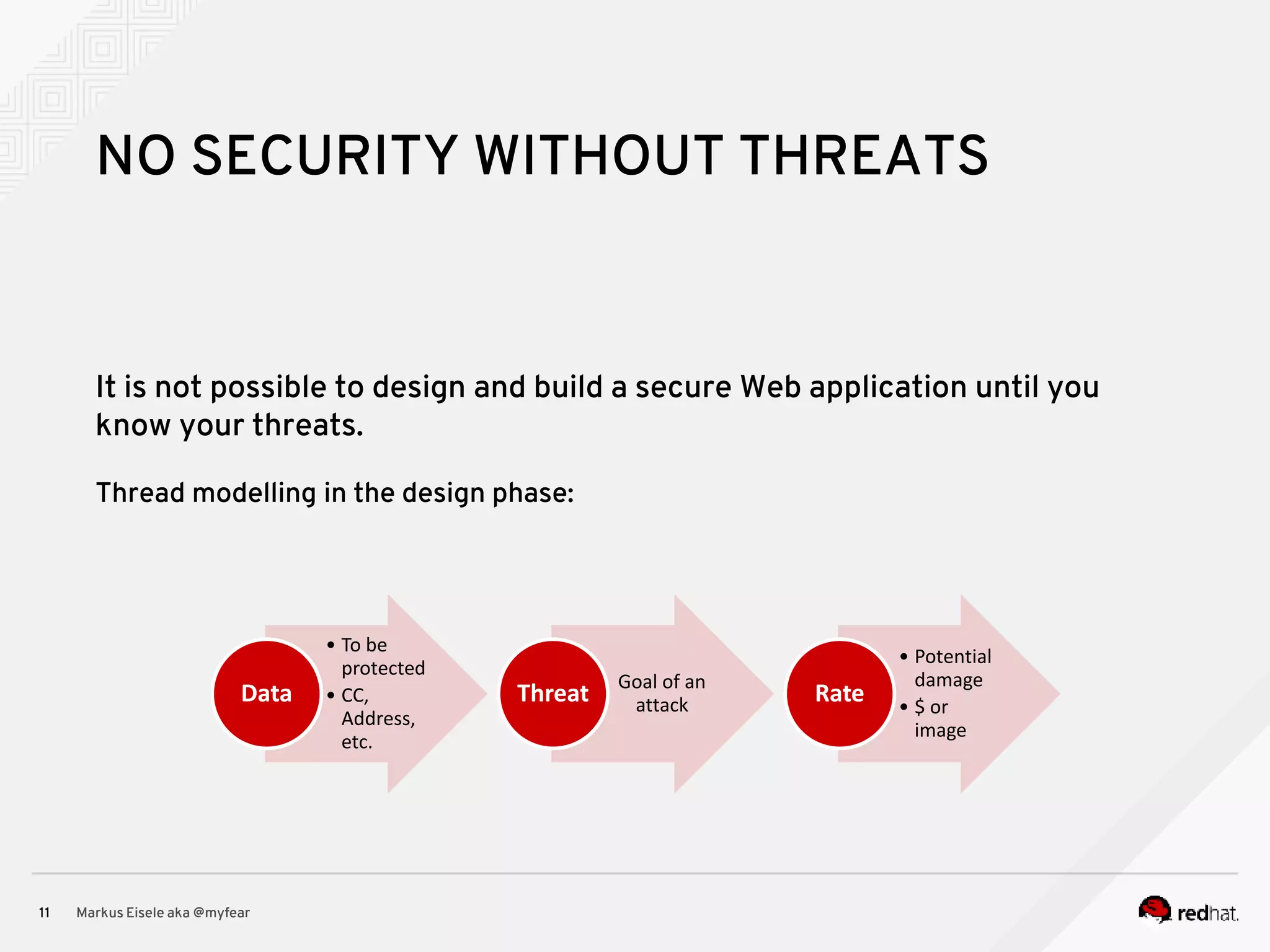
Markus Eisele aka @myfear11 NO SECURITY WITHOUT THREATS It is not possible to design and build a secure Web application until you know your threats. Thread modelling in the design phase: • To be protected • CC, Address, etc. Data Goal of an attackThreat • Potential damage • $ or image Rate
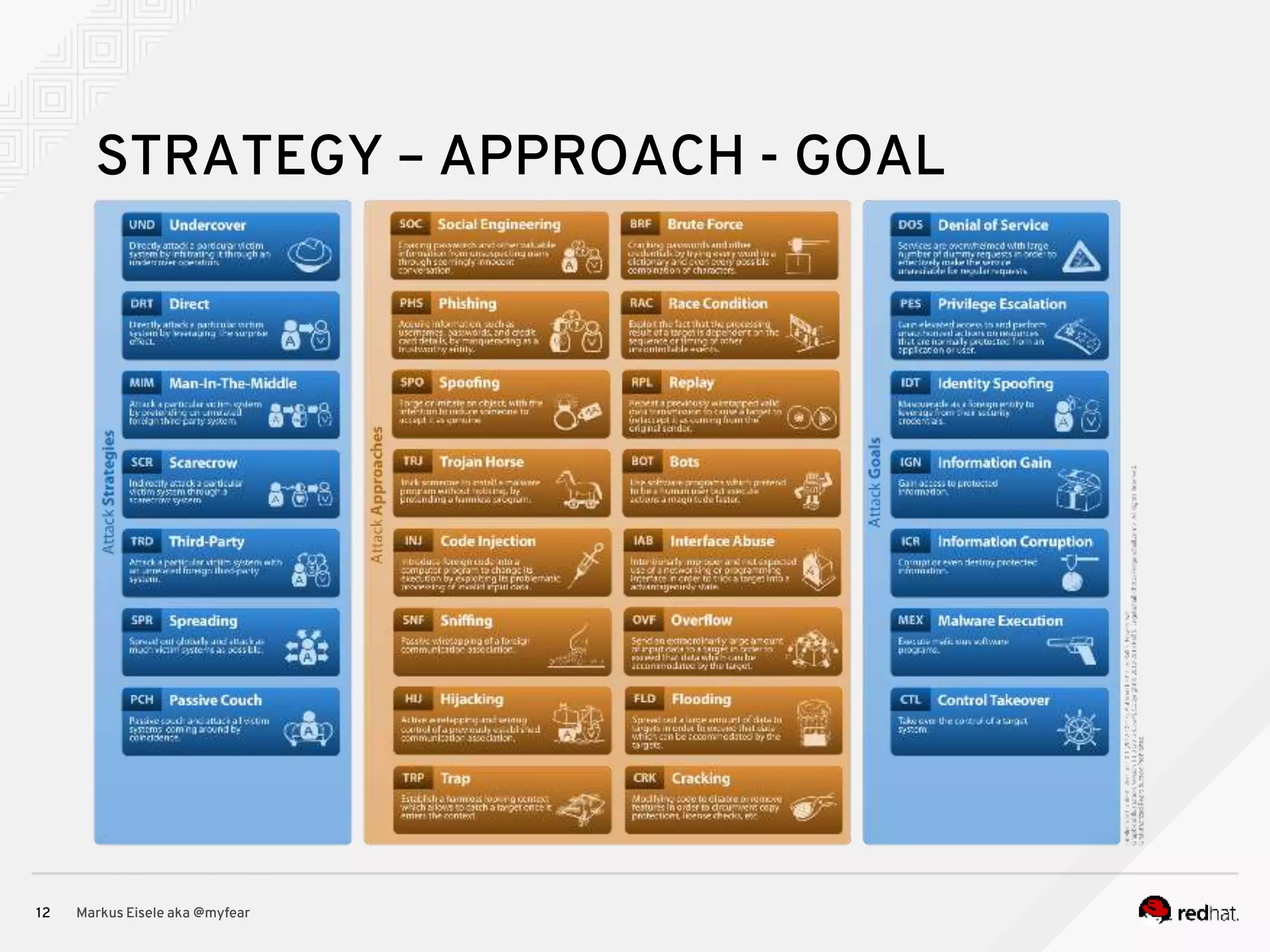
Markus Eisele aka @myfear12 STRATEGY – APPROACH - GOAL
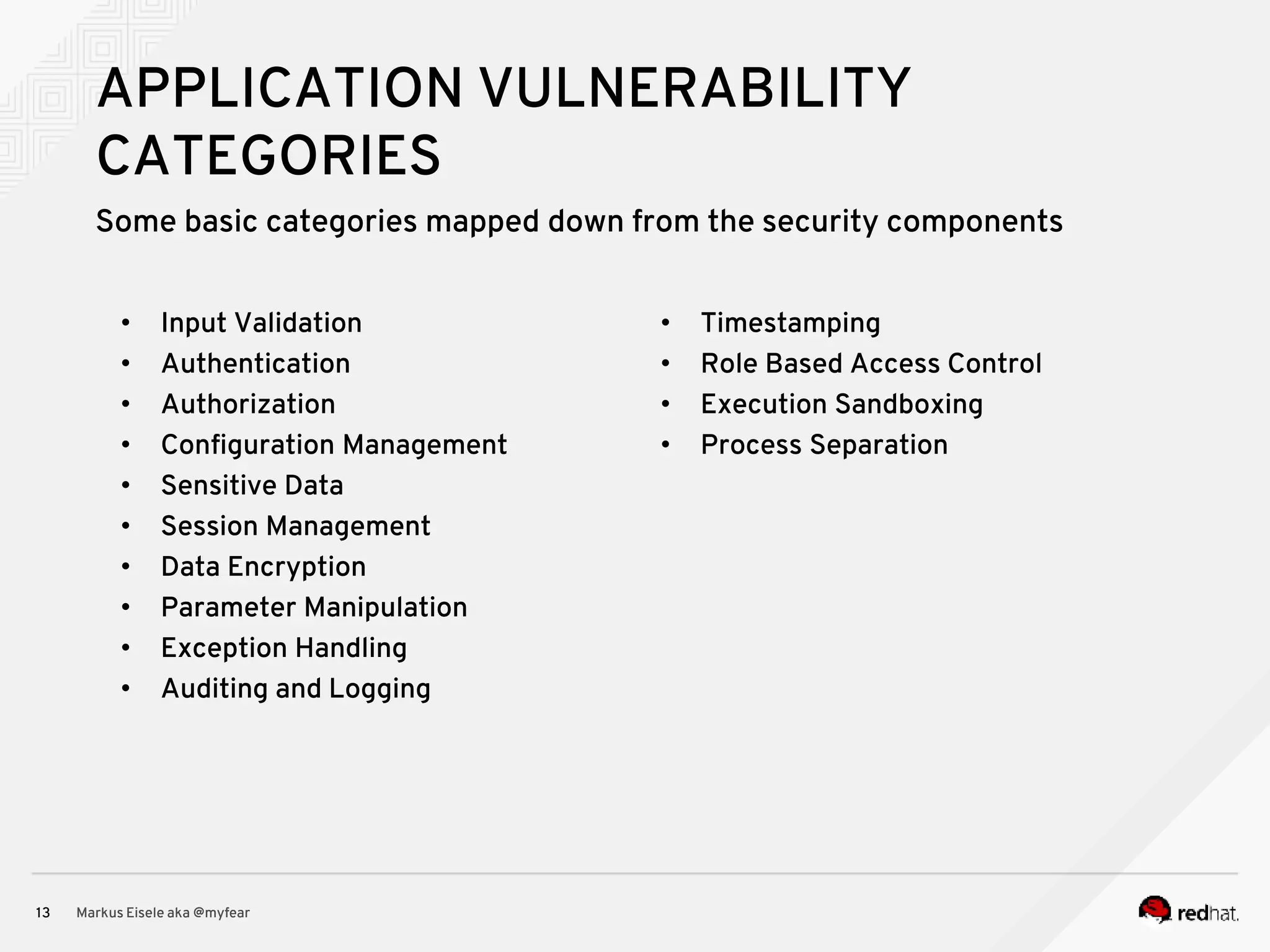
Some basic categories mapped down from the security components Markus Eisele aka @myfear13 APPLICATION VULNERABILITY CATEGORIES • Input Validation • Authentication • Authorization • Configuration Management • Sensitive Data • Session Management • Data Encryption • Parameter Manipulation • Exception Handling • Auditing and Logging • Timestamping • Role Based Access Control • Execution Sandboxing • Process Separation
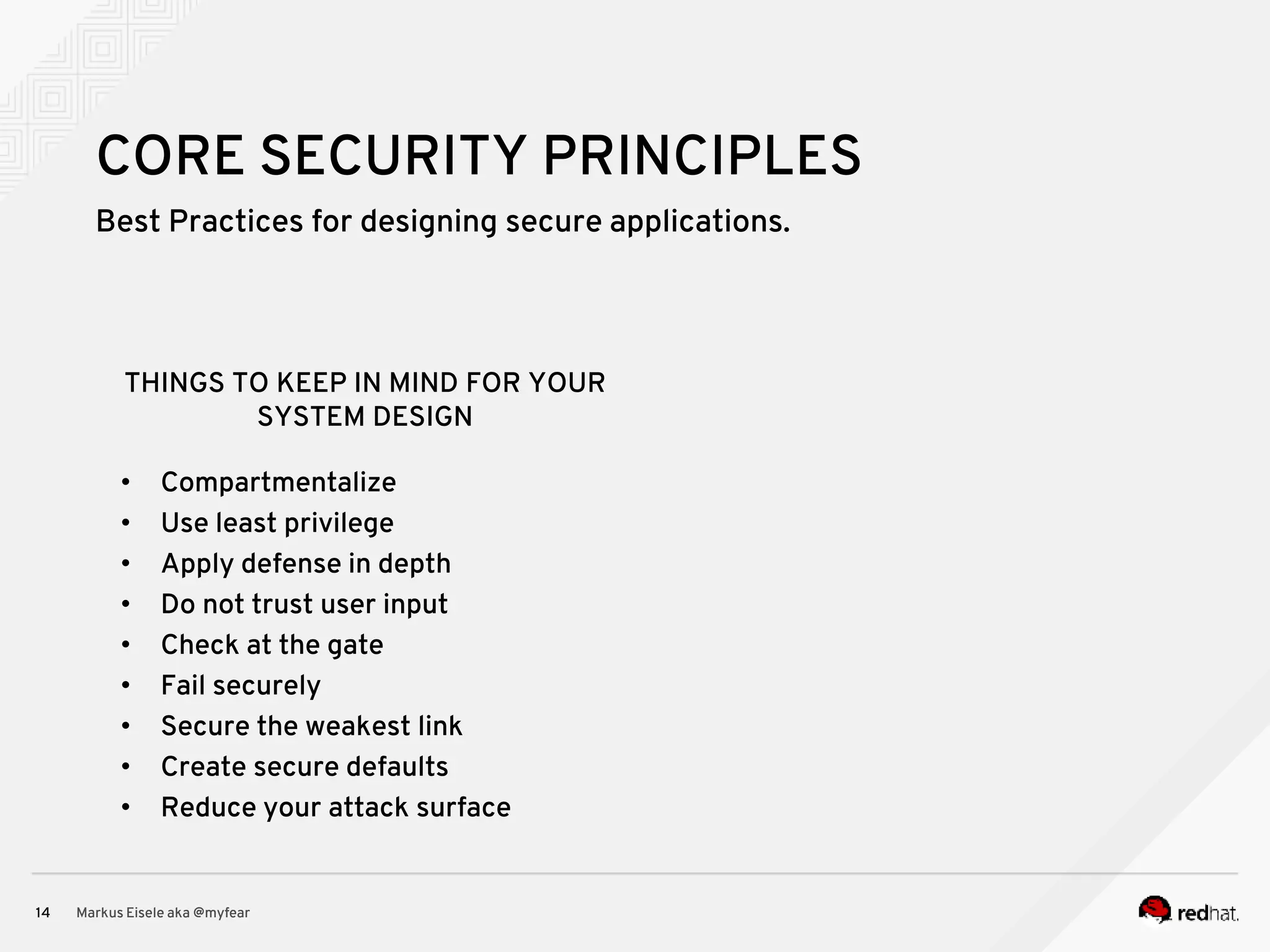
Best Practices for designing secure applications. Markus Eisele aka @myfear14 CORE SECURITY PRINCIPLES • Compartmentalize • Use least privilege • Apply defense in depth • Do not trust user input • Check at the gate • Fail securely • Secure the weakest link • Create secure defaults • Reduce your attack surface THINGS TO KEEP IN MIND FOR YOUR SYSTEM DESIGN
AND HOW MUCH OF THAT CAN YOU DO WITH JAVA EE? 15
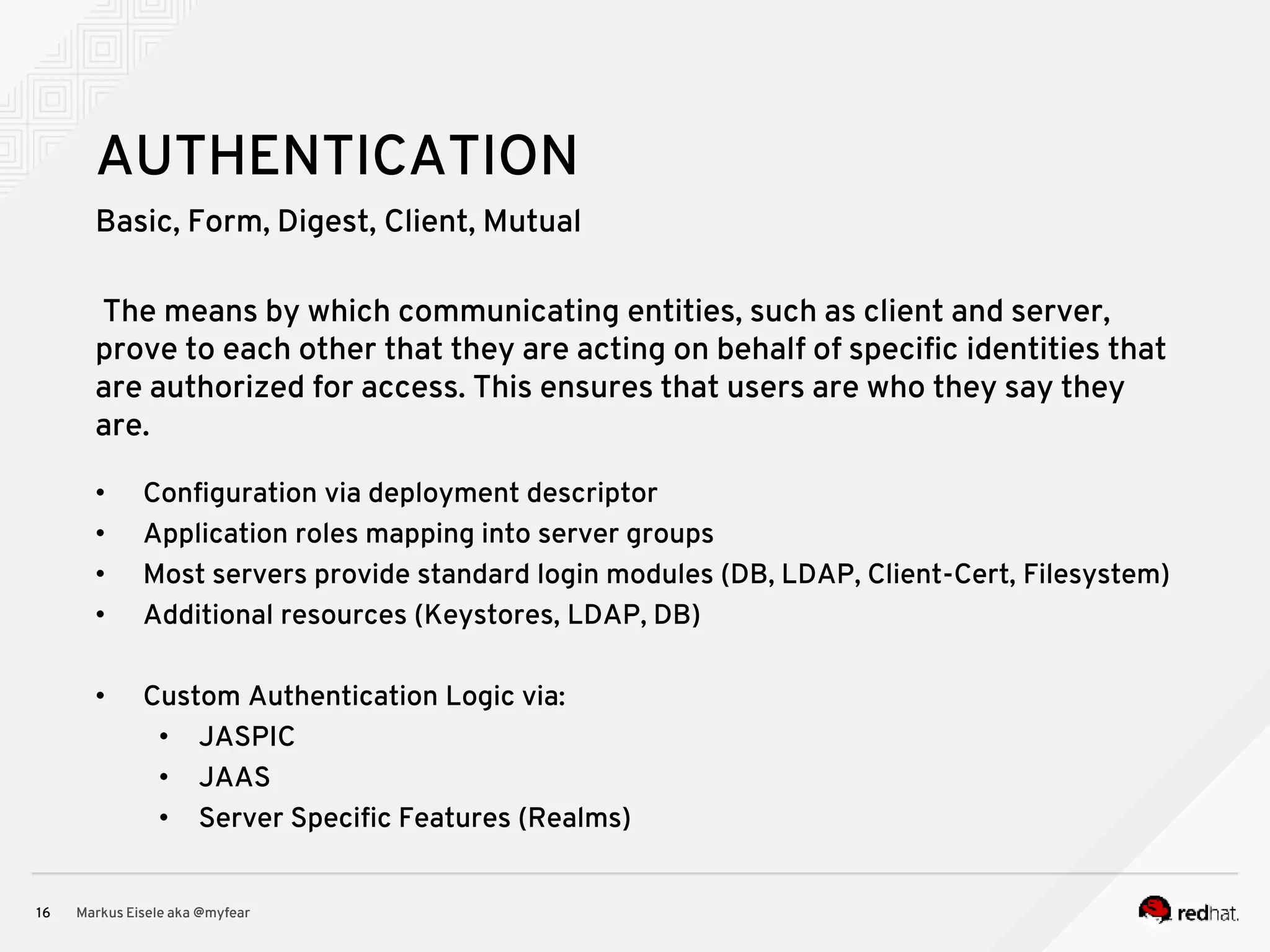
Basic, Form, Digest, Client, Mutual Markus Eisele aka @myfear16 AUTHENTICATION The means by which communicating entities, such as client and server, prove to each other that they are acting on behalf of specific identities that are authorized for access. This ensures that users are who they say they are. • Configuration via deployment descriptor • Application roles mapping into server groups • Most servers provide standard login modules (DB, LDAP, Client-Cert, Filesystem) • Additional resources (Keystores, LDAP, DB) • Custom Authentication Logic via: • JASPIC • JAAS • Server Specific Features (Realms)
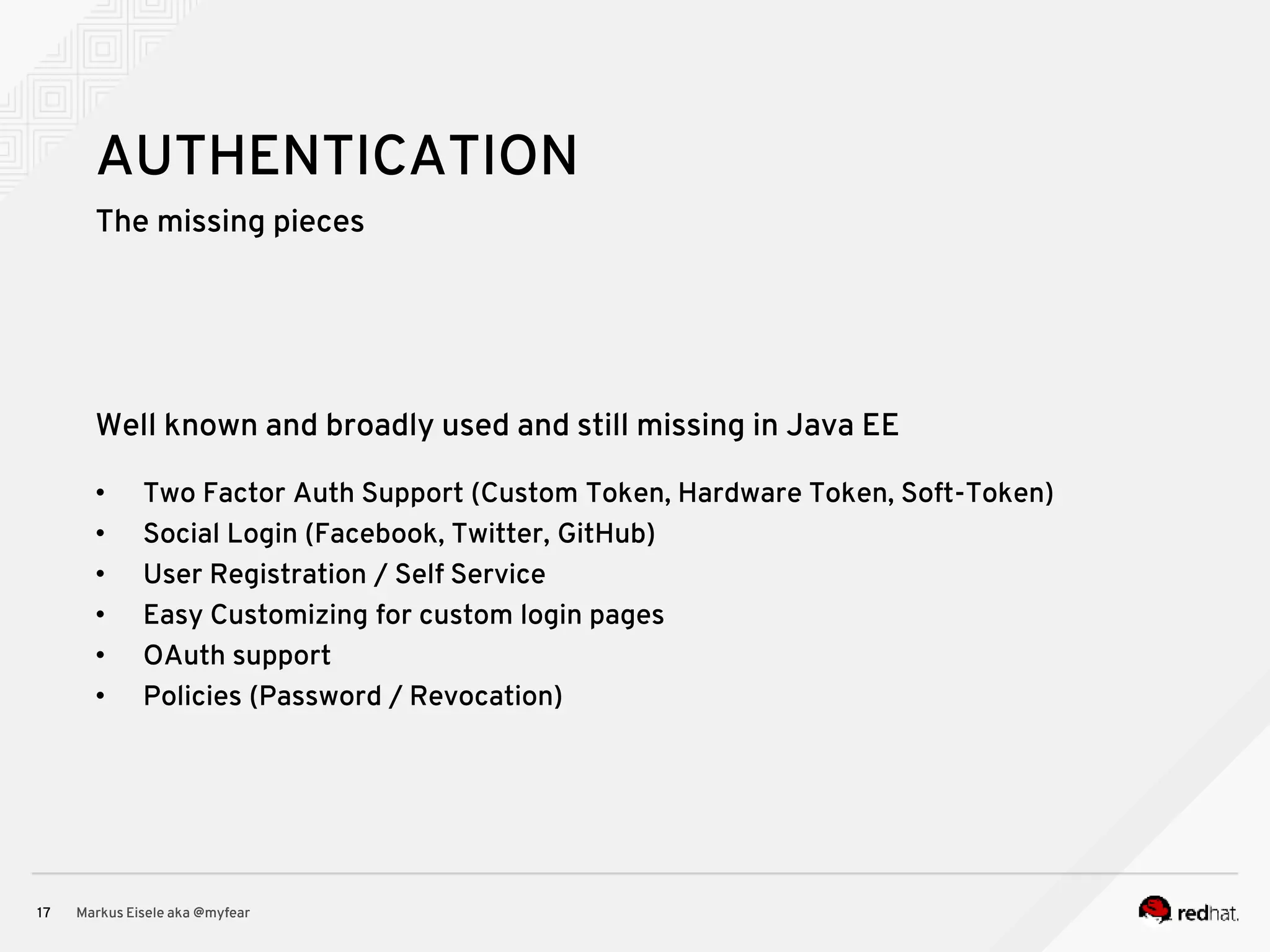
The missing pieces Markus Eisele aka @myfear17 AUTHENTICATION Well known and broadly used and still missing in Java EE • Two Factor Auth Support (Custom Token, Hardware Token, Soft-Token) • Social Login (Facebook, Twitter, GitHub) • User Registration / Self Service • Easy Customizing for custom login pages • OAuth support • Policies (Password / Revocation)
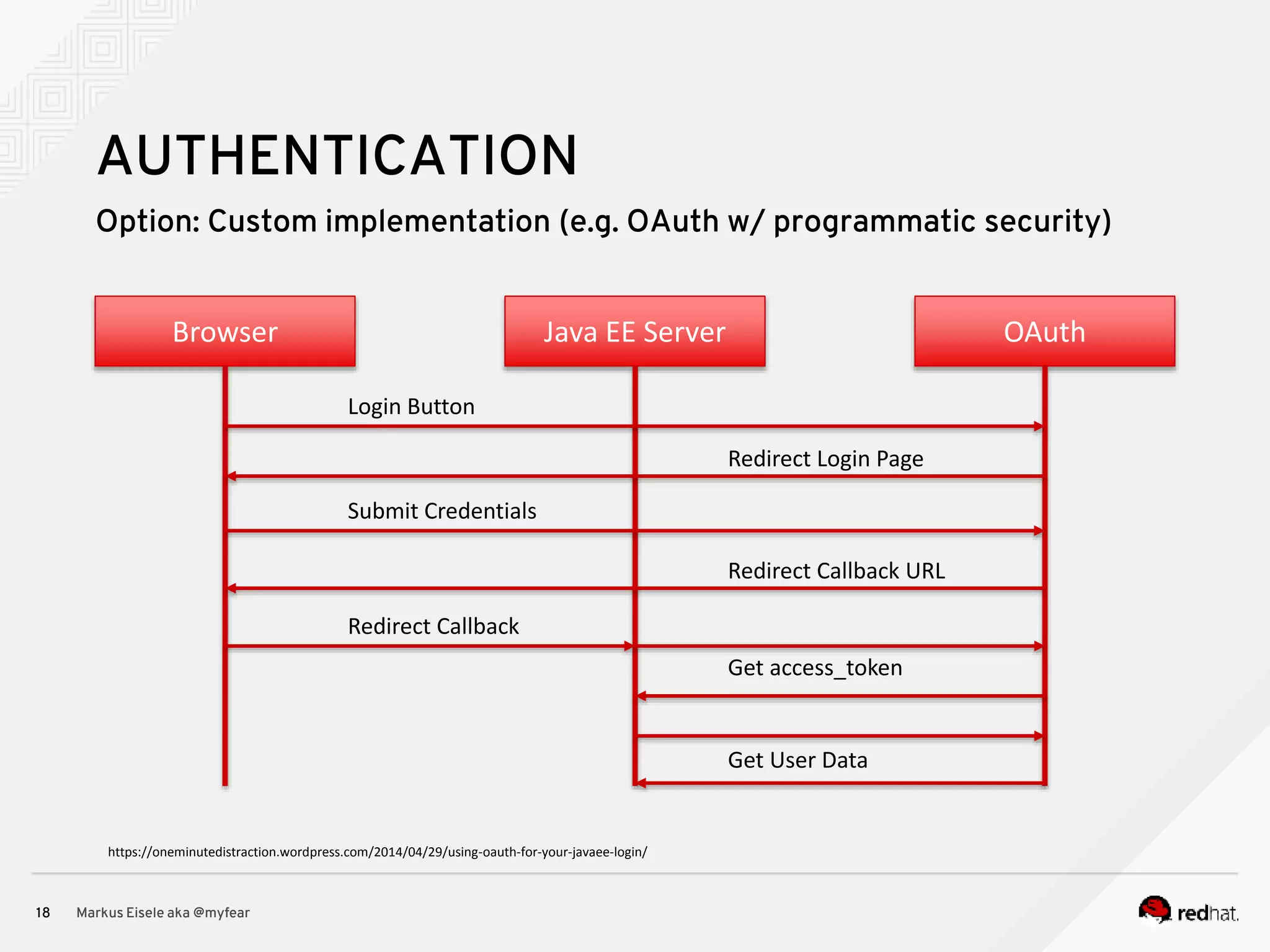
Option: Custom implementation (e.g. OAuth w/ programmatic security) Markus Eisele aka @myfear18 AUTHENTICATION https://oneminutedistraction.wordpress.com/2014/04/29/using-oauth-for-your-javaee-login/ Browser Java EE Server OAuth Login Button Redirect Login Page Submit Credentials Redirect Callback URL Redirect Callback Get access_token Get User Data
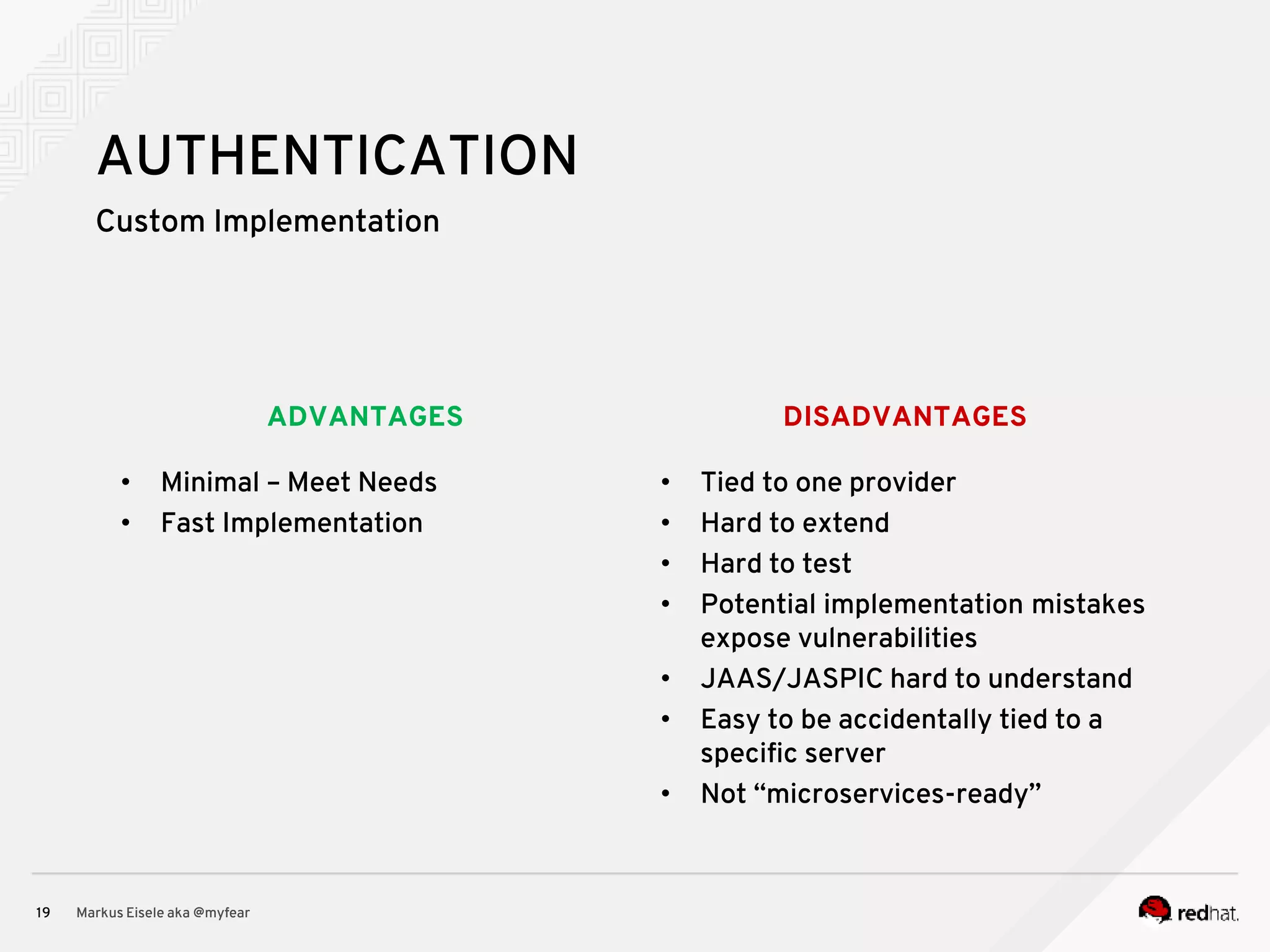
DISADVANTAGESADVANTAGES Custom Implementation Markus Eisele aka @myfear19 AUTHENTICATION • Minimal – Meet Needs • Fast Implementation • Tied to one provider • Hard to extend • Hard to test • Potential implementation mistakes expose vulnerabilities • JAAS/JASPIC hard to understand • Easy to be accidentally tied to a specific server • Not “microservices-ready”
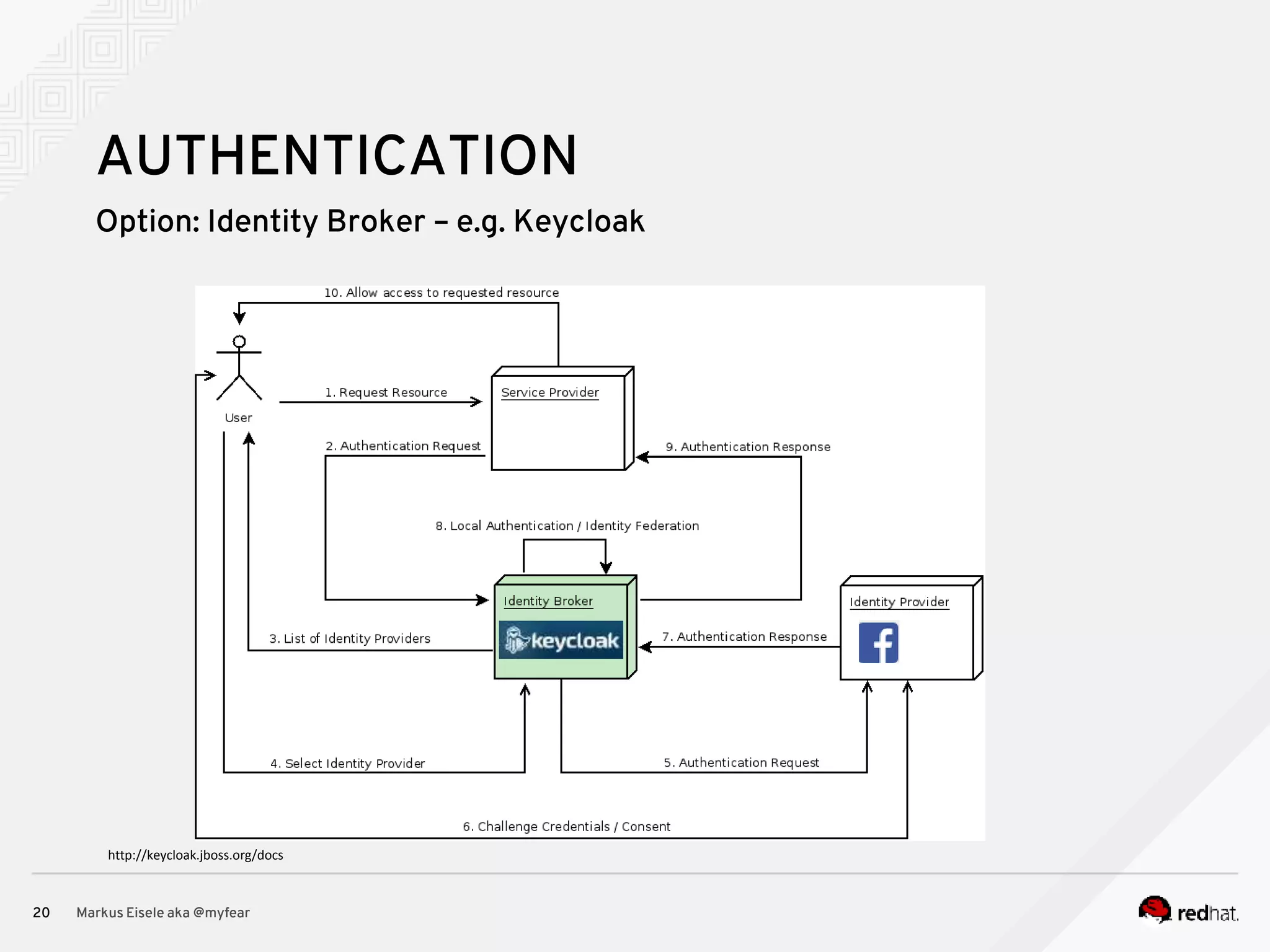
Option: Identity Broker – e.g. Keycloak Markus Eisele aka @myfear20 AUTHENTICATION http://keycloak.jboss.org/docs
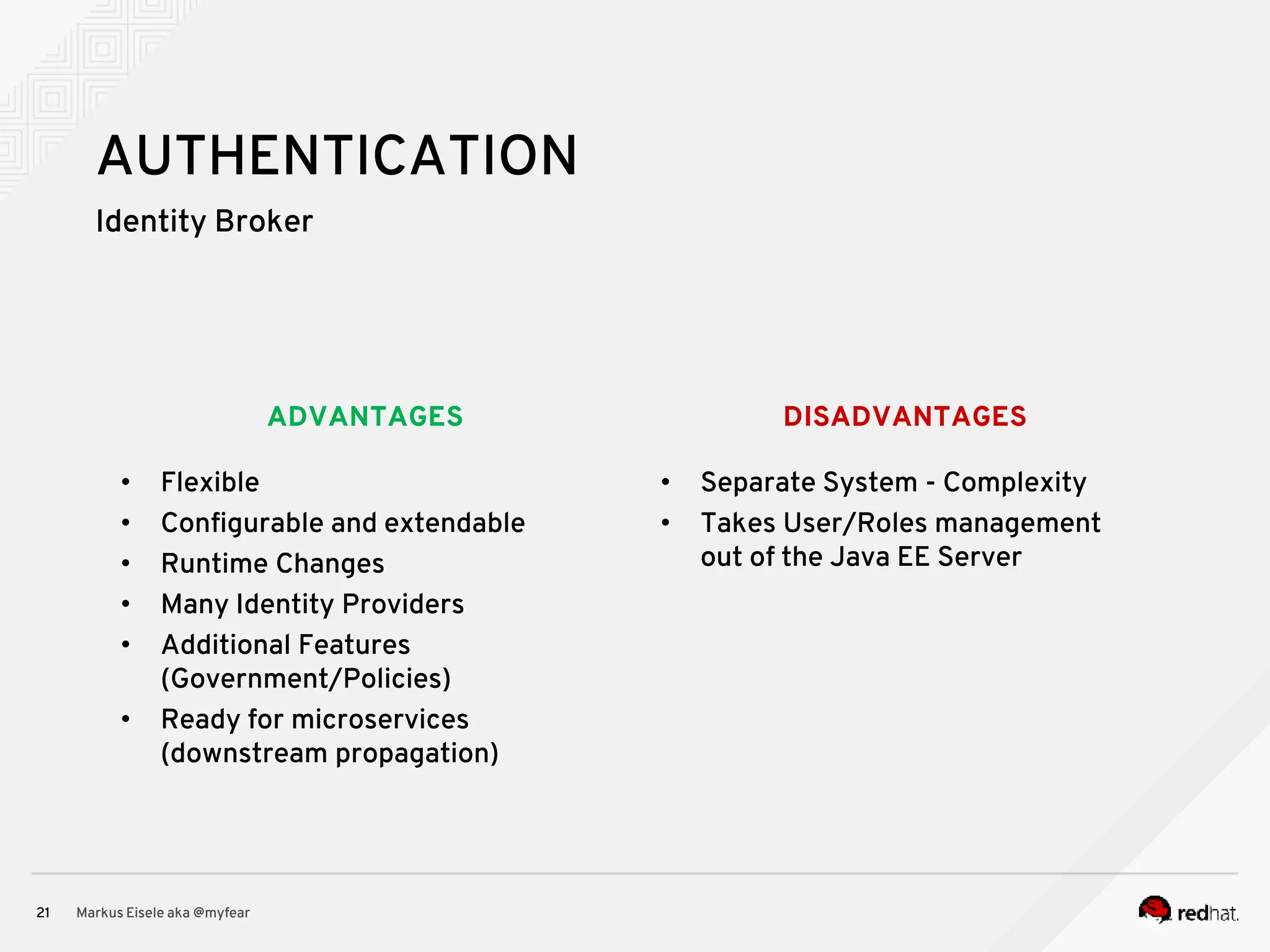
DISADVANTAGESADVANTAGES Identity Broker Markus Eisele aka @myfear21 AUTHENTICATION • Flexible • Configurable and extendable • Runtime Changes • Many Identity Providers • Additional Features (Government/Policies) • Ready for microservices (downstream propagation) • Separate System - Complexity • Takes User/Roles management out of the Java EE Server
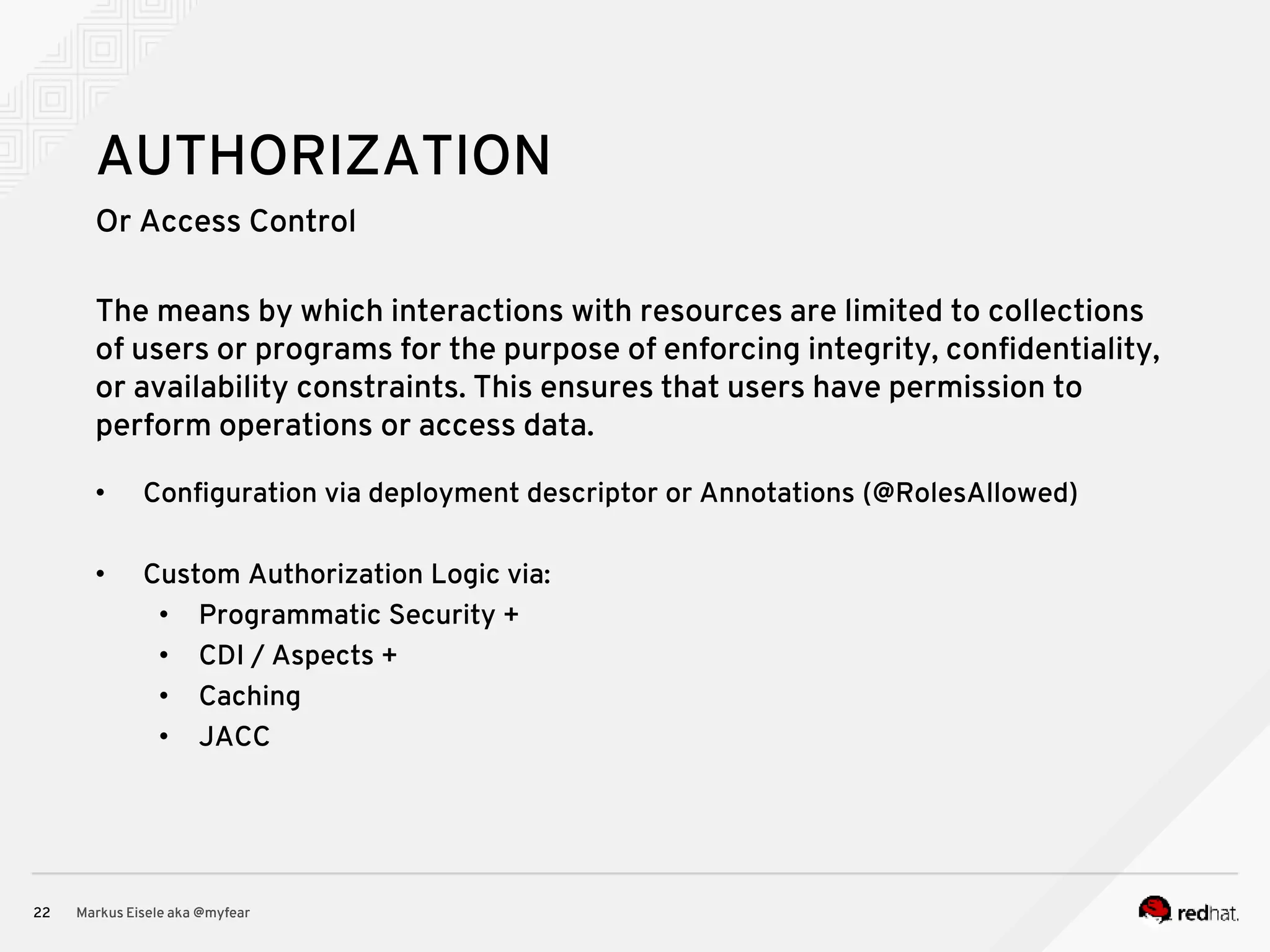
Or Access Control Markus Eisele aka @myfear22 AUTHORIZATION The means by which interactions with resources are limited to collections of users or programs for the purpose of enforcing integrity, confidentiality, or availability constraints. This ensures that users have permission to perform operations or access data. • Configuration via deployment descriptor or Annotations (@RolesAllowed) • Custom Authorization Logic via: • Programmatic Security + • CDI / Aspects + • Caching • JACC
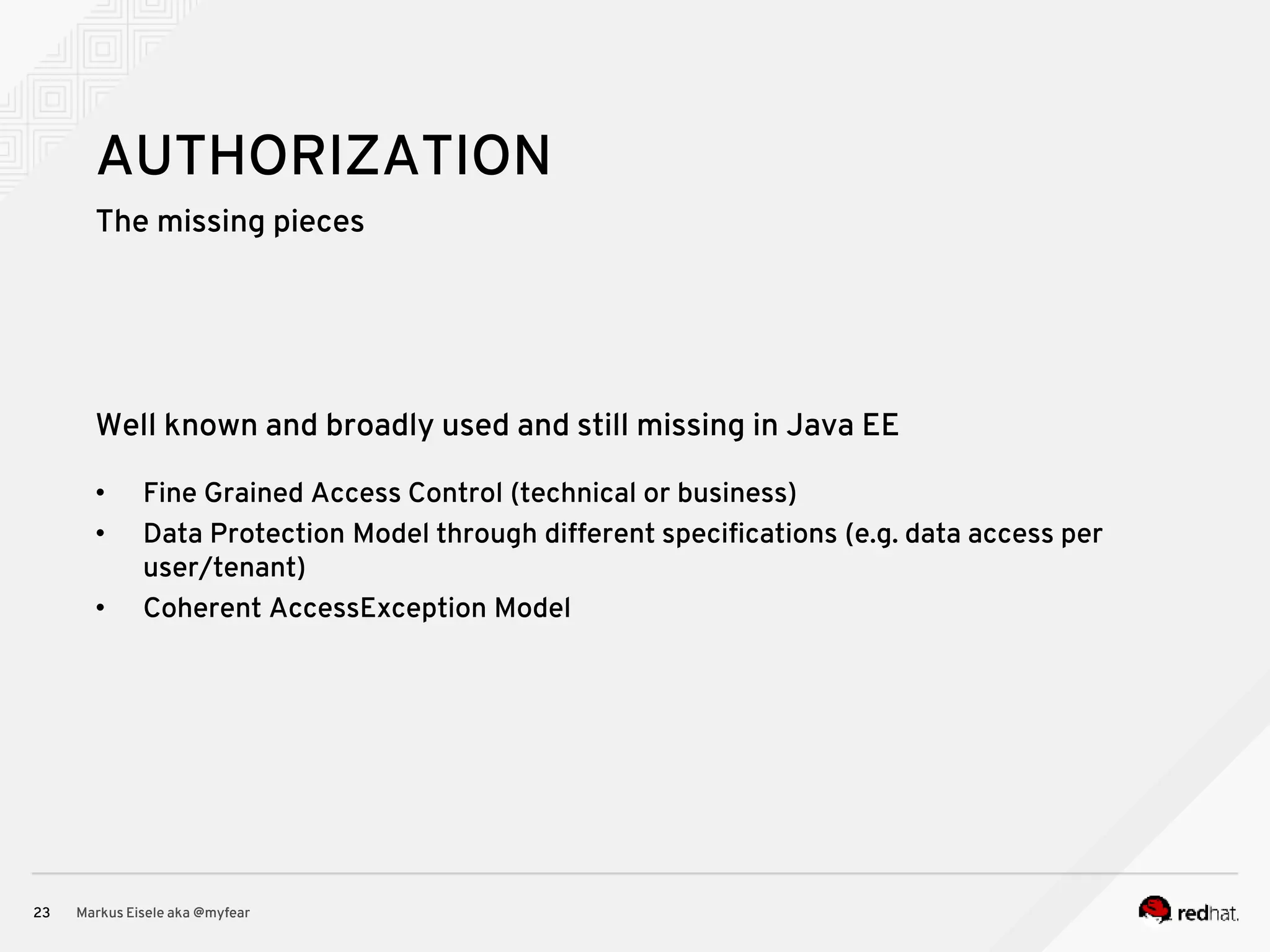
The missing pieces Markus Eisele aka @myfear23 AUTHORIZATION Well known and broadly used and still missing in Java EE • Fine Grained Access Control (technical or business) • Data Protection Model through different specifications (e.g. data access per user/tenant) • Coherent AccessException Model
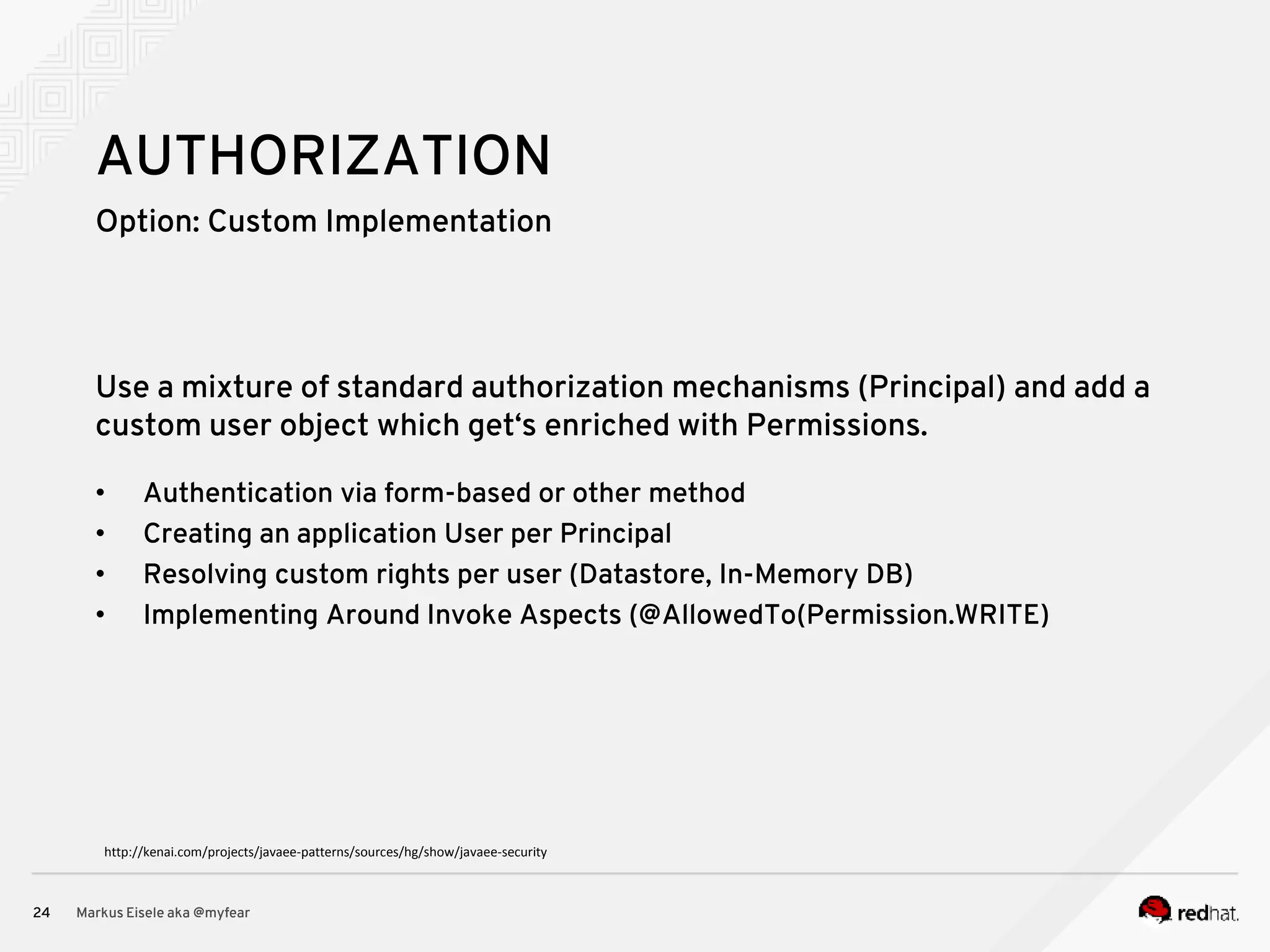
Option: Custom Implementation Markus Eisele aka @myfear24 AUTHORIZATION Use a mixture of standard authorization mechanisms (Principal) and add a custom user object which get‘s enriched with Permissions. • Authentication via form-based or other method • Creating an application User per Principal • Resolving custom rights per user (Datastore, In-Memory DB) • Implementing Around Invoke Aspects (@AllowedTo(Permission.WRITE) http://kenai.com/projects/javaee-patterns/sources/hg/show/javaee-security
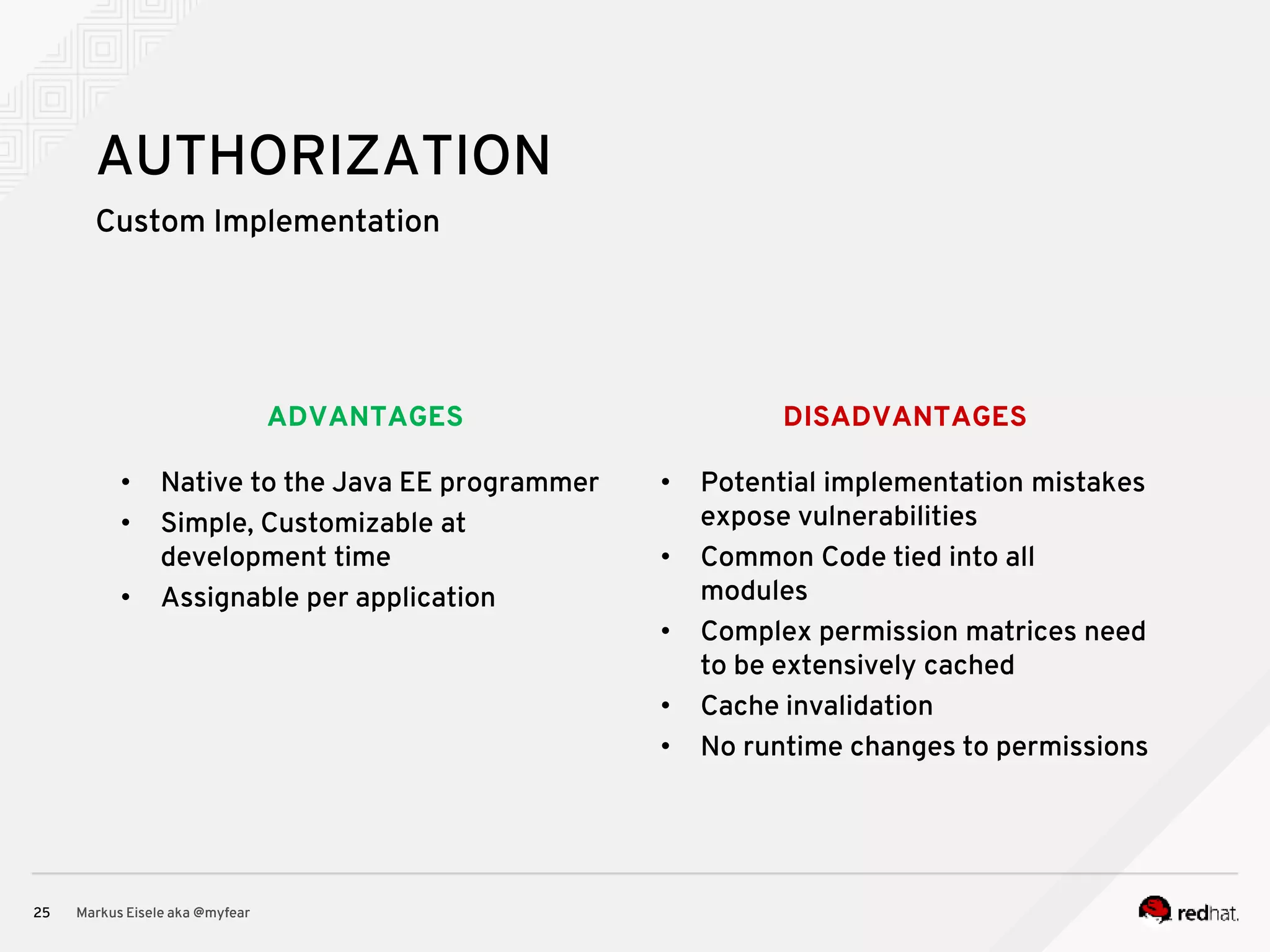
DISADVANTAGESADVANTAGES Custom Implementation Markus Eisele aka @myfear25 AUTHORIZATION • Native to the Java EE programmer • Simple, Customizable at development time • Assignable per application • Potential implementation mistakes expose vulnerabilities • Common Code tied into all modules • Complex permission matrices need to be extensively cached • Cache invalidation • No runtime changes to permissions
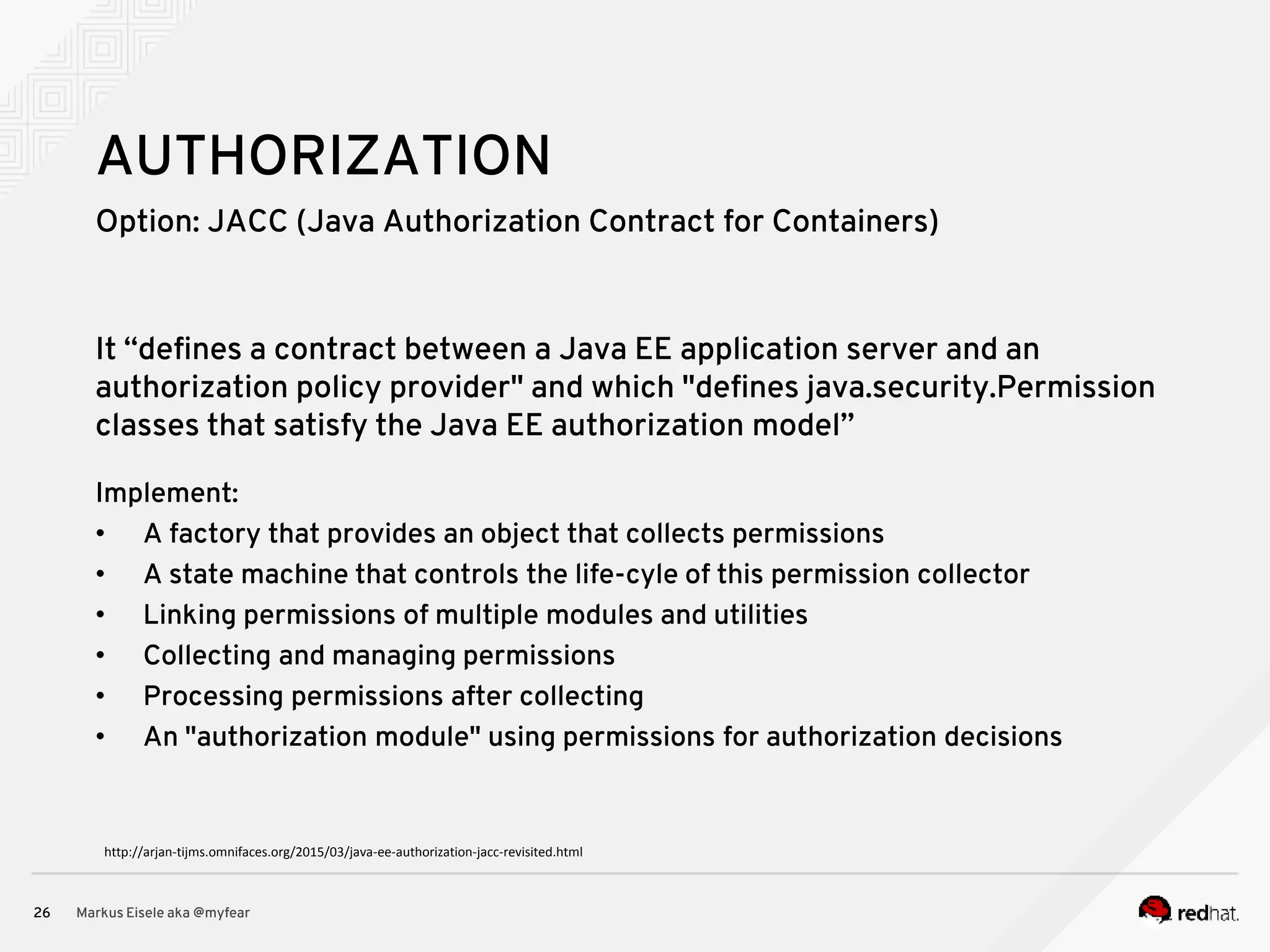
Option: JACC (Java Authorization Contract for Containers) Markus Eisele aka @myfear26 AUTHORIZATION It “defines a contract between a Java EE application server and an authorization policy provider" and which "defines java.security.Permission classes that satisfy the Java EE authorization model” Implement: • A factory that provides an object that collects permissions • A state machine that controls the life-cyle of this permission collector • Linking permissions of multiple modules and utilities • Collecting and managing permissions • Processing permissions after collecting • An "authorization module" using permissions for authorization decisions http://arjan-tijms.omnifaces.org/2015/03/java-ee-authorization-jacc-revisited.html
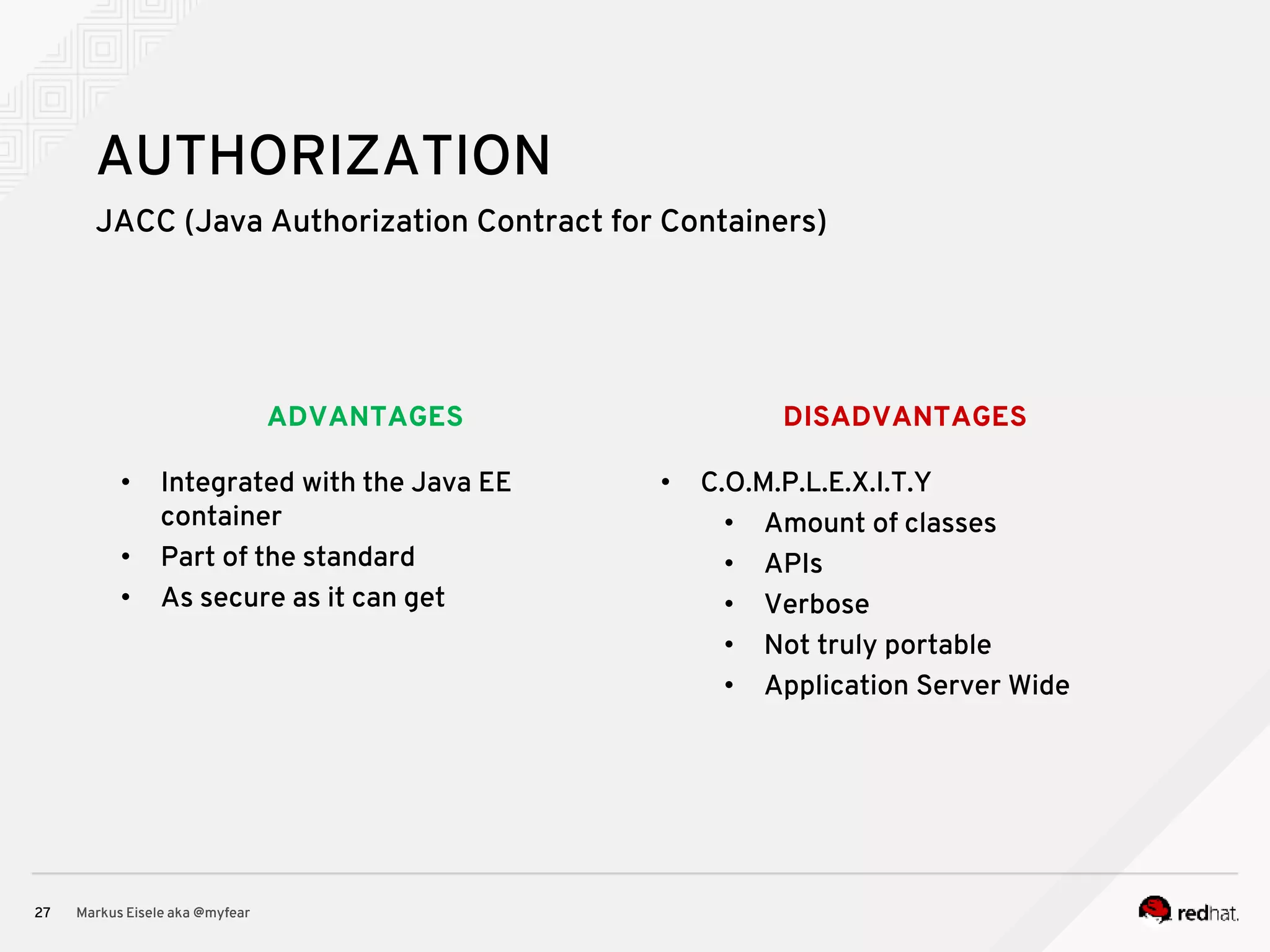
DISADVANTAGESADVANTAGES JACC (Java Authorization Contract for Containers) Markus Eisele aka @myfear27 AUTHORIZATION • Integrated with the Java EE container • Part of the standard • As secure as it can get • C.O.M.P.L.E.X.I.T.Y • Amount of classes • APIs • Verbose • Not truly portable • Application Server Wide
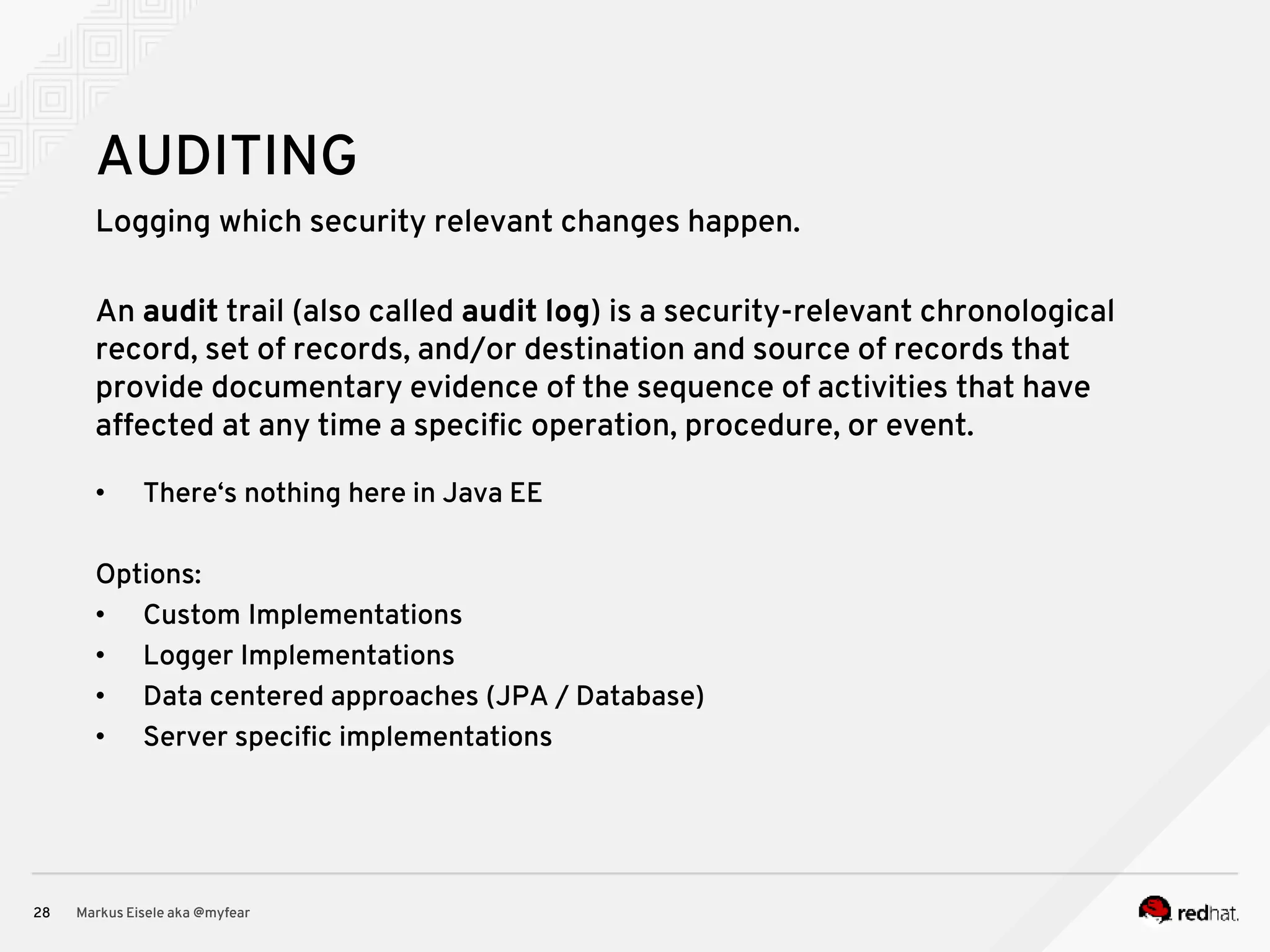
Logging which security relevant changes happen. Markus Eisele aka @myfear28 AUDITING An audit trail (also called audit log) is a security-relevant chronological record, set of records, and/or destination and source of records that provide documentary evidence of the sequence of activities that have affected at any time a specific operation, procedure, or event. • There‘s nothing here in Java EE Options: • Custom Implementations • Logger Implementations • Data centered approaches (JPA / Database) • Server specific implementations
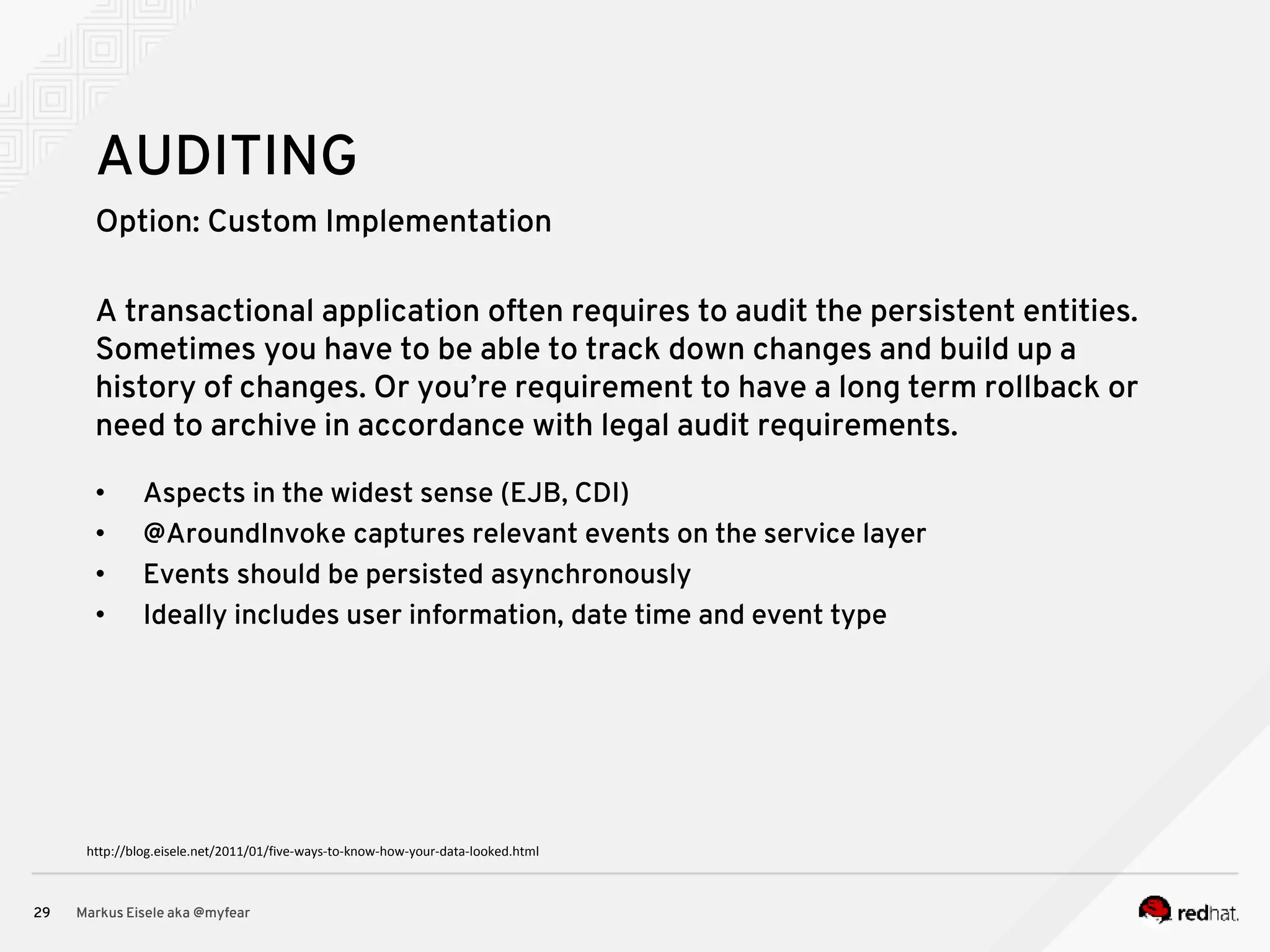
Option: Custom Implementation Markus Eisele aka @myfear29 AUDITING A transactional application often requires to audit the persistent entities. Sometimes you have to be able to track down changes and build up a history of changes. Or you’re requirement to have a long term rollback or need to archive in accordance with legal audit requirements. • Aspects in the widest sense (EJB, CDI) • @AroundInvoke captures relevant events on the service layer • Events should be persisted asynchronously • Ideally includes user information, date time and event type http://blog.eisele.net/2011/01/five-ways-to-know-how-your-data-looked.html
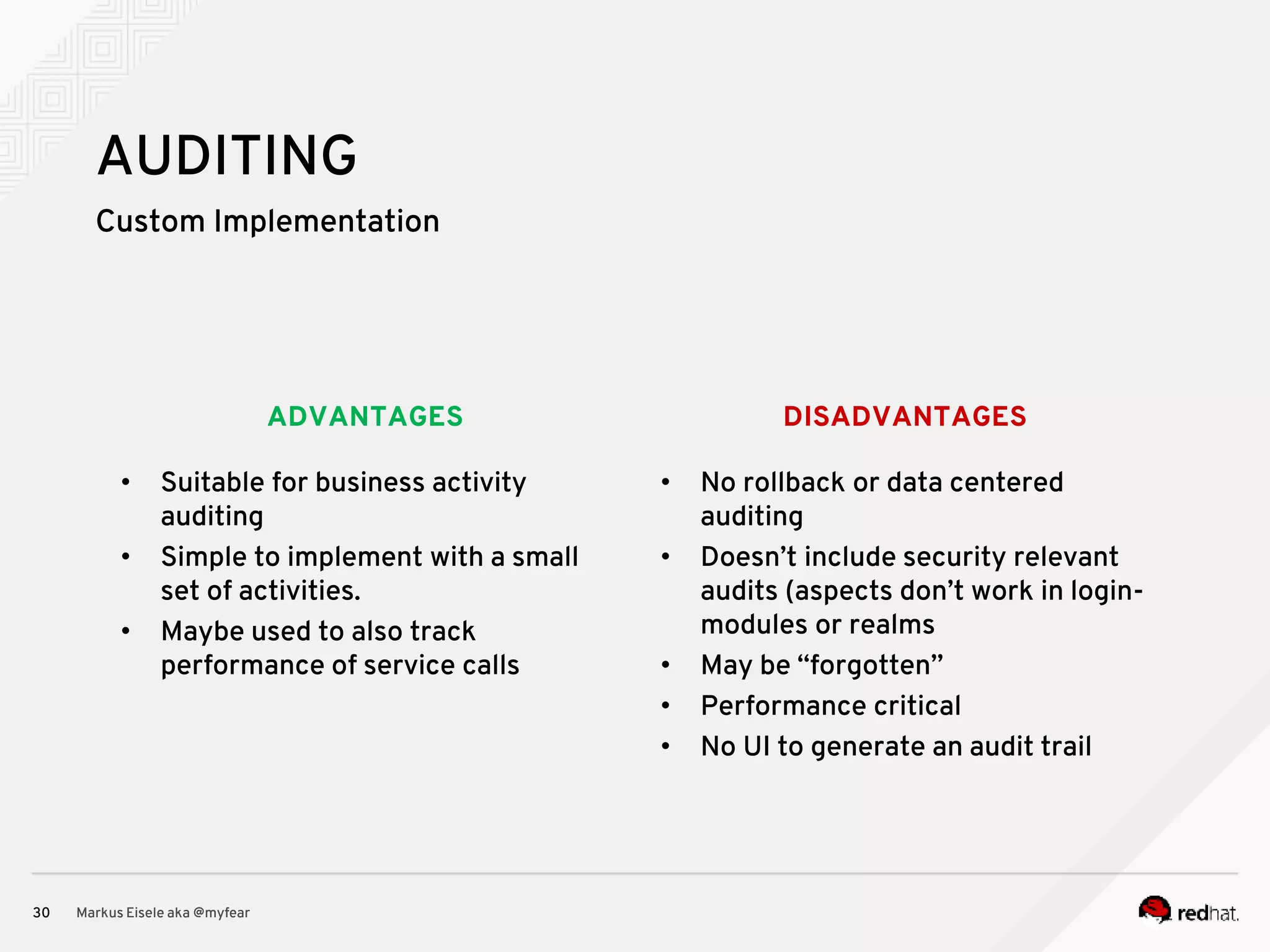
DISADVANTAGESADVANTAGES Custom Implementation Markus Eisele aka @myfear30 AUDITING • Suitable for business activity auditing • Simple to implement with a small set of activities. • Maybe used to also track performance of service calls • No rollback or data centered auditing • Doesn’t include security relevant audits (aspects don’t work in login- modules or realms • May be “forgotten” • Performance critical • No UI to generate an audit trail
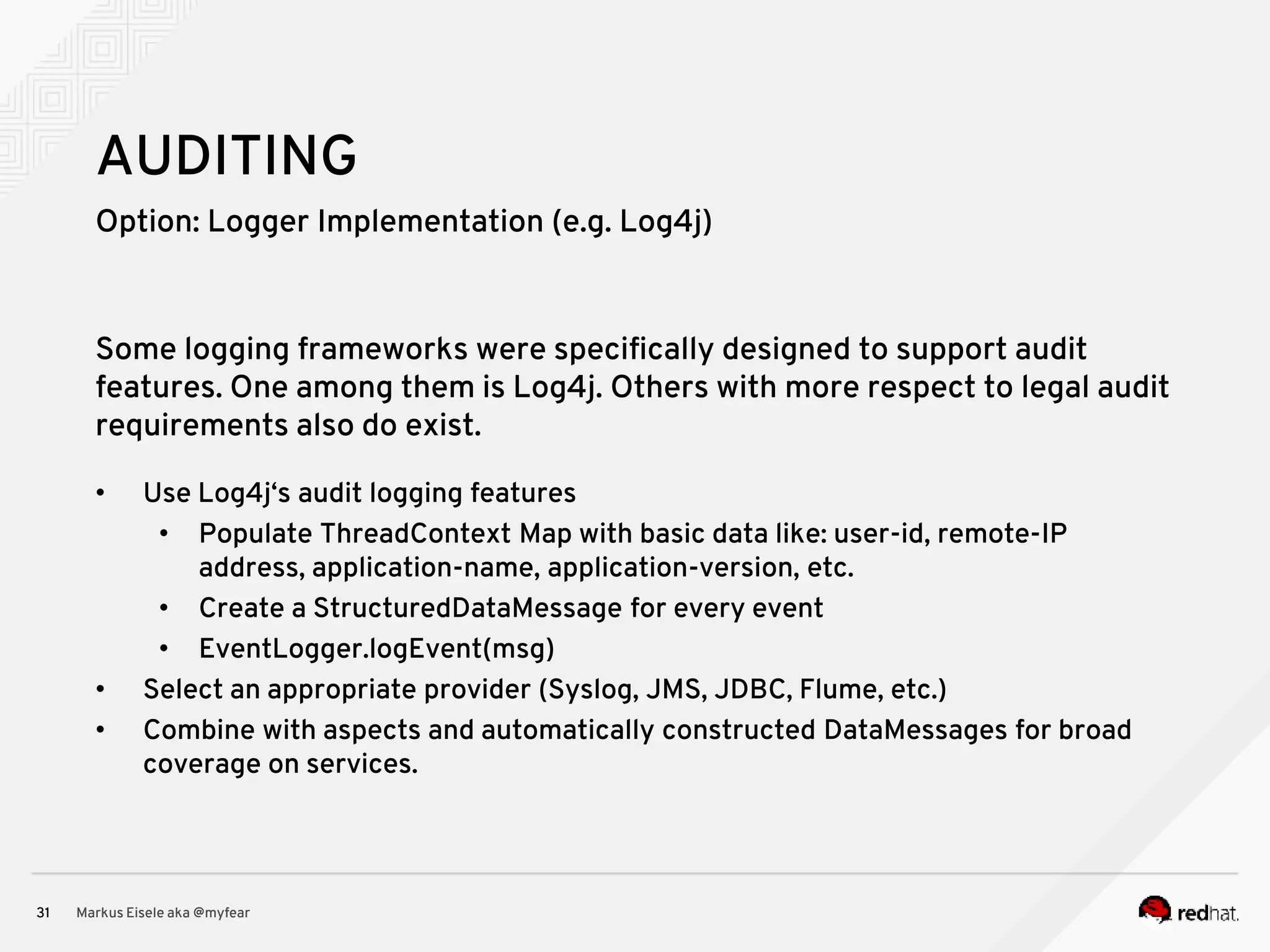
Option: Logger Implementation (e.g. Log4j) Markus Eisele aka @myfear31 AUDITING Some logging frameworks were specifically designed to support audit features. One among them is Log4j. Others with more respect to legal audit requirements also do exist. • Use Log4j‘s audit logging features • Populate ThreadContext Map with basic data like: user-id, remote-IP address, application-name, application-version, etc. • Create a StructuredDataMessage for every event • EventLogger.logEvent(msg) • Select an appropriate provider (Syslog, JMS, JDBC, Flume, etc.) • Combine with aspects and automatically constructed DataMessages for broad coverage on services.
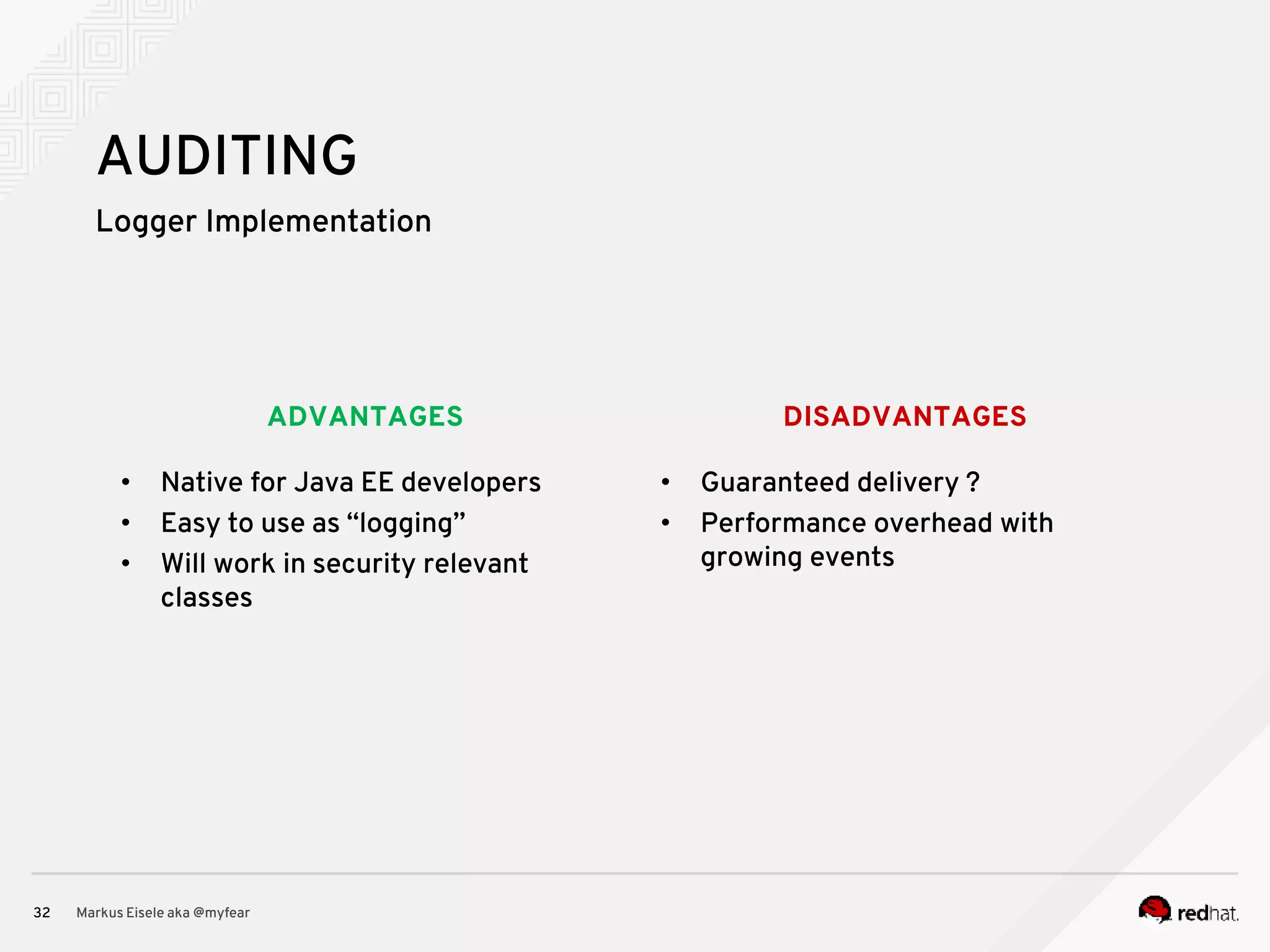
DISADVANTAGESADVANTAGES Logger Implementation Markus Eisele aka @myfear32 AUDITING • Native for Java EE developers • Easy to use as “logging” • Will work in security relevant classes • Guaranteed delivery ? • Performance overhead with growing events
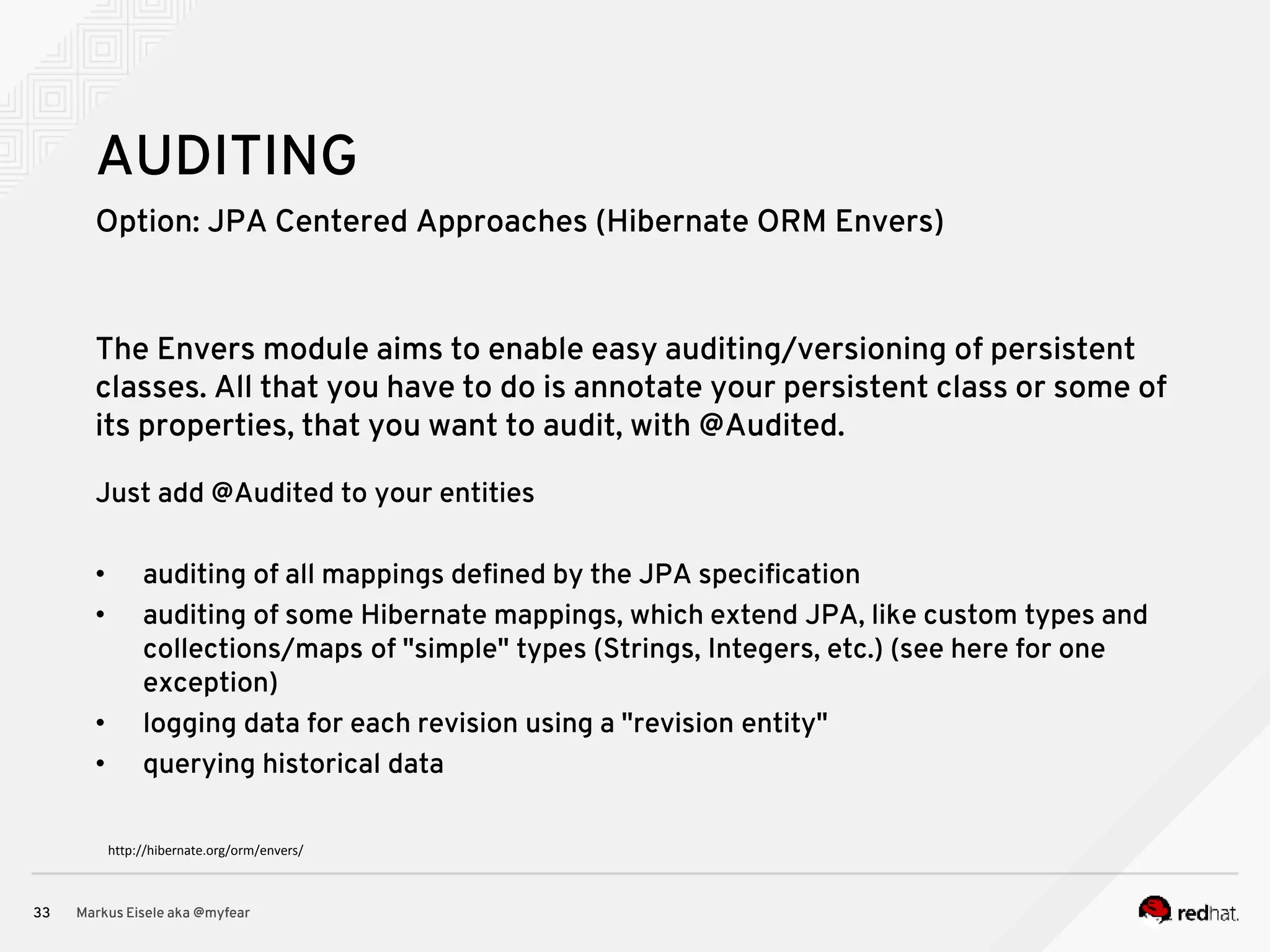
Option: JPA Centered Approaches (Hibernate ORM Envers) Markus Eisele aka @myfear33 AUDITING The Envers module aims to enable easy auditing/versioning of persistent classes. All that you have to do is annotate your persistent class or some of its properties, that you want to audit, with @Audited. Just add @Audited to your entities • auditing of all mappings defined by the JPA specification • auditing of some Hibernate mappings, which extend JPA, like custom types and collections/maps of "simple" types (Strings, Integers, etc.) (see here for one exception) • logging data for each revision using a "revision entity" • querying historical data http://hibernate.org/orm/envers/
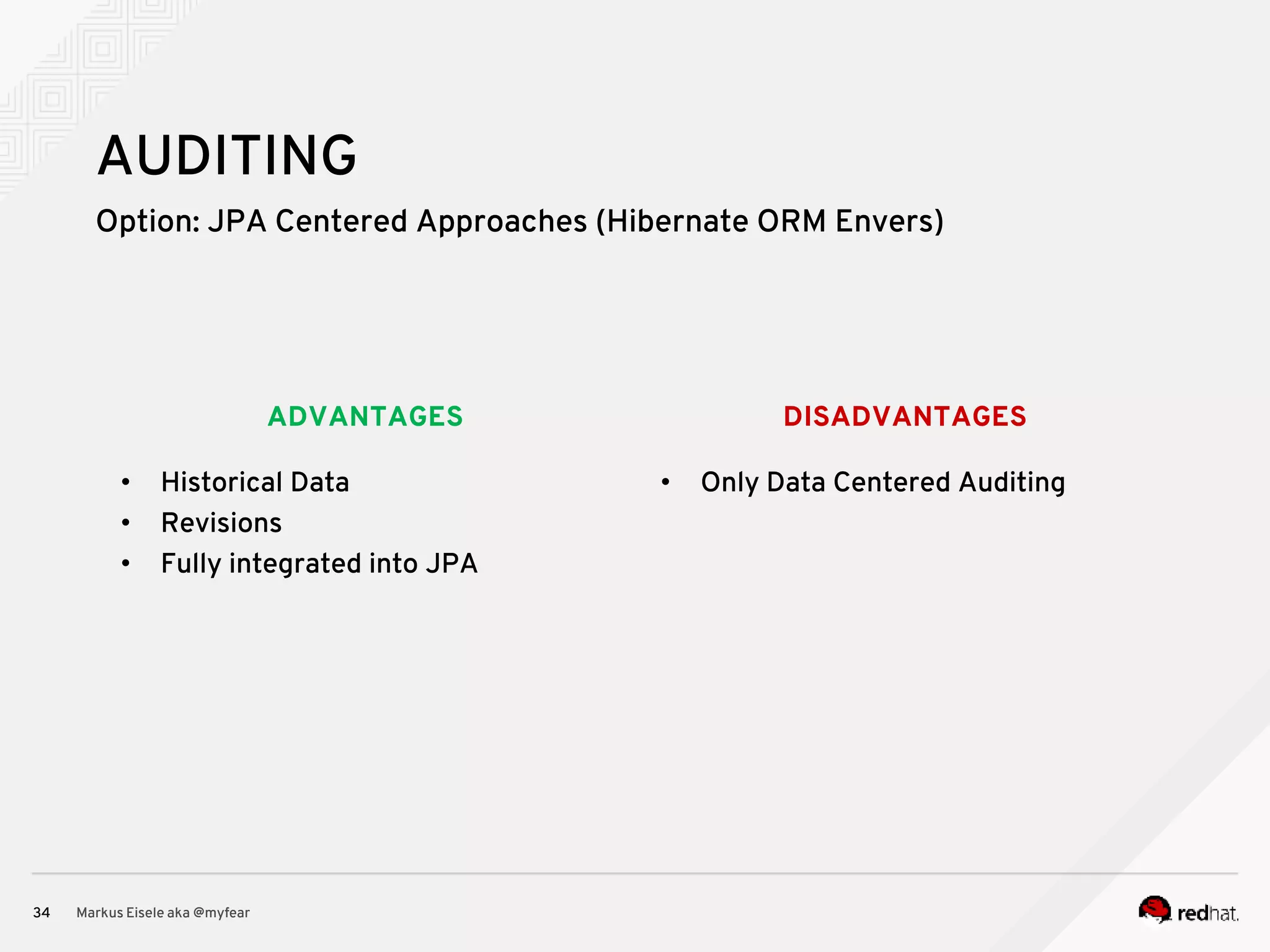
DISADVANTAGESADVANTAGES Option: JPA Centered Approaches (Hibernate ORM Envers) Markus Eisele aka @myfear34 AUDITING • Historical Data • Revisions • Fully integrated into JPA • Only Data Centered Auditing
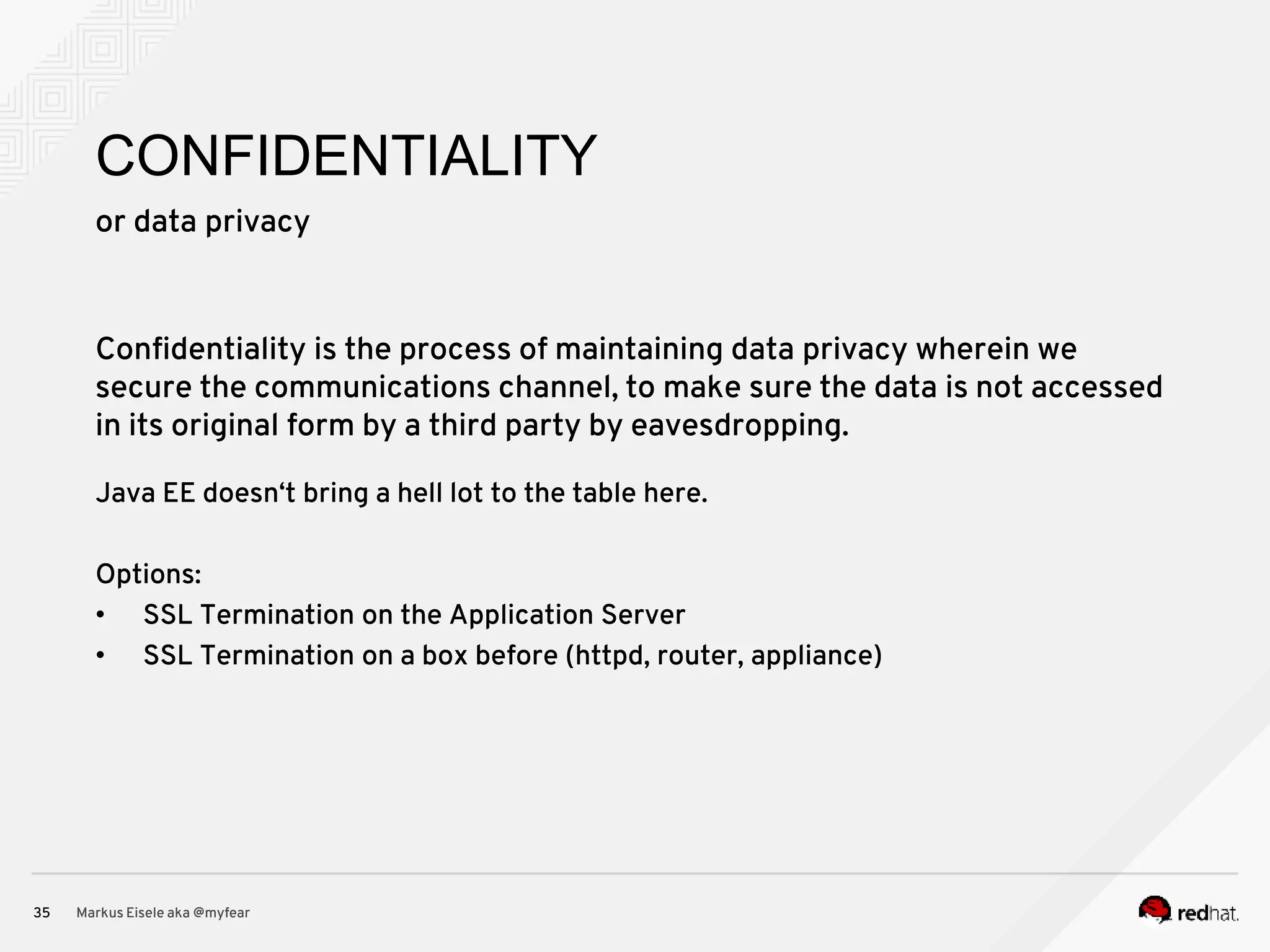
or data privacy Markus Eisele aka @myfear35 CONFIDENTIALITY Confidentiality is the process of maintaining data privacy wherein we secure the communications channel, to make sure the data is not accessed in its original form by a third party by eavesdropping. Java EE doesn‘t bring a hell lot to the table here. Options: • SSL Termination on the Application Server • SSL Termination on a box before (httpd, router, appliance)
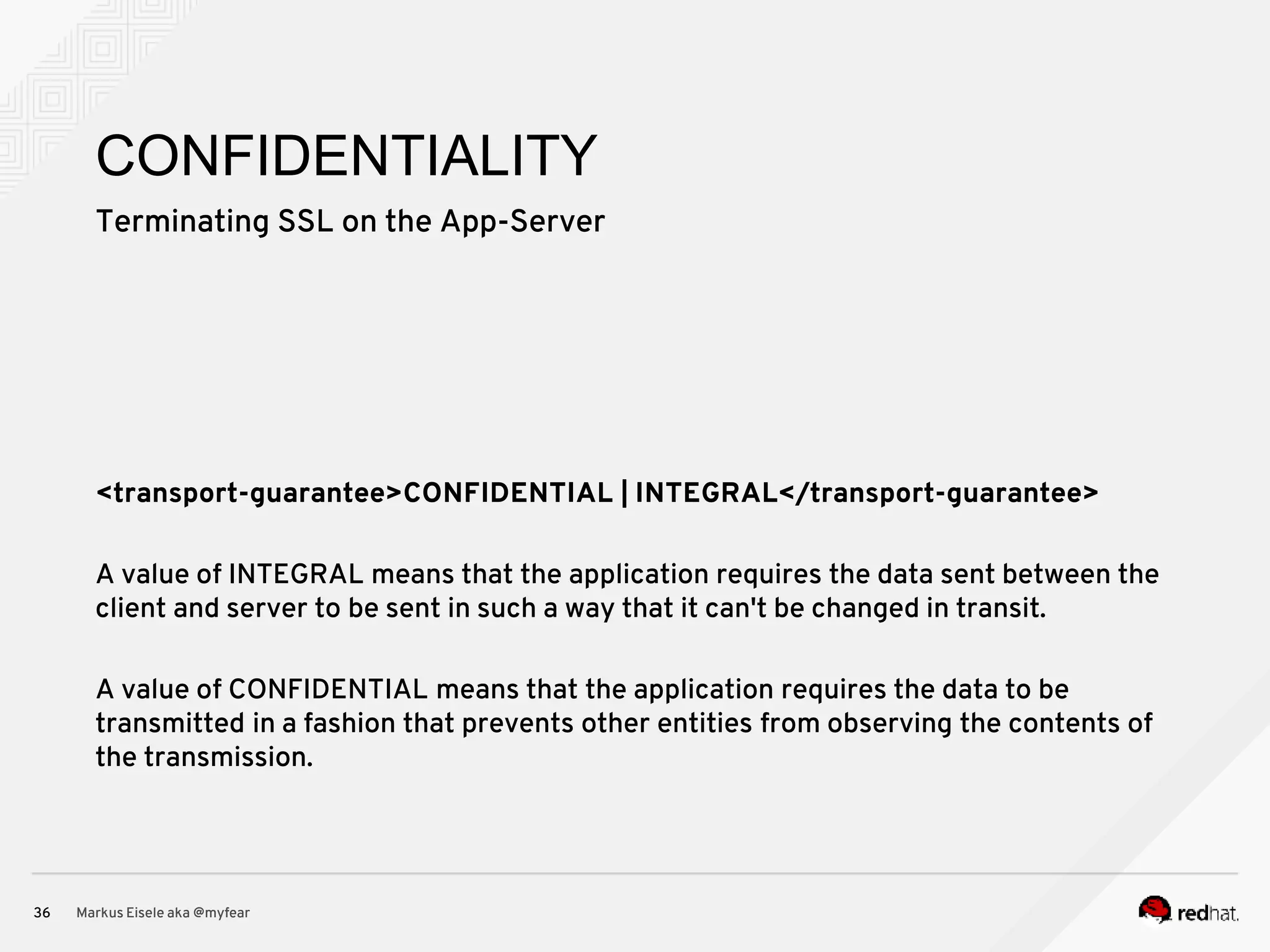
Terminating SSL on the App-Server Markus Eisele aka @myfear36 CONFIDENTIALITY <transport-guarantee>CONFIDENTIAL | INTEGRAL</transport-guarantee> A value of INTEGRAL means that the application requires the data sent between the client and server to be sent in such a way that it can't be changed in transit. A value of CONFIDENTIAL means that the application requires the data to be transmitted in a fashion that prevents other entities from observing the contents of the transmission.
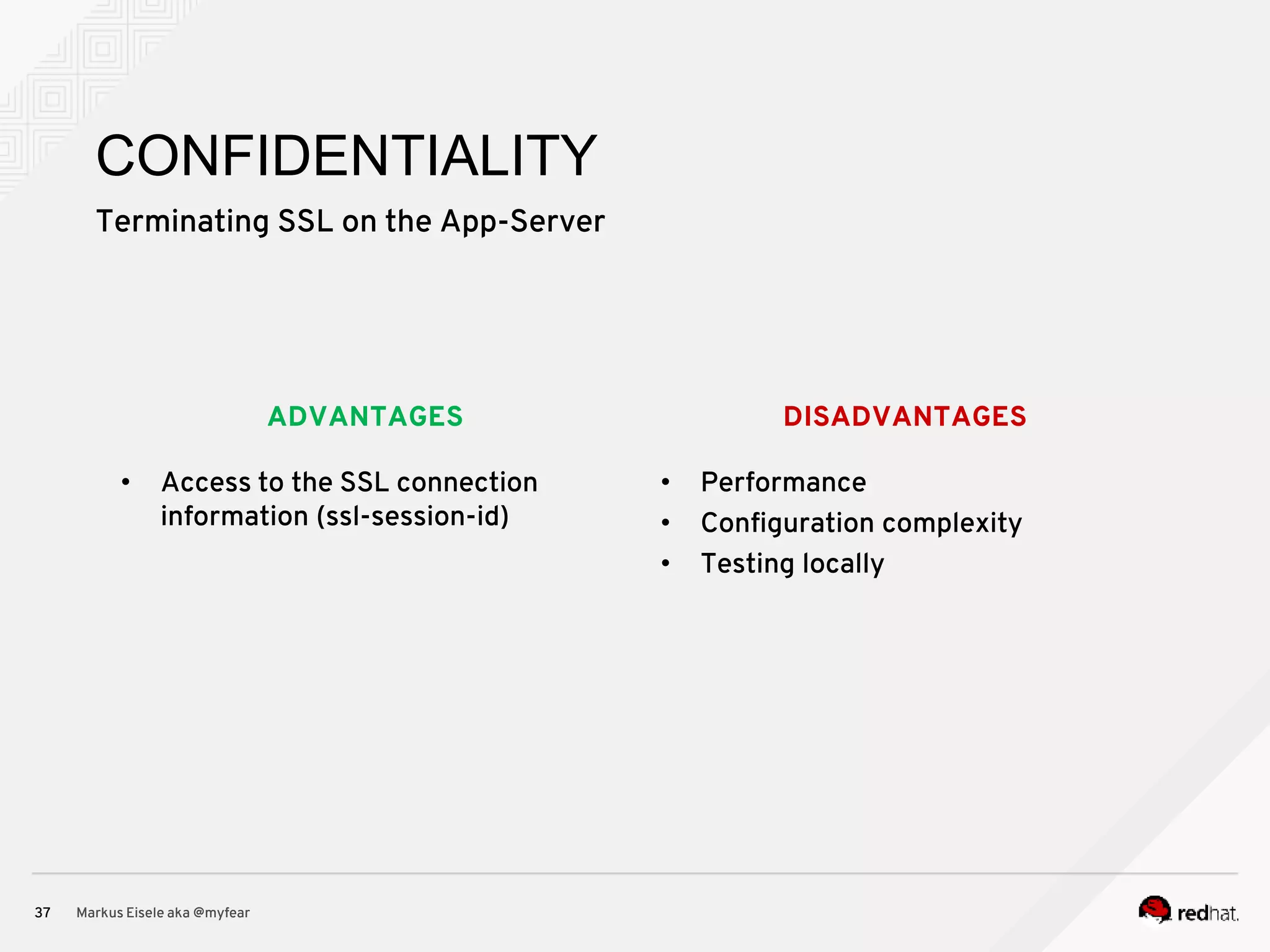
DISADVANTAGESADVANTAGES Terminating SSL on the App-Server Markus Eisele aka @myfear37 CONFIDENTIALITY • Access to the SSL connection information (ssl-session-id) • Performance • Configuration complexity • Testing locally
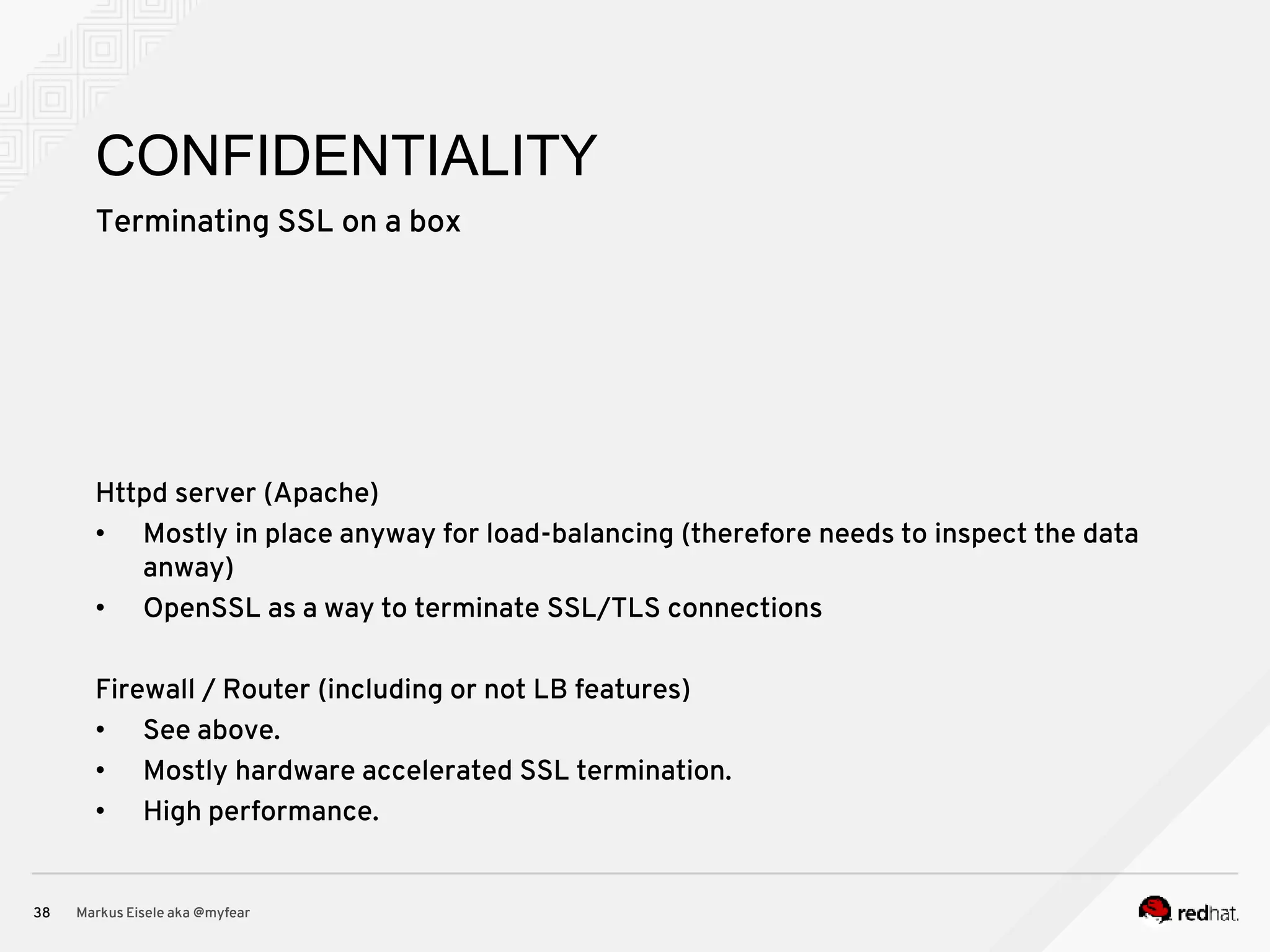
Terminating SSL on a box Markus Eisele aka @myfear38 CONFIDENTIALITY Httpd server (Apache) • Mostly in place anyway for load-balancing (therefore needs to inspect the data anway) • OpenSSL as a way to terminate SSL/TLS connections Firewall / Router (including or not LB features) • See above. • Mostly hardware accelerated SSL termination. • High performance.
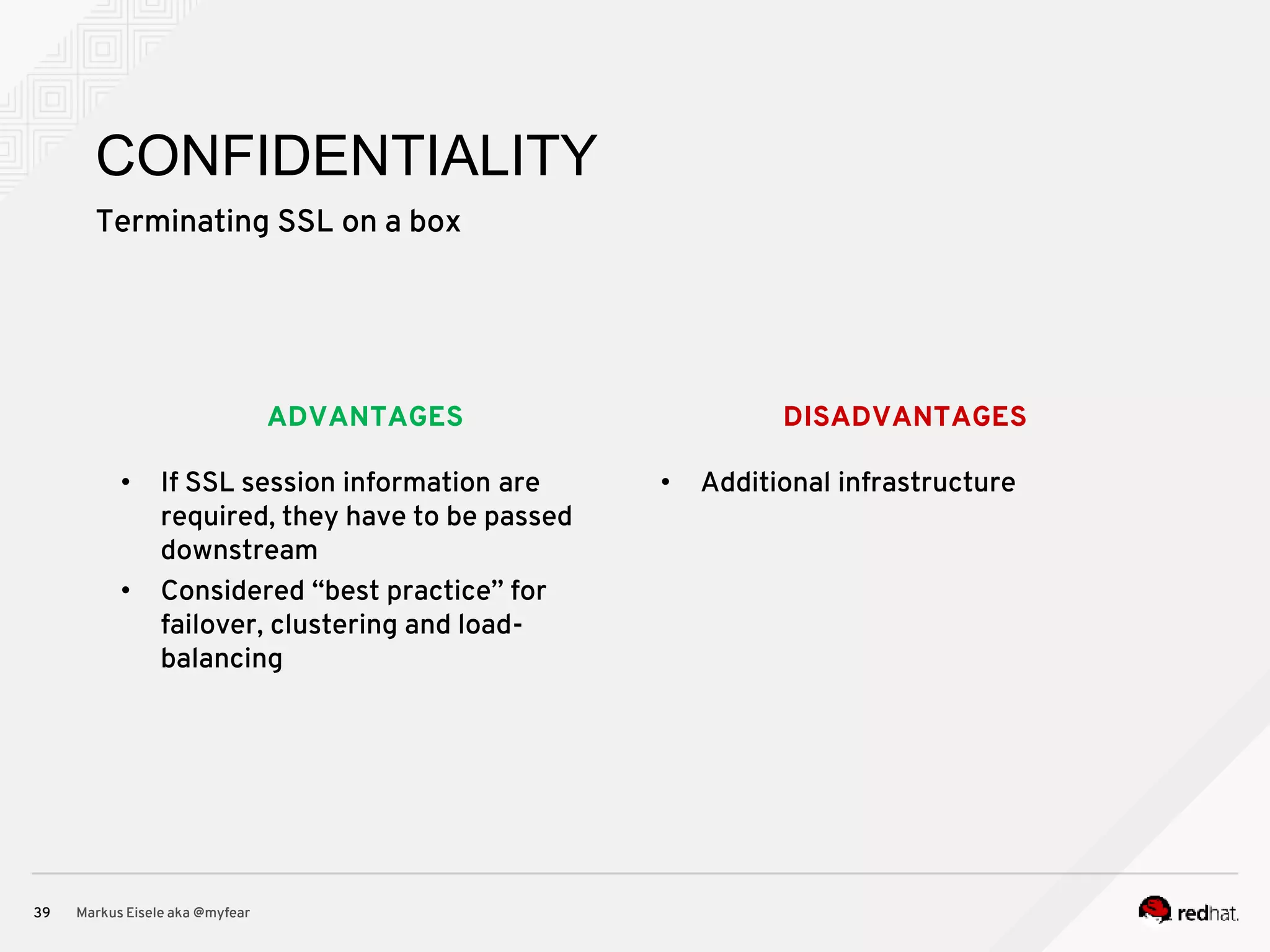
DISADVANTAGESADVANTAGES Terminating SSL on a box Markus Eisele aka @myfear39 CONFIDENTIALITY • If SSL session information are required, they have to be passed downstream • Considered “best practice” for failover, clustering and load- balancing • Additional infrastructure
Mostly Data Integrity Markus Eisele aka @myfear40 INTEGRITY Data integrity is the process of verifying if data is transmitted without corruption or modification, thus making sure that the data received at the receiver end is in fact the same message sent by the sender. In Java EE mostly two big areas: Implemented for data access/exchange with JPA and JTA.
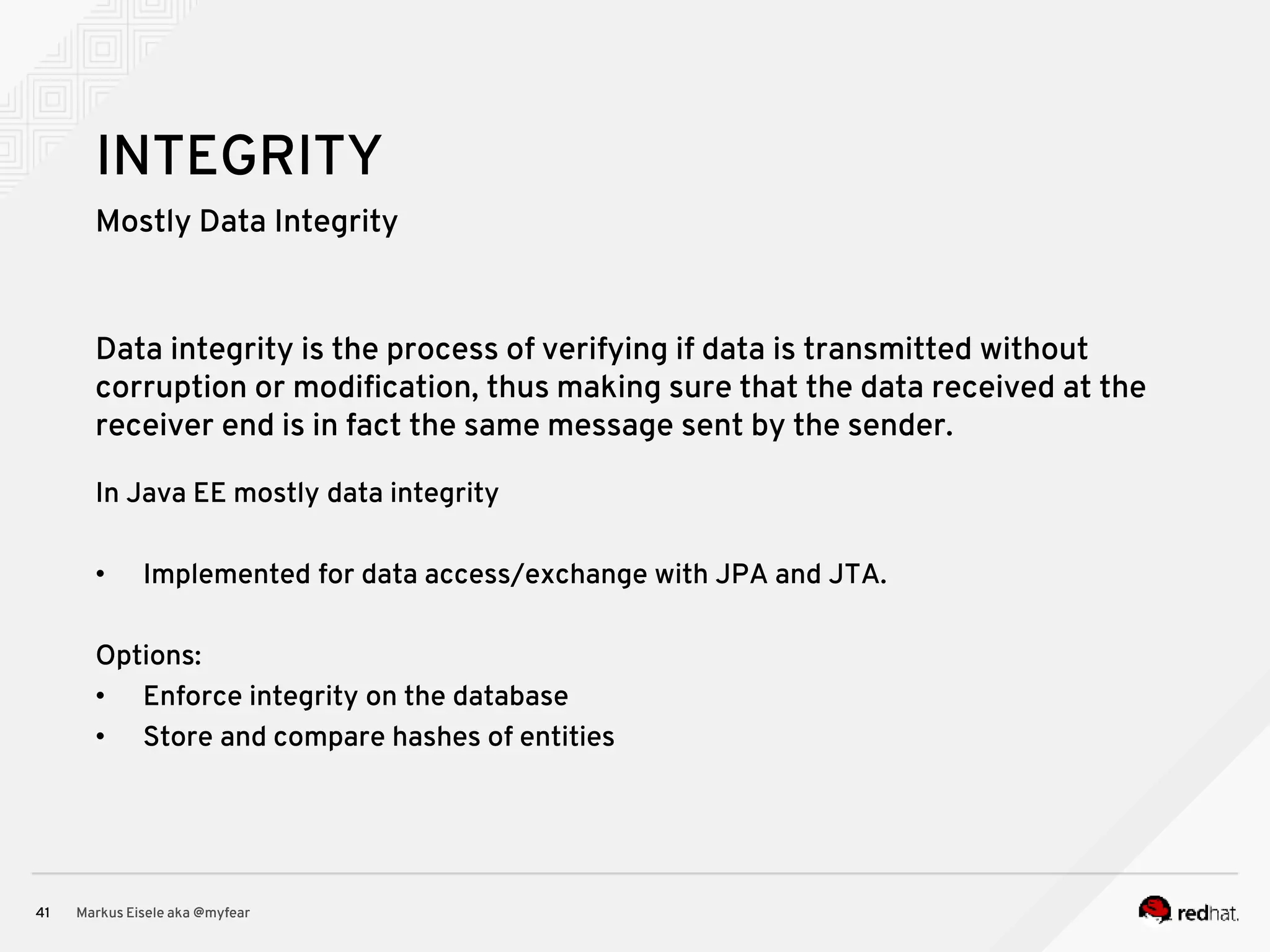
Mostly Data Integrity Markus Eisele aka @myfear41 INTEGRITY Data integrity is the process of verifying if data is transmitted without corruption or modification, thus making sure that the data received at the receiver end is in fact the same message sent by the sender. In Java EE mostly data integrity • Implemented for data access/exchange with JPA and JTA. Options: • Enforce integrity on the database • Store and compare hashes of entities
Clustering, Scaling et al Markus Eisele aka @myfear42 AVAILABILITY Availability is commonly referred to as the most underspecified non- functional requirement for applications. Fact is: Applications only earn money, while they are running. There‘s nothing in Java EE. • Clustering, Scaling and other features aren‘t specified. • Completely vendor specific and server dependent.
WHAT ELSE DOES IT TAKES? 43
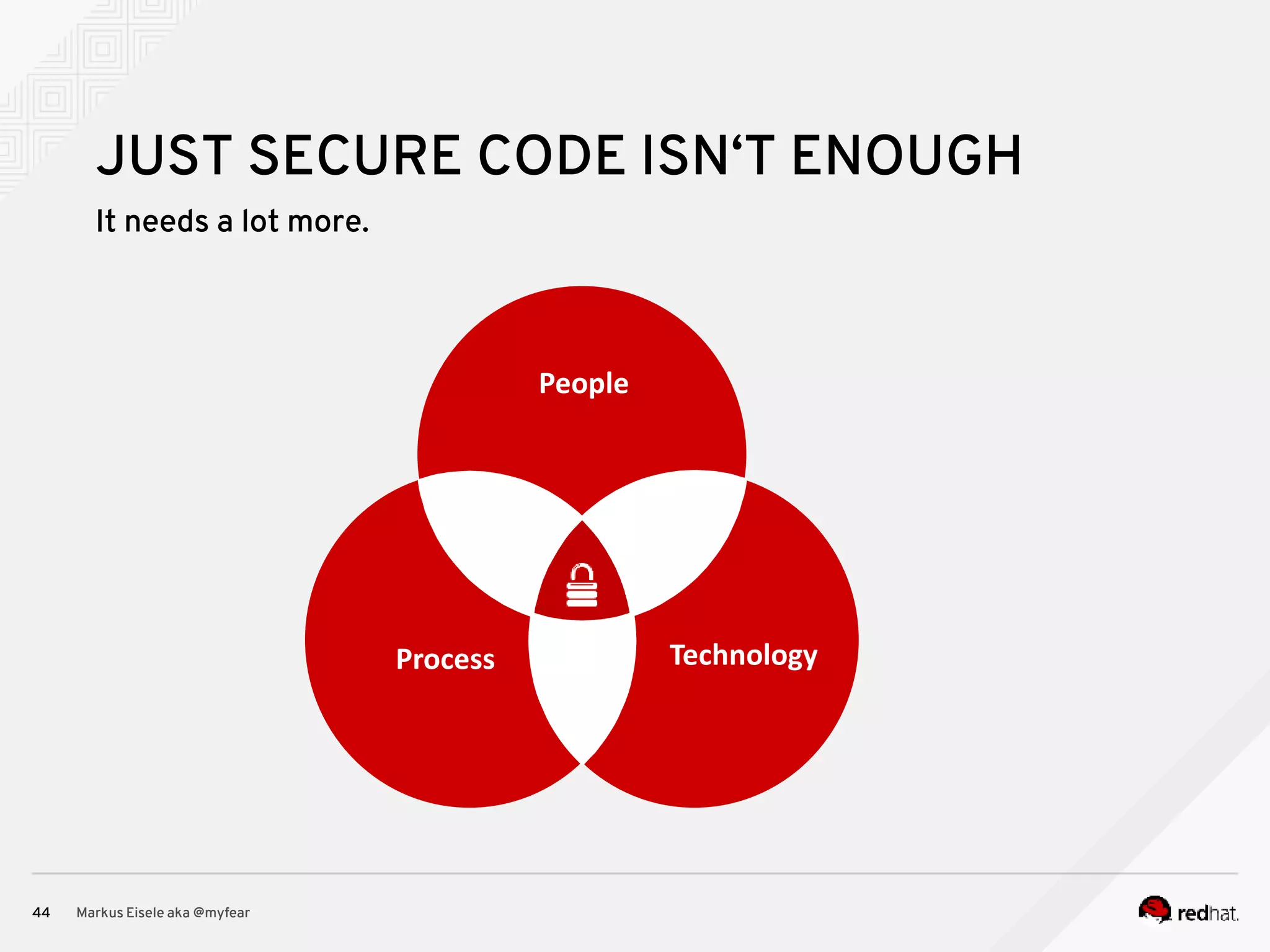
It needs a lot more. JUST SECURE CODE ISN‘T ENOUGH People Process Technology Markus Eisele aka @myfear44
45 “IT AIN’T WHAT YOU DON’T KNOW THAT GETS YOU INTO TROUBLE. IT’S WHAT YOU KNOW FOR SURE THAT JUST AIN’T SO.” — MARK TWAIN
Q&A
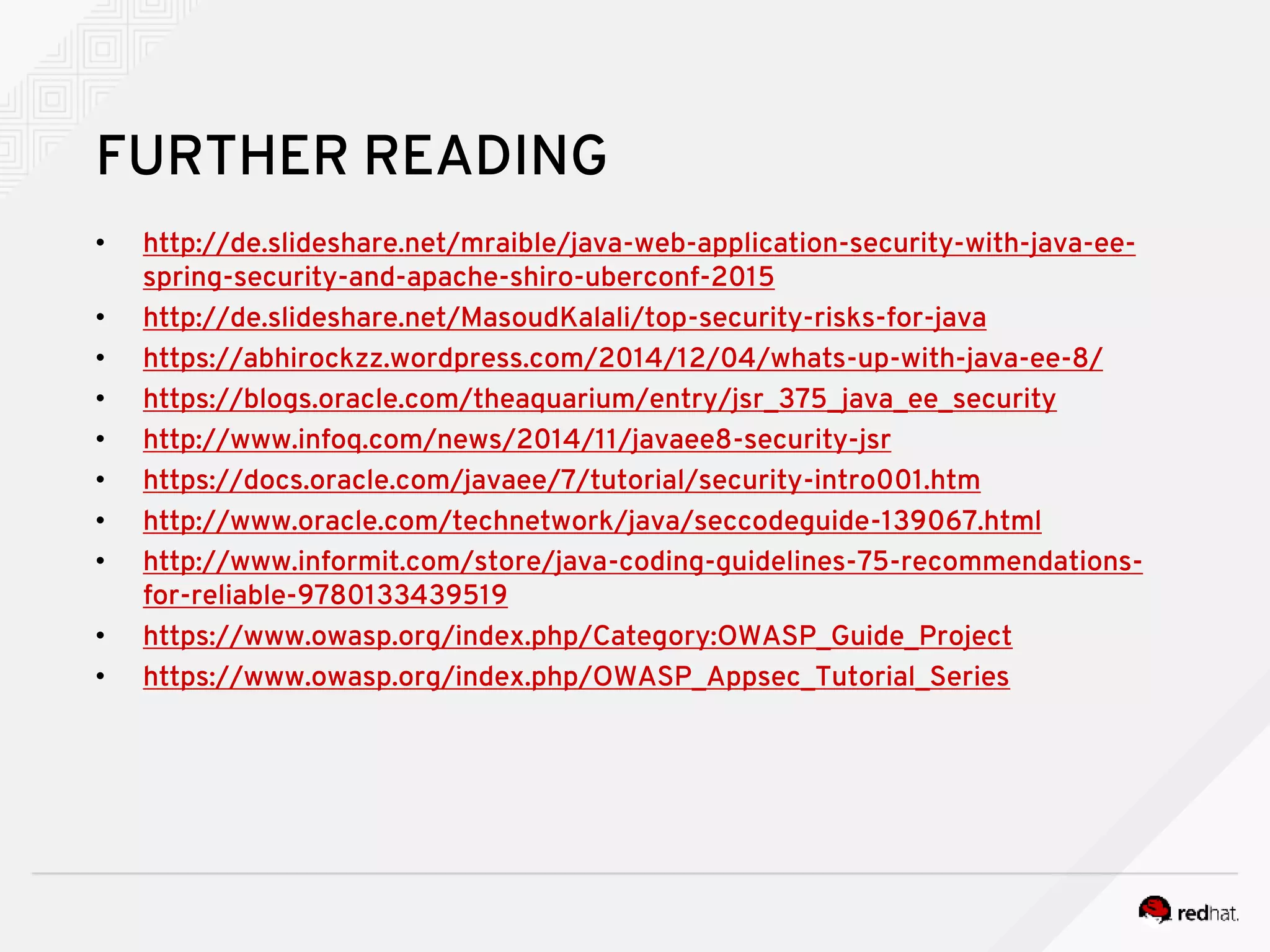
FURTHER READING • http://de.slideshare.net/mraible/java-web-application-security-with-java-ee- spring-security-and-apache-shiro-uberconf-2015 • http://de.slideshare.net/MasoudKalali/top-security-risks-for-java • https://abhirockzz.wordpress.com/2014/12/04/whats-up-with-java-ee-8/ • https://blogs.oracle.com/theaquarium/entry/jsr_375_java_ee_security • http://www.infoq.com/news/2014/11/javaee8-security-jsr • https://docs.oracle.com/javaee/7/tutorial/security-intro001.htm • http://www.oracle.com/technetwork/java/seccodeguide-139067.html • http://www.informit.com/store/java-coding-guidelines-75-recommendations- for-reliable-9780133439519 • https://www.owasp.org/index.php/Category:OWASP_Guide_Project • https://www.owasp.org/index.php/OWASP_Appsec_Tutorial_Series

THEFT-PROOF JAVA EE - SECURING YOUR JAVA EE APPLICATIONS

  • 1.
    THEFT PROOF-JAVA EE MarkusEisele markus@jboss.org @myfear blog.eisele.net Securing your Java EE applications
  • 2.
  • 3.
    BUT WHAT DOYOU KNOW ABOUT SECURITY?
  • 5.
    Markus Eisele aka@myfear5 HOLISTIC SECURITY To build a secure Java EE application, a holistic approach to application security is required and security must be applied at all layers and services. Network Host Application Platform Services (JVM, Application Server) Operating System Infrastructure Software Application Landscape Enterprise- Services Business IT-Security-Architecture
  • 6.
    Secure applications relyon secure networks Markus Eisele aka @myfear6 SECURE NETWORKS Things to look out for: • Router • Firewall • Switch • Protocols • Ports • Firmware • Standard passwords
  • 7.
    Repeat for allof them: including database, message broker, httpd-server and all the others. Markus Eisele aka @myfear7 SECURE HOSTS / OPERATING SYSTEMS Things to look out for: • Shared Volumes • Running Services • Accounts (user and service) • Auditing and Logging • Files and directories • Patches and updates
  • 8.
    All pre-installed runtimes,like the JVM/JDK, Application server, etc. Markus Eisele aka @myfear8 PLATFORM SERVICES Things to look out for: • Policy Files • File Access Rights • Default Passwords • Admin Console
  • 9.
    Security relies onthe following components WHAT IS APPLICATION SECURITY? Availability Integrity Confidentiality Auditing Authorization Authentication Markus Eisele aka @myfear9
  • 10.
    A thread isa potential event that may affect your system. An attack exploits a vulnerability in your system. Markus Eisele aka @myfear10 THREATS, VULNERABILITIES, AND ATTACKS How do you decide if an application is secure? Application + Infrastructure exposes Vulnerability exploits Attack
  • 11.
    Markus Eisele aka@myfear11 NO SECURITY WITHOUT THREATS It is not possible to design and build a secure Web application until you know your threats. Thread modelling in the design phase: • To be protected • CC, Address, etc. Data Goal of an attackThreat • Potential damage • $ or image Rate
  • 12.
    Markus Eisele aka@myfear12 STRATEGY – APPROACH - GOAL
  • 13.
    Some basic categoriesmapped down from the security components Markus Eisele aka @myfear13 APPLICATION VULNERABILITY CATEGORIES • Input Validation • Authentication • Authorization • Configuration Management • Sensitive Data • Session Management • Data Encryption • Parameter Manipulation • Exception Handling • Auditing and Logging • Timestamping • Role Based Access Control • Execution Sandboxing • Process Separation
  • 14.
    Best Practices fordesigning secure applications. Markus Eisele aka @myfear14 CORE SECURITY PRINCIPLES • Compartmentalize • Use least privilege • Apply defense in depth • Do not trust user input • Check at the gate • Fail securely • Secure the weakest link • Create secure defaults • Reduce your attack surface THINGS TO KEEP IN MIND FOR YOUR SYSTEM DESIGN
  • 15.
    AND HOW MUCHOF THAT CAN YOU DO WITH JAVA EE? 15
  • 16.
    Basic, Form, Digest,Client, Mutual Markus Eisele aka @myfear16 AUTHENTICATION The means by which communicating entities, such as client and server, prove to each other that they are acting on behalf of specific identities that are authorized for access. This ensures that users are who they say they are. • Configuration via deployment descriptor • Application roles mapping into server groups • Most servers provide standard login modules (DB, LDAP, Client-Cert, Filesystem) • Additional resources (Keystores, LDAP, DB) • Custom Authentication Logic via: • JASPIC • JAAS • Server Specific Features (Realms)
  • 17.
    The missing pieces MarkusEisele aka @myfear17 AUTHENTICATION Well known and broadly used and still missing in Java EE • Two Factor Auth Support (Custom Token, Hardware Token, Soft-Token) • Social Login (Facebook, Twitter, GitHub) • User Registration / Self Service • Easy Customizing for custom login pages • OAuth support • Policies (Password / Revocation)
  • 18.
    Option: Custom implementation(e.g. OAuth w/ programmatic security) Markus Eisele aka @myfear18 AUTHENTICATION https://oneminutedistraction.wordpress.com/2014/04/29/using-oauth-for-your-javaee-login/ Browser Java EE Server OAuth Login Button Redirect Login Page Submit Credentials Redirect Callback URL Redirect Callback Get access_token Get User Data
  • 19.
    DISADVANTAGESADVANTAGES Custom Implementation Markus Eiseleaka @myfear19 AUTHENTICATION • Minimal – Meet Needs • Fast Implementation • Tied to one provider • Hard to extend • Hard to test • Potential implementation mistakes expose vulnerabilities • JAAS/JASPIC hard to understand • Easy to be accidentally tied to a specific server • Not “microservices-ready”
  • 20.
    Option: Identity Broker– e.g. Keycloak Markus Eisele aka @myfear20 AUTHENTICATION http://keycloak.jboss.org/docs
  • 21.
    DISADVANTAGESADVANTAGES Identity Broker Markus Eiseleaka @myfear21 AUTHENTICATION • Flexible • Configurable and extendable • Runtime Changes • Many Identity Providers • Additional Features (Government/Policies) • Ready for microservices (downstream propagation) • Separate System - Complexity • Takes User/Roles management out of the Java EE Server
  • 22.
    Or Access Control MarkusEisele aka @myfear22 AUTHORIZATION The means by which interactions with resources are limited to collections of users or programs for the purpose of enforcing integrity, confidentiality, or availability constraints. This ensures that users have permission to perform operations or access data. • Configuration via deployment descriptor or Annotations (@RolesAllowed) • Custom Authorization Logic via: • Programmatic Security + • CDI / Aspects + • Caching • JACC
  • 23.
    The missing pieces MarkusEisele aka @myfear23 AUTHORIZATION Well known and broadly used and still missing in Java EE • Fine Grained Access Control (technical or business) • Data Protection Model through different specifications (e.g. data access per user/tenant) • Coherent AccessException Model
  • 24.
    Option: Custom Implementation MarkusEisele aka @myfear24 AUTHORIZATION Use a mixture of standard authorization mechanisms (Principal) and add a custom user object which get‘s enriched with Permissions. • Authentication via form-based or other method • Creating an application User per Principal • Resolving custom rights per user (Datastore, In-Memory DB) • Implementing Around Invoke Aspects (@AllowedTo(Permission.WRITE) http://kenai.com/projects/javaee-patterns/sources/hg/show/javaee-security
  • 25.
    DISADVANTAGESADVANTAGES Custom Implementation Markus Eiseleaka @myfear25 AUTHORIZATION • Native to the Java EE programmer • Simple, Customizable at development time • Assignable per application • Potential implementation mistakes expose vulnerabilities • Common Code tied into all modules • Complex permission matrices need to be extensively cached • Cache invalidation • No runtime changes to permissions
  • 26.
    Option: JACC (JavaAuthorization Contract for Containers) Markus Eisele aka @myfear26 AUTHORIZATION It “defines a contract between a Java EE application server and an authorization policy provider" and which "defines java.security.Permission classes that satisfy the Java EE authorization model” Implement: • A factory that provides an object that collects permissions • A state machine that controls the life-cyle of this permission collector • Linking permissions of multiple modules and utilities • Collecting and managing permissions • Processing permissions after collecting • An "authorization module" using permissions for authorization decisions http://arjan-tijms.omnifaces.org/2015/03/java-ee-authorization-jacc-revisited.html
  • 27.
    DISADVANTAGESADVANTAGES JACC (Java AuthorizationContract for Containers) Markus Eisele aka @myfear27 AUTHORIZATION • Integrated with the Java EE container • Part of the standard • As secure as it can get • C.O.M.P.L.E.X.I.T.Y • Amount of classes • APIs • Verbose • Not truly portable • Application Server Wide
  • 28.
    Logging which securityrelevant changes happen. Markus Eisele aka @myfear28 AUDITING An audit trail (also called audit log) is a security-relevant chronological record, set of records, and/or destination and source of records that provide documentary evidence of the sequence of activities that have affected at any time a specific operation, procedure, or event. • There‘s nothing here in Java EE Options: • Custom Implementations • Logger Implementations • Data centered approaches (JPA / Database) • Server specific implementations
  • 29.
    Option: Custom Implementation MarkusEisele aka @myfear29 AUDITING A transactional application often requires to audit the persistent entities. Sometimes you have to be able to track down changes and build up a history of changes. Or you’re requirement to have a long term rollback or need to archive in accordance with legal audit requirements. • Aspects in the widest sense (EJB, CDI) • @AroundInvoke captures relevant events on the service layer • Events should be persisted asynchronously • Ideally includes user information, date time and event type http://blog.eisele.net/2011/01/five-ways-to-know-how-your-data-looked.html
  • 30.
    DISADVANTAGESADVANTAGES Custom Implementation Markus Eiseleaka @myfear30 AUDITING • Suitable for business activity auditing • Simple to implement with a small set of activities. • Maybe used to also track performance of service calls • No rollback or data centered auditing • Doesn’t include security relevant audits (aspects don’t work in login- modules or realms • May be “forgotten” • Performance critical • No UI to generate an audit trail
  • 31.
    Option: Logger Implementation(e.g. Log4j) Markus Eisele aka @myfear31 AUDITING Some logging frameworks were specifically designed to support audit features. One among them is Log4j. Others with more respect to legal audit requirements also do exist. • Use Log4j‘s audit logging features • Populate ThreadContext Map with basic data like: user-id, remote-IP address, application-name, application-version, etc. • Create a StructuredDataMessage for every event • EventLogger.logEvent(msg) • Select an appropriate provider (Syslog, JMS, JDBC, Flume, etc.) • Combine with aspects and automatically constructed DataMessages for broad coverage on services.
  • 32.
    DISADVANTAGESADVANTAGES Logger Implementation Markus Eiseleaka @myfear32 AUDITING • Native for Java EE developers • Easy to use as “logging” • Will work in security relevant classes • Guaranteed delivery ? • Performance overhead with growing events
  • 33.
    Option: JPA CenteredApproaches (Hibernate ORM Envers) Markus Eisele aka @myfear33 AUDITING The Envers module aims to enable easy auditing/versioning of persistent classes. All that you have to do is annotate your persistent class or some of its properties, that you want to audit, with @Audited. Just add @Audited to your entities • auditing of all mappings defined by the JPA specification • auditing of some Hibernate mappings, which extend JPA, like custom types and collections/maps of "simple" types (Strings, Integers, etc.) (see here for one exception) • logging data for each revision using a "revision entity" • querying historical data http://hibernate.org/orm/envers/
  • 34.
    DISADVANTAGESADVANTAGES Option: JPA CenteredApproaches (Hibernate ORM Envers) Markus Eisele aka @myfear34 AUDITING • Historical Data • Revisions • Fully integrated into JPA • Only Data Centered Auditing
  • 35.
    or data privacy MarkusEisele aka @myfear35 CONFIDENTIALITY Confidentiality is the process of maintaining data privacy wherein we secure the communications channel, to make sure the data is not accessed in its original form by a third party by eavesdropping. Java EE doesn‘t bring a hell lot to the table here. Options: • SSL Termination on the Application Server • SSL Termination on a box before (httpd, router, appliance)
  • 36.
    Terminating SSL onthe App-Server Markus Eisele aka @myfear36 CONFIDENTIALITY <transport-guarantee>CONFIDENTIAL | INTEGRAL</transport-guarantee> A value of INTEGRAL means that the application requires the data sent between the client and server to be sent in such a way that it can't be changed in transit. A value of CONFIDENTIAL means that the application requires the data to be transmitted in a fashion that prevents other entities from observing the contents of the transmission.
  • 37.
    DISADVANTAGESADVANTAGES Terminating SSL onthe App-Server Markus Eisele aka @myfear37 CONFIDENTIALITY • Access to the SSL connection information (ssl-session-id) • Performance • Configuration complexity • Testing locally
  • 38.
    Terminating SSL ona box Markus Eisele aka @myfear38 CONFIDENTIALITY Httpd server (Apache) • Mostly in place anyway for load-balancing (therefore needs to inspect the data anway) • OpenSSL as a way to terminate SSL/TLS connections Firewall / Router (including or not LB features) • See above. • Mostly hardware accelerated SSL termination. • High performance.
  • 39.
    DISADVANTAGESADVANTAGES Terminating SSL ona box Markus Eisele aka @myfear39 CONFIDENTIALITY • If SSL session information are required, they have to be passed downstream • Considered “best practice” for failover, clustering and load- balancing • Additional infrastructure
  • 40.
    Mostly Data Integrity MarkusEisele aka @myfear40 INTEGRITY Data integrity is the process of verifying if data is transmitted without corruption or modification, thus making sure that the data received at the receiver end is in fact the same message sent by the sender. In Java EE mostly two big areas: Implemented for data access/exchange with JPA and JTA.
  • 41.
    Mostly Data Integrity MarkusEisele aka @myfear41 INTEGRITY Data integrity is the process of verifying if data is transmitted without corruption or modification, thus making sure that the data received at the receiver end is in fact the same message sent by the sender. In Java EE mostly data integrity • Implemented for data access/exchange with JPA and JTA. Options: • Enforce integrity on the database • Store and compare hashes of entities
  • 42.
    Clustering, Scaling etal Markus Eisele aka @myfear42 AVAILABILITY Availability is commonly referred to as the most underspecified non- functional requirement for applications. Fact is: Applications only earn money, while they are running. There‘s nothing in Java EE. • Clustering, Scaling and other features aren‘t specified. • Completely vendor specific and server dependent.
  • 43.
    WHAT ELSE DOESIT TAKES? 43
  • 44.
    It needs alot more. JUST SECURE CODE ISN‘T ENOUGH People Process Technology Markus Eisele aka @myfear44
  • 45.
    45 “IT AIN’T WHAT YOUDON’T KNOW THAT GETS YOU INTO TROUBLE. IT’S WHAT YOU KNOW FOR SURE THAT JUST AIN’T SO.” — MARK TWAIN
  • 46.
  • 47.
    FURTHER READING • http://de.slideshare.net/mraible/java-web-application-security-with-java-ee- spring-security-and-apache-shiro-uberconf-2015 •http://de.slideshare.net/MasoudKalali/top-security-risks-for-java • https://abhirockzz.wordpress.com/2014/12/04/whats-up-with-java-ee-8/ • https://blogs.oracle.com/theaquarium/entry/jsr_375_java_ee_security • http://www.infoq.com/news/2014/11/javaee8-security-jsr • https://docs.oracle.com/javaee/7/tutorial/security-intro001.htm • http://www.oracle.com/technetwork/java/seccodeguide-139067.html • http://www.informit.com/store/java-coding-guidelines-75-recommendations- for-reliable-9780133439519 • https://www.owasp.org/index.php/Category:OWASP_Guide_Project • https://www.owasp.org/index.php/OWASP_Appsec_Tutorial_Series