Introduction to Machine Learning
Introduction to Machine Learning Machine Learning is a subset of Artificial Intelligence (AI) that enables systems to learn from data and improve from experience without being explicitly programmed. Types of Machine Learning: 1. Supervised Learning: Learns from labeled data. (e.g., Classification, Regression) 2. Unsupervised Learning: Learns from unlabeled data. (e.g., Clustering, Dimensionality Reduction) 3. Reinforcement Learning: Learns through rewards and punishments. (e.g., Game playing agents)
Supervised Learning
Linear Regression • A supervised learning algorithm used for predicting a continuous value based on input features. Working: • Fits a linear relationship between input variables (X) and output (y). Formula: y = mx + c • Example: Predicting house prices based on size and location.
Logistic Regression • A classification algorithm that predicts the probability of a binary outcome. • Working: Applies sigmoid function to map predicted values to probabilities. • Example: Determining whether an email is spam or not.
Decision Tree • A tree-like structure where each node represents a feature and each branch represents a decision. • Working: Splits the data based on feature values to reach a decision at leaf nodes. • Example: Loan approval based on age, income, and credit score.
Random Forest • An ensemble of decision trees used to improve prediction accuracy. • Working: • Builds multiple decision trees and merges their outputs. • Example: • Credit risk assessment using aggregated decision paths.
Support Vector Machine (SVM) • A classification algorithm that finds the optimal hyperplane to separate classes. • Working: Maximizes the margin between different class boundaries. • Example: Classifying images into cats and dogs.
K-Nearest Neighbors (KNN) • A lazy learning algorithm that classifies based on majority class among k- nearest points. • Working: Computes distance between test data and training samples. • Example: Recommending products based on user similarity.
Naive Bayes • A probabilistic classifier based on Bayes' theorem with feature independence assumption. • Working: Calculates posterior probability for each class and selects the highest. • Example: Sentiment analysis of customer reviews.
Unsupervised Learning
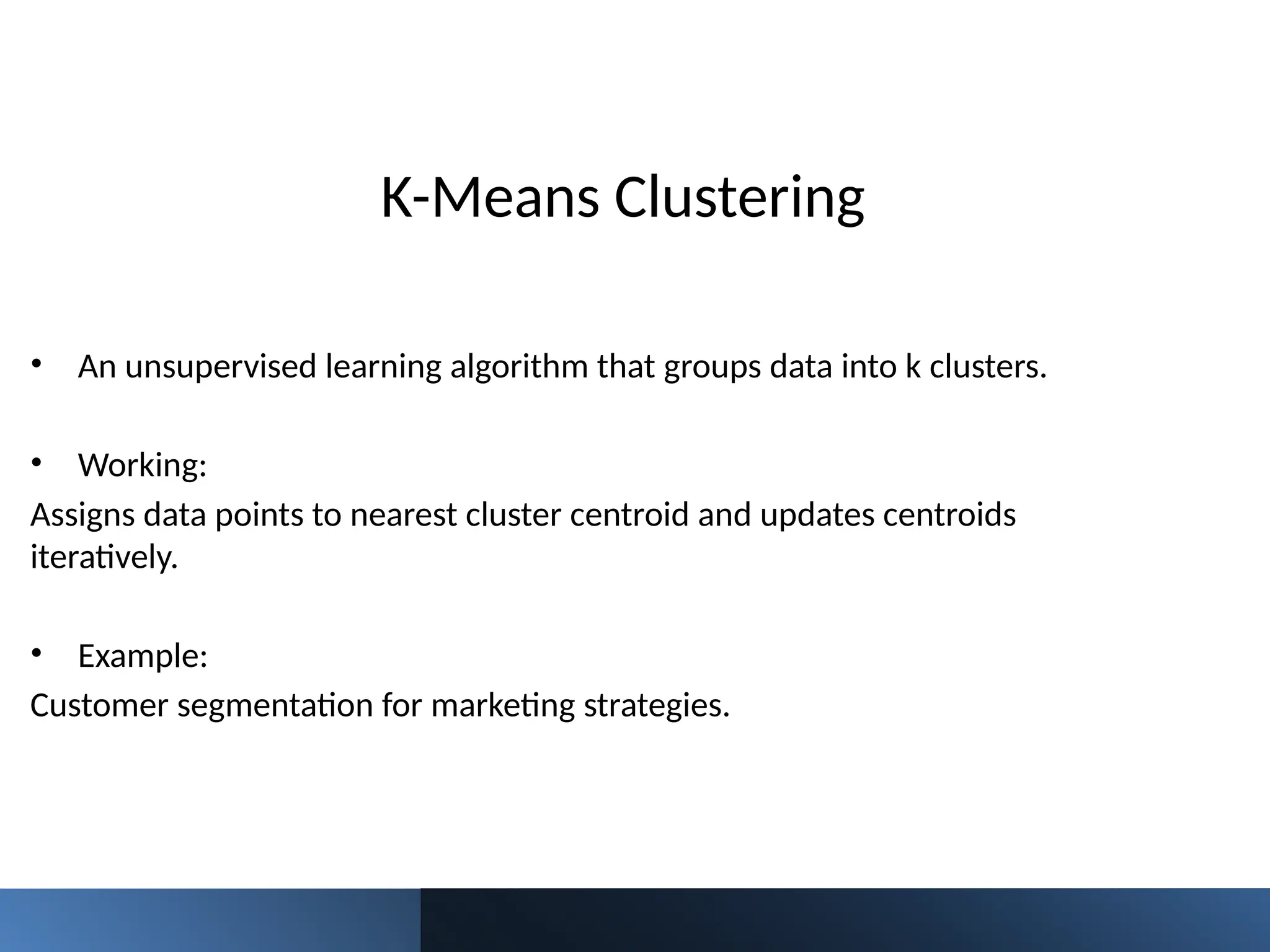
K-Means Clustering • An unsupervised learning algorithm that groups data into k clusters. • Working: Assigns data points to nearest cluster centroid and updates centroids iteratively. • Example: Customer segmentation for marketing strategies.
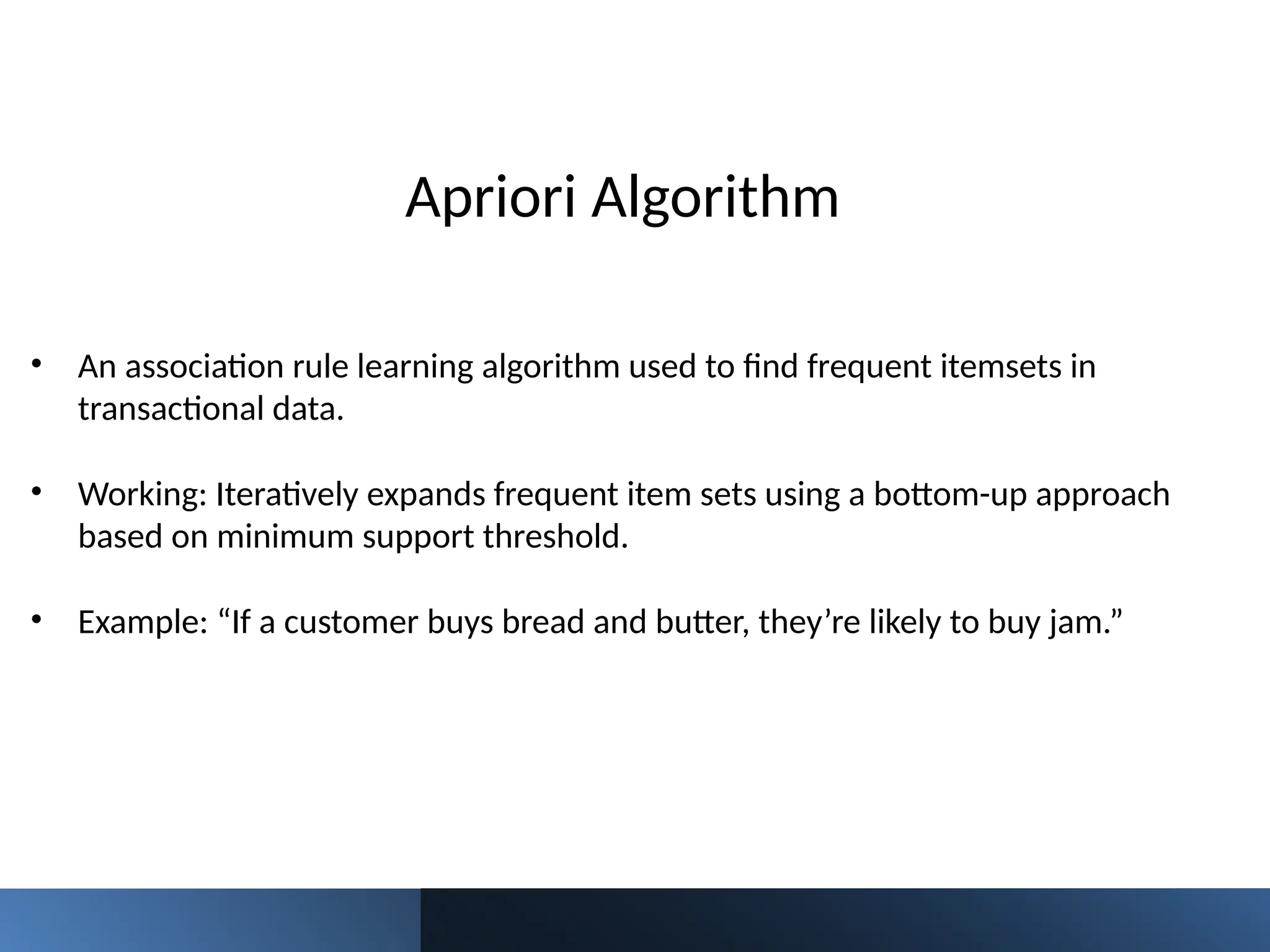
Apriori Algorithm • An association rule learning algorithm used to find frequent itemsets in transactional data. • Working: Iteratively expands frequent item sets using a bottom-up approach based on minimum support threshold. • Example: “If a customer buys bread and butter, they’re likely to buy jam.”
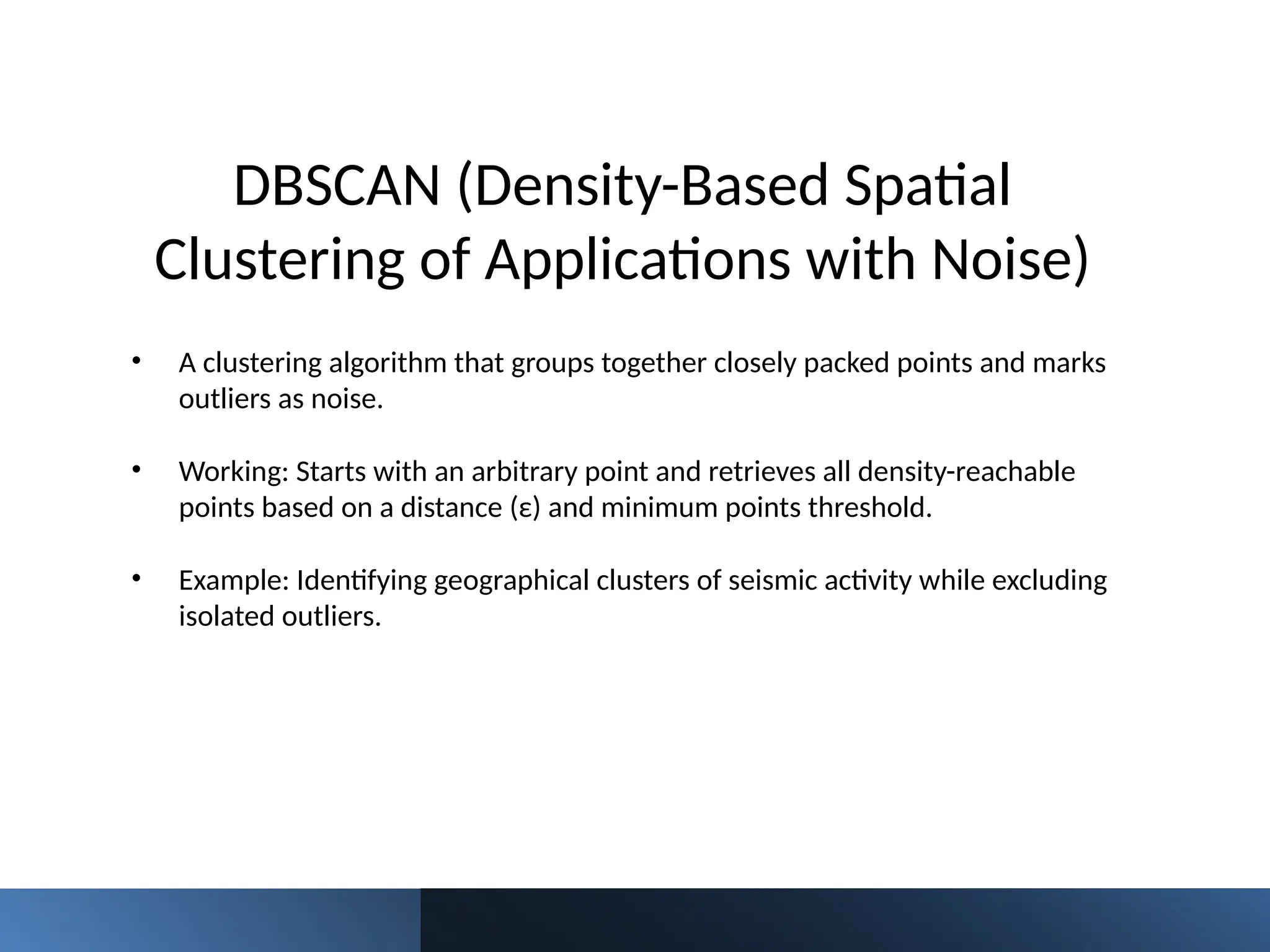
DBSCAN (Density-Based Spatial Clustering of Applications with Noise) • A clustering algorithm that groups together closely packed points and marks outliers as noise. • Working: Starts with an arbitrary point and retrieves all density-reachable points based on a distance (ε) and minimum points threshold. • Example: Identifying geographical clusters of seismic activity while excluding isolated outliers.
Principal Component Analysis (PCA) • A dimensionality reduction technique that transforms features into principal components. • Working: Finds new orthogonal axes (principal components) maximizing variance. • Example: Reducing high-dimensional customer data for visualization.
REINFORCEMENT LEARNING
Q-Learning • A reinforcement learning algorithm used to learn optimal actions in a given state. • Working: Updates Q-values using Bellman equation based on reward and future value. • Example: Training an agent to navigate a maze.
Conclusion Machine Learning has revolutionized the way we process and analyze data. Key Takeaways: • Different algorithms serve different purposes—choose based on data type and problem. • Supervised learning is ideal for prediction with labeled data. • Unsupervised learning is useful for exploring unknown patterns. • Reinforcement learning is powerful in dynamic decision-making scenarios. • Understanding the working and application of each algorithm helps in building better AI systems.
Types of Machine Learning Algorithms with Example

  • 1.
  • 2.
    Introduction to MachineLearning Machine Learning is a subset of Artificial Intelligence (AI) that enables systems to learn from data and improve from experience without being explicitly programmed. Types of Machine Learning: 1. Supervised Learning: Learns from labeled data. (e.g., Classification, Regression) 2. Unsupervised Learning: Learns from unlabeled data. (e.g., Clustering, Dimensionality Reduction) 3. Reinforcement Learning: Learns through rewards and punishments. (e.g., Game playing agents)
  • 3.
  • 4.
    Linear Regression • Asupervised learning algorithm used for predicting a continuous value based on input features. Working: • Fits a linear relationship between input variables (X) and output (y). Formula: y = mx + c • Example: Predicting house prices based on size and location.
  • 5.
    Logistic Regression • Aclassification algorithm that predicts the probability of a binary outcome. • Working: Applies sigmoid function to map predicted values to probabilities. • Example: Determining whether an email is spam or not.
  • 6.
    Decision Tree • Atree-like structure where each node represents a feature and each branch represents a decision. • Working: Splits the data based on feature values to reach a decision at leaf nodes. • Example: Loan approval based on age, income, and credit score.
  • 7.
    Random Forest • Anensemble of decision trees used to improve prediction accuracy. • Working: • Builds multiple decision trees and merges their outputs. • Example: • Credit risk assessment using aggregated decision paths.
  • 8.
    Support Vector Machine(SVM) • A classification algorithm that finds the optimal hyperplane to separate classes. • Working: Maximizes the margin between different class boundaries. • Example: Classifying images into cats and dogs.
  • 9.
    K-Nearest Neighbors (KNN) •A lazy learning algorithm that classifies based on majority class among k- nearest points. • Working: Computes distance between test data and training samples. • Example: Recommending products based on user similarity.
  • 10.
    Naive Bayes • Aprobabilistic classifier based on Bayes' theorem with feature independence assumption. • Working: Calculates posterior probability for each class and selects the highest. • Example: Sentiment analysis of customer reviews.
  • 11.
  • 12.
    K-Means Clustering • Anunsupervised learning algorithm that groups data into k clusters. • Working: Assigns data points to nearest cluster centroid and updates centroids iteratively. • Example: Customer segmentation for marketing strategies.
  • 13.
    Apriori Algorithm • Anassociation rule learning algorithm used to find frequent itemsets in transactional data. • Working: Iteratively expands frequent item sets using a bottom-up approach based on minimum support threshold. • Example: “If a customer buys bread and butter, they’re likely to buy jam.”
  • 14.
    DBSCAN (Density-Based Spatial Clusteringof Applications with Noise) • A clustering algorithm that groups together closely packed points and marks outliers as noise. • Working: Starts with an arbitrary point and retrieves all density-reachable points based on a distance (ε) and minimum points threshold. • Example: Identifying geographical clusters of seismic activity while excluding isolated outliers.
  • 15.
    Principal Component Analysis(PCA) • A dimensionality reduction technique that transforms features into principal components. • Working: Finds new orthogonal axes (principal components) maximizing variance. • Example: Reducing high-dimensional customer data for visualization.
  • 16.
  • 17.
    Q-Learning • A reinforcementlearning algorithm used to learn optimal actions in a given state. • Working: Updates Q-values using Bellman equation based on reward and future value. • Example: Training an agent to navigate a maze.
  • 18.
    Conclusion Machine Learning hasrevolutionized the way we process and analyze data. Key Takeaways: • Different algorithms serve different purposes—choose based on data type and problem. • Supervised learning is ideal for prediction with labeled data. • Unsupervised learning is useful for exploring unknown patterns. • Reinforcement learning is powerful in dynamic decision-making scenarios. • Understanding the working and application of each algorithm helps in building better AI systems.