Fundamentals of Computer Programming Chapter 7 User Defined Data types (union, enum, typedef and class & object) Chere L. (M.Tech) Lecturer, SWEG, AASTU 1
Outline ▪ Introduction to User defined Data type ▪ Defining structure (with tag and without tag) ▪ Declaring structure variable ▪ Initializing structure elements ▪ Accessing structure elements ▪ Nested structure  Defining structure within structure  Structure variable within other structure definition ▪ Array of structure ▪ Structure pointer ▪ Structure with function  Structure variable as parameter  Structure as a return type Chapter 7 2
Outline ▪ Other User defined Data types  Anonymous unions (union)  Enumerated types (enum)  Type definition (typedef) ▪ Class and Object as user defined data type  Class and Object Basics  Class and Object Creation Chapter 7 3
7.1) Union Chapter 7 4  A union is also a user defined data type that declares a set of multiple variable sharing the same memory area  Unions are similar to structures in certain aspects.  It used to group together variables of different data types.  It declared and used in the same way as structures.  The individual members can be accessed using dot operator.  Syntax: union union_tag{ type1 member_namel; type2 member_name2; … … typeN member_nameN; }; CONTENTS User Defined DT Structure Basics Nested Structures Array of Structures Struct manipulation Structure Pointer Structure & Function Union, enum & typdef Class and Objects
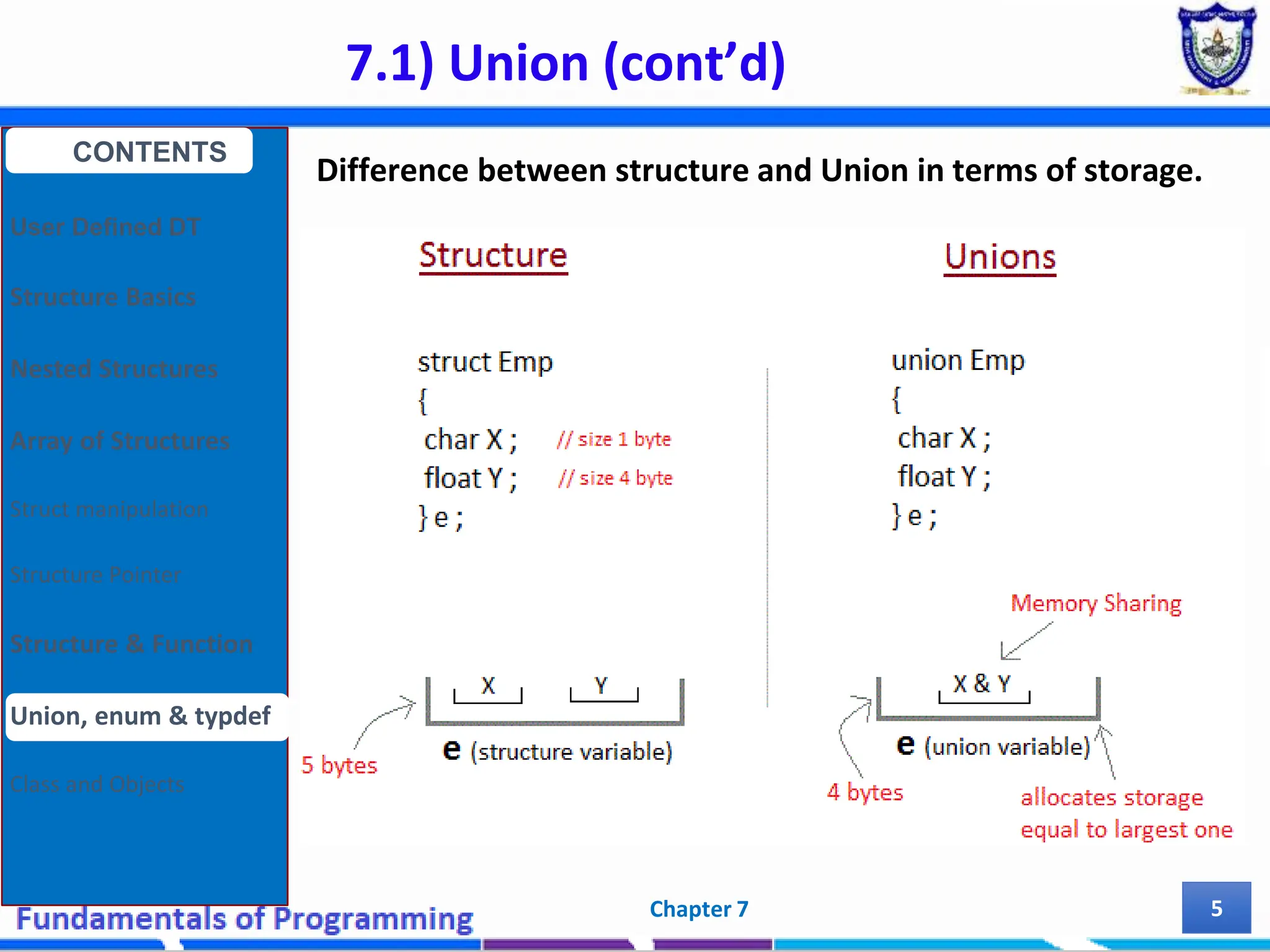
7.1) Union (cont’d) Chapter 7 5 Difference between structure and Union in terms of storage. CONTENTS User Defined DT Structure Basics Nested Structures Array of Structures Struct manipulation Structure Pointer Structure & Function Union, enum & typdef Class and Objects
7.1) Union (cont’d) Chapter 7 6 #include <iostream> using namespace std; // defining a struct struct student1 { int roll_no; char name[40]; }; // defining a union union student2 { int roll_no; char name[40]; }; CONTENTS User Defined DT Structure Basics Nested Structures Array of Structures Struct manipulation Structure Pointer Structure & Function Union, enum & typdef Class and Objects int main() { struct student1 s1; union student2 u1; cout << "size of structure : “; cout << sizeof(s1) << endl; cout << "size of union : “; cout<< sizeof(u1) << endl; return 0; } Example of comparing size of union and structure
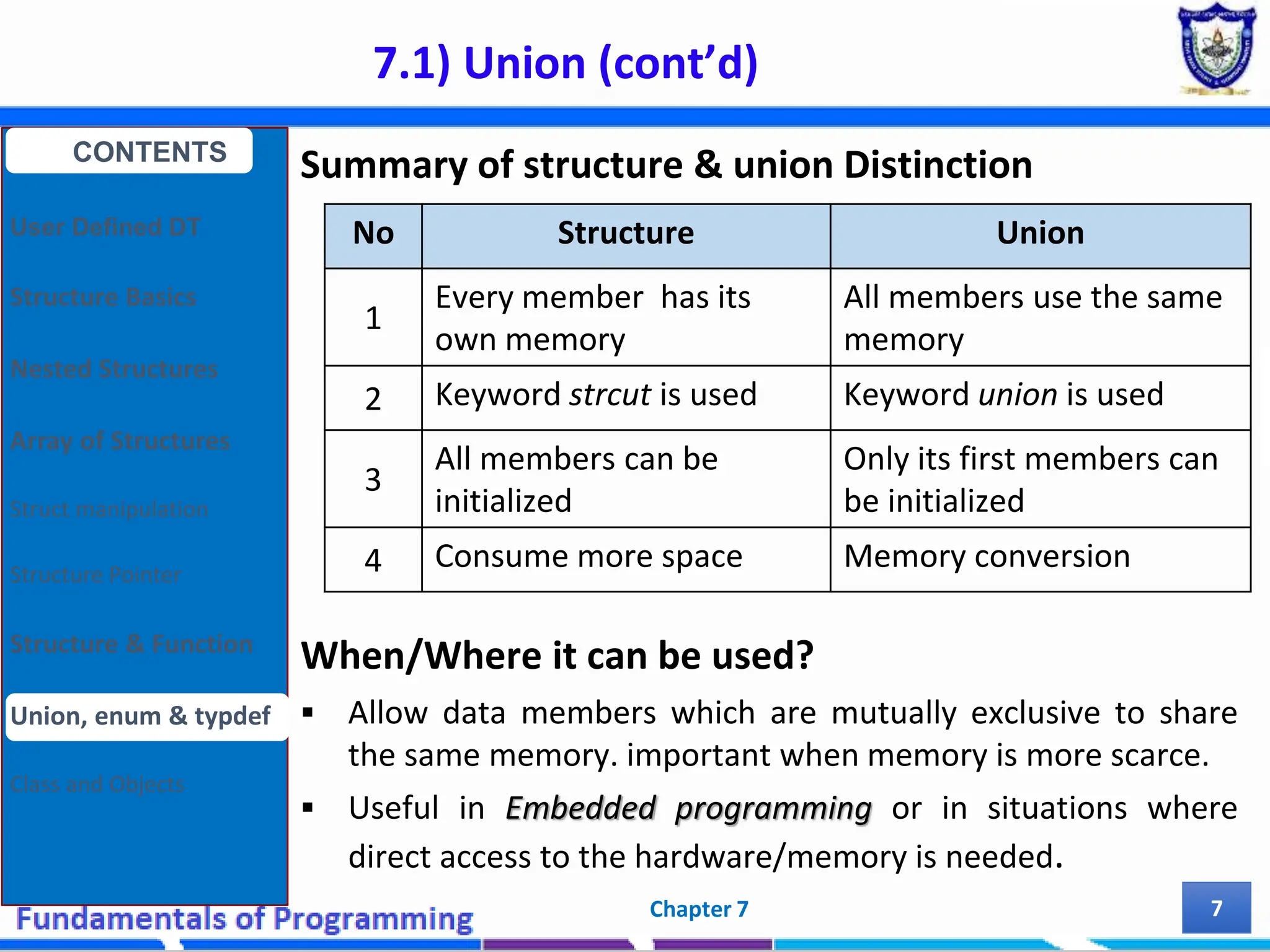
7.1) Union (cont’d) Chapter 7 7 Summary of structure & union Distinction When/Where it can be used?  Allow data members which are mutually exclusive to share the same memory. important when memory is more scarce.  Useful in Embedded programming or in situations where direct access to the hardware/memory is needed. CONTENTS User Defined DT Structure Basics Nested Structures Array of Structures Struct manipulation Structure Pointer Structure & Function Union, enum & typdef Class and Objects No Structure Union 1 Every member has its own memory All members use the same memory 2 Keyword strcut is used Keyword union is used 3 All members can be initialized Only its first members can be initialized 4 Consume more space Memory conversion
7.1) Union (cont’d) Chapter 7 8 #include <iostream> using namespace std; union Employee{ int Id, Age; char Name[25]; long Salary; }; int main(){ Employee E; cout << "nEnter Employee Id : "; cin >> E.Id; cout << "Employee Id : " << E.Id; cout << "nnEnter Employee Name : "; cin >> E.Name; cout << "Employee Name : " << E.Name; cout << "nnEnter Employee Age : "; cin >> E.Age; cout << "Employee Age : " << E.Age; cout << "nnEnter Employee Salary : "; cin >> E.Salary; cout << "Employee Salary : " << E.Salary; } CONTENTS User Defined DT Structure Basics Nested Structures Array of Structures Struct manipulation Structure Pointer Structure & Function Union, enum & typdef Class and Objects Example: creating object & accessing union members
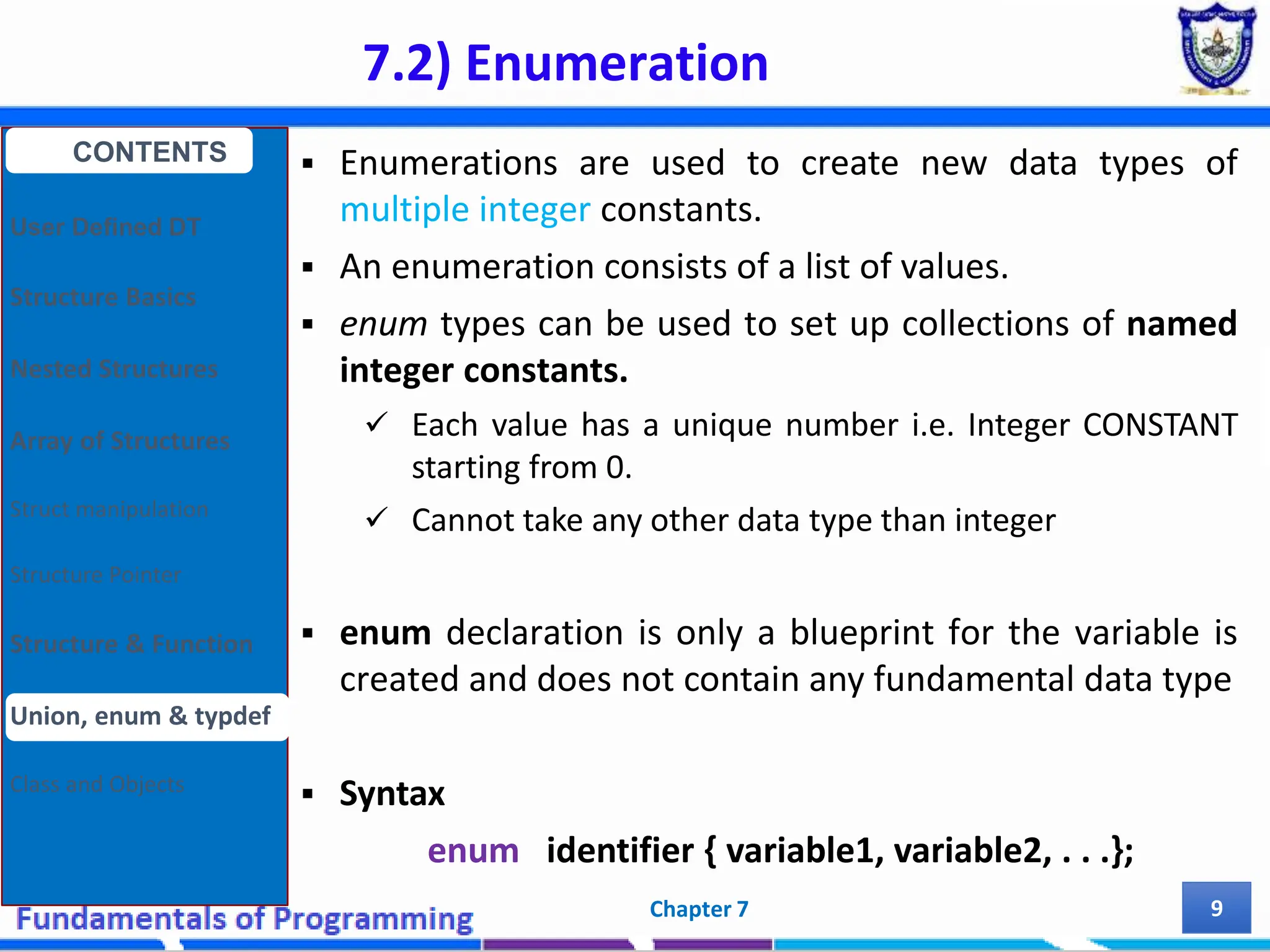
7.2) Enumeration Chapter 7 9  Enumerations are used to create new data types of multiple integer constants.  An enumeration consists of a list of values.  enum types can be used to set up collections of named integer constants.  Each value has a unique number i.e. Integer CONSTANT starting from 0.  Cannot take any other data type than integer  enum declaration is only a blueprint for the variable is created and does not contain any fundamental data type  Syntax enum identifier { variable1, variable2, . . .}; CONTENTS User Defined DT Structure Basics Nested Structures Array of Structures Struct manipulation Structure Pointer Structure & Function Union, enum & typdef Class and Objects
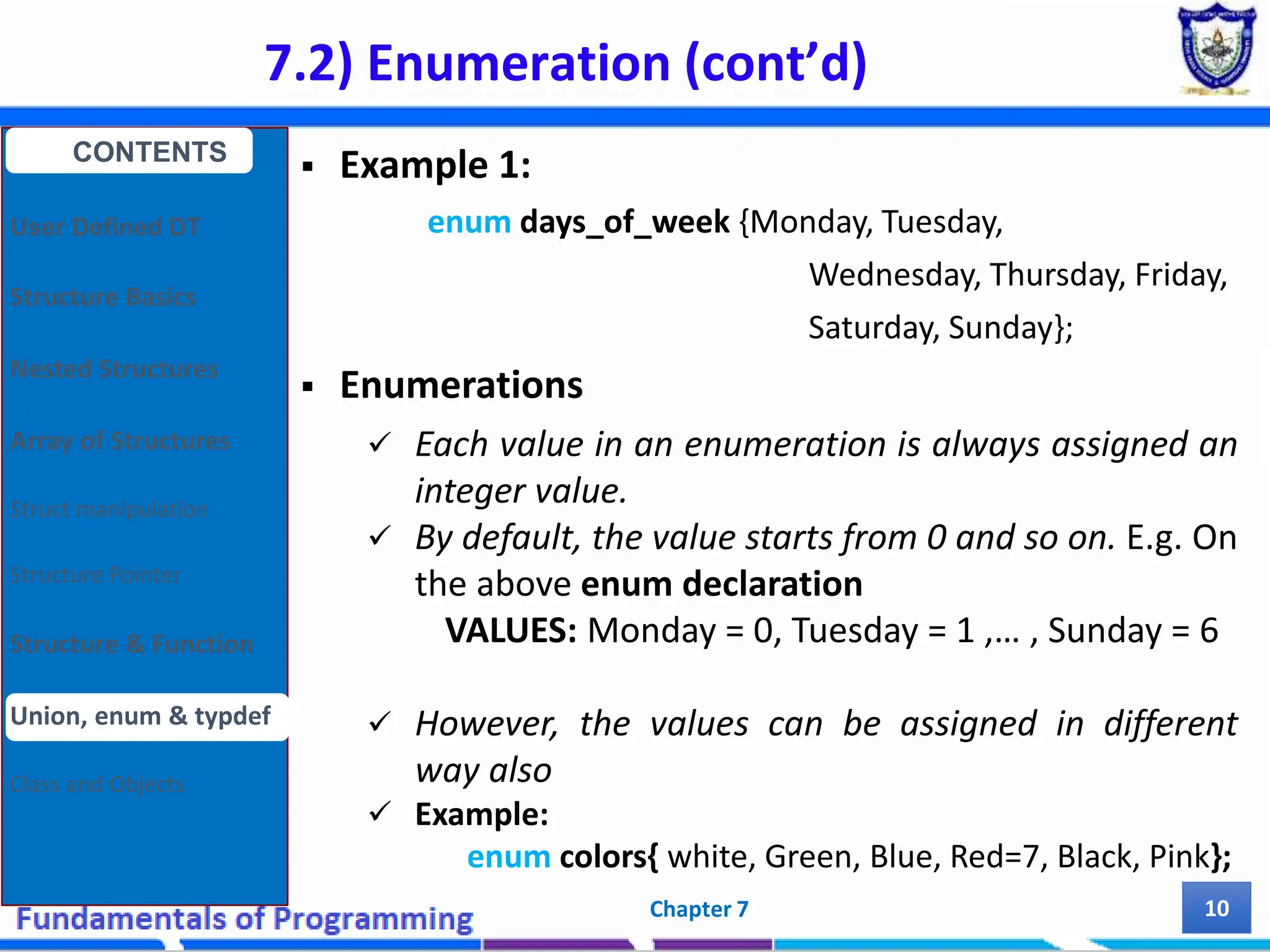
7.2) Enumeration (cont’d) Chapter 7 10  Example 1: enum days_of_week {Monday, Tuesday, Wednesday, Thursday, Friday, Saturday, Sunday};  Enumerations  Each value in an enumeration is always assigned an integer value.  By default, the value starts from 0 and so on. E.g. On the above enum declaration VALUES: Monday = 0, Tuesday = 1 ,… , Sunday = 6  However, the values can be assigned in different way also  Example: enum colors{ white, Green, Blue, Red=7, Black, Pink}; CONTENTS User Defined DT Structure Basics Nested Structures Array of Structures Struct manipulation Structure Pointer Structure & Function Union, enum & typdef Class and Objects
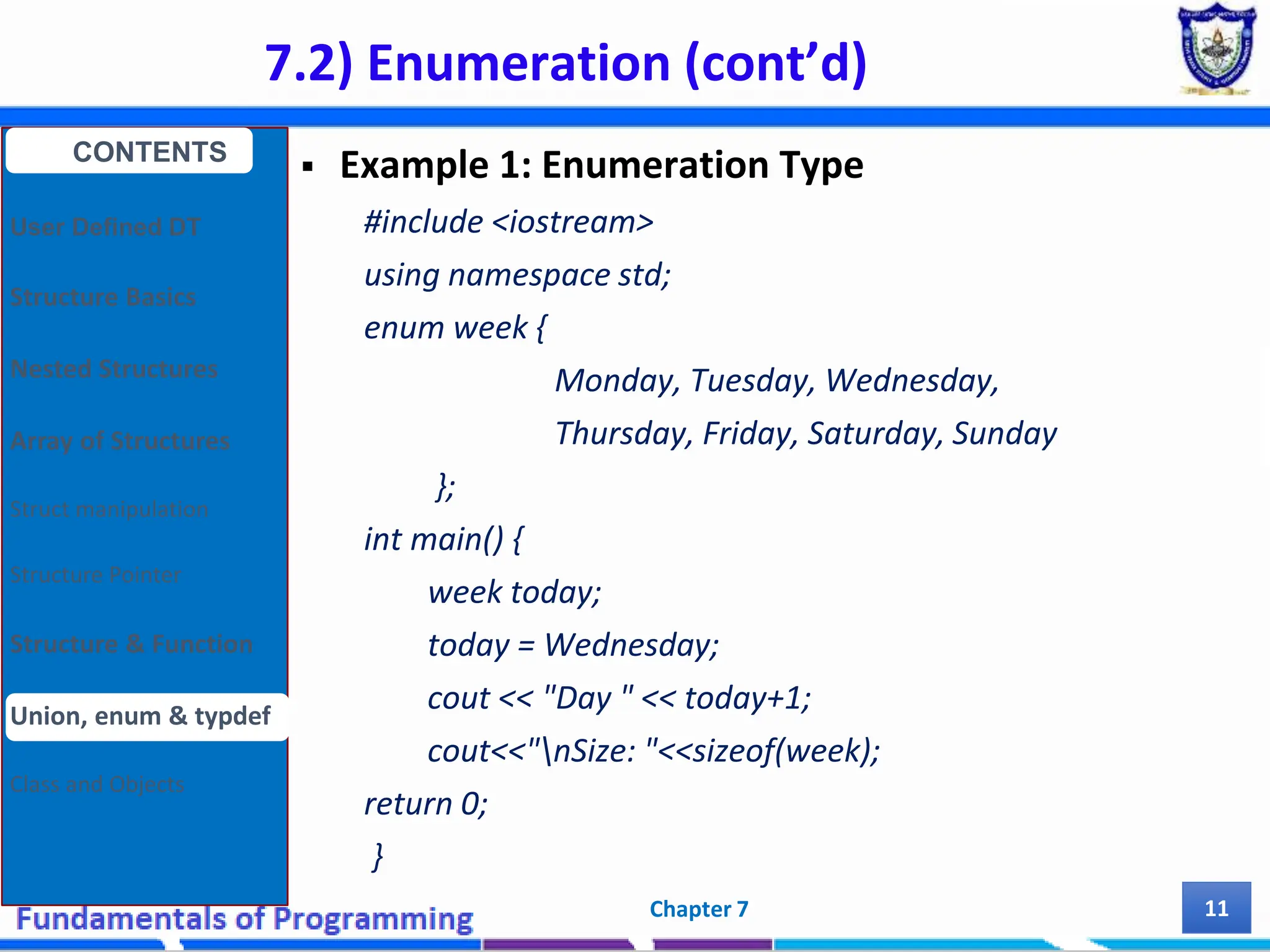
7.2) Enumeration (cont’d) Chapter 7 11  Example 1: Enumeration Type #include <iostream> using namespace std; enum week { Monday, Tuesday, Wednesday, Thursday, Friday, Saturday, Sunday }; int main() { week today; today = Wednesday; cout << "Day " << today+1; cout<<"nSize: "<<sizeof(week); return 0; } CONTENTS User Defined DT Structure Basics Nested Structures Array of Structures Struct manipulation Structure Pointer Structure & Function Union, enum & typdef Class and Objects
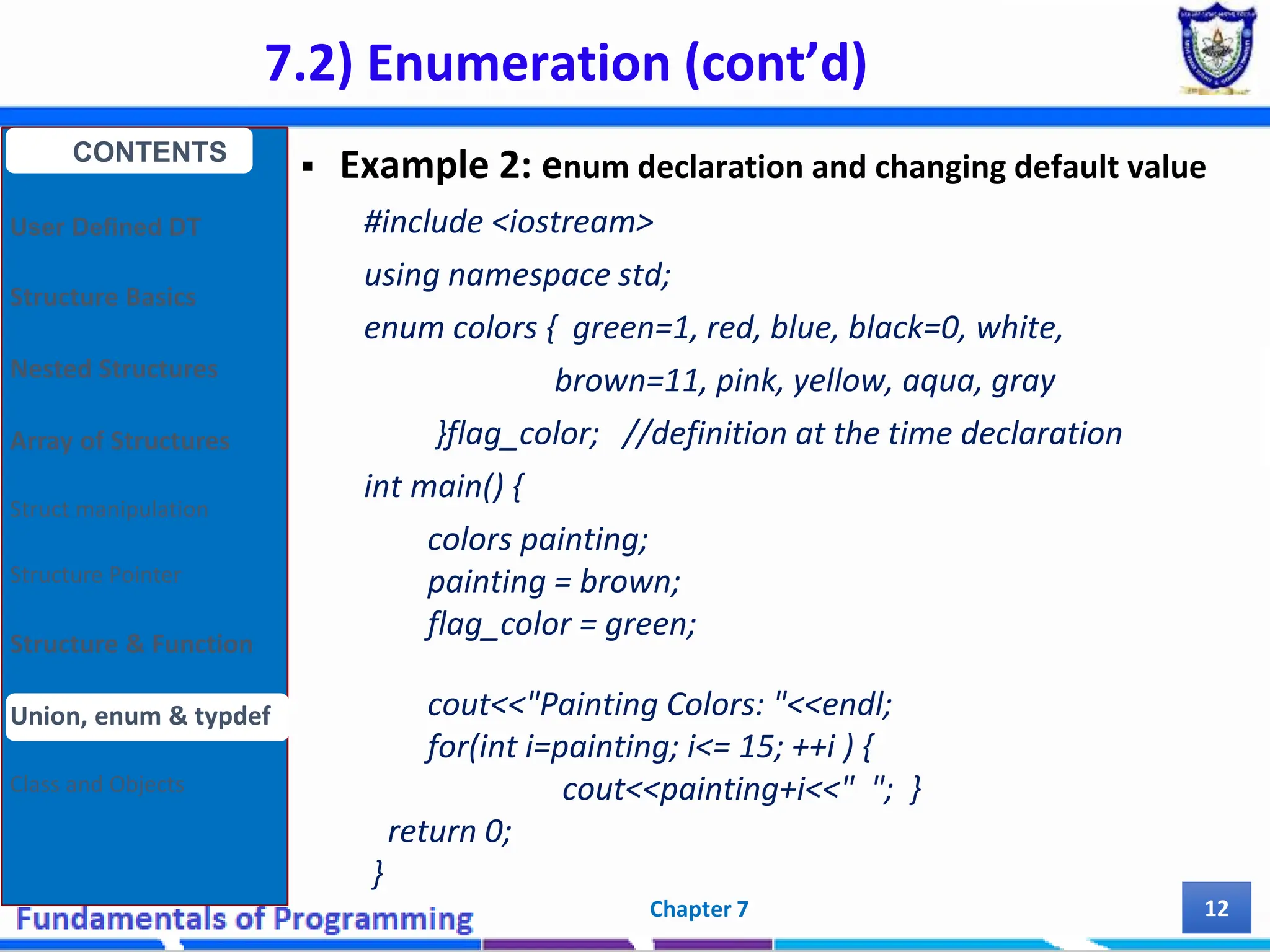
7.2) Enumeration (cont’d) Chapter 7 12  Example 2: enum declaration and changing default value #include <iostream> using namespace std; enum colors { green=1, red, blue, black=0, white, brown=11, pink, yellow, aqua, gray }flag_color; //definition at the time declaration int main() { colors painting; painting = brown; flag_color = green; cout<<"Painting Colors: "<<endl; for(int i=painting; i<= 15; ++i ) { cout<<painting+i<<" "; } return 0; } CONTENTS User Defined DT Structure Basics Nested Structures Array of Structures Struct manipulation Structure Pointer Structure & Function Union, enum & typdef Class and Objects
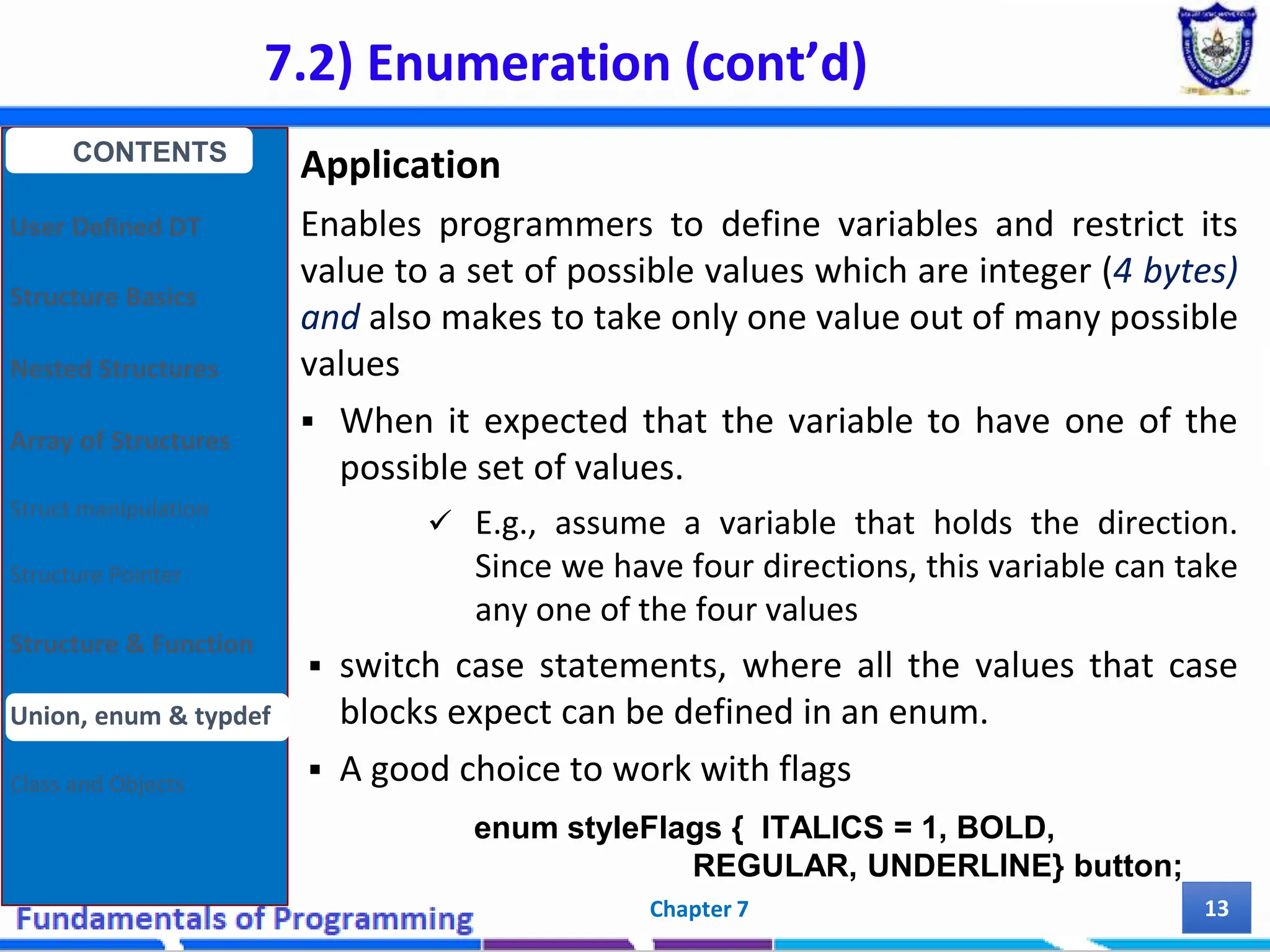
7.2) Enumeration (cont’d) Chapter 7 13 Application Enables programmers to define variables and restrict its value to a set of possible values which are integer (4 bytes) and also makes to take only one value out of many possible values  When it expected that the variable to have one of the possible set of values.  E.g., assume a variable that holds the direction. Since we have four directions, this variable can take any one of the four values  switch case statements, where all the values that case blocks expect can be defined in an enum.  A good choice to work with flags CONTENTS User Defined DT Structure Basics Nested Structures Array of Structures Struct manipulation Structure Pointer Structure & Function Union, enum & typdef Class and Objects enum styleFlags { ITALICS = 1, BOLD, REGULAR, UNDERLINE} button;
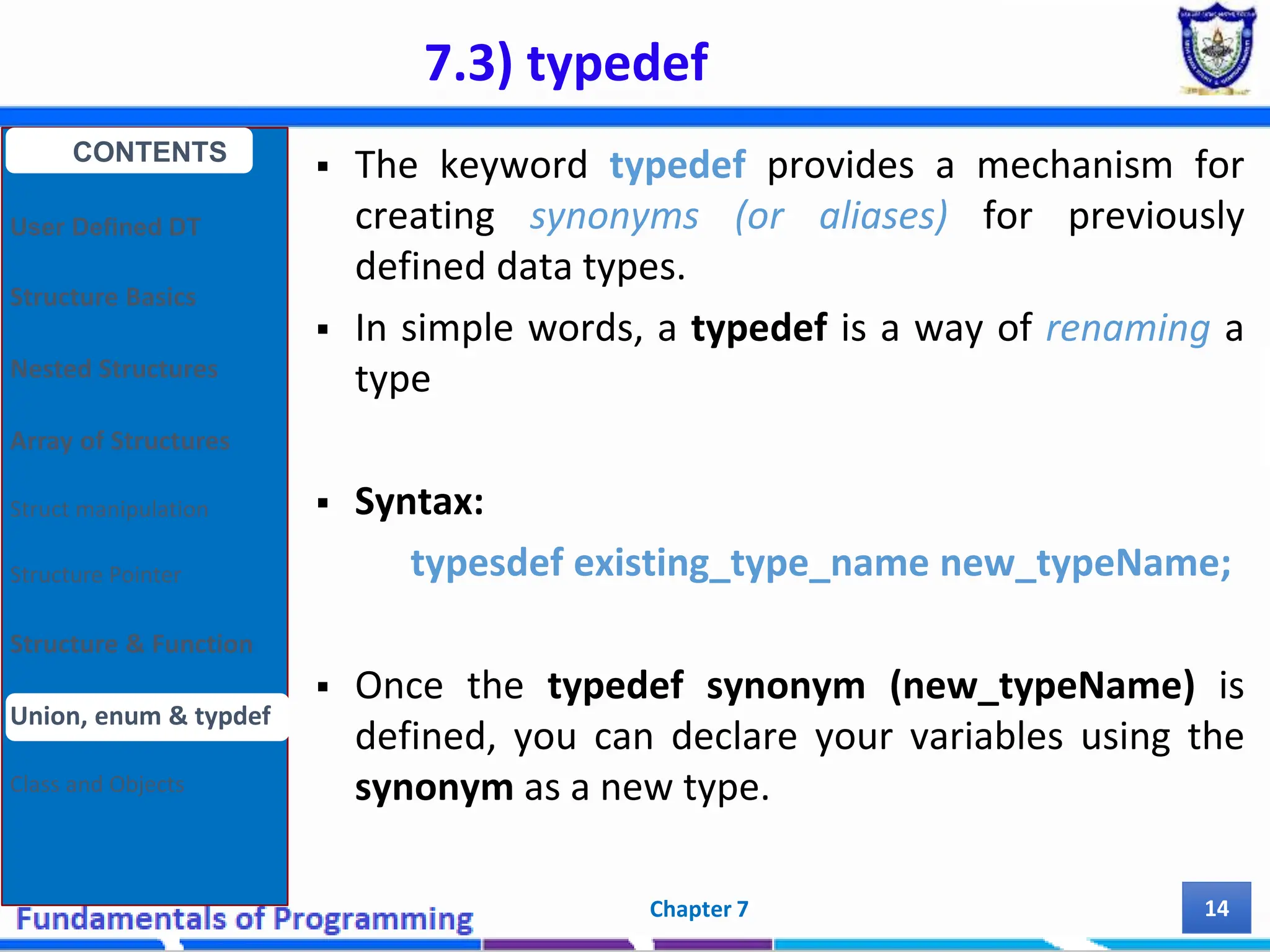
7.3) typedef Chapter 7 14  The keyword typedef provides a mechanism for creating synonyms (or aliases) for previously defined data types.  In simple words, a typedef is a way of renaming a type  Syntax: typesdef existing_type_name new_typeName;  Once the typedef synonym (new_typeName) is defined, you can declare your variables using the synonym as a new type. CONTENTS User Defined DT Structure Basics Nested Structures Array of Structures Struct manipulation Structure Pointer Structure & Function Union, enum & typdef Class and Objects
7.3) typedef (cont’d) Chapter 7 15  Example: typedef unsigned short int USHI; USHI age; typedef struct Student Tstud; Tstud class[50[];  In this example, both USHI and Tstud are a synonym Note:  Typedef does not really create a new type  It is good practice to  Capitalize the first letter of typedef synonym.  Preface it with a capital “T” to indicate it’s one of your new types e.g. TRobot, TStudent, etc. CONTENTS User Defined DT Structure Basics Nested Structures Array of Structures Struct manipulation Structure Pointer Structure & Function Union, enum & typdef Class and Objects
7.3) typedef (cont’d) Chapter 7 16 Example: complete program #include<iostream.h> usning namespace std; struct student_records{ char sId[10]; char sName[20]; float mark; }; typedef unsingned short int ME; typedef student_records studRec; int main(){ ME a=1, b; cout<<“Enter a number: “; cin>>b; CONTENTS User Defined DT Structure Basics Nested Structures Array of Structures Struct manipulation Structure Pointer Structure & Function Union, enum & typdef Class and Objects cout<<"the Numbers are n“ cout<<a<<"n"<<b; cout<<"n"<<sizeof(ME); studRec S1 = {“ETS215/12”, “John”, 80}; cout<<“Student Info:n”; cout<<“ID: “<<S1.sId; cout<<“Name: ”<<S1.sName; cout<<“Mark: “<<S1.mark; return 0; }
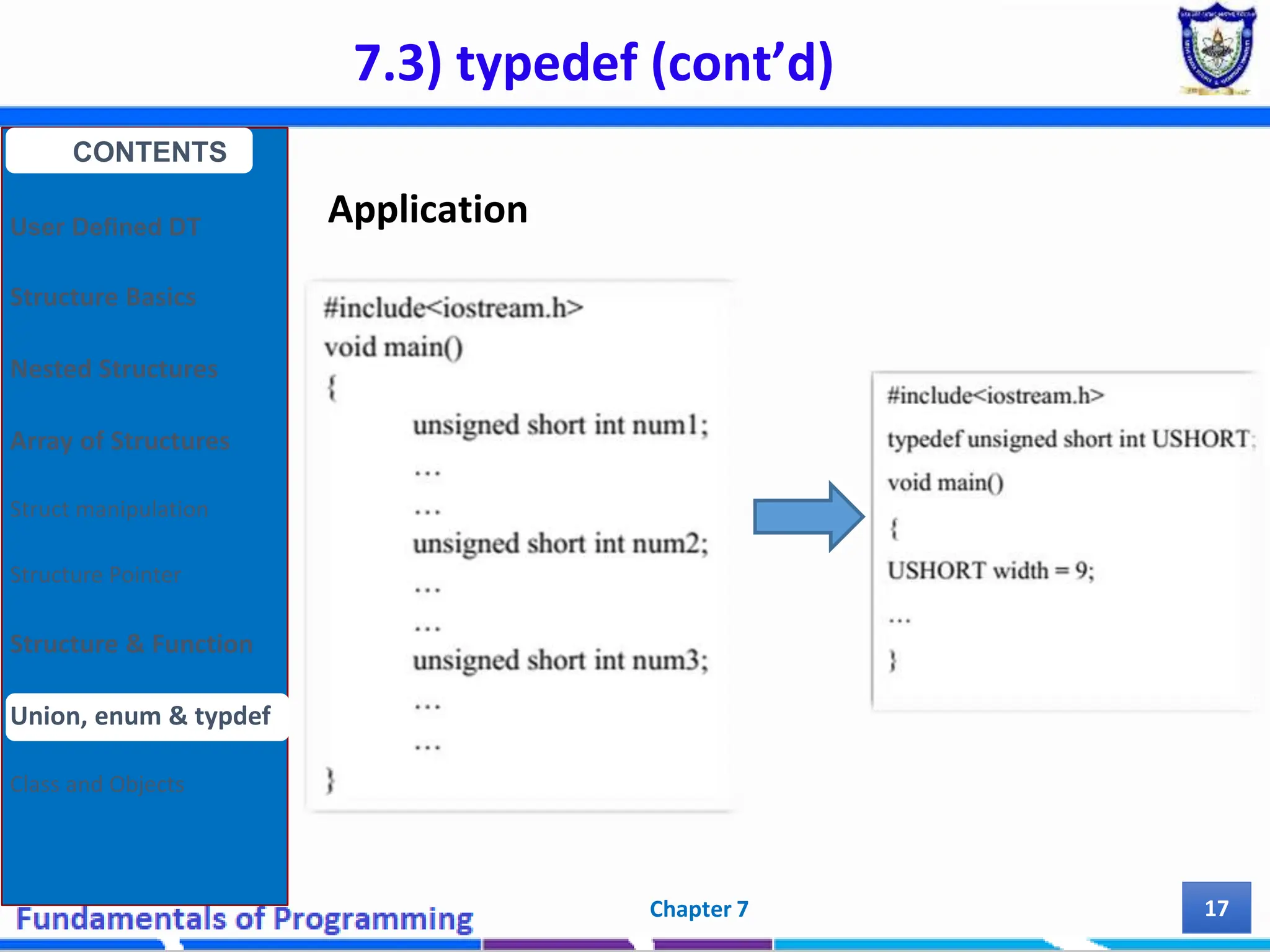
7.3) typedef (cont’d) Chapter 7 17 CONTENTS User Defined DT Structure Basics Nested Structures Array of Structures Struct manipulation Structure Pointer Structure & Function Union, enum & typdef Class and Objects Application
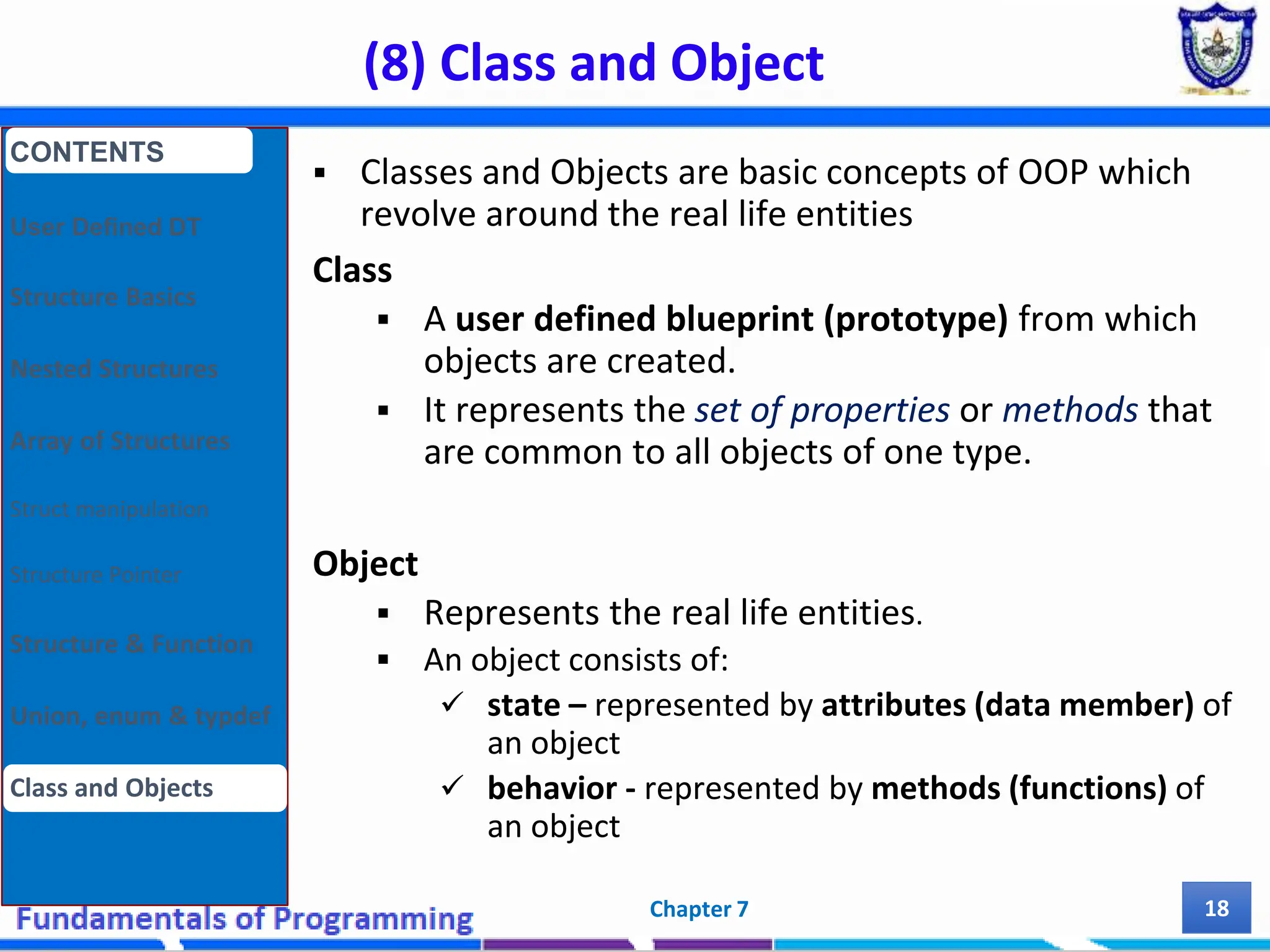
(8) Class and Object Chapter 7 18  Classes and Objects are basic concepts of OOP which revolve around the real life entities Class  A user defined blueprint (prototype) from which objects are created.  It represents the set of properties or methods that are common to all objects of one type. Object  Represents the real life entities.  An object consists of:  state – represented by attributes (data member) of an object  behavior - represented by methods (functions) of an object CONTENTS User Defined DT Structure Basics Nested Structures Array of Structures Struct manipulation Structure Pointer Structure & Function Union, enum & typdef Class and Objects
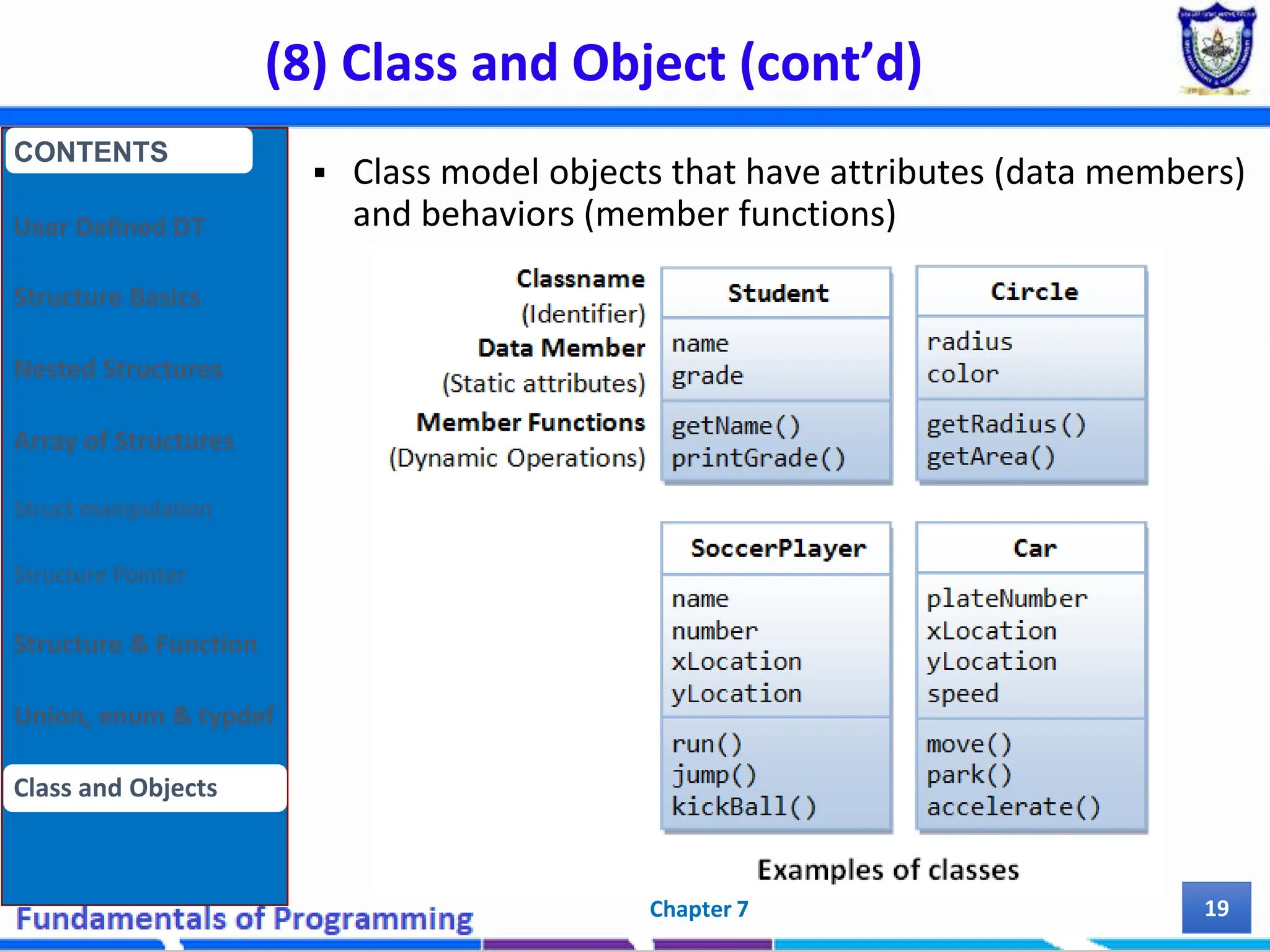
(8) Class and Object (cont’d) Chapter 7 19  Class model objects that have attributes (data members) and behaviors (member functions) CONTENTS User Defined DT Structure Basics Nested Structures Array of Structures Struct manipulation Structure Pointer Structure & Function Union, enum & typdef Class and Objects
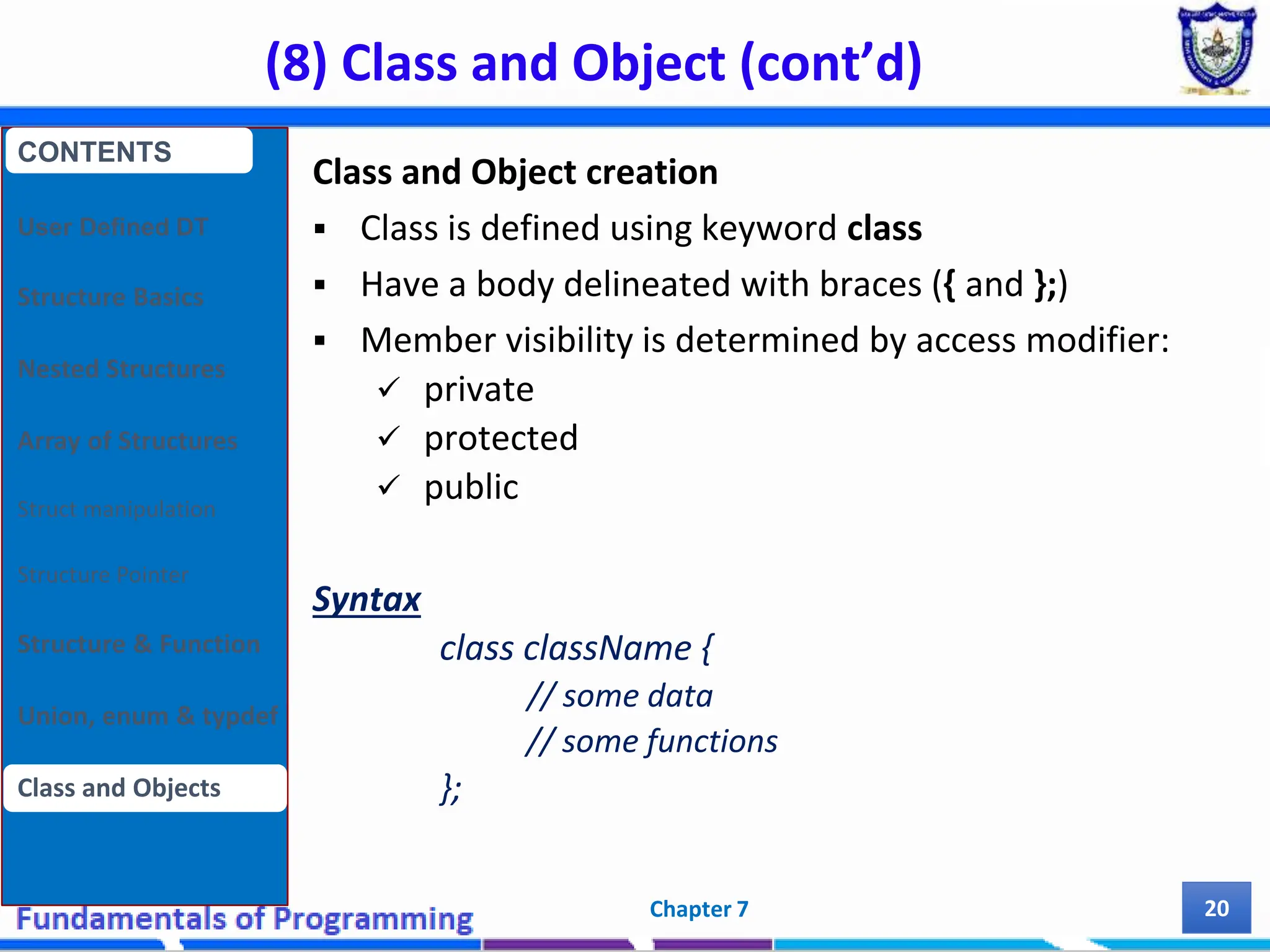
(8) Class and Object (cont’d) Chapter 7 20 Class and Object creation  Class is defined using keyword class  Have a body delineated with braces ({ and };)  Member visibility is determined by access modifier:  private  protected  public Syntax class className { // some data // some functions }; CONTENTS User Defined DT Structure Basics Nested Structures Array of Structures Struct manipulation Structure Pointer Structure & Function Union, enum & typdef Class and Objects
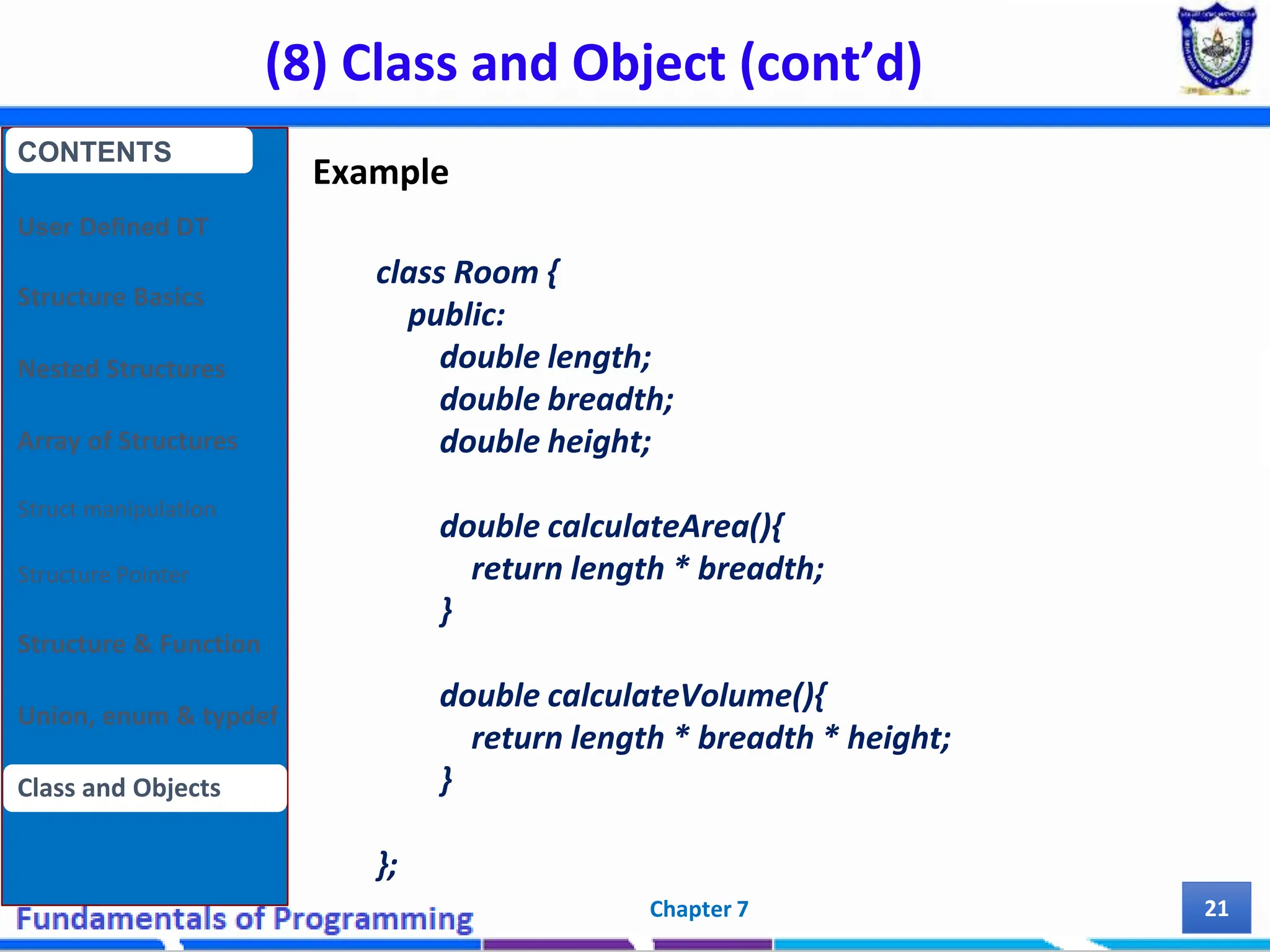
(8) Class and Object (cont’d) Chapter 7 21 Example class Room { public: double length; double breadth; double height; double calculateArea(){ return length * breadth; } double calculateVolume(){ return length * breadth * height; } }; CONTENTS User Defined DT Structure Basics Nested Structures Array of Structures Struct manipulation Structure Pointer Structure & Function Union, enum & typdef Class and Objects
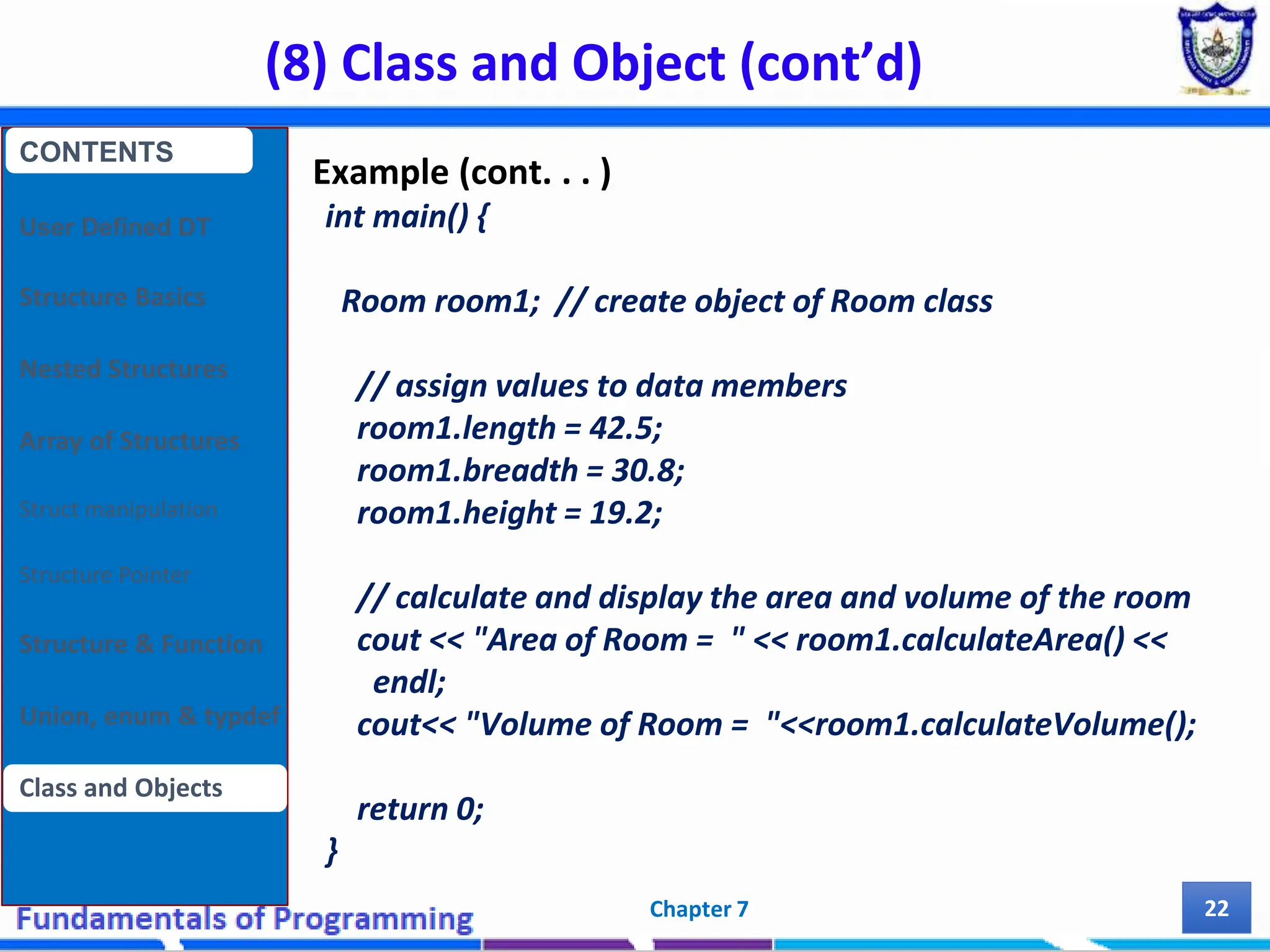
(8) Class and Object (cont’d) Chapter 7 22 Example (cont. . . ) int main() { Room room1; // create object of Room class // assign values to data members room1.length = 42.5; room1.breadth = 30.8; room1.height = 19.2; // calculate and display the area and volume of the room cout << "Area of Room = " << room1.calculateArea() << endl; cout<< "Volume of Room = "<<room1.calculateVolume(); return 0; } CONTENTS User Defined DT Structure Basics Nested Structures Array of Structures Struct manipulation Structure Pointer Structure & Function Union, enum & typdef Class and Objects
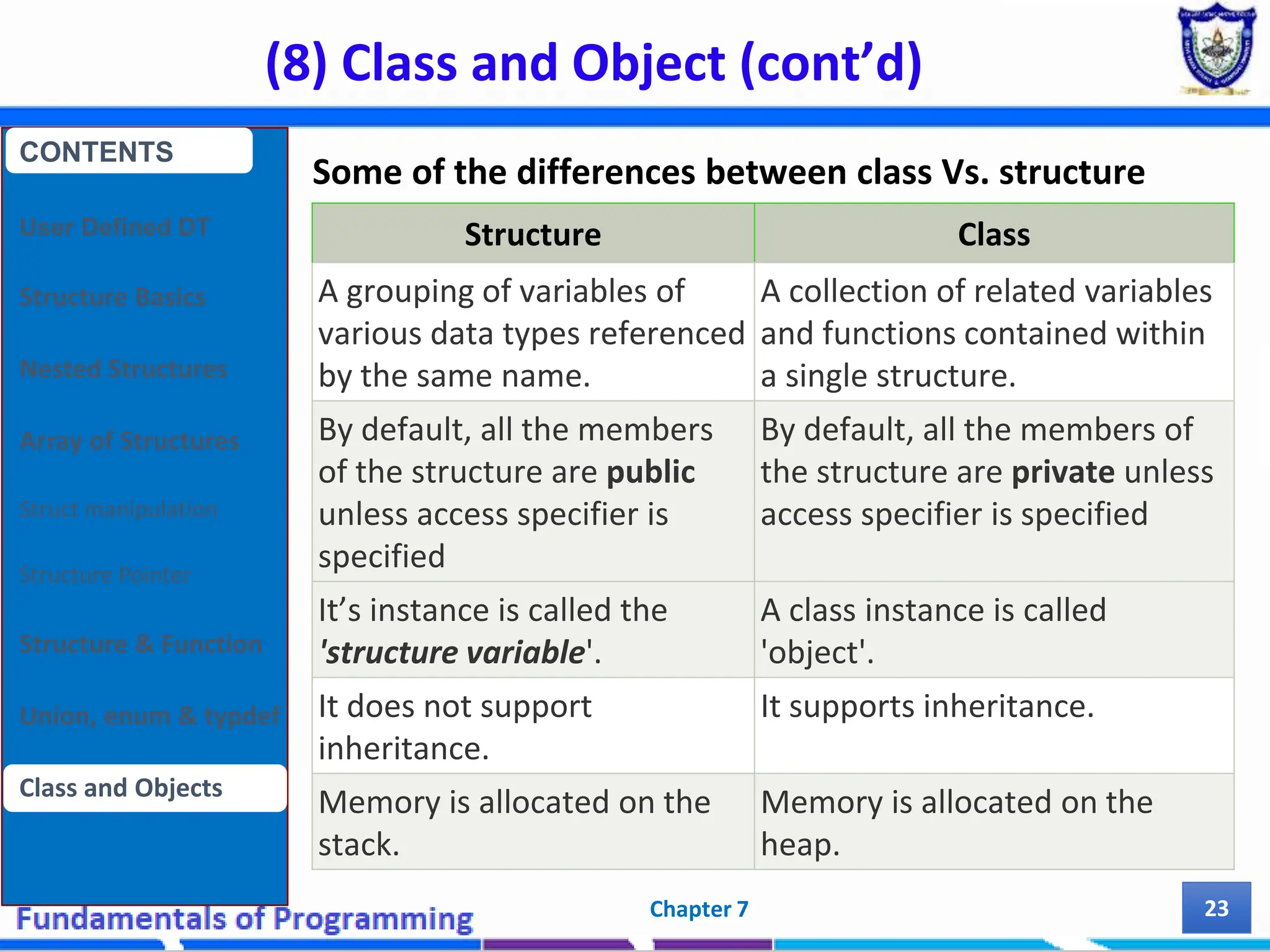
(8) Class and Object (cont’d) Chapter 7 23 Some of the differences between class Vs. structure CONTENTS User Defined DT Structure Basics Nested Structures Array of Structures Struct manipulation Structure Pointer Structure & Function Union, enum & typdef Class and Objects Structure Class A grouping of variables of various data types referenced by the same name. A collection of related variables and functions contained within a single structure. By default, all the members of the structure are public unless access specifier is specified By default, all the members of the structure are private unless access specifier is specified It’s instance is called the 'structure variable'. A class instance is called 'object'. It does not support inheritance. It supports inheritance. Memory is allocated on the stack. Memory is allocated on the heap.
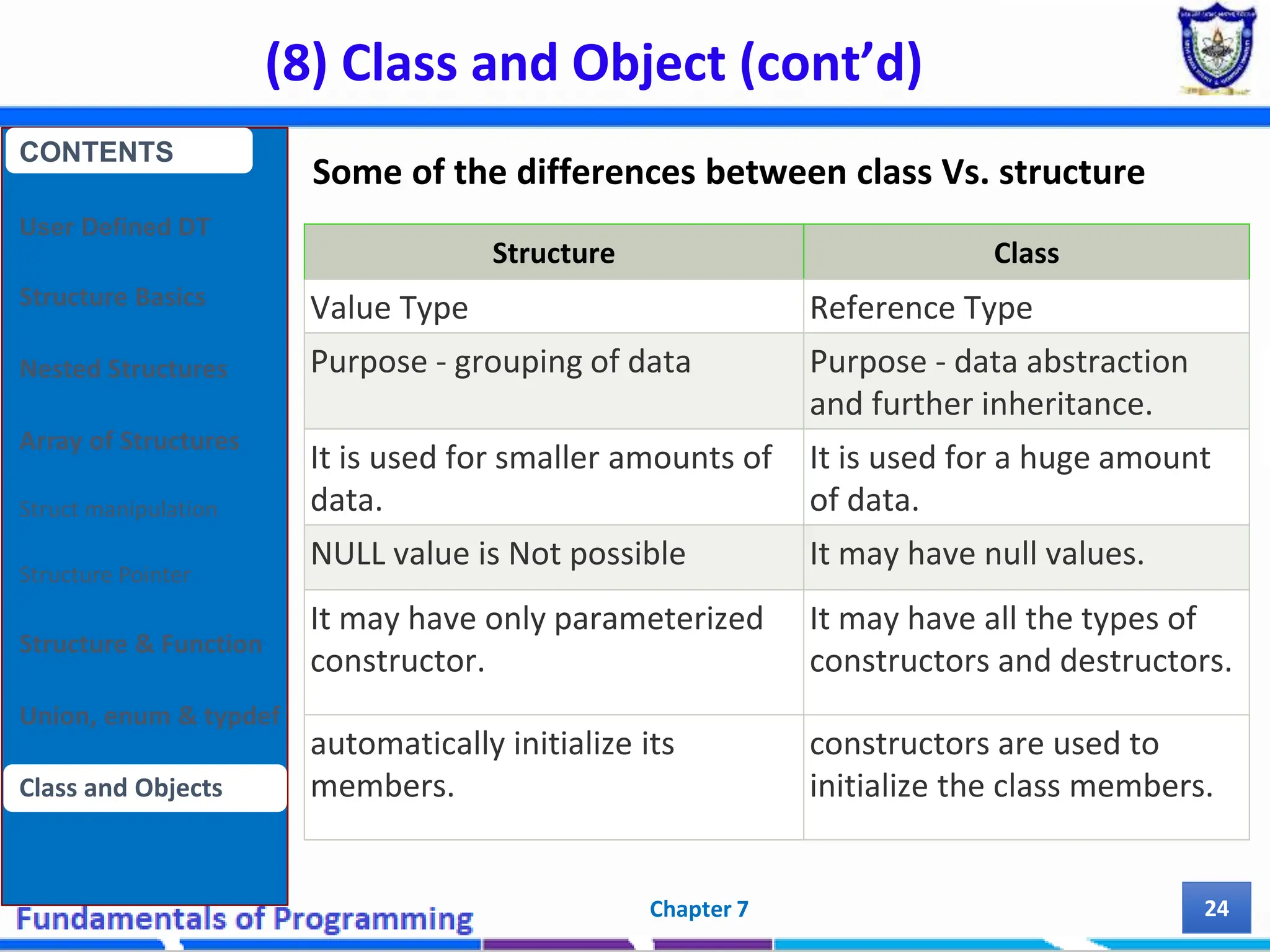
(8) Class and Object (cont’d) Chapter 7 24 Some of the differences between class Vs. structure CONTENTS User Defined DT Structure Basics Nested Structures Array of Structures Struct manipulation Structure Pointer Structure & Function Union, enum & typdef Class and Objects Structure Class Value Type Reference Type Purpose - grouping of data Purpose - data abstraction and further inheritance. It is used for smaller amounts of data. It is used for a huge amount of data. NULL value is Not possible It may have null values. It may have only parameterized constructor. It may have all the types of constructors and destructors. automatically initialize its members. constructors are used to initialize the class members.
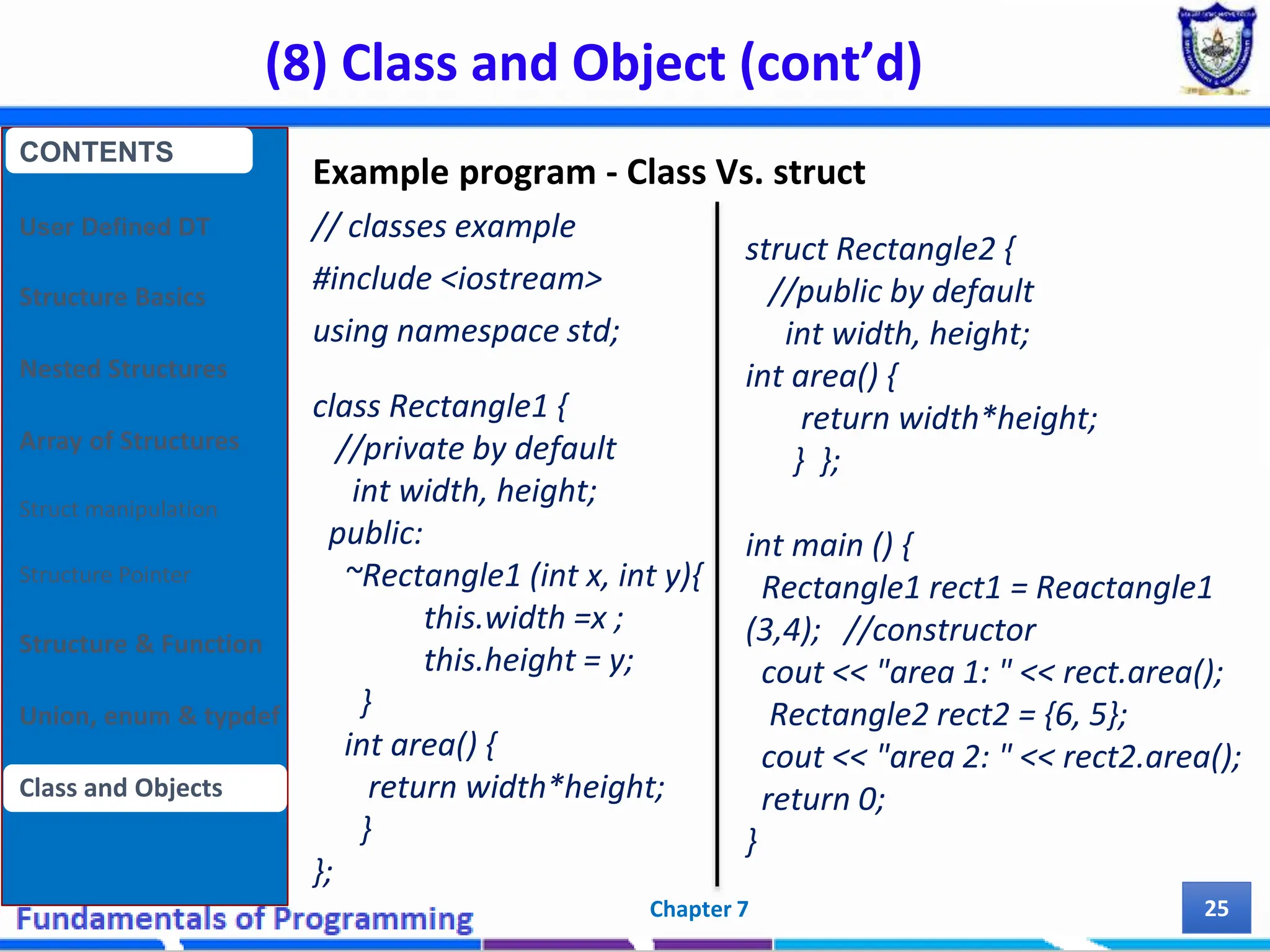
(8) Class and Object (cont’d) Chapter 7 25 Example program - Class Vs. struct // classes example #include <iostream> using namespace std; class Rectangle1 { //private by default int width, height; public: ~Rectangle1 (int x, int y){ this.width =x ; this.height = y; } int area() { return width*height; } }; CONTENTS User Defined DT Structure Basics Nested Structures Array of Structures Struct manipulation Structure Pointer Structure & Function Union, enum & typdef Class and Objects struct Rectangle2 { //public by default int width, height; int area() { return width*height; } }; int main () { Rectangle1 rect1 = Reactangle1 (3,4); //constructor cout << "area 1: " << rect.area(); Rectangle2 rect2 = {6, 5}; cout << "area 2: " << rect2.area(); return 0; }
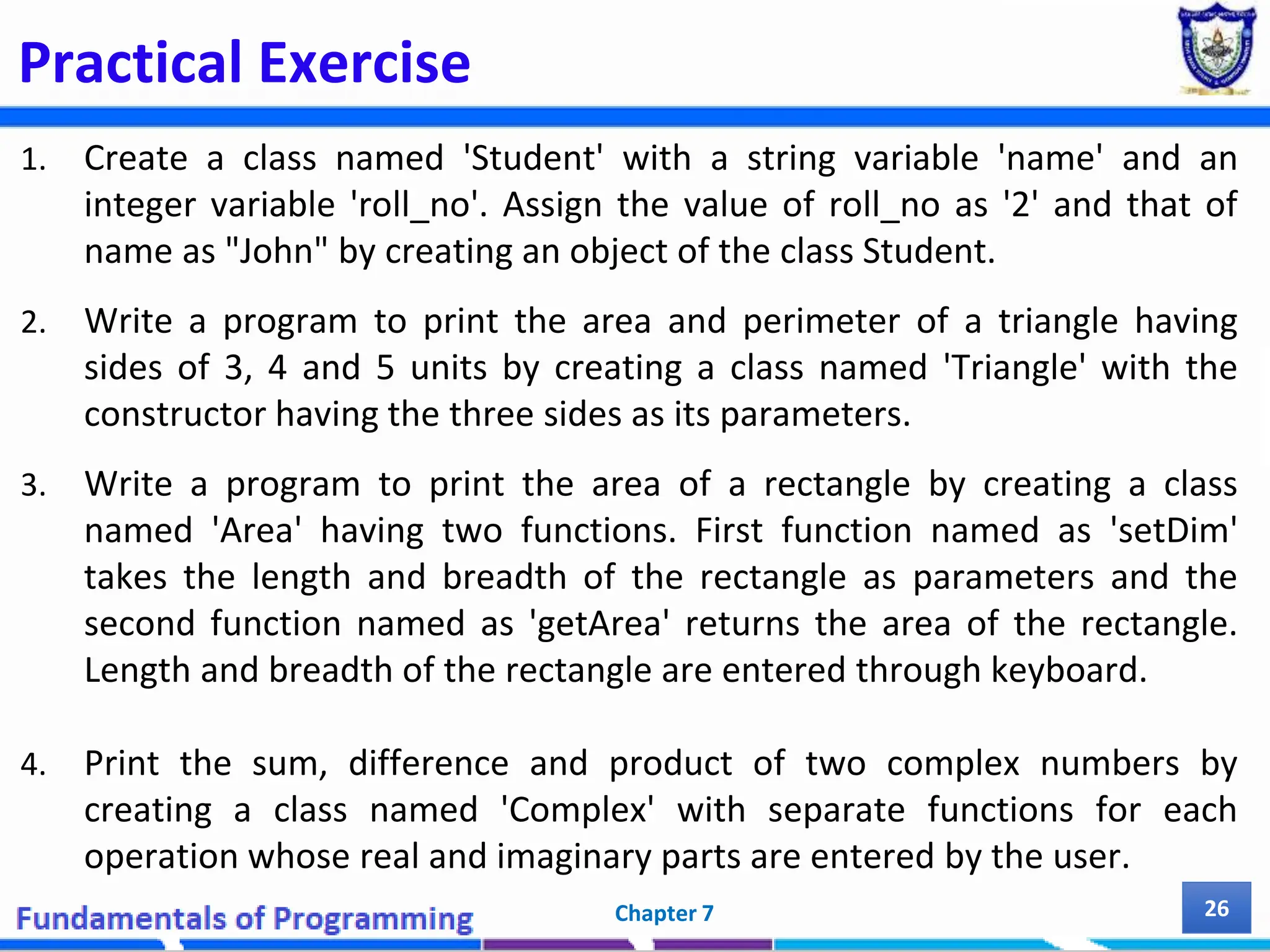
Practical Exercise 1. Create a class named 'Student' with a string variable 'name' and an integer variable 'roll_no'. Assign the value of roll_no as '2' and that of name as "John" by creating an object of the class Student. 2. Write a program to print the area and perimeter of a triangle having sides of 3, 4 and 5 units by creating a class named 'Triangle' with the constructor having the three sides as its parameters. 3. Write a program to print the area of a rectangle by creating a class named 'Area' having two functions. First function named as 'setDim' takes the length and breadth of the rectangle as parameters and the second function named as 'getArea' returns the area of the rectangle. Length and breadth of the rectangle are entered through keyboard. 4. Print the sum, difference and product of two complex numbers by creating a class named 'Complex' with separate functions for each operation whose real and imaginary parts are entered by the user. Chapter 7 26
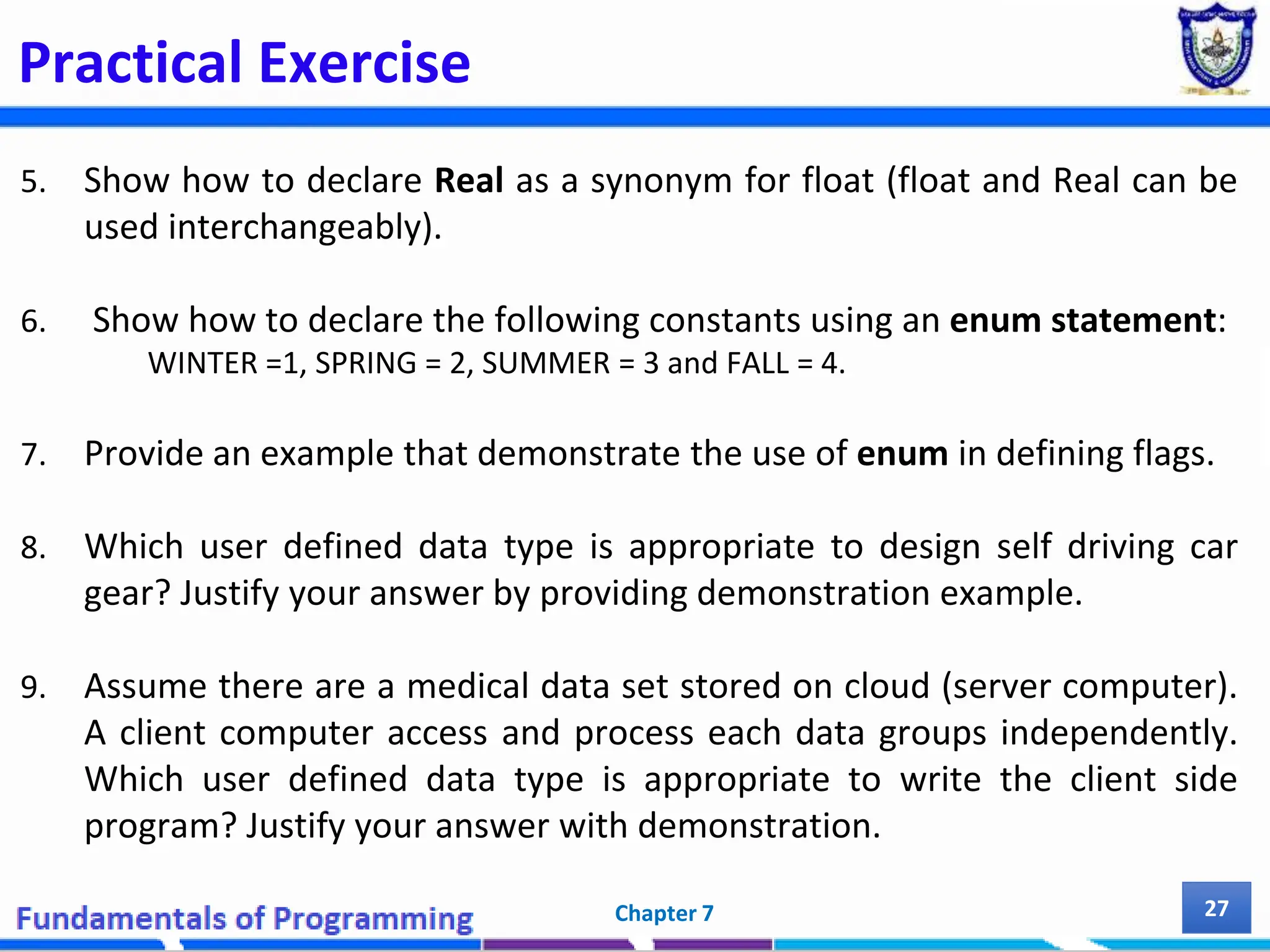
Practical Exercise 5. Show how to declare Real as a synonym for float (float and Real can be used interchangeably). 6. Show how to declare the following constants using an enum statement: WINTER =1, SPRING = 2, SUMMER = 3 and FALL = 4. 7. Provide an example that demonstrate the use of enum in defining flags. 8. Which user defined data type is appropriate to design self driving car gear? Justify your answer by providing demonstration example. 9. Assume there are a medical data set stored on cloud (server computer). A client computer access and process each data groups independently. Which user defined data type is appropriate to write the client side program? Justify your answer with demonstration. Chapter 7 27
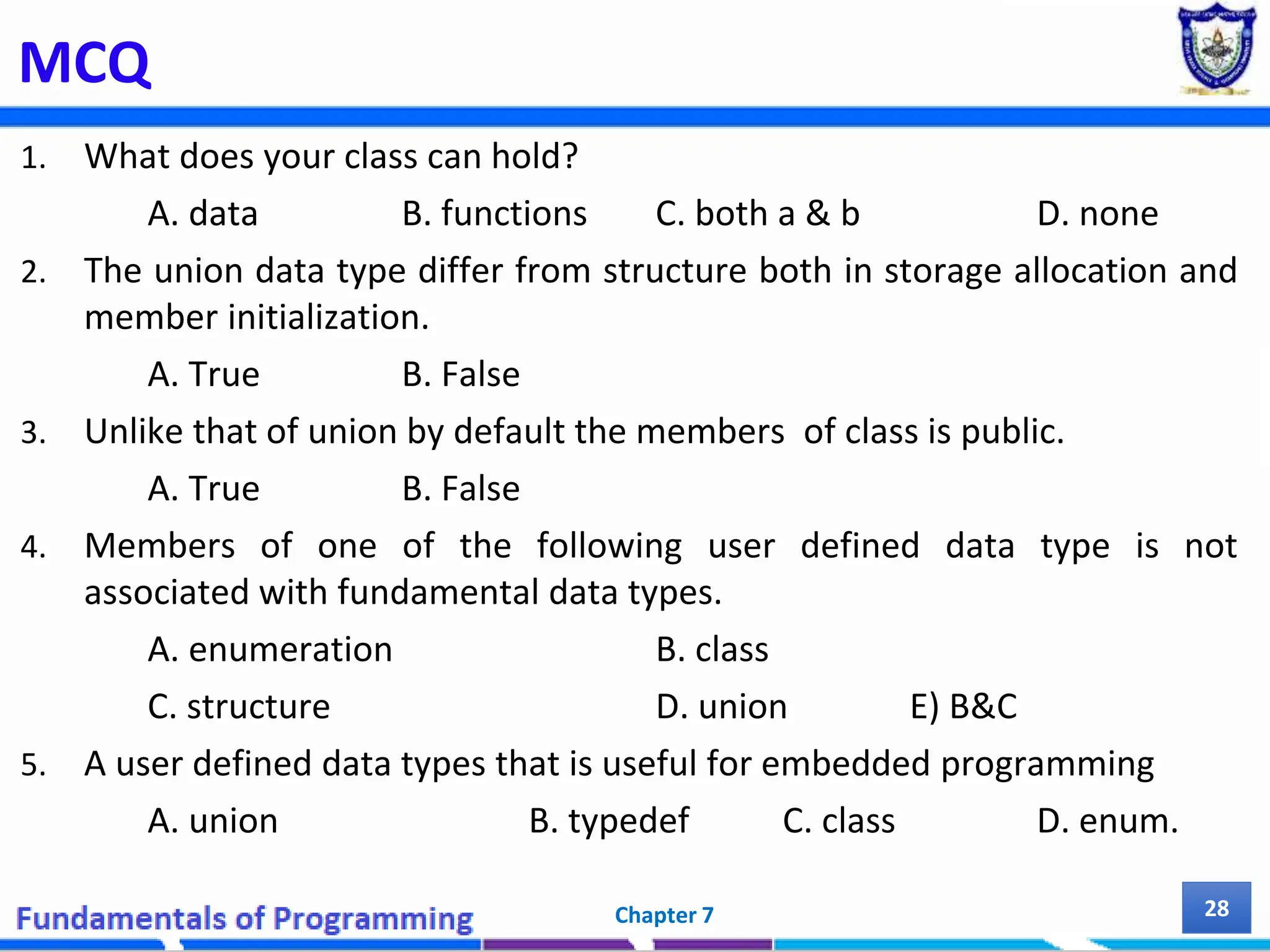
MCQ 1. What does your class can hold? A. data B. functions C. both a & b D. none 2. The union data type differ from structure both in storage allocation and member initialization. A. True B. False 3. Unlike that of union by default the members of class is public. A. True B. False 4. Members of one of the following user defined data type is not associated with fundamental data types. A. enumeration B. class C. structure D. union E) B&C 5. A user defined data types that is useful for embedded programming A. union B. typedef C. class D. enum. Chapter 7 28
MCQ 6. An appropriate user defined data types to work with FLAGS; A. strcut B. union C. class D. enum. 7. An appropriate user defined data types to work with FLAGS; A. strcut B. union C. class D. enum. 8. Which of the following is odd in their declaration style? A. strcut B. union C. typedef D. class E. enum 9. There is no programming philosophy between structure and class. A. True B. False 10. Which of the following is not used to create a new Data Type? A. strcut B. union C. typedef E. enum 11. Is it mandatory that the size of all elements in a union should be same? A. True B. False Chapter 7 29
Short Answer 1. Compare and contrast structure data type with the following: a) Class b) Union c) Array 2. Explain the importance of enumeration and union types. 3. What is the size of the following user defined data types a) Structure c) Union b) Class d) enum 4. Does structure replace class completely? Justify your answer with examples. Chapter 7 30
Reading Resources/Materials Chapter 10 & 11: ✔ Herbert Schildt; C++ from the Ground Up (3rd Edition), 2003 McGraw-Hill, California 94710 U.S.A. Chapter 8: ✔ Bjarne Stroustrup;The C++ Programming Language [4th Edition], Pearson Education, Inc , 2013 Chapter 15: ✔ Diane Zak; An Introduction to Programming with C++ (8th Edition), 2016 Cengage Learning Chapter 10: ✔ Walter Savitch; Problem Solving With C++ [10th edition, University of California, San Diego, 2018 31 Chapter 7
Thank You For Your Attention!! 32 Chapter 7

User Defined Datatypes in C++ (Union, enum, class)

  • 1.
    Fundamentals of Computer Programming Chapter7 User Defined Data types (union, enum, typedef and class & object) Chere L. (M.Tech) Lecturer, SWEG, AASTU 1
  • 2.
    Outline ▪ Introduction toUser defined Data type ▪ Defining structure (with tag and without tag) ▪ Declaring structure variable ▪ Initializing structure elements ▪ Accessing structure elements ▪ Nested structure  Defining structure within structure  Structure variable within other structure definition ▪ Array of structure ▪ Structure pointer ▪ Structure with function  Structure variable as parameter  Structure as a return type Chapter 7 2
  • 3.
    Outline ▪ Other Userdefined Data types  Anonymous unions (union)  Enumerated types (enum)  Type definition (typedef) ▪ Class and Object as user defined data type  Class and Object Basics  Class and Object Creation Chapter 7 3
  • 4.
    7.1) Union Chapter 74  A union is also a user defined data type that declares a set of multiple variable sharing the same memory area  Unions are similar to structures in certain aspects.  It used to group together variables of different data types.  It declared and used in the same way as structures.  The individual members can be accessed using dot operator.  Syntax: union union_tag{ type1 member_namel; type2 member_name2; … … typeN member_nameN; }; CONTENTS User Defined DT Structure Basics Nested Structures Array of Structures Struct manipulation Structure Pointer Structure & Function Union, enum & typdef Class and Objects
  • 5.
    7.1) Union (cont’d) Chapter7 5 Difference between structure and Union in terms of storage. CONTENTS User Defined DT Structure Basics Nested Structures Array of Structures Struct manipulation Structure Pointer Structure & Function Union, enum & typdef Class and Objects
  • 6.
    7.1) Union (cont’d) Chapter7 6 #include <iostream> using namespace std; // defining a struct struct student1 { int roll_no; char name[40]; }; // defining a union union student2 { int roll_no; char name[40]; }; CONTENTS User Defined DT Structure Basics Nested Structures Array of Structures Struct manipulation Structure Pointer Structure & Function Union, enum & typdef Class and Objects int main() { struct student1 s1; union student2 u1; cout << "size of structure : “; cout << sizeof(s1) << endl; cout << "size of union : “; cout<< sizeof(u1) << endl; return 0; } Example of comparing size of union and structure
  • 7.
    7.1) Union (cont’d) Chapter7 7 Summary of structure & union Distinction When/Where it can be used?  Allow data members which are mutually exclusive to share the same memory. important when memory is more scarce.  Useful in Embedded programming or in situations where direct access to the hardware/memory is needed. CONTENTS User Defined DT Structure Basics Nested Structures Array of Structures Struct manipulation Structure Pointer Structure & Function Union, enum & typdef Class and Objects No Structure Union 1 Every member has its own memory All members use the same memory 2 Keyword strcut is used Keyword union is used 3 All members can be initialized Only its first members can be initialized 4 Consume more space Memory conversion
  • 8.
    7.1) Union (cont’d) Chapter7 8 #include <iostream> using namespace std; union Employee{ int Id, Age; char Name[25]; long Salary; }; int main(){ Employee E; cout << "nEnter Employee Id : "; cin >> E.Id; cout << "Employee Id : " << E.Id; cout << "nnEnter Employee Name : "; cin >> E.Name; cout << "Employee Name : " << E.Name; cout << "nnEnter Employee Age : "; cin >> E.Age; cout << "Employee Age : " << E.Age; cout << "nnEnter Employee Salary : "; cin >> E.Salary; cout << "Employee Salary : " << E.Salary; } CONTENTS User Defined DT Structure Basics Nested Structures Array of Structures Struct manipulation Structure Pointer Structure & Function Union, enum & typdef Class and Objects Example: creating object & accessing union members
  • 9.
    7.2) Enumeration Chapter 79  Enumerations are used to create new data types of multiple integer constants.  An enumeration consists of a list of values.  enum types can be used to set up collections of named integer constants.  Each value has a unique number i.e. Integer CONSTANT starting from 0.  Cannot take any other data type than integer  enum declaration is only a blueprint for the variable is created and does not contain any fundamental data type  Syntax enum identifier { variable1, variable2, . . .}; CONTENTS User Defined DT Structure Basics Nested Structures Array of Structures Struct manipulation Structure Pointer Structure & Function Union, enum & typdef Class and Objects
  • 10.
    7.2) Enumeration (cont’d) Chapter7 10  Example 1: enum days_of_week {Monday, Tuesday, Wednesday, Thursday, Friday, Saturday, Sunday};  Enumerations  Each value in an enumeration is always assigned an integer value.  By default, the value starts from 0 and so on. E.g. On the above enum declaration VALUES: Monday = 0, Tuesday = 1 ,… , Sunday = 6  However, the values can be assigned in different way also  Example: enum colors{ white, Green, Blue, Red=7, Black, Pink}; CONTENTS User Defined DT Structure Basics Nested Structures Array of Structures Struct manipulation Structure Pointer Structure & Function Union, enum & typdef Class and Objects
  • 11.
    7.2) Enumeration (cont’d) Chapter7 11  Example 1: Enumeration Type #include <iostream> using namespace std; enum week { Monday, Tuesday, Wednesday, Thursday, Friday, Saturday, Sunday }; int main() { week today; today = Wednesday; cout << "Day " << today+1; cout<<"nSize: "<<sizeof(week); return 0; } CONTENTS User Defined DT Structure Basics Nested Structures Array of Structures Struct manipulation Structure Pointer Structure & Function Union, enum & typdef Class and Objects
  • 12.
    7.2) Enumeration (cont’d) Chapter7 12  Example 2: enum declaration and changing default value #include <iostream> using namespace std; enum colors { green=1, red, blue, black=0, white, brown=11, pink, yellow, aqua, gray }flag_color; //definition at the time declaration int main() { colors painting; painting = brown; flag_color = green; cout<<"Painting Colors: "<<endl; for(int i=painting; i<= 15; ++i ) { cout<<painting+i<<" "; } return 0; } CONTENTS User Defined DT Structure Basics Nested Structures Array of Structures Struct manipulation Structure Pointer Structure & Function Union, enum & typdef Class and Objects
  • 13.
    7.2) Enumeration (cont’d) Chapter7 13 Application Enables programmers to define variables and restrict its value to a set of possible values which are integer (4 bytes) and also makes to take only one value out of many possible values  When it expected that the variable to have one of the possible set of values.  E.g., assume a variable that holds the direction. Since we have four directions, this variable can take any one of the four values  switch case statements, where all the values that case blocks expect can be defined in an enum.  A good choice to work with flags CONTENTS User Defined DT Structure Basics Nested Structures Array of Structures Struct manipulation Structure Pointer Structure & Function Union, enum & typdef Class and Objects enum styleFlags { ITALICS = 1, BOLD, REGULAR, UNDERLINE} button;
  • 14.
    7.3) typedef Chapter 714  The keyword typedef provides a mechanism for creating synonyms (or aliases) for previously defined data types.  In simple words, a typedef is a way of renaming a type  Syntax: typesdef existing_type_name new_typeName;  Once the typedef synonym (new_typeName) is defined, you can declare your variables using the synonym as a new type. CONTENTS User Defined DT Structure Basics Nested Structures Array of Structures Struct manipulation Structure Pointer Structure & Function Union, enum & typdef Class and Objects
  • 15.
    7.3) typedef (cont’d) Chapter7 15  Example: typedef unsigned short int USHI; USHI age; typedef struct Student Tstud; Tstud class[50[];  In this example, both USHI and Tstud are a synonym Note:  Typedef does not really create a new type  It is good practice to  Capitalize the first letter of typedef synonym.  Preface it with a capital “T” to indicate it’s one of your new types e.g. TRobot, TStudent, etc. CONTENTS User Defined DT Structure Basics Nested Structures Array of Structures Struct manipulation Structure Pointer Structure & Function Union, enum & typdef Class and Objects
  • 16.
    7.3) typedef (cont’d) Chapter7 16 Example: complete program #include<iostream.h> usning namespace std; struct student_records{ char sId[10]; char sName[20]; float mark; }; typedef unsingned short int ME; typedef student_records studRec; int main(){ ME a=1, b; cout<<“Enter a number: “; cin>>b; CONTENTS User Defined DT Structure Basics Nested Structures Array of Structures Struct manipulation Structure Pointer Structure & Function Union, enum & typdef Class and Objects cout<<"the Numbers are n“ cout<<a<<"n"<<b; cout<<"n"<<sizeof(ME); studRec S1 = {“ETS215/12”, “John”, 80}; cout<<“Student Info:n”; cout<<“ID: “<<S1.sId; cout<<“Name: ”<<S1.sName; cout<<“Mark: “<<S1.mark; return 0; }
  • 17.
    7.3) typedef (cont’d) Chapter7 17 CONTENTS User Defined DT Structure Basics Nested Structures Array of Structures Struct manipulation Structure Pointer Structure & Function Union, enum & typdef Class and Objects Application
  • 18.
    (8) Class andObject Chapter 7 18  Classes and Objects are basic concepts of OOP which revolve around the real life entities Class  A user defined blueprint (prototype) from which objects are created.  It represents the set of properties or methods that are common to all objects of one type. Object  Represents the real life entities.  An object consists of:  state – represented by attributes (data member) of an object  behavior - represented by methods (functions) of an object CONTENTS User Defined DT Structure Basics Nested Structures Array of Structures Struct manipulation Structure Pointer Structure & Function Union, enum & typdef Class and Objects
  • 19.
    (8) Class andObject (cont’d) Chapter 7 19  Class model objects that have attributes (data members) and behaviors (member functions) CONTENTS User Defined DT Structure Basics Nested Structures Array of Structures Struct manipulation Structure Pointer Structure & Function Union, enum & typdef Class and Objects
  • 20.
    (8) Class andObject (cont’d) Chapter 7 20 Class and Object creation  Class is defined using keyword class  Have a body delineated with braces ({ and };)  Member visibility is determined by access modifier:  private  protected  public Syntax class className { // some data // some functions }; CONTENTS User Defined DT Structure Basics Nested Structures Array of Structures Struct manipulation Structure Pointer Structure & Function Union, enum & typdef Class and Objects
  • 21.
    (8) Class andObject (cont’d) Chapter 7 21 Example class Room { public: double length; double breadth; double height; double calculateArea(){ return length * breadth; } double calculateVolume(){ return length * breadth * height; } }; CONTENTS User Defined DT Structure Basics Nested Structures Array of Structures Struct manipulation Structure Pointer Structure & Function Union, enum & typdef Class and Objects
  • 22.
    (8) Class andObject (cont’d) Chapter 7 22 Example (cont. . . ) int main() { Room room1; // create object of Room class // assign values to data members room1.length = 42.5; room1.breadth = 30.8; room1.height = 19.2; // calculate and display the area and volume of the room cout << "Area of Room = " << room1.calculateArea() << endl; cout<< "Volume of Room = "<<room1.calculateVolume(); return 0; } CONTENTS User Defined DT Structure Basics Nested Structures Array of Structures Struct manipulation Structure Pointer Structure & Function Union, enum & typdef Class and Objects
  • 23.
    (8) Class andObject (cont’d) Chapter 7 23 Some of the differences between class Vs. structure CONTENTS User Defined DT Structure Basics Nested Structures Array of Structures Struct manipulation Structure Pointer Structure & Function Union, enum & typdef Class and Objects Structure Class A grouping of variables of various data types referenced by the same name. A collection of related variables and functions contained within a single structure. By default, all the members of the structure are public unless access specifier is specified By default, all the members of the structure are private unless access specifier is specified It’s instance is called the 'structure variable'. A class instance is called 'object'. It does not support inheritance. It supports inheritance. Memory is allocated on the stack. Memory is allocated on the heap.
  • 24.
    (8) Class andObject (cont’d) Chapter 7 24 Some of the differences between class Vs. structure CONTENTS User Defined DT Structure Basics Nested Structures Array of Structures Struct manipulation Structure Pointer Structure & Function Union, enum & typdef Class and Objects Structure Class Value Type Reference Type Purpose - grouping of data Purpose - data abstraction and further inheritance. It is used for smaller amounts of data. It is used for a huge amount of data. NULL value is Not possible It may have null values. It may have only parameterized constructor. It may have all the types of constructors and destructors. automatically initialize its members. constructors are used to initialize the class members.
  • 25.
    (8) Class andObject (cont’d) Chapter 7 25 Example program - Class Vs. struct // classes example #include <iostream> using namespace std; class Rectangle1 { //private by default int width, height; public: ~Rectangle1 (int x, int y){ this.width =x ; this.height = y; } int area() { return width*height; } }; CONTENTS User Defined DT Structure Basics Nested Structures Array of Structures Struct manipulation Structure Pointer Structure & Function Union, enum & typdef Class and Objects struct Rectangle2 { //public by default int width, height; int area() { return width*height; } }; int main () { Rectangle1 rect1 = Reactangle1 (3,4); //constructor cout << "area 1: " << rect.area(); Rectangle2 rect2 = {6, 5}; cout << "area 2: " << rect2.area(); return 0; }
  • 26.
    Practical Exercise 1. Createa class named 'Student' with a string variable 'name' and an integer variable 'roll_no'. Assign the value of roll_no as '2' and that of name as "John" by creating an object of the class Student. 2. Write a program to print the area and perimeter of a triangle having sides of 3, 4 and 5 units by creating a class named 'Triangle' with the constructor having the three sides as its parameters. 3. Write a program to print the area of a rectangle by creating a class named 'Area' having two functions. First function named as 'setDim' takes the length and breadth of the rectangle as parameters and the second function named as 'getArea' returns the area of the rectangle. Length and breadth of the rectangle are entered through keyboard. 4. Print the sum, difference and product of two complex numbers by creating a class named 'Complex' with separate functions for each operation whose real and imaginary parts are entered by the user. Chapter 7 26
  • 27.
    Practical Exercise 5. Showhow to declare Real as a synonym for float (float and Real can be used interchangeably). 6. Show how to declare the following constants using an enum statement: WINTER =1, SPRING = 2, SUMMER = 3 and FALL = 4. 7. Provide an example that demonstrate the use of enum in defining flags. 8. Which user defined data type is appropriate to design self driving car gear? Justify your answer by providing demonstration example. 9. Assume there are a medical data set stored on cloud (server computer). A client computer access and process each data groups independently. Which user defined data type is appropriate to write the client side program? Justify your answer with demonstration. Chapter 7 27
  • 28.
    MCQ 1. What doesyour class can hold? A. data B. functions C. both a & b D. none 2. The union data type differ from structure both in storage allocation and member initialization. A. True B. False 3. Unlike that of union by default the members of class is public. A. True B. False 4. Members of one of the following user defined data type is not associated with fundamental data types. A. enumeration B. class C. structure D. union E) B&C 5. A user defined data types that is useful for embedded programming A. union B. typedef C. class D. enum. Chapter 7 28
  • 29.
    MCQ 6. An appropriateuser defined data types to work with FLAGS; A. strcut B. union C. class D. enum. 7. An appropriate user defined data types to work with FLAGS; A. strcut B. union C. class D. enum. 8. Which of the following is odd in their declaration style? A. strcut B. union C. typedef D. class E. enum 9. There is no programming philosophy between structure and class. A. True B. False 10. Which of the following is not used to create a new Data Type? A. strcut B. union C. typedef E. enum 11. Is it mandatory that the size of all elements in a union should be same? A. True B. False Chapter 7 29
  • 30.
    Short Answer 1. Compareand contrast structure data type with the following: a) Class b) Union c) Array 2. Explain the importance of enumeration and union types. 3. What is the size of the following user defined data types a) Structure c) Union b) Class d) enum 4. Does structure replace class completely? Justify your answer with examples. Chapter 7 30
  • 31.
    Reading Resources/Materials Chapter 10& 11: ✔ Herbert Schildt; C++ from the Ground Up (3rd Edition), 2003 McGraw-Hill, California 94710 U.S.A. Chapter 8: ✔ Bjarne Stroustrup;The C++ Programming Language [4th Edition], Pearson Education, Inc , 2013 Chapter 15: ✔ Diane Zak; An Introduction to Programming with C++ (8th Edition), 2016 Cengage Learning Chapter 10: ✔ Walter Savitch; Problem Solving With C++ [10th edition, University of California, San Diego, 2018 31 Chapter 7
  • 32.
    Thank You For YourAttention!! 32 Chapter 7