
Jordan
Parliamentary constitutional monarchy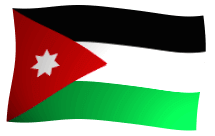
Official:
Hashemite Kingdom of Jordan
Local name:
الأُرْدُنّ / Al-Urdunn
Region:
Western Asia
Surface area:
89,320 km²
Capital:
Amman
Geography
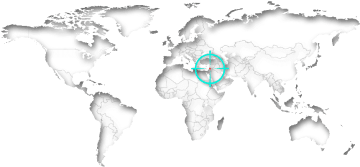
Jordan is a country in the Middle East and borders with its southern tip on the Gulf of Aqaba an the Red Sea. The distance to the Mediterranean is only about 60 km through Israel. The land has a total area of 89,320 km² (34,487 mi²) and a total coastline of 26 km (16.2 mi). This land area is approximately 112% of the area of Maine. Jordan is thus the 21st smallest country in Asia and ranked 112nd in the world. An exceptionally high proportion of residents (93%) belongs to the urban population. More than every third inhabitant lives in Amman.Jordan is comparatively high at an average elevation of 812 meters above sea level. The highest mountain peak (Dschabal Umm ad-Dami) is at 1,854 meters. There are direct national borders with the five neighboring countries Iraq, Israel, Saudi Arabia, Syria and Palestine. The distance between New York City and the Capital Amman is about 9,210 km (5,723 mi).
On further pages:
Current time in Jordan:
The countrywide time in Jordan is Arabia Standard Time (AST), which is currently 7 hours ahead of New York. Daylight saving time has no longer been in use since October 2022. Related to Greenwich Mean Time, there's the same difference of 3 hours all over the year.
Time zonesSunrise + Sunset00:00
April 2026
The countrywide time in Jordan is Arabia Standard Time (AST), which is currently 7 hours ahead of New York. Daylight saving time has no longer been in use since October 2022. Related to Greenwich Mean Time, there's the same difference of 3 hours all over the year.
Population
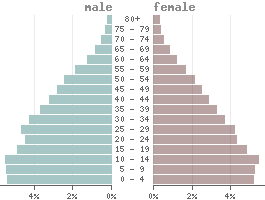
Population:11,553,000
Population per km²:129.3
Life expectancy males:Ø 75.7 years
Life expectancy females:
Ø 80.2 yearsBirth rate:
20.6 ‰Death rate:
3.0 ‰Males/Females:
51.6% : 48.4%Population pyramid
The currency in Jordan is the Jordanian dinar (JOD).
1 Dinar is divided into 100 Piaster.
Status: 04/10/2026
1 Dinar is divided into 100 Piaster.
Status: 04/10/2026
1 US dollar = 0.71 Dinars
1 Dinar = 1.41 US dollar
1 Dinar = 1.41 US dollar
Climate in Jordan
The climate in Jordan is subtropical, so it is much drier and warmer than in the most parts of the US or Central Europe. Only in a few humid months per year is the intensity of rain a bit higher. Depending on the season, the average daytime temperatures range between 17 and 37 degrees. In some parts of the country, the temperature rises to 42 °C. In the colder months, and depending in the region, the temperature drops to 6 °C in a month's average.Average daytime and nighttime temperatures
🔍
Languages
Official language:
Arabic
| Mother tongue | Distribution |
|---|---|
| Arabic | 97.9 % |
| Cherkessia | 1.0 % |
| Armenian | 1.0 % |
| other | 0.1 % |
Religions
Sunni Islam
| Religion | Distribution |
|---|---|
| Buddhists | 0.4% |
| Christs | 5.0% |
| Sunni | 93.0% |
| Shia | 1.0% |
| Druze | 0.2% |
| other | 0.4% |
Land use
| 4% Urban areas: | 3,384 km² |
| 12% Agricultural areas: | 10,629 km² |
| 1% Forest: | 983 km² |
| 1% Water areas: | 540 km² |
| 82% Others: | 73,784 km² |
more...
Transport
| Roadways: | 7,203 km |
| Railways: | 509 km |
| Reg. vehicles: | 2,000,000 |
| Airports: | 4 |
more...
With an average annual income of 4,430 USD Jordan is one of the lower middle-income countries.
Economy
According to the definition from the International Monetary Fund (IMF), Jordan is a developing country because of its lower economic performance. There is one of the lowest crime rates in the world.With an average annual income of 4,430 USD Jordan is one of the lower middle-income countries.
| GDP: | 53.35 bn $ |
| Exportations: | 22,734.5 M $ |
| Importations: | 30,446.8 M $ |
| Tourism receipts: | 5.81 bn $ |
| Debt rate: | 90.23 % |
| › Unemployment rate(ILOEST): | 16.54 % |
| › Inflation rate: | 2.20 % |
| › Corruption index: | 50 (bad) |
| › Energy consumption: | 20.3 bn kWh |
Existing trade agreements
Political indicators
(Based on the "Worldwide Governance Indicators" project of the World Bank)
| Political stability: | ◈ |
| Rule of law: | ◈ |
| Effectivity: | ◈ |
| Regulatory quality: | ◈ |
| Voice accountability: | ◈ |
| Autocracy Index: | ◈ |
| Death penalty: | Legally allowed |