

Spread of the French language
French is an official language in 39 countries and is partly spoken as a mother tongue in 12 other countries. The French language (native name: français, langue française) has its roots in the Indo-European language family.With 64.16 million native speakers, French has the highest prevalence in France. A total of about 112.31 million people worldwide speak French as their mother tongue.
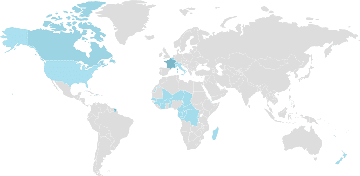
The most important distribution areas within Europe are, besides France itself, Switzerland, Belgium, Luxembourg and Monaco. There are also large parts of Africa, Canada, Oceania, the Caribbean and the islands in the Indian Ocean.
Origins of the French language
The French language has its origins in the time of the ancient Roman Empire with the Celts, Aquitaines and Belgers. With the spread of Latin and Romanization enforced by Rome, the language families became unified and formed a common basis for trade relations throughout the territory of present-day France and its neighbouring regions.Significant increases in the number of speakers were recorded in and after the 17th century, when French became the language of the nobility and the educated, even in other parts of what is incidentally Europe and Russia.
Spread through colonisation
From the beginning of the 16th century until the late 19th century, France was one of the largest colonial powers. France initially claimed large parts of today's USA, Canada and numerous Caribbean states for itself. This was followed by further takeovers in large parts of Africa and the Pacific Ocean. The islands around Madagascar and parts of India, Vietnam and Combodia were also annexed. With these colonial areas and protectorates, the French language spread around the globe and is still the official and everyday language in many countries.It was only with the rise of the British Empire in the 19th century and the development of the United States of America into a great power that France lost political influence and as a result gave up some of its colonies. Since then, the importance of the French language has also declined, while English is steadily gaining in international importance.
| Country | Region | Official language | Distribution | Total |
|---|---|---|---|---|
| France | Western Europe | yes | 93.6 % | 64,164,000 |
| Democratic Republic of the Congo | Central Africa | yes | 12.0 % | 13,113,000 |
| Canada | North America | yes | 22.0 % | 9,083,000 |
| Haiti | Caribbean | yes | 42.0 % | 4,944,000 |
| Belgium | Western Europe | yes | 41.1 % | 4,874,000 |
| United States of America | North America | no | 0.7 % | 2,381,000 |
| Tunisia | Northern Africa | no | 16.0 % | 1,964,000 |
| Switzerland | Western Europe | yes | 21.3 % | 1,918,000 |
| Mali | Western Africa | yes | 6.4 % | 1,567,000 |
| Cameroon | Central Africa | yes | 3.0 % | 874,000 |
| Madagascar | Eastern Africa | yes | 2.3 % | 735,000 |
| Algeria | Northern Africa | no | 1.5 % | 702,000 |
| Togo | Western Africa | yes | 7.2 % | 685,000 |
| Ivory Coast | Western Africa | yes | 2.1 % | 671,000 |
| Chad | Central Africa | yes | 2.3 % | 467,000 |
| Central African Republic | Central Africa | yes | 7.5 % | 400,000 |
| Morocco | Northern Africa | no | 1.0 % | 381,000 |
| Guinea | Western Africa | yes | 2.1 % | 310,000 |
| Burkina Faso | Western Africa | yes | 1.3 % | 306,000 |
| Niger | Western Africa | yes | 1.1 % | 297,000 |
| Italy | Southern Europe | no | 0.5 % | 295,000 |
| Republic of the Congo | Central Africa | yes | 4.6 % | 291,000 |
| Martinique | Caribbean | yes | 80.0 % | 280,000 |
| Senegal | Western Africa | yes | 1.4 % | 259,000 |
| French Polynesia | Polynesia | yes | 61.1 % | 172,000 |
| Laos | Southeast Asia | no | 2.0 % | 155,000 |
| Benin | Western Africa | yes | 0.8 % | 116,000 |
| Comoros | Eastern Africa | yes | 12.9 % | 112,000 |
| Gabon | Central Africa | yes | 4.0 % | 102,000 |
| New Caledonia | Melanesia | yes | 34.3 % | 100,000 |
| French Guiana | South America | yes | 30.7 % | 91,000 |
| Guadeloupe | Caribbean | yes | 20.0 % | 76,000 |
| Mayotte | Eastern Africa | yes | 20.3 % | 65,000 |
| New Zealand | Australia/New Zealand | no | 1.2 % | 63,000 |
| Mauritius | Eastern Africa | no | 4.1 % | 51,000 |
| Equatorial Guinea | Central Africa | yes | 2.4 % | 45,000 |
| Burundi | Eastern Africa | yes | 0.3 % | 42,000 |
| Western Sahara | Northern Africa | no | 5.0 % | 33,000 |
| Luxembourg | Western Europe | yes | 4.2 % | 28,000 |
| Djibouti | Eastern Africa | yes | 1.8 % | 21,000 |
| Principality of Monaco | Western Europe | yes | 41.9 % | 16,000 |
| Sao Tome and Principe | Central Africa | no | 6.8 % | 16,000 |
| Rwanda | Eastern Africa | yes | 0.1 % | 14,000 |
| Saint Barthelemy | Caribbean | yes | 80.0 % | 9,000 |
| Virgin Islands | Caribbean | no | 6.6 % | 7,000 |
| Reunion | Eastern Africa | yes | 0.7 % | 6,000 |
| Andorra | Southern Europe | no | 6.2 % | 5,000 |
| Saint Martin | Caribbean | yes | 9.0 % | 2,000 |
| Vanuatu | Melanesia | yes | 0.6 % | 2,000 |
| Wallis and Futuna | Polynesia | yes | 10.8 % | 1,000 |
| Seychelles | Eastern Africa | yes | 0.7 % | 900 |
Unless otherwise described in the text, this page is about native speakers — not the total number of speakers. How many people understand or speak French as a subsequently learned language is not the subject of this page. Countries where native speakers make up only a few thousand, or even a few hundred people, or countries with a percentage well below 1% are unlikely to be listed here.
Official language, national language or lingua franca: explanation of frequently used terms