


It’s always a bit of a shock to find one of your private PDF files, like a members-only guide or an internal document, listed in a Google search.
We get questions about this all the time from readers who worry about protecting sensitive content. It’s a common concern for anyone who wants to control who sees their files.
We’ve learned firsthand that keeping these files out of search results is key for both privacy and maintaining a clean, professional site. The good news is that it’s surprisingly easy to fix.
In this guide, we’ll show you two simple methods to hide your PDF files from search engines. One method blocks search bots from crawling them, while the other makes sure they won’t be listed in search results at all, making them truly invisible to Google.
Why Hide (Noindex) Your PDF Files in WordPress?
PDFs are one of the most popular file formats, and uploading them to your WordPress website has many benefits.
PDFs are often used to build an email list. A lot of people convert long tutorials on their blogs into PDFs and then offer them as exclusive content on their websites.
These files are also used to offer exclusive members-only premium content for paying subscribers as part of an online course or membership site.
If you are using PDFs on your website or WooCommerce store in a similar way, then it is best to hide your files from search engines and crawlers.
You do not want people to find your PDF files through search results where users can access them without providing you with their email addresses or payments.
You might also have PDFs containing sensitive data that shouldn’t be searchable by the public. Hiding those files using noindex is essential for protection and data security.
That being said, let’s show you how you can easily hide your PDF files from search engines. We will cover different methods, and you can use the quick links below to jump to the one you want to use:
- How to Hide Your PDF Files Using AIOSEO (Recommended)
- How to Hide (Noindex) Your PDF Files Using X-Robots-tag
- Bonus: How to Protect PDF File Download in WordPress (3 Ways)
- Frequently Asked Questions About Hiding PDFs
- Additional Resources for SEO & Site Control
Method 1: How to Hide Your PDF Files Using AIOSEO (Recommended)
An easy way to block your PDF files from search engines is by using the All In One SEO plugin.
It is the best WordPress SEO plugin on the market that allows you to easily optimize your website for search engines and social media platforms.
This plugin also allows you to edit your robots.txt file, which gives bots instructions about your site.
For this tutorial, you will be adding a bit of code that will tell them to ignore your PDFs.
First, you need to install and activate the AIOSEO plugin. For further instructions, see our beginner’s guide on how to install a WordPress plugin.
Next, you will have to set up AIOSEO for your site. If you need help, then you can follow our step-by-step guide on how to set up All in One SEO in WordPress correctly.
Once the plugin is activated, head over to the All in One SEO » Tools page in the WordPress dashboard.
From here, switch to the ‘Robots.txt Editor’ tab and toggle the ‘Enable Custom Robots.txt’ option.
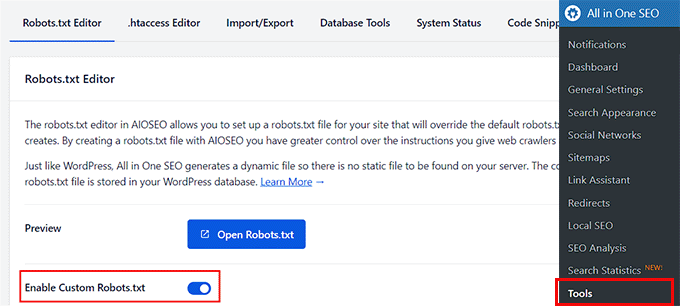
After that, scroll down to where it says ‘User Agent’ and simply add an asterisk (*) to apply the rule to all bots that crawl your site.
Then, select the ‘Disallow’ option in the ‘Rule’ section. This tells search engines not to crawl the file path you provide.
Hiding a Folder of PDF Files
Now, if you wish to block all the PDF files stored in a specific folder, then all you have to do is enter a directory path. Simply add /pdf/ in the ‘Directory Path’ field.

Or if you have saved your PDF directory folder under any other name, then you will have to write that exact PDF directory name in the ‘Directory Path’ field.
After that, just scroll down and click on the ‘Save Changes’ button.
Once that’s done, you’ll be able to view your rules in the ‘Robots.txt Preview’ section of the page.
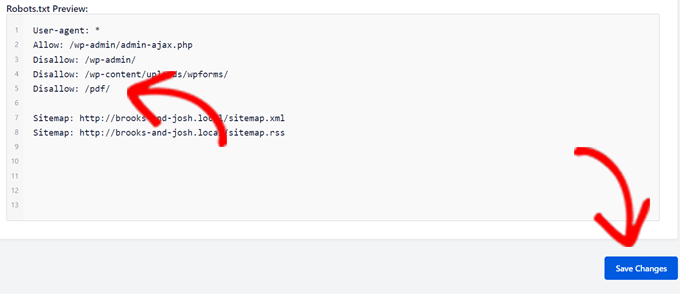
Your robots.txt file will now tell Google Search and other platforms to ignore all the PDF files that are present in your PDF directory folder.
Hiding Individual PDF Files
If you only want to hide individual PDF files, then you can simply type the name of that PDF in the ‘Directory Path’ field.
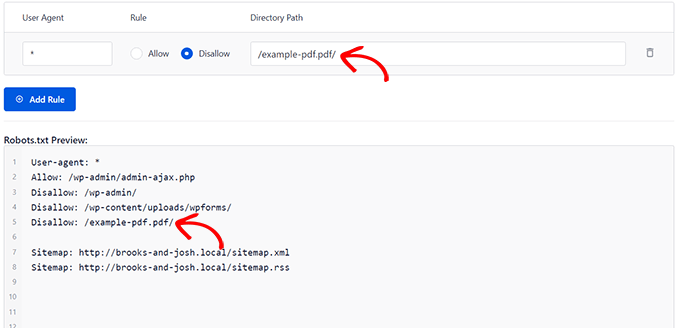
For example, as you can see in the image above, entering example-pdf.pdf will prevent that single PDF file from being indexed without affecting others.
Hiding All PDF Files
You can also block all PDF files at once by adding a rule like Disallow: /*.pdf$. This powerful rule tells search engines to ignore any URL on your site that ends with ‘.pdf’.
This syntax is supported by major search engines like Google and Bing, but some older or less common crawlers may not understand it.
Method 2: How to Hide (Noindex) Your PDF Files Using X-Robots-tag
While Method 1 is a good way to block crawlers, the most effective and reliable way to ensure your PDFs don’t appear in search results is by using the X-Robots-Tag.
This method adds a direct noindex command to the file’s HTTP header, which is an instruction that search engines like Google are required to follow. We highly recommend this method for any sensitive files.
In this method, you will need to manually edit your WordPress site’s .htaccess file and add X-Robots-tag to it. Keep in mind that this method is a bit advanced and may be difficult to apply for beginners.
Normally, this method requires you to edit your site’s .htaccess file using an FTP client, which can be tricky for beginners. However, if you are using All in One SEO, it comes with a built-in .htaccess editor that makes this process much safer.
To use it, go to All in One SEO » Tools from your WordPress dashboard and switch to the ‘htaccess Editor’ tab. From here, you can add the code snippet below to the top of your file.
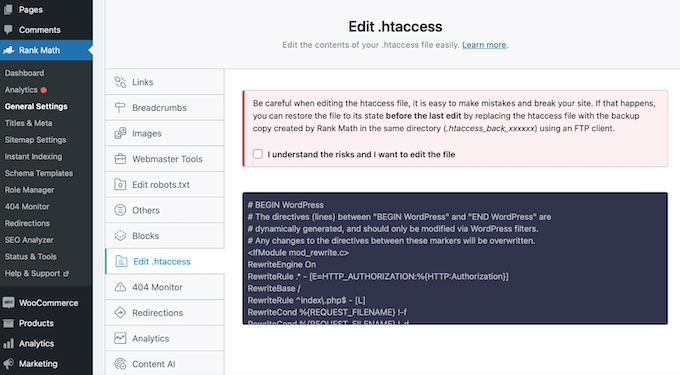
If you don’t have AIOSEO or prefer to do it manually, you can connect to your website using an FTP client or the file manager app in your WordPress hosting control panel.
Next, locate your .htaccess file, which will be in the same folder as your /wp-content/ and /wp-admin/ folders.
If you cannot find the .htaccess file, then you can follow our tutorial on why you can’t find the .htaccess file to make it visible.
For this tutorial, we will be using FileZilla as an FTP client. Once connected to your site, you will find your .htaccess file in the ‘Remote Site’ section in the right-hand column.
Upon locating it, right-click and open the ‘View/Edit’ option.
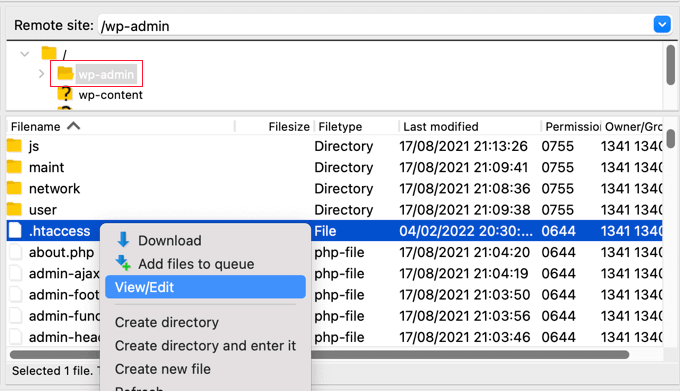
This will open the file in a text editor.
If you are using Notepad, here is how it may look after you’ve added the X-Robots-tag.
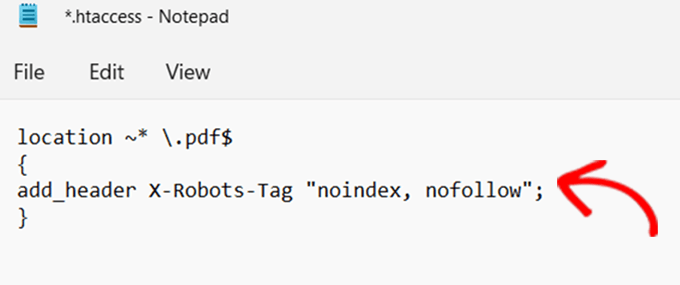
If you are using an Apache server, then simply add the following X-Robots-tag in the .htaccess file:
<Files ~ "\.pdf$"> Header set X-Robots-Tag "noindex, nofollow" </Files>
If you are using the Nginx server, then add the following code:
location ~* \.pdf$ { add_header X-Robots-Tag "noindex, nofollow"; } Once you’ve added the X-robots-tag, simply save your file. This will now mark all the .PDF files as noindex/nofollow, which means you’ve succeeded in hiding your PDF files from search engines!
Bonus: How to Protect PDF File Download in WordPress (3 Ways)
The above two methods cover how to hide PDF files from search engines, but if you want to further restrict PDF downloads to members only, require a password or email address to download PDFs, or even collect payments, then you will need one of the following tools:

MemberPress is the best WordPress membership plugin on the market. In fact, we used it to power our free video membership site and loved it.
For more details, check out our full MemberPress review.
The great thing about MemberPress is that it allows you to restrict PDF file access to registered members only. You can even sell access to PDF files based on different subscription levels.
MemberPress also lets you create and sell online courses, and often, website owners offer premium PDF companion guides with their courses.
This method will ensure that your PDF files are fully password protected, and no one can access them unless they enter the password and log in.

Easy Digital Downloads is a popular WordPress eCommerce plugin for selling digital products such as PDF files, eBooks, and more. Our partner brands use this tool on their websites to sell software and plugins.
So, we know it’s user-friendly and reliable. For more details, see our Easy Digital Downloads review.
It comes with maximum file protection features for PDF files, so you can store them in a private cloud, generate unique access links for each member, track download activity, limit the number of times a specific file can be downloaded, and more.
You can accept payments via credit card, PayPal, and others and restrict PDF access by user subscription level.

OptinMonster is the best lead generation plugin for WordPress. It helps you get more email subscribers and sales from your website visitors.
At WPBeginner, we even use it for all our popups, banners, and deals. For more details, see our full OptinMonster review.
A lot of website owners use OptinMonster to require users to enter an email address before giving them access to their PDF files.
This process is called delivering a lead magnet or content upgrade. Once the user enters their email address in OptinMonster, they’re added as a subscriber in your email marketing service or CRM.
After that, they’ll get access to the PDF file in a personalized welcome email.
Frequently Asked Questions About Hiding PDFs
We get a lot of questions about managing PDF files in WordPress. Here are answers to some of the most common ones we receive.
1. What is the difference between noindexing a PDF and password-protecting it?
Noindexing is a directive that tells search engines not to include the file in their search results. However, anyone who has the direct link can still access and view the PDF.
Password protection, on the other hand, restricts access entirely. A user must log in or provide a password to view the file, offering a much higher level of security.
2. Will hiding my PDF remove it from Google search results immediately?
No, the removal is not instant. After you add a ‘noindex’ rule, search engines like Google must crawl your site again to discover the new instruction.
This process can take anywhere from a few days to several weeks, depending on how frequently your site is crawled.
3. Which method is better: using robots.txt or the X-Robots-Tag?
For most people, using the robots.txt editor inside a plugin like All in One SEO is the recommended method. It is safer, easier to manage, and you don’t risk breaking your site by editing server files directly.
The X-Robots-Tag method is very effective but is considered advanced because it requires editing the .htaccess file, which can be risky for beginners.
4. How can I check if my PDF is still indexed by Google?
You can use a special search operator in Google. Simply go to Google and type site:yourdomain.com filetype:pdf, replacing ‘yourdomain.com’ with your own website’s address.
This will show you all the PDF files from your site that are currently in Google’s index. You can check this again after a few weeks to confirm your file has been removed.
Additional Resources for SEO & Site Control
If you found this guide helpful, you might also want to check out these other articles to get even more control over your site’s SEO and content visibility:
- How to Stop Search Engines from Crawling a WordPress Site – A complete guide to controlling which parts of your website search engines can and cannot see.
- Best WordPress SEO Plugins and Tools – Explore other powerful tools that can help you improve your site’s rankings and manage its SEO settings.
- Best SEO Links Plugins for WordPress – Discover plugins that help you manage both internal and external links for better SEO performance.
If you liked this article, then please subscribe to our YouTube Channel for WordPress video tutorials. You can also find us on Twitter and Facebook.




Mrteesurez
This is great. No one will allow paid PDFs to be accessed by a search engine unless there are free. I run an ebook store so this guide will be of help for me. But my question is, if I block all the PDFs, will their titles and details still available for crawling by search engines for visibility ?
WPBeginner Support
Normally you would use the product page that you are selling the PDF to give search engines that information.
Admin
Mrteesurez
Meaning I will need to create a product page for each book so as to make it be visible to search engine, right ?.
I ma using Woocommerce, I think it create post type product, can’t that be used instead of creating sales page/landing page ?
WPBeginner Support
For WooCommerce, the product’s page would be the sales page normally.
Mrteesurez
Ok, I now understand what you are really taking about. Woocomerce product will be the sales page, Applying Noindex will only affects the PDF document itself and this will not affect it’s woocomerce page(product page) from indexing.
Thanks for your reply, I like your support.
Jiří Vaněk
Thank you for the perfect tutorial. I have AIO SEO, but I didn’t know that I can edit various files in robots.txt in this way. I assume that I can use the same method to hide other file extensions such as .docx etc.?
WPBeginner Comments
Yes, other file types can be hidden in a similar manner.
Jiří Vaněk
Thank you for the response. I have several types of files on my website, mainly text files, that I need to hide this way. Thanks for the reassurance; I will use your guide for this. It’s simple and effective, which is important to me.
Kiran
In .htaccess file
Header set X-Robots-Tag “noindex, nofollow”
is used. Apache server. But when I test, the .pdf URL appears indexable.
Tried all methods. Still the PDF file is getting indexed in the search engines.
I read about this code in more than 20 blogposts and forums online. Everyone has told about this option regarding X-Robots-Tag, but no one has told that it is working.
Can you tell?
WPBeginner Support
If you have not done so already, please reach out to your hosting provider to ensure there are not rules set on their server that may be conflicting or preventing the change from being accepted for a likely cause.
Admin