


North Carolina State University
 | |
Former names | North Carolina College of Agriculture and Mechanic Arts (1887–1918) North Carolina State College of Agriculture and Engineering (1918–1962) North Carolina State of the University of North Carolina at Raleigh (1963–1965) |
|---|---|
| Type | Public land-grant research university |
| Established | March 7, 1887 |
Parent institution | University of North Carolina System |
| Accreditation | SACS |
Academic affiliations | |
| Endowment | $2.54 billion (2025)[1] |
| Chancellor | Kevin Howell |
Academic staff | 2,548[2] |
Administrative staff | 7,452[2] |
| Students | 39,259 (Fall 2025)[3] |
| Undergraduates | 27,885 (Fall 2025)[3] |
| Postgraduates | 9,347 (Fall 2025)[3] |
| Location | , United States 35°47′14″N 78°40′14″W / 35.78722°N 78.67056°W |
| Campus | Large city[4], 2,110 acres (8.5 km2) |
| Colors | Red and white[5]
|
| Nickname | Wolfpack |
Sporting affiliations | |
| Mascot | Mr. Wuf & Mrs. Wuf |
| Website | ncsu |
 | |
 | |
North Carolina State University (NC State) is a public land-grant research university in Raleigh, North Carolina, United States. Founded in 1887 to teach agriculture and mechanics, it is the state's largest university by enrollment. A constituent institution of the University of North Carolina system, it offers a broad curriculum while focusing its research and academics on engineering and the applied sciences. The university maintains extensive public–private partnerships, integrating academic, corporate, and government research within the region's technological economy.
NC State offers over 100 areas of study across 11 degree-granting colleges, including a College of Veterinary Medicine and a college dedicated to textiles. Classified among "R1: Doctoral Universities – Very high research activity," it is one of three universities that form the Research Triangle region, alongside Duke University and the University of North Carolina at Chapel Hill (UNC-Chapel Hill).
The university's 2,100-acre footprint in Raleigh is characterized by a red-brick architectural motif and the central "Brickyard" plaza. The physical layout is divided into four primary sections: Main Campus, Centennial Campus, the Centennial Biomedical Campus, and West Campus, which houses major athletic venues including Carter–Finley Stadium for football and the Lenovo Center for men's basketball. Beyond its primary campuses, NC State maintains a statewide presence through cooperative extension offices in all 100 North Carolina counties and over 19,000 acres of agricultural research stations.
In intercollegiate athletics, NC State's teams are known as the Wolfpack. A charter member of the Atlantic Coast Conference (ACC), the university competes across 22 varsity sports in NCAA Division I and has won 12 team national championships. The athletic program is particularly recognized for its foundational impact on college basketball culture in the South.
History
[edit]Founding and early years (1887–1931)
[edit]
The history of North Carolina State University began on March 7, 1887, when the North Carolina General Assembly authorized the establishment of the North Carolina College of Agriculture and Mechanic Arts. The institution was the result of a movement led by agrarian reformers, including Leonidas L. Polk and the Watauga Club, who advocated for a practical "industrial" education as an alternative to the classical curriculum offered at the University of North Carolina at Chapel Hill (UNC).[6][7] Polk argued that UNC's 1887 enrollment of approximately 200 students failed to represent the state's broader workforce.[8] Secured by a 62-acre land donation from philanthropist R. Stanhope Pullen, the college officially opened on October 3, 1889, in Holladay Hall with an initial enrollment of 72 students.[9][10] In 1918, the school was renamed the North Carolina State College of Agriculture and Engineering.
Consolidation and the struggle for identity (1931–1972)
[edit]In 1931, the General Assembly passed the Consolidation Act, merging the college into the Consolidated University of North Carolina under a centralized administration based at UNC.[11] This period was characterized by administrative subordination; to prevent program duplication, the college's commerce and education departments were closed, and graduate programs were limited. A 1946 mandate effectively prevented the college from awarding its own PhD degrees, requiring all doctoral credentials to bear the name of UNC.[12]
Enrollment and physical scale increased following World War II, aided by the G.I. Bill. Desegregation began in 1953 with the admission of the first African American graduate students, followed in 1956 by the "First Four" Black undergraduates in the School of Engineering.[13] Among them, Irwin Holmes became the first Black captain of an Atlantic Coast Conference varsity team and the university's first Black graduate in 1960.[14] Full coeducation followed in 1964. During this period, the school faced a dispute regarding its institutional identity known as the "Naming War." In 1963, over 2,000 students marched on the State Capitol to protest a plan to rename the school "University of North Carolina at Raleigh."[15] The resulting 1965 compromise established the name North Carolina State University at Raleigh.
Modern research era (1972–present)
[edit]Institutional autonomy was restored through the Higher Education Restructuring Act of 1972, which granted the university its own chancellor and the right to award independent doctoral degrees.[12] This period coincided with the team winning the 1974 NCAA National Championship led by David Thompson.[16]
In 1987, Governor James B. Hunt Jr. championed the creation of Centennial Campus, a research hub that co-located industry and government agencies with academic departments.[17] The university's research activity reached the highest tier of the Carnegie Classification of Institutions of Higher Education (R1: Very High Research Activity) in 2005.[18] This transition was accompanied by athletic milestones, such as the 1983 NCAA National Championship under coach Jim Valvano, and governance changes following administrative crises in 1989 and 2009.[19][20]
Under the leadership of Chancellor Randy Woodson (2010–2025), the university completed a $2.1 billion capital campaign and opened the James B. Hunt Jr. Library (2013).[21][22] In 2025, Kevin Howell was appointed as the 15th chancellor, the first African American to lead the institution.[23]
Campuses
[edit]Main campus
[edit]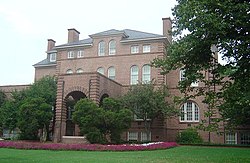
NC State's Main Campus in Raleigh is divided into three functional areas: North, Central, and South campuses. North Campus, the university's historic core, was founded in 1887 as the North Carolina College of Agriculture and Mechanic Arts.[24] It contains the majority of academic departments and administrative offices. Central Campus is primarily dedicated to student support, including residential housing and athletic facilities. South Campus serves as an auxiliary area for conference facilities and student parking. The campus is geographically bounded and intersected by major transit corridors, including the North Carolina Railroad and Western Boulevard.[25]
Architecturally, the campus is noted for its cohesive use of red brick construction. "The Brickyard," officially University Plaza, was paved in 1968 using over 500,000 bricks to replace a muddy expanse between student centers.[26]
Prominent landmarks include the Memorial Belltower, completed in 1937 to honor alumni killed in World War I. The tower was constructed in phases between 1921 and 1949, with a full carillon of 55 bells eventually installed in 2021.[27]
Centennial Campus
[edit]Centennial Campus is a 1,334 acres (5.4 km2) research park and mixed-use expansion located south of the Main Campus. The land, which originally belonged to the Dorothea Dix Hospital, was transferred to the university in 1984 under an allotment by Governor James B. Hunt Jr.[28] It houses the Wilson College of Textiles and the College of Engineering, organized around the "Engineering Oval," a hub for research and biomanufacturing education.
Centennial Biomedical Campus
[edit]The 180-acre (0.73 km2) Centennial Biomedical Campus is anchored by the North Carolina State University College of Veterinary Medicine. It features the Randall B. Terry Jr. Companion Animal Veterinary Medical Center, a 110,000-square-foot (10,000 m2) facility that opened in 2011 to expand the university's clinical research and specialty animal care capacity.[29] The J. C. Raulston Arboretum, an 8 acres (0.032 km2) botanical garden, is situated adjacent to the campus.
NC Research Campus
[edit]In Kannapolis, NC State operates the Plants for Human Health Institute (PHHI) at the North Carolina Research Campus. This biotechnology hub was established on the site of the former Cannon Mills textile complex to revitalize the region through human health and nutrition research.[30]
Organization and administration
[edit]NC State is one of 17 constituent institutions of the University of North Carolina system. The university operates under the policies of the UNC system Board of Governors, while maintaining a degree of administrative independence. The system is led by President Peter Hans.[31]

The university's executive leadership is composed of a thirteen-member board of trustees and the chancellor. The board of trustees consists of eight members elected by the UNC Board of Governors, four members appointed by the Governor of North Carolina, and the university's student body president, who serves as an ex-officio member.
The chancellor serves as the chief executive officer; the position is held by Kevin Howell, who assumed office on May 5, 2025, succeeding Randy Woodson. Howell is the first alumnus to serve as chancellor since the 1960s and the first Black leader in the university's history.[32]
The university's chief academic officer is the Executive Vice Chancellor and Provost, a role held by Warwick Arden since 2010. The provost oversees the eleven academic colleges and the Graduate School, coordinating academic policy, faculty development, and the university's strategic plan, "Wolfpack 2030: Powering the Extraordinary."[33]
Endowment
[edit]As of June 30, 2025, the university's combined endowment was valued at $2.54 billion, representing a 79% increase from the $1.42 billion reported in fiscal year 2020. This total ranks NC State as the 72nd largest overall according to the National Association of College and University Business Officers (NACUBO). The endowment is distributed across several affiliated foundations, supporting approximately 3,000 donor-created funds designated for scholarships, faculty chairs, and research initiatives.[34]
Academics
[edit]Structure and divisions
[edit]The university's academic structure comprises eleven degree-granting colleges and the Graduate School. As of 2025, these colleges oversee 66 academic departments and offer nine associate degree programs, 102 bachelor's degree programs, 108 master's programs, and 60 doctorate degree programs.[35]
The academic divisions are:
- College of Agriculture and Life Sciences
- College of Design
- College of Education
- College of Engineering
- College of Humanities and Social Sciences
- College of Natural Resources
- Poole College of Management
- College of Sciences
- Wilson College of Textiles
- College of Veterinary Medicine
- The Graduate School
- University College (Non-degree granting; provides academic transitions for exploratory students)
Faculty and research staff
[edit]NC State employs over 2,500 faculty members and approximately 7,700 staff members. The university maintains a student-to-faculty ratio of 15:1. The faculty includes members of the National Academies, Guggenheim Fellows, and Fulbright Scholars. In 2025, faculty members were recognized with the Millennium Technology Prize and inductions into the National Academy of Inventors.
The Chancellor’s Faculty Excellence Program organizes educators into 20 thematic clusters, such as bioinformatics, precision medicine, and public science. This interdisciplinary framework is intended to facilitate collaboration across academic departments and corporate partners located on the Centennial Campus.[36]
Admission
[edit]Undergraduate admission is categorized as "more selective" by U.S. News & World Report. For the Fall 2025 cycle, the university received a record 49,450 first-year applications, with an overall acceptance rate of 39.5%. The middle 50% of admitted first-year students typically hold an unweighted GPA between 3.8 and 4.0, an SAT composite score between 1290 and 1440, and an ACT composite score between 25 and 32.[37]
Admission is "major-specific," meaning applicants are reviewed primarily for their chosen academic program rather than the university at large. This policy results in differing levels of competitiveness across the university's colleges; programs in engineering, design, and business typically require higher academic thresholds for admission than the general university average.
NC State utilizes a holistic review process evaluating academic achievement, interest in the intended major, extracurricular involvement, background, and individual history. Under the UNC System's current testing policy, SAT and ACT scores are optional for applicants with a weighted GPA of 2.8 or higher, while students below this threshold are required to submit scores.[38]
Graduate admission
[edit]The Graduate School administers admissions for more than 10,000 students across 160 master's and 60 doctoral programs.[39] Selectivity varies significantly by discipline; for example, the College of Veterinary Medicine maintains an acceptance rate of approximately 10–15%.[40] Graduate applicants are generally required to hold a bachelor's degree from an accredited institution and meet program-specific requirements, which may include the GRE, GMAT, or portfolio submissions for creative fields.[41]
Libraries
[edit]The NC State University Libraries system includes two main facilities and three branch libraries, holding a collection of over 5.3 million volumes as of 2024. The university is a member of the Triangle Research Libraries Network (TRLN), a collaborative organization that facilitates book sharing and resource pooling with Duke University, the University of North Carolina at Chapel Hill, and North Carolina Central University. Notable locations within the system include:
- D. H. Hill Jr. Library: Located on the North Main Campus, it serves as the historic center of the library system and features specialized spaces like the Academic Success Center and the Special Collections Research Center.
- James B. Hunt Jr. Library: Located on the Centennial Campus, it is notable for its "bookBot" automated library storage and retrieval system, which has a 2-million volume capacity and allows for 100% of the library's physical footprint to be dedicated to learning and collaboration space.
Rankings and reputation
[edit]NC State is classified as a doctoral university with "very high research activity" by the Carnegie Classification of Institutions of Higher Education. Nationally, the university is recognized for its technical and professional programs in veterinary medicine, engineering, education, and agriculture. Globally, it maintains a standing within the top 300 universities according to major international ranking bodies.
| Academic rankings | |
|---|---|
| National | |
| Forbes[42] | 65 |
| U.S. News & World Report[43] | 58 (tie) |
| Washington Monthly[44] | 89 |
| WSJ/College Pulse[45] | 104 |
| Global | |
| ARWU[46] | 201–300 |
| QS[47] | =272 |
| THE[48] | 251–300 |
| U.S. News & World Report[49] | 269 |
In its 2025 rankings, U.S. News & World Report placed NC State tied for 58th among national universities and 26th among public institutions. The university was also ranked 60th for "best value."[50]
Program-specific rankings
[edit]Several academic units hold national standing as of 2026:
- Veterinary Medicine: Ranked 4th in the nation (U.S. News, 2024).[51]
- Nuclear Engineering: Ranked 3rd nationally.[52]
- Education: Ranked 26th nationally and 1st in North Carolina (U.S. News, 2026).[53]
- Research Commercialization: Ranked 2nd among public universities in the U.S. for startup creation (Heartland Forward, 2025).[54]
Scholarships and financial aid
[edit]Approximately 70% of undergraduate students receive financial aid. The university administers several institutional scholarship programs:
- The Park Scholarship Program: Established in 1996 via the Park Foundation, it covers the full cost of attendance for approximately 35–40 students annually based on scholarship, leadership, and service.[55]
- The Goodnight Scholars Program: Established in 2008 for North Carolina residents from low- and middle-income families pursuing STEM or education majors.[56]
- The Caldwell Fellows Program: A leadership development program and scholarship named in honor of former Chancellor John T. Caldwell.[57]
- The Centennial Scholarship: A merit-based award for the Wilson College of Textiles.[58]
Athletics
[edit]

North Carolina State (NC State) teams are known as the Wolfpack.[59] They compete as a member of the National Collegiate Athletic Association (NCAA) Division I level (Football Bowl Subdivision (FBS) sub-level for football), primarily competing in the Atlantic Coast Conference (ACC) for all sports since the 1953–54 season. Men's sports include baseball, basketball, cheerleading, cross country, football, golf, soccer, swimming & diving, tennis, track & field and wrestling; while women's sports include basketball, cheerleading, cross country, golf, gymnastics, soccer, softball, swimming and diving, tennis, track & field and volleyball.
NC State has won ten national championships: four NCAA championships, two AIAW championships, and four titles under other sanctioning bodies. Most NC State fans and athletes recognize the rivalry with the North Carolina Tar Heels as their biggest.[60]. The Wolfpack also share a minor rivalry with the East Carolina Pirates and Wake Forest Demon Deacons. NC State was a founding member of the Southern Conference and of the Atlantic Coast Conference, and it is one of the four teams on "Tobacco Road".[61][62]
The logo for NC State athletics is a wolf head wearing a sailor cap. The wolf depicted is known by NC State fans as "Tuffy" (not to be confused with the on-site mascots, Mr. and Ms. Wuf). The wolf head logo was preceded by the block S logo, which consisted of an 'N' and a 'C' inscribed in a larger 'S'.
NC State athletic teams are nicknamed the 'Wolfpack' (most women's teams are also called the "Wolfpack," except for the women's basketball team who go by the "Wolfpack Women"). The name was unofficially adopted in 1921 following an unsigned letter to the NC State Alumni News suggesting the moniker "Wolf Pack". Prior to the adoption of the current nickname, NC State athletic teams went by such names as the Aggies, the Techs, and the Red Terrors. Since the 1960s the Wolfpack has been represented at athletic events by its mascots, Mr. and Mrs. Wuf. In print, the 'Strutting Wolf' is used and is known by the name 'Tuffy.'[63]
Athletic facilities
[edit]
The stadium property is 3.4 mi (5.5 km) northwest of the Memorial Bell Tower. Both Carter–Finley Stadium and the Lenovo Center are located there. Aside from the two stadiums, the property is mainly open space used for event parking. The property borders the North Carolina State Fair to the North and hosts tailgating parties before NC State football games.[64][65] Located on campus, Reynolds Coliseum is now home to all services of ROTC and several Wolfpack teams, including women's basketball, women's volleyball, women's gymnastics, and men's wrestling.
Student life
[edit]| Race and ethnicity | Total | ||
|---|---|---|---|
| White | 67% | ||
| Asian | 10% | ||
| Hispanic | 9% | ||
| Black | 6% | ||
| Two or more races | 5% | ||
| International student | 2% | ||
| Unknown | 1% | ||
| Economic diversity | |||
| Low-income[a] | 20% | ||
| Non-Pell Grant recipient[b] | 80% | ||
| Geographic origin | |||
| In-state | 81% | ||
| Out-of-state | 17% | ||
| International | 2% | ||
Witherspoon Student Center houses an African American Cultural Center, which features an art gallery and a library. The cultural center moved to its current location in Witherspoon in 1991, having formerly been in the Print Shop.[67][68] Witherspoon also houses Student Media and a multicultural student affairs office.[69]
Student life at North Carolina State University includes opportunities in a diverse range of activities and organizations, including multicultural groups, arts groups, political and social action groups, service and professional groups, religious groups, fraternities and sororities (often referred to as Greek organizations), sports and recreation groups, and academic groups.[70]
Residence life
[edit]Thirty-five percent of full-time undergraduate students live on campus in one of nineteen residence halls.[71][72] First-year students are required to live in University Housing.[73] Several residence halls house living-learning villages that cater to specific academic, cultural, or personal interests. Each residence hall or residence area has an elected council. Representatives from each hall make up the Inter-Residence Council, which represents the on-campus residence-life community.[74]
University housing facilities are divided into four areas: East Campus, Central Campus, West Campus, and University Apartments.[71]
Student government
[edit]Founded in 1921, the NC State Student Government is a student-run organization that serves as the official voice of the student body. Both a governing body and an advocacy group, Student Government is involved in policy-making, adjudication, programming, advocating, and community service. The organization is responsible for distributing a portion of student fees to student organizations in a process known as appropriations. Student organizations must be registered through Student Involvement to become eligible for these funds.[75]
Student traditions
[edit]Service NC State
[edit]Service NC State (SNCS) is a volunteer event sponsored by the Center for Student Leadership, Ethics & Public Service. It is open to students, faculty, staff, and the Raleigh community.[76]
Homecoming Week
[edit]Homecoming week, an annual North American tradition intended to welcome back alumni, is run by the AASAP (Alumni Association Student Ambassador Program). Usually held at the end of October, it starts with a Kickoff event and ends with the Pack Howl pep rally (a gathering meant to foster school spirit) and concert. Featured performers have included Lonestar, Ludacris, Chris Daughtry, Cartel, Guster, and The Avett Brothers.
During the week, events such as Wear Red-Get Fed, a parade down Hillsborough Street, and a campus-wide Spirit Competition take place. The week also includes a Leader of the Pack competition honoring male and female student leaders.[77]
Shack-A-Thon
[edit]Shack-A-Thon, a tradition since 1991, is NC State's Habitat for Humanity campus chapter's annual fall fundraiser. The chapter partners with other student organizations to build shacks in the Brickyard, the university's central plaza, where students live, sleep, and study for an entire week. Each group raises money through online donations and by collecting from passersby. This money goes toward funding a house through Habitat for Humanity of Wake County.[78]
Krispy Kreme Challenge
[edit]Started by Park Scholars, a more recent tradition of NC State is the Krispy Kreme Challenge. In this race, students meet at the university's Memorial Bell Tower, then run to a Krispy Kreme shop 2.5 mi (4.0 km) away. Each student must eat twelve glazed doughnuts, then run back to the Bell Tower within one hour. The Challenge was listed as one of the "102 Things You Gotta Do Before You Graduate" by Sports Illustrated.[79] Proceeds from the race go to the NC Children's Hospital. By 2023, the cumulative total donated to the NC Children's Hospital reached $2.1 million.[80]
Student media
[edit]
Technician has been NC State's student-run newspaper since 1920. It employs students throughout the year and reports on campus, state, and national news. As of 2018, Technician is published on Thursdays when school is in session, with a print circulation of 3,000, along with online publishing throughout the week. The paper is funded by advertisements and a student media fee; it is distributed for free at locations on campus and at area merchants.[81]
The Nubian Message is NC State's African American student newspaper. The Nubian Message was first published in 1992 following protests from many African American students denouncing the Technician's alleged racial bias.[82] The Nubian Message is published biweekly.[83]
NC State's oldest student publication, the Agromeck yearbook, acts as a compendium of student life on campus including sporting events, social activities, and day-to-day living. Each year, nearly 1,000 copies are printed and sold.[84]
The university has its own student-run radio station, WKNC. The radio station broadcasts at 25,000 watts and reaches the surrounding Raleigh, Durham, and Chapel Hill areas of North Carolina. The station hosts several formats run by student disc jockeys.[85]
NC State's literary and arts magazine, Windhover, is published once a year in the spring. The publication solicits entries from all university-affiliated individuals, including students, staff, alumni, and faculty. The content published includes visual art, writing, audio, and video.[86]
Notable alumni
[edit]
NC State has more than 300,000 living alumni, with approximately 160,000 residing in North Carolina.[87] Graduates of the university have served in government, military, and academic roles. Alumni in public service include four-term Governor of North Carolina James B. Hunt Jr., former U.S. Senator and presidential candidate John Edwards, and Abdurrahim El-Keib, who served as the interim prime minister of Libya.[88] Among its military alumni, General Hugh Shelton served as Chairman of the Joint Chiefs of Staff, and General William C. Lee is referred to as the "Father of the U.S. Airborne."[89] In academia, Bill Friday led the University of North Carolina system as its president for 30 years.
.jpg/250px-Rajendra_Pachauri_-_WEF_2008_(cropped).jpg)

In science and technology, Rajendra Kumar Pachauri served as the elected chief of the Intergovernmental Panel on Climate Change (IPCC), representing the organization when it shared the 2007 Nobel Peace Prize with Al Gore.[90] Munir Ahmad Khan contributed to reactor quantum physics and directed scientific research for Pakistan's atomic bomb programs.[91] NASA astronaut Christina Koch earned two degrees from NC State and holds the record for the longest continuous spaceflight by a woman.[92] Business leaders include James Goodnight, co-founder and CEO of SAS Institute, and Jeff Williams, chief operating officer of Apple Inc.


Alumni in the arts, media, and athletics include actor and comedian Zach Galifianakis, as well as YouTube creators and comedy duo Rhett and Link (Rhett McLaughlin and Link Neal), who both earned engineering degrees from the university before pursuing media. In sports, athletes include Naismith Hall of Fame inductee David Thompson, Super Bowl-winning Pittsburgh Steelers head coach Bill Cowher, and NFL quarterbacks Russell Wilson and Philip Rivers.
See also
[edit]- University Statisticians of the Southern Experiment Stations
- Education in North Carolina
- Tobacco Road Rivalry
- Research Triangle
- List of colleges and universities in North Carolina
Notes
[edit]- ^ The percentage of students who received an income-based U.S. federal Pell grant intended for low-income students.
- ^ The percentage of students who did not receive an income-based U.S. federal Pell grant.
References
[edit]- ^ "Endowments Matter". NC State University. Retrieved April 8, 2026.
- ^ a b "About NC State". NC State University. Retrieved April 8, 2026.
- ^ a b c "NC State University - Student Enrollment". uda.ncsu.edu. Retrieved April 8, 2026.
- ^ "College Navigator - North Carolina State University at Raleigh". nces.ed.gov. Retrieved August 10, 2023.
- ^ "Our Core Palette". North Carolina State University. Retrieved April 6, 2024.
- ^ "Accessible to all: The Morrill Act Sesquicentennial". Association of Public and Land-grant Universities (APLU). August 6, 2012. Retrieved April 10, 2026.
- ^ Hill, Michael (2006). "Watauga Club". NCpedia. State Library of North Carolina. Retrieved April 10, 2026.
- ^ Battle, Kemp P. (1912). History of the University of North Carolina: From 1868 to 1912. Edwards & Broughton Printing Co.
- ^ "The Pullen Gift". NC State University Libraries. Retrieved April 10, 2026.
- ^ "North Carolina State University". North Carolina Department of Natural and Cultural Resources. November 11, 2016. Retrieved April 10, 2026.
- ^ "Acts of Consolidation and Administrative Reorganization". University of North Carolina System Records. 1931.
- ^ a b Link, William A. (1995). William Friday: Power, Purpose, and American Higher Education. University of North Carolina Press. ISBN 9780807821671.
- ^ "Historical State: Desegregation at NC State". NC State University Libraries. Retrieved April 10, 2026.
- ^ "Irwin Holmes: A Wolfpack Trailblazer". NC State News. February 14, 2020. Retrieved April 10, 2026.
- ^ "Historical State: The Naming War". NC State University Libraries. Retrieved April 10, 2026.
- ^ "1974 National Championship". NC State Athletics. Retrieved April 10, 2026.
- ^ "A History of Centennial Campus". NC State University. Retrieved April 10, 2026.
- ^ "Higher Education Research and Development Survey". National Science Foundation. Retrieved April 10, 2026.
- ^ "Valvano Resigns After Decade of Glories and Controversy". The New York Times. April 8, 1990. Retrieved April 10, 2026.
- ^ Ferreri, Eric (June 8, 2009). "Oblinger resigns as NCSU chancellor". The News & Observer. Retrieved April 10, 2026.
- ^ "Think and Do the Extraordinary Campaign Concludes with Record $2.1 Billion". NC State University News. January 10, 2022. Retrieved April 10, 2026.
- ^ Cite error: The named reference
Hunt_Librarywas invoked but never defined (see the help page). - ^ "Kevin Howell named 15th chancellor of NC State University". WRAL. March 18, 2025. Retrieved April 10, 2026.
- ^ "North Carolina College of Agriculture and Mechanic Arts". North Carolina Highway Historical Marker Program. Retrieved February 16, 2024.
- ^ "How NC State grew from a single building to a Raleigh powerhouse". The News & Observer. September 12, 2021. Retrieved February 16, 2024.
- ^ "The Story Behind NC State's Brickyard". Our State Magazine. August 26, 2015. Retrieved February 16, 2024.
- ^ "A century in the making: NC State's Memorial Belltower finally gets its bells". WRAL-TV. May 12, 2021. Retrieved February 16, 2024.
- ^ "The vision that built Centennial Campus". The News & Observer. May 10, 2022. Retrieved February 16, 2024.
- ^ "NC State opens state-of-the-art veterinary hospital". WRAL-TV. June 3, 2011. Retrieved February 16, 2024.
- ^ Bruni, Frank (March 3, 2011). "The Billionaire Who Is Planning His 125th Birthday". The New York Times. Retrieved February 16, 2024.
- ^ Long, Brian (May 1, 2018). "State Board elects Peter Hans president of NC Community College System". NC Community Colleges. Retrieved July 21, 2022.
- ^ "Kevin Howell Named NC State's 15th Chancellor". NC State News. March 18, 2025. Retrieved April 8, 2026.
- ^ "About Provost Arden". Executive Vice Chancellor and Provost. Retrieved April 8, 2026.
- ^ "Endowments Matter". Giving at NC State. June 30, 2025. Retrieved April 8, 2026.
- ^ "Academic Programs". NC State University. Retrieved April 8, 2026.
- ^ "Rankings and Facts". NC State University. Retrieved April 8, 2026.
- ^ "Admissions Fast Facts". NC State Undergraduate Admissions. Retrieved April 8, 2026.
- ^ "Standardized Test Requirement Policy". University of North Carolina System. Retrieved April 8, 2026.
- ^ "Graduate School Facts". NC State Graduate School. Retrieved April 8, 2026.
- ^ "CVM Admissions Statistics". NC State College of Veterinary Medicine. Retrieved April 8, 2026.
- ^ "Apply to the Graduate School". NC State Graduate School. Retrieved April 8, 2026.
- ^ "America's Top Colleges 2025". Forbes. August 26, 2025. Retrieved November 12, 2025.
- ^ "2025-2026 Best National Universities Rankings". U.S. News & World Report. September 23, 2025. Retrieved November 12, 2025.
- ^ "2025 Best Colleges for Your Tuition (and Tax) Dollars". Washington Monthly. August 25, 2025. Retrieved November 12, 2025.
- ^ "2026 Best Colleges in the U.S." The Wall Street Journal/College Pulse. September 29, 2025. Retrieved November 12, 2025.
- ^ "2025 Academic Ranking of World Universities". ShanghaiRanking Consultancy. August 15, 2025. Retrieved November 12, 2025.
- ^ "QS World University Rankings 2026". Quacquarelli Symonds. June 19, 2025. Retrieved November 12, 2025.
- ^ "World University Rankings 2026". Times Higher Education. October 9, 2025. Retrieved November 12, 2025.
- ^ "2025-2026 Best Global Universities Rankings". U.S. News & World Report. June 17, 2025. Retrieved November 12, 2025.
- ^ "US News and World Report 2025 College Rankings--North Carolina State".
- ^ "Best Veterinary Schools". U.S. News & World Report. Retrieved April 8, 2026.
- ^ "Best Nuclear Engineering Programs". U.S. News & World Report. Retrieved April 8, 2026.
- ^ "Best Education Schools". U.S. News & World Report. Retrieved April 8, 2026.
- ^ "Research to Renewal: Advancing University Tech Transfer". Heartland Forward. Retrieved April 8, 2026.
- ^ "About the Park Scholarships". NC State University. Retrieved April 8, 2026.
- ^ "About the Goodnight Scholars". NC State University. Retrieved April 8, 2026.
- ^ "Caldwell Fellows History". NC State University. Retrieved April 8, 2026.
- ^ "Textiles Scholarships". NC State Wilson College of Textiles. Retrieved April 8, 2026.
- ^ "NC State University Athletics - Official Athletics Website". NC State University Athletics. Archived from the original on October 3, 2019. Retrieved October 3, 2019.
- ^ Doyel, Gregg (September 25, 2001). "A new perspective on Wolfpack-Heels rivalry". The Charlotte Observer. Archived from the original on December 8, 2008. Retrieved June 13, 2008.
- ^ ACC Basketball, Walker 2011
- ^ Fellenzer, Jeff (March 21, 1989). "Taking A Trip Down Tobacco Road: North Carolina Basketball Isn't a Game, It's a State of Mind". Los Angeles Times. Retrieved June 13, 2008.
{{cite news}}: CS1 maint: deprecated archival service (link) - ^ "Timeline of Athletics at NCSU". NC State University. Archived from the original on October 12, 2008. Retrieved June 13, 2008.
- ^ "RBC Center Description". Archived from the original on October 21, 2006.
- ^ "Carter-Finley Stadium Description". Archived from the original on October 5, 2006. Retrieved September 27, 2006.
- ^ "College Scorecard: North Carolina State University at Raleigh". College Scorecard. United States Department of Education. Retrieved April 10, 2026.
- ^ Historical State: History in Red and White; NCSU Libraries Special Collections Research Center. "New African American Cultural Center (1974)". Archived from the original on September 8, 2012. Retrieved January 5, 2012.
- ^ Historical State: History in Red and White; NCSU Libraries Special Collections Research Center. "African-American Cultural Center opens (1991)". Raleigh, NC. Retrieved January 5, 2012.
{{cite web}}: CS1 maint: deprecated archival service (link) - ^ "African American Cultural Center at NCSU". Archived from the original on February 8, 2007.
- ^ "Get Involved at NC State - Organizations". getinvolved.ncsu.edu. Archived from the original on February 3, 2017. Retrieved February 2, 2017.
- ^ a b NCSU Housing. "Residence Halls". Archived from the original on February 2, 2003. Retrieved January 5, 2012.
- ^ NCSU Housing. "Fast Facts". Archived from the original on January 26, 2012. Retrieved January 5, 2012.
- ^ "First-Year Requirement". University Housing. Archived from the original on September 15, 2025. Retrieved October 8, 2025.
- ^ "Inter-Residence Council". Archived from the original on July 28, 2009. Retrieved July 12, 2010.
- ^ "History | Student Government". orgs.ncsu.edu. Archived from the original on August 2, 2021. Retrieved August 2, 2021.
- ^ "Service NC State- Center for Student Leadership, Ethics, & Public Service". Archived from the original on July 1, 2010.
- ^ "Homecoming events finish in full swing". Archived from the original on May 4, 2008.
- ^ "Shack-A-Thon at NCSU". Archived from the original on May 26, 2007.
- ^ "102 More Things You Gotta Do Before You Graduate (South)". SI on Campus. September 27, 2005.
- ^ "Tips to complete NC State's Krispy Kreme Challenge". CBS17.com. February 1, 2024. Retrieved February 25, 2024.
- ^ "Student Media". North Carolina State University. Retrieved April 10, 2026.
- ^ Historical State: History in Red and White. "Nubian Message begins publication (1992)". Archived from the original on February 2, 2014. Retrieved December 23, 2011.
- ^ "About". Nubian Message. Retrieved February 25, 2024.
- ^ "Agromeck Yearbook History". NC State Student Media. Archived from the original on May 9, 2008. Retrieved May 25, 2008.
- ^ Teel, Mark. "The history of WKNC". WKNC 88.1: The Revolution. Archived from the original on April 24, 2008. Retrieved May 25, 2008.
- ^ "History – Windhover". Retrieved February 25, 2024.
- ^ "Rankings and Facts". NC State University. Retrieved April 10, 2026.
- ^ Jay, Price (November 3, 2011). "Can an engineer from N.C. State rebuild Libya as prime minister?". News and Observer. Archived from the original on January 4, 2012. Retrieved March 16, 2012.
- ^ "Aviation: From Sand Dunes to Sonic Booms". National Park Service. Archived from the original on June 11, 2008. Retrieved June 11, 2008.
- ^ "Alumnus Shares 2007 Nobel Peace Prize". NC State University. Archived from the original on May 16, 2008. Retrieved June 11, 2008.
- ^ Ahmad, Ishtiaq (April 21–27, 2006). "Remembering Munir Ahmad Khan". Weekly Pulse. Archived from the original on March 21, 2012. Retrieved November 14, 2012.
- ^ "Record-Setting NASA Astronaut, Crewmates Return from Space Station". NASA. February 6, 2020. Retrieved April 10, 2026.
External links
[edit]

- Official website
- North Carolina State Athletics website
- Guide to the Robert Jackson Fetner Photographs of North Carolina State College and Pullen Park 1936, undated
| |||||||||
| Colleges |  | ||||||||
| Campus | |||||||||
| Athletics |
| ||||||||
| Student life | |||||||||
| Affiliates | |||||||||
| |||||||||

| |||||||||||||


| International | |
|---|---|
| National | |
| Geographic | |
| Other | |
- North Carolina State University
- Land-grant universities and colleges
- Universities and colleges established in 1887
- Universities and colleges in the Research Triangle
- Public universities and colleges in North Carolina
- Flagship universities in the United States
- University of North Carolina
- Universities and colleges in Raleigh, North Carolina
- 1887 establishments in North Carolina