SQLAlchemy
| Original author(s) | Michael Bayer[1][2] |
|---|---|
| Initial release | February 14, 2006[3] |
| Stable release | 1.3.20 / October 12, 2020[4] |
| Repository |  |
| Written in | Python |
| Operating system | Cross-platform |
| Type | Object-relational mapping |
| License | MIT License[5] |
| Website | www |
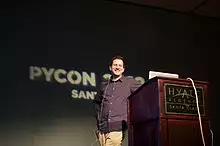
SQLAlchemy is an open-source SQL toolkit and object-relational mapper (ORM) for the Python programming language released under the MIT License.[5]
Description
SQLAlchemy's philosophy is that relational databases behave less like object collections as the scale gets larger and performance starts being a concern, while object collections behave less like tables and rows as more abstraction is designed into them. For this reason it has adopted the data mapper pattern (similar to Hibernate for Java) rather than the active record pattern used by a number of other object-relational mappers.[6] However, optional plugins allow users to develop using declarative syntax.[7]
History
SQLAlchemy was first released in February 2006[8][3] and has quickly become one of the most widely used object-relational mapping tools in the Python community, alongside Django's ORM.
Example
The following example represents an n-to-1 relationship between movies and their directors. It is shown how user-defined Python classes create corresponding database tables, how instances with relationships are created from either side of the relationship, and finally how the data can be queried—illustrating automatically generated SQL queries for both lazy and eager loading.
Schema definition
Creating two Python classes and according database tables in the DBMS:
from sqlalchemy import * from sqlalchemy.ext.declarative import declarative_base from sqlalchemy.orm import relation, sessionmaker Base = declarative_base class Movie(Base): __tablename__ = "movies" id = Column(Integer, primary_key=True) title = Column(String(255), nullable=False) year = Column(Integer) directed_by = Column(Integer, ForeignKey("directors.id")) director = relation("Director", backref="movies", lazy=False) def __init__(self, title=None, year=None): self.title = title self.year = year def __repr__(self): return "Movie(%r, %r, %r)" % (self.title, self.year, self.director) class Director(Base): __tablename__ = "directors" id = Column(Integer, primary_key=True) name = Column(String(50), nullable=False, unique=True) def __init__(self, name=None): self.name = name def __repr__(self): return "Director(%r)" % (self.name) engine = create_engine("dbms://user:pwd@host/dbname") Base.metadata.create_all(engine) Data insertion
One can insert a director-movie relationship via either entity:
Session = sessionmaker(bind=engine) session = Session m1 = Movie("Robocop", 1987) m1.director = Director("Paul Verhoeven") d2 = Director("George Lucas") d2.movies = [Movie("Star Wars", 1977), Movie("THX 1138", 1971)] try: session.add(m1) session.add(d2) session.commit except: session.rollback Querying
alldata = session.query(Movie).all for somedata in alldata: print(somedata) SQLAlchemy issues the following query to the DBMS (omitting aliases):
SELECT movies.id, movies.title, movies.year, movies.directed_by, directors.id, directors.name FROM movies LEFT OUTER JOIN directors ON directors.id = movies.directed_by The output:
Movie('Robocop', 1987L, Director('Paul Verhoeven')) Movie('Star Wars', 1977L, Director('George Lucas')) Movie('THX 1138', 1971L, Director('George Lucas')) Setting lazy=True (default) instead, SQLAlchemy would first issue a query to get the list of movies and only when needed (lazy) for each director a query to get the name of the according director:
SELECT movies.id, movies.title, movies.year, movies.directed_by FROM movies SELECT directors.id, directors.name FROM directors WHERE directors.id = %s See also
- SQLObject
- Storm
- Pylons
- TurboGears
- Cubes (OLAP server)
References
- ^ Mike Bayer is the creator of SQLAlchemy and Mako Templates for Python.
- ^ Interview Mike Bayer SQLAlchemy #pydata #python
- ^ a b "Download - SQLAlchemy". SQLAlchemy. Retrieved 21 February 2015.
- ^ "Releases - sqlalchemy/sqlalchemy". Retrieved 3 November 2020 – via GitHub.
- ^ a b "zzzeek / sqlalchemy / source / LICENSE". BitBucket. Retrieved 21 February 2015.
- ^ in The architecture of open source applications
- ^ Declarative
- ^ http://decisionstats.com/2015/12/29/interview-mike-bayer-sqlalchemy-pydata-python/
- Notes
- Gift, Noah (12 Aug 2008). "Using SQLAlchemy". Developerworks. IBM. Retrieved 8 Feb 2011.
- Rick Copeland, Essential SQLAlchemy, O'Reilly, 2008, ISBN 0-596-51614-2