MongoDB GridFS comes with some natural advantages such as scalability(sharding) and HA(replica set). But as it stores file in ASCII string chunks, there's no doubt a performance loss.
I'm trying 3 different deployments (different MongoDB drivers) to read from GridFS. And compare the results to classic Nginx configuration.
Fan Fei (feifan.pub@gmail.com)
Neil Chen (neil.chen.nj@gmail.com)
location /files/ { alias /home/ubuntu/; } open_file_cache kept off during the test.
It's a Nginx plugin based on MongoDB C driver. https://github.com/mdirolf/nginx-gridfs
I made a quick install script in this repo, run it with sudo. After Nginx is ready, modify the configration file under /usr/local/nginx/conf/nginx.conf (if you didn't change the path).
location /gridfs/{ gridfs test1 type=string field=filename; } Use /usr/local/nginx/sbin/nginx to start Nginx. And use parameter -s reload if you changed the configuration file again.
- Flask 0.10.1
- Gevent 1.0.0
- Gunicorn 0.18.0
- pymongo 2.6.3
cd flaskapp/ sudo chmod +x runflask.sh bash runflask.sh
Script runflask.sh will start gunicorn with gevnet woker mode. Gunicorn configuration file here
- Node.js 0.10.4
- Express 3.4.7
- mongodb(driver) 1.3.23
cd nodejsapp/ sudo chmod +x runnodejs.sh bash runnodejs.sh
- file served by Nginx directly
- file served by Nginx_gridFS + GridFS
- file served by Flask + pymongo + gevent + GridFS
- file served by Node.js + GridFS
Run script insert_file_gridfs.py from MongoDB server to insert 4 different size of file to database test1(pymongo is required)
- 1KB
- 100KB
- 1MB
2 servers:
- MongoDB+Application/Nginx
- tester(Apache ab/JMeter)
hardware:
- Amazon EC2 m1.medium
- Ubuntu 12.04 x64
100 concurrent requests, total 500 requests.
ab -c 100 -n 500 ...
Time per request (download)
| File size | Nginx+Hard drive | Nginx+GridFS plugin | Python(pymongo+gevent) | Node.js |
|---|---|---|---|---|
| 1KB | 0.174 | 1.124 | 1.982 | 1.679 |
| 100KB | 1.014 | 1.572 | 3.103 | 3.708 |
| 1MB | 9.582 | 9.567 | 15.973 | 18.317 |
You can get Apache ab report in folder: testresult
The server load is be monitored by command: vmstat 2
Nginx:
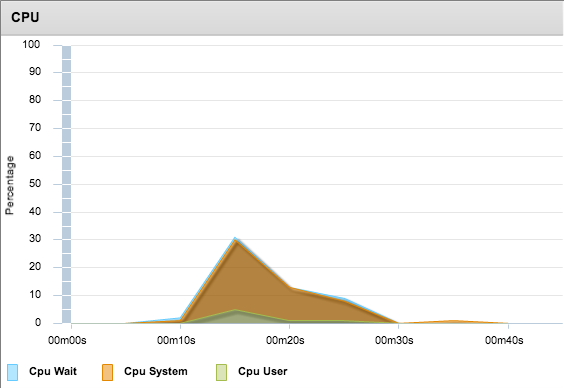
Nginx_gridfs
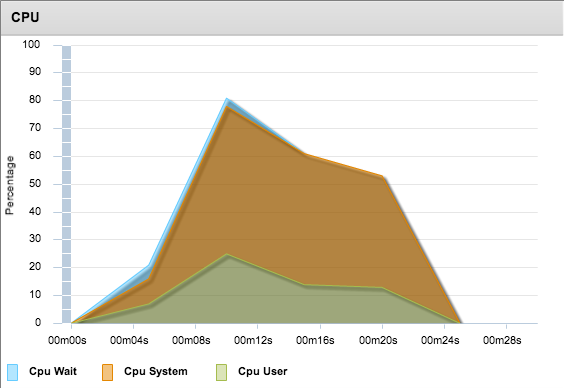
gevent+pymongo

Node.js
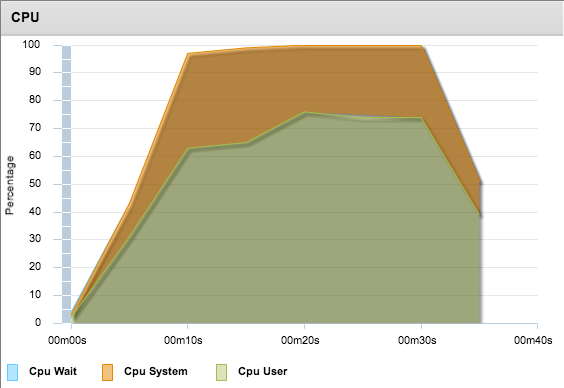
- Files served by Nginx directly
-
No doubt it's the most efficient one, whether performance or server load.
-
Support cache. In real world, the directive
open_file_cacheshould be configured well for better performance. -
And must mention, it's the only one support pause and resume during the download(HTTP range support).
-
For the rest 3 test items, files are stored in MongoDB, but served by different drivers.
- serve static files by application is really not an appropriate choice. They drains CPU too much and the performance is not good.
- nginx_gridfs (MongoDB C driver): downloading requests will be processed at Nginx level, which is in front of web applications in most deployments. Web application can focus on processing dynamic contents instead of static content.
- nginx_gridfs got the best performance comparing to other applications written in script languages. - The performance differences between Nginx and nginx_gridfs getting small after file size increased. But you can not turn a blind eye on the server load.
- pymongo and node.js driver: it's a draw game. Static files should be avoid to be served in productive applications.
- Put files in database make static content management much easier. We can omit maintain the consistency between files and its meta data in database.
- Scalable and HA advantages come with MongoDB
- bad performance
- can not resume downloading after pause or break
There are rare use cases I can imagine, especially in a performance sensitive system. But I may taste it in some prototype projects.
Here goes the answer from MongoDB official website, hope this will help. http://docs.mongodb.org/manual/faq/developers/#faq-developers-when-to-use-gridfs