A Collection of C++20 libraries, include struct_pack, struct_json, struct_xml, struct_yaml, struct_pb, easylog, coro_rpc, coro_http and async_simple



yaLanTingLibs is a collection of modern c++ util libraries, now it contains struct_pack, struct_json, struct_xml, struct_yaml, struct_pb, easylog, coro_rpc, coro_io, coro_http and async_simple, more and more cool libraries will be added into yaLanTingLibs in the future.
The target of yaLanTingLibs: provide very easy and high performance modern C++ libraries for developers, it can help to quickly build high performance applications.
| OS (Compiler Version) | Status |
|---|---|
| Ubuntu 22.04 (clang 14.0.0) |  |
| Ubuntu 22.04 (gcc 11.2.0) |  |
| macOS Monterey 12 (AppleClang 14.0.0.14000029) |  |
| Windows Server 2022 (MSVC 19.33.31630.0) |  |
If your compiler don't support C++20, yalantinglibs will only compile the serialization libraries (struct_pack, struct_json, struct_xml, struct_yaml, easylog support C++17). Make sure you have such compilers:
- g++9 above;
- clang++6 above
- msvc 14.20 above;
Otherwise, yalantinglibs will compile all the libraries. Make sure you have such compilers:
- g++10 above;
- clang++13 above
- msvc 14.29 above;
You can also use cmake option -DENABLE_CPP_20=ON or -DENABLE_CPP_20=OFF to control it.
Yalantinglibs is a head-only library. You can just copy ./include/ylt directory into your project. But we suggest you use cmake to install it.
- clone repo
git clone https://github.com/alibaba/yalantinglibs.git cd yalantinglibs mkdir build cd build- build & test
- We suggest you compile the example and test the code first:
cmake .. cmake --build . --config debug # add -j, if you have enough memory to parallel compile ctest . # run testsYou can see the test/example/benchmark executable file in ./build/output/.
- Or you can just skip build example/test/benchmark:
# You can use those option to skip build unit-test & benchmark & example: cmake .. -DBUILD_EXAMPLES=OFF -DBUILD_BENCHMARK=OFF -DBUILD_UNIT_TESTS=OFF cmake --build .- install
cmake --install . # --prefix ./user_defined_install_path - start develop
- Use Cmake:
After install ylt, copy then open the directory src/*/examples, then:
mkdir build cd build cmake .. cmake --build .- Compile Manually:
- Add
include/directory to include path(skip it if you have install ylt into system default path). - Add
include/ylt/thirdpartyto include path(skip it if you have install thirdparty independency by the cmake option -DINSTALL_INDEPENDENT_THIRDPARTY=ON). - Enable
c++20standard by option-std=c++20(g++/clang++) or/std:c++20(msvc) - If you use any header with
coro_prefix, add link option-pthreadin linux and add option-fcoroutineswhen you use g++. - That's all. We could find other options in
example/cmakelist.txt.
Very easy-to-use, coroutine-based, high performance rpc framework with C++20, more than 0.4M QPS per thread in pipeline mode. coro_rpc is a header only library.
You can finish a rpc server and rpc client in 5 minutes!
[English API] (TODO)
Talk (Chinese) of coro_rpc on purecpp conference.
Video (Chinese) on purecpp conference, start from 04:55:08 of the video record.
1.define a rpc function as a local normal function.
// rpc_service.hpp inline std::string_view echo(std::string_view str) { return str; }2.register rpc function and start a server
#include "rpc_service.hpp" #include <ylt/coro_rpc/coro_rpc_server.hpp> int main() { coro_rpc_server server(/*thread_num =*/10, /*port =*/9000); server.register_handler<echo>(); // register function echo server.start(); // start the server & block }3.rpc client call rpc service
#include "rpc_service.hpp" #include <ylt/coro_rpc/coro_rpc_client.hpp> Lazy<void> test_client() { coro_rpc_client client; co_await client.connect("localhost", /*port =*/"9000"); // connect to the server auto r = co_await client.call<echo>("hello coro_rpc"); // call remote function echo std::cout << r.result.value() << "\n"; //will print "hello coro_rpc" } int main() { syncAwait(test_client()); }More examples here.
Based on compile-time reflection, very easy to use, high performance serialization library, struct_pack is a header only library, it is used by coro_rpc now.
Only one line code to finish serialization and deserialization, 2-20x faster than protobuf.
struct person { int64_t id; std::string name; int age; double salary; }; person person1{.id = 1, .name = "hello struct pack", .age = 20, .salary = 1024.42}; // one line code serialize std::vector<char> buffer = struct_pack::serialize(person1); // one line code deserialization auto person2 = deserialize<person>(buffer);struct_pack is very fast.
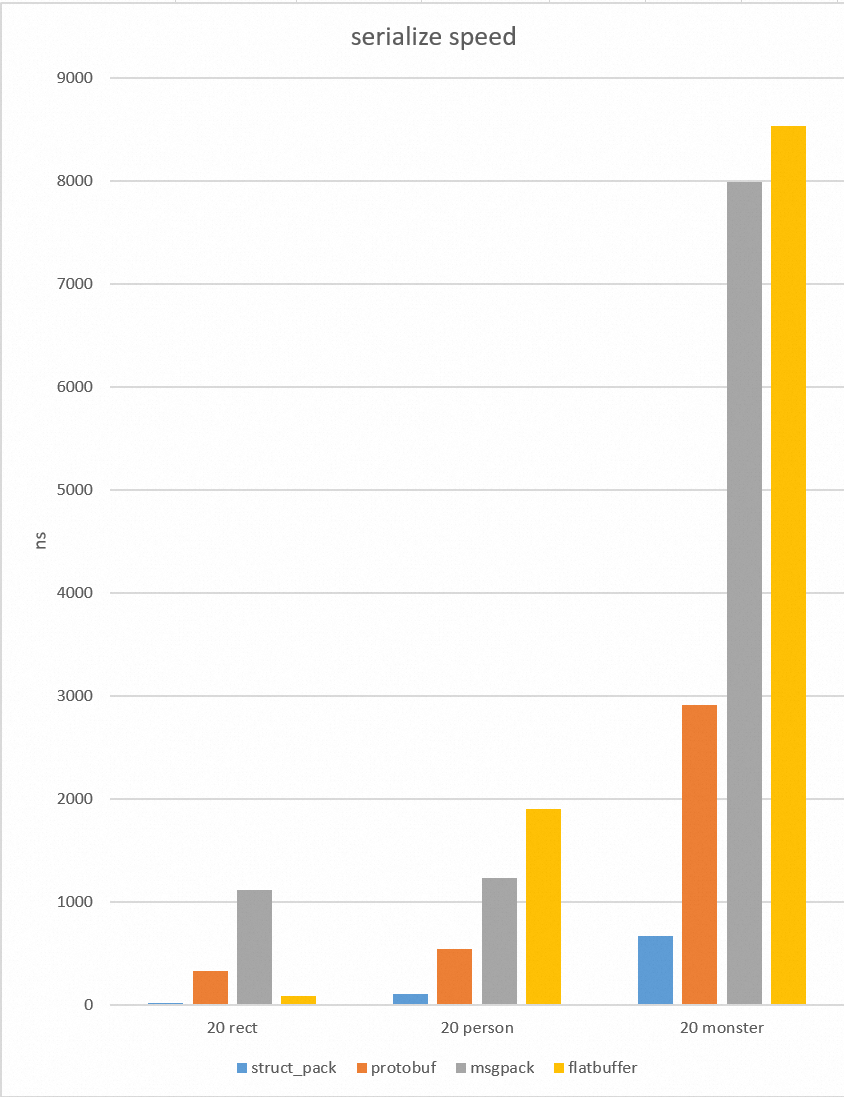
[English API] (TODO)
(Slides) A Faster Serialization Library Based on Compile-time Reflection and C++ 20 of struct_pack on CppCon2022
(Video) A Faster Serialization Library Based on Compile-time Reflection and C++ 20 on cppcon2022
(Slides)(Chinese) of struct_pack on purecpp conference.
(Video)(Chinese) on purecpp conference, start from 01:32:20 of the video record.
See more examples here.
reflection-based json lib, very easy to do struct to json and json to struct.
#include "ylt/struct_json/json_reader.h" #include "ylt/struct_json/json_writer.h" struct person { std::string name; int age; }; REFLECTION(person, name, age); int main() { person p{.name = "tom", .age = 20}; std::string str; struct_json::to_json(p, str); // {"name":"tom","age":20} person p1; struct_json::from_json(p1, str); }reflection-based xml lib, very easy to do struct to xml and xml to struct.
#include "ylt/struct_xml/xml_reader.h" #include "ylt/struct_xml/xml_writer.h" struct person { std::string name; int age; }; REFLECTION(person, name, age); void basic_usage() { std::string xml = R"( <person> <name>tom</name> <age>20</age> </person> )"; person p; bool r = struct_xml::from_xml(p, xml.data()); assert(r); assert(p.name == "tom" && p.age == 20); std::string str; r = struct_xml::to_xml_pretty(p, str); assert(r); std::cout << str; }reflection-based yaml lib, very easy to do struct to yaml and yaml to struct.
#include "ylt/struct_yaml/yaml_reader.h" #include "ylt/struct_yaml/yaml_writer.h" struct person { std::string name; int age; }; REFLECTION(person, name, age); void basic_usage() { // serialization the structure to the string person p = {"admin", 20}; std::string ss; struct_yaml::to_yaml(ss, p); std::cout << ss << std::endl; std::string yaml = R"( name : tom age : 30 )"; // deserialization the structure from the string struct_yaml::from_yaml(p, yaml); }coro_http is a C++20 coroutine http(https) client, include: get/post, websocket, multipart file upload, chunked and ranges download etc.
#include "ylt/coro_http/coro_http_client.hpp" using namespace coro_http; async_simple::coro::Lazy<void> get_post(coro_http_client &client) { std::string uri = "http://www.example.com"; auto result = co_await client.async_get(uri); std::cout << result.status << "\n"; result = co_await client.async_post(uri, "hello", req_content_type::string); std::cout << result.status << "\n"; } int main() { coro_http_client client{}; async_simple::coro::syncAwait(get_post(client)); }async_simple::coro::Lazy<void> websocket(coro_http_client &client) { client.on_ws_close([](std::string_view reason) { std::cout << "web socket close " << reason << std::endl; }); client.on_ws_msg([](resp_data data) { std::cout << data.resp_body << std::endl; }); // connect to your websocket server. bool r = co_await client.async_connect("ws://example.com/ws"); if (!r) { co_return; } co_await client.async_send_ws("hello websocket"); co_await client.async_send_ws("test again", /*need_mask = */ false); co_await client.async_send_ws_close("ws close reason"); }async_simple::coro::Lazy<void> upload_files(coro_http_client &client) { std::string uri = "http://example.com"; client.add_str_part("hello", "world"); client.add_str_part("key", "value"); client.add_file_part("test", "test.jpg"); auto result = co_await client.async_upload(uri); std::cout << result.status << "\n"; result = co_await client.async_upload(uri, "test", "test.jpg"); } async_simple::coro::Lazy<void> download_files(coro_http_client &client) { // chunked download auto result = co_await client.async_download("http://example.com/test.jpg", "myfile.jpg"); std::cout << result.status << "\n"; // ranges download result = co_await client.async_download("http://example.com/test.txt", "myfile.txt", "1-10,11-16"); std::cout << result.status << "\n"; }A C++ 20 coroutine library offering simple, light-weight and easy-to-use components to write asynchronous codes. See async_simple
These CMake options is used for yalantinglibs developing/installing itself. They are not effected for your project, because ylt is a head-only.
| option | default value |
|---|---|
| INSTALL_THIRDPARTY | ON |
| INSTALL_INDEPENDENT_THIRDPARTY | OFF |
| option | default value |
|---|---|
| BUILD_EXAMPLES | ON |
| BUILD_BENCHMARK | ON |
| BUILD_UNIT_TESTS | ON |
| BUILD_*(BUILD_CORO_RPC, BUILD_STRUCT_PACK etc) | ON |
| COVERAGE_TEST | OFF |
| GENERATE_BENCHMARK_DATA | ON |
| CORO_RPC_USE_OTHER_RPC | ON |
These option maybe useful for your project. If you want to enable it in your project, see the cmake code here
| option | default value |
|---|---|
| ENABLE_SSL | OFF |
| ENABLE_PMR | OFF |
| ENABLE_IO_URING | OFF |
| ENABLE_FILE_IO_URING | OFF |
| ENABLE_STRUCT_PACK_UNPORTABLE_TYPE | OFF |
| ENABLE_STRUCT_PACK_OPTIMIZE | OFF |
In default, yalantinglibs will install thirdparty librarys in ylt/thirdparty. You need add it to include path when compile.
If you don't want to install the thirdparty librarys, you can turn off cmake option -DINSTALL_THIRDPARTY=OFF. If you want to install the thirdparty independently (direct install it in system include path so that you don't need add ylt/thirdparty to include path), you can use turn on cmake option -DINSTALL_INDEPENDENT_THIRDPARTY=ON.
Here are the thirdparty libraries we used(Although async_simple is a part of ylt, it open source first, so we import it as a independence thirdparty library).
- asio
- async_simple
- openssl (optional)
- asio
- async_simple
- openssl (optional)
No dependency.
No dependency.
options:
./benchmark_client # [threads = hardware counts] [client_pre_thread = 20] [pipeline_size = 1] [host = 127.0.0.1] [port = 9000] [test_data_path = ./test_data/echo_test] [test_seconds = 30] [warm_up_seconds = 5]see Build Website
- Create an issue in the issue template.
- Run tests and
git-clang-format HEAD^locally for the change. - Create a PR, fill in the PR template.
- Choose one or more reviewers from contributors: (e.g., qicosmos, poor-circle, PikachuHyA).
- Get approved and merged.
DingTalk group id: 645010455
yaLanTingLibs is distributed under the Apache License (Version 2.0) This product contains various third-party components under other open-source licenses. See the NOTICE file for more information.