- This is an implementation of the VAE-GAN based on the implementation described in Autoencoding beyond pixels using a learned similarity metric
- I implement a few useful things like
- Visualizing Movement Through Z-Space
- Latent Space Algebra
- Spike Triggered Average Style Receptive Fields
- We have three networks, an Encoder, a Generator, and a Discriminator.
- The Encoder learns to map input x onto z space (latent space)
- The Generator learns to generate x from z space
- The Discriminator learns to discriminate whether the image being put in is real, or generated

- we train the network to minimize the difference between the high level features of
xandx_tilde - This is basically an autoencoder that works on high level features rather than pixels
- Adding this autoencoder to a GAN helps to stabilize the GAN
Train Encoder on minimization of:
kullback_leibler_loss(z_x, gaussian)mean_squared_error(l_x_tilde_, l_x)
Train Generator on minimization of:
kullback_leibler_loss(z_x, gaussian)mean_squared_error(l_x_tilde_, l_x)-1*log(d_x_p)
Train Discriminator on minimization of:
-1*log(d_x) + log(1 - d_x_p)
# Import all of our packages import os import numpy as np import prettytensor as pt import tensorflow as tf from tensorflow.examples.tutorials.mnist import input_data import matplotlib.pyplot as plt from deconv import deconv2d import IPython.display import math import tqdm # making loops prettier import h5py # for reading our dataset import ipywidgets as widgets from ipywidgets import interact, interactive, fixed %matplotlib inline dim1 = 64 # first dimension of input data dim2 = 64 # second dimension of input data dim3 = 3 # third dimension of input data (colors) batch_size = 32 # size of batches to use (per GPU) hidden_size = 2048 # size of hidden (z) layer to use num_examples = 60000 # how many examples are in your training set num_epochs = 10000 # number of epochs to run ### we can train our different networks with different learning rates if we want to e_learning_rate = 1e-3 g_learning_rate = 1e-3 d_learning_rate = 1e-3 - Set
gpusto a list of the GPUs you're using. The network will then split up the work between those gpus
gpus = [2] # Here I set CUDA to only see one GPU os.environ["CUDA_VISIBLE_DEVICES"]=','.join([str(i) for i in gpus]) num_gpus = len(gpus) # number of GPUs to use - open `makedataset.ipynb' for instructions on how to build the dataset
with h5py.File(''.join(['datasets/faces_dataset_new.h5']), 'r') as hf: faces = hf['images'].value headers = hf['headers'].value labels = hf['label_input'].value # Normalize the dataset between 0 and 1 faces = (faces/255.) # Just taking a look and making sure everything works plt.imshow(np.reshape(faces[1], (64,64,3)), interpolation='nearest') <matplotlib.image.AxesImage at 0x7fe6bc24ce50> 
# grab the faces back out after we've flattened them def create_image(im): return np.reshape(im,(dim1,dim2,dim3)) # Lets just take a look at our channels cm = plt.cm.hot test_face = faces[0].reshape(dim1,dim2,dim3) fig, ax = plt.subplots(nrows=1,ncols=4, figsize=(20,8)) ax[0].imshow(create_image(test_face), interpolation='nearest') ax[1].imshow(create_image(test_face)[:,:,0], interpolation='nearest', cmap=cm) ax[2].imshow(create_image(test_face)[:,:,1], interpolation='nearest', cmap=cm) ax[3].imshow(create_image(test_face)[:,:,2], interpolation='nearest', cmap=cm) <matplotlib.image.AxesImage at 0x7fe6ad0a9150> 
def data_iterator(): """ A simple data iterator """ batch_idx = 0 while True: idxs = np.arange(0, len(faces)) np.random.shuffle(idxs) for batch_idx in range(0, len(faces), batch_size): cur_idxs = idxs[batch_idx:batch_idx+batch_size] images_batch = faces[cur_idxs] #images_batch = images_batch.astype("float32") labels_batch = labels[cur_idxs] yield images_batch, labels_batch iter_ = data_iterator() iter_ = data_iterator() #face_batch, label_batch fig, ax = plt.subplots(nrows=1,ncols=4, figsize=(20,8)) ax[0].imshow(create_image(faces[labels[:,4] == 1][0]), interpolation='nearest') ax[1].imshow(create_image(faces[labels[:,4] == 1][1]), interpolation='nearest') ax[2].imshow(create_image(faces[labels[:,4] == 1][2]), interpolation='nearest') ax[3].imshow(create_image(faces[labels[:,4] == 1][3]), interpolation='nearest') <matplotlib.image.AxesImage at 0x7fe6aabff650> 
- Each of these functions represent the Encoder, Generator, and Discriminator described above.
- It would be interesting to try and implement the inception architecture to do the same thing, next time around:
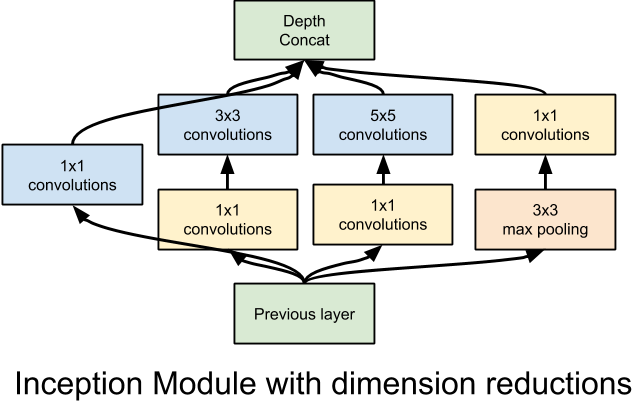
- They describe how to implement inception, in prettytensor, here: https://github.com/google/prettytensor
def encoder(X): '''Create encoder network. Args: x: a batch of flattened images [batch_size, 28*28] Returns: A tensor that expresses the encoder network # The transformation is parametrized and can be learned. # returns network output, mean, setd ''' lay_end = (pt.wrap(X). reshape([batch_size, dim1, dim2, dim3]). conv2d(5, 64, stride=2). conv2d(5, 128, stride=2). conv2d(5, 256, stride=2). flatten()) z_mean = lay_end.fully_connected(hidden_size, activation_fn=None) z_log_sigma_sq = lay_end.fully_connected(hidden_size, activation_fn=None) return z_mean, z_log_sigma_sq def generator(Z): '''Create generator network. If input tensor is provided then decodes it, otherwise samples from a sampled vector. Args: x: a batch of vectors to decode Returns: A tensor that expresses the generator network ''' return (pt.wrap(Z). fully_connected(8*8*256).reshape([batch_size, 8, 8, 256]). #(128, 4 4, 256) deconv2d(5, 256, stride=2). deconv2d(5, 128, stride=2). deconv2d(5, 32, stride=2). deconv2d(1, dim3, stride=1, activation_fn=tf.sigmoid). flatten() ) def discriminator(D_I): ''' A encodes Create a network that discriminates between images from a dataset and generated ones. Args: input: a batch of real images [batch, height, width, channels] Returns: A tensor that represents the network ''' descrim_conv = (pt.wrap(D_I). # This is what we're descriminating reshape([batch_size, dim1, dim2, dim3]). conv2d(5, 32, stride=1). conv2d(5, 128, stride=2). conv2d(5, 256, stride=2). conv2d(5, 256, stride=2). flatten() ) lth_layer= descrim_conv.fully_connected(1024, activation_fn=tf.nn.elu)# this is the lth layer D =lth_layer.fully_connected(1, activation_fn=tf.nn.sigmoid) # this is the actual discrimination return D, lth_layer - This function is based upon the inference function from tensorflows cifar tutorials
- Notice I use
with tf.variable_scope("enc"). This way, we can reuse these variables usingreuse=True. We can also specify which variables to train using which error functions based upon the labelenc
def inference(x): """ Run the models. Called inference because it does the same thing as tensorflow's cifar tutorial """ z_p = tf.random_normal((batch_size, hidden_size), 0, 1) # normal dist for GAN eps = tf.random_normal((batch_size, hidden_size), 0, 1) # normal dist for VAE with pt.defaults_scope(activation_fn=tf.nn.elu, batch_normalize=True, learned_moments_update_rate=0.0003, variance_epsilon=0.001, scale_after_normalization=True): with tf.variable_scope("enc"): z_x_mean, z_x_log_sigma_sq = encoder(x) # get z from the input with tf.variable_scope("gen"): z_x = tf.add(z_x_mean, tf.mul(tf.sqrt(tf.exp(z_x_log_sigma_sq)), eps)) # grab our actual z x_tilde = generator(z_x) with tf.variable_scope("dis"): _, l_x_tilde = discriminator(x_tilde) with tf.variable_scope("gen", reuse=True): x_p = generator(z_p) with tf.variable_scope("dis", reuse=True): d_x, l_x = discriminator(x) # positive examples with tf.variable_scope("dis", reuse=True): d_x_p, _ = discriminator(x_p) return z_x_mean, z_x_log_sigma_sq, z_x, x_tilde, l_x_tilde, x_p, d_x, l_x, d_x_p, z_p - SSE - we don't actually use this loss (also its the MSE), its just to see how close x is to x_tilde
- KL Loss - our VAE gaussian distribution loss.
- D_loss - Our descriminator loss, how good the discriminator is at telling if something is real
- G_loss - essentially the opposite of the D_loss, how good the generator is a tricking the discriminator
- notice we clip our values to make sure learning rates don't explode
def loss(x, x_tilde, z_x_log_sigma_sq, z_x_mean, d_x, d_x_p, l_x, l_x_tilde, dim1, dim2, dim3): """ Loss functions for SSE, KL divergence, Discrim, Generator, Lth Layer Similarity """ ### We don't actually use SSE (MSE) loss for anything (but maybe pretraining) SSE_loss = tf.reduce_mean(tf.square(x - x_tilde)) # This is what a normal VAE uses # We clip gradients of KL divergence to prevent NANs KL_loss = tf.reduce_sum(-0.5 * tf.reduce_sum(1 + tf.clip_by_value(z_x_log_sigma_sq, -10.0, 10.0) - tf.square(tf.clip_by_value(z_x_mean, -10.0, 10.0) ) - tf.exp(tf.clip_by_value(z_x_log_sigma_sq, -10.0, 10.0) ), 1))/dim1/dim2/dim3 # Discriminator Loss D_loss = tf.reduce_mean(-1.*(tf.log(tf.clip_by_value(d_x,1e-5,1.0)) + tf.log(tf.clip_by_value(1.0 - d_x_p,1e-5,1.0)))) # Generator Loss G_loss = tf.reduce_mean(-1.*(tf.log(tf.clip_by_value(d_x_p,1e-5,1.0))))# + #tf.log(tf.clip_by_value(1.0 - d_x,1e-5,1.0)))) # Lth Layer Loss - the 'learned similarity measure' LL_loss = tf.reduce_sum(tf.square(l_x - l_x_tilde))/dim1/dim2/dim3 return SSE_loss, KL_loss, D_loss, G_loss, LL_loss - This function is taken directly from
- Basically we're taking a list of gradients from each tower, and averaging them together
def average_gradients(tower_grads): """Calculate the average gradient for each shared variable across all towers. Note that this function provides a synchronization point across all towers. Args: tower_grads: List of lists of (gradient, variable) tuples. The outer list is over individual gradients. The inner list is over the gradient calculation for each tower. Returns: List of pairs of (gradient, variable) where the gradient has been averaged across all towers. """ average_grads = [] for grad_and_vars in zip(*tower_grads): # Note that each grad_and_vars looks like the following: # ((grad0_gpu0, var0_gpu0), ... , (grad0_gpuN, var0_gpuN)) grads = [] for g, _ in grad_and_vars: # Add 0 dimension to the gradients to represent the tower. expanded_g = tf.expand_dims(g, 0) # Append on a 'tower' dimension which we will average over below. grads.append(expanded_g) # Average over the 'tower' dimension. grad = tf.concat(0, grads) grad = tf.reduce_mean(grad, 0) # Keep in mind that the Variables are redundant because they are shared # across towers. So .. we will just return the first tower's pointer to # the Variable. v = grad_and_vars[0][1] grad_and_var = (grad, v) average_grads.append(grad_and_var) return average_grads - This is just my ugly function to regularly plot the output of my network - tensorboard would probably be a better option for this
def plot_network_output(): """ Just plots the output of the network, error, reconstructions, etc """ random_x, recon_z, all_d= sess.run((x_p, z_x_mean, d_x_p), {all_input: example_data}) top_d = np.argsort(np.squeeze(all_d)) recon_x = sess.run((x_tilde), {z_x: recon_z}) examples = 8 random_x = np.squeeze(random_x) recon_x = np.squeeze(recon_x) random_x = random_x[top_d] fig, ax = plt.subplots(nrows=3,ncols=examples, figsize=(18,6)) for i in xrange(examples): ax[(0,i)].imshow(create_image(random_x[i]), cmap=plt.cm.gray, interpolation='nearest') ax[(1,i)].imshow(create_image(recon_x[i]), cmap=plt.cm.gray, interpolation='nearest') ax[(2,i)].imshow(create_image(example_data[i + (num_gpus-1)*batch_size]), cmap=plt.cm.gray, interpolation='nearest') ax[(0,i)].axis('off') ax[(1,i)].axis('off') ax[(2,i)].axis('off') fig.suptitle('Top: random points in z space | Bottom: inputs | Middle: reconstructions') plt.show() #fig.savefig(''.join(['imgs/test_',str(epoch).zfill(4),'.png']),dpi=100) fig, ax = plt.subplots(nrows=1,ncols=1, figsize=(20,10), linewidth = 4) KL_plt, = plt.semilogy((KL_loss_list), linewidth = 4, ls='-', color='r', alpha = .5, label='KL') D_plt, = plt.semilogy((D_loss_list),linewidth = 4, ls='-', color='b',alpha = .5, label='D') G_plt, = plt.semilogy((G_loss_list),linewidth = 4, ls='-', color='k',alpha = .5, label='G') SSE_plt, = plt.semilogy((SSE_loss_list),linewidth = 4,ls='-', color='g',alpha = .5, label='SSE') LL_plt, = plt.semilogy((LL_loss_list),linewidth = 4,ls='-', color='m',alpha = .5, label='LL') axes = plt.gca() leg = plt.legend(handles=[KL_plt, D_plt, G_plt, SSE_plt, LL_plt], fontsize=20) leg.get_frame().set_alpha(0.5) plt.show() graph = tf.Graph() # Make lists to save the losses to # You should probably just be using tensorboard to do any visualization(or just use tensorboard...) G_loss_list = [] D_loss_list = [] SSE_loss_list = [] KL_loss_list = [] LL_loss_list = [] dxp_list = [] dx_list = [] With your graph, define what a step is (needed for multi-gpu), and what your optimizers are for each of your networks
with graph.as_default(): #with tf.Graph().as_default(), tf.device('/cpu:0'): # Create a variable to count number of train calls global_step = tf.get_variable( 'global_step', [], initializer=tf.constant_initializer(0), trainable=False) # different optimizers are needed for different learning rates (using the same learning rate seems to work fine though) lr_D = tf.placeholder(tf.float32, shape=[]) lr_G = tf.placeholder(tf.float32, shape=[]) lr_E = tf.placeholder(tf.float32, shape=[]) opt_D = tf.train.AdamOptimizer(lr_D, epsilon=1.0) opt_G = tf.train.AdamOptimizer(lr_G, epsilon=1.0) opt_E = tf.train.AdamOptimizer(lr_E, epsilon=1.0) tower_grads_edefines the list of gradients for the encoder for each tower- For each GPU we grab parameters corresponding to each network, we then calculate the gradients, and add them to the twoers to be averaged
with graph.as_default(): # These are the lists of gradients for each tower tower_grads_e = [] tower_grads_g = [] tower_grads_d = [] all_input = tf.placeholder(tf.float32, [batch_size*num_gpus, dim1*dim2*dim3]) KL_param = tf.placeholder(tf.float32) LL_param = tf.placeholder(tf.float32) G_param = tf.placeholder(tf.float32) # Define the network for each GPU for i in xrange(num_gpus): with tf.device('/gpu:%d' % i): with tf.name_scope('Tower_%d' % (i)) as scope: # grab this portion of the input next_batch = all_input[i*batch_size:(i+1)*batch_size,:] # Construct the model z_x_mean, z_x_log_sigma_sq, z_x, x_tilde, l_x_tilde, x_p, d_x, l_x, d_x_p, z_p = inference(next_batch) # Calculate the loss for this tower SSE_loss, KL_loss, D_loss, G_loss, LL_loss = loss(next_batch, x_tilde, z_x_log_sigma_sq, z_x_mean, d_x, d_x_p, l_x, l_x_tilde, dim1, dim2, dim3) # specify loss to parameters params = tf.trainable_variables() E_params = [i for i in params if 'enc' in i.name] G_params = [i for i in params if 'gen' in i.name] D_params = [i for i in params if 'dis' in i.name] # Calculate the losses specific to encoder, generator, decoder L_e = tf.clip_by_value(KL_loss*KL_param + LL_loss, -100, 100) L_g = tf.clip_by_value(LL_loss*LL_param+G_loss*G_param, -100, 100) L_d = tf.clip_by_value(D_loss, -100, 100) # Reuse variables for the next tower. tf.get_variable_scope().reuse_variables() # Calculate the gradients for the batch of data on this CIFAR tower. grads_e = opt_E.compute_gradients(L_e, var_list = E_params) grads_g = opt_G.compute_gradients(L_g, var_list = G_params) grads_d = opt_D.compute_gradients(L_d, var_list = D_params) # Keep track of the gradients across all towers. tower_grads_e.append(grads_e) tower_grads_g.append(grads_g) tower_grads_d.append(grads_d) with graph.as_default(): # Average the gradients grads_e = average_gradients(tower_grads_e) grads_g = average_gradients(tower_grads_g) grads_d = average_gradients(tower_grads_d) # apply the gradients with our optimizers train_E = opt_E.apply_gradients(grads_e, global_step=global_step) train_G = opt_G.apply_gradients(grads_g, global_step=global_step) train_D = opt_D.apply_gradients(grads_d, global_step=global_step) with graph.as_default(): # Start the Session init = tf.initialize_all_variables() saver = tf.train.Saver() # initialize network saver sess = tf.InteractiveSession(graph=graph,config=tf.ConfigProto(allow_soft_placement=True, log_device_placement=True)) sess.run(init) example_data, _ = iter_.next() np.shape(example_data) (32, 12288) epoch = 0 tf.train.Saver.restore(saver, sess, 'models/faces_multiGPU_64_0000.tfmod') - Importantly, notice how we define the learning rates
e_current_lr = e_learning_rate*sigmoid(np.mean(d_real),-.5,10)- we calculate the sigmoid of how the network has been performing, and squash the learning rate using a sigmoid based on that. So if the discriminator has been winning, it's learning rate will be low, and if the generator is winning, it's learning rate will be lower on the next batch.
def sigmoid(x,shift,mult): """ Using this sigmoid to discourage one network overpowering the other """ return 1 / (1 + math.exp(-(x+shift)*mult)) fig, ax = plt.subplots(nrows=1,ncols=1, figsize=(18,4)) plt.plot(np.arange(0,1,.01), [sigmoid(i/100.,-.5,10) for i in range(100)]) ax.set_xlabel('Mean of Discriminator(Real) or Discriminator(Fake)') ax.set_ylabel('Multiplier for learning rate') plt.title('Squashing the Learning Rate to balance Discrim/Gen network performance') <matplotlib.text.Text at 0x7fe065bc41d0> 
total_batch = int(np.floor(num_examples / batch_size*num_gpus)) # how many batches are in an epoch # We balance of generator and discriminators learning rate by using a sigmoid function, # encouraging the generator and discriminator be about equal d_real = .5 d_fake = .5 while epoch < num_epochs: for i in tqdm.tqdm(range(total_batch)): iter_ = data_iterator() # balence gen and descrim e_current_lr = e_learning_rate*sigmoid(np.mean(d_real),-.5,15) g_current_lr = g_learning_rate*sigmoid(np.mean(d_real),-.5,15) d_current_lr = d_learning_rate*sigmoid(np.mean(d_fake),-.5,15) next_batches, _ = iter_.next() _, _, _, D_err, G_err, KL_err, SSE_err, LL_err, d_fake,d_real = sess.run([ train_E, train_G, train_D, D_loss, G_loss, KL_loss, SSE_loss, LL_loss, d_x_p, d_x, ], { lr_E: e_current_lr, lr_G: g_current_lr, lr_D: d_current_lr, all_input: next_batches, KL_param: 1, G_param: 1, LL_param: 1 } ) #KL_err= SSE_err= LL_err = 1 # Save our lists dxp_list.append(d_fake) dx_list.append(d_real) G_loss_list.append(G_err) D_loss_list.append(D_err) KL_loss_list.append(KL_err) SSE_loss_list.append(SSE_err) LL_loss_list.append(LL_err) if i%300 == 0: # print display network output IPython.display.clear_output() print('Epoch: '+str(epoch)) plot_network_output() # save network saver.save(sess,''.join(['models/faces_multiGPU_64_',str(epoch).zfill(4),'.tfmod'])) epoch +=1 Epoch: 46 

- Just uncomment, and name it.
#saver.save(sess,''.join(['models/faces_multiGPU_64_',str(epoch).zfill(4),'.tfmod'])) - we're using jupyter widgets to slide through z-space from one point to another
n_steps = 20 examples = 10 all_x_recon = np.zeros((batch_size, dim1*dim2*dim3,n_steps)) z_point_a= np.random.normal(0,1,(batch_size,hidden_size)) z_point_b= np.random.normal(0,1,(batch_size,hidden_size)) recon_z_step = (z_point_b - z_point_a)/n_steps for i in range(n_steps): z_point_a += recon_z_step all_x_recon[:,:,i] = sess.run((x_tilde), {z_x: z_point_a}) canvas = np.zeros((dim1,dim2*examples,dim3, n_steps)) print np.shape(canvas) for f in range(n_steps): for i in range(examples): canvas[:,dim2*i:dim2*(i+1),:,f] = create_image(all_x_recon[i,:,f]) (64, 640, 3, 20) def plt_random_faces(f): fig, ax = plt.subplots(nrows=1,ncols=1, figsize=(18,12)) plt.imshow(canvas[:,:,:,f],interpolation='nearest') plt.title('This slider won\.t work in Github') plt.show() interact(plt_random_faces, f = (0,n_steps-1,1)) 
<function __main__.plt_random_faces> - We take a look at what makes a neuron respond, by taking a bunch of images, and averaging them based on how much the neuron was activated.
def norm(x): return (x - np.min(x)) / np.max(x - np.min(x)) # get a bunch of images and their corresponding z points in the network recon_z = np.random.normal(0,1,(batch_size,hidden_size)) recon_x, recon_l = sess.run((x_tilde, l_x_tilde), {z_x: recon_z}) for i in range(100): rz = np.random.normal(0,1,(batch_size,hidden_size)) rx, rl = sess.run((x_tilde, l_x_tilde), {z_x: rz}) recon_z= np.concatenate((recon_z,rz),axis = 0) recon_l = np.concatenate((recon_l,rl),axis = 0) recon_x = np.concatenate((recon_x,rx),axis = 0) num_neurons = 25 neuron = 0 fig, ax = plt.subplots(nrows=int(np.sqrt(num_neurons)),ncols=int(np.sqrt(num_neurons)), figsize=(18,12)) for a in range(int(np.sqrt(num_neurons))): for b in range(int(np.sqrt(num_neurons))): proportions = (recon_z[:,neuron] - min(recon_z[:,neuron])) / max((recon_z[:,neuron] - min(recon_z[:,neuron]))) receptive_field = norm(np.sum(([proportions[i] * recon_x[i,:] for i in range(len(proportions))]),axis = 0)/np.sum(proportions)- np.mean(recon_x,axis = 0)) ax[(a,b)].imshow(create_image(receptive_field), cmap=plt.cm.gray, interpolation='nearest') ax[(a,b)].axis('off') neuron+=1 
num_neurons = 25 neuron = 0 fig, ax = plt.subplots(nrows=int(np.sqrt(num_neurons)),ncols=int(np.sqrt(num_neurons)), figsize=(18,12)) for a in range(int(np.sqrt(num_neurons))): for b in range(int(np.sqrt(num_neurons))): proportions = (recon_l[:,neuron] - min(recon_l[:,neuron])) / max((recon_l[:,neuron] - min(recon_l[:,neuron]))) receptive_field = norm(np.sum(([proportions[i] * recon_x[i,:] for i in range(len(proportions))]),axis = 0)/np.sum(proportions)- np.mean(recon_x,axis = 0)) #test = norm(test/np.mean(test_list, axis = 0)) ax[(a,b)].imshow(create_image(receptive_field), cmap=plt.cm.gray, interpolation='nearest') ax[(a,b)].axis('off') neuron+=1 
# Here are the attribute types print [str(i) + ': ' + headers[i] for i in range(len(headers))] ['0: 5_o_Clock_Shadow', '1: Arched_Eyebrows', '2: Attractive', '3: Bags_Under_Eyes', '4: Bald', '5: Bangs', '6: Big_Lips', '7: Big_Nose', '8: Black_Hair', '9: Blond_Hair', '10: Blurry', '11: Brown_Hair', '12: Bushy_Eyebrows', '13: Chubby', '14: Double_Chin', '15: Eyeglasses', '16: Goatee', '17: Gray_Hair', '18: Heavy_Makeup', '19: High_Cheekbones', '20: Male', '21: Mouth_Slightly_Open', '22: Mustache', '23: Narrow_Eyes', '24: No_Beard', '25: Oval_Face', '26: Pale_Skin', '27: Pointy_Nose', '28: Receding_Hairline', '29: Rosy_Cheeks', '30: Sideburns', '31: Smiling', '32: Straight_Hair', '33: Wavy_Hair', '34: Wearing_Earrings', '35: Wearing_Hat', '36: Wearing_Lipstick', '37: Wearing_Necklace', '38: Wearing_Necktie', '39: Young'] # Go through a bunch of inputs, get their z values and their attributes iter_ = data_iterator() all_batch, all_attrib = iter_.next() all_z = sess.run((z_x_mean), {all_input: all_batch}) all_recon_x = sess.run((x_tilde), {z_x: all_z}) for i in range(200): next_batch, next_attrib = iter_.next() recon_z = sess.run((z_x_mean), {all_input: next_batch}) recon_x = sess.run((x_tilde), {z_x: recon_z}) all_z = np.concatenate((all_z,recon_z),axis = 0) all_batch = np.concatenate((all_batch,next_batch),axis = 0) all_recon_x = np.concatenate((all_recon_x,recon_x),axis = 0) all_attrib = np.concatenate((all_attrib,next_attrib),axis = 0) # for each attribute type, get the difference between the mean z-vector of faces with # the attribute, and without the attribute attr_vector_list = [] avg_attr_list = [] avg_not_attr_list = [] for i in range(np.shape(all_attrib)[1]): has_attribute = all_attrib[:,i] == 1 average_attribute = np.mean(all_z[has_attribute], axis=0) average_not_attribute = np.mean(all_z[has_attribute == False], axis=0) avg_attr_list.append(average_attribute) avg_not_attr_list.append(average_not_attribute) attr_vector_list.append(average_attribute - average_not_attribute) feature_to_look_at = 9 # specify the attribute we want to look at # show some faces which have this attribute recon_faces = all_recon_x[all_attrib[:,feature_to_look_at] == 1,:] new_faces = all_batch[all_attrib[:,feature_to_look_at] == 1,:] examples = 4 canvas = np.zeros((dim1*2,dim2*examples,dim3)) for i in range(examples): canvas[0:dim1,dim2*i:dim2*(i+1),:] = create_image(recon_faces[i]) canvas[dim1:,dim2*i:dim2*(i+1),:] = create_image(new_faces[i]) fig, ax = plt.subplots(nrows=1,ncols=1, figsize=(18,6)) ax.imshow(canvas) ax.axis('off') (-0.5, 255.5, 127.5, -0.5) 
recon_z = np.random.normal(0,1,(batch_size,hidden_size)) recon_x = sess.run((x_tilde), {z_x: recon_z}) recon_z_with_attribute = [recon_z[i] + attr_vector_list[feature_to_look_at] for i in range(len(recon_z))] recon_x_with_attribute = sess.run((x_tilde), {z_x: recon_z_with_attribute}) examples = 12 canvas = np.zeros((dim1*2,dim2*examples,dim3)) for i in range(examples): canvas[:dim1,dim2*i:dim2*(i+1),:] = create_image(recon_x[i]) canvas[dim1:,dim2*i:dim2*(i+1),:] = create_image(recon_x_with_attribute[i]) fig, ax = plt.subplots(nrows=1,ncols=1, figsize=(18,6)) ax.imshow(canvas) ax.axis('off') plt.title('Top: random points in z space | Bottom: random points + blonde vector') <matplotlib.text.Text at 0x7fe6a0f1a310> 
recon_z = np.random.normal(0,1,(batch_size,hidden_size)) recon_z[0] = avg_attr_list[feature_to_look_at] recon_z[1] = avg_not_attr_list[feature_to_look_at] recon_z[2] = attr_vector_list[feature_to_look_at] recon_x = sess.run((x_tilde), {z_x: recon_z}) examples = 3 canvas = np.zeros((dim1,dim2*examples,dim3)) for i in range(examples): canvas[:,dim2*i:dim2*(i+1),:] = create_image(recon_x[i]) fig, ax = plt.subplots(nrows=1,ncols=1, figsize=(18,6)) ax.imshow(canvas) ax.axis('off') plt.title('Average Blonde Person | Average Not Blonde Person | ABP-ANBP') <matplotlib.text.Text at 0x7fe0c4218f10> 
- Autoencoding beyond pixels (Github)
- VAE and GAN implementations in prettytensor/tensorflow (Github)
- Tensorflow VAE tutorial
- DCGAN (Github)
- Torch GAN tutorial (Github)
- Open AI improving GANS (Github)
- Other things which I am probably forgetting...
# this is just a little command to convert this as md for the github page !jupyter nbconvert --to markdown VAE-GAN-multi-gpu-celebA.ipynb !mv VAE-GAN-multi-gpu-celebA.md readme.md [NbConvertApp] Converting notebook VAE-GAN-multi-gpu-celebA.ipynb to markdown [NbConvertApp] Support files will be in VAE-GAN-multi-gpu-celebA_files/ [NbConvertApp] Making directory VAE-GAN-multi-gpu-celebA_files [NbConvertApp] Making directory VAE-GAN-multi-gpu-celebA_files [NbConvertApp] Making directory VAE-GAN-multi-gpu-celebA_files [NbConvertApp] Making directory VAE-GAN-multi-gpu-celebA_files [NbConvertApp] Making directory VAE-GAN-multi-gpu-celebA_files [NbConvertApp] Making directory VAE-GAN-multi-gpu-celebA_files [NbConvertApp] Making directory VAE-GAN-multi-gpu-celebA_files [NbConvertApp] Making directory VAE-GAN-multi-gpu-celebA_files [NbConvertApp] Making directory VAE-GAN-multi-gpu-celebA_files [NbConvertApp] Making directory VAE-GAN-multi-gpu-celebA_files [NbConvertApp] Making directory VAE-GAN-multi-gpu-celebA_files [NbConvertApp] Making directory VAE-GAN-multi-gpu-celebA_files [NbConvertApp] Writing 34120 bytes to VAE-GAN-multi-gpu-celebA.md