A library written in Python3 for Polar Codes, a capacity-achieving channel coding technique used in 5G. The library includes functions for construction, encoding, decoding, and simulation of polar codes. In addition, it supports puncturing and shortening.
It provides:
- a systematic and non-systemic encoder.
- non-recursive implementations of the successive cancellation decoder (SCD).
- mothercode construction of polar codes using Bhattacharyya Bounds or Gaussian Approximation
- support for puncturing and shortening.
- Bit-Reversal Shortening (BRS), Wang-Liu Shortening (WLS), and Bioglio-Gabry-Land (BGL) shortening constructions.
- an AWGN channel with BPSK modulation.
- an easy-to-use Graphical User Interface (GUI)
Documentation:
- Main reference (pdf)
- Quick reference (website)
- Introduction to polar codes, shortening, and the library: http://www.youtube.com/watch?v=v47rn77RAxM
- Install the package with
pip install py-polar-codesfrom https://pypi.org/project/py-polar-codes/. - Install matplotlib from https://matplotlib.org/users/installing.html.
- Install numpy from https://docs.scipy.org/doc/numpy/user/install.html.
- Run test.py using a Python3 compiler. If the program runs successfully, the library is ready to use. Make sure the compiler has writing access to directory "root/data", where simulation data will be saved by default.
- Call
GUI()to start the GUI.
An example of encoding and decoding over an AWGN channel for a (256,100) non-systematic mothercode, using Bhattacharyya Bounds for construction and SCD for decoding. For systematic encoding and decoding, replace Encode(myPC) with Encode(myPC, 'systematic_encode') and Decode(myPC) with Decode(myPC, 'systematic_scd').
import numpy as np from polarcodes import * # initialise polar code myPC = PolarCode(256, 100) myPC.construction_type = 'bb' # mothercode construction design_SNR = 5.0 Construct(myPC, design_SNR) print(myPC, "\n\n") # set message my_message = np.random.randint(2, size=myPC.K) myPC.set_message(my_message) print("The message is:", my_message) # encode message Encode(myPC) print("The coded message is:", myPC.get_codeword()) # transmit the codeword AWGN(myPC, design_SNR) print("The log-likelihoods are:", myPC.likelihoods) # decode the received codeword Decode(myPC) print("The decoded message is:", myPC.message_received)An example of constructing a shortened polar code with Bit-Reversal Shortening (BRS) algorithm. The shortening parameters are set by the tuple shorten_params, the third argument of PolarCode, and is defined by:
- Puncturing type:
shortenorpunct. - Puncturing algorithm:
brs,wls, orbgl. - Puncturing set (for manual puncturing):
ndarray<int> - Overcapable set (for manual puncturing):
ndarray<int> - Update reliabilities after puncturing (or use mothercode reliabilities):
TrueorFalse.
import numpy as np from polarcodes import * # initialise shortened polar code shorten_params = ('shorten', 'brs', None, None, False) myPC = PolarCode(200, 100, shorten_params) # construction design_SNR = 5.0 Shorten(myPC, design_SNR) print(myPC, "\n\n")A script to simulate a defined polar code, save the data to directory "/data", and then display the result in a matplotlib figure.
# simulate polar code myPC.simulate(save_to='data/pc_sim', Eb_No_vec=np.arange(1,5), manual_const_flag=True) # plot the frame error rate myPC.plot(['pc_sim'], 'data/')The simulation will save your PolarCode object in a JSON file, for example:
{ "N": 64, "n": 6, "K": 32, "frozen": [ 22, 38, 49, 26, 42, 3, 28, 50, 5,44,9, 52, 6, 17, 10, 33, 56, 18, 12, 34, 20, 36, 1, 24, 40, 48, 2, 4, 8, 16, 32, 0 ], "construction_type": "bb", "punct_flag": false, "punct_type": "", "punct_set": [], "source_set": [], "punct_algorithm": "", "update_frozen_flag": [], "BER": [ 0.09709375, 0.03740625, 0.00815625, 0.0010184612211221122 ], "FER": [ 0.313, 0.126, 0.03,0.004125412541254125 ], "SNR": [ 1, 2, 3, 4 ] }An example of using the GUI to simulate and plot a specified polar code. Note: if "manual construction" is ticked, the user is required to input the frozen bits and the shortened bits. 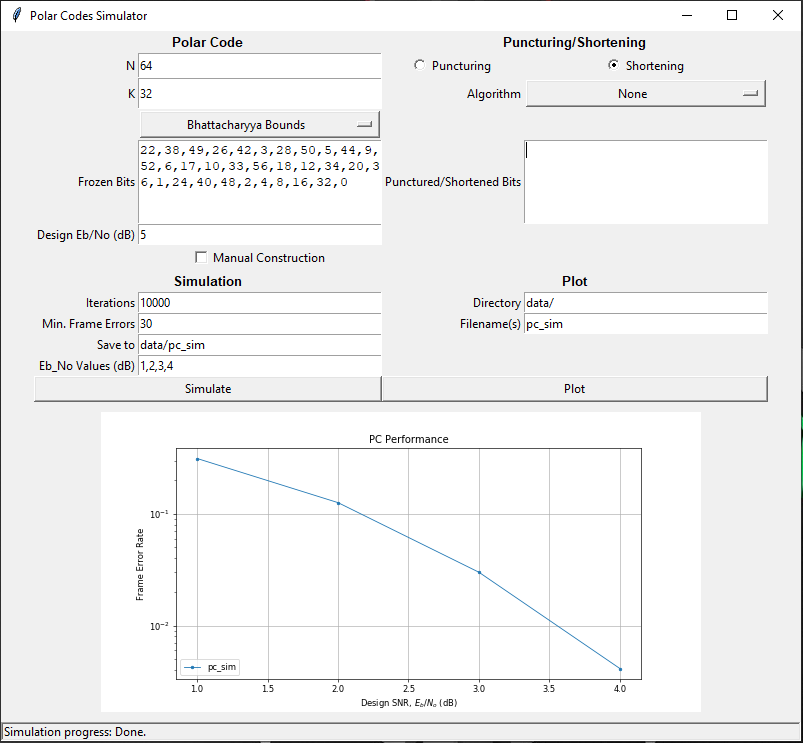
This is a final year project created by Brendon McBain under the supervision of Dr Harish Vangala at Monash University.