Consider switching to Public Fault Tree Analyser (PFTA). PFTA operates under the more general framework where objects can have both a failure probability and a failure intensity.
A slow (also shitty) fault tree analyser inspired by the idea presented in:
- Wheeler et al. (1977). Fault Tree Analysis Using Bit Manipulation. IEEE Transactions on Reliability, Volume R-26, Issue 2. <https://doi.org/10.1109/TR.1977.5220060>
SFTA reads a textual representation of a fault tree. For example:
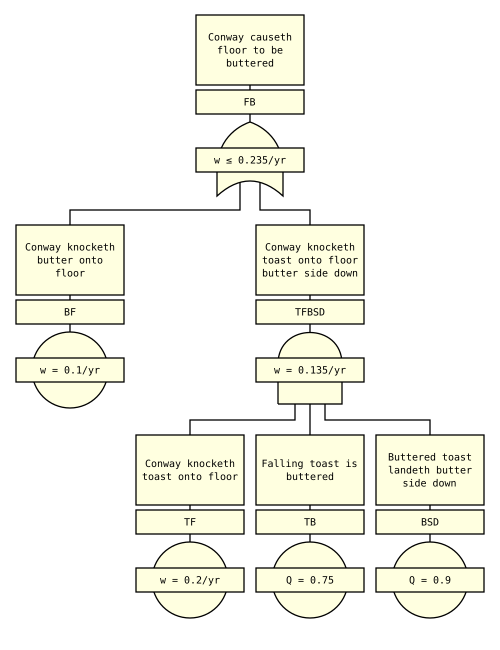
- time_unit: yr Gate: FB - label: Conway causeth floor to be buttered - type: OR - inputs: BF, TFBSD Event: BF - label: Conway knocketh butter onto floor - rate: 0.1 Gate: TFBSD - label: Conway knocketh toast onto floor butter side down - type: AND - inputs: TF, TB, BSD Event: TF - label: Conway knocketh toast onto floor - rate: 0.2 Event: TB - label: Falling toast is buttered - probability: 0.75 Event: BSD - label: Buttered toast landeth butter side down - probability: 0.9This allows for sensible diffing between two versions of a fault tree.
Output consists of:
- an events summary,
- a gates summary,
- cut set listings, and
- SVGs for all top gates and paged gates.
For the example above, we get the following SVG for the top gate FB:
-
Only supports coherent fault trees, which have only AND gates and OR gates.
-
Enforces the naive "initiator-equals-rate" paradigm. Specifically:
- For an AND gate, the first input may be a probability or a rate, but all subsequent inputs must be probabilities.
- For an OR gate, all inputs must be the same type (all probability or all rate).
-
The probability or rate for a gate is approximated by simply summing the contributions from each minimal cut set (rare event approximation). The higher-order terms (subtraction of pairwise intersections, addition of triplet-wise intersections, etc.) have been neglected. This is conservative, as the first-order sum is an upper bound for the actual probability or rate.
$ pip3 install sfta- If simply using as a command line tool, do
pipxinstead ofpip3to avoid having to set up a virtual environment. - If using Windows, do
pipinstead ofpip3.
$ sfta [-h] [-v] ft.txt Perform a slow fault tree analysis. positional arguments: ft.txt name of fault tree text file; output is written unto the directory `{ft.txt}.out/` optional arguments: -h, --help show this help message and exit -v, --version show program's version number and exitfrom sfta.core import FaultTree, Gate fault_tree = FaultTree(''' Event: A - rate: 0.9 Event: B - probability: 0.7 Event: C - rate: 1e-4 Gate: AB - label: This be an AND gate. - type: AND - inputs: A, B Gate: AB_C - label: This be an OR gate. - type: OR - inputs: AB, C ''') fault_tree.gate_from_id['AB'].quantity_value # 0.63 fault_tree.gate_from_id['AB_C'].quantity_value # 0.6301 fault_tree.gate_from_id['AB_C'].input_ids # ['AB', 'C'] fault_tree.gate_from_id['AB_C'].type_ == Gate.TYPE_OR # TrueCopyright 2022–2024 Conway
Licensed under the GNU General Public License v3.0 (GPL-3.0-only).
This is free software with NO WARRANTY etc. etc., see LICENSE.