Any two rectilinear figures with equal area can be dissected into a finite number of pieces to form each other. This is the Wallace-Bolyai-Gerwien theorem. For minimal dissections of a triangle, pentagon, and octagon into a square, see Stewart (1987, pp. 169-170) and Ball and Coxeter (1987, pp. 89-91). The triangle to square dissection (haberdasher's problem) is particularly interesting because it can be built from hinged pieces which can be folded and unfolded to yield the two shapes (Gardner 1961; Stewart 1987, p. 169; Pappas 1989; Steinhaus 1999, pp. 3-4; Wells 1991, pp. 61-62).
Laczkovich (1988) proved that the circle can be squared in a finite number of dissections (). Furthermore, any shape whose boundary is composed of smoothly curving pieces can be dissected into a square.
The situation becomes considerably more difficult moving from two dimensions to three dimensions. In general, a polyhedron cannot be dissected into other polyhedra of a specified type. A cubecan be dissected into cubes, where is any integer. In 1900, Dehn proved that not every prism can be dissected into a tetrahedron (Lenhard 1962, Ball and Coxeter 1987). The third of Hilbert's problems asks for the determination of two tetrahedra which are not equidecomposable by dissection into congruent tetrahedra directly or by adjoining congruent tetrahedra. Dehn (1900, 1902) showed this could not be done, and Kagan (1903) obtained the same result independently shortly thereafter. A quantity growing out of Dehn's work which can be used to analyze the possibility of performing a given solid dissection is the Dehn invariant.
The table below is an updated version of the one given in Gardner (1991, p. 50). Many of the improvements are due to G. Theobald (Frederickson 1997). The minimum number of pieces known to dissect a regular -gon (where is a number in the first column) into a -gon (where is a number is the bottom row) is read off by the intersection of the corresponding row and column. In the table, denotes a regular -gon, GR a golden rectangle, GC a Greek cross, LC a Latin cross, a five-point star (solid pentagram), a six-point star (i.e., hexagram or filled star of David), and the solid octagram.
There is some debate as to the permissibility of flipping pieces. While it is reasonable to prefer an unflipped dissection over a flipped one if both use the same number of pieces, it is also reasonable to separately list the best known dissections flipped and unflipped when the number of pieces differ (G. Frederickson, pers. comm. to G. Theobald). The following table therefore indicates such dissections as flipped/unflipped if a dissections involving one or more flipped pieces is known that uses fewer pieces that the best known unflipped dissection.
GR
GC
LC
4
6
6
5
5
7
8
7
9
8
7
5
8/9
8
10/11
8
9
10
10/11
13
12
7
7
9
8/9
11
10
13
8
6
10
6
11
10
13/14
11/12
GR
4
3
6
5
7
6
9
6
7
GC
5
4
7
7
9
9
11
10
6
5
LC
5
5
8
6
8
8
10
10
7
5
7
7
7
9
9
11
10
14
6
12
7
10
10
5
5
8
6
9
8
11
9
9
5
8
8
10
8
8
9
8/9
12
6
13
12
12
7
10
11
13
10
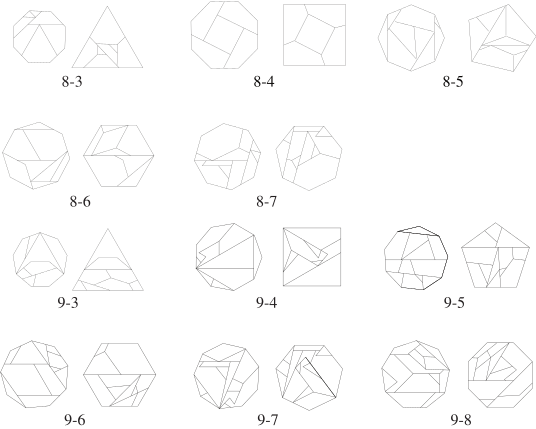
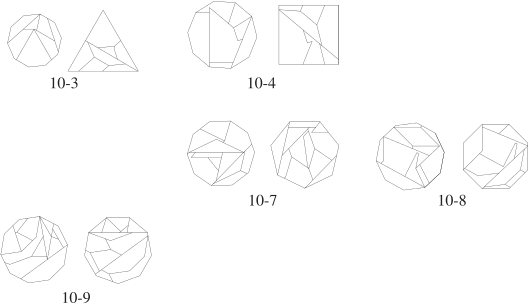
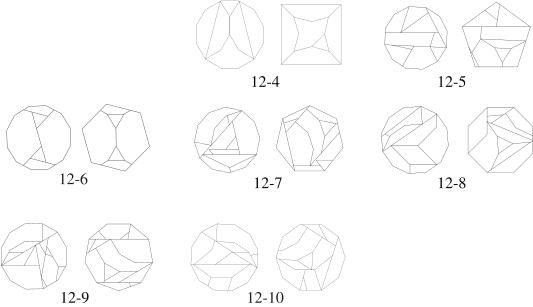
Wells (1991) gives several attractive dissections of the regular dodecagon. The best-known dissections of one regular convex -gon into another are shown for , 4, 5, 6, 7, 8, 9, 10, and 12 in the following illustrations due to Theobald.
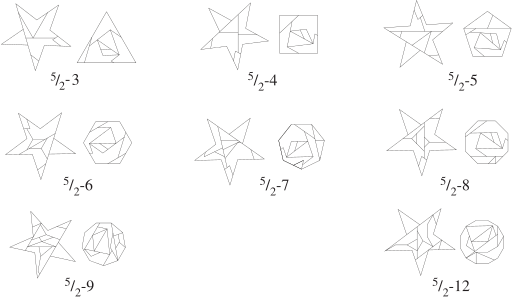
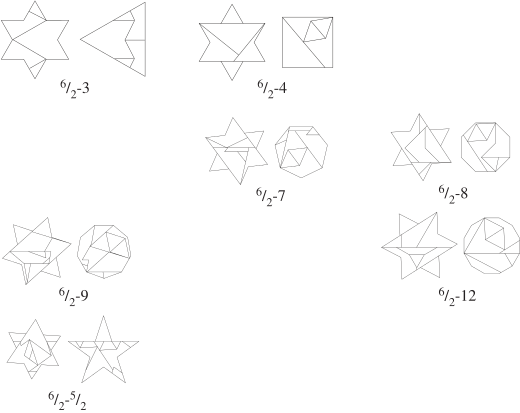
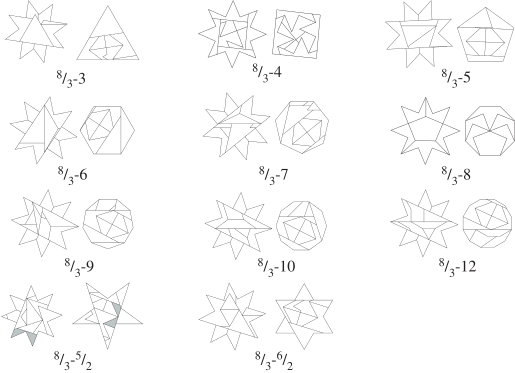
The best-known dissections of regular concave polygons are illustrated below for , , and (Theobald).
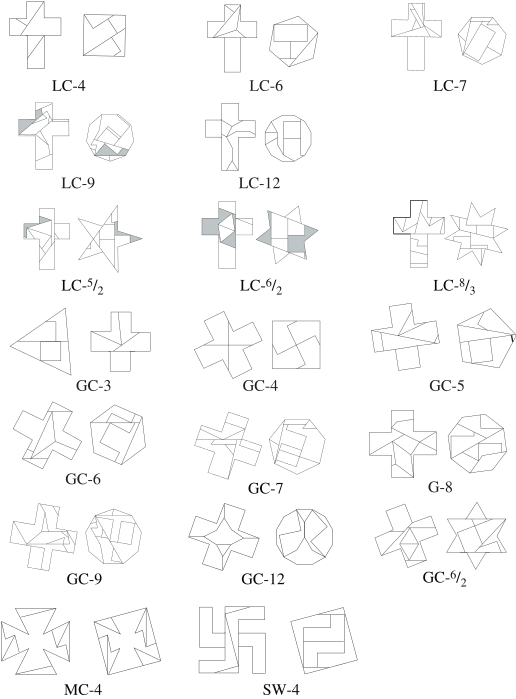
The best-known dissections of various crosses are illustrated below (Theobald).
The best-known dissections of the golden rectangle are illustrated below (Theobald).



 ). Furthermore, any shape whose boundary is composed of smoothly curving pieces can be dissected into a square.
  cubes, where
  is any integer. In 1900, Dehn proved that not every prism can be dissected into a tetrahedron (Lenhard 1962, Ball and Coxeter 1987). The third of Hilbert's problems asks for the determination of two tetrahedra which are not equidecomposable by dissection into congruent tetrahedra directly or by adjoining congruent tetrahedra. Dehn (1900, 1902) showed this could not be done, and Kagan (1903) obtained the same result independently shortly thereafter. A quantity growing out of Dehn's work which can be used to analyze the possibility of performing a given solid dissection is the Dehn invariant.
  -gon (where
  is a number in the first column) into a
  -gon (where
  is a number is the bottom row) is read off by the intersection of the corresponding row and column. In the table,
  denotes a regular
  -gon, GR a golden rectangle, GC a Greek cross, LC a Latin cross,
  a five-point star (solid pentagram),
  a six-point star (i.e., hexagram or filled star of David), and
  the solid octagram.


 -gon into another are shown for
  , 4, 5, 6, 7, 8, 9, 10, and 12 in the following illustrations due to Theobald.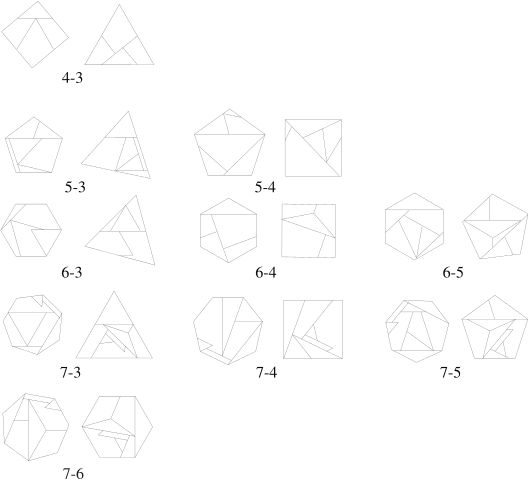
 ,
,  , and
, and  (Theobald).