


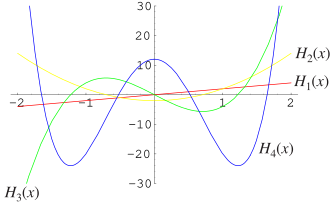
The Hermite polynomials  are set of orthogonal polynomials over the domain
  with weighting function
  , illustrated above for
  , 2, 3, and 4. Hermite polynomials are implemented in the Wolfram Language as HermiteH[n, x].
The Hermite polynomial  can be defined by the contour integral
 | (1) |
where the contour encloses the origin and is traversed in a counterclockwise direction (Arfken 1985, p. 416).
The first few Hermite polynomials are
 |  |  | (2) |
 |  |  | (3) |
 |  |  | (4) |
 |  |  | (5) |
 |  |  | (6) |
 |  |  | (7) |
 |  |  | (8) |
 |  |  | (9) |
 |  |  | (10) |
 |  |  | (11) |
 |  |  | (12) |
When ordered from smallest to largest powers, the triangle of nonzero coefficients is 1; 2; -2, 4; -12, 8; 12, -48, 16; 120, -160, 32; ... (OEIS A059343).
The values  may be called Hermite numbers.
The Hermite polynomials are a Sheffer sequence with
 |  |  | (13) |
 |  |  | (14) |
(Roman 1984, p. 30), giving the exponential generating function
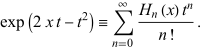 | (15) |
Using a Taylor series shows that
 |  | ![[(partial/(partialt))^nexp(2xt-t^2)]_(t=0)](http://mathworld.wolfram.com/images/equations/HermitePolynomial/Inline48.svg) | (16) |
 |  | ![[e^(x^2)(partial/(partialt))^ne^(-(x-t)^2)]_(t=0).](http://mathworld.wolfram.com/images/equations/HermitePolynomial/Inline51.svg) | (17) |
Since  ,
,
 |  | ![(-1)^ne^(x^2)[(partial/(partialx))^ne^(-(x-t)^2)]_(t=0)](http://mathworld.wolfram.com/images/equations/HermitePolynomial/Inline55.svg) | (18) |
 |  | 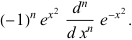 | (19) |
Now define operators
 |  |  | (20) |
 |  | 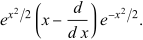 | (21) |
It follows that
 |  | ![-e^(x^2)d/(dx)[fe^(-x^2)]](http://mathworld.wolfram.com/images/equations/HermitePolynomial/Inline67.svg) | (22) |
 |  |  | (23) |
 |  | ![e^(x^2/2)(x-d/(dx))[fe^(-x^2/2)]](http://mathworld.wolfram.com/images/equations/HermitePolynomial/Inline73.svg) | (24) |
 |  | 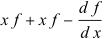 | (25) |
 |  |  | (26) |
so
 | (27) |
and
 | (28) |
(Arfken 1985, p. 720), which means the following definitions are equivalent:
 |  |  | (29) |
 |  | 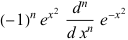 | (30) |
 |  | 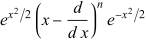 | (31) |
(Arfken 1985, pp. 712-713 and 720).
The Hermite polynomials may be written as
 |  |  | (32) |
 |  |  | (33) |
(Koekoek and Swarttouw 1998), where  is a confluent hypergeometric function of the second kind, which can be simplified to
 | (34) |
in the right half-plane ![R[z]>0](http://mathworld.wolfram.com/images/equations/HermitePolynomial/Inline96.svg) .
.
The Hermite polynomials are related to the derivative of erf by
 | (35) |
They have a contour integral representation
 | (36) |
They are orthogonal in the range  with respect to the weighting function
 | (37) |
The Hermite polynomials satisfy the symmetry condition
 | (38) |
They also obey the recurrence relations
 | (39) |
 | (40) |
By solving the Hermite differential equation, the series
 |  | ![(-1)^k2^k(2k-1)!![1+sum_(j=1)^(k)((-4k)(-4k+4)...(-4k+4j-4))/((2j)!)x^(2j)]](http://mathworld.wolfram.com/images/equations/HermitePolynomial/Inline101.svg) | (41) |
 |  |  | (42) |
 |  | ![(-1)^k2^(k+1)(2k+1)!![x+sum_(j=1)^(k)((-4k)(-4k+4)...(-4k+4j-4))/((2j+1)!)x^(2j+1)]](http://mathworld.wolfram.com/images/equations/HermitePolynomial/Inline107.svg) | (43) |
 |  |  | (44) |
are obtained, where the products in the numerators are equal to
 | (45) |
with  the Pochhammer symbol.
Let a set of associated functions be defined by
 | (46) |
then the  satisfy the orthogonality conditions
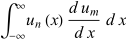 |  | 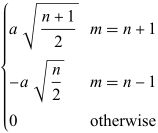 | (47) |
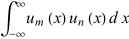 |  |  | (48) |
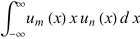 |  | 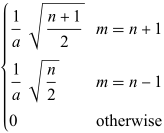 | (49) |
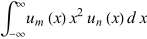 |  | 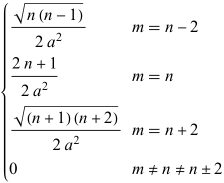 | (50) |
 |  | 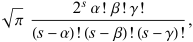 | (51) |
if  is even and
  ,
,  , and
, and  . Otherwise, the last integral is 0 (Szegö 1975, p. 390). Another integral is
 | (52) |
where  and
and  is a binomial coefficient (T. Drane, pers. comm., Feb. 14, 2006).
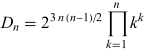
The polynomial discriminant is
 | (53) |
(Szegö 1975, p. 143), a normalized form of the hyperfactorial, the first few values of which are 1, 32, 55296, 7247757312, 92771293593600000, ... (OEIS A054374). The table of resultants is given by  ,
,  ,
,  ,
,  , ... (OEIS A054373).
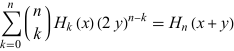
Two interesting identities involving  are given by
 | (54) |
and
 | (55) |
(G. Colomer, pers. comm.). A very pretty identity is
 | (56) |
where  (T. Drane, pers. comm., Feb. 14, 2006).
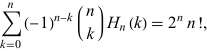
They also obey the sum
 | (57) |
as well as the more complicated
![H_n(x)=H_n+sum_(m=0)^(|_n/2_|)[sum_(k=1)^(n-2m)(-1)^kS(n-2m,k)(-x)_k]×((-1)^m2^(n-2m)n!)/((n-2m)!m!),](http://mathworld.wolfram.com/images/equations/HermitePolynomial/NumberedEquation20.svg) | (58) |
where  is a Hermite number,
  is a Stirling number of the second kind, and
  is a Pochhammer symbol (T. Drane, pers. comm., Feb. 14, 2006).
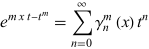
A class of generalized Hermite polynomials  satisfying
 | (59) |
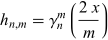
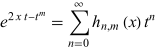
was studied by Subramanyan (1990). A class of related polynomials defined by
 | (60) |
and with generating function
 | (61) |
was studied by Djordjević (1996). They satisfy
 | (62) |
Roman (1984, pp. 87-93) defines a generalized Hermite polynomial  with variance
  .
.
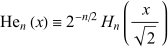
A modified version of the Hermite polynomial is sometimes (but rarely) defined by
 | (63) |
(Jörgensen 1916; Magnus and Oberhettinger 1948; Slater 1960, p. 99; Abramowitz and Stegun 1972, p. 778). The first few of these polynomials are given by
 |  |  | (64) |
 |  |  | (65) |
 |  |  | (66) |
 |  |  | (67) |
 |  |  | (68) |
When ordered from smallest to largest powers, the triangle of nonzero coefficients is 1; 1;  , 1;
, 1;  , 1; 3,
  , 1; 15,
  , 1; ... (OEIS A096713). The polynomial
  is the independence polynomial of the complete graph
  .
.

 -Analogue. Delft, Netherlands: Technische Universiteit Delft, Faculty of Technical Mathematics and Informatics Report 98-17, pp. 50-51, 1998.Magnus, W. and Oberhettinger, F. Ch. 5 in Formeln und Sätze für die speziellen Funktionen der mathematischen Physik, 2nd ed. Berlin: Springer-Verlag, 1948.Roman, S. "The Hermite Polynomials." §4.2.1 in
  ." Ch. 24 in