

Orthogonal polynomials are classes of polynomials  defined over a range
 ![[a,b]](http://mathworld.wolfram.com/images/equations/OrthogonalPolynomials/Inline2.svg) that obey an orthogonality relation
that obey an orthogonality relation
 | (1) |
where  is a weighting function and
  is the Kronecker delta. If
  , then the polynomials are not only orthogonal, but orthonormal.
Orthogonal polynomials have very useful properties in the solution of mathematical and physical problems. Just as Fourier series provide a convenient method of expanding a periodic function in a series of linearly independent terms, orthogonal polynomials provide a natural way to solve, expand, and interpret solutions to many types of important differential equations. Orthogonal polynomials are especially easy to generate using Gram-Schmidt orthonormalization.
A table of common orthogonal polynomials is given below, where  is the weighting function and
![c_n=int_a^bw(x)[p_n(x)]^2dx](http://mathworld.wolfram.com/images/equations/OrthogonalPolynomials/NumberedEquation2.svg) | (2) |
(Abramowitz and Stegun 1972, pp. 774-775).


![[-1,1]](http://mathworld.wolfram.com/images/equations/OrthogonalPolynomials/Inline9.svg)

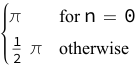
![[-1,1]](http://mathworld.wolfram.com/images/equations/OrthogonalPolynomials/Inline12.svg)


![[-1,1]](http://mathworld.wolfram.com/images/equations/OrthogonalPolynomials/Inline15.svg)

![{(2^(1-2alpha)piGamma(n+2alpha))/(n!(n+alpha)[Gamma(alpha)]^2) for alpha!=0; (2pi)/(n^2) for alpha=0.](http://mathworld.wolfram.com/images/equations/OrthogonalPolynomials/Inline17.svg)





![[-1,1]](http://mathworld.wolfram.com/images/equations/OrthogonalPolynomials/Inline29.svg)

In the above table,
 | (3) |
where  is a gamma function.
The roots of orthogonal polynomials possess many rather surprising and useful properties. For instance, let  be the roots of the
  with
with  and
and  . Then each interval
 ![[x_nu,x_(nu+1)]](http://mathworld.wolfram.com/images/equations/OrthogonalPolynomials/Inline36.svg) for
for  , 1, ...,
  contains exactly one root of
  . Between two roots of
  there is at least one root of
  for
for  .
.
Let  be an arbitrary real constant, then the polynomial
 | (4) |
has  distinct real roots. If
  (
( ), these roots lie in the interior of
 ![[a,b]](http://mathworld.wolfram.com/images/equations/OrthogonalPolynomials/Inline47.svg) , with the exception of the greatest (least) root which lies in
, with the exception of the greatest (least) root which lies in ![[a,b]](http://mathworld.wolfram.com/images/equations/OrthogonalPolynomials/Inline48.svg) only for
only for
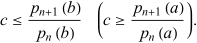 | (5) |
The following decomposition into partial fractions holds
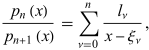 | (6) |
where  are the roots of
  and
and
 |  |  | (7) |
 |  | ![(p_(n+1)^'(xi_nu)p_n(xi_nu)-p_n^'(xi_nu)^'p_(n+1)(xi_nu))/([p_(n+1)^'(xi_nu)]^2)>0.](http://mathworld.wolfram.com/images/equations/OrthogonalPolynomials/Inline56.svg) | (8) |
Another interesting property is obtained by letting  be the orthonormal set of polynomials associated with the distribution
  on
on ![[a,b]](http://mathworld.wolfram.com/images/equations/OrthogonalPolynomials/Inline59.svg) . Then the convergents
. Then the convergents  of the continued fraction
 | (9) |
are given by
 |  |  | (10) |
 |  |  | (11) |
 |  |  | (12) |
where  , 1, ... and
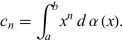 | (13) |
Furthermore, the roots of the orthogonal polynomials  associated with the distribution
  on the interval
 ![[a,b]](http://mathworld.wolfram.com/images/equations/OrthogonalPolynomials/Inline73.svg) are real and distinct and are located in the interior of the interval
are real and distinct and are located in the interior of the interval ![[a,b]](http://mathworld.wolfram.com/images/equations/OrthogonalPolynomials/Inline74.svg) .
.

 -Analogue. Delft, Netherlands: Technische Universiteit Delft, Faculty of Technical Mathematics and Informatics Report 98-17, 1-168, 1998.Nikiforov, A. F.; Uvarov, V. B.; and Suslov, S. S.