


The Zernike polynomials are a set of orthogonal polynomials that arise in the expansion of a wavefront function for optical systems with circular pupils. The odd and even Zernike polynomials are given by
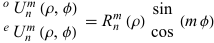 | (1) |
where the radial function  is defined for
  and
and  integers with
  by
by
![R_n^m(rho)={sum_(l=0)^((n-m)/2)((-1)^l(n-l)!)/(l![1/2(n+m)-l]![1/2(n-m)-l]!)rho^(n-2l) for n-m even; 0 for n-m odd.](http://mathworld.wolfram.com/images/equations/ZernikePolynomial/NumberedEquation2.svg) | (2) |
Here,  is the azimuthal angle with
  and
and  is the radial distance with
  (Prata and Rusch 1989). The even and odd polynomials are sometimes also denoted
 |  |  | (3) |
 |  |  | (4) |
Zernike polynomials are implemented in the Wolfram Language as ZernikeR[n, m, rho].
Other closed forms for  include
 | (5) |
for  odd and
  , where
  is the gamma function and
 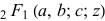 is a hypergeometric function. This can also be written in terms of the Jacobi polynomial
  as
as
 | (6) |
The first few nonzero radial polynomials are
 |  |  | (7) |
 |  |  | (8) |
 |  |  | (9) |
 |  |  | (10) |
 |  |  | (11) |
 |  |  | (12) |
 |  |  | (13) |
 |  |  | (14) |
 |  |  | (15) |
(Born and Wolf 1989, p. 465).
The radial functions satisfy the orthogonality relation
 | (16) |
where  is the Kronecker delta, and are related to the Bessel function of the first kind by
 | (17) |
(Born and Wolf 1989, p. 466). The radial Zernike polynomials have the generating function
![([1+z-sqrt(1+2z(1-2rho^2)+z^2)]^m)/((2zrho)^msqrt(1+2z(1-2rho^2)+z^2))=sum_(s=0)^inftyz^sR_(m+2s)^(+/-m)(rho)](http://mathworld.wolfram.com/images/equations/ZernikePolynomial/NumberedEquation7.svg) | (18) |
(correcting the typo of Born and Wolf) and are normalized so that
 | (19) |
(Born and Wolf 1989, p. 465).
The Zernike polynomials also satisfy the recurrence relations
![rhoR_n^m(rho)=1/(2(n+1))[(n+m+2)R_(n+1)^(m+1)(rho)+(n-m)R_(n-1)^(m+1)(rho)] R_(n+2)^m(rho)=(n+2)/((n+2)^2-m^2){[4(n+1)rho^2-((n+m)^2)/n-((n-m+2)^2)/(n+2)]R_n^m(rho)-(n^2-m^2)/nR_(n-2)^m(rho)} R_n^m(rho)+R_n^(m+2)(rho)=1/(n+1)(d[R_(n+1)^(m+1)(rho)-R_(n-1)^(m+1)(rho)])/(drho)](http://mathworld.wolfram.com/images/equations/ZernikePolynomial/NumberedEquation9.svg) | (20) |
(Prata and Rusch 1989). The coefficients  and
and  in the expansion of an arbitrary radial function
  in terms of Zernike polynomials
![F(rho,phi)=sum_(m=0)^inftysum_(n=m)^infty[A_n^m^oU_n^m(rho,phi)+B_n^m^eU_n^m(rho,phi)]](http://mathworld.wolfram.com/images/equations/ZernikePolynomial/NumberedEquation10.svg) | (21) |
are given by
 | (22) |
where
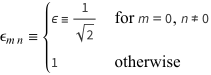 | (23) |
Let a "primary" aberration be given by
 | (24) |
with  and where
  is the complex conjugate of
  , and define
 | (25) |
giving
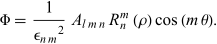 | (26) |
Then the types of primary aberrations are given in the following table (Born and Wolf 1989, p. 470).
| aberration |  |  |  |  |  |
| spherical aberration | 0 | 4 | 0 |  |  |
| coma | 0 | 3 | 1 |  |  |
| astigmatism | 0 | 2 | 2 | 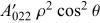 |  |
| field curvature | 1 | 2 | 0 |  |  |
| distortion | 1 | 1 | 1 |  |  |
