Shop tippy type
Kindle app logo image

Download the free Kindle app and start reading Kindle books instantly on your smartphone, tablet, or computer - no Kindle device required.

Read instantly on your browser with Kindle for Web.

Using your mobile phone camera - scan the code below and download the Kindle app.

QR code to download the Kindle App

  • Python for Unix and Linux System Administration

Follow the author

Get new release updates & improved recommendations
Something went wrong. Please try your request again later.

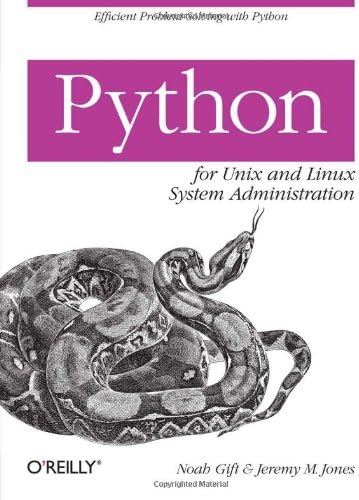
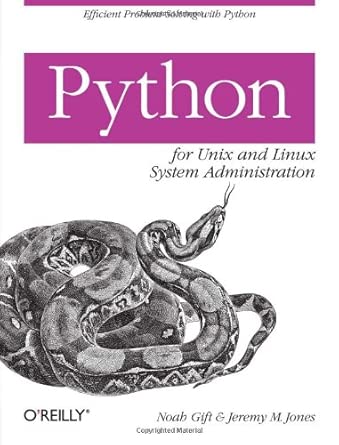
Python for Unix and Linux System Administration 1st Edition


Python is an ideal language for solving problems, especially in Linux and Unix networks. With this pragmatic book, administrators can review various tasks that often occur in the management of these systems, and learn how Python can provide a more efficient and less painful way to handle them.

Each chapter in
Python for Unix and Linux System Administration presents a particular administrative issue, such as concurrency or data backup, and presents Python solutions through hands-on examples. Once you finish this book, you'll be able to develop your own set of command-line utilities with Python to tackle a wide range of problems. Discover how this language can help you:

  • Read text files and extract information
  • Run tasks concurrently using the threading and forking options
  • Get information from one process to another using network facilities
  • Create clickable GUIs to handle large and complex utilities
  • Monitor large clusters of machines by interacting with SNMP programmatically
  • Master the IPython Interactive Python shell to replace or augment Bash, Korn, or Z-Shell
  • Integrate Cloud Computing into your infrastructure, and learn to write a Google App Engine Application
  • Solve unique data backup challenges with customized scripts
  • Interact with MySQL, SQLite, Oracle, Postgres, Django ORM, and SQLAlchemy

With this book, you'll learn how to package and deploy your Python applications and libraries, and write code that runs equally well on multiple Unix platforms. You'll also learn about several Python-related technologies that will make your life much easier.


From the brand

Editorial Reviews

About the Author

Noah Gift is the co-author of Python For Unix and Linux by O'Reilly. He is an author, speaker, consultant, and community leader, writing for publications such as IBM Developerworks, Red Hat Magazine, O'Reilly, and MacTech, and Manning.

His consulting company is Giftcs, LLC and it provides solutions for Python Development and Systems Engineering. His personal website is www.noahgift.com. Noah is also the former organizer for PyAtl, which is the Python User Group for Atlanta, GA. He has given presentations at PyCon and PyAtl.

He has a Master's degree in CIS from Cal State Los Angeles, B.S. in Nutritional Science from Cal Poly San Luis Obispo, is an Apple ACSA and LPI certified SysAdmin, as well as a Avid Certified Support Representative. He has worked at companies such as, Caltech, Disney Feature Animation, Sony Imageworks, and Turner Studios, and Weta Digital. You can see all of his film credits at IMBD.

As a teenager he was a freelance television editor for ABC Network News. While at Caltech he worked for the Nobel Prize Winning President as a Mac Expert, and at Disney and Sony worked on the first feature animated films for both companies: Chicken Little, and Surf's Up, respectively. Recently he has worked on Python development projects as diverse as writing an SNMP auto-discovery system, writing a Content Management System from scratch, creating a large scale Web 2.0/Social Networking Application in Django for Turner Studios, to writing IPhone applications that talk to Google App Engine. He is also involved in a new media journalism project, Spotlight on FOSS, that had a kickoff interview of Mark Shuttleworth.

He is currently co-authoring a book on Google App Engine and writing a large Google App Engine Exercise and Nutrition Tracking Application. Most recently, he works as a Python programmer for Weta Digital in New Zealand, which has one of the world's largest render farms/super computer sites.

In his free time he enjoys spending time with his wife Leah, and their son Liam, and playing and composing piano music. He is also into exercising religiously, including running in and training for marathons, and blogging about it. When he gets a chance, he likes to write open source software. He is also interested in Artificial Intelligence research and software development.

Jeremy Jones is a software engineer/system administrator who works for Predictix. His weapon of choice is Python but he has done plenty of shell and Perl and a touch of Java.

He is the author of the open source projects Munkware, a multiproducer/multiconsumer, transactional, and persistent queuing mechanism, ediplex, an EDI (Electronic Data Interchange) parsing engine, and podgrabber a podcast downloader. All three projects were written in the Python language.

Jeremy spends his spare time enjoying his family and doing a little writing. He lives in Conyers, Georgia, just east of Atlanta, with his wife, Debra and his two children, Zane and Justus.

Product details

About the author

Follow authors to get new release updates, plus improved recommendations.
Noah Gift
Brief content visible, double tap to read full content.
Full content visible, double tap to read brief content.

Noah Gift is the founder of Pragmatic AI Labs. Noah Gift lectures at MSDS, at Northwestern, Duke MIDS Graduate Data Science Program, and the Graduate Data Science program at UC Berkeley and the UC Davis Graduate School of Management MSBA program, and UNC Charlotte Data Science Initiative. He is teaching and designing graduate machine learning, A.I., Data Science courses, and consulting on Machine Learning and Cloud Architecture for students and faculty. These responsibilities include leading a multi-cloud certification initiative for students.

Noah is a Python Software Foundation Fellow, and AWS ML Hero. He currently holds the following industry certifications for AWS: AWS Subject Matter Expert (SME) on Machine Learning, AWS Certified Solutions Architect, and AWS Certified Machine Learning Specialist, AWS Certified Big Data Specialist, AWS Academy Accredited Instructor, AWS Faculty Ambassador. He also is certified on both the Google and Azure platform: Google Certified Professional Cloud Architect, Certified Microsoft MTA on Python. He has published over 100 technical publications including multiple books on subjects ranging from Cloud Machine Learning to DevOps. Publications appear in Forbes, IBM, Red Hat, Microsoft, O’Reilly, Pearson, Udacity, Coursera, datascience.com, and DataCamp. Workshops and Talks around the world for organizations including NASA, PayPal, PyCon, Strata, O’Reilly Software Architecture Conference, and FooCamp. As an SME on Machine Learning for AWS, he helped created the AWS Machine Learning certification.

He has worked in roles ranging from CTO, General Manager, Consulting CTO, Consulting Chief Data Scientist, and Cloud Architect. This experience has been with a wide variety of companies: ABC, Caltech, Sony Imageworks, Disney Feature Animation, Weta Digital, AT&T, Turner Studios, and Linden Lab, and industries: Television, Film, Games, SaaS, Sports, Telecommunications. He has film credits in many major motion pictures for technical work, including Avatar, Spider-Man 3, and Superman Returns.

He has been responsible for shipping many new products at multiple companies that generated millions of dollars of revenue and had a global scale. Currently, he is consulting startups and other companies, on Machine Learning, Cloud Architecture, and CTO level consulting as the founder of Pragmatic A.I. Labs.

Customer reviews

4 out of 5 stars
27 global ratings

Top reviews from the United States

  • Reviewed in the United States on March 22, 2013
    Format: PaperbackVerified Purchase
    Very well written book. It helped me in advancing my carrier.
    easy to understand, with a real life examples. I just love all O'Realy books.

    One person found this helpful
    Report
  • Reviewed in the United States on September 23, 2008
    Format: PaperbackVerified Purchase
    As a sys-admin who has used Python, I couldn't wait for this text to come out. It certainly fills a need and contains useful insights on how to get the job done faster.

    The writing could be better though. The conversational writing style causes the book to take a while to say simple things. It also rambles a bit. I've noticed a couple times that it introduces a topic, goes off on one or two tangents and then gets back to the original topic. I've also noticed more than a few grammar and spelling errors.

    Because of the value of the material covered, it is still well worth reading.
    13 people found this helpful
    Report
  • Reviewed in the United States on January 21, 2015
    Format: PaperbackVerified Purchase
    Great book
  • Reviewed in the United States on January 7, 2009
    Format: PaperbackVerified Purchase
    This book may work for some people but not for me.

    I give it 2 stars for an enticing table of contents. Many topics of interest to UNIX administrators are covered.

    I omit the 3rd star due to the reliance on IPython, which is at best not particularly relevant to this topic and at worst would not compile on my Slackware machine.

    I omit the 4th and 5th stars for a writing style I find intensely irritating. The authors write in a chatty, even gushy first person style which reminds me of grade school. Two examples from the first chapter:

    "... if you make this decision, it will change your life."

    "Wow, that is pretty cool, right?"

    Another sentence indicates a possible cause:

    "Here is what it looks like when we do that on Noah's Macbook Pro laptop:"

    Your mileage may vary. Aeleen Frisch, an excellent O'Reilly author, wrote a very nice forward. With a background in traditional UNIX (and later Linux) I just don't find this book up to O'Reilly's usual high standards. I'll give it to a friend who uses mostly Macintosh computers and hope it will help her more.
    12 people found this helpful
    Report
  • Reviewed in the United States on February 11, 2009
    Format: Paperback
    I highly recommend this book for anyone in the systems admin field, or for anyone who does python development on unix platforms. It has a wealth of knowledge and tips that will give you the tools to be a more productive sysadmin.

    This book will be required reading for my next systems administration class!
    2 people found this helpful
    Report
  • Reviewed in the United States on December 18, 2008
    Format: PaperbackVerified Purchase
    Flicking through the table of contents, there seems to be a lot of promise in Python for Unix and Linux System Administration. The book seems targeted specifically for Unix admins, touching on actual problems and providing actual solutions. On the face of it, it looks to be Programming Python with an OS-specific slant.

    Unfortunately, the execution here just doesn't seem to be on a par with that of other O'Reilly books. There is useful information to be had in this text, to be sure, but it's at times difficult to extract.

    Perhaps my view of this book is tainted by my recent experience with The Ruby Programming Language, one of the most enjoyable technical reference books I've ever encountered. I'll spare you the details (I have a full review on that product page), but rarely have I felt such joy in reading about code.

    I do not feel such joy when slogging through Python for Unix and Linux System Administration. I get the impression, at times, that the author should have simply let the code speak for itself, and spared us his narration entirely.

    For example, here is a snippet from Chapter 3, on text manipulation:

    "The final file method that we will discuss for getting text out of a file is readlines(). Readlines() is not a typo, nor is it a cut-and-paste error from the previous example. Readlines() reads in all of the lines of a file. Well, that is almost true."

    This text feels horribly labored to me. He's telling us what readlines() is not, and it takes him a while to tell us what it actually is. Also, note that Readlines() (with the capital "R") is not valid; despite its use in the beginning of a sentence, the author should always use the proper capitalization of the method to avoid confusion. Nitpick, perhaps, but this could catch somebody off guard.

    Contrast this with the pydoc description of readlines():

    "Call readline() repeatedly and return a list of the lines so read. The optional size argument, if given, is an approximate bound on the total number of bytes in the lines returned."

    Clear, concise, and much more legible. When I want to know about readlines(), I want to know what it does and what it is, not what it *doesn't* do and *almost* is.

    This is just an example. There are others, but I think you get the idea: it's not a book you'll want to curl up with in front of the fire for a pleasant read. Instead, this is a book that does have useful information in it, but you'll have to force yourself to dig it out.

    The book does provide some useful examples for addressing specific problems, and if you have such a problem this might be exactly what you need. Do not mistake this for a cookbook, though; it's a lengthy tutorial with real world examples, not a tome of useful hacks that you will be constantly calling upon.

    In short: a workable introduction to a variety of useful techniques, though lacking a bit in quality compared to other O'Reilly books. Unless you're really interested in some of the OS-specific topics covered in this book, the more general (and much more comprehensive) Programming Python will probably serve you better.
    18 people found this helpful
    Report
  • Reviewed in the United States on December 7, 2016
    Format: PaperbackVerified Purchase
    This is just Ipython interdiction only
    3 people found this helpful
    Report
  • Reviewed in the United States on August 26, 2009
    Format: PaperbackVerified Purchase
    Maybe the comparission between bash features and python features are not very good.

    When Autor try to demostrate python is better, he give some bad examples.

    Seems like Autor doesn't like bash syntax. For various tasks bash is really better, because it was dessign for do it.

    Later, the book is improved and give you some very good tips
    2 people found this helpful
    Report

Top reviews from other countries

  • Gixxer Boy
    4.0 out of 5 stars Great book for admins
    Reviewed in the United Kingdom on May 13, 2009
    Format: PaperbackVerified Purchase
    I found this book to be totally different to most "Learning Python" sytle books, by throwing you in at the deep end. In my opinion, the expected audience will already have dabbled with shell scripting/Perl. An understanding of *nix result codes, pipes, stdin/stderr/stdout will save you some time. If you are looking for a book that teaches python from the ground up, this isn't for you. However for those quick fixes, this book is (in my humble opinion) unbeatable.