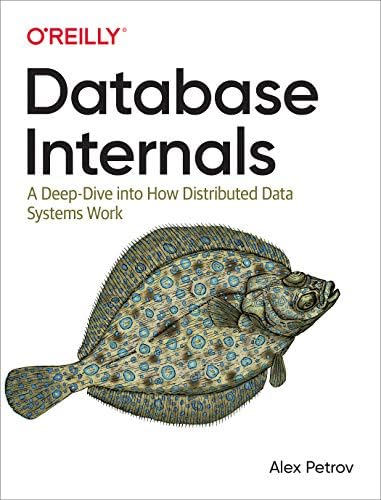




















Can't believe I forgot to write a review for this one!
Partly it's probably because I usually have less to say (or more precisely it's harder for me to be properly articulate) about things I like than I do about the ones I don't. And boy did I like Database Internals! I'll try my best to explain why, the book and the author surely deserve it.
Being a back-end engineer, the main reason for picking this one up was to better understand the distributed databases that I may end up in (or have already had) contact with. With that in mind, I planned on just skimming the first part of the book but imagine my surprise when I found myself Googling BW and LSM trees and going through papers comparing this and that algorithm and their impacts on memory, storage and CPU caches in multicore systems. The geek got suckered in! With my curiosity circuits pleasantly warmed by the first part, I moved on to the second part of the book - the main dish - where a similar scenario unfolded: again I swallowed up whatever was served and ended up digging for more and adding scores of books and papers to my to-read list.
All in all, Database Internals reads felt a lot like a trip to the zoo or a local museum: chock full of data structures and algorithms used by modern-day databases (and distributed systems in general), the book will showcase each item with sufficient details for you to grasp what they're about and then provide you with enough bibliography and reference material to last you a lifetime... or at least a couple of years.


Download the free Kindle app and start reading Kindle books instantly on your smartphone, tablet, or computer - no Kindle device required.
Read instantly on your browser with Kindle for Web.
Using your mobile phone camera - scan the code below and download the Kindle app.

Follow the author
Get new release updates & improved recommendations
Something went wrong. Please try your request again later.
Frequently bought together
This item: Database Internals: A Deep Dive into How Distributed Data Systems Work
$36.33
Get it as soon as Thursday, Apr 16
In Stock
+
$59.99
Get it as soon as Thursday, Apr 16
In Stock
+
$43.99
Get it as soon as Thursday, Apr 16
In Stock
Total price: $00
To see our price, add these items to your cart.
Choose items to buy together.
Explore more items
Page 1 of 1 Start over
- A Philosophy of Software Design, 2nd EditionPaperbackFREE Shipping on orders over $35 shipped by AmazonGet it as soon as Thursday, Apr 16
- AI Engineering: Building Applications with Foundation ModelsPaperbackFREE Shipping by AmazonGet it as soon as Thursday, Apr 16
- Systems Performance (Addison-Wesley Professional Computing Series)PaperbackFREE Shipping by AmazonGet it as soon as Thursday, Apr 16
- The Staff Engineer's Path: A Guide for Individual Contributors Navigating Growth and ChangePaperbackFREE Shipping on orders over $35 shipped by AmazonGet it as soon as Thursday, Apr 16
- Hands-On Large Language Models: Language Understanding and GenerationPaperbackFREE Shipping by AmazonGet it as soon as Thursday, Apr 16
- Team Topologies, 2nd Edition: Organizing Business and Technology for Fast Flow of ValuePaperbackFREE Shipping on orders over $35 shipped by AmazonGet it as soon as Thursday, Apr 16
From the brand

-


Databases, data science & more
-


Data Science
-


Data Visualization
-

Databases
-

Streaming
-

Sharing the knowledge of experts
O'Reilly's mission is to change the world by sharing the knowledge of innovators. For over 40 years, we've inspired companies and individuals to do new things (and do them better) by providing the skills and understanding that are necessary for success.
Our customers are hungry to build the innovations that propel the world forward. And we help them do just that.
From the Publisher

From the Preface
Who is this book for?
In conversations at technical conferences, I often hear the same question: “How can I learn more about database internals? I don’t even know where to start.” Most of the books on database systems do not go into details of storage engine implementation, and cover the access methods, such as B-Trees, on a rather high level. There are very few books that cover more recent concepts, such as different B-Tree variants and log-structured storage, so I usually recommend reading papers.
Everyone who reads papers knows that it’s not that easy: you often lack context, the wording might be ambiguous, there’s little or no connection between papers, and they’re hard to find. This book contains concise summaries of important database systems concepts and can serve as a guide for those who’d like to dig in deeper, or as a cheat sheet for those already familiar with these concepts.
Not everyone wants to become a database developer, but this book will help people who build software that uses database systems: software developers, reliability engineers, architects, and engineering managers.
If your company depends on any infrastructure component, be it a database, a messaging queue, a container platform, or a task scheduler, you have to read the project change-logs and mailing lists to stay in touch with the community and be up-to-date with the most recent happenings in the project.

Understanding terminology and knowing what’s inside will enable you to yield more information from these sources and use your tools more productively to troubleshoot, identify, and avoid potential risks and bottlenecks. Having an overview and a general understanding of how database systems work will help in case something goes wrong. Using this knowledge, you’ll be able to form a hypothesis, validate it, find the root cause, and present it to other project maintainers.
This book is also for curious minds: for the people who like learning things without immediate necessity, those who spend their free time hacking on something fun, creating compilers, writing homegrown operating systems, text editors, computer games, learning programming languages, and absorbing new information.
The reader is assumed to have some experience with developing backend systems and working with database systems as a user. Having some prior knowledge of different data structures will help to digest material faster.
About the author

Customers say
Customers find the book to be a great resource for understanding database internals, covering many core concepts. However, the writing quality receives mixed feedback, with several customers noting that it is often poor.
AI Generated from the text of customer reviews
Select to learn more
36 customers mention content, 28 positive, 8 negative
...This is a must read for anyone who uses database; really helps explain how they workRead more
Solid content on how databases are put togetherRead more
Nice book to read if you want to understand how database systems work underneath....Read more
Delivering on the title is a tall order. The book tries to cover a lot of ground. Some of the content could use better editing....Read more
6 customers mention writing quality, 4 positive, 2 negative
...Succinct, detailed, and quality.Read more
While it does contain interesting and useful information, the writing is bland and uninspiring, and the author comes across as disinterested in the...Read more
...The quality of writing is good, though could have been helped with more ruthless editing....Read more
Very knowledgeable and detail oriented but concise at the same timeRead more

One of the Best Books out there
This is one of the best texts covering Database internals. Databases are used everyday, and understanding what happens under the hood is daunting task. This book takes a pragmatic approach on the topic, starting with basics and then taking a deeper dive into how the basic data structures and concept come together. IMHO, this book shall appeal to both Database developer's and engineer's who want to understand how databases work. This book is must have to for the engineer's who really want to get into Database development. Otherwise also this book is a must have reference in general. I personally liked the attention to details in the book on what really matter's when writing a real database. The concepts are equally applicable to SQL and NoSQL databases.
Top reviews from the United States
There was a problem filtering reviews. Please reload the page.
- Reviewed in the United States on November 3, 2019Format: PaperbackVerified Purchase This is one of the best texts covering Database internals. Databases are used everyday, and understanding what happens under the hood is daunting task. This book takes a pragmatic approach on the topic, starting with basics and then taking a deeper dive into how the basic data structures and concept come together. IMHO, this book shall appeal to both Database developer's and engineer's who want to understand how databases work. This book is must have to for the engineer's who really want to get into Database development. Otherwise also this book is a must have reference in general. I personally liked the attention to details in the book on what really matter's when writing a real database. The concepts are equally applicable to SQL and NoSQL databases.
Images in this review

- Reviewed in the United States on November 30, 2019Format: PaperbackVerified Purchase Mastery in systems abstraction comes through a philosophical pivot. While an enthusiastic beginner considers successful "use cases", an experienced traveler - through her implicit awareness of futility against entropy - often only considers failure and just tries her best. As more systems, and more of every system, are being dictated by the twin forces of economics and architectural modernism, a much higher percentage of design and development efforts in software should be dedicated to understanding fundamentals (CPU registers, branch prediction etc.) and essential complexities (multi-node consensus, replication failures etc.). This book is a good start.
Summarized Recent Overview of Storage & Distributed Systems
Reviewed in the United States on November 30, 2019
Database Internals is divided into two parts - the first deals with database storage. Especially good sections put a 9-cell flash-light on how many recent architectures are indeed built to tackle complexity bottom-up. i.e., LSM (log-structured merge) trees nicely complement the "write amplification" of Solid-State Disks. The discussion on the canonical B-tree and its multiple siblings (especially Bw-tree) is very well done. The functional difference between locks and latches would be enlightening even for experienced database practitioners - locks are used to manage transactions, latches to guard the *physical* storage representation.
The second half of the book focusing on distributed systems is more uneven in quality. It is, however, a great start of economized discussion of about 50 "Best Papers" on Leader Election, Failure/Crash detection, Replication and how distributed systems friendly "consensus protocols", rather than atomic ones like 2-phase commit work better. In many ways, distributed systems have veered from monarchy (single, immutable leader deciding everything, including the next leader) to a true republic (leader is still almost omnipotent, but is regularly replaced by the constituents). The comparative analysis of Paxos, ZAB and Raft - with clear sequence diagrams - is very well done.
The quality of writing is good, though could have been helped with more ruthless editing. The area covered is simply too broad, other than the intersect of SSDs and Modern DB architecture which is very deep and very good. Still the book easily deserves at least 4-stars for the enthusiasm and for its good attempt to convey distributed systems pedagogy to general practitioners. Pair it with Martin Kleppmann's "Designing Data Intensive Applications" and Ken Birman's "Guide to Reliable Distributed Systems".
Images in this review




Top reviews from other countries
- Vladimir KazanovReviewed in the United Kingdom on February 28, 2020
A very good book with developers already working with databases and database-like systems
Format: PaperbackVerified Purchase - hailizhangReviewed in Canada on August 27, 2025
Great value with true knowledge!
Format: PaperbackVerified Purchase The book is really good, mint without any scratches. Love it!hailizhangGreat value with true knowledge!
Reviewed in Canada on August 27, 2025
Images in this review

- Amazon CustomerReviewed in India on February 12, 2026
Good read, and came in well wrapped
I read other reviews, which said "this book is very technical". That made me think, that this book is going to have source code of database internals..Amazon CustomerGood read, and came in well wrapped
Reviewed in India on February 12, 2026
But, these are just theories.
Because, of that i am a little disappointed.
If you are an experienced programmer, then you can read and absorb this books content in single day.
It is a good book, otherwise.
Images in this review


- Amazon CustomerReviewed in Germany on December 20, 2025
Alles, was man wissen muss.
Format: PaperbackVerified Purchase