-
-
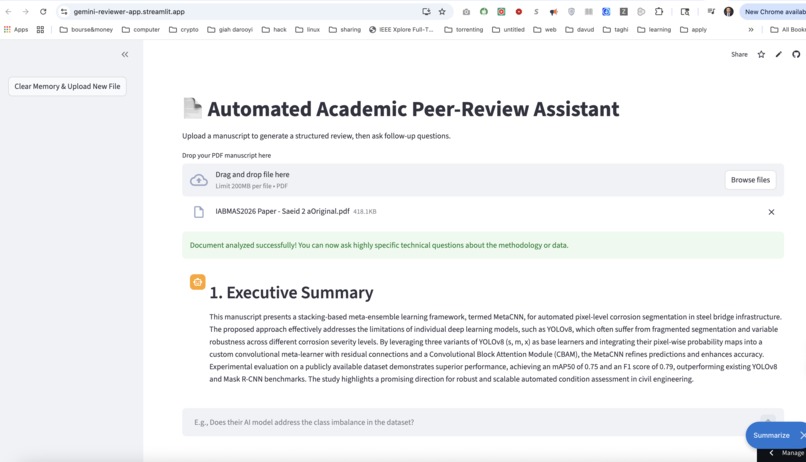
AIReviewer after uploading a paper for review
-
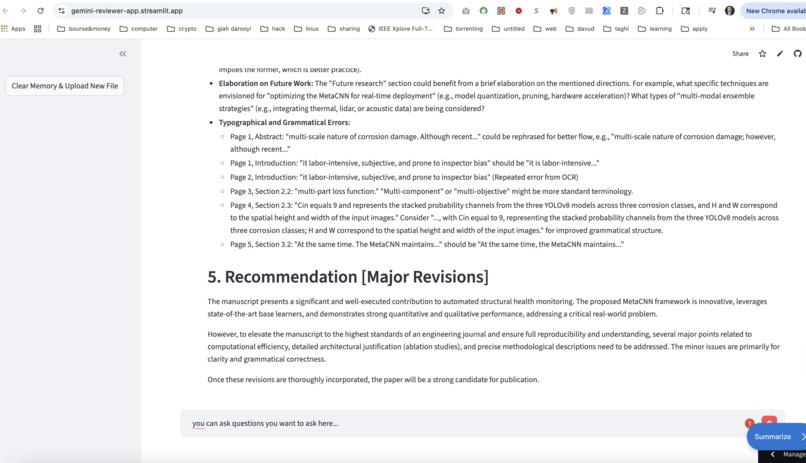
Final recommendation and also you can ask any questions you want too
💡 Inspiration: As a Graduate student in Structural Engineering at the University of Kansas and an active peer reviewer for high-impact journals like ESWA, I have lived the "peer-review bottleneck" firsthand. Evaluating a dense, 30-page manuscript—filled with complex sensor data, deep learning architectures, and structural mechanics—takes hours of intense cognitive labor.I realized that while researchers are producing data faster than ever, the human-in-the-loop verification process hasn't changed in decades. I was inspired to see if I could leverage the Gemini API's massive context window to act as a "co-pilot" for experts, ensuring that no methodological flaw goes unnoticed and that scientific progress isn't delayed by administrative fatigue.🤖 What it does: AIReviewer is a specialized academic co-pilot designed to transform how technical research is validated. It doesn't just "read" text; it "interrogates" manuscripts. Key capabilities include:Automated Methodological Audits: Instantly cross-referencing proposed methods against established scientific frameworks.Native PDF Synthesis: Processing full engineering reports while maintaining the context of tables, diagrams, and formulas.Interactive Peer Review: A stateful chat interface where a reviewer can ask specific, high-level questions like, "Is the sampling frequency in this structural vibration test sufficient for the Nyquist criterion?"🛠️ How I built it: The application is built using a modern, secure Python stack:Core Engine: I integrated Gemini 2.0 Flash via the google-generativeai SDK. I chose the Flash model for its incredible speed and its 1M+ token context window, which is essential for long-form academic papers.Interface: Streamlit was used to build a responsive, stateful dashboard for document interaction.Native File Processing: I utilized the Gemini File API to enable native PDF understanding, avoiding the data loss typically seen with standard OCR or text extraction tools.Mathematical Precision: The system is designed to parse and evaluate complex equations. For example, when evaluating fracture mechanics research, the model can verify the logic behind the Stress Intensity Factor:$$K_I = Y \sigma \sqrt{\pi a}$$🚀 Challenges I ran into: The journey wasn't without its technical hurdles:Environment Isolation: Developing on macOS meant navigating "externally managed environment" restrictions. I overcame this by implementing a robust virtual environment (venv) strategy.Credential Security: To ensure the Gemini API key was never compromised, I utilized Streamlit’s secrets.toml architecture, keeping the "key" out of the source code and GitHub.Prompt Alignment: Getting an LLM to think like a "Senior Journal Editor" required rigorous prompt engineering to ensure the output was critical and constructive rather than just a summary.🎉 Accomplishments that I'm proud of: Zero-Loss PDF Extraction: Successfully processing technical tables and LaTeX formulas without "hallucinations."Expert Persona: Achieving a level of critique that mirrors the feedback I provide in my professional capacity as a journal reviewer.Rapid Deployment: Going from a terminal command-line tool to a fully functional, cloud-ready web app within the hackathon timeline.🎓 What I learned: I learned that the true power of Gemini 2.0 lies in its Multimodality. By allowing the model to process files natively rather than just as strings of text, I unlocked a much higher level of reasoning for technical engineering data. I also learned that AI in academia isn't about replacement; it’s about augmentation—freeing up experts to focus on creative breakthroughs rather than clerical checking.🔮 What's next for AIReviewer: Blockchain Verification: Integrating with decentralized protocols to create an immutable record of peer-review contributions.Direct Journal Integration: Building plugins for manuscript management systems to assist editors in the initial screening phase.SHM Specialized Models: Fine-tuning the prompt logic specifically for Structural Health Monitoring to automatically detect sensor placement errors and data anomalies in real-time.

Log in or sign up for Devpost to join the conversation.