-
-

Coaching Company Ops
-
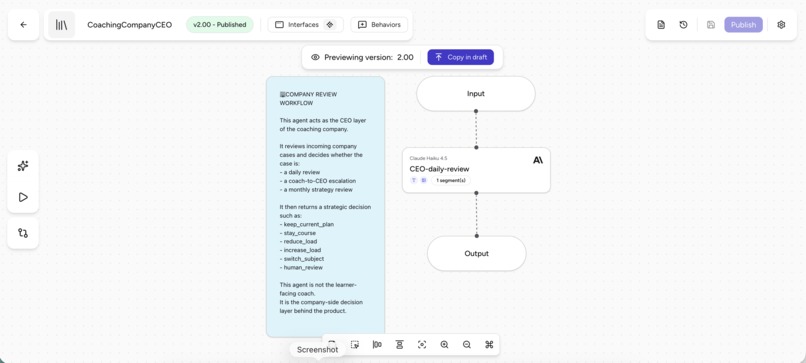
CoachingCompanyCEO - COMPANY REVIEW WORKFLOW
-

Coaching Product Homepage
Inspiration
We wanted to build more than an AI tutor.
Most learning products focus only on the learner-facing experience: a chatbot, a question recommender, or a question bank. What interested us more was the idea of an AI-run coaching company: a system where the learner interacts with a coach, while a company layer behind the scenes continuously reviews progress, adjusts strategy, and decides when human intervention is needed.
That became the core idea of this project: a coaching product specifically designed for the Japanese Management Operations Supervisor Exam, paired with an AI company operations layer that makes ongoing decisions about how learning should proceed.
What it does
This project is an AI coaching product built specifically for learners preparing for the Japanese Management Operations Supervisor Exam.
The project has two connected layers.
1. Learner-facing coaching product
The learner moves through a lightweight coaching session:
- start screen
- short coaching intro
- question session
- explanation and intervention
- summary and day-end closure
The experience is designed to feel like a coach is sitting beside the learner, not like a dashboard.
The content and study flow are tailored to Management Operations Supervisor Exam preparation in Japan, including subject-based question practice, weak-point review, and guided recovery after mistakes.
2. Company-side operations layer
Behind the learner experience, the system runs a company-style review process:
- daily review
- coach-to-CEO escalation
- monthly strategy review
- human review when needed
This layer is represented through an Airia agent and a company control room view inside the product.
How we built it
We kept the frontend intentionally lightweight:
- HTML
- CSS
- JavaScript
The frontend is deployed on Cloudflare Pages.
The backend runs on Cloudflare Workers and connects:
- the learner-facing product
- Supabase for question and session data
- Airia for company-side decision workflows
We used Supabase to store and expand a company question bank across multiple subjects relevant to the Japanese Management Operations Supervisor Exam, including areas such as civil law, condominium ownership law, management practice, and related management regulations.
For AI:
- learner-facing coaching logic is handled through backend LLM calls
- company-side operational decisions are modeled in Airia
- the Airia agent returns structured decisions such as:
keep_current_planreduce_loadincrease_loadswitch_subjecthuman_review
Challenges we ran into
One major challenge was making the company layer understandable in the UI.
It was relatively straightforward to build internal logic, but much harder to make the idea of an AI company visible to a user. We iterated a lot on how to show:
- company health
- decision flow
- escalation
- transmission of decisions from the CEO layer to coaches
Another challenge was separating the learner view from the company view. Early versions mixed learner-facing guidance with internal company logic, which made both weaker. We had to make the learner experience calm and focused, while allowing the company view to express system-wide operational decisions.
We also had to decide what should live in code and what should live in Airia. We ended up using Airia for the company-side operational intelligence, while keeping the learner-facing coaching flow closer to the product code.
A further challenge was making the product feel specific to the Japanese Management Operations Supervisor Exam, rather than a generic AI study tool. That required us to shape the question bank, coaching flow, and decision logic around this particular exam context.
Accomplishments that we're proud of
We are proud that this project became more than a simple AI assistant demo.
We built:
- a complete learner-facing coaching session flow
- a company-side review layer
- an Airia agent that acts as the operational intelligence of the company
- a control-room style company view that shows how the organization is making decisions behind the scenes
- a lightweight but real architecture connecting frontend, backend, database, and agent orchestration
- a product specifically aimed at learners preparing for the Japanese Management Operations Supervisor Exam
We are also proud that we kept the system lightweight while still making it feel like a real product.
What we learned
This project taught us that building with AI is not just about making one smart assistant.
The most important lesson was the distinction between:
- the product layer, where the learner experiences coaching
- the company layer, where review, escalation, and strategy decisions happen
We also learned that orchestration matters as much as intelligence. In practice, the hardest part was not generating answers, but deciding:
- when to keep the plan
- when to reduce load
- when to escalate
- how to make those decisions visible and understandable
A big UI lesson was that it is not enough to display information. To communicate an AI-run company, we had to show that decisions are actively being made.
We also learned that domain specificity matters. A product for the Japanese Management Operations Supervisor Exam needs a different structure, vocabulary, and study rhythm than a generic AI learning tool.
What's next for Coaching Company Ops
The next step is to deepen the company layer while continuing to strengthen the product for the Japanese Management Operations Supervisor Exam.
We want to expand:
- richer multi-learner company operations
- better company-wide health and escalation views
- stronger human-in-the-loop review flows
- more robust learning logs so coaches can improve over time
- a broader exam-specific question bank with stronger validation for Management Operations Supervisor Exam quality and difficulty
Longer term, we want Coaching Company Ops to feel less like a hidden backend and more like a true operating system for an AI-run coaching organization, while also becoming a stronger exam-specific coaching product for this Japanese qualification.
Built With
- cloudflare
- css
- html
- javascript
- pages
- supabase
- workers

Log in or sign up for Devpost to join the conversation.