-
-
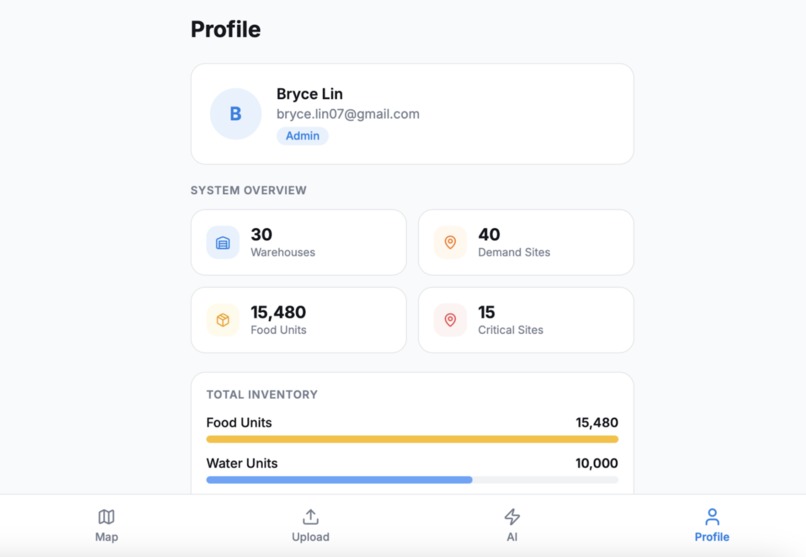
Profile Dashboard with further logistic details and user information
-
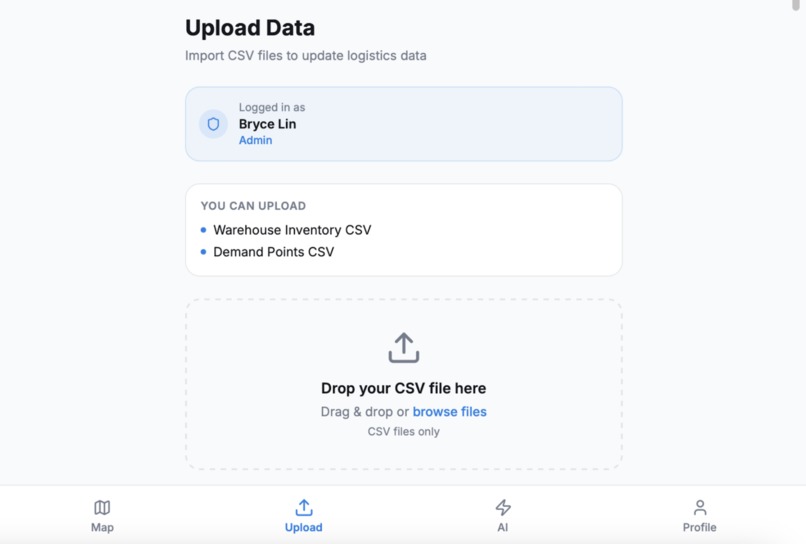
Upload Page for Warehouse / Demand CSV (Input data)
-
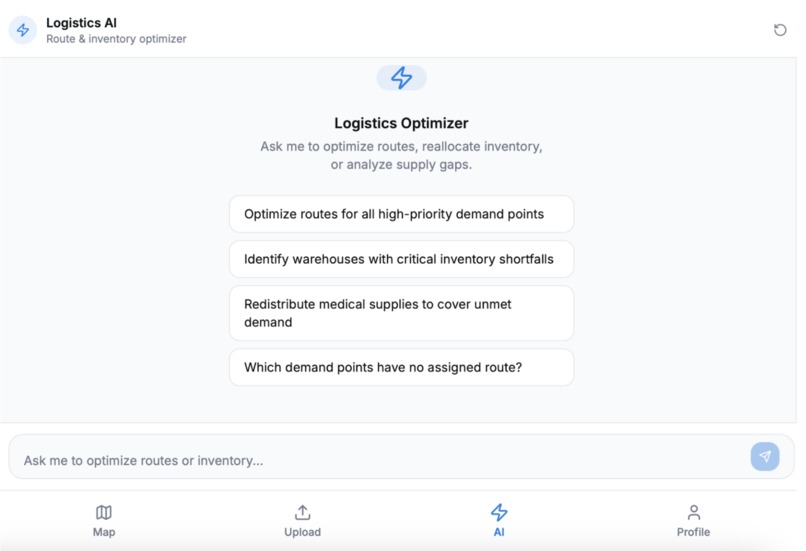
Chat with AI Agent (Logistics AI) Page - AI Chatbot that guides the users based on their need
-
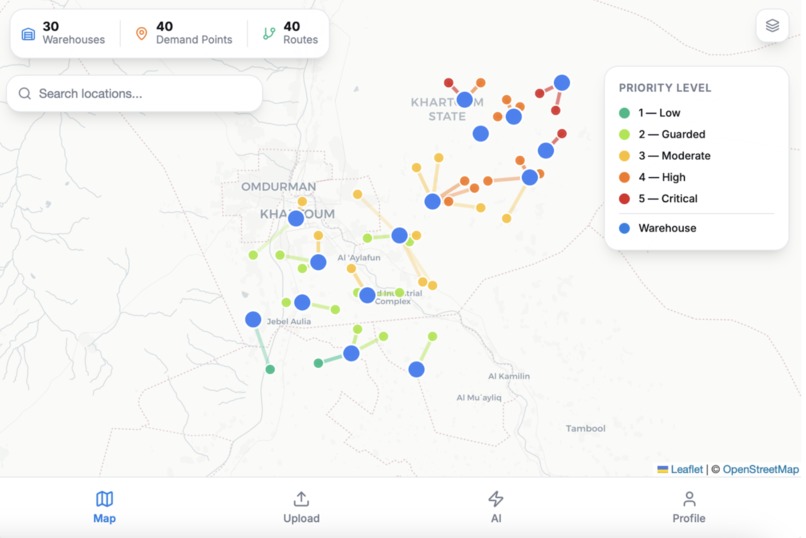
Map (Main) Page - Showcase of routes, warehouses, and populations on a map
Inspiration
No more than 2 days ago, the UN reported a denial of entry through Kerem Shalom that halted delivery of critical supplies to Gaza. With every passing day, humanitarian crises continue to increase in scale and complexity, yet the systems used to respond to them remain stagnant and laborious. Since 2023, the United Nations Office for the Coordination of Humanitarian Affairs (OCHA), has relied on the technical manual JIAF 2.0 as a framework for assessing humanitarian needs. While effective, this process can be time consuming, as it requires analysts to manually compile data from field reports, news updates, and satellite imagery long before producing logistic plans. In this time, warehouse and logistics teams lack clear guidance on where and what supplies are needed, delaying support that leaves vulnerable communities without critical resources during the most urgent stages of a crisis. Our aim is to bridge this gap, through the use of generative AI that transforms fragmented crisis data into actionable logistic recommendations. As of mid-2025, it was reported that the widespread integration of AI by humanitarian organizations had only reached a mere 7.8%. We want to create a platform that analyzes real-time information to produce optimal supply deployment plans for warehouse teams. By giving logistics workers immediate guidance on resource preparation and distribution, our design will be able to accelerate humanitarian response and ensure life-saving aid reaches affected populations as soon as possible, without creating space for waste of scarce resources and manpower.
What it does
Immediaid is an AI-powered platform designed to augment humanitarian logistics and support operational teams during crisis response. The platform focuses on turning complex data into clear operational workflows for logistics teams. It features a centralized dashboard, where users can monitor crisis indicators, review operational insights, and track recommended actions for preparing and dispatching aid supplies. For warehouse personnel and logistics coordinators, the system provides structured guidance on aspects like supply preparation priority, shipment planning, and alerts on potential barriers like damaged infrastructure or compromised transport routes, allowing operational teams to coordinate distribution more effectively during rapidly evolving emergencies.
How we built it
Although our team has a general understanding of ways AI can be incorporated into our designs to enhance efficiency, we do not have the technical skills to bring it to life. Therefore, we experimented with ChatGPT and Claude AI to generate code for us. Then, we noticed that Claude generally performed better, thus started using ChatGPT more to translate our ideas in conversational language into prompts that we could feed into Claude. However, when pasting Claude's code into VS Code, we had errors due to the misaligned versions of IDEs and modules, and had trouble resolving them. Thus, we tried Antigravity, which helped us immensely in helping us debug these errors with its AI assistant. Moreover, as no one in our team has a strong familiarity with the softwares we’re using, we decided to use synthetic data for our app instead of extracting and feeding real data (which would be more time consuming). However, to demonstrate the scalability aspect of our app, we wanted to expand our dataset thus, asked ChatGPT to populate more data points based on the parameters we input. Finally, since the code provided by Claude outputs a simple or text only UI, we wanted to integrate it with a proper front end. Thus, we tried Base44 and Figma, but chose Base44 as we preferred their design’s aesthetics. When prompting Base44, we also used the same process of inputting our ideas in a conversational tone into ChatGPT, which it then converted into a prompt we could directly feed into Base44. In summary, our toolkit primarily consisted of ChatGPT (mainly used for prompt engineering and data population), Claude (used for code generation), Base44 (for frontend UI), and Antigravity (for running Claude’s code and using the AI assistant to make them compatible, allowing programs to run locally). The basis of our model is input data related to warehouse location and demand, from inventory manager and on-site personnel, respectively, which is then used for optimization.
Challenges we ran into
While building this, we ran into many problems, the first of which being our difficulty with getting the GitHub repository to work properly on every team member's device. Eventually, we got this working with the help of other hackers. However, when we tried to prompt the AI for data, it took a few tries for it to work. Then, we had to learn the libraries involved to understand how everything worked which took some time getting used to. Finally, when creating our app, we ran into many issues that hindered development such as bad interactivity, elements that were visually hard to read and uncooperative AI. We also ran out of credits, limiting our ability to add more. One final challenge that we ran into was the unsupported AI agent since we were unable to implement a Google authentication sign in that would give the user access to the model.
Accomplishments that we're proud of
We're extremely proud of our final product even if it isn't as functional as we hoped it would be because it has amazing features that highlight the power of technology in the real world. The visual look and feel of the interactive GUI is something that we love about this project and how it is used for providing an easier experience to the people who put in so much to help others. We're also proud of learning so much about coding and AI in a 2 day time frame since we are all relatively inexperienced with these tools so it was great to get a hands-on learning experience where we all gained a lot of knowledge about AI.
What we learned
In this project, we learned a lot about AI and the process that goes into creating a website. This includes how to set up a shared repository, how to utilize AI to create data and websites and how to implement an AI agent that allows users to talk to a language model. There were also a lot of smaller things we learned like how to use libraries (folium, pandas), different types of files (csv, json), AI powered platforms (VS Code Copilot, Base44), and how to write better prompts.
What's next for ImmediAID
We are interested in finding ways to implement a preparedness and risk monitoring model that can identify trends that signal potential escalations of humanitarian crises. By highlighting these indicators early, teams can be better prepared to help out in areas of higher significance. We plan to use more Generative AI models to help further optimization and prediction through patterns seen throughout the data given by the user.

Log in or sign up for Devpost to join the conversation.