


Hyperoctahedral group

The hyperoctahedral groups are a family of mathematical groups that arise as the group of symmetries of the square, the cube, and their higher-dimensional counterparts (the hypercubes), as well as the corresponding dual polytopes (the regular octahedron and its higher-dimensional counterparts, the cross-polytopes). There is one hyperoctahedral group for each dimension n.
In addition to their role in geometry, the hyperoctahedral groups also appear in Lie theory, as the Weyl group associated to the symplectic groups and the orthogonal groups and their associated Lie algebras, and in combinatorics, where they may be viewed as a signed version of the symmetric groups, with their elements given by signed permutations. Algebraically, each hyperoctahedral group may be realized as a wreath product of the two-element group with the symmetric group , and may be represented as the set of invertible matrices with entries only 0, 1, or −1 and with exactly one non-zero entry in each row or column. The family of hyperoctahedral groups forms type B in the classification of finite Coxeter groups.


The hyperoctahedral groups were named by Alfred Young in 1930.[1]
Low-dimensional examples
[edit]The hyperoctahedral group in dimension 1 is the group of symmetries of a line segment. This is a two-element group, consisting of the identity element and a single other element. In higher dimensions, hyperoctahedral groups have richer structure.
Dimension 2: symmetries of a square
[edit]The hyperoctahedral group in two dimensions is the dihedral group of order 8, the symmetry group of a square. It has eight elements, of which four are rotations (including the identity, a rotation by an angle of 0°) and four are reflections. The group operation is functional composition; for example, first reflecting the square across the horizontal axis, then reflecting it across the diagonal of slope 1 gives the same result as rotating the square by 90° counter-clockwise, so in the group the product of these two reflections is that rotation.[2]


The group can be characterized by generators and relations in several ways. One such expression is , where 1 represents the identity transformation, r represents the rotation by 90° (of order 4), s represents any of the reflections (of order 2), and the final relation captures the fact that reflecting across a line, then rotating by 90° counter-clockwise, then reflecting across the same line has the same effect as applying a single rotation by 90° clockwise.[3][4]

A separate presentation of the group is . In this presentation, s and t represent two reflections, one across a diagonal and one across a line through the centers of two opposite sides. Then the product st is a rotation by 90°, of order 4.[5][4]

Dimension 3: symmetries of a cube
[edit]
Because the cube and regular octahedron are dual polyhedra, they have the same symmetry group.[6] This group consists of 48 = 8·3! elements: each symmetry is determined by picking a vertex of the cube, choosing the position of one of eight vertices to send it to, and choosing how its neighbors are assigned in one of 3! = 6 ways.[7]
Of the 48 symmetries, several families are of note. Nine of the symmetries of the cube are reflections across a plane: three reflections across planes parallel to a pair of opposite faces, and six further reflections across the planes that pass through two opposite edges of the cube.[8][9] Twenty-three of the symmetries are nontrivial rotations: nine are rotations around one of the lines that passes through the centers of two opposite faces (one each by 90°, 180°, and 270° around the three axes), six are rotations by 180° around a line through the midpoints of two opposite edges, and eight are rotations around one of the space diagonals (one each by 120° and 240° around the four diagonals). Along with the identity, these form the rotational subgroup of the cube. This subgroup is isomorphic to the symmetric group of permutations of a four-element set; for example, one can show that each permutation of the four space diagonals can be achieved by exactly one rotational symmetry.[10] The remaining symmetries include the point reflection through the center of the cube that sends each vertex to the opposite vertex, and various improper rotations (a combination of a rotation about an axis and a reflection in a plane perpendicular to that axis) of orders 4 and 6.[9][11]

If one chooses a Cartesian coordinate system so that the origin is at the center of the cube and the three coordinate axes are parallel to the edges, then the choice of where to send the single vertex can be achieved by reflections across the three coordinate planes; because these different reflections commute, these form a subgroup of the form , a direct product of three two-element groups. The rearrangements of the three neighbor vertices are given by a subgroup isomorphic to the symmetric group of permutations of a three-element set. Thus, the whole group of symmetries of the cube can be written as a semidirect product . The same group can also be written as the direct product of the rotational subgroup of the cube by the two-element group generated by the point reflection through the origin.[8]



If one divides the cube into chambers by the planes fixed by each of its reflection symmetries, each chamber is bounded by three such planes. Calling the reflections across these planes , one can show that these form a generating set for all of the symmetries (that is, every other symmetry can be achieved by repeated compositions of these three symmetries), subject to the relations that , , , , , and are all the identity transformation.[12]


In arbitrary dimension
[edit]For any positive integer n, the n-dimensional Euclidean space contains n-dimensional analogues of the cube, called hypercubes. One such hypercube consists of all the points such that for , with vertices .[13][14] The hyperoctahedral group consists of all rigid transformations w of that send to itself: . Equivalently, one may consider the dual polytope of ; this is the n-dimensional cross-polytope . It consists of all points in that satisfy the equation , and has as vertices the vectors , where is the standard basis vector of having ith entry equal to 1 and all other entries equal to 0.[15]




The rigid transformations of that preserve the cross-polytope (equivalently, the hypercube ) are all linear transformations. In the standard basis for , the matrix of such a transformation must be a signed permutation matrix: it must have exactly one nonzero entry in each row and column, and the nonzero entries are all ±1.[a] Thus the hyperoctahedral group of dimension n may be characterized as the group of n × n signed permutation matrices under the operation of matrix multiplication.[16] Combinatorially, the elements may be represented as signed permutations, that is, as n-tuples that contain exactly one element from each of the n sets {1, −1}, {2, −2}, ..., {n, −n}.[17]

![{\displaystyle [w(1),w(2),\dots ,w(n)]}](https://wikimedia.org/api/rest_v1/media/math/render/svg/34b268dda4438e21cf499d7ed7405f6a013baa35)
Algebraically, is isomorphic to the wreath product of the two-element group by the symmetric group . That is, it is a semidirect product of a direct product of n copies of with the symmetric group: the normal subgroup acts by sign changes, while the symmetric group acts by permuting coordinates.[18]


From these characterizations, one can see that the size of the hyperoctahedral group is , since there are (the factorial of n) ways to choose the positions of the nonzero entries (a permutation of the coordinate axes) and ways to choose whether each one should be positive or negative.[19]


As a reflection, Coxeter, and Weyl group
[edit]A reflection in Euclidean space is a linear operator for which there is a hyperplane H (that is, a subspace of dimension n − 1) that t fixes pointwise (that is, such that for all x in H) and such that t negates the vectors in the line perpendicular to H. A finite group W of invertible linear operators on is called a (finite real) reflection group if W is generated by the reflections it contains.[20] The hyperoctahedral group is a reflection group in this sense: the subgroup is generated by the n sign changes, each of which fixes a coordinate hyperplane pointwise while negating the normal vector , and the subgroup is generated by its subset of transpositions, and the transposition fixes the hyperplane pointwise while negating its normal vector . Since is the product of these two subgroups, it is generated by the collection of both types of reflections.[21][22]


For every finite real reflection group acting on a space of dimension n, there is a standard procedure to produce a set of n reflections that generate the group, subject to a simple collection of relations. The reflecting hyperplanes of the reflections divide space into a collection of regions called chambers.[23] Each chamber has n of the hyperplanes in its boundary, and the reflections across these planes form a generating set for the group.[24]
In the case of the hyperoctahedral group, one such choice produces the reflections whose action on is given as follows: for any point in , and for . That is, acts by negating the first coordinate, and acts by transposing the ith and (i + 1)st coordinates for .[25][b]







One can check that these reflections generate and that they satisfy the relations if . In fact, one can show further that these are a complete set of relations; that is, that is the group with presentation This gives the structure of a Coxeter group, with the corresponding set of simple reflections.[25] The corresponding Coxeter–Dynkin diagram recording these relations is


-


 ...
...
As a Weyl group of a root system
[edit]The hyperoctahedral group arises as the symmetries of other geometric objects aside from polyhedra. A root system Φ is a finite set of nonzero vectors (called roots) in Euclidean space that satisfy two properties: if α belongs to Φ then the scalar multiple cα belongs to Φ only for , and if α and β belong to Φ then so does the reflection of β across the hyperplane orthogonal to α.[29] Each root system determines a finite real reflection group, generated by the reflections through the planes orthogonal to its roots.[30]

A root system is crystallographic if its roots span a lattice.[c][31][32] For there are, up to isomorphism, two crystallographic root systems whose associated Weyl group is : letting be the standard basis for , the type B root system consists of the vectors whereas the type C root system is the following minor variant: The root (or ) corresponds to the reflection that, when acting on a vector in , changes the sign of the ith coordinate. The root corresponds to the reflection that swaps the ith and jth coordinates, while the root corresponds to the reflection that swaps the ith and jth coordinates and changes both of their signs.[33]


In the case n = 2, these root systems are isomorphic, and both give the group . For general n, the two root systems are not isomorphic, but they are dual to each other.[d][35][36]

As a permutation group
[edit]The hyperoctahedral group can be identified with the set of bijections w from the set to itself that satisfy for all i in , under the operation of functional composition. The bijection w is determined by the signed permutation , which in this context is called the window notation of w.[37][e]


![{\displaystyle [w(1),w(2),\ldots ,w(n)]}](https://wikimedia.org/api/rest_v1/media/math/render/svg/eb12063c09e545d63e8099681a40c972b7facd75)
The representation of as a group of permutations of a set of size 2n induces a natural inclusion map from the n-dimensional hyperoctahedral group into the symmetric group on twice as many elements. The image of ι is the set of permutations in whose permutation matrix is fixed by 180° rotation around its center.[39] Equivalently, writing for the permutation in whose one-line notation is and whose cycle notation is , the image of ι is the set of permutations that satisfy , and also the set of permutations that commute with .[40][41]


One may alternatively consider the group of bijections from the set to itself that satisfy for all i, since the symmetry condition enforces . In this case the associated inclusion map is into the symmetric group .[39]
![{\displaystyle [-n,n]\cap \mathbb {Z} =\{-n,-n+1,\ldots ,n-1,n\}}](https://wikimedia.org/api/rest_v1/media/math/render/svg/44f61196387da1c7fcdc1b2587ced50531a82003)


Cycles and conjugacy classes
[edit]When viewed as a signed permutation in window notation, a cycle of an element w of is a cycle in the underlying permutation that we get by erasing all minus signs; the length of the cycle is the number of entries it contains. A cycle is positive if the number of negative numbers among its entries in the window is even, and negative otherwise.[42][f] When viewed as a permutation of , each positive cycle corresponds to two cycles, one containing the negatives of the entries of the other, while each negative cycle corresponds to a single cycle that contains i if and only if it contains −i.[43] For example, the signed permutation with window notation has three cycles: the negative cycles (1 3) and (4 7 6 8) and the positive cycle (2 5). As a permutation of , its cycle decomposition is (1 −3 −1 3)(2 5)(−2 −5)(4 −7 6 8 −4 7 −6 −8).[44][17]

![{\displaystyle [-3,5,1,-7,2,8,-6,-4]}](https://wikimedia.org/api/rest_v1/media/math/render/svg/22e35d454d825c10b3ea0d2440e67fd6738bc25b)

The cycle type of a signed permutation w is the pair of two integer partitions where λ consists of the lengths of the positive cycles of w and μ consists of the lengths of the negative cycles of w. Two signed permutations u and w belong to the same conjugacy class of (that is, there exists another signed permutation g such that ) if and only if they have the same cycle type. In other words, the conjugacy classes in are indexed by pairs where λ and μ are two integer partitions whose parts sum to n.[42]


Equivalently, two signed permutations in are conjugate if and only if they have the same number of cycles of each length, and their images under the inclusion ι into the symmetric group also have the same number of cycles of each length.[45]
Special elements
[edit]In total, the hyperoctahedral group of dimension n has reflections. Of these, n are the sign-change reflections across a coordinate hyperplane . They are given in cycle notation by and in window notation by they form a single conjugacy class, indexed by the pair of integer partitions . The other reflections are the transposition-like reflections, across the hyperplanes or for . They are given in cycle notation by In window notation, the reflection across the plane with equation is given by (that is, it is a transposition) while the reflection across the plane with equation is given by (that is, it is the result of transposing the entries i and j and also changing both of their signs). Together, they form the conjugacy class indexed by .[46][47]


![{\displaystyle \{[1,\ldots ,i-1,-i,i+1,\ldots ,n]:i=1,\ldots ,n\};}](https://wikimedia.org/api/rest_v1/media/math/render/svg/048b45a23b3ea1b243dbb849bb2a791f1d071989)





![{\displaystyle [1,2,\ldots ,i-1,j,i+1,\ldots ,j-1,i,j+1,j+2,\ldots ,n]}](https://wikimedia.org/api/rest_v1/media/math/render/svg/39ce9c1e475fcee81b5d4d7f542efd00acfd5606)

![{\displaystyle [1,2,\ldots ,i-1,-j,i+1,\ldots ,j-1,-i,j+1,j+2,\ldots ,n]}](https://wikimedia.org/api/rest_v1/media/math/render/svg/ff8395eddd3b451fdb58d8a4b09032d48dad9f15)

The length of an element g of a Coxeter group G with respect to a set S of simple reflections is the smallest number k such that g can be written as a product of k elements of S.[48] The longest element in a finite real reflection group is the (always unique) element whose Coxeter length is as large as possible. In , this element is −1. That is, it is the point reflection through the origin, whose matrix is the negative of the identity matrix.[49] Combinatorially, its window notation is [−1, −2, ..., −n].[citation needed] It is the unique element in its conjugacy class, which is indexed by .[citation needed] Its Coxeter length is (a special case of the fact that the length of the longest element is always equal to the number of reflections in a finite real reflection group).[50]



In a finite real reflection group W, a Coxeter element is the product of the simple reflections in any simple system (W, S). The Coxeter elements all belong to a single conjugacy class.[51][52] In , this is the conjugacy class indexed by ; that is, the elements with a single negative n-cycle.[53] If c is a Coxeter element in then is the longest element.[g][54]


An element c of a reflection group W is said to be a quasi-Coxeter element if there is a factorization of c as a product of the minimum number of reflections such that the set of the factors is a generating set for W. In , the quasi-Coxeter elements are precisely the Coxeter elements and their conjugates.[55]


A signed permutation w is conjugate in to a permutation if and only if every cycle of w is even.[56] The number of such elements in is the double factorial .[17]

Subgroups
[edit]The hyperoctahedral group has several notable families of subgroups.
Center
[edit]The center of consists solely of the longest element −1 and the identity.[57]
Index-2 subgroups
[edit]For , the group has three subgroups of index 2 (that is, subgroups that include exactly half the elements in ):[58] the orientation-preserving symmetries of the hypercube, the even-signed permutation group (the Coxeter group of type D), and the generalized alternating group.

The alternating subgroup or even subgroup of the hyperoctahedral group is the subgroup consisting of elements of determinant 1 in the matrix representation, that is, the elements that can be written as a product of an even number of reflections. They are also the orientation-preserving symmetries of the hypercube.[59]
A second index-2 subgroup is formed by those elements whose signed permutation has an even number of minus signs. This group is again a Coxeter group, of type D. One possible set of generators for this subgroup is , where the are the Coxeter generating set for .[60] It is also the symmetry group of the demihypercube, the polytope that one gets by taking the convex hull of every other vertex of the hypercube .[61]

When n is odd, the hyperoctahedral group is the direct product of its even subgroup and its center, and also the product of the type D subgroup with its center. Moreover, in this case the even subgroup and type D subgroup are isomorphic and are further isomorphic to the quotient of by its center.[62]
The third index-2 subgroup is the wreath product of the two-element group with the alternating group of even permutations (a generalized alternating group).[63]

Commutator subgroup
[edit]For , the commutator subgroup of has index 4; it is equal to the commutator subgroup of the even-signed subgroup of type D.[64]
Parabolic subgroups
[edit]The maximal standard parabolic subgroups of the hyperoctahedral group are the setwise stabilizers of the set for .[65] That is, each maximal standard parabolic is isomorphic to the direct product of a smaller hyperoctahedral group and a symmetric group. In particular, the symmetric group is a maximal parabolic subgroup of . The hyperoctahedral group is a parabolic subgroup of for all (maximal when ).[citation needed]


Associated Lie groups and algebras
[edit]In the theory of Lie groups (or the related theory of algebraic groups), every connected, compact Lie group has an associated finite group, called its Weyl group, that plays an important role in its representation theory.[66] The hyperoctahedral group is the Weyl group of the "type B" and "type C" objects in the classification: the special orthogonal group SO(2n + 1) and the symplectic group Sp(n).[67] Likewise, in the theory of Lie algebras, every complex simple Lie algebra has an associated Weyl group; is the Weyl group of the Lie algebras and .[68]


Inversions, descents, and length
[edit]In the symmetric group , with respect to the generating set of adjacent transpositions, the length of a permutation w is given by where is the number of pairs such that and .[69] For a signed permutation w in , its length with respect to the Coxeter generating set of § As a reflection, Coxeter, and Weyl group can be computed as where inv has the same meaning.[70] This may also be written as where is the number of negative values among .[71] The generating function for by length is for any .[72]





A simple reflection s is a (right) descent of an element w in a Coxeter group if .[73] For a signed permutation w of length n, the set of descents of w is where we take by convention .[65] Denoting by the number of descents of a signed permutation w, the generating function for by number of descents (its Eulerian polynomial) satisfies the following identities: and where is the Eulerian polynomial for the symmetric group.[74] The exponential generating function for the is A trivariate generating function for the descent number and length of signed permutations over for all was given by Reiner (1995).[75]


Homology
[edit]The group homology of the hyperoctahedral group is similar to that of the symmetric group, and exhibits stabilization, in the sense of stable homotopy theory.
H1: abelianization
[edit]The first homology group, which agrees with the abelianization, stabilizes at the Klein four-group, and is given by:
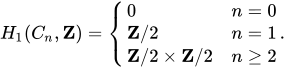
This is easily seen directly: the elements are order 2 (which is non-empty for ), and all conjugate, as are the transpositions in (which is non-empty for ), and these are two separate classes. These elements generate the group, so the only non-trivial abelianizations are to 2-groups, and either of these classes can be sent independently to as they are two separate classes. The maps are explicitly given as "the product of the signs of all the elements" (in the n copies of ), and the sign of the permutation. Multiplying these together yields a third non-trivial map (the determinant of the matrix, which sends both these classes to ), and together with the trivial map these form the 4-group.


H2: Schur multipliers
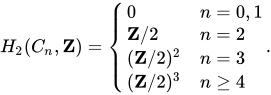
[edit]The second homology groups, known classically as the Schur multipliers, were computed in (Ihara & Yokonuma 1965).
They are:
Polynomial invariants
[edit]For every subgroup G of the orthogonal group on , its action extends to an action on the polynomial ring by linear substitutions of variables.[citation needed] The ring of invariants of such a group is the subring . The ring of invariants of the hyperoctahedral group has a simple description: it consists precisely of the symmetric polynomials in the squares of the variables.[76]
![{\displaystyle R=\mathbb {R} [x_{1},\ldots ,x_{n}]}](https://wikimedia.org/api/rest_v1/media/math/render/svg/7c845024b3627f30601d696a42adea4c355870bf)


Since is a reflection group, the ring of invariants is itself a polynomial ring; that is, for some algebraically independent set of homogeneous polynomials . These basic invariants are not uniquely determined by the group, but their degrees are. For the hyperoctahedral group , these degrees are 2, 4, ..., 2n. One choice of basic invariants is the elementary symmetric polynomials in the squares of the variables: for .[77] Another choice is given by the even power sum symmetric polynomials for .[78]
![{\displaystyle R^{S_{n}^{\pm }}=\mathbb {R} [p_{1},p_{2},\ldots ,p_{n}]}](https://wikimedia.org/api/rest_v1/media/math/render/svg/db417e4d7bfde9b0e1526ea21bd004120faf7c19)


Representation theory
[edit]The representation theory of the hyperoctahedral group was worked out by Alfred Young, in the paper (Young 1930), as an application of his study of the representation theory of symmetric groups.[79] This was subsequently generalized by Wilhelm Specht to the representation theory of more general wreath products.[80]
Concretely, the isomorphism classes of irreducible representations of are indexed by pairs of integer partitions for which the sum of the sizes is equal to n. The irreducible character indexed by is the induced representation of the symmetric group character indexed by from the subgorup to ; the character indexed by is the tensor product where is the linear character that takes the value +1 on transpositions in and takes the value −1 on sign-change reflections; and if is a partition of k and is a partition of n − k, then is the induction product of from to . These characterizations can be combined with the Murnaghan–Nakayama rule to give a combinatorial formula for character values. And there is a characteristic map from the character ring to a ring of symmetric functions in two sets of variables.[81]


The projective representations of likewise have a close relationship to the projective and linear representations of the symmetric group.[82]
Generalizations and extensions
[edit]Colored permutations
[edit]The hyperoctahedral groups are generalized by the groups of r-colored permutations, defined as the wreath product of the cyclic group by the symmetric group . The group may be concretely represented as the group of monomial matrices whose nonzero entries are complex rth roots of unity. For , these groups are no longer real reflection groups; instead, they belong to the infinite family of imprimitive complex reflection groups.[83] In particular, the group is generated by n complex reflections: the n − 1 matrices of the adjacent transpositions, together with the matrix where is a primitive rth root of unity.[84]


Affine Coxeter groups
[edit]

Each finite Weyl group W is associated to an affine Coxeter group, which is generated by the group W together with a reflection across a translated copy of one of the reflecting hyperplanes of a reflection in W. In the case of the dihedral group of order 8, there is (up to isomorphism) a unique associated affine Coxeter group. The lines of the reflections in the group divide the plane into an infinite number of congruent isosceles right triangles (the tetrakis square tiling).[85][86] When , there are two different affine extensions of , corresponding to the two different crystallographic root systems associated to the group. Viewing as a Weyl group acting by linear transformations on , in both cases, the affine group is generated by the finite group together with a single reflection, across a hyperplane with equation where is the highest root of the root system and ⋅ is the standard dot product. In type B, the highest root is , corresponding to the reflection across the hyperplane , while in type C, the highest root is , corresponding to the reflection across the hyperplane with equation .[87][88]


The affine type B and C Coxeter groups associated with have Coxeter–Dynkin diagrams
- ...

 and ...,
Both affine groups also have combinatorial realizations. The affine group of type C can be realized as the set of bijections such that and for all . In other words, these are the bijections on that commute with the reflection across 0 and also the reflection across n + 1 (and consequently with the infinite dihedral group of symmetries of generated by these two reflections). By construction, all permutations in this combinatorial model fix the multiples of n + 1. Alternatively, one may consider a slightly different combinatorial model, consisting of permutations such that and for all . In either model, such a permutation is completely determined by its n values .[91][92]


For , the affine group of type B is the subgroup of the group of type C consisting of those permutations for which the number of positive integers i such that w(i) is negative is even. (This number is always finite.)[91][93] Both affine groups can furthermore be realized as subgroups of an appropriate affine symmetric group.[94]
Braid group
[edit]Each Coxeter group W is associated to an Artin–Tits group , which is defined by a similar presentation that omits relations of the form for each generator s.[95] In particular, the Artin–Tits group associated to is generated by n elements subject to the relations and for (and no others).[96]






Artin–Tits groups are sometimes also known as generalized braid groups, because the Artin–Tits group of the (finite) symmetric group is the braid group on n strands.[97] Not all Artin–Tits groups have a natural representation in terms of geometric braids. However, the Artin–Tits group of the hyperoctahedral group does have such a representation: it is given by the subgroup of the braid group on strands consisting of those braids for which a particular strand ends in the same position it started in, or equivalently as the braid group of n strands in an annular region.[96][98] The Artin–Tits group of is also isomorphic to the mapping class group of a closed disc with n + 1 marked points, with a single point fixed pointwise,[99] and can be written as a semidirect product of with an infinite cyclic group.[100]


Bruhat order
[edit]The Bruhat order is a natural order on every Coxeter group, defined as the transitive closure of the relation that u < w whenever there is a reflection t such that and .[101] In the symmetric group, there is a simple criterion to tell whether one permutation is less than another in Bruhat order, in terms of comparing the number of 1s in certain regions of the permutation matrices of u and w.[102] The analogous criterion in the hyperoctahedral group is as follows: given a signed permutation v of size n and two integers , define to be the number of integers such that and , where v(0) is taken to be 0. Then for signed permutations u and w of size n, one has in Bruhat order if and only if for all . It furthermore follows that if and only if is less than in the Bruhat order on , where ι is the inclusion map defined in § As a permutation group.[103]


![{\displaystyle i,j\in [-n,n]}](https://wikimedia.org/api/rest_v1/media/math/render/svg/0e65b44a1e03d8bb977e28d069e07609a4c1c8d0)
![{\displaystyle v[i,j]}](https://wikimedia.org/api/rest_v1/media/math/render/svg/b863e976be939281b177644ff644d9b020bb057a)
![{\displaystyle a\in [-n,n]}](https://wikimedia.org/api/rest_v1/media/math/render/svg/1d1fd64f55ddaf2186115e0561d4e24337da814e)


![{\displaystyle u[i,j]\leq w[i,j]}](https://wikimedia.org/api/rest_v1/media/math/render/svg/4b0a6a7a70fec4fd657537e1486be792de7d34de)


Absolute order and noncrossing partitions
[edit]In a reflection group W, the reflection length of an element w is the smallest number k such that there exist reflections in W such that w is equal to the product of the reflections. In a finite real reflection group acting on a space V of dimension n, the reflection length of an element w is equal to n − dim(fix(w)), where is the fixed space of w.[104][105] In the case that is viewed as a signed permutation, this fixed space dimension is equal to the number of positive cycles of w. That is, if the conjugacy class of w is (λ, μ), then the reflection length is where is the number of parts of the partition λ.[53]


In a reflection group W, the absolute order is the partial order on W defined by if and the lattice of -noncrossing partitions is the interval in absolute order that lies below a Coxeter element of W (as in § Special elements).[h][106] This poset derives its name because, in the case of the symmetric group , there is a one-to-one correspondence between the elements of the lattice of -noncrossing partitions and the set partitions of the set that are noncrossing, in the sense that when the numbers 1, 2, ..., n are drawn in order on the boundary of a circle and the parts of the partition are drawn as their convex hulls, no two parts intersect. Moreover, under this correspondence, the order relation corresponds to the refinement order on set partitions.[107] In the case of the hyperoctahedral group , the lattice of noncrossing partitions is isomorphic to the sublattice of noncrossing partitions of a 2n-element set that are symmetric under 180° rotation.[41][108]


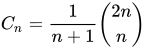
The number of noncrossing partitions of an n-element set is the nth Catalan number , with the number of partitions at each rank given by a Narayana number.[109] The corresponding number of noncrossing partitions for is the central binomial coefficient , with the number of elements at rank k equal to .[110]


Other associated polyhedra
[edit]In addition to its connection with the hypercube and the cross-polytope, the hyperoctahedral group is associated with other polyhedra. The n-dimensional polytope whose vertices are all the permutations of (±1, ±2, ..., ±n) is the type-B permutohedron, a signed analogue of the permutohedron. (A combinatorially equivalent polytope can be constructed by taking the convex hull of the orbit under of any sufficiently generic point in .)[111] Its 1-skeleton is the Hasse diagram of the weak order on .[112][113] In the case it is an octagon, while in the case it is the truncated cuboctahedron.[114]


The cyclohedron is the type-B analogue of the associahedron.[115] Just as the facets of the associahedron can be indexed by sets of noncrossing diagonals of an (n + 2)-gon, the facets of the cyclohedron can be indexed by centrally symmetric sets of noncrossing diagonals of a (2n + 2)-gon. Its 1-skeleton is a contraction of the 1-skeleton of the type-B permutohedron.[116]
As a subgroup of the orthogonal group
[edit]The hyperoctahedral group is a subgroup of the orthogonal group of orthogonal matrices. It consists exactly of those orthogonal matrices whose entries are all integers.[117][118] Is it also the normalizer in of the diagonal subgroup[citation needed]


Tables and diagrams
[edit]The Coxeter–Dynkin diagram for is
- ...
with n nodes;[27][28] the corresponding Coxeter bracket notation[119] is
- [3, 3, 3, ..., 3, 4] = [3n−2, 4].
The Coxeter–Dynkin diagrams of the associated affine Coxeter groups are
- ...
for type and

- ...

The following table collects various "numerological" data attached to the hyperoctahedral groups.
| Cardinality[120] | |
|---|---|
| Degrees[121] | 2, 4, 6, ..., 2n |
| Coxeter number h[122] | 2n |
| Number of reflections[77] | |
| Number of positive roots[122] | |
| Number of roots[120] | |
| Exponents | 1, 3, 5, ..., 2n − 1 |
| W-Catalan number[123] | |
| W-Narayana numbers[124] | , |
| Connection index[i][125][126] | 2 |


See also
[edit]- Hexadecachoric symmetry, the four-dimensional case (symmetry group of the tesseract and 16-cell)
- 5-cube, 5-orthoplex, 6-cube, 6-orthoplex, the five- and six-dimensional regular polytopes with hyperoctahedral symmetry
Notes
[edit]- ^ In other words, it must be a monomial matrix whose nonzero entries are all ±1.
- ^ This is not the only possible choice of simple system;[26] for example, Kane (2001, p. 37) and Humphreys (1990, p. 42) take a system of generators corresponding to the reflections where .
- ^ Equivalently, one can ask that the ratios are integers for all pairs of roots α and β, where ( - , - ) is the standard inner product.
- ^ The dual or inverse of a crystallographic root system Φ consists of all vectors of the form where α is a root in Φ.[34]
- ^ Less concretely, for any set X of size 2n, partitioned into n disjoint pairs. Then the group of permutations of X that respect the decomposition is also isomorphic to the group of n × n signed permutation matrices, that is, to the hyperoctahedral group.[38]
- ^ Other terminology in the literature includes "balanced" (Chen & Stanley 1993), "even" (Reiner 1993), and "paired" (Kallipoliti 2011) in place of "positive".
- ^ More generally, in any finite Coxeter group that contains −1, one has for any Coxeter element that , where the Coxeter number h is the order of c.
- ^ This definition of noncrossing partitions depends not just on W but also on the choice of Coxeter element; however, all choices of Coxeter elements yield isomorphic posets.
- ^ The index of the root lattice in the weight lattice.


- ^ Coxeter & Moser (1980), p. 90.
- ^ Gallian (2013), pp. 31–32.
- ^ Gallian (2013), p. 445.
- ^ a b Kane (2001), pp. 10–11.
- ^ Gallian (2013), pp. 455–456.
- ^ Kane (2001), p. 14.
- ^ Kane (2001), p. 15.
- ^ a b Kane (2001), p. 16.
- ^ a b Isaacs (1994), p. 8.
- ^ Goodman (2014), pp. 220–221.
- ^ Goodman (2014), pp. 230–233.
- ^ Kane (2001), pp. 20–21.
- ^ Kane (2001), p. 18.
- ^ Coxeter (1973), p. 126.
- ^ Coxeter (1973), p. 122.
- ^ Wilson (2014), §2.1.2.
- ^ a b c Chen & Stanley (1993).
- ^ Kane (2001), pp. 10, 18.
- ^ Coxeter (1973), p. 133.
- ^ Humphreys (1990), p. 3.
- ^ Humphreys (1990), p. 5.
- ^ Kane (2001), pp. 8, 10.
- ^ Kane (2001), p. 19.
- ^ Kane (2001), pp. 45–46.
- ^ a b Petersen (2015), pp. 254–255, 293–294.
- ^ Kane (2001), p. 37.
- ^ a b Kane (2001), p. 81.
- ^ a b Humphreys (1990), p. 32.
- ^ Kane (2001), pp. 25–26.
- ^ Kane (2001), pp. 26–27.
- ^ Humphreys (1990), pp. 38–39.
- ^ Kane (2001), pp. 31–32.
- ^ Kane (2001), pp. 30–31.
- ^ Humphreys (1990), p. 39.
- ^ Humphreys (1990), p. 42.
- ^ Kane (2001), p. 102.
- ^ Björner & Brenti (2005), p. 245.
- ^ Miller (1918).
- ^ a b Egge (2007), §2.
- ^ Woo (2018), p. 11.
- ^ a b Armstrong (2009), p. 104.
- ^ a b Stembridge (1992), p. 402.
- ^ & Kallipoliti (2011).
- ^ Björner & Brenti (2005), p. 246.
- ^ Baake (1984), III.A.
- ^ Kane (2001), pp. 23–24.
- ^ Petersen (2015), pp. 254–255.
- ^ Björner & Brenti (2005), p. 15.
- ^ Kane (2001), pp. 280–281.
- ^ Kane (2001), p. 282.
- ^ Humphreys (1990), p. 74.
- ^ Coxeter & Moser (1980), p. 129.
- ^ a b Kallipoliti (2011), p. 189.
- ^ Coxeter & Moser (1980), p. 127.
- ^ Baumeister et al. (2017), Lemma 6.4.
- ^ Chen & Stanley (1993), p. 67.
- ^ Kane (2001), p. 283.
- ^ Stembridge (1992), p. 398.
- ^ Coxeter & Moser (1980), pp. 124–126.
- ^ Björner & Brenti (2005), p. 252–253.
- ^ Coxeter & Moser (1980), p. 123.
- ^ Coxeter & Moser (1980), p. 128.
- ^ Kerber (1971), p. 39.
- ^ Coxeter & Moser (1980), p. 126.
- ^ a b Björner & Brenti (2005), p. 248.
- ^ Bröcker & tom Dieck (1985), p. 157.
- ^ Bröcker & tom Dieck (1985), pp. 171–173.
- ^ Kirillov (2008), A.1 and A.2.
- ^ Björner & Brenti (2005), p. 20.
- ^ Björner & Brenti (2005), p. 247.
- ^ Björner & Brenti (2005), p. 286.
- ^ Petersen (2015), p. 294.
- ^ Björner & Brenti (2005), p. 17.
- ^ Petersen (2015), pp. 294–295.
- ^ Petersen (2015), p. 296.
- ^ Kane (2001), pp. 21–23.
- ^ a b Kane (2001), p. 23.
- ^ Humphreys (1990), p. 68.
- ^ Kerber (1971), p. 2.
- ^ Kerber (1971), p. 37.
- ^ Stembridge (1992), §5.
- ^ Stembridge (1992), p. 396.
- ^ Lehrer & Taylor (2009), pp. 24–27.
- ^ Lehrer & Taylor (2009), p. 36.
- ^ Humphreys (1990), p. 89.
- ^ Björner & Brenti (2005), pp. 8–9.
- ^ Humphreys (1990), pp. 90, 96.
- ^ Kane (2001), pp. 118–122.
- ^ a b Kane (2001), p. 124.
- ^ a b Humphreys (1990), pp. 34, 96.
- ^ a b Eriksson & Eriksson (1998).
- ^ Björner & Brenti (2005), p. 267.
- ^ Björner & Brenti (2005), p. 276.
- ^ Björner & Brenti (2005), p. 275.
- ^ McCammond (2017), Section 1.1.
- ^ a b Kent, IV & Peifer (2002).
- ^ McCammond (2017), p. 11.
- ^ Charney & Peifer (2003), pp. 587–8.
- ^ Heng & Nge (2024), p. 344.
- ^ Charney & Peifer (2003), p. 588.
- ^ Björner & Brenti (2005), p. 28.
- ^ Björner & Brenti (2005), pp. 31–32.
- ^ Björner & Brenti (2005), pp. 251–252.
- ^ Carter (1972), Lemma 2.
- ^ Dyer (2001).
- ^ Armstrong (2009), pp. 23, 31–32.
- ^ Armstrong (2009), p. 5.
- ^ Simion (2000a), p. 5.
- ^ Simion (2000b), pp. 369–371.
- ^ Simion (2000b), p. 393.
- ^ Hetyei (2024), §1.3.
- ^ Fomin & Reading (2007), §5.4.
- ^ Simion (2003), §4.2.
- ^ Sloane A145901.
- ^ Petersen (2015), p. 287.
- ^ Fomin & Reading (2007), §3.2.
- ^ Baake (1984), §VII.
- ^ Stanley (1999), p. 323.
- ^ As in (Coxeter 1973, p. 226).
- ^ a b Humphreys (1990), p. 44.
- ^ Humphreys (1990), p. 59.
- ^ a b Humphreys (1990), p. 80.
- ^ Armstrong (2009), p. 39.
- ^ Petersen (2015), p. 278.
- ^ Kane (2001), p. 105.
- ^ Humphreys (1990), pp. 40, 98.
Works cited
[edit]- Armstrong, Drew (2009), Generalized Noncrossing Partitions and Combinatorics of Coxeter Groups, Memoirs of the AMS, American Mathematical Society, arXiv:math/0611106, doi:10.1090/S0065-9266-09-00565-1
- Baake, M. (1984), "Structure and representations of the hyperoctahedral group", J. Math. Phys., 25 (11): 3171–3182, doi:10.1063/1.526087
- Baumeister, Barbara; Gobet, Thomas; Roberts, Kieran; Wegener, Patrick (2017), "On the Hurwitz action in finite Coxeter groups", J. Group Theory, 20 (1): 103–131
- Björner, Anders; Brenti, Francesco (2005), Combinatorics of Coxeter groups, Springer, doi:10.1007/3-540-27596-7, ISBN 978-3540-442387, S2CID 115235335
- Bröcker, Theodor; tom Dieck, Tammo (1985), Representations of Compact Lie Groups, Graduate Texts in Mathematics, Springer-Verlag, ISBN 0-387-13678-9
- Carter, R.W. (1972), "Conjugacy classes in the Weyl group", Compositio Mathematica, 25 (1): 1–59
- Charney, Ruth; Peifer, David (2003), "The -conjecture for the affine braid groups", Comment. Math. Helv., 78 (3): 584–600, doi:10.1007/S00014-003-0764-Y
- Chen, William Y.C.; Stanley, Richard P. (1993), "Derangements on the n-cube", Discrete Math., 115 (1–3): 65–75, doi:10.1016/0012-365X(93)90479-D
- Coxeter, H.S.M. (1973), Regular Polytopes (3 ed.), Dover, ISBN 0-486-61480-8
- Coxeter, H.S.M.; Moser, W.O.J. (1980), Generators and Relations for Discrete Groups, Ergebnisse der Mathematik und ihrer Grenzgebiete, vol. 14 (4th ed.), Springer-Verlag, ISBN 3-540-09212-9
- Dyer, Matthew J. (2001), "On minimal lengths of expressions of Coxeter group elements as products of reflections", Proceedings of the American Mathematical Society, 129 (9): 2591–2595
- Egge, Eric (2007), "Restricted Symmetric Permutations", Annals of Combinatorics, 11: 405–434, doi:10.1007/s00026-007-0327-9
- Eriksson, Henrik; Eriksson, Kimmo (1998), "Affine Weyl groups as infinite permutations", Electron. J. Combin., 5 R18, doi:10.37236/1356
- Fomin, Sergey; Reading, Nathan (2007), "Root systems and generalized associahedra", Geometric combinatorics, IAS/Park City Math. Ser., vol. 13, American Mathematical Society, pp. 63–131, ISBN 978-0-8218-3736-8
- Gallian, Joseph A. (2013), Contemporary Abstract Algebra (8th ed.), Brooks/Cole, ISBN 978-1-133-59970-8, LCCN 2012938179
- Goodman, Frederick M. (2014), Algebra: abstract and concrete (2.6 ed.), SemiSimple Press, ISBN 978-0-9799142-1-8
- Heng, Edmund; Nge, Kie Seng (2024), "Curves in the disc, the type B braid group, and a type B zigzag algebra", Quantum Topol., 15 (2): 337–417, doi:10.4171/qt/198\
- Hetyei, Gábor (2024), "The type B permutohedron and the poset of intervals as a Tchebyshev transform", Discrete Comput. Geom., 71 (3): 918–944
- Humphreys, James E. (1990), Reflection groups and Coxeter groups, Cambridge University Press, doi:10.1017/CBO9780511623646, ISBN 0-521-37510-X, S2CID 121077209
- Ihara, Shin-ichiro; Yokonuma, Takeo (1965), "On the second cohomology groups (Schur-multipliers) of finite reflection groups", Journal of the Faculty of Science. University of Tokyo. Section IA. Mathematics, 11: 155–171, MR 0190232
- Isaacs, I. Martin (1994), Algebra: A Graduate Course, Graduate Studies in Mathematics, vol. 100, American Mathematical Society
- Kallipoliti, Myrto (2011), "The absolute order on the hyperoctahedral group", J. Algebr. Comb., 34: 183–211, doi:10.1007/s10801-010-0267-z
- Kane, Richard (2001), Reflection groups and invariant theory, CMS Books in Mathematics/Ouvrages de Mathématiques de la SMC, Springer-Verlag, doi:10.1007/978-1-4757-3542-0, ISBN 0-387-98979-X, S2CID 119694827
- Kent, IV, Richard P.; Peifer, David (2002), "A geometric and algebraic description of annular braid groups", International Conference on Geometric and Combinatorial Methods in Group Theory and Semigroup Theory (Lincoln, NE, 2000), Internat. J. Algebra Comput., 12 (1–2): 85–97, doi:10.1142/S0218196702000997, S2CID 13593688
- Kerber, Adalbert (1971), Representations of permutation groups. I, Lecture Notes in Mathematics, vol. 240, Springer-Verlag, doi:10.1007/BFb0067943, ISBN 978-3-540-05693-5, MR 0325752
- Kirillov, Alexander (2008), Introduction to Lie groups and Lie algebras (PDF), Cambridge studies in advanced mathematics, Cambridge University Press, ISBN 9780521889698
- Lehrer, Gustav I.; Taylor, Donald E. (2009), Unitary reflection groups, Australian Mathematical Society Lecture Series, vol. 20, Cambridge University Press, ISBN 978-0-521-74989-3, MR 2542964
- McCammond, Jon (2017), "The mysterious geometry of Artin groups", Winter Braids Lecture Notes, 4 (Winter Braids VII (Caen, 2017)): Exp. No. 1, 30, doi:10.5802/wbln.17, S2CID 128279613
- Miller, G. A. (1918). "Groups formed by special matrices". Bull. Am. Math. Soc. 24 (4): 203–6. doi:10.1090/S0002-9904-1918-03043-7.
- Petersen, T. Kyle (2015), Eulerian Numbers, Birkhäuser Advanced Texts, Springer, doi:10.1007/978-1-4939-3091-3, ISBN 978-1-4939-3090-6
- Reiner, Victor (1993), "Signed Permutation Statistics and Cycle Type", Europ. J. Combinatorics, 14: 569–579
- Reiner, Victor (1995), "The distribution of descents and length in a Coxeter group", Electron. J. Combin., 2 R25, doi:10.37236/1219
- Simion, Rodica (2000a), "Combinatorial statistics on type-B analogues of noncrossing partitions and restricted permutations", Electronic Journal of Combinatorics R9, doi:10.37236/1487
- Simion, Rodica (2000b), "Noncrossing partitions", Discrete Mathematics, 217: 367–409
- Simion, Rodica (2003), "A type-B associahedron", Adv. in Appl. Math., 30 (1–2): 2–25
- Sloane, N. J. A. (ed.), "Sequence A145901 (Triangle of f-vectors of the simplicial complexes dual to the permutohedra of type B_n)", The On-Line Encyclopedia of Integer Sequences, OEIS Foundation
- Stanley, Richard P. (1999), Enumerative Combinatorics, Cambridge Studies in Advanced Mathematics, vol. 2, Cambridge University Press, ISBN 978-0-521-78987-5
- Stembridge, John R. (1992), "The projective representations of the hyperoctahedral group", J. Algebra, 145 (2): 396–453, doi:10.1016/0021-8693(92)90110-8, hdl:2027.42/30235
- Wilson, Jennifer C.H. (2014), "-modules and stability criteria for representations of classical Weyl groups", Journal of Algebra, 420: 269–332, doi:10.1016/j.jalgebra.2014.08.010
- Woo, Alexander (2018), "Hultman Elements for the Hyperoctahedral Groups", Electronic J. Comb., 25 (2) P2.41, doi:10.37236/7636
- Young, Alfred (1930), "On Quantitative Substitutional Analysis 5", Proceedings of the London Mathematical Society, Series 2, 31: 273–288, doi:10.1112/plms/s2-31.1.273, JFM 56.0135.02

