


Surname

In many societies, a surname, last family name, or first family name is the mostly hereditary portion of one's personal name that indicates one's family.[1][2] It is typically combined with a given name to form the full name of a person, although several given names and surnames are possible in the full name. In modern times most surnames are hereditary, although in most countries a person has a right to change their name.
Depending on culture, the surname may be placed either at the start of a person's name, or at the end. The number of surnames given to an individual also varies: in most cases it is just one, but in Portuguese-speaking countries and many Spanish-speaking countries, two surnames (one inherited from the mother and another from the father) are used for legal purposes. Depending on culture, not all members of a family unit are required to have identical surnames. In some countries, surnames are modified depending on gender and family membership status of a person. Compound surnames can be composed of separate names.[3]
The use of names has been documented in even the oldest historical records. Examples of surnames are documented in the 11th century by the barons in England. English surnames began to be formed with reference to a certain aspect of that individual, such as their trade, father's name, location of birth, or physical features, and were not necessarily inherited. By 1400 most English families, and those from Lowland Scotland, had adopted the use of hereditary surnames.[4]
The study of proper names (in family names, personal names, or places) is called onomastics.[5]
History
[edit]Origin
[edit]While the use of given names to identify individuals is attested in the oldest historical records, the advent of surnames is relatively recent.[6] Many cultures have used and continue to use additional descriptive terms in identifying individuals. These terms may indicate personal attributes, location of origin, occupation, parentage, patronage, adoption, or clan affiliation.[7]
In China, according to legend, family names started with Emperor Fu Xi in 2000 BC.[8] His administration standardised the naming system to facilitate census-taking, and the use of census information. Originally, Chinese surnames were derived matrilineally,[9] although by the time of the Shang dynasty (1600 to 1046 BC) they had become patrilineal.[9][10] Chinese women do not change their names upon marriage.[11] In China, surnames have been quite common since at least the 2nd century BC.[12]
In Ancient Greece, as far back as the Archaic Period clan names and patronymics ("son of") were also common, as in Aristides as Λῡσῐμᾰ́χου – a genitive singular form meaning son of Lysimachus. For example, Alexander the Great was known as Heracleides, as a supposed descendant of Heracles, and by the dynastic name Karanos/Caranus, which referred to the founder of the dynasty to which he belonged. These patronymics are already attested for many characters in the works of Homer. At other times formal identification commonly included the place of origin.[13]
Over the course of the Roman Republic and the later Empire, naming conventions went through multiple changes. (See Roman naming conventions.) The nomen, the name of the gens (tribe) inherited patrilineally, is thought to have already been in use by 650 BC.[14] The nomen was to identify group kinship, while the praenomen (forename; plural praenomina) was used to distinguish individuals within the group. Female praenomina were less common, as women had reduced public influence, and were commonly known by the feminine form of the nomen alone.[15]
Medieval era and beyond
[edit]The practice of using family names spread through the Eastern Roman Empire, however it was not until the 11th century that surnames came to be used in West Europe.[16] Medieval Spain used a patronymic system. For example, Álvaro, a son of Rodrigo, would be named Álvaro Rodríguez. His son, Juan, would not be named Juan Rodríguez, but Juan Álvarez. Over time, many of these patronymics became family names, and they are some of the most common names in the Spanish-speaking world today. Other sources of surnames are personal appearance or habit, e.g. Delgado ("thin") and Moreno ("dark"); geographic location or ethnicity, e.g. Alemán ("German"); and occupations, e.g. Molinero ("miller"), Zapatero ("shoe-maker") and Guerrero ("warrior"), although occupational names are much more often found in a shortened form referring to the trade itself, e.g. Molina ("mill"), Guerra ("war"), or Zapata (archaic form of zapato, "shoe").[17]
In England the introduction of family names is generally attributed to the preparation of the Domesday Book in 1086, following the Norman Conquest. Evidence indicates that surnames were first adopted among the feudal nobility and gentry, and slowly spread to other parts of society. Some of the early Norman nobility who arrived in England during the Norman conquest differentiated themselves by affixing 'de' (of) before the name of their village in France. This is what is known as a territorial surname, a consequence of feudal landownership. By the 14th century, most English and most Scottish people used surnames and in Wales following unification under Henry VIII in 1536.[18]
A four-year study led by the University of the West of England, which concluded in 2016, analysed sources dating from the 11th to the 19th century to explain the origins of the surnames in the British Isles.[19] The study found that over 90% of the 45,602 surnames in the dictionary are native to Britain and Ireland, with the most common in the UK being Smith, Jones, Williams, Brown, Taylor, Davies, and Wilson.[20] The findings have been published in the Oxford English Dictionary of Family Names in Britain and Ireland, with project leader Richard Coates calling the study "more detailed and accurate" than those before.[19] He elaborated on the origins: "Some surnames have origins that are occupational – obvious examples are Smith and Baker. Other names can be linked to a place, for example, Hill or Green, which relates to a village green. Surnames that are 'patronymic' are those which originally enshrined the father's name – such as Jackson, or Jenkinson. There are also names where the origin describes the original bearer such as Brown, Short, or Thin – though Short may in fact be an ironic 'nickname' surname for a tall person."[19]
In the modern era, governments have enacted laws to require people to adopt surnames. This served the purpose of uniquely identifying subjects for taxation purposes or for inheritance.[21] In the late Middle Ages in England, mandatory surnames were resisted as they were associated with taxes.[22]
Most modern Arabic names consist of a first, middle and surname, but this wasn't always the case. In medieval times some of the most common parts of a name are called: ism (given name), kunya (name relevant to offspring), nasab (name relevant to descent, traced through the patrilineal line), nisba (can be a tribal or geographical name) and laqab (a title or honorific name). Medieval Arabic documents show that Arabic names included multiple words, which did not appear in the same order that names are written in now. The given name was not always the first name, in terms of name order. Most documents from this era do not use the full name of a person. Al-Tabari, a polymath and author is referred to in this way, despite his full name being Abu Jaʿfar Muhammad ibn Jarir ibn Yazid al-Tabari. Arabic names include lineage information, sometimes across multiple generations (the father, grandfather and great grandfather).[23]
Modern era
[edit]During the modern era many cultures around the world adopted family names, particularly for administrative reasons, especially during the age of European expansion and particularly since 1600. The Napoleonic Code, adopted in various parts of Europe, stipulated that people should be known by both their given name(s) and a family name that would not change across generations. Other notable examples include the Netherlands (1795–1811), Japan (1870s), Thailand (1920), and Turkey (1934). The structure of the Japanese name was formalized by the government as family name + given name in 1868.[24]
In Breslau Prussia enacted the Hoym Ordinance in 1790, mandating the adoption of Jewish surnames.[25][26] Napoleon also insisted on Jews adopting fixed names in a decree issued in 1808.[27]
Names can sometimes be changed to protect individual privacy (such as in witness protection), or in cases where groups of people are escaping persecution.[28] After arriving in the United States, European Jews who fled Nazi persecution sometimes anglicized their surnames to avoid discrimination.[29] Governments can also forcibly change people's names, as when the National Socialist government of Germany assigned German names to European people in the territories they conquered.[30] In the 1980s, the People's Republic of Bulgaria forcibly changed the first and last names of its Turkish citizens to Bulgarian names.[31]
Origins of particular surnames
[edit]Patronymic and matronymic surnames
[edit]These are the oldest and most common type of surname.[32] They may be a first name such as "Wilhelm", a patronymic such as "Andersen", a matronymic such as "Beaton", or a clan name such as "O'Brien". Multiple surnames may be derived from a single given name: e.g. there are thought to be over 90 Italian surnames based on the given name "Giovanni".[32]
Examples
[edit]- Patronymics, matronymics or ancestral, often from a person's given name. e.g., from names: Richardson, Stephenson, Jones (Welsh for Johnson), Williams, Jackson, Wilson, Thompson, Benson, Johnson, Harris, Evans, Simpson, Willis, Davies, Reynolds, Adams, Dawson, Lewis, Rogers, Murphy, Morrow, Nicholson, Robinson, Powell, Ferguson, Davis, Edwards, Hudson, Roberts, Harrison, Watson, Madison (from Maud), or from a clan name (for those of Scottish origin, e.g., MacDonald, Forbes, Henderson, Armstrong, Grant, Cameron, Stewart, Douglas, Crawford, Campbell, Hunter) with "Mac" Gaelic for son.[33]
Cognominal surnames
[edit]This is the broadest class of surnames, originating from nicknames,[34] encompassing many types of origin. These include names based on appearance such as "Schwartzkopf", "Short", and possibly "Caesar",[32] and names based on temperament and personality such as "Daft", "Gutman", and "Maiden", which, according to a number of sources, was an English nickname meaning "effeminate".[32][35]
A group of nicknames look like occupational ones: King, Bishop, Abbot, Sheriff, Knight, etc. but it is rather unlikely that a person with surname King was a king or descended from a king. Bernard Deacon suggests that the first nickname/surname bearer may have acted like a king or bishop, or was as corpulent as a bishop. etc.[34]
A considerable group of surname-producing nicknames may be found among ethnonymic surnames.[36][37]
Ornamental/artificial surnames
[edit]Ornamental surnames (also known as artificial surnames[38][39]) are not specific to any attribute (place, parentage, occupation, caste) of the first person to acquire the name. They were generally acquired later in history and generally when those without surnames needed them. In 1526, King Frederik I of Denmark-Norway ordered that noble families must take up fixed surnames, and many of them took as their name some element of their coat of arms; for example, the Rosenkrantz ("rose wreath") family took their surname from a wreath of roses forming the torse of their arms,[40] and the Gyldenstierne ("golden star") family took theirs from a 7-pointed gold star on their shield.[41] Ornamental surnames are more common in communities that adopted (or were forced to adopt) surnames in the 18th and 19th centuries.[42] They occur commonly in Scandinavia, and among Sinti and Romani and Eastern Ashkenazi Jews in Germany and Austria.[32]
Acquired/assigned surnames
[edit]During the era of the Trans-Atlantic slave trade many Africans were given new names by their masters. Many of the family names of many African-Americans have their origins in slavery (i.e. slave name). Some freed slaves later created family names themselves.[43]
Another category of acquired names is foundlings' names. Historically, children born to unwed parents or extremely poor parents would be abandoned in a public place or anonymously placed in a foundling wheel. Such abandoned children might be claimed and named by religious figures, the community leaders, or adoptive parents. Some such children were given surnames that reflected their condition, like (Italian) Esposito, Innocenti, Della Casagrande, Trovato, Abbandonata, or (Dutch) Vondeling, Verlaeten, Bijstand. Other children were named for the street/place they were found (Union, Liquorpond (street), di Palermo, Baan, Bijdam, van den Eyngel (shop name), van der Stoep, von Trapp), the date they were found (Monday, Septembre, Spring, di Gennaio), or festival/feast day they found or christened (Easter, SanJosé). Some foundlings were given the name of whoever found them.[44][45][46]
Occupational surnames
[edit]Occupational names include Smith, Taylor (Tailor), Miller, Farmer, Thatcher, Shepherd, Potter and analogous names in other languages, for example, various surnames associated with the occupation of smith. There are also more complicated names based on occupational titles. In England it was common for servants to take the name (or modified version) of their employer,[47] such as by adding the letter s to the word, although this formation could also be a patronymic. For instance, the surname Vickers is thought to have arisen as an occupational name adopted by the servant of a vicar,[48] while Roberts could have been adopted by either the son or the servant of a man named Robert. A Dictionary of English Surnames says that "surnames of office, such as Abbot, Bishop, Cardinal and King, are often nicknames".[48]
Toponymic surnames
[edit]Location (toponymic, habitation) names derive from the inhabited location associated with the person given that name. Such locations can be any type of settlement, such as homesteads, farms, enclosures, villages, hamlets, strongholds, or cottages. One element of a habitation name may describe the type of settlement. Examples of Old English elements are frequently found in the second element of habitational names. The habitative elements in such names can differ in meaning, according to different periods, different locations, or with being used with certain other elements. For example, the Old English element tūn may have originally meant "enclosure" in one name, but can have meant "farmstead", "village", "manor", or "estate" in other names.[49]
Location names, or habitation names, may be as generic as "Monte" (Portuguese for "mountain"), "Górski" (Polish for "hill"), or "Pitt" (variant of "pit"), but may also refer to specific locations. "Washington", for instance, is thought to mean "the homestead of the family of Wassa",[35] while "Lucci" means "resident of Lucca".[32] Although some surnames, such as "London", "Lisboa", or "Białystok" are derived from large cities, more people reflect the names of smaller communities, as in Ó Creachmhaoil, derived from a village in County Galway. This is thought to be due to the tendency in Europe during the Middle Ages for migration to chiefly be from smaller communities to the cities and the need for new arrivals to choose a defining surname.[35][42]
Arabic names sometimes contain surnames that denote the city of origin. For example, in cases of Saddam Hussein al Tikriti,[50] meaning Saddam Hussein originated from Tikrit, a city in Iraq. This component of the name is called a nisbah.
Patronage
[edit]Patronal from patronage (Hickman meaning Hick's man, where Hick is a pet form of the name Richard) or strong ties of religion Kilpatrick (follower of Patrick) or Kilbride (follower of Saint Brigid of Kildare).[51][52]
Other
[edit]The meanings of some names are unknown or unclear. The most common European name in this category may be the Irish name Ryan, which means 'little king' in Irish.[35][48] Also, Celtic origin of the name Arthur, meaning 'bear'. Other surnames may have arisen from more than one source: the name De Luca, for instance, likely arose either in or near Lucania or in the family of someone named Lucas or Lucius;[32] in some instances, however, the name may have arisen from Lucca, with the spelling and pronunciation changing over time and with emigration.[32] The same name may appear in different cultures by coincidence or romanization; the surname Lee is used in English culture, but is also a romanization of the Chinese surname Li.[48] In the Russian Empire, illegitimate children were sometimes given artificial surnames rather than the surnames of their adoptive parents.[53][54]
Order of names
[edit]In many cultures (particularly in European and European-influenced cultures in the Americas, Oceania, etc., as well as West Asia/North Africa, South Asia, and most Sub-Saharan African cultures), the surname or family name ("last name") is placed after the personal, forename (in Europe) or given name ("first name"). In other cultures the surname is placed first, followed by the given name or names. The latter is often called the Eastern naming order because Europeans are most familiar with the examples from the East Asian cultural sphere, specifically, Greater China, Korea (both North and South), Japan, and Vietnam. This is also the case in Cambodia and among the Hmong of Laos and Thailand. The Telugu people of south India also place surname before personal name, and historically the Tamil people did the same.[55] There are some parts of Europe, in particular Hungary, where the surname is placed before the personal name.[56]
When people from areas using Eastern naming order write their personal name in the Latin alphabet, it is common to reverse the order of the given and family names for the convenience of Westerners, so that they know which name is the family name for official/formal purposes. Reversing the order of names for the same reason is also customary for the Mordvins and the Hungarians, but other Uralic peoples traditionally did not have surnames, perhaps because of the clan structure of their societies. The Samis, depending on the circumstances of their names, either saw no change or did see a transformation of their name. For example: Sire in some cases became Siri,[57] and Hætta Jáhkoš Ásslat became Aslak Jacobsen Hætta – as was the norm.
Indian surnames may often denote village, profession or caste and are invariably mentioned along with the personal or first names. However, hereditary last names are not universal. In Telugu-speaking families in south India, surname is placed before the personal or first name and in most cases it is only shown as an initial (for example 'S.' for Suryapeth).[58]
In English and other languages, although the usual order of names is "first middle last", for the purpose of cataloging in libraries and in citing the names of authors in scholarly papers, the order is changed to "last, first middle," with the last and first names separated by a comma, and items are alphabetized by the last name.[59][60]
Gender-specific versions of surname
[edit]In most Balto-Slavic languages (such as Latvian, Lithuanian, Bulgarian, Macedonian, Russian, Polish, Slovak, Czech, etc.) as well as in Greek, Irish, Icelandic, and Azerbaijani, some surnames change form depending on the gender of the bearer.[61]
| Language | Male form | Female form | Reference |
|---|---|---|---|
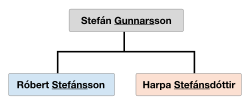
| Icelandic patronymics | Suffix -son | Suffix -dóttir | [62] |
| Greek surnames | Suffixes -os, -as, -is | Suffixes -ou, -a, -i | [63] |
| Irish surnames | Prefixes Mac, Ó, Ua, Mag | Prefixes Bean Uí, Nic, Bean Mhic, Ní, Mhic, Nig | [64] |
| Lithuanian surnames | Suffixes -as, -ys, -is, -us | Suffixes -ienė, -uvienė, -aitė, -utė, -iūtė, -ytė, -ė | [65] |
| Latvian surnames | Suffixes -us, -is, -s, -iņš | Suffixes -a, -e, -iņa | |
| Scottish Gaelic surnames | Prefix Mac- | Prefix Nic- | [66] |
| Bulgarian and Macedonian surnames | Suffixes -ov, -ev, -ski | Suffixes -ova, -eva, -ska | |
| East Slavic surnames and patronymics | Suffixes -ov, -ev, -in, -iy, -oy, -yy, -ou Patronymics -ovich, -ovych, -yovych, -avich | Suffixes -ova, -eva, -ina, -aya Patronymics -ovna, -ivna, -yivna, -ouna | [67] |
| Czech and Slovak surnames | Suffixes -ov, -ý, -ský, -cký | Suffixes -ová, -á, -ská, -cká | [68] |
| Polish surnames | Suffixes -ski, -cki, -dzki | Suffixes -ska, -cka, -dzka | [69] |
| Azerbaijani surnames and patronymics | Suffixes -ov, -yev, Patronymic oğlu | Suffixes -ova, -yeva, Patronymic qızı |
In Greece, if a man called Papadopoulos has a daughter or wife, she will likely be named Papadopoulou, the genitive form, as if the daughter/wife is "of" a man named Papadopoulos. Likewise, the surnames of daughters and wives of males with surnames ending in -as will end in -a, and those of daughters and wives of males with the -is suffix will have the -i suffix.[63]
In Iceland, surnames have a gender-specific suffix (-dóttir = daughter, -son = son).[70] Finnish used gender-specific suffixes up to 1929 when the Marriage Act forced women to use the husband's form of the surname. In 1985, this clause was removed from the act.[71]
Surname law
[edit]Surname laws vary around the world. Traditionally in many European countries for the past few hundred years, it was the custom or the law for a woman, upon marriage, to use her husband's surname and for any children born to bear the father's surname. If a child's paternity was not known, or if the putative father denied paternity, the newborn child would have the surname of the mother. That is still the custom or law in many countries. The surname for children of married parents is usually inherited from the father.[72]
Surname of women
[edit]King Henry VIII of England (reigned 1509–1547) ordered that marital births be recorded under the surname of the father.[6]
The United States followed the naming customs and practices of English common law and traditions until recent times. The first known instance in the United States of a woman insisting on the use of her birth name was that of Lucy Stone in 1855, and there has been a general increase in the rate of women using their birth name. Beginning in the latter half of the 20th century, traditional naming practices (writes one commentator) were recognized as "com[ing] into conflict with current sensitivities about children's and women's rights".[73] Those changes accelerated a shift away from the interests of the parents to a focus on the best interests of the child. The law in this area continues to evolve today mainly in the context of paternity and custody actions.[74]
Naming conventions in the US have gone through periods of flux, however, and the 1990s saw a decline in the percentage of name retention among women.[75] As of 2006, more than 80% of American women adopted the husband's family name after marriage.[76]
In 1979, the United Nations adopted the Convention on the Elimination of All Forms of Discrimination Against Women ("CEDAW"), which declared in effect that women and men, and specifically wife and husband, shall have the same rights to choose a "family name", as well as a profession and an occupation.[77]
In some places, civil rights lawsuits or constitutional amendments changed the law so that men could also easily change their married names (e.g., in British Columbia and California).[78] Québec law permits neither spouse to change surnames.[79]
In France, until 1 January 2005, children were required by law to take the surname of their father. Article 311-21 of the French Civil code now permits parents to give their children the family name of either their father, mother, or hyphenation of both – although no more than two names can be hyphenated. In cases of disagreement, both names are used in alphabetical order.[80] This brought France into line with a 1978 declaration by the Council of Europe requiring member governments to take measures to adopt equality of rights in the transmission of family names, a measure that was echoed by the United Nations in 1979.[81]
Similar measures were adopted by West Germany (1976), Sweden (1982), Denmark (1983), Finland (1985) and Spain (1999). The European Community has been active in eliminating gender discrimination. Several cases concerning discrimination in family names have reached the courts. Burghartz v. Switzerland challenged the lack of an option for husbands to add the wife's surname to his surname, which they had chosen as the family name when this option was available for women.[82] Losonci Rose and Rose v. Switzerland challenged a prohibition on foreign men married to Swiss women keeping their surname if this option was provided in their national law, an option available to women.[83] Ünal Tekeli v. Turkey challenged prohibitions on women using their surname as the family name, an option only available to men.[84] The Court found all these laws to be in violation of the convention.[85]
From 1945 to 2021 in the Czech Republic women by law had to use family names with the ending -ová after the name of their father or husband (so-called přechýlení). This was seen as discriminatory by a part of the public. Since 1 January 2022, Czech women can decide for themselves whether they want to use the feminine or neutral form of their family name.[86]
Couples sometimes keep their own last names but give their children hyphenated or combined surnames.[87]
Compound surnames
[edit]Compound surnames are a type of surname that contain more than one word, which may or may not be used with a hyphen.[88]
English
[edit]Compound surnames in English and several other European cultures feature two (or occasionally more) words, often joined by a hyphen or hyphens. However, it is not unusual for compound surnames to be composed of separate words not linked by a hyphen, for example Iain Duncan Smith, a former leader of the British Conservative Party, whose surname is "Duncan Smith".[89]
Chinese
[edit]Some Chinese surnames use more than one character though this is very rare.[90] Compound surnames are becoming more common in urban areas, in China.[91]
Multiple surnames
[edit]Spanish-speaking countries
[edit]In Spain and in most Spanish-speaking countries, the custom is for people to have two surnames, with the first surname coming from the father and the second from the mother. For example, if José García Torres and María Acosta Gómez had a child named Pablo, then his full name would be Pablo García Acosta.[92]
| José García Torres | María Acosta Gómez | ||||||||||||||||||||||||
| Pablo García Acosta | |||||||||||||||||||||||||
In Spain, feminist activism pushed for a law approved in 1999 that allows an adult to change the order of his/her family names,[93] and parents can also change the order of their children's family names if they (and the child, if over 12) agree, although this order must be the same for all their children.[94][95]
In Spain, a woman does not generally change her legal surname when she marries. In some Spanish-speaking countries in Latin America, a woman may, on her marriage, drop her mother's surname and add her husband's surname to her father's surname using the preposition de ("of"), del ("of the", when the following word is masculine) or de la ("of the", when the following word is feminine). For example, if "Clara Reyes Alba" were to marry "Alberto Gómez Rodríguez", the wife could use "Clara Reyes de Gómez" as her name (or "Clara Reyes Gómez", or, rarely, "Clara Gómez Reyes". She can be addressed as Sra. de Gómez corresponding to "Mrs Gómez"). Feminist activists have criticized this custom [when?] as they consider it sexist.[96][97]
Compound surnames
[edit]Beyond the seemingly "compound" surname system in the Spanish-speaking world, there are also true compound surnames. These true compound surnames are passed on and inherited as compounds. For instance, former chairman of the Supreme Military Junta of Ecuador, General Luis Telmo Paz y Miño Estrella, has Luis as his first given name, Telmo as his middle name, the true compound surname Paz y Miño as his first (i.e. paternal) surname, and Estrella as his second (i.e. maternal) surname. Luis Telmo Paz y Miño Estrella is also known more casually as Luis Paz y Miño, Telmo Paz y Miño, or Luis Telmo Paz y Miño. He would never be regarded as Luis Estrella, Telmo Estrella, or Luis Telmo Estrella, nor as Luis Paz, Telmo Paz, or Luis Telmo Paz. This is because "Paz" alone is not his surname (although other people use the "Paz" surname on its own).[72]

Prevalence of particular surnames
[edit]In the United States, 1,712 surnames cover 50% of the population, and about 1% of the population has the surname Smith, the most common American surname.[98]
According to some estimates, 85% of China's population shares just 100 surnames. The names Wang (王), Zhang (张), and Li (李) are the most frequent.[99]
The surname Silva is by far the most common surname in Brazil and Portugal, forming the basis of Brazilian onomastics. The surname is borne by 34,030,104 Brazilians. This colossal number represents 16.76% of the total population analyzed, consolidating Silva as the most fundamental and widespread surname in the country.[100]
See also
[edit]- Dit name
- Genealogy
- Generation name
- Irish name
- Legal name
- List of family name affixes
- Lists of most common surnames
- Maiden and married names
- Matriname
- Name blending
- Name change
- Naming law
- One-name study
- Skin name
- Spanish naming customs
- Surname extinction
- Surname map
- Surnames by country
- Tussenvoegsel
- Van
- Von
References
[edit]- ^ "Surname". Britannica. Archived from the original on 17 March 2023. Retrieved 11 April 2023.
- ^ "surname". Oxford Dictionaries. Archived from the original on 20 January 2017. Retrieved 3 October 2017.
- ^ Haas, Ann; Elliott, Marc N; Dembosky, Jacob W; Adams, John L; Wilson-Frederick, Shondelle M; Mallett, Joshua S; Gaillot, Sarah; Haffer, Samuel C; Haviland, Amelia M (1 February 2019). "Imputation of race/ethnicity to enable measurement of HEDIS performance by race/ethnicity". Health Services Research. 54 (1): 13–23. doi:10.1111/1475-6773.13099. ISSN 1475-6773. PMC 6338295. PMID 30506674.
- ^ "BBC – Family History – What's in a Name? Your Link to the Past". BBC History. Archived from the original on 20 September 2020. Retrieved 21 September 2020.
- ^ "Name - Onomastics, Etymology, Naming". Encyclopedia Britannica. Retrieved 27 March 2026.
- ^ a b Doll, Cynthia Blevins (1992). "Harmonizing Filial and Parental Rights in Names: Progress, Pitfalls, and Constitutional Problems". Howard Law Journal. Vol. 35. Howard University School of Law. p. 227. ISSN 0018-6813. Content available by subscription only. The first page of content is available via Google Scholar.
- ^ Lederer, Richard (5 September 2015). "Our last names reveal a lot about our labor days". San Diego Union-Tribune. Retrieved 2 June 2024.
- ^ Danesi, Marcel (2007). The Quest for Meaning. University of Toronto Press. p. 48. ISBN 978-0-8020-9514-5. Retrieved 21 September 2008.
- ^ a b "Naming practices" (PDF). Berkeley Linguistics. 2004. Chinese naming practices (Mak et al., 2003). Archived from the original (PDF) on 19 May 2011.
- ^ Zhimin, An (1988). "Archaeological Research on Neolithic China". Current Anthropology. 29 (5): 753–759 [755, 758]. doi:10.1086/203698. JSTOR 2743616. S2CID 144920735.
- ^ Ch'ien, E.N.M. (2005). Weird English. Harvard University Press. p. 310. ISBN 978-0-674-02953-8. Retrieved 2 June 2024.
- ^ Koon, Wee Kek (18 November 2016). "The complex origins of Chinese names demystified". Post Magazine. Archived from the original on 4 October 2017. Retrieved 3 October 2017.
- ^ Gill, N.S. (ed.). "Ancient Names – Greek and Roman Names". About Ancient / Classical History. The New York Times Company. Archived from the original on 28 November 2007. Retrieved 13 May 2016.
- ^ Benet Salway, "What's in a Name? A Survey of Roman Onomastic Practice from c. 700 B.C. to A.D. 700", in Journal of Roman Studies, vol. 84, pp. 124–145 (1994).
- ^ "Roman Naming Conventions". everything-everywhere.com. Retrieved 27 March 2026.
- ^ Kennett, D. (2012). The Surnames Handbook: A Guide to Family Name Research in the 21st Century. History Press. pp. 19–20. ISBN 978-0-7524-8349-8. Retrieved 2 June 2024.
- ^ "What is the origin of the last name Molina?". Last Name Meanings. Archived from the original on 1 August 2023. Retrieved 1 August 2023.
- ^ "BBC – Family History – What's in a Name? Your Link to the Past". Archived from the original on 17 May 2022. Retrieved 17 May 2022.
- ^ a b c "Most common surnames in Britain and Ireland revealed". BBC. 17 November 2016. Archived from the original on 2 November 2018. Retrieved 21 July 2018.
- ^ Hanks, Patrick; Coates, Richard; McClure, Peter (17 November 2016). The Oxford Dictionary of Family Names in Britain and Ireland. Oxford University Press. doi:10.1093/acref/9780199677764.001.0001. ISBN 978-0-19-967776-4. Archived from the original on 26 May 2020. Retrieved 1 March 2020.
- ^ Kennett 2012, p. 20.
- ^ Anderson, Raymond A. (2022). Credit Intelligence and Modelling: Many Paths Through the Forest of Credit Rating and Scoring. Oxford University Press. pp. 193–194. ISBN 978-0-19-284419-4.
- ^ Ali, Adam (24 September 2022). "How to Understand Medieval Arabic Names". Medievalists.net. Retrieved 27 March 2026.
- ^ "Japanese surnames". www.japan-experience.com. Retrieved 27 March 2026.
- ^ "Schlesischen Provinzialblättern 12" [Silesian Provincial Papers]. St. 7 (in German). 1790. pp. 52–61.
- ^ Ury, S. (2012). Barricades and Banners: The Revolution of 1905 and the Transformation of Warsaw Jewry. Stanford Studies in Jewish History and Culture. Stanford University Press. p. 32. ISBN 978-0-8047-8104-6. Retrieved 2 June 2024.
- ^ Scott, James C.; Tehranian, John; Mathias, Jeremy (2002). "The Production of Legal Identities Proper to States: The Case of the Permanent Family Surname". Comparative Studies in Society and History. 44 (1). Cambridge University Press: 4–44. doi:10.1017/S0010417502000026. ISSN 0010-4175. JSTOR 3879399. Retrieved 2 June 2024.
- ^ Ahmed, S.R. (2020). Preventing Identity Crime: Identity Theft and Identity Fraud: An Identity Crime Model and Legislative Analysis with Recommendations for Preventing Identity Crime. Brill. p. 39. ISBN 978-90-04-39597-8. Retrieved 2 June 2024.
- ^ Holton, G.; Sonnert, G. (25 December 2006). What Happened to the Children Who Fled Nazi Persecution. Springer. p. 96. ISBN 978-0-230-60179-6.
- ^ Lemkin, Raphael (2014). Axis Rule in Occupied Europe: Laws of Occupation, Analysis of Government, Proposals for Redress. The Lawbook Exchange, Ltd. p. 82. ISBN 978-1-58477-576-8.
- ^ Neuburger, M.C. (2011). The Orient Within: Muslim Minorities and the Negotiation of Nationhood in Modern Bulgaria. Cornell University Press. p. 77. ISBN 978-1-5017-2023-9. Retrieved 2 June 2024.
- ^ a b c d e f g h Hanks, Patrick and Hodges, Flavia. A Dictionary of Surnames. Oxford University Press, 1989. ISBN 0-19-211592-8.
- ^ Katherine M. Spadaro, Katie Graham (2001) Colloquial Scottish Gaelic: the complete course for beginners p.16. Routledge, 2001
- ^ a b Bernard Deacon, Classifying surnames Archived 4 June 2024 at the Wayback Machine
- ^ a b c d Cottle, Basil. Penguin Dictionary of Surnames. Baltimore, MD: Penguin Books, 1967. No ISBN.
- ^ Butkus, Alvydas, The Lithuanian Nicknames of Ethnonymic Origin, Indogermanische Forschungen; Strassburg Vol. 100, (1 January 1995): 223.
- ^ Tamás Farkas, Surnames of Ethnonymic Origin in the Hungarian Language, In: Name and Naming. Proceedings of the Second International Conference on Onomastics. Onomastics in Contemporary Public Space. Baia Mare, 9–11 May 2013, pp.504–517
- ^ Johannes Czakai, Nochems neue Namen: Die Juden Galiziens und der Bukowina und die Einführung deutscher Vor- und Familiennamen 1772-1820, footnote 78 at p 292, referring to Beider
- ^ Alexander Beider, Introductory chapters to: Beider, Alexander. 2004. A Dictionary of Jewish Surnames from Galicia , Section 2.3 "Artificial surnames", pp. 27–41
- ^ Hiort-Lorensen, H.R., and Thiset, A. (1910) Danmarks Adels Aarbog, 27th ed. Copenhagen: Vilh. Trydes Boghandel, p. 371.
- ^ von Irgens-Bergh, G.O.A., and Bobe, L. (1926) Danmarks Adels Aarbog, 43rd ed. Copenhagen: Vilh. Trydes Boghandel, p. 3.
- ^ a b Bowman, William Dodgson. The Story of Surnames. London, George Routledge & Sons, Ltd., 1932. No ISBN.
- ^ Craven, Julia (24 February 2022). "Many African American last names hold weight of Black history". NBC News. Archived from the original on 23 May 2024. Retrieved 2 June 2024.
- ^ "Finding Foundlings: Searching for Abandoned Children in Italy". Legacy Tree Genealogists. 14 September 2017. Archived from the original on 27 July 2021. Retrieved 27 July 2021.
- ^ "England Regional, Ethnic, Foundling Surnames (National Institute)". FamilySearch Research Wiki. 4 September 2014. Archived from the original on 27 July 2021. Retrieved 27 July 2021.
- ^ "Deciphering Dutch Foundling Surnames". Dutch Ancestry Coach. Archived from the original on 27 July 2021. Retrieved 27 July 2021.
- ^ "Behind Surnames of Relationship". researchthroughpeople.com. 11 September 2020. Retrieved 27 March 2026.
- ^ a b c d Reaney, P.H., and Wilson, R.M. A Dictionary of English Surnames. Oxford: Oxford University Press, 1997. Rev. 3rd ed. ISBN 0-19-860092-5.
- ^ Moss, John (30 May 2020). A History of English Place Names and Where They Came From. Pen and Sword History. ISBN 978-1-5267-2285-0.
- ^ "Saddam Hussein's top aides hanged". BBC News. 15 January 2007. Archived from the original on 2 March 2016. Retrieved 17 October 2011.
- ^ Hanks, Patrick (2022). Dictionary of American Family Names (2nd ed.). Oxford University Press. p. 42.
- ^ "English surnames explained: The seven types of last names you should know". www.findmypast.co.uk. Retrieved 27 March 2026.
- ^ Boris Unbegaun, Russian surnames, — Oxford: Clarendon Press, 1972; Russian version: Русские фамилии, 1989, Chapter IX: "Artificial surnames"
- ^ НЕСТАНДАРТНЫЕ РУССКИЕ ФАМИЛИИ, citing Суслова А.В., Суперанская А.В., О русских именах, Л.: Лениздат, 1991
- ^ S. A., Hariharan (4 April 2010). "First name, middle name, surname... real name?". The Hindu. Archived from the original on 29 November 2014. Retrieved 30 November 2022.
- ^ Kennett 2012, p. 10.
- ^ "Guttorm". Snl.no. 29 May 2017. Archived from the original on 8 February 2018. Retrieved 16 April 2018.
- ^ Brown, Charles Philip (1857). A Grammar of the Telugu Language. printed at the Christian Knowledge Society's Press. p. 209.
- ^ "Filing Rules" Archived 21 January 2013 at the Wayback Machine on the American Library Association website
- ^ "MLA Works Cited Page: Basic Format" Archived 7 January 2013 at the Wayback Machine on the Purdue Online Writing Lab website, Purdue University
- ^ Donner, Paul (2012). Differences in publication behaviour between female and male scientists. Bibliometric analysis of longitudinal data from 1980 to 2005 with regard to gender differences in productivity and involvement, collaboration and citation impact (Thesis). Humboldt-Universität zu Berlin. Archived from the original on 10 April 2023. Retrieved 10 April 2023.
- ^ Heijnen, Adriënne (1 September 2010). "Relating through Dreams: Names, Genes and Shared Substance". History and Anthropology. 21 (3): 307–319. doi:10.1080/02757206.2010.499909. ISSN 0275-7206. S2CID 143703825.
- ^ a b Makri-Tsilipakou, Marianthi (November 2003). "Greek Diminutive Use Problematized: Gender, Culture and Common Sense". Discourse & Society. 14 (6): 699–726. doi:10.1177/09579265030146002. S2CID 145557628.
- ^ Mac Mathúna, Liam (2006). "What's in an irish name?". The Celtic Englishes IV: The interface between English and the Celtic languages; Proceedings of the Fourth International Colloquium on the "Celtic Englishes" held at the University of Potsdam in Golm (Germany) from 22–26 September 2004. Potsdam: University of Potsdam. pp. 64–87. Archived from the original on 10 April 2023. Retrieved 10 April 2023.
- ^ Smoriginaitė, Jovita (2022). Visuomenės reakcijos į kalbinę lyčių problematiką. Nepriesaginių moteriškų pavardžių atvejis Lietuvoje, "hen" įvardžio – Švedijoje (Thesis). Vilniaus universitetas. Archived from the original on 10 April 2023. Retrieved 10 April 2023.
- ^ Graham, Katie; Spadaro, Katherine M. (11 August 2005). Colloquial Scottish Gaelic: The Complete Course for Beginners. Routledge. ISBN 978-1-134-62415-7. Archived from the original on 7 October 2023. Retrieved 15 May 2023.
- ^ Canada, Library and Archives (1 September 2022). "Item – Theses Canada". Library-archives.canada.ca.
- ^ Kolek, Vít; Valdrová, Jana (6 August 2020). "Czech gender linguistics: Topics, attitudes, perspectives". Slovenščina 2.0: Empirične, aplikativne in interdisciplinarne raziskave. 8 (1): 35–65. doi:10.4312/slo2.0.2020.1.35-65. ISSN 2335-2736. S2CID 225419103.
- ^ Nalibow, Kenneth L. (1 June 1973). "The Opposition in Polish of Genus and Sexus in Women's Surnames". Names. 21 (2): 78–81. doi:10.1179/nam.1973.21.2.78. ISSN 0027-7738.
- ^ "Icelandic names – everything you need to know". Reykjavik Excursions. Archived from the original on 13 June 2023. Retrieved 23 June 2023.
- ^ Paikkala, Sirkka (2014). "Which name upon marriage? Family names of women in Finland". eLS noms en la vida quotidiana. Actes del XXIV Congrés Internacional d'ICOS sobre Ciències Onomàstiques: 853–861. doi:10.2436/15.8040.01.88. Retrieved 6 June 2024 – via gencat.
- ^ a b Kelly, 99 W Va L Rev at 10; see id. at 10 n 25 (The custom of taking the father's surname assumes that the child is born to parents in a "state-sanctioned marriage". The custom is different for children born to unmarried parents.). Cited in Doherty v. Wizner, Oregon Court of Appeals Archived 4 March 2016 at the Wayback Machine (2005)
- ^ Richard H. Thornton, The Controversy Over Children's Surnames: Familial Autonomy, Equal Protection, and the Child's Best Interests, 1979 Utah L Rev 303.
- ^ Joanna Grossman, Whose Surname Should a Child Have Archived 28 April 2016 at the Wayback Machine, FindLaw's Writ column (12 August 2003), (last visited 7 December 2006).
- ^ Goldin, Claudia (2004). "Making a Name: Women's Surnames at Marriage and Beyond". The Journal of Economic Perspectives. 18 (2): 143–160. doi:10.1257/0895330041371268. JSTOR 3216895.
- ^ "American Women, Changing Their Names" Archived 4 October 2017 at the Wayback Machine, National Public Radio. Retrieved 10 April 2013.
- ^ UN Convention, 1979. "Convention on the Elimination of Discrimination Against Women". Archived at WebCite on 1 April 2011.
- ^ Risling, Greg (12 January 2007). "Man files lawsuit to take wife's name". The Boston Globe (Boston.com). Los Angeles. Associated Press. Archived from the original on 27 January 2007. Retrieved 22 September 2008.
Because of Buday's case, a California state lawmaker has introduced a bill to put a space on the marriage license for either spouse to change names.
- ^ White, Marianne (8 August 2007). "Quebec newlywed furious she can't take her husband's name". canada.com. CanWest News Service. Archived from the original on 2 January 2016. Retrieved 3 November 2013.
- ^ "Article 311-21 – Code civil". Légifrance. Archived from the original on 24 May 2021. Retrieved 24 May 2021.
- ^ "Convention on the Elimination of All Forms of Discrimination against Women". Human Rights Web. Archived from the original on 21 April 2018. Retrieved 16 April 2018.
- ^ Burghartz v. Switzerland, no. 16213/90, 22 February 1994.
- ^ Losonci Rose and Rose v. Switzerland, no. 664/06, 9 November 2010.
- ^ Ünal Tekeli v Turkey, no. 29865/96, 16 November 2004.
- ^ "European Gender Equality Law Review – No. 1/2012" (PDF). Ec.europa.eu. p. 17. Archived (PDF) from the original on 22 November 2017. Retrieved 16 April 2018.
- ^ "Novela zákona o matrikách, jménech a příijmeni". Archived from the original on 3 April 2022. Retrieved 3 April 2022.
- ^ Daniella Miletic (20 July 2012) Most women say 'I do' to husband's name. The Age.
- ^ "Canadian - Naming". Cultural Atlas. 1 January 2021. Retrieved 27 March 2026.
- ^ "Iain Duncan Smith resigns as work and pensions secretary". BBC News. 19 March 2016. Retrieved 4 November 2025.
- ^ Learn, Sayari (23 July 2020). "Understanding Naming Conventions in China to Enhance Investigations". Sayari Learn. Retrieved 21 March 2025.
- ^ Qi, Xu (10 April 2024). "Chinese Surnames Are Changing. Why?". SixthTone. Retrieved 27 March 2026.
- ^ Erichsen, Gerald (15 August 2019). "How Do Spanish Last Names Work?". ThoughtCo. Retrieved 27 March 2026.
- ^ Govan, Fiona (1 June 2017). "Spain overhauls tradition of 'sexist' double-barrelled surnames". The Local Spain. Archived from the original on 17 October 2017. Retrieved 16 October 2017.
- ^ Art. 55 Ley de Registro Civil – Civil Register Law Archived 16 December 2017 at the Wayback Machine (article in Spanish)
- ^ Juan Carlos, R. (11 February 2000). "Real Decreto 193/2000, de 11 de febrero, de modificación de determinados artículos del Reglamento del Registro Civil en materia relativa al nombre y apellidos y orden de los mismos". Base de Datos de Legislación (in Spanish). Noticias Juridicas. Archived from the original on 3 October 2008. Retrieved 22 September 2008. Google auto-translation of title into English: Royal Decree 193/2000, of 11 February, to amend certain articles of the Civil Registration Regulations in the field on the name and order.
- ^ "Proper married name?". Spanish Dict. 9 January 2012. Archived from the original on 17 October 2017. Retrieved 16 October 2017.
- ^ Frank, Francine; Anshen, Frank (1985). Language and the Sexes. SUNY Press. p. 18. ISBN 978-0-87395-882-0.
- ^ Genealogy Archived 12 October 2010 at the Library of Congress Web Archives, U.S. Census Bureau, Population Division (1995).
- ^ LaFraniere S. Name Not on Our List? Change It, China Says Archived 25 October 2018 at the Wayback Machine. New York Times. 20 April 2009.
- ^ "Nomes no Brasil: Silva (sobrenome)" (in Portuguese). Retrieved 8 November 2025.
Further reading
[edit]- Blark. Gregory, et al. The Son Also Rises: Surnames and the History of Social Mobility (Princeton University Press; 2014) 384 pages; uses statistical data on family names over generations to estimate social mobility in diverse societies and historical periods.
- Bowman, William Dodgson. The Story of Surnames (London, George Routledge & Sons, Ltd., 1932)
- Cottle, Basil. Penguin Dictionary of Surnames (1967)
- Hanks, Patrick and Hodges, Flavia. A Dictionary of Surnames (Oxford University Press, 1989)
- Hanks, Patrick, Richard Coates and Peter McClure, eds. The Oxford Dictionary of Family Names in Britain and Ireland (Oxford University Press, 2016), which has a lengthy introduction with much comparative material.
- Reaney, P.H., and Wilson, R.M. A Dictionary of English Surnames (3rd ed. Oxford University Press, 1997)
External links
[edit]
- Comprehensive surname information and resource site
- Dictionnaire des noms de famille de France et d'ailleurs Archived 13 November 2008 at the Wayback Machine, French surname dictionary
- History of Jewish family Names
- Information on surname history and originsArchived 2 March 2023 at the Wayback Machine
- Italian Surnames, online database of Italian surnames.
- Summers, Neil (4 November 2006). "Welsh surnames and their meaning". Amlwch history databases. Archived from the original on 19 May 2012. Retrieved 19 September 2008.
- Surnames: Resources in Local History and Genealogy
- History of English Surnames
| International | |
|---|---|
| National | |
