


Paratha
.JPG/250px-Triangle_paratha_(cropped).JPG) Plain paratha | |
| Alternative names |
|
|---|---|
| Type | Flatbread |
| Course | Breakfast or other meal |
| Region or state | Northern Indian Subcontinent |
| Associated cuisine | India, Bangladesh, Pakistan, Sri Lanka, Maldives, Mauritius, Trinidad and Tobago, Myanmar, Malaysia |
| Main ingredients | Atta (or maida), ghee (or oil), water, salt |
| Ingredients generally used | Various stuffings (such as potato, cauliflower, or radish) |
| Variations | Mughlai paratha, Dhakai paratha, kathi roll, paratha roll |
| Similar dishes | Chapati, thepla |

Paratha (IPA: [pəˈɾaːʈʰaː, pəˈɾãːʈʰaː], also known by other spellings) is a flatbread from the Indian subcontinent, consisting of a wheat dough, typically whole wheat, that is folded and rolled with ghee, forming multiple layers, and shallow fried. Paratha may be stuffed with various fillings, the most common being potato. Paratha is one of the most popular flatbreads in India. The folded, whole-wheat version is prevalent in the Northern Indian subcontinent, and is distinct from South Indian parotta, which uses refined flour. Variations also exist in the cuisines of Myanmar, Mauritius, Malaysia (where it is known as roti canai), and the Caribbean (where it is known as buss-up-shut).
Although paratha is sometimes said to have originated in Punjabi cuisine, it may have evolved from similar flatbreads from regions connected to India via the Silk Road. Possible origins include the Persian flatbread waraki or from breads introduced by Arabs in India. Sanskrit recipes for versions of paratha appeared in the 12th century. The popularity of paratha increased during the Mughal Empire, which introduced it across the region. During the British imperial era, indentured workers from India introduced paratha to Southeast Asia, the Caribbean, and Mauritius. In India, several versions of paratha were popularised after the 1947 partition.
Paratha is eaten as the central component of a meal, with various accompaniments, often including dahi and pickle. Paratha is eaten for any meal; for breakfast, it is commonly paired with tea. Some types of paratha are made with spiraling layers, such as lachha paratha. Stuffed parathas include aloo paratha, using potatoes; gobhi paratha, using cauliflower; mooli paratha, using radish; methi paratha, using fenugreek leaves, and keema paratha, using minced meat. Paratha is also used for wraps, including the kathi roll and paratha roll.
Names
[edit]The word paratha is from Hindi,[1] derived from the word para, meaning 'layer'.[2] In Indian English, the bread is always referred to by the specific term paratha, rather than bread.[3]
The word for paratha differs across India.[4] Alternative spellings include parantha, prantha,[5] parata,[6] prata, and parotta.[7] It is spelled as palata (pronounced [pəlàtà]) in Myanmar[8] and farata in Mauritius.[9] In the Gulf countries, as well as in East Africa, the breads referred to as chapati are more similar to a paratha.[10]
Preparation
[edit]
Like most Indian breads, paratha is wheat-based and unleavened.[11] The dough is made of atta (whole wheat flour), water, and salt, which is covered in ghee.[12] Oil may be used instead of ghee, and white flour (maida) may be used instead of whole wheat;[13] maida is used for more tender, flaky parathas.[14] Vegetables, herbs, and spices may be added;[15] ajowan is a commonly used spice in plain paratha.[16]
The common wheat, the dominant species of wheat in the northern Indian subcontinent, results in the light, spongy texture of North Indian breads such as paratha.[17] The flour used in paratha is typically of low extraction, although high-extraction flour is sometimes used.[18] In commercial preparations, potato flakes may be used as a binding agent.[19]
.jpg/250px-Cooking_paratha_in_old_Dhaka_(cropped).jpg)
The dough is kneaded by hand.[20] It is rolled out with oil or ghee, then folded.[21] This process of lamination is performed two or more times. This usually forms a triangle with four to six layers;[22] it may also be folded into a circle or square.[5] Stuffed versions of paratha are instead made by shaping the dough into balls and placing a filling inside before rolling them out.[23] Paratha may be rolled out using a dough sheeting machine that may produce thousands of parathas per hour.[24] Both plain and stuffed parathas are shallow fried on a tava, a type of iron griddle,[25] until browned,[13] with or without additional ghee.[7] Sometimes, particularly among street vendors, paratha is fried in a shallow pan filled with oil, thus containing more fat than a paratha cooked on a tawa.[26] Paratha may be brushed with ghee after serving.[27]
While frying, paratha forms distinct layers.[6] The lamination of the dough results in a soft, flaky flatbread.[28] Its lamination process and layered texture are much like a puff pastry,[29] but it does not rise as a puff pastry does.[13] Frying (rather than baking) results in a slightly crispy outside,[30] and, in the absence of leavening, the formation of steam is responsible for the separation of crust and crumb.[31]
Paratha is similar to chapati, with the only difference in physical composition being the use of oil,[32] while paratha also has multiple layers.[33] Paratha is slightly thicker[34] and denser.[35] The starch properties of the two breads differ as paratha has fat in its crumb as well as fat coverage that causes more thorough heat transfer. Paratha has starch granules in its crumb that are deformed and shrunken compared to those of chapati.[36] The Gujarati bread thepla resembles a cross between paratha and roti.[37]
Paratha is the same size as chapati;[38] a single paratha weighs about 140 grams (4.9 oz).[39] Both plain and stuffed parathas are about 15 centimetres (5.9 in) in diameter and 3 mm thick, with plain parathas sometimes ranging to as thin as 2.5 mm.[40] Paratha has a sturdy texture, enabling it to be served with thick foods.[35] Stuffed paratha has a softer texture than plain paratha.[41]
Paratha is eaten quickly; a study in the journal Appetite found that it took about 9 minutes to eat a 250-calorie serving.[42] According to a 2020 study in Delhi, the median portion size of paratha is 60 grams, averaging 1 paratha for women and 2 parathas for men.[43] According to a 2013 study in the United Kingdom, the mean portion size is 121 grams for children and 100 grams for adults.[44]
Varieties
[edit]Paratha exists in both plain and stuffed varieties.[45] Dozens of varieties are commonly consumed.[38] Regional variations differ based on cooking method or filling.[7]
Plain varieties
[edit]

India has two categories of paratha: North Indian paratha, made from atta, and South Indian parotta, made from maida.[46][35] Both are similarly flaky and layered, but the South Indian version achieves this texture through repeated stretching and coiling rather than rolling and folding.[47][35]
Some versions of paratha have spiraling layers, forming a circle or square.[48] Lachha paratha (lit. 'layered paratha') is a kind of North Indian paratha[49] with many circular layers, formed by shaping a circle of dough into a coil before rolling it out again. It has a crispy texture and is the same size as a regular paratha.[50] Ulte tave ke paratha is a North Indian paratha cooked on the bottom side of the pan, the same method as rumali roti.[51]
Cornmeal, atta, palm sugar, ajowan, and green chillis are used to make makkai paratha,[52] while ginger and chillis are used for adraki mirchi paratha.[38] Sattu, a type of chickpea flour, is used to make sattu paratha,[53] a breakfast dish eaten in Bihar, Jharkhand, and part of Uttar Pradesh.[54][55] In the Eastern Himalayas, the legume gahat is crushed into a paste that is added to paratha dough.[56] Paratha has been made with atypical ingredients for nutritional value.[57] For example, it may be made with mulberry leaves as a nutritional supplement,[58] which also increases shelf stability of the flour.[59] Other ingredients that may sometimes be used in the dough include amaranth,[60] flaxseed,[61] sorghum flour,[62] and buckwheat flour.[63]
Stuffed varieties
[edit]Many varieties of stuffed paratha exist. The most common is aloo paratha, with a spiced potato filling.[64] Aloo paratha uses ingredients such as coriander leaf and green chilli[65] and spices such as amchoor and garam masala,[66] and its proportion of dough to filling may vary.[67] Along with aloo paratha, the stuffed parathas common in Punjabi cuisine are gobhi paratha, with cauliflower, and mooli paratha, with radish.[68] Keema paratha uses keema (minced meat), such as lamb,[7] while methi paratha uses fenugreek leaves.[a] Other common fillings include peas (matar), onions, spinach, and paneer.[70] Aloo palak paratha contains both potatoes and spinach.[71] Dal paratha is stuffed with cooked dal such as mung beans.[72] Pudina paratha uses mint.[73] Sweet parathas include gurh ka paratha (jaggery paratha).[74]
-
.jpg/250px-Paratha_and_Lassi-Chennai-Tamilnadu-IMG_1796_(cropped).jpg) Aloo paratha
Aloo paratha -
.JPG/250px-Gobhi_Parantha_(cropped).JPG) Gobhi paratha
Gobhi paratha -
.jpg/250px-Keema_Paratha_by_Preeti_Tamilarasan_(cropped).jpg) Keema paratha
Keema paratha -
.jpg/250px-Paneer_Parantha_(cropped).jpg) Paneer paratha
Paneer paratha -
 Methi paratha
Anda paratha contains beaten eggs; the paratha may simply be coated in eggs, or it may have a filling of eggs, onions, chillis, coriander seed, and ginger added during frying.[37] Anda paratha is a common Punjabi breakfast.[75] Among the Sunni Bohras of Gujarat, egg paratha, known as baida paratha, is a festive food.[37]
In Punjabi cuisine, stuffed parathas are often prepared from leftovers.[76] For example, paratha filled with leftover rice dishes is known as chawal ka paratha.[68] Bathua paratha has dough mixed with the leaf vegetable bathua, which is boiled, and green chillis. This is eaten as breakfast in winter[77] in North India,[78] Paratha stuffed with besan (chickpea flour) is known as birahi.[79] A type of paratha from Chhattisgarh uses a dough with wheat flour, rice flour, and leaf vegetables.[80] Khoa (milk solids) may also be a paratha filling.[81] Modern variations of paratha use ingredients such as cheese, mushrooms, or soya,[76] and meat fillings are used for some fusion versions of paratha.[82]
Regional variants
[edit]The version eaten in the South Indian cuisines of Karnataka and Tamil Nadu is like a chapati made of maida. South Indian variations called Malabar parotta and Ceylon parotta resemble lachha paratha.[37] Malabar parotta, from the cuisine of Kerala, has layers formed by kneading oil into the dough.[76][49] Another preparation from Kerala is kothu parotta, a mixture of chopped parotta with other ingredients. Veechu parotta is a square-shaped parotta eaten in Tamil Nadu. Ceylon parotta is similar to this, with the addition of a minced meat filling. Madurai, Tamil Nadu, has a variant called bun parotta, shaped like a bun.[76] Bidar, Karnataka, is home to the Bidari paratha, distinguished from regular paratha by the addition of a small amount of semolina flour.[37]
-
.jpg/250px-Malabar_Porotta_(cropped).jpg) Malabar parotta
Malabar parotta -
 Veechu parotta
 -

In Bengali cuisine, the typical paratha—or porota—is triangular and usually combines atta and maida.[4] This is common among both Hindu and Muslim Bengalis.[83] Circular parathas also exist in the region, with five or six layers.[84] The Dhakai paratha is deep-fried and has many layers, with a hollow centre.[76] Taking its name from Dhaka, Bangladesh,[5] it is also found in Kolkata, India.[37] Mughlai paratha, a dish from Kolkata, which is prepared by folding a paratha over a filling with beaten eggs and chopped onions,[76] sometimes with minced meat.[37] It is one of the more complex forms of stuffed paratha.[14] Another Bengali version, petai porota (lit. 'beaten paratha'), is tossed and torn apart after cooking,[4] resembling kothu parotta.[76] It is a common street food meal, served with ghugni or aloo dum, and is eaten for breakfast.[85] Vendors sell petai porota by weight.[4]
-

-

-
 Petai porota
Some regions of India serve unique forms of paratha.[74] Warqi paratha (lit. 'layered paratha') is a variant in Awadhi cuisine, originating in Lucknow. It is made of white flour and a large amount of ghee, sometimes with sugar and saffron, and it is folded and rolled.[86] A type of paratha in eastern Uttar Pradesh and Bihar is called makhuni.[37] Dulhan paratha, originating from Hyderabad, Pakistan, is named for its elaborate presentation, which is reminiscent of the ornate appearance of a bride (dulhan in Urdu); this dish is known for its combination of flavorful ingredients.[87]
Versions of paratha exist beyond the Indian subcontinent.[76] Caribbean cuisine features parathas that are milk-based and crispy, known as buss-up-shut.[88] In Trinidad and Tobago, this is classified as a roti, distinguished from other rotis by using more oil.[89] The roti served in Suriname also evolved from paratha.[90] The Malaysian version of paratha is known as roti canai, named after the Indian city of Chennai,[91] and is a type of South Indian parotta.[35] The Burmese version, palata, may use whole-wheat dough with a filling of peas, served with fried onions on top. It is eaten using chopsticks.[92] Other Burmese versions include a banana-stuffed version and a pigeon pea-stuffed version known as bei palata.[8] The Afghan version, known as naun-i-parauta, is leavened and cooked on a griddle.[93] In Sri Lankan cuisine, paratha is known as godamba roti.[94] Similar breads are eaten in Nepal.[6]
-
.jpg/250px-Roti_chanai_at_Lepak_Victoria_Park_(cropped).jpg) Malaysian roti canai
Malaysian roti canai -
 Trinidadian buss-up-shut
 -
.jpg/250px-Palatha,_Myanmar_(cropped).jpg) Burmese palata
Burmese palata
Serving
[edit]
Paratha may be served for any meal.[13][95] Like other flatbreads in North Indian cuisine, it is served as the central component of a typical meal;[33] the bread is eaten by using the hands to tear the bread and pick up the accompanying food.[96] A stuffed paratha may be a full meal.[97]
A wide range of foods may be served with paratha.[95] Common accompaniments include curries, sabzi, pickle, and dahi (curd).[98] Likewise, stuffed parathas such as aloo paratha are commonly served with curd or pickle.[99] When served by vendors, paratha often comes with dahi or pickle included.[74] A paratha may also be served with tea or raita, with which it can be rolled up and dipped.[14] As a dessert, paratha may be eaten with brown sugar.[95]
Although rice is the staple in Kashmiri cuisine, parathas paired with kofta are a common dish served to guests.[37] In the cuisine of Odisha, paratha is eaten with egg curry for dinner.[100] In the cuisine of Haryana, it may be eaten with mung beans.[101] Parotta served with beef is a culturally significant dish in Kerala.[76]

Paratha is frequently part of a breakfast in North India.[102] A common breakfast in India and Pakistan consists of paratha, butter, and tea,[103] and it may also be eaten alongside eggs.[104] In Karachi, breakfast the phrase "chai-paratha" is synonymous with breakfast, and a 1987 survey found that paratha is the most common breakfast food.[95] Paratha with pickle and curd is also a common breakfast.[51] For example, in the cuisine of Uttarakhand, this may use a chutney made from bhangjeera.[105] A typical breakfast in Uttar Pradeshi Hindu cuisine may pair paratha with a vegetable dish or sweet halva.[106] In Hyderabadi Muslim cuisine, paratha may be paired with eggs or minced meat for breakfast or with a meat dish for lunch.[107] Stuffed parathas such as aloo paratha, as well as plain parathas, are commonly eaten for breakfast in Punjabi cuisine.[108]
Paratha may be used for wraps, commonly with kebabs.[109] The kathi roll, originating in Kolkata, is a wrap with a kebab served on an egg-covered paratha;[37] other versions use various toppings.[110] This egg-covered paratha in a kathi roll differs from anda paratha, with the egg being scrambled on top of the paratha as it cooks.[75] In Pakistan, particularly in Karachi, a kebab wrapped in paratha is known as a paratha roll.[111] In Lucknow, ulte tave ke paratha may be served as a crispy cone, and is the typical pairing with galouti kebab.[74] The frankie is another wrap using paratha, with various fillings, served as street food in Indian cities.[112] In the United Arab Emirates, paratha is used to make a wrap with potato chips of the brand Chips Oman.[113] The paratha burger—a hamburger using paratha rather than a hamburger bun—originated in Dubai, at the restaurant Klay by Karak House.[114]
Nutrition and chemistry
[edit]| Nutritional value per 100 g (3.5 oz) | |||||||||||||||||||||||||||||||||||||||||||
|---|---|---|---|---|---|---|---|---|---|---|---|---|---|---|---|---|---|---|---|---|---|---|---|---|---|---|---|---|---|---|---|---|---|---|---|---|---|---|---|---|---|---|---|
| Energy | 327 kcal (1,370 kJ) | ||||||||||||||||||||||||||||||||||||||||||
45.36 g | |||||||||||||||||||||||||||||||||||||||||||
| Sugars | 4.15 | ||||||||||||||||||||||||||||||||||||||||||
| Dietary fiber | 9.6 g | ||||||||||||||||||||||||||||||||||||||||||
13.20 g | |||||||||||||||||||||||||||||||||||||||||||
6.36 g | |||||||||||||||||||||||||||||||||||||||||||
| |||||||||||||||||||||||||||||||||||||||||||
| Other constituents | Quantity | ||||||||||||||||||||||||||||||||||||||||||
| Water | 33.5 g | ||||||||||||||||||||||||||||||||||||||||||
| †Percentages estimated using US recommendations for adults,[115] except for potassium, which is estimated based on expert recommendation from the National Academies.[116] | |||||||||||||||||||||||||||||||||||||||||||
| Nutritional value per 100 g (3.5 oz) | |||||||||||||
|---|---|---|---|---|---|---|---|---|---|---|---|---|---|
| Sugars | 6.0 g | ||||||||||||
3.3 g | |||||||||||||
6.1 g | |||||||||||||
| |||||||||||||
| Other constituents | Quantity | ||||||||||||
| Water | 58 g | ||||||||||||
| Ash | 2 g | ||||||||||||
| †Percentages estimated using US recommendations for adults.[115] Source: [117] | |||||||||||||
| Nutritional value per 100 g (3.5 oz) | |
|---|---|
42.38 g | |
| Starch | 0.49 g |
| Dietary fiber | 10.39 g |
7.03 g | |
10.0 g | |
| Other constituents | Quantity |
| Water | 27.19 g |
| Ash | 2.96 g |
| Source: [118] | |
Paratha contains wheat, which provides calories, protein, and minerals[119] and is a major source of carbohydrates.[120] As parathas are fried in oil, they have a higher fat content than other flatbreads,[121] The fat content of aloo paratha is about 3.3%, while that of leaf vegetable stuffed parathas has been measured at 5%.[122] The sodium content may be high, based on the amount of salt added according to consumer preferences.[123] A 2018 study in Malaysia found high amounts of added sugar in restaurant paratha.[124]
The average commercially produced paratha provides 306 dietary calories per 100 grams. This portion contains 44.97 g carbohydrates (including 3.41 g sugar), 11.37 g fat (including 5.23 g saturated fat), 6.92 g protein, 3.96 g fibre, and 371.28 mg salt.[125] A 100 g serving of a homemade paratha—using the recipe published by the Ministry of Health of Oman—has 394 calories and 13.8 g fat.[126] Parathas have a high trans fat content of about 7.8%.[103] The fat content of paratha may contribute to a lower glycemic index than other breads. The aforementioned homemade paratha has a glycemic index of 32,[127] while methi paratha made with curd and oil has a glycemic index of about 60, lower than that of roti.[128]
Paratha contains a high amount of the vitamin retinol, in part due to the use of ghee.[129] It is also high in iron and vitamin A;[39] the use of palm oil has been shown to increase vitamin A content.[130] The micronutrient content, based on samples from the United Kingdom, is as follows:[131]
| Vitamin | Per 100 g | Mineral | Per 100 g |
|---|---|---|---|
| Retinol | 153 μg | Sodium | 99 mg |
| Beta-carotene | 97 μg | Magnesium | 51 mg |
| Thiamine | 0.18 μg | Potassium | 160 mg |
| Riboflavin | 0.05 mg | Calcium | 85 mg |
| Niacin | 4.1 mg | Iron | 2 mg |
| Vitamin B6 | 0.14 mg | Zinc | 1.2 mg |
| Folate | 16 μg | ||
| Vitamin B12 | Trace | ||
| Vitamin C | Trace | ||
| Vitamin D | 0.1 μg |
Paratha with additional ingredients can be more nutritionally balanced.[132] Methi paratha is high in fibre and carotenoids, while bathua paratha is especially high in iron and carotene.[133]
The moisture content of paratha is over 40%.[132] Due to its short cooking time, paratha experiences low loss of moisture[134] and low deterioration of protein.[135] It loses about 40% of its weight during cooking.[134] The use of composite flours has been shown to produce acceptable parathas with increased nutrition.[136]
Parathas, including stuffed parathas, are very perishable due to a high moisture content.[137] Stuffed parathas experience mold growth in twelve to twenty-four hours.[138] Thermal processing has been shown to increase the shelf life;[139] however, this may result in hardening, discoloration, and loss of shape. Irradiation has been shown to preserve paratha for over six months.[138]
History
[edit]

Historian Pushpesh Pant writes that there is no evidence of paratha in Ancient India,[2] while historian Chitrita Banerji writes that it "has probably been around in some form or another since antiquity."[5] A theory that paratha originated in Punjabi cuisine is commonly held among Punjabis.[76][7][b] Banerji writes that, despite its association with Punjabi and North Indian cuisine, paratha is often said to be related to poli, a flatbread in Maharashtrian and Gujarati cuisine.[5] According to Megha Kohli in The Bloomsbury Handbook of Indian cuisine, paratha originated in Peshawar, Khyber Pakhtunkhwa.[47]
Trade routes to India, such as the Silk Road, may have introduced flatbreads from Persia and Central Asia, as well as the scallion pancake of Chinese and Uyghur cuisine, which resemble paratha.[76][7] The book Whose Samosa Is It Anyway? by Sonal Ved suggests that paratha was adapted from the Persian waraki, a milk-based flatbread with separating layers.[76] A theory supported by Pant states that paratha was invented after the arrival of Arabs in India, who merged flatbreads introduced by the Arabs, like rumali and khamiri, with the local puri.[2] Culinary anthropologist Kurush Dalal stated that South Asian parotta came from Central Asia—through maritime trade routes with the Malabar Coast—rather than from North India. Paratha also entered Sri Lankan cuisine from South India.[76]
Recipes for various parathas are mentioned in Manasollasa, a 12th-century Sanskrit reference work compiled by Someshvara III, a Western Chalukya king who ruled from present-day Karnataka. According to historian K. T. Achaya, the parathas listed in this book were more similar to the modern manda roti.[141] These included purana, which Achaya describes as the modern-day puran poli, as well as stuffed parathas called manda, vestika, and pahalika,[142] the latter being a sweet version.[143] In Bengal, food historian Jayanta Sengupta attributes the introduction of wheat breads like paratha to the thirteenth-century Turkic conquest.[144] During the Islamic era, parathas were common with the Muslim nobility and Hindu aristocracy in Punjab,[145] and paratha was also eaten in the Delhi Sultanate.[143]
The Mughal Empire introduced more complex ingredients to the cuisine of the era, being used for foods such as paratha.[146] Mughal cookbooks included recipes for paratha;[140] it does not appear in the Nushka-e-Shahjahani, indicating that it was not yet present.[147] Banerji states that the Mughals were introduced to parathas during their conquests of Punjab.[148] Banerji states that the paratha was popular among Mughal leadership, and it later became popular in Islamic Indian cuisine.[5] It and other flatbreads spread to Dhaka, in Bengal, during this time.[149] Sweet parathas were also eaten during the Mughal era.[150]
People from India were sent as indentured workers to Southeast Asia, Mauritius, the Maldives, and the Caribbean, where they introduced paratha.[76] This included the British colony in Trinidad, where Indians sent as workers began using white flour for paratha and other flatbreads as a result of European imports.[89] On migrant ships to the Caribbean, cooks began using tavas to make large parathas portioned for several people, originating the variation known as paratha roti.[151]
In 19th-century British India, North Indian snack foods such as paratha were eaten as tiffin snacks as part of an early form of Indian fast food.[152] A similar flatbread, sheermal, is said to have been created as a type of paratha in Lucknow in the 19th century, although it may have originated in Persia.[153] In Bengal, wheat-based foods such as paratha and luchi were primarily for special occasions (such as Ekadashi) before wheat became a staple food, alongside rice, during the 1943 famine.[154]
During the 1947 partition of India, Punjabi refugees propagated various stuffed parathas, including aloo, gobhi, mooli, methi, and matar, with paneer and keema stuffed versions appearing later. Pant writes that tandoor-baked paratha was introduced to India during the partition, out of a desire for roti to be less chewy and cold, and that it originated from Amritsari kulcha. Parathas became a common item at dhaba establishments; Pant writes that roadside dhabas invented lachha and pudina parathas.[74] Some state that the paratha was popularised in Delhi after the partition. However, O'Brien suggests this item was prevalent among Punjabis in Delhi before then, and paratha vendors at the Paranthe Wali Gali claim to have been present since the 1880s.[148] In the Caribbean, paratha was one of several dishes from Mughlai cuisine to be widely popularised in the late 20th century.[88]
The world record for the largest paratha, as recognised by the Guinness World Records, was set in February 2024 in Amritsar, when chefs from the Taj Swarna hotel created a methi paratha weighing 35 kilograms (77 lb).[155][156]
Prevalence
[edit]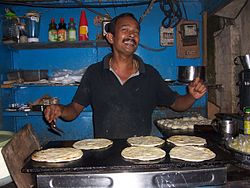
Paratha is one of the most common flatbreads in India—alongside chapati and naan[157]—and is the most common that is shallow-fried.[158] It is associated with North Indian cuisine, in which wheat is the predominant staple[159] and atta is particularly common.[51] A 2022 study in the South Indian city of Hyderabad found that the average adult consumes 1 paratha, or 40 grams, per day.[123]
Like chapati and puri, paratha is often homemade,[160] as tavas are a common household item.[97] Ready-to-eat parathas, sold as a convenience food, are a common product in India,[161] including several types of frozen stuffed paratha.[162] Stores also sell ready-to-cook parathas from brands such as Fingerlix.[163]
Paratha is frequently sold by vendors at marketplaces, roadsides, and transit stations, as a consistently affordable meal.[74] It is served by vendors next to mosques in North India to break the fast on Eid-al-Fitr; they prepare very large parathas that are served as slices with halwa.[164] Paratha is also a typical offering at Punjabi dhabas, a type of establishment on highways.[165] It is less common among chefs, except for unusual stuffed versions, according to food writer Vir Sanghvi.[166]
In North Indian Hindu traditions, paratha is classified as pukka, a type of food that is made with ghee, which is associated with purity, and is served when hosting guests or during festivals.[106] Historically, orthodox Hindus adhered to a pukka diet; those who wanted to limit oil (for health or financial reasons) would cook parathas like rotis, with only a very thin layer of oil applied using a cloth wrapped around a coin.[74] In Uttarakhand, aloo paratha is seen as an energy booster and, when cooked without oil, a cure for a sore throat.[167]
By region
[edit]Paratha is commonly included in meals in both Indian and Pakistani Punjab,[168] but it is not as common in Gujarat[169] or in North India east of Kanpur.[170] According to Banerji, stuffed parathas are associated with North Indian cooking but have spread to every Indian city.[171] Aloo paratha is served across India between Punjab and Bengal.[172] It is also common in parts of Pakistan, except in the highlands.[173] Mooli paratha is common in North India and Kashmir.[174]

Paratha is served by many establishments in Delhi.[49] The city has parathas that are baked, then fried, which are large enough to serve multiple people.[175] Old Delhi houses the Paranthe Wali Gali (lit. 'Alley of Paratha Makers'), a small lane primarily dedicated to paratha restaurants,[176] where parathas are always stuffed,[5] using ingredients including tomato, lemon, peppers, and papad inside the parathas. They are deep-fried in ghee,[74] more similar to stuffed puri or bedmi than typical parathas.[177]
Dhabas of Haryana on the Grand Trunk Road are famous for their parathas, including Sukhdev Dhaba and Gulshan Dhaba in Murthal.[178][179] These dhabas serve Murthal paratha, a version that is deep-fried.[76][179] In Agra, Uttar Pradesh, an establishment called Ramababu Paratha Bhandhar serves very large parathas, weighing 35 kilograms.[37]
In Mauritius, paratha (Morisyen: farata) is eaten across all ethnic groups and is known as a homemade comfort food, particularly as a warm food during rainy weather.[9] In Myanmar, paratha is served at Indian tea shops.[8][92] People in Myanmar eat it on Martyrs' Day, as it was known to be a favorite food of Aung San, whom the holiday celebrates.[180] In the Caribbean, paratha, particularly aloo paratha, is among several Indian fast food dishes in the region.[181]
Many Pakistanis in Norway and in Denmark shift toward eating parathas as a special breakfast on weekends, rather than daily, upon immigrating, in part due to health concerns amid changing lifestyles.[182] Pakistani migrants to the United Kingdom also eat paratha for breakfast, though some members of the community view it as a holdover from Pakistan.[183] Among Indians in the United States, store-bought parathas are common due to busy lifestyles.[184] Aloo paratha is commonly served at South Asian dining establishments in the United Kingdom[185] and Pakistani restaurants in South Africa.[186]
See also
[edit]- Indian bread
- Paratha roll
- Bolani – a similar stuffed bread from Afghanistan[187]
Notes
[edit]- ^ Methi paratha may use kasuri methi, an herb related to fenugreek.[69]
- ^ Food historian Charmaine O'Brien supports the statement that paratha originated in Punjab.[140]
References
[edit]- ^ Ayto, John (1 January 2012). "Paratha". The Diner's Dictionary (2 ed.). Oxford University Press. doi:10.1093/acref/9780199640249.001.0001. ISBN 978-0-19-964024-9.
- ^ a b c Pant 2013, p. 30.
- ^ Davydova 2011, p. 38.
- ^ a b c d Maitra Chakraborty, Barnini (9 March 2022). "Beaten to perfection: The pull of the 'petai porota'". The Telegraph. Retrieved 25 February 2026.
- ^ a b c d e f g Banerji 2008, p. 119.
- ^ a b c Davidson, Alan; Jaine, Tom (1 January 2014). "Parata". The Oxford Companion to Food. Oxford University Press. doi:10.1093/acref/9780199677337.001.0001. ISBN 978-0-19-967733-7.
- ^ a b c d e f Groundwater, Ben (11 August 2025). "Many cuisines have a version of flatbread, but this might be the best". The Sydney Morning Herald. Retrieved 25 February 2026.
- ^ a b c Cummings 2000, p. 218.
- ^ a b Boswell 2019, p. 35.
- ^ Rubel 2011, p. 143; Al-Habsi, Al-Khusaibi & Rahman 2019, p. 42.
- ^ Pant 2010, p. 590.
- ^ Sidhu, Seibel & Meyer 1990, pp. 337–338; Parimala & Sudha 2015, p. 74.
- ^ a b c d Carman, Tim (19 March 2020). "The 10 best breads in the world". The Washington Post. Retrieved 25 February 2026.
- ^ a b c El-Waylly, Sohla (8 December 2025). "Paratha (Flaky South Asian Flatbread) Recipe". Serious Eats. Retrieved 25 February 2026.
- ^ Sengupta 2012, p. 80.
- ^ Malhotra 2012, p. 124; Kohli 2024, p. 61.
- ^ Fuller 2006, p. 24.
- ^ Qarooni 1996, p. 22.
- ^ Chauhan et al. 2023, p. 5776.
- ^ Hegde et al. 2018, p. 20.
- ^ Parimala & Sudha 2015, p. 70.
- ^ Indrani et al. 2011, p. 719.
- ^ Ananthanarayan et al. 2019, p. 135.
- ^ Banerji, Ananthanarayan & Lele 2020, p. 143.
- ^ Beranbaum 2003, p. 232; Ananthanarayan et al. 2019, p. 130.
- ^ Sanghvi, Vir (16 August 2013). "Rude Food: fear of frying". Hindustan Times. Retrieved 25 February 2026.
- ^ Banerji, Ananthanarayan & Lele 2020, p. 21.
- ^ Beranbaum 2003, p. 232.
- ^ Rubel 2011, p. 143; Pant 2013, p. 30.
- ^ Beranbaum 2003, p. 232; Banerji, Ananthanarayan & Lele 2020, p. 43.
- ^ Sidhu, Seibel & Meyer 1990, p. 338.
- ^ Banerji, Ananthanarayan & Lele 2020, p. 93.
- ^ a b Platel 2020, p. 88.
- ^ Mir & Shah 2019, p. 93.
- ^ a b c d e Tan, Alethea (21 August 2019). "Beginner's Guide to Indian Breads: 9 Types to Start With". Michelin Guide. Retrieved 1 February 2026.
- ^ Sidhu, Seibel & Meyer 1990, p. 338; Mir & Shah 2019, p. 93.
- ^ a b c d e f g h i j k Pant 2013, p. 32.
- ^ a b c Rubel 2011, p. 143.
- ^ a b Bender, David A. (1 January 2014). "Paratha". A Dictionary of Food and Nutrition (4 ed.). Oxford University Press. doi:10.1093/acref/9780191752391.001.0001. ISBN 978-0-19-175239-1.
- ^ Banerji, Ananthanarayan & Lele 2020, pp. 5–6.
- ^ Banerji, Ananthanarayan & Lele 2020, p. 43.
- ^ Pai, Ghugre & Udipi 2005, p. 266.
- ^ Sharma & Chadha 2010, pp. 189–190.
- ^ Khokhar et al. 2013, p. 438.
- ^ Banerji, Ananthanarayan & Lele 2020, p. 130.
- ^ Prasada Rao & Hemalatha 2014, p. 287.
- ^ a b Kohli 2024, p. 61.
- ^ Banerji, Ananthanarayan & Lele 2020, p. 5.
- ^ a b c Awal, Vernika (3 January 2024). "Peeling the many layers of parathas across India". The New Indian Express. Retrieved 25 February 2026.
- ^ Banerji, Ananthanarayan & Lele 2020, pp. 6, 13.
- ^ a b c Ribeiro, Mini (6 June 2019). "What's in a bread? The story of the Indian bread basket". The Hindu. Retrieved 25 February 2026.
- ^ Bladholm 2000, p. 39.
- ^ Kaur et al. 2026, p. 1.
- ^ Khatiar 2024, p. 186.
- ^ Shrivastava, Tarishi (28 January 2026). "Sattu Paratha Recipe A High-Protein Traditional Indian Breakfast That Supports Weight Loss and Lasting Energy". Hindustan Times. Retrieved 25 February 2026.
- ^ Bhattacharyya, Thattantavide & Kumar 2023, p. 187.
- ^ Banerji, Ananthanarayan & Lele 2020, p. 109.
- ^ Saini et al. 2023, p. 41.
- ^ Jan et al. 2021, p. 3912; Semwal et al. 2023, p. 6504.
- ^ Bhauso Patil & Jena 2020, p. 1236; Mani 2024, p. 18.
- ^ Parikh & Pierce 2019, p. 76.
- ^ Sen (b) 2024, p. 240.
- ^ Sharma et al. 2023, p. 252.
- ^ Banerji, Ananthanarayan & Lele 2020, p. 4.
- ^ Gill, Romy (1 September 2018). "How to make Romy Gill's aloo paratha". The Independent. Retrieved 28 February 2026.
- ^ Basak, Chakraborty & Singhal 2023, p. 3.
- ^ Krishna, Priya (13 May 2019). "Potatoes — stuffed, roasted, pan-fried and piled on buns — star in Indian cooking". The Washington Post. Archived from the original on 4 April 2022. Retrieved 28 February 2026.
- ^ a b Chatterjee, Priyadarshini (28 August 2023). "From Odisha's puri-upma to Punjab's chawal ka paratha, carb-on-carb treats from around India". Condé Nast Traveller. Retrieved 25 February 2026.
- ^ Ravindran 2024, p. 3570.
- ^ Achaya 1998, p. 138; Beranbaum 2003, p. 232; Pant 2013, p. 31; Ananthanarayan et al. 2019, p. 130.
- ^ Bladholm 2000, p. 38.
- ^ Dahiya et al. 2014, p. 186.
- ^ Herbst 2007, p. 488.
- ^ a b c d e f g h Pant 2013, p. 31.
- ^ a b Arora & Singh Kohli 2011, p. 42.
- ^ a b c d e f g h i j k l m n o Ghose, Sandip (27 August 2023). "Paratha, parotta, prata: How a humble flatbread went global". The New Indian Express. Retrieved 25 February 2026.
- ^ Sarkar et al. 2015, p. 102.
- ^ Prasad & Shivay 2019, p. 172.
- ^ Achaya 1998, p. 138; Bladholm 2000, p. 39.
- ^ Shukla 2021, p. 8.
- ^ Sen (a) 2024, p. 200.
- ^ Khara & Ruby 2019, p. 2.
- ^ Banerji 1997, p. 28.
- ^ Banerji 1997, p. 28; Bladholm 2000, p. 38.
- ^ Alexander, Jaismita (8 June 2025). "The pull of petai porota: Kolkata's breakfast dish that is beaten to perfection — quite literally". The Telegraph. Retrieved 25 February 2026.
- ^ Kohli 2024, pp. 62–63.
- ^ "Hyderabad's Famous Dulhan Paratha: The Paratha Queen - Dr. Saba Noor". Youlin Magazine. Retrieved 10 April 2024.
- ^ a b Afroz 2000, p. 285.
- ^ a b Jayaram 2022, p. 272.
- ^ Kraig & Sen 2013, p. 333.
- ^ Ray 2024, p. 217.
- ^ a b Varma, Anshika (21 November 2022). "Eating paratha with chopsticks and such other Indian-ish stories in Burma". Harper's Bazaar India. Retrieved 25 February 2026.
- ^ Buell et al. 2020, p. 207.
- ^ Liyanage 2020, p. 130.
- ^ a b c d Imtiaz, Saba (9 November 2015). "The Under‑Appreciated Cousin of the World‑Famous Naan". Roads & Kingdoms. Retrieved 25 February 2026.
- ^ Beranbaum 2003, p. 232; Hegde et al. 2018, p. 20.
- ^ a b Lewis, Sarina (11 October 2011). "Knead to know your dough". The Sydney Morning Herald. Retrieved 25 February 2026.
- ^ Ananthanarayan et al. 2019, pp. 130, 135.
- ^ Arora & Singh Kohli 2011, p. 104; Banerji, Ananthanarayan & Lele 2020, p. 7.
- ^ Custodio et al. 2021, p. 8.
- ^ Dahiya et al. 2014, p. 184.
- ^ Platel 2020, p. 89.
- ^ a b Butt & Sultan 2009, p. 1279.
- ^ Fox 2015, p. 701.
- ^ Kala & Nautiyal 2023, p. 44.
- ^ a b Sen 2009, p. 404.
- ^ Sen 2009, p. 407.
- ^ Benson & Helzer 2017, p. 73; Rani, Dharaiya & Singh 2021, p. 30; Kaur Sidhu 2024, p. 299.
- ^ Kraig & Sen 2013, p. 172.
- ^ Kraig & Sen 2013, p. 180.
- ^ Imtiaz, Aysha (19 July 2023). "Why KFC failed to master Karachi's famed paratha rolls". BBC News. Retrieved 28 February 2026.
- ^ Sapra & Bhattacharyya 2024, p. 360.
- ^ Zacharias, Anna (27 November 2013). "UAE National Day: in search of the Chips Oman sandwich". The National. Retrieved 25 February 2026.
- ^ Khan, Bushra (15 September 2025). "Viral and trending: Dubai's Paratha Burger arrives in Hyderabad". The Siasat Daily. Retrieved 25 February 2026.
- ^ a b United States Food and Drug Administration (2024). "Daily Value on the Nutrition and Supplement Facts Labels". FDA. Archived from the original on 27 March 2024. Retrieved 28 March 2024.
- ^ "TABLE 4-7 Comparison of Potassium Adequate Intakes Established in This Report to Potassium Adequate Intakes Established in the 2005 DRI Report". p. 120. In: Stallings, Virginia A.; Harrison, Meghan; Oria, Maria, eds. (2019). "Potassium: Dietary Reference Intakes for Adequacy". Dietary Reference Intakes for Sodium and Potassium. pp. 101–124. doi:10.17226/25353. ISBN 978-0-309-48834-1. PMID 30844154. NCBI NBK545428.
- ^ Kaul et al. 2022, p. 7217.
- ^ Shobana et al. 2022, p. 58.
- ^ Baig et al. 2023, p. 3558.
- ^ Ray et al. 2018, p. 2.
- ^ Ali et al. 2010, p. 204; Boukid 2022, p. 3.
- ^ Kaul et al. 2022, p. 7216.
- ^ a b Baig et al. 2023, p. 3559.
- ^ Zainal Arifen et al. 2024, p. 2.
- ^ Boukid 2022, p. 4.
- ^ Ali et al. 2010, pp. 200–201.
- ^ Ali et al. 2010, pp. 203–204.
- ^ Shobana et al. 2022, p. 62.
- ^ Khokhar et al. 2013, pp. 437.
- ^ Parimala & Sudha 2015, p. 76.
- ^ a b Khokhar et al. 2013, pp. 439.
- ^ a b Kaul et al. 2022, p. 7214.
- ^ Banerji, Ananthanarayan & Lele 2020, p. 110.
- ^ a b Pai, Ghugre & Udipi 2005, p. 267.
- ^ Eggum & Duggal 1977, p. 1056.
- ^ Bhargava, Jyothi Lakshmi & Indrani 2012, p. 254; Ray et al. 2018, p. 5.
- ^ Khan et al. 2014, p. 2190; Kaul et al. 2022, p. 7214.
- ^ a b Khan et al. 2014, pp. 2189–2190.
- ^ Banerji, Ananthanarayan & Lele 2020, p. 132.
- ^ a b O'Brien 2003, p. 97.
- ^ Achaya 1998, p. 88.
- ^ Achaya 2003, p. 85.
- ^ a b Sen (c) 2024, p. 406.
- ^ Sengupta 2023, p. 132.
- ^ Nijjar 1968, p. 162.
- ^ Sengupta 2012, p. 74; Sengupta 2023, p. 134.
- ^ Antani & Mahapatra 2022, p. 7.
- ^ a b O'Brien 2003, p. 149.
- ^ Sengupta 2023, p. 135.
- ^ Sengupta 2023, p. 137.
- ^ Samaroo 2021, p. 32.
- ^ Nandy 2004, pp. 12–13.
- ^ Kohli 2024, p. 62.
- ^ Mukherjee & Biswakarma 2025, p. 172.
- ^ Saini, Neha (29 February 2024). "Guinness World Record for largest parantha made in holy city Amritsar". The Tribune. Retrieved 25 February 2026.
- ^ "Was it heavy! 37-kg parantha makes it to Guinness Book". Times of India. 29 February 2024. Retrieved 25 February 2026.
- ^ Banerji, Ananthanarayan & Lele 2020, p. 11.
- ^ Achaya 1998, p. 138.
- ^ Bharati & Kulkarni 2020, p. 44.
- ^ Banerji, Ananthanarayan & Lele 2020, p. 9.
- ^ Ghosh-Jerath et al. 2024, p. 27; Bhargava, Jyothi Lakshmi & Indrani 2012, p. 247.
- ^ Banerji, Ananthanarayan & Lele 2020, p. 154.
- ^ Ananthanarayan et al. 2019, p. 173.
- ^ Kraig & Sen 2013, pp. 175–176.
- ^ Bhattacharyya 2024, p. 125.
- ^ Sanghvi, Vir (25 February 2026). "Have your loaf and eat it too!". Hindustan Times. Retrieved 25 February 2026.
- ^ Kala & Nautiyal 2023, p. 40.
- ^ Sen (b) 2012.
- ^ Gilbert & Khokhar 2008, p. 206.
- ^ Pant 2013, pp. 21–22.
- ^ Banerji 2008, p. 36.
- ^ Arora & Singh Kohli 2011, p. 104.
- ^ Miller 2022, p. 50.
- ^ Saberi 2024, p. 302.
- ^ Pant 2010, p. 16.
- ^ O'Brien 2003, p. 149; Banerji 2008, p. 117; Kohli 2024, p. 61.
- ^ Jaffrey 2008, pp. 121–122.
- ^ Bhattacharyya 2024, pp. 125–126.
- ^ a b Balasubramaniam, Chitra (2 February 2013). "Food Safari: In search of Murthal Paratha The Hindu newspaper, 2-Feb-2013". The Hindu.
- ^ Girke 2018, p. 150.
- ^ Lal 2013, p. 108.
- ^ Mellin-Olsen & Wandel 2005, pp. 319–321, 334; Halkier & Jensen 2011, p. 477.
- ^ Charsley & Bolognani 2017, p. 53.
- ^ Sen (a) 2012; Trivedi-Grenier 2012.
- ^ Khokhar, Roe & Swan 2012, p. 168.
- ^ Connor & Charway 2020, p. 265.
- ^ Buell et al. 2020, p. 206.
Works cited
[edit]- Achaya, K. T. (1998). Indian food: a historical companion. Delhi: Oxford University Press. ISBN 978-0-19-564416-6 – via Internet Archive.
- Achaya, K. T. (2003). The Story of Our Food. Universities Press. p. 85. ISBN 978-81-7371-293-7 – via Google Books.
- Afroz, Sultana (October 2000). "The Moghul Islamic Diaspora: The Institutionalization of Islam in Jamaica". Journal of Muslim Minority Affairs. 20 (2): 271–289. doi:10.1080/713680368. ISSN 1360-2004.
- Ali, Amanat; Al-Nassri, Hussain Ali S; Al-Rasasi, Buthaina; Akhtar, Mohammad Shoaib; Al-Belushi, Buthaina Saleh (January 2010). "Glycemic Index and Chemical Composition of Traditional Omani Breads". International Journal of Food Properties. 13 (1): 198–208. doi:10.1080/10942910802472852. ISSN 1094-2912.
- Al-Khusaibi, Mohammed; Al-Habsi, Nasser; Rahman, Mohammad Shafiur, eds. (2019). Traditional Foods: History, Preparation, Processing and Safety. Food Engineering Series. Cham: Springer International Publishing AG. ISBN 978-3-030-24619-8.
- Al-Habsi, Nasser; Al-Khusaibi, Mohammed; Rahman, Mohammad Shafiur. "GCC Traditional Foods: Preparation and Processing". In Al-Khusaibi, Al-Habsi & Rahman (2019).
- Ananthanarayan, Laxmi; Dubey, Kriti Kumari; Muley, Abijeet B.; Singhal, Rekha S. "Indian Traditional Foods: Preparation, Processing and Nutrition". In Al-Khusaibi, Al-Habsi & Rahman (2019).
- Antani, Vishu; Mahapatra, Santosh (December 2022). "Evolution of Indian cuisine: a socio-historical review". Journal of Ethnic Foods. 9 (1). doi:10.1186/s42779-022-00129-4. ISSN 2352-6181.
- Arora, Anirudh; Singh Kohli, Hardeep (2011). Food of the Grand Trunk Road: Recipes of Rural India, from Bengal to the Punjab. London: New Holland. ISBN 978-1-84773-968-1 – via Internet Archive.
- Baig, Jameel Ahmed; Chandio, Iram Gul; Kazi, Tasneem Gul; Afridi, Hassan Imran; Akhtar, Khalil; Junaid, Mirza; Naher, Sumsun; Solangi, Shakoor Ahmed; Malghani, Niaz Ali (July 2023). "Risk Assessment of Macronutrients and Minerals by Processed, Street, and Restaurant Traditional Pakistani Foods: a Case Study". Biological Trace Element Research. 201 (7): 3553–3566. doi:10.1007/s12011-022-03429-7. ISSN 0163-4984.
- Banerji, Chitrita (1997). Bengali Cooking: Seasons and Festivals. London: Serif. ISBN 978-1-897959-29-9 – via Internet Archive.
- Banerji, Chitrita (10 December 2008). Eating India: An Odyssey into the Food and Culture of the Land of Spices. Bloomsbury Publishing. ISBN 978-1-59691-712-5 – via Google Books.
- Beranbaum, Rose Levy (30 September 2003). The Bread Bible. W. W. Norton & Company. ISBN 978-0-393-05794-2 – via Google Books.
- Banerji, Anamika; Ananthanarayan, Laxmi; Lele, Smita S. (2020). The science and technology of chapatti and other Indian flatbreads. Boca Raton: CRC Press. ISBN 978-0-367-46209-3.
- Basak, Somnath; Chakraborty, Snehasis; Singhal, Rekha S. (1 January 2023). "Revisiting Indian traditional foods-A critical review of the engineering properties and process operations". Food Control. 143 109286. doi:10.1016/j.foodcont.2022.109286. ISSN 0956-7135. S2CID 251334687.
- Benson, Heather L.; Helzer, Jennifer (January 2017). "Central Valley Culinary Landscapes: Ethnic Foodways of Sikh Transnationals". California Geographer. 56: 55–95.
- Bhargava, Shipra; Jyothi Lakshmi, A.; Indrani, D. (June 2012). "Effect of Barley, Banana, and Soya Protein Isolate on Rheological, Microstructural, and Nutritional Characteristics of North Indian Parotta". Journal of Texture Studies. 43 (3): 246–256. doi:10.1111/j.1745-4603.2011.00334.x. ISSN 0022-4901.
- Bhattacharyya, Malini; Thattantavide, Anju; Kumar, Ajay (2023). "Ethnic Mountain Foods of Western and Eastern Himalayas, India". In Kumar, Ajay; Singh, Pardeep; Singh, Suruchi; Singh, Bhupinder (eds.). Wild Food Plants for Zero Hunger and Resilient Agriculture. Singapore: Springer Nature. pp. 181–205. doi:10.1007/978-981-19-6502-9_8. ISBN 978-981-19-6501-2.
- Bhauso Patil, Swati; Jena, Sujata (28 October 2020). "Utilization of underrated pseudo-cereals of North East India: a systematic review". Nutrition & Food Science. 50 (6): 1229–1240. doi:10.1108/NFS-11-2019-0339. ISSN 0034-6659.
- Bladholm, Linda (12 August 2000). The Indian Grocery Store Demystified. Macmillan Publishers. ISBN 1-58063-143-6 – via Internet Archive.
- Boswell, Rosabelle (2 January 2019). "Desensitized pasts and sensational futures in Mauritius and Zanzibar". Journal of the Indian Ocean Region. 15 (1): 23–39. doi:10.1080/19480881.2019.1568497. ISSN 1948-0881.
- Boukid, Fatma (June 2022). "Flatbread - A canvas for innovation: A review". Applied Food Research. 2 (1) 100071. doi:10.1016/j.afres.2022.100071. hdl:20.500.12327/1666.
- Buell, Paul David; Anderson, Eugene N.; de Pablo Moya, Montserrat; Oskenbay, Moldir (18 June 2020). Crossroads of Cuisine: The Eurasian Heartland, the Silk Roads and Food. BRILL. doi:10.1163/9789004432109_007. ISBN 978-90-04-43210-9.
- Butt, Masood Sadiq; Sultan, Muhammad Tauseef (2009). "Levels of trans fats in diets consumed in developing economies". Journal of AOAC International. 92 (5): 1277–1283. doi:10.1093/jaoac/92.5.1277. ISSN 1060-3271. PMID 19916365.
- Charsley, Katharine; Bolognani, Marta (2 January 2017). "Being a freshie is (not) cool: stigma, capital and disgust in British Pakistani stereotypes of new subcontinental migrants". Ethnic and Racial Studies. 40 (1): 43–62. doi:10.1080/01419870.2016.1145713. hdl:1983/8613307c-f20b-4ff9-83d2-ea05b1b3ff7e. ISSN 0141-9870.
- Chauhan, Anamika; Islam, Fakhar; Imran, Ali; Ikram, Ali; Zahoor, Tahir; Khurshid, Sadaf; Shah, Mohd Asif (October 2023). "A review on waste valorization, biotechnological utilization, and management of potato". Food Science & Nutrition. 11 (10): 5773–5785. doi:10.1002/fsn3.3546. ISSN 2048-7177. PMC 10563700. PMID 37823156.
- Connor, Teresa K.; Charway, Fred (2 April 2020). "Ambiguities of xenophobia in a border town: inner city informal traders and Ekasi shopkeepers in the city of East London, South Africa". Journal of Contemporary African Studies. 38 (2): 257–273. doi:10.1080/02589001.2020.1779917. ISSN 0258-9001.
- Cummings, Joe (2000). Myanmar (Burma). Lonely Planet. ISBN 978-0-86442-703-8 – via Internet Archive.
- Custodio, Marie Claire; Ynion, Jhoanne; Samaddar, Arindam; Cuevas, Rosa Paula; Mohanty, Suva Kanta; Ray (Chakravarti), Anindita; Demont, Matty (March 2021). "Unraveling heterogeneity of consumers' food choice: Implications for nutrition interventions in eastern India". Global Food Security. 28 100497. doi:10.1016/j.gfs.2021.100497. PMC 7937786. PMID 33738189.
- Dahiya, Pradeep K.; Linnemann, Anita R.; Nout, Martinus J. R.; Van Boekel, Martinus A. J. S.; Khetarpaul, Neelam K.; Grewal, Raj B. (4 March 2014). "Consumption Habits and Innovation Potential of Mung Bean Foods in Hisar District of Haryana State, India". Ecology of Food and Nutrition. 53 (2): 171–192. doi:10.1080/03670244.2013.807809. ISSN 0367-0244.
- Davydova, Julia (15 July 2011). "2. Non-native varieties of English". The Present Perfect in Non-Native Englishes. De Gruyter Mouton. pp. 18–41. doi:10.1515/9783110255027.18. ISBN 978-3-11-025501-0.
- Eggum, Bjørn O.; Duggal, Surinder K. (December 1977). "The protein quality of some Indian dishes prepared from wheat". Journal of the Science of Food and Agriculture. 28 (12): 1052–1056. doi:10.1002/jsfa.2740281203. ISSN 0022-5142.
- Fox, Matthew (May 2015). "Global Food Practices, Cultural Competency, and Dietetics: Part 3". Journal of the Academy of Nutrition and Dietetics. 115 (5): S26–S30. doi:10.1016/j.jand.2015.03.019.
- Fuller, Dorian Q. (2006). "Agricultural Origins and Frontiers in South Asia: A Working Synthesis". Journal of World Prehistory. 20 (1): 1–86. ISSN 0892-7537. JSTOR 25801243.
- Ghosh-Jerath, Suparna; Khandpur, Neha; Kumar, Gaurika; Kohli, Sahiba; Singh, Meenu; Bhamra, Inderdeep Kaur; Marrocos-Leite, Fernanda H.; Reddy, K. Srinath (14 August 2024). "Mapping ultra-processed foods (UPFs) in India: a formative research study". BMC Public Health. 24 (1): 2212. doi:10.1186/s12889-024-19624-1. ISSN 1471-2458. PMC 11323379. PMID 39143524.
- Gilbert, Penelope A; Khokhar, Santosh (26 March 2008). "Changing dietary habits of ethnic groups in Europe and implications for health". Nutrition Reviews. 66 (4): 203–215. doi:10.1111/j.1753-4887.2008.00025.x.
- Girke, Felix (31 December 2018). "Das Bildnis des General Aung San". In Hahn, Hans Peter; Neumann, Friedemann (eds.). Dinge als Herausforderung. transcript Verlag. pp. 143–166. doi:10.1515/9783839445136-008. ISBN 978-3-8394-4513-6. Retrieved 21 February 2026.
- Halkier, Bente; Jensen, Iben (December 2011). "Doing 'healthier' food in everyday life? A qualitative study of how Pakistani Danes handle nutritional communication". Critical Public Health. 21 (4): 471–483. doi:10.1080/09581596.2011.594873. ISSN 0958-1596.
- Hegde, Shweta; Nair, Leena P.; Chandran, Haritha; Irshad, Haroon (March 2018). "Traditional Indian way of eating – an overview". Journal of Ethnic Foods. 5 (1): 20–23. doi:10.1016/j.jef.2018.02.001.
- Herbst, Sharon Tyler (2007). The new food lover's companion: more than 6,700 A-to-Z entries describe foods, cooking techniques, herbs, spices, desserts, wines, and the ingredients for pleasurable dining. Haupagge, NY: Barron's Educational Series. ISBN 978-0-7641-3577-4 – via Internet Archive.
- Indrani, D.; Swetha, P.; Soumya, C.; Rajiv, Jyotsna; Venkateswara Rao, G. (April 2011). "Effect of multigrains on rheological, microstructural and quality characteristics of north Indian parotta – An Indian flat bread". LWT - Food Science and Technology. 44 (3): 719–724. doi:10.1016/j.lwt.2010.11.017.
- Jaffrey, Madhur (18 December 2008). Climbing the Mango Trees: A Memoir of a Childhood in India. Knopf Doubleday Publishing Group. ISBN 978-0-307-51769-2 – via Internet Archive.
- Jan, Bisma; Parveen, Rabea; Zahiruddin, Sultan; Khan, Mohammad Umar; Mohapatra, Sradhanjali; Ahmad, Sayeed (July 2021). "Nutritional constituents of mulberry and their potential applications in food and pharmaceuticals: A review". Saudi Journal of Biological Sciences. 28 (7): 3909–3921. doi:10.1016/j.sjbs.2021.03.056. PMC 8241616. PMID 34220247.
- Jayaram, N. (2022). "Culture and the Community: Language and Foodways". From Indians in Trinidad to Indo-Trinidadians. Singapore: Springer Nature. pp. 253–281. doi:10.1007/978-981-19-3367-7_11. ISBN 978-981-19-3366-0.
- Joshee, Kshamata; Abhang, Tanvi; Kulkarni, Ram (5 December 2019). Koenig, Juergen (ed.). "Fatty acid profiling of 75 Indian snack samples highlights overall low trans fatty acid content with high polyunsaturated fatty acid content in some samples". PLOS ONE. 14 (12) e0225798. doi:10.1371/journal.pone.0225798. ISSN 1932-6203. PMC 6894861. PMID 31805103.
- Kala, Chandra Prakash; Nautiyal, Sunil (June 2023). "Traditional food knowledge of local people and its sustainability in mountains of Uttarakhand State of India". Journal of Social and Economic Development. 25 (1): 32–51. doi:10.1007/s40847-022-00222-z. ISSN 0972-5792. PMC 9666931. PMID 36404996.
- Kaul, Shivani; Kaur, Kamaljit; Kaur, Preetinder; Kaur, Jaspreet (November 2022). "Development and shelf‐life assessment of Ready‐to‐Bake frozen potato Paranthas fortified with iron and zinc". International Journal of Food Science & Technology. 57 (11): 7214–7221. doi:10.1111/ijfs.16067. ISSN 0950-5423.
- Kaur, Taranpreet; Kaur, Kamaljit; Kaur, Jaspreet; Rehal, Jagbir; Kaur, Simarjit (January 2026). "Unlocking nutritional and shelf-life potential: Impact of germination on quality attributes of hulless barley based sattu". Journal of Stored Products Research. 115 102831. doi:10.1016/j.jspr.2025.102831.
- Khan, Mohammed Ayub; Mahesh, Chitrashekarachar; Semwal, Anil Dutt; Sharma, Gopal Kumar; Srihari, Somashekharan Pandit; Jayaprahash, Chellappa; Srihari, Kadaba Anantharaman (September 2014). "Studies on the shelf-life enhancement of potato stuffed parotha using thermal processing". Journal of Food Science and Technology. 51 (9): 2190–2196. doi:10.1007/s13197-014-1269-y. ISSN 0022-1155. PMC 4152521. PMID 25190882.
- Khara, Tani; Ruby, Matthew B. (24 April 2019). "Meat Eating and the Transition from Plant-Based Diets among Urban Indians". M/C Journal. 22 (2). doi:10.5204/mcj.1509. ISSN 1441-2616.
- Khokhar, Santosh; Ashkanani, Fatemah; Garduño-Diaz, Sara D.; Husain, Wafaa (October 2013). "Application of ethnic food composition data for understanding the diet and nutrition of South Asians in the UK". Food Chemistry. 140 (3): 436–442. doi:10.1016/j.foodchem.2012.10.034.
- Khokhar, Santosh; Roe, Mark; Swan, Gillian (March 2012). "Carotenoid and retinol composition of South Asian foods commonly consumed in the UK". Journal of Food Composition and Analysis. 25 (2): 166–172. doi:10.1016/j.jfca.2011.11.005.
- Kraig, Bruce; Sen, Colleen Taylor (2013). Street Food Around the World: An Encyclopedia of Food and Culture. ABC-CLIO. p. 124. ISBN 978-1-59884-954-7.
- Lal, Brij V. (2013). Mr. Tulsi's Store: A Fijian Journey. Australian National University Press.
- Malhotra, S.K. (2012). "Ajowan". Handbook of Herbs and Spices. Elsevier. pp. 118–137. doi:10.1533/9780857095688.118. ISBN 978-0-85709-040-9.
- Mellin-Olsen, Tonje; Wandel, Margareta (November 2005). "Changes in Food Habits among Pakistani Immigrant Women in Oslo, Norway". Ethnicity & Health. 10 (4): 311–339. doi:10.1080/13557850500145238. ISSN 1355-7858.
- Miller, Katherine J. L. (31 December 2022). "On the Meanings of Pleasure: Work, Ethics, and Freedom in the Hunza Valley". In Hann, Chris (ed.). Work, Society, and the Ethical Self. Berghahn Books. pp. 49–69. doi:10.1515/9781800732261-004. ISBN 978-1-80073-226-1.
- Mir, Shabir Ahmad; Shah, Manzoor Ahmad (2019). "Indian Flatbreads: How Structure Influences Properties". Encyclopedia of Food Chemistry. Elsevier. pp. 90–95. doi:10.1016/b978-0-08-100596-5.21697-1. ISBN 978-0-12-814045-1.
- Mukherjee, Rituparna; Biswakarma, Juthika (28 April 2025). "Constructing the Ontology of Food Narratives during the Bengal Famine 1943 through Postmemory Practices". In Parui, Avishek; Raj, Merin Simi (eds.). Memory Studies in India: Texts and Contexts. Brill Publishers. pp. 169–181. doi:10.1163/9789004722514_012. ISBN 978-90-04-72248-4.
- Nandy, Ashis (May 2004). "The Changing Popular Culture of Indian Food: Preliminary Notes". South Asia Research. 24 (1): 9–19. doi:10.1177/0262728004042760. ISSN 0262-7280.
- Nijjar, Bakhshish Singh (1968). Panjāb under the sultāns, 1000–1526 A.D. Delhi: Sterling Publishers – via Internet Archive.
- O'Brien, Charmaine (2003). Flavours Of Delhi: A Food Lover's Guide. New York: Penguin Books. ISBN 0-14-302936-3 – via Internet Archive.
- Pai, Sangita; Ghugre, P.S.; Udipi, S.A. (June 2005). "Satiety from rice-based, wheat-based and rice–pulse combination preparations". Appetite. 44 (3): 263–271. doi:10.1016/j.appet.2005.01.004.
- Pant, Pushpesh (2010). India Cookbook. Phaidon. ISBN 978-0-7148-5902-6 – via Internet Archive.
- Pant, Pushpesh (2013). "INDIA: Food and the Making of the Nation". India International Centre Quarterly. 40 (2): 1–34. ISSN 0376-9771. JSTOR 24393273.
- Parikh, Mihir; Pierce, Grant N. (February 2019). "Dietary flaxseed: what we know and don't know about its effects on cardiovascular disease". Canadian Journal of Physiology and Pharmacology. 97 (2): 75–81. doi:10.1139/cjpp-2018-0547. ISSN 0008-4212.
- Parimala, K. R.; Sudha, M. L. (2 January 2015). "Wheat-Based Traditional Flat Breads of India". Critical Reviews in Food Science and Nutrition. 55 (1): 67–81. doi:10.1080/10408398.2011.647121. ISSN 1040-8398.
- Prakash, Jamuna; Waisundara, Viduranga; Prakash, V., eds. (2020). Nutritional and health aspects of food in South Asian countries. Elsevier traditional and ethnic food series. London: Academic Press. ISBN 978-0-12-820011-7.
- Bharati, Pushpa; Kulkarni, Uma N. "Nutritional sufficiency of traditional meal patterns". In Prakash, Waisundara & Prakash (2020).
- Platel, Kalpana. "Functional foods in Indian tradition and their significance for health". In Prakash, Waisundara & Prakash (2020).
- Liyanage, Chathudina J. "Traditional and ethnic foods of Sri Lanka—safety aspects". In Prakash, Waisundara & Prakash (2020).
- Prasad, Rajendra; Shivay, Yashbir Singh (2019). "Chenopodium species: from weeds to a healthy food grain 'quinoa'". Current Science. 116 (2): 171–173. ISSN 0011-3891. JSTOR 27137816.
- Prasada Rao, U. J. S.; Hemalatha, M. S. (11 July 2014). "Enzymes". In Zhou, Weibiao; Hui, Y. H.; De Leyn, I.; Pagani, M. A. (eds.). Bakery Products Science and Technology (1 ed.). Wiley. pp. 275–294. doi:10.1002/9781118792001.ch15. ISBN 978-1-119-96715-6.
- Qarooni, Jalal (1996). "Cereal Milling and Flour Production for Flat Breads". Flat Bread Technology. Boston: Springer US. pp. 19–36. doi:10.1007/978-1-4613-1175-1_2. ISBN 978-1-4612-8498-7.
- Rani, Rekha; Dharaiya, Chetan N.; Singh, Bhopal (January 2021). "Importance of not skipping breakfast: a review". International Journal of Food Science & Technology. 56 (1): 28–38. doi:10.1111/ijfs.14742. ISSN 0950-5423.
- Ravindran, P. N. (2024). "Neglected and Underutilized Spices of India". In Ravindran, P N; Sivaraman, K; Devasahayam, S; Babu, K Nirmal (eds.). Handbook of Spices in India: 75 Years of Research and Development. Singapore: Springer Nature. pp. 3539–3622. doi:10.1007/978-981-19-3728-6_54. ISBN 978-981-19-3727-9. Retrieved 28 February 2026.
- Ray, Krishnendu (September 2024). "Touching food: On finding the tech‐tile". Anthropology of Consciousness. 35 (2): 213–225. doi:10.1111/anoc.12230. ISSN 1053-4202.
- Ray, Amrita; Prakash, Pavan K.; Jyothi Lakshmi, A.; Dasappa, Indrani (September 2018). "Modulation of Carbohydrate Digestibility of North Indian Parotta Using Protein and Dietary Fiber Based Functional Ingredients". Starch - Stärke. 70 (9–10). doi:10.1002/star.201700269. ISSN 0038-9056.
- Rubel, William (2011). Bread: a global history. London: Reaktion Books. ISBN 978-1-86189-854-8 – via Internet Archive.
- Saini, Pawan; Rohela, Gulab Khan; Kumar, Jalaja S.; Shabnam, Aftab A.; Kumar, Amit (2023). "Cultivation, Utilization, and Economic Benefits of Mulberry". In Gnanesh, Belaghihalli N.; Vijayan, Kunjupillai (eds.). The Mulberry Genome. Cham: Springer International Publishing. pp. 13–56. doi:10.1007/978-3-031-28478-6_2. ISBN 978-3-031-28477-9.
- Samaroo, Brinsley (2021). "Changing Caribbean geographies: connections in flora, fauna and patterns of settlement from Indian inheritances". Journal of Indentureship and Its Legacies. 1 (1): 16–35. doi:10.13169/jofstudindentleg.1.1.0016. ISSN 2634-1999.
- Sarkar, Preetam; Lohith Kumar, DH; Dhumal, Chanda; Panigrahi, Shubham Subrot; Choudhary, Ruplal (September 2015). "Traditional and ayurvedic foods of Indian origin". Journal of Ethnic Foods. 2 (3): 97–109. doi:10.1016/j.jef.2015.08.003.
- Semwal, Prabhakar; Painuli, Sakshi; Jamloki, Abhishek; Rauf, Abdur; Rahman, Md. Mominur; Olatunde, Ahmed; Hemeg, Hassan A.; Abu-Izneid, Tareq; Naz, Saima; Punia Bangar, Sneh; Lorenzo, Jose M.; Simal-Gandara, Jesus (3 October 2023). "Himalayan Wild Fruits as a Strong Source of Nutraceuticals, Therapeutics, Food and Nutrition Security". Food Reviews International. 39 (9): 6500–6536. doi:10.1080/87559129.2022.2121407. ISSN 8755-9129.
- Sen, Colleen Taylor (2009). "Indian meals". Meals in Science and Practice. Elsevier. pp. 394–412. doi:10.1533/9781845695712.6.394. ISBN 978-1-84569-403-6.
- Sen, Colleen Taylor; Bhattacharyya, Sourish; Saberi, Helen, eds. (2024). The Bloomsbury Handbook of Indian cuisine. Bloomsbury Academic. ISBN 978-1-350-12864-4.
- Mani, Priya. "Amaranth". In Sen, Bhattacharyya & Saberi (2024).
- Kohli, Megha. "Breads". In Sen, Bhattacharyya & Saberi (2024).
- Bhattacharyya, Sourish. "Dhaba". In Sen, Bhattacharyya & Saberi (2024).
- Khatiar, Anurag. "Jharkhand". In Sen, Bhattacharyya & Saberi (2024).
- Sen (a), Colleen Taylor. "Khoya". In Sen, Bhattacharyya & Saberi (2024).
- Sen (b), Colleen Taylor. "Millets". In Sen, Bhattacharyya & Saberi (2024).
- Kaur Sidhu, Puneetinder. "Punjab". In Sen, Bhattacharyya & Saberi (2024).
- Saberi, Helen. "Radish". In Sen, Bhattacharyya & Saberi (2024).
- Sapra, Anubhav; Bhattacharyya, Sourish. "Street food". In Sen, Bhattacharyya & Saberi (2024).
- Sen (c), Colleen Taylor. "Wheat". In Sen, Bhattacharyya & Saberi (2024).
- Sengupta, Jayanta (2012). "Food in Time and Place: The American Historical Association Companion to Food History". In Freedman, Paul; Chaplin, Joyce E; Albala, Ken (eds.). Food in Time and Place: The American Historical Association Companion to Food History. University of California Press. pp. 68–94. ISBN 978-0-520-95934-7. Project MUSE 35637.
- Sengupta, Jayanta (4 May 2023). "Bengali Mughlai Platter on the Table: Muslim and Indo-Persian Food Culture in Bengal". Global Food History. 9 (2): 130–148. doi:10.1080/20549547.2023.2191491. ISSN 2054-9547.
- Sharma, Vidisha; Chadha, Ravinder (2010). "Assessment of Portion Sizes of Food Items Commonly Consumed by Urban Indian Adults: A Preliminary Study". Current Research in Nutrition and Food Science Journal. 8 (1): 182–196. doi:10.12944/CRNFSJ.8.1.17.
- Sharma, Avinash; Pandey, Himanshu; Manpoong, Chowlani; Vashishth, Amit; Singh, Devendra; Bang, Nguyen Tran Hai (June 2023). "Biometric analysis, biosynthetic pathway and multipurpose uses of buckwheat local varieties in Namsai district of eastern Himalayas in India". Trends in Food Science & Technology. 136: 251–267. doi:10.1016/j.tifs.2023.04.020.
- Shobana, Shanmugam; Geetha, Gunasekaran; Ramya Bai, Mookambika; Vijayalakshmi, Parthasarathy; Gayathri, Rajagopal; Lakshmipriya, Nagarajan; Unnikrishnan, Ranjit; Anjana, Ranjit Mohan; Malleshi, Nagappa Gurusidappa; Krishnaswamy, Kamala; Henry, C.J.K.; Mohan, Viswanathan; Sudha, Vasudevan (January 2022). "Carbohydrate profiling & glycaemic indices of selected traditional Indian foods". Indian Journal of Medical Research. 155 (1): 56–65. doi:10.4103/ijmr.IJMR_1935_19. ISSN 0971-5916. PMC 9552392.
- Shukla, Akhilesh (18 October 2021). "Ethnic food culture of Chhattisgarh state of India". Journal of Ethnic Foods. 8 (1). doi:10.1186/s42779-021-00103-6. ISSN 2352-6181.
- Smith, Andrew F., ed. (1 January 2012). The Oxford Encyclopedia of Food and Drink in America (2 ed.). Oxford University Press. doi:10.1093/acref/9780199734962.001.0001. ISBN 978-0-19-973496-2.
- Sen (a), Colleen Taylor. "Indian American Food". In Smith (2012).
- Trivedi-Grenier, Leena. "Hindu Dietary Laws". In Smith (2012).
- Sen (b), Colleen Taylor. "Pakistani American Food". In Smith (2012).
- Sidhu, Jiwan S.; Seibel, Wilfried; Meyer, Dietrich (January 1990). "Gelatinization of Starch During Preparation of Indian Unleaved Flat Breads". Starch - Stärke. 42 (9): 336–341. doi:10.1002/star.19900420904. ISSN 0038-9056.
- Zainal Arifen, Zainorain Natasha; Shahar, Suzana; Trieu, Kathy; Abdul Majid, Hazreen; Md Noh, Mohd Fairulnizal; Haron, Hasnah (August 2024). "Individual and total sugar contents of street foods in Malaysia – Should we be concerned?". Food Chemistry. 450 139288. doi:10.1016/j.foodchem.2024.139288.
| Main and side dishes |
| ||||||
|---|---|---|---|---|---|---|---|
| Snacks and sauces | |||||||
| Breads | |||||||
| Beverages | |||||||
| Sweetmeats | |||||||
| Bangladeshi diaspora | |||||||


| Regional cuisines |
| ||||||||||
|---|---|---|---|---|---|---|---|---|---|---|---|
| Ingredients / types of food | |||||||||||
| Preparation and cooking | |||||||||||
| Related cuisines | |||||||||||
| Balochi |  | ||||
|---|---|---|---|---|---|
| Kashmiri | |||||
| Muhajir |
| ||||
| Pashtun | |||||
| Punjabi |
| ||||
| Saraiki | |||||
| Sindhi | |||||
| Common dishes |
| ||||
| Pakistani diaspora | |||||


| Salads | |
|---|---|
| Rice dishes | |
| Noodle dishes | |
| Other dishes | |
| Snacks |
|
| Drinks and beverages | |
| Seasonings and ingredients | |
| Miscellaneous | |
| Asia |
|  |
|---|---|---|
| Europe | ||
| Africa | ||
| America | ||
- Paratha
- Flatbreads
- Unleavened breads
- South Asian breads
- Pakistani breads
- Indian breads
- Balochi cuisine
- Bengali cuisine
- Bangladeshi cuisine
- Bihari cuisine
- Burmese cuisine
- Hindu cuisine
- Kashmiri cuisine
- Nepalese cuisine
- Pashtun cuisine
- Punjabi cuisine
- Fijian cuisine
- Sindhi cuisine
- Mauritian cuisine
- Trinidad and Tobago cuisine
- Uttar Pradeshi cuisine
- Vegetarian dishes of India
- Stuffed dishes