


Sigma-ring
In mathematics, a nonempty collection of sets is called a 𝜎-ring (pronounced sigma-ring) if it is closed under countable union and relative complementation.
Formal definition
[edit]Let be a nonempty collection of sets. Then is a 𝜎-ring if:

- Closed under countable unions: if for all
- Closed under relative complementation: if


Properties
[edit]These two properties imply: whenever are elements of


This is because
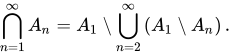
Every 𝜎-ring is a δ-ring but there exist δ-rings that are not 𝜎-rings.
Similar concepts
[edit]If the first property is weakened to closure under finite union (that is, whenever ) but not countable union, then is a ring but not a 𝜎-ring.

Uses
[edit]𝜎-rings can be used instead of 𝜎-fields (𝜎-algebras) in the development of measure and integration theory, if one does not wish to require that the universal set be measurable. Every 𝜎-field is also a 𝜎-ring, but a 𝜎-ring need not be a 𝜎-field.
A 𝜎-ring that is a collection of subsets of induces a 𝜎-field for Define Then is a 𝜎-field over the set - to check closure under countable union, recall a -ring is closed under countable intersections. In fact is the minimal 𝜎-field containing since it must be contained in every 𝜎-field containing





See also
[edit]- δ-ring – Ring closed under countable intersections
- Field of sets – Algebraic concept in measure theory, also referred to as an algebra of sets
- Join (sigma algebra) – Algebraic structure of set algebra
- 𝜆-system (Dynkin system) – Family closed under complements and countable disjoint unions
- Measurable function – Kind of mathematical function
- Monotone class – Measure theory and probability theorem
- π-system – Family of sets closed under intersection
- Ring of sets – Family closed under unions and relative complements
- Sample space – Set of all possible outcomes or results of a statistical trial or experiment
- 𝜎 additivity – Mapping function
- σ-algebra – Algebraic structure of set algebra
- 𝜎-ideal – Family closed under subsets and countable unions
References
[edit]- Walter Rudin, 1976. Principles of Mathematical Analysis, 3rd. ed. McGraw-Hill. Final chapter uses 𝜎-rings in development of Lebesgue theory.
| Families of sets over | ||||||||||
|---|---|---|---|---|---|---|---|---|---|---|
| Is necessarily true of or, is closed under: | Directed by | F.I.P. | ||||||||
| π-system |  | |  | | | | | | | |
| Semiring | | | | | | | | | | Never |
| Semialgebra (semifield) | | | | | | | | | | Never |
| Monotone class | | | | | | only if | only if | | | |
| 𝜆-system (Dynkin system) | | | | only if | | | only if or they are disjoint | | | Never |
| Ring (order theory) | | | | | | | | | | |
| Ring (measure theory) | | | | | | | | | | Never |
| δ-ring | | | | | | | | | | Never |
| 𝜎-ring | | | | | | | | | | Never |
| Algebra (field) | | | | | | | | | | Never |
| 𝜎-algebra (𝜎-field) | | | | | | | | | | Never |
| Filter | | | | | | | | | | |
| Proper filter | | | | Never | Never | | | | Never | |
| Prefilter (filter base) | | | | | | | | | | |
| Filter subbase | | | | | | | | | | |
| Open topology | | | | | | |  (even arbitrary ) | | | Never |
| Closed topology | | | | | | (even arbitrary ) | | | | Never |
| Is necessarily true of or, is closed under: | directed downward | finite intersections | finite unions | relative complements | complements in | countable intersections | countable unions | contains | contains | Finite intersection property |
| Additionally, a semiring is a π-system where every complement is equal to a finite disjoint union of sets in | ||||||||||







