


This is the code for the paper Multi-granularity Temporal Question Answering over Knowledge Graphs (Chen et al., ACL 2023).
MULTITQ is a large-scale dataset featuring ample relevant facts and multiple temporal granularities.
🤗Datasets Link: https://huggingface.co/datasets/chenziyang/MultiTQ
| Example questions | Answer |
|---|---|
| Who condemned Abhisit Vejjajiva in May 2010? | Thailand |
| Who was the first to visit the Middle East in 2008? | Frank Bainimarama |
| When did the Aam Aadmi Party first negotiated with Harish Rawat? | 2015-12-13 |
| Who expressed intent to engage in diplomatic cooperation with Ethiopia before Jun 25th, 2006? | China |
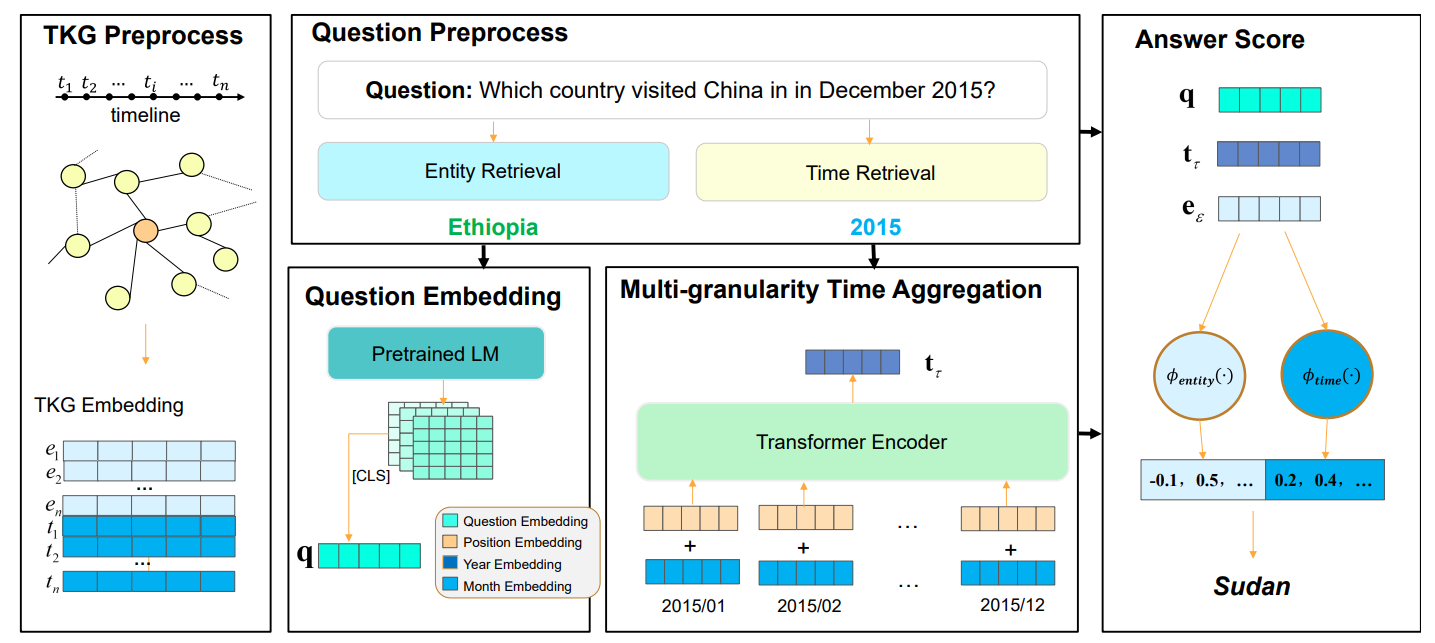
MultiTQ dataset can be found in ./data folder.
git clone https://github.com/czy1999/MultiTQ.git cd ./MultiTQ/data unzip Dataset.zip cd ../MultiQA/models unzip Models.zipMultiQA, a strong baseline to handle multi-granularity TKGQA
cd MultiQA python ner_task.py python ./train_qa_model.py --model multiqaPlease explore more argument options in train_qa_model.py.
The implementation is based on TempoQR in TempoQR: Temporal Question Reasoning over Knowledge Graphs and their code from https://github.com/cmavro/TempoQR. You can find more installation details there. We use TComplEx KG Embeddings as implemented in https://github.com/facebookresearch/tkbc.
If you find our method, code, or experimental setups useful, please cite our paper:
@inproceedings{chen-etal-2023-multi, title = "Multi-granularity Temporal Question Answering over Knowledge Graphs", author = "Chen, Ziyang and Liao, Jinzhi and Zhao, Xiang", booktitle = "Proceedings of the 61st Annual Meeting of the Association for Computational Linguistics (Volume 1: Long Papers)", month = jul, year = "2023", address = "Toronto, Canada", publisher = "Association for Computational Linguistics", url = "https://aclanthology.org/2023.acl-long.637", pages = "11378--11392", }