
Enzyme is a plugin that performs automatic differentiation (AD) of statically analyzable LLVM.
Enzyme can be used by calling __enzyme_autodiff on a function to be differentiated as shown below. Running the Enzyme transformation pass then replaces the call to __enzyme_autodiff with the gradient of its first argument.
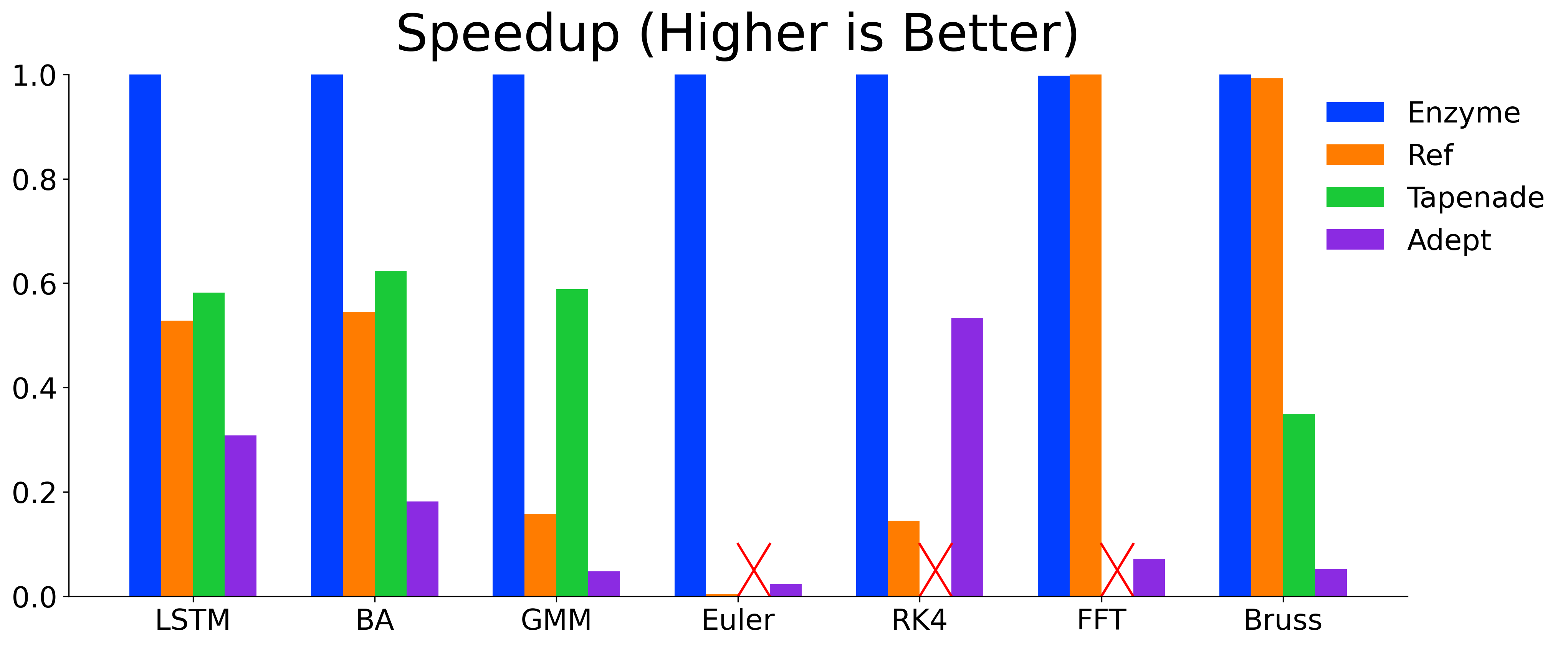
double foo(double); double grad_foo(double x) { return __enzyme_autodiff(foo, x); }Enzyme is highly-efficient and its ability to perform AD on optimized code allows Enzyme to meet or exceed the performance of state-of-the-art AD tools.
Detailed information on installing and using Enzyme can be found on our website: https://enzyme.mit.edu.
A short example of how to install Enzyme is below:
cd /path/to/Enzyme/enzyme mkdir build && cd build cmake -G Ninja .. -DLLVM_DIR=/path/to/llvm/lib/cmake/llvm -DLLVM_EXTERNAL_LIT=/path/to/lit/lit.py ninja Or, install Enzyme using Homebrew:
brew install enzyme To get involved or if you have questions, please join our mailing list.
If using this code in an academic setting, please cite the following:
@inproceedings{NEURIPS2020_9332c513, author = {Moses, William and Churavy, Valentin}, booktitle = {Advances in Neural Information Processing Systems}, editor = {H. Larochelle and M. Ranzato and R. Hadsell and M. F. Balcan and H. Lin}, pages = {12472--12485}, publisher = {Curran Associates, Inc.}, title = {Instead of Rewriting Foreign Code for Machine Learning, Automatically Synthesize Fast Gradients}, url = {https://proceedings.neurips.cc/paper/2020/file/9332c513ef44b682e9347822c2e457ac-Paper.pdf}, volume = {33}, year = {2020} } Julia bindings for Enzyme are available here