



A React component that displays console logs from the current page, an iframe or transported across a server.
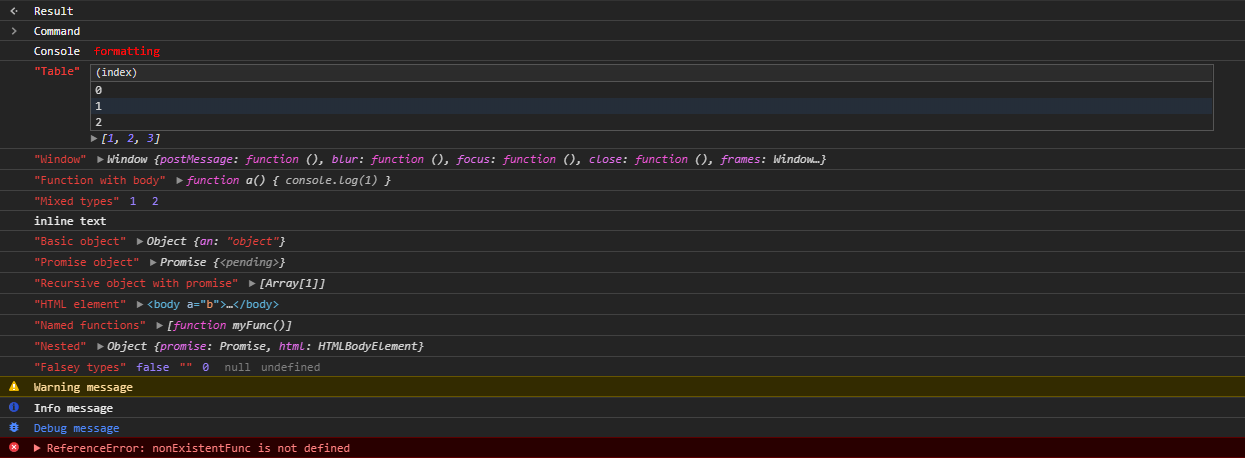
https://github.com/liriliri/chii supports the embedding the entire Chrome devtools.
https://github.com/tachibana-shin/vue-console-feed is a fork for Vue.JS
- Console formatting - style and give your logs color, and makes links clickable
- DOM nodes - easily inspect & expand HTML elements, with syntax highlighting
console.table- view your logs in a table format- Other console methods:
console.time- view the time in milliseconds it takes to complete eventsconsole.assert- assert that a statement is truthyconsole.count- count how many times something occurs
- Inbuilt JSON serialization - Objects, Functions & DOM elements can be encoded / decoded to and from JSON
yarn add console-feed # or npm install console-feedimport React from 'react' import { Hook, Console, Decode } from 'console-feed' class App extends React.Component { state = { logs: [], } componentDidMount() { Hook(window.console, (log) => { this.setState(({ logs }) => ({ logs: [...logs, Decode(log)] })) }) console.log(`Hello world!`) } render() { return ( <div style={{ backgroundColor: '#242424' }}> <Console logs={this.state.logs} variant="dark" /> </div> ) } }OR with hooks:
import React, { useState, useEffect } from 'react' import { Console, Hook, Unhook } from 'console-feed' const LogsContainer = () => { const [logs, setLogs] = useState([]) // run once! useEffect(() => { const hookedConsole = Hook( window.console, (log) => setLogs((currLogs) => [...currLogs, log]), false ) return () => Unhook(hookedConsole) }, []) return <Console logs={logs} variant="dark" /> } export { LogsContainer }An array consisting of Log objects. Required
Filter the logs, only displaying messages of certain methods.
Sets the font color for the component. Default - light
Defines the custom styles to use on the component - see Styles.d.ts
A string value to filter logs
If you want to use a custom log filter function, you can provide your own implementation
Each log has a method assigned to it. The method is used to determine the style of the message and for the filter prop.
type Methods = | 'log' | 'debug' | 'info' | 'warn' | 'error' | 'table' | 'clear' | 'time' | 'timeEnd' | 'count' | 'assert'A log object consists of the following:
type Logs = Log[] interface Log { // The log method method: Methods // The arguments passed to console API data: any[] }By default when you use the Hook() API, logs are serialized so that they will safely work with JSON.stringify. In order to restore a log back to format compatible with the <Console /> component, you need to call the Decode() method.
If the Hook function and the <Console /> component are on the same origin, you can disable serialization to increase performance.
Hook( window.console, (log) => { this.setState(({ logs }) => ({ logs: [...logs, log] })) }, false )You can limit the number of keys/elements included when serializing objects/arrays.
Hook( window.console, (log) => { this.setState(({ logs }) => ({ logs: [...logs, log] })) }, true, 100 // limit to 100 keys/elements )To run console-feed locally, simply run:
yarn yarn start yarn test:watchHead over to http://localhost:3000 in your browser, and you'll see the demo page come up. After you make changes you'll need to reload, but the jest tests will automatically restart.