


Apéry's numbers are defined by
 |  | 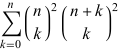 | (1) |
 |  | ![sum_(k=0)^(n)([(n+k)!]^2)/((k!)^4[(n-k)!]^2)](https://mathworld.wolfram.com/images/equations/AperyNumber/Inline6.svg) | (2) |
 |  |  | (3) |
where  is a binomial coefficient. The first few for
  , 1, 2, ... are 1, 5, 73, 1445, 33001, 819005, ... (OEIS A005259).
The first few prime Apéry numbers are 5, 73, 12073365010564729, 10258527782126040976126514552283001, ... (OEIS A092826), which have indices  , 2, 12, 24, ... (OEIS A092825).
The  case of Schmidt's problem expresses these numbers in the form
 | (4) |
(Strehl 1993, 1994; Koepf 1998, p. 55).
They are also given by the recurrence equation
 | (5) |
with  and
and  (Beukers 1987).
There is also an associated set of numbers
 |  | 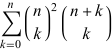 | (6) |
 |  |  | (7) |
(Beukers 1987), where  is a generalized hypergeometric function. The values for
  , 1, ... are 1, 3, 19, 147, 1251, 11253, 104959, ... (OEIS A005258). The first few prime
  -numbers are 5, 73, 12073365010564729, 10258527782126040976126514552283001, ... (OEIS A092827), which have indices
  , 2, 6, 8, ... (OEIS A092828), with no others for
  (Weisstein, Mar. 8, 2004).
The  numbers are also given by the recurrence equation
 | (8) |
with  and
and  .
.
Both  and
and  arose in Apéry's irrationality proof of
  and
and  (van der Poorten 1979, Beukers 1987). They satisfy some surprising congruence properties,
 | (9) |
 | (10) |
for  a prime
  and
and  (Beukers 1985, 1987), as well as
 | (11) |
(Stienstra and Beukers 1985, Beukers 1987). Defining  from the generating function
 |  | 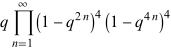 | (12) |
 |  |  | (13) |
where  is a q-Pochhammer symbol, gives
  of 1,
of 1,  ,
,  , 24,
, 24,  ,
,  , ... (OEIS A030211; Koike 1984) for
  , 3, 5, ..., and
 | (14) |
for  an odd prime (Beukers 1987). Furthermore, for
  an odd prime and
  ,
,
 | (15) |
(Beukers 1987).
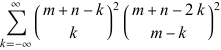
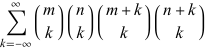
The Apéry numbers are given by the diagonal elements  in the identity
 |  | 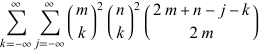 | (16) |
 |  |  | (17) |
 |  |  | (18) |
(Koepf 1998, p. 119).

 et
et  ." Astérisque 61, 11-13, 1979.Apéry, R. "Interpolation de fractions continues et irrationalité de certaines constantes." Mathématiques, Ministère universités (France), Comité travaux historiques et scientifiques. Bull. Section Sciences 3, 243-246, 1981.Beukers, F. "Some Congruences for the Apéry Numbers." J. Number Th. 21, 141-155, 1985.Beukers, F. "Another Congruence for the Apéry Numbers." J. Number Th. 25, 201-210, 1987.Chowla, S.; Cowles, J.; and Cowles, M. "Congruence Properties of Apéry Numbers." J. Number Th. 12, 188-190, 1980.Gessel, I. "Some Congruences for the Apéry Numbers." J. Number Th. 14, 362-368, 1982.Koepf, W. "Hypergeometric Identities." Ch. 2 in
  Surfaces." Math. Ann. 271, 269-304, 1985.Strehl, V. "Binomial Sums and Identities." Maple Technical Newsletter 10, 37-49, 1993.Strehl, V. "Binomial Identities--Combinatorial and Algorithmic Aspects." Discrete Math. 136, 309-346, 1994.van der Poorten, A. "A Proof that Euler Missed... Apéry's Proof of the Irrationality of
  ." Math. Intel. 1, 196-203, 1979.