


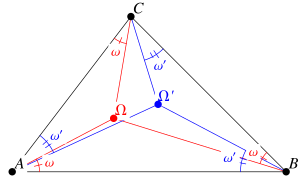
Define the first Brocard point as the interior point  of a triangle for which the angles
  ,
,  , and
, and  are equal to an angle
  . Similarly, define the second Brocard point as the interior point
  for which the angles
  ,
,  , and
, and  are equal to an angle
  . Then
  , and this angle is called the Brocard angle.
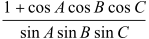
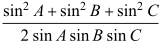
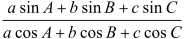
The Brocard angle  of a triangle
  is given by the formulas
 |  |  | (1) |
 |  |  | (2) |
 |  |  | (3) |
 |  |  | (4) |
 |  |  | (5) |
 |  |  | (6) |
 |  | 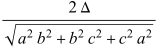 | (7) |
 |  |  | (8) |
 |  |  | (9) |
 |  | 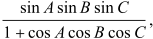 | (10) |
where  is the triangle area,
  ,
,  , and
, and  are angles, and
  ,
,  , and
, and  are the side lengths (Johnson 1929). Equation (8) is due to Neuberg (Tucker 1883).
Gallatly (1913, p. 96) defines the quantity  as
as
 | (11) |
If an angle  of a triangle is given, the maximum possible Brocard angle (and therefore minimum possible value of
  ) is given by
 | (12) |
(Johnson 1929, p. 289). If  is specified, then the largest possible value
  and minimum possible value
  of any possible triangle having Brocard angle
  are given by
 |  |  | (13) |
 |  |  | (14) |
where the square rooted quantity is the radius of the corresponding Neuberg circle (Johnson 1929, p. 288). The maximum possible Brocard angle (and therefore minimum possible value of  ) for any triangle is
  (Honsberger 1995, pp. 102-103), so
 | (15) |
The Abi-Khuzam inequality states that
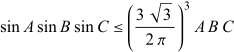 | (16) |
(Abi-Khuzam 1974, Le Lionnais 1983), which can be used to prove the Yff conjecture that
 | (17) |
(Abi-Khuzam 1974). Abi-Khuzam also proved that
 | (18) |
Interestingly, (◇) is equivalent to
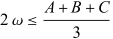 | (19) |
and (◇) is equivalent to
![2omega<=RadicalBox[{A, B, C}, 3],](https://mathworld.wolfram.com/images/equations/BrocardAngle/NumberedEquation8.svg) | (20) |
which are inequalities about the arithmetic and geometric mean, respectively.
